TABLE OF CONTENTS
| | | | | |
| 2026 Annual Information Form | ALAMOS GOLD INC |
| | | | | |
| 2026 Annual Information Form | ALAMOS GOLD INC |
ANNUAL INFORMATION FORM
(“AIF”)
ALAMOS GOLD INC.
(“Alamos” or the “Company”)
PRELIMINARY NOTES
Effective Date of Information
The information in this AIF is current as of March 24, 2026, unless otherwise stated herein.
Currency and Exchange Rates
All dollar amounts in this AIF are expressed in United States dollars unless otherwise indicated (“CAD” denotes Canadian dollars). The following table sets forth the value of the Canadian dollar expressed in United States dollars on December 31 of each year and the average, high, and low exchange rates during the year indicated based on the daily exchange rate as reported by the Bank of Canada.
| | | | | | | | | | | |
| Canadian Dollars into United States Dollars | 2025 | | 2024 | | 2023 | |
| Closing | $0.7296 | $0.6950 | $0.7561 |
| Average | $0.7157 | $0.7302 | $0.7410 |
| High | $0.7376 | $0.7510 | $0.7619 |
| Low | $0.6848 | $0.6937 | $0.7207 |
The exchange rate on March 24, 2026, as reported by the Bank of Canada for the conversion of United States dollars into Canadian dollars, was USD$0.7267 equals CAD$1.00.
Imperial Equivalents
For ease of reference, the following factors for converting metric measurements to imperial equivalents are provided:
| | | | | | | | |
| To Convert from Metric | To Imperial | Multiply by |
| Hectares | Acres | 2.471 |
| Metres (m) | Feet (ft.) | 3.281 |
| Kilometres (km) | Miles | 0.621 |
| Tonnes | Tons (2000 pounds) | 1.102 |
| Grams/tonne | Ounces/ton (troy/ton) | 0.029 |
Cautionary Note Regarding Forward-Looking Statements
This AIF contains or incorporates by reference “forward-looking statements” and “forward-looking information” as defined under applicable Canadian and U.S. securities legislation. All statements, other than statements of historical fact, which address events, results, outcomes or developments that the Company expects to occur are, or may be deemed, to be, forward-looking statements. Forward-looking statements are generally, but not always, identified by the use of forward-looking terminology such as “expect”, “assume”, “believe”, “anticipate”, “likely”, “intend”, “objective”, “estimate”, “budget”, “potential”, “prospective”, “opportunity”, “forecast”, “target”, “goal”, “aim”, “on track”, “on pace”, “on schedule”, “outlook”, “continue”, “ongoing”, “onwards”, “plan”, “scheduled”, or variations of such words and phrases and similar expressions or statements that certain actions, events or results “may”, “could”, “would”, “might” or “will” be taken, occur or be achieved or the negative connotation of such terms. Forward-looking statements in this AIF are based on expectations, estimates and projections as at the date of this AIF.
Forward-looking statements in this AIF may include (without limitation) information, assumptions, expectations and guidance as to strategy, plans, and future financial and operating performance, such as those regarding: free cash flow; mine-
| | | | | |
| 2026 Annual Information Form | 4 | Alamos Gold Inc.
|
site free cash flow; costs (including total cash costs, AISC, mine-site AISC, capital expenditures, growth and sustaining capital, capitalized exploration, exploration spending); budgets; IRR; NPV; returns to stakeholders; impacts of inflation; mine plans; mine life; Mineral Reserve life; Mineral Reserves and Resources; gold and other metal price assumptions; foreign exchange rates; size, value and profitability of operations; project economics; project risks; sufficiency for planned mining operations of surface rights, power sources, water, mining personnel, tailings storage areas and waste disposal; mining methodologies; underground development rates; mining, milling and processing rates; total mill feed and throughput rates; recovery rates; anticipated gold production, production rates, timing of production, further production potential and growth; gold grades; exploration potential, budgets, focuses, programs, targets, and projected results; investment in and funding of growth initiatives and projects; the Company's approach to reduction of its environmental footprint, greenhouse gas emissions, and related investments in new initiatives; the Company's climate change strategy and goals; community relations, engagement activities, and initiatives; corporate governance; plans with respect to health and safety; outlooks for each of the Island Gold District (IGD), Young-Davidson mine (YD), Mulatos District, the Lynn Lake project (LLP) and the Qiqavik Gold project, including (without limitation and in addition to the above): (i) at IGD, the Expansion Study, effects of completion of the IGD Expansion and the Phase 3+ Expansion Project, Magino mill expansion, (ii) at YD, completion of a fourth ore pass, opportunity for mill expansion and sources of supplemental feed; (iii) at the Mulatos District, construction of, the development and mine plan for, and expected results from the Puerto Del Aire (PDA) project, ore from Cerro Pelon, and the Halcon target; (iv) at LLP, construction activities, including timing of completion of construction of a permanent camp; and (v) at the Qiqavik Gold project, exploration potential; the quantum of consideration payable to the Company for the sale of Quartz Mountain to Q-Gold, including future guaranteed and milestone payments; the expected timing of remaining payments with respect to the sale of the Company's Turkish development projects and the status of arbitration brought by the Company's Netherlands subsidiaries against the Republic of Türkiye; and any other statements that express management's expectations or estimates of future performance, operational, geological or financial results.
A Mineral Resource that is classified as “Inferred” or “Indicated” has a great amount of uncertainty as to its existence and economic and legal feasibility. It cannot be assumed that any or part of an “Indicated Mineral Resource” or “Inferred Mineral Resource” will ever be upgraded to a higher category of Mineral Resource. Investors are cautioned not to assume that all or any part of mineral deposits in these categories will ever be converted into Proven and Probable Mineral Reserves.
The Company cautions that forward-looking statements are necessarily based upon a number of factors and assumptions that, while considered reasonable by the Company at the time of making such statements, are inherently subject to significant business, economic, technical, legal, political and competitive uncertainties and contingencies. Known and unknown factors could cause actual results to differ materially from those projected in the forward-looking statements, and undue reliance should not be placed on such statements and information.
Risk factors that may affect Alamos’ ability to achieve the expectations set forth in the forward-looking statements in this document include, but are not limited to: the actual results of current exploration activities; changes to current estimates of Mineral Reserves and Resources; changes to production estimates (which assume accuracy of projected ore grade, mining rates, recovery timing and recovery rate estimates, which may be impacted by unscheduled maintenance, weather issues, labour and contractor availability and other operating or technical difficulties in connection with mining or development activities, including geotechnical challenges); conclusions of economic and geological evaluations; the costs and timing of exploration, construction and development of new deposits; changes in project parameters as plans continue to be refined; operations may be exposed to illnesses, diseases, epidemics and pandemics, which may impact, among other things, the broader market and the trading price of the Company's shares; the duration of any regulatory responses to any illness, disease, epidemic or pandemic; government and the Company’s attempts to reduce the spread of any illness, disease, epidemic or pandemic, which may affect many aspects of the Company's operations including the ability to transport personnel to and from site, contractor and supply availability and the ability to sell or deliver gold doré bars; provincial, state and federal orders or mandates (including with respect to mining operations generally or auxiliary businesses or services required for the Company’s operations) in Canada, Mexico and other jurisdictions in which the Company does or may conduct business; political and economic conditions and developments in the jurisdictions in which the Company operates and in the world generally; fluctuations in the price of gold or certain other commodities such as, diesel fuel, natural gas, and electricity; changes in foreign exchange rates (particularly CAD, MXN and USD); the impact of inflation and any tariffs, trade barriers and/or regulatory costs; changes in the Company's credit rating; any decision to declare a quarterly dividend; employee and community relations; litigation, administrative or regulatory proceedings and any resulting court, administrative, regulatory or arbitral decision(s) or order(s); disruptions affecting operations; availability of and increased costs associated with mining inputs and labour; delays in implementing growth and improvement initiatives; delays with the Phase 3+ Shaft Expansion, the IGD Expansion, construction of the 115kV powerline (including the risk that an expropriation order is not granted by the OEB and the Alamos/BFN partnership cannot otherwise come to an agreement with the Corridor Landowner), expansion of
| | | | | |
| 2026 Annual Information Form | 5 | ALAMOS GOLD INC |
the Magino mill, paste plant construction project, construction of the Lynn Lake Project, construction of the PDA project, and/or the development or updating of mine plans; changes with respect to the intended method of accessing, mining the deposit, and processing any ore at PDA; risks associated with the start-up of new mines; the risk that the Company’s mines may not perform as planned; with respect to the sale of Quartz Mountain, the failure by Q-Gold to make the requisite future payments and actions required to trigger milestone payments not being implemented or coming to fruition; with respect to the sale of the Company's Turkish development projects, default on either or both of the anniversary payments as well as the potential that the arbitration commenced by the Company's Netherlands subsidiaries is resumed; uncertainty with the Company’s ability to secure additional capital to execute its business plans; the speculative nature of mineral exploration and development, including the risks of obtaining and maintaining necessary licenses and permits, including the necessary licenses, permits, authorizations and/or approvals from the appropriate regulatory authorities for the Company’s development stage and operating assets; labour and contractor availability (and being able to secure the same on favourable terms); contests over title to properties; expropriation or nationalization of property; inherent risks and hazards associated with mining and mineral processing including industrial hazards, industrial accidents, and environmental hazards including, without limitation, fires, floods, seismic activity and unusual or unexpected formations, pressures and cave-ins; changes in national and local government legislation, controls or regulations in Canada, Mexico, the United States and other jurisdictions in which the Company does or may carry on business in the future; increased costs and risks related to the potential impact of climate change; failure to comply with environmental and health and safety laws and regulations; disruptions in the maintenance or provision of required infrastructure and information technology systems; risk of loss due to sabotage, protests and other civil disturbances; the impact of global liquidity and credit availability and the values of assets and liabilities based on projected future cash flows; risks arising from holding derivative instruments; and business opportunities that may be pursued by the Company.
Additional risk factors and details with respect to such risk factors are described in the section entitled “Risk Factors” in this AIF. In addition, important factors and assumptions underlying the Company’s three-year production and operating guidance may be found in the Company’s February 4, 2026, news release (available on SEDAR+ at www.sedarplus.ca) titled “Alamos Gold Provides Three-Year Operating Guidance Outlining 46% Production Growth by 2028 at Significantly Lower Costs”. Although the Company has attempted to identify important factors and risks that could cause actual results to differ materially, there may be other factors that cause results not to be as anticipated, estimated, or intended. There can be no assurance that such statements will prove to be accurate as actual results and future events could differ materially from those anticipated in such statements.
The Company disclaims any intention or obligation to update or revise any forward-looking statements, whether written or oral, or whether as a result of new information, future events or otherwise, except as required by applicable law.
Cautionary Note to United States Investors
Measured, Indicated and Inferred Resources: Unless otherwise indicated, all Mineral Resource and Mineral Reserve estimates included in this AIF have been prepared in accordance with National Instrument 43-101 - Standards of Disclosure for Mineral Projects (“NI 43-101”) and the Canadian Institute of Mining, Metallurgy and Petroleum (the “CIM”) - CIM Definition Standards on Mineral Resources and Mineral Reserves, adopted by the CIM Council, as amended (the “CIM Standards”). NI 43-101 is a rule developed by the Canadian Securities Administrators, which established standards for all public disclosure an issuer makes of scientific and technical information concerning mineral projects. Mining disclosure in the United States was previously required to comply with SEC Industry Guide 7 (“SEC Industry Guide 7”) under the United States Securities Exchange Act of 1934, as amended. The U.S. Securities and Exchange Commission (the “SEC”) has adopted final rules to replace SEC Industry Guide 7 with new mining disclosure rules under sub-part 1300 of Regulation S-K of the U.S. Securities Act (“Regulation S-K 1300”), which became mandatory for U.S. reporting companies beginning with the first fiscal year commencing on or after January 1, 2021. Under Regulation S-K 1300, the SEC now recognizes estimates of “Measured Mineral Resources”, “Indicated Mineral Resources” and “Inferred Mineral Resources”. In addition, the SEC has amended its definitions of “Proven Mineral Reserves” and “Probable Mineral Reserves” to be substantially similar to international standards.
Investors are cautioned that while the above terms are “substantially similar” to CIM Definitions, there are differences in the definitions under Regulation S-K 1300 and the CIM Standards. Accordingly, there is no assurance any mineral reserves or mineral resources that the Company may report as “proven mineral reserves”, “probable mineral reserves”, “measured mineral resources”, “indicated mineral resources” and “inferred mineral resources” under NI 43-101 would be the same had the Company prepared the mineral reserve or mineral resource estimates under the standards adopted under Regulation S-K 1300. U.S. investors are also cautioned that while the SEC recognizes “measured mineral resources”, “indicated mineral
| | | | | |
| 2026 Annual Information Form | 6 | ALAMOS GOLD INC |
resources” and “inferred mineral resources” under Regulation S-K 1300, investors should not assume that any part or all of the mineralization in these categories will ever be converted into a higher category of mineral resources or into mineral reserves. Mineralization described using these terms has a greater degree of uncertainty as to its existence and feasibility than mineralization that has been characterized as reserves. Accordingly, investors are cautioned not to assume that any measured mineral resources, indicated mineral resources, or inferred mineral resources that the Company reports are or will be economically or legally mineable.
Normal Course Issuer Bid (“NCIB”)
On December 19, 2024, the Company announced that it filed with and received acceptance from the Toronto Stock Exchange (“TSX”) for renewal of its NCIB, permitting it to purchase for cancellation up to 18,605,661 Common Shares, representing five percent (5%) of the Company's public float as of December 13, 2024. The NCIB provided that the Company may purchase Common Shares over a twelve-month period beginning December 24, 2024 and ending December 23, 2025. The Company purchased 1,326,929 shares under the NCIB.
On December 22, 2025, the Company announced a further renewal of its NCIB, permitting it to purchase for cancellation up to 18,580,120 Common Shares, representing five percent (5%) of the Company's public float as of December 10, 2025. The NCIB provides that the Company may purchase Common Shares over a twelve-month period beginning December 24, 2025 and ending December 23, 2026. Any purchases made by the Company will be effected through the facilities of the TSX, alternative Canadian trading systems, and/or the NYSE. Between December 24, 2025, and March 24, 2026, the Company did not purchase shares under the NCIB.
Non-GAAP Measures and Additional GAAP Measures
The Company has included certain non-GAAP financial measures to supplement its Consolidated Financial Statements, which are presented in accordance with IFRS, including the following contained herein:
•total cash cost per ounce of gold sold;
•mine-site all-in sustaining cost per ounce of gold sold;
•all-in sustaining cost (“AISC”) per ounce of gold sold;
•sustaining and non-sustaining capital expenditures;
•growth capital; and
•mine-site free cash flow.
The Company believes that these measures, together with measures determined in accordance with IFRS, provide investors with an improved ability to evaluate the underlying performance of the Company. Non-GAAP financial measures do not have any standardized meaning prescribed under IFRS, and therefore, they may not be comparable to similar measures employed by other companies. The data is intended to provide additional information and should not be considered in isolation or as a substitute for measures of performance prepared in accordance with IFRS. Management’s determination of the components of non-GAAP and additional measures are evaluated on a periodic basis influenced by new items and transactions, a review of investor uses, and new regulations as applicable. Any changes in the measures are duly noted and retrospectively applied as applicable.
Total Cash Costs per ounce
Total cash costs per ounce is a non-GAAP term typically used by gold mining companies to assess the level of gross margin available to the Company by subtracting these costs from the unit price realized during the period. This non-GAAP term is also used to assess the ability of a mining company to generate cash flow from operations. Total cash costs per ounce includes mining and processing costs plus applicable royalties, net of by-product revenue, and net realizable value adjustments. Total cash costs per ounce is exclusive of exploration costs.
Total cash costs per ounce is intended to provide additional information only and, does not have any standardized meaning under IFRS, and may not be comparable to similar measures presented by other mining companies. It should not be considered in isolation or as a substitute for measures of performance prepared in accordance with IFRS. The measure is not necessarily indicative of cash flow from operations under IFRS or operating costs presented under IFRS.
| | | | | |
| 2026 Annual Information Form | 7 | ALAMOS GOLD INC |
All-in Sustaining Cost per ounce and Mine-site All-in Sustaining Cost
The Company adopted an “all-in sustaining costs per ounce” non-GAAP performance measure in accordance with the World Gold Council published in June 2013. The Company believes the measure more fully defines the total costs associated with producing gold; however, this performance measure has no standardized meaning. Accordingly, there may be some variation in the method of computation of “all-in sustaining costs per ounce” as determined by the Company compared with other mining companies. In this context, “all-in sustaining costs per ounce” for the consolidated Company reflects total mining and processing costs, corporate and administrative costs, share-based compensation, exploration costs, sustaining capital, sustaining finance leases, and accretion of decommissioning liabilities. The Company excludes mark-to-market adjustments for the revaluation of previously issued share-based compensation, therefore all-in sustaining costs incorporate the cost of long term incentives associated with the grant date fair value for instruments issued.
For the purposes of calculating “mine-site all-in sustaining costs” at the individual mine-sites, the Company does not include an allocation of corporate and administrative costs and share-based compensation.
Sustaining capital expenditures are expenditures that do not increase annual gold ounce production at a mine site and exclude all expenditures at the Company’s development projects as well as certain expenditures at the Company’s operating sites that are deemed expansionary in nature (“growth capital”). For each mine-site reconciliation, corporate and administrative costs, and non-site-specific costs are excluded in the calculation of mine-site all-in sustaining cost per ounce.
All-in-sustaining costs per gold ounce is intended to provide additional information only and does not have any standardized meaning under IFRS, and may not be comparable to similar measures presented by other mining companies. It should not be considered in isolation or as a substitute for measures of performance prepared in accordance with IFRS.
The measure is not necessarily indicative of cash flow from operations under IFRS or operating costs presented under IFRS.
Mine-site Free Cash Flow
“Mine-site free cash flow” is a non-GAAP financial performance measure calculated as cash flow from mine-site operating activities, less mineral property, plant, and equipment expenditures and sustaining finance leases. The Company believes this to be a useful indicator of our ability to operate without reliance on additional borrowing or usage of existing cash. Mine-site free cash flow is intended to provide additional information only and, does not have any standardized meaning under IFRS, and may not be comparable to similar measures of performance presented by other mining companies. Mine-site free cash flow should not be considered in isolation or as a substitute for measures of performance prepared in accordance with IFRS.
Detailed reconciliations of the non-GAAP measures to IFRS measures for the years ended December 31, 2025, and December 31, 2024, can be found in the Company’s MD&A for the year ended December 31, 2025, as available on the Alamos website at www.alamosgold.com and on the System for Electronic Document Analysis and Retrieval+ (SEDAR+) at www.sedarplus.ca.
| | | | | |
| 2026 Annual Information Form | 8 | ALAMOS GOLD INC |
GLOSSARY OF TERMS
In this AIF, unless otherwise defined or unless there is something in the subject matter or context inconsistent therewith, the following terms have the meanings set forth herein or therein:
| | | | | |
“Ag” | Silver. |
“AIF” | Annual Information Form. |
“AISC” | All-in sustaining cost. |
“Alamos” | Alamos Gold Inc., which is also referred to as the “Company”. |
“Argonaut” | Argonaut Gold Inc. |
“ASL” | Analytical Solutions Ltd. |
“Au” | Gold. |
“Au Rico” | AuRico Gold Inc. with which “Former Alamos” amalgamated under section 182 of the OBCA pursuant to Articles of Arrangement dated July 2, 2015. |
“BWI” | Bond Ball Work Index. |
“CAD” | Canadian dollars. |
“Canamax” | Canamax Resources Inc. |
| “Capitalized Exploration” | Expenditures that meet the IFRS definition for capitalization and are incurred to further expand the known Mineral Reserve and Resource at existing operations or development projects. |
“CIL” | Carbon-in-leach. |
“CIM” | Canadian Institute of Mining, Metallurgy and Petroleum. |
“CIM Standards” | Mineral Resources and Mineral Reserves prepared by the CIM Standing Committee on Reserve Definitions adopted by CIM Council on May 10, 2014. |
“CIP” | Carbon-in-pulp. |
“CO2e” | Carbon dioxide equivalent. |
“Company” | Alamos Gold Inc. |
“Construplan” | Grupo Construcciones Planificadas, S.A. de C.V. |
“CRM” | Certified reference material. |
“doré” | Unrefined gold and silver bullion bars, which will be further refined to almost pure metal. |
“EPS” | The Ontario Emissions Performance Standard under which Young-Davidson and Island Gold began reporting emissions effective January 1, 2022. |
“ETS” | Emissions Trading System. |
“Former Alamos” | Alamos Gold Inc. as it existed prior to its amalgamation with AuRico. |
“grade” | Term used to indicate the concentration of an economically desirable mineral or element in its host rock as a function of its relative mass. With gold, this term may be expressed as grams per tonne (“g/t”) or ounces per tonne (“opt”). |
“g/t Au” | Grams per tonne of gold. |
“GDI” | Grupo Desarrollo Infraestructura, S.A. de C.V. |
“GHG” | Greenhouse gas. |
“GLDZ” | Goudreau Lake Deformation Zone. |
“ICP” | Inductively Coupled Plasma. |
“IFRS” | International Financial Reporting Standards as issued by the International Accounting Standards Board; the accounting principles used by the Company. |
| | | | | |
| 2026 Annual Information Form | 9 | ALAMOS GOLD INC |
| | | | | |
“Indicated Resource” or “Indicated Mineral Resource” | That part of a Mineral Resource for which quantity, grade or quality, densities, shape, and physical characteristics can be estimated with a level of confidence sufficient to allow the appropriate application of technical and economic parameters, to support mine planning and evaluation of the economic viability of the deposit. The estimate is based on detailed and reliable exploration and testing information gathered through appropriate techniques from locations such as outcrops, trenches, pits, workings, and drill holes that are spaced closely enough for geological and grade continuity to be reasonably assumed. |
“Inferred Resource” or “Inferred Mineral Resource” | That part of a Mineral Resource for which quantity and grade or quality can be estimated on the basis of geological evidence and limited sampling and reasonably assumed, but not verified, geological and grade continuity. The estimate is based on limited information and sampling gathered through appropriate techniques from locations such as outcrops, trenches, pits, workings, and drill holes. |
“Island Gold Mine” | Acquired by Alamos through its 2017 acquisition of Richmont Mines Ltd. (“Richmont”) located east of the town of Dubreuilville, 83 kilometres northeast of Wawa in Northern Ontario. The Island Gold Mine and Magino Mine are within 300 metres of each other. |
“Island Gold District” | The District, collectively comprised of the Island Gold Property and Magino Property. |
“Island Gold Property” | The Island Gold Mine and its surrounding project lands. |
“km” | Kilometres. |
“kWh/t” | Kilowatt hours per tonne. |
“leaching” | The separation, selective removal, or dissolving-out of soluble constituents from a rock or ore body by the natural actions of percolating solutions. |
“LLCFZ” | The regional Larder Lake-Cadillac Fault Zone which cuts across the Young-Davidson project area. |
“Lynn Lake Gold Project” or Lynn Lake” | The Company’s development project in Lynn Lake, Manitoba, which is located in northern Manitoba and consists of two primary sites, MacLellan and Gordon, which are just east of the Town of Lynn Lake. |
“m” | Metres. |
“Manitou” | Manitou Gold Inc. |
| “Magino Mine” | Acquired by Alamos through its 2024 acquisition of Argonaut Gold Inc. (“Argonaut”) and its wholly owned subsidiary, Prodigy Gold Inc. (“Prodigy”) located east of the town of Dubreuilville, 83 kilometres northeast of Wawa in Northern Ontario. The Island Gold Mine and Magino Mine are within 300 metres of each other. |
| “Magino Property” | The Magino Mine and its surrounding project lands. |
“MCM Mine” | Matachewan Consolidated Mines Limited Mine. |
“MD&A” | Management’s Discussion & Analysis of the Company for the year ended December 31, 2025. |
“Measured Resource” or “Measured Mineral Resource” | That part of a Mineral Resource for which quantity, grade or quality, densities, shape, physical characteristics are so well established that they can be estimated with confidence sufficient to allow the appropriate application of technical and economic parameters, to support production planning and evaluation of the economic viability of the deposit. The estimate is based on detailed and reliable exploration, sampling, and testing information gathered through appropriate techniques from locations such as outcrops, trenches, pits, workings, and drill holes that are spaced closely enough to confirm both geological and grade continuity. |
“MGB” | Michipicoten Greenstone Belt. |
“Mineral Reserve” | The economically mineable part of a Measured or Indicated Mineral Resource demonstrated by at least a preliminary feasibility study. The study must include adequate information on mining, processing, metallurgical, economics, and other relevant factors that demonstrate, at the time of reporting, that economic extraction can be justified. A Mineral Reserve includes diluting materials and allowances for losses that occur when the material is mined and processed. |
| | | | | |
| 2026 Annual Information Form | 10 | ALAMOS GOLD INC |
| | | | | |
“Mineral Resource” | A concentration or occurrence of natural, solid, inorganic, or fossilized organic material in or on the earth’s crust in such form and quantity and of such grade or quality that it has reasonable prospects for economic extraction. The location, quantity, grade, geological characteristics, and continuity of a Mineral Resource are known, estimated, or interpreted from specific geological evidence and knowledge. The term “Mineral Resource” covers mineralization and natural material of intrinsic economic interest which has been identified and estimated through exploration and sampling and within which Mineral Reserves may subsequently be defined by the consideration and application of technical, economic, legal, environmental, socio-economic, and governmental factors. The phrase “reasonable prospects for economic extraction” implies a judgment by the Qualified Person in respect of the technical and economic factors likely to influence the prospect of economic extraction. A Mineral Resource is an inventory of mineralization that under realistically assumed and justifiable technical and economic conditions might become economically extractable. The term “Mineral Resource” used in this AIF is a Canadian mining term as defined in accordance with NI 43-101 under the guidelines set out in the CIM Standards. |
“Modifying Factors” | Considerations used to convert Mineral Resources to Mineral Reserves. These include, but are not restricted to, mining, processing, metallurgical, infrastructure, economic, marketing, legal, environmental, social, and governmental factors. |
“MON” | Minas de Oro Nacional, S.A. de C.V., a wholly-owned Mexican subsidiary of Alamos. |
“Mt” | Million tonnes. |
“Mulatos Group of Concessions” | The Mulatos deposit and satellite gold systems known as Cerro Pelon, La Yaqui, El Carricito, El Halcon, Las Carboneras, El Jaspe, Puebla, Los Bajios, and La Dura. |
“Mulatos Mine” | The Mulatos mine in the state of Sonora, Mexico controlled by MON. |
“NCIB” | Normal Course Issuer Bid. |
“NI 43-101” | National Instrument 43-101 - Standards of Disclosure for Mineral Projects of the Canadian Securities Administrators. |
“Northgate” | Northgate Minerals Corporation. |
“NPI” | Net profit interest royalty. |
“NQ diameter” | 1.75-inch diameter drill hole. |
“NSR” | Net smelter return royalty, consisting of a payment made by a producer of metals based on the value of the gross metal production from the property, less deduction of certain limited costs including, but not necessarily limited to, smelting, refining, transportation, and insurance costs. |
“NYSE” | New York Stock Exchange. |
“OBCA” | Business Corporations Act (Ontario). |
“OBPS” | The Output-Based Pricing System under which Young-Davidson and Island Gold reported emissions prior to January 1, 2022. |
“ore” | A natural aggregate of one or more minerals which, at a specified time and place, may be mined and sold at a profit, or from which some part may be profitably separated. |
“OR Royalties” | OR Royalties Inc. (formerly, Osisko Gold Royalties Ltd.) |
“ounces” or “oz” | A measure of weight in gold and other precious metals, correctly troy ounces, which weigh 31.2 grams as distinct from an imperial ounce which weighs 28.4 grams. |
“P3+ Expansion Study” | The Phase 3+ Expansion Study on the Island Gold Mine, the results of which were reported on June 28, 2022. |
“Patricia” | Patricia Mining Corp. |
“PDA” | Puerto Del Aire – a mineralized zone forming part of the Mulatos deposit. |
“PEA” | Preliminary economic assessment. |
“ppm” | Parts per million. |
“ppb” | Parts per billion. |
| | | | | |
| 2026 Annual Information Form | 11 | ALAMOS GOLD INC |
| | | | | |
“Probable Mineral Reserve” | The economically mineable part of an Indicated Mineral Resource, and in some circumstances, a Measured Mineral Resource. The confidence in the Modifying Factors applying to a Probable Mineral Reserve is lower than that applying to a Proven Mineral Reserve. |
“Proven Mineral Reserve” | The economically mineable part of a Measured Mineral Resource. A Proven Mineral Reserve implies a high degree of confidence in the Modifying Factors. |
“QA/QC” | Quality assurance/quality control. |
“Qualified Person” | Has the meaning given to such term in NI 43-101. |
“Redpath” | Redpath Canada Inc. |
“Regulation S-K 1300” | The new rules adopted by the SEC under sub-part 1300 of Regulation S-K of the U.S. Securities Act with respect to mining disclosure in the United States to replace SEC Industry Guide 7 and which became mandatory for U.S. reporting companies beginning with the first fiscal year commencing on or after January 1, 2021. |
“Richmont” | Richmont Mines Inc. with which Alamos amalgamated under section 182 of the OBCA pursuant to Articles of Arrangement dated August 1, 2018. |
“Royal Oak” | Royal Oak Mines Inc. |
“RQD” | Rock quality designation. |
“Standard” | The Energy and Greenhouse Gas Management Standard which informs the Company’s actions to reduce emission intensity, energy-related costs and mitigate risks related to climate change, energy security, supply and cost. |
“SEC” | US Securities and Exchange Commission. |
“SEC Industry Guide 7” | SEC Industry Guide 7 under the United States Securities Exchange Act of 1934, as amended – the SEC Industry Guide with which mining disclosure in the United States was required to comply. SEC Industry Guide 7 was replaced by Regulation S-K 1300. |
“SEDAR+” | System for Electronic Document Analysis and Retrieval+ which can be found at www.sedarplus.ca. |
“SOX” | The Sarbanes-Oxley Act of 2002. |
“T&S Committee” | The Technical and Sustainability Committee of the Company’s Board of Directors. |
“tpd” | Tonnes per day. |
“Trillium” | Trillium Mining Corp., which was acquired by the Company in December, 2020. |
“TSX” | Toronto Stock Exchange. |
“µm” | Micrometer. |
“URSTM” | Unité de Recherche et de Service en Technologie Minérale, a research unit affiliated to the Université du Québec Abitibi-Témiscamingue. |
“US” | United States of America. |
“Wesdome” | The Wesdome Laboratory in Wawa, Ontario. |
“Young-Davidson” or the “Young-Davidson Mine” | The underground gold mine owned and operated by the Company located near the town of Matachewan, approximately 60 kilometres west of Kirkland Lake in Northern Ontario, within the Abitibi Greenstone Belt. |
| | | | | |
| 2026 Annual Information Form | 12 | ALAMOS GOLD INC |
CORPORATE STRUCTURE
Name and Incorporation
The name of the Company is Alamos Gold Inc. The Company’s principal place of business and registered office is Brookfield Place, 181 Bay Street, Suite 3910, Toronto, Ontario M5J 2T3.
AuRico Gold Inc. (“AuRico”) amalgamated with Alamos Gold Inc. (“Former Alamos”) under section 182 of the Business Corporations Act (Ontario) (“OBCA”) pursuant to Articles of Arrangement dated July 2, 2015, with the resulting amalgamated company continuing under the name Alamos Gold Inc. (“Alamos” or the “Company”). Alamos amalgamated with Richmont Mines Inc. (“Richmont”) under section 182 of the OBCA pursuant to the articles of amalgamation dated August 1, 2018, with the resulting amalgamated company continuing under the name Alamos Gold Inc. Alamos amalgamated with its wholly-owned subsidiaries Manitou Gold Inc., Trillium Mining Corp., Carlisle Goldfields Limited, Victoria Gold Mines (East Timmins) Limited and Orford Mining Corporation on September 30, 2024 with the resulting amalgamated company continuing under the name Alamos Gold Inc. Alamos amalgamated with its wholly-owned subsidiary Argonaut Gold Inc. on January 1, 2025, with the resulting amalgamated company continuing under the name Alamos Gold Inc.
Alamos is a public company listed on the TSX and the NYSE under the symbol “AGI” and has a quoted market value of approximately CAD$23.6 billion as of March 24, 2026.
Intercorporate Relationships
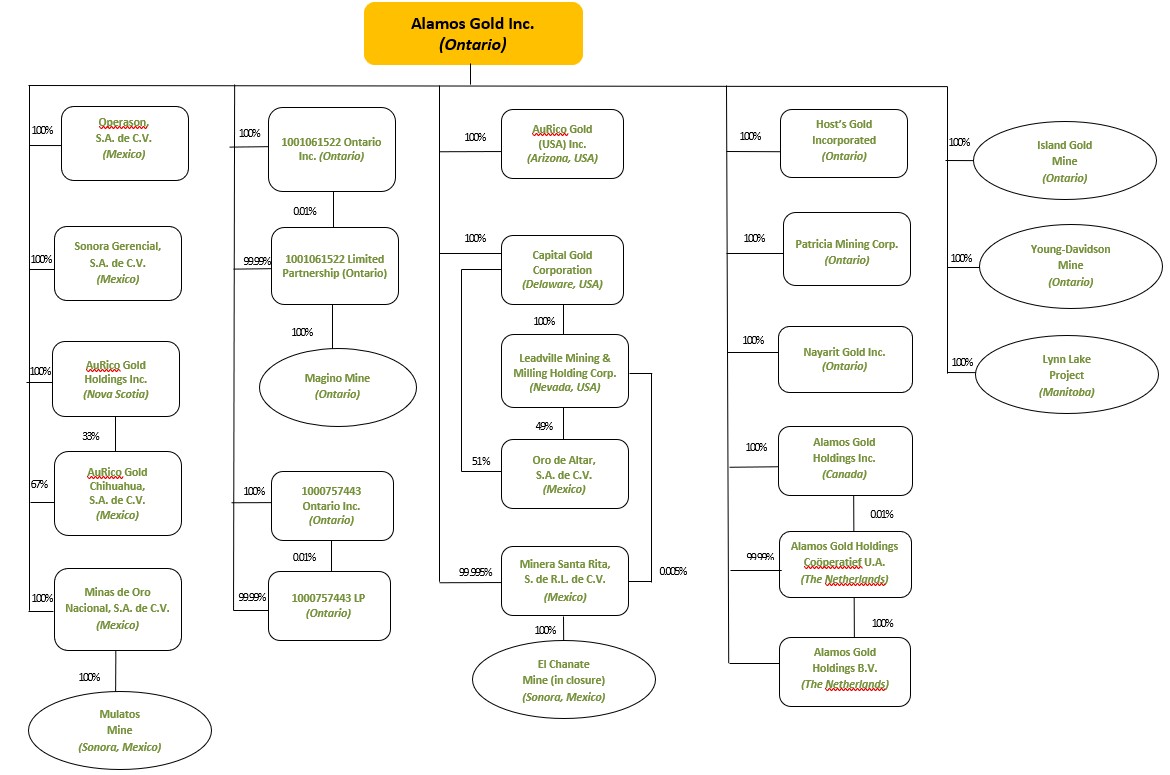
In this AIF, unless the context otherwise requires, the terms “we”, “us”, “our”, and similar terms, as well as references to “Alamos” or the “Company”, refer to Alamos Gold Inc. The following diagram sets forth the Company’s intercorporate relationships with its active subsidiaries, including the jurisdiction of incorporation or organization and the Company’s respective percentage ownership of each subsidiary as of March 24, 2026.
| | | | | |
| 2026 Annual Information Form | 13 | ALAMOS GOLD INC |
GENERAL DEVELOPMENT OF THE BUSINESS
Alamos is a mining company engaged in the mining and extraction of, and exploration for, precious metals, primarily gold. Alamos owns and operates the Island Gold District (comprised of the Island Gold mine (referred to herein as the “Island Gold Mine” or “Island Gold”) and Magino mine (referred to herein as the “Magino Mine or “Magino”), (together, referred to herein as the “Island Gold District”), the Young-Davidson mine (referred to herein as the “Young-Davidson Mine” or “Young-Davidson”), in Ontario, Canada, and the Mulatos District (includes the Mulatos and La Yaqui Grande mines), (referred herein as the “Mulatos District” or “Mulatos”) in the state of Sonora, Mexico. In 2025, the Island Gold District produced 250,400 ounces of gold, the Young-Davidson Mine produced 153,400 ounces of gold, and the Mulatos District produced 141,600 ounces of gold for total gold production in 2025 of 545,400 ounces. Alamos also owns the construction-stage Lynn Lake Gold Project in Lynn Lake, Manitoba (referred to herein as the “Lynn Lake Gold Project” or “Lynn Lake”), and the Qiqavik Gold Project (referred herein as the “Qiqavik Gold Project” or “Qiqavik”), in Nunavik, Quebec.
Three-Year History
ØOn February 21, 2023, the Company reported its updated Mineral Reserves and Resources as of December 31, 2022, including grades increasing by 3%, reflecting higher grade additions at Island Gold and Mulatos. Mineral Reserve additions more than replaced depletion at a rate of 133%.
ØOn February 28, 2023, the Company announced that it had entered into a definitive agreement whereby the Company would acquire all of the issued and outstanding shares of Manitou Gold Inc. (“Manitou”) by way of a plan of arrangement.
ØOn March 6, 2023, the Company announced that the federal Environmental Impact Assessment for the Lynn Lake Gold Project had been completed, and a positive Decision Statement had been issued by the Minister of Environment and Climate Change Canada. As well, in accordance with The Environment Act (Manitoba), the Province of Manitoba issued Environment Act Licenses for the MacLellan and Gordon sites.
ØOn March 13, 2023, the Company announced that Greg Fisher, Senior Vice President of Finance, had been promoted to Chief Financial Officer, effective May 1, 2023.
ØOn May 24, 2023, the Company reported the completion of the previously announced acquisition of all the issued and outstanding common shares of Manitou.
ØOn May 31, 2023, the Company announced that it had filed a base shelf prospectus dated May 31, 2023 (the “Base Shelf Prospectus”) with the Ontario Securities Commission. The Base Shelf Prospectus qualifies the issuance of up to US$500,000,000 (or the equivalent in other currencies) of Class A common shares, debt securities, warrants and subscription receipts (collectively, the “Securities”) of the Company, or any combination thereof, in all of the provinces and territories of Canada, and the Registration Statement registers the Securities for offers and sales in the United States using the multijurisdictional disclosure system. The Base Shelf Prospectus was effective for a period of 25 months.
ØOn June 13, 2023, the Company entered into an Impact Benefit Agreement with Marcel Colomb First Nation, the most proximate First Nation to the Lynn Lake Gold Project.
ØOn August 2, 2023, the Company reported the results from the updated Feasibility Study for the Lynn Lake Gold Project, which incorporates a 44% larger Mineral Reserve and a 14% increase in milling rates to 8,000 tpd, outlining a larger, longer-life, low-cost operation in Canada with attractive economics and significant exploration upside.
ØOn December 21, 2023, the Company announced the renewal of its NCIB to December 23, 2024.
ØOn January 15, 2024, the Company announced that it had entered into a definitive agreement pursuant to which Alamos would acquire all of the issued and outstanding shares of Orford Mining Corporation (“Orford”) by way of a plan of arrangement.
ØOn February 20, 2024, the Company reported its updated Mineral Reserves and Resources as of December 31, 2023, including grades increasing 1%, reflecting higher grade additions at Island Gold and Puerto Del Aire, and growth at Lynn Lake. Mineral Reserve additions more than replaced depletion at a rate of 132%.
| | | | | |
| 2026 Annual Information Form | 14 | ALAMOS GOLD INC |
ØOn March 27, 2024, the Company announced that it had entered into a definitive agreement whereby Alamos would acquire all of the issued and outstanding shares of Argonaut Gold Inc. (“Argonaut”) pursuant to a court approved plan of arrangement.
ØOn April 3, 2024, the Company reported the completion of the previously announced acquisition of all the issued and outstanding common shares of Orford.
ØOn April 4, 2024, the Company announced the closing of their previously announced non-brokered private placement, pursuant to which Alamos subscribed for 174,825,175 common shares of Argonaut, representing approximately 13.8% of Argonaut’s total outstanding common shares after giving effect to the Private Placement. The acquired shares were acquired at a price of CAD$0.286 per share, for total gross proceeds to Argonaut of CAD$50,000,000.
ØOn May 14, 2024, the Company reported new results from its underground exploration program at the Young-Davidson Mine. Underground exploration drilling from the mid-mine intersected a new style of higher-grade gold mineralization in zones within the hanging wall of the Young-Davidson deposit.
ØOn July 12, 2024, the Company announced the completion of the previously announced acquisition of all the issued and outstanding common shares of Argonaut.
ØOn July 15, 2024, the Company announced that it had entered into a gold sale prepayment agreement for a total consideration of $116 million in exchange for the delivery of 49,384 ounces in 2025. The proceeds of the gold prepayment were used to eliminate gold forward sale contracts, previously entered into by Argonaut, totaling 179,417 ounces in 2024 and 2025, at an average price of $1,838 per ounce.
ØOn July 23, 2024, the Company reported new results from underground and surface drilling at the Island Gold Mine.
ØOn September 4, 2024, the Company reported new results from ongoing surface exploration drilling within the Mulatos District focused on defining higher-grade mineralization at PDA and Cerro Pelon.
ØOn September 4, 2024, the Company reported the results of the positive internal economic study completed on its PDA project located within the Mulatos District in Sonora, Mexico.
ØOn September 10, 2024, the Company announced the appointment of Serafino Tony Giardini to its Board of Directors, Scott K. Parsons to Senior Vice President, Corporate Development and Investor Relations, and Khalid Elhaj to Vice President, Business Development and Investor Relations.
ØOn September 10, 2024, the Company announced that it had been recognized as a TSX30™ 2024 winner by the Toronto Stock Exchange. The annual ranking recognizes the 30 top performing stocks based on their dividend-adjusted share price performance over a three-year period. Alamos’ share price increased 134% over the trailing three-year period.
ØOn September 20, 2024, the Company announced a significant contribution to The Princess Margaret Cancer Foundation to create the new Alamos Gold Chair in Gastrointestinal Surgical Oncology. The Company’s $2 million contribution over ten years will support the new Chair in making a meaningful impact on cancer research aimed at better understanding, diagnosing, and treating gastrointestinal cancers.
ØOn December 16, 2024, the Company announced the passing of Paul J. Murphy, a Board member for over 14 years and Chairman for the past nine years.
ØOn December 19, 2024, the Company announced the renewal of its NCIB for a one year period.
ØOn January 8, 2025, the Company announced the appointment of J. Robert S. Prichard as Chair of the Board of Directors.
ØOn January 29, 2025, the Company announced receipt of the Environmental Permit Amendment allowing for the start of construction on the PDA Project in Mexico.
| | | | | |
| 2026 Annual Information Form | 15 | ALAMOS GOLD INC |
ØOn February 18, 2025, the Company reported its updated Mineral Reserves and Resources as of December 31, 2024, including Global Mineral Reserves increase of 31%, driven by the addition of Magino and a 32% increase in Mineral Reserves at Island Gold at 11% higher grades.
ØOn March 5, 2025, the Company entered into an Impact Benefit Agreement with Mathias Colomb Cree Nation (MCCN), a First Nation proximate to the Lynn Lake Gold Project.
ØOn April 3, 2025, the Company announced that it entered into a binding agreement to sell its non-core Quartz Mountain Gold Project located in Lake County, Oregon to Q-Gold Resources Ltd (“Q-Gold”) for total consideration of up to $21 million and a 9.9% equity interest in Q-Gold.
ØOn June 23, 2025, the Company reported results of the Base Case Life of Mine Plan (“Base Case LOM Plan”) completed on the Island Gold District operation, which integrated Island Gold and Magino as one consolidated long-life operation that is expected to become one of the largest, lowest-cost, and most profitable gold mines in Canada.
ØOn June 26, 2025, the Company announced that, in response to the devastating wildfires impacting communities across northern Manitoba, three leading mining companies that operate in the region—Vale Base Metals, Hudbay Minerals Inc., and Alamos Gold Inc.—collectively donated CAD$1.25 million to the Canadian Red Cross to help the residents and Indigenous communities affected by the wildfires.
ØOn August 6, 2025, the Company announced that it had filed a technical report for the Base Case LOM Plan completed on the Island Gold District operation.
ØOn August 8, 2025, the Company announced that it had filed a base shelf prospectus dated August 8, 2025 (the “Base Shelf Prospectus”) with the Ontario Securities Commission. The Base Shelf Prospectus qualifies the issuance of up to US$500,000,000 (or the equivalent in other currencies) of Class A common shares, debt securities, warrants and subscription receipts (collectively, the “Securities”) of the Company, or any combination thereof, in all of the provinces and territories of Canada, and the Registration Statement registers the Securities for offers and sales in the United States using the multijurisdictional disclosure system. The Base Shelf Prospectus is effective for a period of 25 months.
ØOn August 26, 2025, the Company announced the release of its 2024 Environmental, Social, and Governance (ESG) Report, outlining the Company’s progress and performance across its operations, projects and offices in 2024.
ØOn September 9, 2025, the Company announced that it had been recognized for the second consecutive year as a TSX30™ 2025 winner by the Toronto Stock Exchange (“TSX“). The annual ranking recognizes the 30 top performing stocks based on their dividend-adjusted share price performance over a three-year period. Alamos’ share price increased 310% over the trailing three-year period.
ØOn September 14, 2025, the Company announced that its wholly owned Netherlands subsidiaries, Alamos Gold Holdings Coöperatief U.A. and Alamos Gold Holdings B.V., had entered into a definitive agreement to sell Doğu Biga Madencilik Sanayi ve Tic. A.Ş., their wholly owned Turkish subsidiary, which owns the Kirazlı, Ağı Dağı and Çamyurt projects located in northwestern Türkiye, to Tümad Madencilik Sanayi ve Ticaret A.Ş, a mining company operating in the Republic of Türkiye, for total cash consideration of $470 million.
ØOn October 22, 2025, the Company announced the closing of the previously announced transaction to sell its option to earn 100% interest in the Quartz Mountain Gold Project to Q-Gold.
ØOn October 27, 2025, the Company announced that its wholly owned Netherlands subsidiaries, Alamos Gold Holdings Coöperatief U.A. and Alamos Gold Holdings B.V., had completed the sale of Doğu Biga Madencilik Sanayi ve Tic. A.Ş., their wholly owned Turkish subsidiary, which owns the Kirazlı, Ağı Dağı and Çamyurt projects located in northwestern Türkiye, to Tümad Madencilik Sanayi ve Ticaret A.Ş. Upon closing, the Company received the first payment of $160 million. The remaining cash payments, totaling $310 million, are expected to be received on the first and second anniversaries of the closing of the transaction.
ØOn December 22, 2025, the Company announced the renewal of its NCIB for a one year period.
| | | | | |
| 2026 Annual Information Form | 16 | ALAMOS GOLD INC |
ØOn February 3, 2026, the Company announced results of the Expansion Study (“IGD Expansion”) completed on the Island Gold District operation, located in Ontario, Canada. Compared to the Base Case LOM released in June 2025, the IGD Expansion incorporates a 30% increase in Mineral Reserves, and an expansion of the Magino mill to 20,000 tonnes per day (“tpd”) supporting increased processing rates of 3,000 tpd of high-grade underground ore, and 17,000 tpd from the open pit.
ØOn February 17, 2026, the Company reported its updated Mineral Reserves and Resources as of December 31, 2025, including a Global Mineral Reserves increase of 32%, with Grades also increasing 5%, driven by 125% growth in high-grade Mineral Reserves at Island Gold.
ØOn February 18, 2026, the Company announced an increase to its dividend by 60% to an annual rate of $0.16 per share.
ØOn March 20, 2026, the Company announced that it had filed a technical report for the IGD Expansion.
Risk Factors
The following is a discussion of risk factors relevant to the Company’s operations and future financial performance. Additional risks not currently known by the Company, or that the Company currently deems immaterial, may also impair the Company’s operations. You should carefully consider the risks and uncertainties described below as well as the other information contained and incorporated by reference in this Annual Information Form.
The financing, exploration, development, and mining of any of the Company’s properties are subject to a number of risk factors, including, among other things, the price of gold, laws and regulations, technical and geological risks inherent to mining operations, political conditions, currency fluctuations, and the ability to hire qualified people and to obtain necessary services in jurisdictions where the Company operates. Before deciding to invest in securities of the Company, investors should consider carefully such risks and uncertainties.
Commodity and Currency Risks
In recent years, financial conditions have been characterized by volatility, which in turn has resulted in volatility in commodity prices and foreign exchange rates, significant inflation, tightening of the credit market, increased counterparty risk, and volatility in the prices of publicly traded entities. The volatility in commodity prices and foreign exchange rates directly impacts the Company’s revenues, earnings, and cash flow.
The volatility of the price of gold and the price of other metals could have a negative impact on the Company’s future operations.
The value of the Company’s Mineral Resources and future operating profit and loss is significantly impacted by fluctuations in gold prices, over which the Company has no control. A reduction in the price of gold may prevent the Company’s properties from being economically mined, reduce the Company’s ability to generate cash flow to finance its operations and support development and expansion projects, or result in the write-off of assets whose value is impaired due to low gold prices. The price of gold may also have a significant influence on the market price of the Company’s common shares. The price of gold is affected by numerous factors beyond the Company’s control, such as the level of inflation, fluctuation of the United States dollar and foreign currencies, investment and physical demand, sale of gold by central banks, and the political and economic conditions of major gold producing countries throughout the world.
In addition to adversely affecting the Company’s Mineral Reserve and Mineral Resource estimates and financial condition, declining metal prices can impact operations by requiring a reassessment of the feasibility of a particular project, and the Company may determine that it is not feasible to continue commercial production at some or all its current producing or development projects. Even if a project is ultimately determined to be economically viable, the need to conduct such a reassessment may cause substantial delays and/or may interrupt operations until the reassessment can be completed, which may have a material adverse effect on the results of operations and financial condition.
The Company regularly engages in commodity hedging transactions intended to reduce the risk associated with fluctuations in commodity prices; however, there is no assurance that any such commodity-hedging transactions designed to reduce the risk associated with fluctuations in metal prices will be successful. The Company’s hedging program may not protect
| | | | | |
| 2026 Annual Information Form | 17 | ALAMOS GOLD INC |
adequately against declines in the price of the hedged metal. Furthermore, although hedging may protect the Company from a decline in the price of the metal being hedged, it may also prevent it from benefiting from price increases.
The Company is subject to currency fluctuations that may adversely affect the financial position of the Company.
The Company is subject to currency risks. The Company’s functional currency is the U.S. dollar, which is exposed to fluctuations against other currencies. The Company’s mining operations are located in Canada and Mexico, with additional development-stage assets in Canada and Mexico, and as such, many of its expenditures and obligations are denominated in Canadian dollars, and Mexican pesos. The Company maintains its principal office in Toronto (Canada), maintains cash accounts in U.S. dollars, Canadian dollars, and Mexican pesos, and has monetary assets and liabilities in U.S. dollars, Canadian dollars, and Mexican pesos.
The Company’s operating results and cash flow are significantly affected by changes in the U.S./Canadian dollar and U.S./Mexican peso exchange rates. Revenues are denominated in U.S. dollars, while most expenses are currently denominated in Canadian dollars and Mexican pesos. Exchange rate movements can, therefore, have a significant impact on most of the Company’s costs. The appreciation of non-U.S. dollar currencies against the U.S. dollar can increase the costs of production at Alamos’ mines, making these mines less profitable.
From time to time, the Company may engage in foreign exchange hedging transactions intended to reduce the risk associated with fluctuations in foreign exchange rates, but there is no assurance that any such hedging transactions designed to reduce the risk associated with fluctuations in exchange rates will be successful and as such, operating costs and capital expenditures may be adversely impacted.
Financial, Finance and Tax Risks
The Company’s activities expose it to a variety of financial risks, including interest rate risk, credit risk, and liquidity risk. The Company’s risk management program focuses on the unpredictability of financial markets and seeks to minimize potential adverse effects on the Company’s financial performance. The Company may use derivative financial instruments to hedge certain risk exposures. The Company does not purchase derivative financial instruments for speculative investment purposes.
The Company’s revolving credit facility contains a number of restrictive covenants that impose significant operating and financial restrictions on the Company and may limit its ability to engage in acts that may be in the Company’s long-term best interest.
If utilized, the Company’s failure to comply with covenants in its revolving credit facility could result in an event of default, which, if not cured or waived, could result in the acceleration of such debt. The restrictions include, without limitation, restrictions on its ability to:
•Incur additional indebtedness;
•Pay dividends or make other distributions or repurchase or redeem its capital stock;
•Prepay, redeem or repurchase certain debt;
•Make loans and investments;
•Sell, transfer or otherwise dispose of assets;
•Incur or permit to exist certain liens;
•Enter into certain transactions with affiliates;
•Enter into agreements restricting its subsidiaries’ ability to pay dividends; and
•Consolidate, amalgamate, merge or sell all or substantially all of the Company’s assets.
Liquidity Risks
Liquidity risk arises through the excess of financial obligations due over available financial assets at any point in time. The Company’s objective in managing liquidity risk is to maintain sufficient readily available cash reserves and credit in order to meet its liquidity requirements at any point in time. The total cost and planned timing of acquisitions and/or other development or construction projects is not currently determinable, and it is not currently known whether the Company will require external financing in future periods.
| | | | | |
| 2026 Annual Information Form | 18 | ALAMOS GOLD INC |
The Company is subject to taxation in multiple jurisdictions and adverse changes to the taxation laws of such jurisdictions could have a material adverse effect on its profitability.
The Company has operations and conducts business in multiple jurisdictions and it is subject to the taxation laws of each such jurisdiction. These taxation laws are complicated and subject to change. The Company may also be subject to review, audit, and assessment in the ordinary course. Any such changes in taxation law or reviews and assessments could result in higher taxes being payable or require payment of taxes due from previous years, which could adversely affect the Company’s profitability. Taxes may also adversely affect the Company’s ability to repatriate earnings and otherwise deploy its assets.
The Company may not be able to obtain the external financing necessary, including the issuance of shares, debt instruments or other securities convertible into shares, to continue its exploration and development activities on its mineral properties.
The ability of the Company to continue the exploration and development of its property interests will be dependent upon its ability to increase and rely on revenues from its existing production and planned expansions and potentially raise significant additional financing thereafter. The sources of external financing that the Company may use for these purposes may include project debt, corporate debt, or equity offerings. The Company cannot predict the potential need or size of future issuances of common shares or the issuance of debt instruments or other securities convertible into shares or the effect, if any, that this would have on the market price of the Company’s common shares. Any transaction involving the issuance of shares, or securities convertible into shares, could result in dilution, possibly substantial, to present and prospective security holders. Further, there is no assurance that the financing alternative chosen by the Company will be available to the Company, on favourable terms or at all. Depending on the alternative chosen, the Company may have less control over the management of its projects. There is no assurance that the Company will successfully increase revenues from existing and expanded production. Should the Company not be able to obtain such financing and increase its revenues, it may become unable to acquire and retain its exploration properties and carry out exploration and development on such properties, and its title interests in such properties may be adversely affected or lost entirely.
Production, Mining and Operating Risks
The Company is, and expects to continue to be, dependent on three operations for all of its commercial production.
The Young-Davidson mine, Island Gold District, and Mulatos District account for all of the Company’s current commercial production and are expected to continue to account for all of its commercial production in the near term. Any adverse condition affecting mining, processing conditions, labour relations, supply chains, expansion plans, or ongoing permitting at Young-Davidson, Island Gold District, or Mulatos District could have a material adverse effect on the Company’s financial performance and results of operations.
Forecasts of future production are estimates based on interpretation and assumptions and actual production may be less than estimated.
The Company prepares estimates of future production for its operating mines. The Company cannot give any assurance that it will achieve its production estimates. The failure of the Company to achieve its production estimates could have a material and adverse effect on future cash flows, share price, profitability, results of operations, and financial condition. These production estimates are dependent on, among other things, the accuracy of Mineral Reserve estimates, leach pad inventory, assumptions with respect to development and expansion activities, the accuracy of assumptions regarding ore grades and recovery rates, ground conditions, physical characteristics of ores, such as hardness and the presence or absence of particular metallurgical characteristics and the accuracy of estimated rates and costs of mining and processing.
The Company’s actual production may vary from its estimates for a variety of reasons, including: actual ore mined varying from estimates of grade, tonnage, dilution and metallurgical and other characteristics; short-term operating factors such as the need for sequential development of orebodies and the processing of new or different ore grades from those planned; mine failures, slope failures or equipment failures; industrial accidents; potential adverse impacts of any new widespread illness, disease, epidemic or pandemic which may develop; natural phenomena (including consequences of climate change) such as inclement weather conditions, floods, droughts, wildfires, rock slides and earthquakes; encountering unusual or unexpected geological conditions; changes in power costs and potential power shortages or permitting challenges related to power; lack of adequate housing for workers; shortages of principal supplies needed for operation, including explosives, fuels, chemical reagents, water, equipment parts and lubricants; labour shortages or strikes; civil disobedience and protests; and restrictions or regulations imposed by government agencies or other changes in the regulatory environments. Such occurrences could
| | | | | |
| 2026 Annual Information Form | 19 | ALAMOS GOLD INC |
result in damage to mineral properties, interruptions or delays in production, injury or death to persons, damage to property of the Company or others, monetary losses, and legal liabilities. These factors may cause a mineral deposit that has been mined profitably in the past to become unprofitable, forcing the Company to cease production. It is not unusual in new mining operations to experience unexpected problems during the start-up or expansion phase. Depending on the price of gold or other minerals, the Company may determine that it is impractical to commence or, if commenced, to continue commercial production at a particular site.
Mining operations and facilities are intensive users of electricity and carbon-based fuels. There can be no guarantee that the Company will be able to obtain all necessary permits or be able to enter into commercial arrangements for adequate electricity to conduct its future operations and expansion plans, including specifically the requirements for increased electricity capacity for any operational expansion at the Island Gold District. Energy prices can be affected by numerous factors beyond the Company’s control, including global and regional supply and demand, political and economic conditions, and applicable regulatory regimes. The prices of various sources of energy may increase significantly from current levels. An increase in energy prices for which the Company is not hedged could materially adversely affect the results of operations and financial condition.
The Company’s production costs are also affected by the prices of commodities consumed or used in operations, such as lime, cyanide, and explosives. The prices of such commodities are influenced by supply and demand trends affecting the mining industry in general and other factors outside the Company’s control, such as inflation, tariffs, trade barriers, regulations, and ongoing and/or future supply chain challenges. Increases in the price for materials consumed in mining and production activities could materially adversely affect the Company’s results of operations and financial condition.
Risks and costs relating to development, ongoing construction, and changes to existing mining operations and development projects.
The Company’s ability to meet development and production schedules and cost estimates for its development and expansion projects cannot be assured. Changes in key operating and capital costs could result in unexpected costs or uneconomic operations and development projects. Many of these factors are beyond the Company’s control. Without limiting the generality of the foregoing, the Company has commenced an expansion of its operations at the Island Gold District, is engaged in exploration, development, and the commencement of construction activities at its Lynn Lake project in Manitoba, and its PDA project in Mexico. As a result of availability of supply, increasing economic inflation, and the potential impact of any tariffs or other form of trade barrier, the Company may experience significant increases in the price of labour, consumables and other raw materials and related manufactured goods, including steel. The Company may also experience delays due to any impacts of any widespread illness, disease, epidemic or pandemic which may occur, including but not limited to impacts on personnel and contractor availability.
Batchewana First Nation (“BFN”) and Alamos have partnered together to construct a 115kV transmission line which is intended to deliver long-term grid electricity to the Island Gold District mining operations and significantly reduce the mine’s greenhouse gas emissions (the “115kV powerline”). In addition, it is anticipated that the 115kV powerline will improve power reliability and sustainability in the Algoma District and strengthen the Island Gold District’s electrical network. After construction, BFN and Alamos will jointly operate the project. Approximately seven (7) years after construction of the project, or earlier, both ownership and operation will revert to BFN. The majority of the right of way for the 115kV powerline is located on property owned by a private company (the “Corridor Landowner”). The Corridor Landowner has provided access to the corridor such that substantial completion of tree clearing, upgrading of roadways and construction and installation of bridges and other crossings required for the 115kV powerline and necessary to begin construction could occur. On June 23, 2025, Alamos and BFN held a groundbreaking ceremony for the 115kV powerline with Members of Provincial Parliament and local Mayors. However, after the completion of this initial work and the groundbreaking ceremony, the Corridor Landowner and the BFN/Alamos partnership have not come to commercially reasonable terms for a lease agreement such that construction can commence. As a result, the BFN/Alamos partnership, by its general partner, BFN Transmission GP Holding Company Inc., commenced an application on November 14, 2025 asking the Ontario Energy Board (the “OEB”) for authority to expropriate the land interests necessary for construction of the 115kV powerline which will extend from a new switching station near the Hydro One Hollingsworth Transmission Station and will terminate at the new substation being constructed at the Island Gold Mine (the “OEB Proceeding”). A decision on expropriation from the OEB is expected in Q2 2026. All other permits, licences and third-party permissions for access and crossings have been granted or are expected to be granted in Q1 2026 or shortly thereafter. The Company has sufficient power supply to support its Island Gold operations through the existing 44kV line and CNG facility at the Magino mill, though any delay in completion of the 115kV powerline will have an impact on power costs and GHG emissions in 2027 compared to current plans.
| | | | | |
| 2026 Annual Information Form | 20 | ALAMOS GOLD INC |
Technical considerations, stakeholder engagement challenges (including as it pertains to First Nations communities surrounding the Island Gold District and Lynn Lake) for the expansion and exploration projects there, delays in obtaining governmental approvals, inability to obtain financing, or other factors, could cause delays in current mining operations or in developing properties. Such delays could materially affect the financial performance of the Company.
The Company prepares estimates of operating costs and/or capital costs for each operation and project. No assurance can be given that such estimates will be achieved. Failure to achieve cost estimates or material increases in costs could have an adverse impact on future cash flows, profitability, results of operations, and financial condition.
Development projects are uncertain, and it is possible that actual capital and operating costs and economic returns will differ significantly from those estimated for a project prior to production.
Alamos has a number of development-stage projects in Canada and Mexico. Mine development projects require significant expenditures during the development phase before production is possible. Development projects are subject to the completion of successful feasibility studies and environmental assessments, issuance of necessary governmental licences and permits, and the availability of adequate financing. The economic feasibility of development projects is based on many factors, such as estimation of Mineral Reserves, anticipated metallurgical recoveries, environmental considerations and permitting, future gold prices, and anticipated capital and operating costs of these projects. The Company’s development projects have no operating history upon which to base estimates of future production and cash operating costs. Particularly for development projects, estimates of Proven and Probable Mineral Reserves and cash operating costs are, to a large extent, based upon the interpretation of geologic data obtained from drill holes and other sampling techniques, and feasibility studies that derive estimates of cash operating costs based upon anticipated tonnage and grades of ore to be mined and processed, the configuration of the ore body, expected recovery rates of gold from the ore, estimated operating costs, anticipated climatic conditions, and other factors. As a result, it is possible that actual capital and operating costs and economic returns will differ significantly from those currently estimated for a project prior to production.
Any of the following events, among others, could affect the profitability or economic feasibility of a project: unanticipated changes in grade and tonnes of ore to be mined and processed, unanticipated adverse geological conditions, unanticipated metallurgical recovery problems, incorrect data on which engineering assumptions are made, availability of labour, costs of processing and refining facilities, availability of economic sources of power, adequacy of water supply, availability of surface lands on which to locate processing and refining facilities, adequate access to the site, unanticipated transportation costs, government regulations and resource nationalism (including, but not limited to, regulations with respect to the environment, prices, royalties, duties, taxes, labour, permitting, restrictions on production, and quotas on exportation of minerals), fluctuations in gold prices, accidents, labour actions, and force majeure events.
It is not unusual in new mining operations to experience unexpected problems during the start-up phase, and delays can often occur at the start of production. It is likely that actual results for the Company’s projects will differ from current estimates and assumptions, and these differences may be material. In addition, experience from actual mining or processing operations may identify new or unexpected conditions that could reduce production below, or increase capital or operating costs above, current estimates. If actual results are less favourable than currently estimated, the Company’s business, results of operations, financial condition, and liquidity could be materially adversely affected.
The figures for the Company’s Mineral Reserves and Mineral Resources are estimates based on interpretation and assumptions and may yield less mineral production under actual conditions than is currently estimated.
The Company must continually replace Mineral Reserves depleted by production to maintain production levels over the long term. Mineral Reserves can be replaced by expanding known orebodies, locating new deposits, or making acquisitions. Exploration is highly speculative in nature. Alamos’ exploration projects involve many risks and are frequently unsuccessful. Once a site with mineralization is discovered, it may take several years from the initial phases of drilling until production is possible, during which time the economic feasibility of production may change.
The Company’s Mineral Reserve and Mineral Resource estimates are estimates only and no assurance can be given that any particular level of recovery of gold or other minerals from Mineral Resources or Mineral Reserves will in fact be realized. There can also be no assurance that an identified mineral deposit will ever qualify as a commercially mineable (or viable) ore body that can be economically exploited. Additionally, no assurance can be given that the anticipated tonnages and grades will be achieved or that the indicated level of recovery will be realized. These estimates may require adjustments or downward revisions based upon further exploration or development work or actual production experience.
| | | | | |
| 2026 Annual Information Form | 21 | ALAMOS GOLD INC |
Estimates of Mineral Resources and Mineral Reserves can also be affected by such factors as environmental permitting regulations and requirements, weather, environmental factors, unforeseen technical difficulties, unusual or unexpected geological formations, and work interruptions. In addition, the grade of ore ultimately mined may differ dramatically from that indicated by results of drilling, sampling, and other similar examinations. Short-term factors relating to Mineral Resources and Mineral Reserves, such as the need for the orderly development of ore bodies or the processing of new or different grades, may also have an adverse effect on mining operations and on the results of operations.
Material changes in Mineral Resources and Mineral Reserves, grades, stripping ratios, or recovery rates may affect the economic viability of projects. There is a risk that depletion of Mineral Reserves will not be offset by discoveries, acquisitions, or the conversion of Mineral Resources into Mineral Reserves. The Mineral Reserve base of Alamos’ mines may decline if Mineral Reserves are mined without adequate replacement and the Company may not be able to sustain production beyond the current mine lives, based on current production rates.
Mineral Resources and Mineral Reserves are reported as general indicators of mine life. Mineral Resources and Mineral Reserves should not be interpreted as assurances of mine life or the profitability of current or future operations. There is a degree of uncertainty attributable to the calculation and estimation of Mineral Resources and Mineral Reserves and corresponding grades being mined or dedicated to future production. Until ore is actually mined and processed, Mineral Reserves and grades must be considered as estimates only.
In addition, the quantity of Mineral Resources and Mineral Reserves may vary depending on metal prices. Extended declines in market prices for gold, silver, and copper may render portions of the Company’s mineralization uneconomic and result in reduced reported mineralization. Any material change in Mineral Resources and Mineral Reserves, grades, or stripping ratios may affect the economic viability of the Company’s projects.
Mineral Resources that are not Mineral Reserves do not have demonstrated economic viability. Mineral Resource estimates for properties that have not commenced production are based, in many instances, on limited and widely spaced drill hole information, which is not necessarily indicative of the conditions between and around drill holes. Accordingly, such Mineral Resource estimates may require revision as more drilling information becomes available or as actual production experience is gained. No assurance can be given that all or any part of Mineral Resources constitute or will be converted into Mineral Reserves.
Legal, Permitting, Regulatory, Title, and Political Risks
The Company’s operating and development properties are located in jurisdictions that are subject to changes in economic and political conditions and regulations in those countries.
The economics of the mining and extraction of precious metals are affected by many factors, including the costs of mining and processing operations, variations in grade of ore discovered or mined, fluctuations in metal prices, foreign exchange rates and the prices of goods and services, applicable laws and regulations, including regulations relating to royalties, allowable production and importing and exporting goods and services. Depending on the price of minerals, the Company may determine that it is neither profitable nor advisable to acquire or develop properties, or to continue mining activities.
The Company’s mineral properties are located in Canada and Mexico. Economic, legal, and political conditions in either country could adversely affect the business activities of the Company. These conditions are beyond the Company’s control, and there can be no assurances that any mitigating actions by the Company will be effective.
Changing laws, regulations, and restrictions relating to the mining industry or shifts in political conditions may increase the costs related to the Company’s activities, including the cost of maintaining its properties. Operations may also be affected to varying degrees by changes in government legislation and regulations with respect to restrictions on production, price controls, export controls, permitting, licensing, income taxes, royalties, expropriation of property, the environment (including specifically enacted legislation to address climate change), labour and mine safety. In 2021, the Mexican government announced restrictions and increased environmental reviews of the mining sector, resulting in uncertainty with respect to the timing of regulatory approvals, overall permitting of future open-pit mines and a prohibition on the acquisition of new mining concessions. In May 2023, the Mexican Congress approved a decree that amended the Mexican mining regulation, which allows the Mexican State to strongly control new mining activity in Mexico, increasing obligations and restrictions.
| | | | | |
| 2026 Annual Information Form | 22 | ALAMOS GOLD INC |
The effect of these factors cannot be accurately predicted. Economic instability could result from current global economic conditions and could contribute to currency volatility and potential increases in income tax rates, both of which could significantly impact the Company’s profitability.
The Company’s activities are subject to extensive laws and regulations governing worker health and safety, employment standards, waste disposal, protection of historic and archaeological sites, mine development, protection of endangered and protected species, and other matters. Regulators have broad authority to shut down and/or levy fines against facilities that do not comply with regulations or standards.
Risk factors specific to certain jurisdictions are described throughout, including specifically: “The Company will be unable to undertake its required drilling and other development work on its properties if all necessary permits and licences are not granted”, “Security in Mexico” and “Water Management at the Company’s Mining operations.” The occurrence of the various factors and uncertainties related to economic and political risks of operating in the Company’s jurisdictions cannot be accurately predicted and could have a material adverse effect on the Company’s operations or profitability.
The Company will be unable to undertake its required drilling and other development work on its properties if all necessary permits and licenses are not granted.
The Company requires a number of approvals, licences, and permits for various aspects of its exploration, development and expansion. The Company is uncertain if all necessary permits will be maintained or obtained on acceptable terms or in a timely manner. Future changes in applicable laws and regulations or changes in their enforcement or regulatory interpretation could negatively impact current or planned exploration and development activities or any other projects with which the Company becomes involved. Any failure to comply with applicable laws and regulations or failure to obtain or maintain permits or licences, even if inadvertent, could result in the interruption of production, exploration or development, or material fines, penalties, or other liabilities. It remains uncertain if the Company’s existing permits or licences may be affected in the future or if the Company will have difficulties in obtaining all necessary permits and licences that it requires for its proposed or existing mining activities.
In order to maintain mining operating and/or exploration licences in good standing, operating and/or exploration licence holders must advance their projects efficiently, including by obtaining the necessary permits prior to stipulated deadlines. The Company has implemented plans to obtain all necessary permits and licences prior to the relevant deadlines. While the Company is confident in its ability to meet all required deadlines or milestones so as to maintain its licences in good standing, there is a risk that the relevant permitting and licensing authorities will not respond in a timely manner. There is no guarantee that the Company will be able to obtain the approvals, licences and permits as planned or, if unable to meet such deadlines, that negotiations for an extension will be successful in maintaining its permits and licences in good standing.
Security in Mexico
In recent years, criminal activity and violence have increased and continue to increase in parts of Mexico. The mining sector has not been immune to the impact of criminal activity and violence, including in the form of kidnapping for ransom and extortion by organized crime, direct armed robberies of mining operations, and the theft and robbery of supply convoys, including specifically for diesel. In April 2020, the Company suffered an armed robbery at its Mulatos Mine. There were no injuries, and the value of the loss was ultimately recovered. Ore from operations at La Yaqui Grande is required to be transported by truck to Mulatos for processing, which requires the use of community roads leading to an increased risk of theft. The Company maintains insurance and takes measures to protect employees, property, and production facilities from these and other security risks. There can be no assurance; however, that security incidents will not occur in the future, or that if they do, they will not have a material adverse effect on the Company’s operations.
Litigation could be brought against the Company and the resolution of current or future legal proceedings or disputes may have a material adverse effect on the Company’s future cash flows, results of operations or financial condition.
The Company could be subject to legal claims and/or complaints and disputes that result in litigation, including unexpected environmental remediation costs, arising out of the normal course of business. The results of ongoing litigation cannot be predicted with certainty. The costs of defending and settling litigation can be significant, even for claims that Alamos believes have no merit. There is a risk that if such claims are determined adversely to the Company, they could have a material adverse effect on the Company’s financial performance, cash flow, and results of operations.
| | | | | |
| 2026 Annual Information Form | 23 | ALAMOS GOLD INC |
Some of the Company’s mineral assets are located outside of Canada and are held indirectly through foreign affiliates.
It may be difficult, if not impossible, to enforce judgments obtained in Canadian courts predicated upon the civil liability provisions of the securities laws of certain provinces against the Company’s assets that are located outside of Canada.
Failure of the Company to comply with laws and regulations could negatively impact current or planned mining activities and exploration and developmental activities.
The Company’s mining, exploration, and development activities are subject to extensive laws and regulations concerning the environment, worker health and safety, employment standards, waste disposal, mine development, mine operation, mine closure, reclamation, and other matters. The Company requires permits and approvals from various regulatory authorities for many aspects of mine development, operation, closure, and reclamation. In addition to meeting the requirements necessary to obtain such permits and approvals, they may be invalidated if the applicable regulatory authority is legally challenged that it did not lawfully issue such permits and approvals. The ability of the Company to obtain and maintain permits and approvals and to successfully develop and operate mines may be adversely affected by real or perceived impacts associated with its activities that affect the environment and human health and safety at its development projects and operations and in the surrounding communities. The real or perceived impacts of the activities of other mining companies may also adversely affect the Company’s ability to obtain and maintain permits and approvals. The Company is uncertain as to whether all necessary permits will be maintained on acceptable terms or in a timely manner. Future changes in applicable laws and regulations or changes in their enforcement or regulatory interpretation could negatively affect current or planned mining, exploration, and developmental activities on the projects in which the Company is or may become involved. Any failure to comply with applicable laws and regulations or to obtain or maintain permits, even if inadvertent, could result in the interruption of mining, exploration, and developmental operations or in material fines, penalties, clean-up costs, damages, and the loss of key permits or approvals. While the Company has taken great care to ensure full compliance with its legal obligations, there can be no assurance that the Company has been or will be in full compliance with all of these laws and regulations, or with all permits and approvals that it is required to have. Environmental and regulatory review has also become a long, complex, and uncertain process that can cause potentially significant delays.
The Company cannot guarantee that title to its properties will not be challenged.
The validity of the Company’s mining claims and access rights can be uncertain and may be contested. Although the Company is satisfied it has taken reasonable measures to acquire the rights needed to undertake its operations and activities as currently conducted, some risk exists that some titles and access rights may be defective. No assurance can be given that such claims are not subject to prior unregistered agreements or interests or to undetected or other claims or interests which could be materially adverse to the Company. While the Company has used its best efforts to ensure title to all its properties and secured access to surface rights, these titles or rights may be disputed, which could result in costly litigation or disruption of operations. From time to time, a land possessor may dispute the Company’s surface access rights and, as a result, the Company may be barred from its legal occupation rights. Surface access issues have the potential to result in the delay of planned exploration programs, and these delays may be significant. The Company expects that it will be able to resolve these issues, however, there can be no assurance that this will be the case.
Additional future property acquisitions, relocation benefits, legal and related costs may be material. The Company may need to enter into negotiations with landowners and other groups in the host communities where its projects are located in order to conduct future exploration and development work. The Company cannot currently determine the expected timing, outcome of such negotiations, or costs associated with the relocation of property owners and possessors and potential land acquisitions. There is no assurance that future discussions and negotiations will result in agreements with landowners or other local community groups so as to enable the Company to conduct exploration and development work on these projects.
The Company provides significant economic and social benefits to its host communities and countries, which facilitates broad stakeholder support for its operations and projects. There is no guarantee; however, that local residents will support our operations or projects.
| | | | | |
| 2026 Annual Information Form | 24 | ALAMOS GOLD INC |
Relationships with Key Stakeholders
Indigenous title claims, rights to consultation/accommodation, and the Company’s relationship with local communities may affect the Company’s existing operations and development projects.
Governments in many jurisdictions must consult with Indigenous peoples with respect to grants of mineral rights and the issuance or amendment of project authorizations. Impacts to the rights of Indigenous peoples that are brought to light during consultation and other rights of Indigenous peoples may require accommodations, including undertakings regarding employment, training, business opportunities, royalty payments, and other matters. This may also affect the Company’s ability to acquire, within a reasonable time frame, effective mineral titles in these jurisdictions, including in some parts of Canada, in which indigenous title is claimed, and may affect the timetable and costs of development of mineral properties or expansion of existing operations in these jurisdictions, including specifically with respect to the Company’s Island Gold Mine Phase 3+ Shaft Expansion, IGD Expansion and its Lynn Lake project. Under applicable mine permitting legislation, both Canadian federal and provincial governments may require consultation with Indigenous peoples that is beyond the scope expected by the Company. The risk of unforeseen indigenous title claims could also affect existing operations as well as development projects. These legal requirements may also affect the Company’s ability to expand or transfer existing operations or to develop new projects.
The Company’s relationship with the communities in which it operates is critical to ensure the future success of its existing operations and the construction and development of its projects. There is an increasing level of public concern relating to the perceived effect of mining activities on the environment and on communities impacted by such activities. Adverse publicity relating to the mining industry generated by non-governmental organizations and others could have an adverse effect on the Company’s reputation or financial condition and may impact its relationship with the communities in which it operates. While the Company is committed to operating in a socially responsible manner, there is no guarantee that the Company’s efforts in this regard will mitigate this potential risk.
The inability of the Company to maintain positive relationships with local communities and Indigenous peoples, including specifically with respect to the Company’s Canadian expansion or development-stage assets, may result in additional obstacles and timelines with respect to permitting, increased legal challenges, or other disruptive operational issues at any of the Company’s operating mines, and could have a significant adverse impact on the Company’s ability to generate cash flow, with a corresponding adverse impact to the Company’s share price and financial condition.
Exploration, development, and production at the Company’s mining operations are dependent upon the efforts of its key personnel and its relations with its employees and any labor unions that represent employees.
The Company’s success is heavily dependent on its key personnel and on the ability to motivate, retain and attract highly skilled employees.
Relations between the Company and its employees (and, where applicable, their representative unions) may be affected by changes in the scheme of labour relations that may be introduced by Mexican or Canadian governmental authorities in whose jurisdictions the Company carries on operations. Such changes include, but are not limited to, changes in labour laws, outsourcing laws, social security laws, and employment standards. Changes in such legislation or in the relationship between the Company and its employees or their unions may have a material adverse effect on the Company’s business, results of operations, and financial condition. For example, in April 2021, the Mexican Congress approved a bill to amend various federal laws, including the Federal Labour Law. This change has, for the most part, severely regulated the use of service companies in Mexico, a structure commonly used in the mining sector that provides outsourced labour and required companies like Alamos to hire its employees directly, resulting in a requirement to pay profit-sharing required by Mexican laws to those employees, or the obligation to contract only contractors registered before the Labour Authorities in Mexico that authorizes them to provide a specific service. Based on the Company’s assessment, this change has not and is not expected to have a material impact on Alamos. Nonetheless, the risk exists that certain contractors could be deemed service companies, which could potentially have a significant financial impact. The full impact and enforcement of future changes are not known.
In addition, the Company anticipates that as it expands its existing production and brings additional properties into production, and as the Company acquires additional mineral rights, the Company may experience significant growth in its operations. This growth may create new positions and responsibilities for management personnel and increase demands on its operating and financial systems, as well as require the hiring of a significant number of additional operations personnel. There can be no assurance that the Company will successfully meet these demands and effectively attract and retain any such
| | | | | |
| 2026 Annual Information Form | 25 | ALAMOS GOLD INC |
additional qualified personnel. The failure to attract and retain such qualified personnel to manage growth effectively could have a material adverse effect on the Company’s business, financial condition, or results of operations.
Companies today are at a much greater risk of losing control over how they are perceived as a result of social media and other web-based applications.
Damage to the Company’s reputation can be the result of the actual or perceived occurrence of any number of events and could include any negative publicity, whether true or not. Although the Company places great emphasis on protecting its image and reputation, it does not ultimately have direct control over how it is perceived by others. Reputation loss, including specifically as a result of social media misinformation campaigns targeting the Company’s projects, may lead to challenges in developing and maintaining community relations, decreased investor confidence, and act as an impediment to the Company’s overall ability to advance its projects, thereby having a material adverse impact on financial performance, cash flows, and growth prospects.
The Company’s directors and officers may have interests that conflict with the Company’s interests.
Certain of the Company’s directors and officers serve as directors or officers of other public companies and as such it is possible that a conflict may arise between their duties as the Company’s directors or officers and their duties as directors or officers of these other companies.
Health and Environmental Risks
Alamos’ operations may be exposed to serious illness.
Serious illnesses, diseases, epidemics or pandemics (including any ongoing or future impacts of COVID-19), could have material adverse impacts on the Company’s ability to operate and meet expected timelines for development and expansion projects (e.g., the Phase 3+ Shaft Expansion, the IGD Expansion, and construction of the Lynn Lake project and the PDA project) due to employee absences, disruption in supply chains, information technology system constraints, government interventions, market volatility, overall economic uncertainty and other factors currently unknown and not anticipated. Any such disruptions could potentially cause gold sales disruptions and could impact the ability to meet production, cost, and capital guidance. Alamos’ operations are located in relatively remote areas. The Company relies on various modes of transportation to house its employees, move around its people, its product, and the necessary supplies and inputs for its operations. At both the Mulatos District and Island Gold District, the Company has a high concentration of personnel working and residing in close proximity to one another at the mine site (camps). Should an employee or visitor become infected with a serious illness that has the potential to spread rapidly, this could place Alamos’ workforce at risk. The Company takes every precaution to strictly follow industrial hygiene and occupational health guidelines. Approximately 32% of the Island Gold District workforce comes from the local communities, with the other 68% housed in a camp within the town of Dubreuilville and operating on a fly-in, fly-out basis from various other regions. In 2020, the Company experienced several outbreaks of COVID-19 at its mining operations, resulting in, among other things, temporary closure of mining operations. There were no closures in 2021-2025; however, the risk exists that a virus outbreak or other widespread illness could occur again at any operating sites or in the local community, which could result in the temporary closure of the Company’s operations. If any outbreaks or widespread illnesses occur, the government could order temporary suspensions requiring a shutdown of mining operations. Consequently, there can be no assurance that any iteration of COVID-19 or another infectious illness will not materially impact Alamos’ personnel and ultimately, its operation, cash flows, or financial condition.
The Company’s activities are subject to environmental laws and regulations that may increase its costs of doing business and restrict its operations.
The Company’s exploration and production activities are subject to regulation by governmental agencies under various environmental laws. These laws address noise, air emissions, water discharges, waste management, management of hazardous substances, management of tailings facilities, protection of natural resources, antiquities and endangered species, and reclamation of lands disturbed by mining operations. Environmental legislation in many countries is evolving, and the trend has been towards stricter standards and enforcement, increased fines, penalties, and potential for facilities to be shut-down for non-compliance, more stringent environmental assessments of proposed projects, and increasing responsibility for companies and their officers, directors, and employees. Compliance with environmental laws and regulations may require significant capital outlays on behalf of the Company and may cause material changes or delays in the Company’s intended activities. There can be no assurance that future changes in environmental regulations will not adversely affect the
| | | | | |
| 2026 Annual Information Form | 26 | ALAMOS GOLD INC |
Company’s business, and it is possible that future changes in these laws or regulations could have a significant adverse impact on some portion of the Company’s business, causing the Company to re-evaluate those activities at that time.
Failure to comply with such laws and regulations can have serious consequences, including damage to the Company’s reputation, stopping the Company from proceeding with the development of a project, negatively impacting the operation or further development of a mine, increasing the cost of development or production and litigation and regulatory actions against the Company. The Company cannot give any assurance that, notwithstanding its precautions, breaches of environmental laws (whether inadvertent or not) or environmental pollution will not materially and adversely affect its financial condition and its results from operations. There is no assurance that future changes in environmental regulation, if any, will not adversely affect the Company’s operations. Environmental hazards may exist on the properties on which the Company holds interests that are unknown to the Company at present and which have been caused by previous or existing owners or operators of the properties. The Company may also acquire properties with known or undiscovered environmental risks. Any indemnification from the entity from which the Company has acquired such properties may not be adequate to pay all the fines, penalties, and costs (such as clean-up and restoration costs) incurred related to such properties. Some of the Company’s properties also have been used for mining and related operations for many years before acquisition and were acquired as is or with assumed environmental liabilities from previous owners or operators.
The Company’s failure to comply with applicable laws, regulations, and permitting requirements may result in enforcement actions, including orders issued by regulatory or judicial authorities causing operations to cease or be curtailed, and may include corrective measures requiring capital expenditures, installation of additional equipment, or remedial actions. The Company may be required to compensate those suffering loss or damage by reason of its operations and may have civil or criminal fines or penalties imposed for violations of applicable laws or regulations.
Production at certain of the Company’s mines involves the use of various chemicals, including cyanide, which is a toxic material. Should cyanide or other toxic chemicals leak or otherwise be discharged from the containment system, the Company may become subject to liability for cleanup work that may not be insured. While appropriate steps will be taken to prevent discharges of pollutants into the environment, the Company may become subject to liability for hazards that it may not be insured against, and such liability could be material.
Actual costs of reclamation are uncertain, and higher than expected costs could negatively impact the results of operations and financial position.
Land reclamation requirements are generally imposed on mineral exploration companies (as well as companies with mining operations) in order to minimize the long-term effects of land disturbance, and the Company is subject to such requirements at its mineral properties. Decommissioning liabilities include requirements to control the dispersion of potentially deleterious effluents and to reasonably re-establish pre-disturbance landforms and vegetation.
In order to carry out reclamation obligations arising from exploration, potential development activities, and mining operations, the Company must allocate financial resources that might otherwise be spent on further exploration and development programs. Reclamation costs are uncertain, and planned expenditures may differ from the actual expenditures required. If the Company is required to carry out unanticipated reclamation work, its financial position could be adversely affected.
Water management at the Company’s mining operations.
The water collection, treatment, and disposal operations at the Company’s mines are subject to substantial regulation and involve significant environmental risks. If collection or management systems fail, overflow, or do not operate properly, untreated water or other contaminants could spill onto nearby properties or into nearby streams and rivers, causing damage to persons or property, injury to aquatic life, and economic damages.
Environmental and regulatory authorities in Mexico and Canada conduct periodic or annual inspections of the Mulatos District, Island Gold District, and Young-Davidson. As a result of these inspections, the Company is, from time to time, required to modify its water management program, complete additional monitoring work or take remedial actions with respect to the Company’s operations as it pertains to water management.
Liabilities resulting from damage, regulatory orders or demands, or similar, could adversely and materially affect the Company’s business, results of operations, and financial condition. Moreover, in the event that the Company is deemed liable
| | | | | |
| 2026 Annual Information Form | 27 | ALAMOS GOLD INC |
for any damage caused by overflow, the Company’s losses or consequences of regulatory action might not be covered by insurance policies.
Problems with water sources could have a negative impact on the Company’s exploration programs and future operations.
The Company may not be able to secure the water necessary to conduct its activities as planned due to the potential for competing interests and demand for water, or due to the potential impact of drought and dry spells on water availability within local river basins, lakes, or aquifers. The Company will strive to ensure that its activities do not adversely impact the natural environment, community water sources and will seek to minimize freshwater withdrawals whenever possible. Future operations and activities may require that alternate water sources be provided to potentially affected communities at the Company’s expense.
Climate Change Risks, Governance and Strategy
The Company’s mining and processing operations are energy-intensive, and result in a notable carbon footprint. Recognizing climate change as both a global and site-specific issue, Alamos understands that its operations are exposed to transition and physical climate-related risks, as well as potential opportunities. In line with the recommendations of the Task Force on Climate-related Financial Disclosures (“TCFD”) and the IFRS S2 Climate-related Disclosures standard, the Company integrates climate governance, strategy, risk management, metrics, and targets into its annual Environmental, Social, and Governance (“ESG”) reporting.
Climate Change Governance
The Company’s commitment to protecting and preserving land, air, water, and energy resources is outlined in its Sustainability Policy. Oversight of climate change and related impacts – including GHG emissions and energy use – is provided by the Technical and Sustainability Committee of the Board (“T&S Committee”).
Alamos maintains a formal Climate Change Working Group composed of corporate, site-level, and project representatives. This group is responsible for implementing the Company’s Energy & Greenhouse Gas Management Standard, deploying Alamos’ emissions reduction strategy, and the consistent measurement of energy use and GHG emissions across all operations. The Energy & Greenhouse Gas Management Standard guides actions to reduce emission intensity, manage energy-related costs, and mitigate risks related to climate change, energy security, energy supply, and costs. Accountable persons at each site are responsible for applying the Standard and helping the Company meet its climate-related objectives. Energy and climate performance are reported annually and disclosed in Alamos’ public ESG reports.
A Climate Change Steering Committee, composed of senior management, provides strategic guidance and oversees the Climate Change Working Group’s performance. The Steering Committee reports progress to the Board through the T&S Committee and Audit Committee three to four times per year.
Climate Change Strategy
In 2022, Alamos announced a target to reduce absolute Scope 1 and 2 emissions by 30% by 2030, supported by a defined strategy. As part of its commitment to responsible growth, the Company is actively reviewing both the target and supporting strategy in light of significant changes to its operating context.
In 2024, Alamos acquired the Magino Mine, recognizing substantial operational synergies with the adjacent Island Gold operation. This integration is expected to create one of Canada’s largest and lowest-cost gold mines, enhancing value for our people, host communities, and shareholders. However, Magino’s profile as a large, open-pit operation is expected to increase the Company’s projected emissions. Similarly, in the Mulatos District, the discovery and planned development of the higher-grade Puerto Del Aire underground deposit, announced in September 2024, introduces new growth that may further influence the Company’s emissions outlook.
Given these developments, Alamos is reassessing its Scope 1 and 2 emissions reduction target to ensure it remains ambitious, credible, and aligned with the Company’s evolving operational footprint. A revised target is expected to be included in the Company’s 2025 ESG Report. The Company remains committed to reducing the carbon intensity of its operations and supporting Canada’s goals under the Paris Accord.
| | | | | |
| 2026 Annual Information Form | 28 | ALAMOS GOLD INC |
Climate Change Risk Management
Alamos proactively identifies and manages key risks, including significant climate-related risks, across the Company and its mine sites. The Enterprise Risk Management (“ERM”) process ensures that senior management and the Board receive regular updates on material risks, including detailed risk assessments and corresponding mitigation plans. Climate-related risks are integrated into this ERM process.
In 2024, Alamos updated its Climate Change Risk Assessment, initially completed in 2020. The updated assessment – aligned with ISO 14091 (climate change adaptation) and ISO 31000 (risk management) – revisited the physical and transition climate risks first identified in 2020. The assessment was aligned with the Company’s revised Enterprise Risk Matrix and evaluated climate-related risks and opportunities across multiple climate scenarios and time horizons. It covered Alamos’ operating mines (Young-Davidson, Island Gold, and Mulatos District), the Lynn Lake Project, and the closed El Chanate mine.
The assessment included financial analysis of key risks and opportunities and evaluated Alamos’ resiliency against these risks. Identified risks were assessed for their potential impact on financial position, performance, and cash flows. Mitigation plans were developed for the highest-priority risks, and results were integrated into the ERM system. Resilience was assessed through scenario testing that incorporated potential new control mechanisms, which informed strategic planning options.
Transition and Physical Climate-Related Risks and Opportunities
Transition
Transition risks arise from regulatory, economic, technological, and societal changes associated with the shift to a lower-carbon economy. In 2024, the Company expanded its transition risk analysis by aligning it with the TCFD’s four categories – Policy & Legal, Market, Technology, and Reputational – across its three operating jurisdictions: Ontario, Manitoba, and Mexico. Using the International Energy Agency framework, two scenarios were assessed: the Announced Pledges Scenario, which assumes implementation of all publicly announced government climate pledges, and the Net Zero Emissions Scenario, which assumes more stringent policies required to reach net zero emissions by 2050. These scenarios were evaluated over the short-term (2025), medium-term (2030), and long-term (2050) timeframes.
Key transition risks identified include: regulations to restrict or phase out underground diesel; the potential for unreliable grid electricity where utilities prioritize power for critical mineral or green technology sectors; regulatory changes requiring more stringent mine design standards due to more frequent and severe storm events; integration challenges related to new green technologies that could reduce productivity or compress margins; and rising compliance costs from emission pricing systems, tightening requirements for meeting net-zero commitments, and increased insurance costs or reduced availability.
Physical
Alamos evaluated a wide range of physical climate factors including mean temperature, precipitation patterns, heavy rainfall, flooding, water stress, drought, heat and cold extremes, wildfires and wind. Scenario analysis used the International Panel on Climate Change (“IPCC”) Shared Socio Economic Pathways (“SSP”) framework. For the base case, Alamos used the SSP2-4.5 scenario, projecting 2.7°C warming by 2100. For the high-emissions stress test, the SSP5-8.5 scenario was used, projecting 4.4°C warming by 2100. Both scenarios were evaluated for the medium-term (2030) and long-term (2050).
The most significant physical climate impact drivers identified were: forest fires posing safety risks and disrupting operations at Lynn Lake; storms affecting personnel transportation at Lynn Lake; heatwaves and warm spells affecting employee safety and mine operations at the Mulatos District; and heavy precipitation affecting safety and mine operations at the Mulatos District.
For further details, please see the Climate Change section of the Company’s most recent ESG Report.
Insurance and Compliance Risks
The Company may not have sufficient insurance coverage.
The mining industry is subject to significant risks that could result in damage to, or destruction of, mineral properties or producing facilities, personal injury or death, environmental damage, (including, without limitation, unexpected or unusual
| | | | | |
| 2026 Annual Information Form | 29 | ALAMOS GOLD INC |
geological operating conditions, cave-ins, wildfires, flooding and seismic activity) delays in mining, monetary losses, and possible legal liability.
The Company’s insurance policies may not provide sufficient coverage for losses related to these or other risks. The Company’s insurance does not cover all risks that may result in loss or damages and may not be adequate to reimburse the Company for all losses sustained. In particular, the Company does not have coverage for certain environmental losses or certain types of fire or earthquake damage. The occurrence of losses or damage not covered by insurance could have a material and adverse effect on the Company’s cash flows, results of operation, and financial condition.
The Company’s business involves uninsurable risks.
In the course of exploration, development, and production of mineral properties, certain risks and, in particular, unexpected or unusual geological operating conditions including cave-ins, fires, flooding, and earthquakes may occur. It is not always possible to fully insure against such risks and the Company may decide not to take out insurance against such risks as a result of high premiums or other reasons. Should such liabilities arise, they could reduce or eliminate any future profitability and result in increased costs and a decline in the value of the securities of the Company.
The Company may fail to maintain the adequacy of internal control over financial reporting as per the requirements of the Sarbanes-Oxley Act of 2002 (“SOX”).
The Company has documented and tested, during its most recent fiscal year, its internal control procedures in order to satisfy the requirements of Section 404 of SOX. Both SOX and Canadian legislation require an annual assessment by management of the effectiveness of the Company’s internal control over financial reporting.
The Company may fail to maintain the adequacy of its internal control over financial reporting as such standards are modified, supplemented, or amended from time to time, and the Company may not be able to ensure that it can conclude on an ongoing basis that it has effective internal controls over financial reporting. The Company’s failure to satisfy the requirements of Section 404 of SOX and equivalent Canadian legislation on an ongoing, timely basis could result in the loss of investor confidence in the reliability of its financial statements, which in turn could harm the Company’s business and negatively impact the trading price of the Company’s common shares or market value of its other securities. In addition, any failure to implement required new or improved controls, or difficulties encountered in their implementation, could harm the Company’s operating results or cause it to fail to meet its reporting obligations.
The Company may be impacted by Anti-Bribery, Anti-Corruption, and related business conduct laws.
The Canadian Corruption of Foreign Public Officials Act, the U.S. Foreign Corrupt Practices Act, the Mexican National Anti-Corruption System, including the General Law of the National Anti-Corruption System, the General Law of Administrative Responsibilities, and the Mexican Criminal Federal Code and any other anti-bribery and anti-corruption laws applicable to the Company’s operations, prohibit companies and their intermediaries from making improper payments for the purposes of obtaining or retaining business or other commercial advantages. The Company’s policies, including without limitation its Anti-Bribery, Anti-Corruption and Anti-Competition policy and its Code of Business Conduct and Ethics, mandate compliance with these laws, the failure of which often carry substantial penalties. The Company operates in jurisdictions that have experienced governmental and private sector corruption to some degree, and, in certain circumstances, strict compliance with laws may conflict with certain local customs and practices. There can be no assurances that the Company’s internal control policies and procedures will always protect it from reckless or other inappropriate acts committed by the Company’s affiliates, employees, or agents. Violations of these laws, or allegations of such violations, could have a material adverse effect on the Company’s business, financial position, and results of operations.
Alamos’ critical operating systems may be compromised.
Cyber threats, including fraud resulting from cyber threats, have evolved in severity, frequency, and sophistication in recent years, and target entities are no longer primarily from the financial or retail sectors. Individuals engaging in cybercrime may target corruption of systems or data or theft of sensitive data. While the Company invests in robust security systems to detect and block inappropriate or illegal access to its key systems, including supervisory control and data acquisition operating systems at its operations, and regularly reviews policies, procedures, and protocols to ensure data and system integrity, there can be no assurance that critical systems will not be inadvertently or intentionally breached and compromised. This may result in business interruption losses, equipment damage, or loss of critical or sensitive information.
| | | | | |
| 2026 Annual Information Form | 30 | ALAMOS GOLD INC |
Senior leadership briefs the Company’s Audit Committee on information security matters approximately three times a year but in any event at least once a year, and annual independent audits are conducted by the Company’s auditors. Additional independent cyber-specific audits are undertaken on an as-needed basis, and the Company has retained a third party to provide 24x7 managed detection and response services across the Company’s digital environment. A formal information security training and awareness program is compiled annually and executed in segments across the business; this includes quarterly cybersecurity awareness sessions which are mandatory for all individuals with a Company email address or who use a computer as part of their work.
Mining Industry Risks
The Company is in competition with other mining companies that have greater resources and experience.
The Company competes with other mining companies, many of which have greater resources and experience. Competition in the precious metals mining industry is primarily for mineral-rich properties which can be developed and produced economically; the technical expertise to find, develop, and produce such properties; the labour to operate the properties, and the capital for the purpose of financing development of such properties. Many competitors not only explore for and mine precious metals, but also conduct refining and marketing operations on a world-wide basis and some of these companies have much greater financial and technical resources than the Company. Such competition may result in the Company being unable to acquire desired properties, recruit or retain qualified employees or acquire the capital necessary to fund its operations and develop its properties. The Company’s inability to successfully compete with other mining companies for these mineral deposits could have a material adverse effect on the Company’s results of operations.
The Company may be unable to identify opportunities to grow its business or replace depleted Mineral Reserves, and it may be unsuccessful in integrating new businesses and assets that it may acquire in the future.
As part of the Company’s business strategy, it has sought and will continue to seek new operating, development, and exploration opportunities in the mining industry. In pursuit of such opportunities, the Company may fail to select appropriate acquisition candidates or negotiate acceptable arrangements, including arrangements to finance acquisitions or integrate the acquired businesses into its business. The Company cannot provide assurance that it can complete any acquisition or business arrangement that it pursues or is pursuing, on favourable terms, if at all, or that any acquisitions or business arrangements completed will ultimately benefit its business. Further, any acquisition the Company makes will require a significant amount of time and attention from its management, as well as resources that otherwise could be spent on the operation and development of its existing business.
Any future acquisitions would be accompanied by risks, such as a significant decline in the relevant metal price after the Company commits to complete an acquisition on certain terms; the quality of the mineral deposit acquired proving to be lower than expected; the difficulty of assimilating the operations and personnel of any acquired companies; the potential disruption of its ongoing business; the inability of management to realize anticipated synergies and maximize its financial and strategic position; the failure to maintain uniform standards, controls, procedures and policies; and the potential for unknown or unanticipated liabilities associated with acquired assets and businesses, including tax, environmental or other liabilities. There can be no assurance that any business or assets acquired in the future will prove to be profitable, that the Company will be able to integrate the acquired businesses or assets successfully or that the Company will identify all potential liabilities during the course of due diligence. Any of these factors could have a material adverse effect on its business, expansion, results of operations, and financial condition.
Mining is inherently dangerous and subject to conditions or events beyond the Company’s control, which could have a material adverse effect on its business and which conditions and events may not be insurable.
Mining involves various types of risks and hazards, including, but not limited to:
•Geotechnical risks, including rock falls, pit wall failures, and cave-ins;
•Environmental hazards;
•Industrial accidents;
•Metallurgical and other processing problems;
•Unusual or unexpected rock formations;
•Seismic activity;
| | | | | |
| 2026 Annual Information Form | 31 | ALAMOS GOLD INC |
•Flooding;
•Fires;
•Periodic interruptions due to inclement or hazardous weather conditions;
•Variations in grade, deposit size, continuity, and other geological problems;
•Mechanical equipment performance problems;
•Unavailability of materials and equipment;
•Theft of equipment, supplies, and bullion;
•Labour force disruptions;
•Civil strife; and
•Unanticipated or significant changes in the costs of supplies.
Most of these risks are beyond the Company’s control and could result in damage to, or destruction of, mineral properties, production facilities, or other properties; personal injury or death; loss of key employees; environmental damage; delays in mining; delays in production; increased production costs; monetary losses; and could impact the Company’s share price and possible legal liability.
The business of exploration for minerals and mining involves a high degree of risk, as few properties that are explored are ultimately developed into producing mines.
The Company is engaged in exploration, mine development, and the mining and production of precious metals, primarily gold, and is exposed to a number of risks and uncertainties that are common to other companies in the same business. Unusual or unexpected ground movements, fires, power outages, labour disruptions, flooding, cave-ins, landslides, and the inability to obtain suitable adequate machinery, equipment, or labour are risks involved in the operation of mines and the conduct of exploration programs. The Company has relied upon, and may continue to rely upon, consultants and others for mine operating and exploration expertise. Few properties that are explored are ultimately developed into producing mines. Substantial expenditures are required to establish Mineral Reserves through drilling, to develop metallurgical processes to extract the metal from the ore, and, in the case of new properties, to develop the mining and processing facilities and infrastructure at any site chosen for mining. Although substantial benefits may be derived from the discovery of a major mineral deposit, the Company may not be able to raise sufficient funds for development. The economics of developing mineral properties is affected by many factors, including the cost of operations, variations in the grade of ore mined, fluctuations in metal markets, costs of mining and processing equipment, and such other factors as government regulations, including regulations relating to royalties, allowable production, importing and exporting of minerals and environmental protection. Where expenditures on a property have not led to the discovery of Mineral Reserves, spent costs will not usually be recoverable.
The trading price of the Company’s common shares may be subject to large fluctuations and may increase or decrease in response to a number of events and factors.
These factors may include, but are not limited to:
•The price of gold and other metals;
•The Company’s operating performance and the performance of competitors and other similar companies;
•The public’s reaction to the Company’s press releases, other public announcements, and the Company’s filings with the various securities regulatory authorities;
•Changes in earnings estimates or recommendations by research analysts who track the Company’s common shares or the shares of other companies in the resource sector;
•Changes in general economic conditions;
•The arrival or departure of key personnel; and
•Acquisitions, strategic alliances, or joint ventures involving the Company or its competitors.
In addition, the market price of the Company’s shares is affected by many variables not directly related to the Company’s success and are therefore not within the Company’s control, including other developments that affect the market for all resource sector shares, the breadth of the public market for the Company’s shares, and the attractiveness of alternative investments. In addition, securities markets have recently experienced an extreme level of price and volume volatility, and the
| | | | | |
| 2026 Annual Information Form | 32 | ALAMOS GOLD INC |
market price of securities of many companies has experienced wide fluctuations which have not necessarily been related to the operating performance, underlying asset values, or prospects of such companies. The effect of these and other factors on the market price of the common shares on the exchanges in which the Company trades has historically made the Company’s share price volatile and suggests that the Company’s share price will continue to be volatile in the future.
MINERAL PROPERTIES
The Company considers its Young-Davidson Mine, Island Gold District, and Mulatos District its material mineral projects for purposes of NI 43-101. The table below sets forth the technical reports, including for certain non-material properties, prepared in accordance with the disclosure standards set out in NI 43-101 by the Company.
| | | | | | | | |
| Title | Author/Qualified Persons | Date |
| Island Gold District 2026 Expansion Study NI 43-101 Technical Report, Dubreuilville, Ontario, Canada | Christopher Bostwick, FAusIMM, Nathan Bourgeault, P.Eng; Tyler Poulin, P.Geo.; Jeffrey Volk, M.Sc., CPG, FAusIMM; Francis McCann, P.Eng; Michael Yakimchuk, P.Eng; David Bucar, P.Eng. | March 20, 2026 |
| Feasibility Study Update Technical Report for the Lynn Lake Gold Project, Lynn Lake, Manitoba, Canada | Jennifer Abols, P.Eng.; Christopher Bostwick, FAusIMM; Michele Cote, M.Sc. P.Geo.; Jeffrey Volk, M.Sc. CPG, FAusIMM; Colin Webster, P.Eng. | August 22, 2023 |
| Technical Report for the Mulatos Property, Sahuaripa, Sonora, Mexico | Christopher Bostwick, FAusIMM; Marc Jutras, M.A.Sc., P.Eng.; Michele Cote, M.Sc., P.Geo.; David Bucar, M.Sc., P.Eng. | March 27, 2023 |
| Technical Report for the Young-Davidson Mine, Matachewan, Ontario, Canada | Jeffrey Volk, CPG, FAusIMM; Christopher Bostwick, FAusIMM | January 25, 2017 |
Set forth below is certain mining and technical information in relation to those mines and certain of the Company’s other mines and projects.
ISLAND GOLD DISTRICT
Summary
The Island Gold District comprises the adjacent Island Gold Mine and Magino Mine (together the “Island Gold District”), two long-life operations with large Mineral Reserve and Resource bases and significant exploration upside. Island Gold is an underground mine and one of Canada’s highest-grade and lowest-cost gold mines. Magino is an open pit mining operation located within 300 metres of the Island Gold deposit. Alamos acquired the Island Gold Mine through its 2017 acquisition of Richmont Mines Ltd. (“Richmont”) and the Magino Mine through its 2024 acquisition of Argonaut Gold Inc. (“Argonaut”) and its wholly owned subsidiary, Prodigy Gold Inc. (“Prodigy”).
Property Description, Location, and Access
The Island Gold District, collectively comprised of the Island Gold Property and Magino Property, is situated approximately 83 km northeast of Wawa, Ontario, within the Ontario Ministry of Energy and Mines (“MEM”) Sault Ste. Marie Mining Division. The town of Dubreuilville, originally a forestry center, is located approximately 10 km to the northwest of the Island Gold District. Access to the area is provided by the Trans-Canada Highway 17, which continues north from Wawa for 40 km, then following Highway 519 for 31 km to the Town of Dubreuilville. The Goudreau Road, an all-weather, year-round road, extends southeast from Dubreuilville for 12 km to the District.
The Company owns or holds 100% of the mineral rights to all the Mineral Resource and Mineral Reserve related claims at the Island Gold and the Magino Mines. It also holds 100% of the title and/or interest to the Island Gold Mine and its
| | | | | |
| 2026 Annual Information Form | 33 | ALAMOS GOLD INC |
surrounding project lands (collectively, the “Island Gold Property”) and full title and/or interest to the Magino Mine and its surrounding project lands (collectively, the “Magino Property”).
The Island Gold Property is divided into fourteen (14) property areas, namely: Argonaut, Dog Lake, Edwards, Ego, Goudreau, Goudreau Lake, Island Gold, Kremzar, Lochalsh, Magino, Mountain Lake, Salo, Trillium, and Manitou, consisting of patented fee simple and/or patented leasehold mining rights and surface rights claims, mining licenses of occupation and unpatented cell claims covering approximately 54,186 hectares, with the exception of:
(i)Part of one mining lease, for which it holds 100% below 100 m, on the Lochalsh property;
(ii)Six patented fee simple claims, for which it owns 100% below 400 m, and part of one patented fee simple claim for which it owns 100% below 100 m, both situated on the Goudreau property;
(iii)Four patented fee simple claims, for which it owns 100% below 400 m, situated within the Kremzar property; and
(iv)Three patented fee simple claims, for which it owns 100% below 400 m, on the Argonaut property.
The Magino Property, consisting of the Magino Mine and its surrounding project lands, is divided into eight (8) property areas, namely: Aguonie, Doherty, Highland South, Magino Mine, Magino – Goudreau, Murphy, Rand2 and Selkirk Lake, consisting of patented fee simple and/or patented Crown leasehold mining rights and surface rights claims, and unpatented cell claims covering approximately 4,735 hectares, with approximately 2,219 hectares supporting the Magino Mine area.
The Island Gold Property and the Magino Property are subject to different obligations and royalties. Based on the currently defined Mineral Reserves and Mineral Resources, the only royalties to apply are:
Island Gold Property:
(i)The Lochalsh property is subject to a 3% NSR payable to OR Royalties Inc. (formerly, Osisko Gold Royalties Ltd.) (“OR Royalties”). The Island Gold Main and Lochalsh zones, as well as a part of the Island Gold Mineral Resources below the 400 m level, are located on this property;
(ii)The Goudreau Lake property is subject to a 2% NSR royalty payable to OR Royalties as to a 69% interest and to Franco-Nevada Corporation as to a 31% interest; and
(iii)The Goudreau property is subject to a 2% NSR payable to OR Royalties.
In the fourth quarter of 2021, the Company acquired and canceled a net profit interest (“NPI”) royalty payable on production from certain claims at the Island Gold Mine for consideration of $15.7 million. Since acquiring the asset in 2017, the Company has acquired both an NPI and an NSR royalty on Island Gold that have significantly enhanced the long-term value of the operation.
Magino Property:
(i) 3% Net Smelter Returns (“NSR”) royalty in favour of Franco-Nevada Canada Holdings Corp.; and
(ii)0.84% NSR royalty in favour of certain Indigenous partners, as defined and identified under specific agreements entered into with these partners.
Additionally, two (2) further royalties, a 2% NSR and a 3% NSR, both in favour of OR Royalties, apply only to a small portion of the deposit. There also exists a 10% Net Profits royalty, which, based on current plans, is not expected to be payable.
The Company controls sufficient surface rights to cover the sites required for all project buildings and fixed installations for the life of mine. The Company believes it has all the necessary surface rights to dispose of waste rock and tailings on additional areas of the Island Gold and the Magino properties. The Company’s land ownership and interest in its lands and mineral tenures are either registered or recorded with the Government of Ontario. All permits and obligations required to operate the Island Gold and Magino Mines are currently in place.
The surface rights possessed by the Company, along with the availability of sources of power, water, mining personnel, potential tailings storage areas, and potential waste disposal areas, are all expected to be sufficient for planned mining
| | | | | |
| 2026 Annual Information Form | 34 | ALAMOS GOLD INC |
operations. Electricity is provided by both a private company through a transmission line connected to the provincial grid and Company owned compressed natural gas powered turbines.
Physiography
The Island Gold District is located within the Lake Superior Regional climatic zone, moderated by the influence of Lake Superior. The average daytime temperature is 2°C, ranging from -41°C to 31°C throughout the year. Annual precipitation is normally 669 mm of rain and 278 mm as snow. Winter winds are from the northwest and north, and during the summer south-westerly to westerly winds prevail. Given this climate, exploration and mining development activities can be carried out anytime throughout the year.
The Island Gold District is within the Precambrian Shield adjacent to Lake Superior, in an area of low rolling hills that trend in an east-west direction with widespread swamps, and mixed forests of broadleafs and conifers. The property relief is low, from a high point of 488 m above sea level near the Miller and Maskinonge Lakes to a topographic low point of 381 m above sea level near Goudreau Creek. The Island Gold Mine area has been partially logged.
History
Island Gold Mine
The Goudreau - Lochalsh Gold Camp area has been the subject of interest dating back to the early 1900s and has attracted prospectors and mining companies in search of iron ore, gold, and base metal deposits. The Wawa - Michipicoten area has been recognized for its long history of iron exploration, which has resulted in the development and production of several iron ore mining operations.
Gold exploration followed shortly thereafter, resulting in several gold discoveries which were subsequently developed and brought into commercial production in the area, which would later become the Island Gold Property. A detailed summary of the work history is available on SEDAR+ in the Island Gold District 2026 Expansion Study NI 43-101 Technical Report, Dubreuilville, Ontario, Canada, issued March 20, 2026 (the “Island Gold District Technical Report”).
In 1983, Canamax Resources Inc. (“Canamax”) and a private company formed a joint venture to evaluate the mineral potential of the private company’s 117 patented claims covering the Goudreau iron range. In 1985, drilling by Canamax, about two km south of the Kremzar deposit, intersected a series of sub-parallel lenses containing gold mineralization within deformed rocks of the Goudreau Lake Deformation Zone (“GLDZ”).
Canamax developed and operated the Kremzar mine and mill. From 1988 to 1990, production from the Kremzar mine was 306,000 tonnes, grading 4.80 g/t Au. During this period, a total of 96,143 m of core drilling was completed on various parts of the Canamax Property.
In 1989 and 1990, underground access was established into the Island Gold deposit with an adit from the north shore of Goudreau Lake. A 4,167 tonne bulk sample was extracted and processed at the Kremzar Mill.
At the end of 1990, Canamax suspended all operations at both the Kremzar and Island Gold Projects.
Patricia Mining Corp. (“Patricia”) acquired the project in 1996 and undertook diamond drilling and underground exploration between 1996 and 2004. Richmont acquired 100% ownership of the Island Gold Property through a combination of an earn-in arrangement with Patricia between 2003 and 2005, the purchase of a private company’s interest in 2006, the acquisition of Patricia in 2008, and the acquisition of the remaining 31% on four patented mining claims in 2014.
In October 2007, Island Gold began commercial production, with ore being processed in the existing Kremzar mill.
On May 9, 2012, Richmont acquired Red Pine Exploration’s remaining 25% interest in the Edwards property, bringing Richmont’s ownership to 100%, and on June 13, 2012, Richmont acquired the Salo property, which includes three claims located to the east of the Island Gold Mine.
In 2017, Richmont closed an agreement with Argonaut, whereby Richmont acquired three claims in their entirety, and the mining rights below 400 m on three additional Argonaut claims, on the adjacent Magino property. Argonaut received one claim in its entirety and surface and mining rights down to a depth of 400 m on six claims. Argonaut also received surface
| | | | | |
| 2026 Annual Information Form | 35 | ALAMOS GOLD INC |
rights on two claims down to a depth of 100 m. As part of the transaction, Richmont received CAD$2.0 million in cash from Argonaut on closing.
In November 2017, Alamos acquired Richmont and the Island Gold Mine, and on August 1, 2018, Richmont was amalgamated into Alamos.
On December 17, 2020, Alamos announced the acquisition of Trillium Mining Corp. (“Trillium”) for cash consideration of CAD$25M. The acquisition of Trillium’s tenures, consisting of owned and optioned patented fee simple and/or patented leasehold mining rights and surface rights claims, and held unpatented cell claims, covers approximately 5,738 hectares, and significantly expanded Alamos’ land tenure interest around the Island Gold Mine to a total of approximately 15,524 hectares. The expanded land tenure provides significant exploration potential in proximity to the high-grade Mineral Resources and Reserves of the Island Gold deposit, and regionally.
On March 24, 2023, Alamos announced that it had acquired all of the issued and outstanding shares of Manitou by way of a court-approved plan of arrangement. This acquisition increased Alamos’ regional land package around Island Gold with the addition of the Manitou Goudreau Property. This included 40,000 hectares adjacent to and along strike from the Island Gold Mine, adding significant exploration potential across the relatively under explored Michipicoten Greenstone Belt (“MGB”). This increased Alamos’ land package around the Island Gold deposit to 55,277 ha. Alamos has developed a systematic district-scale targeting and exploration approach for the area surrounding the Island Gold Mine. This approach can now be applied to the larger consolidated land package to rapidly generate and test new exploration targets.
Magino Mine
The discovery of iron ore deposits around the turn of the 20th century in the Michipicoten area southwest of Wawa led to prospecting for other minerals. Gold was discovered in 1918 near Goudreau. Prospecting and mining have been semi continuous since then, being particularly active from the mid-1920s to the beginning of World War II. Gold production from the area was sporadic. Various companies owned, operated, and explored the Magino Mine from 1917 to today. The most significant in terms of production was Muscocho, which operated a small underground mine from 1986 to 1992, during which 768,678 tonnes were mined averaging around 4.3 g/t Au.
The area around Dubreuilville, Goudreau, and Lochalsh has been prospected and mined for many years. In the early 1900s, the discovery of iron mineralized rock in the Michipicoten area southwest of Wawa led to a search for similar deposits along the iron ranges further north.
Gold was discovered in 1918 near Goudreau, with prospecting and mining continuing since then. Records show that gold production in the Goudreau area was somewhat sporadic. When gold was discovered on the property on what is now patent hold claim 2050, McCarthy-Webb Goudreau Mines, Limited (“McCarthy-Webb Goudreau Mines”) was formed in 1925 to develop the claim group.
Between 1925 and 1933, McCarthy-Webb Goudreau Mines excavated test pits and trenches on the Magino property. In 1935, Algoma Summit started underground development and production of gold continued through to 1938.
Towards the end of 1938, control of the property passed to a newly formed company called Magino Gold Mines Limited, which commenced a detailed underground exploration program. The mine was closed in 1942. The Magino property lay dormant until 1972 when exploration was again initiated.
On September 25, 1981, McNellen Resources Inc. (“McNellen”), formerly Rico Copper Inc., entered into a joint venture with Cavendish Investing, Limited (“Cavendish”); under the terms of the agreement, Cavendish could earn an undivided 50% interest in the property and project management control by expending CAD$900,000 on the property (Koskitalo, 1983), which they did.
On November 1, 1985, an agreement was reached between Cavendish and Muscocho Explorations Limited (“Muscocho”). At the time, Cavendish and McNellen each owned a 50% interest in the property. Underground development began in 1986 under Project ownership of McNellen and Muscocho, with production beginning in 1988. Mining continued from 1988 to 1992, during which 768,678 tonnes were processed at a recovered grade of 0.137 oz/t gold (4.3 g/t), producing 105,543 oz of gold. The mine closed in mid-1992 due to high operating costs, and the underground workings were allowed to flood. The total historic production from the Magino property was 803,135 tonnes of ore, yielding 114,319 troy ounces (oz.) of gold.
| | | | | |
| 2026 Annual Information Form | 36 | ALAMOS GOLD INC |
In 1996, three companies – Muscocho, McNellen, and Flanagan McAdam Resources Inc. (“Flanagan”) – combined to form Golden Goose Resources (“GGR”), which emerged with a 100% interest in the property. Exploration was re-initiated in 2000 by GGR until 2010.
On August 31, 2010, Kodiak Exploration Limited (“Kodiak”) and GGR announced a definitive merger agreement and plan of arrangement dated August 30, 2010, whereby Kodiak would acquire all of the issued and outstanding shares of GGR. The arrangement effectively combined the assets of both companies on a consolidated basis, with GGR becoming a wholly-owned subsidiary of Kodiak.
On January 4, 2011, Prodigy announced that it was the named unification of Kodiak and GGR.
On February 9, 2011, Prodigy signed an option agreement with MPH Resources, allowing Prodigy to earn up to a 100% interest in the 128 ha Gould Gold Property adjacent to the Property. In 2012, Prodigy earned 100% interest in the property.
On December 11, 2012, an agreement was completed that made Prodigy a wholly-owned subsidiary of Argonaut. Argonaut continued to advance the project with Preliminary Feasibility Studies issued in 2014 and 2017 and a Feasibility Study completed during December 2017. Additional studies were conducted during 2018, 2019, and 2020. Argonaut decided to develop the Magino Project in November 2020, and construction activity commenced in the first quarter of 2021.
On July 12, 2024, all Argonaut's issued, and outstanding common shares were acquired by Alamos through a plan of arrangement, where Argonaut became a wholly owned subsidiary of Alamos. Alamos amalgamated with Argonaut on January 1, 2025, with the resulting amalgamated company continuing under the name Alamos Gold Inc.
Through the acquisition of Argonaut, Alamos Gold integrated the Argonaut’s Magino Mine with its existing Island Gold Mine, creating the Island Gold District.
Geological Setting, Mineralization, and Deposit Types
The Island Gold District is located in the MGB, which is part of the Wawa Subprovince within the Archaean Superior Province. The MGB is approximately 140 km long and up to 45 km wide. The metamorphic grade of the subprovince is greenschist but amphibolite facies can be seen locally or proximal to intrusions. A major regional deformation zone called the Goudreau Lake Deformation Zone (“GLDZ”) is situated throughout the area. It is a north-easterly trending structure that has been traced along strike for 30 km with a width of 4.5 km and is believed to be the main control of gold mineralization for the Project area. It is a high-angle oblique-slip fault zone with an overall dextral movement cutting stratigraphy at a shallow angle. There are three main splays to the GLDZ in the area, the southernmost of which hosts the Island Gold Mine structure, which contains a stacked sequence of east-northeast striking, steeply dipping, and subparallel zones of gold mineralization, and the Webb Lake Intrusion, host of the Magino Gold Deposit.
Lithologies appear to form a conformable homoclinal volcano-stratigraphic sequence, facing and younging to the north in the project area. Tight to isoclinal folds and local attenuation or boudinage of units along fold limbs appear to occur regionally. Fold axes are subparallel to the regional foliation at N070°E to N095°E.
The Island Gold District is stratigraphically positioned in the upper portion of the Wawa Assemblage on the northern limb of the Goudreau Anticline. This assemblage is mostly composed of felsic volcanic rocks of various facies of tuffs and lavas.
In the Island Gold deposit, quartz veins commonly bear visible gold in the form of aggregates, disseminated fine grains, or along chlorite-sericite slickensides within the veins. The degree of veining appears to change at depth, transitioning from a stringer style quartz-carbonate vein on scales between mm to larger-scale veins which can be over 4 m in width.
The Island Gold deposit is composed of multiple, stacked, south-dipping lenses. The mineralized corridor expands from 50 m wide in the upper levels to over 150 m wide at depth. The zone’s dip varies from sub-vertical to vertical from -50° to -90° south. Locally, north dip reversals occur but are not common. Rare instances of offset or folding have been seen. Around the 400 m levels, there is a shallow dipping southern inflection of the mineralized zones. It is not yet clear if this inflection is related to a fault, a shear zone, or a fold. This inflection point is the division of what is locally referred to as the Upper Island Gold Mine and the Lower Island Gold Mine.
The Island Gold Mine is an Archean orogenic lode gold deposit. It is a structurally hosted quartz-carbonate vein system situated within the GLDZ, a major regional brittle-ductile structure. The host terrane is a sequence of felsic to intermediate
| | | | | |
| 2026 Annual Information Form | 37 | ALAMOS GOLD INC |
volcanic rocks of the Wawa Assemblage, which are in the greenschist metamorphic range as is common for this type of deposit. High strain zones associated with the GLDZ have the tendency to develop at variable scales along lithologic unit contacts where complex geology and related competency contrasts can control stress patterns and facilitate shearing and the consequent development of dilatancy zones and concomitant quartz-carbonate vein formation. It is generally accepted that these Archean orogenic lode gold deposits are related to compressional and transpressional tectonics and the associated metamorphic dewatering and devolatilization of magma processes from which the gold-bearing fluids are derived.
The Magino deposit is an Archean intrusion-related gold deposit, with a later orogenic overprint. Gold mineralization at the Magino Mine is primarily hosted by the Webb Lake Stock, which intrudes mafic volcanic rocks. The Webb Lake Stock is a felsic intrusion that has been interpreted as being a trondhjemite but is referred to as a granodiorite in mine terminology and therein. The Webb Lake Stock is east northeast-striking and has a steep northerly dip. The granodiorite contains 5 to 10% veins of quartz. The veins generally parallel the orientation of the Webb Lake Stock.
Exploration
Island Gold Mine
Patricia acquired the project in 1996 and completed 16,862 m of diamond drilling in 49 holes on the Island Gold deposit and Lochalsh Zone between 1996 and 2002. In 2004, Patricia, after driving a 1,280 m ramp, started an underground exploration program with a total of 125 m of exploration drifts, 53 m of ore sill development, and 8,137 m of drilling being completed.
In 2005, Richmont completed 2,111 m of underground development and 7,903 m of delineation drilling. A total of 7,259 tonnes with a content of 6.23 g/t Au from ore development were stockpiled on the surface.
In 2006, Richmont continued the exploration program. A total of 28,149 m of underground diamond drilling was performed on the Island Gold Zone, and 10,602 m of drilling was completed from the surface on the Lochalsh and Goudreau Zones.
Between 2010 and 2012, drilling below the 400 m level was done from surface and from underground and demonstrated the mine’s Mineral Resource potential at depth (Island Gold Deep program). More specifically, the drilling resulted in a first Mineral Resource estimation for the C Zone at depth in January 2013.
Since 2013, exploration drilling has continued, from underground and from surface, with results shown in the continuous annual increase of the Mineral Reserve and Resource base.
In 2018 and 2019, the Company also expanded its focus on regional exploration over its then 9,511 hectare land position. This work included the establishment of a comprehensive exploration database, relogging of drill core on a section-by-section basis, and a property scale 2,170 line km (100 m line spacing) high-resolution airborne gravity gradiometric and magnetic survey (AGG HeliFALCON®).
In 2020, a geological model was completed for the Island Gold deposit, identifying primary controls on gold mineralization that is being used to continue to guide further exploration on the Island Gold Property.
A pipeline of regional exploration targets has been established, which were the focus of regional exploration activities in 2021, including a high-resolution drone (UAV) magnetic survey, a fixed-wing LIDAR survey, gold grain-in-till, and geochemical sampling, and geological mapping over large portions of the expanded 15,524 hectare property.
In 2022, regional exploration focused on advancing early-stage targets throughout the property, including 9,707 m of diamond drilling, a 91 hole basal till/top of bedrock RC drill program, outcrop stripping and channel sampling, and targeted geological mapping and prospecting.
Underground drilling was completed from existing drill bays, providing improved access and allowing for more optimal drilling orientations to define and expand the growing number of sub-parallel and high-angle mineralized zones within the hanging wall and footwall. Initial Mineral Reserves and Resources have been declared and/or increased across a number of these recently defined and expanding zones, which have become significant contributors to the overall growth of the deposit.
These zones and other targets within the hanging wall and footwall represent significant opportunities for further growth. There are nearly 2,000 previous drill hole intersections above 3 g/t Au outside of existing Mineral Reserves and Resources in the hanging wall and footwall, highlighting the opportunity for further near-mine, high-grade additions, as ongoing drilling
| | | | | |
| 2026 Annual Information Form | 38 | ALAMOS GOLD INC |
further defines these areas.
The 2023 regional surface exploration drilling program was successful in identifying high-grade gold mineralization at the Pine-Breccia and the 88-60 targets, located 4 km and 7 km, respectively, from the Island Gold Mine highlighting the significant regional potential across the 55,300 hectare Island Gold Property.
The regional exploration program also tested targets at Pine-Breccia, the Island Gold North Shear, and at the past-producing Cline and Edwards Mines. High-grade gold mineralization was intersected at both the Island Gold North Shear Target, and at Cline and Edwards, which is being followed up on in 2026.
The North Shear is located within 2 km of the Magino mill and adjacent to the Island Gold deposit with the existing Island Gold ramp running through the target. The ramp system could be leveraged to test and ultimately develop the North Shear as a longer-term potential source of additional mill feed within the expanded Magino mill complex. Additional modelling, interpretation and drilling are planned to evaluate the North Shear for underground bulk mining potential.
As announced on June 23, 2025, Mineral Reserves at Island Gold underground increased 138% to 4.1 million ounces with grades increasing 5% to 10.85 g/t Au (11.8 mt) driven by Mineral Resource conversion. This marked the 12th consecutive year of Mineral Reserve growth. An updated classification methodology was adopted based on definition drilling, extensive historical and current production data, reconciliation, and underground mapping, which demonstrates that Indicated Mineral Resource continuity can be reliably established with an average drill spacing of 40 metres, versus 25 metres previously. This contributed to the conversion of a portion of the large Inferred Mineral Resource to Measured & Indicated Mineral Resources, which was subsequently converted to Mineral Reserves.
Reflecting the conversion to Mineral Reserves, Inferred Mineral Resources decreased 64% to 1.3 million ounces with grades increasing 16% to 16.88 g/t Au (2.4 mt). Consistent with the increase in Mineral Reserve grades, a key driver of the increase in Mineral Resource grades has been significantly higher-grade additions in the lower portions of Island Gold East and Island Gold Main. With the deposit open laterally and at depth, and some of the best intercepts ever drilled at Island Gold located within the lower portion of Island Gold East, there is excellent potential for further growth in Mineral Reserves and Resources. The discovery cost of the high-grade Mineral Resource additions averaged an attractive $13 per ounce in 2024, and $13 per ounce over the past five years.
In 2025, exploration activities continued to prioritize mineral resource conversion through surface and underground delineation drilling, with the objective of advancing Inferred Mineral Resources to the Indicated category. Drilling programs were focused on select areas within the hanging wall and footwall zones, which continue to represent key exploratory targets across the mine area. Increased drill density in targeted portions of these zones has improved geological confidence and mineralization continuity, while ongoing exploration continues to evaluate their potential for near‑mine, high‑grade resource additions in support of future mineral resource updates.
A total of $24 million was spent on exploration at the Island Gold District in 2025, up from $20 million spent in 2024. Following up on a successful 2024 program, a total of 46,889 m of underground drilling was completed in 180 holes in 2025 with a focus on defining new Mineral Reserves and Resources in proximity to existing production horizons and infrastructure. Additionally, 14,609 m of surface exploration drilling was completed in 15 holes targeting the area between the Island Gold and Magino deposits, as well as the down-plunge extension of the Island Gold deposit, below a depth of 1,500 m.
A primary focus of the 2025 drill program was the conversion of a portion of the large Mineral Resource base to Mineral Reserves to be included in the Island Gold District Expansion Study. As part of that focus a total of 33,964 m of underground delineation drilling was completed in 117 holes, and 12,269 m of surface delineation drilling was completed in 12 holes.
A total of 11,060 m drilling was also completed in 36 holes as part of regional exploration program at the Island Gold District. The program focused on stepping out from high-grade mineralization intersected at the Cline-Pick deposit located approximately seven kilometres northeast of the Island Gold Mine, with 29 holes totalling 9,911 m completed in 2025. Initial drilling was completed at the past-producing Edwards Mine, which was successful in expanding high-grade mineralization and will continue to be advanced as part of the 2026 program.
Within the Island Gold District land position, mapping and prospecting was completed in 2025 at the Cowie and Corbiere targets located southwest of the Island Gold deposit.
| | | | | |
| 2026 Annual Information Form | 39 | ALAMOS GOLD INC |
Magino Mine
The following outlines the historical work summary for the Magino Property as summarized in the Island Gold District Technical Report. A summary of drilling campaigns is provided in Drilling section below.
In the fall of 1917, D. J. McCarthy and W. J. Webb staked the current patented claims for pyrite after Rand Consolidated and Nichols Chemical Company started their operations in the district. Gold was discovered on the property on what is now claim SSM 2050.
Between 1918 and 1924, McCarthy-Webb and Goudreau Mines, Ltd., developed the claim grouping by sinking two shallow shafts and conducting 335 m of surface diamond drilling.
From 1925 to 1933, McCarthy-Webb and Goudreau Mines, Ltd., conducted test pits, trenching and constructed a 25 t/d mill. Consolidated Mining and Smelting Company drilled 5 surface diamond drill holes.
In 1934, McCarthy-Webb and Goudreau Mines, Ltd. conducted test pits and trenching and 421 tons of ore were milled producing 144 oz gold, with a grade of 0.342 oz/ton.
Between 1935 to 1937, Algoma Summit Gold Mines conducted surface mining as well as the development of a 33° inclined shaft and underground development work. A 500 t/d mill was constructed, and underground diamond drilling was completed. A total of 47,785 tons were milled, producing 2,274 oz of gold with a grade of 0.048 oz/ton.
In 1938 and 1939, Algoma Summit Gold Mines developed the inclined shaft to 114 m and completed additional underground diamond drilling and underground drift development. In total, 68,421 tons were milled, producing 6,049 oz of gold with a grade of approximately 0.088 oz/ton.
Toward the end of 1938, control of the property passed to a newly formed company called Magino Gold Mines Limited, which commenced a detailed underground exploration program consisting of diamond drilling, mapping, sampling, and drifting to develop a proven ore reserve inventory. Between 1939 to 1942, Magino Gold Mines Limited conducted detailed underground exploration after which a decision was made to close the mine. A total of 309 oz of gold was recovered from the mill cleanup.
In 1972, C. McNellen conducted detailed underground exploration and completed 6 diamond drill holes totaling 611 m. New mineralized material intersections were discovered.
In 1981, McNellen completed exploration drilling of 16 diamond drill holes totaling 2,260 m testing the continuity of A, B, and E Zones.
In September 1981, McNellen entered into a joint venture with Cavendish. Under the terms of the agreement, Cavendish could earn an undivided 50% interest in the property.
In 1982, Cavendish conducted underground drilling of 42 diamond drill holes totaling 2,616 m, relogging of historic core, underground channel sampling, and surface core drilling of 38 diamond drill holes totaling 2,073 m resulting in increased delineation of gold resources. In 1984, 25 drill holes totaling 1,558 m were completed.
In November 1985, an agreement was reached between Cavendish and Muscocho. At the time, Cavendish and McNellen each owned a 50% interest in the property. A total of 38 drill holes totaling 5,672 m were completed in 1985.
Underground development began in 1986 under Project ownership of McNellen and Muscocho, with production beginning in 1988. Mining continued from 1988 to 1992, during which 768,678 t were processed at a recovered grade of 0.137 oz/t gold (4.3 g/t), producing 105,543 oz of gold. Between 1986 and 1991, 93,329 m of drilling was completed in 1,066 drill holes.
The mine closed in mid-1992 due to high operating costs, and the underground workings were allowed to flood.
In 1996, three companies – Muscocho, McNellen, and Flanagan – combined to form GGR, which emerged with a 100% interest in the property.
| | | | | |
| 2026 Annual Information Form | 40 | ALAMOS GOLD INC |
In 1997, GGR conducted surface drilling of 10 diamond drill holes totaling 2,088 m, a check sampling program, a surface geochem study, an IP survey of Webb Lake Stock, and stripping, mapping and channel sampling.
In 2000, GGR conducted surface diamond drilling of 19 diamond drill holes totaling 1,231 m.
In 2002, GGR conducted a surface diamond drilling program consisting of 17 diamond drill holes totaling 2,743 m.
In 2006, GGR conducted a surface diamond drilling program consisting of 18 diamond drill holes totaling 8,055 m. In 2007, 9,239 m of drilling was completed in 14 drill holes.
In 2009, GGR conducted a surface diamond drilling consisting of 8 diamond drill holes totaling 2,371 m.
On August 31, 2010, Kodiak and GGR announced a definitive merger agreement and plan of arrangement, whereby Kodiak would acquire all of the issued and outstanding shares of GGR.
In 2010, Kodiak conducted surface diamond drilling of 6 diamond drill holes totaling 1,635 m.
In 2011, Prodigy conducted surface diamond drilling consisting of 214 drill holes totaling 59,147 m.
In 2012, Prodigy conducted surface diamond drilling of 511 diamond drill holes totaling 127,518 m, and Prodigy earned 100% interest in the property.
On December 11, 2012, an agreement was completed that made Prodigy a wholly-owned subsidiary of Argonaut.
In 2013, Argonaut began sampling of old core, selecting metallurgical samples, and worked on pre-feasibility study. A total of 2,904 m of drilling was completed in 23 drill holes.
In 2014, Argonaut continued sampling of old core and reviewing historical underground data. A pre-feasibility study was filed in January 2015.
In 2015, Argonaut conducted surface diamond drilling in 50 diamond drill holes totaling 11,288 m, remodeled the deposit, leased claims from Richmont, and updated the 2015 pre-feasibility study.
In 2016, Argonaut conducted surface RC drilling in 350 holes totaling 39,453 m, remodeled the deposit and updated the technical report.
Between 2017 and 2024, Argonaut completed 394 drill holes totaling 212,153 m.
In 2025, 22,390 m of surface delineation drilling was completed in 51 holes at Magino. The delineation drilling was focused on the conversion of a portion of the large Mineral Resource base to Mineral Reserves.
Drilling
Island Gold Mine
In 2021, a total of 97,016 m of diamond drilling was completed in 469 holes. Drilling in 2021 included 17,143 m of surface directional exploration drilling, 10,597 m of surface regional exploration drilling, 9,458 m of underground directional drilling, 13,862 m of standard underground exploration drilling, 15,555 m of underground definition drilling, and 30,401 m of underground delineation drilling.
In 2022, a total of 94,548 m of diamond drilling was completed in 402 holes at Island Gold.
Drilling in 2022 included 30,163 m of surface directional exploration drilling in 31 holes, 19,976 m of standard underground exploration drilling in 89 holes, 9,865 m of underground definition drilling in 92 holes, and 24,837 m of underground delineation drilling in 180 holes. A total of 374 m of underground exploration drift development was also completed in 2022.
| | | | | |
| 2026 Annual Information Form | 41 | ALAMOS GOLD INC |
The focus of the 2021 and 2022 mine exploration drilling program was to continue to expand the down-plunge and lateral extensions of the Island Gold deposit with the objective of adding new near mine Mineral Resources across the two-km long Island Gold Main Zone.
In addition, 9,707 m of surface regional exploration diamond drilling was completed in 14 holes and 1,428 m of reverse circulation drilling was completed in 91 holes. Both exploration drilling programs tested several targets across the then 15,524 hectares Island Gold Property.
During 2023, 157 holes totaling 39,110 m were completed as part of the underground exploration program, and 155 holes totaling 31,636 m as part of the underground delineation drilling program. To support the underground program, a total of 404 m of underground exploration drift development was completed in 2023 on the 850, 945, and 1025 m levels. Additionally, 5,131 m of surface drilling was completed in three holes. The regional surface drilling program, focused on the Pine-Breccia and Cline Edwards Plowman targets, was completed in the third quarter of 2023 and included 42 holes over 8,432 m.
In 2024, 185 holes totaling 50,416 m were completed as part of the underground exploration program. Additionally, 9,849 m of surface exploration drilling was completed in 11 holes. This drilling focused on evaluating targets across the strike extent of the main Island Gold deposit (E1E and C-Zones), as well as expanding newly defined zones in the hanging wall and footwall of Island Gold. In addition to the exploration budget, 36,686 m of underground delineation drilling was completed in 155 holes in 2024, which focused on the conversion of the large Mineral Resource base to Mineral Reserves.
A total of 10,330 m was completed in 2024 as part of the regional exploration program in 35 holes, at the North Shear, Pine-Breccia, and Cline Edwards Plowman targets.
In 2025, a total of 46,889 m of underground drilling was completed in 180 holes with a focus on defining new Mineral Reserves and Resources in proximity to existing production horizons and infrastructure. Additionally, 14,609 m of surface exploration drilling was completed in 15 holes targeting the area between the Island Gold and Magino deposits, as well as the down-plunge extension of the Island Gold deposit, below a depth of 1,500 m. Included within the sustaining capital budget, a total of 33,964 m of underground delineation drilling was completed in 117 holes, and 12,269 m of surface delineation drilling was completed in 12 holes, which focused on conversion of the large Mineral Resource base to Mineral Reserves.
In 2025, regional exploration focused drilling at the past-producing Cline and Edwards Mines completing 11,060 m of drilling with 36 drill holes. Drilling targeted structural controls to mineralization extending from the past-producing mines.
Magino Mine
The initial drilling program at the Magino project commenced in 1972 when 6 diamond drill holes (611 m) were completed. Drilling commenced again in 1981 by McNellen/Muscocho from both surface and from underground, with 1,227 drill holes completed (107,529 m) during the period 1981-1991. Drilling recommenced in 1997 by GGR and predecessor companies over discontinuous drilling campaigns to present for a total of 587,964 diamond drilling meters in 2,867 holes. A summary of drilling campaigns by year is provided in the table below.
Alamos currently utilizes only post-2006 drilling and assay data for Mineral Resource and Mineral Reserve estimates, as compiled by Argonaut and predecessor companies. The Qualified Person responsible for Mineral Resource estimation was unable to verify drill hole assay information completed before 2006 and has excluded that data from being used to estimate Mineral Resources. Work is ongoing towards verification of these historic data for potential use in future Mineral Resource estimates. Grade control reverse circulation (RC) drilling information from 2021 to present, is utilized for the Mineral Resource estimate. Drill holes are typically drilled towards the southeast (~160 azimuth), to drill perpendicular to the dominant northeast trend of mineralization and generally drilled at angles between 55 degrees and 75 degrees. The average diamond drill hole spacing within the Mineral Reserve is 28 m, though in the upper parts, the phase 1 and phase 2 pushbacks, drill hole spacing is generally between 18 m and 22 m.
| | | | | |
| 2026 Annual Information Form | 42 | ALAMOS GOLD INC |
Magino Drilling Campaigns - by Year
| | | | | | | | | | | | | | |
| TOTAL Drilling |
| Year | RC Drilling | Diamond Drilling |
| Meters Drilled | No of Holes | Meters Drilled | No of Holes |
| 1972 | – | – | 611 | 6 |
| 1981 | – | – | 2,260 | 16 |
| 1982 | – | – | 4,709 | 82 |
| 1984 | – | – | 1,558 | 25 |
| 1985 | – | – | 5,672 | 38 |
| 1986 | – | – | 13,085 | 82 |
| 1987 | – | – | 32,482 | 281 |
| 1988 | – | – | 23,463 | 222 |
| 1989 | – | – | 19,344 | 302 |
| 1990 | – | – | 4,626 | 166 |
| 1991 | – | – | 329 | 13 |
| 1997 | – | – | 2,088 | 10 |
| 2000 | – | – | 1,231 | 19 |
| 2002 | – | – | 2,743 | 17 |
| 2006 | – | – | 8,055 | 18 |
| 2007 | – | – | 9,239 | 14 |
| 2009 | – | – | 2,371 | 8 |
| 2010 | – | – | 1,635 | 6 |
| 2011 | – | – | 59,147 | 214 |
| 2012 | – | – | 127,518 | 511 |
| 2013 | – | – | 2,904 | 23 |
| 2015 | – | – | 11,288 | 50 |
| 2016 | 39,453 | 350 | – | – |
| 2017 | – | – | 3,305 | 13 |
| 2019 | – | – | 13,840 | 19 |
| 2020 | – | – | 41,835 | 53 |
| 2021 | 50,831 | 1,292 | 46,111 | 68 |
| 2022 | 28,884 | 916 | 49,575 | 68 |
| 2023 | 49,951 | 1,027 | 25,563 | 121 |
| 2024 | 99,920 | 1,857 | 31,924 | 52 |
| 2025 | 95,842 | 1,862 | 32,141 | 71 |
| TOTAL | 364,881 | 7,304 | 580,651 | 2,588 |
Sampling, Analysis, and Data Verification
Island Gold Mine
Alamos maintains an industry standard QA/QC program at the Island Gold Mine to ensure best practice in sampling and analysis.
Access to the Island Gold Mine is controlled by security personnel. Drill core is logged and sampled at the on-site core logging facility under the supervision of a professional geologist. Core is photographed and logged for RQD, lithology,
| | | | | |
| 2026 Annual Information Form | 43 | ALAMOS GOLD INC |
mineralization and alteration prior to sampling. Sample lengths range from 0.3 to 1.0 m. Drill core logs and sample IDs are recorded in an acQuire database. Blanks and blind commercial standards are inserted at regular intervals to monitor laboratory performance.
All surface exploration drill core, along with approximately 20% of core drilled underground, is cut in half using an electric core saw with a diamond-tipped blade. One half of the core is placed into a plastic sample bag and sealed with zip ties for shipment, while the other half is returned to the core box for future reference. The samples are packed in labeled, sealed rice bags, which are then placed in collapsible bulk containers. Outgoing shipments are photographed by Company personnel before being transported by AGAT Laboratories (“AGAT”) to their facility in Thunder Bay, Ontario.
Gold is analyzed by fire assay on a 50 gram split with an Atomic Absorption Spectroscopy (AAS) finish. Samples exceeding 10.0 g/t Au are re-analyzed using a gravimetric finish. AGAT is ISO/IEC 17025:2017 accredited for the preparation and analyses performed on the Island Gold samples.
The underground channel sampling method involves collecting horizontal, representative samples from the exposed ore zone, either from the drift face or adjacent walls. Samples, ranging from 0.3 to 1.0 meters in length and weighing between 0.5 and 2 kg, are chipped using a rock hammer. The sampler records the location and lithology of each channel sample. Blanks are inserted after any sample containing significant vein material, and a blind commercial standard is included for every 25 samples. Channel sample lithologies and assay results are imported into an acQuire database. Once collected, channel samples are placed in plastic sample bags, securely sealed with zip ties, and transported by Company personnel to the Wesdome Assay Laboratory (“Wesdome”) in Wawa, Ontario. Gold is analyzed by fire assay on a 30 gram split with a gravimetric finish. At the time of this statement, Wesdome was not an accredited laboratory.
Pulp duplicates from drill core and channel samples are sent to Actlabs (ISO/IEC 17025:2017 accredited) for independent third-party check analyses. Detailed QA/QC procedures are outlined in the Island Gold District Technical Report.
The acQuire databases, which store all drill core and channel sample logs, assays, and surveys, are securely maintained on the Company’s private network. Access is restricted to employees directly involved in the process, with security groups limiting each individual to only the necessary sections of the database. Access is granted exclusively by a supervisor in the Geology Department.
In 2015, Analytical Solutions Ltd. (“ASL”) audited the Island Gold Mine QA/QC program, which consists of inserting blanks and certified reference materials (CRMs) into sample batches submitted to the laboratories. Each laboratory maintains its own QA/QC program, which includes the insertion of internal blanks, standards and duplicates in every batch of assays. Additionally, some core and chip sample duplicates were collected in 2015 and sent for laboratory analysis as part of the QA/QC program. ASL concluded that the Island Gold assay quality control program met or exceeded industry standards, and gold assays from the 2015 drill campaign were deemed reliable for Mineral Resource estimation.
A subsequent audit of Island Gold Mine’s QA/QC procedures by ASL in 2019 reaffirmed that the assay quality control program met or exceeded industry standards, and that the gold assays continued to be considered reliable for the purpose of Mineral Resource estimation.
Magino Mine
Alamos maintains an industry standard QA/QC program at the Magino Mine to ensure best practice in sampling and analysis.
All Argonaut and Prodigy drill samples at the Magino Mine were collected at the drill rig by trained technicians or geologists. Since 2012, all Magino Mine diamond drill samples were sent to Actlabs in Thunder Bay, Ontario for gold analysis. The Corporation routinely utilizes industry standard QA-QC protocols that include the use of Certified Reference Material for pulp standard analysis and coarse blanks. QA-QC check assays were sent to AGAT Laboratories, also of Thunder Bay, Ontario. Both laboratories carry ISO 17025 Certificates issues by the Securities Counsel of Canada, (SCC), with specialization in mineral analysis. All samples were submitted for fire assay with additional gravimetric and metallic screen analysis triggered for assays >3 g/t Au and >10 g/t Au, respectively. A significant proportion of the samples that were analyzed by the primary laboratory were sent to a second accredited assay laboratory for comparative purposes.
For an in-depth breakdown of sampling, analysis, and data verification methods, see Sections 11-12 of the Island Gold District Technical Report.
| | | | | |
| 2026 Annual Information Form | 44 | ALAMOS GOLD INC |
Mineral Processing and Metallurgical Testing
Island Gold Mine
The Island Gold Mine has been in production since October 2007. The metallurgy is well known, and overall metallurgical gold recoveries achieved have averaged approximately 96.5% over the past five years. Mineralogical and metallurgical characterization studies were performed in 2013 by the Unité de Recherche et de Service en Technologie Minérale (“URSTM”), a research unit affiliated to the Université du Québec Abitibi-Témiscamingue. One set of samples from four different drill cores was selected and shipped to URSTM. The average gold grade was determined for each core sample. The samples were thereafter combined in a composite that was sent for metallurgical test work. The composite was tested for mineral content using Inductively Coupled Plasma (“ICP”) chemical analysis, free gold evaluation, and response to cyanidation.
An ICP multi-scan was performed on the composite sample. The ICP was conducted by LabExpert. The results showed that the composite sample did not contain any elements in sufficient concentration to be problematic for gold cyanidation.
The composite sample was tested at the Cégep de l’Abitibi-Témiscamingue for the Bond Ball Work Index (“BWI”) determination. The BWI expresses the material’s resistance to ball milling. A high index value means the material is more difficult to grind. The BWI result was 12.6 kWh/t using the standard test procedure. A 12.6 kWh/t value is in the mid-range of most Canadian gold ores.
Gold leaching of the composite sample was investigated at URSTM. The tests were performed at standard cyanidation conditions with grinds varying from 36 to 101 microns being tested. The leaching performance reached 99% for the finest grind (36 microns) and was slightly lower (down to 96.8%) for the coarsest grind. Cyanide consumption has been found to be low, and it is typical of this kind of non-problematic gold ore.
Magino Mine
Several campaigns of metallurgical testing have been completed at Magino from 2013 to present. A detailed review and analysis are presented in the Island Gold District Technical Report.
The main conclusions drawn from test work are that ore grade composites were readily amenable to whole ore milling cyanidation treatment and respond well to gravity concentration treatment as follows:
(i)Grind size of 80% passing 75 microns;
(ii)Gold recoveries ranged from 94.4% to 96.2% (94% approximately at a head grade of 1.3 g/t Au);
(iii)Cyanide and lime consumptions were low;
(iv)Gravity tailings were readily amenable to cyanidation; and
(v)Little metallurgical difference is seen between various ore zones, depths, or gold grades.
Mineral Resource and Mineral Reserve Estimation
Mineral Resource and Mineral Reserve estimates can be found in the section following “Other Mineral Properties” titled “December 31, 2025 Mineral Reserves and Resources”.
Mining Operations
Island Gold Mine
The primary access for personnel and material at the Island Gold Mine is via a spiral ramp from the Lochalsh portal at surface. This main ramp splits in two at the 410 m level to access the Island Gold Lower Zones sector and the Extension 1 sector on the east side. The main ramp (accessing Island Gold Lower Zones) splits in two again at the 740 m level, where one ramp continues towards Island Gold Lower Zones and the other progresses west at depth to enable mining of the Island Gold West Zones.
| | | | | |
| 2026 Annual Information Form | 45 | ALAMOS GOLD INC |
The primary extraction method is longitudinal long hole retreat mining with a maximum panel length fixed by a hydraulic radius of 6.0 m. Sub levels are fixed every 22 m to 26 m. In 2019, transverse long hole mining was introduced in areas where the orebody widths warranted it. After ore extraction, stopes are backfilled with unconsolidated waste rock fill. In 2019, the mine implemented cemented rock fill in some areas to increase the recovery of ore pillars and increase the long-term stability of certain mined-out areas. Alimak mining is used in a small portion of the Mineral Reserve. The Island Gold ore is brought to the surface by haul trucks using the ramp system.
All mining, except for raise development, shaft sinking and a limited amount of lateral development, is undertaken by Island Gold employees.
Magino Mine
The Magino Mine is a conventional open pit mine. Mine operations consist of drilling small to medium diameter blast holes, ranging from 11.4 cm to 20.3 cm and blasting with explosive emulsions. Ore mining is with two 7 m3 hydraulic excavators (backhoe configuration) to provide better selectivity and control of mining dilution. There are also two 15 m3 hydraulic shovels for bulk mining of waste areas. A large wheel loader is available as a backup loading unit and to rehandle ore stockpiled at the crusher. Most of the haulage is with 140 mt class trucks. Ore is being delivered to the primary crusher north of the pit, and waste to the Mine Rock Management Facility, west of the pit. A significant amount of the waste is being used in the construction of the Tailings Management Facility (TMF), also located west of the pit. There is a low-grade stockpile facility to store material for processing during the last few years of commercial milling operations. There is a fleet of track dozers, motor graders, small loaders, and water trucks to maintain the working areas of the pit, waste storage areas, and haul roads. The mine operates two 12-hour shifts per day for 365 days per year.
Processing and Recovery Operations
Island Gold underground ore is hauled by truck to the mill stockpile located approximately 0.8 km from the portal of the ramp. The ore from the stockpile is crushed by a jaw crusher at the existing Island Gold mill followed by crushing and sampling in a secondary cone crusher. Island Gold ore is processed in the Island Gold mill up to its permitted capacity of 1,265 tpd. Island Gold underground ore in excess of 1,265 tpd is hauled over a dedicated 2.5 km haul road and processed through the existing Magino mill. Upon completion of the Magino mill expansion to 20,000 tpd, expected in 2028, all Island Gold and Magino ore will be processed through the Magino mill, and the Island Gold mill will be decommissioned. Magino open pit ore is hauled directly to Magino primary crusher, or to long term stockpiles adjacent to the mill facilities.
Flowsheet development and design criteria for the Magino mill were based on the interpretation of the metallurgical test work results presented in Section 13 of the Island Gold District Technical Report.
The Magino process plant flowsheet design utilizes primary and secondary crushing followed by a semi-autogenous grinding (“SAG”) mill and ball mill for comminution of ore. The SAG mill discharge is classified with a trommel screen to return oversize to the SAG mill feed. Ball mill discharge is in closed circuit with cyclones for classification and a gravity circuit to remove coarse gold. Prior to the leaching and CIP circuit, the ground product (cyclone overflow) is thickened in a pre-leach thickener to reduce the slurry volume and reagent requirements. The thickener overflow solution is recirculated to the process water tank for re-use as process water. The thickener underflow is pumped to the leach circuit, dosed with lime, oxygen and cyanide, leached for 30 hours, and then flows into the CIP circuit to recover dissolved gold and silver from the leached slurry.
Loaded carbon from the CIP circuit is acid washed, followed by carbon stripping using an AARL (Anglo American Research Laboratories) elution circuit and electrowinning circuit to recover the gold and silver. Gravity concentrate is processed via intensive leaching and its own electrowinning cell. Carbon is reactivated prior to return to the CIP circuit, with smelting of the filtered electrowinning sludge to produce gold doré. CIP tailings are pumped to the cyanide destruction tanks to reduce the Weak Acid Dissociable cyanide (CNWAD) concentration to acceptable environmental levels prior to pumping of the plant tailings to the TMF.
Infrastructure, Permitting, and Compliance Activities
The Island Gold Mine infrastructure includes a primary tailings pond, secondary settling pond, the Kremzar mill, the Lochalsh ramp and portal, mine access road, and hydro-electric power lines, all of which are located on the property. An office, core logging, storage facility, and a mine dry are also located on the previously producing Kremzar mine site. The primary tailings pond, which is located west of the Kremzar mine, is a fully permitted tailings area. The tailings and waste rock have been tested and are not acid generating. No additional lifts are planned at the Island Gold tailings facility. The site
| | | | | |
| 2026 Annual Information Form | 46 | ALAMOS GOLD INC |
Environmental Compliance Approval for mine effluent and domestic sewage is currently under review with the regulatory agency. The most recent Island Gold Mine Closure Plan Amendment was filed in December 2023. All permits for mining and milling operations have been maintained.
The Magino infrastructure includes a 10,000 tpd mill, currently being expanded and for which a new tailings lift is being constructed, explosive magazines, water control structures and facilities, office and a truck shop currently under construction.
Power for the Magino site is supplied by an Alamos-owned and operated on-site natural gas fueled power generating plant. The power plant can generate 100% of Magino’s current requirements and will be augmented by drawing up to 4 MWs of power from the local Algoma Power Inc. system starting in Q2 2026, at a lower cost. Alamos is currently constructing a 115 kV connection to Hydro One to supply power to the District. The gas fueled generating plant will be placed on standby upon completion of the 115 kV line.
The Magino Mine Closure Plan Amendment was filed in October 2025. The site Permit to Take Water is currently under review with the regulatory agency.
Alamos currently has in place all permits required for operation of the existing assets at planned 2026 operating levels. With respect to expanded production, relevant regulatory agencies for anticipated permitting needs include the provincial Ministry of the Environment, Conservation and Parks, Ministry of Natural Resources, and Ministry of Energy and Mines. There may also be permitting requirements from the Federal Department of Fisheries and Oceans and the Impact Assessment Agency of Canada if Alamos triggers any substantial changes to the current federal environmental assessment.
All permitting activities will cover modifications and/or additions to the site including but not limited to:
•Increased mining rates;
•Increased milling rates;
•Increased footprint of waste rock and overburden storage;
•Updated water management and effluent discharge strategies;
•New air and noise discharges;
•New access roads;
•Aggregate sources; and
•Potential impacts to terrestrial habitats and natural water bodies including related fisheries resources.
The Company has recorded an asset retirement obligation liability of $49.1 million for the Island Gold District, which includes the reclamation of additional historic mining areas within the property boundaries beyond the active mining operations. These obligations are expected to be settled over the course of mining operations and at closure.
To date the following Indigenous groups have been identified as having varying degrees of interest around the Island Gold District: Batchewana First Nation, Garden River First Nation, Métis Nation of Ontario, Michipicoten First Nation, Missanabie Cree First Nation, and Red Sky Métis Independent Nation. Agreements are in place with all these Indigenous groups.
| | | | | |
| 2026 Annual Information Form | 47 | ALAMOS GOLD INC |
Capital and Operating Costs
Actual Island Gold District results for 2024 and 2025 and Island Gold District guidance for 2026 production, operating costs, and capital are summarized below.
| | | | | | | | | | | | | | |
| | 2024 Actual(3) | 2025 Actual | 2026 Guidance(2) |
| Gold Production | (ounces) | 188,000 | 250,400 | 290,000 - 330,000 |
Total Cash Costs(1) | ($/ounce) | 804 | 1,044 | 875 - 975 |
Mine Site All-in Sustaining Costs(1) | ($/ounce) | 1,199 | 1,473 | 1,340 - 1,440 |
| Capital | ($ millions) | 263.5 | 311.5 | 135 - 150 |
| Capitalized Exploration | ($ millions) | 14.6 | 18.5 | 33 |
Mine Site Free Cash Flow(1) | ($ millions) | (28.0) | 205.0(4) | N/A |
(1)Refer to Non-GAAP Measures and Additional GAAP Measures on page 7. Detailed reconciliations of the non-GAAP measures to measures under IFRS for the years ended December 31, 2025, and 2024 can be found in the Company’s MD&A for the year ended December 31, 2025, as available on www.sedarplus.ca. (2)2025 Guidance is for the Island Gold District, including both Island Gold and Magino.
(3)The Magino Mine was acquired by the Company on July 12, 2024. Island Gold District results reflect the Company’s ownership period starting July 12, 2024.
(4)Mine-site free cash flow does not include lease payments, which are classified as cash flows used in financing activities on the consolidated financial statements.
2026 Outlook
Production from the Island Gold District is expected to increase 24% in 2026, compared to 2025, driven by the ramp up of underground mining rates. Mining rates are expected to increase from 1,400 tpd at the start of the year to 2,000 tpd by the end of 2026, coinciding with the completion of the shaft infrastructure. Underground grades mined are also expected to increase through the year from approximately 9 g/t Au in the first quarter to 11.5 g/t Au in the fourth quarter, with the full year averaging close to the Mineral Reserve grade. Given the increase in underground mining rates and grades through the year, production is expected to be weighted to the second half of the year.
Total cash costs and mine-site AISC are expected to decrease approximately 11% and 6%, respectively in 2026, relative to 2025. Costs are expected to decrease through the year, particularly into the second half of 2026 reflecting increasing underground mining rates, and the completion of the shaft towards the end of 2026. Mine-site AISC for 2026 reflects higher royalty costs, ongoing labour inflation, increased investment in critical roles to support higher operating efficiency, higher processing costs associated with running the Island Gold mill, and accelerated sustaining capital spending in support of the IGD Expansion to 20,000 tpd. This includes increased tailings capital and underground development.
Capital spending at the Island Gold District (excluding exploration) is expected to be in the range of between $490 and $535 million in 2026, an increase over 2025 primarily due to the inclusion of capital for the IGD Expansion. Capital spending will be higher in the first half of the year as the focus will be on completing the Phase 3+ Expansion. Approximately one-third of growth expenditures are attributable to completing the Phase 3+ Expansion with the remainder of growth capital associated with the larger IGD Expansion.
Capital spending on the IGD Expansion will be focused on construction of the new parallel circuit as part of the mill expansion to 20,000 tpd, accelerated underground development, and additional open pit and underground mobile equipment to support higher underground and open pit mining rates.
Phase 3+ and IGD Expansion
In 2022, the Company announced the Phase 3+ Shaft Expansion at Island Gold to 2,400 tpd from the current rate of 1,200 tpd, which includes various infrastructure investments. These include the installation of a shaft, paste plant, as well as accelerated development to support the higher mining rates. Following the completion of the expansion late in 2026, the operation will transition from trucking ore and waste up the ramp to skipping ore and waste to surface through the new shaft infrastructure, driving production higher and costs significantly lower. As of December 31, 2025, 91% of the total growth capital has been spent and committed on the Phase 3+ Shaft Expansion.
On June 23, 2025, the Company announced the Base Case LOM Plan, which outlined 2,400 tpd underground and 10,000 tpd open pit operations feeding a 12,400 tpd mill. With the continued exploration success and growth of both orebodies at the
| | | | | |
| 2026 Annual Information Form | 48 | ALAMOS GOLD INC |
Island Gold District, the Company announced the IGD Expansion Study on February 3, 2026. The new Study outlined a larger, long-life, low-cost mine with an average annual gold production of 534,000 ounces over the initial 10 years (starting in 2028) at average mine-site AISC of $1,025 per ounce. The IGD Expansion growth capital of $542 million will be spent on the expansion of the Magino mill to 20,000 tpd, accelerated underground development, and mobile equipment to support higher underground and open pit mining rates of 3,000 tpd and 17,000 tpd, respectively. Including remaining spend on the Phase 3+ Shaft Expansion, total growth capital is estimated at $704 million, most of which will be spent over the next three years.
As outlined in the IGD Expansion Study, the Island Gold mill will continue operating and will be dedicated to processing approximately 1,265 tpd of higher grade underground ore until the expected completion of the Magino mill expansion in the first quarter of 2028. The remaining underground ore mined, beyond the permitted Island Gold mill capacity of 1,265 tpd, will be blended at increasing rates with open pit ore and processed within the Magino mill.
A new crushing circuit featuring a gyratory crusher will handle all open‑pit Magino ore, splitting nominal feed to the existing mill and sending the balance for blending with Island Gold ore to the new parallel mill. Island Gold ore will be pre‑crushed underground. Each parallel processing line includes screening and secondary crushing ahead of their respective crushed ore storage areas.
The new mill will use a SAG and ball mill grinding circuit. The SAG mill will operate in open circuit while the Ball millwill operate in closed circuit with a hydro-cyclone cluster. The gravity circuit will be supplied from the cyclone feed pump box. Cyclone overflow will be thickened and pumped to the leach circuit where oxygen, lime, and cyanide will be added. A carbon-in-pulp (CIP) circuit will recover soluble gold and silver. Loaded carbon will be acid‑washed and stripped through a Pressure‑Zadra (PZ) elution system, followed by electrowinning. Gravity concentrate will be treated in an intensive leaching reactor (ILR) unit. Both the PZ and ILR circuits will use two electrowinning cells each. Resulting sludge will be smelted to produce doré.
All pregnant solution streams, including those from the new mill, the existing AARL elution system, and the existing ILR, will be combined in a new refinery with relocated existing electrowinning cells and a larger shared smelting furnace.
CIP tailings will be directed to the cyanide destruction circuit, where SO₂, CuSO₄, and oxygen reduce CNWAD to acceptable levels before tailings are pumped to the TMF.
The Magino mill expansion adds the following major equipment:
•Primary gyratory crusher and associated material handling equipment;
•Secondary screening and secondary cone crusher;
•Two (2) x Crushed ore storage bins and associated reclaim systems;
•SAG mill and ball mill circuit, cyclone classification and associated pumping and material handling systems;
•Two (2) x Gravity concentrators and intensive leaching reactor system;
•Pre-leach thickener;
•One (1) x Pre-Oxidation Tank and Seven (7) x Cyanidation Tanks;
•Eight (8) tank CIP carousel circuit;
•Acid wash, elution, and carbon reactivation (6.0 t Pressure-Zadra plant);
•Gold electrowinning and smelting (gold room);
•Two (2) x SO2 cyanide detoxification; and
•Tailings pumping to the primary TMF.
Construction in 2025 included the continuation of shaft sinking. Further details on progress to the end of 2025 are summarized below:
•Shaft sinking reached the 1350 station level with the waste silo pilot raise also completed. Stations at 840, 1050 and 1265 levels were also established.
•Headframe ore and waste bin house construction substantially complete at end of 2025.
•Magino mill expansion to 20,000 tpd advanced with concrete foundation, mill building steel installation, cladding activities and leach tanks installation underway.
| | | | | |
| 2026 Annual Information Form | 49 | ALAMOS GOLD INC |
•Paste plant construction progressed on plan with expected completion in second quarter of 2026 and commissioning in the fourth quarter.
•Completed concrete foundation for new administrative complex, with main structural steel installment, cladding, and leach tanks installation underway.
•Construction of a haul road between Island Gold and Magino sites to allow ore haulage from Island Gold to Magino completed.
•Advanced lateral development to support higher mining rates with the Phase 3+ Expansion.
The Phase 3+ Shaft Expansion is on schedule to be completed by year-end 2026.
YOUNG-DAVIDSON MINE
Summary
The Young-Davidson Mine is located near the town of Matachewan, approximately 60 km west of Kirkland Lake in northern Ontario. The Young-Davidson property consists of contiguous mineral and/or surface leases, unpatented cell claims, a mining licence of occupation and patented claims totaling approximately 18,731 hectares and is situated on the site of two past-producing mines that produced almost one million ounces of gold between 1934 and 1957. The Young-Davidson Mine consists of an underground mine, currently mining at a rate of approximately 8,000 tpd, a conventional flotation and carbon-in-leach (“CIL”) mill, and associated infrastructure. The mine has been in continuous operation since 2012 and has operated from the lower mine infrastructure since 2020.
Property Description, Location, and Access
The Young-Davidson Mine is located in northern Ontario, Canada, centrally located between Timmins, Kirkland Lake, North Bay, and Sudbury, each of which has businesses that service the mining industry. The Young-Davidson Property is accessed by paved Highway 566, three (3) km west of the town of Matachewan.
The Company holds 100% of the mineral rights to all of the Mineral Resource related claims at the former Young-Davidson Mine and the adjoining Matachewan Consolidated Mines Limited Mine (the “MCM Mine”), which together comprise the modern-day Young-Davidson Mine. In July 2024, the Company acquired the 100% interest in the Matachewan and Wydee project properties, collectively comprising approximately 12,800 hectares, from O3 Mining Corporation, which together with Young-Davidson Mine and its surrounding project lands collectively comprise the “Young-Davidson Property”. Accordingly, the Company owns or holds the rights and/or interest to tenures consisting of patented fee simple and/or patented leasehold mineral rights and surface rights claims, a mining licence of occupation, and unpatented cell claims, covering approximately 18,731 hectares surrounding and including the Young-Davidson Mine. References to the Young-Davidson Mine or Young-Davidson are inclusive of the contiguous claim block that covers the Young-Davidson Mine. These tenures were acquired either through staking, application, option agreements, or purchase.
Young-Davidson is subject to ten (10) separate agreements with different obligations and royalties for each agreement. Based on the currently defined Mineral Reserves and Mineral Resources, the only royalty to apply is a 1.5% net smelter return royalty due to Triple Flag Mining Finance Ltd., applicable since July 2015.
The Company controls sufficient surface rights to cover the sites required for all project buildings and fixed installations for the life of mine. The Company believes it has all the necessary surface rights to dispose of waste rock and tailings on additional areas of the property. Alamos’ land ownership and interest in its lands and mineral tenures are either registered or recorded with the Government of Ontario. All permits required to operate the Young-Davidson Mine are currently in place.
As Young-Davidson was the site of two former producing gold mines, there is an existing surface disturbance in the form of old workings, building foundations, and tailings sites. Although there is no clean-up order on these sites, infrastructure was designed to incorporate these sites where possible so that they are remediated as part of the mine closure plan.
Other than as described above, the Company is not aware of any rights, agreements, or encumbrances to which Young-Davidson and/or the Young-Davidson Property are subject, which would adversely affect the value of the property or Alamos’ ownership.
| | | | | |
| 2026 Annual Information Form | 50 | ALAMOS GOLD INC |
The daily average mean temperature in nearby Kirkland Lake, Ontario, is 1.7°C. The extreme maximum recorded temperature is 38.9°C, and the extreme minimum temperature is -47°C. The average annual precipitation is 884 mm, comprising 590 mm of rainfall and 294 mm as snowfall. Given this climate, exploration and mining development activities can be carried out year-round.
The surface rights possessed by the Company, and the availability of sources of power, water, mining personnel, potential tailings storage areas, and potential waste disposal are sufficient for planned mining operations. Electricity is provided from the provincial grid through a transmission line that was upgraded prior to commercial production.
The property is typical of northern Ontario with forest-covered low rolling hills, small lakes, and wetlands with numerous gravel roads providing access to all areas of the property. The average elevation on the property is 330 m above sea level.
History
The initial discovery of gold in the project area was made by prospector Jake Davidson in 1916 on what became the former Young-Davidson Mine. This sparked a staking rush that resulted in a second discovery by Samuel Otisse on what became the MCM Mine property. Surface prospecting, trenching, and outcrop stripping continued intermittently for the next seventeen years on both properties. During this time, a joint venture was established between Hollinger Corporation and Young-Davidson Mines Limited, and underground mine production was initiated in 1934 and continued until 1957, over which time a total of 5.6 million tonnes were mined, producing 585,690 ounces of gold (3.22 g/t recovered grade). Production from the MCM Mine property over the period 1934-1954 totaled 3.2 million tonnes and 378,101 ounces of gold (3.67 g/t recovered grade). Following the closure of the mines, the properties remained dormant until 1980, at which time Pamour Mines concluded option/joint venture agreements on both properties with the aim of establishing an open pit operation. Approximately 96,000 tonnes of ore were mined and trucked to the Pamour mill facility east of Timmins.
In 1995, Royal Oak Mines Inc. (“Royal Oak”), a successor company to Pamour Mines, initiated extensive diamond drilling to define an open pit Mineral Resource, initiated shaft dewatering with a view to underground exploration, conducted shaft rehabilitation as well as engineering studies and environmental assessment studies with a view to re-opening the mines. Following the bankruptcy of Royal Oak, the property was dormant for several years before being acquired by a private company in 2000. This private company undertook limited exploration and, in 2002, vended the asset into Young-Davidson Mines Limited, the same company that had discovered the property. Young-Davidson Mines Limited re-initiated exploration with 9,312 m of drilling in 58 diamond drill holes.
In late 2005, Northgate Minerals Corporation (“Northgate”) amalgamated with Young-Davidson Mines Limited through a plan of arrangement and proceeded with surface exploration, environmental and engineering studies, and underground exploration and development.
In 2011, AuRico acquired Northgate, which included Young-Davidson.
In 2015, AuRico and Former Alamos combined to form Alamos.
In 2021, Alamos acquired a private company, Victoria Gold Mines (East Timmins) Limited, along with its Golden Arrow Project in Hislop Township.
In 2024, Alamos acquired the “Wydee” and “Matachewan” projects from O3 Mining. The projects are located immediately to the west and east of Young-Davidson, respectively and add an additional 12,800 hectares of mineral tenure.
Geological Setting, Mineralization, and Deposit Types
Young-Davidson is situated within the southwestern part of the Abitibi Greenstone Belt. The Abitibi Greenstone Belt consists of a complex and diverse array of volcanic, sedimentary, and plutonic rocks typically metamorphosed to greenschist facies grade, but locally attaining amphibolite facies grade. Volcanic rocks range in composition from rhyolitic to komatiitic and commonly occur as mafic to felsic volcanic cycles. Sedimentary rocks consist of both chemical and clastic varieties and occur as both intravolcanic sequences and as unconformably overlying sequences. A wide spectrum of mafic to felsic, pre-tectonic, syn-tectonic, and post-tectonic intrusive rocks are present. All lithologies are cut by late, generally northeast-trending Proterozoic diabase dykes.
| | | | | |
| 2026 Annual Information Form | 51 | ALAMOS GOLD INC |
The Abitibi Greenstone Belt rocks have undergone a complex sequence of deformation events ranging from early folding and faulting through later upright folding, faulting, and ductile shearing, resulting in the development of large, dominantly east-west trending, crustal-scale structures that form a lozenge-like pattern. The regional Larder Lake-Cadillac Fault Zone (“LLCFZ”) cuts across the Young-Davidson Project area. The LLCFZ has a sub-vertical dip and generally strikes east-west. The LLCFZ is characterized by chlorite-talc-carbonate schist, and the deformation zone can be followed for over 200 km from west of Kirkland Lake to Val d’Or, Québec.
There are three important groups of Archean sedimentary rocks in the district. The oldest is Pontiac Group quartz greywacke and argillite, which occur as thick assemblages in Québec, while interbedded within the Larder Lake Group volcanic rocks are turbiditic siltstones and greywackes of the Porcupine Group. Unconformably overlying is Timiskaming Group Conglomerate, turbidite, and iron formation with minor interbedded alkalic volcaniclastic units.
Archean intrusive rocks are numerous in the district but are largely manifested as small stocks, dykes, and plugs of augite syenite, syenite, and feldspar porphyry occurring in close temporal and spatial association with the distribution of Timiskaming Group sediments. The main syenite mass, which hosts most of the gold mineralization on Young-Davidson, measures almost 1,100 m east-west by 300 m north-south.
Huronian Proterozoic sedimentary rocks onlap and define the southern limit of the Abitibi in Ontario. In the project area, these rocks are correlative to the Gowganda Formation tillite. Post-Archean dyke rocks include Matachewan diabase and younger Nipissing diabase, which respectively bracket the Huronian unconformity in the project area.
Essentially, all of the historical production at the former Young-Davidson Mine and approximately 60% of the production from the MCM Mine was from syenite-hosted gold mineralization. Most of the current underground Mineral Resources are also related to syenite-hosted gold. The syenite-hosted gold mineralization consists of a stockwork of quartz veinlets and narrow quartz veins, rarely greater than a few inches in thickness, situated within a broader halo of disseminated pyrite and potassic alteration. Visible gold can occasionally be identified in the narrower, glassy-textured quartz veinlets. In general, gold grades increase with quartz veinlet abundance, pyrite abundance, and alteration intensity. Mineralized areas are visually distinctive and are characterized by brick red to pink K-feldspar-rich syenite containing two to three percent disseminated pyrite and several orientations of quartz extension veinlets and veins. The quartz veins and veinlets commonly contain accessory carbonate, pyrite, and feldspar.
In 2024, high-grade gold mineralization was intersected within the hanging wall of the Young-Davidson syenite, in proximity to existing infrastructure and south of existing Mineral Reserves and Resources. This represents a new style of mineralization at Young-Davidson, hosted in hanging wall stratigraphy including a folded sequence of Timiskaming assemblage conglomerates and sediments. Gold mineralization is associated with 3-20% pyrite and occurs both as wide, low- to moderate-grade mineralization, and also within narrower, higher-grade structures.
In 2025, exploration drilling continued in the hanging wall focused on expanding on higher grade gold mineralization in the hanging wall, including in sediments, syenite, and mafic-ultramafic litholoigies. In addition, exploration drilling completed in 2025 intersected a syenite intrusion in the hanging wall to the southeast of the main Young Davidson Deposit. This area is 285 m south of the Northgate Shaft and has seen limited historical drilling. Gold mineralization is associated with 3-20% pyrite and occurs both as wide, low to moderate-grade mineralization, and within narrower, high-grade shear zones and quartz veins. Additional exploration drilling will continue in 2026 focused on defining the geometry, extent, and controls on gold mineralization in the hanging wall.
Exploration
In 2021, a total of 12,998 m of underground exploration drilling and 4,086 m of surface exploration drilling was completed at Young-Davidson. The 2021 underground exploration drilling was completed from drill platforms that had been established both in the mid and lower-mine infrastructure. The objective of the drill program was to explore the down-dip extension of the Young-Davidson ore body to the west, below current Mineral Resources, and to test the extensions of syenite-hosted mineralization in the eastern portion of the deposit. The 2021 mine exploration program was the first significant exploration program at Young-Davidson since 2011, with the focus over the past several years on the completion of the lower mine expansion. The surface exploration program tested several near-surface targets in the north-central portions of the Young-Davidson property. In addition, a high-resolution drone magnetic survey and a fixed-wing LIDAR survey were completed across the property in 2021, the results of which will be used to support exploration targeting.
| | | | | |
| 2026 Annual Information Form | 52 | ALAMOS GOLD INC |
Following up on the 2021 drilling program, a total of 11,786 m of underground exploration drilling and 9,831 m of surface exploration drilling was completed at Young-Davidson in 2022. The 2022 underground exploration drilling was completed from drill platforms located in the mid and lower-mine infrastructure on the 8960 m and 9220 m -levels. The objective of the drill program was to continue to test the down-dip extension of the Young-Davidson ore body to the west, below current Mineral Resources. The 2022 surface exploration program tested several targets across the Young-Davidson property.
In 2023, 23,205 m of underground exploration drilling was completed in 56 holes at Young-Davidson. A total of 7,052 m of surface exploration drilling was completed in 21 holes. In addition, 14 diamond drill holes totaling 2,677 m of drilling was completed at the Golden Arrow Project in 2023.
In 2024, 24,296 m of underground exploration drilling was completed in 55 holes as part of the mine exploration program. The majority of the underground exploration drilling program focused on extending mineralization within the Young-Davidson syenite, which hosts the majority of Mineral Reserves and Resources. Drilling was also completed to test the hanging wall of the deposit, where higher grades were intersected. Underground exploration drilling from the mid-mine intersected a new style of higher-grade gold mineralization in zones within the hanging wall of the Young-Davidson deposit. These zones are located between 10 m and up to 200 m south of existing infrastructure and Mineral Reserves and Resources, highlighting the upside potential with grades intersected well above the current Mineral Reserve grade of 2.20 g/t of gold. This gold mineralization intersected in the hanging wall represents a new style of higher-grade mineralization hosted in sediments and mafic-ultramafic lithologies, and is located in close proximity to the existing mid-mine infrastructure. A detailed interpretation, including core relogging and hyperspectral scanning, commenced in 2024 with the objective of defining the controls on the high-grade mineralization in the hanging well. In addition, in 2024, a total of 3,454 m of surface regional exploration drilling was completed in 11 holes testing near-surface targets within the Young-Davidson Property that could potentially provide future supplemental mill feed.
In 2025, 34,080 m in 81 drill holes of underground exploration drilling was undertaken as part of the Young‑Davidson Mine exploration program, with drilling activities directed primarily toward delineating extensions of mineralization within the Young‑Davidson syenite, which contains the majority of Mineral Reserves and Resources. An exploration drift developed to the south from the 9620 m level provided improved drilling locations and orientations to facilitate continued testing of the hanging wall of the deposit, where higher‑grade mineralization has been previously intersected. The tested zones are situated approximately 10 m to 200 m south of existing underground infrastructure and known Mineral Reserves and Resources and demonstrate potential for additional mineralization, with reported grades exceeding the current Mineral Reserve grade of 2.20 g/t of gold. The hanging wall mineralization represents a distinct style of higher‑grade gold mineralization hosted within sedimentary and mafic‑ultramafic lithologies. Regional surface programs completed 4,716 m of drilling in 15 drill holes testing near mine targets proximal to Young-Davidson as well as regional targets within the broader Young-Davidson land position.
In 2026, a total of $17.2 million has been budgeted for exploration at Young-Davidson, an increase compared to the 2025 budget. The scope of work includes 48,000 m of underground drilling focused on extending mineralization within the Young-Davidson syenite, which hosts the majority of Mineral Reserves and Resources, as well as defining further higher-grade mineralization within the hanging wall. The 2026 program has budgeted 200 m of exploration development drifting to allow for optimal access and drill orientations to support the planned program. The regional program includes 10,000 m of drilling focused on defining mineralization within the Otisse area, located approximately 3 km northeast of the Young-Davidson Mine in addition to testing other near mine regional targets such as Cam King. A review of compilation work will continue for the broader regional land position with regional field work focused on defining and evaluating drill targets.
Drilling
Since the discovery of gold in the project area until October 14, 2008, a total of 293,774 m of surface and underground diamond drilling have been completed. Except for the holes pre-dating 1980 (324 holes, 20,236 m), all of the drill logs have been preserved. All holes have been plotted on historic records and these hole traces and assays have now been entered into the database. All holes since 1988 have been surveyed for their collar co-ordinates, and it is assumed that all pre-1988 underground hole collars were surveyed as per industry practice at the time of production. Since 1980, all holes have been downhole surveyed using a tropari instrument or acid test, and since 2006 all drill holes have been surveyed using FLEXIT and/or a gyroscopic instrument to measure downhole deviation.
Underground drill holes were AQ core (27 mm diameter) as was the practice of the day, surface holes pre-dating Northgate were, with one exception, BQ core (36.5 mm diameter), and all holes by AuRico and Alamos (and the one exception) have
| | | | | |
| 2026 Annual Information Form | 53 | ALAMOS GOLD INC |
been NQ core (47.6 mm diameter) except where a reduction to BQ (36.5 mm diameter) has been required to complete the hole in problematic ground conditions. Core recovery and rock quality designations have not been noted in historic drill logs; however, in all the holes by Northgate, AuRico, and Alamos, core recovery has been excellent, and the rock quality designation factor has been very high, indicating very competent rock.
From 2009 to 2015, a total of 246 surface exploration drill holes were completed for a total of 126,272 m. No surface exploration was undertaken from 2016 to 2020.
From 2009 to 2021, a total of 493,860 m of underground drilling was completed, including 145,813 m of exploration drilling in 283 holes and 384,626 m of definition drilling in 3,034 holes.
In 2021, 12,998 m of underground exploration drilling was completed in 27 holes from drill platforms that had been established both in the mid and lower-mine infrastructure. A total of 4,086 m of surface exploration drilling was completed in 9 holes.
At the Golden Arrow Project, 30 drill holes totaling 4,089 m were completed in 2021. The drilling was completed to infill historic drill holes in preparation for an updated Mineral Resource Estimate in 2022.
The 2022 drilling program consisted of 11,786 m of underground exploration drilling in 18 holes from the mid and lower-mine infrastructure and 31,053 m of definition drilling in 182 drill holes. A total of 9,831 m of surface exploration drilling was completed in 21 holes. No drilling was completed at the Golden Arrow Project in 2022.
In 2023, 23,205 m of underground exploration drilling was completed in 56 holes, and 38,110 m of definition drilling was completed in 271 drill holes from the mid- and lower-mine infrastructure at Young-Davidson. A total of 7,052 m of surface exploration drilling was completed in 21 holes. In addition, 14 diamond drill holes totaling 2,677 m of drilling was completed at the Golden Arrow Project.
In 2024, 24,296 m of underground exploration drilling was completed in 55 holes, and 42,024 m of definition drilling was completed in 202 drill holes from the mid and lower-mine infrastructure at Young-Davidson. A total of 3,454 m of surface exploration drilling was completed in 11 holes in the Otisse NE target area. In addition, 28 surface diamond drill holes totaling 5,580 m was completed at the Golden Arrow Project, focused on infill drilling within Mineral Resources.
In 2025, 34,080 m of underground exploration drilling was completed in 81 drillholes, and 30,649 m of underground definition drilling was completed in 165 drillholes. Surface definition drilling was completed east of the historic open pit and consisted of 3,765 m in 20 drillholes. Surface exploration drilling near the mine targeted the Otisse area where 2,772 m in 10 drillholes were completed. Regional exploration drilling was completed at the Biralger target east of Matachewan and consisted of 1,944 m in 5 drillholes.
Sampling, Analysis, and Data Verification
Drill core is transported directly from the drill rigs to the secure core logging facility. Core is logged with geological information being recorded, including rock type, degree of alteration, the estimated percentage of sulfide minerals, and vein intensity. Zones of interest are marked out and assigned a sample number, and assay tags are inserted into the box as well as being inserted into the sample database. Most of the core is cut with a diamond-bladed core saw. The majority of the samples are 1.0 m in core length and most of the historic samples are in five-foot lengths. Assay procedures were not well documented prior to 2003, but it is assumed that conventional crushing, pulverizing, and classical fire assay techniques were used.
Certified reference material (“CRM”) and blanks were inserted with samples prior to analysis. Several measures have been implemented, which were designed to maintain a high level of security at the core logging facility, at the mine property, and while the samples are in transit.
Drill core samples from the exploration program are shipped to ALS in Timmins, Ontario, for preparation and assaying. Each core sample is entirely crushed to better than 70% passing -2 mm (minus 10 mesh). A 250 gram split of crushed material is taken and pulverized to 85% passing 75 microns (200 mesh) and 30 grams is analyzed by Fire Assay (FA) with an Atomic Absorption Spectrometry (AAS) finish. All samples >8 g/t Au are re-analyzed with a gravimetric finish. All sample batches were subjected to the laboratory’s internal quality control procedures.
| | | | | |
| 2026 Annual Information Form | 54 | ALAMOS GOLD INC |
All mine samples, including muck, underground channel, and underground infill drill core are assayed at the on-site laboratory operated by the Company. Samples are prepared and analyzed as described above. A check assay program and participation in an international round robin were initiated in 2014. The mine laboratory is externally audited semi-annually as part of an international round robin. The most recent round robin review was completed in April 2025. Both the laboratory and the operation’s quality control (“QC”) results have been reviewed regularly by Qualitica Consulting.
No information has been compiled that describes the QC and quality assurance (“QA”) procedures for the pre-2003 drilling; however, it is unlikely that blanks and CRMs were used as this did not become standard industry practice until the early 2000s. The main form of QA/QC would have been periodic re-assaying of anomalous samples with the introduction of blanks in the early 1980s and 1990s.
The QA/QC for the 2006 to 2016 programs is documented in the technical documents filed on SEDAR+ at www.sedarplus.ca. In essence, this data amounted to four percent of the entire population of samples submitted for analysis, including blanks, CRMs, and duplicates. Additionally, about 15-20% of pulp replicates and 2.5% of reject duplicates were analyzed and incorporated into the final assay grade to improve overall precision. The QA/QC data is monitored as the samples are being processed at the laboratories. Where analytical problems are identified, the laboratory is required to reanalyze the samples.
The project database has been subject to verification or audit by Micon International Inc. (2004), Scott Wilson Roscoe Postle Associates Inc. (2006), AMEC plc (2008), and Company geologists (2006, 2007, and 2008) who had no direct involvement with the project. Collar coordinates, downhole survey tests, and assay intervals were verified against a variety of supporting documentation. Where errors have been identified these were corrected and procedures put in place to prevent re-occurrence and to expedite future data verification programs. In each case, the third-party audit has concluded that the database is valid and acceptable for supporting Mineral Resource estimation work on the project.
Mineral Processing and Metallurgical Testing
The metallurgical test work programs considered for the feasibility study were completed in 2008 and early 2009 at SGS Lakefield. The results of these tests provided the data used for the design criteria.
The tests were conducted on samples from 32 holes selected across the mineralization from which five zone composites and a master composite were prepared. Flowsheet optimization was conducted on the master composite. Once the metallurgical parameters were optimized, the five-zone composite and 32 individual samples were used for variability testing.
The grinding characteristics of the design mineralized material, an equal mixture of Upper Boundary Zone, Lower Boundary Zone and Pit Zone, material as combined material for pilot plant feed gave an average Bond Work Index of 15.6 kilowatt hours per tonne (“kWh/t”) at 100 mesh (106 micrometer (“µm”)) of grind. The selected six zone samples work index ranged from 14.7 to 18.3 kWh/t. Most samples tested fell in the medium to hard range of hardness with respect to impact breakage and Bond rod mill/ball mill grindability work indices while there was one waste sample that fell in the very hard range of hardness. All samples have been classified as abrasive or very abrasive.
The gravity recoverable gold was determined to be about 25% of the gold contained in the composite sample tested when cleaning of the primary centrifugal concentrator product on a Mozley table was completed to a target 0.05% weight recovery of the initial feed material.
Mineral Resource and Mineral Reserve Estimation
Mineral Resource and Mineral Reserve estimates can be found in the section following “Other Mineral Properties” titled “December 31, 2025 Mineral Reserves and Resources”.
Mining Operations
Open pit mining commenced in November 2011, and ceased in June 2014, upon depletion of the in-situ open pit Mineral Reserve. While the mining of the open pit has ceased, a sizable stockpile of open pit ore was used to augment underground production until early 2020 but has now been depleted. Over the life of the open pit, approximately 20.9 million tonnes (“Mt”) of waste rock was generated by the open pit and placed in the waste dump to the north of the pit. Commercial production was declared for the Young-Davidson open pit mine and mill, effective September 1, 2012.
| | | | | |
| 2026 Annual Information Form | 55 | ALAMOS GOLD INC |
In October 2013, the Company commissioned the mid-shaft loading pocket and shaft hoisting infrastructure and began hoisting underground ore to surface via the Northgate shaft. Prior to October 2013, ore was being trucked to surface through the exploration ramp. On October 31, 2013, commercial production at the Young-Davidson underground mine was achieved.
The underground deposit is located approximately 210 m to 1,500 m below surface. During 2013, AuRico completed the sinking of the Northgate shaft down to the mid-shaft loading pocket to access the first eight years of mine production. The Company has since completed vertical access in the underground mine below that of the mid-shaft loading pocket, to the ultimate depth of 1,500 m. In 2017, raise boring of the Northgate shaft was completed to the ultimate depth of 1,500 m and ground supporting of the shaft was completed in 2018. Completion of the lower mine development and the tying in of the Northgate shaft extension was completed in mid-2020. In 2015, the existing MCM #3 shaft was extended to a depth of 1,500 m to provide for the hoisting of personnel, materials, and ore and waste. Commissioning of the MCM #3 shaft was completed in the first half of 2016. The mine is also accessed by a ramp, which was extended to the bottom of the mine from the existing exploration ramp and was completed in the first half of 2020. The mine design has taken into consideration the existing MCM #3 shaft, the Northgate shafts and other existing openings for ventilation. Additional ventilation raises to surface have been established and the underground ventilation circuit continues to be upgraded as the mine deepens.
The underground mine has been designed for low operating costs using large modern equipment, gravity movement of ore and waste through passes, shaft hoisting, minimal ore and waste re-handling, high productivity bulk mining methods, and paste backfill. The mining method employed is a combination of transverse and longitudinal stoping, followed by paste backfill, on 30 m sub-levels. Below the 9,400 m level, sub-levels are being developed on 35 m intervals. Given the significant orebody widths, it is expected that approximately 90% of the remaining Mineral Reserves will be transversely mined. The mine operates scoop trams to load, haul and transfer stope production to the ore pass system from where it is hoisted to the surface via two 24.5 tonne skips in the Northgate shaft.
With the commissioning of the lower mine infrastructure in the third quarter of 2020, the Northgate shaft hoisting capacity is approximately 10,500 tpd of ore and waste.
At the current design production rates of 2.92 million tonnes per year (8,000 tpd) at full production (post-2021), the underground will have a minimum mine life of approximately 14 years based on the current Mineral Reserve.
Lateral development of the underground mine will average approximately 11,400 m per year, including capital, operating, and ore categories for the next ten years of the underground mine operation. In the last four years of the underground mine life, the development requirements drop off sharply as the mine is close to being fully developed.
The average underground hourly mining personnel requirements at 8,000 tpd are estimated to be approximately 395 persons. The mine is fully owner-operated, with only diamond drilling and raising being contracted.
Processing and Recovery Operations
The metallurgical test programs supported the selection of single stage semi-autogenous grinding circuit followed by flotation. The flotation concentrate is further ground in a vertimill and leached in a conventional carbon-in-leach circuit. The flotation tailings are also leached in a carbon-in-leach circuit. The gold is recovered from the carbon, followed by electro-winning and pouring doré bars.
The combined leach tailings were used for the cyanide destruction test work. The Young-Davidson carbon-in-leach tailings are treated with the SO2/Air cyanide destruction method.
In January 2014, a paste backfill plant was commissioned and can supply paste fill to the underground voids at a rate in excess of 8,000 tpd.
A pebble crusher was added to the mill circuit in the fourth quarter of 2017.
Gold recovery of the CIL circuit at the Young-Davidson mill is approximately 91%.
Infrastructure, Permitting, and Compliance Activities
Existing infrastructure at the Young-Davidson Mine includes the Northgate and MCM shafts and headframes, the access ramp portal, surface ventilation equipment, an 8,000 tpd conventional CIL mill, an 8,000 tpd paste backfill plant, two tailings
| | | | | |
| 2026 Annual Information Form | 56 | ALAMOS GOLD INC |
facilities, various office and workshop buildings, and two power lines connected to the provincial grid. Paved highway access exists to the mine site.
In 2021, the Young-Davidson Mine completed the construction of a new tailings facility, TIA-1. In 2024, a 5 m lift was constructed (Stage 2) to provide additional capacity for tailings and water storage. The Stage 2 lift was constructed using the modified centerline method. This tailings facility, with additional future lifts, is expected to be able to contain all the current Young-Davidson Mineral Reserves and Resources.
The Young-Davidson Mine received a filing of its Closure Plan Amendment in November 2021 and submitted a further Amendment in December 2022, which remains under regulatory review. As part of its water management strategy, the Young-Davidson Mine completed construction of a new water treatment plant in 2025, which enables the site to treat an additional 4,000 m3/day of mine effluent. An Environmental Compliance Approval for Industrial Sewage Works Amendment is under review with the regulatory agency for the treatment of mine effluents. A second Environmental Compliance Approval for Industrial Sewage Works is under review for the site domestic sewage systems. No additional permits are needed for continued operation. The Company has recorded an asset retirement obligation liability of $15.2 million, which it expects to settle during mining and on closure.
The Company entered into Impact Benefit Agreements with the Matachewan First Nation on July 2, 2009, and with the Temagami First Nation / Teme Augama Anishnabai on July 14, 2012, as the Young-Davidson Mine is situated within the traditional territory of these two First Nations. The Company entered into an Amended Impact Benefit Agreement with the Matachewan First Nation on December 18, 2017. In addition, through its acquisition of the private company Victoria Gold Mines (East Timmins) Limited in 2021, which owns the Golden Arrow Project, the Company inherited an Impact and Benefit Agreement with Apitipi Anicinapek Nation dated December 18, 2014.
Capital and Operating Costs
Actual results for 2024 and 2025 and guidance for 2026 production, operating costs, and capital are depicted below.
| | | | | | | | | | | | | | |
| | 2024 Actual | 2025 Actual | 2026 Guidance |
| Gold Production | (ounces) | 174,000 | 153,400 | 155,000 - 175,000 |
Total Cash Costs(1) | ($/ounce) | 1,047 | 1,244 | 1,350 - 1,450 |
Mine Site All-in Sustaining Costs(1) | ($/ounce) | 1,314 | 1,633 | 1,730 - 1,830 |
| Capital | ($ millions) | 80.2 | 83.9 | 80 - 95 |
| Capitalized Exploration | ($ millions) | 5.9 | 9.7 | 12 |
Mine Site Free Cash Flow(1) | ($ millions) | 140.9 | 249.9 | N/A |
(1)Refer to Non-GAAP Measures and Additional GAAP Measures on page 7. Detailed reconciliations of the non-GAAP measures to measures under IFRS for the years ended December 31, 2025, and 2024 can be found in the Company’s MD&A for the year ended December 31, 2025, as available on www.sedarplus.ca. 2026 Outlook
Gold production at Young-Davidson is expected to increase approximately 8%, relative to 2025, driven by higher underground mining rates. Mining rates are expected to average approximately 7,600 tpd in the first quarter given increased ore pass availability and capacity. A new ore pass will be commissioned during the first quarter, such that four will be available by the second quarter, compared to two for much of the fourth quarter of 2025. This is expected to provide additional operational flexibility and support increased mining rates of approximately 8,000 tpd in the second quarter and through the rest of the year.
Grades mined are expected to be between 1.90 and 2.05 g/t Au in 2026, similar to 2025. Grades are expected to remain at similar levels through 2030, after which grades are expected to increase to average closer to Mineral Reserve grade.
Total cash costs and mine-site AISC are expected to increase approximately 12% and 9%, respectively, from 2025. The key drivers of the increase reflect higher royalty costs, ongoing cost inflation, in particular for labour, as well as increased sustaining capital to support targeted mining rates of 8,000 tpd. Total cash costs and AISC are expected to remain at similar levels in 2027 and 2028.
| | | | | |
| 2026 Annual Information Form | 57 | ALAMOS GOLD INC |
Capital spending in 2026 (excluding exploration) is expected to be between $80 and $95 million, an increase over 2025. This is primarily due to an increased investment in capital spares to minimize potential unplanned downtime, increase underground development to support greater operational flexibility, as well as acceleration of the next tailings lift. Capital spending is expected to remain at similar levels in 2027 and 2028.
Young-Davidson generated approximately $250 million of mine-site free cash flow in 2025. With a 14-year Mineral Reserve life and significant exploration upside, Young-Davidson is well-positioned to generate similar levels of free cash flow over the longer term at current gold prices.
MULATOS DISTRICT
Summary
The Mulatos District is located 220 km east of Hermosillo in the state of Sonora in northwest Mexico. The Company owns 100% of the Mulatos Mine and several other prospective exploration targets throughout the district. The mine includes a number of open pit mines, two crushing facilities, two heap leaching facilities, gold processing facilities, and related infrastructure. The mine has been in continuous operation since 2005, producing over 3.0 million ounces in that period.
Project Description, Location, and Access
The Mulatos Mine is located in the Sierra Madre Occidental mountain range in the east-central portion of the state of Sonora, Mexico. Alamos controls several large mineral concessions, which are located mostly to the west, southwest, and north-northeast of the Mulatos Mine. A total of 34,363 hectares of mineral concessions, in 44 discrete concessions, are controlled by Alamos. The property is approximately 220 km by air east of the city of Hermosillo, and 300 km south of the United States border. Alamos maintains an administration office in Hermosillo, Mexico, which supports the activities and operations of the Mulatos Mine.
The Mulatos group of concessions covers the Mulatos deposit and satellite gold systems known as Cerro Pelon, La Yaqui, El Carricito, El Halcon, Las Carboneras, El Jaspe, and Los Bajios, (the “Mulatos Group of Concessions”). Mineral rights for all concessions comprising the Mulatos Group of Concessions are controlled by Minas de Oro Nacional (“MON”), the Mexican subsidiary of Alamos.
Surface rights in the exploitation area are held both privately and by the Ejido Mulatos. In December 2016, the Company and the Ejido Mulatos entered into a new temporary occupation agreement, which, among other things, provided for the dismissal of several lawsuits related to both the Company’s operations and prior occupation agreements; as well, replaced all prior temporary occupation agreements governing the communal land underlying the Mulatos Mine. The temporary occupation agreement also provides for both annual rent payments to Ejido Mulatos members (both individually and collectively) as well as additional success fee type payments, better aligning the interest of the Company and the local community.
There are no third-party royalties on the Mulatos Group of Concessions.
The Mulatos Group of Concessions is accessible via a combination of a paved road (Highway 16) from the city of Hermosillo, Sonora, and gravel roads direct to the Mulatos Mine. The driving time from Hermosillo to the Mulatos Mine is approximately six hours. In 2010, the Company built and permitted an unpaved airstrip within the limits of the mine property.
The town of Mulatos is in the municipality of Sahuaripa and is located approximately 0.5 km northeast of the Estrella Pit. The population of the town of Mulatos is less than 7 people. The Company is currently engaged in a relocation program. Larger towns within 100 km of Mulatos include Yecora, with a population of 10,000, located southwest of Mulatos, and Sahuaripa, with a population of 7,000, located northwest of Mulatos.
From July to September, the air is humid and hot, typically around 30 degrees Celsius during the day. In this period, over half of the average annual rainfall of 0.8 m falls. The winter months (November to February) are cooler, generally between 15 and 20 degrees Celsius during the day, with occasional frost occurring at night.
History
Mulatos was known to contain gold dating back to the 1600s, with sporadic artisanal mining occurring over the years, especially in the area of Mina Vieja. Starting in the mid-1900s, several companies began to show interest in the claim areas,
| | | | | |
| 2026 Annual Information Form | 58 | ALAMOS GOLD INC |
notably Minera Real de Angeles, Kennecott, and Placer Dome, with a substantial amount of exploration work conducted between 1993 and 1999. A preliminary feasibility study was completed on the property in 1998 by Kennecott and Placer Dome who had entered into a joint venture agreement covering the deposit and a portion of the surrounding land.
In 2001, National Gold Corporation acquired a 100% interest in the property for cash and a sliding-scale royalty on the first two million ounces of gold production. In 2003, Alamos Minerals Ltd. acquired an option on the property and subsequently merged with National Gold Corporation to consolidate 100% ownership.
After completion of a feasibility study in 2004, an open pit operation with crushing and conveying to a heap leach pad at a rate of approximately 10,000 tpd was constructed. The operation commenced production in April 2006. Since 2006, the Mulatos crushing facility has undergone numerous expansions and optimizations to increase capacity to a nominal 18,500 tpd.
In addition to the existing heap leach operations at the Mulatos Mine, between 2009 and 2012, Alamos developed the Escondida high-grade zone and constructed a mill to process high-grade ore from Escondida. The high-grade Escondida deposit was depleted in the second quarter of 2014. Alamos commenced underground development of the San Carlos high-grade underground deposit in 2015 and undertook modifications to the mill to cater to the specific metallurgy of San Carlos. Mining at San Carlos ceased in the third quarter of 2018.
In September 2017, the Company completed construction of La Yaqui Phase I. The deposit was mined until the fourth quarter of 2019.
During the fourth quarter of 2018, the Company received approval of the MIA and CUS permits for Cerro Pelon and commenced full-scale construction. Construction of Cerro Pelon was completed at the end of 2019 and consisted of an open pit and its own dedicated crushing facility feeding the existing Mulatos heap leach facility. Mining at Cerro Pelon ceased in the fourth quarter of 2021 with the depletion of the ore body.
Mining of the Victor open pit was completed in Q2 of 2021, and the San Carlos open pits was completed in Q4 of 2021.
Mining of the main Mulatos open pit was completed in Q3 of 2023, and the crushing and stacking of all existing surface stockpiles was completed in Q4 of 2023 and crushing facilities at Mulatos were decommissioned.
In July 2020, the Company reported the results of the positive internal economic study completed on its fully permitted La Yaqui Grande Project. Given the project’s strong economics and its proximity to the existing Mulatos operation, the Company proceeded with the construction of the project in the third quarter of 2020. Construction was completed ahead of schedule in June 2022, first gold production was reported in August 2022, and the plant was operating at the design rate of 10,000 tpd by the end of 2022. Based on December 31, 2025 Mineral Reserves, La Yaqui Grande is expected to be in production until 2027.
Geological Setting, Mineralization, and Deposit Types
The Mulatos mineral deposits are large epithermal, high-sulfidation, disseminated, gold deposits hosted within a mid-Tertiary dacitic dome complex. Gold mineralization is closely associated with silicic alteration within extensive areas of argillic and advanced argillic alteration. The Mulatos deposit proper is composed of the contiguous Estrella, El Salto, Mina Vieja, and PDA Mineral Resource areas. The Escondida deposit is the faulted extension of the Mina Vieja and El Salto sub-deposits and is believed to be continuous to the northeast with the Gap, El Victor, and San Carlos mineralized areas. Although zones are often bounded by post-mineral faults, together they form a trend of 2.7 km of gold mineralization starting at the north end of the Estrella pit to the San Carlos deposit.
Within the larger Mulatos Group of Concessions, and generally within 20 km from the Mulatos deposit, geologically similar high sulfidation gold deposits, occurrences, or prospects are known such as La Yaqui Grande and Cerro Pelon.
Gold deposits of the Mulatos district are considered to be high sulphidation-state epithermal systems. Epithermal precious metal systems may be classified as high, intermediate, and low sulphidation styles. They are characterized by the sulphidation state of the hypogene sulphide mineral assemblage, and show general relations in volcano-tectonic setting, precious and base metal content, igneous rock association, proximal hypogene alteration, and sulphide abundance. Ore in all occurrences is of the type formed under epizonal conditions, that is, generally within 2 km of the paleo-surface.
| | | | | |
| 2026 Annual Information Form | 59 | ALAMOS GOLD INC |
Precious metal mineralization at Mulatos is associated with intense silicic alteration (mostly vuggy silica), advanced argillic alteration, and the presence of hydrothermal breccias. The original protolith (dacite porphyry flow/tuff, coarse-grained volcaniclastic rocks, breccias), as indicated by surface mapping and core drilling, may have contained in the order of 2-3% sulphide as pyrite with various amounts of enargite and tetrahedrite. The principal gold-bearing host rock is interpreted as favoured for mineralization due to relatively high primary porosity and its intense fracturing.
Gold mineralization within the Mulatos deposit occurs primarily within areas of pervasive silicic alteration of the volcanic host rocks, and to a lesser extent, within advanced argillic alteration assemblages proximal to silicic alteration. The gold-bearing advanced argillic zones are dominated by pyrophyllite or dickite alteration. Silicic rocks host approximately 80% of the contained gold within the deposit. There are three main mineralization assemblages. From oldest to youngest, they are: 1) quartz + pyrite + pyrophyllite + gold; 2) quartz + pyrite + kaolinite + gold + enargite; 3) kaolinite + barite + gold. Free gold is commonly found in hematite-filled fractures. Gold also occurs in pyrite, as gold/silver telluride minerals, and possibly as a solid solution in some copper sulphide minerals. Supergene oxidation and perhaps remobilization and secondary enrichment of gold have been ongoing since the post-mineral volcanic cover was removed (in those specific deposits where it has been removed).
Exploration
Substantial drilling programs have been completed by Alamos since the Mulatos 2004 feasibility study. As of year-end 2025, the property has now been subject to over 556,356 m of core drilling in 2,309 holes, and 530,171 m reverse circulation drilling in 3,110 holes. The majority of this drilling was completed in proximity to the Mulatos deposit, although from mid-2015 through 2017, exploration focused mainly on the La Yaqui deposit, with 28,783 m drilled during 2017.
During 2018, exploration drilling totaled 34,506 m on targets across the Mulatos concessions.
In 2019, exploration drilling totaled 7,996 m as efforts were focused on mapping and geophysical surveys to further advance several regional target areas.
In 2020, exploration activities were impacted by COVID-19, resulting in a limited drill program totaling 8,032 m in the Carricito and Carboneras areas.
A total of 21,029 m of drilling was completed in 2021 at PDA, Carricito, Halcon West, and Los Venados, as well as geological mapping and sampling in several target areas across the large 28,972 hectare property.
In 2022, 32,301 m of exploration drilling was completed in 119 drill holes at PDA, Carricito, Halcon, Halcon West, and Refugio.
In 2023, 83,066 m of drilling was completed on the Mulatos property. Infill drilling at the Puerto del Aire sulphide deposit accounted for 54,666 m in 186 drill holes. An additional 2,221 m of drilling was completed in 10 (1 abandoned) geotechnical holes at the deposit. Regionally, 25,459 m of drilling was completed in 79 drill holes, with the majority targeting the newly discovered Capulin Target in the Refugio Project. Drone magnetic and ground induced polarization surveys were also completed during 2023 at the Capulin Target and Cerro Pelon south areas.
The 2023 Exploration drilling program at PDA resulted in continued growth in Mineral Reserves, increasing 33% to 1.0 million ounces at 16% higher grades of 5.61 g/t Au. This was driven by a tightly spaced step out drill program, which not only expanded the size of the deposit but also improved continuity and better defined its geometry resulting in another increase in grades. Over the past two years, PDA’s Mineral Reserves have more than doubled, at 20% higher grades.
A highlight from the 2023 regional exploration program was the discovery of the Capulin zone located approximately four kilometres east of the Mulatos open pit, and two kilometres east of the former San Carlos open pit, in an area that had seen limited historical exploration. Drill hole 23REF012 intersected a significant interval of oxide and sulphide gold mineralization, 2.01 g/t Au over 82.45 m core length including 4.81 g/t Au over 16.40 m and 5.38 g/t Au over 12.35 m in a breccia unit adjacent to the Capulin Fault Zone. This hole was a 75 m step-out to the northwest from drillhole 17REF015, which was drilled in 2017 and intersected 1.00 g/t Au over 13.80 m. The recognition of the mineralized breccia in 23REF012 and recent mapping has triggered a re-interpretation of the geology in this area east of the past producing San Carlos Mine. Drillhole 23REF022 was completed as a 25 m step-out to the west of 23REF012, and intersected 2.73 g/t Au over 120.85 m core length, including 9.31 g/t Au over 29.05 m in a wider and higher-grade zone of oxide and sulphide gold mineralization in the breccia.
| | | | | |
| 2026 Annual Information Form | 60 | ALAMOS GOLD INC |
The 2024 surface exploration drilling program within the Mulatos District included 46,224 m of near-mine drilling completed in 168 holes, and 18,430 m of surface regional drilling was completed in 54 holes. The near-mine drill program focused on the expanding mineralization at PDA and Cerro Pelon. Drilling at Cerro Pelon was planned to follow up on wide, high-grade underground oxide and sulphide intersections previously drilled below the Cerro Pelon open pit. The 2024 drill program successfully expanded high-grade mineralization beyond the historical drilling in multiple oxide and sulphide zones. Additionally, surface drilling has extended higher-grade mineralization across multiple zones within the PDA area.
The 2024 regional exploration program continued to evaluate, the Capulin target located 4 km from the Mulatos pit where significant, wide intervals of oxide and sulphide gold mineralization were intersected in 2023. Drilling was also completed at several other high priority targets, including Cerro Pelon West and South, Halcon, and Bajos.
The 2025 surface exploration drilling program within the Mulatos District included 34,650 m of near-mine drilling in 111 drill holes at both the PDA and Cerro Pelon deposits. At PDA, drilling focused on testing beyond the boundary of and within the current resource. At Cerro Pelon, drilling focused on expanding the maiden underground Mineral Resource declared in 2024 as well as testing the 900 m of strike length between the most northerly high grade sulphide intercepts and the northern margin of the open pit. The 2025 regional drilling program included 53 drill holes for 19,944 m. The majority of this work, 12,622 m in 36 drill holes, was focused in the Halcon area where a new high grade, mineralized, stratiform breccia was discovered.
Drilling
Drilling statistics for 2025 and project-to-date are presented below:
| | | | | | | | | | | | | | |
| 2025 Core Drilling |
| Zone Drilled | Drill Holes Completed 2025 | Total # Drill Holes on Project | Drilling 2025 (m) | Total Drilling on Project (m) |
| Carricito | – | 71 | – | 16,140 |
| Cerro Pelon | 56 | 363 | 21,394 | 77,586 |
| El Refugio including Capulin Target | 2 | 88 | 827 | 26,890 |
| Los Bajios | 2 | 47 | 977 | 16,049 |
| Halcon | 36 | 89 | 12,662 | 23,516 |
| Mulatos Deposit including Puerto del Aire deposit | 55 | 917 | 13,256 | 230,184 |
| La Yaqui | 2 | 452 | 773 | 85,229 |
| All others areas | 11 | 282 | 5,407 | 80762 |
| Total | 164 | 2,309 | 54,594 | 556,356 |
| | | | | | | | | | | | | | |
2025 Reverse Circulation Drilling |
| Zone Drilled | Drill Holes Completed 2025 | Total # Drill Holes on Project | Drilling 2025 (m) | Total Drilling on Project (m) |
| La Yaqui | – | 217 | – | 31,395 |
| Cerro Pelon | – | 164 | – | 30,375 |
| El Refugio | – | 9 | – | 2,651 |
| Los Bajios | – | 62 | – | 12,587 |
| Halcon | – | 44 | – | 7,150 |
| Mulatos Deposit | – | 2,117 | – | 335,112 |
| All others areas | – | 361 | – | 85,443 |
| Total | – | 3,110 | – | 530,171 |
| | | | | |
| 2026 Annual Information Form | 61 | ALAMOS GOLD INC |
Mulatos Main Zone
The Mulatos Main Zone is a continuous zone of mineralisation that comprises the La Estrella, La Escondida, Mina Vieja, El Salto, PDA, Gap, El Victor, and El Victor North deposits. This whole zone shows similar geological characteristics with comparable styles of mineralization. Dacitic and rhyodacitic rocks have undergone intense silica alteration (often vuggy), which is the key host for mineralisation. These zones are often blind, being overlain by a relatively thick sequence of ignimbrite flows. Historically, these flows have been referred to as post-mineral, but recently acquired data shows portions of it to host vein-style mineralization such as at San Carlos.
Mineralisation is usually stratiform with some local structural control, especially on high grades and zones of brecciation. This structural control that directly affects higher grades has been identified at La Estrella and PDA Deposits and is also likely at Gap. Within the stratiform mineralisation higher grades are sometimes seen along the upper contact of the vuggy silica alteration. Alamos conducted exploration systematically through this zone commencing in 2006 and by the end of 2014, 338,470 m had been drilled. No exploration drilling has occurred within the Mulatos Deposit since 2014, with no drilling planned in 2026.
Puerto Del Aire
Exploration drilling recommenced at PDA in 2021 and continued through 2022. PDA is a higher-grade underground deposit located adjacent to the main Mulatos pit, and is comprised of five mineralized zones – PDA1, PDA2, Gap, Victor, and Estrella. In February 2022, Alamos announced an initial Mineral Reserve at PDA totaling 428,000 ounces (2.85 Mt grading 4.67 g/t Au) as part of the December 31, 2021, Mineral Reserve and Mineral Resource update. In addition to the Mineral Reserve, Measured and Indicated Mineral Resources totaled 124,000 ounces (0.77 Mt grading 5.05 g/t Au).
The objectives of the 2021 and 2022 exploration drilling programs were to expand mineralization - either as step outs from existing Mineral Resources, or targeting areas within the previously interpreted mineralization wireframe that did not contain a Mineral Resource due to limited drilling. From April 2021 to year-end 2022, 92 drill holes totaling 27,117 m were completed at PDA, and were included in the year end 2022 Mineral Resource.
The 2023 exploration drilling program at PDA consisted of 56,712 m of drilling completed in 196 holes, including 10 geotechnical holes totaling 2,221 m. The focus of the exploration drilling program was: (1) continuing to step out from existing Mineral Resources, (2) targeting areas within the mineralization wireframe that did not contain Mineral Resources due to limited drilling, and (3) targeting along structures that control higher-grade mineralization within the deposit.
In 2024, 35,063 m of drilling was completed at PDA in 110 holes. The focus of the exploration drilling program was to continue to step out from existing Mineral Reserves and Resources with the objective of defining additional high-grade mineralization. The program was successful in intersecting gold mineralization outside of the existing wireframes and also extending mineralization within the area between the PDA and the GAP-Victor zones, which will be the focus of ongoing drilling in 2025. The 2024 program also identified gold mineralization to the north of GAP-Victor where limited drilling has been completed, which will also continue to be tested in 2025.
In February 2025, Alamos announced an initial Mineral Reserve at PDA totaling 1,060,000 ounces (6.05 Mt grading 5.45 g/t Au) as part of the December 31, 2024, Mineral Reserve and Mineral Resource update. In addition to the Mineral Reserve, Measured and Indicated Mineral Resources totaled 269,000 ounces (2.40 Mt grading 3.49 g/t Au).
The 2025 exploration program focused on testing beyond the boundary of, and infilling, the current resource. Drilling totaled 13,256 m in 55 drill holes.
La Yaqui & La Yaqui Grande
The La Yaqui Project is located approximately 9.5 km southwest of the Mulatos Main Zone. After a successful negotiation in 2007, Alamos gained exploration access to La Yaqui for the first time since 1997. Exploration drilling commenced shortly after and continued into 2008, with 11,514 m drilled in 84 holes.
The results of drilling were incorporated into Alamos’ Measured and Indicated Mineral Resource statement as of December 31, 2008. In 2009, Alamos completed engineering work and an economic evaluation and reported its first Probable Mineral Reserve on December 31, 2009.
| | | | | |
| 2026 Annual Information Form | 62 | ALAMOS GOLD INC |
Access once again became an issue until 2014, when Alamos executed an agreement to acquire the surface rights. On closing of this agreement Alamos commenced work towards permitting and construction on this project.
Exploration programs over the larger La Yaqui Grande area began immediately with a detailed mapping and sampling program undertaken in late 2014 and early 2015. A total of 556 rock chip samples were taken, and an area of 1,950 m x 2,210 m was covered by mapping and sampling. Infill, geotechnical and metallurgical drilling was carried out concurrently with mapping and sampling while exploration drilling commenced afterward. In 2015, a total of 17,517 m were drilled on the project in 105 holes.
This drilling intersected ore-grade mineralisation over a one km strike length along the ridge-top to the northeast of in-pit Mineral Reserves. Mineralisation is associated with quartz-alunite altered dacitic rocks and usually sits below a barren massive silica cap. The drilling carried out in 2015 was widely spaced and purely exploratory in nature. Drill results received in 2015 include 1.36 g/t Au over 117.4 m (15YAQ058), 1.34 g/t Au over 64.0 m (15YAQ064), and 2.03 g/t Au over 32.0 m (15YAQ068).
Drilling in 2015 had outlined 3 potential zones of mineralization; Zones 1 - 3. Zone 1 sits at the southeast end of the northwest trending silica ridge, with Zone 2 further to the northwest and Zone 3 located further northwest again. Gold mineralisation in Zone 1 is associated with a north-south trending structural corridor and as a result, is more linear in morphology. Zone 2 is more stratiform in nature and dips to the northeast at approximately 35-40 degrees (sub-parallel to topography). While the main control on mineralisation in Zone 2 appears to be lithological, a higher grade section may be associated with structural intersections.
An interim Mineral Resource statement was calculated for La Yaqui Grande in September 2016. This included 27,201 m of drilling from Zones 1 and 2 only.
The main focus for exploration at La Yaqui Grande in 2017 was drilling out Zone 3 in the north of the prospect, the east area of Zone 2 as well as infill drilling in Zone 2. A complete re-logging of the existing drill core followed by geological modeling of the three zones of La Yaqui Grande was also undertaken in 2017. Geological mapping and sampling were extended northwards to cover all of Zone 3 and areas farther north and a campaign of revision geological mapping was undertaken over the entire Yaqui prospect to obtain conformity between subsurface geology interpreted from drill core with surface geology. At the end of the year a geological model was compiled for La Yaqui Grande, and the Mineral Resource and Mineral Reserve estimates were updated in January 2018. Some of the best drill intercepts obtained during 2017 include: 36.5 m at 6.15 g/t Au (17YAQ133); 35.6 m at 3.41 g/t Au (17YAQ118); 23.1 m at 2.81 g/t Au (17YAQ065); and 10.8 m at 4.88 g/t Au (17YAQ129).
2026 Exploration Outlook
A total of $21 million has been budgeted at Mulatos for exploration in 2026, similar to the prior year. The near-mine and regional drilling program is expected to total 44,500 m and includes 20,000 m of surface exploration drilling at the Cerro Pelon sulphide targets. This drilling will follow up on another successful year of exploration at PDA with high-grade mineralization discovered and where infill drilling continued to define continuity of the mineralized, structurally controlled feeder zones. Another 14,000 m of drilling will target the newly discovered sulphide mineralization at Halcon, with the objective of defining a mineral resource by year end. At San Carlos, a new level of sulphide mineralization, below the historic underground mine will be tested.
For the regional exploration program, 10,500 m of drilling has been budgeted for advanced and greenfield targets within the Mulatos District.
Sampling, Analysis, and Data Verification
Alamos Gold maintains an internal QA/QC program at Mulatos to ensure sampling and analysis of all exploration work is conducted in accordance with best practices.
Access to the Mulatos Property is controlled by security personnel. Drill core is logged and sampled at the core logging facility within the mine site under the supervision of a Qualified Geologist. A geologist marks the individual samples for analysis, and sample intervals, based on lithology and alteration, standards and blanks are entered into the database. The core is cut in half using an electric core saw equipped with a diamond tipped blade. One half of the core is placed into a micropore sample bag and sealed with a cable tie in preparation for shipment. The other half of the core is returned to the core box and
| | | | | |
| 2026 Annual Information Form | 63 | ALAMOS GOLD INC |
retained for future reference. The samples are placed in large heavy-duty nylon reinforced micropore bags, which are identified and sealed before being dispatched. The core samples are picked up at the mine site and delivered to Bureau Veritas Commodities Canada Ltd. laboratory in Hermosillo, Mexico.
Gold is analyzed by 30 grams Lead Collection Fire Assay Fusion (FA) that ends with an Atomic Absorption Spectroscopy finish (AAS). Samples greater than 5.0 g/t Au are re-analyzed starting again with an FA process but ending with a gravimetric finish (GRAV). Bureau Veritas is an ISO/IEC 17025 accredited laboratory and has internal QC programs that include insertion of reagent blanks, reference materials, and pulp duplicates that are in line with standard requirements, as well as participating in yearly proficiency tests to evaluate lab performance.
The Company inserts QC samples (blanks and reference materials) at regular intervals to monitor laboratory performance. Cross check assays are completed on a regular basis in a secondary accredited laboratory.
Mineral Processing and Metallurgical Testing
The Mulatos deposit and surrounding oxide deposits are amenable to cyanidation and heap leaching, as determined by lab scale testing conducted prior to project construction. The test work indicated that mineralized material varies from pure oxide to pure sulphide, with gold recovery typically varying from 55% to 90% as material grades from sulphide to oxide. Actual recoveries experienced early in the project life were below this as run-of-mine un-crushed material, coarse crushed material, and an area of low-recovery material were stacked on the leach pad at various times since mine commissioning. The Company has completed several operational initiatives that have improved leach pad percolation and resulted in higher gold recoveries, including conveying and stacking ore on the leach pad, implementing a drum agglomeration process, and closing the crushing circuit to reduce the crusher discharge size to as close to 100% passing 3/8 of an inch as possible. As a result, recoveries have improved significantly.
Metallurgical testing of PDA underground material has been undertaken. Due to its sulphidic nature, comprehensive PDA test work indicated that optimum results would be obtained by producing a flotation concentrate rather than by cyanidation methods. Rougher, scavenger and cleaner cycle test work has led to an optimized milling flow sheet that is further discussed below.
Mineral Resource and Mineral Reserve Estimates
Mineral Resource and Mineral Reserve estimates can be found in the section following “Other Mineral Properties” titled “December 31, 2025, Mineral Reserves and Resources”.
Mining Operations
With the completion of mining at the Mulatos open pit in Q2 2023 the Company is currently mining from only the La Yaqui Grande open pit. The Company completed development of the La Yaqui Grande open pit project in Q2 2022. Mining of La Yaqui Grande is undertaken by a contractor.
Processing and Recovery Operations
The Mulatos processing facilities consist of a heap leach pad with an associated crushing plant, and a high-grade mill.
Crushing and stacking at the Mulatos facility was completed in Q4 2023. Run of mine heap leach ore from the open pit was crushed in a four-stage plant to 100% passing -3/8”. Following quaternary crushing, the ore was transported via a 1.7 km overland conveyor to the leach pad. At the leach pad, cement was added via two agglomerators and the ore was then transported via grasshopper portable conveyors to a stacker where it was stacked in 7 m lifts.
Cyanide leach solution is applied to each lift for approximately 90 days. The gold-bearing solution reports to one of two “pregnant” solution ponds via gravity. Pregnant solution is pumped to the ADR, where gold is recovered through the carbon absorption columns, carbon stripping, and electrowinning to produce doré bars containing gold and silver in the refinery. Residual leaching of the Mulatos heap leach is expected to continue through 2026.
With the depletion of the San Carlos underground in 2018, the high-grade mill has been placed on care and maintenance. Portions of this mill are expected to be used for the future processing of underground ore from the PDA deposit.
| | | | | |
| 2026 Annual Information Form | 64 | ALAMOS GOLD INC |
The La Yaqui Grande processing facilities consist of a heap leach pad with an associated crushing plant and carbon columns. Run of mine ore from the La Yaqui open pit is crushed in a three stage plant to 100% passing -3/4“. The crushed ore is agglomerated prior to being conveyed to the leach pad via a series of grasshopper conveyors and stacked with a radial stacker. Pregnant solution is processed in a single line of carbon columns, and loaded carbon is trucked to the Mulatos ADR facility for gold recovery.
Gold recovery of the La Yaqui Grande heap leach material is expected to be between 80% and 85%.
PDA Development Plan
The PDA underground deposit is located adjacent to the main Mulatos pit and will be accessed via two portals located in the east wall of the Mulatos Pit. Underground ore mined will be processed through a flotation plant. No cyanide will be utilized with a concentrate produced for final gold recovery offsite. Tailings from onsite processing will be dry stacked.
Higher-grade sulphide mineralization was intersected at PDA more than 10 years ago. The focus at that time was on finding additional oxide, heap leachable ore such that follow up drilling at PDA did not resume until 2019. The exploration program has been extremely successful with an initial Mineral Reserve of 428,000 ounces (2.8 Mt grading 4.67 g/t Au) declared at the end of 2021. Since then, the deposit has continued to grow, more than doubling by the end of 2024 to 1.0 million ounces with grades also increasing 20% (5.4 Mt grading 5.46 g/t Au).
Transverse long-hole open stoping will be the primary mining method utilized, as well as underhand drift and fill, with cemented rockfill supporting higher mining and ore recovery rates. Ore will be mined at a rate of 2,000 tpd over an eight-year mine life based on existing Mineral Reserves. Contract mining will be utilized over the mine life.
Initial production from PDA is expected mid-2027. Grades mined are expected to average approximately 7 g/t Au over the first four years supporting higher average annual production of 127,000 ounces over that time frame, and peak annual production of 149,000 ounces.
Grades are expected to decrease to average approximately 4 g/t Au from 2031 onward under the current mine plan. Ongoing exploration success at PDA and Cerro Pelon represents an upside opportunity to define additional higher-grade Mineral Reserves and Resources that could maintain higher grades and production well beyond the initial four years of the current mine plan.
The processing circuit will include three-stage crushing, utilizing the existing Cerro Pelon crushing circuit, and one primary ball mill. Ore at PDA will be crushed to 80% passing (P80) ¼ inch. Following crushing, ore will be sent to the grinding circuit and then through a flotation circuit that includes both rougher flotation and cleaner flotation.
The flow sheet incorporates the following major process operations:
•Three-stage crushing
•Single ball mill
•Concentrate flotation
•Concentrate dewatering
•Tailings dewatering
A concentrate will be produced with gold to be recovered off-site, eliminating the use of cyanide for on-site processing. Over the life of mine, approximately 300,000 tonnes of concentrate will be produced at average grades of 90 g/t Au. Off-site treatment, refining and transportation costs are estimated to be $130 per tonne of concentrate. Mill recoveries are expected to average 85%, of which 95% is payable.
Power to site is supplied from the existing connection to the commercial electricity grid operated by the state-owned electric utility of Mexico, the Comisión Federal de Electricidad, which was commissioned in December 2024.
With the tailings dry stacked, no tailings dam will be required. Tailings will be filtered and deposited where low-grade stockpiles from Mulatos were previously located.
Mill construction and mine development were initiated in 2025 and will ramp up through 2026, with expected completion of the project in mid-2027.
| | | | | |
| 2026 Annual Information Form | 65 | ALAMOS GOLD INC |
Infrastructure, Permitting, and Compliance Activities
Due to its distance from large population centers, the Mulatos complex maintains a camp at the Mulatos site and a camp at La Yaqui Grande site. Each camp includes accommodation, kitchen, medical and recreational facilities. The camp facilities are maintained by an outside contractor. Employees are transported by bus to the mine site from Hermosillo and work a nominal 14 days on 7 days off rotation.
There are currently two power plants at the Mulatos District. In 2024 the Company completed construction and connection of a power line to bring grid power to both mine sites, negating the need to operate the diesel-powered power plants other than during emergency situations.
The Company is permitted to mine its Mineral Reserves at the Mulatos and La Yaqui Grande pits and has obtained the required surface rights to carry on mining, processing, and exploration activities in these areas. In 2014, Alamos completed negotiations to acquire additional land surface rights covering and surrounding La Yaqui and Cerro Pelon satellite deposits. From time to time, the Company acquires additional permanent and temporary surface rights to explore additional targets within the Mulatos Group of Concessions.
The Company complies with all environmental obligations set out in its mining plan, including eventual reclamation of mine and exploration roads, drill set-up, dumps, and the heap leach pads. The Company has recorded an asset retirement obligation liability of $109.6 million, which it expects to settle during the course of mining and on closure. The Mulatos Mine undertakes ongoing reclamation of open pits and waste rock facilities.
The Company is in receipt of all permits to operate its existing mines and facilities.
The Company proactively monitors noise, dust, and vibration levels to ensure that they are within acceptable limits, and the Company takes every precaution to minimize the impact of its mining operations on the local community. In 2016, the Company worked collaboratively with residents of Mulatos to begin a voluntary relocation. Over 95% of families have been resettled, with many residents choosing to relocate to Matarachi, where the Company built new homes, a school, church, and medical clinic. The Company continues to work collaboratively with residents to build a shared community vision and provide ongoing medical and educational assistance to the town of Matarachi as well as employment opportunities.
On January 29, 2025, the Company announced it had been granted approval of an amendment to its existing environmental impact assessment (Manifestación de Impacto Ambiental “MIA”) by Mexico’s Secretariat of Environment and Natural Resources (“SEMARNAT”), allowing for the start of construction on the PDA project located within the Mulatos District.
| | | | | |
| 2026 Annual Information Form | 66 | ALAMOS GOLD INC |
Capital and Operating Costs
Actual results for 2024 and 2025, and guidance for 2026 production, operating costs, and capital are depicted below.
| | | | | | | | | | | | | | |
| | 2024 Actual | 2025 Actual | 2026 Guidance |
Gold Production(1) | (ounces) | 205,000 | 141,600 | 125,000 - 145,000 |
Total Cash Costs(2) | ($/ounce) | 935 | 947 | 930 - 1,030 |
Mine Site All-in Sustaining Costs(2) | ($/ounce) | 1,001 | 1,018 | 1,000 - 1,100 |
| Capital | ($ millions) | 12.6 | 17.4 | 140 - 150 |
| Capitalized Exploration | ($ millions) | 7.5 | 12.7 | 9 |
Mine Site Free Cash Flow(2) | ($ millions) | 239.9 | 221.5 | N/A |
(1)The Mulatos District includes both the Mulatos pit, as well as La Yaqui Grande.
(2)Refer to Non-GAAP Measures and Additional GAAP Measures on page 7. Detailed reconciliations of the non-GAAP measures to measures under IFRS for the years ended December 31, 2025, and 2024 can be found in the Company’s MD&A for the year ended December 31, 2025, as available on www.sedarplus.ca. 2026 Outlook
Combined gold production from the Mulatos District is expected to be between 125,000 and 145,000 ounces in 2026, an 8% increase from previous guidance. The increase is due to the expected recovery of previously stacked ounces on the leach pad at La Yaqui Grande and continued residual leaching of the main Mulatos leach pad. Production from La Yaqui Grande will continue to account for the vast majority of production in 2026.
Grades mined and stacked at La Yaqui Grande are expected to be at the top end of guidance early in the year and decline through the year towards the lower end of guidance. Additionally, ounces produced from residual leaching at Mulatos are expected to decrease through the year, such that approximately 55% of the annual production is expected within the first half of the year.
Total cash costs and mine-site AISC in 2026 are expected to be consistent with 2025 costs. Reflecting the cadence of production through the year, costs are expected to be below the low end of guidance during the first half of the year and above the high end in the second half of the year.
Capital spending (excluding exploration) is expected to total $140 to $150 million in 2026, an increase from 2025 reflecting the timing of spending with the majority of the overall PDA project budget expected to be incurred in 2026. Capital spending at PDA will be focused on advancing underground development and mill construction. The total initial capital estimate of $165 million for PDA is unchanged, and the project remains on track for initial production mid-2027.
| | | | | |
| 2026 Annual Information Form | 67 | ALAMOS GOLD INC |
OTHER MINERAL PROPERTIES
Lynn Lake (Manitoba, Canada)
On January 13, 2025, the Company announced a positive construction decision on the Lynn Lake project. With the approval of the Closure Plan in January 2025, the required permitting and pre-construction conditions have been met allowing for the start of construction on the Lynn Lake project. During the first quarter of 2025, the Company also signed an Impact Benefit Agreement (“IBA”) with Mathias Colomb Cree Nation. The Company now has IBAs in place with both of the First Nation communities proximal to the Lynn Lake project.
In February 2025, an internal economic study and development plan was released on the Burnt Timber and Linkwood satellite deposits located in proximity to the Lynn Lake project. The Burnt Timber and Linkwood deposits are expected to provide a source of additional mill feed to the Lynn Lake project, extending the combined mine life of the project to 27 years (from 17 years), increase longer term rates of production, and enhance the overall economics.
Given the impact of wildfires and evacuation orders in Northern Manitoba in 2025, the planned ramp up of construction activities on the Lynn Lake project was delayed. With the evacuation order lifted, the project team returned to site late in 2025. Limited construction activities are planned during the winter months with construction activities expected to resume during the spring of 2026, which is the more cost-effective and lower risk approach.
With the delays in ramping up construction activities and significantly longer mine life, incorporating the Burnt Timber and Linkwood deposits, the Company has re-engineered and optimized a number of elements within the broader Lynn Lake development plan. This includes several scope changes, most notably increasing the mill capacity by 13% to 9,000 tpd, driving production higher and stronger economics.
Reflecting scope changes to support a larger operation, three years of inflation since the 2023 Feasibility Study, and the longer construction timeline due to the 2025 wildfires, initial capital for the project has increased to $937 million, with $871 million remaining to be spent as of the start of 2026. This is up from $632 million in the 2023 Feasibility Study, which was based on 2022 costing.
The updated parameters for the Lynn Lake project, incorporating the revised capital, larger Mineral Reserve base including Burnt Timber and Linkwood, and increased mill throughput, are as follows:
•Average annual production of 186,000 ounces over the initial 10 years;
•Low mine-site AISC of $829 per ounce over the initial 10 years ($1,039 per ounce over the life of mine);
•Long mine life of 25 years with total production of three million ounces (based on Mineral Reserves at the end of 2024); and
•Attractive economics with significant near-mine and regional exploration upside.
Capital spending on the Lynn Lake project in 2026 is expected to be between $140 and $160 million, a decrease from the previous 2026 guidance reflecting the delay in construction ramp up. Spending is expected to be second half-weighted with a gradual ramp up in the first half of the year. Construction activities in 2026 include permanent camp construction, bulk earthworks, initial building foundations, process plant structural steel, power infrastructure upgrades, and orders for long lead-time items.
The majority of initial capital will be spent in 2027 and 2028, with first production expected in the first half of 2029. With attractive economics and significant exploration upside, the Lynn Lake project is a key component of the Company’s leading high-return organic growth profile.
Development spending (excluding exploration) was $9.8 million in the fourth quarter of 2025, primarily on procurement, process design engineering, site remobilization and preparation, and project owner's team. For the full year, development spending (excluding exploration) was $49.8 million, with spending to ramp up in 2026.
The 2025 exploration program at the Lynn Lake project, completed in the first quarter of the year, totaled $4.0 million, down from $7 million spent in 2024, with the focus shifting to the ramp up of construction activities. In 2025, 7,268 m in 41 drillholes of surface exploration drilling was undertaken as part of the Burnt Timber and Linkwood exploration programs,
| | | | | |
| 2026 Annual Information Form | 68 | ALAMOS GOLD INC |
with drilling activities focused on expanding Mineral Reserves and Resources outside of the development study Mineral Reserve pits. The program was successful in extending mineralization at both Linkwood and Burnt Timber as well as identifying significant potential beyond the currently defined Mineral Reserve pits at Burnt Timber, Linkwood, and the East Foster target, a potential satellite deposit one kilometre southwest of Linkwood.
In 2026, a total of $5.7 million has been budgeted for exploration for the Lynn Lake project, an increase compared to 2025. The scope of work includes 13,500 m of surface drilling focused on evaluating the potential for underground Mineral Reserves at both the Gordon and MacLellan deposits.
Qiqavik Gold Project (Quebec, Canada)
On April 3, 2024, the Company completed the acquisition of Orford, acquiring a 100% interest in the Qiqavik gold project. Qiqavik is a camp scale property covering 438 square km in the Cape Smith Greenstone Belt in Nunavik, Quebec. The Qiqavik Property covers 40 km of strike along the Qiqavik Break, a major crustal-scale structure controlling gold mineralization on the belt. Early-stage exploration completed to date indicates that high-grade gold occurrences are controlled by structural splays off the Qiqavik Break.
Orford commenced exploration on the Qiqavik Gold Project in 2016. From 2016 to 2023, Orford identified over 40 highly prospective targets across the previously under explored property through mapping, prospecting, till sampling, geophysics, and limited drilling.
Exploration activities completed by Alamos in 2024 focused on testing targets with the objective of identifying the highest-priority areas to drill in 2025. Additional field activities included detailed geological mapping, prospecting, till sampling, and Quaternary field investigations to determine glacial dispersal direction and transport distances. A 500 km2 high-resolution Lidar survey with photo imagery, and a 25 m line-spacing drone magnetic survey, was also flown over four prospective areas.
The 2025 drill program consisted of 29 surface diamond drill holes totaling 8,736 metres across five distinct target areas. Drilling in all five target areas intersected gold mineralization, with 72% of the holes reporting gold grades above 1.0 g/t Au.
A total of $7.4 million has been budgeted for exploration at the Qiqavik project in 2026. Drilling in 2026 is planned to follow up on the results from the 2025 program, focusing on defining the geometry and extent of the mineralized structures and determining the plunge of the mineralized shoots. A total of 8,000 m of heli-supported surface drilling is planned with two rigs for the summer field season.
Through the Orford acquisition, Alamos also acquired interests in several exploration stage critical mineral and gold projects in Quebec, including West Raglan, the Joutel area properties, and Nunavik Lithium.
DECEMBER 31, 2025 MINERAL RESERVES AND MINERAL RESOURCES
At December 31, 2025, Alamos’ total Proven and Probable gold Mineral Reserves were 15.9 million ounces of gold (265 million tonnes (“mt”)), a 32% increase from 12.0 million ounces (net of divestitures) of gold in 2024. Mining depletion at the operating mines was offset by additions, through exploration at those same operations. The Company’s Mineral Reserve and Mineral Resource estimates have been estimated as at December 31, 2025, in accordance with definitions adopted by CIM and incorporated into NI 43-101. Readers should refer to the note to investors concerning Mineral Reserve and Resource Estimates on page 6 of this AIF and the risk factors beginning on page 17 of this AIF. The Company’s normal data verification procedures have been employed in connection with the calculations contained herein. Sampling, analytical, and test data underlying the stated Mineral Resources and Mineral Reserves have been verified by employees of Alamos under the supervision of qualified persons, and/or independent qualified persons. Verification procedures include industry-standard quality control practices. For details of data verification and quality control practices at each material property, please see “Mineral Properties”. Although the Company has carefully prepared and verified the Mineral Reserve figures presented below and elsewhere in this AIF, such figures are estimates, which are, in part, based on forward-looking information and certain assumptions, and no assurance can be given that the indicated level of mineral will be produced. Estimated Mineral Reserves may have to be recalculated based on actual production experience. Market price fluctuations of gold, as well as increased production costs or reduced recovery rates and other factors, may render the present Proven and Probable Mineral Reserves unprofitable to develop at a particular site or sites. See “Risk Factors” and “Forward-
| | | | | |
| 2026 Annual Information Form | 69 | ALAMOS GOLD INC |
Looking Information” for additional details concerning factors and risks that could cause actual results to differ from those set out below.
The following tables set forth the estimated Mineral Reserves and Mineral Resources attributable to interests held by Alamos for each of its material and non-material properties as at December 31, 2025:
PROVEN AND PROBABLE GOLD MINERAL RESERVES (as at December 31, 2025)
| | | | | | | | | | | | | | | | | | | | | | | | | | | | | |
| PROVEN AND PROBABLE GOLD RESERVES (as at December 31, 2025) |
| Proven Reserves | Probable Reserves | Total Proven and Probable |
| Tonnes | Grade | Ounces | Tonnes | Grade | Ounces | Tonnes | Grade | Ounces |
| (000's) | (g/t Au) | (000's) | (000's) | (g/t Au) | (000's) | (000's) | (g/t Au) | (000's) |
| Island Gold | 1,123 | 11.50 | 415 | 13,949 | 10.54 | 4,726 | 15,072 | 10.61 | 5,141 |
| Magino | 42,437 | 0.80 | 1,097 | 70,704 | 0.90 | 2,044 | 113,141 | 0.86 | 3,141 |
| Total Island Gold District | 43,559 | 1.08 | 1,512 | 84,653 | 2.49 | 6,769 | 128,212 | 2.01 | 8,282 |
| Young-Davidson | 12,457 | 2.18 | 873 | 29,727 | 2.21 | 2,109 | 42,184 | 2.20 | 2,983 |
| La Yaqui Grande | 127 | 0.90 | 4 | 3,166 | 1.37 | 139 | 3,293 | 1.35 | 143 |
| Puerto Del Aire | 946 | 4.78 | 145 | 5,104 | 5.57 | 914 | 6,050 | 5.45 | 1,060 |
| Total Mulatos | 1,073 | 4.32 | 149 | 8,270 | 3.96 | 1,054 | 9,343 | 4.00 | 1,203 |
| MacLellan | 16,840 | 1.64 | 886 | 24,318 | 1.08 | 846 | 41,158 | 1.31 | 1,732 |
| Gordon | 4,347 | 2.29 | 320 | 6,093 | 1.83 | 359 | 10,440 | 2.02 | 679 |
| Burnt Timber | 4,201 | 1.26 | 170 | 9,733 | 0.89 | 278 | 13,934 | 1.00 | 449 |
| Linkwood | 1,779 | 0.90 | 51 | 18,127 | 0.90 | 525 | 19,906 | 0.90 | 576 |
| Total Lynn Lake | 27,167 | 1.64 | 1,428 | 58,271 | 1.07 | 2,008 | 85,438 | 1.25 | 3,436 |
| Alamos - Total | 84,256 | 1.46 | 3,963 | 180,920 | 2.05 | 11,940 | 265,176 | 1.87 | 15,903 |
MEASURED AND INDICATED GOLD MINERAL RESOURCES (as at December 31, 2025)
| | | | | | | | | | | | | | | | | | | | | | | | | | | | | |
| MEASURED AND INDICATED GOLD MINERAL RESOURCES (as at December 31, 2025) |
| Measured Resources | Indicated Resources | Total Measured and Indicated |
| Tonnes | Grade | Ounces | Tonnes | Grade | Ounces | Tonnes | Grade | Ounces |
| (000's) | (g/t Au) | (000's) | (000's) | (g/t Au) | (000's) | (000's) | (g/t Au) | (000's) |
| Island Gold | 329 | 11.19 | 118 | 1,764 | 8.32 | 472 | 2,093 | 8.77 | 590 |
| Magino | 6,714 | 0.70 | 151 | 50,084 | 0.80 | 1,288 | 56,798 | 0.79 | 1,439 |
| Total Island Gold District | 7,042 | 1.19 | 270 | 51,848 | 1.06 | 1,760 | 58,891 | 1.07 | 2,029 |
| Young-Davidson - Surface | 496 | 1.13 | 18 | 1,242 | 1.28 | 51 | 1,739 | 1.24 | 69 |
| Young-Davidson - Underground | 5,417 | 2.65 | 461 | 7,553 | 3.95 | 959 | 12,970 | 3.40 | 1,420 |
| Total Young-Davidson | 5,913 | 2.52 | 479 | 8,795 | 3.57 | 1,010 | 14,708 | 3.15 | 1,489 |
| Golden Arrow | 3,626 | 1.26 | 147 | 2,816 | 1.09 | 99 | 6,442 | 1.19 | 246 |
| Mulatos | 864 | 0.97 | 27 | 7,326 | 0.96 | 225 | 8,190 | 0.96 | 252 |
| La Yaqui Grande | - | - | - | 1,462 | 0.80 | 38 | 1,462 | 0.81 | 38 |
| Puerto Del Aire | 364 | 3.32 | 39 | 2,039 | 3.52 | 230 | 2,403 | 3.49 | 269 |
| Cerro Pelon | 238 | 4.91 | 38 | 1,153 | 0.00 | 154 | 1,391 | 4.28 | 192 |
| Carricito | - | - | - | 3,356 | 0.75 | 80 | 3,356 | 0.74 | 80 |
| Total Mulatos | 1,466 | 2.20 | 103 | 15,336 | 1.48 | 727 | 16,802 | 1.54 | 831 |
| MacLellan | 892 | 2.87 | 82 | 7,331 | 1.43 | 337 | 8,223 | 1.59 | 419 |
| Gordon | 104 | 5.55 | 19 | 1,148 | 2.36 | 87 | 1,252 | 2.63 | 106 |
| Burnt Timber | 531 | 1.62 | 28 | 6,497 | 0.87 | 181 | 7,028 | 0.92 | 208 |
| Linkwood | 208 | 1.00 | 7 | 5,024 | 0.90 | 145 | 5,232 | 0.90 | 152 |
| Total Lynn Lake | 1,735 | 2.42 | 135 | 20,000 | 1.17 | 750 | 21,735 | 1.27 | 885 |
| Alamos - Total | 19,782 | 1.78 | 1,135 | 98,795 | 1.37 | 4,346 | 118,578 | 1.44 | 5,480 |
| | | | | |
| 2026 Annual Information Form | 70 | ALAMOS GOLD INC |
INFERRED GOLD MINERAL RESOURCES (as at December 31, 2025)
| | | | | | | | | | | |
| INFERRED GOLD MINERAL RESOURCES (as at December 31, 2025) |
| Tonnes | Grade | Ounces |
| (000's) | (g/t Au) | (000's) |
| Island Gold | 2,867 | 11.51 | 1,061 |
| Magino | 14,045 | 0.75 | 338 |
| Total Island Gold District | 16,912 | 2.57 | 1,398 |
| Young-Davidson - Surface | 31 | 0.99 | 1 |
| Young-Davidson - Underground | 1,382 | 3.73 | 166 |
| Total Young-Davidson | 1,413 | 3.67 | 167 |
| Golden Arrow | 2,028 | 1.07 | 70 |
| Mulatos | 761 | 0.91 | 22 |
| La Yaqui Grande | 41 | 2.17 | 3 |
| Puerto Del Aire | 281 | 4.07 | 37 |
| Cerro Pelon | 83 | 3.99 | 11 |
| Carricito | 1,499 | 0.60 | 29 |
| Total Mulatos | 2,665 | 1.18 | 101 |
| MacLellan | 9,085 | 0.77 | 225 |
| Gordon | 222 | 1.23 | 9 |
| Burnt Timber | 1,379 | 0.81 | 36 |
| Linkwood | 1,253 | 0.93 | 37 |
| Total Lynn Lake | 11,939 | 0.80 | 308 |
| Alamos - Total | 34,958 | 1.82 | 2,044 |
PROVEN AND PROBABLE SILVER MINERAL RESERVES (as at December 31, 2025)
| | | | | | | | | | | | | | | | | | | | | | | | | | | | | |
| PROVEN AND PROBABLE SILVER MINERAL RESERVES (as at December 31, 2025) |
| Proven Reserves | Probable Reserves | Total Proven and Probable |
| Tonnes | Grade | Ounces | Tonnes | Grade | Ounces | Tonnes | Grade | Ounces |
| (000's) | (g/t Ag) | (000's) | (000's) | (g/t Ag) | (000's) | (000's) | (g/t Ag) | (000's) |
| La Yaqui Grande | - | - | - | 3,166 | 14.77 | 1,503 | 3,166 | 14.77 | 1,503 |
| Puerto Del Aire | 946 | 13.31 | 405 | 5,104 | 6.60 | 1,083 | 6,050 | 7.65 | 1,487 |
| MacLellan | 16,840 | 5.25 | 2,840 | 24,318 | 3.48 | 2,719 | 41,158 | 4.20 | 5,559 |
| Alamos - Total | 17,786 | 5.67 | 3,245 | 32,587 | 5.06 | 5,304 | 50,373 | 5.28 | 8,549 |
MEASURED AND INDICATED SILVER MINERAL RESOURCES (as at December 31, 2025)
| | | | | | | | | | | | | | | | | | | | | | | | | | | | | |
| MEASURED AND INDICATED SILVER MINERAL RESOURCES (as at December 31, 2025) |
| Measured Resources | Indicated Resources | Total Measured and Indicated |
| Tonnes | Grade | Ounces | Tonnes | Grade | Ounces | Tonnes | Grade | Ounces |
| (000's) | (g/t Ag) | (000's) | (000's) | (g/t Ag) | (000's) | (000's) | (g/t Ag) | (000's) |
| La Yaqui Grande | - | - | - | 1,462 | 9.93 | 467 | 1,462 | 9.93 | 467 |
| Puerto Del Aire | 364 | 14.69 | 172 | 2,039 | 9.16 | 601 | 2,403 | 10.00 | 772 |
| Cerro Pelon | 238 | 75.25 | 577 | 1,153 | 43.93 | 1,628 | 1,391 | 49.29 | 2,205 |
| Carricito | - | - | - | 3,356 | 0.61 | 66 | 3,356 | 0.61 | 66 |
| MacLellan | 892 | 10.53 | 302 | 7,331 | 4.00 | 942 | 8,223 | 4.71 | 1,244 |
| Alamos - Total | 1,494 | 21.87 | 1,050 | 15,340 | 7.51 | 3,704 | 16,834 | 8.78 | 4,754 |
| | | | | |
| 2026 Annual Information Form | 71 | ALAMOS GOLD INC |
INFERRED SILVER MINERAL RESOURCES (as at December 31, 2025)
| | | | | | | | | | | |
| INFERRED SILVER MINERAL RESOURCES (as at December 31, 2025) |
| Tonnes | Grade | Ounces |
| (000's) | (g/t Ag) | (000's) |
| La Yaqui Grande | 41 | 3.69 | 5 |
| Puerto Del Aire | 281 | 11.30 | 102 |
| Cerro Pelon | 83 | 20.86 | 55 |
| Carricito | 1,499 | 0.53 | 26 |
| MacLellan | 9,085 | 1.60 | 466 |
| Alamos - Total | 10,989 | 1.85 | 655 |
Notes to Mineral Reserve and Mineral Resource Tables:
•The Company’s Mineral Reserves and Mineral Resources as at December 31, 2025 are classified in accordance with the Canadian Institute of Mining Metallurgy and Petroleum’s “CIM Standards on Mineral Resources and Reserves, Definition and Guidelines” as per Canadian Securities Administrator’s NI 43-101 requirements.
•Mineral Resources are not Mineral Reserves and do not have demonstrated economic viability.
•Mineral Resources are exclusive of Mineral Reserves.
•Mineral Reserve cut-off grade for the La Yaqui Pit is determined as a net of process value of $0.10 per tonne for each model block.
•All Measured, Indicated and Inferred open pit Mineral Resources are pit constrained.
•With the exceptions noted below, Mineral Reserve estimates assumed a gold price of $1,800 per ounce and Mineral Resource estimates assumed a gold price of $2,000 per ounce.
•Metal prices, cut-off grades and metallurgical recoveries are set out in the table below.
MINERAL RESERVE AND RESOURCE PARAMETERS (as at December 31, 2025)
| | | | | | | | | | | | | | | | | |
| Mineral Resources | Mineral Reserves | |
| Gold Price | Cut-off | Gold Price | Cut-off | Met Recovery |
| Island Gold | $2,000 | 3.75 | $1,800 | 3.78 | 97% |
| Magino | $2,000 | 0.28 | $1,800 | 0.30 | 90-93% |
| Young-Davidson - Surface | $1,400 | 0.5 | n/a | n/a | n/a |
| Young-Davidson - Underground | $2,000 | 1.39 | $1,800 | 1.57 | 92% |
| Golden Arrow | $1,600 | 0.64 | n/a | n/a | 91% |
| Mulatos: | | | | | |
| Mulatos Main Open Pit | $2,000 | 0.5 | n/a | n/a | n/a |
| PDA Underground | $1,800 | 2.5 | $1,600 | 3.0 | 85% |
| La Yaqui Grande | $2,000 | 0.3 | $1,800 | see notes | 75% |
| Cerro Pelon | $2,000 | 2.5 | n/a | n/a | n/a |
| Carricito | $2,000 | 0.3 | n/a | n/a | n/a |
| Lynn Lake - MacLellan | $2,000 | 0.30 | $1,800 | 0.33 | 91-92% |
| Lynn Lake - Gordon | $2,000 | 0.41 | $1,800 | 0.45 | 92.4% |
| Lynn Lake - Burnt Timber | $2,000 | 0.36 | $1,800 | 0.40 | 91-92% |
| Lynn Lake - Linkwood | $2,000 | 0.36 | $1,800 | 0.40 | 91-92% |
| | | | | |
| 2026 Annual Information Form | 72 | ALAMOS GOLD INC |
The following table presents a year-over-year reconciliation of Mineral Reserves based on contained gold (x1,000):
| | | | | | | | | | | | | | |
| Project | Mineral Reserves 31-Dec-24 | Processed in 2025 | Increase / (Decrease) | Mineral Reserves 31-Dec-25 |
| Young-Davidson | 3,030 | 166 | 118 | 2,982 |
| Island Gold District | 4,293 | 257 | 4,246 | 8,282 |
| Mulatos | 1,391 | 168 | (20) | 1,203 |
| Lynn Lake | 3,322 | — | 114 | 3,436 |
| Total Alamos | 12,036 | 594 | 4,458 | 15,903 |
Qualified Person(s) Disclosure
The following tables set forth the Qualified Persons who supervised the preparation of Alamos’ December 31, 2025, Mineral Reserve and Mineral Resource estimate. All are recognized as Qualified Persons according to the requirements of NI 43-101.
| | | | | | | | |
Mineral Resources QP | Company | Project |
Jeffrey Volk, CPG, FAusIMM | Director, Reserves and Resources, Alamos Gold Inc. | Young-Davidson, Lynn Lake, Golden Arrow, Magino |
Tyler Poulin, P.Geo | Geology Superintendent, Island Gold, Alamos Gold Inc. | Island Gold |
Marc Jutras, P.Eng | Principal, Ginto Consulting Inc. | Mulatos Pits, PDA, La Yaqui Grande, Cerro Pelon, Carricito |
Mineral Reserves QP | Company | Project |
Chris Bostwick, FAusIMM | Senior Vice President, Technical Services, Alamos Gold Inc. | Young-Davidson, PDA |
| Francis McCann, P.Eng | Director, Technical Services, Alamos Gold Inc. | Magino, Lynn Lake |
| Nathan Bourgeault, P.Eng | Technical Services Superintendent, Island Gold, Alamos Gold Inc. | Island Gold |
Herb Welhener, SME-QP | Vice President, Independent Mining Consultants Inc. | La Yaqui Grande |
The scientific and technical information in this AIF has been reviewed and approved by Chris Bostwick, FAusIMM, Senior Vice President, Technical Services for Alamos. Mr. Bostwick is a Qualified Person within the meaning of NI 43-101.
Global exploration programs are overseen by Scott R.G. Parsons, M.Sc., MBA, P.Geo., FAusIMM, Vice President, Exploration for Alamos. Mr. Scott R.G. Parsons is a Qualified Person within the meaning of NI 43-101.
Uses of Gold
The two principal uses of gold are bullion investment and product fabrication. Within the fabrication category, there are a wide variety of end uses, the largest of which is the manufacture of jewelry. Other fabrication purposes include official coins, electronics, dentistry, medallions and other industrial and decorative uses.
Sales and Refining
Gold can be readily sold in numerous markets throughout the world, and its market price can be readily ascertained at any time. Because there are a large number of available gold purchasers, the Company is not dependent upon the sale of gold to any one customer.
| | | | | |
| 2026 Annual Information Form | 73 | ALAMOS GOLD INC |
The Company’s gold production is currently refined to market delivery standards by third-party refineries in Canada and Switzerland. The Company believes that, because of the availability of alternate refiners, the inability of the Company’s refiners to process the Company’s product would not have a material adverse effect on the Company.
Employees
As of December 31, 2025, the Company had 88 full-time employees reporting to its Toronto corporate head office. Each of these corporate head office employees is employed under a contract for services directly with the Company.
At the Company’s Young-Davidson Mine, which is based in Matachewan, Ontario, there are 727 full-time employees and 163 contractors as at December 31, 2025.
At the Company’s Island Gold District, which is based in Dubreuilville, Ontario, there are 1,006 full-time employees and 1,250 contractors as at December 31, 2025.
In addition, at the Company’s Mulatos District, which is located in the Sierra Madre Occidental mountain range in the east-central portion of the State of Sonora, Mexico and has administrative offices in Hermosillo, Mexico, as of December 31, 2025, had 523 full-time employees and 1,019 contractors. The Company has sourced most of its labour pool, including skilled mining personnel, from the state of Sonora in Mexico.
The Company had 58 full-time employees as at December 31, 2025, and on average 40 contract employees at the Lynn Lake Gold Project in Manitoba for the year ended December 31, 2025.
The Company is committed to providing and maintaining a safe and healthy working environment at all of its operations and development projects. The Company has designed practices and policies at each location to ensure a safe and healthy work environment. The Company has invested heavily in this area, and the primary goal is to achieve zero accidents in the workplace.
The nature of the Company’s business requires specialized skills and knowledge. The Company operates large mining operations in Canada and Mexico, which require technical expertise in the areas of geology, engineering, mine planning, metallurgical processing, mine operations, and environmental compliance. Despite generally good labour relations, competition for skilled workers in the resource sector results in employee turnover at the Company’s operations and a need to constantly recruit and train new employees. This competition for qualified employees occasionally results in workforce shortages, which can often be supplemented with more costly contract labour.
DIVIDENDS
In the year ended December 31, 2025, Alamos declared dividends totaling $42.1 million, of which $39.5 million were paid in cash. The Company does not have a formal dividend policy.
| | | | | | | | | | | |
| Dividends | Year ended Dec 31, 2025(1) | Year ended Dec 31, 2024(1) | Year ended Dec 31, 2023(1) |
| Declared | 42,100,000 | 40,900,000 | 39,400,000 |
| Paid | 39,500,000 | 35,100,000 | 35,300,000 |
| Weighted Average number of common shares outstanding | 420,444,000 | 408,165,000 | 395,509,000 |
| Dividend per share | $0.10 | $0.10 | $0.10 |
(1)The difference in the declared and paid dividends in the years ended December 31, 2025, 2024 and 2023 is due to the Company’s DRIP (defined below) and shareholder’s participation in it.
On February 18, 2026, the Company announced a 60% increase to its first quarter dividend to $0.04 per common share, or $0.16 per share on an annualized basis.
The Company announced its implementation of a dividend reinvestment and share purchase plan (“DRIP”) on March 3, 2020. This gives shareholders the option of increasing their investment in Alamos, at a discount to the prevailing market price and without incurring any transaction costs, by electing to receive common shares in place of cash dividends. The Company has the discretion to elect to issue such common shares at up to a 5% discount to the prevailing market price from treasury or
| | | | | |
| 2026 Annual Information Form | 74 | ALAMOS GOLD INC |
purchase the common shares on the open market, including the facilities of the New York Stock Exchange and will advise as such with each dividend declaration. Enrollment in the DRIP is optional. Further information on the DRIP, including the forms needed to enroll, are available on the Company’s website at http://www.alamosgold.com/investors/Dividend-Reinvestment-Plan.
DESCRIPTION OF CAPITAL STRUCTURE
Common Shares
The Company’s authorized capital consists of one class of Class A common shares without par value (the “common shares”). The Company is authorized to issue an unlimited number of common shares. Each common share is entitled to one vote. As at December 31, 2025, a total of 419,860,744 common shares were issued and outstanding and as at March 24, 2026 a total of 419,947,079 common shares were issued and outstanding.
All of the Company’s common shares are of the same class and rank equally as to voting rights, dividends and participation in assets of the Company on wind-up or dissolution. There are no pre-emptive rights or conversion rights, and no provisions for redemption or purchase for cancellation, surrender, or sinking or purchase funds; however, the Company’s articles provide that the Company may, if authorized by a resolution of the directors, purchase or otherwise acquire any of its shares at the price and upon the terms specified in such resolution and subject to the OBCA. Provisions as to creation, modification, amendment, or variation of such rights or such provisions are contained in the OBCA.
On August 8, 2025, the Company announced that it has filed a Base Shelf Prospectus dated August 8, 2025 with the Ontario Securities Commission, relying on the well-known seasoned issuer exemption, and a corresponding shelf registration statement with the SEC on Form F-10 (the “Registration Statement”). The Base Shelf Prospectus qualifies the issuance of up to US$500,000,000 (or the equivalent in other currencies) of Class A common shares, debt securities, warrants and subscription receipts (collectively, the “Securities”) of the Company, or any combination thereof, in all of the provinces and territories of Canada, and the Registration Statement registers the Securities for offers and sales in the United States using the multijurisdictional disclosure system. The Base Shelf Prospectus is effective for a period of 25 months. The Registration Statement, was declared effective by the SEC and will be effective for the remaining duration of the Base Shelf Prospectus.
The Company has filed the Base Shelf Prospectus and Registration Statement to maintain financial flexibility but has no present intentions to undertake an offering of securities under the Base Shelf Prospectus. There is no certainty any Securities will be offered or sold under the Base Shelf Prospectus and/or Registration Statement within the 25-month effective period. Should the Company decide to offer securities during the 25-month effective period, the specific terms, including the use of proceeds, will be set forth in a prospectus supplement to the Base Shelf Prospectus and Registration Statement.
| | | | | |
| 2026 Annual Information Form | 75 | ALAMOS GOLD INC |
MARKET FOR SECURITIES
The Company’s common shares are listed on the TSX and NYSE under the ticker symbol “AGI”.
Alamos Gold Inc. - Trading Price and Volume
The following table sets out the monthly high and low trading prices and the monthly volume of trading of the common shares of the Company on the TSX for January 1, 2025, to December 31, 2025:
| | | | | | | | | | | |
| 2025 | High (CAD$) | Low (CAD$) | Volume |
| January | $31.10 | | $26.78 | | 12,225,464 | |
| February | $34.42 | | $30.51 | | 18,597,084 | |
| March | $38.98 | | $32.94 | | 22,933,702 | |
| April | $42.97 | | $33.50 | | 27,275,199 | |
| May | $37.83 | | $32.90 | | 59,483,430 | |
| June | $38.11 | | $34.36 | | 28,122,046 | |
| July | $37.99 | | $33.11 | | 25,439,364 | |
| August | $41.98 | | $33.88 | | 19,940,815 | |
| September | $48.90 | | $41.71 | | 29,220,166 | |
| October | $52.73 | | $41.00 | | 30,309,683 | |
| November | $52.83 | | $42.27 | | 16,493,899 | |
| December | $56.14 | | $49.13 | | 14,370,000 | |
The following table sets out the monthly high and low trading prices and the monthly volume of trading of the common shares of the Company on the NYSE for January 1, 2025, to December 31, 2025:
| | | | | | | | | | | |
| 2025 | High (USD$) | Low (USD$) | Volume |
| January | $21.45 | | $18.65 | | 38,081,092 | |
| February | $24.27 | | $20.98 | | 54,869,982 | |
| March | $27.25 | | $22.77 | | 81,071,095 | |
| April | $31.00 | | $23.49 | | 86,027,034 | |
| May | $27.29 | | $23.75 | | 90,264,414 | |
| June | $27.97 | | $25.08 | | 75,954,848 | |
| July | $27.80 | | $23.92 | | 75,813,890 | |
| August | $30.58 | | $24.55 | | 65,121,769 | |
| September | $35.13 | | $30.20 | | 94,230,622 | |
| October | $37.54 | | $29.28 | | 100,749,097 | |
| November | $37.67 | | $29.99 | | 53,690,755 | |
| December | $40.98 | | $35.26 | | 51,040,583 | |
| | | | | |
| 2026 Annual Information Form | 76 | ALAMOS GOLD INC |
DIRECTORS AND OFFICERS
The name, province or state and country of residence, positions held within the Company, and principal occupation of each director and executive officer of the Company during the five preceding years from the date of this AIF are as follows:
| | | | | | | | |
Name, Position Province or State and Country of Residence(1) | Principal Occupations During the Past 5 Years(1) | Term as a Director |
J. ROBERT S. PRICHARD, MBA, LLB, LLM, LLD, OC, O.Ont (3) (4) (6) Ontario, Canada | Non-executive Chairman of Torys LLP and Director of Onex Corporation and Whittington Investments and Chair of VIA HFR (crown corporation). Mr. Prichard is the former Chair of BMO Financial Group and Director of George Weston Ltd. He is also on the International Advisory Board of Barrick Gold Corporation and President Emeritus of the University of Toronto. | Since May 2, 2019 |
JOHN A. McCLUSKEY President, Chief Executive Officer, and Director Ontario, Canada | Chief Executive Officer, President and Director of the Company. Mr. McCluskey is currently a Director of the World Gold Council and a former Director of Orford Mining Corporation and New Pacific Metals Corp. | Since July 2, 2015 |
ALEXANDER CHRISTOPHER, B.Sc. (Hons.), P.Geo (3) (5) Director British Columbia, Canada | Senior Vice President, Teck Resources Limited before retiring in 2024. Mr. Christopher is currently a Director of BMC Minerals Ltd. and a former director of Horizonte Minerals Plc, the Association of Mineral Exploration BC, and the Prospectors and Developers Association of Canada, where he served as President from 2021 to 2023. | Since May 29, 2025 |
ELAINE ELLINGHAM, MBA, M.Sc., P.Geo. (2) (5) Director Ontario, Canada | Principal of Ellingham Consulting Ltd., Executive Chairman, President and Chief Executive Officer of Omai Gold Mining Corp. Ms. Ellingham is a former Director of Wallbridge Mining Company Ltd., Almaden Minerals Ltd., and Aurania Resources Ltd. | Since May 8, 2018 |
DAVID FLECK, B.A., MBA, ICD.D(2) (3) (4) Director Ontario, Canada | Principal at First Avenue Investment Counsel. Mr. Fleck is a former Co-President of Forthlane Partners, Member of the Advisory Committee for Forum Equity Partners, and Partner and Senior Vice President of Delaney Capital Management. | Since July 2, 2015 |
SERAFINO TONY GIARDINI, CPA, CBV (2) (5) Director Rome, Italy | President and Chief Executive Officer of Trilogy Metals Inc. Mr. Giardini previously served as President of Ivanhoe Mines Ltd. from May 2019 to March 2020 and Director of Torex Gold Resources Inc. from June 2021 to June 2024. | Since September 10, 2024 |
CLAIRE KENNEDY, B.A.Sc., LL.D, P.Eng, ICD.D (2) (4) (6) Director Ontario, Canada | Corporate director and former Managing Partner of Bennett Jones LLP, where she was also a senior tax partner. Director of Constellation Software Inc. Ms. Kennedy served on the board of the Bank of Canada from 2012 to 2025 and was Lead Director from 2018 to 2025. She served on the board of Neo Performance Materials Inc. from 2017 and as Chair from 2020 until her retirement from the board in June 2025. | Since November 10, 2015 |
CHANA MARTINEAU, BA, ICD.D (5) (6) Director Alberta, Canada | Chief Executive Officer of Alberta Indigenous Opportunities Corporation, Director of Cernovus Energy Inc. and Governance Chair Alberta Heritage Fund Opportunities Corporation. Prior thereto Vice President, Canadian Western Bank (acquired by National Bank Financial Group in 2025) until June 2021. | Since May 29, 2025 |
RICHARD McCREARY, MBA, M.Sc.Eng. B.Sc.Eng. (Hons) (2) (5) Director Ontario, Canada | Former Deputy Chair, Investment Banking, TD Securities. Currently a Director of Atex Resources Inc. | Since May 29, 2025 |
| | | | | |
| 2026 Annual Information Form | 77 | ALAMOS GOLD INC |
| | | | | | | | |
Name, Position Province or State and Country of Residence(1) | Principal Occupations During the Past 5 Years(1) | Term as a Director |
MONIQUE MERCIER, LL.B., M.Phil. (Oxon), Ad. E. (3) (4) (6) Director Quebec, Canada | Senior Advisor at Bennett Jones LLP, Chair of Innergex Renewable Energy Inc. and Director of TMX Group Ltd. Formerly a Director of the Bank of Canada and iA Financial Corporation Inc. | Since May 2, 2019 |
SHAUN USMAR, B.Sc. (Metallurgy and Materials), MBA(5) Director Ontario, Canada | Chief Executive Officer of Vale Base Metals. Formerly, Mr. Usmar founded Triple Flag Precious Metals Corp. and served as the Chief Executive Officer and a Director until September 2024 and was previously a Director of the World Gold Council.
| Since May 25, 2023 |
CHRISTOPHER BOSTWICK, B.Sc., FAusIMM Senior Vice President, Technical Services Ontario, Canada | Senior Vice President, Technical Services of the Company from January 2022 to present. Prior thereto Vice President, Technical Services of the Company from July 2015 to 2021. | N/A |
LUIS M. CHAVEZ, B.A., M.Sc., Ph.D. Senior Vice President, Mexico San Luis Potosi, Mexico | Senior Vice President, Mexico of the Company from July 2015 to present and Director of Zacatecas Silver Corp. (Alamos nominee). | N/A |
KHALID ELHAJ, B.A.Sc., P.Eng., CFA Vice President, Business Development and Investor Relations Ontario, Canada | Vice President, Business Development and Investor Relations of the Company from September 2024 to present. Prior thereto, Vice President, Business Development from January 2022 to September 2024 and Director, Corporate Development & Business Planning of the Company from 2015 to 2021. | N/A |
GREGORY FISHER, B.Comm, CPA, CA Chief Financial Officer and Corporate Secretary Ontario, Canada | Chief Financial Officer and Corporate Secretary of the Company from May 2023 to present and Alternative Director of the World Gold Council. Mr. Fisher was the Senior Vice President, Finance of the Company from January 2022 to April 2023 and Vice President, Finance of the Company from July 2015 to 2021. | N/A |
JOHN FITZGERALD, MBA, B.Eng., P.Eng. Senior Vice President, Projects Ontario, Canada | Senior Vice President, Projects of the Company from September 2022 to present. Prior thereto Vice President, Projects of the Company from February 2021 to August 2022 and Vice President, Projects and Technical Services at Centerra Gold Inc. from January 2018 to January 2021. | N/A |
LUC GUIMOND, B.Sc., P.Eng. Chief Operating Officer Ontario, Canada | Chief Operating Officer of the Company from September 2022 to present. Prior thereto, Vice President, Operations of the Company from January 2022 to August 2022 and General Manager, Young-Davidson Mine of the Company from 2015 to 2021. | N/A |
NICOLE LICHOWIT, MSW, MBA Vice President, Human Resources Ontario, Canada | Vice President, Human Resources of the Company from October 2023 to present. Prior thereto, Managing Director, Global Head of Human Resources at Brookfield Asset Management from March 2018 to October 2023. | N/A |
SCOTT R.G. PARSONS, M.Sc., MBA, P.Geo., FAusIMM Vice President, Exploration Ontario, Canada | Vice President, Exploration of the Company from September 2020 to present. Prior thereto, Director Exploration, Canada of the Company from June 2018 to August 2020, and Exploration Manager, Canada, of the Company from January 2018 to May 2018. Director of Q-Gold Resources Ltd. | N/A |
| | | | | |
| 2026 Annual Information Form | 78 | ALAMOS GOLD INC |
| | | | | | | | |
Name, Position Province or State and Country of Residence(1) | Principal Occupations During the Past 5 Years(1) | Term as a Director |
SCOTT K. PARSONS, BBA, CFA Senior Vice President, Corporate Development and Investor Relations Ontario, Canada | Senior Vice President, Corporate Development and Investor Relations of the Company from September 2024 to present. Prior thereto, Senior Vice President, Investor Relations from January 2023 to September 2024 and Vice President, Investor Relations of the Company from July 2015 to 2022.
| N/A |
ADRIAN PAULSE, B.Com (Hons), CISA, MBA Vice President, Information Technology Ontario, Canada | Vice President, Information Technology of the Company from February 2020 to present. Prior thereto, Director, Information Technology of the Company from 2015 to January 2020. | N/A |
EDWARD (WARD) SELLERS, B.Com (Hons), LL.B Vice President, General Counsel Ontario, Canada | Vice President, General Counsel from April 2025 to present. Prior thereto, Senior Vice President, General Counsel and Corporate Secretary at Sherritt International Corporation from October 2013 to April 2025. | N/A |
LYNSEY SHERRY, B.Sc., Ph.D. (Biochemistry and Cell Biology) Vice President, Finance Ontario, Canada | Vice President, Finance of the Company from June 2023 to present. Prior thereto, Chief Financial Officer and Corporate Secretary at Fury Gold Mines from November 2020 to June 2023, and Vice President, Corporate Controller at Canada Goose from May 2020 to November 2020. | N/A |
GRACE TANG, MAcc, CPA, CA, CPA (Illinois) Vice President, Treasury Ontario, Canada | Vice President, Treasurer of the Company from January 2023 to present. Prior thereto, Director, Treasurer from 2015 to December 2022. | N/A |
REBECCA THOMPSON, BA Vice President, Public Affairs Ontario, Canada | Vice President, Public Affairs of the Company from October 2019 to present. | N/A |
COLIN WEBSTER, B.Sc., P.Eng Vice President, Sustainability and External Affairs Ontario, Canada | Vice President, Sustainability and External Affairs of the Company from January 2016 to present. | N/A |
(1)The information as to province or state of residence and principal occupation, has been furnished by the respective directors and executive officers individually.
(2)Member of the Audit Committee. Ms. Kennedy is the chair of this Committee.
(3)Member of the Human Resources Committee. Ms. Mercier is the chair of this Committee.
(4)Member of the Corporate Governance and Nominating Committee. Mr. Fleck is the chair of this Committee.
(5)Member of the Technical and Sustainability Committee. Mr. Giardini is the chair of this Committee.
(6)Member of the Public Affairs Committee. Mr. Prichard is the chair of this Committee.
The term of office of each of the current directors expires at the next annual general meeting of shareholders of the Company.
As at the date of this AIF, the Company’s directors and executive officers, as a group, beneficially own, directly or indirectly, or exercise control or direction over a total of 1,467,036 common shares, directly or indirectly, representing approximately
0.35 % of the issued and outstanding common shares of the Company.
Cease Trade Orders, Bankruptcies and Penalties and Sanctions
Except as described below, no proposed director of the Company is, as at the date of this AIF or was within 10 years before the date of this AIF, a director, chief executive officer or chief financial officer of any company (including the Company), that: (i) was subject to a cease trade order, an order similar to a cease trade order or an order that denied the relevant company access to any exemption under securities legislation, for a period of more than 30 consecutive days, that was issued while the
| | | | | |
| 2026 Annual Information Form | 79 | ALAMOS GOLD INC |
proposed director was acting in the capacity as director, chief executive officer or chief financial officer; or (ii) was subject to a cease trade order, an order similar to a cease trade order or an order that denied the relevant company access to any exemption under securities legislation, for a period of more than 30 consecutive days, that was issued after the proposed director ceased to be a director, chief executive officer or chief financial officer and which resulted from an event that occurred while that person was acting in the capacity as director, chief executive officer or chief financial officer.
Except as described below, no proposed director of the Company; (i) is, as at the date of this AIF, or has been within the 10 years before the date of this AIF, a director or executive officer of any company (including the Company) that, while that person was acting in that capacity, or within a year of that person ceasing to act in that capacity, became bankrupt, made a proposal under any legislation relating to bankruptcy or insolvency or was subject to or instituted any proceedings, arrangement or compromise with creditors or had a receiver, receiver manager or trustee appointed to hold its assets; or (ii) has, within the 10 years before the date of this AIF, become bankrupt, made a proposal under any legislation relating to bankruptcy or insolvency, or become subject to or instituted any proceedings, arrangement or compromise with creditors, or had a receiver, receiver manager or trustee appointed to hold the assets of the proposed director.
On February 28, 2020, a receiver was appointed over the assets, undertakings, and properties of Kew Media Group Inc. David Fleck resigned from the board of directors of Kew Media Group Inc. in late February 2020.
No proposed director of the Company has been subject to (i) any penalties or sanctions imposed by a court relating to securities legislation or by a securities regulatory authority or has entered into a settlement agreement with a securities regulatory authority; or (ii) any other penalties or sanctions imposed by a court or regulatory body that would likely be considered important to a reasonable security holder in deciding whether to vote for a proposed director.
Conflicts of Interest
Certain directors and officers of the Company are also directors, officers, or shareholders of other companies that are similarly engaged in the business of acquiring, developing, and exploiting natural resource properties. The directors and officers of the Company are also directors of other companies that are similarly engaged in the business of acquiring, developing, and exploiting natural resource properties. These associations with other public companies in the resource sector may give rise to conflicts of interest from time to time. The directors and officers of the Company are required by law to act honestly and in good faith with a view to the best interests of the Company and to disclose any interest that they may have in a contract or transaction if the contract or transaction is material to the Company, the Company has entered, or proposes to enter, into the contract or transaction, and either the director or officer has a material interest in the contract or transaction or the director or officer is a director or officer of, or has a material interest in, a corporation that has a material interest in the contract or transaction. If a conflict of interest arises at a meeting of the board of directors, any director in a conflict is required to disclose his or her interest and abstain from voting on such matter. In determining whether the Company will participate in any project or opportunity, the directors will primarily consider the degree of risk to which the Company may be exposed and its financial position at the time.
AUDIT COMMITTEE
Pursuant to the provisions of section 158(1) of the Business Corporations Act (Ontario), the Company is required to have an Audit Committee. The Company must also, pursuant to the provisions of National Instrument 52-110 - Audit Committees (“NI 52-110”), have a written charter that sets out the duties and responsibilities of its audit committee. The Company’s audit committee charter is attached hereto as Schedule “A”.
Composition of the Audit Committee
The Audit Committee is comprised of Claire Kennedy (Chair), David Fleck, Elaine Ellingham, Serafino Tony Giardini and Richard McCreary. Each member is financially literate, and all members of the Audit Committee are independent directors.
Relevant Education and Experience
•Ms. Kennedy is a corporate director and former Managing Partner of Bennett Jones LLP, where she was also a senior tax partner. She is a director of Constellation Software Inc. and a member of its Audit Committee and is also a Trustee of the National Gallery of Canada. Ms. Kennedy served on the board of the Bank of Canada from 2012 to 2025 and was Lead Director from 2018 to 2025. She served on the board of Neo Performance Materials Inc. from 2017 and as Chair from 2020 until her retirement from the board in June 2025. She was formerly a director of
| | | | | |
| 2026 Annual Information Form | 80 | ALAMOS GOLD INC |
predecessor company, Neo Material Technologies Inc. Ms. Kennedy holds a Bachelor of Applied Science degree in chemical engineering from the University of Toronto and a law degree from Queen’s University. She has completed the University of Chicago’s Booth School of Business Advanced Management Program and the Making Corporate Boards More Effective program at Harvard Business School. Ms. Kennedy also holds the ICD.D designation from the Institute of Corporate Directors, is a Professional Engineer in Ontario, and was awarded an honorary LL.D. by the University of Toronto.
•Mr. Fleck has more than 30 years of capital markets experience, including as former President and Chief Executive Officer of Macquarie Capital Markets Canada, and holds a B.A. in Economics from the University of Western Ontario and an MBA from INSEAD School of Business. Mr. Fleck also holds the ICD.D designation from the Institute of Corporate Directors.
•Ms. Ellingham has over 30 years of financial and management experience, including serving as an audit committee member for several companies and completing financial due diligence while employed at TSX. Ms. Ellingham is formerly a Director and the Chair of the Audit Committee of Almaden Minerals Ltd., and a former director Wallbridge Mining Company Ltd, Aurania Resources Ltd, Almaden Minerals Ltd, and Richmont Mines Inc., (acquired by Alamos in 2017) of Ms. Ellingham is currently the President, CEO and Chairman of Omai Gold Mines Corp.
•Mr. Giardini has over 30-years of financial experience, including the last 19-years in senior management roles within publicly listed mining companies on Canadian and US exchanges. Mr. Giardini is currently the President and Chief Executive Officer of Trilogy Metals Inc. Mr. Giardini previously served as President of Ivanhoe Mines Ltd. from May 2019 to March 2020 and was Executive Vice President and Chief Financial Officer of Kinross Gold Corporation from December 2012 to April 2019.
•Mr. McCreary has over 40 years of experience in the resource sector, both as a principal in executive and board roles with various companies, as well as a financial advisor in investment banking. His most recent investment banking role was Deputy Chair Investment Banking at TD Securities, and prior, Head of CIBC’s Global Mining Investment Banking Group. Currently he is a director of ATEX Resources Inc. He holds an MBA in Finance and Strategy from McGill University, and a Master of Science and Bachelor of Science (Hons) in Geological Engineering from Queen’s University.
Each member has a significant understanding of the mineral exploration and mining business in which the Company is engaged in and has an appreciation for the relevant accounting principles for this business. Ms. Kennedy and Mr. Fleck have been certified by and are members of the Institute of Corporate Directors.
Reliance on Certain Exemptions
At no time since the commencement of the Company’s most recently completed financial year has the Company relied on the exemptions in section 2.4 (De Minimis Non-audit Services), section 3.2 (Initial Public Offerings), section 3.4 (Events Outside Control of Member), section 3.5 (Death, Disability or Resignation of Audit Committee Member) or Part 8 (Exemptions) of NI 52-110.
Reliance on the Exemption in Subsection 3.3(2) or Section 3.6
At no time since the commencement of the Company’s most recently completed financial year has the Company relied on the exemption in subsection 3.3(2) (Controlled Companies) or section 3.6 (Temporary Exemption for Limited and Exceptional Circumstances) of NI 52-110.
Reliance on Section 3.8
At no time since the commencement of the Company’s most recently completed financial year has the Company relied on section 3.8 (Acquisition of Financial Literacy) of NI 52-110.
Audit Committee Oversight
At no time since the commencement of the Company’s most recently completed financial year was a recommendation of the Audit Committee to nominate or compensate an external auditor not adopted by the Board of Directors.
| | | | | |
| 2026 Annual Information Form | 81 | ALAMOS GOLD INC |
Pre-approval Policies and Procedures
The Audit Committee shall pre-approve all audit and non-audit services provided by the independent auditors and not engage the independent auditors to perform the specific non-audit services prohibited by law or regulation.
External Auditor Service Fees (By Category)
| | | | | | | | | | | | | | |
Fiscal Year-End(1) | Audit Fees(2,6) | Audit Related Fees(3) | Tax Fees(4) | All Other Fees(5) |
| 2024 | $1,938,264 | | $36,536 | | $22,816 | | $Nil |
| 2025 | $1,858,107 | | $37,661 | | $26,305 | | $Nil |
(1)All fees are in USD.
(2)Fees charged for the annual financial statement audit and quarterly reviews.
(3)Fees charged for assurance and related services reasonably related to the performance of an audit, and not included under “Audit Fees”.
(4)Fees charged for tax compliance, tax advice, and tax planning services.
(5)Fees for services other than disclosed in any other column.
(6)Audit fees for 2024 have been restated to include additional billings for the 2024 year-end audit.
INTEREST OF MANAGEMENT AND OTHERS IN MATERIAL TRANSACTIONS
Other than as set forth herein and other than transactions carried out in the ordinary course of business of the Company or any of its subsidiaries, none of the directors or executive officers of the Company, any shareholder directly or indirectly beneficially owning or exercising control or direction over, shares carrying more than 10% of the voting rights attached to the shares of the Company, nor an associate or affiliate of any of the foregoing persons has since January 1, 2022 (being the commencement of the Company’s third most recently completed financial year) any material interest, direct or indirect, in any transactions that materially affected or would materially affect the Company or any of its subsidiaries.
TRANSFER AGENT AND REGISTRAR
The Company’s registrar and transfer agent, Computershare Trust Company of Canada, is located at 320 Bay Street, 14th Floor, Toronto, Ontario, Canada M5H 4A6.
LEGAL PROCEEDINGS
On April 20, 2021, the Company announced that its Netherlands subsidiaries, Alamos Gold Holdings Coöperatief U.A, and Alamos Gold Holdings B.V., which directly owned and controlled the Company’s Turkish assets, would file a bilateral investment treaty claim against the Republic of Türkiye for expropriation and unfair and inequitable treatment, among other things, with respect to their Turkish gold mining projects (the “BIT Claim”). The claim/request for arbitration was registered with the International Centre for Settlement of Investment Disputes (World Bank Group) on June 7, 2021. In October 2024, the arbitral tribunal heard evidence and arguments with respect to part of the BIT Claim. The remaining evidence and arguments were scheduled to be heard in January 2026, subject to any interim decision of the arbitral tribunal. However, on September 14, 2025, the Company announced that its Netherlands subsidiaries had entered into a definitive agreement to sell Doğu Biga Madencilik Sanayi ve Tic. A.Ş., their wholly owned Turkish subsidiary, which owns the Kirazlı, Ağı Dağı and Çamyurt projects located in northwestern Türkiye, to Tümad Madencilik Sanayi ve Ticaret A.Ş., a mining company operating in the Republic of Türkiye, for total cash consideration of $470 million, payable in three installments ($160 million upon closing of the transaction; $160 million on the one-year anniversary of the closing of the transaction; and $150 million on the two-year anniversary of the closing of the transaction). The transaction closed on October 27, 2025. In conjunction with the transaction, the Company’s Netherlands subsidiaries and the Republic of Türkiye have agreed that the above-noted arbitration proceedings shall remain suspended, and will be discontinued with prejudice after certain contractual milestones are reached.
There are no other material legal proceedings to which the Company is a party.
| | | | | |
| 2026 Annual Information Form | 82 | ALAMOS GOLD INC |
MATERIAL CONTRACTS
Except as otherwise set out in this Annual Information Form, the following are the only material contracts of the Company, other than contracts entered into in the ordinary course of business not otherwise required to be disclosed, that we have entered into within the most recently completed fiscal year or before the most recently completed fiscal year but still in effect.
On June 17, 2021, the Company entered into a construction contract with Redpath Canada Limited (“Redpath”) pursuant to which Redpath will perform construction and development for shaft sinking and headworks with respect to the Company’s P3+ Expansion Project at Island Gold. The value of the contract is approximately CAD$76 million, which amount may be subject to increase due to a variety of factors, including but not limited to equipment supply costs and additional required labour.
On November 6, 2020, the Company entered into a mining services agreement with Grupo Desarrollo Infraestructura, S.A. de C.V. (“GDI”), which shall remain in force for a period of 7 years after its signature, pursuant to which GDI will perform essentially all of the open-pit mining operations at the “La Yaqui Grande” Project, Mulatos Mine.
Effective January 1, 2025 the Company entered into a product purchase master agreement with Suncor Energy Products Partnership for the supply of diesel at all its mine sites in Canada. This contract is valued at approximately CAD$250,000,000 over the span of 5 years.
INTERESTS OF EXPERTS
KPMG LLP are the auditors of the Company and have confirmed that they are independent within the meaning of the relevant rules and related interpretations prescribed by the relevant professional bodies in Canada and any applicable legislation or regulations and also that they are independent accountants with respect to the Company under all relevant US professional and regulatory standards.
The individuals who are qualified persons for the purposes of NI 43-101 are listed under the section of this AIF entitled “Qualified Person(s) Disclosure”. As a group, they beneficially own, directly or indirectly, less than 1% of any class of the outstanding securities of the Company and our associates and affiliates.
ADDITIONAL INFORMATION
Additional information relating to the Company is available under the Company’s profile on the SEDAR+ website at www.sedarplus.ca. Financial information relating to the Company is provided in the Company’s comparative consolidated financial statements and management’s discussion and analysis for the most recent fiscal year.
Additional information, including director and officer remuneration and indebtedness, principal holders of the Company’s securities and securities authorized for issuance under equity compensation plans, if applicable, is contained in the Company’s most recent information circular available on SEDAR+.
| | | | | |
| 2026 Annual Information Form | 83 | ALAMOS GOLD INC |
SCHEDULE “A”
ALAMOS GOLD INC.
AUDIT COMMITTEE CHARTER
Audit Committee Charter
This charter governs the operations of the Audit Committee (the “Committee”) of Alamos Gold Inc. (the “Company”). The purpose, composition, responsibilities, and authority of the Committee are set out in this Charter.
This Charter and the Articles of the Company and such other procedures, not inconsistent therewith, as the Committee may adopt from time to time, shall govern the meetings and procedures of the Committee.
1. Purpose
The Committee shall provide assistance to the Board of Directors of the Company (the “Board”) in fulfilling their oversight responsibility to the shareholders, potential shareholders, the investment community, and others relating to:
(a) the integrity of the Company’s financial statements;
(b) the financial reporting process;
(c) the systems of internal accounting and financial controls;
(d) financial risk management;
(e) the performance of the Company’s internal audit function (if applicable) and independent auditors;
(f) the independent auditors’ qualifications and independence;
(g) the Company’s compliance with ethics policies and legal and regulatory requirements; and
(h) the system of cyber security controls.
2. Composition
The Committee shall be composed of at least three (3) directors of the Company (the “Members”), each of whom is “independent” as defined by applicable Canadian and US laws and regulations as well as the rules of relevant stock exchanges, all as set out in the Company’s Director Independence Policy.
All Members shall be “financially literate” as defined in National Instrument 52-110 Audit Committees or any successor policy, meaning that the director has the ability to read and understand a set of financial statements that present the breadth and level of complexity of accounting issues that can reasonably be expected to be raised by the Company’s financial statements.
At least one member of the Committee shall be a ‘financial expert’ within the meaning of Applicable Laws. The financial expert should have the following competencies:
•An understanding of financial statements and accounting principles used by the Company to prepare its financial statements;
•The ability to assess the general application of such accounting principles in connection with the accounting for estimates, accruals and reserves;
•Experience preparing, auditing, analyzing or evaluating financial statements that present a breadth and level of complexity comparable to the Company’s financial statements, or experience actively supervising one or more persons engaged in such activities;
•An understanding of internal controls and procedures for financial reporting; and
•An understanding of audit committee functions.
| | | | | |
| 2026 Annual Information Form | 84 | ALAMOS GOLD INC |
Members shall be appointed by the Board and shall serve until they resign, cease to be a director, or are removed or replaced by the Board.
3. Authority
The Committee is authorized to carry out its responsibilities as set out in this Charter, and to make recommendations to the Board arising therefrom.
In discharging its oversight role, the Committee is empowered to investigate any matter brought to its attention with full access to all books, records, facilities, and personnel of the Company and the authority to engage, and to set and pay the compensation of, independent accountants, legal counsel and other advisers as it determines necessary to carry out its duties.
The Committee may also communicate directly with the auditors, legal and other advisors, management and employees of the Company to carry out its responsibilities and duties set out in this Charter.
The Company shall pay directly or reimburse the Committee for the expenses incurred by the Committee in carrying out its responsibilities.
4. Responsibilities
The primary responsibility of the Committee is to oversee the Company’s financial reporting process on behalf of the Board and report the results of their activities to the Board. While the Committee has the responsibilities and powers set forth in this Charter, it is not the duty of the Committee to plan or conduct audits or to determine that the Company’s financial statements are complete and accurate and are in accordance with generally accepted accounting principles. Management is responsible for the preparation, presentation, and integrity of the Company’s financial statements and for the appropriateness of the accounting principles and reporting policies that are used by the Company. The independent auditors are responsible for auditing the Company’s financial statements and for reviewing the Company’s unaudited interim financial statements.
The Committee, in carrying out its responsibilities, believes its policies and procedures should remain flexible, in order to best react to changing conditions and circumstances. The Committee should take appropriate actions to set the overall corporate “tone” for quality financial reporting, sound business risk practices, and ethical behaviour. The following shall be the principal direct responsibilities of the Committee:
(a) Appointment and termination (subject, if applicable, to shareholder ratification), compensation, and oversight of the work of the independent auditors, including resolution of disagreements between management and the auditors regarding financial reporting. The Committee shall arrange for the independent auditors to report directly to the Committee.
(b) Pre-approve all audit and non-audit services provided by the independent auditors and not engage the independent auditors to perform the specific non-audit services prohibited by law or regulation. The Committee may delegate pre-approval authority to a member of the Committee. The decisions of any Committee member to whom pre-approval authority is delegated must be presented to the full Committee at its next scheduled meeting.
(c) At least annually, obtain and review a report by the independent auditors describing:
(i) The firm’s internal control procedures.
(ii) Any material issues raised by the most recent internal control review, or peer review, of the firm, or by any inquiry or investigation by governmental or professional authorities, within the preceding five years, respecting one or more independent audits carried out by the firm, and any steps taken to deal with any such issues.
(iii) All relationships between the independent auditor and the Company (to assess the auditor’s independence).
(d) Establish clear hiring policies for employees, partners, former employees and former partners of the current and former independent auditors of the Company that meet the requirements of applicable securities laws and stock exchange rules.
| | | | | |
| 2026 Annual Information Form | 85 | ALAMOS GOLD INC |
(e) Discuss with the auditors, the overall scope and plans for audits of the Company’s financial statements, including the adequacy of staffing and compensation. Ensure there is rotation of the audit partner having primary responsibility for the independent audit of the Company at such intervals as may be required.
(f) Discuss with management and the auditors the adequacy and effectiveness of the accounting and financial controls, including the Company’s policies and procedures to assess, monitor, and manage business risk, and legal and ethical compliance programs (e.g. Company’s Code of Business Conduct and Ethics).
(g) Periodically meet separately with management and the auditors to discuss issues and concerns warranting Committee attention. The Committee shall provide sufficient opportunity for the auditors to meet privately with the members of the Committee, which shall at minimum include an in camera meeting following each quarterly meeting. The Committee shall review with the auditor any audit problems or difficulties and management’s response.
The processes set forth represent a guide with the understanding that the Committee may supplement them as appropriate.
5. Chair Responsibilities
The Chair of the Committee shall provide leadership to the Committee to enhance the Committee’s effectiveness and ensure adherence to this Charter and, in relevant part, to the Code of Business Conduct and Ethics:
(a) Convene and preside over Committee meetings and ensure they are conducted in an efficient, effective and focused manner that promotes meaningful discussion;
(b) Assist management with the preparation of an agenda and ensure that meeting materials are prepared and disseminated in a timely manner and is appropriate in terms of relevance, efficient format and detail; and
(c) Adopting procedures to ensure that the Committee can conduct its work effectively and efficiently, including committee structure and composition and management of meetings;
(d) Ensure that the Committee has sufficient time and information to make informed decisions; and
(e) Provide leadership to the Committee and management with respect to matters covered by this mandate.
(f) Review any related party transaction or arrangement involving Alamos and any financial reporting thereof, and give or withhold permission (as appropriate), to give full effect to the Conflicts of Interest and Corporate Opportunities section of the Code of Business Conduct and Ethics.
The Committee shall designate one of its Members as chair of the Committee (the “Chair”).
The Corporate Secretary of the Company, or the individual designated as fulfilling the function of Secretary of the Company, will be the secretary of all meetings and will maintain minutes of all meetings and deliberations of the Committee. In the absence of the Corporate Secretary at any meeting, the Committee will appoint another person who may, but need not, be a Member to be the secretary of that meeting.
6. Specifically Delegated Duties
For purposes of this Charter, specific accounting, financial and treasury related duties delegated to the Committee by the Company’s Board of Directors include:
Accounting and Financial
(a) Receive regular reports from the independent auditor on the critical policies and practices of the Company, and all alternative treatments of financial information within generally accepted accounting principles that have been discussed with management.
(b) Where applicable, review management’s assertion on its assessment of the effectiveness of internal controls as of the end of the most recent fiscal year and the independent auditor’s report on management’s assertion.
(c) Review and discuss annual and interim earnings press releases before the Company publicly discloses this information.
| | | | | |
| 2026 Annual Information Form | 86 | ALAMOS GOLD INC |
(d) Review and approve the interim quarterly unaudited financial statements and disclosures under Management’s Discussion and Analysis of Financial Condition and Results of Operations with management and, where applicable, the independent auditors prior to the filing of the Company’s Quarterly Report or their inclusion in any filing with regulatory authorities. Also, the Committee shall discuss the results of the quarterly review, if any, and any other matters required to be communicated to the Committee by the independent auditors under generally accepted auditing standards.
(e) Review with management and the independent auditors the financial statements and disclosures under Management’s Discussion and Analysis of Financial Condition and Results of Operations to be included in the Company’s Annual Report to shareholders and any other filing with regulatory authorities, including their judgment about the quality, not just the acceptability of accounting principles, the reasonableness of significant judgments, and the clarity of the disclosures in the financial statements.
(f) The Committee shall discuss any matters required to be communicated to the Committee by the independent auditors under generally accepted auditing standards and shall specifically review with the independent auditors, upon completion of their audit:
(i) the contents of their report;
(ii) the scope and quality of the audit work performed;
(iii) the adequacy of the Company’s financial and auditing personnel;
(iv) co-operation received from the Company’s personnel during the audit;
(v) significant transactions outside of the normal business of the Company; and
(vi) significant proposed adjustments and recommendations for improving internal accounting controls, accounting principles or management systems.
(g) Establish procedures for the review of the public disclosure of financial information extracted from the financial statements of the Company.
(h) Establish procedures for the receipt, retention, and treatment of complaints received by the Company regarding accounting, internal accounting controls, or auditing matters, and the confidential, anonymous submission by employees of the Company of concerns regarding questionable accounting or auditing matters.
Treasury Related
(a) Monitor and review risk management strategies as they pertain to the Company’s general insurance programs, and foreign exchange and commodity hedging programs, and make recommendations to the Board with respect to such strategies.
(b) Approve investment policies and appoint investment managers, where appropriate, for the Company’s retirement and other funded benefit plans.
(c) Perform such other duties in respect of financial matters as, in the opinion of the Board, should be performed by the Committee.
7. Meetings and Proceedings
The Committee shall meet as frequently as required, but not less than four times each year. Any Member or the independent auditors of the Company may call a meeting of the Committee.
The agenda of each meeting of the Committee will include input from the independent auditors, directors, officers and employees of the Company as appropriate. Meetings will include presentations by management, or professional advisers and consultants when appropriate, and will allow sufficient time to permit a full and open discussion of agenda items.
Forty-eight (48) hours advance notice of each meeting will be given to each Member verbally, by telephone or email, unless all Members are present and waive notice, or if those absent waive notice before or after a meeting. Members may attend all meetings either in person, virtually or by conference call. Any Member may call a meeting of the Committee.
| | | | | |
| 2026 Annual Information Form | 87 | ALAMOS GOLD INC |
The independent auditors of the Company are entitled to attend and be heard at meetings of the Committee where there is approval of the financial statements and disclosures under Management’s Discussion and Analysis of Financial Condition and Results of Operations to be included in the Company’s Annual Report to shareholders and any other filing with regulatory authorities. For certainty, the independent auditors of the Company may still be requested by the Committee to attend other meetings of the Committee, from time to time.
The quorum for each meeting of the Committee is a majority of the Members. The Chair of the Committee shall chair each meeting. In the absence of the Chair, the other Members may appoint one of their number as chair of a meeting. The chair of a meeting shall not have a second or casting vote.
The Chair of the Committee or his delegate shall report to the Board following each meeting of the Committee.
The Secretary or his delegate shall keep minutes of all meetings of the Committee, including all resolutions passed by the Committee. Minutes of meetings shall be distributed to the Members and the other directors of the Company after preliminary approval thereof by the Chair of the Committee.
The Committee shall meet regularly, at a minimum quarterly, alone to facilitate full communication.
8. Self-Assessment
The Committee and the Board shall annually assess the effectiveness of the Committee with a view to ensuring that the performance of the Committee accords with best practices.
The Committee shall review and reassess this Charter at least annually and obtain the approval of the Company’s Board for any changes.
| | | | | |
| 2026 Annual Information Form | 88 | ALAMOS GOLD INC |