
Sukari Gold Mine, Egypt Technical Report Summary Report current at: 31 December 2025 Report prepared for: AngloGold Ashanti plc Qualified Persons: Mr. Doxel Mutunda, MAIG, Senior Resource Geologist Mr. Sherif Moemen, MAusIMM (CP), Senior Open Pit Mining Engineer Mr. Mahmoud Abdelmonem, MIMMM QMR, Underground Planning Superintendent AngloGold Ashanti Sukari Gold Mine Technical Report Summary – current at 31 December 2025 _____________________________________________________________________________________ 26 March 2026 2 Forward looking statements Certain statements contained in this Technical Report Summary (Report), other than statements of historical fact, including, without limitation, those concerning metal price assumptions, cash flow forecasts, projected capital and operating costs, metal recoveries, mine life and production rates, and other assumptions used in this Report, are forward-looking statements. These forward-looking statements or forecasts are not based on historical facts, but rather reflect current beliefs and expectations concerning future events and generally may be identified by the use of forward-looking words, phrases and expressions such as “believe”, “expect”, “aim”, “anticipate”, “intend”, “foresee”, “forecast”, “predict”, “project”, “estimate”, “likely”, “may”, “might”, “could”, “should”, “would”, “seek”, “plan”, “scheduled”, “possible”, “continue”, “potential”, “outlook”, “target” or other similar words, phrases, and expressions; provided that the absence thereof does not mean that a statement is not forward-looking. Similarly, statements that describe objectives, plans or goals are or may be forward- looking statements. These forward-looking statements or forecasts involve known and unknown risks, uncertainties and other factors that may cause actual results, performance, actions or achievements to differ materially from the anticipated results, performance, actions or achievements expressed or implied in these forward-looking statements. Although AngloGold Ashanti plc (AngloGold Ashanti) believes that the expectations reflected in such forward-looking statements and forecasts are reasonable, no assurance can be given that such expectations will prove to have been correct. Accordingly, results, performance, actions or achievements could differ materially from those set out in the forward-looking statements as a result of, among other factors, changes in economic, social, political and market conditions, including related to inflation or international conflicts, the success of development and operating initiatives, changes in the regulatory environment and other government actions, including environmental approvals, fluctuations in gold prices and exchange rates, the lack of legal challenges or social opposition to our mines or facilities, the outcome of future litigation proceedings, any supply chain disruptions, any public health crises, pandemics or epidemics, the ultimate determination and realisation of Mineral Reserve, the existence or realisation of Mineral Resource, the availability and receipt of required approvals, titles, licences and permits, the availability of sufficient working capital, availability of a qualified work force, the timing and amount of future production, the ability to meet production, cost and capital expenditure targets, the timing and ability to produce studies and analyses, the ultimate ability to mine, process and sell mineral products on economically favourable terms and other timing, business and operational risks and challenges and other factors that may influence future events or conditions. These factors are not necessarily all of the important factors that could cause AngloGold Ashanti’s actual results, performance, actions or achievements to differ materially from those expressed in any forward- looking statements. Other unknown or unpredictable factors could also have material adverse effects on AngloGold Ashanti’s future results, performance, actions or achievements. Consequently, readers are cautioned not to place undue reliance on forward-looking statements. AngloGold Ashanti undertakes no obligation to update publicly or release any revisions to these forward-looking statements to reflect events or circumstances after the date hereof or to reflect the occurrence of unanticipated events, except to the extent required by applicable law. AngloGold Ashanti Sukari Gold Mine Technical Report Summary – current at 31 December 2025 _____________________________________________________________________________________ 26 March 2026 3 Qualified Persons signature page This Report is current at 31 December 2025. In preparing this Report, the Qualified Person(s) may have, where necessary, relied on the registrant, AngloGold Ashanti, company reports, property data, public information, and assumptions supplied by AngloGold Ashanti employees and other third party sources, including the reports and documents listed in Chapter 24 of this Report, available at the time of writing this Report. All information provided by AngloGold Ashanti has been identified in Chapter 25: Reliance on information provided by the registrant in this Report. QUALIFIED PERSONS /s/ Doxel Mutunda Doxel Mutunda, MAIG Senior Resource Geologist /s/ Mahmoud Abdelmonem Mahmoud Abdelmonem, MIMMM QMR Underground Planning Superintendent /s/ Sherif Moemen Sherif Moemen, MAusIMM (CP) Senior Open Pit Mining Engineer AngloGold Ashanti Sukari Gold Mine Technical Report Summary – current at 31 December 2025 _____________________________________________________________________________________ 26 March 2026 4 Contents 1. Executive summary ........................................................................................................................... 16 1.1. Property description including mineral rights ................................................................................... 16 1.2. Ownership ....................................................................................................................................... 16 1.3. Geology and mineralisation ............................................................................................................. 16 1.4. Status of exploration, development and operations ......................................................................... 17 1.5. Mining methods ............................................................................................................................... 17 1.5.1. Open pit ............................................................................................................................... 17 1.5.2. Underground ....................................................................................................................... 17 1.5.3. Cemented pastefill system ................................................................................................... 17 1.5.4. Underground ventilation ...................................................................................................... 18 1.6. Mineral processing .......................................................................................................................... 18 1.7. Mineral Resource and Mineral Reserve estimates .......................................................................... 18 1.7.1. Mineral Resource estimates ................................................................................................ 18 1.7.2. Mineral Resource statement ................................................................................................ 19 1.7.2.1. Factors that may affect the Mineral Resource estimates .................................................. 19 1.7.3. Mineral Reserve estimates .................................................................................................. 19 1.7.4. Mineral Reserve statement .................................................................................................. 20 1.7.4.1. Factors that may affect the Mineral Reserve estimates .................................................... 21 1.8. Capital and operating cost estimates .............................................................................................. 21 1.8.1. Capital costs ........................................................................................................................ 21 1.8.2. Operating costs ................................................................................................................... 21 1.9. Economic analysis .......................................................................................................................... 22 1.10. Permitting requirements .................................................................................................................. 22 1.11. Conclusions and recommendations ................................................................................................ 22 2. Introduction ....................................................................................................................................... 22 2.1. Disclose registrant .......................................................................................................................... 22 2.2. Terms of reference .......................................................................................................................... 23 2.3. Purpose of this Report .................................................................................................................... 23 2.4. Sources of information and data contained in the Report or used in its preparation ........................ 23 2.5. Report date ..................................................................................................................................... 23 2.6. Qualified Person(s) site inspections ................................................................................................ 23 2.6.1. Mr. Doxel Mutunda .............................................................................................................. 24 2.6.2. Mr. Mahmoud Abdelmonem ................................................................................................. 24 2.6.3. Mr. Sherif Moemen .............................................................................................................. 25 3. Property description .......................................................................................................................... 26 3.1. Location of the property .................................................................................................................. 26 3.2. Area of the property ........................................................................................................................ 29 3.3. Legal aspects and permitting .......................................................................................................... 29 3.3.1. Ownership ........................................................................................................................... 29 3.3.2. Legal aspects ...................................................................................................................... 29

AngloGold Ashanti Sukari Gold Mine Technical Report Summary – current at 31 December 2025 _____________________________________________________________________________________ 26 March 2026 5 3.3.3. Permitting ............................................................................................................................ 30 3.3.3.1. Mining concession ........................................................................................................... 30 3.3.3.2. Exploration concessions .................................................................................................. 31 3.3.4. Surface rights ...................................................................................................................... 32 3.3.5. Water rights ......................................................................................................................... 33 3.3.6. Encumbrances .................................................................................................................... 33 3.3.7. Significant factors and risks that may affect access, title, or work programs ........................ 34 3.4. Royalties ......................................................................................................................................... 34 4. Accessibility, climate, local resources, infrastructure and physiography ............................................. 34 4.1. Physiography .................................................................................................................................. 34 4.2. Accessibility .................................................................................................................................... 34 4.3. Climate ........................................................................................................................................... 34 4.4. Local resources and infrastructure .................................................................................................. 35 5. History ............................................................................................................................................... 35 6. Geological setting, mineralisation and deposit ................................................................................... 36 6.1. Geological setting and mineralisation .............................................................................................. 36 6.1.1. Regional and local geology .................................................................................................. 36 6.1.2. Property geology ................................................................................................................. 38 6.2. Deposit descriptions ........................................................................................................................ 43 6.2.1. Geometry ............................................................................................................................ 43 6.2.2. Structure .............................................................................................................................. 44 6.2.3. Mineralisation controls ......................................................................................................... 46 6.2.4. Vein geometry ..................................................................................................................... 46 6.2.5. Sulphides ............................................................................................................................ 47 6.2.6. Gold .................................................................................................................................... 47 6.2.7. Alteration ............................................................................................................................. 47 6.3. Deposit types .................................................................................................................................. 47 7. Exploration ........................................................................................................................................ 48 7.1. Nature and extent of relevant exploration work ............................................................................... 48 7.1.1. Grids and surveys ............................................................................................................... 49 7.1.2. Geological mapping ............................................................................................................. 50 7.1.3. Geochemical sampling ........................................................................................................ 52 7.1.4. Geophysical surveys ........................................................................................................... 54 7.1.5. Petrology, mineralogy, and research studies ........................................................................ 55 7.1.6. Exploration potential ............................................................................................................ 55 7.1.7. Near-mine surface exploration ............................................................................................. 57 7.2. Drilling ............................................................................................................................................. 58 7.2.1. Drilling techniques and spacing ........................................................................................... 60 7.2.2. Logging ............................................................................................................................... 61 7.2.3. Recovery ............................................................................................................................. 61 AngloGold Ashanti Sukari Gold Mine Technical Report Summary – current at 31 December 2025 _____________________________________________________________________________________ 26 March 2026 6 7.2.4. Collar surveys ...................................................................................................................... 61 7.2.5. Downhole surveys ............................................................................................................... 61 7.2.6. Condemnation, geotechnical and hydrogeological drilling.................................................... 61 7.2.7. Metallurgical drilling ............................................................................................................. 62 7.2.8. Grade control drilling ........................................................................................................... 63 7.2.9. Drill hole spacing ................................................................................................................. 63 7.2.10. Sample length/true thickness ............................................................................................... 63 7.2.11. Results ................................................................................................................................ 64 7.3. Hydrogeology .................................................................................................................................. 64 7.3.1. Nature and quality of sampling methods .............................................................................. 64 7.3.2. Type and appropriateness of laboratory techniques............................................................. 64 7.3.3. Results ................................................................................................................................ 65 7.3.4. Qualified Person(s) interpretation ........................................................................................ 65 7.4. Geotechnical testing and analysis ................................................................................................... 65 7.4.1. Nature and quality of sampling methods .............................................................................. 65 7.4.2. Type and appropriateness of laboratory techniques............................................................. 66 7.4.3. Results ................................................................................................................................ 66 7.4.4. Qualified Person(s) interpretation ........................................................................................ 66 8. Sample preparation, analyses and security ....................................................................................... 67 8.1. Sampling methods .......................................................................................................................... 67 8.1.1. Diamond drill core ............................................................................................................... 67 8.1.2. RC chips .............................................................................................................................. 67 8.2. Density determinations .................................................................................................................... 67 8.3. Sample retention ............................................................................................................................. 67 8.4. Laboratories .................................................................................................................................... 68 8.5. Sample preparation ......................................................................................................................... 68 8.6. Analytical methods .......................................................................................................................... 68 8.6.1. Soil samples ........................................................................................................................ 69 8.6.2. RC drilling samples.............................................................................................................. 69 8.7. Database ........................................................................................................................................ 69 8.8. Quality assurance and quality control (QA/QC) ............................................................................... 70 8.9. Sampling governance ..................................................................................................................... 71 8.10. Summary of data used within the Mineral Resource estimates ....................................................... 71 8.10.1. Additional drilling for the open pit Mineral Resource estimate .............................................. 71 8.10.2. Additional drilling for the underground Mineral Resource estimate ...................................... 72 8.11. Qualified Person's opinion on the adequacy of sample preparation, security and analytical procedures ............................................................................................................................................... 72 9. Data verification ................................................................................................................................ 73 9.1. Data verification procedures ............................................................................................................ 73 9.1.1. Internal reviews ................................................................................................................... 73 9.1.2. External audit ...................................................................................................................... 73 AngloGold Ashanti Sukari Gold Mine Technical Report Summary – current at 31 December 2025 _____________________________________________________________________________________ 26 March 2026 7 9.2. Limitations on, or failure to conduct verification ............................................................................... 73 9.3. Qualified Person's opinion on data adequacy .................................................................................. 73 9.3.1. Mr. Doxel Mutunda .............................................................................................................. 73 9.3.2. Mr. Mahmoud Abdelmonem ................................................................................................. 74 9.3.3. Mr. Sherif Moemen .............................................................................................................. 74 10. Mineral processing and metallurgical testing ..................................................................................... 75 10.1. Mineral processing and metallurgical testing ................................................................................... 75 10.1.1. Independent Metallurgical Laboratories 2005 testwork ........................................................ 75 10.1.2. AMMTEC 2006 testwork ...................................................................................................... 75 10.1.3. AMMTEC 2011 testwork ...................................................................................................... 76 10.1.3.1. Head sample analysis ...................................................................................................... 77 10.1.3.2. Flotation testing ............................................................................................................... 77 10.1.3.3. Knelson gravity process route .......................................................................................... 77 10.1.4. ALS 2022 testwork .............................................................................................................. 77 10.1.5. ALS 2023 testwork .............................................................................................................. 78 10.1.5.1. Comminution testwork ..................................................................................................... 78 10.1.5.2. Head assays, mineralogy, and gravity recoverable gold .................................................. 79 10.1.5.3. Extractive testwork .......................................................................................................... 79 10.1.6. Maelgwyn 2023 testwork ..................................................................................................... 80 10.1.6.1. Samples head assay ....................................................................................................... 80 10.1.6.2. Bond ball work index........................................................................................................ 80 10.1.6.3. Extended gravity recoverable gold ................................................................................... 80 10.1.6.4. Diagnostic leach .............................................................................................................. 81 10.1.6.5. Bulk flotation .................................................................................................................... 81 10.1.6.6. Concentrate leach ........................................................................................................... 83 10.1.6.7. Tailing leach ..................................................................................................................... 83 10.1.7. Additional gravity testwork ................................................................................................... 84 10.1.7.1. Consep gravity testwork and modelling report ................................................................. 84 10.1.7.2. Maelgwyn South Africa pilot plant gravity recovery testwork ............................................ 84 10.1.7.3. Gekko testwork 2023 ....................................................................................................... 85 10.1.7.4. Maelgwyn South Africa testwork 2024 ............................................................................. 85 10.2. Recovery forecast ........................................................................................................................... 85 10.3. Metallurgical variability .................................................................................................................... 85 10.4. Deleterious elements ...................................................................................................................... 86 10.5. Qualified Person's opinion on data adequacy .................................................................................. 86 11. Mineral Resource estimates .............................................................................................................. 87 11.1. Mineral Resource potentially amenable to open pit mining methods ............................................... 87 11.1.1. Multiple indicator kriging for Mineral Resource estimation ................................................... 87 11.1.2. Mineralisation modelling ...................................................................................................... 87 11.1.3. Data analysis ....................................................................................................................... 90 AngloGold Ashanti Sukari Gold Mine Technical Report Summary – current at 31 December 2025 _____________________________________________________________________________________ 26 March 2026 8 11.1.4. Negative values treatment ................................................................................................... 91 11.1.5. Sample compositing ............................................................................................................ 91 11.1.6. Top capping ......................................................................................................................... 91 11.1.7. Variography ......................................................................................................................... 91 11.1.8. Dry bulk density ................................................................................................................... 92 11.1.9. Estimation ........................................................................................................................... 92 11.1.10. Validation ............................................................................................................................. 94 11.2. Mineral Resource potentially amenable to underground mining methods ........................................ 95 11.2.1. Mineral Resource data set ................................................................................................... 95 11.2.2. Geological modelling ........................................................................................................... 95 11.2.3. Mineralisation modelling ...................................................................................................... 95 11.2.4. Sample compositing ............................................................................................................ 97 11.2.5. Top capping ......................................................................................................................... 97 11.2.6. Variography ......................................................................................................................... 97 11.2.7. Dry bulk density ................................................................................................................... 97 11.2.8. Block model setup ............................................................................................................... 97 11.2.9. Estimation ........................................................................................................................... 98 11.2.10. Validation ............................................................................................................................. 98 11.3. Combined Mineral Resource ........................................................................................................... 98 11.3.1. Mineral Resource classification and uncertainty .................................................................. 98 11.3.2. Depletion and sterilisation.................................................................................................... 99 11.3.3. Block model to mill reconciliation ......................................................................................... 99 11.3.4. Stockpiles .......................................................................................................................... 100 11.3.5. Reasonable basis for establishing the prospects of economic extraction ........................... 100 11.3.5.1. Open pit ......................................................................................................................... 100 11.3.5.2. Underground ................................................................................................................. 100 11.4. Mineral Resource statement ......................................................................................................... 101 11.5. Factors that may affect the Mineral Resource estimates ............................................................... 104 11.6. Qualified Person's opinion ............................................................................................................. 104 12. Mineral Reserve estimates .............................................................................................................. 104 12.1. Introduction ................................................................................................................................... 104 12.2. Open pit Mineral Reserve ............................................................................................................. 105 12.2.1. Open pit optimisation ......................................................................................................... 105 12.2.1.1. Input parameters ........................................................................................................... 105 12.2.1.2. Geotechnical parameters ............................................................................................... 106 12.2.1.3. Process recoveries ........................................................................................................ 106 12.2.1.4. Dilution and losses ........................................................................................................ 106 12.2.1.5. Operating costs ............................................................................................................. 106 12.2.2. Open pit cut-off grades ...................................................................................................... 107

AngloGold Ashanti Sukari Gold Mine Technical Report Summary – current at 31 December 2025 _____________________________________________________________________________________ 26 March 2026 9 12.2.3. Pit design .......................................................................................................................... 107 12.3. Underground Mineral Reserve ...................................................................................................... 109 12.3.1. Optimisation input parameters ........................................................................................... 109 12.3.2. Underground cut-off grade ................................................................................................. 110 12.3.3. Underground mine design ................................................................................................. 110 12.3.3.1. Design basis .................................................................................................................. 110 12.3.3.2. Development ................................................................................................................. 110 12.3.3.3. Stoping .......................................................................................................................... 111 12.3.4. Underground dilution and recovery .................................................................................... 111 12.4. Modifying factors ........................................................................................................................... 112 12.5. Mineral Reserve statement ........................................................................................................... 112 12.6. Factors that may affect the Mineral Reserve estimates ................................................................. 114 12.7. Qualified Persons’ opinion ............................................................................................................ 115 13. Mining methods ............................................................................................................................... 115 13.1. Open pit operations ....................................................................................................................... 115 13.1.1. Open pit development ....................................................................................................... 115 13.1.2. Load and haul .................................................................................................................... 116 13.1.3. Drill and blast ..................................................................................................................... 117 13.1.4. Mining equipment .............................................................................................................. 117 13.1.5. Ore and waste selection .................................................................................................... 118 13.1.6. Waste dumps .................................................................................................................... 118 13.2. Underground operations ............................................................................................................... 119 13.2.1. Underground development ................................................................................................ 119 13.2.2. Transverse long hole stoping ............................................................................................. 121 13.2.3. Longitudinal long hole stoping ........................................................................................... 122 13.2.4. Mining equipment .............................................................................................................. 123 13.2.5. Cemented pastefill system ................................................................................................. 123 13.2.6. Ventilation .......................................................................................................................... 124 13.2.7. Refuge and emergency egress .......................................................................................... 124 13.3. Mining schedule ............................................................................................................................ 124 13.4. Geotechnical considerations ......................................................................................................... 126 13.4.1. Open pit ............................................................................................................................. 126 13.4.1.1. Mine hydrogeology ........................................................................................................ 126 13.4.1.2. Open pit geotechnical risk mitigation ............................................................................. 126 13.4.1.3. Open pit stability modelling ............................................................................................ 127 13.4.2. Underground ..................................................................................................................... 127 13.4.2.1. Underground geotechnical conditions ............................................................................ 127 13.4.2.2. Underground development ............................................................................................ 127 13.4.2.3. Void management .......................................................................................................... 127 13.4.2.4. Underground monitoring ................................................................................................ 127 AngloGold Ashanti Sukari Gold Mine Technical Report Summary – current at 31 December 2025 _____________________________________________________________________________________ 26 March 2026 10 13.5. Hydrogeological considerations .................................................................................................... 128 13.5.1. Open pit ............................................................................................................................. 128 13.5.2. Underground ..................................................................................................................... 128 14. Processing and recovery methods .................................................................................................. 128 14.1. Process description ....................................................................................................................... 129 14.1.1. Crushing and ore storage .................................................................................................. 129 14.1.2. Milling ................................................................................................................................ 131 14.1.3. Flotation ............................................................................................................................ 131 14.1.4. Thickeners ......................................................................................................................... 132 14.1.5. Regrind .............................................................................................................................. 132 14.1.6. Leach and carbon-in-leach circuits .................................................................................... 132 14.1.6.1. Float concentrate leach and CIL circuit .......................................................................... 132 14.1.6.2. Float tail leach and CIL circuit ........................................................................................ 133 14.1.7. Elution, carbon regeneration and gold room ...................................................................... 133 14.1.7.1. Carbon transfer .............................................................................................................. 133 14.1.7.2. Acid wash ...................................................................................................................... 134 14.1.7.3. Elution ........................................................................................................................... 134 14.1.7.4. Carbon regeneration ...................................................................................................... 134 14.1.7.5. Ashing plant ................................................................................................................... 134 14.1.7.6. Gold room ...................................................................................................................... 134 14.2. Energy, water, process materials and personnel requirements ..................................................... 135 14.2.1. Reagents ........................................................................................................................... 135 14.2.2. Water services ................................................................................................................... 135 14.2.2.1. Water management and effluents .................................................................................. 135 14.2.2.2. Process water ................................................................................................................ 135 14.2.2.3. Raw water ..................................................................................................................... 136 14.2.2.4. Gland water ................................................................................................................... 136 14.2.2.5. Freshwater .................................................................................................................... 136 14.2.2.6. Potable water ................................................................................................................ 136 14.2.2.7. Firewater ....................................................................................................................... 136 14.2.3. Power ................................................................................................................................ 136 14.2.4. Personnel .......................................................................................................................... 136 14.3. Laboratory ..................................................................................................................................... 136 14.4. Dump leaching .............................................................................................................................. 136 14.5. Process plant improvements ......................................................................................................... 137 15. Infrastructure ................................................................................................................................... 137 15.1. On-site infrastructure..................................................................................................................... 137 15.2. Tailings storage facilities ............................................................................................................... 138 15.2.1. TSF #1 .............................................................................................................................. 140 15.2.2. TSF #2 .............................................................................................................................. 140 AngloGold Ashanti Sukari Gold Mine Technical Report Summary – current at 31 December 2025 _____________________________________________________________________________________ 26 March 2026 11 15.3. Power supply ................................................................................................................................ 140 15.4. Off-site infrastructure..................................................................................................................... 141 16. Market studies and contracts ........................................................................................................... 141 16.1. Market for mine products .............................................................................................................. 141 16.2. Commodity price forecasts ............................................................................................................ 141 16.3. Contracts ...................................................................................................................................... 142 17. Environmental studies, permitting plans, negotiations, or agreements with local individuals or groups .. ........................................................................................................................................................ 142 17.1. Socio-economic considerations ..................................................................................................... 143 17.1.1. Land use ........................................................................................................................... 143 17.1.2. Communities and livelihoods ............................................................................................. 143 17.1.3. Stakeholder engagement................................................................................................... 143 17.2. Permitting and approvals .............................................................................................................. 144 17.3. Requirements and plans for waste tailings disposal, site monitoring and water management ....... 144 17.3.1. Air emissions ..................................................................................................................... 144 17.3.2. Waste management .......................................................................................................... 145 17.3.2.1. Mineral waste – rock ...................................................................................................... 145 17.3.2.2. Non-hazardous wastes .................................................................................................. 145 17.3.2.3. Security ......................................................................................................................... 145 17.4. Environmental management ......................................................................................................... 145 17.4.1. Environmental monitoring, compliance and reporting ........................................................ 145 17.4.2. Social initiatives and community development ................................................................... 146 17.5. Health and safety considerations .................................................................................................. 146 17.5.1. Occupational health and safety management system ........................................................ 146 17.5.2. Emergency preparedness and response ........................................................................... 146 17.6. Mine closure and reclamation ....................................................................................................... 146 17.6.1. Key 2025 milestones ......................................................................................................... 146 17.6.2. Asset retirement obligation ................................................................................................ 147 17.6.3. Closure principles and activities......................................................................................... 147 17.7. Qualified Person's opinion on adequacy of current plans .............................................................. 147 17.8. Commitments to ensure local procurement and hiring ................................................................... 147 18. Capital and operating cost estimates ............................................................................................... 148 18.1. Capital costs ................................................................................................................................. 148 18.2. Operating costs ............................................................................................................................. 148 18.3. Risk assessment ........................................................................................................................... 150 18.3.1. Carbon tax ......................................................................................................................... 150 18.3.2. Voids impact ...................................................................................................................... 150 18.3.3. Productivity targets ............................................................................................................ 150 18.3.4. Fleet replacement plan ...................................................................................................... 150 18.3.5. Operational risks ............................................................................................................... 151 19. Economic analysis ........................................................................................................................... 151 AngloGold Ashanti Sukari Gold Mine Technical Report Summary – current at 31 December 2025 _____________________________________________________________________________________ 26 March 2026 12 19.1. Key assumptions, parameters and methods ................................................................................. 151 19.2. Results of economic analysis ........................................................................................................ 151 19.3. Sensitivity analysis ........................................................................................................................ 153 20. Adjacent properties ......................................................................................................................... 153 21. Other relevant data and information ................................................................................................ 154 22. Interpretation and conclusions ......................................................................................................... 154 23. Recommendations .......................................................................................................................... 154 23.1. Exploration .................................................................................................................................... 154 23.2. Drilling, sampling and analysis ...................................................................................................... 155 23.3. Mineral Resource estimation ......................................................................................................... 155 23.4. Recovery methods ........................................................................................................................ 155 23.5. Environmental and social management ........................................................................................ 155 24. References ...................................................................................................................................... 156 24.1. References ................................................................................................................................... 156 24.1.1. External ............................................................................................................................. 156 24.1.2. Internal .............................................................................................................................. 156 24.2. Glossary of terms .......................................................................................................................... 157 24.3. Abbreviations and acronyms ......................................................................................................... 163 25. Reliance on information provided by the registrant .......................................................................... 166 List of figures Figure 3.1. Location of Sukari Gold Mine. ................................................................................................... 27 Figure 3.2. Map showing the location, infrastructure and mining licence area for Sukari Gold Mine............ 28 Figure 3.3. Sukari mining concession and Nugrus Block showing location of Little Sukari. ......................... 31 Figure 6.1. Geological map of the Eastern Desert, Egypt. .......................................................................... 37 Figure 6.2. Geology of the Sukari area. ...................................................................................................... 38 Figure 6.3. Geology of the Sukari and Nugrus Block area. ......................................................................... 39 Figure 6.4. Sukari Hill and geographical zones, viewed from the north-west. .............................................. 39 Figure 6.5. Map of Sukari geology and original relogging fences. ............................................................... 40 Figure 6.6. Geological cross-section - Horus Fence 33, 10200N. ............................................................... 41 Figure 6.7: Stratigraphic column for Sukari Gold Mine. ............................................................................... 42 Figure 6.8. Long section showing the geometry of the granodiorite (pink) system and different ore zones (yellow). ...................................................................................................................................................... 44 Figure 6.9. Cross section 10100N (right) and level plan 800mRL (left) highlighting the deposit-scale structural architecture. ................................................................................................................................ 45 Figure 6.10. Conceptual genetic model of the Sukari gold deposit. ............................................................. 48 Figure 7.1. An example of a geological plan and interpretation showing lithological and structural domains at Sukari. .................................................................................................................................................... 51 Figure 7.2. Sukari licence, soil sampling results.......................................................................................... 53 Figure 7.3. Soil sampling programme at Nugrus Block with drill targets outlined......................................... 54 Figure 7.4. Airborne geophysics flight lines, Sukari licence. ........................................................................ 55 Figure 7.5. Sukari licence target generation map. ....................................................................................... 56 Figure 7.6. Worked prospects within the Sukari concession. ...................................................................... 57

AngloGold Ashanti Sukari Gold Mine Technical Report Summary – current at 31 December 2025 _____________________________________________________________________________________ 26 March 2026 13 Figure 7.7. Sukari drill hole plan. ................................................................................................................ 59 Figure 7.8. Nugrus Block drill hole plan. ..................................................................................................... 60 Figure 7.9. Sterilisation drill holes within the planned Dump Leach 3 area. ................................................. 62 Figure 10.1. Flotation concentrates cyanidation gold extraction. ................................................................. 83 Figure 10.2. Flotation tail cyanidation gold extraction. ................................................................................ 84 Figure 11.1. 3D long section of major mineralisation domains (looking east). ............................................. 88 Figure 11.2. Boundary analysis and development of western contact domain - section 10940N. ................ 89 Figure 11.3. 3D View of Sukari mineralisation lodes looking east. .............................................................. 96 Figure 12.1. Sukari mine layout. ............................................................................................................... 105 Figure 12.2. LOM design. ......................................................................................................................... 108 Figure 13.1. Remaining open pit stages at Sukari open pit. ...................................................................... 116 Figure 13.2. Map of the final underground mine outline. ........................................................................... 120 Figure 13.3 Schematic transverse long-hole stoping progression. ............................................................ 121 Figure 13.4. Schematic longitudinal long-hole stoping progression. .......................................................... 122 Figure 13.5. Sukari primary ventilation schematic. .................................................................................... 124 Figure 14.1. Sukari process plant flowsheet. ............................................................................................ 130 Figure 15.1. TSF site layout plan of the existing TSF #1 and TSF #2. ...................................................... 139 Figure 19.1. Sukari Mineral Reserve (100% basis) sensitivity analysis (±20%) for key value drivers (numbers as after-tax NPV5, in $M). ......................................................................................................... 153 List of tables Table 1.1. Mineral Resource statement – 100% basis. ............................................................................... 19 Table 1.2. Mineral Resource statement – attributable basis (50%). ............................................................ 19 Table 1.3. Mineral Reserve statement – 100% basis. ................................................................................. 20 Table 1.4. Mineral Reserve statement – attributable basis (50%). .............................................................. 20 Table 1.5. Capital budget in the financial model. ........................................................................................ 21 Table 1.6. Cost per tonne estimates for the LOM Mineral Reserve. ............................................................ 22 Table 3.1. Sukari mining concession coordinates. ...................................................................................... 31 Table 3.2. Nugrus Block concession coordinates........................................................................................ 32 Table 5.1. Production summary for Sukari (2009 to 2025). ......................................................................... 36 Table 6.1. Stratigraphic interpretation for Sukari Gold Mine. ....................................................................... 43 Table 7.1. Coordinate transformation between UTM WGS84 Zone 36N and the Sukari Local Grid. ........... 49 Table 7.2. Sukari drilling summary current at 31 December 2025. .............................................................. 58 Table 7.3. Nugrus Block drilling summary current at 31 December 2025. ................................................... 60 Table 7.4. Drill hole spacing and drill hole type in relation to Mineral Resource classification. .................... 63 Table 8.1. Analytical methods used. ........................................................................................................... 68 Table 8.2. Summary of drill hole types for the open pit Mineral Resource. .................................................. 71 Table 8.3. Summary of drill hole types for the underground Mineral Resource. .......................................... 72 Table 10.1. Samples used in the AMMREC testwork programme. .............................................................. 75 Table 10.2. Samples used in ALS testwork programme. ............................................................................. 78 Table 10.3. Results summary of the various comminution tests. ................................................................. 78 AngloGold Ashanti Sukari Gold Mine Technical Report Summary – current at 31 December 2025 _____________________________________________________________________________________ 26 March 2026 14 Table 10.4. Key head assay data and total gravity recoverable gold content. ............................................. 79 Table 10.5. Sample mineralogy. ................................................................................................................. 79 Table 10.6. Gold assay results. .................................................................................................................. 80 Table 10.7. Sulphur speciation results. ....................................................................................................... 80 Table 10.8. Bond ball work index results. ................................................................................................... 80 Table 10.9. Horus domain 1 bulk flotation. .................................................................................................. 81 Table 10.10. Horus domain 2 bulk flotation. ................................................................................................ 82 Table 10.11. Bast domain 1 bulk flotation. .................................................................................................. 82 Table 10.12. Bast domain 2 bulk flotation. .................................................................................................. 83 Table 11.1. Domain codes and orientations. ............................................................................................... 90 Table 11.2. Indicator statistics for Domain 10. ............................................................................................ 92 Table 11.3. Average density values by lithology and oxidation zone ........................................................... 92 Table 11.4. Open pit Mineral Resource model dimensions. ........................................................................ 93 Table 11.5. Multiple indicator kriging estimation search strategy. ............................................................... 93 Table 11.6. Soft (1) and hard (0) boundaries. ............................................................................................. 94 Table 11.7. Top indicator class statistics (preferred values indicated by shading). ...................................... 94 Table 11.8. Categorisation and number of mineralised domains. ................................................................ 96 Table 11.9. Block model extents. ................................................................................................................ 97 Table 11.10. Mineral Resource classification parameters. .......................................................................... 98 Table 11.11. Input parameters, conceptual constraining pit shell for Mineral Resources. ......................... 100 Table 11.12. Parameters used for generating the Mineral Resource considered potentially amenable to underground mining methods. .................................................................................................................. 101 Table 11.13. Mineral Resource statement – 100% basis. ......................................................................... 101 Table 11.14. Mineral Resource statement – attributable basis (50%). ...................................................... 103 Table 12.1. General input factors. ............................................................................................................. 105 Table 12.2. Pit optimisation parameters. ................................................................................................... 105 Table 12.3. Pit slope angles. .................................................................................................................... 106 Table 12.4. Open pit cut-off grade parameters and costs. ........................................................................ 107 Table 12.5. Cut-off grades. ....................................................................................................................... 107 Table 12.6. Underground cut-off grade parameters and costs. ................................................................. 109 Table 12.7. Development design standards. ............................................................................................. 110 Table 12.8. Standard stope sizes. ............................................................................................................ 111 Table 12.9. Dilution and recovery (ore loss) assumptions used in Mineral Reserve estimates. ................. 112 Table 12.10. Mineral Reserve modifying factors. ...................................................................................... 112 Table 12.10. Mineral Reserve modifying factors (continued). ................................................................... 112 Table 12.11. Mineral Reserve statement – 100% basis. ........................................................................... 113 Table 12.12. Mineral Reserve statement – attributable basis (50%). ........................................................ 113 Table 13.1. General production blast pattern. ........................................................................................... 117 Table 13.2. Sukari open pit equipment. .................................................................................................... 117 Table 13.3. Waste dump design parameters. ........................................................................................... 118 Table 13.4. Sukari underground LOM equipment fleet. ............................................................................. 123 AngloGold Ashanti Sukari Gold Mine Technical Report Summary – current at 31 December 2025 _____________________________________________________________________________________ 26 March 2026 15 Table 13.5. Open pit and underground mining schedule for Mineral Reserve estimation – 100% basis. ... 125 Table 18.1. Capital budget in the financial model...................................................................................... 148 Table 18.2. Key operational costs for open pit mining. .............................................................................. 149 Table 18.3. Key operational costs for underground mining. ...................................................................... 149 Table 18.4. Key operational costs for processing. ..................................................................................... 149 Table 18.5. Key operational costs for administration costs. ...................................................................... 150 Table 19.1. Sukari cash flow analysis (Mineral Reserve material only) – 100% basis. .............................. 152 Table 19.2. Sukari Mineral Reserve (100% basis) sensitivity analysis (±20%) for key value drivers (numbers as after-tax NPV5, in $M). ......................................................................................................................... 153 AngloGold Ashanti Sukari Gold Mine Technical Report Summary – current at 31 December 2025 _____________________________________________________________________________________ 26 March 2026 16 1. Executive summary 1.1. Property description including mineral rights This Technical Report Summary (Report) for the Sukari Gold Mine (also referred to as Sukari or the Project, including the adjacent exploration licence Nugrus Block), located in Egypt, was prepared for AngloGold Ashanti plc (AngloGold Ashanti) by Mr. Doxel Mutunda, MAIG, Mr. Sherif Moemen, MAusIMM (CP), and Mr. Mahmoud Abdelmonem, MIMMM QMR. Sukari, a production stage property, is jointly owned by Pharoah Gold Mines NL (Pharoah Gold) (a wholly owned subsidiary of AngloGold Ashanti) and Egyptian Mineral Resource Authority (EMRA) through their respective 50% equity stake in Sukari Gold Mining Company, which operates the Sukari Gold Mine. The Nugrus Block is operated by Eastern Desert Exploration (EDX), a wholly owned subsidiary of AngloGold Ashanti. The Sukari concession agreement was ratified by the Egyptian Parliament through the adoption of Law No. 222/1994 and came into effect on 13 June 1995. The Sukari exploitation lease covers an area of approximately 160km² surrounding the Sukari Gold Mine site within the Sukari concession. Under the terms of the Sukari concession agreement, the exploitation lease is valid for 30 years from the first date of commercial discovery. The lease may be renewed for a further 30-year period at the option of Pharoah Gold, provided there is reasonable commercial justification and upon six months' written notice to EMRA prior to the expiry of the initial 30-year period. Any such renewal of the exploitation lease will require ratification by the Egyptian Parliament. The Nugrus Block comprises an exploration licence around the eastern, northern, and western boundaries of the mining lease. The exploration licence for the Nugrus Block, covering an area of approximately 848km2 located adjacent to the Sukari gold mine, is held by Centamin Central Mining SAE. It is currently in its second exploration phase which has a duration of two years and will expire on 25 May 2026. An extension request for the current Nugrus Block licence has been formally submitted and is currently under review by the EMRA. Per regulatory requirements and existing legislation, the renewal is expected to be granted as a matter of legal standing, ensuring the continued retention of the ground into the third exploration phase. The Project is located in the Red Sea Governorate in the Eastern Desert of Egypt, approximately 25km southwest of the tourist town of Marsa Alam on the Red Sea, and approximately 750km southeast of Cairo. Sukari includes: the open pit mine, underground mine, processing plant, on-site thermal power generation facilities, solar plant and associated facilities at the mine site, three pipelines and associated pumping stations to take seawater from the Red Sea to the Sukari site, and the access road from Marsa Alam. The Nugrus Block features a satellite camp at Little Sukari (located 27km east of Sukari Gold Mine), comprising accommodation, messing facilities, offices, a core yard with core cutting facilities, and a maintained gravel access road. The geographic coordinates of the processing plant at Sukari are latitude 24°57’34” N and longitude 34°42’42” E (Universal Transverse Mercator (UTM) Zone 36R and UTM coordinates 672797E, 2761546N). The mine can be easily accessed through a well-connected paved road network from Cairo to Hurghada to Marsa Alam on the Red Sea. Additionally, air transport is available from Cairo, with international flights landing in both Hurghada and Marsa Alam. 1.2. Ownership Sukari Gold Mine is jointly owned by Pharoah Gold (a wholly owned subsidiary of AngloGold Ashanti) and EMRA through their respective 50% equity stake in Sukari Gold Mining Company, which operates the Sukari Gold Mine. The Nugrus Block is being explored by EDX, a wholly owned subsidiary of AngloGold Ashanti. AngloGold Ashanti has the requisite surface rights that are sufficient to support the life of mine (LOM) plan presented in this Report. Under the mining concession agreement between the Egyptian government and AngloGold Ashanti, royalties are payable by Sukari to Egypt. The royalty is set at 3% of the total revenue from gold production at Sukari. Pharaoh Gold holds the necessary water rights for mining operations and associated activities at Sukari under the terms of its concession agreement (Law No. 222/1994) and in compliance with Egyptian water and environmental regulations. 1.3. Geology and mineralisation The Sukari deposit is an example of an orogenic gold deposit.

AngloGold Ashanti Sukari Gold Mine Technical Report Summary – current at 31 December 2025 _____________________________________________________________________________________ 26 March 2026 17 The Project is located in the Neoproterozoic (900 to 650Ma) Arabian Nubian Shield, one of a number of areas of African continental crust that accreted and stabilised during the Pan-African Orogeny. At a district scale, the host sequence at Sukari comprises a north-northeast striking mélange, while the Nugrus Block hosts east-west and north-northeast striking melanges. These sequences predominantly consist of calc-alkaline igneous rocks and metasediments, which have undergone regional metamorphism to mid-upper greenschist facies. The gold mineralisation comprises a broadly mineralised granodiorite dislocated by major shear/vein hosted higher grade mineralised zones. The Sukari granodiorite strikes north-northeast and typically dips between 50° and 75° to the east. The granodiorite has a strike length of approximately 2.3km, and ranges in thickness from approximately 100m in the south to 600m in the north. Gold mineralisation within the granodiorite is not homogenous and its deposition has been influenced by major long-lived structures that experienced continuous reactivation. Gold mineralisation is hosted mainly by granodiorite and diorite at Little Sukari, with some mineralisation extending into the surrounding metasediments. The Little Sukari deposit is characterised by a shear-bound, east-west trending intrusive mass comprising a composite sequence of diorites, quartz diorites, and granodiorites. The deposit exhibits a strong alteration overprint and hosts protracted syn- to late deformation gold mineralisation. The mineralised body measures approximately 50m wide by 300m long, plunging moderately east, and is geologically analogous to Sukari. Bulk mineralisation is associated with a quartz-sericite-pyrite-altered granodiorite that hosts extensive vein stockworks whereas narrower higher-grade zones in chlorite-pyrite-altered diorite and quartz diorite are associated with zones of sulphidic veining. 1.4. Status of exploration, development and operations Exploration is currently focused on defining targets close to existing infrastructure (within 10km) and continuing to test the depth and strike extents of the known mineralisation. Horus Deeps zone remains open to the north, south and down dip. Surface exploration has identified multiple shallow potentially open pit-amenable gold satellite targets within the mining concession and Nugrus Block. 1.5. Mining methods 1.5.1. Open pit The Sukari open pit mine is operated as a conventional truck and shovel mine using face shovels and backhoe excavators to load ore and waste to CAT 785 haul trucks. All ore and waste material requires drilling and blasting. Ore is transported to a run-of-mine (ROM) pad adjacent to the processing plant and either stockpiled for blending purposes or direct tipped to the crusher. Waste is transported to waste rock dumps which are located around the perimeter of the pit. Working benches are of 10m height, whilst final benches are 10 to 20m in height, depending on geotechnical factors. 1.5.2. Underground Underground operations at Sukari utilise a fully mechanised mining method for both development and stoping with access from surface via the Amun decline. The Ptah decline has been developed from the 710mRL to access the Ptah orebody to the north and Amun and Horus orebodies to the south. Historically underground mining targeted high-grade zones which were followed by the open pit, but current and future underground operations are now planned to be deeper and below the final open pit shell. A minimum crown pillar of 40m is maintained between the pit and active underground workings. The Sukari underground mine utilises two mining methods for ore production: • Transverse long hole open stoping. • Longitudinal long hole open stoping. 1.5.3. Cemented pastefill system Following commissioning of a paste plant in Q4 2023, Sukari uses cemented pastefill for stability with the long hole open stoping mining method. AngloGold Ashanti Sukari Gold Mine Technical Report Summary – current at 31 December 2025 _____________________________________________________________________________________ 26 March 2026 18 Paste is delivered to the designated stope by the underground delivery system and will discharge from the top drive to fill the stope. A barricade will retain the initial plug pour that will cure before filling the bulk of the stope. Allowing the system to operate up to 7,000kPa provides operating flexibility and gives the paste plant operator the time to take corrective actions if the cemented pastefill yield stress increases. 1.5.4. Underground ventilation The total ventilation air is approximately 560m3/s with intake via the main decline portal, 920 and 850 portals, and via leakage through stoping that has caved at surface. Air is exhausted via two circuits, Ptah and Horus exhaust, and both exhaust to the open pit. 1.6. Mineral processing The processing plant was commissioned in 2009 and has undergone several expansions and modifications to enhance gold recovery. The plant was initially designed to process 4Mtpa of oxide ore using a crushing, milling, and carbon-in-leach (CIL) circuit. Subsequent expansions increased the capacity to 5Mtpa with the addition of secondary crushing, flotation, flotation concentrate regrind, and a flotation concentrate CIL circuit. A major expansion in 2012 doubled throughput to 10Mtpa with the addition of a second crushing, milling, and flotation circuit. Further optimisations, including a second Zadra elution circuit and a second carbon regeneration kiln, have increased the nominal processing capacity to 12Mtpa. The processing plant operates two parallel crushing and milling circuits (Line #1 and Line #2). Line #1 processes a higher-grade blend of underground and open pit ore, while Line #2 predominantly treats lower- grade open pit ore. Each line consists of a semi-autogenous grinding (SAG) mill, a ball mill, and a pebble crushing circuit. Crushed ore from the two stockpiles is reclaimed via apron feeders and fed into the milling circuits, where it is ground to a target P80 size of 150–200µm before being processed through flotation. The flotation circuit is key to gold recovery at Sukari, producing a high-grade sulphide concentrate. The flotation process utilises potassium amyl xanthate as the collector, with copper sulphate as the activator. Sulphide recovery typically ranges from 88–89%, though gold recovery can remain stable even if sulphide recovery drops to 80%. The flotation concentrate is thickened before entering the CIL circuit for gold adsorption onto activated carbon. Additional recovery methods at Sukari include dump leaching, which contributes a small amount of gold production and offsets mine waste transportation costs. There are two active dump leach operations, with a third under construction. Furthermore, gold is recovered from carbon fines and tailings dam return solution via an Ashing plant and a carbon-in-column circuit. The Sukari process plant is designed for a LOM throughput of 12Mtpa with an average gold recovery of 89.5%. The plant receives power from on-site diesel generators. Water for processing is sourced from the Red Sea, while potable water is trucked to site from Marsa Alam. Continuous process optimisation, including automated sampling systems and ongoing metallurgical testwork, ensures maximum gold recovery and operational efficiency. 1.7. Mineral Resource and Mineral Reserve estimates 1.7.1. Mineral Resource estimates Open pit Mineral Resource is estimates of potentially recoverable tonnes and grade using multiple indicator kriging with indirect lognormal change of support, whilst underground Mineral Resource was estimated via ordinary kriging into block models of specific dimensions. The database supporting the Mineral Resource estimate, was closed as at June 30 2024 for open pit mining, and closed as at 15 May 2025 for underground mining. The Mineral Resource considered potentially amenable to open pit mining was constrained within a $2,150/oz pit shell, while Mineral Resource considered potentially amenable to underground mining methods was constrained by optimised stope shapes generated using mineable shape optimiser (MSO) software, assuming long-hole open stoping as the primary mining method. A gold price of $2,150/oz and $2,000/oz, along with cost assumptions, was used to determine the appropriate cut-off grades for the open pit and underground, respectively. The cut-off grade applied was 0.2g/t gold for open pit and 1.0g/t gold for underground. AngloGold Ashanti Sukari Gold Mine Technical Report Summary – current at 31 December 2025 _____________________________________________________________________________________ 26 March 2026 19 1.7.2. Mineral Resource statement The Mineral Resource for mineralisation assumed to be amenable to open pit and underground mining methods is reported in situ. Mineralisation in stockpiles is reported as broken material, in stockpiles. The Mineral Resource is reported exclusive of the Mineral Resource converted to Mineral Reserve. Mineral Resource that is not Mineral Reserve does not have demonstrated economic viability. The Mineral Resource is current at 31 December 2025 and is summarised in Table 1.1 (100% basis) and Table 1.2 (50% attributable basis). Table 1.1. Mineral Resource statement – 100% basis. Area/Deposit Category Tonnes (Mt) Grade (g/t Au) Contained Gold (t) (Moz Au) Total Sukari (underground, open pit and stockpiles) Measured 83.20 0.82 67.92 2.18 Indicated 80.95 0.59 47.96 1.54 Total Measured & Indicated 164.15 0.71 115.88 3.73 Inferred 60.68 0.59 35.88 1.15 Table 1.2. Mineral Resource statement – attributable basis (50%). Area/Deposit Category Tonnes (Mt) Grade (g/t Au) Contained Gold (t) (Moz Au) Total Sukari (underground, open pit and stockpiles) Measured 41.60 0.82 33.96 1.09 Indicated 40.48 0.59 23.98 0.77 Total Measured & Indicated 82.08 0.71 57.94 1.86 Inferred 30.34 0.59 17.94 0.58 Notes: Rounding of numbers may result in computational discrepancies in the Mineral Resource tabulations. All figures are expressed on an attributable basis unless otherwise indicated. To reflect that figures are not precise calculations and that there is uncertainty in their estimation, AngloGold Ashanti reports tonnage, grade and content for gold to two decimals. All ounces are Troy ounces. “Moz” refers to million ounces. 1. The Mineral Resource stated herein is current at date and was prepared in compliance with Regulation S-K 1300 2. All disclosure of Mineral Resource is exclusive of Mineral Reserve. The Mineral Resource exclusive of Mineral Reserve is defined as the inclusive Mineral Resource less the Mineral Reserve before dilution and other factors are applied. 3. “Tonnes” refers to a metric tonne which is equivalent to 1,000 kilograms. 4. The Mineral Resource tonnages and grades are reported in situ and constrained to meet the requirement for reasonable prospects of economic extraction by volumes created through a mine shape optimiser process for underground or within an economically optimised pit shell for open pit and stockpiled material is reported as broken material. 5. Property currently in a production stage. 6. Mr. Doxel Mutunda, MAIG, employed by AngloGold Ashanti, is the Qualified Person for the Sukari Mineral Resource. 7. Based on a gold price of $2,150 (open pit) and $2,000/oz (underground). 8. In 2025, a metallurgical recovery factor of 89.5% was applied to the open pit and underground, and 86.56% was applied to the stockpile. 9. In 2025, a cut-off grade of 0.20g/t was applied to the open pit, a cut-off grade of 0.40g/t was applied to the stockpile and a cut-off grade of 1.20g/t was applied to the underground. 1.7.2.1. Factors that may affect the Mineral Resource estimates Uncertainties that may affect the Mineral Resource estimates include: metal price and exchange rate assumptions; changes to the assumptions used to generate the gold grade cut-off grade; changes in local interpretations of mineralisation geometry and continuity of mineralised zones; changes to geological and mineralisation shape and geological and grade continuity assumptions; density and domain assignments; changes to geotechnical, mining and metallurgical recovery assumptions; changes to the input and design parameter assumptions that pertain to the conceptual stope designs constraining the underground estimates; and assumptions as to the continued ability to access the site, retain mineral and surface rights titles, maintain environment and other regulatory permits, and maintain the social licence to operate. 1.7.3. Mineral Reserve estimates Mineral Reserve was converted from Measured and Indicated Mineral Resource. Inferred Mineral Resource was treated as waste in the mining schedule. Sukari consists of both an open pit and underground operation and undertakes annual updates of its Mineral Resource and Mineral Reserve estimates, which includes changes to various modifying factors such as gold price, process recoveries, geotechnical parameters, costs and estimates, dilution, ore loss, as well as additions and subtractions due to exploration and depletion. AngloGold Ashanti Sukari Gold Mine Technical Report Summary – current at 31 December 2025 _____________________________________________________________________________________ 26 March 2026 20 General parameters and modifying factors, applicable to both the open pit and underground operations, includes the assumed gold price, sales costs, mineral royalty and diesel price. The operating costs and process recoveries for optimisation have been provided based upon production actuals defined by the Sukari mining, metallurgical and processing department. Sukari is currently undertaking metallurgical testwork of samples to better understand the differences in recovery from the various ore sources. Calculations of open pit dilution at Sukari have been based upon the regularisation of an original sub-celled Mineral Resource estimate block model to a selective mine unit (SMU) of 20 x 25 x 10m (XYZ). Calculation of underground dilution and ore loss factors was based on stope reconciliation data and calculation of dilution percentages and grades using dilution shells within Deswik.SO. Only Measured and Indicated Mineral Resource within the optimised pit shell are classified as Mineral Reserve. The underground stope cut-off grade is calculated as 2.00g/t gold. The stope cut-off is used for Deswik.SO stope optimisation and Mineral Reserves reporting. Stopes are generated at sectional intervals of 10m to 20m based on geotechnical parameters, including rock mass characteristics and numerical modelling; minimum mining widths suitable for the longitudinal long hole open stoping method; a cut-off grade that factors in mining and processing costs, backfill type and haulage distance; and the gold price assumption of $1,700/oz and a metallurgical recover factor of 89.5%. The LOM plan integrates fleet capacity, infrastructure needs, and scheduling constraints. The Mineral Reserve estimate considers only Measured and Indicated Mineral Resource as ore (which are converted to Proven and Probable Reserves) and are designed to ensure that all included blocks are economically mineable under the proposed conditions. 1.7.4. Mineral Reserve statement The Mineral Reserves are reported at the point of delivery to the process plant. Mineralisation in stockpiles is reported as broken material. The Mineral Reserve is current at 31 December 2025 and is summarised in Table 1.3 (100% basis) and Table 1.4 (50% attributable basis). Table 1.3. Mineral Reserve statement – 100% basis. Area/Deposit Category Tonnes (Mt) Grade (g/t Au) Contained Gold (t) (Moz Au) Total Sukari (underground, open pit and stockpiles) Proven 111.22 1.00 110.79 3.56 Probable 40.89 0.88 36.17 1.16 Total Proven & Probable 152.11 0.97 146.95 4.72 Table 1.4. Mineral Reserve statement – attributable basis (50%). Area/Deposit Category Tonnes (Mt) Grade (g/t Au) Contained Gold (t) (Moz Au) Total Sukari (underground, open pit and stockpiles) Proven 55.61 1 55.39 1.78 Probable 20.44 0.88 18.08 0.58 Total Proven & Probable 76.06 0.97 73.48 2.36 Notes: Rounding of numbers may result in computational discrepancies in the Mineral Reserve tabulations. All figures are expressed on an attributable basis unless otherwise indicated. To reflect that figures are not precise calculations and that there is uncertainty in their estimation, AngloGold Ashanti reports tonnage, grade and content for gold to two decimals. All ounces are Troy ounces. “Moz” refers to million ounces. 1. The Mineral Reserve stated herein is current at date and was prepared in compliance with Regulation S-K 1300 2. “Tonnes” refers to a metric tonne which is equivalent to 1,000 kilograms. 3. The Mineral Reserve tonnages and grades are estimated and reported as delivered to the plant (i.e., the point where material is delivered to the processing facility). 4. Property currently in a production stage. 5. Based on a gold price of $1,700/oz. 6. Mr. Sherif Moemen, MAusIMM (CP), employed by AngloGold Ashanti, is the Qualified Person for the Sukari open pit Mineral Reserve, and Mahmoud Abdelmonem, MIMMM QMR, employed by AngloGold Ashanti, is the Qualified Person for the Sukari underground Mineral Reserve. 7. In 2025, a metallurgical recovery factor of 89.5% was applied to the open pit and underground, and 86.56% was applied to the stockpile. 8. In 2025, a cut-off grade of 0.43g/t was applied to the open pit and stockpile, and a cut-off grade of 2.34g/t was applied to the underground.

AngloGold Ashanti Sukari Gold Mine Technical Report Summary – current at 31 December 2025 _____________________________________________________________________________________ 26 March 2026 21 1.7.4.1. Factors that may affect the Mineral Reserve estimates Uncertainties that may affect the Mineral Reserve estimates include: long-term commodity price assumptions; long-term exchange rate assumptions; long-term consumables price assumptions; Mineral Resource input parameters for the Mineral Resource converted to Mineral Reserve; Mineral Reserves to grade control reconciliations; changes to input parameters used in the constraining stope and open pit designs; changes to cut-off grade assumptions; changes to mining method; changes to geotechnical (including seismicity) and hydrogeological factors and assumptions; underground void interaction with the open pit; open pit interaction with underground decline; changes to metallurgical and mining recovery assumptions; the ability to control unplanned dilution; changes to inputs to capital and operating cost estimates; ability to access the site, retain mineral and surface rights titles; and the ability to maintain environmental and other regulatory permits, and maintain the social licence to operate. 1.8. Capital and operating cost estimates 1.8.1. Capital costs The open pit and underground capital costs were calculated by the site maintenance team using current equipment hours, maintenance plans and life of asset planning to maximise the life of the equipment. Capital for tailings storage facility-lifts was based on the current LOM design capacity. Total capital expenditure was estimated to total $556M. A summary of total capital cost estimates is presented in Table 1.5. Table 1.5. Capital budget in the financial model. Sustaining capital LOM (2026-2035) ($M) Open pit fleet rebuilds 160 Open pit fleet replacements 80 Total open pit capital 240 Underground fleet replacements 13 Underground fleet rebuilds 13 Total underground capital 26 Tailings dam lifts 170 Plant 30 Crusher feed fleet rebuilds 19 Crusher feed fleet replacement 6 Total processing capital 225 Dump Leach capital 31 General and administrative 34 Total 556 1.8.2. Operating costs Open pit operating costs were estimated by applying existing and budgeted fixed costs and unit rates to the estimated equipment hours; volumes drilled, blasted and mined; required grade control for ore mined and areas for geotechnical control. Underground mining costs were based on an average of the last 18 of months actual costs and average $42.05/t mined. The key operating costs are categorised into four main components: open pit mining, underground mining, processing and general and administrative. These costs are based on the LOM plan (Mineral Reserve only). The estimated average LOM mining operating cost is $2.18/t mined. The annual unit cost of mining per tonne increases over the LOM from $2.06/t mined to $2.37/t mined reflecting additional haulage costs for mining at depth. A summary of estimates cost per tonne for the areas for 2025 LOM Mineral Reserve-only case is presented in Table 1.6. AngloGold Ashanti Sukari Gold Mine Technical Report Summary – current at 31 December 2025 _____________________________________________________________________________________ 26 March 2026 22 Table 1.6. Cost per tonne estimates for the LOM Mineral Reserve. Operating expenditure - cost per tonnes $/t LOM (2026-2035) ($/t) Open pit mining 2.18 Underground mining 42.05 Processing 11.04 Dump leach 2.46 General and administrative 3.31 1.9. Economic analysis The following are material assumptions used for the Sukari 2025 Mineral Reserve business plan: • Power rate: $0.045/kWh. • Diesel cost: $0.90/L. • Gold: $1,700/oz as determined by AngloGold Ashanti (refer to Chapter 25). Mineral Reserve declaration is supported by a positive cash flow. 1.10. Permitting requirements The Sukari Gold Mine operates under robust environmental, permitting, and social frameworks that support its long-term viability. All necessary permits are current, with renewals systematically tracked, and the mine complies with Egypt's Environmental Law 4/1994. Various permits and authorisations are required for Sukari. AngloGold Ashanti currently holds all permits required for operational and exploration activities. In terms of permitting requirements, there are no significant current or future encumbrances affecting the property. 1.11. Conclusions and recommendations Sukari is well-placed to continue Mineral Resource extraction with a focus on efficiency and sustainability. The outlined risks and opportunities highlight areas for continued attention and improvement, which will help balance operational demands with the need for long-term viability and community alignment. AngloGold Ashanti runs a comprehensive business planning process that is framed by its strategic options process. This sets the mine budget requirements aligned to both the larger group and the necessities of the operation. The decisions that result from this process are ultimately approved by AngloGold Ashanti Executive Leadership, Business Unit Level management, and mine Senior management. While the Qualified Person is an intimate part of this process, they do not make recommendations for the operation without it being part of the described framework. As Sukari is a mature operating mine, the Qualified Persons recommend sustaining programs to maintain and, where applicable, improve confidence in the estimates and key modifying factors, including targeted definition/infill drilling in planned open pit and underground areas, reconciliation governance, confirmation of geotechnical/hydrogeology performance against design assumptions, and ongoing metallurgical and underground performance reviews as part of normal planning and continuous improvement processes. 2. Introduction 2.1. Disclose registrant This Technical Report Summary (Report) for Sukari Gold Mine (also referred to as Sukari or the Project, including the adjacent exploration licence Nugrus Block), located in Egypt, was prepared for AngloGold Ashanti plc (AngloGold Ashanti) by Mr. Doxel Mutunda, MAIG, Mr. Sherif Moemen, MAusIMM (CP), and Mr. Mahmoud Abdelmonem, MIMMM QMR. AngloGold Ashanti has a 50% interest in the Project and is operator through its acquisition of Centamin plc (Centamin). The in-country operating subsidiary is Pharoah Gold Mines NL (Pharoah Gold). The remaining 50% of the Sukari Gold Mine is owned by the Egyptian Mineral Resource Authority (EMRA). AngloGold Ashanti Sukari Gold Mine Technical Report Summary – current at 31 December 2025 _____________________________________________________________________________________ 26 March 2026 23 2.2. Terms of reference The terms of reference are based on public reporting requirements as per Subpart 229.1300 of Regulation S-K (Regulation S-K 1300) of the US Securities and Exchange Commission. The Technical Report Summary aims to reduce complexity and therefore does not include large amounts of technical or other project data, either in the Report or as appendices to the Report, as stipulated in Subpart § 229.1300 and § 229.1301, Disclosure by Registrants Engaged in Mining Operations and § 229.601 (Item 601) Exhibits, and General Instructions. Mineral Resources and Mineral Reserves are reported using the definitions in Regulation S-K 1300 (S-K1300), under Item 1300. The Qualified Persons have drafted the summary to conform, to the extent practicable, with the plain English principles set forth in Subpart 230.421 of Regulation S-K. Should more detail be required they will be furnished on request. The following should be noted in respect of this Report: • Unless otherwise stated, monetary units are in US dollars; $ or dollar refers to United States dollars. • This Report uses UK English. • All figures are expressed on an attributable basis unless otherwise indicated. • Rounding of numbers may result in computational discrepancies in this Report. • To reflect that figures are not precise calculations and that there is uncertainty in their estimation, AngloGold Ashanti reports tonnage and content for gold to two decimal places. • Metric tonnes (t) are used throughout, and all ounces are Troy ounces. • The reference coordinate system used for the location of properties as well as infrastructure and licences maps/plans are latitude longitude geographic coordinates. • All figures and images in this Report have been prepared by AngloGold Ashanti, unless otherwise stated. • The Report includes certain “non-GAAP” financial performance measures, which have been determined using industry guidelines and practices and are not measures under International Financial Reporting Standards (IFRS). Such non-GAAP financial measures should be viewed in addition to, and not as an alternative to, any other measure of performance prepared in accordance with IFRS, and the presentation of these measures may not be comparable to similarly titled measures that other companies use. 2.3. Purpose of this Report The purpose of this Report is to support public disclosure of the updated Mineral Resource and Mineral Reserve estimates current at 31 December 2025. This Report updates the following Technical Report Summary previously filed by AngloGold Ashanti on the Sukari Gold Mine: • 2024 Technical Report Summary, Sukari Gold Mine, A Life of Mine Summary (dated at 31 December 2024). 2.4. Sources of information and data contained in the Report or used in its preparation The reported estimates and supporting background information, conclusions, and opinions contained herein are based on AngloGold Ashanti reports, property data, public information, and assumptions supplied by AngloGold Ashanti employees and other third party sources, including the reports and documents listed in Chapter 24 of this Report, available at the time of writing this Report. Unless otherwise stated, all figures and images were prepared by AngloGold Ashanti. All information provided by AngloGold Ashanti was identified in Chapter 25: Reliance on information provided by the registrant in this Report. 2.5. Report date Information in the Report is current at 31 December 2025. 2.6. Qualified Person(s) site inspections All of the Qualified Persons either work at Sukari or visit regularly on roster or on a quarterly basis. The Qualified Persons’ inspections are integral to maintaining the accuracy and compliance of Mineral Resource AngloGold Ashanti Sukari Gold Mine Technical Report Summary – current at 31 December 2025 _____________________________________________________________________________________ 26 March 2026 24 and Mineral Reserve estimations, with detailed reports provided to track and verify their findings across exploration, operations, infrastructure, and financial metrics. Each Qualified Person is responsible for the chapters identified below under each Qualified Person’s name in the following sub-chapters and has relied on information provided by AngloGold Ashanti as described in Chapter 25. 2.6.1. Mr. Doxel Mutunda Mr. Doxel Mutunda has been based full-time at the mine site since July 2024. While onsite he has been actively involved with Sukari as a Senior Resource Geologist. His responsibilities include: • Oversee and produce the annual Resource Estimation, ensuring accuracy, robustness, and adherence to industry standards. • Assist in project evaluation, due diligence, and new project acquisitions, ensuring resource potential is accurately assessed to align with Sukari’s growth strategy. • Providing technical guidance to the geology department in data validation, open pit and underground mining requirements, modelling and estimation techniques, sampling quality assurance and quality control (QA/QC), drilling, logging and interpretation, target generation and management. • Maintain an active field presence by conducting regular inspections of active drill rigs, performing detailed reviews of drill core at the logging sheds, and visiting both underground and open-pit workings to ensure geological interpretations align with observed mineralisation. • Ensure comprehensive database management, maintaining industry best practices for data collection, validation, and storage. • Mineral Resource modelling and geological data verification: ensuring the accuracy of geological models by conducting regular reviews of geological interpretations, drilling plans, data reviews, logging practices, and validating mineralisation continuity. • Team development & skills transfer, mentoring geologists and ensuring continuous professional growth. • Long-term geological planning: collaborating on the strategic direction of future exploration initiatives, including regional geological studies and potential new Mineral Resource identification, which directly impacts Mineral Resource growth and mine longevity. Mr. Doxel Mutunda is responsible for the following chapters of this Report as well as the tables/figures associated with these chapters: • Chapters 1.1, 1.2, 1.3, 1.4, 1.7.1, 1.7.2, 1.10, and 1.11. • Chapters 2.1, 2.2, 2.3, 2.4, 2.5, and 2.6.1. • Chapters 3, 4, 5, 6. • Chapters 7.1 and 7.2. • Chapter 8. • Chapters 9.1, 9.2, and 9.3.1. • Chapter 11. • Chapters 17.1, and 17.2. • Chapters 20, 21, and 22. • Chapters 23.1, 23.2, and 23.3. • Chapters 24 and 25. 2.6.2. Mr. Mahmoud Abdelmonem Mr. Mahmoud Abdelmonem has been based full-time at the mine site since May 2017. While onsite he has been actively involved with Sukari as an Underground Planning Superintendent. His responsibilities include:
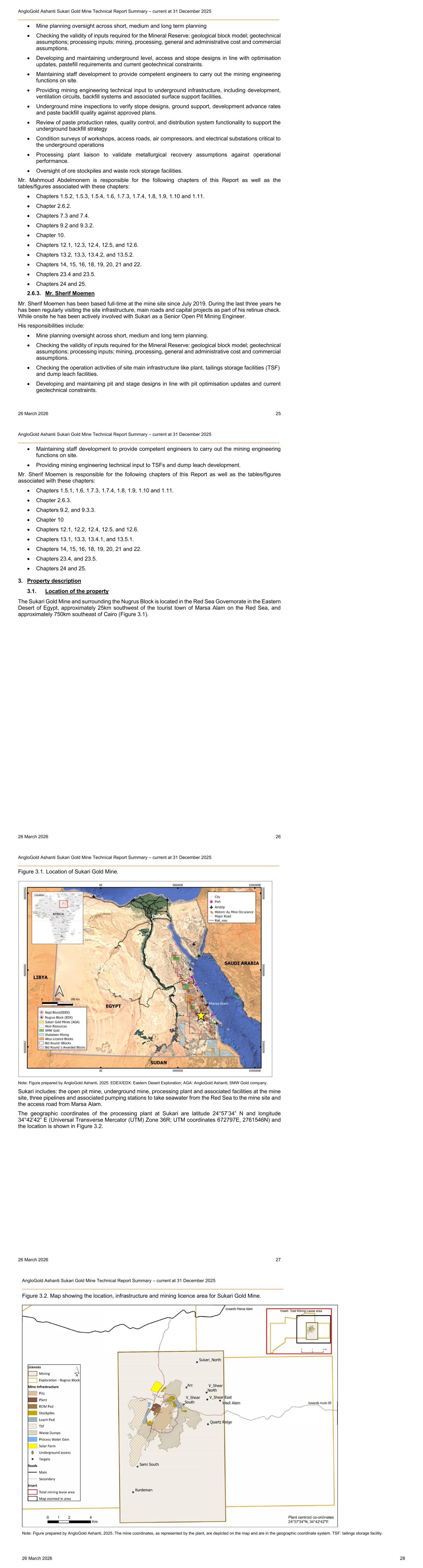
AngloGold Ashanti Sukari Gold Mine Technical Report Summary – current at 31 December 2025 _____________________________________________________________________________________ 26 March 2026 25 • Mine planning oversight across short, medium and long term planning • Checking the validity of inputs required for the Mineral Reserve: geological block model; geotechnical assumptions; processing inputs; mining, processing, general and administrative cost and commercial assumptions. • Developing and maintaining underground level, access and stope designs in line with optimisation updates, pastefill requirements and current geotechnical constraints. • Maintaining staff development to provide competent engineers to carry out the mining engineering functions on site. • Providing mining engineering technical input to underground infrastructure, including development, ventilation circuits, backfill systems and associated surface support facilities. • Underground mine inspections to verify stope designs, ground support, development advance rates and paste backfill quality against approved plans. • Review of paste production rates, quality control, and distribution system functionality to support the underground backfill strategy • Condition surveys of workshops, access roads, air compressors, and electrical substations critical to the underground operations • Processing plant liaison to validate metallurgical recovery assumptions against operational performance. • Oversight of ore stockpiles and waste rock storage facilities. Mr. Mahmoud Abdelmonem is responsible for the following chapters of this Report as well as the tables/figures associated with these chapters: • Chapters 1.5.2, 1.5.3, 1.5.4, 1.6, 1.7.3, 1.7.4, 1.8, 1.9, 1.10 and 1.11. • Chapter 2.6.2. • Chapters 7.3 and 7.4. • Chapters 9.2 and 9.3.2. • Chapter 10. • Chapters 12.1, 12.3, 12.4, 12.5, and 12.6. • Chapters 13.2, 13.3, 13.4.2, and 13.5.2. • Chapters 14, 15, 16, 18, 19, 20, 21 and 22. • Chapters 23.4 and 23.5. • Chapters 24 and 25. 2.6.3. Mr. Sherif Moemen Mr. Sherif Moemen has been based full-time at the mine site since July 2019. During the last three years he has been regularly visiting the site infrastructure, main roads and capital projects as part of his retinue check. While onsite he has been actively involved with Sukari as a Senior Open Pit Mining Engineer. His responsibilities include: • Mine planning oversight across short, medium and long term planning. • Checking the validity of inputs required for the Mineral Reserve: geological block model; geotechnical assumptions; processing inputs; mining, processing, general and administrative cost and commercial assumptions. • Checking the operation activities of site main infrastructure like plant, tailings storage facilities (TSF) and dump leach facilities. • Developing and maintaining pit and stage designs in line with pit optimisation updates and current geotechnical constraints. AngloGold Ashanti Sukari Gold Mine Technical Report Summary – current at 31 December 2025 _____________________________________________________________________________________ 26 March 2026 26 • Maintaining staff development to provide competent engineers to carry out the mining engineering functions on site. • Providing mining engineering technical input to TSFs and dump leach development. Mr. Sherif Moemen is responsible for the following chapters of this Report as well as the tables/figures associated with these chapters: • Chapters 1.5.1, 1.6, 1.7.3, 1.7.4, 1.8, 1.9, 1.10 and 1.11. • Chapter 2.6.3. • Chapters 9.2, and 9.3.3. • Chapter 10 • Chapters 12.1, 12.2, 12.4, 12.5, and 12.6. • Chapters 13.1, 13.3, 13.4.1, and 13.5.1. • Chapters 14, 15, 16, 18, 19, 20, 21 and 22. • Chapters 23.4, and 23.5. • Chapters 24 and 25. 3. Property description 3.1. Location of the property The Sukari Gold Mine and surrounding the Nugrus Block is located in the Red Sea Governorate in the Eastern Desert of Egypt, approximately 25km southwest of the tourist town of Marsa Alam on the Red Sea, and approximately 750km southeast of Cairo (Figure 3.1). AngloGold Ashanti Sukari Gold Mine Technical Report Summary – current at 31 December 2025 _____________________________________________________________________________________ 26 March 2026 27 Figure 3.1. Location of Sukari Gold Mine. Note: Figure prepared by AngloGold Ashanti, 2025. EDEX/EDX: Eastern Desert Exploration; AGA: AngloGold Ashanti; SMW Gold company. Sukari includes: the open pit mine, underground mine, processing plant and associated facilities at the mine site, three pipelines and associated pumping stations to take seawater from the Red Sea to the mine site and the access road from Marsa Alam. The geographic coordinates of the processing plant at Sukari are latitude 24°57’34” N and longitude 34°42’42” E (Universal Transverse Mercator (UTM) Zone 36R; UTM coordinates 672797E, 2761546N) and the location is shown in Figure 3.2. AngloGold Ashanti Sukari Gold Mine Technical Report Summary – current at 31 December 2025 _____________________________________________________________________________________ 26 March 2026 28 Figure 3.2. Map showing the location, infrastructure and mining licence area for Sukari Gold Mine. Note: Figure prepared by AngloGold Ashanti, 2025. The mine coordinates, as represented by the plant, are depicted on the map and are in the geographic coordinate system. TSF: tailings storage facility.

AngloGold Ashanti Sukari Gold Mine Technical Report Summary – current at 31 December 2025 _____________________________________________________________________________________ 26 March 2026 29 3.2. Area of the property The mining concession area currently operated by the Sukari Gold Mine covers 160km², while the surrounding Nugrus Block, operated by Eastern Desert Exploration (EDX), spans 848km². 3.3. Legal aspects and permitting 3.3.1. Ownership Sukari Gold Mine is jointly owned by Pharoah Gold and EMRA through their respective 50% equity stake in the Sukari Gold Mining Company which operates the Sukari Gold Mine. EMRA is entitled to 50% of the operating profits from the Sukari Gold Mine, as per the terms of the concession agreement. The Nugrus Block is being explored by EDX. 3.3.2. Legal aspects Egypt is an Arabic-speaking country in North Africa, bordered by the Mediterranean Sea to the north and the Red Sea to the east. It shares land borders with Libya to the west, Sudan to the south, and Israel and the Gaza Strip to the northeast. Egypt has a population of approximately 113M people (Worldometer, 2023), making it the most populous country in the Arab world. Its capital, Cairo, is located near the Nile River and serves as the country’s political, economic, and cultural hub. Other major cities include Alexandria, Giza, Sharm El-Sheikh, and Luxor. Egypt has multiple seaports, with the largest being the Port of Alexandria, which handles the majority of the country’s trade. Other key ports include Port Said at the northern entrance of the Suez Canal, Safaga on the Red Sea, and Damietta on the Mediterranean. The Suez Canal, one of the world’s most significant waterways, connects the Mediterranean Sea to the Red Sea, facilitating global maritime trade. Egypt is divided into 27 governorates, with Marsa Alam and the Sukari Gold Mine located in the Red Sea Governorate. Egypt is a presidential republic with a multi-party political system. Abdel Fattah el-Sisi has served as the country’s president since 2014, following his re-election in 2018 and 2024. Egypt has a mixed economy driven by sectors such as tourism, agriculture, oil and gas, and mining. According to GlobalData, Egypt produced approximately 650,000 ounces of gold in 2022, ranking it among Africa’s significant gold producers. The country’s estimated gross domestic product (GDP) in 2023 was $475B, with a per capita GDP of $4,150. The Egyptian Pound (EGP) is the national currency, and current at December 2025, the exchange rate to the US dollar was approximately 47.57. Despite economic growth, Egypt faces challenges such as inflation, high public debt, and infrastructure constraints, particularly in energy and transportation. The mineral resources of Egypt, including gold, are considered state-owned assets. The legal framework for mining is governed by the Mineral Resources Law No. 198/2014 and its amendments, which regulate exploration, extraction, and investment in the sector. EMRA oversees the issuance of mining licences and agreements, with terms subject to approval by the government. Mining contracts in Egypt typically involve production-sharing agreements, with the state retaining a stake in key mining projects. Additionally, mining companies are subject to royalty payments, corporate taxes, and investment regulations. Upon the expiration of a mining licence, all immovable assets revert to the state, while moveable property may be transferred at a negotiated value. Mining operations must adhere to environmental and land-use regulations set by the government. The Sukari Gold Mine operates under Law No. 222/1994, which governs concession agreements for gold and associated minerals in Egypt. This law is distinct from the Mineral Resources Law No. 198/2014, which applies to other mining projects in Egypt. Since the Sukari Gold Mine operates under Law 222, it has different contractual terms compared to newer mining projects regulated by Law 198/2014, which applies to most other mineral exploration and mining activities in Egypt. Key provisions of Law 222/1994 (as applicable to the Sukari Gold Mine) include: • Sukari concession agreement and EMRA partnership: o The law grants a long-term mining concession to Pharaoh Gold in partnership with EMRA. o The agreement follows a 50/50 profit-sharing model, with revenues split between Pharoah Gold and EMRA after cost recovery. • Cost recovery mechanism: o Pharoah Gold (the operator) is entitled to recover operating and capital costs before splitting profits with EMRA. AngloGold Ashanti Sukari Gold Mine Technical Report Summary – current at 31 December 2025 _____________________________________________________________________________________ 26 March 2026 30 o There is a defined cost recovery period and cap, ensuring that a portion of revenues is allocated to the Egyptian government. • Tax and royalty exemptions: o The Sukari Gold Mine is exempt from certain taxes and duties under the concession terms. o The tax exemption on all income generated in Egypt is renewed every 15 years, with the most recent renewal completed at the end of 2024. • State ownership and asset reversion: o Upon termination or expiry of the concession, all immovable assets (e.g., infrastructure, plant, and facilities) revert to state ownership. o Moveable assets (e.g., equipment) may be acquired by the state or removed by the operator. • Operational and environmental obligations: o The mine must comply with Egyptian environmental laws and report to regulatory authorities on its activities. o Rehabilitation and closure obligations are outlined in the concession agreement. • Renewal and duration: o The concession agreement is long-term, but renewals or modifications require government approval. o The law ensures stability for investors while maintaining sovereign control over resources. A Model Mining Exploitation Agreement (MMEA), agreed in principle in 2023, serves as the investment framework for commercial discoveries within AngloGold Ashanti's EDX blocks, including the Nugrus Block. The MMEA will come into effect upon signing and following approval by the Egyptian parliament, with the approval date yet to be determined. Exploration activities by EDX are continuing in parallel with the approval process. Under the MMEA, exploitation licences will be granted for a 30-year period, governed by a stabilised fiscal and legal regime. Key terms include: • A 5% government net smelter royalty on revenue pending final approval from the Egyptian Parliament, subject to change. • A 22.5% corporate tax rate. • A 15% government financial net profit interest (applied to post-tax income). • A 0.5% contribution towards community development. • Life of mine (LOM) commitments focused on local employment, training, and procurement. This framework aims to provide long-term fiscal stability while ensuring benefits for local communities and stakeholders throughout the mine's operational life. 3.3.3. Permitting 3.3.3.1. Mining concession The Sukari concession agreement was ratified by the Egyptian Parliament through the adoption of Law No. 222/1994 and came into effect on 13 June 1995. The Sukari exploitation lease covers an area of approximately 160km² surrounding the Sukari Gold Mine site within the Sukari concession. Under the terms of the Sukari concession agreement, the exploitation lease is valid for 30 years from the first date of commercial discovery. While the agreement took effect in 1995, the formal commercial announcement occurred in 2001; consequently, the initial term is set to expire in 2031. The lease may be renewed for a further 30-year period at the option of Pharoah Gold, provided there is reasonable commercial justification and upon six months' written notice to EMRA prior to the expiry of the initial term. Any such renewal of the exploitation lease will require ratification by the Egyptian Parliament. The mining concession contains the Sukari Gold Mine and surrounding prospects, and its extents are shown in Figure 3.3 and Table 3.1. AngloGold Ashanti Sukari Gold Mine Technical Report Summary – current at 31 December 2025 _____________________________________________________________________________________ 26 March 2026 31 Figure 3.3. Sukari mining concession and Nugrus Block showing location of Little Sukari. Note: Figure sourced from Sukari Gold Mine, 2025. Red boundary Sukari mining concession; white boundary the Nugrus Block. Table 3.1. Sukari mining concession coordinates. Longitude Latitude 34°30’0” E 25°3’4” N 34°35’6” E 25°2’17” N 34°39’47” E 25°5’3” N 34°45’0” E 25°5’2” N At the current date of this Report, the tenure of the Sukari mining lease was secure and all government/statutory requirements for its validity and enforceability had been met. The Mineral Resource and Mineral Reserve estimates are constrained within the one mining lease. 3.3.3.2. Exploration concessions Beyond the near-mine exploration opportunities within the Sukari mining concession, AngloGold Ashanti also holds a highly prospective terrain in the Eastern Desert comprising the Nugrus Block which surrounds the Sukari mining concession. The exploration licence for the Nugrus Block, covering an area of approximately 848km2 located adjacent to the Sukari gold mine, is held by Centamin Central Mining SAE, and was granted on 12 October 2021. The Nugrus Block is operated by EDX. It is currently in its second exploration phase which has a duration of two years and will expire on 25 May 2026. An extension request for the current Nugrus Block licence has been formally submitted and is currently under review by the EMRA. Per regulatory requirements and existing legislation, the renewal is expected to be granted as a matter of legal standing, ensuring the continued retention of the ground into the third exploration phase. Table 3.2 provides the exploration concession coordinates. AngloGold Ashanti Sukari Gold Mine Technical Report Summary – current at 31 December 2025 _____________________________________________________________________________________ 26 March 2026 32 Table 3.2. Nugrus Block concession coordinates. Nugrus Block (East) Coordinate point Longitude Latitude O 34°46’30” E 25°00’00” N P 34°52’30” E 25°00’00” N Q 34°52’30” E 24°52’30” N R 34°46’30” E 24°52’30” N Nugrus Block (West) Coordinate point Longitude Latitude A 34°30'0'' E 25°3'4'' N B 34°35'6'' E 25°2'17'' N C 34°39'47'' E 25°5'3'' N D 34°45'0'' E 25°5'2'' N E 34°45'0'' E 25°0'20'' N F 34°40'40'' E 25°0'20'' N G 34°40'40'' E 24°52'30'' N H 34°30'0'' E 24°52'30'' N I 34°30'0'' E 24°50'33'' N J 34°23'51'' E 24°46'4'' N K 34°23'50'' E 24°45'0'' N L 34°22'30'' E 24°45'0'' N M 34°22'30'' E 25°0'0'' N N 34°30'0'' E 25°0'0'' N 3.3.4. Surface rights Pharaoh Gold holds the requisite surface rights for mining operations and related activities at the Sukari Gold Mine. Under Egyptian law, surface rights are granted as part of the mining concession and are distinct from mineral rights. The concession agreement allows Pharoah Gold to: • Conduct mineral operations, including mining for the specified minerals covered under the concession. • Erect equipment, processing plants, and infrastructure necessary for mining, transporting, crushing, processing, smelting, or refining minerals recovered during operations. • Extract and remove minerals from the concession area and sell or export them in accordance with the approved marketing plan. • Stack or store ore, waste, and tailings in designated areas as approved in the mine’s environmental impact assessment (EIA) and operational permits. • Carry out other ancillary or supporting activities necessary for efficient mining and processing operations. EMRA maintains oversight of the operation, ensuring compliance with the concession terms, environmental regulations, and profit-sharing mechanisms. Furthermore, the Sukari Gold Mining Company holds the rights to lease land for infrastructure beyond the mining concession, including easements for power lines, water pipelines, and the water intake structure on the Red Sea. Centamin Central Mining SAE holds the surface rights over the Nugrus Block area. Tenure is managed through a system of two-year exploration cycles, providing a maximum tenure of eight years via two standard renewals and one exceptional renewal. Additional renewals may be granted if a "commercial discovery" is agreed upon with EMRA, potentially allowing further tenure for commercial satellite deposits.

AngloGold Ashanti Sukari Gold Mine Technical Report Summary – current at 31 December 2025 _____________________________________________________________________________________ 26 March 2026 33 The project is currently in the middle of this tenure cycle. One renewal has already been obtained, and the process for the second renewal is currently underway. The initial application was submitted six months prior to the licence expiry, with the final application currently being prepared for submission 60 days before the deadline. Following this, the third exploration phase is scheduled to commence on 25 May 2026 and will continue until 25 May 2028. Each renewal cycle requires a minimum relinquishment of 20% of the area. Ground rent begins at 5,000 EGP/km² and increases by 5,000 EGP at each renewal; however, due to EGP devaluation since 2020, these costs have effectively reduced in real terms. Expenditure commitments are enforced by EMRA, with a “Letter of Guarantee” equivalent to 10% of the committed budget required to ensure compliance. At Report current date, there were no known impediments related to the security of tenure and the right to operate with respect to the current Mineral Resource and Mineral Reserve estimates. 3.3.5. Water rights Pharaoh Gold holds the necessary water rights for mining operations and associated activities at Sukari Gold Mine under the terms of its concession agreement (Law No. 222/1994) and in compliance with Egyptian water and environmental regulations. Water supply for Sukari Gold Mine is primarily sourced from: • Seawater desalination: the mine operates a desalination plant near the Red Sea to produce freshwater for processing and operational use. • Groundwater wells: limited volumes of groundwater may be utilised, subject to government approval and EIAs. • Recycling and reuse: water management strategies prioritise recycling process water to minimise freshwater consumption. Sukari’s water use is governed by agreements with: • The Egyptian Environmental Affairs Agency: ensures compliance with EIAs and water management plans. • The Ministry of Water Resources and Irrigation: regulates water abstraction, use, and discharge to protect national water resources. • The Red Sea Governorate: oversees coastal water use and environmental protections related to desalination and wastewater management. Water use permits must be obtained and periodically reviewed to ensure compliance with Egyptian environmental laws and best practice water conservation measures. The mine is required to monitor and report water consumption, discharge quality, and compliance with regulatory standards. Discharge of treated water or waste into the environment must meet Egyptian water quality and environmental protection regulations. Effective water management is critical for the Sukari Gold Mine’s operations due to the arid climate of Egypt’s Eastern Desert. The mine continues to implement sustainable water strategies, including increased recycling, to reduce its environmental footprint. 3.3.6. Encumbrances At Sukari Gold Mine, significant encumbrances include compliance with Egyptian mining regulations, government royalties, and environmental obligations. The mine operates under an exploitation lease granted by the Egyptian government, which requires adherence to strict permitting and reporting requirements. Future permitting includes approvals for underground expansions, waste disposal, and tailings storage facility modifications, all subject to review by the Egyptian Environmental Affairs Agency and EMRA. The permitting timelines vary, with major approvals potentially taking several months to over a year. Permit conditions involve environmental monitoring, water management, and rehabilitation plans to mitigate ecological impact. To date, there have been no major violations or fines reported that significantly impact operations, though ongoing compliance with evolving regulations remains a key operational focus. AngloGold Ashanti Sukari Gold Mine Technical Report Summary – current at 31 December 2025 _____________________________________________________________________________________ 26 March 2026 34 3.3.7. Significant factors and risks that may affect access, title, or work programs There are no known significant factors or risks that may affect access, title, or the right or ability to perform work at the Sukari Gold Mine. The mine and exploration units operate under a secure and legally recognised exploitation and exploration lease, with all necessary permits and regulatory approvals in place. Infrastructure, including roads, power, and water supply, supports uninterrupted operations, and there are no disputes or legal challenges impacting access or ownership. Additionally, the mine maintains strong relationships with local stakeholders and complies with all government regulations, ensuring continued stability in its operations. While regulatory requirements evolve, there are no foreseeable risks that would materially impact mining activities at Sukari. 3.4. Royalties The royalty is set at 3% of the net sales revenue from the sale of gold at Sukari and is paid to the Government of Egypt each calendar half year. 4. Accessibility, climate, local resources, infrastructure and physiography 4.1. Physiography The Sukari Gold Mine is located in the central part of the Eastern Desert of Egypt on the western slope of Sukari Hill with elevation of 630m above sea level. The mine area is located within a mountainous terrain characterised by the sharply incised Red Sea Hills and numerous wadis draining towards the Red Sea coast. Elevations range between approximately 300m and 585m. No seismic activity has been recorded in the region. The closest settlement is the coastal town of Marsa Alam, some 25km to the northeast. The Sukari deposit is associated with a granodiorite outcrop, that, prior to operations, formed a topographic high rising to 350m above the local wadi level and extending for up to 2,500m along strike. The surrounding topography comprises wadi drainage plains that pass to the east and west of the outcrop and the sharply incised, green-brown, Red Sea Hills which surround these. Vegetation in the Sukari deposit area is sparse due to the arid desert environment. The landscape is largely rugged rock outcrops and barren, with plant life limited by extreme water scarcity. However, sporadic trees and shrubs can be found along the main wadi drainage lines, including umbrella thorn acacia, spiny zilla, desert cotton and tumbleweed. 4.2. Accessibility The closest settlement is the coastal town of Marsa Alam, some 25km to the northeast. A coastal highway runs along the west coast of the Red Sea from the border with Sudan in the south to Suez in the north, passing through Marsa Alam, and providing connectivity to Cairo. The distance from Cairo to Marsa Alam by highway is some 750km (or 8-10 hours travel time). There is also a bitumen highway from Edfu on the Nile River to Marsa Alam. From the town of Marsa Alam, the Edfu highway is followed to the west for around 20km before taking a good, corrugated gravel road which runs southerly for approximately 8km, crossing a low divide and running down into Wadi Sukari (a wadi is an intermittent water course) before turning east to the Sukari Gold Mine operations complex. Drive time from Marsa Alam is around 30 minutes. EDX has an office in Marsa Alam and a campsite at Little Sukari. To reach the Little Sukari camp, the Edfu– Marsa Alam highway is taken to the west for 41km, then turning south onto the Al Sheikh Shazli road for 3km. From there, a west-southwest corrugated gravel road is taken for 11.5km. This route leads to the camp, which serves as the base for most exploration activities. The total drive time from Marsa Alam is approximately one hour. The closest international airports are located at Marsa Alam (airport situated some 60km to the north, close to Port Ghalib) and in Hurghada (some four hours by car). 4.3. Climate The climate at the Sukari site, Nugrus Block and the Marsa Alam region on the Red Sea, where critical mine infrastructure is located, is characteristic of a desert environment. Average temperatures during the winter months (October to March) range from 17-27°C and during the summer months (April to September) from 26-36°C with maximum temperatures frequently exceeding 40°C. Humidity is normally very low but has been known to exceed 80% at the seawater intake near the coast, especially during the winter months. Precipitation is almost non-existent with rainfall rarely exceeding 10mm per year. AngloGold Ashanti Sukari Gold Mine Technical Report Summary – current at 31 December 2025 _____________________________________________________________________________________ 26 March 2026 35 A steady wind from the northwest helps to lower the temperature near the coast. The Khamaseen is a wind that blows from the south in Egypt, usually in spring or summer, bringing sand and dust, and sometimes raises the temperature in the desert to >38°C. Mining and processing operations are conducted year-round, while exploration activities are primarily conducted during the cooler months (November – March). 4.4. Local resources and infrastructure No permanent population is present in the immediate area. The nearest local town is Marsa Alam, which is a tourism-focused suburban town area with population estimated at approximately 10,000. The town offers hospital facilities, a police presence, and other municipal facilities associated with a tourist destination. There are numerous resort complexes located along the coastline and within proximity of the town, which also offer similar public facilities such as automated teller machines (ATMs), restaurants and shops. AngloGold Ashanti rented the Moon Resort in Marsa Alam town under a three-year contract which acts as additional accommodation for the mine, with staff bussed to and from the mine. A longer-term solution is under development. Infrastructure to support mining operations is in place, and includes the mine site, onsite power generation facilities, as well as water pipelines and a water pumping station on the coast. More detailed information on Project-related infrastructure is provided in Chapter 15. 5. History Gold was mined in Pharaonic and Roman times. Small-scale mining was re-established between 1912 and 1914. In 1936, a renewed effort by government authorities to re-establish Egypt’s gold mining industry saw the Sukari Gold Mine selected as the first mine to be brought back into production. After preparatory work, production started in August 1937 and continued intermittently until February 1951. All mining activities terminated in 1958 due to political reasons. The first systematic modern exploration in the Sukari area was carried out in the 1970s by the Egyptian Government with assistance from the former Union of Soviet Socialist Republics (USSR). While the USSR was assisting Egypt with major infrastructure projects such as the Aswan Dam, cooperative mineral resource exploration efforts were undertaken across the Eastern Desert. The Egyptian Geological Survey and Mining Authority, in collaboration with Soviet geologists, conducted systematic regional geological surveys, geochemical sampling, and detailed mapping at Sukari between 1971 and 1977. This included trenching over mineralised zones and the completion of five diamond drill holes, which confirmed the presence of gold mineralisation at depth (Cavaney, 2004). However, neither the USSR nor the Egyptian government operated the Sukari Gold Mine as a production site during this period. Their role remained focused on geological assessments rather than active mining. From 1912 to 1920, the Sukari Gold Mine was operated under Mining Licence 15, granted initially to John Wells and later transferred to Sukkari Mines Ltd. During this period, records show that 522.5t of ore were treated, producing 8.324kg of gold at a recovered grade of 15.93g/t gold. Between 1936 and 1958, the mine was managed by the Egyptian Mining Department. The estimated production from 1937 to 1951 was approximately 476.8kg of gold from 27,800t of ore, equating to a recovered grade of 17.0g/t gold (Cavaney, 2004). Additional historical production estimates suggest that ancient miners extracted around 30,000t of ore, producing between 300 and 400kg of gold at estimated grades ranging from 16 to 22g/t gold. Tailings studies indicate that 32,000 tonnes of tailings averaging 2.8g/t gold remained from earlier operations (Cavaney, 2004). Exploration by Pharoah Gold began in 1995 with the establishment of a camp. Work completed consisted of a detailed literature search prior to gridding, traversing, mapping, geochemical sampling, trenching, channel sampling, heavy mineral sampling, augering, and surveying. Drilling started in April 1997. In 1999, Centamin acquired Pharoah Gold. In November 2000, Pharoah Gold submitted a feasibility study, dated 26 October 2000 on the Sukari Gold Project, in accordance with the terms of the concession agreement. On 4 November 2001, Pharoah Gold was formally notified by EMRA that the feasibility study had been accepted and had demonstrated the existence of a “commercial discovery” at the Sukari Gold Project. Pharoah Gold and EMRA were required to establish an operating company to develop mining operations. Sukari Gold Mining Company was incorporated under the laws of Egypt on 13 April 2006, to conduct AngloGold Ashanti Sukari Gold Mine Technical Report Summary – current at 31 December 2025 _____________________________________________________________________________________ 26 March 2026 36 exploration, development, exploitation and marketing operations in accordance with the concession agreement. Centamin completed a feasibility study in 2007. The first gold was poured in June 2009. The open pit was owner-operated. Underground mining was initially performed by a contractor but is now owner-operated. A summary of the recorded production since modern mining operations started is shown in Table 5.1. Table 5.1. Production summary for Sukari (2009 to 2025). Year Tonnes milled (kt) Grade (g/t Au) Contained metal (oz Au) Metallurgical recovery (% Au) 2009 3,612 1.37 67,101 87.0 2010 1,378 2.06 83,432 85.4 2011 3,612 1.90 202,699 85.3 2012 4,526 2.04 262,828 87.8 2013 5,684 2.12 356,943 88.5 2014 8,427 1.53 377,261 87.8 2015 10,575 1.40 439,072 88.8 2016 11,559 1.65 551,036 89.4 2017 12,032 1.57 544,658 88.1 2018 12,568 1.26 472,418 88.7 2019 12,859 1.28 480,528 88.1 2020 11,913 1.35 452,320 87.8 2021 11,916 1.18 415,370 87.6 2022 12,114 1.26 440,974 88.2 2023 12,019 1.26 488,928 88.7 2024 12,450 1.27 506,951 88.5 2025 12,182 1.37 537,796 89.1 Total 159,426 1.35 6,680,315 87.9 6. Geological setting, mineralisation and deposit 6.1. Geological setting and mineralisation 6.1.1. Regional and local geology The Sukari deposit and exploration concessions are located in the Neoproterozoic (900-650Ma) Arabian Nubian Shield, one of a number of areas of African continental crust that accreted and stabilised during the Pan-African Orogeny. Formation of the Arabian Nubian Shield took place during closure of the Mozambique Ocean between the East and West Gondwanan continental blocks. Ocean closure led to amalgamation of numerous circa 870– 625Ma juvenile arc and back-arc igneous and sedimentary rock sequences, with many resulting terrane sutures marked by mafic-ultramafic ophiolitic assemblages and fragments. The orogeny began at circa 650Ma, continued for approximately 100Ma, and included crustal shortening, lithospheric reworking, escape tectonics (i.e., the movement of rock layers to relieve pressure), and eventual orogenic collapse. Peak metamorphism was reached in different parts and depths of the orogen at different times between 620 and 585Ma. Magmatism was widespread during 650–580Ma, and rapid exhumation of the metamorphosed rocks and mid-crustal intrusions took place from circa 600 to 580Ma. Regional fault sets that controlled much of the gold occurrences were related to initial transpression by oblique convergence between the arcs and associated with subsequent sinistral shearing reported as overlapping the exhumation. As existing geological data are not adequate to fully evaluate the overall terrane history, work by Zoheir et al. (2019) has subdivided the Eastern Desert into nine structural blocks, rather than arc terranes, commonly based on bounding shear zones and major faults (Figure 6.1).

AngloGold Ashanti Sukari Gold Mine Technical Report Summary – current at 31 December 2025 _____________________________________________________________________________________ 26 March 2026 37 Figure 6.1. Geological map of the Eastern Desert, Egypt. Note: Figure sourced from Zoheir et al., 2019. The greatest abundance of gold deposits is associated with the north-west-trending Najd Fault system that comprises many splays throughout the blocks in the central Eastern Desert, and underwent episodes of shearing at circa 640–570Ma. Significant deposits are also notably widespread along reactivated east-west thrust faults in the Allaqi-Sol Hamed block of the southern Eastern Desert, with significant shearing at 610– 580Ma. Sulphide mineralogy of the Eastern Desert gold-bearing veins is dominated by pyrite, arsenopyrite, and (or) pyrrhotite, in addition to subordinate chalcopyrite, sphalerite, galena and tetrahedrite. Alteration minerals include white mica, chlorite, and carbonate, and are typical of orogenic gold deposits. Many gold occurrences are located along sheared margins to granitic intrusions or along contacts between different lithologies; sheared silica- and carbonate-altered ultramafic rocks. Fault zones are particularly widely associated with many of the gold occurrences. At a district scale, the host sequence of the Sukari deposit comprises a north-northeast striking mélange of predominantly calc-alkaline igneous rocks and metasedimentary units representing an accreted island arc or arcs. Several bodies of serpentinite, representing accreted slivers of highly deformed oceanic crustal rocks, occur in the hanging wall of the north-northeast striking, east-southeast verging, Sefein-Sukari thrust (Akaad, et al., 1993). This district-scale (circa 25km) structure is mapped as passing immediately to the east of the AngloGold Ashanti Sukari Gold Mine Technical Report Summary – current at 31 December 2025 _____________________________________________________________________________________ 26 March 2026 38 Sukari Gold Mine, where it separates rocks of the Um Khariga metapyroclastic unit (west of Sukari granitoid and enveloping serpentinite seen within the Nugrus Block) from the Sukari metavolcanic rocks (east of the Sukari Gold Mine). Vail (1983) assigns an age of 770-660Ma to rocks of the region. The entire sequence has undergone regional metamorphism to mid-upper greenschist facies. 6.1.2. Property geology The Sukari granodiorite outcrop is located in an easterly-dipping sequence of andesite flows, serpentinites and associated volcanoclastic sediments, mainly tuffs and epiclastic rocks. It strikes for 2.3km and is 100m to 600m thick. Drilling to date indicates that the Sukari granodiorite dips toward the east at between 50° and 75°. The western and eastern contacts of the granodiorite are thus regarded as footwall and hanging wall contacts respectively. Granodiorite/wall rock contacts are, in places, vertical or overturned. The geology of the Sukari area is presented in Figure 6.2. Figure 6.2. Geology of the Sukari area. Note: Figure prepared by EDX, 2024. The Nugrus Block, predominately located to the west of the Sukari mining concession hosts similar lithologies and has significant mineral potential. It is bordered by Atud to the north and the Hangaliya and Umm Ud deposits to the south, predominantly within ophiolitic sequences (Figure 6.3). AngloGold Ashanti Sukari Gold Mine Technical Report Summary – current at 31 December 2025 _____________________________________________________________________________________ 26 March 2026 39 Figure 6.3. Geology of the Sukari and Nugrus Block area. Note: Figure prepared by EDX, 2024. The northern part of the block is dominated by a gabbro-diorite complex, while the southern and eastern regions are characterised by granites. A large thrust outlier of mafic- to intermediate calc-alkaline volcanics, mostly andesites, occurs northeast of Sukari. The block also contains metasedimentary rocks, including volcano-siliciclastic and ultramafic units, along with felsic- to intermediate volcanics, which are observed on either side of the Nugrus Block shear zone and in the northwest-trending range of hills west of Sukari. The geology of Nugrus Block includes granitoids and arc-related rocks, commonly hosted within ophiolite mélanges. Carbonate alteration is prevalent throughout the block, indicating significant hydrothermal activity. Mineralisation within the Nugrus Block is primarily constrained to structural high-strain corridors trending east- west and north-south, highlighting the importance of deformation zones in localising gold and associated mineralisation. The original Sukari area was designated by four geographical zones namely the Amun, Ra, Gazelle, and Pharaoh Zones from south to north respectively (Khalil et al., 2015), as shown in Figure 6.4. Figure 6.4. Sukari Hill and geographical zones, viewed from the north-west. Note: Figure sourced from Khalil et al., 2015. Red lines are fault planes. AngloGold Ashanti Sukari Gold Mine Technical Report Summary – current at 31 December 2025 _____________________________________________________________________________________ 26 March 2026 40 The initial geological interpretation suggested that the hanging wall sequences comprised a mixture of serpentinite, meta-conglomerate, fine-grained metasediments, minor basalt and granodiorite dykes or sills. Drill hole logging clearly defined the hanging wall sequence as metasediments (i.e., lapilli and ash tuffs). Surface exposures indicated that these rocks were strongly deformed. It is reasonable to assume that the granodiorite dykes in the hanging wall sequence were genetically and temporally related to the main Sukari granodiorite. The footwall sequence was devoid of granodiorite dykes. This potentially indicated that the entire sequence was overturned as it would be reasonable to expect subsidiary or feeder dykes in the footwall of the main intrusion rather than the hanging wall. From 2021, an intensive relogging programme started, covering the entire Sukari deposit on 25m sections. The programme started with seven typical sections (Figure 6.5) on 200–400m centres through the Sukari granodiorite system to obtain a basic framework. Figure 6.5. Map of Sukari geology and original relogging fences. Note: Figure prepared by Sukari Gold Mine, 2021. This was subsequently infilled over a 16 month period with 108 infill sections completed. An example of the results is illustrated by Horus-Section_33-10200N (see Figure 6.6), which was specifically aimed at defining the hanging wall and the footwall geological sequence with different intrusion events, determining the relative age of dykes, determining the geological control of mineralisation and defining potential mineralisation extensions.
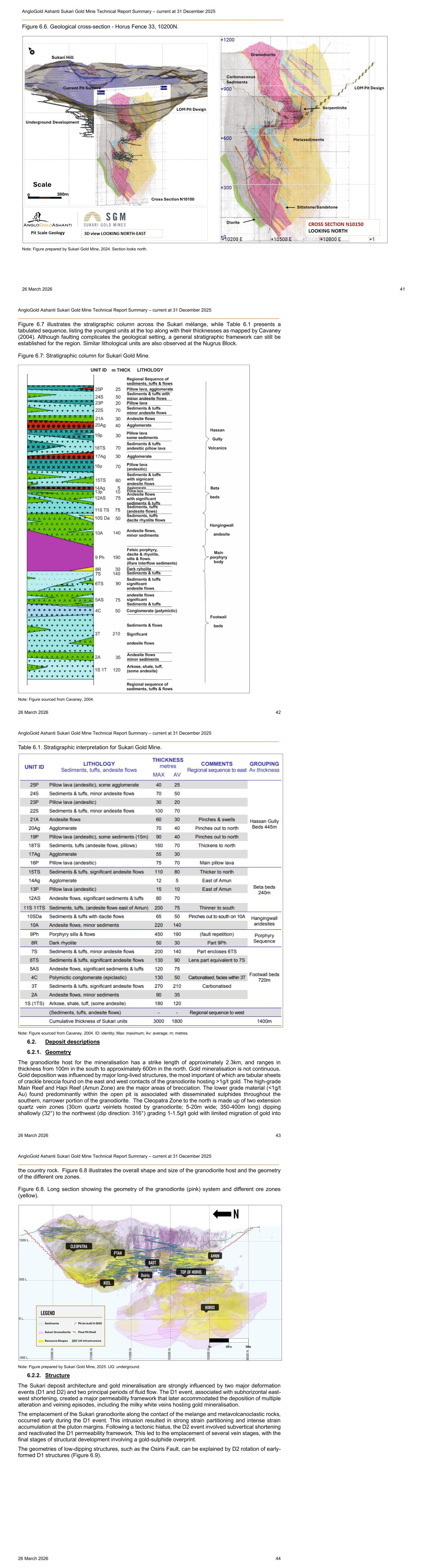
AngloGold Ashanti Sukari Gold Mine Technical Report Summary – current at 31 December 2025 _____________________________________________________________________________________ 26 March 2026 41 Figure 6.6. Geological cross-section - Horus Fence 33, 10200N. Note: Figure prepared by Sukari Gold Mine, 2024. Section looks north. AngloGold Ashanti Sukari Gold Mine Technical Report Summary – current at 31 December 2025 _____________________________________________________________________________________ 26 March 2026 42 Figure 6.7 illustrates the stratigraphic column across the Sukari mélange, while Table 6.1 presents a tabulated sequence, listing the youngest units at the top along with their thicknesses as mapped by Cavaney (2004). Although faulting complicates the geological setting, a general stratigraphic framework can still be established for the region. Similar lithological units are also observed at the Nugrus Block. Figure 6.7: Stratigraphic column for Sukari Gold Mine. Note: Figure sourced from Cavaney, 2004. AngloGold Ashanti Sukari Gold Mine Technical Report Summary – current at 31 December 2025 _____________________________________________________________________________________ 26 March 2026 43 Table 6.1. Stratigraphic interpretation for Sukari Gold Mine. Note: Figure sourced from Cavaney, 2004. ID: identity; Max: maximum; Av: average; m: metres. 6.2. Deposit descriptions 6.2.1. Geometry The granodiorite host for the mineralisation has a strike length of approximately 2.3km, and ranges in thickness from 100m in the south to approximately 600m in the north. Gold mineralisation is not continuous. Gold deposition was influenced by major long-lived structures, the most important of which are tabular sheets of crackle breccia found on the east and west contacts of the granodiorite hosting >1g/t gold. The high-grade Main Reef and Hapi Reef (Amun Zone) are the major areas of brecciation. The lower grade material (<1g/t Au) found predominantly within the open pit is associated with disseminated sulphides throughout the southern, narrower portion of the granodiorite. The Cleopatra Zone to the north is made up of two extension quartz vein zones (30cm quartz veinlets hosted by granodiorite; 5-20m wide; 350-400m long) dipping shallowly (32°) to the northwest (dip direction: 316°) grading 1-1.5g/t gold with limited migration of gold into AngloGold Ashanti Sukari Gold Mine Technical Report Summary – current at 31 December 2025 _____________________________________________________________________________________ 26 March 2026 44 the country rock. Figure 6.8 illustrates the overall shape and size of the granodiorite host and the geometry of the different ore zones. Figure 6.8. Long section showing the geometry of the granodiorite (pink) system and different ore zones (yellow). Note: Figure prepared by Sukari Gold Mine, 2025. UG: underground. 6.2.2. Structure The Sukari deposit architecture and gold mineralisation are strongly influenced by two major deformation events (D1 and D2) and two principal periods of fluid flow. The D1 event, associated with subhorizontal east- west shortening, created a major permeability framework that later accommodated the deposition of multiple alteration and veining episodes, including the milky white veins hosting gold mineralisation. The emplacement of the Sukari granodiorite along the contact of the melange and metavolcanoclastic rocks, occurred early during the D1 event. This intrusion resulted in strong strain partitioning and intense strain accumulation at the pluton margins. Following a tectonic hiatus, the D2 event involved subvertical shortening and reactivated the D1 permeability framework. This led to the emplacement of several vein stages, with the final stages of structural development involving a gold-sulphide overprint. The geometries of low-dipping structures, such as the Osiris Fault, can be explained by D2 rotation of early- formed D1 structures (Figure 6.9).
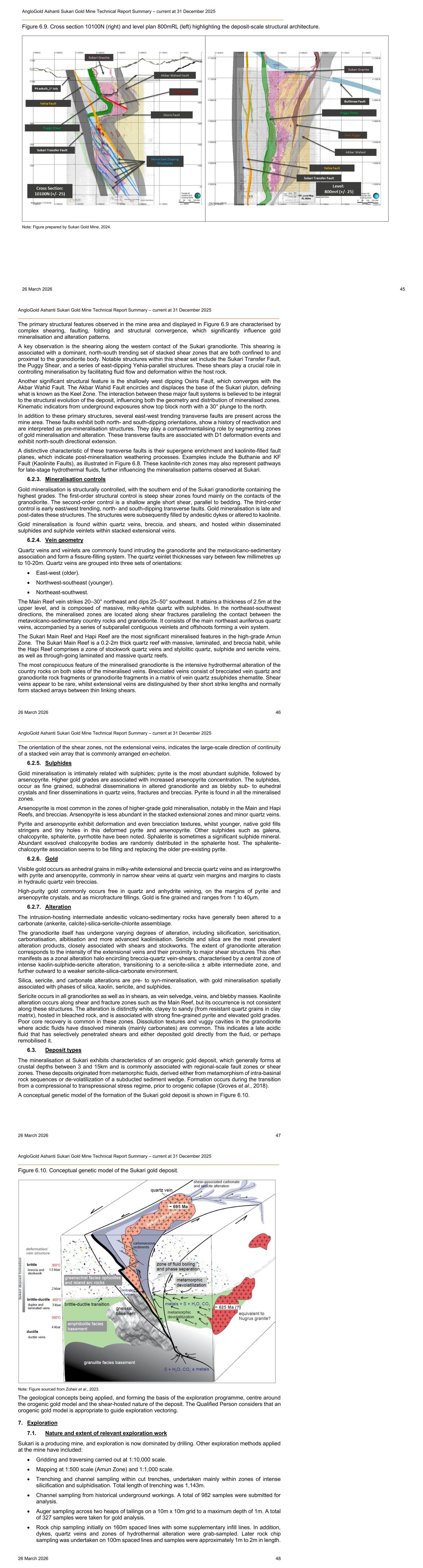
AngloGold Ashanti Sukari Gold Mine Technical Report Summary – current at 31 December 2025 _____________________________________________________________________________________ 26 March 2026 45 Figure 6.9. Cross section 10100N (right) and level plan 800mRL (left) highlighting the deposit-scale structural architecture. Note: Figure prepared by Sukari Gold Mine, 2024. AngloGold Ashanti Sukari Gold Mine Technical Report Summary – current at 31 December 2025 _____________________________________________________________________________________ 26 March 2026 46 The primary structural features observed in the mine area and displayed in Figure 6.9 are characterised by complex shearing, faulting, folding and structural convergence, which significantly influence gold mineralisation and alteration patterns. A key observation is the shearing along the western contact of the Sukari granodiorite. This shearing is associated with a dominant, north-south trending set of stacked shear zones that are both confined to and proximal to the granodiorite body. Notable structures within this shear set include the Sukari Transfer Fault, the Puggy Shear, and a series of east-dipping Yehia-parallel structures. These shears play a crucial role in controlling mineralisation by facilitating fluid flow and deformation within the host rock. Another significant structural feature is the shallowly west dipping Osiris Fault, which converges with the Akbar Wahid Fault. The Akbar Wahid Fault encircles and displaces the base of the Sukari pluton, defining what is known as the Keel Zone. The interaction between these major fault systems is believed to be integral to the structural evolution of the deposit, influencing both the geometry and distribution of mineralised zones. Kinematic indicators from underground exposures show top block north with a 30° plunge to the north. In addition to these primary structures, several east-west trending transverse faults are present across the mine area. These faults exhibit both north- and south-dipping orientations, show a history of reactivation and are interpreted as pre-mineralisation structures. They play a compartmentalising role by segmenting zones of gold mineralisation and alteration. These transverse faults are associated with D1 deformation events and exhibit north-south directional extension. A distinctive characteristic of these transverse faults is their supergene enrichment and kaolinite-filled fault planes, which indicate post-mineralisation weathering processes. Examples include the Buthanie and KF Fault (Kaolinite Faults), as illustrated in Figure 6.8. These kaolinite-rich zones may also represent pathways for late-stage hydrothermal fluids, further influencing the mineralisation patterns observed at Sukari. 6.2.3. Mineralisation controls Gold mineralisation is structurally controlled, with the southern end of the Sukari granodiorite containing the highest grades. The first-order structural control is steep shear zones found mainly on the contacts of the granodiorite. The second-order control is a shallow angle short shear, parallel to bedding. The third-order control is early east/west trending, north- and south-dipping transverse faults. Gold mineralisation is late and post-dates these structures. The structures were subsequently filled by andesitic dykes or altered to kaolinite. Gold mineralisation is found within quartz veins, breccia, and shears, and hosted within disseminated sulphides and sulphide veinlets within stacked extensional veins. 6.2.4. Vein geometry Quartz veins and veinlets are commonly found intruding the granodiorite and the metavolcano-sedimentary association and form a fissure-filling system. The quartz veinlet thicknesses vary between few millimetres up to 10-20m. Quartz veins are grouped into three sets of orientations: • East-west (older). • Northwest-southeast (younger). • Northeast-southwest. The Main Reef vein strikes 20–30° northeast and dips 25–50° southeast. It attains a thickness of 2.5m at the upper level, and is composed of massive, milky-white quartz with sulphides. In the northeast-southwest directions, the mineralised zones are located along shear fractures paralleling the contact between the metavolcano-sedimentary country rocks and granodiorite. It consists of the main northeast auriferous quartz veins, accompanied by a series of subparallel contiguous veinlets and offshoots forming a vein system. The Sukari Main Reef and Hapi Reef are the most significant mineralised features in the high-grade Amun Zone. The Sukari Main Reef is a 0.2-2m thick quartz reef with massive, laminated, and breccia habit, while the Hapi Reef comprises a zone of stockwork quartz veins and stylolitic quartz, sulphide and sericite veins, as well as through-going laminated and massive quartz reefs. The most conspicuous feature of the mineralised granodiorite is the intensive hydrothermal alteration of the country rocks on both sides of the mineralised veins. Brecciated veins consist of brecciated vein quartz and granodiorite rock fragments or granodiorite fragments in a matrix of vein quartz ±sulphides ±hematite. Shear veins appear to be rare, whilst extensional veins are distinguished by their short strike lengths and normally form stacked arrays between thin linking shears. AngloGold Ashanti Sukari Gold Mine Technical Report Summary – current at 31 December 2025 _____________________________________________________________________________________ 26 March 2026 47 The orientation of the shear zones, not the extensional veins, indicates the large-scale direction of continuity of a stacked vein array that is commonly arranged en-echelon. 6.2.5. Sulphides Gold mineralisation is intimately related with sulphides; pyrite is the most abundant sulphide, followed by arsenopyrite. Higher gold grades are associated with increased arsenopyrite concentration. The sulphides, occur as fine grained, subhedral disseminations in altered granodiorite and as blebby sub- to euhedral crystals and finer disseminations in quartz veins, fractures and breccias. Pyrite is found in all the mineralised zones. Arsenopyrite is most common in the zones of higher-grade gold mineralisation, notably in the Main and Hapi Reefs, and breccias. Arsenopyrite is less abundant in the stacked extensional zones and minor quartz veins. Pyrite and arsenopyrite exhibit deformation and even brecciation textures, whilst younger, native gold fills stringers and tiny holes in this deformed pyrite and arsenopyrite. Other sulphides such as galena, chalcopyrite, sphalerite, pyrrhotite have been noted. Sphalerite is sometimes a significant sulphide mineral. Abundant exsolved chalcopyrite bodies are randomly distributed in the sphalerite host. The sphalerite- chalcopyrite association seems to be filling and replacing the older pre-existing pyrite. 6.2.6. Gold Visible gold occurs as anhedral grains in milky-white extensional and breccia quartz veins and as intergrowths with pyrite and arsenopyrite, commonly in narrow shear veins at quartz vein margins and margins to clasts in hydraulic quartz vein breccias. High-purity gold commonly occurs free in quartz and anhydrite veining, on the margins of pyrite and arsenopyrite crystals, and as microfracture fillings. Gold is fine grained and ranges from 1 to 40μm. 6.2.7. Alteration The intrusion-hosting intermediate andesitic volcano-sedimentary rocks have generally been altered to a carbonate (ankerite, calcite)-silica-sericite-chlorite assemblage. The granodiorite itself has undergone varying degrees of alteration, including silicification, sericitisation, carbonatisation, albitisation and more advanced kaolinisation. Sericite and silica are the most prevalent alteration products, closely associated with shears and stockworks. The extent of granodiorite alteration corresponds to the intensity of the extensional veins and their proximity to major shear structures This often manifests as a zonal alteration halo encircling breccia-quartz vein-shears, characterised by a central zone of intense kaolin-sulphide-sericite alteration, transitioning to a sericite-silica ± albite intermediate zone, and further outward to a weaker sericite-silica-carbonate environment. Silica, sericite, and carbonate alterations are pre- to syn-mineralisation, with gold mineralisation spatially associated with phases of silica, kaolin, sericite, and sulphides. Sericite occurs in all granodiorites as well as in shears, as vein selvedge, veins, and blebby masses. Kaolinite alteration occurs along shear and fracture zones such as the Main Reef, but its occurrence is not consistent along these structures. The alteration is distinctly white, clayey to sandy (from resistant quartz grains in clay matrix), hosted in bleached rock, and is associated with strong fine-grained pyrite and elevated gold grades. Poor core recovery is common in these zones. Dissolution textures and vuggy cavities in the granodiorite where acidic fluids have dissolved minerals (mainly carbonates) are common. This indicates a late acidic fluid that has selectively penetrated shears and either deposited gold directly from the fluid, or perhaps remobilised it. 6.3. Deposit types The mineralisation at Sukari exhibits characteristics of an orogenic gold deposit, which generally forms at crustal depths between 3 and 15km and is commonly associated with regional-scale fault zones or shear zones. These deposits originated from metamorphic fluids, derived either from metamorphism of intra-basinal rock sequences or de-volatilization of a subducted sediment wedge. Formation occurs during the transition from a compressional to transpressional stress regime, prior to orogenic collapse (Groves et al., 2018). A conceptual genetic model of the formation of the Sukari gold deposit is shown in Figure 6.10. AngloGold Ashanti Sukari Gold Mine Technical Report Summary – current at 31 December 2025 _____________________________________________________________________________________ 26 March 2026 48 Figure 6.10. Conceptual genetic model of the Sukari gold deposit. Note: Figure sourced from Zoheir et al., 2023. The geological concepts being applied, and forming the basis of the exploration programme, centre around the orogenic gold model and the shear-hosted nature of the deposit. The Qualified Person considers that an orogenic gold model is appropriate to guide exploration vectoring. 7. Exploration 7.1. Nature and extent of relevant exploration work Sukari is a producing mine, and exploration is now dominated by drilling. Other exploration methods applied at the mine have included: • Gridding and traversing carried out at 1:10,000 scale. • Mapping at 1:500 scale (Amun Zone) and 1:1,000 scale. • Trenching and channel sampling within cut trenches, undertaken mainly within zones of intense silicification and sulphidisation. Total length of trenching was 1,143m. • Channel sampling from historical underground workings. A total of 982 samples were submitted for analysis. • Auger sampling across two heaps of tailings on a 10m x 10m grid to a maximum depth of 1m. A total of 327 samples were taken for gold analysis. • Rock chip sampling initially on 160m spaced lines with some supplementary infill lines. In addition, dykes, quartz veins and zones of hydrothermal alteration were grab-sampled. Later rock chip sampling was undertaken on 100m spaced lines and samples were approximately 1m to 2m in length.
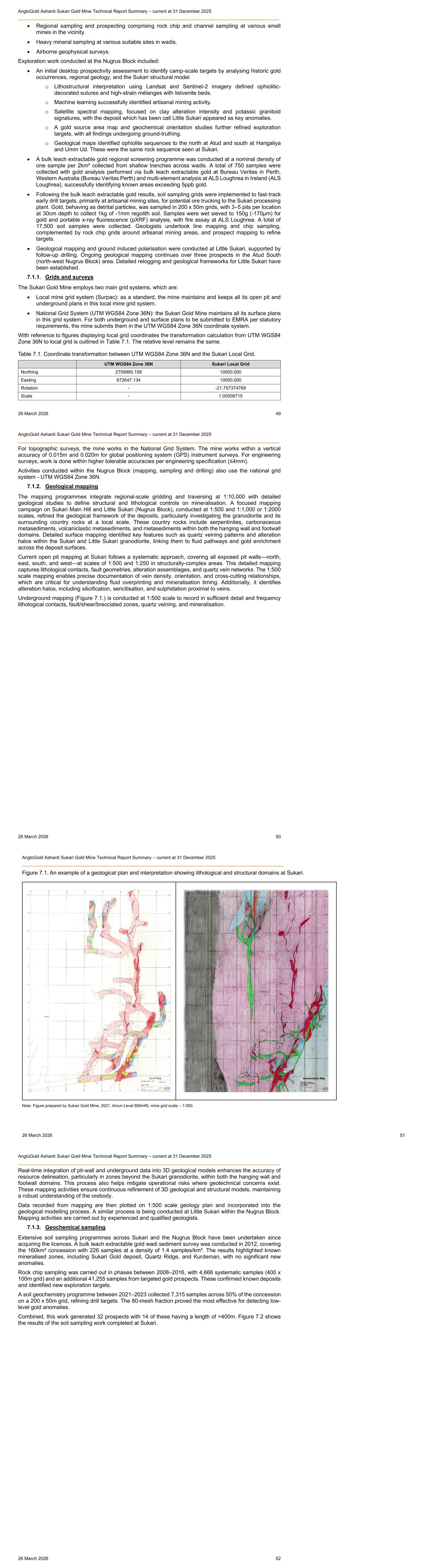
AngloGold Ashanti Sukari Gold Mine Technical Report Summary – current at 31 December 2025 _____________________________________________________________________________________ 26 March 2026 49 • Regional sampling and prospecting comprising rock chip and channel sampling at various small mines in the vicinity. • Heavy mineral sampling at various suitable sites in wadis. • Airborne geophysical surveys. Exploration work conducted at the Nugrus Block included: • An initial desktop prospectivity assessment to identify camp-scale targets by analysing historic gold occurrences, regional geology, and the Sukari structural model. o Lithostructural interpretation using Landsat and Sentinel-2 imagery defined ophiolitic- decorated sutures and high-strain mélanges with listvenite beds. o Machine learning successfully identified artisanal mining activity. o Satellite spectral mapping, focused on clay alteration intensity and potassic granitoid signatures, with the deposit which has been call Little Sukari appeared as key anomalies. o A gold source area map and geochemical orientation studies further refined exploration targets, with all findings undergoing ground-truthing. o Geological maps identified ophiolite sequences to the north at Atud and south at Hangaliya and Umm Ud. These were the same rock sequence seen at Sukari. • A bulk leach extractable gold regional screening programme was conducted at a nominal density of one sample per 2km² collected from shallow trenches across wadis. A total of 750 samples were collected with gold analysis performed via bulk leach extractable gold at Bureau Veritas in Perth, Western Australia (Bureau Veritas Perth) and multi-element analysis at ALS Loughrea in Ireland (ALS Loughrea), successfully identifying known areas exceeding 5ppb gold. • Following the bulk leach extractable gold results, soil sampling grids were implemented to fast-track early drill targets, primarily at artisanal mining sites, for potential ore trucking to the Sukari processing plant. Gold, behaving as detrital particles, was sampled in 200 x 50m grids, with 3–5 pits per location at 30cm depth to collect 1kg of -1mm regolith soil. Samples were wet sieved to 150g (-170µm) for gold and portable x-ray fluorescence (pXRF) analysis, with fire assay at ALS Loughrea. A total of 17,500 soil samples were collected. Geologists undertook line mapping and chip sampling, complemented by rock chip grids around artisanal mining areas, and prospect mapping to refine targets. • Geological mapping and ground induced polarisation were conducted at Little Sukari, supported by follow-up drilling. Ongoing geological mapping continues over three prospects in the Atud South (north-west Nugrus Block) area. Detailed relogging and geological frameworks for Little Sukari have been established. 7.1.1. Grids and surveys The Sukari Gold Mine employs two main grid systems, which are: • Local mine grid system (Surpac): as a standard, the mine maintains and keeps all its open pit and underground plans in this local mine grid system. • National Grid System (UTM WGS84 Zone 36N): the Sukari Gold Mine maintains all its surface plans in this grid system. For both underground and surface plans to be submitted to EMRA per statutory requirements, the mine submits them in the UTM WGS84 Zone 36N coordinate system. With reference to figures displaying local grid coordinates the transformation calculation from UTM WGS84 Zone 36N to local grid is outlined in Table 7.1. The relative level remains the same. Table 7.1. Coordinate transformation between UTM WGS84 Zone 36N and the Sukari Local Grid. UTM WGS84 Zone 36N Sukari Local Grid Northing 2759995.158 10000.000 Easting 672647.134 10000.000 Rotation - -21.757374769 Scale - 1.00008715 AngloGold Ashanti Sukari Gold Mine Technical Report Summary – current at 31 December 2025 _____________________________________________________________________________________ 26 March 2026 50 For topographic surveys, the mine works in the National Grid System. The mine works within a vertical accuracy of 0.015m and 0.020m for global positioning system (GPS) instrument surveys. For engineering surveys, work is done within higher tolerable accuracies per engineering specification (≤4mm). Activities conducted within the Nugrus Block (mapping, sampling and drilling) also use the national grid system - UTM WGS84 Zone 36N. 7.1.2. Geological mapping The mapping programmes integrate regional-scale gridding and traversing at 1:10,000 with detailed geological studies to define structural and lithological controls on mineralisation. A focused mapping campaign on Sukari Main Hill and Little Sukari (Nugrus Block), conducted at 1:500 and 1:1,000 or 1:2000 scales, refined the geological framework of the deposits, particularly investigating the granodiorite and its surrounding country rocks at a local scale. These country rocks include serpentinites, carbonaceous metasediments, volcaniclastic metasediments, and metasediments within both the hanging wall and footwall domains. Detailed surface mapping identified key features such as quartz veining patterns and alteration halos within the Sukari and Little Sukari granodiorite, linking them to fluid pathways and gold enrichment across the deposit surfaces. Current open pit mapping at Sukari follows a systematic approach, covering all exposed pit walls—north, east, south, and west—at scales of 1:500 and 1:250 in structurally-complex areas. This detailed mapping captures lithological contacts, fault geometries, alteration assemblages, and quartz vein networks. The 1:500 scale mapping enables precise documentation of vein density, orientation, and cross-cutting relationships, which are critical for understanding fluid overprinting and mineralisation timing. Additionally, it identifies alteration halos, including silicification, sericitisation, and sulphidation proximal to veins. Underground mapping (Figure 7.1.) is conducted at 1:500 scale to record in sufficient detail and frequency lithological contacts, fault/shear/brecciated zones, quartz veining, and mineralisation. AngloGold Ashanti Sukari Gold Mine Technical Report Summary – current at 31 December 2025 _____________________________________________________________________________________ 26 March 2026 51 Figure 7.1. An example of a geological plan and interpretation showing lithological and structural domains at Sukari. Note: Figure prepared by Sukari Gold Mine, 2021. Amun Level 800mRL mine grid scale – 1:500. AngloGold Ashanti Sukari Gold Mine Technical Report Summary – current at 31 December 2025 _____________________________________________________________________________________ 26 March 2026 52 Real-time integration of pit-wall and underground data into 3D geological models enhances the accuracy of resource delineation, particularly in zones beyond the Sukari granodiorite, within both the hanging wall and footwall domains. This process also helps mitigate operational risks where geotechnical concerns exist. These mapping activities ensure continuous refinement of 3D geological and structural models, maintaining a robust understanding of the orebody. Data recorded from mapping are then plotted on 1:500 scale geology plan and incorporated into the geological modelling process. A similar process is being conducted at Little Sukari within the Nugrus Block. Mapping activities are carried out by experienced and qualified geologists. 7.1.3. Geochemical sampling Extensive soil sampling programmes across Sukari and the Nugrus Block have been undertaken since acquiring the licences. A bulk leach extractable gold wadi sediment survey was conducted in 2012, covering the 160km² concession with 226 samples at a density of 1.4 samples/km². The results highlighted known mineralised zones, including Sukari Gold deposit, Quartz Ridge, and Kurdeman, with no significant new anomalies. Rock chip sampling was carried out in phases between 2008–2016, with 4,666 systematic samples (400 x 100m grid) and an additional 41,255 samples from targeted gold prospects. These confirmed known deposits and identified new exploration targets. A soil geochemistry programme between 2021–2023 collected 7,315 samples across 50% of the concession on a 200 x 50m grid, refining drill targets. The 80-mesh fraction proved the most effective for detecting low- level gold anomalies. Combined, this work generated 32 prospects with 14 of these having a length of >400m. Figure 7.2 shows the results of the soil sampling work completed at Sukari.

AngloGold Ashanti Sukari Gold Mine Technical Report Summary – current at 31 December 2025 _____________________________________________________________________________________ 26 March 2026 53 Figure 7.2. Sukari licence, soil sampling results. Note: Figure prepared by Sukari Gold Mine, 2022. ppm: parts per million. Exploration activities at the Nugrus Block started in Q2 2022 with a bulk leach extractable gold regional screening programme designed to rapidly distinguish between barren and mineralised zones. Sampling was conducted at a density of one sample per 2km². A total of 741 bulk leach extractable gold samples were collected from shallow trenches (30–40cm deep, 10–12m long) across wadi systems. The samples were wet sieved using a nylon mesh, and ultrafine material was separated and dried to produce a 150g fraction, which was then analysed for gold at Bureau Veritas, Perth and for multi-element geochemistry at ALS Loughrea, Ireland. Results from the bulk leach extractable gold programme successfully delineated key mineralised corridors, guiding the next phase of geochemical sampling. Following the bulk leach extractable gold results, a systematic soil sampling programme was conducted on a 200 x 50m grid, targeting key bulk leach extractable gold anomalies and potential drill targets. A total of 18,257 soil samples were collected, focusing on weathered rock environments where gold behaves as detrital particles and accumulates at the base of slopes. Field sampling involved collecting 1kg of -1mm fraction AngloGold Ashanti Sukari Gold Mine Technical Report Summary – current at 31 December 2025 _____________________________________________________________________________________ 26 March 2026 54 material, with further wet sieving to obtain a 150g -170µm (80#) sample for gold analysis (fire assay at ALS, Ireland) and pXRF multi-element testing. This approach provided improved grade discrimination at lower gold concentrations. In parallel, 3,066 rock chip samples were taken from artisanal workings and mapped prospects, further refining exploration models. This extensive geochemical programme identified eight high-priority drill targets, leading to the beginning of the initial drill testing programme in May 2023. The integration of bulk leach extractable gold and soil geochemistry with rock chip mapping successfully highlighted mineralised zones with gold concentrations exceeding 5ppb (Figure 7.3). Figure 7.3. Soil sampling programme at Nugrus Block with drill targets outlined. Note: Figure prepared by EDX, 2024. Green lines show highlight prospective ophiolite sequence; ppb: parts per billion. 7.1.4. Geophysical surveys An airborne geophysical survey, covering the entire 160km2 Sukari mining concession area, was completed during Q2 2022. The heliborne survey combined versatile time-domain electromagnetic, magnetic and radiometric techniques, flown at 100m line spacing. The programme was designed to further the understanding of the geological and structural setting of the Sukari mineralised system itself as well as the numerous gold prospects across the concession area. Figure 7.4 shows the flight lines of the versatile time-domain electromagnetic survey which further defined the arcuate nature of the Sukari mineralised corridor, supporting the soil geochemistry results presented in Figure 7.2. AngloGold Ashanti Sukari Gold Mine Technical Report Summary – current at 31 December 2025 _____________________________________________________________________________________ 26 March 2026 55 Figure 7.4. Airborne geophysics flight lines, Sukari licence. Note: Figure prepared by Geotech, 2022. In April 2024, a ground induced polarisation and magnetic survey was conducted along Little Sukari, covering an area of 1.3km x 1.2km. The primary objective of the induced polarisation survey was to delineate zones of high chargeability, potentially indicating the dissemination of sulphides associated with gold mineralisation. The survey identified a significant chargeability anomaly to the southwest of Little Sukari, linked to extensive carbonate-silica alteration resulting from metasomatic processes. In the northern and northwestern parts of the survey area, a high resistivity anomaly was detected, attributed to intense silicification and carbonisation. The induced polarisation survey was conducted using a pole-dipole configuration at 50m x 50m spacing, achieving a depth of investigation between 200 and 250m. The ground magnetic survey, conducted over the same area, proved valuable in identifying key structural features, including faults, folds, and linear ligaments. These structures are significant as they provide important contrasts related to mineralisation within the Little Sukari area. 7.1.5. Petrology, mineralogy, and research studies Several petrological, mineralogical, and research studies were conducted on the Sukari Gold Mine and Nugrus Block. Between 2006 and 2008, Dr. A.I. Arslan and Dr. K.I. Khalil from Alexandria University completed extensive petrological and mineralogical investigations. Earlier studies were conducted between 2000 and 2001 by J.E. Borner from Mintek Services. More recently, AMTEL Ltd. completed deportment studies in 2014, 2016, and 2020, further refining the understanding of Sukari’s mineralogy and gold deportment. While significant research has been conducted by Egyptian universities, with findings published in recognised journals, a PhD study is currently underway at the University of Western Australia’s Centre for Targeting. Supervised by Dr. Steffen Hagemann, this research aims to further advance the understanding of Sukari’s geology and mineralisation, with completion expected in September 2027. Petrographic studies were conducted on all formations defined at Little Sukari within the Nugrus Block to support lithological classification. Nineteen samples were collected from various lithologies, including diorites, granodiorites, mafic dykes, ultramafic serpentinites, and sheared meta-sediments. The study was carried out by EDX geologist Ahmed Yosief, with thin section preparation completed by the University of Cairo. 7.1.6. Exploration potential Exploration at Sukari is currently focussed on defining targets close to existing infrastructure (within 10km), while also continuing to test the depth and strike extents of the known mineralisation (Figure 7.5). AngloGold Ashanti Sukari Gold Mine Technical Report Summary – current at 31 December 2025 _____________________________________________________________________________________ 26 March 2026 56 Figure 7.5. Sukari licence target generation map. Note: Figure prepared by Sukari Gold Mine, 2022. Drilling within the mining concession is focused on identifying satellite deposits with specified tonnage and grade criteria to potentially enhance flexibility in the LOM plan. A total of 18 targets were drill-tested across the concession, with 50% warranting follow-up drilling. Results from six prospects were justified further infill drilling and metallurgical testwork. However, this work did not support the internal tonnage and grade criteria for additional studies, and no additional work is planned for these six areas. Systematic exploration across the Nugrus Block has revealed strong potential for gold mineralisation. Initial work, including satellite imagery interpretation, mineral mapping, mapping of artisanal mining sites, geological mapping, bulk leach extractable gold sampling, and soil geochemistry, collectively defined eight priority drill targets within the Nugrus Block. Given its proximity to the Sukari mining concession, the Nugrus Block was prioritised for exploration in Q2 2022. There is potential to use Sukari processing infrastructure, subject to agreement with EMRA, to process any mineralisation discovered in the area.

AngloGold Ashanti Sukari Gold Mine Technical Report Summary – current at 31 December 2025 _____________________________________________________________________________________ 26 March 2026 57 Little Sukari is situated roughly 28km west of the Sukari Gold Mine and was tested by two drilling campaigns (RC and DD) completed in 2023 and 2024. Located 5km southeast of Little Sukari, the Umm Majal prospect hosts gold mineralisation within an altered granitoid, distinct from the host rocks at Little Sukari but still occurring within a similar ophiolitic mélange sequence. Mineralisation extends over a 200–250m strike length, with mineralised zones up to 20m wide. Initial shallow drilling confirmed gold mineralisation to depths of 30-40m below surface, with the mineralisation remaining open down dip. 7.1.7. Near-mine surface exploration A map showing the principal near-mine prospects at Sukari is shown in Figure 7.6. Figure 7.6. Worked prospects within the Sukari concession. Note: Figure prepared by Sukari Gold Mine, 2024. AngloGold Ashanti Sukari Gold Mine Technical Report Summary – current at 31 December 2025 _____________________________________________________________________________________ 26 March 2026 58 7.2. Drilling Sukari Gold Mine uses a combination of RC and DD. At Sukari, drilling started in April 1997 and is ongoing at the Report current date. Current at 31st December, 2025, the Sukari drill hole database comprised 100,719 drill holes for 4,697,582m of drilling. No historic drilling has been recorded prior to drilling undertaken by Sukari Gold Mine. A summary of drilling by type and year for Sukari is provided in Table 7.2. Table 7.2. Sukari drilling summary current at 31 December 2025. Year Diamond drill Reverse circulation RC Collar + DD Tail Holes Metres Holes Metres Holes Metres 1997 59 8,694 - - - - 1998 56 7,675 - - - - 1999 54 6,122 - - - - 2000 31 4,340 - - - - 2001 57 8,189 - - - - 2002 54 12,586 21 2,380 10 3,396 2003 29 8,046 6,957 245,391 - - 2004 395 9,778 6 185 - - 2005 83 16,926 9 1,086 58 21,992 2006 74 13,656 60 6,729 214 74,463 2007 116 31,807 668 51,504 55 22,939 2008 133 52,766 712 16,104 9 4,283 2009 116 56,674 6,618 111,475 - - 2010 137 67,051 6,940 145,269 - - 2011 390 73,965 6,622 131,920 - - 2012 363 74,406 4,806 122,477 - - 2013 452 77,654 6,263 219,344 1 521 2014 618 77,273 3,109 130,506 - - 2015 733 78,456 3,255 121,007 - - 2016 619 76,290 2,611 121,259 - - 2017 571 75,854 4,198 184,659 - - 2018 513 74,939 5,779 222,541 - - 2019 870 88,445 4,616 170,946 1 174 2020 327 79,056 4,702 162,044 - - 2021 399 96,082 3,899 151,696 - - 2022 372 70,123 3,919 150,758 1 155 2023 623 100,474 5,776 215,560 10 754 2024 706 102,203 6,707 242,725 - - 2025 503 71,227.3 3654 169,502.5 - - Total 9,453 1,520,757.3 91907 3,097,067.5 359 128,677 Note: RC: reverse circulation; DD: diamond drilling. Figure 7.7 displays all the types of surface drilling that has been performed since 1997. AngloGold Ashanti Sukari Gold Mine Technical Report Summary – current at 31 December 2025 _____________________________________________________________________________________ 26 March 2026 59 Figure 7.7. Sukari drill hole plan. Note: Figure prepared by Sukari Gold Mine, 2025. Drilling at the Nugrus Block began in Q3 2023 with two phases completed. No drilling was undertaken in 2025. A summary of drilling by type and year for the Nugrus Block is provided in Table 7.3. AngloGold Ashanti Sukari Gold Mine Technical Report Summary – current at 31 December 2025 _____________________________________________________________________________________ 26 March 2026 60 Table 7.3. Nugrus Block drilling summary current at 31 December 2025. Year Prospect Diamond drill Reverse circulation RC Collar + DD Tail Holes Metres Holes Metres Holes Metres 2023 Wadi Kiribi - - 24 3,361 - - Jebel Rabdi - - 16 1,943 - - Ambaud South - - 9 1,380 - - Ambaud North - - 8 1,137 - - Little Sukari - - 29 4,793 - - Umm Majal - - 12 870 - - Wadi Marwah - - 13 1,710 - - Umm Shaw - - 7 1,022 - - 2024 Little Sukari 22 5,744 42 11,622 17 7,152 Total 22 5,744 160 27,838 17 7,152 Note: RC: reverse circulation; DD: diamond drilling. The drill hole plan for Nugrus Block is shown in Figure 7.8. Figure 7.8. Nugrus Block drill hole plan. Note: Figure prepared by EDX, 2024. 7.2.1. Drilling techniques and spacing Drill contractors up to the Report’s effective date have included Barminco Australia, Capital Drilling, and Geodrill.

AngloGold Ashanti Sukari Gold Mine Technical Report Summary – current at 31 December 2025 _____________________________________________________________________________________ 26 March 2026 61 Drilling operations were completed by a range of DD, multi-purpose, and RC drill rigs. Programmes have mainly been executed using Atlas Copco (252, 262, CS14, CS3001, CS1000), Boart Longyear (LM90, LMP850), Epiroc (Explorac 235 and 100) and Newland Erubus (MCR) rigs. Most of the underground core was NQ2 (47.6mm core diameter) size and orientated using a Reflex EZ-Trac digital core orientation tool. The DD hole core size used for surface exploration is HQ (61.1mm core diameter) and NQ2. Exploration RC holes were drilled using 114mm diameter rods with a 140mm (5.5”) face‐sampling bit and 146 casing bits. 2025 grade control RC holes were drilled using 146 mm diameter rods with a 5.5-inch face‐ sampling bit. A drill spacing of 48mE x 72mN is used for the open pit, and a spacing of 50mE x 100mN is used for surface and underground exploration. Drill coverage extends to approximately 1500m below surface at Sukari and 200m at satellite prospects. Drilling is orientated to ensure that drill intersections are as close to perpendicular with mineralisation as technically possible. In the open pit, drilling is oriented east-west perpendicular to mineralisation strike, whilst the drill hole dip is steep to sub-vertical (except at the edges of the pit). The underground drilling is mostly fan drilling, with the majority orientated east to west and drilled over a broad range of hole dips. 7.2.2. Logging DD core is geologically logged and includes weathering, veining, mineralisation, alteration, lithology, and structure onto paper logging templates. The paper logs are transcribed into the central database using a digital data entry template after verification. Tablets were introduced in 2022 for logging. The core is photographed both wet and dry before sampling. RC chip samples are logged with the same lithological, weathering, veining, mineralogical, and alteration information as DD core. 7.2.3. Recovery Drill sample recovery is captured for both DD and RC drilling. Core recovery (by length) is measured during logging, with core loss marked out clearly. RC sample recovery is measured by weighing the total weight of sample collected over the sample interval drilled and compared to the theoretical weight for each lithological unit and weathering type. A 2015 review of all prior drilling of the Sukari deposit showed average core recovery of 94.7% and RC recovery of 86%. More recent checks of 2025 data found average core recovery of 99% and RC recovery of 88%. Whilst there are intervals of low recovery, no correlation exists between gold grade and drill sample recovery for either drilling type. No drilling, sampling, or recovery factors have been applied to the Sukari drill hole data. 7.2.4. Collar surveys Surface collar location is measured with high accuracy Trimble GPS with an accuracy of 10mm. Underground drill collars are surveyed using a Leica total station instrument. 7.2.5. Downhole surveys Downhole survey is carried out using both Reflex EZ-Trac and conventional gyroscopic instruments. The downhole survey is ranked in terms of priority where the gyroscopic results are the top priority, and the design directions are the bottom priority. Downhole survey equipment is checked weekly in a designated testing frame, calibrated annually, and checked every quarter by qualified technicians from the supplier. Coordinate system conversion is automated within the drill hole database. 7.2.6. Condemnation, geotechnical and hydrogeological drilling Detailed geotechnical logging is performed on holes drilled specifically for geotechnical assessment as required for projects, however the Mineral Resource DD holes still capture some geo-mechanical parameters AngloGold Ashanti Sukari Gold Mine Technical Report Summary – current at 31 December 2025 _____________________________________________________________________________________ 26 March 2026 62 such as rock quality designation and fracture frequency for each logged metre. Refer to Chapter 7.4. for more detail on geotechnical testing and analysis. Hydrogeological drilling focuses on installing piezometers around the operation to monitor water and particle movement, as well as depressurisation holes to control water accumulation behind the pit walls. Several regional structures influence the hydrogeological characteristics, leading to the compartmentalisation of groundwater within the wall rocks. Refer to Chapter 7.3. for more detail on hydrogeological sampling methods and results. Sterilisation drilling is carried out within the operation to assess areas designated for infrastructure. This includes drilling in the processing and TSF areas before and during operations for TSF #2, the solar farm, and, more recently, the northern Dump Leach 3 area (Figure 7.9). Figure 7.9. Sterilisation drill holes within the planned Dump Leach 3 area. Note: Figure prepared by Sukari Gold Mine, 2024. Sterilisation drilling at the Dump Leach 3 footprint area was conducted to assess the suitability of the site for infrastructure development. The area is situated in low-lying terrain between the eastern contact of the ophiolitic mélange and the Arc prospect to the east, with the northern dump located to the west. Arc is a historical exploration prospect situated approximately 1.7 km northeast of the Sukari open pit, bounded to the west by the northern waste dump. Lithological mapping indicates that the region is primarily composed of mélange-related graphite schists, which host isolated rootless boudins of gabbro and serpentinite, along with recent wadi deposits. Structurally, the dominant trends include north-northeast-trending transpressional shear zones, which reflect the flow of the mélange, as well as more recent extensional deformation features associated with the relaxation of the system. Drilling activities were carried out in two phases. The first phase, conducted in 2018, focused on sterilising the solar panel option and involved the drilling of 32 RC boreholes, totalling 1,310m. These holes overlapped with the Dump Leach 3 footprint and encountered small boudins of mafic and serpentinite within a background of metasediments and graphite schists. The second phase, completed in 2024, included three RC boreholes with a total drilled depth of 300m. This phase encountered similar lithological units as the first phase, along with clasts of listvenites and granites likely derived from the proximal Arc prospect units. Both drilling phases confirmed the absence of economically significant mineralisation, confirming that the area is suitable for infrastructure development. 7.2.7. Metallurgical drilling Annual geometallurgical testwork is conducted to mitigate risks associated with future optimal ore extraction over the LOM from stoping and end of period surfaces across the orebody, adopting a long-term predictive AngloGold Ashanti Sukari Gold Mine Technical Report Summary – current at 31 December 2025 _____________________________________________________________________________________ 26 March 2026 63 approach. A comprehensive geometallurgical testwork gap analysis is carried out over the LOM to identify key focus areas for the next 12 months, ensuring adequate spatial coverage of various geometallurgical variables, including recoveries, multi-element analysis, comminution test variables, and gold deportment studies. As part of the annual geometallurgical test framework, at least 10 samples from both underground and open pit areas are analysed each month. The expansion of mills and increased throughput occasionally necessitate additional advanced tests, such as comminution testing, with the most recent conducted in 2024 in no-depletion areas. These tests, which include cores, chips, and stope samples, are spatially referenced, and their results are incorporated into the Mineral Resource model. The process also includes short-term geometallurgical testwork on stockpiles to predict feed responses. Additionally, the metallurgical laboratory periodically conducts production metallurgical testwork on the most plausible blending scenarios over a defined feed period. Plant feed samples, collected after the mill circuit for better representation, are used alongside ROM stockpile samples provided by the geologists for plant simulation tests as part of an ongoing optimisation process. 7.2.8. Grade control drilling Grade control drilling is used to refine production boundaries and support advanced resource development. The programme is designed to provide high-resolution geological and grade data necessary for short-term mine planning and resource estimation. The drill spacing and methodology are optimised based on the deposit's continuity and the specific mining environment: • Open pit RC: Standard production definition is performed via RC drilling on a 6mE x 8mN or 8mE x 12mN grid. For broader geological definition and early-stage planning, a expanded spacing of 24mE x 36mN is used. • Underground RC: High-density definition for active stoping areas is conducted using RC drilling at a 10m x 10m spacing. • Underground DD: To achieve higher geological confidence and structural detail, diamond core drilling is conducted at spacings of 10mE x 20mN to 10mE x 25mN. Regional or broader geological definition underground is maintained at a 25mE x 50mN spacing. 7.2.9. Drill hole spacing The details of the average drill hole spacing and type of drilling in relation to the Mineral Resource classification, is summarised in Table 7.4. Table 7.4. Drill hole spacing and drill hole type in relation to Mineral Resource classification. Category Spacing (metres) Type of drilling Diamond Reverse circulation Measured 15x25 30x30 Yes Yes Indicated 25x50 45x45 Yes Yes Inferred 50x80 60x60 Yes Yes Grade/ore control 10x10 10x20 8x12 Yes Yes 7.2.10. Sample length/true thickness The reported drill intercepts represent apparent thicknesses. The mineralisation exhibits varying dips and orientations but predominantly features a steep north-south strike. Drill holes are generally designed to intersect the mineralisation at 90° where possible. The relationship between sample length and true thickness is well-constrained to approximate, depending on drill site availability and mineralisation orientation. True thickness is estimated to range between 65% and 75% of the drilled length. Drill hole planning considers the orebody geometry to maximise perpendicular intersections. However, underground drilling is often constrained by site availability, leading to a "fan" drilling approach that may not always achieve optimal intersections. AngloGold Ashanti Sukari Gold Mine Technical Report Summary – current at 31 December 2025 _____________________________________________________________________________________ 26 March 2026 64 All drill holes are surveyed, ensuring intersection angles are known, and true widths can be estimated accordingly. The actual true width depends on the inclination and direction of the hole at the point of intersection with the mineralised zone. 7.2.11. Results In the opinion of the Qualified Person, the quantity and quality of the logged geological and geotechnical data, collar and downhole survey data collected in the exploration and infill drill programmes on the mine are sufficient to support Mineral Resource and Mineral Reserve estimation and mine planning for the following reasons: • Drilling procedures, core and RC logging meets industry standards for gold exploration. • Collar surveys have been performed using industry standard instrumentation. • Downhole surveys were collected at the time of the programmes using industry standard instrumentation. • Recovery data from core and RC drill programmes are acceptable. • Drill orientations are appropriate for the mineralisation style and are optimal for the orientation of the mineralisation for the bulk of the deposit area. • Drilling intervals have been regularly spaced and considered adequate and representative of the deposits. Drilling was not specifically targeted to the high-grade portions of the deposits, rather a relatively consistent drill spacing was completed. No material factors were identified with the data collection from the drill programmes that could affect Mineral Resource or Mineral Reserve estimation. 7.3. Hydrogeology 7.3.1. Nature and quality of sampling methods Hydrogeological drilling at Sukari is designed to install piezometers for monitoring water and particle movement, as well as depressurisation holes to control water accumulation behind pit walls. The drilling programme follows industry-standard hydrogeological techniques, ensuring representative sampling of groundwater conditions. Sampling is conducted at varying depths, with piezometers placed at strategic locations to track changes in water pressure and flow over time. The collected samples are analysed for water quality, hydrochemical properties, and potential contaminants, ensuring a comprehensive understanding of groundwater behaviour. In addition, hydrogeological core samples are extracted and logged to evaluate lithological and structural controls on groundwater flow. The core samples are assessed for permeability, porosity, and fracture density, providing essential data for the mine’s dewatering strategy. Field observations, including water strike levels and inflow rates, are systematically recorded to correlate with laboratory results and numerical models. 7.3.2. Type and appropriateness of laboratory techniques A range of laboratory techniques are employed to analyse rock and groundwater properties, ensuring that data meets the required accuracy and precision for geotechnical and hydrogeological modelling. Key laboratory tests include: • Hydraulic conductivity testing: conducted on selected core samples using permeameters to measure fluid movement through rock units, essential for assessing dewatering potential. • Pore pressure monitoring: utilises vibrating wire piezometers to track pressure variations within pit walls and underground workings, allowing for real-time stability assessment. • Geochemical analysis: water samples undergo laboratory testing for pH, total dissolved solids, major cations and anions, and trace elements, helping determine water-rock interaction and potential contamination. • Rock strength testing: since 2006, extensive mechanical testing has been conducted, including: o 765 uniaxial compressive strength tests to determine rock integrity. o 499 tensile strength tests to assess material response to stress. o 712 modulus tests to evaluate rock elasticity and deformation behaviour.

AngloGold Ashanti Sukari Gold Mine Technical Report Summary – current at 31 December 2025 _____________________________________________________________________________________ 26 March 2026 65 o 509 triaxial tests to establish shear strength parameters under varying confinement conditions. o 128 direct shear tests to obtain the cohesion and friction angle of certain structures These tests provide reliable input data for geotechnical stability analysis, supporting slope design and mine planning in accordance with the Read and Stacey guidelines. 7.3.3. Results Hydrogeological studies confirm that the wall rocks exhibit low permeability, with groundwater compartmentalised by regional structural features such as the Sukari thrust, Puggy shear, and major fault zones. Groundwater recharge occurs episodically through wadi sediments, with minor seepage observed along faults and geological contacts. Despite the presence of underground workings beneath the open pit, no significant drawdown has been recorded in the pit walls due to the impermeable nature of the host rock. The geotechnical analysis indicates that intact rock strength varies between 32MPa (graphite schist) and 85MPa (granodiorite), reflecting the diverse lithological units present. Numerical modelling, incorporating both static and dynamic conditions, confirms that pit slope stability remains within acceptable factors of safety. However, localised zones with high pore-water pressure, particularly in structural features like the Sukari thrust and Puggy shear zones, may require targeted depressurisation using horizontal drill holes extending up to 150m behind the pit walls. Groundwater inflows to the open pit and underground workings remain low, generally <5L/s and <2L/s respectively, as reported by SRK (2022). These inflows are effectively managed using sump collection and localised dewatering. The findings suggest that while the hydraulic gradient between bedrock groundwater and the pit base exists, connectivity remains limited due to structural compartmentalisation. Continued monitoring via installed piezometers will ensure that hydrogeological models remain updated, guiding future depressurisation efforts and slope design modifications as mining progresses. 7.3.4. Qualified Person(s) interpretation The hydrogeological investigations at Sukari confirm that groundwater flow is largely controlled by regional structural features, with limited permeability in the wall rocks leading to compartmentalisation of groundwater. Episodic recharge through wadi sediments contributes to localised inflows, but overall groundwater inflow rates remain low (<5L/s in the open pit and <2L/s in the underground workings). Laboratory analyses of rock strength and permeability indicate that pit slope stability is within acceptable safety factors, though localised zones of elevated pore-water pressure, particularly within shear zones, may require targeted depressurisation through horizontal drilling. The numerical modelling results align with field observations, supporting the continued use of dewatering infrastructure and piezometer monitoring to refine hydrogeological models. Based on current data, no significant impact from underground workings on pit wall draw-down has been observed, and seepage inflows remain manageable within existing sump storage capacity. Ongoing monitoring will be essential to assess any changes as mining progresses, ensuring proactive adjustments to dewatering and slope stability management strategies. 7.4. Geotechnical testing and analysis 7.4.1. Nature and quality of sampling methods The sampling methods for both underground and open pit mining at Sukari Gold Mine are comprehensive and adhere to industry best practices. In the open pit, DD was conducted with 12 geotechnical holes totalling 3,660m from 2024 to 2025. Rock mass classification follows the RMR89, GSI, and Q-prime systems, with core samples sent to a Cairo laboratory for uniaxial compressive strength, Poisson’s ratio, Young’s modulus, unit weight, and triaxial testing. Geotechnical monitoring involves prisms, Interferometric Synthetic Aperture Radar, mine survey radars, sloughmeters, and time-domain reflectometers to detect ground movement and void propagation. Hydrogeological assessments show low permeability rock with compartmentalised groundwater influenced by geological structures, with depressurisation drilling in the southwest to manage seepage. Post-blast inspections ensure pit wall integrity, while 2D and 3D limit equilibrium stability analyses help in risk mitigation. For the underground mine, the 2025 drilling programme included 762 DD holes, covering 90,120m, with >50 geotechnical drill holes specifically targeting structural zones such as Puggy Shear and Buthinae Fault. Additionally, 1,549m were logged from the grade control drilling programme for Bast underground, and used AngloGold Ashanti Sukari Gold Mine Technical Report Summary – current at 31 December 2025 _____________________________________________________________________________________ 26 March 2026 66 for advanced development design approval. Advance geotechnical DD is used to cover proposed development infrastructure and stopes in the underground, to improve the robustness of the mine planning process. A total of 13,500m of drilling is planned for Ptah and Ptah-keel, and 4,650m is planned for Bast. Rock mass characterisation follows rock mass rating of RMR89, geological strength index, and Q-prime systems, with extensive core logging and mapping. Ground control methods include a combination of friction bolts, Kinloc bolts, dynamic bolts, mesh, fibrecrete, and Osro straps, with additional spiling and shotcrete arch ribs in weak zones. Numerical modelling using RS3 and Map3D software assesses stress distribution, with major principal stress analysis identifying areas of potential strain bursts. Hydrogeological monitoring includes vibrating wire piezometers and micro-seismic systems, and the paste backfill system helps mitigate void migration risks. Overall, the sampling methods at Sukari are rigorous and data-driven, ensuring robust geotechnical design, stability assessments, and risk mitigation. The integration of advanced monitoring, laboratory testing, and numerical modelling supports both short-term operational safety and long-term mine planning. 7.4.2. Type and appropriateness of laboratory techniques Laboratory testing for both open pit and underground geotechnical investigations at Sukari Gold Mine follows industry-standard methodologies to characterise rock mass properties. Core samples are collected from DD and sent to a Cairo-based laboratory for uniaxial compressive strength, Poisson’s ratio, Young’s modulus, unit weight, and triaxial strength testing. Uniaxial compressive strength testing provides direct strength measurements, while triaxial tests determine shear strength parameters under different confinement conditions, aiding in rock mass stability assessments. Point load tests are used as a rapid method to assess rock strength, particularly for weak zones such as shear-hosted mineralisation. Additionally, acoustic televiewer logging allows for high-resolution structural analysis, improving the accuracy of geotechnical domain modelling. These techniques are appropriate for assessing both competent and weak rock formations, with triaxial and uniaxial compressive strength tests particularly crucial for determining pit slope and underground pillar stability. In situ stress measurement testing using the over coring method (CSIRO HI Cell) for three testing sites underground at Sukari was conducted in July 2025 for the underground to validate previous stress studies. Findings will be incorporated into the 2026 LOM numerical modelling. All the tests conducted are appropriate for gathering geotechnical data which in turn will aid into rock mass classification, potential failure mode prediction, geotechnical domaining, geotechnical designs and numerical modelling. 7.4.3. Results The laboratory results confirm variable rock mass quality across both the open pit and underground operations. High-strength units, such as granodiorite and gabbro, show uniaxial compressive strength values exceeding 100MPa, with moderate deformation characteristics. In contrast, shear zones, serpentinite, and black shale units exhibit significantly lower uniaxial compressive strength values, often below 40MPa, with higher deformability and fracture persistence. Young’s modulus values vary according to rock type, with competent units such as porphyry displaying higher stiffness, while weathered sediments and altered zones show lower modulus values indicative of weaker ground conditions. Hydrogeological assessments indicate low overall permeability, with some localised water ingress associated with faults and shear zones, particularly in the southwest pit wall and some underground stope abutments. Numerical modelling results, incorporating laboratory test data, highlight localised zones of potential failure in faulted or highly altered rock domains, guiding ground support and depressurisation strategies. 7.4.4. Qualified Person(s) interpretation The geotechnical and geomechanical assessment indicates that the Sukari deposit consists of a mix of high- strength competent rock and structurally complex weaker zones, requiring a multi-faceted ground control strategy. The Qualified Person interprets the results as confirming the feasibility of current pit and underground designs, provided adequate ground support and depressurisation measures are maintained. The stronger rock units allow for steep inter-ramp and overall slope angles, but localised support measures are necessary in faulted or low-strength units. In the underground mine, stress modelling results indicate manageable stress conditions, but areas near major geological structures (e.g., Puggy Shear and Osiris AngloGold Ashanti Sukari Gold Mine Technical Report Summary – current at 31 December 2025 _____________________________________________________________________________________ 26 March 2026 67 Fault) require enhanced support, including cable bolting and reinforced shotcrete. The integration of laboratory test results, in situ monitoring, and numerical modelling provides a robust geotechnical framework, supporting safe and efficient mining while mitigating risks associated with slope instability, underground stress redistribution, and void migration. 8. Sample preparation, analyses and security Diamond and RC drilling are the primary sampling methods that provide the data for the Mineral Resource estimates. Underground face sampling is also used for modelling of geological contacts and grade interpolation. Other samples such as surface grab, channel, and soil samples are collected in the early stages of exploration to assess prospectivity but are excluded from use in Mineral Resource estimation. 8.1. Sampling methods 8.1.1. Diamond drill core Drill core is placed into core boxes marked with hole ID, sequence numbering and depth interval. DD core is used for both exploration and grade control in the underground Mine. The core is cut in half using an Almonte automatic core saw. Half core samples are taken within geological units and are normally between 0.8m and 1.2m long. Half core is submitted for assay analysis whilst the other half is either submitted as a field duplicate (5% of samples) or stored for future reference. 8.1.2. RC chips All RC samples are collected through a static cone splitter attached to the cyclone. Approximately 7% of the total sample interval is split into a calico bag. The remaining bulk sample is collected and stored in large plastic bags. RC sample length varies between drill programmes including: • Exploration RC drilling with 1m intervals. • Grade control samples with 1.5m intervals (underground). • Grade control samples with 2.5m intervals (open pit). All RC drilling was carried out using face sampling hammers and rigs with large air capacity and pressure, to effectively flush samples from the hole face through the rod string and hoses. Prior to drilling and sampling each metre, the driller is instructed to clean the sample system by lifting off the bottom of hole and blowing back through the rods and cyclone to clear all sample from the previous metre. This is undertaken to minimise any potential downhole contamination. The same processes are used by EDX. 8.2. Density determinations A total of approximately 92,000 dry bulk density measurements was collected from DD core (the majority) and grab samples up to December 2025. This dataset provides good spatial coverage across the deposit and is considered representative of the range of lithologies present. To ensure the maximum integrity of the measured data, two types of certified density and weight materials are used as QA/QC standards. QA/QC samples are inserted at a rate of one in every ten samples, alternately, to monitor and validate analytical accuracy. Density samples are taken every 3m along the diamond core, with each sample tested three times to ensure accuracy, and the average value recorded. Fresh rock density measurements range from 2.00 to 3.31t/m³. Granodiorite, which hosts the majority of the gold mineralisation, has an average density of 2.76t/m³. These density values are then assigned to the block model for tonnage and ounce calculations. The same process is used by EDX. 8.3. Sample retention DD half-core samples are permanently retained and securely stored in the core farm. RC chip trays and pulp reject samples from the onsite laboratory are kept in sea containers or on covered pallets in the core yard. These storage facilities are located adjacent to the maintenance workshop, within the operational grounds, which are under 24/7 security. AngloGold Ashanti Sukari Gold Mine Technical Report Summary – current at 31 December 2025 _____________________________________________________________________________________ 26 March 2026 68 8.4. Laboratories All samples (including exploration samples) are analysed by the Sukari laboratory based at Sukari Gold Mine. The onsite laboratory is accredited with ISO/IEC 17025:2017 for general requirements for the competence of testing and calibration laboratories. The ALS Loughrea is used as an umpire laboratory, with 5% of all samples sent to ALS on a quarterly basis for check analysis. ALS Loughrea is accredited by the Irish National Accreditation Board to undertake testing as detailed in the scope bearing the registration number 173T, in conformity with ISO/IEC 17025:2017. ALS Loughrea is independent of AngloGold Ashanti. In addition to the onsite laboratory, Sukari Gold Mine has started submitting samples to MSA Laboratories (MSALABS in Marsa Alam, Egypt). MSALABS provides internationally recognised geochemical analytical services to the exploration and mining industry and has achieved ISO 9001:2015 certification. MSALABS Egypt has been formally accredited for the determination of gold concentrations in rock and soil samples in accordance with ISO/IEC 17025:2017. EDX uses ALS Marsa Alam and ALS Loughrea for all exploration sample preparation and analysis respectively. 8.5. Sample preparation Samples are bagged, sealed, numbered, and delivered to the onsite laboratory from the Sukari Gold Mine core storage facility in the case of DD samples and from the pit area in the case of RC grade control samples. A hard copy sample submission form accompanies each sample batch, and a digital copy is emailed to the laboratory. Upon receipt at the onsite laboratory, the submission is sorted and checked against the sample submission form. Any discrepancies, including missing or additional samples, are immediately communicated to the core shed geologists and the database specialist. Pulp reject samples are catalogued and stored in a dedicated container in the core yard area. These samples are retained for re-assay or umpire laboratory checks until a given area is mined out. Umpire laboratory check samples are analysed outside the mine site at MSALABS. Sukari staff and security deliver the pulp samples to ALS Marsa Alam. This facility then forwards the samples to ALS Loughrea. A duplicate of the pulp sample is sent to EMRA and kept for reference. ALS Marsa Alam organises approvals to dispatch the samples outside the country for analysis. The sample preparation procedure conducted by the Sukari laboratory involves drying, crushing to 2mm (for DD and face samples only), splitting of a 1kg sub-sample, which is then pulverised to 90% passing 75µm. 8.6. Analytical methods Various analytical methods have been employed, including those outlined in Table 8.1. Table 8.1. Analytical methods used. Technique Laboratory Analytical method Comment 1. Soils ALS Loughrea Au-ICP22 Au 50g FA ICP-AES finish; ME using pXRF Since 2021 2. Rock chip SGM site laboratory FA 30g; ME using pXRF 3. Trenching, and SGM site laboratory FA 30g 4. Exploration drilling at Sukari. SGM site laboratory/ALS Loughrea SGM Lab: FA 30g - ALS Lab: Au-ICP22 Au 50g FA ICP-AES finish; ME using pXRF ALS laboratory was used between 2021 and H1 2022. Otherwise, all the analysis was completed at the SGM site laboratory. Note: SGM: Sukari Gold Mine; Au: gold; FA: fire assay; ICP-AES: inductively coupled plasma-atomic emission spectrometry; ME: multi element; pXRF: portable x-ray fluorescence; ICP: inductively coupled plasma. Samples were typically delivered to the ALS facility in Marsa Alam (ALS Marsa Alam; e.g., EDX samples) before the pulp samples were shipped to ALS Loughrea for analysis.

AngloGold Ashanti Sukari Gold Mine Technical Report Summary – current at 31 December 2025 _____________________________________________________________________________________ 26 March 2026 69 8.6.1. Soil samples No sample preparation was conducted at ALS Marsa Alam. Once shipped to Ireland, the soil samples underwent the ROL-21 Manual Sheet Rolling process before analysis using Au-ICP22: gold 50g FA ICP-AES finish. 8.6.2. RC drilling samples Sample preparation for RC drilling was carried out at ALS Marsa Alam using the following protocol: • PREP-31B – Crushing, splitting, and pulverising a 1kg sample. • PREP-31B Weight charge – reconfirmation of sample weight before further processing. • SPLIT-Z – Splitting the pulp into two portions: o One for EMRA. o One for Sukari Gold Mine. • SPLIT-Zd – Duplicate pulp split for additional send-out. • After shipment to Ireland, the following steps were performed before analysis: o ROL-21 Manual Sheet Rolling. o Au-ICP22: gold 50g FA ICP-AES finish. If visible gold nuggets were observed, ALS Loughrea conducted further analysis using Au-GRA22: gold 50g FA-GRAV finish. 8.7. Database Geological logging data, including weathering, veining, mineralisation, alteration, lithology, and structural observations, are initially recorded on paper templates during drilling. These data are then captured and directly uploaded into the Datamine Fusion database, which operates as a relational system and incorporates all key datasets and associated metadata. Validation mechanisms are embedded within the data management system to maintain accuracy, completeness, and integrity. Automatic checks flag anomalies or outliers, prompting immediate review by the logging geologist. An additional layer of verification is performed by the on-site database administrator before data are authorised for modelling and estimation. To maintain data security, the Fusion database operates within Sukari’s secured server infrastructure, employing stringent cybersecurity protocols to prevent unauthorised access. Access control measures with passwords are strictly enforced, with only authorised personnel at different levels able to modify and or extract data, preserving data integrity and security. The entire database is backed up daily and stored on the Sukari Gold Mine server, which is also backed up weekly, ensuring backup and recovery capabilities that protect against data loss in the event of system failures or other disruptions. Data extraction from Fusion for modelling and estimation is enabled through open database connectivity (ODBC) connections, allowing seamless integration with geological modelling software. This direct data connection eliminates the need for manual data handling, thereby minimising errors and ensuring that the most up-to-date data is used in Mineral Resource modelling. At Sukari Gold Mine, a robust system of validation, security, and integrity checks ensures that the geological database supports accurate Mineral Resource estimation, reliable decision-making, and optimal operational outcomes. The ODBC connection is linked to structured query language (SQL) views, which function as virtual tables based on the result set of SQL queries. Unlike physical tables, views do not store data but dynamically retrieve it from underlying tables when queried. Views serve multiple purposes, including simplifying complex queries, enhancing data security, providing data abstraction, and ensuring consistency. By using views, direct access to physical tables is restricted, safeguarding the database from unauthorised modifications and unintended errors. This approach aligns with our data security policies and helps maintain the integrity of the database. Data collected by EDX is currently stored in Excel with the expectation to move to a database format in 2025. AngloGold Ashanti Sukari Gold Mine Technical Report Summary – current at 31 December 2025 _____________________________________________________________________________________ 26 March 2026 70 8.8. Quality assurance and quality control (QA/QC) The QA/QC programme follows industry standard practices for Mineral Resource estimation, ensuring the reliability of assay data and laboratory analyses. This programme includes the routine submission of certified reference materials (CRMs), pulp and coarse blanks and pulp and coarse duplicates at regular intervals for both DD and RC drilling to monitor assay accuracy, precision, and contamination. The pulp CRMs used were sourced from ORE Research and Exploration Pty Ltd (OREAS). Multiple CRM samples were inserted into the sample batches to cover a wide range of gold grades (<0.01g/t to 15.70g/t Au). Each QC type is inserted at a rate of approximately one in 20 (5%) for both grade control and exploration samples. This level of insertion is considered adequate to comprehensively test for assay accuracy, precision, and contamination both in DD and RC drilling and is consistent with industry best practices. The results are analysed by the database and QA/QC specialist as received and are compiled into a monthly report. Re-assay is requested for failed samples. The accepted range for the CRMs is the expected value of ±2 standard deviations. The expected value and standard deviations are as per the product certificate. It is expected that, if the laboratory is performing well, <5% of submitted CRMs will be outside of the two standard deviation limits. For samples submitted 2025, overall, CRM performance was considered acceptable, with 90% of results falling within ±2 standard deviations of the certified value and 97% within ±3 standard deviations. However, these results do not fully meet the applied performance criteria of 95% within ±2 standard deviations and 99.7% within ±3 standard deviations, indicating that while analytical quality is generally satisfactory, further improvement is required to consistently achieve best-practice standards. In-house coarse blanks are sourced from barren gabbro and serpentine aggregate from the Sukari concession (GBLANK). Pulp blanks from OREAS (OREAS 23b – STD011) were also used. Expected gold values for all blanks are below the analytical detection limit (i.e. <0.01g/t Au). In 2025, blank performance was considered good, with 92.19% of results for the in-house gabbro blank falling within ±2 standard deviations and 98.57% within ±3 standard deviations. In addition, the CRM blank (OREAS 23b) returned 100% of results within both ±2 and ±3 standard deviations, indicating effective control of sample contamination. Pulp and coarse duplicates were inserted and compared with the original assay to measure assay precision and bias. For pulps, 100% of the duplicate pairs measured an imprecision of <20% (as measured by a half absolute relative difference (HARD) analysis). For coarse duplicates, 100% of the pulp duplicate pairs measured an imprecision of <25% HARD. Both are within the limits set given the nature and style of mineralisation at the Sukari Gold Mine. Overall, these results show that the onsite laboratory is achieving good accuracy and precision, and that no significant contamination is occurring. This QA/QC programme is run in addition to the routine QC insertions and monitoring undertaken in-house by the laboratory. The results for the QA/QC samples are frequently analysed, with any discrepancies dealt with in conjunction with the laboratory prior to the analytical data being imported into the database. QA/QC records are available for samples collected since 2010. External quality control is maintained by submitting 5% of total assays to referee laboratories; this workload is split between ALS Loughrea and MSALABS for an independent check analysis. Similar to the process followed for the onsite assay laboratory, CRMs, and blanks are inserted at regular intervals into the sample stream at a rate of about one in 20. In 2024, a general positive bias was observed with the CRMs but within acceptable limits of ±2 standard deviations of the respective standard deviations as stated in their product certificates. For the blanks, a general failure percentage below 1% confirms that contamination was well controlled at the laboratory. Umpire checks on the onsite laboratory shows a slight negative bias towards the umpire laboratory which is considered generally acceptable given the nature of mineralisation with the presence of coarse gold. Given these, the results are within acceptable thresholds and can be reliably used in Mineral Resource estimation. EDX is following the same protocols. The Qualified Person has reviewed the available QC data and identified no issues of concern. AngloGold Ashanti Sukari Gold Mine Technical Report Summary – current at 31 December 2025 _____________________________________________________________________________________ 26 March 2026 71 8.9. Sampling governance Sample recovery is measured for all core and RC samples and is considered good (>95% for DD and 86% for RC) and is not considered to be a significant source of bias. A comprehensive QA/QC process is in place. It includes internal QA/QC processes used by the laboratory as well as an independent, external process used by Sukari Gold Mine to independently verify QA/QC performance. Overall, the QA/QC results showed adequate accuracy and precision with no significant contamination. In addition, ongoing production data confirms the reliability of prior sampling and assaying. Barcodes are currently being introduced at all stages of core and RC sample movement and sampling. Initially, the core samples will be transported by the drilling contractor in barcoded trays with the hand over point being the core yard where the core is checked and is electronically recorded as "received". Samples taken for assay are also barcoded at the core yard before dispatch to the laboratory, with the individual sample's barcode being retained throughout its preparation and assay. When logging and sampling are complete, the geologists deliver the samples to the onsite laboratory, and all parties sign a sample dispatch sheet. The dispatch of the samples is also electronically recorded as "dispatched". The geology department completes quarterly audits of the laboratory processes and procedures to ensure that the delivered assays are of adequate quality and reliability and that expected conditions are being met. A more comprehensive audit by a specialist is instituted on an ad-hoc basis. Such an audit was completed in April 2022. Several continuous improvement items were identified, but no material risks. All existing core and pulp samples are stored at the core laydown area for easy archiving and data retrieval. EDX follows Sukari QA/QC protocols for testing sample precision and accuracy, while adhering to ALS sample protocols for sample submission. 8.10. Summary of data used within the Mineral Resource estimates The database supporting the Mineral Resource estimate, was closed as at June 30 2024 for open pit mining, and closed as at 15 May 2025 for underground mining. The extracted information included collar coordinates, downhole survey data, assay results, density measurements, and geological logging. This dataset was imported into Vulcan software. The compiled dataset comprises 134,918 drill holes, consisting of: • 80,374 RC drill holes • 9,535 DD drill holes and DD Tail • 45,009 Face samples 8.10.1. Additional drilling for the open pit Mineral Resource estimate Between 30 June 2023 and 30 June 2024, a total of 7,384 new drill holes were added to the database, comprising: • 527 DD • 6,857 Open pit grade control drill holes A summary of the drill hole types and their proportional contribution by drilled length for new drill holes, old drill holes and combined datasets for the open pit Mineral Resource is shown in Table 8.2. Table 8.2. Summary of drill hole types for the open pit Mineral Resource. Period Drill hole type Number of holes Length (m) Proportion by length (%) New DD 527 68,696 21 RC 6,857 254,962 79 Sub-total 7,384 323,657 9 Old DD 7,561 1,139,994 34 RC 68,543 2,170,507 66 Sub-total 76,104 3,310,501 91 AngloGold Ashanti Sukari Gold Mine Technical Report Summary – current at 31 December 2025 _____________________________________________________________________________________ 26 March 2026 72 Period Drill hole type Number of holes Length (m) Proportion by length (%) New + Old DD 8,088 1,208,689 33 RC 75,400 2,425,469 67 Total 83,488 3,634,158 100 Note: DD: diamond drilling; RC: reverse circulation. 8.10.2. Additional drilling for the underground Mineral Resource estimate Between 30 June 2024 and 15 May 2025, a total of 7,201 new drillholes were added to the database, comprising: • 664 DD • 107 RC • 4,867 Open pit grade control drill holes • 1,563 Face samples A summary of the drill hole types and their proportional contribution by drilled length for new drill holes, old drill holes and combined datasets for the underground Mineral Resource is shown in Table 8.3. Table 8.3. Summary of drill hole types for the underground Mineral Resource. Period Drill hole type Number of holes Length (m) Proportion by length (%) New DD 664 93,135 33 RC 4,974 182,353 64 FS 1,563 8,422 3 Sub-total 7,201 283,910 7 Old DD 8,871 1,217,145 32 RC 75,400 2,425,469 63 FS 43,446 217,036 6 Sub-total 127,717 3,859,650 93 New + Old DD 9,535 1,310,280 32 RC 80,374 2,607,822 63 FS 45,009 225,458 5 Total 134,918 4,143,560 100 Note: DD: diamond drilling; RC: reverse circulation. 8.11. Qualified Person's opinion on the adequacy of sample preparation, security and analytical procedures The Qualified Person considers that sample preparation, security and analytical procedures are acceptable for the 2025 Mineral Resource estimates. Industry-standard practices are followed by the laboratory for sample preparation and analysis. The analytical procedures used represent conventional industry practice. Rigorous QA/QC processes are applied (internal and external) to check for contamination and ensure that sample results are reliable and representative. QA/QC programme results do not indicate any problems with the analytical programmes. Laboratory audits are completed to identify any non-conformances and external check assaying is done every quarter. The handover point of the samples is at the onsite laboratory by geology staff which is within the mine perimeter (<3km away from the core yard) and is also a secure facility. Data are subject to validation, which includes checks on surveys, collar co-ordinates, lithology data, and assay data. The checks are appropriate, and consistent with industry standards. Data are acceptable to provide reliable gold data to support estimation of Mineral Resource and Mineral Reserve and can be used in mine planning.

AngloGold Ashanti Sukari Gold Mine Technical Report Summary – current at 31 December 2025 _____________________________________________________________________________________ 26 March 2026 73 9. Data verification 9.1. Data verification procedures Data entry, validation, storage and database maintenance is carried out using established procedures. Data used for the Mineral Resource estimates included diamond core and RC drilling. All data are stored in a central Fusion SQL database located at the Sukari site. The database has a series of automated validation tools during import and export for error identification and data that fails validation are rejected and stored for further verification. Assay data are imported directly from laboratory assay certificates by assigned persons. A laboratory information management system has been installed, with a barcode system being implemented. The database validates every input and produces a report, detailed log and full quality control charts of duplicates and CRMs such that checks are completed during each batch import. A full-time database administrator is employed at the Sukari site. 9.1.1. Internal reviews Sukari Gold Mine has developed and implemented a rigorous system of internal and external reviews aimed at providing assurance in respect of Mineral Resource and Mineral Reserve estimates. This structured system ensures the accuracy and validity of Mineral Resource and Mineral Reserve estimates. The approach involves a clear delegation of responsibilities, with individuals at various organisational levels assuming responsibility and reviewing the work they are directly involved in through an internal review and sign-off process. Mine-site technical specialists, who may be Qualified Persons, prepare and document the information supporting the Mineral Resource and Mineral Reserve estimates. Mineral Resource estimates are audited by external consultants during key stages of the estimate generation and reporting, followed by a final review conducted by corporate Qualified Persons with a global oversight role. Sukari has a number of internal processes in support of Mineral Resource and Mineral Reserve estimates. These include reconciliation, mineability and dilution evaluations, investigations of grade discrepancies, long- term/strategic plan reviews, and mining studies to meet internal financing criteria for project advancement. 9.1.2. External audit An external independent audit was undertaken by Snowden Optiro during November 2025. Snowden Optiro concluded that the Mineral Resource and Mineral Reserve was reported in accordance with Regulation S-K 1300. No material risks were identified following completion of the external review. 9.2. Limitations on, or failure to conduct verification There were no limitations with verifying the data that supports the Mineral Resource and Mineral Reserve estimate. 9.3. Qualified Person's opinion on data adequacy 9.3.1. Mr. Doxel Mutunda Doxel Mutunda completed site visits (refer to Chapter 2.6). Through completion of data verification procedures and activities listed in Chapter 9.1, Doxel Mutunda has verified that: • Appropriate procedures, checks, and validations for drilling, sampling, assaying, and geological logging are in place. • Drilling, sampling, assaying, and logging activities are conducted and/or supervised by trained and competent personnel. • Core and RC logging is conducted to a high standard and meets industry standards for gold exploration. • Collar and downhole surveying have been performed using industry standard instrumentation, and suitable for determining 3D position of mineralised intercepts relied upon for interpreting mineralisation wireframes. • Appropriate levels of QA/QC are performed routinely to confirm precision and accuracy. AngloGold Ashanti Sukari Gold Mine Technical Report Summary – current at 31 December 2025 _____________________________________________________________________________________ 26 March 2026 74 • Density data is accurately measured, and adequate coverage of density data is available for tonnage estimation in Mineral Resource and Mineral Reserve estimates. • Routine RC recovery checks are completed, demonstrating acceptable RC sample recoveries over time. • Core recovery is measured, demonstrating acceptable DD core recoveries over time. • Data integrity is verified for data in the drill hole database. In summary, data are considered by the Qualified Person to be sufficiently reliable to support estimation without limitations on Mineral Resource confidence categories. The checks are appropriate, and consistent with industry standards. Data are acceptable to provide reliable data to inform estimation of Mineral Resource and Mineral Reserve, and for use in mine planning. 9.3.2. Mr. Mahmoud Abdelmonem Mahmoud Abdelmonem completed site visits (refer to Chapter 2.6). Mahmoud Abdelmonem focused on verifying the adequacy and accuracy of data specifically related to Mineral Reserve estimation, covering the following aspects: • Ensured that mine designs, including stope shapes, and layouts, were feasible and based on accurate data, such as geotechnical stability and access requirements. • Verified that Mineral Reserve estimates were based on realistic and current economic assumptions, including commodity prices, recovery rates, mining costs, processing costs, and capital expenditures. • Reviewed the cut-off grade calculations, ensuring they accurately reflected processing costs, metallurgical recoveries, and operational constraints. • Confirmed that recovery factors, processing methods, and throughput rates aligned with the Mineral Reserve estimates, and that metallurgical assumptions for ore processing were reliable and consistent with the expected mineralised material characteristics. • Evaluated the adequacy of site infrastructure required to support Mineral Reserve extraction. • Assessed whether the processing plant and TSFs have adequate capacity and design to support production. This included verifying that infrastructure plans aligned with the scale of mining and processing required. • Conducted risk and sensitivity analyses to assess the impact of potential changes in key factors such as metal prices, operating costs, and recovery rates on the Mineral Reserve estimates. The Qualified Person's opinion on these aspects ensures that the data used to support Mineral Reserve estimates are comprehensive, and reliable, with appropriate consideration of economic, operational, environmental, and technical factors that are critical to the LOM mining and process plan. 9.3.3. Mr. Sherif Moemen Sherif Moemen completed site visits (refer to Chapter 2.6). Sherif Moemen focused on verifying the adequacy and accuracy of data specifically related to Mineral Reserve estimation, covering the following aspects: • The mine, dump and stockpile designs, and access requirements are accurate and feasible. Representative economic assumptions, including commodity prices, recovery rates, mining costs, processing costs, general and administrative costs and capital expenditures were used. Cut-off grade calculations reflect processing costs, metallurgical recoveries, and operational constraints. • The recovery factors are representative of the processing methods used. • Adequate mine infrastructure is in place to support Mineral Reserve extraction. • The geotechnical data, including slope stability and rock mass characteristics, are suitable for long- term mining operations. • Suitable mine dewatering and groundwater control measures are in place. • Processing plant throughput is accurate and reflects achievable rates. AngloGold Ashanti Sukari Gold Mine Technical Report Summary – current at 31 December 2025 _____________________________________________________________________________________ 26 March 2026 75 • The TSF has adequate capacity to support short-term production and conceptual designs to support the LOM production. The opinion of the Qualified Person is that the data used is adequate, accurate and sufficient to support the Mineral Reserve estimates. 10. Mineral processing and metallurgical testing Metallurgical testwork was conducted at multiple laboratories to evaluate ore characteristics and optimise processing parameters. Early test programmes were carried out at ALS, and AMMTEC, focusing on comminution, gravity recovery, and flotation performance. Subsequent studies at Core Resources and SGS expanded on these findings, assessing leaching kinetics, reagent consumption, and variability across different ore domains. These comprehensive studies provided critical data for process design and operational planning. 10.1. Mineral processing and metallurgical testing Starting in 2000, numerous metallurgical and comminution testwork programmes have been conducted on samples from across the Sukari deposit, including the Amun, Ptah, Horus, Cleopatra and Bast zones. 10.1.1. Independent Metallurgical Laboratories 2005 testwork Mineralogical investigation showed that Sukari ore is a competent, siliceous rock consisting mainly of quartz, albite, and orthoclase, with minor sericite, kaolin, and hematite. Gold occurs in the ore as gold and argentian gold, as fine inclusions in pyrite or arsenopyrite, or enclosed in sulphides. Sulphide minerals are present in low proportion, with an average assay of 1% sulphur in the ore. Pyrite is the most common sulphide present. Weathering of rock is predominant at and near the surface of the orebody. There is limited and localised weathering down surface fractures, and deeper along fractures associated with shear and brecciation. Sulphides have been oxidised to a varying extent in the weathered zones, with formation of mainly iron oxides. Comminution testwork was performed on a composite sample taken from the underground workings, as well as on variability drill-core samples. Comminution test results show that the ore is competent, abrasive, and hard to grind to its final product size. The results were consistent and indicate an orebody with unusually low variation in its hardness and abrasivity. 10.1.2. AMMTEC 2006 testwork The AMMTEC third party independent metallurgical laboratory based in Australia, and accredited for ISO/IEC 17025, and ISO 9001, performed a testwork programme consisted of flotation test, followed by cyanidation of flotation concentrates and tailing streams. The AMMTEC study included tests on samples of Set A – a bulk ore sample, Set C1 – oxide ore, and Set C2 – siliceous/sulphide ore, these materials were all sourced from the open pit. These samples had previously been tested at Independent Metallurgical Laboratories. The samples used in the AMMREC testwork programme are listed in Table 10.1. Table 10.1. Samples used in the AMMREC testwork programme. Sample type Description No. of samples Head grade (g/t Au) Mineralisation Composite M1 1 1.74 M2 1 1.46 M3 1 1.22 M4 1 1.28 M5 1 1.13 Mineralisation Variability Sulphur grade 4 1.77 Low grade gold 5 0.99 High grade gold 6 5.85 Primary hematite 1 1.87 Hanging wall/granodiorite 1 1.67 Kaolinite 2 3.36 AngloGold Ashanti Sukari Gold Mine Technical Report Summary – current at 31 December 2025 _____________________________________________________________________________________ 26 March 2026 76 Sample type Description No. of samples Head grade (g/t Au) Mining stage one 11 1.39 Mining stage two 7 1.60 Note: g/t: grams per tonne. M1: fresh rock, only sulphide mineralisation present; M2: Mixed sulphide and oxide, >75% of mineralisation is sulphide; M3: Mixed sulphide and oxide, >25% but <75% of mineralisation is sulphide; M4: Mixed sulphide and oxide, <25% of mineralisation is sulphide; M5: Fully oxidised, only mineralisation present. The sulphur grade decreases from M1 to M5, consistent with the increasing proportion of oxide mineralisation. The gold grade also decreases from M1 to M5, which reflects the general trend of lower-grade ore closer to surface. Flotation tests on the mineralisation composites showed gold recovery ranging from 97.6% to 65.8%, with recovery decreasing from Type M1 to M5 proportional to the degree of oxidation of the sulphide mineralisation. Flotation of a 1:1 blend of M1 and M5 material gave 83% gold recovery. This is slightly greater than the arithmetic mean of the individual M1 and M5 recoveries, which shows that flotation is not affected by a high proportion of oxide (M5) material in the sample. Flotation of the sulphur variability samples showed gold recovery of 88.8% for the low grade (0.53% sulphur) sample. A similar result of 91.7% was achieved on the low-grade gold (0.75g/t gold) sample. Flotation tests on the other sulphur and low-grade variability samples gave recoveries consistent with the results achieved on mineralisation composite M1. Flotation tests on the high grade and mining variability samples gave recoveries ranging from 61.1% to 99.4%, consistent with the results achieved on the mineralisation composites. Regrinding of the flotation concentrates to a nominal grind P80 of 10μm followed by cyanidation, gave gold extraction of 91.9% for type M1. Gold extraction increased for types M2 to M5 consistent with the degree of oxidation of the sulphide mineralisation. A maximum gold extraction of 98% was achieved on mineralisation composite M5. Subsequent checks of the actual grinds achieved on these samples showed the P80 size varied between 9 and 13μm, with an average of 11.2μm. The agreement between mineralisation composite and average mineralisation variability sample results was good. Cyanidation of the mineralisation composite flotation tailings gave gold extraction ranging from 67% to 72%. Cyanidation tests on the mineralisation variability sample flotation tailings gave gold extraction (by mineralisation type) ranging from 60.2% to 75.5%, which is consistent with the mineralisation composite results. Heap leach amenability cyanidation on set C1, using a seven day bottle roll at a crush size of 3.35mm, gave a gold extraction of 88.6%. Tests on samples of M3 and M5, at the same conditions, gave gold extractions of 66.3% and 83.9% respectively. 10.1.3. AMMTEC 2011 testwork In 2011 a programme of laboratory testwork was undertaken on five samples by AMMTEC external lab based in Australia Accredited for ISO/IEC 17025, ISO 9001. The samples were designated as follows: • High sulphide open pit – Main Zone. • High sulphide open pit – Main Reef. • High grade underground. The two high sulphide open pit samples were combined to produce a “Main Sulphide Ore” composite. The high-grade underground sample was re-designated as “Hapi Zone Ore”. A 25kg sub-sample of each composite was combined to produce an additional test composite, designated as “50/50 blend ore”. After head analysis of each composite, the gold grade of the main sulphide ore composite was considered to be too low, which prompted the dispatch of a replacement composite, designated as “New Main Sulphide Ore”. Each of the test composites were treated individually throughout the test programme.

AngloGold Ashanti Sukari Gold Mine Technical Report Summary – current at 31 December 2025 _____________________________________________________________________________________ 26 March 2026 77 10.1.3.1. Head sample analysis Variability in gold grades indicated the presence of coarse-grained gold in the ore. Arsenic levels were moderate, increasing the possibility of gold locked in ultra-refractory mode in solid solution with minerals such as arsenopyrite. Organic carbon levels were below detection, limiting the possibility of preg-robbing occurring during cyanidation leaching. Base metal levels were relatively low, reducing the possibility of excess cyanide consumption through complexation with these minerals. 10.1.3.2. Flotation testing The use of froth flotation was investigated as a means of upgrading the ore to maximise gold extraction. A series of sighter tests were carried out followed by bulk separation. The bulk flotation products were utilised for subsequent extraction testwork. Excellent results were achieved in all of the tests, with >98% of the gold recovered in each case. Increasing the grind size from 80% passing 150 to 200µm significantly reduced concentrate gold grade at a similar recovery. A sub-sample of the bulk flotation tailing produced for the Hapi Zone and 50/50 Blend composites were used for carbon-in-leach (CIL) cyanidation time leach testwork. For both composites, gold extraction was relatively high, suggesting that little gold would be lost to tailings in a full-scale operation. Relatively high lime consumption could most likely be attributed to the high level of dissolved salts in the sea water. Sub-samples of the bulk flotation concentrate produced for each composite were used for CIL cyanidation time leach testwork at ultra-fine grind sizes to investigate the effect of grind size and oxygen on gold extraction levels. For the new main sulphide ore composite bulk flotation concentrate product, gold extraction was significantly improved at the finer grind size. The use of oxygen had no discernible effect on overall gold extraction, but it did appear to improve dissolution kinetics (however, note that the addition of oxygen for optimal gold recovery was demonstrated and applied in practice). For the Hapi Zone and 50/50 Blend ore composites, gold extraction levels were excellent, with >99% of the gold recovered in each case. This indicates that the majority of refractory gold in these ore types had reported to the flotation tailing. 10.1.3.3. Knelson gravity process route The use of gravity separation via Knelson concentrator was investigated as a means of upgrading the ore to maximise gold extraction. A bulk separation was undertaken on each ore sample. The bulk gravity separation products were used for subsequent extraction testwork. Gravity separation was conducted using a Knelson KC-MD3 gravity concentrator. The results indicate the relative inefficiency of gravity separation in comparison to flotation separation. The results suggest a close association between the gold in the ore and the heavy sulphide minerals. Subsequent gravity work has been undertaken with summary findings from the testwork available in Chapter 10.1.7. A 4kg sub-sample of each of the bulk gravity tailings products (excluding the original main sulphide ore composite) was used for rougher flotation testwork to further concentrate the gold in the ore prior to cyanidation. Excellent results were achieved in all of the tests, with >98% of the gold recovered in each case. Results again suggest a close association between the gold in the ore and the sulphide minerals. A sub-sample of the gravity tailing flotation tailing produced for the three test composites were used for CIL cyanidation time leach testwork. Gold extraction was relatively poor for each of the composites, indicating that gravity separation followed by flotation was relatively successful at isolating the highly refractory gold component of the ore. 10.1.4. ALS 2022 testwork Testwork was completed by an independent ALS laboratory in Perth, Westerna Australia, Australia (ALS Australia) accredited for SO 9001, and ISO/IEC 17025, in July 2022 on three composite samples from EMRA (transitional), Finger 13 (oxide and transitional), and Finger 17 (transitional and fresh material) stockpiles. The main objective of the testwork was to determine the suitability of dump/heap leaching as a means of extracting gold from the composites. Column leach tests were conducted at two different crush sizes – P100 AngloGold Ashanti Sukari Gold Mine Technical Report Summary – current at 31 December 2025 _____________________________________________________________________________________ 26 March 2026 78 100mm and P100 38mm - for a duration of 60 days. The results from a 38 and 100mm crush size using operational parameters saw a 30 – 65% gold recovery from material ranging in grades from 0.23-0.69g/t gold. A trial was conducted on transition and fresh ore from Finger 17, as well as Stage 5 fresh subgrade ore, to assess the economic viability of constructing a third dump leach pad. This trial was carried out in collaboration with ALS Metallurgy. The dump leach trials yielded recoveries ranging from 21% to 33% from two composite samples grading 0.30 to 0.42g/t gold. These results were generally consistent with ALS testwork, except for sample BK15849, which achieved a 65% recovery - notably the highest among all samples - while also having the highest grade at 0.69g/t gold. 10.1.5. ALS 2023 testwork ALS Australia completed metallurgical testwork on seven “future ore” composites from across the Sukari deposit as shown in Table 10.2. Table 10.2. Samples used in ALS testwork programme. Composite no. Composite description Mass (kg) 1 Open pit area 540.5 2 Open pit area 2 483.5 3 Open pit area 3 652.7 4 Underground - east contact samples of Ptah 160.5 5 Underground - west stock work of Ptah 100.4 6 Underground - quartz vein along Ptah western contact 91.5 7 Underground - along Amun western contact 152.7 The key results and outcomes from the testwork programme are summarised below. 10.1.5.1. Comminution testwork The results in Table 10.3 highlight the comminution characteristics of rock composites from Sukari, based on SMC testwork, Bond abrasion index (Ai), Bond crushing work index (CWi), and Bond ball mill work index (BWi). Table 10.3. Results summary of the various comminution tests. Composit e no. Composite description SMC testwork Bond abrasion index Bond work index (kWh/t) DWi (kWh/m3) A B Crushing Ball mill 1 Open pit area 7.1 76.0 0.5 0.4322 6.78 17.50 2 Open pit area 2 6.3 68.5 0.6 0.3427 6.06 17.00 3 Open pit area 3 6.4 73.4 0.6 0.3666 5.94 17.20 4 Underground - east contact samples of Ptah 7.0 81.0 0.5 0.5277 12.50 17.40 5 Underground - west stock work of Ptah 5.9 64.1 0.7 0.2589 6.56 17.20 6 Underground - quartz vein along Ptah western contact 5.6 66.2 0.7 0.4213 6.97 17.60 7 Underground - along Amun western contact 8.0 77.2 0.4 0.5138 8.80 19.20 Note: DWi: drop weight index. The SMC testwork shows that the underground - along Amun western contact sample is the hardest to break (Drop weight index (Dwi): 8.0kWh/m³), while the underground - quartz vein along Ptah western contact is the easiest (DWi: 5.6kWh/m³). The Bond abrasion index indicates that the Amun western contact sample is the most abrasive (Ai: 8.0), leading to higher wear rates, whereas the quartz vein sample is the least abrasive (Ai: 5.6). AngloGold Ashanti Sukari Gold Mine Technical Report Summary – current at 31 December 2025 _____________________________________________________________________________________ 26 March 2026 79 The Bond crushing work index reveals that the east contact of Ptah requires the most energy for crushing (CWi: 81.0kWh/t), while the west stock work of Ptah requires the least (CWi: 64.1kWh/t). Similarly, the Bond ball mill work index shows that grinding the Amun western contact sample demands the highest energy (BWi: 19.20kWh/t), compared to the open pit area 2 sample (BWi: 17.00kWh/t). Overall, open pit materials are less abrasive and easier to process, resulting in lower energy and operational costs, while underground materials, particularly from the Amun western contact, are harder and more abrasive, requiring higher energy input and increasing processing costs. 10.1.5.2. Head assays, mineralogy, and gravity recoverable gold The disparity between the duplicate gold head assays indicates the composites are likely to contain coarse gold, particularly composite #2 and the underground composites (#4 to #7). This is confirmed by the high gravity recoverable gold content determined for these composites – particularly composites #4 and #6 (Table 10.4) Table 10.4. Key head assay data and total gravity recoverable gold content. Analyte Unit Composite no. 1 2 3 4 5 6 7 Au 1 g/t 1.75 1.88 1.71 4.86 5.52 14.60 5.77 Au 2 g/t 1.65 2.73 1.57 3.96 4.11 16.90 6.35 Au average g/t 1.70 2.31 1.64 4.41 4.82 15.80 6.06 As ppm 2,230 1,150 2,080 60 150 230 2,680 S2- % 0.42 0.30 0.22 0.70 1.32 0.36 0.96 Gravity recoverable gold % 24.7 34.2 24.4 75.6 35.3 91.0 43.2 Note: Au: gold; As: arsenic; S2-: sulphide; ppm: parts per million. For the open pit composites, the total gravity recoverable gold was moderate, ranging from ~25% to ~34%. For the underground ore composites, the total gravity recoverable gold ranged from moderate (~35% for composite #5) to very high (~91% for composite #6). Elevated arsenic in composites #1, #2, #3 and #7 indicates these samples contain arsenopyrite, which may contain refractory gold. The mineralogical analysis confirmed these composites contained gold in arsenopyrite (as well as pyrite), as shown in Table 10.5. Table 10.5. Sample mineralogy. Composite no. No. of gold grains detected Grain size (µm) Dominant gold-hosting minerals Liberated gold detected 1 63 2-15 Pyrite/arsenopyrite No 2 37 2-20 Pyrite/arsenopyrite No 3 44 2-53 Pyrite > Fe-arsenate/arsenopyrite Yes 4 23 2-10 Pyrite No 5 114 2-27 Pyrite No 6 29 2-210 Pyrite Yes 7 36 2-38 Pyrite/arsenopyrite No Note: µm: micrometres; Fe: iron. Pyrite and arsenopyrite were the main sulphide minerals detected in the samples, whilst the bulk of the samples was comprised of feldspars and quartz. 10.1.5.3. Extractive testwork Sub-samples of each composite were ground to P80 212μm and submitted for extractive testwork. The testwork investigated two different processing options: • Flotation followed by ultrafine grinding (to P80 7μm) and cyanide leaching of the flotation concentrate. The flotation tail was also cyanide leached (separate to the concentrate) at the ‘as-received’ size. • As above, but with gravity gold recovery ahead of flotation. AngloGold Ashanti Sukari Gold Mine Technical Report Summary – current at 31 December 2025 _____________________________________________________________________________________ 26 March 2026 80 All flotation and leaching testwork was conducted in site process water. Flotation concentrates leach extractions after fine grinding to P80 7μm, however, were quite high (>90%) for all but one of the samples. Similarly, cyanidation of the flotation tail was moderate to high, ranging from 53% to 92%. Somewhat surprisingly, gravity gold recovery/removal prior to flotation provided very marginal or no benefit at all to overall gold extraction for all samples. 10.1.6. Maelgwyn 2023 testwork Sukari Gold Mine requested testwork be conducted at Maelgwyn South Africa (Maelgwyn) on samples from two new zones: • Horus Deeps • Bast The testwork focused on the simulation and evaluation of the current processing flowsheet. 10.1.6.1. Samples head assay The sample head assay results are shown in Table 10.6 and Table 10.7. Table 10.6. Gold assay results. Unit Horus domain 1 Horus domain 2 Bast domain 1 Bast domain 2 Gold g/t 8.95 1.72 9.25 2.66 Gold duplicate g/t 8.04 1.97 8.97 2.55 Gold triplicate g/t 6.96 1.75 8.96 2.00 Gold average g/t 7.98 1.81 9.06 2.40 Table 10.7. Sulphur speciation results. Unit Horus domain 1 Horus domain 2 Bast domain 1 Bast domain 2 Sulphur total % 0.76 0.55 0.81 0.43 Sulphide % 0.59 0.36 0.59 0.14 Sulphate % 0.168 0.187 0.218 0.293 10.1.6.2. Bond ball work index The bond ball work index results are shown in Table 10.8. Table 10.8. Bond ball work index results. Sample BWi (kW/t) Classification Horus domain 1 20.8 Very hard Horus domain 2 22.6 Very hard Bast domain 1 19.5 Hard Bast domain 2 19.8 Hard Note: BWi: bond ball work index. 10.1.6.3. Extended gravity recoverable gold Horus domain 1 sample had an overall gravity recoverable gold content of 65.8%. A gravity recoverable gold recovery of 35.2% was achieved after stage 1 at 850μm. Further liberation at 212μm yielded another 21.1% recovery, while an additional 9.5% was achieved at 75μm. Based on the AMIRA scale, the gravity recoverable gold recovered is very coarse. Around 7.23% of the gravity recoverable gold particles were finer than 38μm, the recovery of which is more difficult for traditional gravity devices. Horus domain 2 sample had an overall gravity recoverable gold content of 46.8%. A gravity recoverable gold recovery of 7.4% was achieved after stage 1 at 850μm. Further liberation at 212μm yielded another 20.3% recovery, while an additional 19.1% was achieved at 75μm. Based on the AMIRA scale, the gravity recoverable gold recovered is coarse to very coarse. Around 4.92% of the gravity recoverable gold particles were finer than 38μm, the recovery of which is more difficult for traditional gravity devices.

AngloGold Ashanti Sukari Gold Mine Technical Report Summary – current at 31 December 2025 _____________________________________________________________________________________ 26 March 2026 81 Bast domain 1 sample had an overall gravity recoverable gold content of 57.6%. A gravity recoverable gold recovery of 21.2% was achieved after stage 1 at 850μm. Further liberation at 212μm yielded another 18.0% recovery, while an additional 18.3% was achieved at 75μm. Based on the AMIRA scale, the gravity recoverable gold recovered is coarse. Around 7.64% of the gravity recoverable gold particles were finer than 38μm, the recovery of which is more difficult for traditional gravity devices. The Bast domain 2 sample had an overall gravity recoverable gold content of 50.8%. A gravity recoverable gold recovery of 28.6% was achieved after stage 1 at 850μm. Further liberation at 212μm yielded another 13.6% recovery, while an additional 8.7% was achieved at 75μm. Based on the AMIRA scale, the gravity recoverable gold recovered is very coarse. Around 5.89% of the gravity recoverable gold particles were finer than 38μm, the recovery of which is more difficult for gravity devices. 10.1.6.4. Diagnostic leach Horus domain 1 sample yielded a 93.2% CIL recovery with 1.68% preg-robbing. 1.43% of the gold was locked in the HCl digestible minerals, such as pyrrhotite, calcite and galena. An additional 4.34% of the gold was associated with the HNO3 digestible minerals such as pyrite and arsenopyrite. Only 0.24% of the gold was locked in the carbonaceous material, liberated through the roasting process, while the remainder of the gold was associated with the silica/gangue material. Horus domain 2 sample yielded an 80.14% CIL recovery with 7.06% preg-robbing. 0.95% of the gold was locked in the HCl digestible minerals, such as pyrrhotite, calcite and galena. An additional 15.76% of the gold was associated with the HNO3 digestible minerals such as pyrite and arsenopyrite. Only 1.58% of the gold was locked in the carbonaceous material, liberated through the roasting process, while the remainder of the gold was associated with the silica/gangue material Bast domain 1 sample yielded a 96.47% CIL recovery with 3.44% preg-robbing. 0.86% of the gold was locked in the HCl digestible minerals, such as pyrrhotite, calcite and galena. An additional 1.00% of the gold was associated with the HNO3 digestible minerals such as pyrite and arsenopyrite. None of the gold was locked in the carbonaceous material, liberated through the roasting process, while the remainder of the gold was associated with the silica/gangue material. Bast domain 2 sample yielded an 87.82% CIL recovery with negligible preg-robbing. 4.62% of the gold was locked in the HCl digestible minerals, such as pyrrhotite, calcite and galena. An additional 6.81% of the gold was associated with the HNO3 digestible minerals such as pyrite and arsenopyrite. None of the gold was locked in the carbonaceous material, liberated through the roasting process, while the remainder of the gold was associated with the silica/gangue material. 10.1.6.5. Bulk flotation The Horus domain 1 bulk flotation results are shown in Table 10.9. Table 10.9. Horus domain 1 bulk flotation. Horus domain 1 % Cumulative mass Assays Au (g/t) Cumulative assays Au (g/t) % Distribution Au % Cumulative distribution Au Product Mass (g) Mass (%) Rougher concentrate 3.63 7.69 7.69 96.27 96.27 94.68 94.68 Final tails 43.60 92.31 100.00 0.45 7.81 5.32 100.00 Calculated head 47.23 100.00 - 7.81 - 100.00 - Measured head - - - 7.98 - - - Horus domain 1 % Cumulative mass Assays S (%) Cumulative assays S (%) % Distribution S % Cumulative distribution S Product Mass (g) Mass (%) Rougher concentrate 3.63 7.69 7.69 10.90 10.90 94.88 94.88 Final tails 43.60 92.31 100.00 0.05 0.88 5.12 100.00 Calculated head 47.23 100.00 - 0.88 - 100.00 - Measured head - - - 0.86 - - - AngloGold Ashanti Sukari Gold Mine Technical Report Summary – current at 31 December 2025 _____________________________________________________________________________________ 26 March 2026 82 The Horus domain 2 bulk flotation results are shown in Table 10.10. Table 10.10. Horus domain 2 bulk flotation. Horus domain 2 % Cumulative mass Assays Au (g/t) Cumulative assays Au (g/t) % Distribution Au % Cumulative distribution Au Product Mass (g) Mass (%) Rougher concentrate 4.10 8.63 8.63 21.27 21.27 83.40 83.40 Final tails 43.35 91.37 100.00 0.40 2.20 16.60 100.00 Calculated head 47.44 100.00 - 2.20 - 100.00 - Measured head - - - 1.81 - - - Horus domain 2 % Cumulative mass Assays S (%) Cumulative assays S (%) % Distribution S % Cumulative distribution S Product Mass (g) Mass (%) Rougher concentrate 4.10 8.63 8.63 10.10 10.10 95.50 95.50 Final tails 43.35 91.37 100.00 0.05 0.91 4.50 100.00 Calculated head 47.44 100.00 - 0.91 - 100.00 - Measured head - - - 1.03 - - - The Bast domain 1 bulk flotation results are shown in Table 10.11. Table 10.11. Bast domain 1 bulk flotation. Bast domain 1 % Cumulative mass Assays Au (g/t) Cumulative assays Au (g/t) % Distribution Au % Cumulative distribution Au Product Mass (g) Mass (%) Rougher concentrate 4.05 8.55 8.55 70.63 70.63 75.53 75.53 Final tails 43.30 91.45 100.00 2.14 8.00 24.47 100.00 Calculated head 47.35 100.00 - 8.00 - 100.00 - Measured head - - - 9.06 - - - Bast domain 1 % Cumulative mass Assays S (%) Cumulative assays S (%) % Distribution S % Cumulative distribution S Product Mass (g) Mass (%) Rougher concentrate 4.05 8.55 8.55 6.59 6.59 92.08 92.08 Final tails 43.30 91.45 100.00 0.05 0.61 7.92 100.00 Calculated head 47.35 100.00 - 0.61 - 100.00 - Measured head - - - 0.70 - - - The Bast domain 2 bulk flotation results are shown in Table 10.12. AngloGold Ashanti Sukari Gold Mine Technical Report Summary – current at 31 December 2025 _____________________________________________________________________________________ 26 March 2026 83 Table 10.12. Bast domain 2 bulk flotation. Bast domain 2 % Cumulative mass Assays Au (g/t) Cumulative assays Au (g/t) % Distribution Au % Cumulative distribution Au Product Mass (g) Mass (%) Rougher concentrate 3.28 6.78 6.78 27.57 27.57 88.13 88.13 Final tails 45.16 93.22 100.00 0.27 2.12 11.87 100.00 Calculated head 48.45 100.00 - 2.12 - 100.00 - Measured head - - - 2.66 - - - Bast domain 2 % Cumulative mass Assays S (%) Cumulative assays S (%) % Distribution S % Cumulative distribution S Product Mass (g) Mass (%) Rougher concentrate 3.28 6.78 6.78 13.70 13.70 95.59 95.59 Final tails 45.16 93.22 100.00 0.05 0.97 4.41 100.00 Calculated head 48.45 100.00 - 0.97 - 100.00 - Measured head - - - 1.01 - - - 10.1.6.6. Concentrate leach The Horus domain 2 sample had the lowest final gold recovery of ~82%, while the other three samples all achieved gold recoveries of >90%. The calculated head grades differ greatly from that of the assayed head grades; this is suspected to be a result of the ‘nugget effect’ caused by gravity gold. The extended gravity recoverable gold test results confirmed that the samples all had significant gravity recoverable gold values, the removal of this gold before leaching would theoretically result in a better correlation between the assayed and calculated head grades, without compromising the recoveries (Figure 10.1). Figure 10.1. Flotation concentrates cyanidation gold extraction. 10.1.6.7. Tailing leach The Horus domain 1 sample had the lowest gold recovery of ~60%, followed by Bast domain 2 with an gold recovery of ~77%, while the other two samples both achieved gold recoveries of ~87%. The calculated head grades differ slightly from that of the assayed head grades, again, this is suspected to be a result of the ‘nugget effect’ caused by gravity gold, only to a lesser extent. This would suggest that the majority of the gravity gold reports to the concentrate during flotation (Figure 10.2). AngloGold Ashanti Sukari Gold Mine Technical Report Summary – current at 31 December 2025 _____________________________________________________________________________________ 26 March 2026 84 Figure 10.2. Flotation tail cyanidation gold extraction. 10.1.7. Additional gravity testwork 10.1.7.1. Consep gravity testwork and modelling report The independent Consep metallurgical laboratory in Wetherill Park, New South Wales, Australia, accredited for ISO 9001 issued a report on gravity testwork and modelling in March 2019. Samples tested from Line #1 included semi-autogenous grinding (SAG) mill feed, cyclone overflow and flotation tailings. The test data from the SAG mill feed sample were used for gravity circuit modelling. Overall, the ore was very high in gravity-recoverable gold at 78.5-81.7%. Very high gravity-recoverable gold values in the cyclone overflow and flotation tails samples were directly related to the lack of a gravity circuit. Consep recommended a gravity circuit consisting of four KC-QS48 Knelson concentrators and a Consep CS4000 Acacia intensive leach reactor. Modelling indicated that, at a flotation grind size P80 of 150µm, gravity gold recovery was 37.6%. The circuit, conceptually to be installed as a dedicated “gravity tower” due to lack of space, was based on treating a portion of the cyclone feed stream. 10.1.7.2. Maelgwyn South Africa pilot plant gravity recovery testwork Maelgwyn completed pilot plant testwork using a Knelson KC-CD10 unit. The unit was initially installed on Line #1 treating the cyclone feed and then cyclone underflow streams. Finally, the unit was moved to Line #2 treating the cyclone underflow stream. A 1mm screen was used to feed the unit. Each concentrate sample was also intensively leached. Varying unit cycle times was investigated, and multiple tests conducted for each cycle time. A sampling valve and flowmeter was installed on the tailings line, and the tailings density was measured at set intervals. The concentrate grade was determined from intensive leaching and the head grade was determined from the shift composite sample assay results for the cyclone underflow samples but actual sample grades for the cyclone feed samples. For the Line #1 cyclone underflow stream, the best gravity gold recovery of 40.9% was achieved at the lowest cycle time of 20 minutes to a concentrate grading 1.5kg/t on average and from an average head grade of 10.1g/t gold. For the Line #1 cyclone feed stream, the best gravity gold recovery of 21.4% was achieved at the highest cycle time of 120 minutes to a concentrate grading 7.7kg/t on average and from an average head grade of 25.4g/t gold. For the Line #2 cyclone underflow stream, the best gravity gold recovery of 45.4% was achieved at the lowest cycle time of 20 minutes to a concentrate grading 1.8kg/t on average and from an average head grade of 10.7g/t gold. Intensive leaching recovered approximately 89-96.9% of the gold in the concentrates. Throughout the testwork campaign, visible coarse gold particles were seen.

AngloGold Ashanti Sukari Gold Mine Technical Report Summary – current at 31 December 2025 _____________________________________________________________________________________ 26 March 2026 85 It was concluded that the trials were successful and showed that the ore sources tested were highly amenable to gravity recovery, with the Line #1 and Line #2 Cyclone underflow stream being most amenable to a gravity circuit. 10.1.7.3. Gekko testwork 2023 Laboratory gravity three-stage gravity recoverable gold testwork was conducted on two samples from conveyor belt CV-02 and CV-403, representing Line #1 and Line #2 respectively. The entirety of the Knelson test concentrates were sent to the independent Gekko Assay Laboratory (Gekko) in Ballarat, Victoria, Australia, accredited for ISO/IEC 17025 (NATA), for sizing and assay. The average head assay for CV-02 was 1.30g/t gold (average of assayed and recalculated head grades). The average head grade for CV-403 was 0.78g/t gold. After the conventional third stage of gravity recoverable gold testing, a gold recovery of 59.1% was obtained for the CV-02 sample and 55.4% for the CV-403 sample. Gekko provided information on three-stage gravity recoverable gold testwork results. Gekko used the AMIRA P420 BCC gravity model to simulate the change of gravity recovery with feed rate for three gravity circuit feed scenarios: mill discharge, cyclone underflow, and cyclone feed. For both Plant #1 and Plant #2, the mill discharge-fed gravity circuit configuration resulted in the highest gold recoveries at all feed rates. For Plant #1, based on mill discharge, the gravity recovery increased with increasing feed rate and no distinct plateau in the curve was observed. The steepest part of the curve was below 375tph and a recommended minimum throughput of 425tph was advised. The gravity recovery at this rate was approximately 27%, increasing to about 33% at 750tph. For Plant #2, based on mill discharge, the gravity recovery also increased with increasing feed rate and no distinct plateau in the curve was observed. The steepest part of the curve was below 425tph and a recommended minimum throughput of 475tph was advised. The gravity recovery at this rate was approximately 25%, increasing to about 27% at 750tph, so a slightly flatter curve than for Plant #1. For both plants, the installation of a gravity circuit fed from a split of the mill discharge stream was recommended. The limiting factor for the optimal throughput to maximise gold recovery is dependent on the overall water balance (including the screen spray and concentrator fluidisation water flows) and its effect on the mill density and grinding efficiency. 10.1.7.4. Maelgwyn South Africa testwork 2024 Five samples from Little Sukari representing waste, low-grade, and high-grade material, along with a sample of Sukari mill processing water, were sent to Maelgwyn South Africa in Randburg for metallurgical and comminution testing. Results were received in late October 2024. Testing revealed that 59% of the gold could be recovered through gravity separation when milled to 80% passing 75µm. An additional 84% of the gold remaining in the gravity tails was recovered via leaching over a 24-hour period. For ROM samples milled to 80% passing 150µm, gold recovery ranged from 72% to 96%. The average bond work index was determined to be 18.5kWh/t. 10.2. Recovery forecast No change in recovery has been identified or flagged as the open pit and underground operations progress deeper, as all zones, except Horus Deeps, have been mined previously. Metallurgical samples from Horus Deeps indicate a consistent recovery rate of 88–89%. A recovery rate of 89.5% has therefore been applied to the Mineral Resource and Mineral Reserve categories and has been incorporated into the LOM plan, including the production schedule and economic model. This assumption is consistent with historical operating data and recent metallurgical testwork. 10.3. Metallurgical variability Metallurgical variability exists at Sukari, particularly where carbonaceous sediments come into contact with the ore at the footwall contact. While these sediments contain little to no mineralisation, when mineralisation does occur, recoveries tend to decrease. However, the proportion of carbonaceous sediments is minimal and has a negligible impact on overall plant recoveries. AngloGold Ashanti Sukari Gold Mine Technical Report Summary – current at 31 December 2025 _____________________________________________________________________________________ 26 March 2026 86 Bast is a lode where carbonaceous sediments are present in both the footwall and hanging wall. However, since these sediments are associated with only small tonnages (hundreds of tonnes at high grade) compared to the tens of thousands of tonnes processed daily, the overall recovery remains unaffected. 10.4. Deleterious elements The primary deleterious elements affecting processing are kaolinite and talc, which are associated with the supergene enrichment of transverse faults trending east-west across the open pit and the deposit. These clay minerals pose challenges in the flotation process, as they interfere with the hydrophobic properties of gold-bearing particles, preventing them from floating efficiently. This displacement reduces flotation recovery, which is a key step in the gold extraction process. To mitigate this impact, material containing kaolinite and talc is stockpiled separately and blended into the mill feed in low proportions to minimise any adverse effects on processing performance. This controlled blending ensures that the overall recovery rates remain stable while maintaining efficient throughput. Beyond kaolinite and talc, no other deleterious elements have been identified at Sukari that could significantly impact gold recovery or processing efficiency. 10.5. Qualified Person's opinion on data adequacy The metallurgical and mineral processing data available for the Sukari deposit are considered adequate, reliable, and consistent with current industry standards for the purposes of this Report. Metallurgical testwork has been conducted over an extended period (from 2000 to 2023) by multiple internationally recognised and accredited independent laboratories, including ALS, AMMTEC, SGS, Core Resources, Maelgwyn, Consep, and Gekko. These laboratories operate under internationally recognised quality systems such as ISO/IEC 17025 and ISO 9001, providing confidence in the reliability and traceability of the analytical and metallurgical results. The metallurgical database includes a comprehensive range of testwork programmes covering the principal ore domains across the Sukari deposit, including the Amun, Ptah, Horus, Cleopatra, Bast, and Hapi zones. The testwork programmes have evaluated: • Comminution characteristics, including SMC tests, Bond crushing work index, Bond ball mill work index, and abrasion indices. • Mineralogical and diagnostic investigations, identifying gold associations with pyrite, arsenopyrite, and gangue minerals. • Gravity recoverable gold testing, including laboratory and pilot-scale testwork. • Flotation performance and variability testing across multiple ore types and mineralisation styles. • Ultrafine grinding and cyanidation performance of flotation concentrates. • CIL/CIP leaching kinetics, reagent consumption, and tailings extraction; and • Heap and dump leach amenability testing for lower-grade materials. The metallurgical testwork has also incorporated variability testing across multiple ore types, including oxide, transitional, and fresh sulphide mineralisation, as well as high-grade underground and lower-grade open pit materials. The results consistently demonstrate that the ore responds well to the established processing flowsheet, consisting primarily of grinding, flotation, ultrafine grinding of concentrates, and cyanide leaching, with overall recoveries generally exceeding 85–90% depending on ore type and processing route. Additional gravity recovery investigations and pilot-scale trials have confirmed the presence of significant gravity-recoverable gold in certain ore domains and have provided further insight into potential process optimisation opportunities. The metallurgical testwork results are internally consistent, supported by mineralogical observations, and representative of the range of mineralisation types expected to be processed during the life of mine. Furthermore, the large operational history of the Sukari processing plant provides additional validation that the metallurgical assumptions used in this report are reasonable. Based on the quantity, quality, and representativeness of the available data, the Qualified Person considers the metallurgical information to be sufficiently robust to support process design assumptions, recovery forecasts, and the conclusions presented in this Report. No material data gaps have been identified that would materially impact the reliability of the metallurgical interpretations or the projected plant performance. AngloGold Ashanti Sukari Gold Mine Technical Report Summary – current at 31 December 2025 _____________________________________________________________________________________ 26 March 2026 87 It is the opinion of the Qualified Person that the supporting technical information is with industry standards and adequate for this Report. 11. Mineral Resource estimates 11.1. Mineral Resource potentially amenable to open pit mining methods The Mineral Resource estimate potentially amenable to open pit mining methods was estimated using multiple indicator kriging; the model was constructed using a database cut-off of 30 June 2024 and Maptek Vulcan software. Trench and face samples were excluded from estimation support. Selected underground drill holes were also excluded if the drill holes were <10m long, or <25m long with high grade samples at each end. 11.1.1. Multiple indicator kriging for Mineral Resource estimation The basic unit of a multiple indicator kriging block model is a panel that typically has the dimensions of the average drill hole spacing in the horizontal plane. The average drill hole spacing is 20m in the grid east direction and 25m in the grid north direction. The panel should be large enough to contain a reasonable number of blocks, or selective mining units (SMUs) (about 15). The dimensions of this block are assumed to be in the order of 5mE x 8mN x 10mRL which coincides with the grade control drill spacing. The following steps were performed: 1. Estimate the proportion of each domain within each panel. Wireframes were used for the assigning of domain proportions into panels for the Mineral Resource model. 2. Estimate the histogram of grades of sample-sized units within each domain within each panel using multiple indicator kriging. 3. For each domain, and for each panel that receives an estimated grade >0.0g/t gold, implement a block support correction (variance adjustment) using indirect lognormal correction and using zero variance reduction on the estimated histogram of sample grades to achieve a histogram of grades for SMU-sized blocks. 4. Calculate the proportion of each panel estimated to exceed a set of selected cut-off grades, and the grades of those proportions. 5. Apply to each panel, or portion of a panel below surface, a bulk density value based on the lithology and weathering profile to achieve estimates of recoverable tonnages and grades for each panel. 6. For the recoverable multiple indicator kriging resource model, an indirect lognormal correction was applied without a variance reduction factor. The corrected multiple indicator kriging model assumes larger SMUs, equivalent to panel-sized units, to account for the limited selectivity resulting from the bulk mining practices at Sukari. Apart from considerations of Mineral Resource classification (Chapter 11.3.1), step five was the final step in construction of the Mineral Resource model. 11.1.2. Mineralisation modelling The geological interpretation and mineralisation domaining were based on lithological and structural wireframe models (Figure 11.1). Structural measurements collected in the open pit and underground, were used to assist with modelling the mineralised zones. AngloGold Ashanti Sukari Gold Mine Technical Report Summary – current at 31 December 2025 _____________________________________________________________________________________ 26 March 2026 88 Figure 11.1. 3D long section of major mineralisation domains (looking east). Note: Figure prepared by Sukari Gold Mine, 2025.GD: Granodiorite; Au_ppm: gold grade in parts per million. There are three main blocks – the upper Main zone (Domains 10 – 40), the middle Amun zone (Domain 50) and the lower Horus zone (Domain 60) as shown in Figure 14.1. The Hapi fault separates the Main and Amun zones, while the Osiris fault separates the Amun and Horus zones. There is also some sub-horizontal granodiorite and gold mineralisation within the Osiris fault zone that constitutes the Osiris domain. The upper Main zone was sub-divided into four domains by the Buthinae and Kaolin 1 faults, including the northern domain which was split into eastern and western following a barren dyke boundary. The Main zone north of the Buthinae fault is generally weakly mineralised with a number of sub-parallel northwest-dipping lodes (Cleopatra, Anthony, Julious). The central Main zone between the Buthinae and Kaolin 1 faults is strongly mineralised and appears to plunge to the north. Part of the Main Reef mineralisation occurs in the Central Main domain. The Main zone south of the Kaolin 1 faults is also strongly mineralised, has a horizontal plunge and includes the other half of the Main Reef. The bottom part of the Central zone is more strongly mineralised around the keel of the granodiorite, so this material was divided into a separate Keel domain. A number of subsidiary granodiorite bodies occur to the east of the Main zone to the south of the Buthinae faults and generally west of the Akbar Wahed fault. These hanging wall granodiorites are sometimes mineralised, so this area was treated as another domain for estimation. The footwall and hanging wall of the Upper Main zone are generally unmineralised, although there are occasional narrow high-grade veins. The main footwall contact domain was split into an immediate domain that is 20m off the granodiorite contact to avoid grade smearing from the high-grade contact samples into the dominantly non-mineralised domain (Figure 11.2).
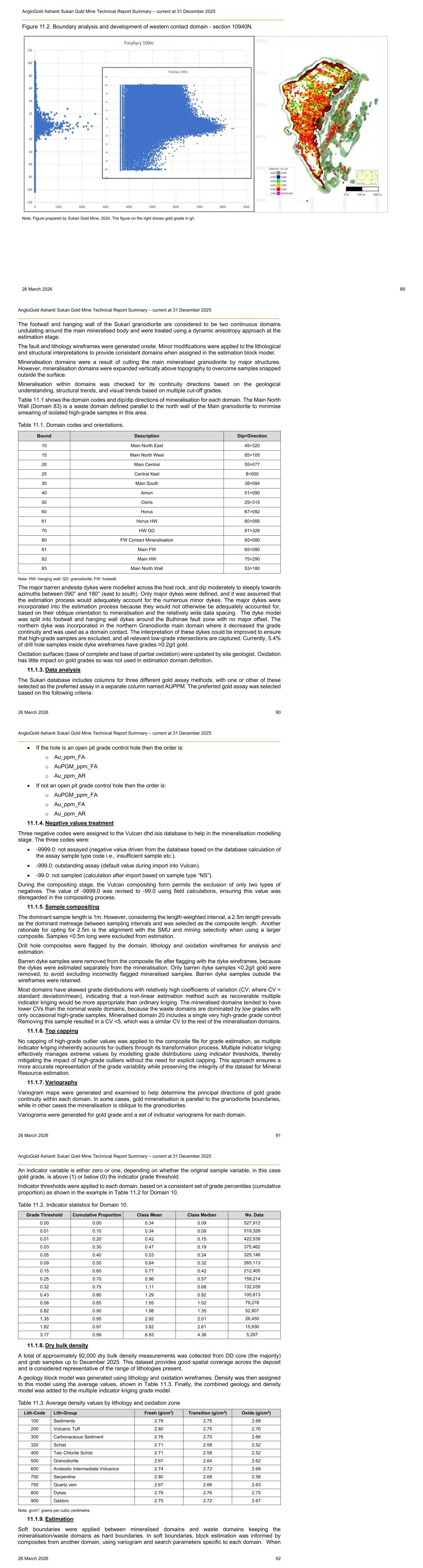
AngloGold Ashanti Sukari Gold Mine Technical Report Summary – current at 31 December 2025 _____________________________________________________________________________________ 26 March 2026 89 Figure 11.2. Boundary analysis and development of western contact domain - section 10940N. Note: Figure prepared by Sukari Gold Mine, 2024. The figure on the right shows gold grade in g/t. AngloGold Ashanti Sukari Gold Mine Technical Report Summary – current at 31 December 2025 _____________________________________________________________________________________ 26 March 2026 90 The footwall and hanging wall of the Sukari granodiorite are considered to be two continuous domains undulating around the main mineralised body and were treated using a dynamic anisotropy approach at the estimation stage. The fault and lithology wireframes were generated onsite. Minor modifications were applied to the lithological and structural interpretations to provide consistent domains when assigned in the estimation block model. Mineralisation domains were a result of cutting the main mineralised granodiorite by major structures. However, mineralisation domains were expanded vertically above topography to overcome samples snapped outside the surface. Mineralisation within domains was checked for its continuity directions based on the geological understanding, structural trends, and visual trends based on multiple cut-off grades. Table 11.1 shows the domain codes and dip/dip directions of mineralisation for each domain. The Main North Wall (Domain 83) is a waste domain defined parallel to the north wall of the Main granodiorite to minimise smearing of isolated high-grade samples in this area. Table 11.1. Domain codes and orientations. Bound Description Dip>Direction 10 Main North East 45>320 15 Main North West 85>105 20 Main Central 55>077 25 Central Keel 8>000 30 Main South 38>094 40 Amun 51>090 50 Osiris 25>315 60 Horus 67>092 61 Horus HW 60>095 70 HW GD 81>326 80 FW Contact Mineralisation 65>090 81 Main FW 65>090 82 Main HW 75>290 83 Main North Wall 53>180 Note: HW: hanging wall; GD: granodiorite; FW: footwall. The major barren andesite dykes were modelled across the host rock, and dip moderately to steeply towards azimuths between 090° and 180° (east to south). Only major dykes were defined, and it was assumed that the estimation process would adequately account for the numerous minor dykes. The major dykes were incorporated into the estimation process because they would not otherwise be adequately accounted for, based on their oblique orientation to mineralisation and the relatively wide data spacing. The dyke model was split into footwall and hanging wall dykes around the Buthinae fault zone with no major offset. The northern dyke was incorporated in the northern Granodiorite main domain where it decreased the grade continuity and was used as a domain contact. The interpretation of these dykes could be improved to ensure that high-grade samples are excluded, and all relevant low-grade intersections are captured. Currently, 5.4% of drill hole samples inside dyke wireframes have grades >0.2g/t gold. Oxidation surfaces (base of complete and base of partial oxidation) were updated by site geologist. Oxidation has little impact on gold grades so was not used in estimation domain definition. 11.1.3. Data analysis The Sukari database includes columns for three different gold assay methods, with one or other of these selected as the preferred assay in a separate column named AUPPM. The preferred gold assay was selected based on the following criteria: AngloGold Ashanti Sukari Gold Mine Technical Report Summary – current at 31 December 2025 _____________________________________________________________________________________ 26 March 2026 91 • If the hole is an open pit grade control hole then the order is: o Au_ppm_FA o AuPGM_ppm_FA o Au_ppm_AR • If not an open pit grade control hole then the order is: o AuPGM_ppm_FA o Au_ppm_FA o Au_ppm_AR 11.1.4. Negative values treatment Three negative codes were assigned to the Vulcan dhd.isis database to help in the mineralisation modelling stage. The three codes were: • -9999.0: not assayed (negative value driven from the database based on the database calculation of the assay sample type code i.e., insufficient sample etc.). • -999.0: outstanding assay (default value during import into Vulcan). • -99.0: not sampled (calculation after import based on sample type “NS”). During the compositing stage, the Vulcan compositing form permits the exclusion of only two types of negatives. The value of -9999.0 was revised to -99.0 using field calculations, ensuring this value was disregarded in the compositing process. 11.1.5. Sample compositing The dominant sample length is 1m. However, considering the length-weighted interval, a 2.5m length prevails as the dominant metreage between sampling intervals and was selected as the composite length. Another rationale for opting for 2.5m is the alignment with the SMU and mining selectivity when using a larger composite. Samples <0.5m long were excluded from estimation. Drill hole composites were flagged by the domain, lithology and oxidation wireframes for analysis and estimation. Barren dyke samples were removed from the composite file after flagging with the dyke wireframes, because the dykes were estimated separately from the mineralisation. Only barren dyke samples <0.2g/t gold were removed, to avoid excluding incorrectly flagged mineralised samples. Barren dyke samples outside the wireframes were retained. Most domains have skewed grade distributions with relatively high coefficients of variation (CV; where CV = standard deviation/mean), indicating that a non-linear estimation method such as recoverable multiple indicator kriging would be more appropriate than ordinary kriging. The mineralised domains tended to have lower CVs than the nominal waste domains, because the waste domains are dominated by low grades with only occasional high-grade samples. Mineralised domain 20 includes a single very high-grade grade control Removing this sample resulted in a CV <5, which was a similar CV to the rest of the mineralisation domains. 11.1.6. Top capping No capping of high-grade outlier values was applied to the composite file for grade estimation, as multiple indicator kriging inherently accounts for outliers through its transformation process. Multiple indicator kriging effectively manages extreme values by modelling grade distributions using indicator thresholds, thereby mitigating the impact of high-grade outliers without the need for explicit capping. This approach ensures a more accurate representation of the grade variability while preserving the integrity of the dataset for Mineral Resource estimation. 11.1.7. Variography Variogram maps were generated and examined to help determine the principal directions of gold grade continuity within each domain. In some cases, gold mineralisation is parallel to the granodiorite boundaries, while in other cases the mineralisation is oblique to the granodiorites. Variograms were generated for gold grade and a set of indicator variograms for each domain. AngloGold Ashanti Sukari Gold Mine Technical Report Summary – current at 31 December 2025 _____________________________________________________________________________________ 26 March 2026 92 An indicator variable is either zero or one, depending on whether the original sample variable, in this case gold grade, is above (1) or below (0) the indicator grade threshold. Indicator thresholds were applied to each domain, based on a consistent set of grade percentiles (cumulative proportion) as shown in the example in Table 11.2 for Domain 10. Table 11.2. Indicator statistics for Domain 10. Grade Threshold Cumulative Proportion Class Mean Class Median No. Data 0.00 0.00 0.34 0.09 527,912 0.01 0.10 0.34 0.09 519,328 0.01 0.20 0.42 0.15 422,539 0.03 0.30 0.47 0.19 375,462 0.05 0.40 0.53 0.24 325,146 0.09 0.50 0.64 0.32 265,113 0.15 0.60 0.77 0.42 212,405 0.25 0.70 0.96 0.57 159,214 0.32 0.75 1.11 0.68 132,039 0.43 0.80 1.29 0.82 105,613 0.58 0.85 1.55 1.02 79,278 0.82 0.90 1.98 1.35 52,807 1.35 0.95 2.92 2.01 26,450 1.82 0.97 3.82 2.61 15,930 3.17 0.99 6.83 4.36 5,297 11.1.8. Dry bulk density A total of approximately 92,000 dry bulk density measurements was collected from DD core (the majority) and grab samples up to December 2025. This dataset provides good spatial coverage across the deposit and is considered representative of the range of lithologies present. A geology block model was generated using lithology and oxidation wireframes. Density was then assigned to this model using the average values, shown in Table 11.3. Finally, the combined geology and density model was added to the multiple indicator kriging grade model. Table 11.3. Average density values by lithology and oxidation zone Lith-Code Lith-Group Fresh (g/cm3) Transition (g/cm3) Oxide (g/cm3) 100 Sediments 2.78 2.75 2.68 200 Volcanic Tuff 2.80 2.75 2.76 300 Carbonaceous Sediment 2.76 2.70 2.66 320 Schist 2.71 2.58 2.52 400 Talc Chlorite Schist 2.71 2.58 2.52 500 Granodiorite 2.67 2.64 2.62 600 Andesitic Intermediate Volcanics 2.74 2.72 2.68 700 Serpentine 2.80 2.68 2.58 750 Quartz vein 2.67 2.66 2.63 800 Dykes 2.79 2.76 2.75 900 Gabbro 2.75 2.72 2.67 Note: g/cm3: grams per cubic centimetre. 11.1.9. Estimation Soft boundaries were applied between mineralised domains and waste domains keeping the mineralisation/waste domains as hard boundaries. In soft boundaries, block estimation was informed by composites from another domain, using variogram and search parameters specific to each domain. When

AngloGold Ashanti Sukari Gold Mine Technical Report Summary – current at 31 December 2025 _____________________________________________________________________________________ 26 March 2026 93 samples from neighbouring domains were used, the boundary was classified based on the main domain parameters being estimated. This estimation methodology is appropriate given that: • Around open pit cut-off grades the deposit has relatively diffuse grade architecture. • Mixed distributions are present within domains, which may not be effectively partitioned by further domaining. • Domain statistics show extreme positive skew (CVs ranging from ~5 to 30). • It is useful to estimate within a large block (panel), to better forecast grade control model/production results at SMU scale. The multiple indicator kriging estimates were depleted using pit topography and underground voids as of end of December 2025. Blocks were constrained within a $2,150/oz gold reporting pit shell. The input parameters for multiple indicator kriging include: • Indicator variogram models describing the spatial continuity of indicator variables within each domain at each indicator threshold. • Variograms describing the spatial continuity of gold grades within each domain. • Mean gold grades of each of the indicator classes within each domain. Details of block model dimensions for the multiple indicator kriging estimates are provided in Table 11.4. Table 11.4. Open pit Mineral Resource model dimensions. Parameter X Y Z Origin 9690 9000 -500 Offset 2020 3400 1950 Block Size 20 25 10 Number of blocks 101 136 195 Pass 1 represents the minimum radii required to ensure that the block is entirely enclosed by the search ellipsoid regardless of the rotations. The ellipsoids for each domain were tested so that the geological directions stated in Table 11.5 are replicated in the software. Table 11.5. Multiple indicator kriging estimation search strategy. Estimation Pass Search Radii Samples Octants X Y Z Min Max Min 1 30 30 15 16 48 4 2 45 45 22.5 16 48 4 3 60 60 30 8 48 4 4 75 75 37.5 4 48 2 Discretisation was set at 5 x 5 x 5 points per block to generate block rather than point estimates. Multiple indicator kriging was first used to estimate a panel cumulative distribution function, used to calculate a panel E-type grade. Change of support was then implemented using the indirect log-normal method with a variance reduction of zero so the correction only applied the mean and variance of the distribution. The boundary treatment was by restricting the soft boundaries between the mineralised zones and the waste zones to prevent grade smearing both ways. The footwall mineralisation domain “80” was in the mineralised zones side. A matrix showing the relation between domains is provided in Table 11.6 where 1 is a soft and 0 is a hard boundary. AngloGold Ashanti Sukari Gold Mine Technical Report Summary – current at 31 December 2025 _____________________________________________________________________________________ 26 March 2026 94 Table 11.6. Soft (1) and hard (0) boundaries. Bound Description 10 15 20 25 30 40 50 60 61 70 80 81 82 83 10 Main North East 10 1 1 1 1 1 1 1 1 0 0 1 0 0 0 15 Main North West 15 1 1 1 1 1 1 1 1 0 0 1 0 0 0 20 Main Central 20 1 1 1 1 1 1 1 1 0 0 1 0 0 0 25 Central Keel 25 1 1 1 1 1 1 1 1 0 0 1 0 0 0 30 Main South 30 1 1 1 1 1 1 1 1 0 0 1 0 0 0 40 Amun 40 1 1 1 1 1 1 1 1 0 0 1 0 0 0 50 Osiris 50 1 1 1 1 1 1 1 1 0 0 1 0 0 0 60 Horus 60 1 1 1 1 1 1 1 1 0 0 1 0 0 0 61 Horus HW 61 0 0 0 0 0 0 0 0 1 1 0 1 1 1 70 HW GD 70 0 0 0 0 0 0 0 0 1 1 0 1 1 1 80 FW Сontact Mineralisation 80 1 1 1 1 1 1 1 1 0 0 1 0 0 0 81 Main FW 81 0 0 0 0 0 0 0 0 1 1 0 1 1 1 82 Main HW 82 0 0 0 0 0 0 0 0 1 1 0 1 1 1 83 Main North Wall 83 0 0 0 0 0 0 0 0 1 1 0 1 1 1 Note: HW: hanging wall; FW: footwall; GD: granodiorite. Based on the experience gained from the reconciliation of estimates against mine production, the following scheme was developed. The preferred value in mineralised domains was the average of the mean and median grades for the top indicator class, while the more conservative median grade was used for the waste domains, to limit smearing of isolated high-grade samples in these nominally low-grade domains. Table 11.7 shows the top indicator statistics for all domains, with the values used for the preferred model indicated by shading. Table 11.7. Top indicator class statistics (preferred values indicated by shading). Description Bound Gold threshold ppm Count Mean Median Mn+Md/2 Main North East 10 3.17 5,297 6.83 4.37 5.60 Main North West 15 0.46 98 0.89 0.69 0.79 Main Central 20 7.256 1,981 32.75 11.23 21.99 Central Keel 25 14.913 94 49.07 23.92 36.49 Main South 30 8.173 2,022 24.80 12.80 18.80 Amun 40 30.7 293 90.00 56.00 73.00 Osiris 50 8.058 286 38.95 16.77 27.86 Horus 60 7.1 516 28.95 13.73 21.34 Horus HW 61 0.406 373 1.70 0.72 1.21 HWGD 70 2.629 2,672 8.69 3.71 6.20 FW Contact Mineralisation 80 7.985 542 62.32 24.56 43.44 Main FW 81 0.284 203 13.62 0.84 7.23 Main HW 82 1.82 149 12.48 4.82 8.65 Main North Wall 83 0.129 28 4.95 0.41 2.68 Note: HW: hanging wall; FW: footwall; GD: granodiorite. 11.1.10. Validation The model was validated in several ways, including visual comparison of block and drill hole grades, statistical analysis (summary statistics, swath plot), examination of grade-tonnage data, and comparison with grade control and the previous resource model. Visual comparison of block and drill hole grades showed reasonable agreement in all areas examined and no obvious evidence of excessive smearing of high-grade assays. AngloGold Ashanti Sukari Gold Mine Technical Report Summary – current at 31 December 2025 _____________________________________________________________________________________ 26 March 2026 95 A comparison of average sample composite and model block grades by domain was completed. The composite statistics were not declustered and length weighted, while the block grades were volume weighted. The block averages by domain were consistently less than the samples, this was due to the clustering of the high-grade samples. Overall, the average block grades were lower than the sample grades because the sample grades tended to be clustered in high grade areas, particularly the underground grade controlled areas. Swath plots of gold grades demonstrated that the composite and block grades showed similar spatial trends and average values were comparable, allowing for smoothing in the model, clustering in the drill hole data and the generally larger volume represented by the model. Two sets of swath plots were generated, one using all drill holes and the other using only Mineral Resource drill holes. The grade profiles for the Mineral Resource drill holes only are closer to the block model grades than those using all drill holes, which is due to the underground grade control holes being clustered in high grade areas. The impact and location of the underground grade control holes was most apparent in the swath plots by elevation. The visual validation between the block model and sample data demonstrated a reasonably strong alignment, indicating that the block model accurately represented the spatial distribution of grade values observed in the samples. This consistency reflected the reliability of the interpolation methods used and validated the integrity of the geological and grade modelling processes. A grade-tonnage curve showed a smooth gradation in both tonnage and grade over the range of cut-off grades examined, and no obvious kinks or bumps suggestive of estimation issues were noted. Validation of the model showed that estimates are reasonable compared to all drilling, grade control data and the previous model. 11.2. Mineral Resource potentially amenable to underground mining methods The Mineral Resource estimate potentially amenable to underground mining methods was estimated using ordinary kriging and was informed by drilling up to 15 May 2025. 11.2.1. Mineral Resource data set The mineralisation interpretation included all validated open pit RC grade control holes 60m above the 30 June 2024 hard pit shell in Amun and 150m above in the Ptah Zone. All open pit RC grade control holes below the hard pit shell and the advanced grade control drill holes from surface were retained. The remainder of the open pit RC grade control holes were excluded. All underground grade control and face samples were used in estimation. Underground grade control was nominally drilled on a 25 x 25m spacing and face samples were taken across each exposed development face, determined by lithology and structural orientation. Holes without assays were excluded from estimation support. 11.2.2. Geological modelling Geological paper cross sections and level plans were generated on 25m intervals or on drill hole (oblique) section and georeferenced in Maptek Vulcan and Leapfrog software for 3D explicit and implicit modelling, respectively. Lithological, weathering, and redox wireframes were modelled and subsequently flagged into the database and block model. Geological sections are updated daily while the geological models are updated quarterly, and interpretations are regularly cross checked with drill core, RC chips, and underground mapping to ensure the model is representative of the geology on the local scale. 11.2.3. Mineralisation modelling Mineralisation domains were built based on a combination of grade, lithology, alteration and structural data from drill core, open pit and underground mapping. Statistical and visual analysis showed that a suitable geologically related boundary cut-off grade was approximately 0.5g/t gold for the underground. The resulting low-grade mineralised envelopes incorporated minor amounts of internal sub-grade material to preserve continuity. Where grades >2g/t gold were observed with geological continuity, a high-grade domain was generated that capture internal rod-like ore shoots. Boundary analysis was completed to confirm if there was a sharp change in grade profile across domain boundaries. Mineralisation models were generated from geo-referenced paper cross-sections into Vulcan. Interval selection method using Leapfrog was completed on vertical sections in a north-south direction across the mineralisation extent. AngloGold Ashanti Sukari Gold Mine Technical Report Summary – current at 31 December 2025 _____________________________________________________________________________________ 26 March 2026 96 Wireframes were snapped, where possible, to the drill hole sample intervals to create a precise boundary. The resulting interpretation produced consistent geometry and geological continuity for the plunging mineralised lodes (Figure 11.3). Figure 11.3. 3D View of Sukari mineralisation lodes looking east. Note: Figure prepared by Sukari Gold Mine, 2025. The mineralisation domains were categorised into eight main groups of lodes, comprising a total of 389 individual domains (Table 11.8). Table 11.8. Categorisation and number of mineralised domains. Lode Domains LG Domains (<1.6g/t Au) MG Domains (1.6g/t – 2.2g.t Au) HG Domains (2.2g/t – 8g/t Au) VHG Domains (>8g/t Au) Granodiorite 1000 4 0 0 0 Amun 2000 28 4 36 6 Osiris 3000 6 3 12 6 Horus 4000 46 12 32 9 Ptah 5000 33 8 16 7 Cleopatra 6000 90 1 0 0 Bast 7000 10 3 2 5 Keel 8000 3 1 6 0 Note: g/t Au: grams per ton of gold; LG: low grade; MG: marginal grade; HG: high grade; VHG: very high grade. The 1000 lode refers to the main granodiorite intrusion, excluding mineralisation above 0.5g/t gold. The 2000 lodes comprise the Amun domains, situated in the southern portion of the deposit. The 3000 lodes represent the Osiris domains, located beneath Amun. The 4000 lodes represent the Top of Horus and Horus Deeps domains. The 5000 lodes represent the Ptah domains, found in the central portion of the deposit. The 6000 lodes represent the Cleopatra domains, situated in the north of the deposit. The 7000 lodes represent the Bast domains, situated between the Amun and Ptah zones. The 8000 lodes represent the Keel domains beneath the Ptah domains. Amun, Ptah, and Cleopatra are mined from both open pit and underground, whereas Horus is mined exclusively from underground. Thin, continuous, barren, mafic dyke units are interspersed within the metasedimentary units in the footwall and within the main granodiorite in the northern zone. These barren units were modelled independently and flagged as code 800 for both the composites and block model.

AngloGold Ashanti Sukari Gold Mine Technical Report Summary – current at 31 December 2025 _____________________________________________________________________________________ 26 March 2026 97 11.2.4. Sample compositing Drill samples were composited down hole on a 1m length for underground samples. The minimum composite length was 0.2m. Compositing was completed in Vulcan software using the merge option for small composites, which adds the last composite, to the previous interval. A tolerance length of 0.2m was used. Compositing honoured the estimation domains by terminating on the domain boundary. 11.2.5. Top capping Top capping was applied to reduce the effect of high-grade outliers during Mineral Resource estimation. A multi-variate analysis method was used to select the top cap, including analysing a combination of histograms, probability plots, and their disintegration trends. The top capping occurred within the top percentile ranges, between the 95th and 99.9th percentiles within the individual mineralised lodes. Mine to mill reconciliation data in active areas of the mine were also used when assessing the final top cut grade. Occasionally, where there were many other notable disintegration points in a grade population for a given domain, high yield limits were also used. In these instances, the distance in which elevated values could be used during interpolation were restricted (limited range of influence), minimising the potential for grade smearing. Gold top cut ranges applied to each domain included: • Amun: 1.8–209g/t. • Osiris: 6–246g/t. • Horus: 1.66–265g/t. • Ptah: 2.5–600g/t. • Cleopatra: 1.2–40g/t. • Bast: 5.8–419g/t. • Keel: 0.55–42g/t. 11.2.6. Variography Variography was conducted using Snowden Supervisor v9 software. Individual domains with sufficient data to support modelling were generated for variography based on spatial continuity, directional grade variability and orientation. A normal scores transform was applied to declustered composites to help resolve spatial structures. Gaussian variogram models were back transformed to derive model inputs for estimation. Where an individual domain had insufficient samples to undertake variography, the variogram model parameters from a comparative domain with a similar trend were used, and the orientation adjusted to match the domain with insufficient data. 11.2.7. Dry bulk density Density was assigned in the block model using the approach described for the Mineral Resources considered potentially amenable to open pit mining methods. 11.2.8. Block model setup The block model parent block size was tailored to the local data spacing. The maximum parent block size was 30mE x 32mN x 10mRL in waste areas and the minimum was 6mE x 4mN x 2.5mRL. The minimum sub cell size was 2mE x 2mN x 1.25mRL, which effectively resolves domain boundaries. The block model was not rotated, and was flagged by weathering, lithology and mineralisation domain. Table 11.9 summarises the block extents. Table 11.9. Block model extents. Block extents Easting (X) Northing (Y) Elevation (Z) Origin 9,600 9,000 -500 Minimum Offset 0 0 0 Maximum Offset 2,010 3,424 2,000 Parent Block Size (m) 30 32 10 AngloGold Ashanti Sukari Gold Mine Technical Report Summary – current at 31 December 2025 _____________________________________________________________________________________ 26 March 2026 98 Block extents Easting (X) Northing (Y) Elevation (Z) Sub Cell Size (m) 2 2 1.25 Rotation (°) 90 0 0 Note: m: metres; °degrees. 11.2.9. Estimation Mineral Resource potentially amenable to underground mining methods was estimated using ordinary kriging in Vulcan software. All domains used hard boundaries to ensure that separate grade populations did not influence the estimate. Dynamic anisotropy was implemented to align variogram and search orientations to local domain orientation. Each estimation domain was attributed its own estimation parameters defined via quantitative kriging neighbourhood analysis (QKNA). QKNA was used to optimise the search ranges, sample numbers, and for discretisation. Optimisations looked at kriging efficiency slope of regression and negative kriging weights. The QKNA was completed for each variogram domain with the first estimation pass. Each estimation domain was sub-domained by data density such that smaller blocks and more localised searches could be applied to the estimation of grade control-drilled areas, relative to the wider-spaced exploration drilling. Sulphur was also estimated for geometallurgical purposes. 11.2.10. Validation Model validation used volume comparison, swath plots, grade comparisons with nearest neighbour, and visual validation techniques to ensure no significant errors occurred during the estimation process. Validation checks showed good agreement between drill hole composite values and model block values. The hard boundaries between wireframes constrained grades to their respective estimation domains. Top capping and high-grade restraining succeeded in minimising grade smearing in regions of sparse data. 11.3. Combined Mineral Resource 11.3.1. Mineral Resource classification and uncertainty Classification for the open pit estimate was based on estimation passes. Pass 1 (30 x 30 x 15m) could support Measured Mineral Resource classification, pass 2 (45 x 45 x 22.5m) could support Indicated Mineral Resource classification, pass 3 (60 x 60 x 30m) could support Inferred Mineral Resource classification and an additional pass 4 (75 x 75 x 37.5m) was assigned as “unclassified”. The Mineral Resource classification was not smoothed because the use of octant constraints minimised isolated confidence category blocks and areas of Measured and Indicated Mineral Resource confidence classifications are generally quite coherent. This classification included consideration of deposit type, continuity of geology and grade, sampling and assaying methods, and analysis of QA/QC data. This strategy was considered by the Qualified Person to be defensible, given consistent data quality across the deposit and precise lithological modelling, with changes primarily driven by search parameters/distances. An additional step was taken to reclassify Inferred material within the host rock. Inferred blocks that were located within a conservatively defined drilling solid and supported by at least 16 samples from two or more drill holes, were upgraded to Indicated status. Mineral Resources potentially amenable to underground mining methods were classified as Measured, Indicated, and Inferred Mineral Resources based on data quality, drilling density, geological continuity, the variogram range, number of passes and the slope of regression. The main classification parameters applied are presented in Table 11.10. Table 11.10. Mineral Resource classification parameters. Parameter Measured Indicated Inferred Kriging efficiency and slope of regression >0.7 0.5-0.7 0.3-0.5 Number of samples >12 12–8 8-4 Minimum drill hole samples 8 6 4 Minimum consecutive sections 4 good geological continuity - Grade continuity very good good moderate to poor AngloGold Ashanti Sukari Gold Mine Technical Report Summary – current at 31 December 2025 _____________________________________________________________________________________ 26 March 2026 99 Parameter Measured Indicated Inferred Infrastructure existing underground development No existing underground development no existing underground development Maximum drilling density Underground 20m by 10m or 25m by 10m 20m by 25m 50m by 50m Note: m: metres. For Indicated Mineral Resource, there was some allowances for areas where drilling density was lower, but where successive drilling campaigns had shown grade and geological continuity. To ensure that the classification was continuous, classification wireframes were generated from the classification criteria and used to flag the block models. 11.3.2. Depletion and sterilisation Active mining areas are scanned using cavity monitoring laser scanners on a monthly basis for underground and detailed drone photometry scans are completed weekly for open pit. Depletion pit surveys and underground cavity monitoring scans were updated at the end of December 2025 and used to flag the block models in the mined-out field. The block models were not sub-celled on depletion boundaries and reporting used a partial block depletion percentage. For the open pit, grade estimates were generated with barren dyke samples excluded. Barren dyke depletion used the following process. Blocks were flagged with their proportion of barren dyke, which was treated as dilution if <20% but was assumed to potentially be selectively mineable if >20%. Therefore, if the proportion of dyke was <20%, then the block proportions and grades above each cut-off were diluted by the proportion of dyke at a grade of 0.02g/t gold. However, if the proportion of dyke was >20%, then the block proportions above each cut-off were reduced by the proportion of dyke, but grades above cut-off were unchanged. In both cases, the average block grade was re-calculated. The 20% threshold between dilution and mineability was selected based on the current mining selectivity. The open pit Mineral Resource model was also depleted using existing (current at end of December 2025) underground development and stopes, as well as an additional set of voids, referred to as open pit voids, which includes previously unsurveyed voids encountered during open pit and underground mining. These were treated in the same way as stopes for the purpose of model depletion. Stopes were depleted from the open pit Mineral Resource model by preferentially removing the highest-grade material in each block, if stopes targeted the highest available grades. Development was depleted at average gold grades, assuming that no specific material was targeted by this type of mining. While this approach is simplistic, it is more realistic than applying a single methodology to all underground voids. For the underground model, regions considered sterilised by existing stoping or capital infrastructure were flagged and excluded from Mineral Resource reporting. 11.3.3. Block model to mill reconciliation Several metrics are used for reconciliation of open pit and underground estimated tonnages and grade versus actual values on a weekly, monthly, quarterly and annual basis. In 2025, the grade control model consistently overperformed in tonnes by 6% but underperformed in grade and ounces by 8% and 3% respectively compared to the multiple indicator kriging model. Variation in tonnes, grade and ounces, ranged between +15% and -24% on a monthly basis. This issue was resolved in the latest Mineral Resource model by using additional drill hole data, improved geological constraints, top cuts, and high yields in the estimation process. Overall, the ounce linear trend line showed a +7% reduction in ounces compared to the Mineral Resource model. Advanced grade control drilling on a 24 x 24m grid is planned to be continued until the open pit has been drilled out to that spacing. Initiatives are underway to address the disparity between actuals versus resource model forecasts in the underground mining operation. These include use of RC drilling and will add the second RC underground rig at the end of 2026, and conditional simulation, adjustment of top cut values, ongoing geological interpretation refinements, and defining the true shape, orientation and grade continuity of the deposit. AngloGold Ashanti Sukari Gold Mine Technical Report Summary – current at 31 December 2025 _____________________________________________________________________________________ 26 March 2026 100 Underground RC drilling was introduced in Q1 2025 and continues to increase the sample size and decrease the grade variability seen in core samples. Drilling rates will also be higher, meaning that a tighter-spaced drill pattern can be achieved. 11.3.4. Stockpiles A total of seven stockpiles containing substantial tonnages of low-grade material (>0.2g/t gold), along with ROM material that is blended and fed into the processing plant, was reported as at 31 December 2025. This material primarily originates from the open pit and was classified based on grade control drilling. The stockpile tonnages were determined through monthly survey control and loose density testwork, while grades were assigned based on drilling results. All stockpiled mineralised material is planned for processing through the mill or placement under irrigation on the dump leach. Underground ore, which is higher grade than the open pit material, is hauled to the surface immediately after mining. It is then stockpiled on the ROM pad before being fed in batches into the processing plant. 11.3.5. Reasonable basis for establishing the prospects of economic extraction 11.3.5.1. Open pit Mineral Resource potentially amenable to open pit mining methods was reported within a $2,150/oz gold pit shell and above a 0.2g/t gold cut-off grade. The input parameters are listed in Table 11.11. Table 11.11. Input parameters, conceptual constraining pit shell for Mineral Resources. Parameter Unit Value Gold price $/oz 2,150 Refining and selling cost $/oz 3.10 Mineral royalty % 3.0 Diesel price $/L 0.90 Base open pit mining cost (mined) $/t/mined 2.07 Depth cost $/t/mined ±$0.02 (per 10m vertical uphill haul) ±$0.02 (per 10m vertical downhill haul) Mining recovery fraction % 100 Mining dilution fraction % 7 Rock types used # Measured, Indicated and Inferred Processing stream # CIL (Fresh / Transition @ 0.4g/t cut-off grade) CIL (Oxide @ 0.9g/t cut-off grade) DL (Oxide & SG @ 0.2g/t cut-off grade) Process recovery CIL fixed % 89.5 Process recovery dump leach fixed % 60.5 Process recovery subgrade fixed % 32.5 Processing cost CIL (processed) $/t/processed 12.93 Processing cost dump leach (processed) $/t/processed 2.27 Optimisation method # Lerchs-Grossman Discount rate % 7 Note: CIL: carbon-in-leach; DL: dump leach. 11.3.5.2. Underground Mineral Resource potentially amenable to underground mining methods was reported above a 1.2g/t gold cut-off grade, and below the $2,150/oz pit shell. The estimate was constrained by optimised stope shapes using mineable shape optimiser (MSO) software, and an assumption of long-hole open stoping as the mining method. The shape optimiser creates and evaluates 3D envelopes of material based on the cut-off grade and other relevant factors such as minimum size, shape, dilution, and orientation of mining units. The reported Mineral Resource is confined within these mining shapes, and all material within these shapes is included in the estimate. This means that the cut-off

AngloGold Ashanti Sukari Gold Mine Technical Report Summary – current at 31 December 2025 _____________________________________________________________________________________ 26 March 2026 101 grade is considered during the creation of these shapes, and no additional cut-off grade is applied when reporting from them. The parameters used are summarised in Table 11.12. A gold price of $2,000/oz was used in conjunction with cost assumptions to calculate the appropriate cut-off grades for the Mineral Resource considered amenable to underground mining methods. Table 11.12. Parameters used for generating the Mineral Resource considered potentially amenable to underground mining methods. Inputs Sukari underground Gold price Gold price ($/oz) 2,000 Costs Mining cost – mined ($/t) 42.04 Processing cost – processed only ($/t) 14.57 General and administrative – processed ($/t) 3.02 Royalty (%) 3% Metallurgical Recovery Metallurgical Recovery (%) 89.5 Cut-off grades MSO optimising cut-off grade (g/t) 1.2 Mineral Resource cut-off grade (g/t) 1.15 Other MSO parameters Dynamic dip and strike control Used (mineralisation wireframes for stope dip and strike control) Sub-stope definition method Not applicable Stope sections (m) Slice interval 2.0m Stope levels Aligned with development levels or proposed development levels Stope width (m) Apparent width method (min 2m, max 20m) Stope dilution (m) Applied (ELOS dilution; near/far method; single values of 0.5m for near and far) Stope dip angle (°) Min 42, max 135, and max change 45 Stope strike angle (°) Min -30, max 30, and max change 60 Note: ELOS: equivalent linear overbreak slough; MSO: mineable shape optimiser; m: metres 11.4. Mineral Resource statement The Mineral Resource for mineralisation assumed to be amenable to open pit and underground mining methods is reported in situ and constrained to meet the requirement for reasonable prospects of economic extraction by volumes created through a mine shape optimiser process for underground or within an economically optimised pit shell for open pit. Mineralisation in stockpiles is reported as broken material, in stockpiles. The Mineral Resource is reported exclusive of the Mineral Resource converted to Mineral Reserve. Mineral Resource that is not Mineral Reserve does not have demonstrated economic viability. The selected point of reference is 31 December 2025. The Mineral Resource is current at 31 December 2025 and is summarised in Table 11.13 (100% basis) and Table 11.14 (50% attributable basis). Table 11.13. Mineral Resource statement – 100% basis. Deposit/Area Category Tonnes (Mt) Grade (g/t Au) Contained Gold (t) (Moz Au) Open pit Measured 78.51 0.72 56.79 1.83 Indicated 73.47 0.47 34.45 1.11 Sub-total Measured & Indicated 151.98 0.60 91.23 2.93 Inferred 34.22 0.47 16.10 0.52 AngloGold Ashanti Sukari Gold Mine Technical Report Summary – current at 31 December 2025 _____________________________________________________________________________________ 26 March 2026 102 Deposit/Area Category Tonnes (Mt) Grade (g/t Au) Contained Gold (t) (Moz Au) Open pit – Stage 5 Measured - - - - Indicated - - - - Sub-total Measured & Indicated - - - - Inferred 0.19 0.82 0.16 0.01 Open pit – Stage 6 Measured - - - - Indicated - - - - Sub-total Measured & Indicated - - - - Inferred 3.57 0.85 3.03 0.10 Open pit – Stage 7 Measured - - - - Indicated - - - - Sub-total Measured & Indicated - - - - Inferred 0.05 0.45 0.02 0.00 Open pit – Stage 8 Measured - - - - Indicated - - - - Sub-total Measured & Indicated - - - - Inferred 9.01 0.46 4.16 0.13 Underground – Amun Measured 0.35 1.99 0.69 0.02 Indicated 0.28 2.17 0.61 0.02 Sub-total Measured & Indicated 0.63 2.07 1.31 0.04 Inferred 0.05 2.15 0.10 0.00 Underground – Bast Measured 0.16 7.43 1.18 0.04 Indicated 0.04 5.00 0.19 0.01 Sub-total Measured & Indicated 0.20 6.95 1.37 0.04 Inferred 0.10 2.27 0.23 0.01 Underground – Horus Measured 2.41 2.50 6.02 0.19 Indicated 6.55 1.79 11.69 0.38 Sub-total Measured & Indicated 8.96 1.98 17.72 0.57 Inferred 4.27 1.73 7.40 0.24 Underground – Ptah Measured 1.78 1.82 3.24 0.10 Indicated 0.60 1.68 1.02 0.03 Sub-total Measured & Indicated 2.38 1.79 4.26 0.14 Inferred 0.26 2.08 0.54 0.02 Stockpiles Measured - - - - Indicated - - - - Sub-total Measured & Indicated - - - - Inferred 8.96 0.46 4.14 0.13 Total Sukari (open pit, underground and stockpiles) Measured 83.20 0.82 67.92 2.18 Indicated 80.95 0.59 47.96 1.54 Total Measured & Indicated 164.15 0.71 115.88 3.73 Inferred 60.68 0.59 35.88 1.15 AngloGold Ashanti Sukari Gold Mine Technical Report Summary – current at 31 December 2025 _____________________________________________________________________________________ 26 March 2026 103 Table 11.14. Mineral Resource statement – attributable basis (50%). Deposit/Area Category Tonnes (Mt) Grade (g/t Au) Contained Gold (t) (Moz Au) Open pit Measured 39.26 0.72 28.39 0.91 Indicated 36.74 0.47 17.22 0.55 Sub-total Measured & Indicated 75.99 0.60 45.62 1.47 Inferred 17.11 0.47 8.05 0.26 Open pit – Stage 5 Measured - - - - Indicated - - - - Sub-total Measured & Indicated - - - - Inferred 0.10 0.82 0.08 0.00 Open pit – Stage 6 Measured - - - - Indicated - - - - Sub-total Measured & Indicated - - - - Inferred 1.78 0.85 1.51 0.05 Open pit – Stage 7 Measured - - - - Indicated - - - - Sub-total Measured & Indicated - - - - Inferred 0.02 0.45 0.01 0.00 Open pit – Stage 8 Measured - - - - Indicated - - - - Sub-total Measured & Indicated - - - - Inferred 4.50 0.46 2.08 0.07 Underground – Amun Measured 0.17 1.99 0.35 0.01 Indicated 0.14 2.17 0.31 0.01 Sub-total Measured & Indicated 0.32 2.07 0.65 0.02 Inferred 0.02 2.15 0.05 0.00 Underground – Bast Measured 0.08 7.43 0.59 0.02 Indicated 0.02 5 0.10 0.00 Sub-total Measured & Indicated 0.10 6.95 0.68 0.02 Inferred 0.05 2.27 0.11 0.00 Underground – Horus Measured 1.21 2.50 3.01 0.10 Indicated 3.27 1.79 5.85 0.19 Sub-total Measured & Indicated 4.48 1.98 8.86 0.28 Inferred 2.13 1.73 3.70 0.12 Underground – Ptah Measured 0.89 1.82 1.62 0.05 Indicated 0.30 1.68 0.51 0.02 Sub-total Measured & Indicated 1.19 1.79 2.13 0.07 Inferred 0.13 2.08 0.27 0.01 Stockpiles Measured - - - - Indicated - - - - Sub-total Measured & Indicated - - - - Inferred 4.48 0.46 2.07 0.07 Total Sukari (open pit, underground and stockpiles) Measured 41.60 0.82 33.96 1.09 Indicated 40.48 0.59 23.98 0.77 Total Measured & Indicated 82.08 0.71 57.94 1.86 Inferred 30.34 0.59 17.94 0.58 AngloGold Ashanti Sukari Gold Mine Technical Report Summary – current at 31 December 2025 _____________________________________________________________________________________ 26 March 2026 104 Notes: Rounding of numbers may result in computational discrepancies in the Mineral Resource tabulations. All figures are expressed on an attributable basis unless otherwise indicated. To reflect that figures are not precise calculations and that there is uncertainty in their estimation, AngloGold Ashanti reports tonnage, grade and content for gold to two decimals. All ounces are Troy ounces. “Moz” refers to million ounces. 1. The Mineral Resource stated herein is current at date and was prepared in compliance with Regulation S-K 1300 2. All disclosure of Mineral Resource is exclusive of Mineral Reserve. The Mineral Resource exclusive of Mineral Reserve is defined as the inclusive Mineral Resource less the Mineral Reserve before dilution and other factors are applied. 3. “Tonnes” refers to a metric tonne which is equivalent to 1,000 kilograms. 4. The Mineral Resource tonnages and grades are reported in situ and constrained to meet the requirement for reasonable prospects of economic extraction by volumes created through a mine shape optimiser process for underground or within an economically optimised pit shell for open pit and stockpiled material is reported as broken material. 5. Property currently in a production stage. 6. Based on a gold price of $2,150 (open pit) and $2,000/oz (underground). 7. Mr. Doxel Mutunda, MAIG, employed by AngloGold Ashanti, is the Qualified Person for the Sukari Mineral Resource. 8. In 2025, a metallurgical recovery factor of 89.5% was applied to the open pit and underground, and 86.56% was applied to the stockpile. 9. In 2025, a cut-off grade of 0.20g/t was applied to the open pit, a cut-off grade of 0.40g/t was applied to the stockpile and a cut-off grade of 1.20g/t was applied to the underground. 11.5. Factors that may affect the Mineral Resource estimates Uncertainties that may affect the Mineral Resource estimates include changes to the following: • Metal price and exchange rate assumptions. • Assumptions used to generate the gold grade cut-off grade • Local interpretations of mineralisation geometry and continuity of mineralised zones. • Geological and mineralisation shape and geological and grade continuity assumptions. • Density and domain assignments. • Geotechnical, mining and metallurgical recovery assumptions. • Input and design parameter assumptions that pertain to the conceptual stope designs constraining the underground estimates. • Assumptions as to the continued ability to access the site, retain mineral and surface rights titles, maintain environment and other regulatory permits, and maintain the social licence to operate. 11.6. Qualified Person's opinion There is upside potential for the estimates if mineralisation that is currently classified as Inferred Mineral Resource can be upgraded to higher-confidence Mineral Resource categories. The Mineral Resource estimate has been prepared using industry accepted practice and conforms to the disclosure requirements of S-K1300. The Mineral Resource estimates are evaluated annually providing the opportunity to reassess the assumed conditions. The Qualified Person's opinion is that all relevant technical and economic factors likely to influence the prospect of economic extraction can be resolved with further work. Additional drilling and ongoing modelling will help refine the Mineral Resource estimate, improve geological confidence, and support the assessment of economic viability. These efforts will contribute to a more comprehensive understanding of the deposit, addressing any outstanding uncertainties related to grade distribution, geological continuity, and mining considerations. There are no other environmental, legal, title, taxation, socioeconomic, marketing, political or other relevant factors known to the Qualified Person that would materially affect the Mineral Resource estimates that are not discussed in this Report. 12. Mineral Reserve estimates 12.1. Introduction The Mineral Reserve tonnages and grades are estimated and reported as delivered to the plant (i.e., the point where material is delivered to the processing facility). The selected point of reference is 31 December 2025. The open pit is designed with eight phases, four of which remain to be completed, and there are four underground mining zones: Amun, Ptah, Horus and Bast, as shown in Figure 12.1.

AngloGold Ashanti Sukari Gold Mine Technical Report Summary – current at 31 December 2025 _____________________________________________________________________________________ 26 March 2026 105 Figure 12.1. Sukari mine layout. Note: Figure prepared by Sukari Gold Mine, 2025. Mineral Reserve was converted from Measured and Indicated Mineral Resource. Inferred Mineral Resource is treated as waste in the mine schedule. 12.2. Open pit Mineral Reserve 12.2.1. Open pit optimisation 12.2.1.1. Input parameters General parameters and modifying factors, applicable to both the open pit and underground operations, include the forecast gold price, sales costs, mineral royalty and diesel price. For the 2025 Mineral Reserve estimation, the general parameters in Table 12.1 were used. Table 12.1. General input factors. Parameter Unit 2025 Mineral Reserve Notes Gold price $/oz 1,700 Refining and selling costs $/oz 3.1 Mineral royalty % 3.00 Apply to sales revenue Diesel price $/L 0.90 The pit optimisation parameters are given in Table 12.2. Table 12.2. Pit optimisation parameters. Parameter Units Value Notes Final bench height m 10 Overall slope angle North wall ° North-east wall° East wall° South-east wall° South-west wall° West wall° 45 43 42 42 34 32 AngloGold Ashanti Sukari Gold Mine Technical Report Summary – current at 31 December 2025 _____________________________________________________________________________________ 26 March 2026 106 Parameter Units Value Notes Base mining cost $/t mined 2.07 ±$0.02 (per 10m vertical uphill haul) ±$0.02 (per 10m vertical downhill haul) (datum at 1090mRL) Including sustaining capex CIL processing cost $/t processed 12.93 Including sustaining capex Dump leaching cost $/t processed 2.45 Including general and administrative cost proportion to DL (0.175) General and administrative cost $/t processed 2.52 Applied to CIL processing cost CIL process recovery % 89.5 Dump leach recovery % 60.5 32.5 Dump leach oxide Dump leach sub-grade Mining dilution % 7 Additional to dilution accounted for via model reblocking to 20m x 25m x 10m (XYZ) Ore losses % Nil Note: CIL: carbon-in-leach; mRL: metres relative; m: metres Values are based on 2025 budget annualised costs and assume a connection to grid power in 2027. 12.2.1.2. Geotechnical parameters A geotechnical review was completed for the stage eight pit design. Revised pit design walls have typical inter-ramp angles and overall slope angles as per Table 12.3. Table 12.3. Pit slope angles. Wall Inter-ramp Overall slope IRA (°) Slope height (m) OSA (°) Slope Height (m) East 46° 190 42° 550 West 36° 450 32° 500 North 49° 295 42° 570 South 44° 180 38.5° 520 Note IRA: inter-ramp angles; OSA: overall slope angles; m: metres; °: degrees. East wall was reviewed as Geotech information was updated to add the Anubis fault to the wall stability model. To stabilise the wall a cutback was added with 40 Mt to be mined from the top of the east wall to make it flatter (35°). 12.2.1.3. Process recoveries The process recoveries for optimisation were based upon production actuals. The recovery values used for pit optimisation and cut-off grade calculation are in line with the production actuals. 12.2.1.4. Dilution and losses Dilution calculations were based on regularisation of the sub-celled block model to a SMU of 20m x 25m x 10m (XYZ). The re-blocking process accounted for any mineralisation below cut-off grade in the evaluation process. A 7% dilution was applied in the optimisation process to account for unplanned dilution during mining. 12.2.1.5. Operating costs Operating cost assumptions were based on actual mine data combined with production estimates, including haulage fleet and maintenance-related improvements. The average elevation of the base mining cost of $2.07/t mined is 1090mRL, with an assumption of incremental depth variation of ±$0.02/t mined per 10m bench (with increased cost as depth increases). AngloGold Ashanti Sukari Gold Mine Technical Report Summary – current at 31 December 2025 _____________________________________________________________________________________ 26 March 2026 107 12.2.2. Open pit cut-off grades Table 12.4 provides the assumptions used in the calculation of cut-off grade to be applied to the material contained within the optimised pit and final designed pits, and Table 12.5 summarises the resulting cut-off grades. Table 12.4. Open pit cut-off grade parameters and costs. Description Unit CIL process Dump leach OX Dump leach SG Parameters Gold price $/oz $/g 1,700 54.65 1,700 54.65 1,700 54.65 Revenue and selling cost $/g 0.099 0.099 0.099 Mineral royalty % 3.00 3.00 3.00 Mining dilution/loss % - - - Process recovery % 89.5 60.5 32.5 Costs Total mining cost $/t ore 2.52 2.52 2.52 Total processing $/t ore 12.93 2.27 2.27 Power $/t ore 1.29 0.20 0.20 General and administrative $/t ore 2.52 0.175 0.175 Table 12.5. Cut-off grades. Cut-off grade Unit CIL Process Dump leach OX Dump leach SG Full grade g/t 0.43 0.12 - Marginal grade g/t 0.4 0.10 - Mineralised waste g/t - - 0.18 Full ore cut-off grade refers to the breakeven grade where cost is representative of all cost to carry the full operation (excluding direct mining cost), and revenue is at the Mineral Reserve/planning gold price. Marginal cut-off grade is the breakeven grade where the cost is representative of the reduced cost that will be experienced after mining, and revenue is at the Mineral Reserve/planning gold price. A 7% mining dilution is applied to the calculated and marginal values to provide the in situ cut-off grades. The parameters quoted result in a theoretical (calculated) ore cut-off grade for material sent to the CIL process plant of 0.43g/t gold. Operationally, a mill cut-off of 0.50g/t gold and an ore cut-off grade of 0.40g/t gold is used; with material in the 0.40-0.50g/t gold range stockpiled as low grade, and material of >0.50g/t gold sent to the ROM stockpile. Operationally, material grade bins can be summarised as follows: • High-grade fresh and transitional ore portion: transitional and fresh ore, ≥0.90g/t gold, sent to the ROM pad. • Medium-grade fresh and transitional ore portion: transitional and fresh ore, 0.50-0.90g/t gold, sent to the ROM pad. • Low-grade fresh and transitional ore portion: transitional and fresh ore, 0.40-0.50g/t gold, sent to the low grade stockpile. • High-grade oxide ore portion: oxide ore, ≥0.90 g/t gold, sent to the ROM pad. • Low-grade oxide ore portion for dump leach: oxide ore, 0.20-0.90g/t gold, sent to the to dump leach. • Sub-grade material: transitional and fresh material, 0.25-0.4g/t gold, sent to the sub-grade stockpile. • Waste: oxide material where gold <0.20g/t and fresh or transitional material where gold <0.25g/t. 12.2.3. Pit design No material changes were made to the pit design during 2025. Minor operational changes based on updated localised geotechnical information were completed. There is also a change in the north to mine part of the Mineral Reserve that was left between Stage 7 and 8. AngloGold Ashanti Sukari Gold Mine Technical Report Summary – current at 31 December 2025 _____________________________________________________________________________________ 26 March 2026 108 The final pit was used to generate the LOM schedule and generate the Mineral Reserve estimate. Figure 12.2 presents the final LOM pit design. Figure 12.2. LOM design. Note: Figure prepared by Sukari Gold Mine, 2025.

AngloGold Ashanti Sukari Gold Mine Technical Report Summary – current at 31 December 2025 _____________________________________________________________________________________ 26 March 2026 109 Operational design parameters for the open pit include: • Dual-lane haul ramp of 32m width at a gradient of 1 in 10. • Underground void intersections in final pit walls have been considered by adopting void fill parameters within the numerical modelling. • Mining capacity: o 107Mtpa production rate, which deceases steadily from 2030 as stages are completed. • Geotechnical observations: o Industry-accepted methods have been used to assess slope stability (2D and 3D limit equilibrium) and industry-accepted design acceptance criteria (adopted from Read and Stacey 2009) have been applied. The failure mechanisms are well-known from back-analysis of previous and existing slope performance. An acceleration of 0.04g was also applied to the analyses. Slopes were assessed using a detailed model of the geology including large-scale structures. o Investigations into the properties of Sukari thrust 2 indicated that the fault conditions are better than previously assumed. Similarly, the conditions in the Cross fault were also found to be improved. The Cross fault will potentially affect wall stability in stage seven, and the Sukari thrust 2 will potentially affect wall stability in stage eight. o The analysis results indicate that for the majority of areas, the design acceptance criteria are exceeded. Minor areas where marginal factor of safety values is obtained from the assessments, additional mitigation measures are undertaken, for example, reinforcing and buttressing the slope. • Mine scheduling: o Mining to be completed in four remaining stages (five, six, seven and eight). o Allowances for rill material in the mine schedule. o 10m benches for scheduling purposes. o Maximum vertical rate advance of 120m per year per stage. 12.3. Underground Mineral Reserve 12.3.1. Optimisation input parameters General parameters and modifying factors, applicable to both the open pit and underground operations, includes the assumed gold price, sales costs, mineral royalty and diesel price. For the 2025 Mineral Reserve estimation, the general parameters and assumptions are shown in Table 12.6. Table 12.6. Underground cut-off grade parameters and costs. Description Unit Value Gold price $/oz 1,450 Gold price $/g 46.62 Process recovery % 88.4 Unplanned average stope dilution % 20 Unplanned average dev dilution % 20 Stope unplanned ore loss % 10 Development unplanned ore loss % 2 Ore development $/t 8.40 Stoping $/t 33.15 Underground mining (ore + waste)1 $/t 43.81 Processing $/t 14.65 Haulage $/t 5.58 Power $/t 2.56 AngloGold Ashanti Sukari Gold Mine Technical Report Summary – current at 31 December 2025 _____________________________________________________________________________________ 26 March 2026 110 Description Unit Value General and administrative $/t 3.19 Total cost2 $/t 69.79 Full economic g/t 2.34 Stope3 g/t 1.99 Development g/t 1.06 Processing g/t 0.51 Haulage g/t 0.80 Underground operational stope g/t 2.00 Underground operational development g/t 1.00 Note: 1 Includes operating and sustaining capital development costs; 2 All costs, inclusive of development and sustaining capital; 3 Stope or incremental cut-off grade considers that the development cost is already sunk. 12.3.2. Underground cut-off grade The assumptions used in the calculation of cut-off grades for the underground mine design and Mineral Reserve are presented in Table 12.6. The full cut-off grade and stope cut-off grade of 2.34g/t and 2.00g/t respectively, are applied for operational continuity. A new stope cut-off grade was calculated from updated cost assumptions of 1.34g/t gold based on an average of the last 18 months of underground mining costs, reflecting lower mining and processing costs alongside a higher gold price. However, a decision was made to allow time for detailed evaluation and validation before considering adopting the lower grade. The cut-off value for treating development material as ore is 1.00g/t. The stope cut-off is used for Deswik.SO stope optimisation and Mineral Reserve reporting. 12.3.3. Underground mine design 12.3.3.1. Design basis Mineral Reserve estimation was carried out based on the 2025 Mineral Resource geological block model and the grade control block model. This model was depleted from the current Mineral Reserve open pit design, generating stope shapes using Deswik.SO. Manual stope designs were completed for some of the areas where grade control drilling was completed. The stopes were limited to a maximum hydraulic radius of 5m (area/perimeter) in the effective unsupported spans for backs, hanging wall, footwall and side walls. Cable bolting at a maximum spacing of 2.0m (and up to 2.5m on strike) using 6.0m cables in the backs and 8.0m cables in the walls was typically used to reduce the effective unsupported spans. 12.3.3.2. Development The LOM development design was completed using the design criteria set out in Table 12.7 with the purpose of optimising layouts for the mining methods employed per section. Table 12.7. Development design standards. Type Item Guideline Development Decline minimum radius 25m Vertical height between horizontal development 2.5:1 Pillar between vertical and horizontal development 2.0-2.5:1 Vertical development offset from declines ≥10m Pillar between horizontal development and pit >25m Ore pillars and horizontal development 2:1 Decline standoff from major structure (if parallel) 20m Decline standoff from orebody 50m Return air raise standoff from orebody >25m 4-way intersections Avoid, otherwise use Jn x 3 Development drive parallel to major structure Support as per geotechnical recommendations AngloGold Ashanti Sukari Gold Mine Technical Report Summary – current at 31 December 2025 _____________________________________________________________________________________ 26 March 2026 111 Type Item Guideline Major/mine scale geological structures Avoid development drives and intersections along structures or support as per geotechnical recommendations Stopes Longitudinal and transverse stope height 20m (floor to floor) Longitudinal stope width 2–20m (subject to ground conditions) Longitudinal stope strike length Variable not exceeding 20m1 Transverse stope strike length Variable not exceeding 20m1 Transverse stope width Variable not exceeding 20m1 Within Horus, development has been laid out in such a way that either longitudinal or transverse mining methods can be employed should the mineralised zone lend itself to bulk mining. Inter-level spacing is governed by the geotechnical requirement that the middling (pillar) between vertical and horizontal development be at least three times the width of the controlling drive. In case of ore drives, the standard width of 5m therefore dictates a “floor to floor” spacing minimum of 20m apart from sill pillars where access to the top is required for filling purposes. These drives are closely monitored, and local amendments may be made as required to the standard support patterns. 12.3.3.3. Stoping Stope dimensions are limited to 20m heights because of interlevel spacing. For transverse stopes, the “T- drive” required for establishing the slot raise and opening a void suitable to blast the remainder of the stope, is also limited to 20m (Table 12.8). Table 12.8. Standard stope sizes. Item Guideline Longitudinal and transverse stope height 20m floor to floor Longitudinal stope width 2–20m (subject to ground conditions) Longitudinal stope strike length Variable not exceeding 20m Transverse stope strike length 20m Transverse stope width Variable not exceeding 20m With changing ground conditions, controlling overall stope stability is addressed by limiting the stope width in transverse stopes, and stope length in longitudinal stopes. Geotechnical stope stability assessments are completed for every stope, and guidelines as to stope detailing are communicated before stope drilling begins. 12.3.4. Underground dilution and recovery Calculation of dilution and ore loss factors used two methods: • Unplanned dilution based on stope reconciliation data. • Planned dilution using dilution shells within Deswik.SO. Dilution and recovery/ore loss are tracked and reported on a monthly basis. This performance is considered in the LOM planning process and in Mineral Reserve estimation. Planned dilution of 0.5m on both hanging wall and footwall was coded into stope optimiser parameters. The final drill and blast design shapes were reconciled against the original optimised shapes. As the planned dilution was added within the optimised shapes during creation, the amount of unplanned dilution (added manually from within the long-term scheduler) was reduced. Dilution and ore loss assumptions used are provided in Table 12.9. AngloGold Ashanti Sukari Gold Mine Technical Report Summary – current at 31 December 2025 _____________________________________________________________________________________ 26 March 2026 112 Table 12.9. Dilution and recovery (ore loss) assumptions used in Mineral Reserve estimates. Modifying factors verification Dilution Ore loss Tonnes (%) g/t Au Tonnes (%) Grade (%) Development Development 20 0 2 100 Stopes Bulk Primary 20 0.75 10 100 Secondary 20 0 10 100 Narrow 20 0 10 100 12.4. Modifying factors The factors applied are Mineral Resource modifying factor (RMF), mining recovery factor (MRF), mine call factor (MCF) and metallurgical recovery factor (MetRF). The Mineral Reserve modifying factors are listed in Table 12.10. Table 12.10. Mineral Reserve modifying factors. Deposit/Area Primary commodity price (Au) ($/oz) Cut-off grade (g/t Au) Dilution (%) RMF (%) (based on tonnes) Open pit – Stage 5 1,700 0.43 100.0 100.0 Open pit – Stage 6 1,700 0.43 100.0 100.0 Open pit – Stage 7 1,700 0.43 100.0 100.0 Open pit – Stage 8 1,700 0.43 100.0 100.0 Underground - Amun 1,700 2.13 100.0 100.0 Underground - Bast 1,700 2.13 20.0 100.0 Underground - Horus 1,700 2.13 20.0 100.0 Underground - Ptah 1,700 2.13 20.0 100.0 Stockpiles 1,700 0.43 100.0 100.0 Table 12.10. Mineral Reserve modifying factors (continued). Deposit/Area RMF (%) (based on g/t Au) MRF (%) (based on tonnes) MRF (%) (based on g/t Au) MCF (%) MetRF (%) Open pit – Stage 5 100.0 100.0 100.0 100.0 89.58 Open pit – Stage 6 100.0 100.0 100.0 100.0 89.58 Open pit – Stage 7 100.0 100.0 100.0 100.0 89.58 Open pit – Stage 8 100.0 100.0 100.0 100.0 89.58 Underground - Amun 100.0 90.0 100.0 100.0 89.58 Underground - Bast 100.0 90.0 100.0 100.0 89.58 Underground - Horus 100.0 90.0 100.0 100.0 89.58 Underground - Ptah 100.0 90.0 100.0 100.0 89.58 Stockpiles 100.0 100.0 100.0 100.0 86.56 Note: RMF: Mineral Resource modifying factor; MRF: mining recovery factor; MCF: mine call factor; MetRF: metallurgical recovery factor. 12.5. Mineral Reserve statement The Mineral Reserve is reported at the point of delivery to the process plant. Mineralisation in stockpiles is reported as broken material, in stockpiles. The Mineral Reserve is current at 31 December 2025 and is summarised in Table 12.11 (100% basis) and Table 12.12 (50% attributable basis).

AngloGold Ashanti Sukari Gold Mine Technical Report Summary – current at 31 December 2025 _____________________________________________________________________________________ 26 March 2026 113 Table 12.11. Mineral Reserve statement – 100% basis. Deposit/Area Category Tonnes (Mt) Grade (g/t Au) Contained Gold (t) (Moz Au) Open pit – Stage 5 Proven 4.18 1.36 5.69 0.18 Probable 0.45 0.53 0.24 0.01 Sub-total Proven & Probable 4.63 1.28 5.92 0.19 Open pit – Stage 6 Proven 25.84 1.54 39.77 1.28 Probable 6.23 0.91 5.64 0.18 Sub-total Proven & Probable 32.07 1.42 45.42 1.46 Open pit – Stage 7 Proven 2.76 0.70 1.92 0.06 Probable 0.46 0.73 0.34 0.01 Sub-total Proven & Probable 3.22 0.70 2.26 0.07 Open pit – Stage 8 Proven 55.83 0.76 42.27 1.36 Probable 29.27 0.56 16.35 0.53 Sub-total Proven & Probable 85.10 0.69 58.62 1.88 Underground - Amun Proven 0.14 3.66 0.51 0.02 Probable 0.08 2.87 0.24 0.01 Sub-total Proven & Probable 0.22 3.36 0.75 0.02 Underground – Bast Proven 0.05 14.73 0.67 0.02 Probable 0.01 5.61 0.04 0.00 Sub-total Proven & Probable 0.05 13.52 0.71 0.02 Underground – Horus Proven 0.76 3.47 2.64 0.08 Probable 3.35 3.13 10.50 0.34 Sub-total Proven & Probable 4.11 3.20 13.14 0.42 Underground – Ptah Proven 2.91 3.00 8.72 0.28 Probable 1.03 2.73 2.81 0.09 Sub-total Proven & Probable 3.94 2.93 11.53 0.37 Stockpiles Proven 18.77 0.46 8.60 0.28 Probable - - - - Sub-total Proven & Probable 18.77 0.46 8.60 0.28 Total Sukari (open pit, underground and stockpiles) Proven 111.22 1.00 110.79 3.56 Probable 40.89 0.88 36.17 1.16 Total Proven & Probable 152.11 0.97 146.95 4.72 Table 12.12. Mineral Reserve statement – attributable basis (50%). Deposit/Area Category Tonnes (Mt) Grade (g/t Au) Contained Gold (t) (Moz Au) Open pit – Stage 5 Proven 2.09 1.36 2.84 0.09 Probable 0.22 0.53 0.12 0.00 Sub-total Proven & Probable 2.31 1.28 2.96 0.10 Open pit – Stage 6 Proven 12.92 1.54 19.89 0.64 Probable 3.12 0.91 2.82 0.09 Sub-total Proven & Probable 16.04 1.42 22.71 0.73 Open pit – Stage 7 Proven 1.38 0.70 0.96 0.03 Probable 0.23 0.73 0.17 0.01 Sub-total Proven & Probable 1.61 0.70 1.13 0.04 Open pit – Stage 8 Proven 27.91 0.76 21.14 0.68 AngloGold Ashanti Sukari Gold Mine Technical Report Summary – current at 31 December 2025 _____________________________________________________________________________________ 26 March 2026 114 Deposit/Area Category Tonnes (Mt) Grade (g/t Au) Contained Gold (t) (Moz Au) Probable 14.64 0.56 8.18 0.26 Sub-total Proven & Probable 42.55 0.69 29.31 0.94 Underground - Amun Proven 0.07 3.66 0.25 0.01 Probable 0.04 2.87 0.12 0.00 Sub-total Proven & Probable 0.11 3.36 0.38 0.01 Underground – Bast Proven 0.02 14.73 0.34 0.01 Probable 0.00 5.61 0.02 0.00 Sub-total Proven & Probable 0.03 13.52 0.35 0.01 Underground - Horus Proven 0.38 3.47 1.32 0.04 Probable 1.68 3.13 5.25 0.17 Sub-total Proven & Probable 2.05 3.20 6.57 0.21 Underground – Ptah Proven 1.45 3 4.36 0.14 Probable 0.52 2.73 1.41 0.05 Sub-total Proven & Probable 1.97 2.93 5.76 0.19 Stockpiles Proven 9.38 0.46 4.30 0.14 Probable - - - - Sub-total Proven & Probable 9.38 0.46 4.30 0.14 Total Sukari (open pit, underground and stockpiles) Proven 55.61 1.00 55.39 1.78 Probable 20.44 0.88 18.08 0.58 Total Proven & Probable 76.06 0.97 73.48 2.36 Notes: Rounding of numbers may result in computational discrepancies in the Mineral Reserve tabulations. All figures are expressed on an attributable basis unless otherwise indicated. To reflect that figures are not precise calculations and that there is uncertainty in their estimation, AngloGold Ashanti reports tonnage, grade and content for gold to two decimals. All ounces are Troy ounces. “Moz” refers to million ounces. 1. The Mineral Reserve stated herein is current at date and was prepared in compliance with Regulation S-K 1300 2. “Tonnes” refers to a metric tonne which is equivalent to 1,000 kilograms. 3. The Mineral Reserve tonnages and grades are estimated and reported as delivered to the plant (i.e., the point where material is delivered to the processing facility). 4. Property currently in a production stage. 5. Based on a gold price of $1,700/oz. 6. Mr. Sherif Moemen, MAusIMM (CP), employed by AngloGold Ashanti, is the Qualified Person for the Sukari open pit Mineral Reserve, and Mahmoud Abdelmonem, MIMMM QMR, employed by AngloGold Ashanti, is the Qualified Person for the Sukari underground Mineral Reserve. 7. In 2025, a metallurgical recovery factor of 89.5% was applied to the open pit and underground, and 86.56% was applied to the stockpile. 8. In 2025, a cut-off grade of 0.43g/t was applied to the open pit and stockpile, and a cut-off grade of 2.34g/t was applied to the underground. 12.6. Factors that may affect the Mineral Reserve estimates Uncertainties that may affect the Mineral Reserve estimates include: • Long-term commodity price assumptions. • Long-term exchange rate assumptions. • Long-term consumables price assumptions. Other factors that can affect the estimates include changes to: • Mineral Resource input parameters for the Mineral Resource converted to Mineral Reserve. • Mineral Reserve to grade control reconciliation. • Input parameters used in the constraining stope designs. • Cut-off grade assumptions. • Changes to geotechnical (including seismicity) and hydrogeological factors and assumptions. • Changes to metallurgical and mining recovery assumptions. AngloGold Ashanti Sukari Gold Mine Technical Report Summary – current at 31 December 2025 _____________________________________________________________________________________ 26 March 2026 115 • Assumptions as to the ability to control unplanned dilution. • Changes to mining method. • Underground void interaction with the open pit. • Open pit interaction with the main underground decline. • Inputs to capital and operating cost estimates. • Assumptions as to the ability to access the site, retain mineral and surface rights titles. • Assumptions as to the ability to maintain environmental and other regulatory permits and maintain the social licence to operate. 12.7. Qualified Persons’ opinion There are no other mining, metallurgical, infrastructure, permitting, and other relevant factors known to the Qualified Persons that would materially affect the Mineral Reserve estimates that are not discussed in this Report. The Qualified Persons consider that the relevant modifying factors used are reasonably estimated within industry standards. As such, there is a reasonable expectation that the modifying factors will not change materially to adversely affect the Mineral Reserve estimates. 13. Mining methods 13.1. Open pit operations The Sukari open pit mine is operated as a conventional truck and shovel operation using a combination of 400t class face shovels and backhoe excavators to load ore and waste into 150t class haul trucks. All ore and waste material requires drilling and blasting. Ore is classified into three categories: mill feed, low grade and dump leach. Mill feed ore is transported to a ROM pad adjacent to the processing plant and either stockpiled for blending purposes or direct tipped to the crusher. Low grade ore is stockpiled for processing towards the end of the operation or to supplement mill feed as required, and dump leach ore consists of economic low grade oxide material. Sub–grade material below the economic cut-off grade is stockpiled separately and waste is transported to waste rock dumps that are located around the perimeter of the pit. Working benches are of 10m height, whilst final benches are 10 to 20m in height, depending on geotechnical factors. The mine is currently operating at rate of 107Mtpa for total rock movement. Mining will be completed in four stages over the remaining LOM, stages five, six, seven, and eight. Mining is owner-operated. 13.1.1. Open pit development The final pit dimensions will be 2,450m (north-south), 1,400m (east-west) and the pit will have a maximum depth of 490m. Figure 13.1 shows the final pit phases. AngloGold Ashanti Sukari Gold Mine Technical Report Summary – current at 31 December 2025 _____________________________________________________________________________________ 26 March 2026 116 Figure 13.1. Remaining open pit stages at Sukari open pit. Note: Figure prepared by Sukari Gold Mine, 2025. 13.1.2. Load and haul All ore and waste from the open pit is mined as owner-operator using a conventional open pit truck and shovel method, across two, 12-hour shifts, with three crews. Dual lane pit ramps (32m wide) provide an operating width of 25m and are designed at a gradient of one in 10. Switchbacks are designed on the flat to accommodate the required turning radius of the trucks. Mining occurs in two flitches over a 10m bench.
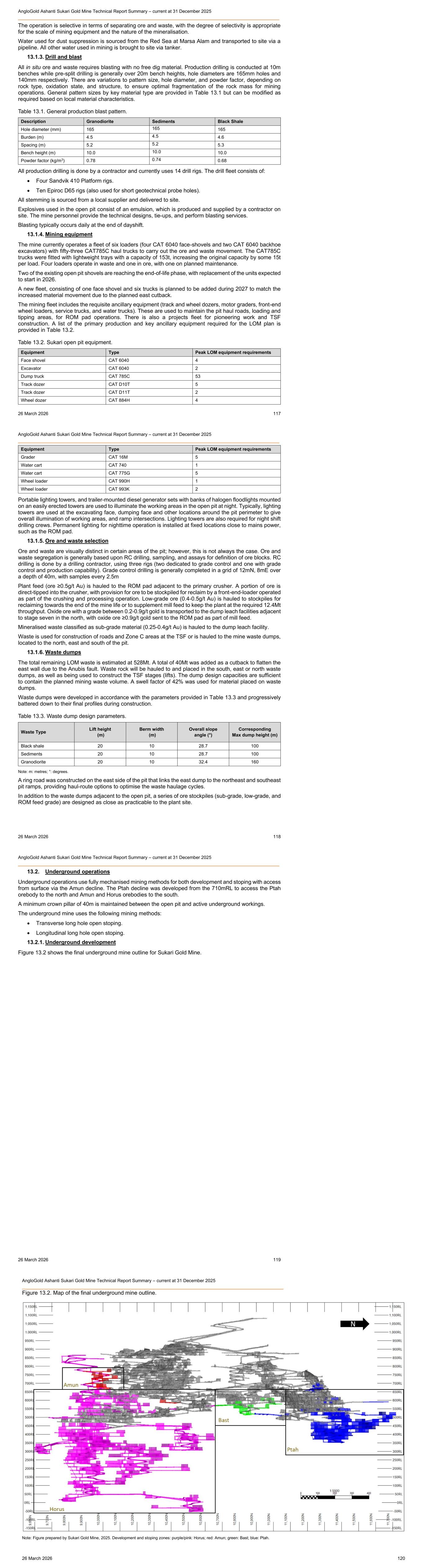
AngloGold Ashanti Sukari Gold Mine Technical Report Summary – current at 31 December 2025 _____________________________________________________________________________________ 26 March 2026 117 The operation is selective in terms of separating ore and waste, with the degree of selectivity is appropriate for the scale of mining equipment and the nature of the mineralisation. Water used for dust suppression is sourced from the Red Sea at Marsa Alam and transported to site via a pipeline. All other water used in mining is brought to site via tanker. 13.1.3. Drill and blast All in situ ore and waste requires blasting with no free dig material. Production drilling is conducted at 10m benches while pre-split drilling is generally over 20m bench heights, hole diameters are 165mm holes and 140mm respectively. There are variations to pattern size, hole diameter, and powder factor, depending on rock type, oxidation state, and structure, to ensure optimal fragmentation of the rock mass for mining operations. General pattern sizes by key material type are provided in Table 13.1 but can be modified as required based on local material characteristics. Table 13.1. General production blast pattern. Description Granodiorite Sediments Black Shale Hole diameter (mm) 165 165 165 Burden (m) 4.5 4.5 4.6 Spacing (m) 5.2 5.2 5.3 Bench height (m) 10.0 10.0 10.0 Powder factor (kg/m3) 0.78 0.74 0.68 All production drilling is done by a contractor and currently uses 14 drill rigs. The drill fleet consists of: • Four Sandvik 410 Platform rigs. • Ten Epiroc D65 rigs (also used for short geotechnical probe holes). All stemming is sourced from a local supplier and delivered to site. Explosives used in the open pit consist of an emulsion, which is produced and supplied by a contractor on site. The mine personnel provide the technical designs, tie-ups, and perform blasting services. Blasting typically occurs daily at the end of dayshift. 13.1.4. Mining equipment The mine currently operates a fleet of six loaders (four CAT 6040 face-shovels and two CAT 6040 backhoe excavators) with fifty-three CAT785C haul trucks to carry out the ore and waste movement. The CAT785C trucks were fitted with lightweight trays with a capacity of 153t, increasing the original capacity by some 15t per load. Four loaders operate in waste and one in ore, with one on planned maintenance. Two of the existing open pit shovels are reaching the end-of-life phase, with replacement of the units expected to start in 2026. A new fleet, consisting of one face shovel and six trucks is planned to be added during 2027 to match the increased material movement due to the planned east cutback. The mining fleet includes the requisite ancillary equipment (track and wheel dozers, motor graders, front-end wheel loaders, service trucks, and water trucks). These are used to maintain the pit haul roads, loading and tipping areas, for ROM pad operations. There is also a projects fleet for pioneering work and TSF construction. A list of the primary production and key ancillary equipment required for the LOM plan is provided in Table 13.2. Table 13.2. Sukari open pit equipment. Equipment Type Peak LOM equipment requirements Face shovel CAT 6040 4 Excavator CAT 6040 2 Dump truck CAT 785C 53 Track dozer CAT D10T 5 Track dozer CAT D11T 2 Wheel dozer CAT 884H 4 AngloGold Ashanti Sukari Gold Mine Technical Report Summary – current at 31 December 2025 _____________________________________________________________________________________ 26 March 2026 118 Equipment Type Peak LOM equipment requirements Grader CAT 16M 5 Water cart CAT 740 1 Water cart CAT 775G 5 Wheel loader CAT 990H 1 Wheel loader CAT 993K 2 Portable lighting towers, and trailer-mounted diesel generator sets with banks of halogen floodlights mounted on an easily erected towers are used to illuminate the working areas in the open pit at night. Typically, lighting towers are used at the excavating face, dumping face and other locations around the pit perimeter to give overall illumination of working areas, and ramp intersections. Lighting towers are also required for night shift drilling crews. Permanent lighting for nighttime operation is installed at fixed locations close to mains power, such as the ROM pad. 13.1.5. Ore and waste selection Ore and waste are visually distinct in certain areas of the pit; however, this is not always the case. Ore and waste segregation is generally based upon RC drilling, sampling, and assays for definition of ore blocks. RC drilling is done by a drilling contractor, using three rigs (two dedicated to grade control and one with grade control and production capability). Grade control drilling is generally completed in a grid of 12mN, 8mE over a depth of 40m, with samples every 2.5m Plant feed (ore ≥0.5g/t Au) is hauled to the ROM pad adjacent to the primary crusher. A portion of ore is direct-tipped into the crusher, with provision for ore to be stockpiled for reclaim by a front-end-loader operated as part of the crushing and processing operation. Low-grade ore (0.4-0.5g/t Au) is hauled to stockpiles for reclaiming towards the end of the mine life or to supplement mill feed to keep the plant at the required 12.4Mt throughput. Oxide ore with a grade between 0.2-0.9g/t gold is transported to the dump leach facilities adjacent to stage seven in the north, with oxide ore ≥0.9g/t gold sent to the ROM pad as part of mill feed. Mineralised waste classified as sub-grade material (0.25-0.4g/t Au) is hauled to the dump leach facility. Waste is used for construction of roads and Zone C areas at the TSF or is hauled to the mine waste dumps, located to the north, east and south of the pit. 13.1.6. Waste dumps The total remaining LOM waste is estimated at 528Mt. A total of 40Mt was added as a cutback to flatten the east wall due to the Anubis fault. Waste rock will be hauled to and placed in the south, east or north waste dumps, as well as being used to construct the TSF stages (lifts). The dump design capacities are sufficient to contain the planned mining waste volume. A swell factor of 42% was used for material placed on waste dumps. Waste dumps were developed in accordance with the parameters provided in Table 13.3 and progressively battered down to their final profiles during construction. Table 13.3. Waste dump design parameters. Waste Type Lift height (m) Berm width (m) Overall slope angle (°) Corresponding Max dump height (m) Black shale 20 10 28.7 100 Sediments 20 10 28.7 100 Granodiorite 20 10 32.4 160 Note: m: metres; °: degrees. A ring road was constructed on the east side of the pit that links the east dump to the northeast and southeast pit ramps, providing haul-route options to optimise the waste haulage cycles. In addition to the waste dumps adjacent to the open pit, a series of ore stockpiles (sub-grade, low-grade, and ROM feed grade) are designed as close as practicable to the plant site. AngloGold Ashanti Sukari Gold Mine Technical Report Summary – current at 31 December 2025 _____________________________________________________________________________________ 26 March 2026 119 13.2. Underground operations Underground operations use fully mechanised mining methods for both development and stoping with access from surface via the Amun decline. The Ptah decline was developed from the 710mRL to access the Ptah orebody to the north and Amun and Horus orebodies to the south. A minimum crown pillar of 40m is maintained between the open pit and active underground workings. The underground mine uses the following mining methods: • Transverse long hole open stoping. • Longitudinal long hole open stoping. 13.2.1. Underground development Figure 13.2 shows the final underground mine outline for Sukari Gold Mine. AngloGold Ashanti Sukari Gold Mine Technical Report Summary – current at 31 December 2025 _____________________________________________________________________________________ 26 March 2026 120 Figure 13.2. Map of the final underground mine outline. Note: Figure prepared by Sukari Gold Mine, 2025. Development and stoping zones: purple/pink: Horus; red: Amun; green: Bast; blue: Ptah.

AngloGold Ashanti Sukari Gold Mine Technical Report Summary – current at 31 December 2025 _____________________________________________________________________________________ 26 March 2026 121 13.2.2. Transverse long hole stoping The transverse mining method is used for bulk stoping areas, allowing for multiple stopes to be in production along strike simultaneously on any given sublevel. Stopes along strike are split into primary and secondary stopes, allowing a pillar to be maintained between the primaries during excavation to improve overall stability. Once primary stopes have been excavated, backfilled and cured, a secondary stope between pairs of primaries is excavated and subsequently filled with either lower-strength fill, waste rock or a combination of the two. Mining then progresses bottom-up. The transverse method is predominantly employed in the Ptah East, West and Keel zones. Figure 13.3 shows an example of the progression of the transverse stoping method within the Ptah Keel Zone. Figure 13.3 Schematic transverse long-hole stoping progression. Note: Figure prepared by Sukari Gold Mine, 2024; P: primary; S: secondary. AngloGold Ashanti Sukari Gold Mine Technical Report Summary – current at 31 December 2025 _____________________________________________________________________________________ 26 March 2026 122 13.2.3. Longitudinal long hole stoping A longitudinal long-hole method is used for narrower vein stoping. This method consists of driving horizontal drifts along the strike of the vein and then blasting the ore vertically between the upper and lower drifts. The current methodology mines a block of three, 20m high levels in an overhand lift sequence using cemented rock fill to fill the completed stopes and later be used as a platform for the next sub-level. Development waste is currently used for fill purposes either on its own or as the primary component of cemented rock fill. The use of cemented rock fill has now been predominantly replaced by cemented paste backfill. The transverse methodology is predominantly employed in the Amun, Bast and Horus (Horus and Deep) zones. Figure 13.4 shows a schematic for the longitudinal stoping method. Figure 13.4. Schematic longitudinal long-hole stoping progression. Note: Figure prepared by Sukari Gold Mine, 2024. AngloGold Ashanti Sukari Gold Mine Technical Report Summary – current at 31 December 2025 _____________________________________________________________________________________ 26 March 2026 123 13.2.4. Mining equipment The underground operation uses a conventional fleet of underground trucks and loaders for material movement, in addition to jumbo drill rigs and auxiliary equipment. Table 13.4 presents the equipment requirements for the LOM. Table 13.4. Sukari underground LOM equipment fleet. Plant description Make and model Number Forklift CAT DP30NT Underground workshop 1 Jumbo development drill Sandvik DD421 4 Sandvik DD422 1 Long hole drill Sandvik DL431 1 Sandvik DL421 1 Sandvik DL432i 1 Surface top hammer drill Commando DC300Ri T3 1 Tele handler MANITOU MHT 860L Underground maintenance 1 Underground agitator ULTIMEC LF600 3 Underground concrete spraying Spraymec SF050D 2 Underground explosives charging equipment CHARMEC 1614B 1 CHARMEC MF605D 2 Underground integrated tool carrier Volvo L120F 6 Underground maintenance graders CAT 12M 1 CAT 14H 1 Underground truck CAT AD45 2 CAT AD63 6 CAT AD55 1 Sandvik TH663 1 Underground water truck CAT AD30 1 Underground wheel loader CAT R1700 3 CAT R2900G 4 There is a potential production risk due to the current long lead times for new equipment purchases. The strategy to mitigate production disruptions is as follows: • Purchase new equipment where available. • Rebuild existing equipment where sufficient value can be extracted. 13.2.5. Cemented pastefill system Following commissioning of a paste plant in Q3 2023, cemented pastefill is used for stability with the long hole open stoping and cut and fill mining methods. Tailings from the process plant are sent to the paste plant and stored in a buffer tank. If needed, a cyclone cluster installed on the buffer tank allows for the de-sliming of the tailings feed. The buffer tank feeds a horizontal belt filter that discharges to a transfer conveyor that feeds into the paste mixer. Binder and trim slurry are added to the paste mixer to achieve the desired backfill concentrations. A hopper feeds the pastefill to a positive displacement piston pump. The pump sends the pastefill to an underground distribution system. The paste is transferred from the paste hopper via a paste pipeline to the underground mine stopes using a duty paste pump. Paste is delivered to the designated stope by the underground distribution system and discharges from the top drive to fill the stope. A barricade retains the initial plug pour and allows for the mix to cure before the bulk of the stope is filled. AngloGold Ashanti Sukari Gold Mine Technical Report Summary – current at 31 December 2025 _____________________________________________________________________________________ 26 March 2026 124 13.2.6. Ventilation The total ventilation air movement is approximately 560m3/s with intake via the main decline portal, 920 and 850 portals, and via leakage through stoping that has caved at surface. Air is exhausted via two circuits, Ptah and Horus exhaust, and both exhaust to the open pit. The ventilation system (Figure 13.5) has approximately 11% leakage from the intake straight to the exhaust. Around 16% of the Horus intake air is used air coming from the Ptah area. Figure 13.5. Sukari primary ventilation schematic. Note: Figure prepared by Sukari Gold Mine, 2025. m3/s: cubic metres per second. 13.2.7. Refuge and emergency egress The mine has a number of mobile refuge chambers for between four and 20 persons. Fixed permanent fresh air bases are also in place or planned. An emergency set of services runs through the exhaust system, providing an independent source of compressed air and fire-fighting water. Radio communications are available throughout the mine, and a backup conventional telephone system is also in place. 13.3. Mining schedule The detailed production schedule is based on ROM tonnages from the open pit and underground operation and augmented by stockpile feed where required to provide plant feed at a throughput rate of 12Mtpa. Table 13.5 presents the LOM schedule.
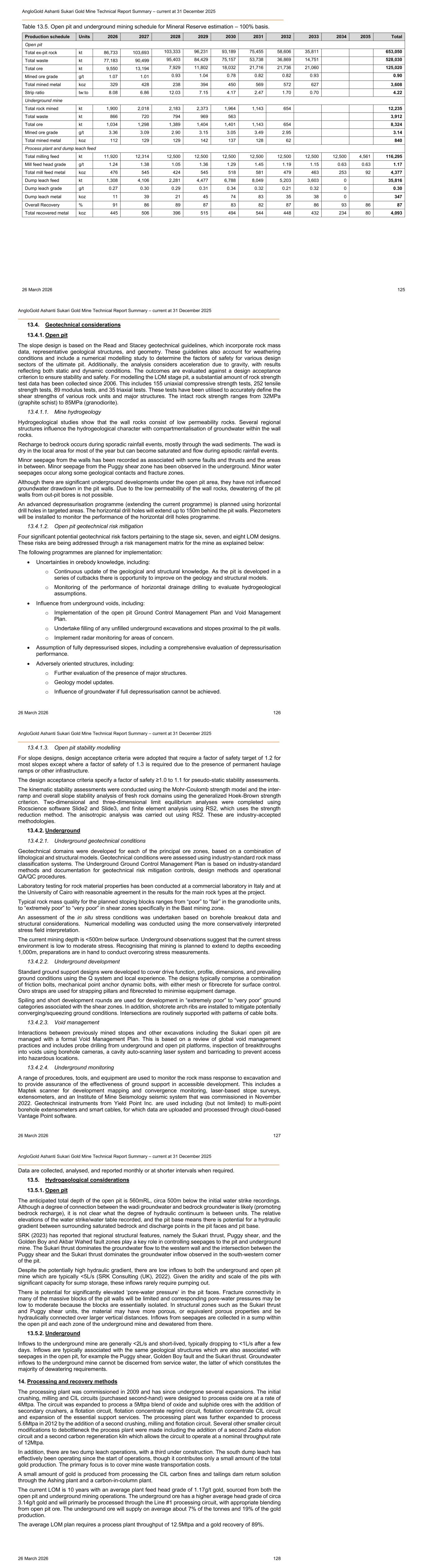
AngloGold Ashanti Sukari Gold Mine Technical Report Summary – current at 31 December 2025 _____________________________________________________________________________________ 26 March 2026 125 Table 13.5. Open pit and underground mining schedule for Mineral Reserve estimation – 100% basis. Production schedule Units 2026 2027 2028 2029 2030 2031 2032 2033 2034 2035 Total Open pit Total ex-pit rock kt 86,733 103,693 103,333 96,231 93,189 75,455 58,606 35,811 653,050 Total waste kt 77,183 90,499 95,403 84,429 75,157 53,738 36,869 14,751 528,030 Total ore kt 9,550 13,194 7,929 11,802 18,032 21,716 21,736 21,060 125,020 Mined ore grade g/t 1.07 1.01 0.93 1.04 0.78 0.82 0.82 0.93 0.90 Total mined metal koz 329 428 238 394 450 569 572 627 3,608 Strip ratio tw:to 8.08 6.86 12.03 7.15 4.17 2.47 1.70 0.70 4.22 Underground mine Total rock mined kt 1,900 2,018 2,183 2,373 1,964 1,143 654 12,235 Total waste kt 866 720 794 969 563 3,912 Total ore kt 1,034 1,298 1,389 1,404 1,401 1,143 654 8,324 Mined ore grade g/t 3.36 3.09 2.90 3.15 3.05 3.49 2.95 3.14 Total mined metal koz 112 129 129 142 137 128 62 840 Process plant and dump leach feed Total milling feed kt 11,920 12,314 12,500 12,500 12,500 12,500 12,500 12,500 12,500 4,561 116,295 Mill feed head grade g/t 1.24 1.38 1.05 1.36 1.29 1.45 1.19 1.15 0.63 0.63 1.17 Total mill feed metal koz 476 545 424 545 518 581 479 463 253 92 4,377 Dump leach feed kt 1,308 4,106 2,281 4,477 6,788 8,049 5,203 3,603 0 35,816 Dump leach grade g/t 0.27 0.30 0.29 0.31 0.34 0.32 0.21 0.32 0 0.30 Dump leach metal koz 11 39 21 45 74 83 35 38 0 347 Overall Recovery % 91 86 89 87 83 82 87 86 93 86 87 Total recovered metal koz 445 506 396 515 494 544 448 432 234 80 4,093 AngloGold Ashanti Sukari Gold Mine Technical Report Summary – current at 31 December 2025 _____________________________________________________________________________________ 26 March 2026 126 13.4. Geotechnical considerations 13.4.1. Open pit The slope design is based on the Read and Stacey geotechnical guidelines, which incorporate rock mass data, representative geological structures, and geometry. These guidelines also account for weathering conditions and include a numerical modelling study to determine the factors of safety for various design sectors of the ultimate pit. Additionally, the analysis considers acceleration due to gravity, with results reflecting both static and dynamic conditions. The outcomes are evaluated against a design acceptance criterion to ensure stability and safety. For modelling the LOM stage pit, a substantial amount of rock strength test data has been collected since 2006. This includes 155 uniaxial compressive strength tests, 252 tensile strength tests, 89 modulus tests, and 35 triaxial tests. These tests have been utilised to accurately define the shear strengths of various rock units and major structures. The intact rock strength ranges from 32MPa (graphite schist) to 85MPa (granodiorite). 13.4.1.1. Mine hydrogeology Hydrogeological studies show that the wall rocks consist of low permeability rocks. Several regional structures influence the hydrogeological character with compartmentalisation of groundwater within the wall rocks. Recharge to bedrock occurs during sporadic rainfall events, mostly through the wadi sediments. The wadi is dry in the local area for most of the year but can become saturated and flow during episodic rainfall events. Minor seepage from the walls has been recorded as associated with some faults and thrusts and the areas in between. Minor seepage from the Puggy shear zone has been observed in the underground. Minor water seepages occur along some geological contacts and fracture zones. Although there are significant underground developments under the open pit area, they have not influenced groundwater drawdown in the pit walls. Due to the low permeability of the wall rocks, dewatering of the pit walls from out-pit bores is not possible. An advanced depressurisation programme (extending the current programme) is planned using horizontal drill holes in targeted areas. The horizontal drill holes will extend up to 150m behind the pit walls. Piezometers will be installed to monitor the performance of the horizontal drill holes programme. 13.4.1.2. Open pit geotechnical risk mitigation Four significant potential geotechnical risk factors pertaining to the stage six, seven, and eight LOM designs. These risks are being addressed through a risk management matrix for the mine as explained below: The following programmes are planned for implementation: • Uncertainties in orebody knowledge, including: o Continuous update of the geological and structural knowledge. As the pit is developed in a series of cutbacks there is opportunity to improve on the geology and structural models. o Monitoring of the performance of horizontal drainage drilling to evaluate hydrogeological assumptions. • Influence from underground voids, including: o Implementation of the open pit Ground Control Management Plan and Void Management Plan. o Undertake filling of any unfilled underground excavations and stopes proximal to the pit walls. o Implement radar monitoring for areas of concern. • Assumption of fully depressurised slopes, including a comprehensive evaluation of depressurisation performance. • Adversely oriented structures, including: o Further evaluation of the presence of major structures. o Geology model updates. o Influence of groundwater if full depressurisation cannot be achieved. AngloGold Ashanti Sukari Gold Mine Technical Report Summary – current at 31 December 2025 _____________________________________________________________________________________ 26 March 2026 127 13.4.1.3. Open pit stability modelling For slope designs, design acceptance criteria were adopted that require a factor of safety target of 1.2 for most slopes except where a factor of safety of 1.3 is required due to the presence of permanent haulage ramps or other infrastructure. The design acceptance criteria specify a factor of safety ≥1.0 to 1.1 for pseudo-static stability assessments. The kinematic stability assessments were conducted using the Mohr-Coulomb strength model and the inter- ramp and overall slope stability analysis of fresh rock domains using the generalized Hoek-Brown strength criterion. Two-dimensional and three-dimensional limit equilibrium analyses were completed using Rocscience software Slide2 and Slide3, and finite element analysis using RS2, which uses the strength reduction method. The anisotropic analysis was carried out using RS2. These are industry-accepted methodologies. 13.4.2. Underground 13.4.2.1. Underground geotechnical conditions Geotechnical domains were developed for each of the principal ore zones, based on a combination of lithological and structural models. Geotechnical conditions were assessed using industry-standard rock mass classification systems. The Underground Ground Control Management Plan is based on industry-standard methods and documentation for geotechnical risk mitigation controls, design methods and operational QA/QC procedures. Laboratory testing for rock material properties has been conducted at a commercial laboratory in Italy and at the University of Cairo with reasonable agreement in the results for the main rock types at the project. Typical rock mass quality for the planned stoping blocks ranges from “poor” to “fair” in the granodiorite units, to “extremely poor” to “very poor” in shear zones specifically in the Bast mining zone. An assessment of the in situ stress conditions was undertaken based on borehole breakout data and structural considerations. Numerical modelling was conducted using the more conservatively interpreted stress field interpretation. The current mining depth is <500m below surface. Underground observations suggest that the current stress environment is low to moderate stress. Recognising that mining is planned to extend to depths exceeding 1,000m, preparations are in hand to conduct overcoring stress measurements. 13.4.2.2. Underground development Standard ground support designs were developed to cover drive function, profile, dimensions, and prevailing ground conditions using the Q system and local experience. The designs typically comprise a combination of friction bolts, mechanical point anchor dynamic bolts, with either mesh or fibrecrete for surface control. Osro straps are used for strapping pillars and fibrecreted to minimise equipment damage. Spiling and short development rounds are used for development in “extremely poor” to “very poor” ground categories associated with the shear zones. In addition, shotcrete arch ribs are installed to mitigate potentially converging/squeezing ground conditions. Intersections are routinely supported with patterns of cable bolts. 13.4.2.3. Void management Interactions between previously mined stopes and other excavations including the Sukari open pit are managed with a formal Void Management Plan. This is based on a review of global void management practices and includes probe drilling from underground and open pit platforms, inspection of breakthroughs into voids using borehole cameras, a cavity auto-scanning laser system and barricading to prevent access into hazardous locations. 13.4.2.4. Underground monitoring A range of procedures, tools, and equipment are used to monitor the rock mass response to excavation and to provide assurance of the effectiveness of ground support in accessible development. This includes a Maptek scanner for development mapping and convergence monitoring, laser-based stope surveys, extensometers, and an Institute of Mine Seismology seismic system that was commissioned in November 2022. Geotechnical instruments from Yield Point Inc. are used including (but not limited) to multi-point borehole extensometers and smart cables, for which data are uploaded and processed through cloud-based Vantage Point software. AngloGold Ashanti Sukari Gold Mine Technical Report Summary – current at 31 December 2025 _____________________________________________________________________________________ 26 March 2026 128 Data are collected, analysed, and reported monthly or at shorter intervals when required. 13.5. Hydrogeological considerations 13.5.1. Open pit The anticipated total depth of the open pit is 560mRL, circa 500m below the initial water strike recordings. Although a degree of connection between the wadi groundwater and bedrock groundwater is likely (promoting bedrock recharge), it is not clear what the degree of hydraulic continuum is between units. The relative elevations of the water strike/water table recorded, and the pit base means there is potential for a hydraulic gradient between surrounding saturated bedrock and discharge points in the pit faces and pit base. SRK (2023) has reported that regional structural features, namely the Sukari thrust, Puggy shear, and the Golden Boy and Akbar Wahed fault zones play a key role in controlling seepages to the pit and underground mine. The Sukari thrust dominates the groundwater flow to the western wall and the intersection between the Puggy shear and the Sukari thrust dominates the groundwater inflow observed in the south-western corner of the pit. Despite the potentially high hydraulic gradient, there are low inflows to both the underground and open pit mine which are typically <5L/s (SRK Consulting (UK), 2022). Given the aridity and scale of the pits with significant capacity for sump storage, these inflows rarely require pumping out. There is potential for significantly elevated ‘pore-water pressure’ in the pit faces. Fracture connectivity in many of the massive blocks of the pit walls will be limited and corresponding pore-water pressures may be low to moderate because the blocks are essentially isolated. In structural zones such as the Sukari thrust and Puggy shear units, the material may have more porous, or equivalent porous properties and be hydraulically connected over larger vertical distances. Inflows from seepages are collected in a sump within the open pit and each zone of the underground mine and dewatered from there. 13.5.2. Underground Inflows to the underground mine are generally <2L/s and short-lived, typically dropping to <1L/s after a few days. Inflows are typically associated with the same geological structures which are also associated with seepages in the open pit, for example the Puggy shear, Golden Boy fault and the Sukari thrust. Groundwater inflows to the underground mine cannot be discerned from service water, the latter of which constitutes the majority of dewatering requirements. 14. Processing and recovery methods The processing plant was commissioned in 2009 and has since undergone several expansions. The initial crushing, milling and CIL circuits (purchased second-hand) were designed to process oxide ore at a rate of 4Mtpa. The circuit was expanded to process a 5Mtpa blend of oxide and sulphide ores with the addition of secondary crushers, a flotation circuit, flotation concentrate regrind circuit, flotation concentrate CIL circuit and expansion of the essential support services. The processing plant was further expanded to process 5.6Mtpa in 2012 by the addition of a second crushing, milling and flotation circuit. Several other smaller circuit modifications to debottleneck the process plant were made including the addition of a second Zadra elution circuit and a second carbon regeneration kiln which allows the circuit to operate at a nominal throughput rate of 12Mtpa. In addition, there are two dump leach operations, with a third under construction. The south dump leach has effectively been operating since the start of operations, though it contributes only a small amount of the total gold production. The primary focus is to cover mine waste transportation costs. A small amount of gold is produced from processing the CIL carbon fines and tailings dam return solution through the Ashing plant and a carbon-in-column plant. The current LOM is 10 years with an average plant feed head grade of 1.17g/t gold, sourced from both the open pit and underground mining operations. The underground ore has a higher average head grade of circa 3.14g/t gold and will primarily be processed through the Line #1 processing circuit, with appropriate blending from open pit ore. The underground ore will supply on average about 7% of the tonnes and 19% of the gold production. The average LOM plan requires a process plant throughput of 12.5Mtpa and a gold recovery of 89%.
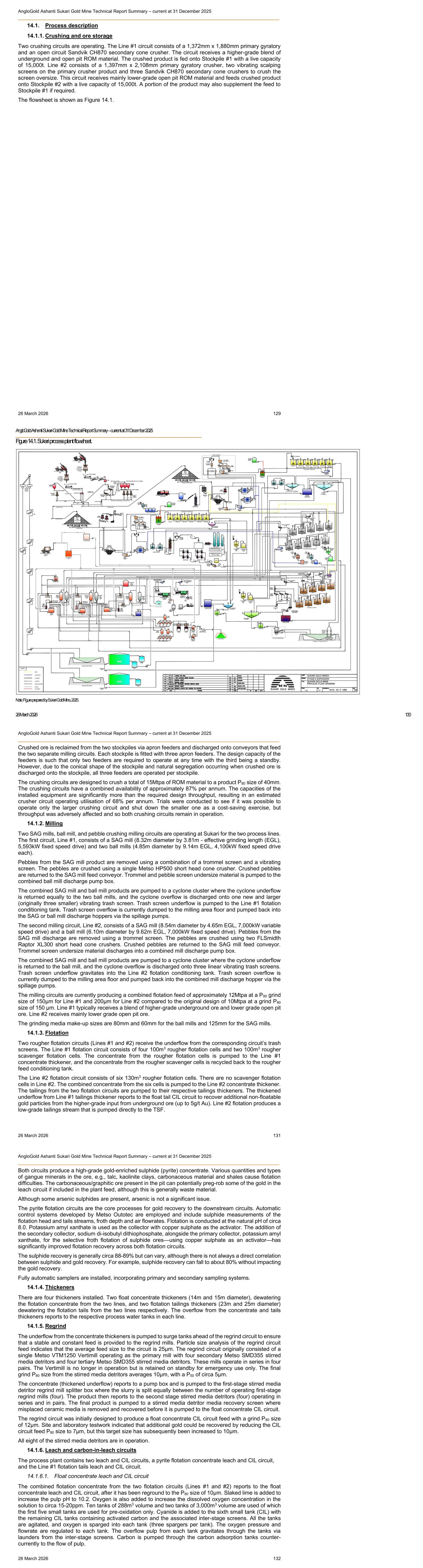
AngloGold Ashanti Sukari Gold Mine Technical Report Summary – current at 31 December 2025 _____________________________________________________________________________________ 26 March 2026 129 14.1. Process description 14.1.1. Crushing and ore storage Two crushing circuits are operating. The Line #1 circuit consists of a 1,372mm x 1,880mm primary gyratory and an open circuit Sandvik CH870 secondary cone crusher. The circuit receives a higher-grade blend of underground and open pit ROM material. The crushed product is fed onto Stockpile #1 with a live capacity of 15,000t. Line #2 consists of a 1,397mm x 2,108mm primary gyratory crusher, two vibrating scalping screens on the primary crusher product and three Sandvik CH870 secondary cone crushers to crush the screen oversize. This circuit receives mainly lower-grade open pit ROM material and feeds crushed product onto Stockpile #2 with a live capacity of 15,000t. A portion of the product may also supplement the feed to Stockpile #1 if required. The flowsheet is shown as Figure 14.1. AngloGold Ashanti Sukari Gold Mine Technical Report Summary – current at 31 December 2025 _____________________________________________________________________________________ 26 March 2026 130 Figure 14.1. Sukari process plant flowsheet. Note: Figure prepared by Sukari Gold Mine, 2025. AngloGold Ashanti Sukari Gold Mine Technical Report Summary – current at 31 December 2025 _____________________________________________________________________________________ 26 March 2026 131 Crushed ore is reclaimed from the two stockpiles via apron feeders and discharged onto conveyors that feed the two separate milling circuits. Each stockpile is fitted with three apron feeders. The design capacity of the feeders is such that only two feeders are required to operate at any time with the third being a standby. However, due to the conical shape of the stockpile and natural segregation occurring when crushed ore is discharged onto the stockpile, all three feeders are operated per stockpile. The crushing circuits are designed to crush a total of 15Mtpa of ROM material to a product P80 size of 40mm. The crushing circuits have a combined availability of approximately 87% per annum. The capacities of the installed equipment are significantly more than the required design throughput, resulting in an estimated crusher circuit operating utilisation of 68% per annum. Trials were conducted to see if it was possible to operate only the larger crushing circuit and shut down the smaller one as a cost-saving exercise, but throughput was adversely affected and so both crushing circuits remain in operation. 14.1.2. Milling Two SAG mills, ball mill, and pebble crushing milling circuits are operating at Sukari for the two process lines. The first circuit, Line #1, consists of a SAG mill (8.32m diameter by 3.81m - effective grinding length (EGL), 5,593kW fixed speed drive) and two ball mills (4.85m diameter by 9.14m EGL, 4,100kW fixed speed drive each). Pebbles from the SAG mill product are removed using a combination of a trommel screen and a vibrating screen. The pebbles are crushed using a single Metso HP500 short head cone crusher. Crushed pebbles are returned to the SAG mill feed conveyor. Trommel and pebble screen undersize material is pumped to the combined ball mill discharge pump box. The combined SAG mill and ball mill products are pumped to a cyclone cluster where the cyclone underflow is returned equally to the two ball mills, and the cyclone overflow is discharged onto one new and larger (originally three smaller) vibrating trash screen. Trash screen underflow is pumped to the Line #1 flotation conditioning tank. Trash screen overflow is currently dumped to the milling area floor and pumped back into the SAG or ball mill discharge hoppers via the spillage pumps. The second milling circuit, Line #2, consists of a SAG mill (8.54m diameter by 4.65m EGL, 7,000kW variable speed drive) and a ball mill (6.10m diameter by 9.62m EGL, 7,000kW fixed speed drive). Pebbles from the SAG mill discharge are removed using a trommel screen. The pebbles are crushed using two FLSmidth Raptor XL300 short head cone crushers. Crushed pebbles are returned to the SAG mill feed conveyor. Trommel screen undersize material discharges into a combined mill discharge pump box. The combined SAG mill and ball mill products are pumped to a cyclone cluster where the cyclone underflow is returned to the ball mill, and the cyclone overflow is discharged onto three linear vibrating trash screens. Trash screen underflow gravitates into the Line #2 flotation conditioning tank. Trash screen overflow is currently dumped to the milling area floor and pumped back into the combined mill discharge hopper via the spillage pumps. The milling circuits are currently producing a combined flotation feed of approximately 12Mtpa at a P80 grind size of 150µm for Line #1 and 200µm for Line #2 compared to the original design of 10Mtpa at a grind P80 size of 150 µm. Line #1 typically receives a blend of higher-grade underground ore and lower grade open pit ore. Line #2 receives mainly lower grade open pit ore. The grinding media make-up sizes are 80mm and 60mm for the ball mills and 125mm for the SAG mills. 14.1.3. Flotation Two rougher flotation circuits (Lines #1 and #2) receive the underflow from the corresponding circuit’s trash screens. The Line #1 flotation circuit consists of four 100m3 rougher flotation cells and two 100m3 rougher scavenger flotation cells. The concentrate from the rougher flotation cells is pumped to the Line #1 concentrate thickener, and the concentrate from the rougher scavenger cells is recycled back to the rougher feed conditioning tank. The Line #2 flotation circuit consists of six 130m3 rougher flotation cells. There are no scavenger flotation cells in Line #2. The combined concentrate from the six cells is pumped to the Line #2 concentrate thickener. The tailings from the two flotation circuits are pumped to their respective tailings thickeners. The thickened underflow from Line #1 tailings thickener reports to the float tail CIL circuit to recover additional non-floatable gold particles from the higher-grade input from underground ore (up to 5g/t Au). Line #2 flotation produces a low-grade tailings stream that is pumped directly to the TSF. AngloGold Ashanti Sukari Gold Mine Technical Report Summary – current at 31 December 2025 _____________________________________________________________________________________ 26 March 2026 132 Both circuits produce a high-grade gold-enriched sulphide (pyrite) concentrate. Various quantities and types of gangue minerals in the ore, e.g., talc, kaolinite clays, carbonaceous material and shales cause flotation difficulties. The carbonaceous/graphitic ore present in the pit can potentially preg-rob some of the gold in the leach circuit if included in the plant feed, although this is generally waste material. Although some arsenic sulphides are present, arsenic is not a significant issue. The pyrite flotation circuits are the core processes for gold recovery to the downstream circuits. Automatic control systems developed by Metso Outotec are employed and include sulphide measurements of the flotation head and tails streams, froth depth and air flowrates. Flotation is conducted at the natural pH of circa 8.0. Potassium amyl xanthate is used as the collector with copper sulphate as the activator. The addition of the secondary collector, sodium di-isobutyl dithiophosphate, alongside the primary collector, potassium amyl xanthate, for the selective froth flotation of sulphide ores—using copper sulphate as an activator—has significantly improved flotation recovery across both flotation circuits. The sulphide recovery is generally circa 88-89% but can vary, although there is not always a direct correlation between sulphide and gold recovery. For example, sulphide recovery can fall to about 80% without impacting the gold recovery. Fully automatic samplers are installed, incorporating primary and secondary sampling systems. 14.1.4. Thickeners There are four thickeners installed. Two float concentrate thickeners (14m and 15m diameter), dewatering the flotation concentrate from the two lines, and two flotation tailings thickeners (23m and 25m diameter) dewatering the flotation tails from the two lines respectively. The overflow from the concentrate and tails thickeners reports to the respective process water tanks in each line. 14.1.5. Regrind The underflow from the concentrate thickeners is pumped to surge tanks ahead of the regrind circuit to ensure that a stable and constant feed is provided to the regrind mills. Particle size analysis of the regrind circuit feed indicates that the average feed size to the circuit is 25µm. The regrind circuit originally consisted of a single Metso VTM1250 Vertimill operating as the primary mill with four secondary Metso SMD355 stirred media detritors and four tertiary Metso SMD355 stirred media detritors. These mills operate in series in four pairs. The Vertimill is no longer in operation but is retained on standby for emergency use only. The final grind P80 size from the stirred media detritors averages 10µm, with a P50 of circa 5µm. The concentrate (thickened underflow) reports to a pump box and is pumped to the first-stage stirred media detritor regrind mill splitter box where the slurry is split equally between the number of operating first-stage regrind mills (four). The product then reports to the second stage stirred media detritors (four) operating in series and in pairs. The final product is pumped to a stirred media detritor media recovery screen where misplaced ceramic media is removed and recovered before it is pumped to the float concentrate CIL circuit. The regrind circuit was initially designed to produce a float concentrate CIL circuit feed with a grind P80 size of 12µm. Site and laboratory testwork indicated that additional gold could be recovered by reducing the CIL circuit feed P80 size to 7µm, but this target size has subsequently been increased to 10µm. All eight of the stirred media detritors are in operation. 14.1.6. Leach and carbon-in-leach circuits The process plant contains two leach and CIL circuits, a pyrite flotation concentrate leach and CIL circuit, and the Line #1 flotation tails leach and CIL circuit. 14.1.6.1. Float concentrate leach and CIL circuit The combined flotation concentrate from the two flotation circuits (Lines #1 and #2) reports to the float concentrate leach and CIL circuit, after it has been reground to the P80 size of 10µm. Slaked lime is added to increase the pulp pH to 10.2. Oxygen is also added to increase the dissolved oxygen concentration in the solution to circa 15-20ppm. Ten tanks of 288m3 volume and two tanks of 3,000m3 volume are used of which the first five small tanks are used for pre-oxidation only. Cyanide is added to the sixth small tank (CIL) with the remaining CIL tanks containing activated carbon and the associated inter-stage screens. All the tanks are agitated, and oxygen is sparged into each tank (three spargers per tank). The oxygen pressure and flowrate are regulated to each tank. The overflow pulp from each tank gravitates through the tanks via launders from the inter-stage screens. Carbon is pumped through the carbon adsorption tanks counter- currently to the flow of pulp.

AngloGold Ashanti Sukari Gold Mine Technical Report Summary – current at 31 December 2025 _____________________________________________________________________________________ 26 March 2026 133 Oxygen is supplied on site from two sources: the first is from a dedicated cryogenic oxygen plant, the second is through the supply of liquid oxygen which is trucked to site. The first two tanks of the flotation tails leach and CIL circuit have been converted to pyrite flotation concentrate leach tanks to increase the residence time of the pyrite concentrate leach circuit, circa 36 hours, for increased gold recovery. Carbon recovered from the float tail CIL circuit is pumped to the last CIL tank and then pumped counter- current to the slurry stream, using airlift vertical slurry pumps, to adsorb the gold in solution. Gold-loaded carbon is recovered in batches from the first CIL tank via the carbon recovery pump and a vibrating screen. The loaded carbon overflows the loaded carbon screen and discharges into a three-tonne carbon transfer column. The carbon recovery pump is stopped when the transfer column is full. The transfer column is pressurised using freshwater, and the carbon is transferred to either one of the acid wash columns. The pulp pH is monitored, and slaked lime and cyanide can be stage-added as required to the pre-oxidation and CIL tanks. The slurry temperature in the float concentrate leach circuit is too high for dissolved oxygen probes to function correctly. Therefore, oxygen is continuously metered into all the tanks based on pre- determined flow set points. For the first two tanks, oxygen is added via a multimixer oxygen sparging system with hyper spargers for the other tanks. A project to replace the three small pre-oxidation tanks with a single large tank from the float tail CIL circuit was successfully completed, with TK10, a 3,000m³ capacity tank, converted for pre-oxidation, and the Aachen shear reactor successfully commissioned which will result in improving the leaching kinetics as well as reduce cyanide consumption. 14.1.6.2. Float tail leach and CIL circuit The Line #1 flotation tailings are thickened and then pumped to the float tail leach and CIL circuit, which consists of six 3,000m3 volume CIL tanks (originally the old oxide CIL circuit containing eight tanks, but the second and fourth tanks are currently used for the flotation concentrate leach and CIL circuit). Slaked lime is added to the first tank to maintain a pH of 9.9. Cyanide is also added to start the gold leach process. Oxygen is metered into all the tanks via side sparging. The tailings slurry from the last pyrite float concentrate CIL tank is also added to the third tank. The slurry gravitates through the six tanks via the intertank screens and launders. The tailings from the last CIL tank gravitates over three carbon safety screens before being pumped to the TSF without thickening. Regenerated carbon, fresh carbon and loaded carbon from the north and south heap leach dumps are added directly to the acid wash column then to the elution column. Carbon is pumped counter-current to the slurry from the last and through to the first tank using an airlift pumping system. Loaded carbon is recovered from the first tank using the carbon recovery pump and a Dutch State Mines (DSM) screen. Recovered carbon discharges into the last pyrite float concentrate CIL tank, and the slurry returns back to the first float tail CIL tank. The carbon recovered using the DSM screen and carbon recovery pump is not sufficient to maintain a constant carbon concentration throughout the float tail CIL tanks and the pyrite float concentrate CIL tanks. Therefore, carbon is also recovered from the first float tail CIL tank using the carbon recovery pump and the old, loaded vibrating carbon recovery screen. Carbon recovered from this screen discharges into either of the two acid wash columns and is then transferred to the penultimate float concentrate CIL tank using pressurised freshwater. 14.1.7. Elution, carbon regeneration and gold room Gold is recovered from the loaded carbon using two parallel 9t Zadra elution circuits, each processing two batches of carbon per day. This requires a daily carbon movement of 36t. The average loaded carbon value is circa 1kg/t gold. Two regeneration kilns are operating with a smaller 3t column which is used, when required, to reduce gold in circuit. 14.1.7.1. Carbon transfer Loaded carbon is recovered from the first pyrite float concentrate CIL tank via the loaded carbon recovery screen and discharged into a 3t transfer column. The transfer column is pressurised when full using freshwater and the carbon is then transferred in batches to one of the two 9t acid wash columns. Three batches of carbon are required to fill one acid wash column. AngloGold Ashanti Sukari Gold Mine Technical Report Summary – current at 31 December 2025 _____________________________________________________________________________________ 26 March 2026 134 14.1.7.2. Acid wash The two acid wash columns operate independently from the elution circuit, i.e., any one of the acid wash columns can feed any one of the elution columns. During acid washing, concentrated hydrochloric acid is metered into the bottom of the column where it is diluted with freshwater to achieve a 2.6% w/w concentration. The acid solution in the column is circulated through the acid wash column by the acid circulation pump for 60 minutes at a flow rate of 0.9 bed volumes per hour. The acid wash circulation pump is shared between the two acid wash columns. Therefore, only one acid wash column can conduct the soaking cycle at any one time. The loaded carbon is then rinsed with 6.8 bed volumes of freshwater. The rinse water displaces any residual acid from the loaded carbon. Dilute acid and rinse water is discharged into the float tail CIL tail pump box. Once the rinse is complete, the water is drained into the bund. The carbon is then hydraulically transferred using freshwater to either of the two elution columns which are ready to receive the next batch of loaded carbon. 14.1.7.3. Elution There are three Zadra elution circuits: two with 9t elution columns and one with a 3t elution column. Each circuit includes an elution column, strip solution heaters, heat exchangers, and four electrowinning cells, each containing 12 cathodes. A stripping solution containing 1% cyanide and 3% caustic soda is prepared before elution begins. More solution is added before the second elution to replace losses from the first. After every two elutions, the entire solution is replaced to prevent contamination. The solution is continuously pumped through the elution column and heat exchangers while being heated. Once it reaches 85°C for 10 minutes, it is sent through a flash vessel, where the pressure drops to atmospheric, then into the electrowinning cells at 124°C. In these cells, an electric current causes the gold to deposit onto stainless-steel cathodes. The remaining solution flows back to the strip solution tank and recirculates through the system nine times. Once this cycle is complete, the heaters are turned off, and the solution continues to circulate until it cools below 95°C. Finally, fresh cold water is pumped in to remove any remaining solution and cool the carbon. 14.1.7.4. Carbon regeneration After the carbon in the elution column is cooled down, the barren carbon is hydraulically transferred using freshwater to the carbon dewatering screen ahead of the carbon regeneration kiln. Two kilns are available, one of which is new to replace one of the older kilns that was previously used for drying the carbon only due to low temperatures. The throughput for both regeneration kilns is 1.5tph. 14.1.7.5. Ashing plant Fine carbon is generated during the long process of carbon transfer in the CIL tanks, which can negatively impact gold recovery. To prevent this, fine carbon is removed from the circuit, leading to the accumulation of a large amount of barren fine carbon over time. The ashing plant is designed to recover gold traces from this fine barren carbon using a combustion system. A new Holman shaking table has been installed to separate grit from the fine carbon, improving the efficiency of the ashing process. 14.1.7.6. Gold room After elution and electrowinning, the cathodes are washed in a designated washing bay using a high-pressure water machine. The washed gold-bearing material, or calcine, is collected in a hopper. Water from the hopper is drained through a vacuum filter to separate the sludge. The filtered water is transferred to another vacuum filtrate tank, where any remaining particles settle for collection. The gold sludge is then placed in oven trays and dried at 500°C for 12 hours. Once dried, the sludge is mixed by hand with fluxes (borax, soda ash, and silica) and fed into one of two diesel-fired smelting furnaces. The molten gold is poured into moulds to form bars, which are stamped with an identification number and weighed for shipment. AngloGold Ashanti Sukari Gold Mine Technical Report Summary – current at 31 December 2025 _____________________________________________________________________________________ 26 March 2026 135 Crystallised slag from the smelting process is crushed and passed through a mineral cone. Heavy particles are recovered and reprocessed with the gold sludge, while lighter slag particles are sent to the ball mill. Gold bars are packed inside the gold room, sealed, and prepared for shipment. 14.2. Energy, water, process materials and personnel requirements 14.2.1. Reagents The following reagents are used in the process: • Lime. • Sodium cyanide. • Caustic. • Hydrochloric acid. • Flocculant. • Collector. • Secondary collector (dithiophosphate-type) • Frother. • Sodium sulphite • Copper sulphate and ferrous sulphate. • Carboxymethyl cellulose dispersant. • Oxygen. A new reagent preparation area has been installed and commissioned for copper sulphate, ferrous sulphate, flocculant, and carboxymethyl cellulose. 14.2.2. Water services 14.2.2.1. Water management and effluents There are no surface water resources in the mine area. Groundwater resources originate from occasional rainfall, that partially infiltrate through the more permeable wadi deposits and accumulate in basement depressions or is trapped by faults and buried dykes. Based on the numerous faults and shear zones intersecting the Sukari open pit and underground mine, it is reasonable to deduce that seepage is minimal and structurally controlled. Groundwater is characterised as brackish with high total dissolved solids levels and is not suitable for drinking. The combined capacity of 1,700m3/h is sufficient to meet the process plant and mining water requirements at Sukari. The seawater pipelines report to the raw water ponds located within the process plant area. Reverse osmosis water treatment plants draw a portion of the seawater for potable and fresh water supplies. Brine solution produced at the desalination plant is recycled to the raw water ponds. A back-up bore field is installed close to the coastline were seawater freely infiltrates into the groundwater. It has not been required to support operations to the Report current date. The water balance for the TSF is strongly negative due to the low rainfall and high evaporation that characterises the region’s climate, thus 60-70% of total process water requirements need to be extracted from the Red Sea. Above 50% of water is reused. A closed-circuit system is in place, and the mine does not discharge water to the environment. 14.2.2.2. Process water Process water is stored and reticulated through the process plant from three storage tanks. Two of the process water tanks, one in each flotation circuit, receive the overflow from the flotation concentrate and tailings thickeners of each circuit and decant return water from the TSF. Raw water is used as make-up water to maintain the tank level if required. The process water is then reticulated to the respective milling and flotation circuits for dilution and spray water. The process water tank in Line #1 also provides process water to the float concentrate CIL and the float tail CIL circuits. Process water to the concentrate regrind circuit is provided from the Line #2 process water tank. AngloGold Ashanti Sukari Gold Mine Technical Report Summary – current at 31 December 2025 _____________________________________________________________________________________ 26 March 2026 136 14.2.2.3. Raw water Raw water from the Red Sea is supplied from two seawater harvesting systems containing intake pumps, buffer tanks and booster pumps. Harvested seawater is discharged into a concrete tank located at the process plant that feeds the freshwater supply system. The concrete tank overflows into two raw water storage ponds. Raw water pumps reticulate raw water through the process plant from the storage ponds. 14.2.2.4. Gland water Raw water is used as gland water for the slurry pumps. Gland water is stored in several surge tanks throughout the process plant and reticulated to the slurry pumps via ring main systems. Dedicated gland water and gland water booster pumps provide gland water to the two-stage tailings pumps. 14.2.2.5. Freshwater Freshwater to the process plant, offices and camp is supplied by two reverse osmosis plants with a combined capacity of 3,000m3 per day and stored in two freshwater tanks. Freshwater in the process plant is used for reagent make-up, carbon transfer and strip solution in the elution process. Freshwater is also reticulated to the camp, offices and the mining areas. 14.2.2.6. Potable water Potable water is delivered to site in a bulk tanker from Marsa Alam and stored in the potable water tank. Potable water is reticulated to the safety showers in the process plant and for domestic use in the camp and office buildings. 14.2.2.7. Firewater A firewater reserve of approximately 1,800m3 is maintained in the two freshwater tanks. Firewater is reticulated through the plant using an electrical and diesel motor driven pump. Pressure in the firewater system is maintained with an electrical jockey pump. 14.2.3. Power Power generation is from both a dedicated solar power station and from diesel-fuelled generators in two power stations. Additional detail on power generation and consumption is provided in Chapter 15. 14.2.4. Personnel The Sukari processing plant currently employs a total workforce of 274 personnel, covering all operational, maintenance, and technical support functions necessary for efficient plant performance. The staffing levels are structured to ensure optimal throughput, equipment reliability, and adherence to safety and environmental regulations. Given the stability of operations and the absence of any significant expansions or process modifications, no changes to the current workforce are anticipated in the foreseeable future. The existing personnel structure is considered sufficient to maintain production targets while supporting continuous improvement initiatives. 14.3. Laboratory The on-site laboratory is owner-operated and can treat up to 1,200 samples per day from the plant, exploration and grade control departments. The laboratory also includes an extensive metallurgical test laboratory, enabling all areas of the process plant to be tested at a laboratory scale. 14.4. Dump leaching Dump leaching of low-grade mine waste has essentially been operating since the mine began and is an effective way of paying for the mine waste transportation costs, with any additional gold recovery a bonus. There are two dump leach areas, South and North, with a third under construction to minimise stockpiling lower grade material. The South dump leach is basically completed with no new stacking of material, although leaching continues. This contains approximately 16Mt of material. The North dump leach operation was extended through 2024 to process extra 8.3Mt of fresh ore. The reticulation of the cells being extended, pumps have been upgraded and the carbon-in-column was increased from 8 to 26 and the reticulation rates were increased from approximately 200m3/hr to nearly 600m3/hr to recover gold from the solutions off the pads.
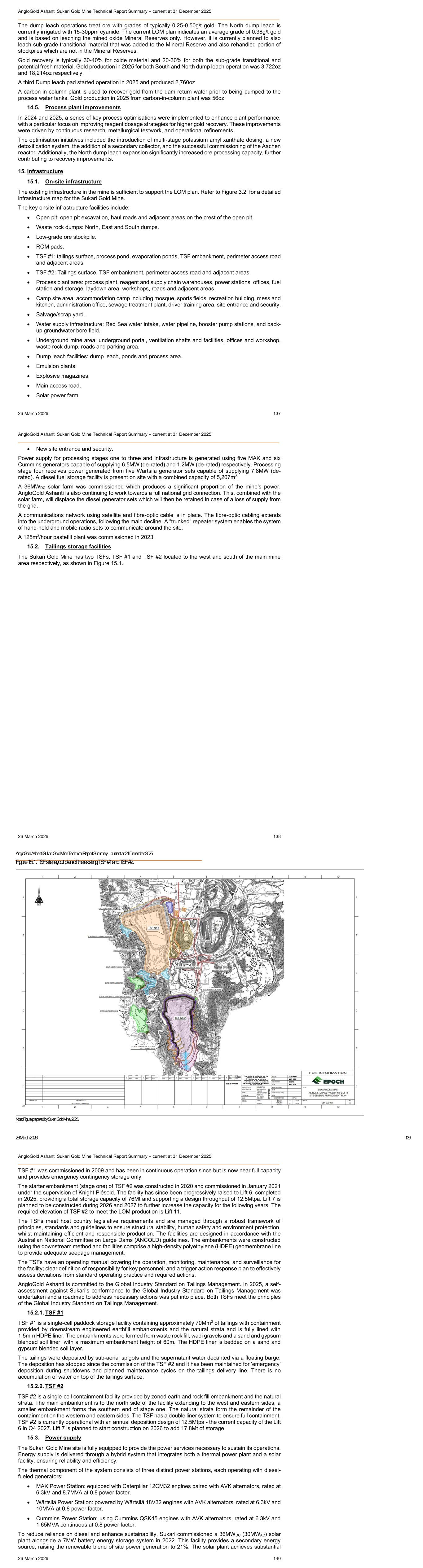
AngloGold Ashanti Sukari Gold Mine Technical Report Summary – current at 31 December 2025 _____________________________________________________________________________________ 26 March 2026 137 The dump leach operations treat ore with grades of typically 0.25-0.50g/t gold. The North dump leach is currently irrigated with 15-30ppm cyanide. The current LOM plan indicates an average grade of 0.38g/t gold and is based on leaching the mined oxide Mineral Reserves only. However, it is currently planned to also leach sub-grade transitional material that was added to the Mineral Reserve and also rehandled portion of stockpiles which are not in the Mineral Reserves. Gold recovery is typically 30-40% for oxide material and 20-30% for both the sub-grade transitional and potential fresh material. Gold production in 2025 for both South and North dump leach operation was 3,722oz and 18,214oz respectively. A third Dump leach pad started operation in 2025 and produced 2,760oz A carbon-in-column plant is used to recover gold from the dam return water prior to being pumped to the process water tanks. Gold production in 2025 from carbon-in-column plant was 56oz. 14.5. Process plant improvements In 2024 and 2025, a series of key process optimisations were implemented to enhance plant performance, with a particular focus on improving reagent dosage strategies for higher gold recovery. These improvements were driven by continuous research, metallurgical testwork, and operational refinements. The optimisation initiatives included the introduction of multi-stage potassium amyl xanthate dosing, a new detoxification system, the addition of a secondary collector, and the successful commissioning of the Aachen reactor. Additionally, the North dump leach expansion significantly increased ore processing capacity, further contributing to recovery improvements. 15. Infrastructure 15.1. On-site infrastructure The existing infrastructure in the mine is sufficient to support the LOM plan. Refer to Figure 3.2. for a detailed infrastructure map for the Sukari Gold Mine. The key onsite infrastructure facilities include: • Open pit: open pit excavation, haul roads and adjacent areas on the crest of the open pit. • Waste rock dumps: North, East and South dumps. • Low-grade ore stockpile. • ROM pads. • TSF #1: tailings surface, process pond, evaporation ponds, TSF embankment, perimeter access road and adjacent areas. • TSF #2: Tailings surface, TSF embankment, perimeter access road and adjacent areas. • Process plant area: process plant, reagent and supply chain warehouses, power stations, offices, fuel station and storage, laydown area, workshops, roads and adjacent areas. • Camp site area: accommodation camp including mosque, sports fields, recreation building, mess and kitchen, administration office, sewage treatment plant, driver training area, site entrance and security. • Salvage/scrap yard. • Water supply infrastructure: Red Sea water intake, water pipeline, booster pump stations, and back- up groundwater bore field. • Underground mine area: underground portal, ventilation shafts and facilities, offices and workshop, waste rock dump, roads and parking area. • Dump leach facilities: dump leach, ponds and process area. • Emulsion plants. • Explosive magazines. • Main access road. • Solar power farm. AngloGold Ashanti Sukari Gold Mine Technical Report Summary – current at 31 December 2025 _____________________________________________________________________________________ 26 March 2026 138 • New site entrance and security. Power supply for processing stages one to three and infrastructure is generated using five MAK and six Cummins generators capable of supplying 6.5MW (de-rated) and 1.2MW (de-rated) respectively. Processing stage four receives power generated from five Wartsila generator sets capable of supplying 7.8MW (de- rated). A diesel fuel storage facility is present on site with a combined capacity of 5,207m3. A 36MWDC solar farm was commissioned which produces a significant proportion of the mine’s power. AngloGold Ashanti is also continuing to work towards a full national grid connection. This, combined with the solar farm, will displace the diesel generator sets which will then be retained in case of a loss of supply from the grid. A communications network using satellite and fibre-optic cable is in place. The fibre-optic cabling extends into the underground operations, following the main decline. A “trunked” repeater system enables the system of hand-held and mobile radio sets to communicate around the site. A 125m3/hour pastefill plant was commissioned in 2023. 15.2. Tailings storage facilities The Sukari Gold Mine has two TSFs, TSF #1 and TSF #2 located to the west and south of the main mine area respectively, as shown in Figure 15.1. AngloGold Ashanti Sukari Gold Mine Technical Report Summary – current at 31 December 2025 _____________________________________________________________________________________ 26 March 2026 139 Figure 15.1. TSF site layout plan of the existing TSF #1 and TSF #2. Note: Figure prepared by Sukari Gold Mine, 2025. AngloGold Ashanti Sukari Gold Mine Technical Report Summary – current at 31 December 2025 _____________________________________________________________________________________ 26 March 2026 140 TSF #1 was commissioned in 2009 and has been in continuous operation since but is now near full capacity and provides emergency contingency storage only. The starter embankment (stage one) of TSF #2 was constructed in 2020 and commissioned in January 2021 under the supervision of Knight Piésold. The facility has since been progressively raised to Lift 6, completed in 2025, providing a total storage capacity of 76Mt and supporting a design throughput of 12.5Mtpa. Lift 7 is planned to be constructed during 2026 and 2027 to further increase the capacity for the following years. The required elevation of TSF #2 to meet the LOM production is Lift 11. The TSFs meet host country legislative requirements and are managed through a robust framework of principles, standards and guidelines to ensure structural stability, human safety and environment protection, whilst maintaining efficient and responsible production. The facilities are designed in accordance with the Australian National Committee on Large Dams (ANCOLD) guidelines. The embankments were constructed using the downstream method and facilities comprise a high-density polyethylene (HDPE) geomembrane line to provide adequate seepage management. The TSFs have an operating manual covering the operation, monitoring, maintenance, and surveillance for the facility; clear definition of responsibility for key personnel; and a trigger action response plan to effectively assess deviations from standard operating practice and required actions. AngloGold Ashanti is committed to the Global Industry Standard on Tailings Management. In 2025, a self- assessment against Sukari’s conformance to the Global Industry Standard on Tailings Management was undertaken and a roadmap to address necessary actions was put into place. Both TSFs meet the principles of the Global Industry Standard on Tailings Management. 15.2.1. TSF #1 TSF #1 is a single-cell paddock storage facility containing approximately 70Mm3 of tailings with containment provided by downstream engineered earthfill embankments and the natural strata and is fully lined with 1.5mm HDPE liner. The embankments were formed from waste rock fill, wadi gravels and a sand and gypsum blended soil liner, with a maximum embankment height of 60m. The HDPE liner is bedded on a sand and gypsum blended soil layer. The tailings were deposited by sub-aerial spigots and the supernatant water decanted via a floating barge. The deposition has stopped since the commission of the TSF #2 and it has been maintained for ‘emergency’ deposition during shutdowns and planned maintenance cycles on the tailings delivery line. There is no accumulation of water on top of the tailings surface. 15.2.2. TSF #2 TSF #2 is a single-cell containment facility provided by zoned earth and rock fill embankment and the natural strata. The main embankment is to the north side of the facility extending to the west and eastern sides, a smaller embankment forms the southern end of stage one. The natural strata form the remainder of the containment on the western and eastern sides. The TSF has a double liner system to ensure full containment. TSF #2 is currently operational with an annual deposition design of 12.5Mtpa - the current capacity of the Lift 6 in Q4 2027. Lift 7 is planned to start construction on 2026 to add 17.8Mt of storage. 15.3. Power supply The Sukari Gold Mine site is fully equipped to provide the power services necessary to sustain its operations. Energy supply is delivered through a hybrid system that integrates both a thermal power plant and a solar facility, ensuring reliability and efficiency. The thermal component of the system consists of three distinct power stations, each operating with diesel- fueled generators: • MAK Power Station: equipped with Caterpillar 12CM32 engines paired with AVK alternators, rated at 6.3kV and 8.7MVA at 0.8 power factor. • Wärtsilä Power Station: powered by Wärtsilä 18V32 engines with AVK alternators, rated at 6.3kV and 10MVA at 0.8 power factor. • Cummins Power Station: using Cummins QSK45 engines with AVK alternators, rated at 6.3kV and 1.65MVA continuous at 0.8 power factor. To reduce reliance on diesel and enhance sustainability, Sukari commissioned a 36MWDC (30MWAC) solar plant alongside a 7MW battery energy storage system in 2022. This facility provides a secondary energy source, raising the renewable blend of site power generation to 21%. The solar plant achieves substantial

AngloGold Ashanti Sukari Gold Mine Technical Report Summary – current at 31 December 2025 _____________________________________________________________________________________ 26 March 2026 141 savings, reducing diesel consumption by approximately 21ML per year, which translates into an annual reduction of 41,000t of CO₂ emissions. AngloGold Ashanti has established a decarbonisation roadmap for Sukari Gold Mine, setting an interim target of a 30% reduction in scope 1 and scope 2 greenhouse gas emissions by 2030. To achieve this, several carbon abatement projects have been identified: • A 13MWAC extension of the existing solar plant. • An 80MWAC connection to the national electricity grid. • Increased integration of renewable energy sourced through the national grid compared to the 2021 baseline. 15.4. Off-site infrastructure The mine receives a supply of seawater via three pipelines, two sets of intake pumps and coastal wells, and booster pumping stations. The pipeline was constructed at a depth of 1m below ground level. Power is carried along an overhead 34.5kV cable from the site power plant, mentioned above, which feeds the five booster stations and the intake pumps. 16. Market studies and contracts 16.1. Market for mine products No market studies are currently relevant as the Sukari Gold Mine is an operating mine producing a readily saleable commodity in the form of doré. The accepted framework governing the sale or purchase of gold, is conformance with the Loco London standard. Only gold that meets the London Bullion Market Association’s (LMBA) Good Delivery standard is acceptable in the settlement of a Loco London contract. In the Loco London market, gold is traded directly between two parties without the involvement of an exchange, and so the system relies on strict specifications for fine ounce weight, purity and physical appearance. For a bar to meet the LMBA’s Good Delivery standard, the following specifications must be met as a minimum: • Weight: 350 fine troy ounces (min) to 430 fine troy ounces (max). • Purity/fineness: minimum fineness of 995.0 parts per thousand fine gold. • Appearance: bars must be of good appearance not displaying any defects, irregularities such as cavities, holes or blisters. Only bullion produced by refiners whose practices and bars meet the stringent standards of the LMBA’s Good Delivery List can be traded on the London market. Such a refiner is then a LMBA Accredited Refiner and must continue to meet and uphold these standards in order for its bars to be traded in the London market. Provided the bullion meets the LMBA’s Good Delivery standard, it is accepted by all market participants and thus provides a ready market for the sale or purchase of bullion. 16.2. Commodity price forecasts AngloGold Ashanti management determined the gold prices (in US dollars) used for estimating the Mineral Resource and Mineral Reserve. The Mineral Resource and Mineral Reserve are based on the use of economic assumptions that provide a reasonable basis for establishing the prospects of economic extraction for the Mineral Resource as well as the expected price for the Mineral Reserve to be economically viable. These economic assumptions are based on AngloGold Ashanti’s assessment of multiple factors, including long-range commodity price trends, consensus exchange rate and price forecasts, historical price averages, impacts on inflation and the resulting high-interest rate environment. AngloGold Ashanti selects appropriate prices for the Mineral Reserve mine plan that align to its strategy for each asset. The resultant plan is then tested for economic viability at the stated Mineral Reserve price. A gold price of $1,700/oz was used for the Mineral Reserve. A gold price of $2,150/oz (open pit) and $2,000/oz (underground) was used for the Mineral Resource. Typically, the price for Mineral Resource is set AngloGold Ashanti Sukari Gold Mine Technical Report Summary – current at 31 December 2025 _____________________________________________________________________________________ 26 March 2026 142 higher than the Mineral Reserve price. The metal price assumptions for the mine’s metal products are considered suitable to support the financial analysis of the Mineral Reserve evaluation. 16.3. Contracts Numerous contracts are in place with local and international companies relating to the operation of the mining and processing operations. The following key contracts are in place: • The open pit drilling operations is contracted to Capital Ltd. • Mantrac Egypt provide labour and parts for the caterpillar mining equipment used in the open pit and underground mines. • Exploration and grade control drilling are undertaken by two third party contractors, Capital Ltd for the open pit and Silverback Egypt (a subsidiary of Geodrill) in the underground mine. • Bulk explosive manufacturing and accessories are supplied by Maxam Egypt (a subsidiary of Maxam). • Mining equipment is purchased from Caterpillar, Sandvik, Normet and Volvo. • Construction Technology Contractors Egypt provides critical labour hire for ad-hoc activities for the mine. • Cyplus are contracted to supply cyanide for gold recovery. • Lubricants, oils and grease are supplied by Shell Corporation. • Heavy earthmoving equipment tyres are supplied by Michelin. • Oxygen used in gold processing is supplied by Air Liquide Egypt. • Gold refining services are contracted to MKS Pamp, Switzerland. • Internation freight forwarding services are contracted to Gulf Agency Company. • Engineer of record for the TSFs is contracted to Epoch Pty, South Africa. All contracts listed above are with unaffiliated third parties as at the Report current date. Contracts are negotiated and renewed as needed. Contract terms are within industry norms, and typical of similar contracts in Egypt with which AngloGold Ashanti is familiar. 17. Environmental studies, permitting plans, negotiations, or agreements with local individuals or groups No known permitting or social constraints are expected to materially impact the Mineral Reserve production schedule as at the Report current date. The Sukari Gold Mine continues to operate without significant flaws regarding environmental, socio-economic, or occupational health and safety aspects. The operation maintains a robust social licence through strict legal compliance, ethical conduct, and a commitment to transparent stakeholder partnerships. All essential permits remain current, and risk management plans are reviewed regularly to ensure alignment with evolving industry best practices. A key milestone achieved in 2025 was the successful attainment of ISO 14001 certification, formalizing Sukari’s commitment to an internationally recognised Environmental Management System. Furthermore, the operation has advanced its long-term sustainability strategy by developing a conceptual mine closure plan strictly aligned with the current LOM plan. To ensure continuous improvement, the following priorities have been established for the upcoming period: • System Integration: Maintain and leverage the newly acquired ISO 14001 certification to drive operational efficiencies and environmental excellence. • Tailings Stewardship: Complete the final stages of aligning the Sukari tailings management system with the Global Industry Standard on Tailings Management. • Ongoing collaboration with contractors and suppliers to strengthen their conformance to good industry practice. AngloGold Ashanti Sukari Gold Mine Technical Report Summary – current at 31 December 2025 _____________________________________________________________________________________ 26 March 2026 143 • Tailings Stewardship: Complete the final stages of aligning the Sukari tailings management system with the Global Industry Standard on Tailings Management. • Decarbonisation: Execute scheduled projects under the Sukari 2030 Decarbonisation Roadmap to achieve measurable reductions in greenhouse gas emissions. • Carbon Policy Monitoring: Routinely assess domestic and international carbon pricing developments to mitigate potential impacts on the asset’s carrying value. • Closure Refinement: Transition the conceptual closure plan into a detailed operational framework as the LOM plan evolves. 17.1. Socio-economic considerations 17.1.1. Land use There are few forms of active land use within the Sukari mining licence area due to the rugged terrain, remoteness, absence of surface water and low flora coverage. There are no communities living within the licence area, nor is it judged to be of importance to indigenous peoples. The operations have not resulted in the physical resettlement of communities nor economic displacement and there are no reported grievances or disputes between Sukari Gold Mine and local communities related to land use rights. Small-scale mechanised mining is widespread in the Eastern Desert, including areas within the Sukari licence area, but generally at remote sites where it neither disturbs nor presents a risk to mine operation. It is an unauthorised, clandestine activity that employs a relatively small number of people. The Eastern Desert is notable for its geological history, with a variety of ancient Egyptian and Romanic mining settlements of varying archaeological value. At Sukari, one site of archaeological value comprising the rock ruins of mine worker houses was identified during the environmental and social impact assessment and was protected from mine disturbance on the recommendation of the Supreme Council of Antiquities (GM, 2007). At the request of Sukari in 2022, the Supreme Council of Antiquities performed an operation to salvage and relocate the ruins to allow for the progressive expansion of the mine. Excavations of the ruins have revealed features typical of the Ptolemaic and Roman empires, including artefacts dating back to the Modern Pharaonic State. These findings are of surprising richness in the context of ancient gold mining and investigations are ongoing including academic research led by the Supreme Council of Antiquities. A small museum has been established at the Sukari Gold Mine to display these findings. 17.1.2. Communities and livelihoods There are a small number of Bedouin families who live outside but adjacent to the mine licence area with whom Sukari Gold Mine retains good relations. The nearest Bedouin camp, located 9km away, is occupied intermittently by one family. The nearest town is Marsa Alam, located approximately 25km to the east of Sukari located on the Red Sea coast, with a population of approximately 10,000. The population of Marsa Alam comprises a mix of Bedouin people and economic migrants from elsewhere in Egypt, attracted by opportunities in the tourism sector and the presence of the mine. The opening of an international airport in Marsa Alam in 2003, led to a rapid increase in coastal development associated with the tourism sector. This development was substantially curtailed following the Egyptian revolution in 2011 and coronavirus pandemic in 2020/21. The Sukari Gold Mine is the largest industrial operator in the region and provides a significant contribution to the economy of Marsa Alam through the procurement of goods and services. 17.1.3. Stakeholder engagement Sukari Gold Mine has in place various tools and processes to guide local stakeholder engagement. This includes stakeholder mapping, social risks and opportunities register, stakeholder engagement register, commitments register and community grievance mechanism. At the level of Marsa Alam, the Community Consultation Committee, comprising Bedouin elders and community leaders, is in place to provide a formal channel for informed consultation and participation on matters relating to Sukari. Committee meetings are held monthly, supplemented by regular meetings with government authorities, public service providers, community-based organisations and vulnerable groups. Since 2021, Sukari Gold Mine has conducted an annual community perceptions survey to assess the strength of its relations with the township of Marsa Alam, the effectiveness of its engagement practices and community investment initiatives. The overwhelming majority of survey respondents support Sukari. AngloGold Ashanti Sukari Gold Mine Technical Report Summary – current at 31 December 2025 _____________________________________________________________________________________ 26 March 2026 144 Owing to the relative remoteness of Sukari Gold Mine from community areas, the number of community incidents and grievances reported is minimal. Zero community incidents were recorded in 2025. 17.2. Permitting and approvals The concession agreement signed with the government of Egypt in 1995, defines the legal, administrative, financial and fiscal conditions of the mine and activities within the Sukari licence area. More broadly, Sukari is subject to the laws, regulations, guidelines, and standards of Egypt. Issues of environmental protection in Egypt are governed by Environmental Law 4/1994 (amended in 2009 and 2015) that outlines regulations pertaining to land, air, and water pollution and creates the Environmental Affairs Agency, endowing it with the powers to enforce these requirements. As per the requirements of Law 4/1994 and its executive regulations, new projects are to prepare and submit an EIA study according to the EIA guidelines as part of the project approval process. An environmental and social impact assessment was carried out in 2007 by Environics and approved by the Egyptian Environmental Affairs Agency. Various elements of mine infrastructure have been the subject of an EIA addenda subsequent to the original environmental and social impact assessment, including the extension of the power plant (2008); water intake from the Red Sea and borefield (2009); oily sludge incinerator (2009); the second tailings storage facility (2016); the solar farm project (2021) and solar expansion (2023); and the third dump leach facility (2024). Sukari Gold Mine maintains various other operational permits, including: • Approval from the Egyptian Armed Forces for development of new facilities within the licence area. • Approval from the Industrial Development Authority for the establishment and operation of the process plant and hazardous chemical storage areas. • Approvals from EMRA and the Red Sea Governorate for the lease of land for facilities located outside the Sukari licence area i.e. water offtake and pipeline. • Approvals from the Supreme Council of Antiquities for the excavation of archaeological ruins. Sukari Gold Mine has a tracking system to ensure timely renewal and/or extension of regulatory permits. As of December 2025, all permits were reported as current, with two permits under renewal: • Importation and use of explosives. • Use of ammonium nitrate. 17.3. Requirements and plans for waste tailings disposal, site monitoring and water management 17.3.1. Air emissions Sukari is located 25km from Marsa Alam, to which it is connected by a bitumen road, and 13km from the northern extent of the Wadi El Gamal National Park. The operation has negligible impact on the airshed of these sensitive receptors and no community incidents related to air quality have been reported. The priority issues regarding air quality are the impact on work conditions and potential impact on occupational health, rather than fugitive emissions. Occupational health risks are assessed in each work area and the necessary controls implemented to ensure compliance with relevant exposure limits. The primary sources of air pollutant emissions included drilling, blasting, haulage, crushing, power generation and transportation. Associated air emissions include particulate matter and thermal combustion gases. In recent years, Sukari Gold Mine has paid particular attention to underground air quality including upgrade of the underground ventilation system and investigating the opportunities of replacing the underground equipment with more environmentally friendly options. The introduction of new primary fans underground in 2025 increased ventilation capacity to 560m3/s. The mine also sources low sulphur diesel for use by an underground mobile plant, subject to availability. The principal dust suppression and control measures deployed at Sukari include road maintenance and watering, strict control on vehicle speed limits, waste dump/ROM pads management, enclosures and screens within the rock crushing circuit, environmentally controlled operator booths and personal protective equipment.

AngloGold Ashanti Sukari Gold Mine Technical Report Summary – current at 31 December 2025 _____________________________________________________________________________________ 26 March 2026 145 Stack emissions from thermal electricity generators are sampled monthly for SO2, CO and NOX. Mine workers are regularly fitted with personal dust monitors to measure their occupational exposure to dust and gases during their workday. Twice a year, the air quality monitoring programme is externally audited including independent sampling and analysis. There are occasional exceedance of NO/NOX levels in stack emissions, other parameters were typically in compliance with the permissible limits, established by Egyptian Environmental Law 4/1994. 17.3.2. Waste management 17.3.2.1. Mineral waste – rock A detailed waste management plan is in place to ensure all hazardous and non-hazardous waste generated is managed in a manner that minimises environmental risks and reduces closure and reclamation liabilities. The largest waste product by volume is waste rock generated from the extraction of ore. A total of 636Mt of waste rock will be mined, based on the LOM plan. The bulk of this material is stored onsite in designated waste rock dumps to the south, east and north of the pit, that are engineered for geotechnical stability. Quantities of waste rock are used for construction of TSF stages, haul roads maintenance and backfilling of underground voids. Geochemical testwork (Knight Piésold, 2006) on waste rock and low-grade ore samples showed that the materials were non-acid forming with low sulphide contents and variable acid neutralising capacities. The acid neutralising capacity was predominantly from contained carbonate minerals. Owing to extremely low rainfall, the risk of mobilisation of environmentally significant elements is considered low. Further geochemical testwork was completed by Digby Wells in 2023 which verified these results. 17.3.2.2. Non-hazardous wastes Non-hazardous waste includes scrap metal, wood waste, tyres, cardboard, plastic, rubber, and food waste. Non-hazardous waste materials of beneficial value for reuse or recycling are segregated and stockpiled for periodic collection and transfer off-site by licenced third party waste contractors appointed by EMRA. Food waste is donated as animal feed to local herders. Non-mineral wastes that are classified as hazardous include sewerage effluent, used oils and lubricants, residual hazardous chemicals and their packaging, batteries and some medical waste. To ensure safe management and legal compliance, all hazardous waste removal is conducted through a contract with a certified and approved contractor officially licenced by the Egyptian Environmental Affairs Agency. 17.3.2.3. Security Plant infrastructure is surrounded by 2.4m-high mesh fencing, and all persons entering controlled areas must enter through security gatehouses which are staffed 24hr/d. 17.4. Environmental management 17.4.1. Environmental monitoring, compliance and reporting Sukari Gold Mine continues to operate under a robust Environmental Management System (EMS) that ensures sustainable practices across all operational facets. Project performance is systematically monitored through visual inspections, internal and external auditing, data collection, and precise measurements. Current monitoring focuses on: • Water Quality: Continuous assessment of groundwater, sewage, and TSF water. A network of boreholes upstream and downstream of TSFs, pits, and water ponds monitors for parameters including total dissolved solids, pH, cyanide (CN- and weakly acid dissociable (WAD) CN-), sulphate, chloride, copper (Cu), and arsenic (As). • Air Quality & Emissions: Stack emissions from thermal electricity generators are sampled monthly for SO₂, CO, and NOₓ. To reduce reliance on diesel and lower greenhouse gas intensity, the mine uses a 36MW solar power plant and is integrating national grid power into its mix. • Work Environment: Occupational exposure to dust, noise, and illumination is tracked via personal monitors and site sensors. The majority of monitored components consistently align with the permissible limits established by Egyptian Environmental Law 4/1994. While occasional exceedances of NO/NOₓ were historically noted in stack AngloGold Ashanti Sukari Gold Mine Technical Report Summary – current at 31 December 2025 _____________________________________________________________________________________ 26 March 2026 146 emissions, ongoing investments in clean energy and operational efficiency target full and continuous compliance. 17.4.2. Social initiatives and community development Sukari Gold Mine allocates an annual budget for community investments and donations. The Marsa Alam Community Consultative Committee supports the governance of the community investment programme, ensuring that community needs are effectively identified and prioritised. Through partnership with a registered training organisation and the Ministry of Education, Sukari is continuing to advance the establishment of a technical school in Marsa Alam that will provide specialised vocational training in heavy equipment maintenance. 17.5. Health and safety considerations 17.5.1. Occupational health and safety management system Sukari Gold Mine is certified to ISO 45001:2018 occupational health and safety management system. Sukari Gold Mine has a structured approach to the identification, control and review of occupational health and safety related risks and impacts. Critical risk standards have been developed to mitigate and control risks that can cause grave damage to mine operation or result in worker fatality. These standards are in place for: fitness for work; light vehicle operations; mobile vehicle, plant, equipment and operation; hazardous energy; lifting; explosives and blasting; hazardous work; hazardous materials; geotechnical and ground control; confined space; working at heights; and management of TSFs. Each operational department has in place a risk register that identifies material risks which is reviewed at leadership level on a quarterly basis. Leading and lagging indicators, and progress against safety targets are reviewed. All workers are trained in hazard recognition, avoidance and reporting. All hazards are entered into a hazard register including the corrective and preventative actions. A training matrix identifies the occupational health and safety training requirements relevant to the work activities of each role. It is mandatory for all employees and contractors to attend the safety training relevant to their role. The Sukari Gold Mine tracks and reports on fatality, lost time injuries, total recordable injury, and all injuries frequency rates. Sukari submits a monthly report to the Egyptian regulator which details occupational health and safety performance against key indicators and monitoring results. 17.5.2. Emergency preparedness and response A comprehensive site-specific crisis management plan was developed. The plan, which is regularly updated, includes site description and risk assessment, guidance for its activation and application in a step-by-step manner, and sections featuring contact details of key staff member, crisis communications information, duties, and responsibilities. It is supported by a series of standard operating procedures, open pit and surface operations emergency management plan and underground mining emergency duty cards. The standard operating procedures outline the requirements for everyone who might be involved in a specific emergency. Duty cards provide detailed instructions to people involved in emergency response activities. The emergency and crisis management plan as well as its all supporting documentation are reviewed on a regular basis. There is an emergency response team on site, which is trained and equipped to manage emergency situations, including potential incidents related to tailings management or hazardous chemical spills. 17.6. Mine closure and reclamation At the end of 2025, the total land disturbed within the Sukari operational footprint was 30.12km². While the mine operates with closure objectives in mind, all components remain active, and substantive large-scale reclamation activities have not yet begun. 17.6.1. Key 2025 milestones • First Closure Plan Completed: The Sukari Gold Mine successfully developed and formalized its first comprehensive conceptual closure plan during 2025. AngloGold Ashanti Sukari Gold Mine Technical Report Summary – current at 31 December 2025 _____________________________________________________________________________________ 26 March 2026 147 • Execution Plan Development: A detailed closure execution plan successfully developed for the next two years to address all knowledge gaps, conduct specific risk assessments, and complete necessary specialised studies. 17.6.2. Asset retirement obligation • To meet reporting and financial assurance obligations, an asset retirement obligation for the closure and decommissioning of the mine and rehabilitation of the affected area is routinely reviewed and updated annually. • The estimated cost liability as of 31 December 2025 was $68.8M. 17.6.3. Closure principles and activities The asset retirement obligation defines preliminary, site-specific objectives based on established general principles: • Salvage equipment for local socio-economic benefit or repurpose select infrastructure as agreed in closure objectives. • Remove project infrastructure and rehabilitate affected areas to sustain post-mining land use. • Stabilise physical, chemical, ecological, and social conditions to prevent long-term degradation. • Design final landforms to be geotechnically stable and blend with the surrounding landscape. • Establish stormwater systems to restore natural drainage or protect geotechnical integrity. • Ensure the closed facility requires minimal maintenance and poses no health and safety risks to humans, livestock, or wildlife above natural ambient levels. • Meet all regulatory obligations and facilitate a smooth social transition for the workforce and local communities. Main closure activities include dismantling infrastructure, moving waste rock, ripping compacted surfaces, and grading the area topographically. As the site is in an arid desert, no topsoil conservation or revegetation is required as part of the mine closure plan. 17.7. Qualified Person's opinion on adequacy of current plans Sukari Gold Mine currently holds valid permits to operate and ensures compliance with all requirements of the permits. The closure plans have been catered for in the mine plan. Future permits can be reasonably expected to be obtained. The social-economic, local, and general community issues are acceptably managed, and the Qualified Person considers these plans to be adequate. 17.8. Commitments to ensure local procurement and hiring At Sukari, AngloGold Ashanti is committed to prioritising the employment of local, regional, and national candidates in that order. AngloGold Ashanti has set a target of achieving a national employment rate of over 90% across the operation, in alignment with the Egyptian Ministry of Manpower’s directive that expatriates should not exceed 10% of the total workforce. Additionally, AngloGold Ashanti aims to progressively increase the proportion of leadership positions held by national employees at Sukari. Under the Sukari concession agreement, Sukari Gold Mines implements stringent procedures to maximise local procurement opportunities. International sourcing is only considered when local suppliers are unable to meet quality and performance standards or if the international price is at least 10% lower than that offered by local suppliers. As per the exploration agreement, AngloGold Ashanti prioritises local contractors, provided their performance meets international standards and their service costs do not exceed those of other contractors by more than 10%. Exploration also favours locally manufactured goods, provided their quality and delivery timelines are comparable to those available internationally. AngloGold Ashanti Sukari Gold Mine Technical Report Summary – current at 31 December 2025 _____________________________________________________________________________________ 26 March 2026 148 Additionally, AngloGold Ashanti is committed to hiring skilled and semi-skilled Egyptian candidates, particularly those residing in the Governorate where the project is located. To support workforce development, AngloGold Ashanti will implement training programmes designed to enhance employee skills and practical experience. 18. Capital and operating cost estimates Capital and operating expenditures were estimated based on the 10-year (2026-2035) LOM, mining and processing schedule. In accordance with S-K1300 costs were estimated based on the LOM mining schedule and are within an accuracy of ±15%, which is reasonable based on the operating history of the mine and the level of risk of risk being low. The costs are updated on an annual basis. The open pit and underground capital costs were calculated by the site maintenance team using current equipment hours, maintenance plans and life of asset planning to maximise the life of the equipment. Capital for TSF lifts was based on the current LOM design capacity. Open pit operating costs were estimated by applying existing and budgeted fixed costs and unit rates to the: estimated equipment hours; volumes drilled, blasted and mined; required grade control for ore mined and areas for geotechnical control. Underground mining costs were based on an average of the last 21 months actual costs. A gold price of $1,700/oz and diesel price of $0.90/L were used. 18.1. Capital costs Total capital expenditure was estimated to total $556M. These capital cost estimates are based on a site‐specific cost model built using vendor quotes for major equipment, historical capital expenditure multiples from prior projects, and updated results from previous studies. A summary of total capital cost estimates is presented in Table 18.1. Table 18.1. Capital budget in the financial model. Sustaining capital LOM (2026-2035) ($M) Open pit fleet rebuilds 160 Open pit fleet replacements 80 Total open pit capital 240 Underground fleet replacements 13 Underground fleet rebuilds 13 Total underground capital 26 Tailings dam lifts 170 Plant 30 Crusher feed fleet rebuilds 19 Crusher feed fleet replacement 6 Total processing capital 225 Dump Leach capital 31 General and administrative 34 Total 556 18.2. Operating costs Open pit operating costs were estimated by applying existing and budgeted fixed costs and unit rates to the estimated equipment hours; volumes drilled, blasted and mined; required grade control for ore mined and areas for geotechnical control. Underground mining costs were based on an average of the last 18 of months actual costs. The key operating costs are categorised into four main components: open pit mining (Table 18.2), underground mining (Table 18.3); processing (Table 18.4) and general and administrative (Table 18.5). These costs are based on the LOM plan.
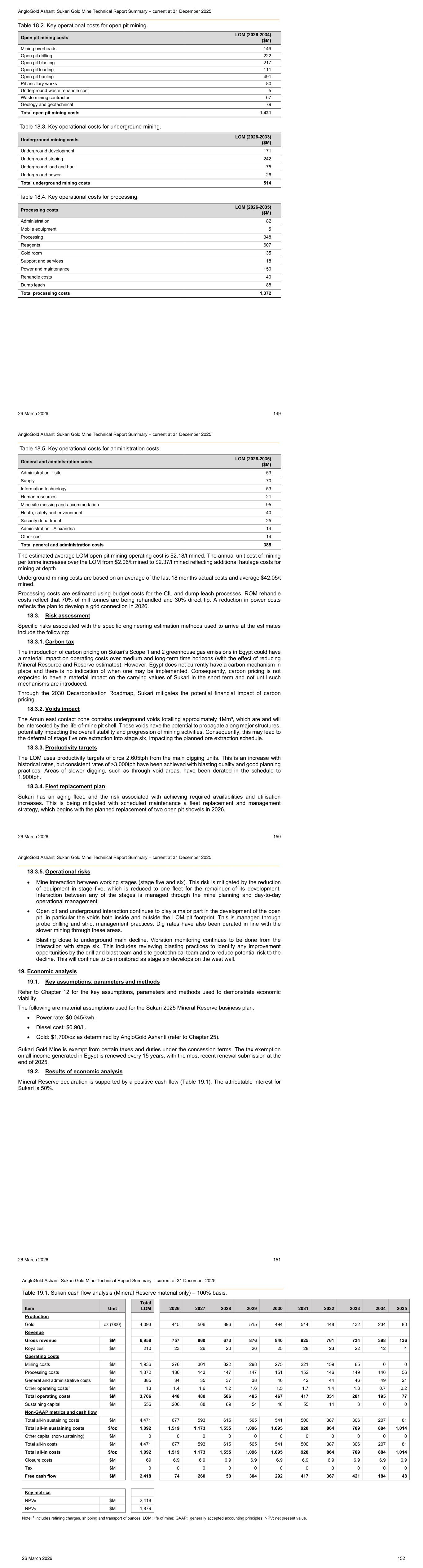
AngloGold Ashanti Sukari Gold Mine Technical Report Summary – current at 31 December 2025 _____________________________________________________________________________________ 26 March 2026 149 Table 18.2. Key operational costs for open pit mining. Open pit mining costs LOM (2026-2034) ($M) Mining overheads 149 Open pit drilling 222 Open pit blasting 217 Open pit loading 111 Open pit hauling 491 Pit ancillary works 80 Underground waste rehandle cost 5 Waste mining contractor 67 Geology and geotechnical 79 Total open pit mining costs 1,421 Table 18.3. Key operational costs for underground mining. Underground mining costs LOM (2026-2033) ($M) Underground development 171 Underground stoping 242 Underground load and haul 75 Underground power 26 Total underground mining costs 514 Table 18.4. Key operational costs for processing. Processing costs LOM (2026-2035) ($M) Administration 82 Mobile equipment 5 Processing 348 Reagents 607 Gold room 35 Support and services 18 Power and maintenance 150 Rehandle costs 40 Dump leach 88 Total processing costs 1,372 AngloGold Ashanti Sukari Gold Mine Technical Report Summary – current at 31 December 2025 _____________________________________________________________________________________ 26 March 2026 150 Table 18.5. Key operational costs for administration costs. General and administration costs LOM (2026-2035) ($M) Administration – site 53 Supply 70 Information technology 53 Human resources 21 Mine site messing and accommodation 95 Heath, safety and environment 40 Security department 25 Administration - Alexandria 14 Other cost 14 Total general and administration costs 385 The estimated average LOM open pit mining operating cost is $2.18/t mined. The annual unit cost of mining per tonne increases over the LOM from $2.06/t mined to $2.37/t mined reflecting additional haulage costs for mining at depth. Underground mining costs are based on an average of the last 18 months actual costs and average $42.05/t mined. Processing costs are estimated using budget costs for the CIL and dump leach processes. ROM rehandle costs reflect that 70% of mill tonnes are being rehandled and 30% direct tip. A reduction in power costs reflects the plan to develop a grid connection in 2026. 18.3. Risk assessment Specific risks associated with the specific engineering estimation methods used to arrive at the estimates include the following: 18.3.1. Carbon tax The introduction of carbon pricing on Sukari’s Scope 1 and 2 greenhouse gas emissions in Egypt could have a material impact on operating costs over medium and long-term time horizons (with the effect of reducing Mineral Resource and Reserve estimates). However, Egypt does not currently have a carbon mechanism in place and there is no indication of when one may be implemented. Consequently, carbon pricing is not expected to have a material impact on the carrying values of Sukari in the short term and not until such mechanisms are introduced. Through the 2030 Decarbonisation Roadmap, Sukari mitigates the potential financial impact of carbon pricing. 18.3.2. Voids impact The Amun east contact zone contains underground voids totalling approximately 1Mm³, which are and will be intersected by the life-of-mine pit shell. These voids have the potential to propagate along major structures, potentially impacting the overall stability and progression of mining activities. Consequently, this may lead to the deferral of stage five ore extraction into stage six, impacting the planned ore extraction schedule. 18.3.3. Productivity targets The LOM uses productivity targets of circa 2,605tph from the main digging units. This is an increase with historical rates, but consistent rates of >3,000tph have been achieved with blasting quality and good planning practices. Areas of slower digging, such as through void areas, have been derated in the schedule to 1,900tph. 18.3.4. Fleet replacement plan Sukari has an aging fleet, and the risk associated with achieving required availabilities and utilisation increases. This is being mitigated with scheduled maintenance a fleet replacement and management strategy, which begins with the planned replacement of two open pit shovels in 2026. AngloGold Ashanti Sukari Gold Mine Technical Report Summary – current at 31 December 2025 _____________________________________________________________________________________ 26 March 2026 151 18.3.5. Operational risks • Mine interaction between working stages (stage five and six). This risk is mitigated by the reduction of equipment in stage five, which is reduced to one fleet for the remainder of its development. Interaction between any of the stages is managed through the mine planning and day-to-day operational management. • Open pit and underground interaction continues to play a major part in the development of the open pit, in particular the voids both inside and outside the LOM pit footprint. This is managed through probe drilling and strict management practices. Dig rates have also been derated in line with the slower mining through these areas. • Blasting close to underground main decline. Vibration monitoring continues to be done from the interaction with stage six. This includes reviewing blasting practices to identify any improvement opportunities by the drill and blast team and site geotechnical team and to reduce potential risk to the decline. This will continue to be monitored as stage six develops on the west wall. 19. Economic analysis 19.1. Key assumptions, parameters and methods Refer to Chapter 12 for the key assumptions, parameters and methods used to demonstrate economic viability. The following are material assumptions used for the Sukari 2025 Mineral Reserve business plan: • Power rate: $0.045/kwh. • Diesel cost: $0.90/L. • Gold: $1,700/oz as determined by AngloGold Ashanti (refer to Chapter 25). Sukari Gold Mine is exempt from certain taxes and duties under the concession terms. The tax exemption on all income generated in Egypt is renewed every 15 years, with the most recent renewal submission at the end of 2025. 19.2. Results of economic analysis Mineral Reserve declaration is supported by a positive cash flow (Table 19.1). The attributable interest for Sukari is 50%. AngloGold Ashanti Sukari Gold Mine Technical Report Summary – current at 31 December 2025 _____________________________________________________________________________________ 26 March 2026 152 Table 19.1. Sukari cash flow analysis (Mineral Reserve material only) – 100% basis. Item Unit Total LOM 2026 2027 2028 2029 2030 2031 2032 2033 2034 2035 Production Gold oz ('000) 4,093 445 506 396 515 494 544 448 432 234 80 Revenue Gross revenue $M 6,958 757 860 673 876 840 925 761 734 398 136 Royalties $M 210 23 26 20 26 25 28 23 22 12 4 Operating costs Mining costs $M 1,936 276 301 322 298 275 221 159 85 0 0 Processing costs $M 1,372 136 143 147 147 151 152 146 149 146 56 General and administrative costs $M 385 34 35 37 38 40 42 44 46 49 21 Other operating costs1 $M 13 1.4 1.6 1.2 1.6 1.5 1.7 1.4 1.3 0.7 0.2 Total operating costs $M 3,706 448 480 506 485 467 417 351 281 195 77 Sustaining capital $M 556 206 88 89 54 48 55 14 3 0 0 Non-GAAP metrics and cash flow Total all-in sustaining costs $M 4,471 677 593 615 565 541 500 387 306 207 81 Total all-in sustaining costs $/oz 1,092 1,519 1,173 1,555 1,096 1,095 920 864 709 884 1,014 Other capital (non-sustaining) $M 0 0 0 0 0 0 0 0 0 0 0 Total all-in costs $M 4,471 677 593 615 565 541 500 387 306 207 81 Total all-in costs $/oz 1,092 1,519 1,173 1,555 1,096 1,095 920 864 709 884 1,014 Closure costs $M 69 6.9 6.9 6.9 6.9 6.9 6.9 6.9 6.9 6.9 6.9 Tax $M 0 0 0 0 0 0 0 0 0 0 0 Free cash flow $M 2,418 74 260 50 304 292 417 367 421 184 48 Key metrics NPV0 $M 2,418 NPV5 $M 1,879 Note: 1 Includes refining charges, shipping and transport of ounces; LOM: life of mine; GAAP: generally accepted accounting principles; NPV: net present value.

AngloGold Ashanti Sukari Gold Mine Technical Report Summary – current at 31 December 2025 _____________________________________________________________________________________ 26 March 2026 153 19.3. Sensitivity analysis A sensitivity analysis on NPV5 model for key value drivers (gold price, capital cost, operating cost, and processed grade) was completed on the Mineral Reserve financial model. A 20% change in either gold price or processed grade resulted in the NPV5 changes of 60%, with a 20% change in operating and capital costs resulted in 33% and 5% changes to the NPV5, respectively. As shown in Table 19.2 and Figure 19.1, the Mineral Reserve is most sensitive to gold price and processed grade changes. Capital and operating costs have less impact compared to price and feed grade. Table 19.2. Sukari Mineral Reserve (100% basis) sensitivity analysis (±20%) for key value drivers (numbers as after-tax NPV5, in $M). Parameter 1 Unit -20% Base case +20% % Change NPV5 -20% +20% Gold price $/oz 747 1,879 3,012 -60% 60% Grade processed g/t 747 1,879 3,012 -60% 60% Operating costs $M 2,491 1,879 1,267 33% -32% Capital costs $M 1,979 1,879 1,780 5% -5% Note: 1 Sensitivities estimated based on given current mine plan for the base case; NPV: net present value. Figure 19.1. Sukari Mineral Reserve (100% basis) sensitivity analysis (±20%) for key value drivers (numbers as after-tax NPV5, in $M). 20. Adjacent properties This Chapter is not relevant to this Report. AngloGold Ashanti Sukari Gold Mine Technical Report Summary – current at 31 December 2025 _____________________________________________________________________________________ 26 March 2026 154 21. Other relevant data and information This Chapter is not relevant to this Report. 22. Interpretation and conclusions The Qualified Persons have reviewed the licensing, geology, exploration, Mineral Resource and Mineral Reserve estimation methods, mining, mineral processing, infrastructure requirements, environmental, permitting, social considerations and financial information and consider the Mineral Resource and Mineral Reserve estimates for Sukari, current at 31 December, 2025, are reported in accordance with Regulation S- K 1300.AngloGold Ashanti maintains a process of verifying and documenting the Mineral Resource and Mineral Reserve estimates, information for which is located at the mine site and AngloGold Ashanti corporate offices. AngloGold Ashanti conducts ongoing studies of its ore bodies to optimize economic value and to manage risk. AngloGold Ashanti and the QPs believe that the geologic interpretation and modelling of exploration data, economic analysis, mine design and sequencing, process scheduling, and operating and capital cost estimation have been developed using accepted industry practices. Periodic reviews by third- party consultants confirm these conclusions. The Mineral Resource and Mineral Reserve represent the amount of gold estimated at 31 December 2025 and are based on information available at the time of estimation. Such estimates are, or will be, to a large extent, based on the prices of the respective commodities and interpretations of geologic data obtained from drill holes and other exploration techniques, which data may not necessarily be indicative of future results. The Mineral Resource and Mineral Reserve estimates are published at 31 December 2025, taking into account economic assumptions, changes to future production and capital costs, depletion, additions as well as any acquisitions or disposals during 2025. The legal tenure of each material property has been verified to the satisfaction of the accountable Qualified Person and all of the Mineral Reserve has been confirmed to be covered by the required mining permits or there exists a realistic expectation, based on applicable laws and regulations, that issuance of permits or resolution of legal issues necessary for mining and processing at a particular deposit will be accomplished in the ordinary course and in a timeframe consistent with AngloGold Ashanti’s (or its joint venture partners’) current mine plans. If estimations must be revised due to significantly lower commodity prices, increases in operating costs, reductions in metallurgical recovery or other factors, the Mineral Resource or Mineral Reserve may not be mined or processed profitably. In addition, material write-downs of AngloGold Ashanti’s investment in its mining properties may be required, including impacts on goodwill, as well as increased amortisation, reclamation and closure charges. If AngloGold Ashanti determines that certain parts of its Mineral Resource or Mineral Reserve have become uneconomic, this may ultimately lead to a reduction in its reported aggregate Mineral Resource or Mineral Reserve, respectively. Consequently, if AngloGold Ashanti’s actual Mineral Resource and Mineral Reserve is less than current estimates, its business, prospects, results of operations and financial position may be materially impaired. An economic analysis was performed in support of the estimation of the Mineral Reserve; this indicated a positive cash flow using the assumptions detailed in this Report. 23. Recommendations AngloGold Ashanti runs a comprehensive business planning process that is framed by the its strategic options process. This sets the mine budget requirements aligned to both the larger group and the necessities of the operation. The decisions that result from this process are ultimately approved by AngloGold Ashanti Executive Leadership, Business Unit Level management, and mine Senior management. While the Qualified Persons are an intimate part of this process, they do not make recommendations for the operation without it being part of the described framework. The following recommendations can be made to ensure continuous improvement: 23.1. Exploration Continued exploration at Sukari is paramount to extend the LOM and increase optionality. This includes testing strike and depth extensions to the underground mine (e.g. Horus South and North; Ptah and Cleopatra), alongside development of potential satellite deposits including Little Sukari which is part of the EDX portfolio of targets to define a maiden Mineral Resource and Mineral Reserve for inclusion into the LOM plan. AngloGold Ashanti Sukari Gold Mine Technical Report Summary – current at 31 December 2025 _____________________________________________________________________________________ 26 March 2026 155 23.2. Drilling, sampling and analysis The fractured nature of the Sukari host rocks makes it challenging to collect oriented drill core. To obtain reliable oriented planar structural data during exploration DD, the use of televiewers or other downhole tools should be considered. The onsite laboratory is currently managed and operated by Sukari employees. To enhance compliance, it should be independently managed and operated by an internationally reputable laboratory services company. 23.3. Mineral Resource estimation Moving both the open pit and underground models to recoverable local estimates (i.e., local multiple indicator kriging and/or local uniform conditioning (UC)). Testwork was conducted in 2025 on the open pit Mineral Resource estimate, with the implementation of localised uniform conditioning (LUC) planned for 2026. Ongoing initiatives to improve model reconciliation include on-site model ownership, alignment of Mineral Resource and grade control model domain architecture, the introduction of underground RC drilling, and the expansion of the grade control inventory to cover one year ahead of underground and open pit production. Further improvements to underground Mineral Resource model reconciliation could involve calibrating top- caps and high-yield limits based on domain grade-tonnage curve comparisons with the grade control model. Additionally, underground reconciliation results would provide a more accurate representation of model performance if calculated over a common volume encompassing both the LOM stope and design stope extents. 23.4. Recovery methods To enhance Sukari’s processing efficiency and gold recovery, ongoing optimisation of flotation and CIL circuits is recommended. Further testing of alternative collector reagents and refining reagent dosages could improve the recovery of gold-enriched pyrite concentrates. Automation and artificial intelligence-driven process control could also be explored to enhance milling efficiency and reagent consumption. Additionally, energy audits could identify cost-saving opportunities in regrinding and seawater desalination, potentially reducing operational expenses while improving overall process performance. Water management remains a critical aspect of Sukari’s operations, given its reliance on seawater and limited freshwater sources. Increasing the current 38% water reuse rate through enhanced recycling strategies could significantly reduce seawater extraction requirements. Expanding reverse osmosis capacity would also improve freshwater availability while minimising dependency on external water sources. To address high evaporation losses at the TSF, strategies such as improved water covers, or evaporation suppression technologies could be considered. Additionally, continuous monitoring of groundwater infiltration and regional hydrology is essential to ensure long-term water sustainability. From an environmental and operational standpoint, Sukari should explore integrating more renewable energy sources, such as solar or hybrid solutions, to reduce reliance on fuel-based power generation. Maintaining strict compliance with environmental regulations, particularly in tailings and water management, will ensure sustainable operations. Regular assessments of tailings storage and disposal strategies should align with best practices to minimise environmental impact. By implementing these measures, Sukari can improve efficiency, reduce costs, and ensure the long-term sustainability of its mining operations. To reduce further future operating costs, decommissioning the old/oxide CIL circuit would be beneficial; however, this depends on the successful implementation of the current project to install a gravity circuit. Testwork and simulation studies conducted to date clearly demonstrate the metallurgical benefits of installing a gravity circuit, given the high gravity gold content, which would enhance overall gold recovery. 23.5. Environmental and social management • Continuous update of operational management systems and plans to ensure they are relevant and proportionate to risks, including alignment with ISO standards and successfully achieve the accreditation in ISO14001. • Ongoing collaboration with contractors and suppliers to strengthen their conformance to good industry practice, including the contract renewal condition of converting solid cyanide supply to an SLS (Solid- Liquid-Station) system to reduce human intervention and the carbon footprint from burning cyanide boxes. • Alignment of the Sukari tailings management system to the requirements of the Global Industry Standard on Tailings Management. AngloGold Ashanti Sukari Gold Mine Technical Report Summary – current at 31 December 2025 _____________________________________________________________________________________ 26 March 2026 156 • Ongoing reduction of greenhouse gas emissions through the execution of projects identified under the 2030 decarbonisation roadmap, including the investigation of additional opportunities. • Routinely monitor the development of domestic and international policy on carbon pricing and the anticipated impact on the carrying values of Sukari. • Develop a standalone mine closure plan aligned with the LOM plan, which includes developing the first conceptual closure plan, a closure execution plan for the next two years to address knowledge gaps, conducting proper closure risk assessments, and performing additional special studies. 24. References 24.1. References The references cited in the Technical Report Summary include the following: 24.1.1. External Abd El-Wahed, M.A., Harraz, H.Z., and El-Behairy, M.H., 2016, Transpressional imbricate thrust zones controlling gold mineralization in the Central Eastern Desert of Egypt: Ore Geology Reviews, v. 78, p. 424– 446. Abdelnasser, A., Kumral, M., 2017. The nature of gold-bearing fluids in Atud gold deposit, Central Eastern Desert, Egypt. Int. Geol. Rev. 59 (15), 1845e1860. Akaad, MK., Abu El-Ela, AM., and El Kamshoshy, HI., 1993. Geology of the Region West of Marsa Alam, Eastern Desert, Egypt. In Annals of the Geological Survey of Egypt, vol. XIX, pp 1-15. Helmy, HM., Kaindl, R., Fritz, H., and Loizenbauer, J., 2004. The Sukari Gold Mine, Eastern Desert – Egypt: structural setting, mineralogy and fluid inclusion study. Mineralium Deposita (2004) 39: pp 495-511. Groves, D.I., Santosh, M., Goldfarb, R.J., and Zhang, L., 2018, Structural geometry of orogenic gold deposits: Implications for exploration of worldclass and giant deposits: Geoscience Frontiers, v. 9, no. 4, p. 1163–1177. Groves, D.I., Santosh, M., and Zhang, L., 2020, A scale-integrated exploration model for orogenic gold deposits based on a mineral system approach: Geoscience Frontiers, v. 11, no. 3, p. 719–738. Khalil, SM., Mesbah, MA., Soliman, FA., Abd El-Khalek, IM., 2015. Geological Evolution of Sukari Gold Mines Area – Eastern Desert, Egypt. Journal of Petroleum and Mining Engineering 17(1)2015. McCuaig, T.C., and Kerrick, R., 1998, P-T-t-deformation-fluid characteristics of lode gold deposits: evidence from alteration systematics: Ore Geology Reviews, v. 12, p. 381–453. Passchier, C.W., and Trouw, R., 2005, Microtectonics, 2nd ed.: Heidelberg, Springer, 366 p. Ridley, R., and Diamond, L.W., 2000, Fluid chemistry of orogenic lode gold deposits and implications for genetic models: Reviews in Economic Geology, v. 13, p. 141–162. Sharara, N., & Vennemann, T.W., 1999. Composition and Origin of the Fluid Responsible for Gold Mineralization in Some Occurrences in the Eastern Desert, Egypt: Evidence from Fluid Inclusions and Stable Isotopes. The First International Conference on the Geology of Africa, 1, 421-445. Vail, J.R., 1983. Pan-African Crustal Accretion in North-East Africa. Journal of African Earth Sciences, v. 1, p. 285-294. Zoheir, B.A., Johnson, P.R., Goldfarb, RJ., and Klemm, DD., 2019. Orogenic gold in the Egyptian Eastern Desert: Widespread Gold Mineralization in the Late Stages of Neoproterozoic Orogeny. Gondwana Research 75: 184-217. Zoheir, BA., Mcaleer, RJ., Zeh, A., and El Behairy MH., 2023. The Sukari Gold Deposit, Egypt: Geochemical and Geochronological Constraints on the Ore Genesis and Implications for Regional Exploration. Economic Geology, January 2023. 24.1.2. Internal AngloGold Ashanti., 2025. Guideline for the reporting of Mineral Resource and Mineral Reserve. AngloGold Ashanti., 2024. Mineral Resource and Mineral Reserve Reporting Group Standard. AngloGold Ashanti., 2025. Resource Prices and FX Rates, updated 12 November 2025.

AngloGold Ashanti Sukari Gold Mine Technical Report Summary – current at 31 December 2025 _____________________________________________________________________________________ 26 March 2026 157 Cavaney, R.J, 2004. Geology of Sukari Gold Mine, Eastern Desert, Egypt. Internal Pharaoh Gold Mines NL Technical Report. Chilala, G. C., 2024. Geotechnical Review of Stage 8 Open Pit Design for Resource and Reserve Estimation, Sukari Gold Mine. Internal report prepared for AMC by Sukari Gold Mine. November 12, 2024. Consep Engineering Innovation, 2023. Gravity Testwork and Modeling Report. Internal Centamin Technical Report. Cowan, J., 2021. Deposit-scale Structural Controls of the Sukari Gold Deposit. Internal Centamin Technical Report. Davis, B., 2023. Insights into the Evolution of the Sukari Gold Deposit, Egypt. Internal Centamin Technical Report. Maelgwyn South Africa, 2023. Flowsheet Evaluation on Horus and Bast Samples. Internal Centamin Technical Report. Snowden Optiro., 2026. Report for AngloGold Ashanti, 2025 Mineral Resource and Mineral Reserve Audit Sukari Gold Mine. Internal report prepared for Sukari Gold Mine, February 2026. SRK Consulting (UK) Limited., 2022. Review of hydrogeology and water management at Sukari open pit and underground gold mine, Egypt. Internal report prepared for Sukari Gold Mines. Report No. UK31559, October 2022. Sukari Gold Mine – Geotechnical Superintendent., 2024. Geotechnical Review of Underground Mine Design for Reserve and Resource Estimation, Sukari Gold Mine. Internal report prepared for AMC Consultants. December 20, 2024. Sukari Gold Mine., 2025. Underground Ground Control Management Plan. Sukari Gold Mine., 2024. Void Management Plan. 24.2. Glossary of terms All-in costs (AIC): All-in cost refers to the total expenses associated with completing a transaction, project, or obtaining a loan, inclusive of all direct and indirect costs. AIC includes growth capital and exploration cost for new deposits and or expansions. All-in sustaining costs (AISC): AISC is a non-GAAP measure which is an extension of the “total cash costs” metric and incorporates all costs related to sustaining production and recognises sustaining capital expenditures associated with developing and maintaining gold mines. In addition, the metric includes the cost associated with corporate office structures that support these operations, the community and environmental rehabilitation costs attendant with responsible mining and any exploration and evaluation cost associated with sustaining current operations. AISC includes stay-in-business capital and items of capital nature and excludes growth capital. By-products: Any potentially economic or saleable products that emanate from the core process of producing gold or copper, including silver, molybdenum and sulphuric acid. Capital expenditure: Capital expenditures are the funds companies allocate to acquire, upgrade, and maintain essential physical assets like property, technology, or equipment, crucial for expanding operational capacity and securing long-term economic benefits. Carbon-in-leach (CIL): Gold is leached from a slurry of ore where cyanide and carbon granules are added to the same agitated tanks. The gold loaded carbon granules are separated from the slurry and treated in an elution circuit to remove the gold. Carbon-in-pulp (CIP): Gold is leached conventionally from a slurry of ore with cyanide in agitated tanks. The leached slurry then passes into the CIP circuit where activated carbon granules are mixed with the slurry and gold is adsorbed on to the activated carbon. The gold-loaded carbon is separated from the slurry and treated in an elution circuit to remove the gold. Comminution: Comminution is the crushing and grinding of ore to make gold available for physical or chemical separation (see also “Milling”). AngloGold Ashanti Sukari Gold Mine Technical Report Summary – current at 31 December 2025 _____________________________________________________________________________________ 26 March 2026 158 Contained gold: The total gold content (tonnes multiplied by grade) of the material being described. Cut-off grade: Cut-off grade is the grade (i.e., the concentration of metal or mineral in rock) that determines the destination of the material during mining. For purposes of establishing “prospects of economic extraction,” the cut-off grade is the grade that distinguishes material deemed to have no economic value (it will not be mined in underground mining or if mined in surface mining, its destination will be the waste dump) from material deemed to have economic value (its ultimate destination during mining will be a processing facility). Other terms used in similar fashion as cut-off grade include net smelter return, pay limit, and break- even stripping ratio. Depletion: The decrease in the quantity of ore in a deposit or property resulting from extraction or production. Development: The process of accessing an orebody through shafts and/or tunnelling in underground mining operations. Development stage property: A development stage property is a property that has Mineral Reserve disclosed, but no material extraction. Diorite: An igneous rock formed by the solidification of molten material (magma). Doré: Impure alloy of gold and silver produced at a mine to be refined to a higher purity. Economically viable: Economically viable, when used in the context of Mineral Reserve determination, means that the Qualified Person has determined, using a discounted cash flow analysis, or has otherwise analytically determined, that extraction of the Mineral Reserve is economically viable under reasonable investment and market assumptions. Electrowinning: A process of recovering gold from solution by means of electrolytic chemical reaction into a form that can be smelted easily into gold bars. Elution: Recovery of the gold from the activated carbon into solution before zinc precipitation or electrowinning. Exploration results: Exploration results are data and information generated by mineral exploration programmes (i.e., programmes consisting of sampling, drilling, trenching, analytical testing, assaying, and other similar activities undertaken to locate, investigate, define or delineate a mineral prospect or mineral deposit) that are not part of a disclosure of Mineral Resource or Mineral Reserve. A registrant must not use exploration results alone to derive estimates of tonnage, grade, and production rates, or in an assessment of economic viability. Exploration stage property: An exploration stage property is a property that has no Mineral Reserve disclosed. Exploration target: An exploration target is a statement or estimate of the exploration potential of a mineral deposit in a defined geological setting where the statement or estimate, quoted as a range of tonnage and a range of grade (or quality), relates to mineralisation for which there has been insufficient exploration to estimate a Mineral Resource. Feasibility study: A feasibility study is a comprehensive technical and economic study of the selected development option for a mineral project, which includes detailed assessments of all applicable modifying factors, as defined by this section, together with any other relevant operational factors, and detailed financial analyses that are necessary to demonstrate, at the time of reporting, that extraction is economically viable. The results of the study may serve as the basis for a final decision by a proponent or financial institution to proceed with, or finance, the development of the project. A feasibility study is more comprehensive, and with a higher degree of accuracy, than a pre-feasibility study. It must contain mining, infrastructure, and process designs completed with sufficient rigour to serve as the basis for an investment decision or to support project financing. The confidence level in the results of a feasibility study is higher than the confidence level in the results of a pre-feasibility study. Terms such as full, final, comprehensive, bankable, or definitive feasibility study are equivalent to a feasibility study. Flotation: Concentration of gold and gold-hosting minerals into a small mass by various techniques (e.g. collectors, frothers, agitation, air-flow) that collectively enhance the buoyancy of the target minerals, relative to unwanted gangue, for recovery into an over-flowing froth phase. AngloGold Ashanti Sukari Gold Mine Technical Report Summary – current at 31 December 2025 _____________________________________________________________________________________ 26 March 2026 159 Gold produced or gold production: Refined gold in a saleable form derived from the mining process. Grade: The quantity of ore contained within a unit weight of mineralised material generally expressed in grams per metric tonne (g/t) or ounce per short ton for gold bearing material. Greenschist: A schistose metamorphic rock whose green colour is due to the presence of chlorite, epidote or actinolite. Indicated Mineral Resource: An Indicated Mineral Resource is that part of a Mineral Resource for which quantity and grade or quality are estimated on the basis of adequate geological evidence and sampling. The level of geological certainty associated with an Indicated Mineral Resource is sufficient to allow a Qualified Person to apply modifying factors in sufficient detail to support mine planning and evaluation of the economic viability of the deposit. Because an Indicated Mineral Resource has a lower level of confidence than the level of confidence of a Measured Mineral Resource, an Indicated Mineral Resource may only be converted to a Probable Mineral Reserve. Inferred Mineral Resource: An Inferred Mineral Resource is that part of a Mineral Resource for which quantity and grade or quality are estimated on the basis of limited geological evidence and sampling. The level of geological uncertainty associated with an Inferred Mineral Resource is too high to apply relevant technical and economic factors likely to influence the prospects of economic extraction in a manner useful for evaluation of economic viability. Because an Inferred Mineral Resource has the lowest level of geological confidence of all Mineral Resource, which prevents the application of the modifying factors in a manner useful for evaluation of economic viability, an Inferred Mineral Resource may not be considered when assessing the economic viability of a mining project, and may not be converted to a Mineral Reserve. Initial assessment (also known as concept study, scoping study, conceptual study and preliminary economic assessment): An initial assessment is a preliminary technical and economic study of the economic potential of all or parts of mineralisation to support the disclosure of Mineral Resource. The initial assessment must be prepared by a Qualified Person and must include appropriate assessments of reasonably assumed technical and economic factors, together with any other relevant operational factors, that are necessary to demonstrate at the time of reporting that there are reasonable prospects for economic extraction. An initial assessment is required for disclosure of Mineral Resource but cannot be used as the basis for disclosure of Mineral Reserve. Leaching: Dissolution of gold from crushed or milled material, including reclaimed slime, prior to adsorption on to activated carbon or direct zinc precipitation. Life of mine (LOM): Number of years for which an operation is planning to mine and treat ore, and is taken from the current mine plan. Measured Mineral Resource: A Measured Mineral Resource is that part of a Mineral Resource for which quantity and grade or quality are estimated on the basis of conclusive geological evidence and sampling. The level of geological certainty associated with a Measured Mineral Resource is sufficient to allow a qualified person to apply modifying factors, as defined in this section, in sufficient detail to support detailed mine planning and final evaluation of the economic viability of the deposit. Because a Measured Mineral Resource has a higher level of confidence than the level of confidence of either an Indicated Mineral Resource or an Inferred Mineral Resource, a Measured Mineral Resource may be converted to a Proven Mineral Reserve or to a Probable Mineral Reserve. Metallurgical plant / gold plant / plant: A processing plant constructed to treat ore and extract gold (and, in some cases, often valuable by-products). Metallurgical recovery factor (MetRF): A measure of the efficiency in extracting gold or silver from the ore. Milling: A process of reducing broken ore to a size at which concentrating or leaching can be undertaken (see also “Comminution”). AngloGold Ashanti Sukari Gold Mine Technical Report Summary – current at 31 December 2025 _____________________________________________________________________________________ 26 March 2026 160 Mine call factor (MCF): The ratio, expressed as a percentage, of the total quantity of recovered and unrecovered mineral product after processing with the amount estimated in the ore based on sampling. The ratio of contained gold delivered to the metallurgical plant divided by the estimated contained gold of ore mined based on sampling. Mineralisation: The process or processes by which a mineral or minerals are introduced into rock, resulting in a potentially valuable deposit. Mineral deposit: A mineral deposit is a concentration (or occurrence) of material of possible economic interest in or on the earth’s crust. Mineral Reserve: A Mineral Reserve is an estimate of tonnage and grade or quality of Indicated and Measured Mineral Resource that, in the opinion of the Qualified Person, can be the basis of an economically viable project. More specifically, it is the economically mineable part of a Measured or Indicated Mineral Resource, which includes diluting materials and allowances for losses that may occur when the material is mined or extracted. Mineral Reserve is subdivided in order of increasing confidence into Probable Mineral Reserve and Proven Mineral Reserve. Mineral Reserve is aggregated from the Proven and Probable Mineral Reserve categories. A Measured Mineral Resource may be converted to either a Proven Mineral Reserve or a Probable Mineral Reserve depending on uncertainties associated with modifying factors that are taken into account in the conversion from Mineral Resource to Mineral Reserve. The Mineral Reserve tonnages and grades are estimated and reported as delivered to plant (i.e., the point where material is delivered to the processing facility). Mineral Resource: A Mineral Resource is a concentration or occurrence of material of economic interest in or on the Earth's crust in such form, grade or quality, and quantity that there are reasonable prospects for economic extraction. A Mineral Resource is a reasonable estimate of mineralisation, taking into account relevant factors such as cut-off grade, likely mining dimensions, location or continuity, that, with the assumed and justifiable technical and economic conditions, is likely to, in whole or in part, become economically extractable. It is not merely an inventory of all mineralisation drilled or sampled. Mineral Resource is subdivided and must be so reported, in order of increasing confidence in respect of geoscientific evidence, into Inferred, Indicated or Measured categories. The Mineral Resource tonnages and grades are reported in situ and stockpiled material is reported as broken material. Mining recovery factor (MRF): This factor reflects a mining efficiency factor relating the recovery of material during the mining process and is the variance between the tonnes called for in the mining design and what the plant receives. It is expressed in both a grade and tonnage number. Modifying factors: Modifying factors are the factors that a Qualified Person must apply to Indicated and Measured Mineral Resource and then evaluate in order to establish the economic viability of Mineral Reserve. A Qualified Person must apply and evaluate modifying factors to convert Measured and Indicated Mineral Resource to Proven and Probable Mineral Reserve. These factors include but are not restricted to: Mining; processing; metallurgical; infrastructure; economic; marketing; legal; environmental compliance; plans, negotiations, or agreements with local individuals or groups; and governmental factors. The number, type and specific characteristics of the modifying factors applied will necessarily be a function of and depend upon the mineral, mine, property, or project. Non-sustaining capital (expenditure): Non-sustaining capital (expenditure) is a non-GAAP measure comprising capital expenditure incurred at new operations and capital expenditure related to ‘major projects’ at existing operations where these projects will materially increase production. Open pit mining: An excavation made at the surface of the ground for the purpose of extracting minerals, inorganic and organic, from their natural deposits, which excavation is open to the surface. Operating expenditure: An operating expense is an expenditure that a business incurs as a result of performing its normal business operations. Operating expenses differ from capital expenses, which are involved with acquiring or upgrading assets over time, and non-operating expenses, which are not related to core business activities. Ounce (oz) (troy): Used in imperial statistics for the standard measurement of mass specifically for precious metals. A kilogram is equal to 32.1507 ounces. A troy ounce is equal to 31.1035 grams.

AngloGold Ashanti Sukari Gold Mine Technical Report Summary – current at 31 December 2025 _____________________________________________________________________________________ 26 March 2026 161 Pay limit: The grade of a unit of ore at which the revenue from the recovered mineral content of the ore is equal to the sum of total cash costs, closure costs, Mineral Reserve development and sustaining capital. This grade is expressed as an in situ value in grams per tonne or ounces per short ton (before dilution and mineral losses). Precipitate: The solid product formed when a change in solution chemical conditions results in conversion of some pre-dissolved ions into solid state. Preliminary feasibility study (pre-feasibility study): is a comprehensive study of a range of options for the technical and economic viability of a mineral project that has advanced to a stage where a Qualified Person has determined (in the case of underground mining) a preferred mining method, or (in the case of surface mining) a pit configuration, and in all cases has determined an effective method of mineral processing and an effective plan to sell the product. A pre-feasibility study includes a financial analysis based on reasonable assumptions, based on appropriate testing, about the modifying factors and the evaluation of any other relevant factors that are sufficient for a Qualified Person to determine if all or part of the Indicated and Measured Mineral Resource may be converted to Mineral Reserve at the time of reporting. The financial analysis must have the level of detail necessary to demonstrate, at the time of reporting, that extraction is economically viable. A pre-feasibility study is less comprehensive and results in a lower confidence level than a feasibility study. A pre-feasibility study is more comprehensive and results in a higher confidence level than an initial assessment. Probable Mineral Reserve: A Probable Mineral Reserve is the economically mineable part of an Indicated and, in some cases, a Measured Mineral Resource. The confidence in the modifying factors applying to a Probable Mineral Reserve is lower than that applying to a Proven Mineral Reserve. The degree of assurance, although lower than that for Proven Mineral Reserve, is high enough to assume continuity between points of observation. Production stage property: A production stage property is a property with material extraction of Mineral Reserve. Productivity: An expression of labour productivity based on the ratio of ounces of gold produced per month to the total number of employees in mining operations. Proven Mineral Reserve: A Proven Mineral Reserve is the economically mineable part of a Measured Mineral Resource and can only result from conversion of a Measured Mineral Resource. A Proven Mineral Reserve implies a high degree of confidence in the modifying factors. Qualified Person: A Qualified Person is an individual who is (1) a mineral industry professional with at least five years of relevant experience in the type of mineralisation and type of deposit under consideration and in the specific type of activity that person is undertaking on behalf of the registrant; and (2) an eligible member or licencee in good standing of a recognised professional organisation at the time the technical report is prepared. Section 229.1300 of Regulation S-K 1300 details further recognised professional organisations and also relevant experience. Quartz: A hard mineral consisting of silica dioxide found widely in all rocks. Recovered grade: The recovered mineral content per unit of ore treated. Refining: The final purification process of a metal or mineral. Regulation S-K 1300: Subpart 1300 of Regulation S-K (17 CFR § 229.1300) which contains the SEC’s mining property disclosure requirements for mining registrants. Rehabilitation: The process of reclaiming land disturbed by mining to allow an appropriate post-mining use. Rehabilitation standards are defined by country-specific laws, including but not limited to the US Bureau of Land Management, the US Forest Service, and the relevant Australian mining authorities, and address among other issues, ground and surface water, topsoil, final slope gradient, waste handling and re- vegetation issues. AngloGold Ashanti Sukari Gold Mine Technical Report Summary – current at 31 December 2025 _____________________________________________________________________________________ 26 March 2026 162 Resource modification factor (RMF): This factor is applied when there is an historic reconciliation discrepancy in the Mineral Resource model. For example, between the Mineral Resource model tonnage and the grade control model tonnage. It is expressed in both a grade and tonnage number. Scats: Within the metallurgical plants, scats is a term used to describe ejected ore or other uncrushable / grinding media arising from the milling process. This, typically oversize material (ore), is ejected from the mill and stockpiled or re-crushed via a scats retreatment circuit. Retreatment of scats is aimed at fracturing the material such that it can be returned to the mills and processed as with the other ores to recover the gold locked up within this oversize material. Seismic event: A sudden inelastic deformation within a given volume of rock that radiates detectable seismic energy. Shaft: A vertical or subvertical excavation used for accessing an underground mine; for transporting personnel, equipment and supplies; for hoisting ore and waste; for ventilation and utilities; and/or as an auxiliary exit. Smelting: A pyro-metallurgical operation in which gold precipitate from electro-winning or zinc precipitation is further separated from impurities. Stay-in-business capital (or sustaining capital): Refers to funds used to maintain existing assets and operations to ensure continued service. These expenditures, often categorised as maintenance capital expenditure, are crucial for replacing old equipment, ensuring safety compliance, and improving operational efficiency without necessarily driving growth. Stoping: The process of excavating ore underground. Stripping ratio: The ratio of waste tonnes to ore tonnes mined calculated as total tonnes mined less ore tonnes mined divided by ore tonnes mined. Sustaining capital (expenditure): Sustaining capital (expenditure) is a non-GAAP measure comprising capital expenditure incurred to sustain and maintain existing assets at their current productive capacity in order to achieve constant planned levels of productive output and capital expenditure to extend useful lives of existing production assets. This includes replacement of vehicles, plant and machinery, Mineral Reserve development, deferred stripping and capital expenditure related to financial benefit initiatives, safety, health and the environment. Tailings: Finely ground rock of low residual value from which valuable minerals have been extracted. Tailings storage facility/facilities (TSF): Facilities designed to store discarded tailings. Tonnage: Quantity of material measured in tonnes. Tonne: Used in metric statistics. Equal to 1,000 kilograms. Total cash costs: Total cash costs is a non-GAAP metric and, as calculated and reported by AngloGold Ashanti, includes costs for all mining, processing, onsite administration costs, royalties and production taxes, as well as contributions from by-products, but exclude amortisation of tangible, intangible and right of use assets, rehabilitation costs and other non-cash costs, retrenchment costs, corporate administration, marketing and related costs, capital costs and exploration costs. Underground mining: The extraction of rocks, minerals and industrial materials, other than coal, oil and gas, from the Earth by developing entries or shafts from the surface to the seam or deposit before recovering the product by underground extraction methods. Waste: Material that contains insufficient mineralisation for consideration for future treatment and, as such, is discarded. Yield: The amount of valuable mineral or metal recovered from each unit mass of ore expressed as ounces per short ton or grams per metric tonne. AngloGold Ashanti Sukari Gold Mine Technical Report Summary – current at 31 December 2025 _____________________________________________________________________________________ 26 March 2026 163 Zinc precipitation: Zinc precipitation is the chemical reaction using zinc dust that converts gold in solution to a solid form for smelting into unrefined gold bars. 24.3. Abbreviations and acronyms ° Degree(s) > Greater than ≥ Greater than or equal to < Less than ≤ Less than or equal to % Percentage µm Micrometre(s) $ United States dollar $/kWh United States dollar per kilo watt hour $/L United States dollar per litre $/oz United States dollar per ounce $/t United States dollar per tonne 3D Three dimensional Ai Bond abrasion index ANCOLD Australian National Committee on Large Dams ATM Automated teller machine Au Gold B Billion BWi Bond ball work index C Celsius cm Centimetre(s) CO Carbon monoxide CO2 Cardon dioxide CORG Organic carbon CRM Certified reference material CTOT Total carbon CV Coefficient of variation DD Diamond drilling DSM Dutch State Mines DWi Drop weight index EDX Eastern Desert Exploration EGL Effective grinding length EGP Egyptian Pound EGP/km2 Egyptian Pound(s) per square kilometre EIA Environmental impact assessment EMRA Egyptian Mineral Resource Authority EMS Environmental Management System FA Fire assay Fe Iron AngloGold Ashanti Sukari Gold Mine Technical Report Summary – current at 31 December 2025 _____________________________________________________________________________________ 26 March 2026 164 FW Footwall g Gram(s) g/cm3 Gram(s) per cubic centimetre g/t Gram(s) per tonne GAAP Generally accepted accounting principles GD Granodiorite GDP Gross domestic product GPS Global positioning system HARD Half absolute relative difference HCl Hydrochloric Acid HDPE High-density polyethylene HNO3 Nitric acid hr/d Hours per day HW Hanging wall ICP Inductively coupled plasma ICP-AES Inductively coupled plasma-atomic emission spectrometry IRA Inter-ramp angles kg Kilogram(s) kg/m3 Kilogram(s) per cubic metre kg/t Kilgram(s) per tonne km Kilometre(s) km2 Square kilometre(s) koz Kilo (thousand) ounces kPa Kilopascal kW Kilowatt kWh/m3 Kilowatt hour(s) per cubic metre kWh/t Kilowatt hour(s) per tonne L/s Litre(s) per second L/m Litres(s) per minute LMBA London Bullion Market Association LUC Localised uniform conditioning m Metre(s) M Million m3 Cubic metre(s) m3/hour Cubic metre(s) per hour m3/s Cubic metre(s) per second Ma Million annum MAIG Member of the Australian Institute of Geoscientists MAusIMM (CP) Chartered Professional Member of the Australasian Institute of Mining and Metallurgy mE Metres east ME Multi element
AngloGold Ashanti Sukari Gold Mine Technical Report Summary – current at 31 December 2025 _____________________________________________________________________________________ 26 March 2026 165 MIMMM QMR Member of the Institute of Materials, Minerals and Mining and Qualified for Minerals Reporting ML Million litre(s) mm Millimetre(s) MMEA Model Mining Exploitation Agreement mN Metres north Moz Million ounces MPa Megapascal(s) mRL Metres relative MSO Mineable shape optimiser Mt Million tonnes Mtpa Million tonne(s) per annum MVA Megavolt-ampere MW Megawatt(s) MWAC Megawatt(s) alternating current MWDC Megawatt(s) direct current NaCN Sodium cyanide NOx Nitric oxide NSR Net smelter return ODBC Open database connectivity OREAS ORE Research and Exploration Pty Ltd OSA Overall slope angles oz Ounce(s) Pharoah Gold Pharoah Gold Mines NL ppb Parts per billion ppm Parts per million pXRF Portable x-ray fluorescence Q Quarter QA/QC Quality assurance and quality control QKNA Quantitative kriging neighbourhood analysis RC Reverse circulation ROM Run-of-mine rpm Revolutions per minute SAG Semi-autogenous grinding SMU Selective mining unit SO2 Sulphur dioxide SQL Structured query language SSULPH Sulphide STOT Total sulphur t Tonne(s) tCO2 Total carbon dioxide tph Tonnes per hour AngloGold Ashanti Sukari Gold Mine Technical Report Summary – current at 31 December 2025 _____________________________________________________________________________________ 26 March 2026 166 TSF Tailings storage facility UC Uniform conditioning USSR Union of Soviet Socialist Republics UTM Universal Transverse Mercator w/w% Percentage weight concentration 25. Reliance on information provided by the registrant The Qualified Persons are of the opinion that AngloGold Ashanti has extensive experience in managing the complex challenges associated with operating at local, regional, national and international levels in support of successful global mining operations. AngloGold Ashanti maintains well-established divisions, departments and multidisciplinary teams organised both at mine sites and at corporate level to meet its operational and business requirements. These closely integrated functions address matters which, while not directly related to the physical production of saleable metals, are essential to fulfilling corporate obligations and navigating the regulatory, financial, environmental and social dimensions of modern mining. By way of illustration of AngloGold Ashanti’s organisational structure, the corporate office includes departments responsible for Financial and Operational Analysis, Information Services, Administration and Sales, Business Development and Growth, Legal, Global Strategic Relations, Government Relations, Communications, Finance, Accounting, Tax and Investor Relations. Additional corporate teams are similarly structured to provide broad-based services and oversight. These departments work in coordination with the operating divisions, ensuring alignment of requirements, reporting and information flow. At mine-site level, operating divisions are organised into dedicated management teams, including Mine Management, Operations, Maintenance and Construction, Processing, Finance and Accounting, Social Responsibility and Community Development, Environmental Management, Regional Supply Chain and Human Resources. These teams are staffed with experienced professionals responsible for addressing the full range of technical, regulatory and operational requirements associated with mining activities. As subject- matter specialists within their respective disciplines, they represent reliable sources of information and have been consulted in the preparation, support and characterisation of information contained in this Report. In connection with the preparation of this Report, AngloGold Ashanti departments have provided information in the following areas: • Macroeconomic trends, data, interest rates and related assumptions • Marketing information • Legal matters outside the scope of the Qualified Persons’ expertise • Environmental matters outside the scope of the Qualified Persons’ expertise • Community development initiatives and local stakeholder accommodation • Governmental and regulatory factors outside the scope of the QPs’ expertise The Qualified Persons have prepared Chapter 16.2 of this Report in reliance on the information provided by AngloGold Ashanti as described above. The Qualified Persons consider it reasonable to rely upon AngloGold Ashanti for the information specified above because it is generated and maintained by the its responsible corporate and site functions under established governance, control and review processes, and has been checked by the Qualified Persons for consistency and reasonableness in the context of this Report. As noted, the corporate and mine-site divisions contributing information to this Report are business-directed functions responsible for generating accurate and reliable data in support of AngloGold Ashanti’s operational and strategic objectives. This structured organisational framework supports the production of dependable information and provides an appropriate foundation for Mineral Resource and Mineral Reserve estimates.