
Geita Gold Mine, Tanzania Technical Report Summary Report current at: 31 December 2025 Report prepared for: AngloGold Ashanti plc Qualified Persons: Ms. Janeth Luponelo, RM SME, Senior Manager Geology and Exploration Mr. Duan Campbell, Pr. Eng, Business Improvement Manager AngloGold Ashanti Geita Gold Mine Technical Report Summary – current at 31 December 2025 _____________________________________________________________________________________ 26 March 2026 2 Forward looking statements Certain statements contained in this Technical Report Summary (Report), other than statements of historical fact, including, without limitation, those concerning metal price assumptions, cash flow forecasts, projected capital and operating costs, metal recoveries, mine life and production rates, and other assumptions used in this Report, are forward-looking statements. These forward-looking statements or forecasts are not based on historical facts, but rather reflect current beliefs and expectations concerning future events and generally may be identified by the use of forward-looking words, phrases and expressions such as “believe”, “expect”, “aim”, “anticipate”, “intend”, “foresee”, “forecast”, “predict”, “project”, “estimate”, “likely”, “may”, “might”, “could”, “should”, “would”, “seek”, “plan”, “scheduled”, “possible”, “continue”, “potential”, “outlook”, “target” or other similar words, phrases, and expressions; provided that the absence thereof does not mean that a statement is not forward-looking. Similarly, statements that describe objectives, plans or goals are or may be forward- looking statements. These forward-looking statements or forecasts involve known and unknown risks, uncertainties and other factors that may cause actual results, performance, actions or achievements to differ materially from the anticipated results, performance, actions or achievements expressed or implied in these forward-looking statements. Although AngloGold Ashanti plc (AngloGold Ashanti) believes that the expectations reflected in such forward-looking statements and forecasts are reasonable, no assurance can be given that such expectations will prove to have been correct. Accordingly, results, performance, actions or achievements could differ materially from those set out in the forward-looking statements as a result of, among other factors, changes in economic, social, political and market conditions, including related to inflation or international conflicts, the success of development and operating initiatives, changes in the regulatory environment and other government actions, including environmental approvals, fluctuations in gold prices and exchange rates, the lack of legal challenges or social opposition to our mines or facilities, the outcome of future litigation proceedings, any supply chain disruptions, any public health crises, pandemics or epidemics, the ultimate determination and realisation of Mineral Reserve, the existence or realisation of Mineral Resource, the availability and receipt of required approvals, titles, licences and permits, the availability of sufficient working capital, availability of a qualified work force, the timing and amount of future production, the ability to meet production, cost and capital expenditure targets, the timing and ability to produce studies and analyses, the ultimate ability to mine, process and sell mineral products on economically favourable terms and other timing, business and operational risks and challenges and other factors that may influence future events or conditions. These factors are not necessarily all of the important factors that could cause AngloGold Ashanti’s actual results, performance, actions or achievements to differ materially from those expressed in any forward- looking statements. Other unknown or unpredictable factors could also have material adverse effects on AngloGold Ashanti’s future results, performance, actions or achievements. Consequently, readers are cautioned not to place undue reliance on forward-looking statements. AngloGold Ashanti undertakes no obligation to update publicly or release any revisions to these forward-looking statements to reflect events or circumstances after the date hereof or to reflect the occurrence of unanticipated events, except to the extent required by applicable law. AngloGold Ashanti Geita Gold Mine Technical Report Summary – current at 31 December 2025 _____________________________________________________________________________________ 26 March 2026 3 Qualified Persons signatures page This Report is current at 31 December 2025. In preparing this Report, the Qualified Person(s) may have, where necessary, relied on the registrant, AngloGold Ashanti, company reports, property data, public information, and assumptions supplied by AngloGold Ashanti employees and other third party sources, including the reports and documents listed in Chapter 24 of this Report, available at the time of writing this Report. All information provided by AngloGold Ashanti has been identified in Chapter 25: Reliance on information provided by the registrant in this Report. QUALIFIED PERSONS /s/ Janeth Luponelo Janeth Luponelo, RM SME Senior Manager Geology and Exploration /s/ Duan Campbell Duan Campbell, Pr. Eng. Business Improvement Manager AngloGold Ashanti Geita Gold Mine Technical Report Summary – current at 31 December 2025 _____________________________________________________________________________________ 26 March 2026 4 Contents 1. Executive summary ............................................................................................................................. 13 1.1 Property description including mineral rights ................................................................................ 13 1.2 Ownership .................................................................................................................................... 14 1.3 Geology and mineralisation .......................................................................................................... 14 1.4 Status of exploration, development and operations ...................................................................... 15 1.5 Mining methods ............................................................................................................................ 15 1.6 Mineral processing ....................................................................................................................... 15 1.7 Mineral Resource and Mineral Reserve estimates ........................................................................ 15 1.7.1 Mineral Resource estimates .................................................................................................. 15 1.7.2 Mineral Resource statement .................................................................................................. 16 1.7.2.1 Factors that may affect the Mineral Resource estimates ................................................ 16 1.7.3 Mineral Reserve estimates .................................................................................................... 17 1.7.4 Mineral Reserve statement .................................................................................................... 17 1.7.4.1 Factors that may affect the Mineral Reserve estimates .................................................. 17 1.8 Capital and operating costs .......................................................................................................... 18 1.8.1 Capital costs .......................................................................................................................... 18 1.8.2 Operating costs ..................................................................................................................... 18 1.9 Economic analysis ........................................................................................................................ 18 1.10 Permitting requirements ............................................................................................................ 19 1.11 Conclusions and recommendations .......................................................................................... 19 2. Introduction.......................................................................................................................................... 19 2.1 Disclose registrant ........................................................................................................................ 19 2.2 Terms of reference ....................................................................................................................... 19 2.3 Purpose of this Report .................................................................................................................. 20 2.4 Sources of information and data contained in the report or used in its preparation ....................... 20 2.5 Report date .................................................................................................................................. 20 2.6 Qualified Person(s) site inspections .............................................................................................. 20 2.6.1 Ms. Janeth Luponelo ............................................................................................................. 20 2.6.2 Mr. Duan Campbell ............................................................................................................... 21 3. Property description ............................................................................................................................. 21 3.1 Location of the property ................................................................................................................ 21 3.2 Area of the property ...................................................................................................................... 24 3.3 Legal aspects (including environmental liabilities) and permitting ................................................. 24 3.4 Agreements, royalties and liabilities .............................................................................................. 27 4. Accessibility, climate, local resources, infrastructure and physiography ............................................... 27 5. History ................................................................................................................................................. 29 6. Geological setting, mineralisation and deposit ..................................................................................... 30 6.1 Geological setting ......................................................................................................................... 30 6.1.1 Geita greenstone belt ............................................................................................................ 30 6.1.2 Deformation history and mineralisation .................................................................................. 33 6.1.3 Property geology ................................................................................................................... 34

AngloGold Ashanti Geita Gold Mine Technical Report Summary – current at 31 December 2025 _____________________________________________________________________________________ 26 March 2026 5 6.1.3.1 Nyamulilima district ........................................................................................................ 34 6.1.3.2 Central district ................................................................................................................ 34 6.1.3.3 Matandani-Kukuluma district .......................................................................................... 35 6.2 Geological models and mineralisation .......................................................................................... 35 6.2.1 Nyamulilima district ............................................................................................................... 36 6.2.1.1 Nyamulilima Cuts 1, 2, 3 and 4 deposit geology and mineralisation ............................... 38 6.2.1.2 Selous geology and mineralisation ................................................................................. 42 6.2.1.3 Star and Comet-Ridge 8 Complex geology and mineralisation ....................................... 42 6.2.2 Central district ....................................................................................................................... 46 6.2.2.1 Nyankanga geology and mineralisation .......................................................................... 49 6.2.2.2 Geita Hill geology and mineralisation .............................................................................. 52 6.2.2.3 Kalondwa Hill geology and mineralisation....................................................................... 54 6.2.2.4 Chipaka geology and mineralisation ............................................................................... 55 6.2.3 Matandani-Kukuluma district ................................................................................................. 57 6.2.3.1 Matandani deposit geology and mineralisation ............................................................... 59 6.2.3.2 Kukuluma deposit geology and mineralisation ................................................................ 61 6.2.3.3 Area 3 West deposit geology and mineralisation ............................................................ 63 6.3 Deposit types................................................................................................................................ 64 7. Exploration .......................................................................................................................................... 65 7.1 Nature and extent of relevant exploration work ............................................................................. 65 7.1.1 Grids and surveys ................................................................................................................. 65 7.1.2 Geological mapping ............................................................................................................... 66 7.1.3 Geochemical sampling .......................................................................................................... 66 7.1.4 Rock chip sampling ............................................................................................................... 68 7.1.5 Geophysical surveys ............................................................................................................. 69 7.1.5.1 1996-2000 Geita mine detailed airborne magnetic surveys ............................................ 69 7.1.5.2 2003 High-resolution helicopter-borne airborne magnetic survey (MIDAS) ..................... 69 7.1.5.3 2006 and 2008 AeroTEM airborne electro-magnetic survey ........................................... 70 7.1.5.4 2008-2009 High resolution Xcalibur helicopter-borne magnetic and radiometric survey . 71 7.1.5.5 2011 Kukuluma and Matandani audio-frequency magneto-telluric survey....................... 72 7.1.5.6 2015-2016 Geita mine 2D, 3D and vertical seismic profile full waveform seismic surveys .. ....................................................................................................................................... 73 7.2 Drilling .......................................................................................................................................... 74 7.2.1 Drilling techniques and drill spacing ....................................................................................... 78 7.2.2 Logging ................................................................................................................................. 78 7.2.3 Density .................................................................................................................................. 79 7.2.4 Recovery ............................................................................................................................... 80 7.2.4.1 Diamond drill core recovery ............................................................................................ 80 7.2.4.2 Reverse circulation sample recovery procedure ............................................................. 81 7.2.5 Collar surveys ....................................................................................................................... 81 7.2.6 Downhole surveys ................................................................................................................. 82 7.2.7 Condemnation, geotechnical and hydrological drilling ........................................................... 82 AngloGold Ashanti Geita Gold Mine Technical Report Summary – current at 31 December 2025 _____________________________________________________________________________________ 26 March 2026 6 7.2.8 Metallurgical drilling ............................................................................................................... 82 7.2.9 Grade control drilling ............................................................................................................. 82 7.2.10 Sample length/true thickness ................................................................................................. 83 7.2.11 Results .................................................................................................................................. 83 7.3 Hydrogeology ............................................................................................................................... 83 7.3.1 Nature and quality of sampling methods ................................................................................ 83 7.3.2 Type and appropriateness of laboratory techniques .............................................................. 84 7.3.3 Results .................................................................................................................................. 84 7.3.3.1 Geita rainfall ................................................................................................................... 84 7.3.3.2 Ground water monitoring ................................................................................................ 85 7.3.3.3 Underground water supply and dewatering .................................................................... 86 7.3.3.4 Open pit water supply and dewatering ............................................................................ 87 7.3.4 Qualified Person(s) interpretation .......................................................................................... 87 7.4 Geotechnical testing and analysis ................................................................................................ 88 7.4.1 Nature and quality of sampling methods ................................................................................ 89 7.4.2 Type and appropriateness of laboratory techniques .............................................................. 89 7.4.3 Results .................................................................................................................................. 89 7.4.4 Qualified Person(s) interpretation .......................................................................................... 90 8. Sample preparation, analyses and security ......................................................................................... 90 8.1 Sample preparation ...................................................................................................................... 91 8.2 Assay method and laboratory ....................................................................................................... 91 8.3 Sampling governance ................................................................................................................... 92 8.4 Quality assurance and quality control ........................................................................................... 92 8.5 Qualified Person's opinion on adequacy ....................................................................................... 94 9. Data verification ................................................................................................................................... 94 9.1 Data verification procedures ......................................................................................................... 94 9.1.1 Site procedures ..................................................................................................................... 96 9.1.2 Internal reviews ..................................................................................................................... 96 9.1.3 External audit ........................................................................................................................ 97 9.2 Limitations on, or failure to conduct verification ............................................................................ 97 9.3 Qualified Person's opinion on data adequacy ............................................................................... 97 9.3.1 Ms. Janeth Luponelo ............................................................................................................. 97 9.3.2 Mr. Duan Campbell ............................................................................................................... 97 10. Mineral processing and metallurgical testing .................................................................................... 98 10.1 Mineral processing and metallurgical testing ............................................................................. 99 10.1.1 Location of the analytical/testing laboratories and relationship to the registrant ..................... 99 10.2 Laboratory testwork and results .............................................................................................. 100 10.2.1 Laboratories used for testwork ............................................................................................ 100 10.2.2 Geometallurgical programme .............................................................................................. 100 10.2.3 Nyamulilima pit testwork results .......................................................................................... 101 10.2.4 Geita Hill underground testwork results ............................................................................... 103 10.2.5 Test results of other individual mineralisation sources ......................................................... 104 10.2.6 Gold deportment .................................................................................................................. 105 AngloGold Ashanti Geita Gold Mine Technical Report Summary – current at 31 December 2025 _____________________________________________________________________________________ 26 March 2026 7 10.2.7 Recovery forecast ............................................................................................................... 105 10.2.7.1 LOM recovery assumptions .......................................................................................... 105 10.2.8 Metallurgical variability ........................................................................................................ 107 10.2.9 Deleterious elements ........................................................................................................... 107 10.3 Qualified Person's opinion on data adequacy.......................................................................... 108 11. Mineral Resource estimates ........................................................................................................... 108 11.1 Reasonable basis for establishing the prospects of economic extraction ................................ 108 11.2 Key assumptions, parameters and methods used ................................................................... 109 11.2.1 Geological models ............................................................................................................... 114 11.2.2 Estimation methodology ...................................................................................................... 115 11.2.3 Compositing ........................................................................................................................ 115 11.2.4 Wireframing and domaining ................................................................................................. 115 11.2.4.1 Nyankanga, Geita Hill and Star and Comet, Ridge 8 underground ............................... 115 11.2.4.2 Selous, Chipaka, Kukuluma, Matandani, Area 3 West open pit .................................... 115 11.2.5 Grade capping and outlier restriction ................................................................................... 116 11.2.6 Density ................................................................................................................................ 116 11.2.7 Variography ......................................................................................................................... 116 11.2.8 Quantitative kriging neighbourhood analysis ....................................................................... 116 11.2.9 Block model extent and block size ....................................................................................... 117 11.2.10 Estimation ........................................................................................................................ 119 11.2.10.1 Nyamulilima open pit ................................................................................................... 119 11.2.10.2 Underground models ................................................................................................... 120 11.2.10.3 Open pit models .......................................................................................................... 120 11.2.10.4 Stockpiles .................................................................................................................... 120 11.2.11 Block model validation ..................................................................................................... 120 11.3 Mineral Resource classification and uncertainty ...................................................................... 120 11.4 Mineral Resource statement ................................................................................................... 121 11.5 Factors that may affect the Mineral Resource estimates ......................................................... 123 11.6 Qualified Person's opinion....................................................................................................... 124 12. Mineral Reserve estimates ............................................................................................................. 124 12.1 Key assumptions, parameters and methods used ................................................................... 124 12.1.1 Open pit .............................................................................................................................. 124 12.1.2 Underground ....................................................................................................................... 125 12.1.3 Input assumptions ............................................................................................................... 125 12.1.4 Modifying factors ................................................................................................................. 127 12.2 Cut-off grades ......................................................................................................................... 128 12.2.1 Full-grade ore cut-off ........................................................................................................... 128 12.2.2 Open pit .............................................................................................................................. 128 12.2.3 Underground ....................................................................................................................... 129 12.3 Mineral Reserve classification and uncertainty ........................................................................ 131 12.4 Mineral Reserve statement ..................................................................................................... 131 12.5 Factors that may affect the Mineral Reserve estimates ........................................................... 133 AngloGold Ashanti Geita Gold Mine Technical Report Summary – current at 31 December 2025 _____________________________________________________________________________________ 26 March 2026 8 12.6 Qualified Person's opinion....................................................................................................... 133 13. Mining methods.............................................................................................................................. 133 13.1 Open pit .................................................................................................................................. 133 13.2 Underground ........................................................................................................................... 135 13.3 Requirements for stripping, underground development and backfilling .................................... 138 13.3.1 Mine scheduling strategies .................................................................................................. 138 13.3.1.1 Open pit stripping strategy ............................................................................................ 138 13.3.1.2 Waste rock dump strategy ............................................................................................ 138 13.3.1.3 Stockpile strategy ......................................................................................................... 138 13.3.1.4 Blending strategy .......................................................................................................... 138 13.3.1.5 Underground stoping strategy ...................................................................................... 139 13.3.1.6 Mine ventilation strategy ............................................................................................... 139 13.4 Mine equipment, machinery and personnel ............................................................................. 140 13.4.1 Mine equipment and machinery ........................................................................................... 140 13.4.1.1 Open Pit ....................................................................................................................... 140 13.4.1.2 Underground ................................................................................................................ 140 13.4.2 Personnel ............................................................................................................................ 141 13.5 Final mine outline .................................................................................................................... 141 14. Processing and recovery methods ................................................................................................. 141 14.1 Process plant design ............................................................................................................... 141 14.2 Energy, water, and process materials requirements ................................................................ 144 14.2.1 Power .................................................................................................................................. 144 14.2.1.1 Own power source and supply ..................................................................................... 144 14.2.1.2 Tanesco power source and supply ............................................................................... 144 14.2.2 Water .................................................................................................................................. 144 14.2.3 Process consumables ......................................................................................................... 145 14.3 Flowsheet ............................................................................................................................... 145 15. Infrastructure .................................................................................................................................. 147 15.1 Logistics .................................................................................................................................. 147 15.2 Power ..................................................................................................................................... 147 15.3 Water supply ........................................................................................................................... 147 15.4 Accommodation and facilities .................................................................................................. 147 15.5 Built infrastructure ................................................................................................................... 147 15.6 Communications ..................................................................................................................... 148 16. Market studies ............................................................................................................................... 148 16.1 Market for mine products ........................................................................................................ 148 16.2 Commodity price forecasts ...................................................................................................... 149 16.3 Contracts ................................................................................................................................ 149 17. Environmental studies, permitting plans, negotiations, or agreements with local individuals or groups ...................................................................................................................................................... 149 17.1 Permitting ............................................................................................................................... 149 17.2 Requirements and plans for waste tailings disposal, site monitoring and water management . 150 17.3 Socio-economic impacts ......................................................................................................... 150

AngloGold Ashanti Geita Gold Mine Technical Report Summary – current at 31 December 2025 _____________________________________________________________________________________ 26 March 2026 9 17.4 Mine closure and reclamation ................................................................................................. 151 17.5 Qualified Person's opinion on adequacy of current plans ........................................................ 151 17.6 Commitments to ensure local procurement and hiring ............................................................ 151 18. Capital and operating costs ............................................................................................................ 152 18.1 Capital costs ........................................................................................................................... 152 18.2 Operating costs ....................................................................................................................... 152 18.3 Risk assessment ..................................................................................................................... 154 18.3.1 Technical and operational risks ........................................................................................... 154 18.3.2 Environmental, social, and permitting risks .......................................................................... 154 18.3.3 Economic and financial risks ............................................................................................... 154 18.3.4 Political and regulatory risks ................................................................................................ 155 19. Economic analysis ......................................................................................................................... 155 19.1 Key assumptions, parameters and methods ........................................................................... 155 19.2 Results of economic analysis .................................................................................................. 155 19.3 Sensitivity analysis .................................................................................................................. 157 20. Adjacent properties ........................................................................................................................ 158 21. Other relevant data and information ............................................................................................... 158 22. Interpretation and conclusions ....................................................................................................... 158 23. Recommendations ......................................................................................................................... 159 23.1 Continuous improvement ........................................................................................................ 159 23.2 Costs and schedule ................................................................................................................ 159 24. References .................................................................................................................................... 159 24.1 References ............................................................................................................................. 159 24.1.1 External ............................................................................................................................... 159 24.1.2 Internal ................................................................................................................................ 160 24.2 Glossary of terms .................................................................................................................... 160 24.3 Abbreviations and acronyms ................................................................................................... 165 25. Reliance on information provided by the registrant ......................................................................... 168 List of figures Figure 3.1. Map of Tanzania showing the location of Geita to the south of Lake Victoria. ........................... 22 Figure 3.2. Mining infrastructure map for Geita mine. ................................................................................. 23 Figure 3.3. Geita mine licence status, current at 31 December 2025. ......................................................... 25 Figure 4.1. Elevation contour map for the Geita mine. ................................................................................ 28 Figure 6.1. Location map of the Archean greenstone belts that constitute the Lake Victoria goldfields and locations of major gold deposits. ................................................................................................................. 31 Figure 6.2. Geological map of the Geita greenstone belt showing litho-structural framework and deposits. 32 Figure 6.3. Generalised stratigraphy of Geita greenstone belt. ................................................................... 33 Figure 6.4. Geological map of the Nyamulilima district showing spatial distribution of the open pit and underground deposits as well as surrounding prospects. ............................................................................ 37 Figure 6.5. Geological map of the Nyamulilima district showing the location of Nyamulilima Cuts 1, 2, 3 and 4 deposit and other potential exploration targets......................................................................................... 39 AngloGold Ashanti Geita Gold Mine Technical Report Summary – current at 31 December 2025 _____________________________________________________________________________________ 26 March 2026 10 Figure 6.6. Plan view of Nyamulilima Cuts 1 to 4 open pit, showing the litho-structural set up in relation to tonalite intrusives and mineralisation. ......................................................................................................... 41 Figure 6.7. Geological cross section 4755E through Star and Comet Cuts 2 and 3 showing the relationship between lithologies and structures controlling mineralisation. ..................................................................... 44 Figure 6.8. Geological cross section 6000E through Ridge 8 showing the relationship between lithologies and structures controlling mineralisation. .................................................................................................... 45 Figure 6.9. Geological map of Geita greenstone belt showing the three mineralised districts, deposits and key exploration targets................................................................................................................................ 47 Figure 6.10. Geological map of the Central district showing location of the underground operations and structures hosting mineralisation and truncating mineralisation. ................................................................. 48 Figure 6.11. Cross section through the Nyankanga deposit (Block 4) showing an open-ended down-plunge continuity of the mineralisation past the terminating faults. ......................................................................... 49 Figure 6.12. Composite (900mRL-815mRL levels) geological map for Nyankanga underground project showing litho-structural framework.............................................................................................................. 50 Figure 6.13. Hand drawn geological cross section through the Nyankanga underground Block 4 showing the effect of litho-structural set up in relation to mineralisation. ................................................................... 51 Figure 6.14. Hand drawn geological cross section through Geita Hill underground Block 2 showing an open-ended down-dip mineralisation continuity along the shear plane. ...................................................... 53 Figure 6.15. Oblique view of the Geita Block 1 underground (Lone Cone deposit as open pits) showing litho-structural set and control for high-grade shoot. ................................................................................... 54 Figure 6.16: Kalondwa Hill 3D modelled orebody next to Nyankanga pit. ................................................... 55 Figure 6.17. Geological map of the Chipaka deposit showing litho-structural set and mineralisation. ......... 56 Figure 6.18. Geological cross of the Chipaka deposit showing spatial distribution of rocks, structures, and controls for mineralisation. .......................................................................................................................... 56 Figure 6.19. Geological map of the Kukuluma district showing litho-structural framework, location of deposits and prospects. .............................................................................................................................. 58 Figure 6.20. Geology of the Matandani deposit showing litho-types and controls (D3-shear zones) for gold mineralisation. ............................................................................................................................................ 60 Figure 6.21. Geological cross section 21550E through Matandani deposit showing litho-structural set up and controls on gold mineralisation (view looking north-northwest). ........................................................... 61 Figure 6.22. Geological map of the Kukuluma deposit showing litho-structural set up. ............................... 62 Figure 6.23. Geological cross section 21000E through Kukuluma showing litho-structural set up and controls for gold mineralisation. .................................................................................................................. 63 Figure 6.24. Geological cross section through Area 3 West deposit showing litho-types, structures, and mineralisation. ............................................................................................................................................ 64 Figure 7.1. Geochemical sampling coverage across the SML..................................................................... 67 Figure 7.2. Rock chips sampling coverage across the SML. ....................................................................... 68 Figure 7.3. 1996-2000 detailed airborne magnetic survey areas. ................................................................ 69 Figure 7.4. Detailed airborne magnetics surveys by helicopter across Central district. ............................... 70 Figure 7.5. 2006 and 2008 AeroTEM survey areas. .................................................................................... 71 Figure 7.6. 2008-2009 high resolution Xcalibur airborne magnetic and radiometric survey area. ................ 72 Figure 7.7. Audio-frequency magneto-telluric sections across Kukuluma and Matandani. .......................... 73 Figure 7.8. 2015-2016 Geita mine 2D, 3D and vertical seismic profile full waveform seismic survey areas.74 Figure 7.9. Geita mine map summary of drilling by location and drill hole type. .......................................... 77 Figure 7.10. Geita Gold Mine actual rainfall over average rainfall and evaporation. .................................... 84 Figure 7.11. Environmental monitoring boreholes and hydrogeological piezometers. ................................. 86 AngloGold Ashanti Geita Gold Mine Technical Report Summary – current at 31 December 2025 _____________________________________________________________________________________ 26 March 2026 11 Figure 7.12. Nyamulilima dewatering lines. ................................................................................................. 87 Figure 8.1. Geita mine sampling, assay, and quality assurance workflow. .................................................. 93 Figure 8.2. Exploration and grade control sampling flowsheet. ................................................................... 94 Figure 10.1. Demonstration of the Geita mine geometallurgical programme (data types and techniques).101 Figure 10.2. Variation of hardness values for Geita mine plant ore sources. ............................................. 103 Figure 10.3. Multi-element analysis x-ray fluorescence (XRF) results of Geita mine ore sources. ............ 103 Figure 10.4. Total recoveries (CIL+ gravity gold recovery) for all Geita Hill underground domains. ........... 104 Figure 10.5. Recovery forecast for LOM. .................................................................................................. 106 Figure 10.6. Location of samples collected in each Geita Hill domain and classified by grade. ................. 107 Figure 12.1. 2025 Mineral Reserve modifying factors regarding mining methods. .................................... 125 Figure 12.2. Cut-off grade interpretation and use in MSO shapes. ........................................................... 131 Figure 14.1. Process flow chart. ............................................................................................................... 146 Figure 19.1. Net present value at a $1,700/oz gold Mineral Reserve price. .............................................. 157 Figure 19.2. NPV sensitivity analysis. ....................................................................................................... 158 List of tables Table 1.1. Mineral Resource statement. ..................................................................................................... 16 Table 1.2. Mineral Reserve statement. ....................................................................................................... 17 Table 1.3. LOM capital cost estimate. ......................................................................................................... 18 Table 1.4. Unit operating costs. .................................................................................................................. 18 Table 5.1. Historical production from Geita mine. ....................................................................................... 29 Table 7.1. RC and DD drilling records from Geita mine drill hole database. ................................................ 75 Table 7.2. All drilling data informing the Geita mine Mineral Resource estimates by deposit and hole type. ................................................................................................................................................................... 76 Table 7.4. Nyamulilima open pit densities. .................................................................................................. 79 Table 7.5. Underground sulphide rock densities. ........................................................................................ 79 Table 7.6. Underground sulphide rock densities. ........................................................................................ 80 Table 7.7. Drill core recovery from 2000 to 2025. ....................................................................................... 81 Table 7.8. RC sample recovery from 2018 to 2025. .................................................................................... 81 Table 7.9. Summary of grade control drilling. .............................................................................................. 82 Table 7.10. Strength parameter results for the major lithologies per deposit. .............................................. 90 Table 10.1. Summary of Nyamulilima comminution results. ...................................................................... 102 Table 10.2. Laboratory leach test conditions. ............................................................................................ 102 Table 10.3. SGS South Africa testwork results (24 hours leach). .............................................................. 102 Table 10.4. Metallurgical recoveries Selous, Kalondwa Hill, Kukuluma, Matandani and Area 3 West. ...... 106 Table 11.1. Input parameters Mineral Resource pit shells. ....................................................................... 111 Table 11.2. Input parameters MSO shapes. ............................................................................................. 113 Table 11.3. Block model extents and block sizes. ..................................................................................... 118 Table 11.4. Drill hole spacings for Mineral Resource confidence classification. ........................................ 120 Table 11.5. Mineral Resource statement. ................................................................................................. 121 Table 12.1. Open pit input assumptions. ................................................................................................... 126 AngloGold Ashanti Geita Gold Mine Technical Report Summary – current at 31 December 2025 _____________________________________________________________________________________ 26 March 2026 12 Table 12.2. Underground input assumptions. ........................................................................................... 127 Table 12.3. Mineral Reserve modifying factors. ........................................................................................ 127 Table 12.3. Mineral Reserve modifying factors (continued). ..................................................................... 128 Table 12.4. Cut-off grade calculation for full-grade ore (open pit). ............................................................ 129 Table 12.5. Cut-off calculation for full-grade ore (underground). ............................................................... 130 Table 12.6. Mineral Reserve statement. ................................................................................................... 132 Table 13.1. Equipment list for the open pit. ............................................................................................... 140 Table 13.2. Equipment list for the underground. ....................................................................................... 140 Table 14.1. Process plant design components. ........................................................................................ 143 Table 18.1. LOM capital cost estimate. ..................................................................................................... 152 Table 18.2. Unit operating costs. .............................................................................................................. 153 Table 18.3. LOM operating cost estimate. ................................................................................................ 153 Table 19.1. Cash flow and NPV calculations. ........................................................................................... 156

AngloGold Ashanti Geita Gold Mine Technical Report Summary – current at 31 December 2025 _____________________________________________________________________________________ 26 March 2026 13 1. Executive summary 1.1 Property description including mineral rights Geita Gold Mine (GGM, or Geita mine) is operated by Geita Gold Mining Limited (Geita Gold). Special mining licence (SML) 45/1999 (also referred to as SML 45/99) is jointly held by Geita Gold and Samax Resources Limited (Samax), with 85% and 15% ownership, respectively. Both Geita Gold and Samax are wholly owned subsidiaries of AngloGold Ashanti. Geita mine is located approximately 1,200km from the main Tanzanian business centre of Dar es Salaam. It falls within the Lake Zone of northwestern Tanzania, approximately 120km west of Mwanza and 4km west of Geita town. The mining operations currently consist of three underground mines, Star and Comet, Nyankanga, and Geita Hill, and one open pit mine, Nyamulilima. The Mineral Reserve is estimated for Nyamulilima, Geita Hill, Nyankanga, Star and Comet, and material in stockpiles. The Mineral Resource is estimated for Geita Hill (includes Lone Cone), Nyankanga, Star and Comet, Ridge 8, Nyamulilima, Area 3 West, Chipaka, Kalondwa Hill, Kukuluma, Matandani, Selous, and material in stockpiles. The mine has a private airport, located 6km north of the process plant, with a dirt air strip that is suitable for small- to medium-sized propeller aircraft. The airport is primarily used for transport of mine personnel between Geita, Mwanza, Dodoma, and Dar es Salaam. Gold was first discovered at Geita in 1898, with formal mine development and underground production occurring from the late 1930s to the mid-1960s, producing approximately 1Moz before closure. Intensive exploration programmes resumed in the mid-1990s, supporting redevelopment and the start of modern mining operations. In 1996, Ashanti Goldfields Company Limited (Ashanti) acquired the Geita tenure through the acquisition of Cluff Resources and acquired the Kukuluma and Matandani deposits in 1998 from Samax Resources Limited. In December 2000, Ashanti reached an agreement to sell a 50% interest in Geita to AngloGold Limited (AngloGold) for $324M, with AngloGold adding its neighbouring Nyamulilima deposits into the joint venture company. In 2004, the merger of AngloGold and Ashanti resulted in the operation being wholly run by AngloGold Ashanti. Open pit mining began in June 2000, at Geita Hill. Over the years, a number of open pits were mined, namely Nyankanga, (operating between 1999 and 2020), Geita Hill East, Geita Hill West, and Lone Cone (between 2000 and 2018) open pits; oxide ore mining at Kukuluma and Matandani open pits (between 2002 and 2007); and Star and Comet open pit (between 2007 and 2014). In September 2020, the Nyankanga open pit was mined to completion. In April 2021, the Nyamulilima open pit began operations following intensive surface exploration programmes that began in 2019. From 2016, underground mining operations restarted, initially from the Star and Comet with access via the Star and Comet open pit. Underground mining began at Nyankanga in 2017 with access via the Nyankanga open pit, and at Geita Hill in 2020 with access via the Geita Hill West open pit. AngloGold Ashanti holds SML 45/1999, issued by the Ministry of Energy and Minerals on 27 August 1999 for a 25-year term. The SML was successfully renewed on 27 August 2024 for a further 15-year term. On 18 August 2025, 5.4602km2 of the SML was voluntarily surrendered as part of a strategic decision by AngloGold Ashanti. SML 45/1999 covers an area of approximately 190km2. Within the SML there are seven primary mining licences (PML) totalling 0.629km2 which belong to third parties. Two prospecting licences (PL): Kifufu PL 10566/2016 and Bukolwa South PL 10925/2016, located to the north of the SML and collectively covering an area of 22.7km2 attained their final expiry and final renewal durations in September-October 2025 and were surrendered to the government. AngloGold Ashanti has the surface rights to the necessary portions of the SML required for mining and infrastructure for current operations. The mine operates under a mine development agreement (MDA) established with Government of Tanzania in 1999. AngloGold Ashanti has obtained all necessary permits and approvals for current open pit and underground mining operations. There are no known regulatory impediments to obtaining or retaining the right to operate in the SML. The mine is permitted to extract approximately 25,000m3 per day of raw water from Lake Victoria by pumping. In addition, there is sustainable use of raw water through recycling of the process water. The Geita process plant is crushing and milling approximately 5.5Mtpa and forecast to produce approximately 0.5Mozpa over the life of mine (LOM) plan. AngloGold Ashanti Geita Gold Mine Technical Report Summary – current at 31 December 2025 _____________________________________________________________________________________ 26 March 2026 14 The current operations are supported by a LOM plan to 2039. An annually updated LOM exploration strategy is in place for Mineral Resource growth and to replace and grow Mineral Reserve at a rate of greater than depletion (greater than 0.6Mozpa). The exploration strategy is aligned with the Geita business plan and seeks to extend the LOM mining plan beyond 2034, targeting Mineral Resource conversion drilling in the underground mines to secure near-term ounces, in conjunction with exploration of underground extensions and pit expansion potential for Mineral Resource growth, and surface exploration of key prospects for potential future open pit and underground mining opportunities. 1.2 Ownership Geita Gold is wholly-owned and operated by AngloGold Ashanti.. SML 45/1999 is jointly held by Geita Gold and Samax, with 85% and 15% ownership respectively. Both Geita Gold and Samax are wholly owned subsidiaries of AngloGold Ashanti. 1.3 Geology and mineralisation GGM is hosted in the Geita greenstone belt, which is a northern segment of the Sukumaland Greenstone Belt, located in the northwestern part of the Tanzania Craton and south of Lake Victoria. This Archaean sequence strikes almost east west, extending for about 80km and up to 20km wide. The Geita greenstone belt sits dominantly within the Nyanzian Supergroup stratigraphy that is subdivided into the Lower Nyanzian and the Upper Nyanzian Groups. The Geita greenstone belt is mainly comprised of Nyanzian Supergroup mafic volcanic, volcaniclastic and sedimentary rocks, including banded iron formation (BIF). The entire Nyanzian sequence is intruded by a variety of Archaean and Proterozoic igneous rocks. Lower areas across the property are covered by remnants of a thick paleo-alluvial system that likely drained towards Lake Victoria. Both the Archaean-Proterozoic rocks and paleo-alluvials are covered by ferricrete at different levels of induration and evolution, up to 15m thick. The Geita mine gold deposits are shear-hosted, Archaean orogenic gold deposits. All these deposits are hosted in silicified, magnetite-rich metasedimentary units along the sheared intrusive contacts of various plutonic bodies that intruded the greenstone belt. Within the GGM leases, the Geita greenstone belt is subdivided into three major mineralised trends: • The Geita Central district contains three major gold deposits occurring along a northeast-southwest mineralised trend: Geita Hill (northeast), Lone Cone and Nyankanga (southwest). Geita Hill, Lone Cone and Nyankanga occur along a moderately northwest-dipping system of reverse faults that have been reactivated several times during subsequent deformation events. The mineralisation is mainly related to diorite and BIF contacts exploited by the shear system. The alteration is restricted within the ore zone and consists of secondary sulphide (mainly pyrite), silica, carbonate and moderate potassic alteration. Chipaka exists as a separate deposit within the central part of the Geita Greenstone Belt. Other key prospects within the Central Trend include Kalondwa Hill, Fikiri-Jumanne, Samena and Prospect 30, all located within the westward extension of the Central Trend. • The Nyamulilima trend contains three major gold deposits on an approximately northwest-southeast mineralised trend: Nyamulilima in the northwest (historically named Roberts), and Star and Comet and Ridge 8 in the southeast. Individual deposits occur along a series of north-south trending, steeply dipping, left stepping en-echelon fault zones that cut across the ironstone-rich sediments and granite- granodiorite-tonalite intrusions. Mineralisation is preferentially localised along fault zones where they cut the ironstone-granitoid contacts. The mineralisation is associated with secondary pyrite and minor pyrrhotite, silica, carbonate and actinolite alteration. • The Matandani-Kukuluma trend contains five gold deposits distributed along an approximately east- west mineralised trend: Area 3 South in the east, Area 3 Central, Area 3 West, and Kukuluma and Matandani in the west. The mineralisation is steeply dipping along the contacts of intermediate fine- grained intrusions and magnetite rich chert and ironstone showing a general en-echelon, left stepping geometry. The gold is associated with secondary pyrite, arsenopyrite and minor pyrrhotite. Magnetite, silica, carbonate and amphibole alteration are variably present within the mineralised zone. Deformation in the Geita greenstone belt is comprised of early stages of ductile shearing and folding, with periodic emplacement of large diorite intrusive complexes, sills and dykes. Later stages of deformation involved development of brittle-ductile shear zones, with faults developed in the later stages of deformation AngloGold Ashanti Geita Gold Mine Technical Report Summary – current at 31 December 2025 _____________________________________________________________________________________ 26 March 2026 15 associated with late emplacement of felsic porphyry dykes within the Geita greenstone belt, and granitic intrusions located on the margins of the Geita greenstone belt. Gold mineralisation occurred late in the tectonic history of the Geita greenstone belt, synchronous with the development of brittle-ductile shear zones. Mineralisation is dominantly sulphide replacement of magnetite- rich layers in ironstone, with local replacement of ferromagnesian phases and magnetite in the diorite intrusions. Primary gold mineralisation is associated with the intersection of the brittle-ductile shear zones and pre-existing fold hinges, with higher-grade concentrations associated with BIF lithologies and with diorite dyke and sill contacts. The structures associated with the mineralised system are well-defined, the alteration zone is restricted to the mineralised zone, and quartz veins are rare or missing although silicification is common. 1.4 Status of exploration, development and operations Geita has an annually updated five-year exploration plan in place, with an aggressive current plan operating approximately 20 drill rigs forecast to drill approximately 235km in 2026 with a budget of $51M. The exploration strategy targets Mineral Resource and Mineral Reserve growth ahead of annual depletion in the LOM plan, where surface drilling is targeting new open pit and underground opportunities, and underground drilling is targeting Mineral Resource conversion to allow Mineral Reserve growth via mine planning, engineering and extension of underground operations down-dip and along strike. 1.5 Mining methods Mining at GGM uses both open pit and underground mining methods. The Nyamulilima open pit began production in April 2021 and reached full production during 2022. Open pit mining is by conventional truck and shovel methods, where production mining equipment is operated by GGM, with Capital Mining Services Tanzania Limited providing production and grade control drilling services and Orica providing blasting and explosives services. Underground mining began at Star and Comet in 2016 and subsequently at Nyankanga in 2017, and most recently Geita Hill in 2020. Star and Comet underground has successfully transitioned to owner mining. The mining contractor African Underground Mining Services is used at Nyankanga and Geita Hill for underground development and stoping. The underground mining method is a combination of longitudinal retreat open stoping and transverse open stoping. Cemented aggregate backfill is used at Nyankanga to fill the primary stopes and allows for the mining of secondary stopes. Ore is hauled from the Nyamulilima open pit (22km) and from Star and Comet (17km), Nyankanga (4km) and Geita Hill (2km) underground operations to the central run-of-mine (ROM) pad by the Geita surface mining fleet. 1.6 Mineral processing Geita mine’s ore processing method is a conventional carbon-in-leach (CIL) process with a throughput capacity of 5.5Mtpa. The circuit contains a primary gyratory crusher, secondary and tertiary crushers, a semi- autogenous grinding (SAG) mill, a ball mill and 12 leach tanks (two x pre-oxygenation and ten x leach tanks). This is coupled with a gravity circuit using two Knelson concentrators. In planning the plant feed blend material, hardness grade, oxide and sulphide content are considered to optimise throughput and recovery. 1.7 Mineral Resource and Mineral Reserve estimates 1.7.1 Mineral Resource estimates The total Geita exclusive Mineral Resource is 133.27Mt at 1.92g/t gold and 8.23Moz (of which 42% or 53.22Mt at 2.01g/t gold and 3.44Moz is Inferred Mineral Resource). The total open pit exclusive Mineral Resource is 91.91Mt at 1.16g/t gold and 3.84Moz (47%), the underground exclusive Mineral Resource is 40.79Mt at 3.33g/t gold and 4.34Moz (53%) as well as 0.56Mt at 2.80g/t gold and 0.05Moz (1%) in stockpiles. The open pit exclusive Mineral Resource for Nyamulilima open pit is 75.20Mt at 1.05g/t gold and 2.54Moz), being minor Inferred Mineral Resource inside the final pit design (less than 5%) and remaining Mineral Resource outside the final pit design and inside the 2025 $2,000/oz gold price Mineral Resource optimisation shell. Kukuluma/Matandani open Mineral Resource is 7.61Mt at 2.84g/t gold and 0.69Moz and several small open pit Mineral Resource total 9.11Mt at 2.08g/t gold and 0.61Moz (Area 3, Kalondwa Hill, Chipaka, Selous) and these have no Mineral Reserve declared. AngloGold Ashanti Geita Gold Mine Technical Report Summary – current at 31 December 2025 _____________________________________________________________________________________ 26 March 2026 16 The underground exclusive Mineral Resource is informed by the Geita Hill underground 15.14Mt at 3.69g/t gold and 1.80Moz, Nyankanga underground 15.75Mt at 3.09g/t gold and 1.56Moz and Star and Comet 7.65Mt at 3.16g/t gold and 0.69Moz. The exclusive Mineral Resource for Ridge 8 underground is 2.25Mt at 3.87g/t gold and 0.28Moz. Stockpiles of 0.05Moz below the Mineral Reserve cut-off and above the Mineral Resource cut-off include refractory ore stockpiles only. There was no change in stockpiles from 2024 to 2025. 1.7.2 Mineral Resource statement The Mineral Resource for mineralisation assumed to be amenable to open pit and/or underground mining methods is reported in situ. Mineralisation in stockpiles is reported as broken material, in stockpiles. The Mineral Resource is reported exclusive of the Mineral Resource converted to Mineral Reserve. Mineral Resource that is not Mineral Reserve does not have demonstrated economic viability. The Mineral Resource is current at 31 December 2025 and is shown in Table 1.1. Table 1.1. Mineral Resource statement. Area/Deposit Category Tonnes (Mt) Grade (g/t Au) Contained gold (t) (Moz Au) Total Geita mine (underground and open pit) Measured 9.90 2.47 24.51 0.79 Indicated 70.15 1.77 124.31 4.00 Total Measured & Indicated 80.05 1.86 148.82 4.78 Inferred 53.22 2.01 107.09 3.44 Notes: Rounding of numbers may result in computational discrepancies in the Mineral Resource tabulations. All figures are expressed on an attributable basis unless otherwise indicated. To reflect that figures are not precise calculations and that there is uncertainty in their estimation, AngloGold Ashanti reports tonnage, grade and content for gold to two decimals. All ounces are Troy ounces. “Moz” refers to million ounces. 1. The Mineral Resource stated herein is current at date and was prepared in compliance with Regulation S-K 1300 2. All disclosure of Mineral Resource is exclusive of Mineral Reserve. The Mineral Resource exclusive of Mineral Reserve is defined as the inclusive Mineral Resource less the Mineral Reserve before dilution and other factors are applied. 3. “Tonnes” refers to a metric tonne which is equivalent to 1,000 kilograms. 4. The Mineral Resource tonnages and grades are reported in situ and constrained to meet the requirement for reasonable prospects of economic extraction by volumes created through a mine shape optimiser process for underground or within an economically optimised pit shell for open pit and stockpiled material is reported as broken material. 5. Property currently in a production stage. 6. Based on a gold price of $2,000/oz. 7. Ms. Janeth Luponelo, RM SME, employed by AngloGold Ashanti, is the Qualified Person for the Geita mine Mineral Resource. 8. In 2025, a cut-off grade range from 0.50g/t to 1.20/t gold (varying according to area) was applied to the open pit, and a cut-off grade range from 0.88g/t to 2.52g/t gold (varying according to area) was applied to the underground. 9. In 2025, a metallurgical recovery factor range from 43.50% to 97.00% (varying according to material type) was applied to the open pit, a metallurgical recovery factor of 92.80% was applied to the stockpile, and a metallurgical recovery factor range from 78.02% to 93.37% (varying according to area) was applied to the underground for gold. 1.7.2.1 Factors that may affect the Mineral Resource estimates Uncertainties that may affect the Mineral Resource estimates include: • Metal price and exchange rate assumptions. • Changes to the assumptions used to generate the gold grade cut-off grade. • Changes in local interpretations of mineralisation geometry and continuity of mineralised zones. • Changes to geological and mineralisation shape and geological and grade continuity assumptions. • Density and domain assignments. • Changes to geotechnical, mining, and metallurgical recovery assumptions. • Changes to the input and design parameter assumptions that pertain to the conceptual pit shell and stope designs constraining the estimates. • Assumptions as to the continued ability to access the site, retain mineral and surface rights titles, maintain environment and other regulatory permits, and maintain the social licence to operate.

AngloGold Ashanti Geita Gold Mine Technical Report Summary – current at 31 December 2025 _____________________________________________________________________________________ 26 March 2026 17 There are no other environmental, legal, title, taxation, socioeconomic, marketing, political or other relevant factors known to the Qualified Person that would materially affect the estimation of the Mineral Resource that are not discussed in this Report. 1.7.3 Mineral Reserve estimates The Mineral Reserve estimate was classified as either Proven and Probable Mineral Reserve based on the confidence levels determined in the Mineral Resource confidence classifications and the level of understanding of the historical performance of the appropriate modifying parameters. Inferred Mineral Resource is not used in the estimation and reporting of the Mineral Reserve estimate. The open pit mine makes use of traditional truck and shovel mining while the underground mines make use of two methods, up-hole longitudinal retreat and/or transverse mining. Mine designs are derived from optimised mining shapes using a gold price of $1,700/oz. Cut-off grades vary by deposit and oxidation state. Cut-off grades used for the open pit estimate range from 0.85g/t gold to 0.95g/t gold. Cut-off grades for the underground range from 2.40g/t gold to 3.36g/t gold. 1.7.4 Mineral Reserve statement The Mineral Reserve using underground and open pit mining methods are reported at the point of delivery to the process plant. Mineralisation in stockpiles is reported as broken material, in stockpiles. The total GGM estimated Mineral Reserve is 75.69Mt at 1.65g/t gold and 4.02Moz. The open pit Mineral Reserve is 41.07Mt at 1.31g/t gold and 1.73Moz (43% of the total Mineral Reserve), the underground Mineral Reserve is 13.42Mt at 3.65g/t gold and 1.57Moz (39% of the total Mineral Reserve) and 21.20Mt at 1.06g/t and 0.72Moz (18% of the total Mineral Reserve) in stockpiles. The Mineral Reserve is current at 31 December 2025 and is summarised in Table 1.2. Table 1.2. Mineral Reserve statement. Area/Deposit Category Tonnes (Mt) Grade (g/t Au) Contained gold (t) (Moz Au) Total Geita mine (underground and open pit) Proven 21.20 1.06 22.44 0.72 Probable 54.49 1.88 102.65 3.30 Total Proven & Probable 75.69 1.65 125.09 4.02 Notes: Rounding of numbers may result in computational discrepancies in the Mineral Reserve tabulations. All figures are expressed on an attributable basis unless otherwise indicated. To reflect that figures are not precise calculations and that there is uncertainty in their estimation, AngloGold Ashanti reports tonnage, grade and content for gold to two decimals. All ounces are Troy ounces. “Moz” refers to million ounces. 1. The Mineral Reserve stated herein is current at date and was prepared in compliance with Regulation S-K 1300 2. “Tonnes” refers to a metric tonne which is equivalent to 1,000 kilograms. 3. The Mineral Reserve tonnages and grades are estimated and reported as delivered to the plant (i.e., the point where material is delivered to the processing facility). 4. Property currently in a production stage. 5. Based on a gold price of $1,700/oz. 6. Mr. Duan Campbell, Pr. Eng, employed by AngloGold Ashanti, is the Qualified Person for the Geita mine Mineral Reserve. 7. In 2025, a cut-off grade range from 0.85g/t to 0.95g/t (varying according to area) was applied to the open pit, a cut-off grade range from 0.70g/t to 0.88g/t (varying according to the material type) was applied to the stockpiles, and a cut-off grade range from 2.40g/t to 3.36g/t (varying according to area) was applied to the underground. 8. In 2025, a metallurgical recovery factor range from 92.80% to 97.00% (varying according to material type) was applied to the open pit, a metallurgical recovery factor of 92.80% was applied to the stockpiles, and a metallurgical recovery factor range from 78.02% to 93.37% (varying according to area) was applied to the underground for gold. 1.7.4.1 Factors that may affect the Mineral Reserve estimates Uncertainties that may affect the Mineral Reserve estimates include: long-term commodity price assumptions; long-term exchange rate assumptions; long-term consumables price assumptions; Mineral Resource input parameters for that Mineral Resource converted to Mineral Reserve; changes to input parameters used in the constraining stope or pit designs; changes to cut-off grade assumptions; changes to geotechnical (including seismicity) and hydrogeological factors and assumptions; changes to metallurgical and mining recovery assumptions; the ability to control unplanned dilution; changes to inputs to capital and operating cost estimates; ability to access the site, retain mineral and surface rights titles; and the ability to maintain environmental and other regulatory permits, and maintain the social licence to operate. AngloGold Ashanti Geita Gold Mine Technical Report Summary – current at 31 December 2025 _____________________________________________________________________________________ 26 March 2026 18 There is upside potential for the estimates if mineralisation that is currently classified as Mineral Resource can be converted to Mineral Reserve following appropriate technical studies. 1.8 Capital and operating costs 1.8.1 Capital costs Stay-in-business and exploration sustaining capital expenditure was estimated on a zero-base using the Geita mine’s Mineral Reserve based on capital assumptions and is estimated at $231M for the Mineral Reserve. The stay-in-business relates to surface and underground infrastructure, mining fleet replacement, process infrastructure upgrades and other site stay-in-business projects. Exploration capital was categorised by sustaining, non-sustaining, and brownfields; however, only sustaining exploration costs were proportioned using produced ounces. The stay-in-business provisions are summarised in Table 1.3. Table 1.3. LOM capital cost estimate. Mineral Reserve stay-in-business expectations Units UG GH UG NY UG SC OP NYM Total LOM per operation Years 5 5 3 7 — Stay-in-business capital $M 14.27 22.37 58.53 135.62 230.79 $/t treated 2.85 3.13 46.25 2.18 3.05 Note: LOM: life of mine; UG: underground; GH: Geita Hill; NY: Nyankanga; SC: Star and Comet; OP: open pit; NYM: Nyamulilima. 1.8.2 Operating costs Operating expenditure is estimated by a first principles budget process, applying known unit costs from mine contracts to physicals, and is estimated at $4,336M for the LOM plan. The average all in costs (AIC) over the Mineral Reserve derived LOM plan equates to $1,379/oz gold. Unit operating costs are summarised in Table 1.4. Table 1.4. Unit operating costs. Description Unit UG GH UG NY UG SC OP NYM Total Mining cost (ore tonnes) $/t 51.00 53.02 70.08 10.97 18.58 Processing cost $/t 19.94 19.30 19.32 19.07 19.15 General and administrative cost $/t 15.24 15.24 15.24 12.86 13.28 Other operational $/t 7.65 19.36 11.47 4.56 6.27 Stay-in-business capital $/t 2.85 3.13 46.25 2.18 3.05 Closure cost $/t 1.76 1.82 1.76 1.04 1.17 Total mining cost/tonne ore treated $/t 98.43 111.88 164.11 50.67 61.51 Note: UG: underground; GH: Geita Hill; NY: Nyankanga; SC: Star and Comet; OP: open pit; NYM: Nyamulilima. 1.9 Economic analysis The following are material assumptions used for the Geita 2025 Mineral Reserve: • Gold price $1,700/oz real terms. • Royalties: 8.1% of gross gold revenue which includes the following: o Government Royalty: 6.0% of gross gold revenue. o Service Levy: 0.3% of gross gold revenue. o Inspection and clearance fees: 1% of gross gold revenue. o Community Investment Spent: 0.7% of gross gold revenue. o World Gold Council: 0.10% of gross gold revenue. • Income Tax: 30% of net profit (as per current tax legislation). AngloGold Ashanti Geita Gold Mine Technical Report Summary – current at 31 December 2025 _____________________________________________________________________________________ 26 March 2026 19 1.10 Permitting requirements Environmental impact assessments (EIAs) have been completed in support of mine construction and operations, and Geita mine maintains budgets and programmes to comply with applicable legislative requirements. All key environmental permits, licences and approvals required for current mining operations are in place. AngloGold Ashanti complies with a requirement to spend 0.7% of its total turnover on corporate social investment and allocates approximately $4M/year to community investment initiatives in the Geita host communities. The tailings storage facility (TSF) was registered with the Ministry of Water in compliance with the Dam Safety regulations. Water quality monitoring plans cover locations in and around the TSF. Site monitoring and water management are covered in an approved environmental management plan (EMP), which was prepared to comply with relevant legal requirements. Approximately 77% of the SML is within the Geita forest reserve. AngloGold Ashanti has permission to carry out mining operations in the reserve from the Ministry of Natural Resources and Tourism and has controls in place to comply with the Forest Act and regulations. The mine closure plan is an active document which is updated on a regular basis. Current at December 2025, the total mine closure liability estimates stand at $88.6M. 1.11 Conclusions and recommendations The Qualified Persons have reviewed the licensing, geology, exploration, Mineral Resource and Mineral Reserve estimation methods, mining, mineral processing, infrastructure requirements, environmental, permitting, social considerations and financial information and consider the Mineral Resource and Mineral Reserve estimates for the Geita mine, current at 31 December, 2025, are reported in accordance with Subpart 1300 of Regulation S-K (Regulation S-K 1300) of the U.S. Securities and Exchange Commission (SEC). An economic analysis was performed in support of the estimation of the Mineral Reserve; this indicated a positive cash flow using the assumptions detailed in this Report. As GGM is a mature operating mine, the Qualified Persons recommend sustaining programmes to maintain and, where applicable, improve confidence in the estimates and key modifying factors, including targeted definition/infill drilling in planned open pit and underground areas, reconciliation governance, confirmation of geotechnical/hydrogeology performance against design assumptions, and ongoing metallurgical and underground performance reviews as part of normal planning and continuous improvement processes. 2. Introduction 2.1 Disclose registrant This Technical Report Summary (Report) was prepared for AngloGold Ashanti in respect of Geita Gold Mine (GGM, or Geita mine). 2.2 Terms of reference The terms of reference are based on public reporting requirements as per Subpart 229.1300 of Regulation S-K (Regulation S-K 1300) of the US Securities and Exchange Commission. The Technical Report Summary aims to reduce complexity and therefore does not include large amounts of technical or other project data, either in the Report or as appendices to the Report, as stipulated in Subpart § 229.1300 and § 229.1301, Disclosure by Registrants Engaged in Mining Operations and § 229.601 (Item 601) Exhibits, and General Instructions. Mineral Resources and Mineral Reserves are reported using the definitions in Regulation S-K 1300 (S-K1300), under Item 1300. The Qualified Persons have drafted the summary to conform, to the extent practicable, with the plain English principles set forth in Subpart 230.421 of Regulation S-K. Should more detail be required they will be furnished on request. The following should be noted in respect of this Report: • Unless otherwise stated, monetary units are in US dollars; $ or dollar refers to United States dollars. AngloGold Ashanti Geita Gold Mine Technical Report Summary – current at 31 December 2025 _____________________________________________________________________________________ 26 March 2026 20 • The Report uses UK English. • All figures are expressed on an attributable basis unless otherwise indicated. • Rounding of numbers may result in computational discrepancies in this Report. • To reflect that figures are not precise calculations and that there is uncertainty in their estimation, AngloGold Ashanti reports tonnage and content for gold to two decimals. • Metric tonnes (t) are used throughout, and all ounces are Troy ounces. • The reference coordinate system used for the location of properties as well as infrastructure and licence maps/plans are latitude-longitude geographic coordinates. • All figures and images in this Report have been prepared by AngloGold Ashanti, unless otherwise stated. • The Report includes certain “non-GAAP” financial performance measures, which have been determined using industry guidelines and practices and are not measures under International Financial Reporting Standards (IFRS). Such non-GAAP financial measures should be viewed in addition to, and not as an alternative to, any other measure of performance prepared in accordance with IFRS, and the presentation of these measures may not be comparable to similarly titled measures that other companies use. 2.3 Purpose of this Report The purpose of this Report is to support public disclosure of Mineral Resource and Mineral Reserve estimates for the Geita mine, current at 31 December 2025. This Report updates the following Technical Report Summaries previously filed by AngloGold Ashanti for Geita mine: • 2022 Technical Report Summary, Geita Gold Mine, A Life of Mine Summary Report (dated at 31 December 2022). • 2021 Technical Report Summary, Geita Gold Mine, A Life of Mine Summary Report (dated at 31 December 2021). 2.4 Sources of information and data contained in the report or used in its preparation The reported estimates and supporting background information, conclusions, and opinions contained herein are based on AngloGold Ashanti reports, property data, public information, and assumptions supplied by AngloGold Ashanti employees and other third party sources, including the reports and documents listed in Chapter 24 of this Report, available at the time of writing this Report. Unless otherwise stated, all figures and images were prepared by AngloGold Ashanti. All information provided by AngloGold Ashanti was identified in Chapter 25: Reliance on information provided by the registrant in this Report. 2.5 Report date Information in the Report is current at 31 December 2025. 2.6 Qualified Person(s) site inspections All of the Qualified Persons either work at Geita mine or visit regularly on roster or on a quarterly basis. The Qualified Persons’ inspections are integral to maintaining the accuracy and compliance of Mineral Resource and Mineral Reserve estimations, with detailed reports provided to track and verify their findings across exploration, operations, infrastructure, and financial metrics. Each Qualified Person is responsible for the chapters identified below under each Qualified Person’s name in the following sub-chapters and has relied on information provided by AngloGold Ashanti as described in Chapter 25. 2.6.1 Ms. Janeth Luponelo Ms. Janeth Luponelo is an employee of AngloGold Ashanti and has been based full-time at the Geita mine since January 2010. While on-site, she is appointed Senior Manager Geology and Exploration, and manages a team of 215 employees, and is responsible for surface and underground mine geology, grade control and exploration. In the course of her duties, she regularly visits open pit and underground mining operations, and
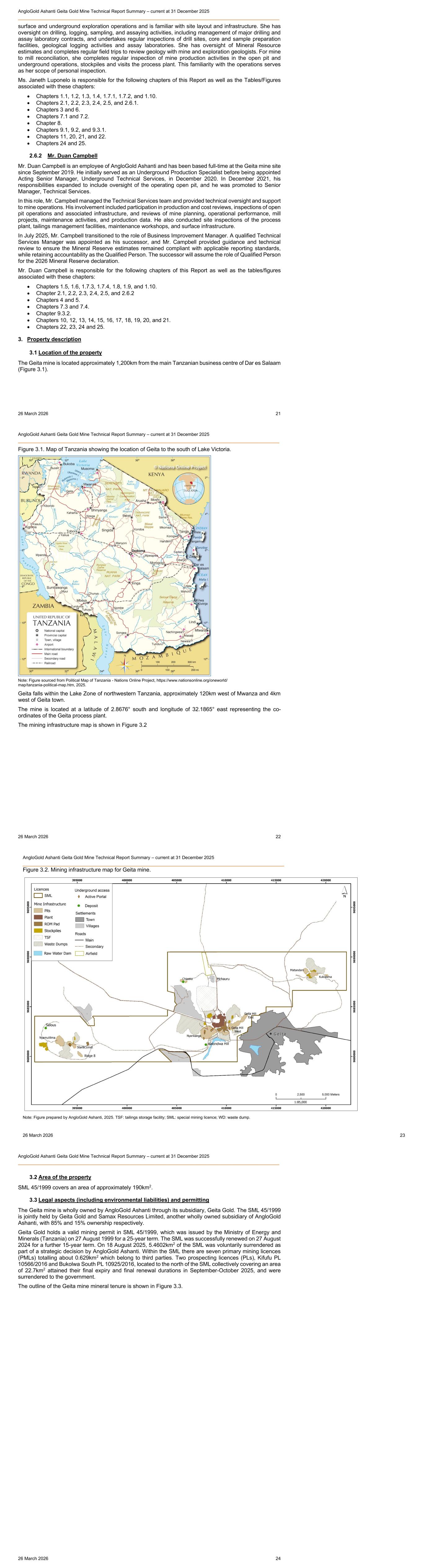
AngloGold Ashanti Geita Gold Mine Technical Report Summary – current at 31 December 2025 _____________________________________________________________________________________ 26 March 2026 21 surface and underground exploration operations and is familiar with site layout and infrastructure. She has oversight on drilling, logging, sampling, and assaying activities, including management of major drilling and assay laboratory contracts, and undertakes regular inspections of drill sites, core and sample preparation facilities, geological logging activities and assay laboratories. She has oversight of Mineral Resource estimates and completes regular field trips to review geology with mine and exploration geologists. For mine to mill reconciliation, she completes regular inspection of mine production activities in the open pit and underground operations, stockpiles and visits the process plant. This familiarity with the operations serves as her scope of personal inspection. Ms. Janeth Luponelo is responsible for the following chapters of this Report as well as the Tables/Figures associated with these chapters: • Chapters 1.1, 1.2, 1.3, 1.4, 1.7.1, 1.7.2, and 1.10. • Chapters 2.1, 2.2, 2.3, 2.4, 2.5, and 2.6.1. • Chapters 3 and 6. • Chapters 7.1 and 7.2. • Chapter 8. • Chapters 9.1, 9.2, and 9.3.1. • Chapters 11, 20, 21, and 22. • Chapters 24 and 25. 2.6.2 Mr. Duan Campbell Mr. Duan Campbell is an employee of AngloGold Ashanti and has been based full-time at the Geita mine site since September 2019. He initially served as an Underground Production Specialist before being appointed Acting Senior Manager, Underground Technical Services, in December 2020. In December 2021, his responsibilities expanded to include oversight of the operating open pit, and he was promoted to Senior Manager, Technical Services. In this role, Mr. Campbell managed the Technical Services team and provided technical oversight and support to mine operations. His involvement included participation in production and cost reviews, inspections of open pit operations and associated infrastructure, and reviews of mine planning, operational performance, mill projects, maintenance activities, and production data. He also conducted site inspections of the process plant, tailings management facilities, maintenance workshops, and surface infrastructure. In July 2025, Mr. Campbell transitioned to the role of Business Improvement Manager. A qualified Technical Services Manager was appointed as his successor, and Mr. Campbell provided guidance and technical review to ensure the Mineral Reserve estimates remained compliant with applicable reporting standards, while retaining accountability as the Qualified Person. The successor will assume the role of Qualified Person for the 2026 Mineral Reserve declaration. Mr. Duan Campbell is responsible for the following chapters of this Report as well as the tables/figures associated with these chapters: • Chapters 1.5, 1.6, 1.7.3, 1.7.4, 1.8, 1.9, and 1.10. • Chapter 2.1, 2.2, 2.3, 2.4, 2.5, and 2.6.2 • Chapters 4 and 5. • Chapters 7.3 and 7.4. • Chapter 9.3.2. • Chapters 10, 12, 13, 14, 15, 16, 17, 18, 19, 20, and 21. • Chapters 22, 23, 24 and 25. 3. Property description 3.1 Location of the property The Geita mine is located approximately 1,200km from the main Tanzanian business centre of Dar es Salaam (Figure 3.1). AngloGold Ashanti Geita Gold Mine Technical Report Summary – current at 31 December 2025 _____________________________________________________________________________________ 26 March 2026 22 Figure 3.1. Map of Tanzania showing the location of Geita to the south of Lake Victoria. Note: Figure sourced from Political Map of Tanzania - Nations Online Project, https://www.nationsonline.org/oneworld/ map/tanzania-political-map.htm, 2025. Geita falls within the Lake Zone of northwestern Tanzania, approximately 120km west of Mwanza and 4km west of Geita town. The mine is located at a latitude of 2.8676° south and longitude of 32.1865° east representing the co- ordinates of the Geita process plant. The mining infrastructure map is shown in Figure 3.2 AngloGold Ashanti Geita Gold Mine Technical Report Summary – current at 31 December 2025 _____________________________________________________________________________________ 26 March 2026 23 Figure 3.2. Mining infrastructure map for Geita mine. Note: Figure prepared by AngloGold Ashanti, 2025. TSF: tailings storage facility; SML: special mining licence; WD: waste dump. AngloGold Ashanti Geita Gold Mine Technical Report Summary – current at 31 December 2025 _____________________________________________________________________________________ 26 March 2026 24 3.2 Area of the property SML 45/1999 covers an area of approximately 190km2. 3.3 Legal aspects (including environmental liabilities) and permitting The Geita mine is wholly owned by AngloGold Ashanti through its subsidiary, Geita Gold. The SML 45/1999 is jointly held by Geita Gold and Samax Resources Limited, another wholly owned subsidiary of AngloGold Ashanti, with 85% and 15% ownership respectively. Geita Gold holds a valid mining permit in SML 45/1999, which was issued by the Ministry of Energy and Minerals (Tanzania) on 27 August 1999 for a 25-year term. The SML was successfully renewed on 27 August 2024 for a further 15-year term. On 18 August 2025, 5.4602km2 of the SML was voluntarily surrendered as part of a strategic decision by AngloGold Ashanti. Within the SML there are seven primary mining licences (PMLs) totalling about 0.629km2 which belong to third parties. Two prospecting licences (PLs), Kifufu PL 10566/2016 and Bukolwa South PL 10925/2016, located to the north of the SML collectively covering an area of 22.7km2 attained their final expiry and final renewal durations in September-October 2025, and were surrendered to the government. The outline of the Geita mine mineral tenure is shown in Figure 3.3.
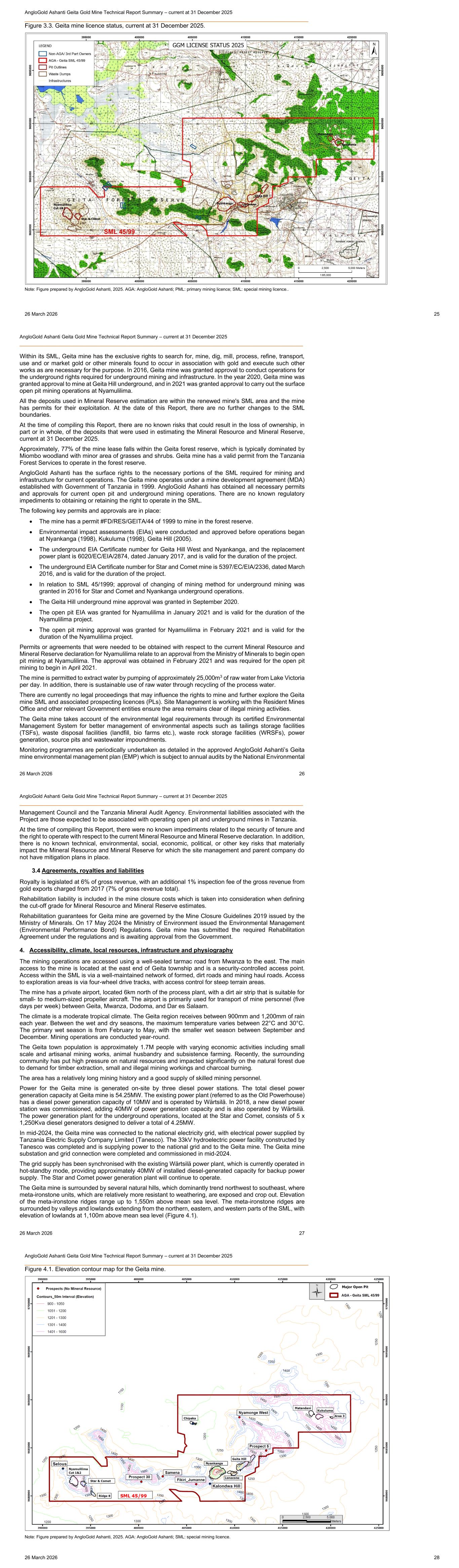
AngloGold Ashanti Geita Gold Mine Technical Report Summary – current at 31 December 2025 _____________________________________________________________________________________ 26 March 2026 25 Figure 3.3. Geita mine licence status, current at 31 December 2025. Note: Figure prepared by AngloGold Ashanti, 2025. AGA: AngloGold Ashanti; PML: primary mining licence; SML: special mining licence.. AngloGold Ashanti Geita Gold Mine Technical Report Summary – current at 31 December 2025 _____________________________________________________________________________________ 26 March 2026 26 Within its SML, Geita mine has the exclusive rights to search for, mine, dig, mill, process, refine, transport, use and or market gold or other minerals found to occur in association with gold and execute such other works as are necessary for the purpose. In 2016, Geita mine was granted approval to conduct operations for the underground rights required for underground mining and infrastructure. In the year 2020, Geita mine was granted approval to mine at Geita Hill underground, and in 2021 was granted approval to carry out the surface open pit mining operations at Nyamulilima. All the deposits used in Mineral Reserve estimation are within the renewed mine's SML area and the mine has permits for their exploitation. At the date of this Report, there are no further changes to the SML boundaries. At the time of compiling this Report, there are no known risks that could result in the loss of ownership, in part or in whole, of the deposits that were used in estimating the Mineral Resource and Mineral Reserve, current at 31 December 2025. Approximately, 77% of the mine lease falls within the Geita forest reserve, which is typically dominated by Miombo woodland with minor area of grasses and shrubs. Geita mine has a valid permit from the Tanzania Forest Services to operate in the forest reserve. AngloGold Ashanti has the surface rights to the necessary portions of the SML required for mining and infrastructure for current operations. The Geita mine operates under a mine development agreement (MDA) established with Government of Tanzania in 1999. AngloGold Ashanti has obtained all necessary permits and approvals for current open pit and underground mining operations. There are no known regulatory impediments to obtaining or retaining the right to operate in the SML. The following key permits and approvals are in place: • The mine has a permit #FD/RES/GEITA/44 of 1999 to mine in the forest reserve. • Environmental impact assessments (EIAs) were conducted and approved before operations began at Nyankanga (1998), Kukuluma (1998), Geita Hill (2005). • The underground EIA Certificate number for Geita Hill West and Nyankanga, and the replacement power plant is 6020/EC/EIA/2874, dated January 2017, and is valid for the duration of the project. • The underground EIA Certificate number for Star and Comet mine is 5397/EC/EIA/2336, dated March 2016, and is valid for the duration of the project. • In relation to SML 45/1999; approval of changing of mining method for underground mining was granted in 2016 for Star and Comet and Nyankanga underground operations. • The Geita Hill underground mine approval was granted in September 2020. • The open pit EIA was granted for Nyamulilima in January 2021 and is valid for the duration of the Nyamulilima project. • The open pit mining approval was granted for Nyamulilima in February 2021 and is valid for the duration of the Nyamulilima project. Permits or agreements that were needed to be obtained with respect to the current Mineral Resource and Mineral Reserve declaration for Nyamulilima relate to an approval from the Ministry of Minerals to begin open pit mining at Nyamulilima. The approval was obtained in February 2021 and was required for the open pit mining to begin in April 2021. The mine is permitted to extract water by pumping of approximately 25,000m3 of raw water from Lake Victoria per day. In addition, there is sustainable use of raw water through recycling of the process water. There are currently no legal proceedings that may influence the rights to mine and further explore the Geita mine SML and associated prospecting licences (PLs). Site Management is working with the Resident Mines Office and other relevant Government entities ensure the area remains clear of illegal mining activities. The Geita mine takes account of the environmental legal requirements through its certified Environmental Management System for better management of environmental aspects such as tailings storage facilities (TSFs), waste disposal facilities (landfill, bio farms etc.), waste rock storage facilities (WRSFs), power generation, source pits and wastewater impoundments. Monitoring programmes are periodically undertaken as detailed in the approved AngloGold Ashanti’s Geita mine environmental management plan (EMP) which is subject to annual audits by the National Environmental AngloGold Ashanti Geita Gold Mine Technical Report Summary – current at 31 December 2025 _____________________________________________________________________________________ 26 March 2026 27 Management Council and the Tanzania Mineral Audit Agency. Environmental liabilities associated with the Project are those expected to be associated with operating open pit and underground mines in Tanzania. At the time of compiling this Report, there were no known impediments related to the security of tenure and the right to operate with respect to the current Mineral Resource and Mineral Reserve declaration. In addition, there is no known technical, environmental, social, economic, political, or other key risks that materially impact the Mineral Resource and Mineral Reserve for which the site management and parent company do not have mitigation plans in place. 3.4 Agreements, royalties and liabilities Royalty is legislated at 6% of gross revenue, with an additional 1% inspection fee of the gross revenue from gold exports charged from 2017 (7% of gross revenue total). Rehabilitation liability is included in the mine closure costs which is taken into consideration when defining the cut-off grade for Mineral Resource and Mineral Reserve estimates. Rehabilitation guarantees for Geita mine are governed by the Mine Closure Guidelines 2019 issued by the Ministry of Minerals. On 17 May 2024 the Ministry of Environment issued the Environmental Management (Environmental Performance Bond) Regulations. Geita mine has submitted the required Rehabilitation Agreement under the regulations and is awaiting approval from the Government. 4. Accessibility, climate, local resources, infrastructure and physiography The mining operations are accessed using a well-sealed tarmac road from Mwanza to the east. The main access to the mine is located at the east end of Geita township and is a security-controlled access point. Access within the SML is via a well-maintained network of formed, dirt roads and mining haul roads. Access to exploration areas is via four-wheel drive tracks, with access control for steep terrain areas. The mine has a private airport, located 6km north of the process plant, with a dirt air strip that is suitable for small- to medium-sized propeller aircraft. The airport is primarily used for transport of mine personnel (five days per week) between Geita, Mwanza, Dodoma, and Dar es Salaam. The climate is a moderate tropical climate. The Geita region receives between 900mm and 1,200mm of rain each year. Between the wet and dry seasons, the maximum temperature varies between 22°C and 30°C. The primary wet season is from February to May, with the smaller wet season between September and December. Mining operations are conducted year-round. The Geita town population is approximately 1.7M people with varying economic activities including small scale and artisanal mining works, animal husbandry and subsistence farming. Recently, the surrounding community has put high pressure on natural resources and impacted significantly on the natural forest due to demand for timber extraction, small and illegal mining workings and charcoal burning. The area has a relatively long mining history and a good supply of skilled mining personnel. Power for the Geita mine is generated on-site by three diesel power stations. The total diesel power generation capacity at Geita mine is 54.25MW. The existing power plant (referred to as the Old Powerhouse) has a diesel power generation capacity of 10MW and is operated by Wärtsilä. In 2018, a new diesel power station was commissioned, adding 40MW of power generation capacity and is also operated by Wärtsilä. The power generation plant for the underground operations, located at the Star and Comet, consists of 5 x 1,250Kva diesel generators designed to deliver a total of 4.25MW. In mid-2024, the Geita mine was connected to the national electricity grid, with electrical power supplied by Tanzania Electric Supply Company Limited (Tanesco). The 33kV hydroelectric power facility constructed by Tanesco was completed and is supplying power to the national grid and to the Geita mine. The Geita mine substation and grid connection were completed and commissioned in mid-2024. The grid supply has been synchronised with the existing Wärtsilä power plant, which is currently operated in hot-standby mode, providing approximately 40MW of installed diesel-generated capacity for backup power supply. The Star and Comet power generation plant will continue to operate. The Geita mine is surrounded by several natural hills, which dominantly trend northwest to southeast, where meta-ironstone units, which are relatively more resistant to weathering, are exposed and crop out. Elevation of the meta-ironstone ridges range up to 1,550m above mean sea level. The meta-ironstone ridges are surrounded by valleys and lowlands extending from the northern, eastern, and western parts of the SML, with elevation of lowlands at 1,100m above mean sea level (Figure 4.1). AngloGold Ashanti Geita Gold Mine Technical Report Summary – current at 31 December 2025 _____________________________________________________________________________________ 26 March 2026 28 Figure 4.1. Elevation contour map for the Geita mine. Note: Figure prepared by AngloGold Ashanti, 2025. AGA: AngloGold Ashanti; SML: special mining licence.
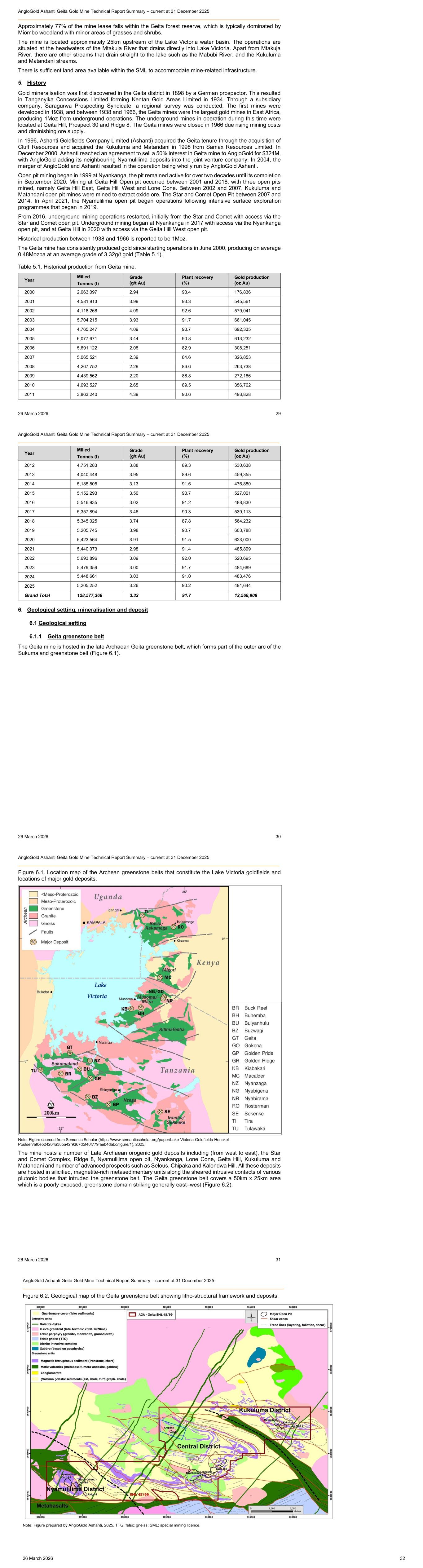
AngloGold Ashanti Geita Gold Mine Technical Report Summary – current at 31 December 2025 _____________________________________________________________________________________ 26 March 2026 29 Approximately 77% of the mine lease falls within the Geita forest reserve, which is typically dominated by Miombo woodland with minor areas of grasses and shrubs. The mine is located approximately 25km upstream of the Lake Victoria water basin. The operations are situated at the headwaters of the Mtakuja River that drains directly into Lake Victoria. Apart from Mtakuja River, there are other streams that drain straight to the lake such as the Mabubi River, and the Kukuluma and Matandani streams. There is sufficient land area available within the SML to accommodate mine-related infrastructure. 5. History Gold mineralisation was first discovered in the Geita district in 1898 by a German prospector. This resulted in Tanganyika Concessions Limited forming Kentan Gold Areas Limited in 1934. Through a subsidiary company, Saragurwa Prospecting Syndicate, a regional survey was conducted. The first mines were developed in 1938, and between 1938 and 1966, the Geita mines were the largest gold mines in East Africa, producing 1Moz from underground operations. The underground mines in operation during this time were located at Geita Hill, Prospect 30 and Ridge 8. The Geita mines were closed in 1966 due rising mining costs and diminishing ore supply. In 1996, Ashanti Goldfields Company Limited (Ashanti) acquired the Geita tenure through the acquisition of Cluff Resources and acquired the Kukuluma and Matandani in 1998 from Samax Resources Limited. In December 2000, Ashanti reached an agreement to sell a 50% interest in Geita mine to AngloGold for $324M, with AngloGold adding its neighbouring Nyamulilima deposits into the joint venture company. In 2004, the merger of AngloGold and Ashanti resulted in the operation being wholly run by AngloGold Ashanti. Open pit mining began in 1999 at Nyankanga, the pit remained active for over two decades until its completion in September 2020. Mining at Geita Hill Open pit occurred between 2001 and 2018, with three open pits mined, namely Geita Hill East, Geita Hill West and Lone Cone. Between 2002 and 2007, Kukuluma and Matandani open pit mines were mined to extract oxide ore. The Star and Comet Open Pit between 2007 and 2014. In April 2021, the Nyamulilima open pit began operations following intensive surface exploration programmes that began in 2019. From 2016, underground mining operations restarted, initially from the Star and Comet with access via the Star and Comet open pit. Underground mining began at Nyankanga in 2017 with access via the Nyankanga open pit, and at Geita Hill in 2020 with access via the Geita Hill West open pit. Historical production between 1938 and 1966 is reported to be 1Moz. The Geita mine has consistently produced gold since starting operations in June 2000, producing on average 0.48Mozpa at an average grade of 3.32g/t gold (Table 5.1). Table 5.1. Historical production from Geita mine. Year Milled Tonnes (t) Grade (g/t Au) Plant recovery (%) Gold production (oz Au) 2000 2,063,097 2.94 93.4 176,836 2001 4,581,913 3.99 93.3 545,561 2002 4,118,268 4.09 92.6 579,041 2003 5,704,215 3.93 91.7 661,045 2004 4,765,247 4.09 90.7 692,335 2005 6,077,671 3.44 90.8 613,232 2006 5,691,122 2.08 82.9 308,251 2007 5,065,521 2.39 84.6 326,853 2008 4,267,752 2.29 86.6 263,738 2009 4,439,562 2.20 86.8 272,186 2010 4,693,527 2.65 89.5 356,762 2011 3,863,240 4.39 90.6 493,828 AngloGold Ashanti Geita Gold Mine Technical Report Summary – current at 31 December 2025 _____________________________________________________________________________________ 26 March 2026 30 Year Milled Tonnes (t) Grade (g/t Au) Plant recovery (%) Gold production (oz Au) 2012 4,751,283 3.88 89.3 530,638 2013 4,040,448 3.95 89.6 459,355 2014 5,185,805 3.13 91.6 476,880 2015 5,152,293 3.50 90.7 527,001 2016 5,516,935 3.02 91.2 488,830 2017 5,357,894 3.46 90.3 539,113 2018 5,345,025 3.74 87.8 564,232 2019 5,205,745 3.98 90.7 603,788 2020 5,423,564 3.91 91.5 623,000 2021 5,440,073 2.98 91.4 485,899 2022 5,693,896 3.09 92.0 520,695 2023 5,479,359 3.00 91.7 484,689 2024 5,448,661 3.03 91.0 483,476 2025 5,205,252 3.26 90.2 491,644 Grand Total 128,577,368 3.32 91.7 12,568,908 6. Geological setting, mineralisation and deposit 6.1 Geological setting 6.1.1 Geita greenstone belt The Geita mine is hosted in the late Archaean Geita greenstone belt, which forms part of the outer arc of the Sukumaland greenstone belt (Figure 6.1). AngloGold Ashanti Geita Gold Mine Technical Report Summary – current at 31 December 2025 _____________________________________________________________________________________ 26 March 2026 31 Figure 6.1. Location map of the Archean greenstone belts that constitute the Lake Victoria goldfields and locations of major gold deposits. Note: Figure sourced from Semantic Scholar (https://www.semanticscholar.org/paper/Lake-Victoria-Goldfields-Henckel- Poulsen/af0e524264a38ba42f9367d5f40f779faeb4dabc/figure/1), 2025. The mine hosts a number of Late Archaean orogenic gold deposits including (from west to east), the Star and Comet Complex, Ridge 8, Nyamulilima open pit, Nyankanga, Lone Cone, Geita Hill, Kukuluma and Matandani and number of advanced prospects such as Selous, Chipaka and Kalondwa Hill. All these deposits are hosted in silicified, magnetite-rich metasedimentary units along the sheared intrusive contacts of various plutonic bodies that intruded the greenstone belt. The Geita greenstone belt covers a 50km x 25km area which is a poorly exposed, greenstone domain striking generally east–west (Figure 6.2). AngloGold Ashanti Geita Gold Mine Technical Report Summary – current at 31 December 2025 _____________________________________________________________________________________ 26 March 2026 32 Figure 6.2. Geological map of the Geita greenstone belt showing litho-structural framework and deposits. Note: Figure prepared by AngloGold Ashanti, 2025. TTG: felsic gneiss; SML: special mining licence.

AngloGold Ashanti Geita Gold Mine Technical Report Summary – current at 31 December 2025 _____________________________________________________________________________________ 26 March 2026 33 The belt is bounded to the north, east and west by late syn- to post-tectonic 2660-2620Ma, high-potassium granites, and to the south by tonalite, trondhjemite and granodiorite gneisses across a large, east-west- trending mylonitic shear zone. The southern part of the Geita greenstone belt contains meta-basalt with minor gabbro yielding model ages of approximately 2820Ma. The remaining area of the Geita greenstone belt is composed of sediments deposited approximately 2770Ma. Within the Geita greenstone belt, number of intrusive bodies with various compositions are recorded and include tonalite, trondhjemite, granodiorite, monzonite, diorites, lamprophyres, and gabbro. Emplacement ages range from 2720-2660Ma. Both the meta-volcano sedimentary package as well as intrusive bodies are variably deformed and metamorphosed. The metamorphic grade within the belt is generally greenschist facies and progressively increases towards the edge/margin of the belt to amphibolite close to the contact with the high-potassium granites. Stratigraphically, the Geita greenstone belt sits dominantly within the Nyanzian Supergroup that is sub- divided into the Lower Nyanzian and the Upper Nyanzian Groups (Figure 6.3). Figure 6.3. Generalised stratigraphy of Geita greenstone belt. Note: Figure prepared by AngloGold Ashanti, 2025. The Lower Nyanzian Group is composed of mafic volcanic units (basalts, pillow basalt, minor gabbro, and dolerites). This group of rocks within the Geita greenstone belt is collectively termed the Kiziba Formation. The Upper Nyanzian Group consists of black shales, BIF, clastic sedimentary rocks, tuffs, agglomerates and felsic volcaniclastic rocks. The Nyanzian Supergroup is unconformably overlain by the Kavirondian System comprising conglomerates and sandstones. The entire package is intruded by a variety of mafic to felsic rocks. The supra-crustal package shows variable thickness and is estimated to be more than 500m thick in places. Across the Archaean-Proterozoic rocks there is a property-wide paleo-drainage system, which likely flowed towards Lake Victoria. The Archaean-Proterozoic rocks and paleo-alluvials are covered by ferricrete at different levels of induration and evolution, up to 15m thick. 6.1.2 Deformation history and mineralisation The Geita greenstone belt has been subjected through a protracted history of deformation involving tectonic switches from extensional to compressional regimes resulting in the formation of a large scale synformal AngloGold Ashanti Geita Gold Mine Technical Report Summary – current at 31 December 2025 _____________________________________________________________________________________ 26 March 2026 34 configuration in the region (Central district). West-northwest-trending limbs connected by a northeast- trending hinge zone are surrounded by tight antiforms and synforms to the east (Kukuluma district) and west (Nyamulilima district) respectively. Generally, four main deformation phases (D1-D4) are recorded post-deposition of the 2.82Ga mafic basement (high-magnesium tholeiites). Extensional processes led to the formation of a basin on top of the mafic basement with the basin fill materials being black shales, volcaniclastic units, BIF, ferruginous shales and clastic sediments. The D1-D2 deformation phases record the onset of a compressional regime resulting in tight isoclinal folds with possible northwest-southeasterly directed compression related to thrusts (southeasterly-directed thrusting) associated with synchronous periodic emplacement of large diorite intrusive complexes as sills and dykes. This phase was followed by a progressive northeast-southwest compression stage (D3) that is associated with the formation of a large syncline in the Central district and tight folding in the surrounding Kukuluma and Nyamulilima districts. D3 was also associated with continued emplacement of intrusions of tonalite, trondhjemite, granodiorite, diorite, and monzonite. Reactivation of thrusts led to the formation of brittle-ductile sinistral shear zones in the Central district as well as steep brittle-ductile northwest-southeast- trending shear zones within the surrounding Kukuluma and Nyamulilima districts. These shear zones control gold mineralisation within the three districts. Emplacement of intrusive bodies during this deformation phase stopped shortly before the gold mineralising event. Gold mineralisation within the Geita greenstone belt is estimated to have occurred at approximately 2.64Ga. The high-potassium granitoids, which are undeformed, were emplaced at approximately 2.62Ga. Gold mineralisation within the Geita greenstone belt occurred late in the tectonic history of the greenstone belt, synchronous with the development of the D3 brittle-ductile shear zones. Mineralisation is preferentially developed along the sheared lithological contacts such as intrusive-metasediment contacts, and tuff-BIF contacts. It is also hosted in the hinge zones of D3 folds that generally plunge shallowly to moderately towards the northwest. The shear zones manifest as highly deformed zones associated with intense silicification and brecciation with disseminated sulphides such as pyrite, pyrrhotite, and arsenopyrite. In the Central district, gold occurs as electrum and gold tellurides along grain boundaries and as inclusions in pyrite, biotite, and potassium-feldspar. Silicification and potassic alteration occur within the ore zone. Gold mineralisation within the Nyamulilima district is strongly associated with intense silicification and disseminated sulphides, dominantly pyrite, but with occasional pyrrhotite. Gold can also occur in association with electrum and tellurides. At the Kukuluma district, gold is predominantly (approximately 80%) locked within arsenopyrite, with minor pyrrhotite. Gold can also occur in association with electrum and tellurides. Gold occurs texturally late in all three districts and is associated with a potassic-carbonate-quartz alteration assemblage. 6.1.3 Property geology There are three major mineralised districts within the SML: • Nyamulilima district is in the west, is oriented northwest-southeast, and hosts the Star and Comet, Ridge 8, Nyamulilima and Selous deposits. • Central district is located centrally, oriented northeast-southwest, and hosts the Nyankanga, Geita Hill, Lone Cone, Kalondwa Hill, and Chipaka deposits. • Matandani-Kukuluma district is in the northeast, is oriented east-west, and hosts the Kukuluma, Matandani, and Area 3 West deposits. 6.1.3.1 Nyamulilima district The Nyamulilima deposits occur along a series of north-south-trending, steeply-dipping, left-stepping en- echelon fault zones that cut across the ironstone-rich sediments and granite, granodiorite, and tonalite intrusions. Mineralisation is preferentially localised along fault zones where the faults cut the ironstone- granitoid contacts. Mineralisation is associated with secondary pyrite and minor pyrrhotite, silica, carbonate, and actinolite alteration. 6.1.3.2 Central district The Geita Hill and Nyankanga deposits occur along a moderately northwest-dipping system of reverse faults that have been multiply reactivated during subsequent deformation events. The mineralisation is mainly hosted in diorite and along BIF contacts exploited by mineralised shear systems. Alteration is restricted within AngloGold Ashanti Geita Gold Mine Technical Report Summary – current at 31 December 2025 _____________________________________________________________________________________ 26 March 2026 35 the mineralised zone and consists of secondary sulphide (mainly pyrite), silica, carbonate, and moderate potassic alteration. Chipaka deposit occurs as a separate deposit within the central part of the Geita greenstone belt located about 5km towards north-northwest from the Nyankanga deposit. Gold mineralisation at Chipaka is controlled by sheared BIF-diorite contacts along the D3 fold limbs and hinges. The high-grade and wider ore zones are hosted in BIF with high-grade ore shoots located along the fold hinges of the anticline with shallow plunging angles towards the northwest. Breccia zones do occur within fold hinges associated with high-grade ore zone. The high-grade ore zones vary in size from 3-5m wide, defining a total strike length of ~400m within the area drilled to an Inferred Mineral Resource. The Fikiri, Jumanne, Samena, and Prospect 30 prospects are located along a northwest-southeast-trending meta-ironstone ridge on the western fold limb of the Central district, extending west from Nyankanga. Prospect 5 and Nyamonge West are located along a northwest-southeast trending meta-ironstone ridge, on the eastern fold limb of the Central district, with its fold closure coinciding with the eastern extension of Geita Hill deposits. 6.1.3.3 Matandani-Kukuluma district The Matandani, Kukuluma, and Area 3 West deposits are shear-hosted on steeply dipping contacts of intermediate fine-grained intrusions and magnetite-rich chert and ironstone sediments, showing a general en-echelon, left-stepping structural geometry. Gold is associated with secondary pyrite, arsenopyrite, and minor pyrrhotite. Magnetite, silica, carbonate, and amphibole alteration are variably present within the mineralised zone. 6.2 Geological models and mineralisation Geological models are constructed using integrated geological data obtained through exploration work programmes such as surface geological mapping, pits and underground face and side wall mapping, geochemical studies, geophysical surveys and interpretation of geophysical data, and making use of exploration drilling data for each deposit at Geita. The exploration process map begins with land acquisition (prospecting licences) from the issuing authority. Once the prospecting licences have been granted, desktop studies are conducted to establish an understanding of previous land holdings, previous works and gain a quick overview of the landforms and other features or lineaments related to geological settings as well as sitting exploration targets. For Geita’s licences, desktop studies were completed between the mid-1990’s and 2010. The exploration work programmes mentioned above are designed to follow up on the exploration targets based on the preliminary geological understanding gained from the desktop studies and ground truthing. Exploration targeting identifies new prospects for exploration, where exploration drilling advances within the target area as the level of geological confidence increases. For Geita mine deposits, the mineralisation is generally hosted in BIF and along the lithological contacts between BIF and other volcano-sedimentary units or intrusive rocks at locations where these host rocks have been interacted by shear zones and fold systems. Once the geology of the area has been well understood, a comprehensive geological interpretation is then performed, followed by 3D geological modelling. Significant exploration was completed from the mid-1990s to the late 2000s and used to delineate and consolidate the exploration targets (surface and sub-surface data) covering the lease area. Collection of drilling samples, logging and assaying have been performed according to AngloGold Ashanti and industry best practice protocols. The exploration drill holes data combined with integrated geology and geophysical data sets form the basis for the geological models, which are constructed using Leapfrog and Datamine software. Intensive exploration programmes at Geita mine began in the mid-1990s and mining operations resumed in 1999. Since then, Geita mine has been consistently investing in exploration to facilitate new gold discoveries and improve confidence in the known Mineral Resource to extend the LOM. The geological concepts behind exploration initiatives and the confidence within the Geita greenstone belt have been driven by presence of colonial mining at Geita Hill, Prospect 30 and Ridge 8, presence of historical and recent mining activities within the belt, strong geochemical anomalies in all known deposits and satellite targets, coherent geophysical features with good correlation with other geological data sets, favourable host rocks, confidence level in understanding the geology and mineralisation controls and confidence in ore recoveries. Excluding the Matandani and Kukuluma deposits, which are metallurgically refractory in nature. AngloGold Ashanti Geita Gold Mine Technical Report Summary – current at 31 December 2025 _____________________________________________________________________________________ 26 March 2026 36 6.2.1 Nyamulilima district The Nyamulilima district forms the western part of the Geita greenstone belt and has a total strike length of 5km. It is dominated by a volcano-sedimentary package intruded by various igneous bodies of tonalite, trondhjemite, and granodiorite composition (Figure 6.4). The Nyamulilima district hosts the Nyamulilima, Selous and Star and Comet (including Ridge 8) underground deposits.
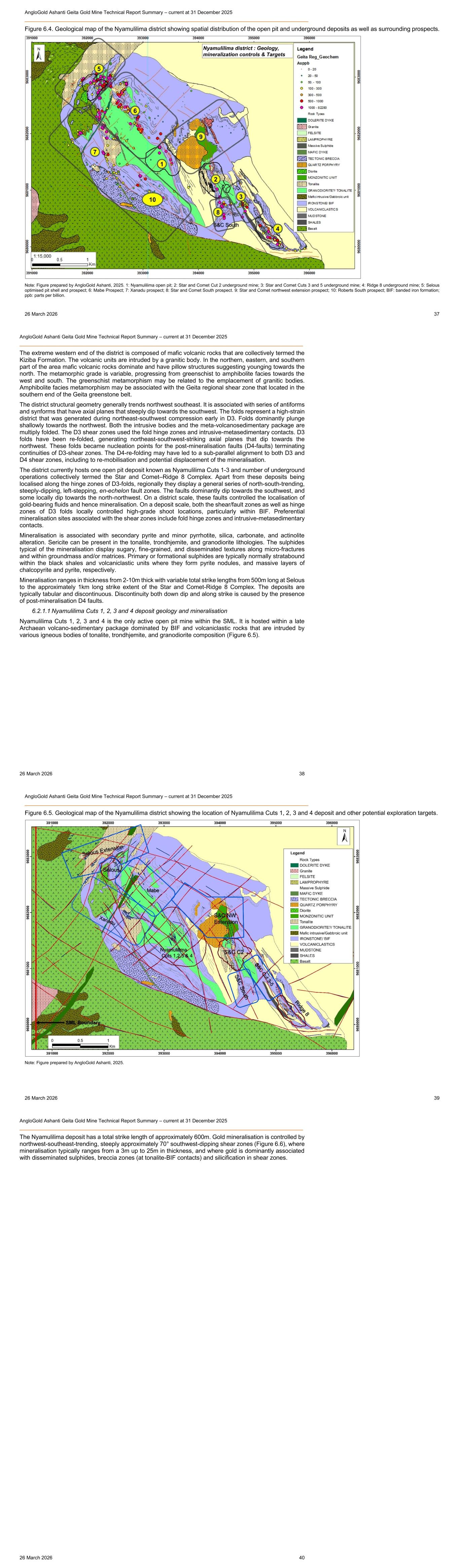
AngloGold Ashanti Geita Gold Mine Technical Report Summary – current at 31 December 2025 _____________________________________________________________________________________ 26 March 2026 37 Figure 6.4. Geological map of the Nyamulilima district showing spatial distribution of the open pit and underground deposits as well as surrounding prospects. Note: Figure prepared by AngloGold Ashanti, 2025. 1: Nyamulilima open pit; 2: Star and Comet Cut 2 underground mine; 3: Star and Comet Cuts 3 and 5 underground mine; 4: Ridge 8 underground mine; 5: Selous optimised pit shell and prospect; 6: Mabe Prospect; 7: Xanadu prospect; 8: Star and Comet South prospect. 9: Star and Comet northwest extension prospect; 10: Roberts South prospect; BIF: banded iron formation; ppb: parts per billion. AngloGold Ashanti Geita Gold Mine Technical Report Summary – current at 31 December 2025 _____________________________________________________________________________________ 26 March 2026 38 The extreme western end of the district is composed of mafic volcanic rocks that are collectively termed the Kiziba Formation. The volcanic units are intruded by a granitic body. In the northern, eastern, and southern part of the area mafic volcanic rocks dominate and have pillow structures suggesting younging towards the north. The metamorphic grade is variable, progressing from greenschist to amphibolite facies towards the west and south. The greenschist metamorphism may be related to the emplacement of granitic bodies. Amphibolite facies metamorphism may be associated with the Geita regional shear zone that located in the southern end of the Geita greenstone belt. The district structural geometry generally trends northwest southeast. It is associated with series of antiforms and synforms that have axial planes that steeply dip towards the southwest. The folds represent a high-strain district that was generated during northeast-southwest compression early in D3. Folds dominantly plunge shallowly towards the northwest. Both the intrusive bodies and the meta-volcanosedimentary package are multiply folded. The D3 shear zones used the fold hinge zones and intrusive-metasedimentary contacts. D3 folds have been re-folded, generating northeast-southwest-striking axial planes that dip towards the northwest. These folds became nucleation points for the post-mineralisation faults (D4-faults) terminating continuities of D3-shear zones. The D4-re-folding may have led to a sub-parallel alignment to both D3 and D4 shear zones, including to re-mobilisation and potential displacement of the mineralisation. The district currently hosts one open pit deposit known as Nyamulilima Cuts 1-3 and number of underground operations collectively termed the Star and Comet–Ridge 8 Complex. Apart from these deposits being localised along the hinge zones of D3-folds, regionally they display a general series of north-south-trending, steeply-dipping, left-stepping, en-echelon fault zones. The faults dominantly dip towards the southwest, and some locally dip towards the north-northwest. On a district scale, these faults controlled the localisation of gold-bearing fluids and hence mineralisation. On a deposit scale, both the shear/fault zones as well as hinge zones of D3 folds locally controlled high-grade shoot locations, particularly within BIF. Preferential mineralisation sites associated with the shear zones include fold hinge zones and intrusive-metasedimentary contacts. Mineralisation is associated with secondary pyrite and minor pyrrhotite, silica, carbonate, and actinolite alteration. Sericite can be present in the tonalite, trondhjemite, and granodiorite lithologies. The sulphides typical of the mineralisation display sugary, fine-grained, and disseminated textures along micro-fractures and within groundmass and/or matrices. Primary or formational sulphides are typically normally stratabound within the black shales and volcaniclastic units where they form pyrite nodules, and massive layers of chalcopyrite and pyrite, respectively. Mineralisation ranges in thickness from 2-10m thick with variable total strike lengths from 500m long at Selous to the approximately 1km long strike extent of the Star and Comet-Ridge 8 Complex. The deposits are typically tabular and discontinuous. Discontinuity both down dip and along strike is caused by the presence of post-mineralisation D4 faults. 6.2.1.1 Nyamulilima Cuts 1, 2, 3 and 4 deposit geology and mineralisation Nyamulilima Cuts 1, 2, 3 and 4 is the only active open pit mine within the SML. It is hosted within a late Archaean volcano-sedimentary package dominated by BIF and volcaniclastic rocks that are intruded by various igneous bodies of tonalite, trondhjemite, and granodiorite composition (Figure 6.5). AngloGold Ashanti Geita Gold Mine Technical Report Summary – current at 31 December 2025 _____________________________________________________________________________________ 26 March 2026 39 Figure 6.5. Geological map of the Nyamulilima district showing the location of Nyamulilima Cuts 1, 2, 3 and 4 deposit and other potential exploration targets. Note: Figure prepared by AngloGold Ashanti, 2025. AngloGold Ashanti Geita Gold Mine Technical Report Summary – current at 31 December 2025 _____________________________________________________________________________________ 26 March 2026 40 The Nyamulilima deposit has a total strike length of approximately 600m. Gold mineralisation is controlled by northwest-southeast-trending, steeply approximately 70° southwest-dipping shear zones (Figure 6.6), where mineralisation typically ranges from a 3m up to 25m in thickness, and where gold is dominantly associated with disseminated sulphides, breccia zones (at tonalite-BIF contacts) and silicification in shear zones.
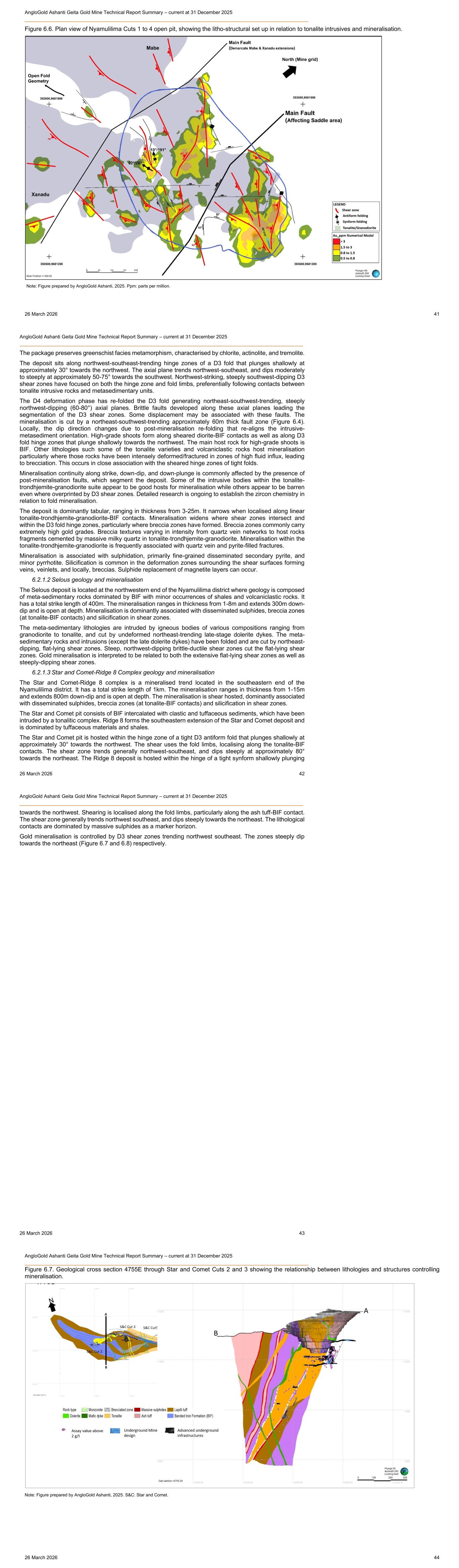
AngloGold Ashanti Geita Gold Mine Technical Report Summary – current at 31 December 2025 _____________________________________________________________________________________ 26 March 2026 41 Figure 6.6. Plan view of Nyamulilima Cuts 1 to 4 open pit, showing the litho-structural set up in relation to tonalite intrusives and mineralisation. Note: Figure prepared by AngloGold Ashanti, 2025. Ppm: parts per million. AngloGold Ashanti Geita Gold Mine Technical Report Summary – current at 31 December 2025 _____________________________________________________________________________________ 26 March 2026 42 The package preserves greenschist facies metamorphism, characterised by chlorite, actinolite, and tremolite. The deposit sits along northwest-southeast-trending hinge zones of a D3 fold that plunges shallowly at approximately 30° towards the northwest. The axial plane trends northwest-southeast, and dips moderately to steeply at approximately 50-75° towards the southwest. Northwest-striking, steeply southwest-dipping D3 shear zones have focused on both the hinge zone and fold limbs, preferentially following contacts between tonalite intrusive rocks and metasedimentary units. The D4 deformation phase has re-folded the D3 fold generating northeast-southwest-trending, steeply northwest-dipping (60-80°) axial planes. Brittle faults developed along these axial planes leading the segmentation of the D3 shear zones. Some displacement may be associated with these faults. The mineralisation is cut by a northeast-southwest-trending approximately 60m thick fault zone (Figure 6.4). Locally, the dip direction changes due to post-mineralisation re-folding that re-aligns the intrusive- metasediment orientation. High-grade shoots form along sheared diorite-BIF contacts as well as along D3 fold hinge zones that plunge shallowly towards the northwest. The main host rock for high-grade shoots is BIF. Other lithologies such some of the tonalite varieties and volcaniclastic rocks host mineralisation particularly where those rocks have been intensely deformed/fractured in zones of high fluid influx, leading to brecciation. This occurs in close association with the sheared hinge zones of tight folds. Mineralisation continuity along strike, down-dip, and down-plunge is commonly affected by the presence of post-mineralisation faults, which segment the deposit. Some of the intrusive bodies within the tonalite- trondhjemite-granodiorite suite appear to be good hosts for mineralisation while others appear to be barren even where overprinted by D3 shear zones. Detailed research is ongoing to establish the zircon chemistry in relation to fold mineralisation. The deposit is dominantly tabular, ranging in thickness from 3-25m. It narrows when localised along linear tonalite-trondhjemite-granodiorite-BIF contacts. Mineralisation widens where shear zones intersect and within the D3 fold hinge zones, particularly where breccia zones have formed. Breccia zones commonly carry extremely high gold grades. Breccia textures varying in intensity from quartz vein networks to host rocks fragments cemented by massive milky quartz in tonalite-trondhjemite-granodiorite. Mineralisation within the tonalite-trondhjemite-granodiorite is frequently associated with quartz vein and pyrite-filled fractures. Mineralisation is associated with sulphidation, primarily fine-grained disseminated secondary pyrite, and minor pyrrhotite. Silicification is common in the deformation zones surrounding the shear surfaces forming veins, veinlets, and locally, breccias. Sulphide replacement of magnetite layers can occur. 6.2.1.2 Selous geology and mineralisation The Selous deposit is located at the northwestern end of the Nyamulilima district where geology is composed of meta-sedimentary rocks dominated by BIF with minor occurrences of shales and volcaniclastic rocks. It has a total strike length of 400m. The mineralisation ranges in thickness from 1-8m and extends 300m down- dip and is open at depth. Mineralisation is dominantly associated with disseminated sulphides, breccia zones (at tonalite-BIF contacts) and silicification in shear zones. The meta-sedimentary lithologies are intruded by igneous bodies of various compositions ranging from granodiorite to tonalite, and cut by undeformed northeast-trending late-stage dolerite dykes. The meta- sedimentary rocks and intrusions (except the late dolerite dykes) have been folded and are cut by northeast- dipping, flat-lying shear zones. Steep, northwest-dipping brittle-ductile shear zones cut the flat-lying shear zones. Gold mineralisation is interpreted to be related to both the extensive flat-lying shear zones as well as steeply-dipping shear zones. 6.2.1.3 Star and Comet-Ridge 8 Complex geology and mineralisation The Star and Comet-Ridge 8 complex is a mineralised trend located in the southeastern end of the Nyamulilima district. It has a total strike length of 1km. The mineralisation ranges in thickness from 1-15m and extends 800m down-dip and is open at depth. The mineralisation is shear hosted, dominantly associated with disseminated sulphides, breccia zones (at tonalite-BIF contacts) and silicification in shear zones. The Star and Comet pit consists of BIF intercalated with clastic and tuffaceous sediments, which have been intruded by a tonalitic complex. Ridge 8 forms the southeastern extension of the Star and Comet deposit and is dominated by tuffaceous materials and shales. The Star and Comet pit is hosted within the hinge zone of a tight D3 antiform fold that plunges shallowly at approximately 30° towards the northwest. The shear uses the fold limbs, localising along the tonalite-BIF contacts. The shear zone trends generally northwest-southeast, and dips steeply at approximately 80° towards the northeast. The Ridge 8 deposit is hosted within the hinge of a tight synform shallowly plunging AngloGold Ashanti Geita Gold Mine Technical Report Summary – current at 31 December 2025 _____________________________________________________________________________________ 26 March 2026 43 towards the northwest. Shearing is localised along the fold limbs, particularly along the ash tuff-BIF contact. The shear zone generally trends northwest southeast, and dips steeply towards the northeast. The lithological contacts are dominated by massive sulphides as a marker horizon. Gold mineralisation is controlled by D3 shear zones trending northwest southeast. The zones steeply dip towards the northeast (Figure 6.7 and 6.8) respectively. AngloGold Ashanti Geita Gold Mine Technical Report Summary – current at 31 December 2025 _____________________________________________________________________________________ 26 March 2026 44 Figure 6.7. Geological cross section 4755E through Star and Comet Cuts 2 and 3 showing the relationship between lithologies and structures controlling mineralisation. Note: Figure prepared by AngloGold Ashanti, 2025. S&C: Star and Comet.
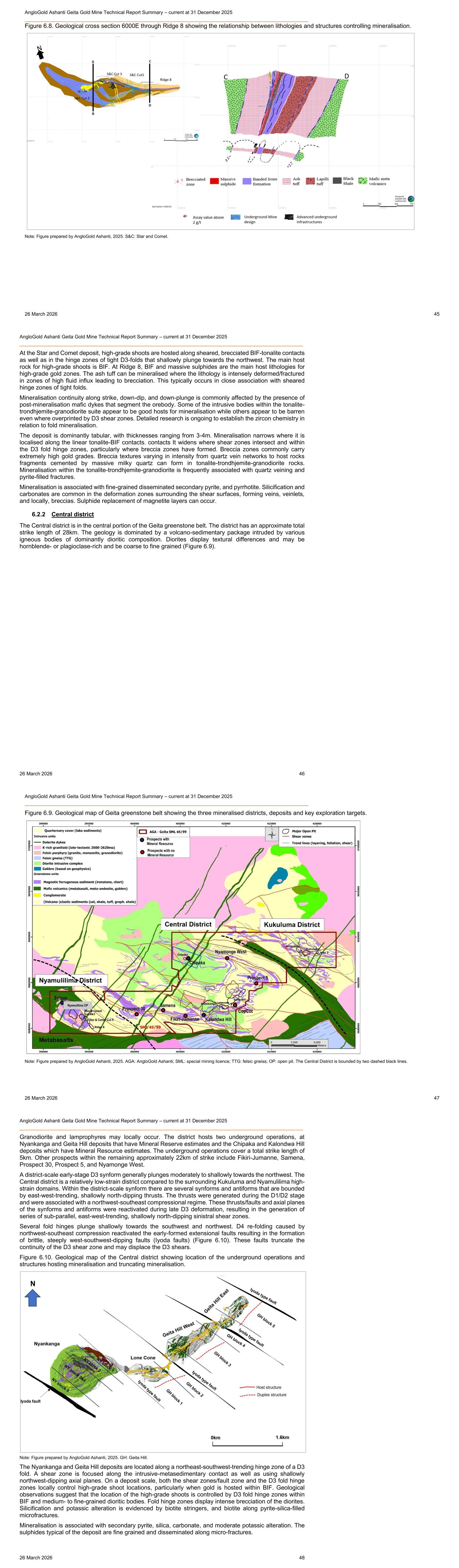
AngloGold Ashanti Geita Gold Mine Technical Report Summary – current at 31 December 2025 _____________________________________________________________________________________ 26 March 2026 45 Figure 6.8. Geological cross section 6000E through Ridge 8 showing the relationship between lithologies and structures controlling mineralisation. Note: Figure prepared by AngloGold Ashanti, 2025. S&C: Star and Comet. AngloGold Ashanti Geita Gold Mine Technical Report Summary – current at 31 December 2025 _____________________________________________________________________________________ 26 March 2026 46 At the Star and Comet deposit, high-grade shoots are hosted along sheared, brecciated BIF-tonalite contacts as well as in the hinge zones of tight D3-folds that shallowly plunge towards the northwest. The main host rock for high-grade shoots is BIF. At Ridge 8, BIF and massive sulphides are the main host lithologies for high-grade gold zones. The ash tuff can be mineralised where the lithology is intensely deformed/fractured in zones of high fluid influx leading to brecciation. This typically occurs in close association with sheared hinge zones of tight folds. Mineralisation continuity along strike, down-dip, and down-plunge is commonly affected by the presence of post-mineralisation mafic dykes that segment the orebody. Some of the intrusive bodies within the tonalite- trondhjemite-granodiorite suite appear to be good hosts for mineralisation while others appear to be barren even where overprinted by D3 shear zones. Detailed research is ongoing to establish the zircon chemistry in relation to fold mineralisation. The deposit is dominantly tabular, with thicknesses ranging from 3-4m. Mineralisation narrows where it is localised along the linear tonalite-BIF contacts. contacts It widens where shear zones intersect and within the D3 fold hinge zones, particularly where breccia zones have formed. Breccia zones commonly carry extremely high gold grades. Breccia textures varying in intensity from quartz vein networks to host rocks fragments cemented by massive milky quartz can form in tonalite-trondhjemite-granodiorite rocks. Mineralisation within the tonalite-trondhjemite-granodiorite is frequently associated with quartz veining and pyrite-filled fractures. Mineralisation is associated with fine-grained disseminated secondary pyrite, and pyrrhotite. Silicification and carbonates are common in the deformation zones surrounding the shear surfaces, forming veins, veinlets, and locally, breccias. Sulphide replacement of magnetite layers can occur. 6.2.2 Central district The Central district is in the central portion of the Geita greenstone belt. The district has an approximate total strike length of 28km. The geology is dominated by a volcano-sedimentary package intruded by various igneous bodies of dominantly dioritic composition. Diorites display textural differences and may be hornblende- or plagioclase-rich and be coarse to fine grained (Figure 6.9). AngloGold Ashanti Geita Gold Mine Technical Report Summary – current at 31 December 2025 _____________________________________________________________________________________ 26 March 2026 47 Figure 6.9. Geological map of Geita greenstone belt showing the three mineralised districts, deposits and key exploration targets. Note: Figure prepared by AngloGold Ashanti, 2025. AGA: AngloGold Ashanti; SML: special mining licence; TTG: felsic gneiss; OP: open pit. The Central District is bounded by two dashed black lines. AngloGold Ashanti Geita Gold Mine Technical Report Summary – current at 31 December 2025 _____________________________________________________________________________________ 26 March 2026 48 Granodiorite and lamprophyres may locally occur. The district hosts two underground operations, at Nyankanga and Geita Hill deposits that have Mineral Reserve estimates and the Chipaka and Kalondwa Hill deposits which have Mineral Resource estimates. The underground operations cover a total strike length of 5km. Other prospects within the remaining approximately 22km of strike include Fikiri-Jumanne, Samena, Prospect 30, Prospect 5, and Nyamonge West. A district-scale early-stage D3 synform generally plunges moderately to shallowly towards the northwest. The Central district is a relatively low-strain district compared to the surrounding Kukuluma and Nyamulilima high- strain domains. Within the district-scale synform there are several synforms and antiforms that are bounded by east-west-trending, shallowly north-dipping thrusts. The thrusts were generated during the D1/D2 stage and were associated with a northwest-southeast compressional regime. These thrusts/faults and axial planes of the synforms and antiforms were reactivated during late D3 deformation, resulting in the generation of series of sub-parallel, east-west-trending, shallowly north-dipping sinistral shear zones. Several fold hinges plunge shallowly towards the southwest and northwest. D4 re-folding caused by northwest-southeast compression reactivated the early-formed extensional faults resulting in the formation of brittle, steeply west-southwest-dipping faults (Iyoda faults) (Figure 6.10). These faults truncate the continuity of the D3 shear zone and may displace the D3 shears. Figure 6.10. Geological map of the Central district showing location of the underground operations and structures hosting mineralisation and truncating mineralisation. Note: Figure prepared by AngloGold Ashanti, 2025. GH: Geita Hill. The Nyankanga and Geita Hill deposits are located along a northeast-southwest-trending hinge zone of a D3 fold. A shear zone is focused along the intrusive-metasedimentary contact as well as using shallowly northwest-dipping axial planes. On a deposit scale, both the shear zones/fault zone and the D3 fold hinge zones locally control high-grade shoot locations, particularly when gold is hosted within BIF. Geological observations suggest that the location of the high-grade shoots is controlled by D3 fold hinge zones within BIF and medium- to fine-grained dioritic bodies. Fold hinge zones display intense brecciation of the diorites. Silicification and potassic alteration is evidenced by biotite stringers, and biotite along pyrite-silica-filled microfractures. Mineralisation is associated with secondary pyrite, silica, carbonate, and moderate potassic alteration. The sulphides typical of the deposit are fine grained and disseminated along micro-fractures.
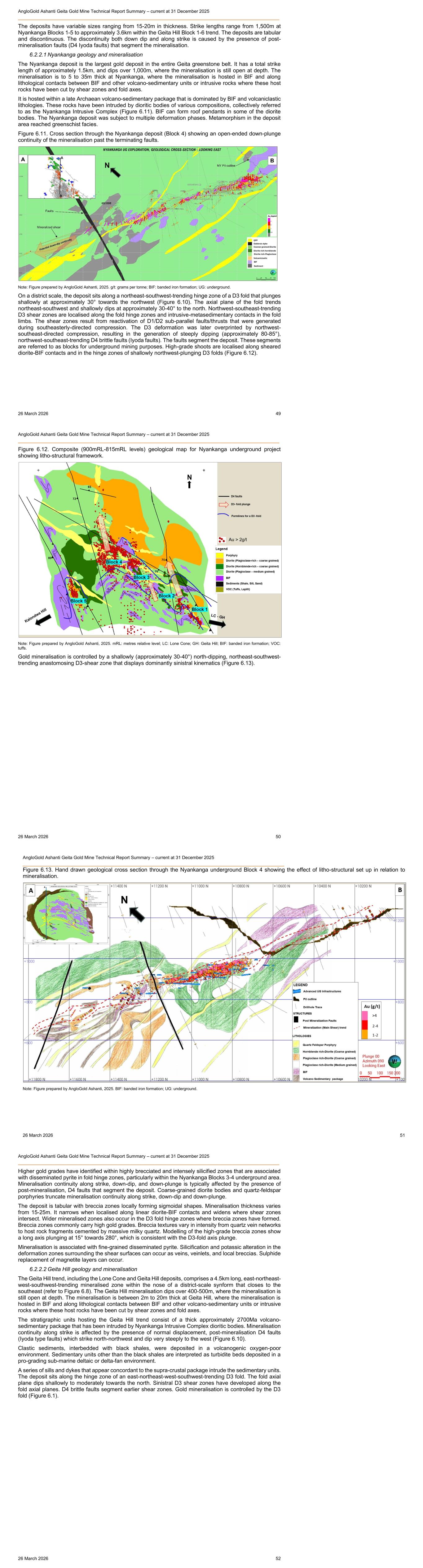
AngloGold Ashanti Geita Gold Mine Technical Report Summary – current at 31 December 2025 _____________________________________________________________________________________ 26 March 2026 49 The deposits have variable sizes ranging from 15-20m in thickness. Strike lengths range from 1,500m at Nyankanga Blocks 1-5 to approximately 3.6km within the Geita Hill Block 1-6 trend. The deposits are tabular and discontinuous. The discontinuity both down dip and along strike is caused by the presence of post- mineralisation faults (D4 Iyoda faults) that segment the mineralisation. 6.2.2.1 Nyankanga geology and mineralisation The Nyankanga deposit is the largest gold deposit in the entire Geita greenstone belt. It has a total strike length of approximately 1.5km, and dips over 1,000m, where the mineralisation is still open at depth. The mineralisation is to 5 to 35m thick at Nyankanga, where the mineralisation is hosted in BIF and along lithological contacts between BIF and other volcano-sedimentary units or intrusive rocks where these host rocks have been cut by shear zones and fold axes. It is hosted within a late Archaean volcano-sedimentary package that is dominated by BIF and volcaniclastic lithologies. These rocks have been intruded by dioritic bodies of various compositions, collectively referred to as the Nyankanga Intrusive Complex (Figure 6.11). BIF can form roof pendants in some of the diorite bodies. The Nyankanga deposit was subject to multiple deformation phases. Metamorphism in the deposit area reached greenschist facies. Figure 6.11. Cross section through the Nyankanga deposit (Block 4) showing an open-ended down-plunge continuity of the mineralisation past the terminating faults. Note: Figure prepared by AngloGold Ashanti, 2025. g/t: grams per tonne; BIF: banded iron formation; UG: underground. On a district scale, the deposit sits along a northeast-southwest-trending hinge zone of a D3 fold that plunges shallowly at approximately 30° towards the northwest (Figure 6.10). The axial plane of the fold trends northeast-southwest and shallowly dips at approximately 30-40° to the north. Northwest-southeast-trending D3 shear zones are localised along the fold hinge zones and intrusive-metasedimentary contacts in the fold limbs. The shear zones result from reactivation of D1/D2 sub-parallel faults/thrusts that were generated during southeasterly-directed compression. The D3 deformation was later overprinted by northwest- southeast-directed compression, resulting in the generation of steeply dipping (approximately 80-85°), northwest-southeast-trending D4 brittle faults (Iyoda faults). The faults segment the deposit. These segments are referred to as blocks for underground mining purposes. High-grade shoots are localised along sheared diorite-BIF contacts and in the hinge zones of shallowly northwest-plunging D3 folds (Figure 6.12). AngloGold Ashanti Geita Gold Mine Technical Report Summary – current at 31 December 2025 _____________________________________________________________________________________ 26 March 2026 50 Figure 6.12. Composite (900mRL-815mRL levels) geological map for Nyankanga underground project showing litho-structural framework. Note: Figure prepared by AngloGold Ashanti, 2025. mRL: metres relative level; LC: Lone Cone; GH: Geita Hill; BIF: banded iron formation; VOC: tuffs. Gold mineralisation is controlled by a shallowly (approximately 30-40°) north-dipping, northeast-southwest- trending anastomosing D3-shear zone that displays dominantly sinistral kinematics (Figure 6.13). AngloGold Ashanti Geita Gold Mine Technical Report Summary – current at 31 December 2025 _____________________________________________________________________________________ 26 March 2026 51 Figure 6.13. Hand drawn geological cross section through the Nyankanga underground Block 4 showing the effect of litho-structural set up in relation to mineralisation. Note: Figure prepared by AngloGold Ashanti, 2025. BIF: banded iron formation; UG: underground. AngloGold Ashanti Geita Gold Mine Technical Report Summary – current at 31 December 2025 _____________________________________________________________________________________ 26 March 2026 52 Higher gold grades have identified within highly brecciated and intensely silicified zones that are associated with disseminated pyrite in fold hinge zones, particularly within the Nyankanga Blocks 3-4 underground area. Mineralisation continuity along strike, down-dip, and down-plunge is typically affected by the presence of post-mineralisation, D4 faults that segment the deposit. Coarse-grained diorite bodies and quartz-feldspar porphyries truncate mineralisation continuity along strike, down-dip and down-plunge. The deposit is tabular with breccia zones locally forming sigmoidal shapes. Mineralisation thickness varies from 15-25m. It narrows when localised along linear diorite-BIF contacts and widens where shear zones intersect. Wider mineralised zones also occur in the D3 fold hinge zones where breccia zones have formed. Breccia zones commonly carry high gold grades. Breccia textures vary in intensity from quartz vein networks to host rock fragments cemented by massive milky quartz. Modelling of the high-grade breccia zones show a long axis plunging at 15° towards 280°, which is consistent with the D3-fold axis plunge. Mineralisation is associated with fine-grained disseminated pyrite. Silicification and potassic alteration in the deformation zones surrounding the shear surfaces can occur as veins, veinlets, and local breccias. Sulphide replacement of magnetite layers can occur. 6.2.2.2 Geita Hill geology and mineralisation The Geita Hill trend, including the Lone Cone and Geita Hill deposits, comprises a 4.5km long, east-northeast- west-southwest-trending mineralised zone within the nose of a district-scale synform that closes to the southeast (refer to Figure 6.8). The Geita Hill mineralisation dips over 400-500m, where the mineralisation is still open at depth. The mineralisation is between 2m to 20m thick at Geita Hill, where the mineralisation is hosted in BIF and along lithological contacts between BIF and other volcano-sedimentary units or intrusive rocks where these host rocks have been cut by shear zones and fold axes. The stratigraphic units hosting the Geita Hill trend consist of a thick approximately 2700Ma volcano- sedimentary package that has been intruded by Nyankanga Intrusive Complex dioritic bodies. Mineralisation continuity along strike is affected by the presence of normal displacement, post-mineralisation D4 faults (Iyoda type faults) which strike north-northwest and dip very steeply to the west (Figure 6.10). Clastic sediments, interbedded with black shales, were deposited in a volcanogenic oxygen-poor environment. Sedimentary units other than the black shales are interpreted as turbidite beds deposited in a pro-grading sub-marine deltaic or delta-fan environment. A series of sills and dykes that appear concordant to the supra-crustal package intrude the sedimentary units. The deposit sits along the hinge zone of an east-northeast-west-southwest-trending D3 fold. The fold axial plane dips shallowly to moderately towards the north. Sinistral D3 shear zones have developed along the fold axial planes. D4 brittle faults segment earlier shear zones. Gold mineralisation is controlled by the D3 fold (Figure 6.1).

AngloGold Ashanti Geita Gold Mine Technical Report Summary – current at 31 December 2025 _____________________________________________________________________________________ 26 March 2026 53 Figure 6.14. Hand drawn geological cross section through Geita Hill underground Block 2 showing an open- ended down-dip mineralisation continuity along the shear plane. Note: Figure prepared by AngloGold Ashanti, 2025. BIF: banded iron formation; GHUG: Geita Hill underground. Higher-grade shoots occur within sheared diorite-BIF contacts, along shallowly (approximately 25-40°) northwest-plunging hinge zones of D3 folds, and in association with jogs, bends, and oversteps in the D3 sinistral shear zone (Figure 6.15). AngloGold Ashanti Geita Gold Mine Technical Report Summary – current at 31 December 2025 _____________________________________________________________________________________ 26 March 2026 54 Figure 6.15. Oblique view of the Geita Block 1 underground (Lone Cone deposit as open pits) showing litho- structural set and control for high-grade shoot. Note: Figure prepared by AngloGold Ashanti, 2025. UG: underground; mRL: metres relative level; NYUG: Nyankanga underground; BLK: block. The deposit is dominantly tabular. Locally, breccia zones can form sigmoidal shapes. Mineralisation thickness varies from 15-20m. Mineralisation narrows when is localised along linear diorite-BIF contacts and widens at shear zone intersections, and where breccia zones have formed in D3 fold hinge zones. Breccia zones and deformational damage zones can carry extremely high gold grades. Breccia textures vary in intensity from quartz vein networks to host rock fragments cemented by massive milky quartz. Mineralisation is associated with fine-grained disseminated pyrite. Silicification and potassic alteration in the deformation zones surrounding the shear surfaces occurs as veins, veinlets, and local breccias. Sulphide replacement of magnetite layers can occur. 6.2.2.3 Kalondwa Hill geology and mineralisation The Kalondwa Hill deposit is located immediately southwest of the Nyankanga deposit, in a fault corridor called the Iyoda fault zone, which is also intruded by the Nyankanga Intrusive Complex. The Kalondwa Hill deposit covers a total strike length of approximately 800m. The mineralisation is hosted in mineralised shears between 5m and 15m thick. The mineralisation dips steeply over 400m and is still open at depth. In the deposit area, a volcano-sedimentary package has been intruded by dioritic bodies with compositions similar those within the Nyankanga Intrusive Complex. The entire rock mass was subjected to greenschist facies metamorphism evidenced by the presence of actinolite, tremolite and epidote preserved within the supracrustal rocks. The deposit is hosted in the limbs of re-folded D3 folds, which have been segmented by D4 brittle faults (Iyoda fault zone) into a northern and southern domain (Figure 6.16). D3 shear zones are preferentially developed along northwest striking moderately-steeply southwest dipping D3 fold axial planes in the northern domain, developing along diorite-BIF contacts. An overturned antiform is intruded by dioritic bodies. AngloGold Ashanti Geita Gold Mine Technical Report Summary – current at 31 December 2025 _____________________________________________________________________________________ 26 March 2026 55 Figure 6.16: Kalondwa Hill 3D modelled orebody next to Nyankanga pit. Note: Figure prepared by AngloGold Ashanti, 2025. In the southern domain, D3 shear zones are developed along northeast-striking moderately- to steeply dipping northwest D3 axial planes. The southern domain shows a dominance of supracrustal rocks with only minor dioritic apophyses. Gold mineralisation is hosted along the sheared diorite-BIF and BIF-volcaniclastic lithology contact within the D3 fold limbs and fold hinge zone. The mineralisation varies in thickness from 5-15m. Breccia zones can occur within fold hinges and may be associated with higher-grade shoots. Mineralisation is associated with fine-grained disseminated pyrite. Silicification in the deformation zones surrounding the shear surfaces consists of veins, veinlets, and local breccias. Sulphide replacement of magnetite layers can occur. 6.2.2.4 Chipaka geology and mineralisation The Chipaka deposit is located approximately 5km northwest of the Nyankanga deposit, and the prospect strikes northwest-southeast over approximately 3km. The deposit lithologies consist of a volcano- sedimentary package intruded by dioritic bodies that have a similar composition like the rocks of the Nyankanga Intrusive Complex (Figure 6.17). AngloGold Ashanti Geita Gold Mine Technical Report Summary – current at 31 December 2025 _____________________________________________________________________________________ 26 March 2026 56 Figure 6.17. Geological map of the Chipaka deposit showing litho-structural set and mineralisation. Note: Figure prepared by AngloGold Ashanti, 2025. Ppb: parts per billion; BIF: banded iron formation; VOC: tuff. The entire rock mass has been metamorphosed to greenschist facies, as evidenced by the presence of actinolite, tremolite and epidote preserved within the supracrustal rocks. The late Archaean rock package is cut by a northeast-southwest-trending Paleoproterozoic dyke of gabbroic composition. The deposit sits along the hinge zone of an overturned northwest-southeast trending D3 antiform intruded by the dioritic body (Figure 6.18). Figure 6.18. Geological cross of the Chipaka deposit showing spatial distribution of rocks, structures, and controls for mineralisation. Note: Figure prepared by AngloGold Ashanti, 2025. Section looks west. Ppm: parts per million. D3 shear zones preferentially developed along diorite-BIF contacts along the limbs of D3 folds. The southern fold limb dips shallowly at approximately 35° towards south. The northern limb is relatively steeper, at approximately 70°, dipping towards the north. The fold hinge zone plunges shallowly at approximately 30°
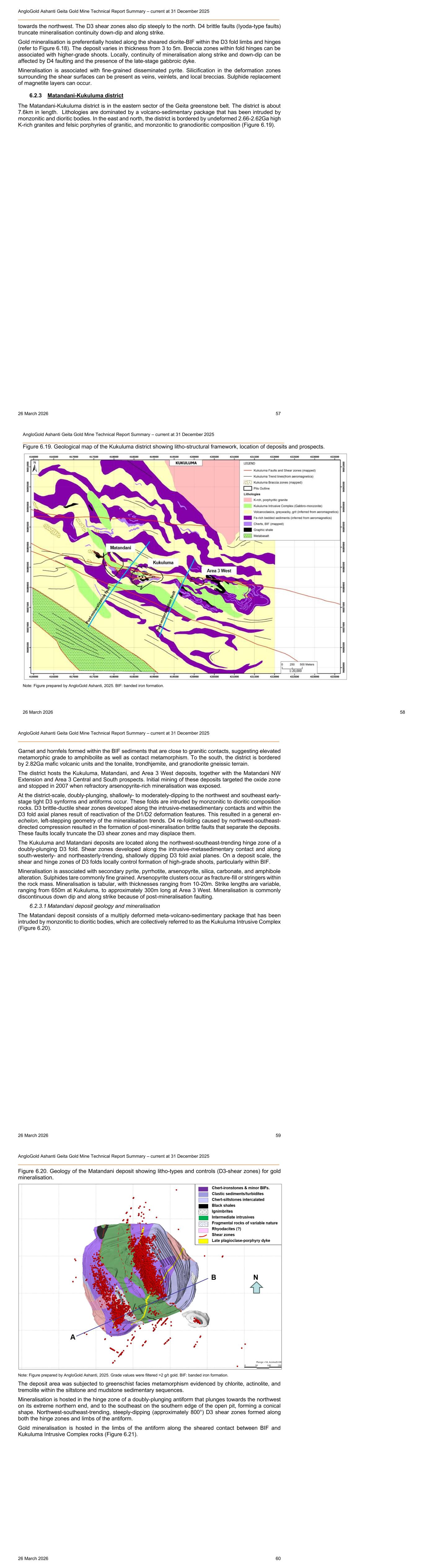
AngloGold Ashanti Geita Gold Mine Technical Report Summary – current at 31 December 2025 _____________________________________________________________________________________ 26 March 2026 57 towards the northwest. The D3 shear zones also dip steeply to the north. D4 brittle faults (Iyoda-type faults) truncate mineralisation continuity down-dip and along strike. Gold mineralisation is preferentially hosted along the sheared diorite-BIF within the D3 fold limbs and hinges (refer to Figure 6.18). The deposit varies in thickness from 3 to 5m. Breccia zones within fold hinges can be associated with higher-grade shoots. Locally, continuity of mineralisation along strike and down-dip can be affected by D4 faulting and the presence of the late-stage gabbroic dyke. Mineralisation is associated with fine-grained disseminated pyrite. Silicification in the deformation zones surrounding the shear surfaces can be present as veins, veinlets, and local breccias. Sulphide replacement of magnetite layers can occur. 6.2.3 Matandani-Kukuluma district The Matandani-Kukuluma district is in the eastern sector of the Geita greenstone belt. The district is about 7.6km in length. Lithologies are dominated by a volcano-sedimentary package that has been intruded by monzonitic and dioritic bodies. In the east and north, the district is bordered by undeformed 2.66-2.62Ga high K-rich granites and felsic porphyries of granitic, and monzonitic to granodioritic composition (Figure 6.19). AngloGold Ashanti Geita Gold Mine Technical Report Summary – current at 31 December 2025 _____________________________________________________________________________________ 26 March 2026 58 Figure 6.19. Geological map of the Kukuluma district showing litho-structural framework, location of deposits and prospects. Note: Figure prepared by AngloGold Ashanti, 2025. BIF: banded iron formation. AngloGold Ashanti Geita Gold Mine Technical Report Summary – current at 31 December 2025 _____________________________________________________________________________________ 26 March 2026 59 Garnet and hornfels formed within the BIF sediments that are close to granitic contacts, suggesting elevated metamorphic grade to amphibolite as well as contact metamorphism. To the south, the district is bordered by 2.82Ga mafic volcanic units and the tonalite, trondhjemite, and granodiorite gneissic terrain. The district hosts the Kukuluma, Matandani, and Area 3 West deposits, together with the Matandani NW Extension and Area 3 Central and South prospects. Initial mining of these deposits targeted the oxide zone and stopped in 2007 when refractory arsenopyrite-rich mineralisation was exposed. At the district-scale, doubly-plunging, shallowly- to moderately-dipping to the northwest and southeast early- stage tight D3 synforms and antiforms occur. These folds are intruded by monzonitic to dioritic composition rocks. D3 brittle-ductile shear zones developed along the intrusive-metasedimentary contacts and within the D3 fold axial planes result of reactivation of the D1/D2 deformation features. This resulted in a general en- echelon, left-stepping geometry of the mineralisation trends. D4 re-folding caused by northwest-southeast- directed compression resulted in the formation of post-mineralisation brittle faults that separate the deposits. These faults locally truncate the D3 shear zones and may displace them. The Kukuluma and Matandani deposits are located along the northwest-southeast-trending hinge zone of a doubly-plunging D3 fold. Shear zones developed along the intrusive-metasedimentary contact and along south-westerly- and northeasterly-trending, shallowly dipping D3 fold axial planes. On a deposit scale, the shear and hinge zones of D3 folds locally control formation of high-grade shoots, particularly within BIF. Mineralisation is associated with secondary pyrite, pyrrhotite, arsenopyrite, silica, carbonate, and amphibole alteration. Sulphides tare commonly fine grained. Arsenopyrite clusters occur as fracture-fill or stringers within the rock mass. Mineralisation is tabular, with thicknesses ranging from 10-20m. Strike lengths are variable, ranging from 650m at Kukuluma, to approximately 300m long at Area 3 West. Mineralisation is commonly discontinuous down dip and along strike because of post-mineralisation faulting. 6.2.3.1 Matandani deposit geology and mineralisation The Matandani deposit consists of a multiply deformed meta-volcano-sedimentary package that has been intruded by monzonitic to dioritic bodies, which are collectively referred to as the Kukuluma Intrusive Complex (Figure 6.20). AngloGold Ashanti Geita Gold Mine Technical Report Summary – current at 31 December 2025 _____________________________________________________________________________________ 26 March 2026 60 Figure 6.20. Geology of the Matandani deposit showing litho-types and controls (D3-shear zones) for gold mineralisation. Note: Figure prepared by AngloGold Ashanti, 2025. Grade values were filtered >2 g/t gold. BIF: banded iron formation. The deposit area was subjected to greenschist facies metamorphism evidenced by chlorite, actinolite, and tremolite within the siltstone and mudstone sedimentary sequences. Mineralisation is hosted in the hinge zone of a doubly-plunging antiform that plunges towards the northwest on its extreme northern end, and to the southeast on the southern edge of the open pit, forming a conical shape. Northwest-southeast-trending, steeply-dipping (approximately 800°) D3 shear zones formed along both the hinge zones and limbs of the antiform. Gold mineralisation is hosted in the limbs of the antiform along the sheared contact between BIF and Kukuluma Intrusive Complex rocks (Figure 6.21).

AngloGold Ashanti Geita Gold Mine Technical Report Summary – current at 31 December 2025 _____________________________________________________________________________________ 26 March 2026 61 Figure 6.21. Geological cross section 21550E through Matandani deposit showing litho-structural set up and controls on gold mineralisation (view looking north-northwest). Note: Figure prepared by AngloGold Ashanti, 2025. BIF: banded iron formation. The deposit is tabular, and mineralisation thicknesses range from 10-30m. Thicker mineralised zones occur within bends in the BIF. There is limited post-mineralisation faulting, so mineralisation is relatively continuous down dip and along strike. A highly silicified zone can be associated with partial to complete replacement of magnetite to pyrrhotite. Fine-grained arsenopyrite clusters can occur along micro-fractures as well as in the matrix of the BIF. Locally, high-grade zones are spatially associated with the hinge zone of the non-cylindrical D3 folds within the BIF. The higher-grade portions of the deposit appear to be shallower in the central deposit area, trending to deeper levels to the northwestern and southeastern deposit edges. The western deposit area has relatively lower grades compared to the eastern, which may be due to variability in rock assemblages within the limbs. The eastern limb is dominated by BIF, which is some places is interbedded with volcaniclastic (ignimbrites) rocks. The western limb consists of a breccia zone that consists of highly silicified black shales with pyrite nodules, volcaniclastic lithologies, and BIF, which makes it less favourable for gold precipitation. The main alteration types are silicification and sulphidation, with carbonate and amphibole being observed. 6.2.3.2 Kukuluma deposit geology and mineralisation The Kukuluma deposit area consists of a multiply deformed meta-volcano-sedimentary package that is intruded by the Kukuluma Intrusive Complex (Figure 6.22). AngloGold Ashanti Geita Gold Mine Technical Report Summary – current at 31 December 2025 _____________________________________________________________________________________ 26 March 2026 62 Figure 6.22. Geological map of the Kukuluma deposit showing litho-structural set up. Note: Figure prepared by AngloGold Ashanti, 2025. BIF: banded iron formation. The Kukuluma deposit area has a significant of shale content. There is an almost complete change of stratigraphy between the western and eastern deposit edges. The eastern part is dominated by volcaniclastics (Ignimbrites) rocks interbedded by BIF. The western deposit area is dominated by turbiditic sequences. The deposit has been subjected to greenschist facies metamorphism. The deposit has developed along a north-westerly-plunging antiform hinge zone. The antiform is conical in shape, with the two limbs dipping steeply at approximately 80° to the southwest and northeast. Northwest- southeast-trending D3 shear zones preferentially developed along the fold hinge zone and limbs. Mineralisation is hosted in antiform limbs along the sheared contact between BIF and the Kukuluma Intrusive Complex lithologies (Figure 6.23). AngloGold Ashanti Geita Gold Mine Technical Report Summary – current at 31 December 2025 _____________________________________________________________________________________ 26 March 2026 63 Figure 6.23. Geological cross section 21000E through Kukuluma showing litho-structural set up and controls for gold mineralisation. Note: Figure prepared by AngloGold Ashanti, 2025. Grade values > g/t gold. Mineralisation is tabular, with thicknesses ranging from 5-10m. There is limited post-mineralisation faulting, so mineralisation is relatively continuous down dip and along strike. A highly silicified zone can be associated with partial to complete replacement of magnetite to pyrrhotite. Fine-grained arsenopyrite clusters occur along micro-fractures as well as in the BIF matrix. Higher-grade zones are spatially associated BIF within the D3 fold hinge zone. Mineralisation on the western limb is lower grade than on the eastern limb, possibly due to lithology variations. The eastern limb is dominated by BIF, which is some places is interbedded with volcaniclastic (ignimbrite) rocks. The western limb consists of a breccia zone that consists of highly silicified black shales with pyrite nodules, volcaniclastic lithologies, and BIF, which makes it less favourable for gold precipitation. The main alteration types are silicification and sulphidation, with carbonate and amphibole being observed. The intensity of the alteration is relatively low at Kukuluma compared to Matandani and may reflect the lower grade and mineralisation thicknesses. 6.2.3.3 Area 3 West deposit geology and mineralisation The Area 3 West deposit is located at the southeastern extent of the Kukuluma district. Lithologies consist of a multiply deformed meta-volcano-sedimentary package that has been intruded by rocks of the Kukuluma Intrusive Complex. The deposit area has been subjected to greenschist facies metamorphism. The deposit sits along the hinge zone of a semi-district scale synform that plunges shallowly towards the northwest (Figure 6.24). AngloGold Ashanti Geita Gold Mine Technical Report Summary – current at 31 December 2025 _____________________________________________________________________________________ 26 March 2026 64 Figure 6.24. Geological cross section through Area 3 West deposit showing litho-types, structures, and mineralisation. Note: Figure prepared by AngloGold Ashanti, 2025. Northwest-southeast-trending, steeply (approximately 80°) southwest-dipping shear zones have developed within the synform hinges. The shears are preferentially located along intrusive-metasedimentary contacts and form an intensely brecciated zone. Mineralisation is tabular, with thicknesses ranging from 10-15m. There is limited post-mineralisation faulting, so mineralisation is relatively continuous down dip and along strike. A highly silicified zone can be associated with partial to complete replacement of magnetite to pyrrhotite. Fine-grained arsenopyrite clusters occur along micro-fractures as well as in the BIF matrix. The main alteration types are silicification and sulphidation, with carbonate and amphibole being observed. 6.3 Deposit types The Geita mine gold deposit(s) are considered examples of orogenic gold deposit(s). Orogenic gold deposits are typically located within Archean greenstone belts, with age of formation in the Neoarchean (2.8 to 2.5Ga) geological time. Typical characteristics of orogenic gold deposits include formation in subduction-related orogenic belts. Common lithologies associated with orogenic gold deposits are volcaniclastic sediments, BIF, and metasedimentary host rocks with granitoids, diorite intrusive rocks, lamprophyres and felsic porphyry dykes. Alteration typically observed in orogenic gold deposits includes hydrothermal alteration, involving the chemical alteration of rocks by hot, mineral-laden fluids, with common alteration minerals including sericite, chlorite, and silicification, and often associated with gold mineralisation, silicification: where silica rich fluids are released into the rock, often resulting in the formation of quartz veins, and often associated with gold mineralisation and carbonate alteration: where carbonate-rich fluids are released into the rock, often resulting in the formation of carbonate veins, and associated with gold mineralisation. Orogenic gold deposits typically form during multiple deformation phases, often referred to as D1, D2, D3, etc. Each phase involves different types of stress and structural changes in the crust, with shear zones.
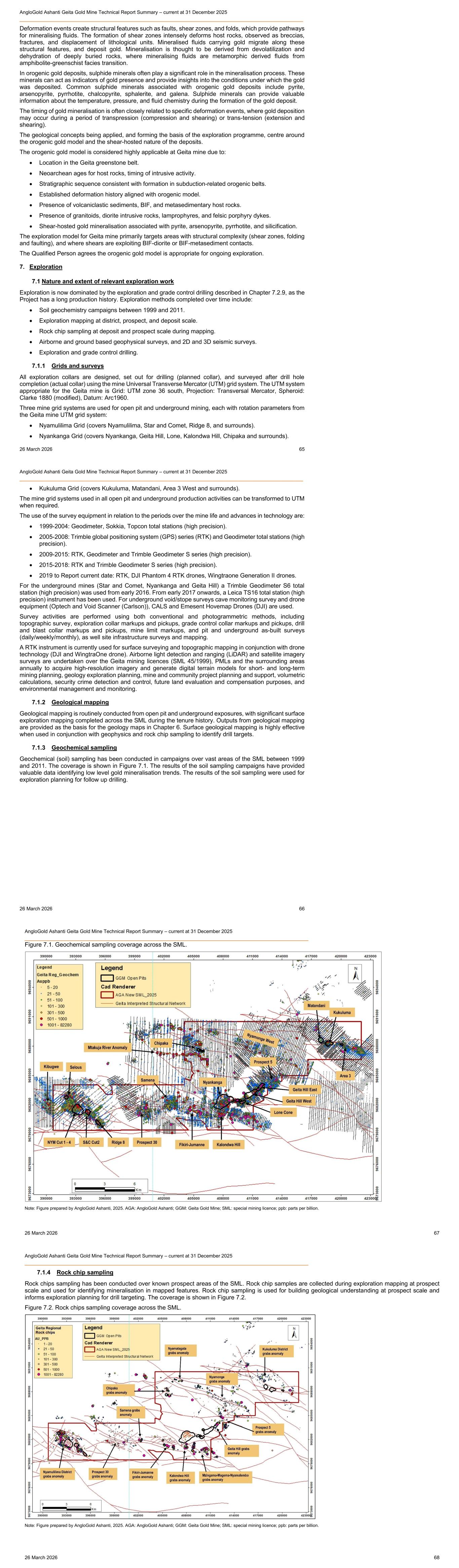
AngloGold Ashanti Geita Gold Mine Technical Report Summary – current at 31 December 2025 _____________________________________________________________________________________ 26 March 2026 65 Deformation events create structural features such as faults, shear zones, and folds, which provide pathways for mineralising fluids. The formation of shear zones intensely deforms host rocks, observed as breccias, fractures, and displacement of lithological units. Mineralised fluids carrying gold migrate along these structural features, and deposit gold. Mineralisation is thought to be derived from devolatilization and dehydration of deeply buried rocks, where mineralising fluids are metamorphic derived fluids from amphibolite-greenschist facies transition. In orogenic gold deposits, sulphide minerals often play a significant role in the mineralisation process. These minerals can act as indicators of gold presence and provide insights into the conditions under which the gold was deposited. Common sulphide minerals associated with orogenic gold deposits include pyrite, arsenopyrite, pyrrhotite, chalcopyrite, sphalerite, and galena. Sulphide minerals can provide valuable information about the temperature, pressure, and fluid chemistry during the formation of the gold deposit. The timing of gold mineralisation is often closely related to specific deformation events, where gold deposition may occur during a period of transpression (compression and shearing) or trans-tension (extension and shearing). The geological concepts being applied, and forming the basis of the exploration programme, centre around the orogenic gold model and the shear-hosted nature of the deposits. The orogenic gold model is considered highly applicable at Geita mine due to: • Location in the Geita greenstone belt. • Neoarchean ages for host rocks, timing of intrusive activity. • Stratigraphic sequence consistent with formation in subduction-related orogenic belts. • Established deformation history aligned with orogenic model. • Presence of volcaniclastic sediments, BIF, and metasedimentary host rocks. • Presence of granitoids, diorite intrusive rocks, lamprophyres, and felsic porphyry dykes. • Shear-hosted gold mineralisation associated with pyrite, arsenopyrite, pyrrhotite, and silicification. The exploration model for Geita mine primarily targets areas with structural complexity (shear zones, folding and faulting), and where shears are exploiting BIF-diorite or BIF-metasediment contacts. The Qualified Person agrees the orogenic gold model is appropriate for ongoing exploration. 7. Exploration 7.1 Nature and extent of relevant exploration work Exploration is now dominated by the exploration and grade control drilling described in Chapter 7.2.9, as the Project has a long production history. Exploration methods completed over time include: • Soil geochemistry campaigns between 1999 and 2011. • Exploration mapping at district, prospect, and deposit scale. • Rock chip sampling at deposit and prospect scale during mapping. • Airborne and ground based geophysical surveys, and 2D and 3D seismic surveys. • Exploration and grade control drilling. 7.1.1 Grids and surveys All exploration collars are designed, set out for drilling (planned collar), and surveyed after drill hole completion (actual collar) using the mine Universal Transverse Mercator (UTM) grid system. The UTM system appropriate for the Geita mine is Grid: UTM zone 36 south, Projection: Transversal Mercator, Spheroid: Clarke 1880 (modified), Datum: Arc1960. Three mine grid systems are used for open pit and underground mining, each with rotation parameters from the Geita mine UTM grid system: • Nyamulilima Grid (covers Nyamulilima, Star and Comet, Ridge 8, and surrounds). • Nyankanga Grid (covers Nyankanga, Geita Hill, Lone, Kalondwa Hill, Chipaka and surrounds). AngloGold Ashanti Geita Gold Mine Technical Report Summary – current at 31 December 2025 _____________________________________________________________________________________ 26 March 2026 66 • Kukuluma Grid (covers Kukuluma, Matandani, Area 3 West and surrounds). The mine grid systems used in all open pit and underground production activities can be transformed to UTM when required. The use of the survey equipment in relation to the periods over the mine life and advances in technology are: • 1999-2004: Geodimeter, Sokkia, Topcon total stations (high precision). • 2005-2008: Trimble global positioning system (GPS) series (RTK) and Geodimeter total stations (high precision). • 2009-2015: RTK, Geodimeter and Trimble Geodimeter S series (high precision). • 2015-2018: RTK and Trimble Geodimeter S series (high precision). • 2019 to Report current date: RTK, DJI Phantom 4 RTK drones, Wingtraone Generation II drones. For the underground mines (Star and Comet, Nyankanga and Geita Hill) a Trimble Geodimeter S6 total station (high precision) was used from early 2016. From early 2017 onwards, a Leica TS16 total station (high precision) instrument has been used. For underground void/stope surveys cave monitoring survey and drone equipment (Optech and Void Scanner (Carlson)), CALS and Emesent Hovemap Drones (DJI) are used. Survey activities are performed using both conventional and photogrammetric methods, including topographic survey, exploration collar markups and pickups, grade control collar markups and pickups, drill and blast collar markups and pickups, mine limit markups, and pit and underground as-built surveys (daily/weekly/monthly), as well site infrastructure surveys and mapping. A RTK instrument is currently used for surface surveying and topographic mapping in conjunction with drone technology (DJI and WingtraOne drone). Airborne light detection and ranging (LiDAR) and satellite imagery surveys are undertaken over the Geita mining licences (SML 45/1999), PMLs and the surrounding areas annually to acquire high-resolution imagery and generate digital terrain models for short- and long-term mining planning, geology exploration planning, mine and community project planning and support, volumetric calculations, security crime detection and control, future land evaluation and compensation purposes, and environmental management and monitoring. 7.1.2 Geological mapping Geological mapping is routinely conducted from open pit and underground exposures, with significant surface exploration mapping completed across the SML during the tenure history. Outputs from geological mapping are provided as the basis for the geology maps in Chapter 6. Surface geological mapping is highly effective when used in conjunction with geophysics and rock chip sampling to identify drill targets. 7.1.3 Geochemical sampling Geochemical (soil) sampling has been conducted in campaigns over vast areas of the SML between 1999 and 2011. The coverage is shown in Figure 7.1. The results of the soil sampling campaigns have provided valuable data identifying low level gold mineralisation trends. The results of the soil sampling were used for exploration planning for follow up drilling. AngloGold Ashanti Geita Gold Mine Technical Report Summary – current at 31 December 2025 _____________________________________________________________________________________ 26 March 2026 67 Figure 7.1. Geochemical sampling coverage across the SML. Note: Figure prepared by AngloGold Ashanti, 2025. AGA: AngloGold Ashanti; GGM: Geita Gold Mine; SML: special mining licence; ppb: parts per billion. AngloGold Ashanti Geita Gold Mine Technical Report Summary – current at 31 December 2025 _____________________________________________________________________________________ 26 March 2026 68 7.1.4 Rock chip sampling Rock chips sampling has been conducted over known prospect areas of the SML. Rock chip samples are collected during exploration mapping at prospect scale and used for identifying mineralisation in mapped features. Rock chip sampling is used for building geological understanding at prospect scale and informs exploration planning for drill targeting. The coverage is shown in Figure 7.2. Figure 7.2. Rock chips sampling coverage across the SML. Note: Figure prepared by AngloGold Ashanti, 2025. AGA: AngloGold Ashanti; GGM: Geita Gold Mine; SML: special mining licence; ppb: parts per billion.

AngloGold Ashanti Geita Gold Mine Technical Report Summary – current at 31 December 2025 _____________________________________________________________________________________ 26 March 2026 69 7.1.5 Geophysical surveys A range of geophysical surveys were conducted between 1996 and 2016. A summary of the surveys is provided in the following subsections. The geophysical surveys are used extensively in generation of drill targets. 7.1.5.1 1996-2000 Geita mine detailed airborne magnetic surveys The area covered by the airborne magnetic survey is shown in Figure 7.3. Figure 7.3. 1996-2000 detailed airborne magnetic survey areas. Note: Figure prepared by AngloGold Ashanti, 2025. The 1996-2000 airborne magnetic survey conducted over the GGM licence provided the first pass regional geometry of the fold system and mafic dykes mapped by magnetic highs as well as major tenement scale breaks which were interpreted to be faults. 7.1.5.2 2003 High-resolution helicopter-borne airborne magnetic survey (MIDAS) The MIDAS survey covered the area from Kalondwa Hill to Fikiri-Jumanne, and the Prospect 5 - Nyamonge West trends (Figure 7.4.). AngloGold Ashanti Geita Gold Mine Technical Report Summary – current at 31 December 2025 _____________________________________________________________________________________ 26 March 2026 70 Figure 7.4. Detailed airborne magnetics surveys by helicopter across Central district. Note: Figure prepared by AngloGold Ashanti, 2025. SML: special mining licence; PL: prospecting licence. The survey used a horizontal line gradient, and nominal 25m line spacing (effective 18.5m). The survey produced exceptional data quality. The MIDAS data improved the resolution of the 1996-2000 low resolution magnetic data specifically in the area covering Central district. The clarity of the image (signals) improved significantly resulting into better delineation of the lithological units and breaks. In addition, topographic highs and lows were well established. 7.1.5.3 2006 and 2008 AeroTEM airborne electro-magnetic survey A time domain electromagnetic (TEM) survey using AeroTEM covered the areas shown in Figure 7.5. AngloGold Ashanti Geita Gold Mine Technical Report Summary – current at 31 December 2025 _____________________________________________________________________________________ 26 March 2026 71 Figure 7.5. 2006 and 2008 AeroTEM survey areas. Note: Figure prepared by AngloGold Ashanti, 2025. SML: special mining licence; PL: prospecting licence. The survey used an in-loop AeroTEM loop, at 125Hz, and a 75m line spacing. The estimated depth of investigation was limited to <200m. The AeroTEM survey results provided better understanding of the tenement scale distribution of lithological units which are conductive or conductive bodies. Conductive bodies may be potential hosts for gold mineralisation. 7.1.5.4 2008-2009 High resolution Xcalibur helicopter-borne magnetic and radiometric survey The area covered by the high resolution Xcalibur airborne magnetic and radiometric survey is shown in Figure 7.6. AngloGold Ashanti Geita Gold Mine Technical Report Summary – current at 31 December 2025 _____________________________________________________________________________________ 26 March 2026 72 Figure 7.6. 2008-2009 high resolution Xcalibur airborne magnetic and radiometric survey area. Note: Figure prepared by AngloGold Ashanti, 2025. SML: special mining licence; PL: prospecting licence. The survey used a horizontal gradient, with 25m line spacing (effective 18.5m), and 20m of ground clearance where possible. The survey was undertaken to support detailed mapping of BIF and intrusive units. The 2008-2009’s high resolution Xcalibur radiometric survey over the tenement improved delineation of lithological units which are radiometric high (Potential intermediate to felsic units) versus ones which are low. The high-resolution magnetic surveys provided detailed tenement scale magnetic signals compared to the 1996-2000`s survey. 7.1.5.5 2011 Kukuluma and Matandani audio-frequency magneto-telluric survey The area covered by the 2011 audio-frequency magneto-telluric survey is provided in Figure 7.7.
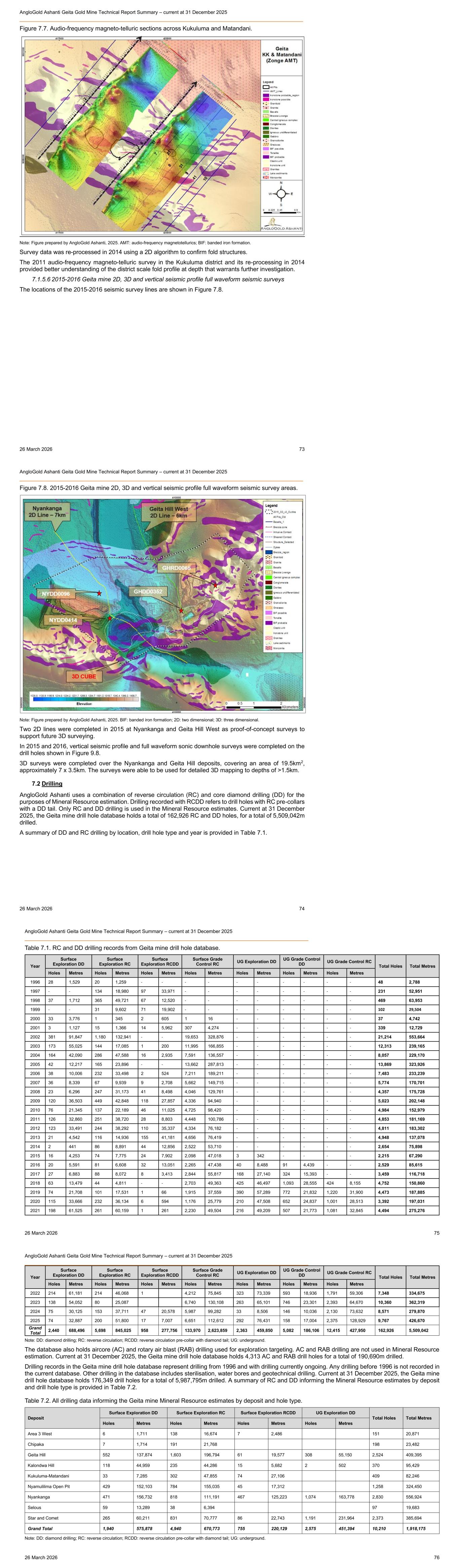
AngloGold Ashanti Geita Gold Mine Technical Report Summary – current at 31 December 2025 _____________________________________________________________________________________ 26 March 2026 73 Figure 7.7. Audio-frequency magneto-telluric sections across Kukuluma and Matandani. Note: Figure prepared by AngloGold Ashanti, 2025. AMT: audio-frequency magnetotellurics; BIF: banded iron formation. Survey data was re-processed in 2014 using a 2D algorithm to confirm fold structures. The 2011 audio-frequency magneto-telluric survey in the Kukuluma district and its re-processing in 2014 provided better understanding of the district scale fold profile at depth that warrants further investigation. 7.1.5.6 2015-2016 Geita mine 2D, 3D and vertical seismic profile full waveform seismic surveys The locations of the 2015-2016 seismic survey lines are shown in Figure 7.8. AngloGold Ashanti Geita Gold Mine Technical Report Summary – current at 31 December 2025 _____________________________________________________________________________________ 26 March 2026 74 Figure 7.8. 2015-2016 Geita mine 2D, 3D and vertical seismic profile full waveform seismic survey areas. Note: Figure prepared by AngloGold Ashanti, 2025. BIF: banded iron formation; 2D: two dimensional; 3D: three dimensional. Two 2D lines were completed in 2015 at Nyankanga and Geita Hill West as proof-of-concept surveys to support future 3D surveying. In 2015 and 2016, vertical seismic profile and full waveform sonic downhole surveys were completed on the drill holes shown in Figure 9.8. 3D surveys were completed over the Nyankanga and Geita Hill deposits, covering an area of 19.5km2, approximately 7 x 3.5km. The surveys were able to be used for detailed 3D mapping to depths of >1.5km. 7.2 Drilling AngloGold Ashanti uses a combination of reverse circulation (RC) and core diamond drilling (DD) for the purposes of Mineral Resource estimation. Drilling recorded with RCDD refers to drill holes with RC pre-collars with a DD tail. Only RC and DD drilling is used in the Mineral Resource estimates. Current at 31 December 2025, the Geita mine drill hole database holds a total of 162,926 RC and DD holes, for a total of 5,509,042m drilled. A summary of DD and RC drilling by location, drill hole type and year is provided in Table 7.1. AngloGold Ashanti Geita Gold Mine Technical Report Summary – current at 31 December 2025 _____________________________________________________________________________________ 26 March 2026 75 Table 7.1. RC and DD drilling records from Geita mine drill hole database. Year Surface Exploration DD Surface Exploration RC Surface Exploration RCDD Surface Grade Control RC UG Exploration DD UG Grade Control DD UG Grade Control RC Total Holes Total Metres Holes Metres Holes Metres Holes Metres Holes Metres Holes Metres Holes Metres Holes Metres 1996 28 1,529 20 1,259 - - - - - - - - - - 48 2,788 1997 - - 134 18,980 97 33,971 - - - - - - - - 231 52,951 1998 37 1,712 365 49,721 67 12,520 - - - - - - - - 469 63,953 1999 - - 31 9,602 71 19,902 - - - - - - - - 102 29,504 2000 33 3,776 1 345 2 605 1 16 - - - - - - 37 4,742 2001 3 1,127 15 1,366 14 5,962 307 4,274 - - - - - - 339 12,729 2002 381 91,847 1,180 132,941 - - 19,653 328,876 - - - - - - 21,214 553,664 2003 173 55,025 144 17,085 1 200 11,995 166,855 - - - - - - 12,313 239,165 2004 164 42,090 286 47,588 16 2,935 7,591 136,557 - - - - - - 8,057 229,170 2005 42 12,217 165 23,896 - - 13,662 287,813 - - - - - - 13,869 323,926 2006 38 10,006 232 33,498 2 524 7,211 189,211 - - - - - - 7,483 233,239 2007 36 8,339 67 9,939 9 2,708 5,662 149,715 - - - - - - 5,774 170,701 2008 23 6,296 247 31,173 41 8,498 4,046 129,761 - - - - - - 4,357 175,728 2009 120 36,503 449 42,848 118 27,857 4,336 94,940 - - - - - - 5,023 202,148 2010 76 21,345 137 22,189 46 11,025 4,725 98,420 - - - - - - 4,984 152,979 2011 126 32,860 251 38,720 28 8,803 4,448 100,786 - - - - - - 4,853 181,169 2012 123 33,491 244 38,292 110 35,337 4,334 76,182 - - - - - - 4,811 183,302 2013 21 4,542 116 14,936 155 41,181 4,656 76,419 - - - - - - 4,948 137,078 2014 2 441 86 8,891 44 12,856 2,522 53,710 - - - - - - 2,654 75,898 2015 16 4,253 74 7,775 24 7,902 2,098 47,018 3 342 - - - - 2,215 67,290 2016 20 5,591 81 6,608 32 13,051 2,265 47,438 40 8,488 91 4,439 - - 2,529 85,615 2017 27 6,883 88 8,072 8 3,413 2,844 55,817 168 27,140 324 15,393 - - 3,459 116,718 2018 63 13,479 44 4,811 - - 2,703 49,363 425 46,497 1,093 28,555 424 8,155 4,752 150,860 2019 74 21,708 101 17,531 1 66 1,915 37,559 390 57,289 772 21,832 1,220 31,900 4,473 187,885 2020 115 33,666 232 36,134 6 594 1,176 25,779 210 47,508 652 24,837 1,001 28,513 3,392 197,031 2021 198 61,525 261 60,159 1 261 2,230 49,504 216 49,209 507 21,773 1,081 32,845 4,494 275,276 AngloGold Ashanti Geita Gold Mine Technical Report Summary – current at 31 December 2025 _____________________________________________________________________________________ 26 March 2026 76 Year Surface Exploration DD Surface Exploration RC Surface Exploration RCDD Surface Grade Control RC UG Exploration DD UG Grade Control DD UG Grade Control RC Total Holes Total Metres Holes Metres Holes Metres Holes Metres Holes Metres Holes Metres Holes Metres Holes Metres 2022 214 61,181 214 46,068 1 4,212 75,845 323 73,339 593 18,936 1,791 59,306 7,348 334,675 2023 138 54,052 80 25,087 6,740 130,108 263 65,101 746 23,301 2,393 64,670 10,360 362,319 2024 75 30,125 153 37,711 47 20,578 5,987 99,282 33 8,506 146 10,036 2,130 73,632 8,571 279,870 2025 74 32,887 200 51,800 17 7,007 6,651 112,612 292 76,431 158 17,004 2,375 128,929 9,767 426,670 Grand Total 2,440 688,496 5,698 845,025 958 277,756 133,970 2,623,859 2,363 459,850 5,082 186,106 12,415 427,950 162,926 5,509,042 Note: DD: diamond drilling; RC: reverse circulation; RCDD: reverse circulation pre-collar with diamond tail; UG: underground. The database also holds aircore (AC) and rotary air blast (RAB) drilling used for exploration targeting. AC and RAB drilling are not used in Mineral Resource estimation. Current at 31 December 2025, the Geita mine drill hole database holds 4,313 AC and RAB drill holes for a total of 190,690m drilled. Drilling records in the Geita mine drill hole database represent drilling from 1996 and with drilling currently ongoing. Any drilling before 1996 is not recorded in the current database. Other drilling in the database includes sterilisation, water bores and geotechnical drilling. Current at 31 December 2025, the Geita mine drill hole database holds 176,349 drill holes for a total of 5,987,795m drilled. A summary of RC and DD informing the Mineral Resource estimates by deposit and drill hole type is provided in Table 7.2. Table 7.2. All drilling data informing the Geita mine Mineral Resource estimates by deposit and hole type. Deposit Surface Exploration DD Surface Exploration RC Surface Exploration RCDD UG Exploration DD Total Holes Total Metres Holes Metres Holes Metres Holes Metres Holes Metres Area 3 West 6 1,711 138 16,674 7 2,486 151 20,871 Chipaka 7 1,714 191 21,768 198 23,482 Geita Hill 552 137,874 1,603 196,794 61 19,577 308 55,150 2,524 409,395 Kalondwa Hill 118 44,959 235 44,286 15 5,682 2 502 370 95,429 Kukuluma-Matandani 33 7,285 302 47,855 74 27,106 409 82,246 Nyamulilima Open Pit 429 152,103 784 155,035 45 17,312 1,258 324,450 Nyankanga 471 156,732 818 111,191 467 125,223 1,074 163,778 2,830 556,924 Selous 59 13,289 38 6,394 97 19,683 Star and Comet 265 60,211 831 70,777 86 22,743 1,191 231,964 2,373 385,694 Grand Total 1,940 575,878 4,940 670,773 755 220,129 2,575 451,394 10,210 1,918,175 Note: DD: diamond drilling; RC: reverse circulation; RCDD: reverse circulation pre-collar with diamond tail; UG: underground.
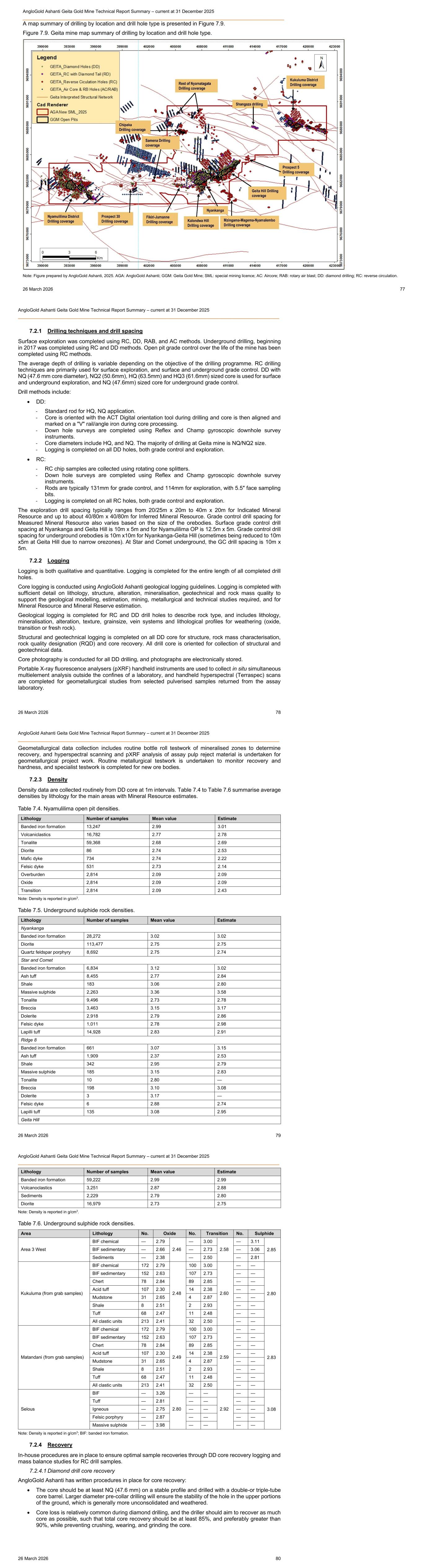
AngloGold Ashanti Geita Gold Mine Technical Report Summary – current at 31 December 2025 _____________________________________________________________________________________ 26 March 2026 77 A map summary of drilling by location and drill hole type is presented in Figure 7.9. Figure 7.9. Geita mine map summary of drilling by location and drill hole type. Note: Figure prepared by AngloGold Ashanti, 2025. AGA: AngloGold Ashanti; GGM: Geita Gold Mine; SML: special mining licence; AC: Aircore; RAB: rotary air blast; DD: diamond drilling; RC: reverse circulation. AngloGold Ashanti Geita Gold Mine Technical Report Summary – current at 31 December 2025 _____________________________________________________________________________________ 26 March 2026 78 7.2.1 Drilling techniques and drill spacing Surface exploration was completed using RC, DD, RAB, and AC methods. Underground drilling, beginning in 2017 was completed using RC and DD methods. Open pit grade control over the life of the mine has been completed using RC methods. The average depth of drilling is variable depending on the objective of the drilling programme. RC drilling techniques are primarily used for surface exploration, and surface and underground grade control. DD with NQ (47.6 mm core diameter), NQ2 (50.6mm), HQ (63.5mm) and HQ3 (61.6mm) sized core is used for surface and underground exploration, and NQ (47.6mm) sized core for underground grade control. Drill methods include: • DD: - Standard rod for HQ, NQ application. - Core is oriented with the ACT Digital orientation tool during drilling and core is then aligned and marked on a "V" rail/angle iron during core processing. - Down hole surveys are completed using Reflex and Champ gyroscopic downhole survey instruments. - Core diameters include HQ, and NQ. The majority of drilling at Geita mine is NQ/NQ2 size. - Logging is completed on all DD holes, both grade control and exploration. • RC: - RC chip samples are collected using rotating cone splitters. - Down hole surveys are completed using Reflex and Champ gyroscopic downhole survey instruments. - Rods are typically 131mm for grade control, and 114mm for exploration, with 5.5″ face sampling bits. - Logging is completed on all RC holes, both grade control and exploration. The exploration drill spacing typically ranges from 20/25m x 20m to 40m x 20m for Indicated Mineral Resource and up to about 40/80m x 40/80m for Inferred Mineral Resource. Grade control drill spacing for Measured Mineral Resource also varies based on the size of the orebodies. Surface grade control drill spacing at Nyankanga and Geita Hill is 10m x 5m and for Nyamulilima OP is 12.5m x 5m. Grade control drill spacing for underground orebodies is 10m x10m for Nyankanga-Geita Hill (sometimes being reduced to 10m x5m at Geita Hill due to narrow orezones). At Star and Comet underground, the GC drill spacing is 10m x 5m. 7.2.2 Logging Logging is both qualitative and quantitative. Logging is completed for the entire length of all completed drill holes. Core logging is conducted using AngloGold Ashanti geological logging guidelines. Logging is completed with sufficient detail on lithology, structure, alteration, mineralisation, geotechnical and rock mass quality to support the geological modelling, estimation, mining, metallurgical and technical studies required, and for Mineral Resource and Mineral Reserve estimation. Geological logging is completed for RC and DD drill holes to describe rock type, and includes lithology, mineralisation, alteration, texture, grainsize, vein systems and lithological profiles for weathering (oxide, transition or fresh rock). Structural and geotechnical logging is completed on all DD core for structure, rock mass characterisation, rock quality designation (RQD) and core recovery. All drill core is oriented for collection of structural and geotechnical data. Core photography is conducted for all DD drilling, and photographs are electronically stored. Portable X-ray fluorescence analysers (pXRF) handheld instruments are used to collect in situ simultaneous multielement analysis outside the confines of a laboratory, and handheld hyperspectral (Terraspec) scans are completed for geometallurgical studies from selected pulverised samples returned from the assay laboratory. AngloGold Ashanti Geita Gold Mine Technical Report Summary – current at 31 December 2025 _____________________________________________________________________________________ 26 March 2026 79 Geometallurgical data collection includes routine bottle roll testwork of mineralised zones to determine recovery, and hyperspectral scanning and pXRF analysis of assay pulp reject material is undertaken for geometallurgical project work. Routine metallurgical testwork is undertaken to monitor recovery and hardness, and specialist testwork is completed for new ore bodies. 7.2.3 Density Density data are collected routinely from DD core at 1m intervals. Table 7.4 to Table 7.6 summarise average densities by lithology for the main areas with Mineral Resource estimates. Table 7.4. Nyamulilima open pit densities. Lithology Number of samples Mean value Estimate Banded iron formation 13,247 2.99 3.01 Volcaniclastics 16,782 2.77 2.78 Tonalite 59,368 2.68 2.69 Diorite 86 2.74 2.53 Mafic dyke 734 2.74 2.22 Felsic dyke 531 2.73 2.14 Overburden 2,814 2.09 2.09 Oxide 2,814 2.09 2.09 Transition 2,814 2.09 2.43 Note: Density is reported in g/cm3. Table 7.5. Underground sulphide rock densities. Lithology Number of samples Mean value Estimate Nyankanga Banded iron formation 28,272 3.02 3.02 Diorite 113,477 2.75 2.75 Quartz feldspar porphyry 8,692 2.75 2.74 Star and Comet Banded iron formation 6,834 3.12 3.02 Ash tuff 8,455 2.77 2.84 Shale 183 3.06 2.80 Massive sulphide 2,263 3.36 3.58 Tonalite 9,496 2.73 2.78 Breccia 3,463 3.15 3.17 Dolerite 2,918 2.79 2.86 Felsic dyke 1,011 2.78 2.98 Lapilli tuff 14,928 2.83 2.91 Ridge 8 Banded iron formation 661 3.07 3.15 Ash tuff 1,909 2.37 2.53 Shale 342 2.95 2.79 Massive sulphide 185 3.15 2.83 Tonalite 10 2.80 — Breccia 198 3.10 3.08 Dolerite 3 3.17 — Felsic dyke 6 2.88 2.74 Lapilli tuff 135 3.08 2.95 Geita Hill AngloGold Ashanti Geita Gold Mine Technical Report Summary – current at 31 December 2025 _____________________________________________________________________________________ 26 March 2026 80 Lithology Number of samples Mean value Estimate Banded iron formation 59,222 2.99 2.99 Volcanoclastics 3,251 2.87 2.88 Sediments 2,229 2.79 2.80 Diorite 16,979 2.73 2.75 Note: Density is reported in g/cm3. Table 7.6. Underground sulphide rock densities. Area Lithology No. Oxide No. Transition No. Sulphide Area 3 West BIF chemical — 2.79 2.46 — 3.00 2.58 — 3.11 2.85 BIF sedimentary — 2.66 — 2.73 — 3.06 Sediments — 2.38 — 2.50 — 2.81 Kukuluma (from grab samples) BIF chemical 172 2.79 2.48 100 3.00 2.60 — — 2.80 BIF sedimentary 152 2.63 107 2.73 — — Chert 78 2.84 89 2.85 — — Acid tuff 107 2.30 14 2.38 — — Mudstone 31 2.65 4 2.87 — — Shale 8 2.51 2 2.93 — — Tuff 68 2.47 11 2.48 — — All clastic units 213 2.41 32 2.50 — — Matandani (from grab samples) BIF chemical 172 2.79 2.49 100 3.00 2.59 — — 2.83 BIF sedimentary 152 2.63 107 2.73 — — Chert 78 2.84 89 2.85 — — Acid tuff 107 2.30 14 2.38 — — Mudstone 31 2.65 4 2.87 — — Shale 8 2.51 2 2.93 — — Tuff 68 2.47 11 2.48 — — All clastic units 213 2.41 32 2.50 — — Selous BIF — 3.26 2.80 — — 2.92 — — 3.08 Tuff — 2.81 — — — — Igneous — 2.75 — — — — Felsic porphyry — 2.87 — — — — Massive sulphide — 3.98 — — — — Note: Density is reported in g/cm3; BIF: banded iron formation. 7.2.4 Recovery In-house procedures are in place to ensure optimal sample recoveries through DD core recovery logging and mass balance studies for RC drill samples. 7.2.4.1 Diamond drill core recovery AngloGold Ashanti has written procedures in place for core recovery: • The core should be at least NQ (47.6 mm) on a stable profile and drilled with a double-or triple-tube core barrel. Larger diameter pre-collar drilling will ensure the stability of the hole in the upper portions of the ground, which is generally more unconsolidated and weathered. • Core loss is relatively common during diamond drilling, and the driller should aim to recover as much core as possible, such that total core recovery should be at least 85%, and preferably greater than 90%, while preventing crushing, wearing, and grinding the core.

AngloGold Ashanti Geita Gold Mine Technical Report Summary – current at 31 December 2025 _____________________________________________________________________________________ 26 March 2026 81 • Although the drilling company calculates a total core recovery and solid core recovery, it is important that the geological technician and geologist on-site are also familiar with these. RQD is generally measured as a geotechnical parameter in the core yard. Total core recovery, solid core recovery, and RQD are calculated as follows: • Total core recovery = (total length of core recovered/drilled length) x 100. • Solid core recovery = (total length of core in pieces > core diameter/drilled length) x 100. • RQD = (Length of core in pieces > 100mm/drilled length) x 100. Core recovery data has been collected throughout the mine’s history. For all collected data the total average value is 97.4%, with a minimum recovery of 92.1% at Kalondwa Hill where the area is relatively fractured, and a maximum core recovery of 98.9% at Xanadu. Drill core recovery over time is presented in Table 7.7. Table 7.7. Drill core recovery from 2000 to 2025. Project Year Average core recovery (%) Status Comments Nyankanga 2019-2025 85.3 Active Geotechnical complexity across Iyoda Faults Geita Hill 2019-2025 78.5 Active Geotechnical complexity across Iyoda Faults Star and Comet 2020-2025 90.7 Active Nyamulilima 2020-2025 83.8 Active Multiple faults within the deposit Ridge 8 2020-2025 90.7 Active Mabe 2023-2025 98.8 Active Xanadu 2023-2025 78.3 Active Multiple faults within the target area Kalondwa Hill 2023-2025 88.2 Active Kukuluma 2007-2011 94.5 Inactive Matandani 2007-2011 98.5 Inactive Area 3 West 2007-2011 94.1 Inactive Selous 2018-2025 98.9 Active Lone Cone 2000-2010 80.11 Active Geotechnical complexity across Iyoda Faults P30 2022-2025 98.1 Active Total average core recovery (%) 89.89 7.2.4.2 Reverse circulation sample recovery procedure In-house procedures are in place to ensure optimal sample recoveries. RC sample recovery is measured through mass balance, where samples from different chutes are collected, weighed, recorded, and compared to the expected weight calculated from the density of the rock and the drill bit diameter for the drilling interval, which is typically a 1m interval. The RC sample recovery over time is presented in Table 7.8. Table 7.8. RC sample recovery from 2018 to 2025. Project Year Average RC sample recovery (%) Nyankanga 2020-2025 87 Geita Hill 2018-2025 85 Star and Comet 2019-2025 90 Nyamulilima 2020-2025 89.3 Total average RC recovery (%) 87.8 Note: RC: reverse circulation. 7.2.5 Collar surveys Survey and grid information was provided in Chapter 7.1.1. AngloGold Ashanti Geita Gold Mine Technical Report Summary – current at 31 December 2025 _____________________________________________________________________________________ 26 March 2026 82 7.2.6 Downhole surveys All exploration drill holes, surface and underground, and underground RC and DD grade control, are currently set up using ACE Azi Alignment tools or survey control, with surveying at 6m to confirm correct hole trajectory during rig set up and after collaring. Downhole surveying is typically completed at 30m intervals as the drill hole progresses, with an end-of-hole survey completed. Downhole surveys are collected using north-seeking gyroscopic downhole survey instruments, due to magnetic rock types present in the area. For surface and underground grade control drilling downhole surveys are only completed on drill holes greater than 40m in length. The survey results are sent electronically to the project geologists who verify the surveys and prepare data for import into the Fusion database. 7.2.7 Condemnation, geotechnical and hydrological drilling Sterilisation drilling was completed in 2020 to 2021 to confirm the location of the Nyamulilima WRSF. A total 18,250m of RC and DD drilling was completed to approximately 500m depth. No significant mineralisation was identified. Geotechnical drilling is routinely drilled for open pit and underground operations. Geotechnical drilling was completed in 2021 to 2022 in support of Nyamulilima open pit design. Additional drilling was completed in 2023 to collect geotechnical information for zones associated with open pit expansion. Hydrological drilling comprises water bore drilling for water supply at various locations around the site, and piezometers for monitoring ground water. 7.2.8 Metallurgical drilling Limited dedicated metallurgical drilling is recorded in the Fusion drill hole database. Metallurgical samples are typically collected from exploration drill holes or collected from run-of-mine (ROM) mineralisation. 7.2.9 Grade control drilling RC drilling is undertaken for open pit and underground grade control. Table 7.9 provides a summary of the grade control drilling completed. Table 7.9. Summary of grade control drilling. Project Surface Underground Underground Total holes Total metres Grade control RC Grade control DD Grade control RC Holes Metres Holes Metres Holes Metres Chipaka 20 975 20 975 Geita Hill 30,623 713,509 44 4,903 2,936 112,127 33,603 830,539 Kukuluma- Matandani 13,912 275,211 13,912 275,211 Nyamulilima open pit 26,802 481,473 26,802 481,473 Nyankanga 56,192 1,013,463 2,172 89,104 4,600 203,117 62,964 1,305,684 Star and Comet 7,403 153,348 2,805 83,093 5,887 164,420 16,095 400,861 Total 134,952 2,637,979 5,021 177,100 13,423 479,664 153,396 3,294,743 Note: RC: reverse circulation; DD: diamond drilling. Open pit RC grade control drilling is currently completed at Nyamulilima open pit from every 10m bench. Grade control drilling is designed to drill up to four benches at a time on wider spaced patterns as advanced grade control drilling. Hole depths range from 13-54m depending on design for ore zone coverage. The current drill spacing for Nyamulilima is 12.5m along strike and 5m across strike, with 1m samples collected AngloGold Ashanti Geita Gold Mine Technical Report Summary – current at 31 December 2025 _____________________________________________________________________________________ 26 March 2026 83 as a dry sample through rotating cone splitters. The drill holes are drilled to the northeast, toward 040°, at - 50° to intersect the orebody perpendicular to strike. Underground grade control is completed from within ore drives using ring pattern, drilling from -90° to + 90°. Drilling is undertaken by both RC and DD methods. Drill holes range in length from 10-150m. Drill spacing is 10m along strike, with 3-10m drill hole toe spacing. RC samples are taken as 1m samples collected as a wet sample (water injection) through rotating cone splitters. DD samples are taken from NQ drill core and submitted as full core samples after logging. 7.2.10 Sample length/true thickness Exploration drilling from surface and underground is drilled to intersect the mineralisation as close to perpendicular as possible to produce mineralised intercepts representing true thickness. Open pit grade control drilling is drilled to intersect the mineralisation as close to perpendicular as possible to produce mineralised intercepts representing true thickness. Underground grade control is drilled in ore drives, using ring pattern, and cuts mineralisation at all orientations. 7.2.11 Results The geological data used to carry out the geological interpretation and geological modelling are extracted by the project geologist from the Fusion database. Primary information to plot the drill holes trace are the collar, downhole survey, lithology, and assay tables. The secondary tables to supplement the interpretation are the structure, alteration, vein sets and mineralisation tables. 3D geological data viewing, validation, interpretation, and modelling are conducted using Leapfrog and Datamine computer-based software. The project data can still be further integrated with geophysical data using a 2D based ArcGIS software. Drill plans and sections are printed as hard copies for detailed geological interpretation on a light table. Once completed, they are scanned and digitized to continue with interpretation and 3D modelling in Leapfrog and Datamine. No drilling results relating to the Mineral Resource model areas have been excluded from use in Mineral Resource estimates. Both DD and RC samples are used for Mineral Resource calculations at Geita mine as these methods are believed to provide good quality samples. Assay results from the laboratory are accompanied by Certificates of Analysis for each batch. Assays are validated and imported into the Fusion database as they are received, and the import notification is automatically generated to notify pass or failed batches. The laboratory is notified on the failed batches and re-assay is completed. Quality assurance and quality control (QA/QC) reports are generated on weekly, monthly, quarterly, annually and for specific Mineral Resource model estimates. Geological models are routinely validated and updated as drilling progresses, and the final review is conducted prior to Mineral Resource model updates. Exploration results are communicated on weekly, monthly, quarterly, and annual basis through site and corporate reporting frameworks. 7.3 Hydrogeology 7.3.1 Nature and quality of sampling methods Geita does not use laboratory techniques to test for groundwater flow parameters. However, for the water quality analysis the laboratory techniques are utilised, where the sample are sent to accredited laboratory for analysis. Groundwater flow parameters are not laboratory-derived, they are determined from field tests such as pumping tests, packer tests and falling head tests. In these tests, the changes in water level over time in a pumping drill hole, together with measurements of water level response in surrounding piezometers (water level monitoring drill holes), are used to determine the hydrogeological parameters of an aquifer, i.e., the permeability (K), transmissivity (T) and storage or storativity (s) of the lithology through which groundwater is flowing in response to a flow gradient (i). Pumping tests are carried out comprising Step-Tests, Constant Discharge (or Constant Head) Tests, followed by a Recovery Test. These are standard tests used by hydrogeologists to determine aquifer parameters where the data from the tests are collated and assessed using industry standard equations such as the Theis DuPuit and Thiem equations applied to Darcy’s Law. For rainfall monitoring, routine rainfall measurements are taken from gauging stations across the Geita mine. These data are used to determine surface flow and groundwater recharge rates based on surface catchment runoff and groundwater infiltration rates using Excel spreadsheets and applying models such as Cumulative AngloGold Ashanti Geita Gold Mine Technical Report Summary – current at 31 December 2025 _____________________________________________________________________________________ 26 March 2026 84 Rainfall Departure and OPSIM (Operational Simulation of Industrial water Management and natural resource systems). Seasonal rainfall is compared to long-term site average conditions and predicted conditions (global meteorological forecasting models). Site dewatering pumping rates are set to cater for average as well as extreme events using pit stage curves to determine expected ingress volumes of water to the open pits based on average and extreme events. Open pit sump dewatering pump availability is set to enable pumping out a 1:100 RI event within 30 days. Surface water flow monitoring and site water balances are carried out using data from flowmeters and flow gauges (such as a V-notch weir) and data is collated and assessed in Excel spreadsheets as well as using software packages such as OPSIM. This is an integral component of routine water flow and storage monitoring and management at Geita mine to ensure operational efficiency (maximise re-use of water) and mitigate risks (e.g., inrush and inundation of underground workings from an extreme rainfall event). 7.3.2 Type and appropriateness of laboratory techniques The environmental section under the Health, Safety and Environment department at GGM routinely carried out surface water and groundwater quality monitoring to ensure quality compliance to the mining licence and national standards. Samples are collected and analysed at accredited laboratories for indicator parameters and compared with water use and discharge standards. Geochemical analysis-water samples undergo laboratory testing for physical parameters such as, pH, electrical conductivity, total dissolved solids, chemical parameters such as major cations and anions, heavy metals and biological parameters like total coliforms, e-coli, hydrocarbons. These parameters help to determine water-rock interaction and potential groundwater contamination. Standard QA/QC and strict chain of custody procedures are followed in handling samples collected. The hydrogeology section under the Technical Services Department at GGM routinely makes in-field water quality tests for basic indicator parameters (salinity and pH). Water quality results are collated and assessed for compliance to, or deviation from, relevant standards and remediation measures put in place if required. 7.3.3 Results 7.3.3.1 Geita rainfall The Geita District falls within the highland equatorial climate zone with a dry period in the middle of the year and a bi-modal wet season between November and April. The average annual precipitation amounts to approximately 1000mm/year, and the average annual evapotranspiration of approximately 1300mm/year (Figure 7.10). Therefore, only the four wettest months of the year produce an excess of water around the area. Figure 7.10. Geita Gold Mine actual rainfall over average rainfall and evaporation. Note: Figure prepared by AngloGold Ashanti, 2025. GGML: Geita Gold Mine.

AngloGold Ashanti Geita Gold Mine Technical Report Summary – current at 31 December 2025 _____________________________________________________________________________________ 26 March 2026 85 Water management focuses on pumping out of rainwater incident to the open pits falling within the catchment area and inflows from groundwater intersected in fracture/fault zones in the underground operations. Sub- horizontal weepholes are installed during open pit mining to dewater and de-pressurise the upper saprolite package and underlying weathered zone. Surface and underground mining takes place in predominantly massive, competent rock with limited open fractures and resultant low permeability and storage with respect to groundwater hydraulics. During open pit mining, minor groundwater seepages (<1L/s) were encountered with excavation through the surficial saprolite package overlying the basal BIF because of the low permeability and moderate storage of the saprolite material. Pit dewatering comprises transfer pumping from a sump installed in the pit bottom that stores rainwater and minor groundwater seepage inflow, as well as return flows from water used for underground mining operations. This is carried out via several stage-pumping systems as the pit deepens. The stage-pumping stations typically comprise one to two electrical or diesel operated pumps with a 100L/s (360m3/hr) flow rate and 100m head capacity. During normal operations one pump is a duty pump and one is on standby to cater for extreme rainfall events. Pit water management is done to ensure that dry mining conditions exist as well as to eliminate the risk of flooding of underground operations during extreme rainfall events, where the pit lake water level may rise to the entrance level of the underground workings (portal). Target levels are set to maintain the pit lake water level a minimum of 10m below the elevation of the lowest portal. No water is discharged to the environment in compliance with the Tanzanian regulations. In an extreme case following flood events that result in the storage (surge) capacity of the on-site containments being exceeded, special permission is sought from the regulatory authorities to discharge this floodwater to local river courses such as the Mtakuja River Swamp. In this case routine water quality sampling is undertaken to ensure compliance of discharged water to receiving water quality guidelines, in line with the current discharge permits. Surface (open pit) mining is carried out at Nyamulilima pit where de-watering infrastructure commissioned in 2022, and de-watering is being done to date, discharging into Nyamulilima dam. All underground operations are accessed from within their respective open pit shells, where the mined out open pits are used for water storage from both surface and underground water sources. Pumps and related infrastructure for the underground dewatering are managed by Underground Engineering, and the pumping rates and targets are managed by the Hydrogeology Section of the Mine Technical Services Department on site. 7.3.3.2 Ground water monitoring The mine is situated at an elevation of approximately 1,200m above mean sea level. Groundwater quality and water levels are measured in approximately 40 environmental monitoring boreholes across the mine site catchment area, and water levels are recorded at 44 piezometers installed near the major open pits (Figure 7.11). The groundwater elevations: the levels range from 1300m above mean sea level along the hills to 1150m above mean sea level towards Lake Victoria. This results in a hydraulic gradient of between 1-3%, with the groundwater flow path resembling the general surface water run-off direction in each sub-catchment. AngloGold Ashanti Geita Gold Mine Technical Report Summary – current at 31 December 2025 _____________________________________________________________________________________ 26 March 2026 86 Figure 7.11. Environmental monitoring boreholes and hydrogeological piezometers. Note: Figure prepared by AngloGold Ashanti, 2024. GW: groundwater; SML: special mining licence. 7.3.3.3 Underground water supply and dewatering As underground workings are developed, sumps are constructed, and dewatering pumping is done via stage- lifts to surface where water is discharged into the respective pit lakes/sumps for re-use/recycling for mining operations. Star and Comet underground water supply rate approx. 18L/s from open pit pumps. Outflow from underground is discharged to the Star and Comet Open pit and Star and Comet dam and recycled. The Nyankanga underground operations is supplied at approx. 25L/s from the mined out Lone Cone open pit. Dewatering is discharged from Nyankanga underground operations into the Nyankanga open pit sump. Geita Hill underground water supply is from water stored in the pit lake as well as pumping of a void dewatering drill hole (approximately 11L/s). Underground water is discharged into Geita Hill open pit lake/sump and transfer pumped to Lone Cone pit for storage and re-use for GGM mining and ore processing operations. At strategic positions, cover holes are drilled serving a dual purpose to validate the presence of water-bearing structures/bodies and geotechnical rock conditions. The information derived from these holes guides further development plans and execution. The cover drilling is carried out at all underground operations ahead of 'blind' development zones supervised by the geotechnical section, to check for structure ahead of development, for water, and for voids. Underground water intersections from drilling are reported to, and monitored by, the hydrogeology and geotechnical departments, who advise on appropriate water management strategies (i.e., whether to grout or plug drill holes or to allow drill holes to self-drain into the underground sumps). Water and void intersections encountered during exploration drilling follow the same procedure. Typically, the majority of water-bearing structures intersected are left open and drain with time, requiring minimal intervention. Depending on operational requirements, development plans and sump infrastructure some water intersections are sealed AngloGold Ashanti Geita Gold Mine Technical Report Summary – current at 31 December 2025 _____________________________________________________________________________________ 26 March 2026 87 using a Van Ruth plug, which is removed once development has proceeded to allow gravity drainage. Overall, the preferred method is to minimise piezometric pressure build-up in and around underground workings. A series of sumps have been developed as mining progresses to pump out any groundwater seepages encountered with mining development, as well as excess water used for underground mining operations that flows to collect in underground sub-level sumps. Excess water from sump pumping and underground mining is pumped to existing site water storages, i.e., either the existing pit lake or to on-site water containments such as Lone Cone North pit. Water is then re- circulated back into the system and used for both underground mining and gold plant operations to ensure maximum re-use of water on-site. 7.3.3.4 Open pit water supply and dewatering Open pit water levels are maintained at an elevation below the lowest portal to underground workings that provides adequate buffer to contain rain/storm water inflow during extreme events (1:100 RI), to prevent inrush or inundation. Open pit dewatering is carried out to ensure dry mining operations, prevent flooding of equipment and to prevent water inrush or inundation of entrances/portals to underground workings. Nyankanga dewatering pumping rate approx. 270m3/hr and stage-pumped to Lone Cone pit for re-use in mining operations and Process Plant. Similarly, Geita Hill West pit is dewatered at a rate of approx. 205m3/hr and stage-pumped into Lone Cone Pit for operational use. Nyamulilima pit is dewatered at a rate of 48m3/hr to Nyamulilima dam for mining operations and dust suppression (Figure 7.12). Figure 7.12. Nyamulilima dewatering lines. Note: Figure prepared by AngloGold Ashanti, 2025. 7.3.4 Qualified Person(s) interpretation From various hydrogeological studies confirm that the Geita mine’s climatic patterns results into the site water deficit for which the pit lake waters and dams are utilised for raw water supply in the mines to compensate the deficit, and in-satellite sites are supplied from the drilled boreholes. AngloGold Ashanti Geita Gold Mine Technical Report Summary – current at 31 December 2025 _____________________________________________________________________________________ 26 March 2026 88 For intersected water bearing structures in the underground and open pit operations due to low permeability rocks structures (0.001-1.0m/d) the amount intersected are collected in the mine sumps and pumped to the storages by dewatering pumps. As per environmental regulations and site procedures of zero discharge of mine-water; all water generated during the mining operations are contained and recycled for mine operations, and if there is a need of discharge of fresh water the authority permit is acquired. Based on current piezometric and dewatering data, no significant impact of groundwater into the operations. The seepages observed in open pit structures are managed by weep holes and pit sumps while underground is managed by decline sumps, pumped out and recycled for mine use like underground supply and for dust suppression. 7.4 Geotechnical testing and analysis Stability of underground and open pit excavations are mainly affected by geotechnical structures such as faults, thrusts, shears. Groundwater is synonymous with these structures adding to the complication of stress management. The management of groundwater drainage and mining shapes in and around the proximity of these geotechnical structures are crucial to minimise the induced stresses that cause dilution and/or mining recovery. Management interventions include the following: • Cover hole drilling to determine presence of groundwater. • Lithological drill hole logging derived from either Mineral Resource definition and/or grade control drilling to assess the ground conditions and weathering profile. • Face sampling underground and open pit. • Interpret and build structural models also included in Mineral Resource models used for planning purposes. • Minimise mining width and length to reduce hydraulic radius underground. • Mining Sequence and backfill underground. • Development support standard per excavation size and purpose underground. • Reduce face angle in open pit. • Increase berm widths in open pit. • Slope management plan and monitoring systems in open pit. • Rockfall analysis using specialised software in the open pit. • Seismicity sensors for underground and open pit. Geotechnical information that has been collected from laboratory testing and field measurements include: • Various lithologies and alteration types present, and their distribution within the deposit. • Structural data regarding the location, orientation, length, spacing and character of infilling material for faults, defects, and veins strength properties of intact rock and of fresh and saw-cut joint planes. Geotechnical core logging is undertaken primarily to obtain information that can be used to determine the engineering properties of the rock mass, which is essential for open pit and underground mine design. The engineering properties of the rock mass determines behaviours and response of the rock mass when benches, slopes, tunnels and stopes are excavated in them. The data gathered from geotechnical logging forms the basis for determining the stable slope, stope and pillar size design parameters and design for stope and development ground support. The following geotechnical parameters are collected from geotechnical logging: • Material strength and anisotropy estimates. • Quantity of defects. • Strength quality of defects. • Orientation and geometry of structures.

AngloGold Ashanti Geita Gold Mine Technical Report Summary – current at 31 December 2025 _____________________________________________________________________________________ 26 March 2026 89 Geotechnical field mapping is done to identify structures and rock masses that can have a material impact on production. Major structure mapping, which involves collecting data about large structures that may affect the overall design of the underground mine or inter-ramp/overall slopes or multiple developments and/or stopes; and cell mapping, which involves collecting relatively small structures that may affect a single bench, development, or stope. The mapped structures are projected to interim and final benches, inter-ramp and overall slopes for the open pits, and onto development and stope designs for the underground to identify possible failure geometries before they are exposed. 7.4.1 Nature and quality of sampling methods The sampling methods for both underground and open pit mining at GGM adhere to industry best practices and AngloGold Ashanti standards. The DD that was conducted for open pit had four geotechnical holes totalling 1,109m for 2025. Rock mass classification follows the RMR89 and GSI systems, with core samples sent to Geological Survey of Tanzania laboratory for uniaxial compressive strength and triaxial testing. The sample transportation is done by the transporter selected by GGM logistics team Geotechnical monitoring involves prisms, extensometers and GroundProbe radars to detect ground movement. The stability of the operating pit (Nyamulilima) is controlled by the structures and poor ground especially on the oxide zone, model updates for the structures are done to project to the benches below and give guidance on how such structures can be avoided/mitigated to allow the safe mining of the pit. The unfavourable orientations of the structures are most located on the Southern part of the Nyamulilima pit For the underground mine, the 2025 drilling programme covered the Nyankanga underground, Geita Hill underground and Star and Comet with 52 holes totalling 7,932m. Rock mass classification follows the Q- prime systems for underground, with core samples sent to Geological Survey of Tanzania laboratory for uniaxial compressive strength and triaxial testing. The drilling covers some of the developments and stopes that deem to require additional information on the assessment of the ground condition and presence of voids. 7.4.2 Type and appropriateness of laboratory techniques Laboratory testing of rock material is undertaken to give confidence to the rock mass strength properties that are estimated from rock mass classification systems. Laboratory testing techniques used at GGM include uniaxial compressive strength (UCS), triaxial compressive strength and direct shear testing to some extent. Historically, the mine has utilised accredited rock testing laboratories to undertaking laboratory testing. Currently, GGM is utilising the services of the Geological Survey of Tanzania rock testing laboratory in Dodoma for conducting all rock strength testing. The backfilling samples are tested on-site using Geita mine’s laboratory. Rock sampling and testing procedures are used as part of quality control and assurance to ensure the samples are collected and prepared correctly and to ensure that testing is done in accordance with International Society of Rock Mechanics Commission on Standardisation of Laboratory and Field Tests (1978). The collected data (laboratory and field) is validated and stored in secure site databases and a central companywide geotechnical database. The quality control and assurance data for backfill is undertaken to ensure that the cemented aggregate fill (CAF) deposited underground meets the strength, quality and placement requirements. The quality of the CAF ingredient materials is monitored by: • Ensuring correct cement is delivered, no damage is evident on the packaging, test certificates are supplied by the cement manufacturer and periodic spot checks are conducted by an external laboratory to confirm the cement specifications are correct. • Ensuring consistent water quality by doing monthly checks on the water chemistry and quality. Ensuring that the correct particle size distribution (PSD) is produced by the crushing circuit and performing UCS tests to ensure that the rock quality is consistent. 7.4.3 Results The results of laboratory testing at Geita mine show that the rock strengths in all the deposits (i.e., Nyankanga, Geita Hill, Star and Comet and Nyamulilima) are generally greater than 100MPa, which equates AngloGold Ashanti Geita Gold Mine Technical Report Summary – current at 31 December 2025 _____________________________________________________________________________________ 26 March 2026 90 to a R5 grade and very strong rock. The majority of the UCS results for the CAF samples are recorded to have 2MPa which is the requirement as suggested by Peterson and Cooke, the backfilling consultant. The strength parameter results for the major lithologies per deposit are summarised in Table 7.10. Table 7.10. Strength parameter results for the major lithologies per deposit. Lithology Uniaxial compressive strength Mean (MPa) Standard deviation (MPa) Nyankanga BIF 144.74 80.27 DPH 108.58 39.54 QFP 52.09 24.21 TUFF 189.11 63.98 Geita Hill BIF 194.81 69.02 DPH 108.00 32.37 Star and Comet BIF 214.48 101.04 DPH 367.32 101.87 QFP 344.67 156.33 Nyamulilima BIF 107.7 47.9 DPH 129.8 49.8 Note: BIF: banded iron formation; DPH: diorite (rich in plagioclase over hornblende); QFP: quartz feldspar porphyry; TUFF: volcanic tuffaceous sediment; MPa: megapascal 7.4.4 Qualified Person(s) interpretation The geotechnical assessment indicates that the Geita deposits consist of mainly very strong rock (R5 grade), however structural complex zones are intersected at some zones especially for the Nyankanga and Geita Hill underground. These zones require additional ground control measures for the safe development of excavations. The stability of the stopes in all the underground operations is mostly controlled by the structures; structure models are updated every time they are intersected so that they can be incorporated in the design. Geotechnical assessment and analysis are conducted to the individual stope to provide recommendation and guidance to the operation team for safe mining of the stope. The Nyamulilima pit structures affect mostly the Southern side of the pit, design of the pit accounts for these structures to check for the influence as per the recommendation from the geotechnical section, additionally ground based radar (GroundProbe radar) is deployed to monitor this slope so that it inform the movement of the slope in case they is any instability developed. The Qualified Person interprets the results and confirms that the mining at Geita mine is geotechnically controlled to allow safe mining, however the mitigation suggested needs to be maintained. 8. Sample preparation, analyses and security Diamond and RC drilling are the primary sources of samples that provide data for Mineral Resource estimates. DD and RC samples are used from both exploration, Mineral Resource definition (infill) and grade control drilling programmes and used to inform Mineral Resource estimates. Underground face samples are collected routinely and used operationally for identifying ore zones during underground development. Truck dump samples and ROM face samples (grab samples) are routinely collected for checking ROM ore grades. Other samples such as surface grab, channel, trench, and soil samples are collected during exploration to assess prospectivity. Underground face samples, truck samples, ROM face samples and exploration surface grab, channel, trench and soil samples are excluded from Mineral Resource estimation. AngloGold Ashanti Geita Gold Mine Technical Report Summary – current at 31 December 2025 _____________________________________________________________________________________ 26 March 2026 91 Samples from RC drilling are collected at 1m intervals using rotating cone splitters, with approximately 3-5kg collected in calico sample bags, and bulk reject sample is collected in plastic sample bags (in case re- assaying is required) and retained at the core sheds. Surface RC samples are collected as dry samples, where underground RC samples are collected as wet samples using water injection. Water injection is required to eliminate dust underground where the underground RC method is applied. For DD, samples are typically collected at 1m intervals, but the sampling interval can change based on geological observations (change in rock type, alteration, mineralisation, structural fabrics in the rock mass or core loss). The minimum sample length from drill core is 0.5m and the maximum length is 1.5m. For DD, the samples are cut with a core saw and half is submitted (half-core) for analysis. NQ core generated from underground grade control drilling, is sampled as full core after logging. The core is placed in calico sample bags for transport to the lab. Grab samples (rock chips, channels, ROM face, truck dump) are collected routinely from underground, open pit and exploration mapping, underground face sampling in development, and from stockpiles. The samples are typically 3-5kg and are used for improving geological understanding at specific locations. Grab samples are not used in Mineral Resource estimation but may be used during interpretation of mineralisation wireframes. Exploration and grade control samples are adequately monitored in the field to ensure sampling protocols are followed at the rigs, transport of samples from the drilling sites to the core shed is completed under sample transport protocols to ensure sample security, and on receipt at the core shed samples are prepared for sample dispatch to the laboratories to undergo laboratory tests. The initial process to prepare the samples for dispatch to the laboratory begins at exploration core yard. Samples are confirmed and identified with sample numbers and reconciled with drilling and sampling records. Once samples are confirmed, blanks and certified reference materials (CRMs) are inserted for QA/QC purposes. Samples transported to the SGS Mwanza laboratory (outside the mine site) undergo security checks at the sample yard by government officials and are sealed in a closed truck using the government seals. Samples processed on-site are submitted to the SGS Geita site laboratory by Geita Gold Mine employees (geologists who are responsible for the samples dispatch to the labs). Comprehensive sample transport procedures are in place. The receiving laboratory sends back electronic reconciliation reports confirming that samples were received. At the laboratory, assaying is then completed and follows analytical procedures aligned with industry and AngloGold Ashanti standards. Assay results and Certificates of Analysis are sent electronically, and QA/QC verification is completed before assays are loaded to the Fusion database for geology and mine planning use. 8.1 Sample preparation RC samples, typically 3-5kg, are oven dried (12 hours at 104°C), then crushed to 90% passing 2mm. Samples are split to approximately 0.5kg and pulverised to 90% passing 75µm. Drill core samples, typically 3-5kg, are oven dried (12 hours at 104°C), then crushed to 90% passing 2mm. Samples are then split to approximately 0.5kg and pulverised to 90% passing 75µm. Grab samples, typically 3-5kg, are oven dried (12 hours at 104°C), then crushed to 90% passing 2mm. Samples are split to approximately 0.5kg and pulverised to 90% passing 75µm. Crushed samples (coarse reject) and pulverised pulps are stored by the laboratories for three months to one year, for the purposes of re-assaying, check assaying and quality assurance/quality control testwork. 8.2 Assay method and laboratory All exploration, Mineral Resource definition and grade control samples are currently assayed by African Assay Laboratories Tanzania Limited, which is owned by, and is a subsidiary of, the SGS group. SGS has provided laboratory services for the Geita mine since 2002. Currently, SGS operates a commercial laboratory located in Mwanza (SGS Mwanza) and the AngloGold Ashanti-owned laboratories located at the Geita mine. On-site, the main laboratory (SGS Geita) is located at the process plant, with a sample preparation facility located at Star and Comet. The SGS Mwanza laboratory was ISO 17025 accredited by the South African National Accreditation System in 2012. Whilst the SGS Geita on-site laboratory is not ISO accredited, it is AngloGold Ashanti Geita Gold Mine Technical Report Summary – current at 31 December 2025 _____________________________________________________________________________________ 26 March 2026 92 run by the same management and uses the same applied methodology and standards. The laboratories are independent of AngloGold Ashanti. AngloGold Ashanti staff complete routine site laboratory visits at all SGS facilities to check compliance with industry practices and AngloGold Ashanti standards. From 2007 to 2016, the Geita mine engaged ALS Chemex laboratories located in Australia, Canada, and South Africa for independent sample assay verification services. ALS certifications with respect to ISO 17025 during the provision of this service is unknown. Gold is determined using fire assay with an atomic absorption spectroscopy (AAS) finish. This is considered a total assay for gold. The SGS Mwanza laboratory completes 50g fire assays and the SGS Geita on-site laboratory completes 40g fire assays. The detection limit is 0.01 g/t gold in both cases. A gravimetric finish is used for samples returning assays >5g/t gold and screen fire assay for all samples returning values >20g/t gold (this is a quality control measure to check for the presence of coarse gold). Base metal assaying is conducted on mineralised intervals using the ICP12B method, which analyses for a 32-element suite using aqua regia digest and an inductively coupled plasma (ICP) optical emission spectroscopy (OES) finish. 8.3 Sampling governance DD half-core is retained and stored in the core yard for future reference and in case re-logging, sampling, and assaying as required. DD core samples are generally retained throughout the life of mine (LOM) and beyond. If a need to dispose of DD core arises, a disposal permit is requested from the Ministry of Energy and Minerals and is typically limited to DD core related to mined-out volumes. RC bulk/reject samples are stored for three to six months and discarded once assays are received and validated. RC sample chip trays are stored for future reference and re-logging, and RC samples (chips) are retained until mined out, and if they need to be disposed of, the disposal process follows AngloGold Ashanti’s environmental waste management protocols. Data are electronically stored in the Fusion database with built-in quality controls to prevent duplication, overlaps and gaps. On-site database personnel conduct daily, weekly, and monthly database health checks on the imported data to ensure validated and accurately captured data. Assay data are managed and controlled as per in-house QA/QC protocols which are aligned to AngloGold Ashanti standards and guidelines for sampling, assaying, and QA/QC. The Fusion database is a structured query language (SQL) database, and is hosted on secure servers, with routine backup functionality. 8.4 Quality assurance and quality control Comprehensive QA/QC procedures and protocols are in place and are aligned with AngloGold Ashanti QA/QC guidelines. Representative QA/QC is conducted on exploration, grade control and underground sampling during routine submission for assay and check assaying on a quarterly basis. QA/QC performance is presented for 2025 and is considered a representative of current QA/QC procedures and protocols in place, and which have been followed routinely to this standard for the past ten years. QA/QC is reviewed for each Mineral Resource estimate and was verified by the Qualified Person, where the following is presented in detail as an example of QA/QC that is routinely conducted. Sampling, assaying, and QA/QC workflow is shown in Figure 8.1.

AngloGold Ashanti Geita Gold Mine Technical Report Summary – current at 31 December 2025 _____________________________________________________________________________________ 26 March 2026 93 Figure 8.1. Geita mine sampling, assay, and quality assurance workflow. Note: Figure prepared by AngloGold Ashanti, 2025. QA/QC samples submitted include submission of: • CRMs to determine precision and accuracy of analytical procedures (2.5%). • Coarse blanks (4%) are submitted to monitor sample hygiene and contamination during sample preparation (splitting). • Pulp blanks (4%) submitted to monitor hygiene at assaying stage, in particular if there is contamination from re-used fire assay pots. • Field duplicates (2%), known as rig duplicates for RC sampling and DD duplicates from the second split of core, to monitor for sample bias during splitting, and for determination of coarse gold variability (nugget), and general mineralisation variability. • Coarse rejects are routinely assayed (2.5%) to monitor repeatability and sample bias of assays during splitting at the laboratory. • Pulp duplicates (2.5%) are assayed routinely to monitor precision and repeatability of assaying techniques. • Particle size analysis checks for crushing to 2mm and pulverizing performance to 75µm. • Check assaying of pulps quarterly targeting 100+ samples re-submitted for checking repeatability and precision. • Other QA/QC methods include comparison of gravimetric analysis for gold for assays reported over 5 g/t and screen fire assay analysis for selected high-grade assays (>20g/t). Overall, the operation targets about 10% of the total drilling sample count for the combined QA/QC samples submitted. Sample collection strictly adheres to AngloGold Ashanti Sampling Guideline Rev 1.04 2019, and sample collection is controlled as per in-house sampling protocols and procedures that are aligned to AngloGold Ashanti’s standards and guidelines for sampling, assaying, and QA/QC. Sampling procedures require secure AngloGold Ashanti Geita Gold Mine Technical Report Summary – current at 31 December 2025 _____________________________________________________________________________________ 26 March 2026 94 packaging, labelling and transportation of samples to laboratories. The SGS laboratories send an electronic reconciliation of samples received. Thereafter, assay results are reported electronically and captured into the Fusion database (Figure 8.2). Figure 8.2. Exploration and grade control sampling flowsheet. Note: Figure prepared by AngloGold Ashanti, 2025. QAQC: quality assurance and quality control. 8.5 Qualified Person's opinion on adequacy The Qualified Person has verified adequate procedures are in place for sample preparation, sample transport and security and analytical methods. The Qualified Person has regularly completed inspections of open pit and underground operations and exploration areas to observe sampling practices at the rigs and completed regular visits to core sheds and assay laboratories observe sample handling, sample preparation and sample transport practices. Sampling activities are conducted by trained and competent personnel. The observed sampling practices do not indicate any material problems with sampling, sample handling, sample preparation and sample transport. Sampling is conducted in line with industry standards, and sufficiently reliable to provide representative samples for assaying/gold determination. The Qualified Person considers that sufficient QA/QC samples are submitted for each batch to confirm precision and accuracy of assay data reported and used in Mineral Resource estimates. The QA/QC programme results do not indicate any material problems with sampling or analytical programmes, and data are sufficiently reliable to support estimation without limitations on Mineral Resource estimates. 9. Data verification 9.1 Data verification procedures While completing site duties as the appointed Senior Manager Geology and Exploration, the Qualified Person has routinely conducted the following data verification procedures: AngloGold Ashanti Geita Gold Mine Technical Report Summary – current at 31 December 2025 _____________________________________________________________________________________ 26 March 2026 95 • Visited the open pit, underground operations, and exploration areas to inspect activities relating to drilling and sampling. • Visited the core shed to inspect activities relating to geological logging, sampling, sample despatch and sample storage. • Visited the site assay laboratory facilities to inspect activities relating to sample preparation and assaying. • Visited the main ROM pad, satellite ROM pads and low-grade stockpile areas to inspect activities relating to stockpiles. • Visited exploration and operational areas to review geology and mineralisation. • Regularly inspected drill core with Exploration Manager to confirm the nature of the mineralisation and geological and structural features present. • Reviewed Mineral Resource and grade control models and signs off on model handover reports. • Reviewed drilling performance monthly and attends drilling contractor performance meetings. • Reviewed QA/QC performance monthly and attends laboratory performance meetings. • Reviewed reconciliation performance monthly, specifically reviewing Mineral Resource model to grade control to mine design to mined actual. • Reviewed monthly change in stockpile calculations and signs off on stockpile reports. • Attended daily production meetings, and weekly management meetings and chairs monthly site reconciliation meetings to report on geology and reconciliation performance. • Conducted scheduled reviews of Geology and Exploration procedures as per document control protocols. During the preparation of this Report, the Qualified Person has conducted the following data verification procedures: • Cross-referenced database records with drill hole extracts used in each of the 2025 Mineral Resource updates. • Coordinated QA/QC review for 2025 drilling data and reviewed results. • Reviewed QA/QC reports relating to each Mineral Resource estimate. • Reviewed procedures relating to drilling, sampling, assaying, geological modelling, and resource estimation. • Reviewed and read all Mineral Resource Estimation Documents relating to 2025 Mineral Resource updates. • Reviewed and re-read SRK Consulting 2022 Geita External Mineral Resource and Reserve Report. • Interviewed Evaluation Superintendent to verify data used, geological model assumptions and model estimation parameters for each Mineral Resource update. • Interviewed Senior Manager Process Plant to verify metallurgical assumptions and get information for documenting metallurgical testwork completed over time. • Interviewed Exploration Manager and team exploration geologists to verify understanding of geological models. • Interviewed Survey Superintendent to verify site survey equipment specifications and to validate survey practices in the field. • Interviewed Downhole Survey contractor to verify downhole survey equipment specifications and to validate downhole survey practices in the field. • Interviewed drilling contractor Project Managers to verify drilling procedures. The Qualified Person has verified that data management, relating to sampling, assaying and QA/QC incorporates rigorous data validation, and follows established procedures for recording of sampling against AngloGold Ashanti Geita Gold Mine Technical Report Summary – current at 31 December 2025 _____________________________________________________________________________________ 26 March 2026 96 drill holes, and recording of assaying data against the samples. Sampling and assaying data is validated and stored in a secure database. The Qualified Person has verified that appropriate procedures are in place for QA/QC and has reviewed QA/QC data and associated reports (monthly, quarterly) prepared by geology personnel. The Qualified Person has reviewed QA/QC data relating to each Mineral Resource estimate, which is documented each of the Mineral Resource estimation documents relating to the Mineral Resource estimate update. Monthly laboratory performance meetings are held with SGS laboratory managers, laboratory visits are conducted quarterly, and laboratories are audited annually by internal AngloGold Ashanti experts. Bi- annually, the laboratories are audited by independent consultants as part of Mineral Resource and Mineral Reserve Review. The last third party Mineral Resource and Reserve review was completed in November 2022, by SRK Consulting, who in addition to laboratory inspections, reviewed QA/QC data for the period of 2019 to 2022. No material issues with QA/QC were identified in that review. 9.1.1 Site procedures The Qualified Person verified that adequate procedures are in place at the Geita mine, and data is collected by trained and competent personnel. The following provides a summary of procedures in place. Drill hole data are electronically stored in the Datamine Fusion database with built-in QC controls to prevent duplication, overlaps and gaps. The database has a series of automated validation tools during import and export for error identification. Data that fail validation are verified and corrected. On-site database personnel conduct daily, weekly, and monthly database health checks on the imported data to ensure that it is validated and accurately captured. Drill hole collar locations, after drilling, are surveyed by Survey Department using industry-recognised survey techniques (discussed in Chapter 7.1.1 and 7.2.5). Downhole surveying is undertaken on all exploration drill holes, using appropriate gyro downhole survey tools (see Chapter 7.2.6). Downhole surveys are validated in Datamine by supervising geologists to validate downhole survey prior to import into Datamine Fusion database. Geological logging is completed for all drill holes and is conducted by trained geologists (refer to Chapter 7.2.2). Geological logging data is imported to the Datamine Fusion database and validated to ensure logged intervals use approved logging codes for lithology, texture, mineralisation, alteration, and structure. Procedures are in place for routine density measurement and for RC and DD core recovery (see Chapter 7.2.4) Assay data are managed and controlled as per QA/QC protocols, which are aligned to AngloGold Ashanti standards and guidelines for drilling, sampling, and assaying (see Chapter 8). Assay data are imported directly from laboratory assay certificates by assigned persons. Database routines validate every input and produce a report, detailed log and full quality control charts of check assays and CRMs such that checks are completed during each batch import. Results of the QA/QC programmes are rigorously tracked through internal weekly and monthly reporting protocols. The Datamine Fusion database is a SQL database, and is hosted on secure servers, with routine backup functionality. A full-time database administrator is employed at the Geita mine to manage the database. 9.1.2 Internal reviews AngloGold Ashanti has developed and implemented a rigorous system of internal and external reviews aimed at providing assurance in respect of Mineral Resource and Mineral Reserve estimates. This structured system ensures the accuracy and validity of Mineral Resource and Mineral Reserve estimates. This approach involves a clear delegation of responsibilities, with individuals at various organisational levels assuming responsibility and reviewing the work they are directly involved in through an internal review and sign-off process. Mine site technical specialists, who may be Qualified Persons, prepare and document the information supporting the Mineral Reserve and Mineral Resource estimates. Mineral Resource and Mineral Reserve estimates are reviewed by the Business Unit technical specialists during key stages of the estimate generation and reporting, followed by a final review conducted by corporate Qualified Persons with a global oversight role.

AngloGold Ashanti Geita Gold Mine Technical Report Summary – current at 31 December 2025 _____________________________________________________________________________________ 26 March 2026 97 AngloGold Ashanti has a number of internal processes in support of Mineral Resource and Mineral Reserve estimates. These include reconciliation, mineability and dilution evaluations, investigations of grade discrepancies, long-term/strategic plan reviews, and mining studies to meet internal financing criteria for project advancement. 9.1.3 External audit An external independent audit by SRK Consulting was undertaken on the mine during December 2022. SRK Consulting concluded that the Mineral Resource and Mineral Reserve were reported in accordance with the current international reporting codes. No material risks were identified following completion of the external review. 9.2 Limitations on, or failure to conduct verification No limitations were placed on the Qualified Persons for data verification. 9.3 Qualified Person's opinion on data adequacy 9.3.1 Ms. Janeth Luponelo Through completion of data verification procedures and activities listed in Chapter 9.1, Ms. Luponelo verified that: • Appropriate procedures, checks, and validations for drilling, sampling, assaying, and geological logging are in place. • Drilling, sampling, assaying, and logging activities are conducted and/or supervised by trained and competent personnel. • Core and RC logging is conducted to a high standard and meets industry standards for gold exploration. • Collar and downhole surveying are performed using industry standard instrumentation, and suitable for determining 3D position of mineralised intercepts relied upon for interpreting mineralisation wireframes. • Appropriate levels of QA/QC are performed routinely to confirm precision and accuracy. • Density data are accurately measured, and adequate coverage of density data is available for tonnage estimation in Mineral Resource and Mineral Reserve estimates. • Routine RC recovery checks are completed, demonstrating acceptable RC sample recoveries over time. • Core recovery is measured, demonstrating acceptable DD core recoveries over time. • Data integrity is verified for data in the drill hole database. In summary, data are to be sufficiently reliable to support estimation without limitations on Mineral Resource confidence categories. The checks are appropriate, and consistent with industry standards. Data are acceptable to provide reliable data to inform estimation of Mineral Resource and Mineral Reserve, and for use in mine planning. 9.3.2 Mr. Duan Campbell Mr. Campbell focused on verifying the adequacy and accuracy of data specifically related to Mineral Reserve, covering the following aspects: • Ensures that mine designs, including stope shapes, pit outlines, and layouts, are feasible and based on accurate data, such as geotechnical stability and access requirements. Mineral Reserve estimates must reflect practical, safe, and economically viable mining practices. • Verifies that Mineral Reserve estimates are based on realistic and current economic assumptions, including commodity prices, recovery rates, mining costs, processing costs, and capital expenditures. This ensures the economic feasibility of Mineral Reserve under forecast market conditions. AngloGold Ashanti Geita Gold Mine Technical Report Summary – current at 31 December 2025 _____________________________________________________________________________________ 26 March 2026 98 • Reviews the cut-off grade calculations, ensuring they accurately reflect processing costs, metallurgical recoveries, and operational constraints. This cut-off grade supports which material qualifies as Mineral Reserve and thus directly impacts Mineral Reserve tonnage and grade estimates. • Examines the adequacy of metallurgical testing and processing data, confirming that recovery factors, processing methods, and throughput rates align with Mineral Reserve estimates, and that metallurgical assumptions for ore processing are reliable and consistent with the expected mineralised material characteristics. • Evaluates the adequacy of on-site and off-site infrastructure required to support Mineral Reserve extraction, such as transportation, water supply, tailings management, power, and waste disposal. For Mineral Reserve, the Qualified Person ensured that all infrastructure requirements are feasible and properly costed to support planned operations. • Ensures the Mineral Reserve estimates account for any critical environmental constraints, including compliance with environmental regulations, water management plans, and reclamation requirements. The Qualified Person verified that long-term sustainability issues, such as TSFs, acid rock drainage, and habitat conservation, were factored into mine planning and cost estimates. • Verifies that geotechnical data, including slope stability and rock mass characteristics, are suitable for long-term mining operations and that Mineral Reserve estimates reflect necessary ground support or slope adjustments. Hydrological data are also reviewed to ensure mine dewatering and groundwater control measures are feasible and accounted for in Mineral Reserve plans. • Assesses whether the processing plant and TSFs have adequate capacity and design to support production. This includes verifying that infrastructure plans align with the scale of mining and processing required. • Conducts risk and sensitivity analysis to assess the impact of potential changes in key factors such as metal prices, operating costs, and recovery rates on the Mineral Reserve estimates. This analysis provides insights into estimation robustness and highlights any potential need for contingency measures. • Ensures that all data, methods, and assumptions meet the requirements of the 2014 CIM definitions for Mineral Reserve, particularly with regards to the level of confidence required for classifying Mineral Reserve as Proven or Probable. The Qualified Person's opinion on these aspects ensures that the data used to support Mineral Reserve estimates are comprehensive, sufficient, and reliable, with appropriate consideration of economic, operational, environmental, and technical factors that are critical to the life of mine (LOM) mining and process plan. 10. Mineral processing and metallurgical testing The process plant was commissioned in 1999 following design and constriction managed by Lycopodium in Australia. The plant is designed to treat hard sulphide ore together with a mix of oxide material when it becomes available. Detailed designs and tests were conducted as part of the project development during 1997-1999. After the operations began in 1999, the following key metallurgical testwork programmes were completed: • 2013-2015: Kukuluma-Matandani testwork. A detailed testwork programme to study the metallurgical performance of the Kukuluma Matandani mineralisation was completed as part of a prefeasibility study. This study included testing of various processing methods for highly refractory ore such as bio- oxidation, and pressure oxidation. • 2016-2017: Star and Comet underground testwork. This aimed to establishing the metallurgical behaviour of the mineralisation at depth. • 2020-2021: Nyamulilima testwork. Evaluated metallurgical performance of Nyamulilima (new pit) mineralisation and assessing the potential impact on the existing plant design. 2022-2023: Geita Hill underground testwork. Completed to establish the metallurgical behaviour of the mineralisation at depth. AngloGold Ashanti Geita Gold Mine Technical Report Summary – current at 31 December 2025 _____________________________________________________________________________________ 26 March 2026 99 10.1 Mineral processing and metallurgical testing Significant metallurgical testwork has been conducted on samples from the various deposits since the 1990s, targeting parameters such as mineralogy, hardness, grindability, gravity recoverability, flotation, sensitivity to cyanide including carbon-in-leach (CIL) and intensive leaching, optimisation on grinds, leaching time and cyanide concentration, diagnostic leach, gold deportment and effect of blending. 10.1.1 Location of the analytical/testing laboratories and relationship to the registrant Testwork programmes were conducted primarily by SGS in South Africa, Advanced Mineral Technology Laboratory (AMTEL) in Canada, and ALS in Australia. These are international independent commercial laboratories which are not affiliated with AngloGold Ashanti. They have performed several metallurgical testworks used for plant optimisation. Other laboratories such as the Nesch Mintec Laboratory in Mwanza (Nesch Mintec) and SGS Mwanza are certified laboratories available in Tanzania and have provided essential analytical support within Tanzania. They are independent commercial laboratories, not affiliated with the AngloGold Ashanti. Information below indicates a summary of the independent commercial laboratories that were contracted for analytical, metallurgical, and mineralogical services. 1. Nesch Mintech Tanzania Limited • Location: Butimba, Mwanza, Tanzania. • Role: Independent contractor for analytical and metallurgical services. • Accreditation: ISO/IEC 17025 certified by SADCAS, Facility #TEST-5 0029. • Technical Scope: Fire Assay and mineral analysis adhering to various regulatory standards. • Quality Assurance: Monitors quality via African Mineral Standards, Rocklabs, and Geostats proficiency programmes. • Validity: Active through June 2, 2028. • Subcontracting: Maintains partnerships with GEOLABS SA and Petrolab (UK) for specialised requirements. 2. African Assay Laboratories (T) Limited (SGS Mwanza) • Location: Mkuyuni Industrial Area, Mwanza, Tanzania. • Role: Independent third-party contractor for geochemical and gold analysis. • Accreditation: ISO/IEC 17025 certified by CALA (Canada), Certificate #1004114. • Technical Scope: Specialises in gold by fire assay. • Quality Assurance: Participates in monthly Laboratory Quality Services International and African Mineral Standards programmes, and biannual Geostats proficiency testing. • Validity: Active through May 12, 2027. • Subcontracting: None; all analytical work is performed in-house. 3. African Assay Laboratories (T) Limited (SGS South Africa (Pty) Ltd.) • Location: 58 Melville Street, Booysens, Johannesburg. • Role: Independent third-party contractor for geochemical and gold analysis. • Accreditation: ISO/IEC 17025:2017 certified by the South African National Accreditation Systems, facility accreditation number T0265. • Validity: Active through Feb 27, 2030. • Subcontracting: None; all analytical work is performed in-house. 4. Advanced Mineral Technology Laboratory Ltd. (AMTEL) • Location: London, Ontario, Canada. • Role: Independent consulting group for mineralogical characterization and gold deportment. AngloGold Ashanti Geita Gold Mine Technical Report Summary – current at 31 December 2025 _____________________________________________________________________________________ 26 March 2026 100 • Technical Scope: Advanced microscopy and metallurgical balance. • Accreditation Strategy: Operates as a specialist consultancy; all primary chemical assays are subcontracted to ISO-accredited facilities. • Quality Assurance: Employs a pm10% reconciliation protocol between mineralogical gold deportment and certified head assays. • Validity (Subcontractor): ALS accreditation is valid until May 18, 2029. 5. ALS Pty Limited • Location: Perth Metallurgy. 6 MacAdam Place, Balcatta WA 6021 • Role: Independent contractor for analytical and metallurgical mineral division. • Accreditation: ISO 9001, ISO 45001 and ISO 14001 • Validity: Active through May 28, 2028. 10.2 Laboratory testwork and results 10.2.1 Laboratories used for testwork The Geita site laboratory consists of two main sections: the metallurgical laboratory, which handles process optimisation testwork (e.g. bottle roll tests, gravity gold recovery, diagnostic leach tests, Bond work index etc.), and SGS geochemical laboratory, which handles analytical services such as fire assay for plant accounting samples (finished by AAS machine) as well as X-ray fusion and limited wet chemistry. Additional testwork such as mineralogy, gold deportment, ore characterisation and other extensive treatment processes (e.g. bio-oxidation, heap leach etc.) is conducted at external laboratories including SGS, AMTEL, and ALS) Nesch Mintec and SGS Mwanza. 10.2.2 Geometallurgical programme A geometallurgical programme was launched in late 2012 to enhance predictions of material property changes in the mineralisation to be treated, and their effects on metallurgical processes (Figure 10.1).

AngloGold Ashanti Geita Gold Mine Technical Report Summary – current at 31 December 2025 _____________________________________________________________________________________ 26 March 2026 101 Figure 10.1. Demonstration of the Geita mine geometallurgical programme (data types and techniques). Note: Figure prepared by AngloGold Ashanti, 2025. A*b: ore hardness factor; pXRF: Portable X-Ray Fluorescence; BBW: Bond Ball Work Index; CSS: Closed Side Setting (106mm); UCS: universal compressive strength; ICP-MS: Inductively Coupled Plasma Mass Spectrometry; LECO: LECO trademark is an acronym of the original name, Laboratory Equipment Corporation. Various test programmes were initiated, including comminution tests (modified and full Bond work index), diagnostic leaching, gravity gold recovery tests, oxygen uptake tests, and optimisation of reagent usage. 10.2.3 Nyamulilima pit testwork results During the development of Nyamulilima pit in 2020-2021, extensive metallurgical tests were completed by SGS South Africa to establish the metallurgical response. The external testwork included mineralogy, ore characterisation (hardness and elemental analysis), gravity gold recovery, leach recovery and reagent and grind optimisation. The on-site testwork used standard leach conditions for each test, which differed from those used by the external laboratory, but allowed for a large quantity of leach recovery data to be compiled. The mineralogical laboratory results showed that the average head gold grade was 6.43 g/t, which was higher than average mill feed grade. The bulk mineralogy by quantitative X-ray diffraction showed that the sample consisted mainly of silicates (quartz, plagioclase and pyroxene) with lesser amounts of sulphides and Fe- oxides. Heavy liquid separation results indicated that there was approximately 15% gold distributed within the slimes (supported by the quantitative evaluation of minerals by scanning electron microscopy (QEMSCAN) result for the feed gold grains <20µm), approximately 30% gold distributed within the floats (due to very fine unliberated gold associated with silicate and sulphide gangue) and only approximately 56% of the gold distributed within the sinks (which could be attributed to liberated gold particles or to fine gold associated with sulphides). A similar trend was seen in the sulphur distribution. Gold deportment tests indicated that gold occurs as native gold with minor amounts of silver as well as antimony (not detected in all grains). Based on over a thousand particles measured ,100% of the gold grains was <35µm. Gold grains are very fine grained and locked within “gangue” particles, hence poor liberation. Gold is primarily associated with silicates (65%) and pyrite (12%). The Nyamulilima ore is classified as hard with a Bond work index (BWi) ranging from 16.2-18.8kWh/t. Modified Bond ball mill tests conducted on five samples yielded results ranging from 15.6-18.6kWh/t at limiting screen of 150µm. The Bond crushability index (CWi) averaged 20.2 kWh/t with a minimum 11.0 kWh/t AngloGold Ashanti Geita Gold Mine Technical Report Summary – current at 31 December 2025 _____________________________________________________________________________________ 26 March 2026 102 and maximum of 30.3kWh/t. Previously, different ore sources were tested at the limiting screen size of 106µm and varied from 9.6 to 20.6kWh/t. A dry specific gravity (SG) value was determined as part of the CWi for the Nyamulilima testwork at 2.71. SG measurements varied from 2.68 to 4.17. Table 10.1 summarises the comminution results: Table 10.1. Summary of Nyamulilima comminution results. Test Units Nyamulilima (range) Nyamulilima (average) No. of samples Range Average Crusher work index kWh/t 11.0-30.3 20.2 20 — — Specific gravity — 2.71 2.71 20 2.68-4.17 — BWi (p80 75µm equivalent) kWh/t 16.2-18.8 17.64 5 9.6-20.6 17.03 Note: BWi: bond work index; µm: micrometres; kWh/t: kilo watt hours per tonne. The gravity gold recovery testwork indicated that the largest portion of the gold is liberated at a grind of 212µm, but the overall gravity gold recovery ranges from 18.0- 25%. The gravity recovery at 75µm appears less than optimum with an industry benchmark of good gravity gold recovery being >30%. The gravity separation results indicated that the primary concentrate sample was comprised of native gold, minor amounts of silver and antimony detected (not detected in all grains). There was some coarser gold grains detected in the gold deportment, with 80% <35µm, the primary concentrate sample showed approximately 62% of gold grains are liberated with approximately 35% that are locked. The gold is also associated with sulphides (pyrite) and silicates. A total of 714 leach tests were conducted at the on-site metallurgical laboratory on the gravity tails with an average overall recovery of approximately 94%. The leach conditions were significantly different than the testwork that was conducted at SGS South Africa, i.e. the gravity portion was not removed, milling was to a finer grind (p80-75µm) and with a higher cyanide addition of 1kg/t. Table 10.2 summarises the leach conditions. Table 10.2. Laboratory leach test conditions. Laboratory Location Cyanide (kg/t) Dissolved Oxygen (ppm) Carbon (kg/t) Lead (kg/t) Grind (p80 µm) Relative Density (%solids) Gravity Residence Time (hour) Oxygen Addition On-site 1 >5 30 0.05 75 50 N/A 24 Hydrogen peroxide SGS South Africa 0.35 >10 15 0.05 106 52 Yes 24 Oxygen gas Note: kg/t: kilogram per tonne; ppm: parts per million; µm: micrometres; N/A: not applicable. The overall average gold recovery for the blends as conducted at SGS South Africa at plant conditions is 86.3% whilst for the Nyamulilima composite it was 88.8% (Table 10.3). Table 10.3. SGS South Africa testwork results (24 hours leach). Test Leach recovery (%) Overall recovery (%) Range Average Range Average Nyamulilima — 82.8 — 88.8 Blends 74.1- 89.2 81.7 79.8-92.1 86.3 The diagnostic leach indicated that the gravity tails sample contained about 5.62g/t gold. Of the contained gold, approximately 86% was recoverable via CIL, with only 1.35% of the gold associated with preg-robbing material. Much of the remaining gold (6.16%) was associated with HCl-digestible minerals. The sample contained about 24% (m/m) mass of HCl-digestible minerals. Gold is of a very fine particle size (i.e. 100% <35µm based on measurements on nearly 2,000 particles. Gravity gold recoveries (e.g. at 18.3%) are low compared to the 56% recovered by heavy liquid separation on 100% <1.7mm). However, most, if not all, of the latter gold can be attributed to association with pyrite, which is also recovered in the sinks. The fine gold particles were found to be occluded within, or associated with, silicate gangue (65%) and pyrite (12%). AngloGold Ashanti Geita Gold Mine Technical Report Summary – current at 31 December 2025 _____________________________________________________________________________________ 26 March 2026 103 Comminution tests showed that the ore hardness (modified bond) is in the same operating envelope as the current mineralisation being treated to the plant, although some of the latest and most recent results indicate that the mineralisation from the Nyamulilima pit is relatively harder than other sources within the Geita mine deposit. Gravity response appeared to be more favourable than the existing response, which indicated an opportunity to increased gravity gold recovery. Variability appears to exist with the gravity recovery response due to the fine-grained nature of the gravity recoverable gold albeit at the deeper levels within the Nyamulilima open pit. 10.2.4 Geita Hill underground testwork results In 2022–2023, an extensive testwork programme was conducted for the development of the Geita Hill underground operations. Prior to that, the Geita Hill deposit had been mined as an open pit mine and therefore more work was needed to establish the metallurgical performance of the mineralisation at depth. Core samples were collected for comminution and leaching tests. The samples collected were categorised in terms of domains (Block 1, Block 2, 3 and 4, Block 5 and 6 and Lone Cone), lithologies, and gold grades. The external testwork scope at SGS in South Africa included mineralogy, ore characterisation (hardness and elemental analysis), gravity gold recovery, leach recovery, settling, oxygen uptake rate test, reagents, and optimisation testwork. Comminution test results showed that the average BWi values were 18.37, 15.77, 19.81 and 19.31kWh/t for Block 1, Blocks 2, 3 and 4, Blocks 5 and 6 and Lone Cone respectively. These values classify the mineralisation as hard but within the hardness range of current ore as indicated in Figure 10.2. Figure 10.2. Variation of hardness values for Geita mine plant ore sources. Note: Figure prepared by AngloGold Ashanti, 2025. KWh/t: kilo watt hours per tonne; BP2026: 2026 business plan; UG: underground. A multi-element analysis for selected samples was completed and the results indicated that Geita Hill underground ore is similar to the existing ores (Figure 10.3), but has no silver and less copper, nickel and lead than other sources. Figure 10.3. Multi-element analysis x-ray fluorescence (XRF) results of Geita mine ore sources. AngloGold Ashanti Geita Gold Mine Technical Report Summary – current at 31 December 2025 _____________________________________________________________________________________ 26 March 2026 104 Note: Figure prepared by AngloGold Ashanti, 2025. XRF: x-ray fluorescence; ppm: parts per million; Al: aluminium; As: arsenic; Ca: calcium; Cu: copper; Fe: iron; Ni: nickel; Pb: lead; S: sulphur; Ag: silver. The overall gravity recoveries for all domains at Geita Hill underground trended lower than the current plant gravity gold recovery of ≥20%. The gravity recoveries as a percentage of total gold recovered range was 14- 19% and 14-18% for the eight-hour batch test and 24-hour batch test respectively These results indicated that Geita Hill underground ore will not enhance the gravity gold recovery component of the Geita mine plant feed ore. The average total recovery (gravity and CIL leach) was 87.2% as indicated in Figure 10.4. Figure 10.4. Total recoveries (CIL+ gravity gold recovery) for all Geita Hill underground domains. Note: Figure prepared by AngloGold Ashanti, 2025. Optimisation tests indicated that a finer grind size would increase recoveries, but no significant recovery benefit was noted with increased cyanide addition. Based on the metallurgical testwork results conducted and the other considerations, the metallurgical behaviour of the Geita Hill underground mineralisation is within the existing treatment envelopes and as such its treatment risks were deemed as within acceptable levels. 10.2.5 Test results of other individual mineralisation sources A 2016 testwork programme conducted at SGS for five individual high-grade samples indicated average gold head grade ranging between 5.43-6.40g/t. The samples were collected from the Star and Comet, Geita Hill, and Nyankanga deposits. The samples were subjected to gravity separation using the Knelson MD-3 concentrator, and the concentrate and tailings subjected to leach tests where intense cyanidation as well as the effect of grind, cyanide addition and time on gold dissolution was investigated. The gravity separation results showed that three of the composites for Star and Comet Cut 3 underground normal material, Geita Hill East and Nyankanga achieved gold recoveries above 20% illustrating that gravity concentration remains a viable option as a concentration process. The highest gravity gold recovery achieved was 49.5% for the Nyankanga sample. During the intensive cyanidation of the gravity tails, the maximum leach gold dissolutions achieved after 24 hours for the five composites ranged between 97.9-99.4%. For the majority of the samples, steady state was reached in 2-4 hours. Leach tests investigating the effect of grind size illustrated that there is an increase in gold dissolution as particle size decreases. Gold dissolutions ranging between 83.7-94.6% were achieved. The optimum grind size was shown to be 80% passing 106µm. The effect of cyanide addition was investigated, and it was found that an increase in cyanide addition increased gold dissolution. The optimum cyanide addition for the five samples was found to be 0.35kg/t and 0.50kg/t based on the three addition rates investigated. It was observed that during leaching tests on the Star and Comet Cut 3 massive sulphide sample, foam formed on top of the slurry. This could have an impact on plant operation and was taken into consideration as a risk. Leach tests were conducted using varying leaching times in the presence and absence of oxygen. For all five samples the addition of oxygen increased the rate of gold dissolution as well as the maximum dissolution achieved. For three of the samples, Star and Comet Cut 2 underground massive sulphide, Geita Hill east and Nyankanga, a leaching time of 12 hours would be sufficient to reach steady state. For the remaining two

AngloGold Ashanti Geita Gold Mine Technical Report Summary – current at 31 December 2025 _____________________________________________________________________________________ 26 March 2026 105 samples, Star and Comet Cut 3 underground massive sulphide and Star and Comet Cut 3 underground normal sulphide, steady state was only reached at approximately 48 hours of leaching. 10.2.6 Gold deportment The gold deportment was established in five composite samples from Nyankanga, Geita Hill open pit, Geita Hill underground, Star and Comet Cut 2, and Star and Comet Cut 3. The samples were sent to AMTEL during 2016. Certain ores were sent as distinct ore zone and wall-rock units, which were blended. The aim of the gold deportment analyses was to quantify all gold forms and carriers, to predict metallurgical behaviour, and determine the best blending recipe based on mineralogy. The deportment testwork allows for prediction of ore behaviour within the existing flowsheet at Geita. Key findings were as follows: • Pyrite is the principal sulphide in Star and Comet Cut 3, Nyankanga and Geita Hill Pit ores. Pyrrhotite is more abundant in Geita Hill underground and Star and Comet Cut 2 ores. Monoclinic (magnetic) pyrrhotite is the dominant form in the ores, except for Star and Comet Cut 3 which has roughly equal hexagonal and monoclinic pyrrhotite. • Free gold mineral grains are the principal gold carrier in all ores except Star and Comet Cut 3. • The highest-grade composites (Geita Hill open pit and Nyankanga) have significant coarse gold (>40µm), which will benefit from up-front gravity processing. • The gold deportment of the Star and Comet Cut 3 ore is different due to the very high pyrite content (32wt.%) of this composite, and lack of coarsest free gold grains. • The gold grade in pyrite is highest in the high-grade ores (Geita Hill open pit 69g/t Au; Nyankanga 44g/t Au). The high pyrite content appears to result in a dilution of associated gold, with these particles having the lowest grade (13g/t Au). • Predicted rougher flotation recovery ranges from 73-86%. Highest predicted flotation recovery is in the Star and Comet Cut 3 ore, where sulphide content is highest (albeit this recovery would come at a very high mass pull). The lowest predicted flotation recovery is in the Star and Comet Cut 2 and Geita Hill underground ores, due to high magnetite contents. • Leach recovery (at grind P80 110µm) was better overall, ranging from 85-91%, except for Star and Comet Cut 3 (78%) which is lower due to the absence of coarse gold grains. • Refractory gold content is low and consistent at about 1% of the head grade for all ores. 10.2.7 Recovery forecast 10.2.7.1 LOM recovery assumptions Figure 10.5 presents the forecast recoveries for the LOM. AngloGold Ashanti Geita Gold Mine Technical Report Summary – current at 31 December 2025 _____________________________________________________________________________________ 26 March 2026 106 Figure 10.5. Recovery forecast for LOM. Note: Figure prepared by AngloGold Ashanti, 2025. BP 2025: business plan 2025; GH: Geita Hill; S&C: Star and Comet; UG: underground. The recovery forecast for each year considers the blend mix of the sources mined in that year and the recovery assumption for each individual source. The recovery assumptions for each source are based on testwork completed on-site and at external laboratories. For Mineral Resource reported exclusive of Mineral Reserve, the metallurgical recoveries are shown in Table 10.4. Table 10.4. Metallurgical recoveries Selous, Kalondwa Hill, Kukuluma, Matandani and Area 3 West. Weathering Profile Unit Selous Kalondwa Hill Kukuluma Matandani Area 3 West Chipaka Met. recovery oxide % 95.6 95.6 75.2 84.4 80.6 87.8 Met. recovery transition % 92.6 94.6 43.5 52.7 65.9 87.8 Met. recovery fresh % 90.4 93.4 48.8 47.1 51.5 58.6 Note: Met: metallurgical. For the Selous deposit, a total of 231 samples were collected in 2018 for bottle roll analysis at an average composite length of 3m where average recoveries for oxide are 95.6%, transitional 92.6% and for sulphide 90.4%. For the Kalondwa Hill deposit, a total of 15 bottle roll samples were collected in 2023 from dominantly BIF, where average recoveries for oxide are 95.6%, transitional 94.6% and for sulphide 93.4%, which aligns closely to average recoveries reported at Nyankanga (sulphide ore 92 to 94%). Kalondwa Hill is adjacent to Nyankanga with similar host lithologies. For the Kukuluma-Matandani deposit, representative testwork was completed during mining between 2003 and 2007 on composite samples for bottle roll leach testwork that were collected from grade control drilling. Average recoveries for Kukuluma oxide are 75.2%, transitional 43.5% and for sulphide 48.8%. Average recoveries for Matandani oxide are 84.4%, transitional 52.7% and for sulphide 47.1%. The Area 3 West deposit has testwork results from exploration drilling, with average recoveries for oxide are 80.6%, transitional 65.9% and for sulphide 51.5%. In 2015, a gold deportment study was carried out on AngloGold Ashanti Geita Gold Mine Technical Report Summary – current at 31 December 2025 _____________________________________________________________________________________ 26 March 2026 107 Matandani exploration samples, indicated that 68% of the gold was sub-microscopic (approximately 2.5µm) and hosted exclusively in arsenopyrite, confirming refractory nature of the mineralisation. For the Chipaka deposit, a total of 33 bottle roll composites were collected in 2006 from exploration drilling, where average recoveries for oxide and transitional 87.8% and for sulphide 58.6%. The forecast average annual recovery for the LOM ranges from 84.6% to 94.4% with Ridge 8 (78.0%) material potentially having the greatest impact on recoveries in the years 2026-2028. Star and Comet, including Ridge 8 recoveries range from 78.0% to 85.0%. Nyamulilima and Nyankanga have good recoveries of 92.8% and 93.4% respectively, and Geita Hill has average recoveries of 89.3%. Recoveries for Nyamulilima, Star and Comet, Nyankanga and Geita Hill are based on comprehensive metallurgical testwork. 10.2.8 Metallurgical variability Samples selected for metallurgical testwork were chosen to ensure that variability was adequately addressed. For the Nyamulilima testwork, samples collected represented the various host lithologies, including, by mass, tuff-volcanoclastic (43%), BIF (36%) and tonalite (21%). Various weathering zones were also considered with the samples composed of 60% fresh, 26% transitional and 14% oxide material. For Geita Hill underground testwork, samples collected were selected from the four domains identified at that time (Block 1, Block 2,3, and 4, Blocks 5 and 6 and Lone Cone) and primarily consisted of BIF (80%) and diorite (20%). Figure 10.6 is an illustration of the location of the various samples by grade also showing the spatial representation by domain. Figure 10.6. Location of samples collected in each Geita Hill domain and classified by grade. Note: Figure prepared by AngloGold Ashanti, 2025. GH: Geita Hill. 10.2.9 Deleterious elements Silver is present in the ores at Geita mine accounting for 7% of bullion for Star and Comet/Nyankanga blended ores. Silver increases to 10% of bullion in Nyankanga/Geita Hill blends. The presence of silver is not considered deleterious to metallurgical recovery. Testwork results have not indicated the presence of deleterious elements in any significant concentrations that could be of concern. None of the bullion produced has incurred penalties due to the presence of deleterious elements at the refinery. The Kukuluma and Matandani transitional and sulphide mineralisation (reported as Mineral Resource only) are refractory with recoveries of approximately 60% from preliminary 2011-2015 testwork using the current process plant configuration. The Kukuluma and Matandani mineralisation will require alternative processing methods to be determined to increase recovery and support economic potential evaluations. AngloGold Ashanti Geita Gold Mine Technical Report Summary – current at 31 December 2025 _____________________________________________________________________________________ 26 March 2026 108 10.3 Qualified Person's opinion on data adequacy The laboratory data provided in this Report is considered accurate and determined using conventional analytical techniques and procedures for exploration and grade control drilling and for metallurgical sampling for the process plant. 11. Mineral Resource estimates Mineral Resource considered potentially amenable to open pit mining methods is reported for Nyamulilima Cuts 1, 2, 3 and 4, Selous, Kalondwa Hill, Chipaka, Kukuluma, Matandani and Area 3 West. Mineral Resource considered potentially amenable to underground mining methods is reported for Geita Hill, Nyankanga, and Star and Comet (including Ridge 8). Stockpiled material with average stockpile grade above mineralised waste cut-off grade is included in the Mineral Resource estimate. The primary Mineral Resource models are updated annually, typically in the first quarter of each year, and are in place for Nyankanga underground, Star and Comet underground and Geita Hill underground operations and for the Nyamulilima open pit operations. For each of the deposits, 3D geological wireframe models were constructed for the mineralisation, structures and lithology and were used as the basis for the Mineral Resource estimate. The following discussion covers geological modelling, drilling data and validation and comments on mineral estimation parameters for the Mineral Resource estimates. All Mineral Resource estimates at Geita mine were documented internally and were comprehensively reviewed during the preparation of this Report. 11.1 Reasonable basis for establishing the prospects of economic extraction The Geita mine Mineral Resource tonnages and grades are reported in situ and constrained to meet the requirement for reasonable prospects of economic extraction by volumes created through a mine shape optimiser process for underground or within an economically optimised pit shell for open pit and stockpiled material is reported as broken material. Appropriate factors have been applied to the modelled grade and tonnage to account for anticipated dilution and ore loss in determination of the Mineral Resource. open pit Mineral Resource and Mineral Reserve are supported by optimised pit shells and designs, while underground Mineral Resource and Mineral Reserve are supported by the sufficient designs and modifying factors. Sufficient work has been done to determine the prospect for economic extraction. Open pit mining at Geita, located at Nyamulilima (22km from process plant), is by conventional truck-and- shovel open pit mining method. The open pit mining is conducted using Geita mine-owned, operated, and maintained fleet. Capital Mining Services Tanzania Limited provides production drilling services and Orica provides blasting services. Underground mining began at Star and Comet in 2016 while at Nyankanga the operations started in 2017 using the services of an underground mining contractor. In 2018, Star and Comet became an owner operator operation, whilst Nyankanga and Geita Hill are mined using the services of an underground mining contractor. Stope mining is by a combination of longitudinal and transverse open stoping. Ore is hauled from the Nyamulilima open pit (22km) and from Star and Comet (17km), Nyankanga (4km) and Geita Hill (2km) underground operations to the central ROM pad by the Geita surface mining fleet. Geita ore processing method is via conventional CIL process. The CIL plant has a throughput capacity of approximately 5.5Mtpa. The circuit contains a primary gyratory crusher, secondary and tertiary crushers, a semi-autogenous grinding (SAG) mill, ball mill and 12 leach tanks. This is coupled with a gravity circuit through two Knelson concentrators. In planning, the plant feed blend based on material, hardness, grade, and sulphide content are considered to optimize throughput and recovery. Ore from Nyankanga (90.7%) and Nyamulilima (92%) have recoveries greater than 90%, however Geita Hill (87.2%) and Star and Comet (Cut 2 88.3%, Cut 3 88.4%, Cut 5 80.4% and Ridge 8 80.4%) ore have lower metallurgical recoveries. When blended with Nyankanga and Nyamulilima ores, at up to 30% in blend, recoveries above 87% are maintained in the blends, with a metallurgical recovery of 91.6% recorded for 2024. A comprehensive strategy is in place to manage ore blending in the LOM. Geita has an established 5.5Mtpa CIL processing plant capable of processing hard ore. While open pit mining at Nyankanga was completed in October 2020, the start of open pit mining in 2021 allows for 5.5Mtpa to be maintained, hence, no modifications are required to the processing plant. GGM also has an established TSF with sufficient area to construct wall raises. Raise four was completed in 2024 and raise five is planned for 2027, which will provide capacity up to 2033. Thereafter, strategic options are being assessed for a raise six
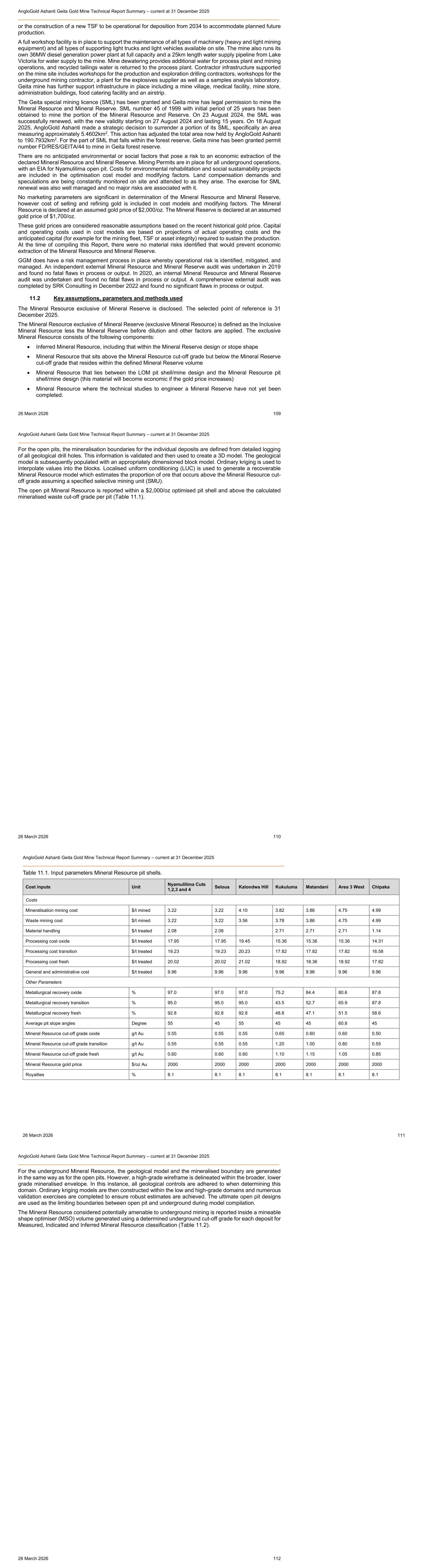
AngloGold Ashanti Geita Gold Mine Technical Report Summary – current at 31 December 2025 _____________________________________________________________________________________ 26 March 2026 109 or the construction of a new TSF to be operational for deposition from 2034 to accommodate planned future production. A full workshop facility is in place to support the maintenance of all types of machinery (heavy and light mining equipment) and all types of supporting light trucks and light vehicles available on site. The mine also runs its own 36MW diesel generation power plant at full capacity and a 25km length water supply pipeline from Lake Victoria for water supply to the mine. Mine dewatering provides additional water for process plant and mining operations, and recycled tailings water is returned to the process plant. Contractor infrastructure supported on the mine site includes workshops for the production and exploration drilling contractors, workshops for the underground mining contractor, a plant for the explosives supplier as well as a samples analysis laboratory. Geita mine has further support infrastructure in place including a mine village, medical facility, mine store, administration buildings, food catering facility and an airstrip. The Geita special mining licence (SML) has been granted and Geita mine has legal permission to mine the Mineral Resource and Mineral Reserve. SML number 45 of 1999 with initial period of 25 years has been obtained to mine the portion of the Mineral Resource and Reserve. On 23 August 2024, the SML was successfully renewed, with the new validity starting on 27 August 2024 and lasting 15 years. On 18 August 2025, AngloGold Ashanti made a strategic decision to surrender a portion of its SML, specifically an area measuring approximately 5.4602km2. This action has adjusted the total area now held by AngloGold Ashanti to 190.7932km2. For the part of SML that falls within the forest reserve, Geita mine has been granted permit number FD/RES/GEITA/44 to mine in Geita forest reserve. There are no anticipated environmental or social factors that pose a risk to an economic extraction of the declared Mineral Resource and Mineral Reserve. Mining Permits are in place for all underground operations, with an EIA for Nyamulilima open pit. Costs for environmental rehabilitation and social sustainability projects are included in the optimisation cost model and modifying factors. Land compensation demands and speculations are being constantly monitored on site and attended to as they arise. The exercise for SML renewal was also well managed and no major risks are associated with it. No marketing parameters are significant in determination of the Mineral Resource and Mineral Reserve, however cost of selling and refining gold is included in cost models and modifying factors. The Mineral Resource is declared at an assumed gold price of $2,000/oz. The Mineral Reserve is declared at an assumed gold price of $1,700/oz. These gold prices are considered reasonable assumptions based on the recent historical gold price. Capital and operating costs used in cost models are based on projections of actual operating costs and the anticipated capital (for example for the mining fleet, TSF or asset integrity) required to sustain the production. At the time of compiling this Report, there were no material risks identified that would prevent economic extraction of the Mineral Resource and Mineral Reserve. GGM does have a risk management process in place whereby operational risk is identified, mitigated, and managed. An independent external Mineral Resource and Mineral Reserve audit was undertaken in 2019 and found no fatal flaws in process or output. In 2020, an internal Mineral Resource and Mineral Reserve audit was undertaken and found no fatal flaws in process or output. A comprehensive external audit was completed by SRK Consulting in December 2022 and found no significant flaws in process or output. 11.2 Key assumptions, parameters and methods used The Mineral Resource exclusive of Mineral Reserve is disclosed. The selected point of reference is 31 December 2025. The Mineral Resource exclusive of Mineral Reserve (exclusive Mineral Resource) is defined as the Inclusive Mineral Resource less the Mineral Reserve before dilution and other factors are applied. The exclusive Mineral Resource consists of the following components: • Inferred Mineral Resource, including that within the Mineral Reserve design or stope shape • Mineral Resource that sits above the Mineral Resource cut-off grade but below the Mineral Reserve cut-off grade that resides within the defined Mineral Reserve volume • Mineral Resource that lies between the LOM pit shell/mine design and the Mineral Resource pit shell/mine design (this material will become economic if the gold price increases) • Mineral Resource where the technical studies to engineer a Mineral Reserve have not yet been completed. AngloGold Ashanti Geita Gold Mine Technical Report Summary – current at 31 December 2025 _____________________________________________________________________________________ 26 March 2026 110 For the open pits, the mineralisation boundaries for the individual deposits are defined from detailed logging of all geological drill holes. This information is validated and then used to create a 3D model. The geological model is subsequently populated with an appropriately dimensioned block model. Ordinary kriging is used to interpolate values into the blocks. Localised uniform conditioning (LUC) is used to generate a recoverable Mineral Resource model which estimates the proportion of ore that occurs above the Mineral Resource cut- off grade assuming a specified selective mining unit (SMU). The open pit Mineral Resource is reported within a $2,000/oz optimised pit shell and above the calculated mineralised waste cut-off grade per pit (Table 11.1). AngloGold Ashanti Geita Gold Mine Technical Report Summary – current at 31 December 2025 _____________________________________________________________________________________ 26 March 2026 111 Table 11.1. Input parameters Mineral Resource pit shells. Cost inputs Unit Nyamulilima Cuts 1,2,3 and 4 Selous Kalondwa Hill Kukuluma Matandani Area 3 West Chipaka Costs Mineralisation mining cost $/t mined 3.22 3.22 4.10 3.82 3.86 4.75 4.99 Waste mining cost $/t mined 3.22 3.22 3.56 3.78 3.86 4.75 4.99 Material handling $/t treated 2.08 2.08 2.71 2.71 2.71 1.14 Processing cost oxide $/t treated 17.95 17.95 19.45 15.36 15.36 15.36 14.31 Processing cost transition $/t treated 19.23 19.23 20.23 17.82 17.82 17.82 16.58 Processing cost fresh $/t treated 20.02 20.02 21.02 18.92 18.36 18.92 17.82 General and administrative cost $/t treated 9.96 9.96 9.96 9.96 9.96 9.96 9.96 Other Parameters Metallurgical recovery oxide % 97.0 97.0 97.0 75.2 84.4 80.6 87.8 Metallurgical recovery transition % 95.0 95.0 95.0 43.5 52.7 65.9 87.8 Metallurgical recovery fresh % 92.8 92.8 92.8 48.8 47.1 51.5 58.6 Average pit slope angles Degree 55 45 55 45 45 60.8 45 Mineral Resource cut-off grade oxide g/t Au 0.55 0.55 0.55 0.65 0.60 0.60 0.50 Mineral Resource cut-off grade transition g/t Au 0.55 0.55 0.55 1.20 1.00 0.80 0.55 Mineral Resource cut-off grade fresh g/t Au 0.60 0.60 0.60 1.10 1.15 1.05 0.85 Mineral Resource gold price $/oz Au 2000 2000 2000 2000 2000 2000 2000 Royalties % 8.1 8.1 8.1 8.1 8.1 8.1 8.1 AngloGold Ashanti Geita Gold Mine Technical Report Summary – current at 31 December 2025 _____________________________________________________________________________________ 26 March 2026 112 For the underground Mineral Resource, the geological model and the mineralised boundary are generated in the same way as for the open pits. However, a high-grade wireframe is delineated within the broader, lower grade mineralised envelope. In this instance, all geological controls are adhered to when determining this domain. Ordinary kriging models are then constructed within the low and high-grade domains and numerous validation exercises are completed to ensure robust estimates are achieved. The ultimate open pit designs are used as the limiting boundaries between open pit and underground during model compilation. The Mineral Resource considered potentially amenable to underground mining is reported inside a mineable shape optimiser (MSO) volume generated using a determined underground cut-off grade for each deposit for Measured, Indicated and Inferred Mineral Resource classification (Table 11.2).
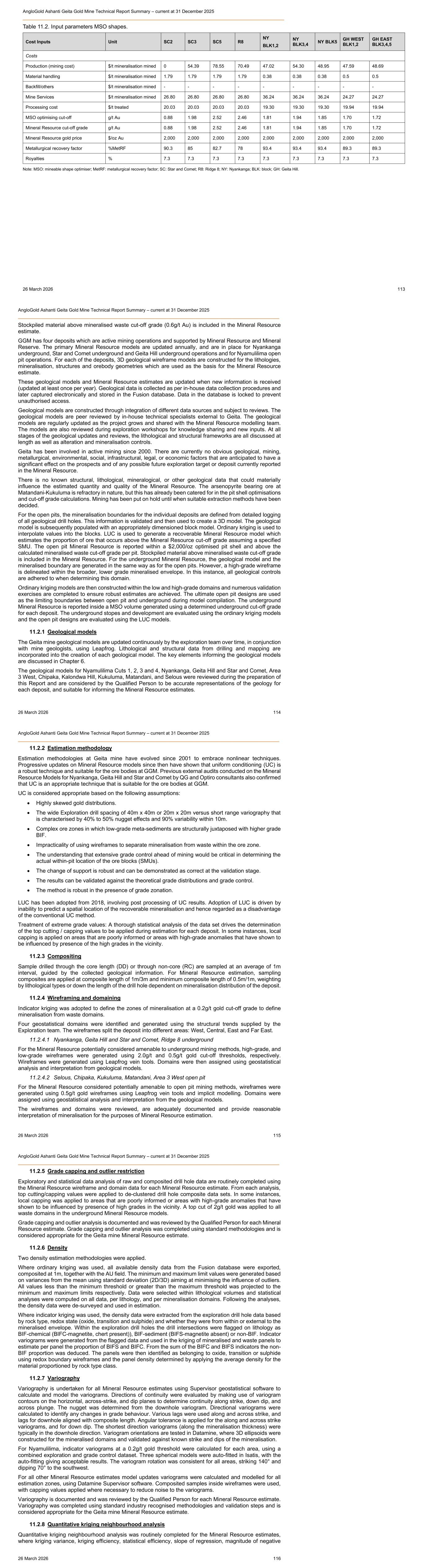
AngloGold Ashanti Geita Gold Mine Technical Report Summary – current at 31 December 2025 _____________________________________________________________________________________ 26 March 2026 113 Table 11.2. Input parameters MSO shapes. Cost Inputs Unit SC2 SC3 SC5 R8 NY BLK1,2 NY BLK3,4 NY BLK5 GH WEST BLK1,2 GH EAST BLK3,4,5 Costs Production (mining cost) $/t mineralisation mined 0 54.39 78.55 70.49 47.02 54.30 48.95 47.59 48.69 Material handling $/t mineralisation mined 1.79 1.79 1.79 1.79 0.38 0.38 0.38 0.5 0.5 Backfill/others $/t mineralisation mined - - - - - - - - - Mine Services $/t mineralisation mined 26.80 26.80 26.80 26.80 36.24 36.24 36.24 24.27 24.27 Processing cost $/t treated 20.03 20.03 20.03 20.03 19.30 19.30 19.30 19.94 19.94 MSO optimising cut-off g/t Au 0.88 1.98 2.52 2.46 1.81 1.94 1.85 1.70 1.72 Mineral Resource cut-off grade g/t Au 0.88 1.98 2.52 2.46 1.81 1.94 1.85 1.70 1.72 Mineral Resource gold price $/oz Au 2,000 2,000 2,000 2,000 2,000 2,000 2,000 2,000 2,000 Metallurgical recovery factor %MetRF 90.3 85 82.7 78 93.4 93.4 93.4 89.3 89.3 Royalties % 7.3 7.3 7.3 7.3 7.3 7.3 7.3 7.3 7.3 Note: MSO: mineable shape optimiser; MetRF: metallurgical recovery factor; SC: Star and Comet; R8: Ridge 8; NY: Nyankanga; BLK: block; GH: Geita Hill. AngloGold Ashanti Geita Gold Mine Technical Report Summary – current at 31 December 2025 _____________________________________________________________________________________ 26 March 2026 114 Stockpiled material above mineralised waste cut-off grade (0.6g/t Au) is included in the Mineral Resource estimate. GGM has four deposits which are active mining operations and supported by Mineral Resource and Mineral Reserve. The primary Mineral Resource models are updated annually, and are in place for Nyankanga underground, Star and Comet underground and Geita Hill underground operations and for Nyamulilima open pit operations. For each of the deposits, 3D geological wireframe models are constructed for the lithologies, mineralisation, structures and orebody geometries which are used as the basis for the Mineral Resource estimate. These geological models and Mineral Resource estimates are updated when new information is received (updated at least once per year). Geological data is collected as per in-house data collection procedures and later captured electronically and stored in the Fusion database. Data in the database is locked to prevent unauthorised access. Geological models are constructed through integration of different data sources and subject to reviews. The geological models are peer reviewed by in-house technical specialists external to Geita. The geological models are regularly updated as the project grows and shared with the Mineral Resource modelling team. The models are also reviewed during exploration workshops for knowledge sharing and new inputs. At all stages of the geological updates and reviews, the lithological and structural frameworks are all discussed at length as well as alteration and mineralisation controls. Geita has been involved in active mining since 2000. There are currently no obvious geological, mining, metallurgical, environmental, social, infrastructural, legal, or economic factors that are anticipated to have a significant effect on the prospects and of any possible future exploration target or deposit currently reported in the Mineral Resource. There is no known structural, lithological, mineralogical, or other geological data that could materially influence the estimated quantity and quality of the Mineral Resource. The arsenopyrite bearing ore at Matandani-Kukuluma is refractory in nature, but this has already been catered for in the pit shell optimisations and cut-off grade calculations. Mining has been put on hold until when suitable extraction methods have been decided. For the open pits, the mineralisation boundaries for the individual deposits are defined from detailed logging of all geological drill holes. This information is validated and then used to create a 3D model. The geological model is subsequently populated with an appropriately dimensioned block model. Ordinary kriging is used to interpolate values into the blocks. LUC is used to generate a recoverable Mineral Resource model which estimates the proportion of ore that occurs above the Mineral Resource cut-off grade assuming a specified SMU. The open pit Mineral Resource is reported within a $2,000/oz optimised pit shell and above the calculated mineralised waste cut-off grade per pit. Stockpiled material above mineralised waste cut-off grade is included in the Mineral Resource. For the underground Mineral Resource, the geological model and the mineralised boundary are generated in the same way as for the open pits. However, a high-grade wireframe is delineated within the broader, lower grade mineralised envelope. In this instance, all geological controls are adhered to when determining this domain. Ordinary kriging models are then constructed within the low and high-grade domains and numerous validation exercises are completed to ensure robust estimates are achieved. The ultimate open pit designs are used as the limiting boundaries between open pit and underground during model compilation. The underground Mineral Resource is reported inside a MSO volume generated using a determined underground cut-off grade for each deposit. The underground stopes and development are evaluated using the ordinary kriging models and the open pit designs are evaluated using the LUC models. 11.2.1 Geological models The Geita mine geological models are updated continuously by the exploration team over time, in conjunction with mine geologists, using Leapfrog. Lithological and structural data from drilling and mapping are incorporated into the creation of each geological model. The key elements informing the geological models are discussed in Chapter 6. The geological models for Nyamulilima Cuts 1, 2, 3 and 4, Nyankanga, Geita Hill and Star and Comet, Area 3 West, Chipaka, Kalondwa Hill, Kukuluma, Matandani, and Selous were reviewed during the preparation of this Report and are considered by the Qualified Person to be accurate representations of the geology for each deposit, and suitable for informing the Mineral Resource estimates. AngloGold Ashanti Geita Gold Mine Technical Report Summary – current at 31 December 2025 _____________________________________________________________________________________ 26 March 2026 115 11.2.2 Estimation methodology Estimation methodologies at Geita mine have evolved since 2001 to embrace nonlinear techniques. Progressive updates on Mineral Resource models since then have shown that uniform conditioning (UC) is a robust technique and suitable for the ore bodies at GGM. Previous external audits conducted on the Mineral Resource Models for Nyankanga, Geita Hill and Star and Comet by QG and Optiro consultants also confirmed that UC is an appropriate technique that is suitable for the ore bodies at GGM. UC is considered appropriate based on the following assumptions: • Highly skewed gold distributions. • The wide Exploration drill spacing of 40m x 40m or 20m x 20m versus short range variography that is characterised by 40% to 50% nugget effects and 90% variability within 10m. • Complex ore zones in which low-grade meta-sediments are structurally juxtaposed with higher grade BIF. • Impracticality of using wireframes to separate mineralisation from waste within the ore zone. • The understanding that extensive grade control ahead of mining would be critical in determining the actual within-pit location of the ore blocks (SMUs). • The change of support is robust and can be demonstrated as correct at the validation stage. • The results can be validated against the theoretical grade distributions and grade control. • The method is robust in the presence of grade zonation. LUC has been adopted from 2018, involving post processing of UC results. Adoption of LUC is driven by inability to predict a spatial location of the recoverable mineralisation and hence regarded as a disadvantage of the conventional UC method. Treatment of extreme grade values: A thorough statistical analysis of the data set drives the determination of the top cutting / capping values to be applied during estimation for each deposit. In some instances, local capping is applied on areas that are poorly informed or areas with high-grade anomalies that have shown to be influenced by presence of the high grades in the vicinity. 11.2.3 Compositing Sample drilled through the core length (DD) or through non-core (RC) are sampled at an average of 1m interval, guided by the collected geological information. For Mineral Resource estimation, sampling composites are applied at composite length of 1m/3m and minimum composite length of 0.5m/1m, weighting by lithological types or down the length of the drill hole dependent on mineralisation distribution of the deposit. 11.2.4 Wireframing and domaining Indicator kriging was adopted to define the zones of mineralisation at a 0.2g/t gold cut-off grade to define mineralisation from waste domains. Four geostatistical domains were identified and generated using the structural trends supplied by the Exploration team. The wireframes split the deposit into different areas: West, Central, East and Far East. 11.2.4.1 Nyankanga, Geita Hill and Star and Comet, Ridge 8 underground For the Mineral Resource potentially considered amenable to underground mining methods, high-grade, and low-grade wireframes were generated using 2.0g/t and 0.5g/t gold cut-off thresholds, respectively. Wireframes were generated using Leapfrog vein tools. Domains were then assigned using geostatistical analysis and interpretation from geological models. 11.2.4.2 Selous, Chipaka, Kukuluma, Matandani, Area 3 West open pit For the Mineral Resource considered potentially amenable to open pit mining methods, wireframes were generated using 0.5g/t gold wireframes using Leapfrog vein tools and implicit modelling. Domains were assigned using geostatistical analysis and interpretation from the geological models. The wireframes and domains were reviewed, are adequately documented and provide reasonable interpretation of mineralisation for the purposes of Mineral Resource estimation. AngloGold Ashanti Geita Gold Mine Technical Report Summary – current at 31 December 2025 _____________________________________________________________________________________ 26 March 2026 116 11.2.5 Grade capping and outlier restriction Exploratory and statistical data analysis of raw and composited drill hole data are routinely completed using the Mineral Resource wireframe and domain data for each Mineral Resource estimate. From each analysis, top cutting/capping values were applied to de-clustered drill hole composite data sets. In some instances, local capping was applied to areas that are poorly informed or areas with high-grade anomalies that have shown to be influenced by presence of high grades in the vicinity. A top cut of 2g/t gold was applied to all waste domains in the underground Mineral Resource models. Grade capping and outlier analysis is documented and was reviewed by the Qualified Person for each Mineral Resource estimate. Grade capping and outlier analysis was completed using standard methodologies and is considered appropriate for the Geita mine Mineral Resource estimate. 11.2.6 Density Two density estimation methodologies were applied. Where ordinary kriging was used, all available density data from the Fusion database were exported, composited at 1m, together with the AU field. The minimum and maximum limit values were generated based on variances from the mean using standard deviation (2D/3D) aiming at minimising the influence of outliers. All values less than the minimum threshold or greater than the maximum threshold was projected to the minimum and maximum limits respectively. Data were selected within lithological volumes and statistical analyses were computed on all data, per lithology, and per mineralisation domains. Following the analyses, the density data were de-surveyed and used in estimation. Where indicator kriging was used, the density data were extracted from the exploration drill hole data based by rock type, redox state (oxide, transition and sulphide) and whether they were from within or external to the mineralised envelope. Within the exploration drill holes the drill intersections were flagged on lithology as BIF-chemical (BIFC-magnetite, chert present)), BIF-sediment (BIFS-magnetite absent) or non-BIF. Indicator variograms were generated from the flagged data and used in the kriging of mineralised and waste panels to estimate per panel the proportion of BIFS and BIFC. From the sum of the BIFC and BIFS indicators the non- BIF proportion was deduced. The panels were then identified as belonging to oxide, transition or sulphide using redox boundary wireframes and the panel density determined by applying the average density for the material proportioned by rock type class. 11.2.7 Variography Variography is undertaken for all Mineral Resource estimates using Supervisor geostatistical software to calculate and model the variograms. Directions of continuity were evaluated by making use of variogram contours on the horizontal, across-strike, and dip planes to determine continuity along strike, down dip, and across plunge. The nugget was determined from the downhole variogram. Directional variograms were calculated to identify any changes in grade behaviour. Various lags were used along and across strike, and lags for downhole aligned with composite length. Angular tolerance is applied for the along and across strike variograms, and for down dip. The shortest direction variograms (along the mineralisation thickness) were typically in the downhole direction. Variogram orientations are tested in Datamine, where 3D ellipsoids were constructed for the mineralised domains and validated against known strike and dips of the mineralisation. For Nyamulilima, indicator variograms at a 0.2g/t gold threshold were calculated for each area, using a combined exploration and grade control dataset. Three spherical models were auto-fitted in Isatis, with the auto-fitting giving acceptable results. The variogram rotation was consistent for all areas, striking 140° and dipping 70° to the southwest. For all other Mineral Resource estimates model updates variograms were calculated and modelled for all estimation zones, using Datamine Supervisor software. Composited samples inside wireframes were used, with capping values applied where necessary to reduce noise to the variograms. Variography is documented and was reviewed by the Qualified Person for each Mineral Resource estimate. Variography was completed using standard industry recognised methodologies and validation steps and is considered appropriate for the Geita mine Mineral Resource estimate. 11.2.8 Quantitative kriging neighbourhood analysis Quantitative kriging neighbourhood analysis was routinely completed for the Mineral Resource estimates, where kriging variance, kriging efficiency, statistical efficiency, slope of regression, magnitude of negative
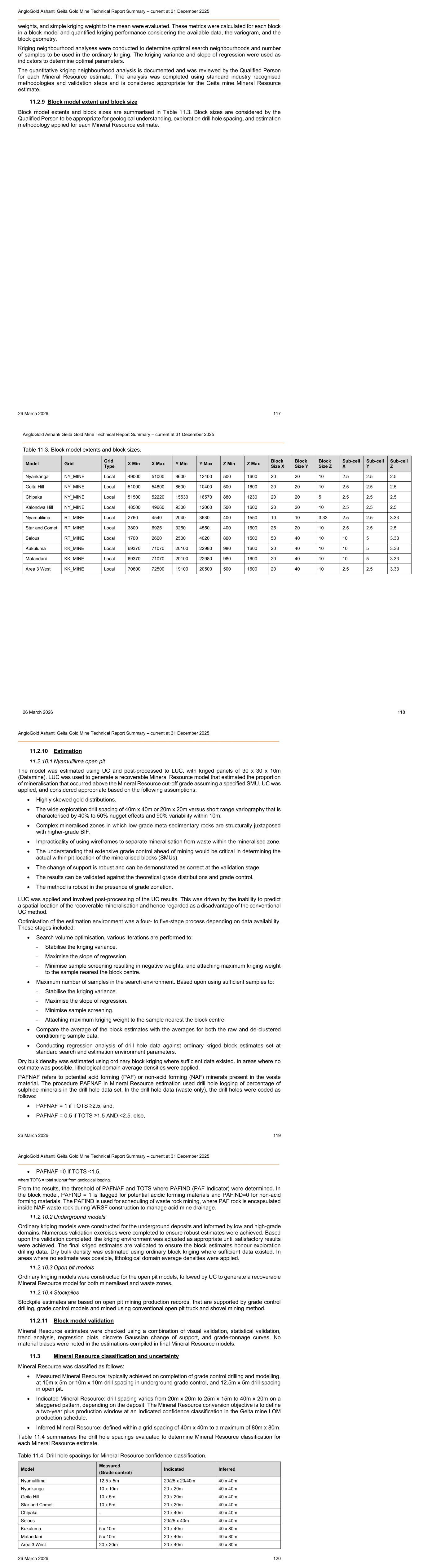
AngloGold Ashanti Geita Gold Mine Technical Report Summary – current at 31 December 2025 _____________________________________________________________________________________ 26 March 2026 117 weights, and simple kriging weight to the mean were evaluated. These metrics were calculated for each block in a block model and quantified kriging performance considering the available data, the variogram, and the block geometry. Kriging neighbourhood analyses were conducted to determine optimal search neighbourhoods and number of samples to be used in the ordinary kriging. The kriging variance and slope of regression were used as indicators to determine optimal parameters. The quantitative kriging neighbourhood analysis is documented and was reviewed by the Qualified Person for each Mineral Resource estimate. The analysis was completed using standard industry recognised methodologies and validation steps and is considered appropriate for the Geita mine Mineral Resource estimate. 11.2.9 Block model extent and block size Block model extents and block sizes are summarised in Table 11.3. Block sizes are considered by the Qualified Person to be appropriate for geological understanding, exploration drill hole spacing, and estimation methodology applied for each Mineral Resource estimate. AngloGold Ashanti Geita Gold Mine Technical Report Summary – current at 31 December 2025 _____________________________________________________________________________________ 26 March 2026 118 Table 11.3. Block model extents and block sizes. Model Grid Grid Type X Min X Max Y Min Y Max Z Min Z Max Block Size X Block Size Y Block Size Z Sub-cell X Sub-cell Y Sub-cell Z Nyankanga NY_MINE Local 49000 51000 8600 12400 500 1600 20 20 10 2.5 2.5 2.5 Geita Hill NY_MINE Local 51000 54800 8600 10400 500 1600 20 20 10 2.5 2.5 2.5 Chipaka NY_MINE Local 51500 52220 15530 16570 880 1230 20 20 5 2.5 2.5 2.5 Kalondwa Hill NY_MINE Local 48500 49660 9300 12000 500 1600 20 20 10 2.5 2.5 2.5 Nyamulilima RT_MINE Local 2760 4540 2040 3630 400 1550 10 10 3.33 2.5 2.5 3.33 Star and Comet RT_MINE Local 3800 6925 3250 4550 400 1600 25 20 10 2.5 2.5 2.5 Selous RT_MINE Local 1700 2600 2500 4020 800 1500 50 40 10 10 5 3.33 Kukuluma KK_MINE Local 69370 71070 20100 22980 980 1600 20 40 10 10 5 3.33 Matandani KK_MINE Local 69370 71070 20100 22980 980 1600 20 40 10 10 5 3.33 Area 3 West KK_MINE Local 70600 72500 19100 20500 500 1600 20 40 10 2.5 2.5 3.33 AngloGold Ashanti Geita Gold Mine Technical Report Summary – current at 31 December 2025 _____________________________________________________________________________________ 26 March 2026 119 11.2.10 Estimation 11.2.10.1 Nyamulilima open pit The model was estimated using UC and post-processed to LUC, with kriged panels of 30 x 30 x 10m (Datamine). LUC was used to generate a recoverable Mineral Resource model that estimated the proportion of mineralisation that occurred above the Mineral Resource cut-off grade assuming a specified SMU. UC was applied, and considered appropriate based on the following assumptions: • Highly skewed gold distributions. • The wide exploration drill spacing of 40m x 40m or 20m x 20m versus short range variography that is characterised by 40% to 50% nugget effects and 90% variability within 10m. • Complex mineralised zones in which low-grade meta-sedimentary rocks are structurally juxtaposed with higher-grade BIF. • Impracticality of using wireframes to separate mineralisation from waste within the mineralised zone. • The understanding that extensive grade control ahead of mining would be critical in determining the actual within pit location of the mineralised blocks (SMUs). • The change of support is robust and can be demonstrated as correct at the validation stage. • The results can be validated against the theoretical grade distributions and grade control. • The method is robust in the presence of grade zonation. LUC was applied and involved post-processing of the UC results. This was driven by the inability to predict a spatial location of the recoverable mineralisation and hence regarded as a disadvantage of the conventional UC method. Optimisation of the estimation environment was a four- to five-stage process depending on data availability. These stages included: • Search volume optimisation, various iterations are performed to: - Stabilise the kriging variance. - Maximise the slope of regression. - Minimise sample screening resulting in negative weights; and attaching maximum kriging weight to the sample nearest the block centre. • Maximum number of samples in the search environment. Based upon using sufficient samples to: - Stabilise the kriging variance. - Maximise the slope of regression. - Minimise sample screening. - Attaching maximum kriging weight to the sample nearest the block centre. • Compare the average of the block estimates with the averages for both the raw and de-clustered conditioning sample data. • Conducting regression analysis of drill hole data against ordinary kriged block estimates set at standard search and estimation environment parameters. Dry bulk density was estimated using ordinary block kriging where sufficient data existed. In areas where no estimate was possible, lithological domain average densities were applied. PAFNAF refers to potential acid forming (PAF) or non-acid forming (NAF) minerals present in the waste material. The procedure PAFNAF in Mineral Resource estimation used drill hole logging of percentage of sulphide minerals in the drill hole data set. In the drill hole data (waste only), the drill holes were coded as follows: • PAFNAF = 1 if TOTS ≥2.5, and, • PAFNAF = 0.5 if TOTS ≥1.5 AND <2.5, else, AngloGold Ashanti Geita Gold Mine Technical Report Summary – current at 31 December 2025 _____________________________________________________________________________________ 26 March 2026 120 • PAFNAF =0 If TOTS <1.5. where TOTS = total sulphur from geological logging. From the results, the threshold of PAFNAF and TOTS where PAFIND (PAF Indicator) were determined. In the block model, PAFIND = 1 is flagged for potential acidic forming materials and PAFIND=0 for non-acid forming materials. The PAFIND is used for scheduling of waste rock mining, where PAF rock is encapsulated inside NAF waste rock during WRSF construction to manage acid mine drainage. 11.2.10.2 Underground models Ordinary kriging models were constructed for the underground deposits and informed by low and high-grade domains. Numerous validation exercises were completed to ensure robust estimates were achieved. Based upon the validation completed, the kriging environment was adjusted as appropriate until satisfactory results were achieved. The final kriged estimates are validated to ensure the block estimates honour exploration drilling data. Dry bulk density was estimated using ordinary block kriging where sufficient data existed. In areas where no estimate was possible, lithological domain average densities were applied. 11.2.10.3 Open pit models Ordinary kriging models were constructed for the open pit models, followed by UC to generate a recoverable Mineral Resource model for both mineralised and waste zones. 11.2.10.4 Stockpiles Stockpile estimates are based on open pit mining production records, that are supported by grade control drilling, grade control models and mined using conventional open pit truck and shovel mining method. 11.2.11 Block model validation Mineral Resource estimates were checked using a combination of visual validation, statistical validation, trend analysis, regression plots, discrete Gaussian change of support, and grade-tonnage curves. No material biases were noted in the estimations compiled in final Mineral Resource models. 11.3 Mineral Resource classification and uncertainty Mineral Resource was classified as follows: • Measured Mineral Resource: typically achieved on completion of grade control drilling and modelling, at 10m x 5m or 10m x 10m drill spacing in underground grade control, and 12.5m x 5m drill spacing in open pit. • Indicated Mineral Resource: drill spacing varies from 20m x 20m to 25m x 15m to 40m x 20m on a staggered pattern, depending on the deposit. The Mineral Resource conversion objective is to define a two-year plus production window at an Indicated confidence classification in the Geita mine LOM production schedule. • Inferred Mineral Resource: defined within a grid spacing of 40m x 40m to a maximum of 80m x 80m. Table 11.4 summarises the drill hole spacings evaluated to determine Mineral Resource classification for each Mineral Resource estimate. Table 11.4. Drill hole spacings for Mineral Resource confidence classification. Model Measured (Grade control) Indicated Inferred Nyamulilima 12.5 x 5m 20/25 x 20/40m 40 x 40m Nyankanga 10 x 10m 20 x 20m 40 x 40m Geita Hill 10 x 5m 20 x 20m 40 x 40m Star and Comet 10 x 5m 20 x 20m 40 x 40m Chipaka - 20 x 40m 40 x 40m Selous - 20/25 x 40m 40 x 40m Kukuluma 5 x 10m 20 x 40m 40 x 80m Matandani 5 x 10m 20 x 40m 40 x 80m Area 3 West 20 x 20m 20 x 40m 40 x 80m

AngloGold Ashanti Geita Gold Mine Technical Report Summary – current at 31 December 2025 _____________________________________________________________________________________ 26 March 2026 121 No uncertainties were identified that would materially impact the Mineral Resource, including classification or level of confidence of the Mineral Resource. All aspects of the data capture from drilling, geological logging, sampling, and assaying are verified to ensure location / positional accuracy and sampling and assaying follows strict guidelines for data processing, gold analysis and QA/QC validation. Drilling, sampling, data processing and handling, geological modelling and Mineral Resource estimation were conducted as per AngloGold Ashanti standard operating procedures and guidelines, aiming at addressing uncertainties to increase Mineral Resource confidence. 11.4 Mineral Resource statement The Mineral Resource for mineralisation assumed to be amenable to open pit and underground mining methods is reported in situ. Mineralisation in stockpiles is reported as broken material, in stockpiles. The Mineral Resource is reported exclusive of the Mineral Resource converted to Mineral Reserve. Mineral Resource that is not Mineral Reserve does not have demonstrated economic viability. The Mineral Resource is current at 31 December 2025 and is shown in Table 11.5. Table 11.5. Mineral Resource statement. Area/Deposit Category Tonnes (Mt) Grade (g/t Au) Contained gold (t) (Moz Au) Area 3 West (oxides) (open pit) Measured - - - - Indicated 1.65 2.11 3.48 0.11 Sub-total Measured & Indicated 1.65 2.11 3.48 0.11 Inferred 0.62 1.51 0.94 0.03 Area 3 West (transitional) (open pit) Measured - - - - Indicated 0.18 1.96 0.35 0.01 Sub-total Measured & Indicated 0.18 1.96 0.35 0.01 Inferred 0.01 2.56 0.02 0.00 Area 3 West (sulphides) (open pit) Measured - - - - Indicated 0.01 2.15 0.01 0.00 Sub-total Measured & Indicated 0.01 2.15 0.01 0.00 Inferred 0.00 1.22 0.00 0.00 Chipaka (open pit) Measured - - - - Indicated 0.62 1.92 1.18 0.04 Sub-total Measured & Indicated 0.62 1.92 1.18 0.04 Inferred 1.19 2.17 2.59 0.08 Kalondwa Hill (open pit) Measured - - - - Indicated - - - - Sub-total Measured & Indicated - - - - Inferred 1.81 2.62 4.75 0.15 Kukuluma (oxides) (open pit) Measured - - - - Indicated 0.07 3.14 0.21 0.01 Sub-total Measured & Indicated 0.07 3.14 0.21 0.01 Inferred 0.03 1.89 0.07 0.00 Kukuluma (transitional) (open pit) Measured - - - - Indicated 0.14 4.12 0.58 0.02 Sub-total Measured & Indicated 0.14 4.12 0.58 0.02 Inferred 0.03 4.56 0.14 0.00 Kukuluma (sulphides) (open pit) Measured - - - - Indicated 0.03 4.62 0.13 0.00 AngloGold Ashanti Geita Gold Mine Technical Report Summary – current at 31 December 2025 _____________________________________________________________________________________ 26 March 2026 122 Area/Deposit Category Tonnes (Mt) Grade (g/t Au) Contained gold (t) (Moz Au) Sub-total Measured & Indicated 0.03 4.62 0.13 0.00 Inferred 0.40 3.94 1.58 0.05 Matandani (oxides) (open pit) Measured - - - - Indicated 1.95 1.78 3.47 0.11 Sub-total Measured & Indicated 1.95 1.78 3.47 0.11 Inferred 1.01 1.79 1.80 0.06 Matandani (transitional) (open pit) Measured - - - - Indicated 0.09 2.70 0.24 0.01 Sub-total Measured & Indicated 0.09 2.70 0.24 0.01 Inferred 0.26 3.53 0.91 0.03 Matandani (sulphides) (open pit) Measured - - - - Indicated 0.08 3.21 0.27 0.01 Sub-total Measured & Indicated 0.08 3.21 0.27 0.01 Inferred 3.52 3.47 12.21 0.39 Nyamulilima Cuts 1, 2, 3 and 4 (open pit) Measured - - - - Indicated 46.01 0.94 43.07 1.38 Sub-total Measured & Indicated 46.01 0.94 43.07 1.38 Inferred 29.19 1.23 35.88 1.15 Selous (open pit) Measured - - - - Indicated - - - - Sub-total Measured & Indicated - - - - Inferred 3.03 1.86 5.62 0.18 Geita stockpile (refractory) (open pit) Measured - - - - Indicated 0.56 2.80 1.57 0.05 Sub-total Measured & Indicated 0.56 2.80 1.57 0.05 Inferred - - - - Geita Hill - West (underground) Measured 1.66 2.04 3.38 0.11 Indicated 3.38 3.54 11.94 0.38 Sub-total Measured & Indicated 5.03 3.04 15.32 0.49 Inferred 2.20 3.18 6.99 0.22 Geita Hill - East (underground) Measured - - - - Indicated 6.09 4.55 27.75 0.89 Sub-total Measured & Indicated 6.09 4.55 27.75 0.89 Inferred 1.82 3.20 5.84 0.19 Nyankanga - Blocks 1 and 2 (underground) Measured 0.81 3.47 2.80 0.09 Indicated 1.76 4.40 7.73 0.25 Sub-total Measured & Indicated 2.57 4.11 10.53 0.34 Inferred 0.43 2.79 1.20 0.04 Nyankanga - Blocks 3 and 4 (underground) Measured 3.65 2.42 8.83 0.28 Indicated 2.74 3.03 8.30 0.27 Sub-total Measured & Indicated 6.39 2.68 17.13 0.55 Inferred 2.43 3.22 7.83 0.25 Nyankanga - Block 5 (underground) Measured 0.33 2.69 0.88 0.03 Indicated 0.92 2.35 2.17 0.07 Sub-total Measured & Indicated 1.25 2.44 3.05 0.10 AngloGold Ashanti Geita Gold Mine Technical Report Summary – current at 31 December 2025 _____________________________________________________________________________________ 26 March 2026 123 Area/Deposit Category Tonnes (Mt) Grade (g/t Au) Contained gold (t) (Moz Au) Inferred 2.69 3.30 8.89 0.29 Ridge 8 (underground) Measured - - - - Indicated 1.37 3.76 5.14 0.17 Sub-total Measured & Indicated 1.37 3.76 5.14 0.17 Inferred 0.88 4.04 3.57 0.11 Star and Comet - Cut 2 (underground) Measured 2.12 2.24 4.75 0.15 Indicated 0.94 0.76 0.71 0.02 Sub-total Measured & Indicated 3.06 1.78 5.46 0.18 Inferred 0.24 3.39 0.82 0.03 Star and Comet - Cut 3 (underground) Measured 1.29 2.83 3.66 0.12 Indicated 1.11 3.21 3.56 0.11 Sub-total Measured & Indicated 2.40 3.01 7.21 0.23 Inferred 0.56 3.57 2.01 0.06 Star and Comet - Cut 5 (underground) Measured 0.05 4.44 0.21 0.01 Indicated 0.47 5.19 2.46 0.08 Sub-total Measured & Indicated 0.52 5.12 2.67 0.09 Inferred 0.86 4 3.45 0.11 Total Geita mine (underground and open pit) Measured 9.90 2.47 24.51 0.79 Indicated 70.15 1.77 124.31 4.00 Total Measured & Indicated 80.05 1.86 148.82 4.78 Inferred 53.22 2.01 107.09 3.44 Notes: Rounding of numbers may result in computational discrepancies in the Mineral Resource tabulations. All figures are expressed on an attributable basis unless otherwise indicated. To reflect that figures are not precise calculations and that there is uncertainty in their estimation, AngloGold Ashanti reports tonnage, grade and content for gold to two decimals. All ounces are Troy ounces. “Moz” refers to million ounces. 1. The Mineral Resource stated herein is current at date and was prepared in compliance with Regulation S-K 1300 2. All disclosure of Mineral Resource is exclusive of Mineral Reserve. The Mineral Resource exclusive of Mineral Reserve is defined as the inclusive Mineral Resource less the Mineral Reserve before dilution and other factors are applied. 3. “Tonnes” refers to a metric tonne which is equivalent to 1,000 kilograms. 4. The Mineral Resource tonnages and grades are reported in situ and constrained to meet the requirement for reasonable prospects of economic extraction by volumes created through a mine shape optimiser process for underground or within an economically optimised pit shell for open pit and stockpiled material is reported as broken material. 5. Property currently in a production stage. 6. Based on a gold price of $2,000/oz. 7. Ms. Janeth Luponelo, RM SME, employed by AngloGold Ashanti, is the Qualified Person for the Geita mine Mineral Resource. 8. In 2025, a cut-off grade range from 0.50g/t to 1.20g/t gold (varying according to area) was applied to the open pit, and a cut-off grade range from 0.88g/t to 2.52g/t gold (varying according to area) was applied to the underground. 9. In 2025, a metallurgical recovery factor range from 43.50% to 97.00% (varying according to material type) was applied to the open pit, a metallurgical recovery factor of 92.80% was applied to the stockpile, and a metallurgical recovery factor range from 78.02% to 93.37% (varying according to area) was applied to the underground for gold. 11.5 Factors that may affect the Mineral Resource estimates Uncertainties that may affect the Mineral Resource estimates include changes to the following: • Metal price and exchange rate assumptions. • Assumptions used to generate the gold grade cut-off grade. • Local interpretations of mineralisation geometry and continuity of mineralised zones. • Geological and mineralisation shape and geological and grade continuity assumptions. • Density and domain assignments. • Geotechnical, mining, and metallurgical recovery assumptions. AngloGold Ashanti Geita Gold Mine Technical Report Summary – current at 31 December 2025 _____________________________________________________________________________________ 26 March 2026 124 • Input and design parameter assumptions that pertain to the conceptual stope designs and pit shells constraining the estimates. • Assumptions as to the continued ability to access the site, retain mineral and surface rights titles, maintain environment and other regulatory permits, and maintain the social licence to operate. 11.6 Qualified Person's opinion There is upside potential for the estimates if mineralisation that is currently classified as Inferred Mineral Resource can be upgraded to higher-confidence Mineral Resource categories. Current reconciliation of the Mineral Resource models with actual production is in line with industry benchmarks; however, it is possible that the reconciliation of the Mineral Resource models with actual production may decline as mining goes deeper. The Mineral Resource estimate has been prepared using industry accepted practice and conforms to the disclosure requirements of S-K1300. The Mineral Resource estimates are evaluated annually providing the opportunity to reassess the assumed conditions. There are no other environmental, legal, title, taxation, socioeconomic, marketing, political or other relevant factors known to the Qualified Person that would materially affect the estimation of the Mineral Resource that are not discussed in this Report. 12. Mineral Reserve estimates The Mineral Reserve is reported for Nyamulilima Cuts 1, 2, 3 and 4, Geita Hill, Nyankanga, Star and Comet, and in stockpiles. The Mineral Reserve tonnages and grades are estimated and reported as delivered to the plant (i.e., the point where material is delivered to the processing facility). The selected point of reference is 31 December 2025. 12.1 Key assumptions, parameters and methods used The open pit mine makes use of traditional truck and shovel mining while the underground mines make use of two methods, up-hole longitudinal retreat and/or transverse mining. Mine designs are derived from optimised mining shapes using a gold price of $1,700/oz. 12.1.1 Open pit The Mineral Resource models received from the geology department on-site were first prepared for pit optimisation. The first step was performing the model data checks that include checking for zero densities, missing cells, and grade errors. Waste blocks were added to the Mineral Resource models by the geology departments evaluation team so as to cover projected practical pit limits. The models are also depleted using projected end-of-year surfaces. The conversion of Mineral Resource models to Gemcoms Whittle 4X optimisation models also includes the digital insertion into the model of mining and processing costs. A reference level or elevation is selected for each pit and the base cost applicable at that reference level determined. Additional costs related to elevation and material type are added. These are termed the mining cost adjustment factors and processing cost adjustment factors. The Datamine sub-celled model was converted to a Datamine regularised model (10m length x 5m width x 3.33m height) and used in Whittle 4X. The Datamine regularised mode enables faster processing time allowing for multiple scenarios. For the open pit, optimised pit shells were created using Whittle optimisation software and typically selected the optimisation shell that represented the revenue factor shell, i.e., the $1,700/oz gold shell. A practical mine design was created from the selected optimised Whittle shell allowing for in pit haul roads, berms, water deviation channels and other infrastructure considerations. All relevant geological, geotechnical, hydrogeological, equipment type, and mining rates were factored into the design and schedules. In the Whittle pit optimisation process only, Measured and Indicated Mineral Resource was considered for process plant treatment, with the combined marginal-grade ore deferred for treatment at the end of the LOM. The four components of the Measured and Indicated Mineral Resource are the in situ full-grade ore, the in situ marginal-grade ore, stockpiled full-grade ore and stockpiled marginal-grade ore. The in situ components

AngloGold Ashanti Geita Gold Mine Technical Report Summary – current at 31 December 2025 _____________________________________________________________________________________ 26 March 2026 125 are determined from the material above the respective full-grade ore and marginal-grade ore cut-off grades and lie within the practical design pit shell. To assist the sequencing of the Mineral Reserve sources, the cash cost per recovered ounce for each cutback or pit was calculated and ranked from lowest to highest. To maximise the return on investment, cutbacks with the lowest cash cost (or in other words highest cash margins) were excavated first. Other considerations were: • Target range of volumes moved per annum matched to the heavy mining fleet capacity. • Satellite ROM to main ROM haulage capacity. • Practical bench turnover rate. This sequencing was independent of any sequencing information obtained from the nested pits in Whittle. The treatment scheduling philosophy was that higher-grade, lower stripping ratio ore was preferentially treated, whilst lower-grade and marginal material was stockpiled for later treatment. 12.1.2 Underground The underground department uses Datamine Studio Underground, Enhanced Production Scheduler (EPS) and MSO software for the underground Mineral Reserve optimisation. The first principal costing approach is followed where the in situ economic cut-off grade is determined using the cost and modifying factors and then applied in the Datamine's Studio Underground software to determine the Mineral Reserve MSO shapes. The appropriate factors are then applied to declare Mineral Reserve (Figure 12.1). Figure 12.1. 2025 Mineral Reserve modifying factors regarding mining methods. Note: Figure prepared by AngloGold Ashanti, 2025. 12.1.3 Input assumptions A combination of MSO and Stope Notes is used for Mineral Reserve estimates. Stope Notes is an AngloGold Ashanti-approved method for creating signed-off stope notes. All relevant geological, geotechnical, and hydrogeological data, ventilation requirements, equipment types, and mining rates are factored into the design and schedules. AngloGold Ashanti Geita Gold Mine Technical Report Summary – current at 31 December 2025 _____________________________________________________________________________________ 26 March 2026 126 Mining and processing assumption factors were applied such as: • Face and regional pit slope angles. • Dilution. • Mining recovery. • Metallurgical recovery factor. • Revenue factors: - Gold price. - Refinery costs. - Selling costs. - Royalties. • Costs: - Mining. - Material handling - General and administrative. - Processing. - Mine closure. The open pit and underground assumptions are listed in Table 12.1 and Table 12.2, respectively. Table 12.1. Open pit input assumptions. Cost inputs Unit Nyamulilima Cuts 1, 2, 3 and 4 Ore tonnes mined kt 41,071 Waste mined kt 131,772 Total material mined kt 172,844 Stripping ratio t:t 3.21 Costs Mineralisation mining $/t mined 3.32 Waste mining $/t mined 3.22 Material handling $/t treated 2.08 Processing $/t treated 19.07 General and administrative $/t treated 16.88 Other Parameters Metallurgical recovery % 92.80 Slope angles degree 40-55 Mineral Reserve cut-off grade g/t Au 0.95 Mineral Reserve price $/oz Au 1,700 Royalties % 8.1 AngloGold Ashanti Geita Gold Mine Technical Report Summary – current at 31 December 2025 _____________________________________________________________________________________ 26 March 2026 127 Table 12.2. Underground input assumptions. Cost Inputs Unit SC3 SC5 R8 NYB12 NY34 NYB5 GHW GHE Ore tonnes mined kt 196.7 568.7 500.2 722.0 5,656.4 765.1 748.3 4,263.0 Total material mined kt 218.2 889.3 752.7 907.4 6,538.45 862.4 917.0 4,968.4 Costs Production (mining cost) $/t mineralisation 70.08 70.08 70.08 53.02 53.02 53.02 51.00 51.00 Mine services $/t mineralisation 28.59 28.59 28.59 36.55 36.55 36.55 24.77 24.77 Processing cost $/t treated 19.32 19.32 19.32 19.30 19.30 19.30 19.94 19.94 MSO optimising cut-off g/t Au 3.29 2.97 3.36 2.40 2.83 2.78 2.88 2.68 Mineral Reserve cut-off grade g/t Au 2.33 2.90 2.94 2.12 2.32 2.12 2.14 2.08 Mineral Reserve price $/oz Au 1,700 1,700 1,700 1,700 1,700 1,700 1,700 1,700 Metallurgical recovery factor %MetRF 85.00 82.65 78.02 93.37 93.37 93.37 89.26 89.30 Royalties % 8.1 8.1 8.1 8.1 8.1 8.1 8.1 8.1 Note: MSO: mineable shape optimiser; MetRF: metallurgical recovery factor; SC: Star and Comet; NY: Nyankanga; B: blocks; GH: Geita Hill; W: west; E: east. 12.1.4 Modifying factors The factors applied are Mineral Resource modifying factor (RMF), mining recovery factor (MRF), mine call factor (MCF) and metallurgical recovery factor (MetRF). For underground operations a MRF and dilution is applied. The Mineral Reserve modifying factors are listed in Table 12.3. Table 12.3. Mineral Reserve modifying factors. Deposit/Area Primary commodity price (Au) ($/oz) Cut-off grade (g/t Au) Stoping width (cm) Dilution (%) Nyamulilima Cuts 1, 2, 3 and 4 (open pit) 1,700 0.95 - 5.44 Stockpile (full grade) (open pit) 1,700 0.88 - - Stockpile (marginal) (open pit) 1,700 0.70 - - Geita Hill – West (underground) 1,700 2.88 450 14.80 Geita Hill – East (underground) 1,700 2.68 2,500 14.80 Nyankanga - Blocks 1 and 2 (underground) 1,700 2.40 2,500 14.40 Nyankanga - Blocks 3 and 4 (underground) 1,700 2.83 2,500 14.20 Nyankanga - Block 5 (underground) 1,700 2.78 2,500 17.40 Ridge 8 (underground) 1,700 3.36 450 10.00 Star and Comet - Cut 3 (underground) 1,700 3.29 450 19.90 Star and Comet - Cut 5 (underground) 1,700 2.97 450 10.00 AngloGold Ashanti Geita Gold Mine Technical Report Summary – current at 31 December 2025 _____________________________________________________________________________________ 26 March 2026 128 Table 12.3. Mineral Reserve modifying factors (continued). Deposit/Area RMF (%) (based on g/t Au) MRF (%) (based on tonnes) MRF (%) (based on g/t Au) MCF (%) MetRF (%) Nyamulilima Cuts 1, 2, 3 and 4 (open pit) 106.88 107.0 95.0 100.0 92.80 Stockpile (full grade) (open pit) - - - - 92.80 Stockpile (marginal) (open pit) - - - - 92.80 Geita Hill – West (underground) 100.0 86.01 86.01 100.0 89.26 Geita Hill – East (underground) 100.0 76.44 76.44 100.0 89.30 Nyankanga - Blocks 1 and 2 (underground) 100.0 89.00 89.00 100.0 93.37 Nyankanga - Blocks 3 and 4 (underground) 100.0 93.04 93.04 100.0 93.37 Nyankanga - Block 5 (underground) 100.0 95.00 95.00 100.0 93.37 Ridge 8 (underground) 100.0 89.15 89.15 100.0 78.02 Star and Comet - Cut 3 (underground) 100.0 81.33 81.33 100.0 85.00 Star and Comet - Cut 5 (underground) 100.0 95.00 95.00 100.0 82.65 Note: RMF: Mineral Resource modifying factor; MRF: mining recovery factor; MCF: mine call factor; MetRF: metallurgical recovery factor. 12.2 Cut-off grades All costs and parameters were based on the 2026 business plan. The cut-off grade was based on economic factors using a break-even point to determine ore. 12.2.1 Full-grade ore cut-off The full-grade ore cut-off is the breakeven grade where all costs, except direct mining cost, carry the full operation. The key assumption is that direct mining costs are sunk since the decision to mine would have been made already. What would be outstanding at that stage is determining the destination of the material in line with its ability to pay for varying levels of other input costs. Material above full-grade ore cut-off grades will be processed as it is mined, subject to stockpile variations. The following formula is used to calculate the full-grade ore cut-off: )(** CsPrm CmcCsibcComCmfCrCaCp g − ++++++ = Where: • Cp is the total processing costs (fixed and variable) in $/t of ore treated. • Ca is general and administrative cost in $/t of ore treated. • Cr is the cost of rehandle in $/t treated. • Cmf is mining, contractor (<10%) and geology fixed cost in $/t treated. • Com is the difference between ore and waste mining cost in $/t treated (also called the additional ore cost). • Csibc is non-mining stay in business capital and items of a capital nature in $/t treated over LOM. • Cmc is mine closure cost incurred during the LOM in $/t treated. • r is the metallurgical recovery (%). • m is the mine call factor (96%). • P is the gold price in $/g. • Cs is the cost of selling gold (refining, royalties, management fees) in $/g. 12.2.2 Open pit The following cut-off grades were used: • Nyamulilima oxide: 0.85g/t gold. • Nyamulilima transitional: 0.90g/t gold.
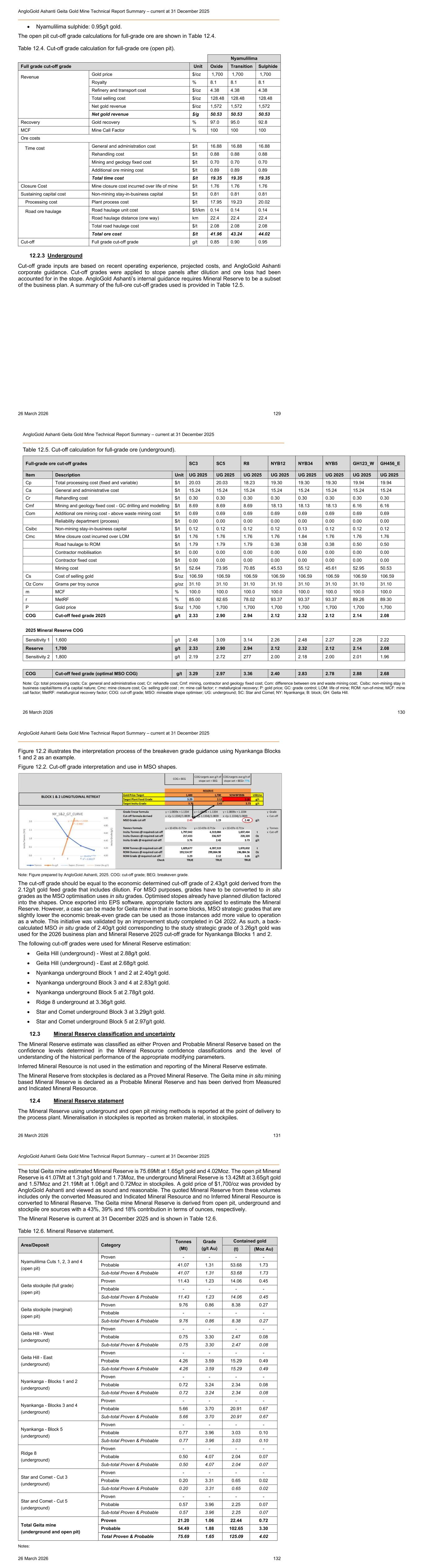
AngloGold Ashanti Geita Gold Mine Technical Report Summary – current at 31 December 2025 _____________________________________________________________________________________ 26 March 2026 129 • Nyamulilima sulphide: 0.95g/t gold. The open pit cut-off grade calculations for full-grade ore are shown in Table 12.4. Table 12.4. Cut-off grade calculation for full-grade ore (open pit). Nyamulilima Full grade cut-off grade Unit Oxide Transition Sulphide Revenue Gold price $/oz 1,700 1,700 1,700 Royalty % 8.1 8.1 8.1 Refinery and transport cost $/oz 4.38 4.38 4.38 Total selling cost $/oz 128.48 128.48 128.48 Net gold revenue $/oz 1,572 1,572 1,572 Net gold revenue $/g 50.53 50.53 50.53 Recovery Gold recovery % 97.0 95.0 92.8 MCF Mine Call Factor % 100 100 100 Ore costs Time cost General and administration cost $/t 16.88 16.88 16.88 Rehandling cost $/t 0.88 0.88 0.88 Mining and geology fixed cost $/t 0.70 0.70 0.70 Additional ore mining cost $/t 0.89 0.89 0.89 Total time cost $/t 19.35 19.35 19.35 Closure Cost Mine closure cost incurred over life of mine $/t 1.76 1.76 1.76 Sustaining capital cost Non-mining stay-in-business capital $/t 0.81 0.81 0.81 Processing cost Plant process cost $/t 17.95 19.23 20.02 Road ore haulage Road haulage unit cost $/t/km 0.14 0.14 0.14 Road haulage distance (one way) km 22.4 22.4 22.4 Total road haulage cost $/t 2.08 2.08 2.08 Total ore cost $/t 41.96 43.24 44.02 Cut-off Full grade cut-off grade g/t 0.85 0.90 0.95 12.2.3 Underground Cut-off grade inputs are based on recent operating experience, projected costs, and AngloGold Ashanti corporate guidance. Cut-off grades were applied to stope panels after dilution and ore loss had been accounted for in the stope. AngloGold Ashanti’s internal guidance requires Mineral Reserve to be a subset of the business plan. A summary of the full-ore cut-off grades used is provided in Table 12.5. AngloGold Ashanti Geita Gold Mine Technical Report Summary – current at 31 December 2025 _____________________________________________________________________________________ 26 March 2026 130 Table 12.5. Cut-off calculation for full-grade ore (underground). Full-grade ore cut-off grades SC3 SC5 R8 NYB12 NYB34 NYB5 GH123_W GH456_E Item Description Unit UG 2025 UG 2025 UG 2025 UG 2025 UG 2025 UG 2025 UG 2025 UG 2025 Cp Total processing cost (fixed and variable) $/t 20.03 20.03 18.23 19.30 19.30 19.30 19.94 19.94 Ca General and administrative cost $/t 15.24 15.24 15.24 15.24 15.24 15.24 15.24 15.24 Cr Rehandling cost $/t 0.30 0.30 0.30 0.30 0.30 0.30 0.30 0.30 Cmf Mining and geology fixed cost - GC drilling and modelling $/t 8.69 8.69 8.69 18.13 18.13 18.13 6.16 6.16 Com Additional ore mining cost - above waste mining cost $/t 0.69 0.69 0.69 0.69 0.69 0.69 0.69 0.69 Reliability department (process) $/t 0.00 0.00 0.00 0.00 0.00 0.00 0.00 0.00 Csibc Non-mining stay-in-business capital $/t 0.12 0.12 0.12 0.12 0.13 0.12 0.12 0.12 Cmc Mine closure cost incurred over LOM $/t 1.76 1.76 1.76 1.76 1.84 1.76 1.76 1.76 Road haulage to ROM $/t 1.79 1.79 1.79 0.38 0.38 0.38 0.50 0.50 Contractor mobilisation $/t 0.00 0.00 0.00 0.00 0.00 0.00 0.00 0.00 Contractor fixed cost $/t 0.00 0.00 0.00 0.00 0.00 0.00 0.00 0.00 Mining cost $/t 52.64 73.95 70.85 45.53 55.12 45.61 52.95 50.53 Cs Cost of selling gold $/oz 106.59 106.59 106.59 106.59 106.59 106.59 106.59 106.59 Oz Conv Grams per troy ounce g/oz 31.10 31.10 31.10 31.10 31.10 31.10 31.10 31.10 m MCF % 100.0 100.0 100.0 100.0 100.0 100.0 100.0 100.0 r MetRF % 85.00 82.65 78.02 93.37 93.37 93.37 89.26 89.30 P Gold price $/oz 1,700 1,700 1,700 1,700 1,700 1,700 1,700 1,700 COG Cut-off feed grade 2025 g/t 2.33 2.90 2.94 2.12 2.32 2.12 2.14 2.08 2025 Mineral Reserve COG Sensitivity 1 1,600 g/t 2.48 3.09 3.14 2.26 2.48 2.27 2.28 2.22 Reserve 1,700 g/t 2.33 2.90 2.94 2.12 2.32 2.12 2.14 2.08 Sensitivity 2 1,800 g/t 2.19 2.72 277 2.00 2.18 2.00 2.01 1.96 COG Cut-off feed grade (optimal MSO COG) g/t 3.29 2.97 3.36 2.40 2.83 2.78 2.88 2.68 Note: Cp: total processing costs; Ca: general and administrative cost; Cr: rehandle cost; Cmf: mining, contractor and geology fixed cost; Com: difference between ore and waste mining cost; Csibc: non-mining stay in business capital/items of a capital nature; Cmc: mine closure cost; Cs: selling gold cost ; m: mine call factor; r: metallurgical recovery; P: gold price; GC: grade control; LOM: life of mine; ROM: run-of-mine; MCF: mine call factor; MetRF: metallurgical recovery factor; COG: cut-off grade; MSO: mineable shape optimiser; UG: underground; SC: Star and Comet; NY: Nyankanga; B: block; GH: Geita Hill. AngloGold Ashanti Geita Gold Mine Technical Report Summary – current at 31 December 2025 _____________________________________________________________________________________ 26 March 2026 131 Figure 12.2 illustrates the interpretation process of the breakeven grade guidance using Nyankanga Blocks 1 and 2 as an example. Figure 12.2. Cut-off grade interpretation and use in MSO shapes. Note: Figure prepared by AngloGold Ashanti, 2025. COG: cut-off grade; BEG: breakeven grade. The cut-off grade should be equal to the economic determined cut-off grade of 2.43g/t gold derived from the 2.12g/t gold feed grade that includes dilution. For MSO purposes, grades have to be converted to in situ grades as the MSO optimisation uses in situ grades. Optimised stopes already have planned dilution factored into the shapes. Once exported into EPS software, appropriate factors are applied to estimate the Mineral Reserve. However, a case can be made for Geita mine in that in some blocks, MSO strategic grades that are slightly lower the economic break-even grade can be used as those instances add more value to operation as a whole. This initiative was validated by an improvement study completed in Q4 2022. As such, a back- calculated MSO in situ grade of 2.40g/t gold corresponding to the study strategic grade of 3.26g/t gold was used for the 2026 business plan and Mineral Reserve 2025 cut-off grade for Nyankanga Blocks 1 and 2. The following cut-off grades were used for Mineral Reserve estimation: • Geita Hill (underground) - West at 2.88g/t gold. • Geita Hill (underground) - East at 2.68g/t gold. • Nyankanga underground Block 1 and 2 at 2.40g/t gold. • Nyankanga underground Block 3 and 4 at 2.83g/t gold. • Nyankanga underground Block 5 at 2.78g/t gold. • Ridge 8 underground at 3.36g/t gold. • Star and Comet underground Block 3 at 3.29g/t gold. • Star and Comet underground Block 5 at 2.97g/t gold. 12.3 Mineral Reserve classification and uncertainty The Mineral Reserve estimate was classified as either Proven and Probable Mineral Reserve based on the confidence levels determined in the Mineral Resource confidence classifications and the level of understanding of the historical performance of the appropriate modifying parameters. Inferred Mineral Resource is not used in the estimation and reporting of the Mineral Reserve estimate. The Mineral Reserve from stockpiles is declared as a Proved Mineral Reserve. The Geita mine in situ mining based Mineral Reserve is declared as a Probable Mineral Reserve and has been derived from Measured and Indicated Mineral Resource. 12.4 Mineral Reserve statement The Mineral Reserve using underground and open pit mining methods is reported at the point of delivery to the process plant. Mineralisation in stockpiles is reported as broken material, in stockpiles. AngloGold Ashanti Geita Gold Mine Technical Report Summary – current at 31 December 2025 _____________________________________________________________________________________ 26 March 2026 132 The total Geita mine estimated Mineral Reserve is 75.69Mt at 1.65g/t gold and 4.02Moz. The open pit Mineral Reserve is 41.07Mt at 1.31g/t gold and 1.73Moz, the underground Mineral Reserve is 13.42Mt at 3.65g/t gold and 1.57Moz and 21.19Mt at 1.06g/t and 0.72Moz in stockpiles. A gold price of $1,700/oz was provided by AngloGold Ashanti and viewed as sound and reasonable. The quoted Mineral Reserve from these volumes includes only the converted Measured and Indicated Mineral Resource and no Inferred Mineral Resource is converted to Mineral Reserve. The Geita mine Mineral Reserve is derived from open pit, underground and stockpile ore sources with a 43%, 39% and 18% contribution in terms of ounces, respectively. The Mineral Reserve is current at 31 December 2025 and is shown in Table 12.6. Table 12.6. Mineral Reserve statement. Area/Deposit Category Tonnes (Mt) Grade (g/t Au) Contained gold (t) (Moz Au) Nyamulilima Cuts 1, 2, 3 and 4 (open pit) Proven - - - - Probable 41.07 1.31 53.68 1.73 Sub-total Proven & Probable 41.07 1.31 53.68 1.73 Geita stockpile (full grade) (open pit) Proven 11.43 1.23 14.06 0.45 Probable - - - - Sub-total Proven & Probable 11.43 1.23 14.06 0.45 Geita stockpile (marginal) (open pit) Proven 9.76 0.86 8.38 0.27 Probable - - - - Sub-total Proven & Probable 9.76 0.86 8.38 0.27 Geita Hill - West (underground) Proven - - - - Probable 0.75 3.30 2.47 0.08 Sub-total Proven & Probable 0.75 3.30 2.47 0.08 Geita Hill - East (underground) Proven - - - - Probable 4.26 3.59 15.29 0.49 Sub-total Proven & Probable 4.26 3.59 15.29 0.49 Nyankanga - Blocks 1 and 2 (underground) Proven - - - - Probable 0.72 3.24 2.34 0.08 Sub-total Proven & Probable 0.72 3.24 2.34 0.08 Nyankanga - Blocks 3 and 4 (underground) Proven - - - - Probable 5.66 3.70 20.91 0.67 Sub-total Proven & Probable 5.66 3.70 20.91 0.67 Nyankanga - Block 5 (underground) Proven - - - - Probable 0.77 3.96 3.03 0.10 Sub-total Proven & Probable 0.77 3.96 3.03 0.10 Ridge 8 (underground) Proven - - - - Probable 0.50 4.07 2.04 0.07 Sub-total Proven & Probable 0.50 4.07 2.04 0.07 Star and Comet - Cut 3 (underground) Proven - - - - Probable 0.20 3.31 0.65 0.02 Sub-total Proven & Probable 0.20 3.31 0.65 0.02 Star and Comet - Cut 5 (underground) Proven - - - - Probable 0.57 3.96 2.25 0.07 Sub-total Proven & Probable 0.57 3.96 2.25 0.07 Total Geita mine (underground and open pit) Proven 21.20 1.06 22.44 0.72 Probable 54.49 1.88 102.65 3.30 Total Proven & Probable 75.69 1.65 125.09 4.02 Notes:

AngloGold Ashanti Geita Gold Mine Technical Report Summary – current at 31 December 2025 _____________________________________________________________________________________ 26 March 2026 133 Rounding of numbers may result in computational discrepancies in the Mineral Reserve tabulations. All figures are expressed on an attributable basis unless otherwise indicated. To reflect that figures are not precise calculations and that there is uncertainty in their estimation, AngloGold Ashanti reports tonnage, grade and content for gold to two decimals. All ounces are Troy ounces. “Moz” refers to million ounces. 1. The Mineral Reserve stated herein is current at date and was prepared in compliance with Regulation S-K 1300. 2. “Tonnes” refers to a metric tonne which is equivalent to 1,000 kilograms. 3. The Mineral Reserve tonnages and grades are estimated and reported as delivered to the plant (i.e., the point where material is delivered to the processing facility). 4. Property currently in a production stage. 5. Based on a gold price of $1,700/oz. 6. Mr. Duan Campbell, Pr. Eng, employed by AngloGold Ashanti, is the Qualified Person for the Geita mine Mineral Reserve. 7. In 2025, a cut-off grade range from 0.85g/t to 0.95g/t (varying according to area) was applied to the open pit, a cut-off grade range from 0.70g/t to 0.88g/t (varying according to the material type) was applied to the stockpiles, and a cut-off grade range from 2.40g/t to 3.36g/t (varying according to area) was applied to the underground. 8. In 2025, a metallurgical recovery factor range from 92.80% to 97.00% (varying according to material type) was applied to the open pit, a metallurgical recovery factor of 92.80% was applied to the stockpiles, and a metallurgical recovery factor range from 78.02% to 93.37% (varying according to area) was applied to the underground for gold. 12.5 Factors that may affect the Mineral Reserve estimates Uncertainties that may affect the Mineral Reserve estimates include: • Long-term commodity price assumptions. • Long-term exchange rate assumptions. • Long-term consumables price assumptions. Other factors that can affect the estimates include changes to: • Mineral Resource input parameters for the Mineral Resource converted to Mineral Reserve. • Input parameters used in the constraining stope and pit shell designs. • Cut-off grade assumptions. • Changes to geotechnical (including seismicity) and hydrogeological factors and assumptions. • Changes to metallurgical and mining recovery assumptions. • Assumptions as to the ability to control unplanned dilution in the underground operations. • Inputs to capital and operating cost estimates. • Assumptions as to the ability to access the site, retain mineral and surface rights titles. • Assumptions as to the ability to maintain environmental and other regulatory permits and maintain the social licence to operate. 12.6 Qualified Person's opinion There is upside potential for the estimates if mineralisation that is currently classified as Mineral Resource can be converted to Mineral Reserve following appropriate technical studies. There is no other mining, metallurgical, infrastructure, permitting, and other relevant factors known to the Qualified Person that would materially affect the estimation of Mineral Reserve that are not discussed in this Report. 13. Mining methods Mining at Geita mine uses both open pit and underground mining methods. 13.1 Open pit Open pit mines are known to have high productivities and flexibility, with high ore recoveries and better working conditions than underground mines. The unit costs of mining with the open pit method are normally lower than the unit costs of mining using underground methods because of economies of scale. Usually when the unit costs of mining with open pit method becomes higher than unit costs of mining with underground methods, a decision must be made to switch to underground methods. AngloGold Ashanti Geita Gold Mine Technical Report Summary – current at 31 December 2025 _____________________________________________________________________________________ 26 March 2026 134 For the open pit operations at Geita, a conventional drill, blast, load and haul shovel and truck open pit mining method is used. This is the same mine method that was used at completed open pits for Nyankanga, Geita Hill, Lone Cone, Matandani, Kukuluma and Star and Comet. Currently open pit operations are located at the Nyamulilima open pit deposit. The Nyamulilima open pit began production in April 2021 and reached full production during 2022. The Nyamulilima open pit is comprised of four phases or cutbacks (Cuts 1, 2, 3 and 4). The deposit is situated 1km east of the on-going underground operation at Star and Comet and 22km from the processing plant. Studies for this mining this open pit deposit were completed to FS level in 2020. Ore from the open pit operations is trucked by Caterpillar 785C and Caterpillar 777D haul trucks from the Nyamulilima ROM stockpile to the central stockpiling area about 22km by haul road from the Nyamulilima Pit. Open pit mining activities are conducted as owner miner for both open pit operations and ore haulage from Nyamulilima open pit to the plant. An intermediate ROM pad at Nyamulilima has been designed to allow flexibility in ore haulage and provide safety around mining and ore haulage equipment interactions. The primary waste dump (WD17) has been designed and placed following sterilisation drilling in 2020 and 2021, to avoid sterilising any further potential pit expansions due to economics changes as well as staying within the exclusion zones and licence areas, and the waste dump (WD17) extension has been designed to accommodate the additional waste from Cut 4 updated pit design and the following sterilisation drilling is completed Mining operations at Nyamulilima open pit involve the conventional drilling of grade control and production holes, blasting, loading, and hauling. The design parameters are driven by previous open pit such Nyankanga and Geita Hill. These include a bench height of 10m mined in three flitches of 3.33m each. Some significant considerations for the Nyamulilima open pit Mineral Reserve included the following: • The Mineral Resource model used for the 2026 business plan budget was released in Q1 2025. • The process recoveries are based on the test results done on site and in laboratories in South Africa as well as actuals derived from the current feed. • The geotechnical slope angles are based using latest geotechnical results. • The costs are based on the detailed Geita mine’s business plan for 2026. • A $1,700/oz gold price was used for cut-off-grade calculation and optimisation. The open pit LOM plan is based on a mining schedule with a start position based on the nine-month actual plus three-month forecast for 2025, therefore effectively started in October 2025. The mining operations is owner operated and uses the existing mining fleet on site, RH170 excavators and Cat785 haulage trucks. The current pit design is based on a selected shell from the Whittle optimisation following metallurgical recoveries, economics, geotechnical assumptions and has been designed to accommodate the size of mining fleet equipment. When deciding on the theoretical pit shell to use for design, the limiting pit is initially selected as the highest, best-case shell. A push back strategy is applied with the final shell lying between the best- and worst-case scenarios. This selection method can provide a final pit at a price below the base gold price used. In addition to the discounted value, overall cost per ounce, incremental cost by pushback, minimum mining width, pit size, required Mineral Reserve base, and ore and waste volumes are considered before selecting the final pit. The $1,700/oz gold price used in the optimisation process was issued as part of the in-house Guidelines for Reporting. The optimal open pit excavation rates were based on the existing mining fleet capacity and in particular the hauling fleet. The mining schedule was optimised with the key objective of minimising cash and capital costs, while maximising free cash flow. Increased amount of stripping is expected ahead of ore mining in Nyamulilima open pit with mining volumes of approximately 30Mbcm maintained. Once the requisite sequence was determined, the equipment and materials inputs were estimated in line with the concept of resourcing to the schedule. The forecast fleet availabilities and utilisations were used to derive the fleet size. Any shortfall in the ROM ore delivery to the plant meant that plant feed had to be supplemented with ore from the underground sources and from existing stockpiles, a large portion of the latter being low-grade marginal ore. The Mineral Resource models received from the geology department on site were first prepared for pit optimisation. The first step was performing the model data checks that include checking for zero densities, AngloGold Ashanti Geita Gold Mine Technical Report Summary – current at 31 December 2025 _____________________________________________________________________________________ 26 March 2026 135 missing cells, and grade errors. Waste blocks were added to the Mineral Resource models by the geology departments evaluation team so as to cover projected practical pit limits. The models are also depleted using projected end of year surfaces. The conversion of Mineral Resource models to Gemcoms Whittle 4X optimisation models also includes the digital insertion into the model of mining and processing costs. A reference level or elevation is selected for each pit and the base cost applicable at that reference level determined. Additional costs related to elevation and material type are added. These are termed the mining cost adjustment factors and processing cost adjustment factors. The Datamine subcelled model was converted to a Datamine regularised model (10m length x 5m width x 3.33m height) and used in Whittle 4X. The Datamine regularised mode enables faster processing time allowing for multiple scenarios. In the Whittle pit optimisation process only, Measured and Indicated full grade ore (FGO) Mineral Resource was considered for process plant treatment, with the combined marginal grade ore (MGO) and mineralised waste material being available for sensitivity studies, and later if required, treatment scheduling. The four components of the Measured and Indicated Mineral Resource are the in situ FGO, the in situ MGO, stockpiled FGO and stockpiled MGO. The in situ components are determined from the material above the respective FGO and MGO cut-off grades and lie within the practical design pit shell. A set of nested pits for each deposit is produced during the pit optimisation exercise. Using various scheduling simulations in the Whittle software, a series of net present values (NPVs), stripping profiles, and pushback options were generated. The pit with the optimum NPV was chosen as the ultimate theoretical pit for each area. Factors such as pit value, mill tonnes, pit depth, strip ratios, mining width, and incremental profit per tonne milled, and ounce of gold recovered were considered in arriving at the optimal shell. In general, the biggest pit with last significant increase in content whilst still having positive incremental shell value was selected. This selected pit was used as a guideline to design the final practical pit in Datamine mine planning software. Pit shell selection during mine optimisation for Nyamulilima deposit based on two sets of optimisations conducted separately for Measured and Indicated Mineral Resource; and Measured and Indicated and Inferred Mineral Resource. The pits were designed based on the shell generated from Measured, Indicated and Inferred Mineral Resource at $1,700/oz, optimisations using the Measured, Indicated and Inferred Mineral Resource at $1,700/oz were completed to confirm additional cutbacks and hence the final pit shell was derived from the Measured, Indicated and Inferred Mineral Resource at $1,700/oz. Mining blocks are generated and evaluated in the Datamine software provide the tonnes and grade classified into FGO, MGO, waste material and waste for oxide, transitional and sulphide material types. In addition, any Inferred Mineral Resource within the cutbacks or practical pit designs is tracked so that it can be excluded from the Mineral Reserve to be published. Tonnage and grade factors and mining parameters are applied in SPRY to provide detailed mining production, ore tonnes and metal delivered to the ROM stockpiles. To assist the sequencing of the Mineral Reserve sources, cash cost per recovered ounce for each cutback or pit was calculated and ranked from lowest to highest. To maximise the return on investment, cutbacks with the lowest cash cost (or in other words highest cash margins) are excavated first. Other considerations were: • Target range of volumes moved per annum matched to the heavy mining fleet capacity, • Satellite ROM to main ROM haulage capacity, and • Practical bench turnover rate. This sequencing is independent of any sequencing information obtained from the nested pits in Whittle. The ore treatment scheduling philosophy is that the higher grade, lower stripping ratio ore is preferentially treated, whilst the lower grade and marginal ore material is stockpiled for later treatment. From its very definition, marginal ore is treated at the end of mine life after all mining has stopped, i.e., under a much- reduced cost structure. 13.2 Underground The current and proposed mining methods for underground operations at Geita mine are well proven mining techniques that do not introduce unknown risks to people, equipment, and the environment; and are mining AngloGold Ashanti Geita Gold Mine Technical Report Summary – current at 31 December 2025 _____________________________________________________________________________________ 26 March 2026 136 methods adopted in other underground mining operations in Tanzania, and globally. At Geita mine, a combination of longitudinal and transverse stoping methods is used. The main underground mining activities include horizontal development, vertical development, production and grade control drilling, production blasting, bogging, and hauling, and all associated works required as part of the mining cycle. The advantages of this mining method include: • Less upfront capital with balanced development and stoping schedules. • Ability to access high-grade ore located at the top of the orebody during the early stages of the production schedule. • Rapid payback period due to early access to ore. • Provides flexibility through grade control, and then drill and blast techniques to define the ore boundary on each production level; and • Development ahead of mining for underground Mineral Resource conversion and extensional exploration drilling. Transverse longhole stoping is a bulk mining method in which the long axis of the stope and access drives are perpendicular to the strike of the orebody. Transverse longhole stoping is more favourable to longitudinal stoping in areas of increased ore thickness. Transverse longhole stoping is also used where the rock mass quality of the hanging wall limits the length of the stope strike length. Transverse open stope mining method with a variant of top-down and bottom-up mining sequence is used for primary and secondary stope mining respectively. CAF and rockfill are used for stability support of primary and secondary stopes respectively. Cable bolting of the sub-panel backs and hanging walls are also implemented. The general minimum guidance rule of thumb for the mining of stopes in proximity to the pit walls stopes was evaluated at 50m when the stopes are mined below a water inundated pit lake and a minimum standoff of 25m applies when stopes are above the water level of the pit lake. A detailed stability risk assessment is conducted for every stope planned to be mined in proximity to the pit. It is the intention of GGM management to dewater the pit lakes and de-risk the mining plan. Fortunately, due to the shallow dipping nature of the orebody, all planned stopes do not lie directly below the pit bottom. Underground mining began at Star and Comet in 2016 and subsequently at Nyankanga in 2017, and most recently Geita Hill in 2020. At Star and Comet, the orebody is structurally controlled and sub-vertically dipping with a northwest- southeast strike. Orebody width varies from about 5m is generally less than 20m. The rock mass is competent and slightly blocky to massive. Ground stability is controlled by localised poor rock mass conditions associated with sub-vertical dyke contacts and faults; and interaction of steep dipping mineralisation controlling thrusts with the stope excavations. longitudinal longhole methods operate parallel to the strike of the orebody. Longitudinal longhole stoping is more favourable to transverse stoping in areas where ore thickness is narrower. Longitudinal methods are used where the rock mass quality of the hanging wall rock is competent enough to allow the development of greater stope strike lengths. The resulting open stopes are supported using a combination of vertical (rib) pillars and horizontal (sill) pillars to achieve local and regional stability. Rib pillars are generally used to provide stope stability for thicker ore bodies while sill pillars are used to provide stope stability for thinner ore bodies. An inverted V mining advance shape is employed to manage regional stability. A minimum crown pillar thickness from the base of the pit to the stopes was evaluated at 25m, with a minimum standoff of 15m of the stopes from the pit walls. At Nyankanga, the orebody is structurally controlled and shallow dipping to the north. Orebody width varies from about 10m to over 50m for Nyankanga Blocks 3,4 and 5. The ore body width for the Nyankanga Blocks 1 and 2 varies between 10-20m. The rock mass is moderately competent and generally blocky to very blocky. Ground stability at Nyankanga is controlled by poor rock mass conditions associated with Iyoda shears, shallow dipping thrusts and fault contacts; and interaction of shallow north dipping thrusts and fault contacts with trending northwest-southeast subvertical shears, veins and joints that tend to form blocks that can be released from stope backs and hanging walls. At strategic positions, cover holes are drilled serving a dual purpose to validate the presence of water bearing structures/bodies and geotechnical rock conditions. The information derived from these holes guide further development plans and execution. The cover drilling is carried out at all underground operations ahead of

AngloGold Ashanti Geita Gold Mine Technical Report Summary – current at 31 December 2025 _____________________________________________________________________________________ 26 March 2026 137 'blind' development zones supervised by the geotechnical section, to check for structure ahead of development, water, and voids. Underground water intersections from drilling are reported to and monitored by the hydrogeology and geotechnical departments, who advise on appropriate water management strategies (i.e., whether to grout or plug drill holes or to allow drill holes to self-drain into the underground sumps). Water and void intersections encountered during exploration drilling follow the same procedure. Typically, the majority of water-bearing structures intersected are left open and drain with time, requiring minimal intervention. Depending on operational requirements, development plans and sump infrastructure, some water intersections are sealed using a Van Ruth plug, which is removed once development has proceeded to allow gravity drainage. Overall, the preferred method is to minimise piezometric pressure build-up in and around underground workings. For the underground schedule, a combination of MSO and Stope Note are used to generate Mineral Reserve estimates. The MSO process is run using Datamine mine planning software and is the underground optimisation equivalent of the open pit Whittle optimisation and is widely recognised as the industry-standard software tool for generating stope optimisation shapes. A Stope Note is an AngloGold Ashanti approved method for creating signed off stope notes. All relevant geological, geotechnical, hydrogeological, ventilation, equipment type, and mining rates are factored into the design and schedules. For the LOM steady state ore tonnes of 1,141ktpa, 1,516ktpa and 712ktpa are targeted for Geita Hill, Nyankanga and Star and Comet respectively resulting in a combined underground mined ounces profile of 391kozpa. To sustainably mine the required ounce profile and create Mineral Reserve development rates of 6,245 metres per annum (mpa), 8,096mpa and 6,896mpa for Geita Hill, Nyankanga and Star and Comet respectively are required, where these include capital development and operation development headings with capital development contributing 45%. Mining dilution and recovery are mainly affected by the geotechnical structures, the methods of mining have been adapted to safely operate within the geotechnical constraints to minimise dilution and recovery losses. The economic stable mining shapes are designed to include dilution that would otherwise create unsafe working conditions. The unplanned dilution and recovery factors depend on the mining methods used, values ranging from 10% to 21.5% and 76.44% to 95% for dilution and mining recovery respectively are applied to stable shape designs. For stopes that that were derived from MSO, higher factors are assigned, and this is to allow for the geotechnical structures. Underground grade control forms an integral part of any mining operation being a precursor to any stoping activity. Grade control drilling is conducted at a 10 x 10m optimal fan drilling pattern from the ore drives using specialised underground RC drill rigs, and minor DD. In addition, face sampling is done at every cut (nominally 4m). The information gathered from the grade control drill sampling are used to create the grade control models that the mine planners use for final stope designs. Mining production rates and grades are aligned with the strategic objectives of Geita, aiming to consistently produce >0.5Mozpa. The process plant is designed to treat approximately 5.2Mt of sulphide ore per annum. The instantaneous plant throughput is around 680tph, and the mill availability and utilisation are about 96% and 94% respectively. Ore from open pit and underground sources are placed and blended on the main ROM stockpile to and through blending strategy achieve the desired feed grade blend. Ore is hauled from Star and Comet (17km), Nyankanga (4km) and Geita Hill (2km) underground operations to the central ROM pad by the Geita mine surface mining fleet. The following items form key elements of the combined open pit and underground LOM plan: • GGM has four sources of ore. The mine will continue to focus on developing Nyamulilima for open pit operations (Cuts 2 to 4) while underground operations are mining at Nyankanga Blocks 1 to 5, Geita Hill Blocks East and West and Star and Comet Cut 3, 5 and Ridge 8 for Mineral Reserve. • The mine continues with the cash conservation approach that implies reduced stripping levels and increased depletion of ore from existing ore stockpiles. • The marginal Mineral Reserve currently on stockpiles and future mining will form part of mill feed over LOM. AngloGold Ashanti Geita Gold Mine Technical Report Summary – current at 31 December 2025 _____________________________________________________________________________________ 26 March 2026 138 • The gold production profile will increase gradually in the next three years maintaining gold production above 0.5Mozpain the next four years. The mining of all four sources of ore is of strategic importance ensuring a steady flow of ore supply to the process plant. • LOM scheduling was done using SPRY and EPS software for the open pit and underground respectively. Simplistically the software enables manual block by block scheduler, to produce material movements, equipment usage and an input into the processing plant schedule, budget system and financial models. • Safety is AngloGold Ashanti's first value, all economic extraction activities are planned and executed with this value in mind. Geita mine is compliant with ISO 45001 and ISO 14001 Standards. • The Underground Planning section uses Datamine Studio Underground, EPS and MSO software for the underground Mineral Reserve optimisation. The first principal costing approach is followed where the in situ economic cut-off Grade is determined using the cost and modifying factors and then applied in the Datamine's Studio Underground software to determine the Mineral Reserve MSO shapes. The appropriate factors are then applied to declare Mineral Reserve. 13.3 Requirements for stripping, underground development and backfilling 13.3.1 Mine scheduling strategies The guiding strategy is to continue mining the Nyamulilima Pit and together with underground ore sources feed the plant. Any shortfalls in ore supply required to fill the plant will be supplemented by marginal ore stockpiles. 13.3.1.1 Open pit stripping strategy The mining of the Nyamulilima open pit has progressed in a phased manner. Bulk waste stripping for Cut 2 will be completed in October 2026. Ore volumes from Cut 2 steadily increased while waste stripping for Cut 3 began. Waste stripping for Cut 3 continued throughout 2025 and into 2028, with ore extraction from Cut 3 gradually increasing. Cut 3 will be completed in February 2028 Nyamulilima Cut 4 waste stripping will begin in May 2026 throughout the LOM until 2032. 13.3.1.2 Waste rock dump strategy The waste dumping schedule incorporates management of PAFNAF materials, where waste tipping designs are converted to block models to calculate volumes and to have as waste dump models as inputs for scheduling waste dumping. The waste dumping strategy manages PAF material by encapsulation. The Nyamulilima WD17 waste dump is currently active with an expansion eminent now that Cut 4 has been added. 13.3.1.3 Stockpile strategy Gold bearing material from the pit has three destinations namely, full grade ore stockpiles (ROM pad), marginal and mineralised waste stockpiles. The marginal and mineralised stockpiles need clear demarcation and undergo regular volume and grade balances. Marginal ore is preferably stockpiled at the satellite ROM pad (temporary) close to the open pit and treated at the end of the mine's life or at any time when the full grade ore cannot fill up the plant. This approach enables haulage costs to be deferred as much as practically possible. The plan also strives to maintain on the ROM pad full grade ore tonnages equivalent two to three months of production at the planned feed grade. This is to enable smooth blending, manage the possible risks that can cause disruptions to pit operations (floods, small scale wall or ramp failures) as well as enable unhurried, carefully thought out and safe excavation of the pits. Stockpiles are an inherent part of a gold mine with different processing plant feed sources available (especially if they all have different effects on the plant), high variability of grades in the model, pits, and pushbacks at various stages (pre-stripping, waste stripping and ore mining) and the mine striving to produce a certain target at a certain margin. By creating a stable feed and treating the higher grade at a stable enough high production rate, NPV is maximised under stable conditions. 13.3.1.4 Blending strategy AngloGold Ashanti Geita Gold Mine Technical Report Summary – current at 31 December 2025 _____________________________________________________________________________________ 26 March 2026 139 The blending strategy was established to ensure stable hardness, recovery, and grade blend to stabilise processing plant operations. Since the inception of the Star and Comet underground, it has been discovered that the blend of Geita Hill and Star and Comet material does not yield good recoveries because of pyrrhotite in the Star and Comet Cut 3 material, and the silver in Geita Hill material. There is also excessive consumption of reagents associated with a Geita Hill and Star and Comet blend. However, a better recovery is achieved from a blend of Nyankanga and Star and Comet material. Current practice is that before the Nyankanga and Star and Comet blend, the plant needs to run with only Nyankanga material for 24 hours before the new blend can be introduced. Geita Hill ore is similar, where Geita Hill ore maintains good recoveries when blended with Nyankanga and Nyamulilima ores. The feeding of Star and Comet alone remains a challenge in the plant because of the mineralogy of the material. The excessive consumption of cyanide, lead nitrate and oxygen can result in low recoveries, of 88%. Star and Comet sulphide ore is also very hard and can result lower throughputs. In response Star and Comet ore is limited to 30% of the plant feed blend at any time to manage both lower metallurgical recoveries and throughput relating to ore hardness. Star and Comet ore is only blended with Nyankanga and Nyamulilima ores. Geita Hill ore is fed to a maximum of 35% with only Nyankanga and Nyamulilima ores. Oxide material, currently being mined from Nyamulilima, is limited to 35% of the blend. The oxide material poses major handling challenges, during the wet season, where high moisture in the oxide results in clogging and blocking of the crusher. This is managed by reducing the oxide blend where high moisture is encountered in saturated, oxide ores. 13.3.1.5 Underground stoping strategy There are two distinct sequencing patterns for the various mining methods, including transverse primary and secondary stoping and longitudinal retreat stoping. The transverse primary and secondary sequencing concept is that primary stopes mine from hanging wall to footwall on a top-down mining sequence with a vertical height not exceeding 50m. The secondary stopes follow a bottom-up approach, this is achieved by placing rockfill in the bottom stope before the next stope above can be mined. A secondary stope cannot start mining until the primary stopes on either side have been mined and filled with CAF. Regional pillars are required in areas of high stress. Access development is via portals in the open pit. Major development infrastructure is placed in the footwall side of the orebody with ore drives placed parallel to the transverse stopes, stopes are placed 25m apart. Hanging wall drives connect the ore drives with the footwall drives (effectively forming multiple access points. Declines are spiralled as far as practically possible with longer straight sections strategically placed to maintain the optimal weighted strike per production level as it connects the production levels that are spaced 25m vertically apart. Longitudinal retreat stoping is used as the extraction method to mine the narrower stopes retreating from the furthest extent of the economical stopes back towards the crosscut. Major development infrastructure is placed in the footwall side of the orebody. Cross cuts are placed in the middle of the strike as far as practically possible to allow for dual mining horizons per level. Rib and sill pillars are required to stabilise the ore body to ensure safe stable mining extraction. 13.3.1.6 Mine ventilation strategy All underground mines at GGM are ventilated by both primary and secondary ventilation systems. Ventilation requirements are modelled using Ventsim software to ensure all working areas have adequate ventilation for both personnel and diesel equipment. Geita provides mine ventilation designs that support best practice and good quality air to ensure the health and safety of mine workers as well as providing a suitable atmosphere for the safe and effective operation of mining plant and equipment. The primary ventilation system utilises the decline as the fresh air intake, with a system of inter- level rises forming the return air circuit, exhausting the return air through the vent rises into the atmosphere. This system of rises provides the exhaust ventilation circuit for the mine development, preventing recirculation of contaminated mine air. The primary exhaust system is ventilated using dedicated primary fans, located at the top of the vent rises. Where possible as the mine deepens longer dedicated ventilation return air rises are bored as this reduces air friction losses, improving the overall pressures that primary fans need to operate at. Secondary ventilation is provided by underground secondary fans and ventilation ducting. Secondary fans are mounted in the main decline or incline development, drawing in fresh air, which will force fresh air to the AngloGold Ashanti Geita Gold Mine Technical Report Summary – current at 31 December 2025 _____________________________________________________________________________________ 26 March 2026 140 working face via the ventilation duct. The ducting is extended periodically as the development advances and shifted to the new mine areas as they are developed. 13.4 Mine equipment, machinery and personnel 13.4.1 Mine equipment and machinery 13.4.1.1 Open Pit The equipment list for the open pit is provided in Table 13.1 and represents peak equipment requirements. Table 13.1. Equipment list for the open pit. Purpose Equipment type Peak LOM requirements Excavators RH40; 6m3 2 RH170, RH170E; 20m3 3 Front-end loaders Caterpillar 966; 5m3 1 Caterpillar 990; 9m3 1 Caterpillar 992K 12m3 4 Haul trucks Caterpillar 777D; 100t 12 Caterpillar 785C/D; 150t 21 Dozers Caterpillar D10T 7 Wheeled dozers Caterpillar 834H 2 Graders Caterpillar 16H 4 Water trucks Caterpillar 777WC 3 Support equipment Caterpillar 336 3 Drill rigs DML with 203mm drill bit diameter for production drilling 3 D65 with 127mm drill bit diameter for presplit drilling 2 Charging trucks MMU from Orica Note: LOM: life of mine; MMU: mobile manufacturing unit. 13.4.1.2 Underground The underground fleet equipment includes twin boom jumbo drills, long-hole drill rigs, load-haul-dump and low-profile haul trucks as the primary mining fleet. Table 13.2 provides the underground equipment list. Table 13.2. Equipment list for the underground. Mine/operation Equipment type Peak LOM requirements Star and Comet Jumbo drills capable of 180m/month 2 Jumbo drills capable of 275m/month 1 Longhole drills capable of 5,700m/month 2 Tele remote loaders capable of 27,820t/month 1 Tele remote loaders capable of 33,447t/month 1 Conventional loaders capable of 43,738t/month 2 Trucks capable of 53,914tkm/month 3 Trucks capable of 63,804tkm/month 2 Charge wagons 3 Integrated tool carriers 5 Nyankanga Jumbo drills capable of 275m/month 4 Longhole drills capable of 7,000m/month 1 Tele remote loaders capable of 27,820t/month 3 Tele remote loaders capable of 33,447t/month 1 Conventional loaders capable of 43,738t/month 2

AngloGold Ashanti Geita Gold Mine Technical Report Summary – current at 31 December 2025 _____________________________________________________________________________________ 26 March 2026 141 Mine/operation Equipment type Peak LOM requirements Trucks capable of 53,914tkm/month 3 Trucks capable of 63,804tkm/month 1 Charge wagons 2 Integrated tool carriers 2 Geita Hill Jumbo drills capable of 275m/month 2 Longhole drills capable of 7,000m/month 1 Conventional loader capable of 36,380t/month 1 Tele remote loaders capable of 33,447t/month 1 Trucks capable of 53,914tkm/month 1 Trucks capable of 63,804tkm/month 2 Charge wagon 2 Integrated tool carrier 3 Electric-powered Sandvik DD421-60C jumbos are used for all development and ground support installation. Diesel-powered Sandvik LH621i loaders are the primary loaders used for the extraction of ore and waste. Due to the Sandvik LH621i loaders having a larger bucket capacity than the Catepillar R2900G loader, Geita commenced a transition from Caterpillar to Sandvik loaders in February 2024, with the last unit commissioned in October 2025. These loaders are used to load waste and ore onto trucks for transportation to the designated dumping areas. Diesel-powered Sandvik TH663i underground haul trucks are used as the primary haul and dump units for both waste and ore. A transition from Caterpillar AD60 trucks commenced in September 2023 to improve the payload carrying capacity, with the last unit commissioned in February 2026. Waste is transported and dumped into mined out open pits. Ore is transported to the ore stockpile locations on surface. A Volvo L120 IT is used as a utility and support vehicle. Some units will be fitted with quick hitch and forks, as well as fork extensions. Light vehicles including single and dual cab Land Cruisers personnel carriers are utilised at the Nyankanga, Geita Hill and Star and Comet underground projects. The light vehicles will be used for transportation into the mine and between the mine, workshop and camp. The personal carriers will be used to transport employees between their places of residence and work. The equipment selection was based on the rates that can be achieved using industry benchmarks for each required piece of equipment. This was derived from the mining schedule and the unit rate for each piece of equipment. 13.4.2 Personnel The open pit workforce consists of 369 employees, while the combined underground workforce, spanning both owner-operated (240) and contractor personnel (260), totals 500 employees. Engineering services contribute an additional 576 personnel to bring the total mining-related compliment to 1,445 personnel. The process area assumed a personnel count of 266. A total of 862 personnel (Community Affairs, Executive Management, Finance, Geology, Health, Safety and Environment, Human Resources, Security, Sustainability and Technical Services) provide the essential services that enable safe and productive mining. 13.5 Final mine outline Geita is an operating mine adequately equipped with all the facilities and infrastructure to safely maintain the production profiles. The final mine outline is shown in Figure 3.1. 14. Processing and recovery methods 14.1 Process plant design Processing starts with crushing through a three-stage crushing circuit. Mined ore is delivered to the ROM pad where it is temporarily stored before being blended and fed to the 42″ x 70″ primary gyratory crusher, using dump trucks and front-end loaders. The primary crusher is operated at a closed side setting of 120mm. The primary crushed product is screened to remove +120mm size fraction which is either fed to the secondary AngloGold Ashanti Geita Gold Mine Technical Report Summary – current at 31 December 2025 _____________________________________________________________________________________ 26 March 2026 142 crusher or sent directly to the fine ore stockpile. The -120mm fraction is screened again in the tertiary screen to remove the -40mm (to the fine ore stockpile) before feeding the two off tertiary crushers (CH600 Sandvik). The tertiary crushers are in closed circuit with one 40mm aperture double deck screen. The +40mm and - 120mm material from the tertiary screen is delivered to the tertiary crusher. Products from both secondary and tertiary crushers report to the double deck tertiary screen (closed circuit) which recovers the -40mm material as final product conveyed to the fine ore stockpile. The fine ore stockpile has a live capacity of 9kt, and a total capacity of around 100kt. Crushed ore from the fine ore stockpile is reclaimed by two hydraulically driven apron feeders to the mill feed conveyor which feeds the grinding circuit. Dry quicklime is added directly onto the mill feed conveyor to condition the ore for the leaching process. The grinding circuit is a two-stage milling process consisting of a SAG mill in open circuit and a ball mill in closed circuit with hydro-cyclones. Both mills are rated at 9.0MW individually. The SAG mill product is screened through a trommel that produces the oversize scats (pebbles) and the undersize mill product which reports to the mill discharge hopper. The scats product is recycled back to the SAG mill via a series of conveyors. The SAG mill product is combined with the ball mill product in the common mill discharge hopper where the two products are diluted using process water prior to cyclone classification. The cyclones include two primary clusters which produce the final product and two gravity (dewatering) clusters dedicated for the gravity circuit. The diluted mill discharge slurry is pumped to a distribution box which feeds the primary clusters and the gravity clusters. The cyclone overflow at about 40 w/w% solids (weight per weight percent) gravitate to the thickener via two trash screens for trash removal whilst the underflow gravitates to ball mill at 80 w/w% solids. The underflow from the gravity cluster feeds a scalping screen which removes and returns the +3mm particles to the SAG mill. Undersize from the scalping screen reports directly to two off 48″ Knelson concentrators. The Knelson concentrator is a centrifugal gravity concentrator that recovers free gold from the scalping screen underflow into a small mass concentrate suitable for treatment in an Acacia reactor by an intensive cyanidation leaching process. The intensive leach reactor produces a highly concentrated gold solution that is pumped to an electrowinning cell where gold concentrate is plated before the smelting process. The tails stream from Knelson concentrator is gravity fed to the mill discharge hopper. Overflow from both the primary and gravity clusters gravitates to two linear trash screens (to remove trash and grit) before reporting to the 25m diameter high-rate thickener for solid-liquid separation. Flocculant is added to accelerate the settling rate of solid particles to the underflow stream. Thickened slurry at 52 w/w% solids as thickener underflow is pumped to the CIL circuit for the cyanidation process. The CIL circuit consists of two pre oxidation tanks and ten CIL tanks, each with a live capacity of 2,240m3. The slurry flows by gravity through the tanks which are interconnected by launders. Each tank has been fitted with a mechanical agitator for uniform slurry mixing. The ten CIL tanks are each fitted with two mechanically swept wedge wire screens (Kemix screens) to retain the carbon. The pH is maintained around 10.5 for optimum cyanidation and cyanide stabilisation. Lead nitrate is added into the pre-oxidation tanks for gold recovery improvement. Oxygen is sparged through the agitator shafts for an optimal dissolved oxygen concentration. In addition, hydrogen peroxide is added to supplement the oxygen supply. Sodium cyanide solution is dosed in two stages to maintain the desired concentration for gold leaching process. The first dose is tank no. 03 (the first CIL stage) and the second one in tank no. 06. Regenerated and activated carbon is added in tank no.12 (last CIL stage) and advanced counter-current to the slurry flow until it reaches the first CIL tank (tank no. 03), where loaded carbon is recovered with slurry and pumped to the loaded carbon recovery screen. All parameters for the CIL operation are monitored and controlled by in line instruments for optimal metallurgical requirements. Two automatic samplers are installed before and after the CIL circuit to determine the CIL gold feed grade and the tails grade. Gold barren slurry (tailings) from the last CIL tank (tank 12) gravitates to the tailing’s hopper via the linear carbon safety screen where fine carbon is recovered for further treatment. Tailings slurry is pumped and safely stored at the TSF. On the carbon recovery screen, slurry is washed off the loaded carbon through the screen underflow and gravitates back to the CIL tanks whilst the loaded carbon reports to the 14-ton acid wash column to begin the gold stripping processes. The acid wash process makes use of a dilute (3%) hydrochloric acid to remove inorganic foulants from the carbon. After acid washing, the loaded carbon is hydraulically transferred to the AngloGold Ashanti Geita Gold Mine Technical Report Summary – current at 31 December 2025 _____________________________________________________________________________________ 26 March 2026 143 elution column. Elution is by means of the Anglo American Research Laboratory (AARL) method using treated water (through the inline solution heaters and a heat exchanger) and sodium hydroxide (caustic soda) at high temperature and pressure. After desorbing, the gold from the surface of the carbon is transported in solution referred to as the pregnant solution which is directed to one of the pregnant solution tanks prior to electrowinning. After elution, carbon is re-activated in the regeneration kiln and recycled back to the CIL circuit through the carbon sizing screen. The pregnant solution is pumped through the electrowinning cells and recirculated back to the pregnant solution tank. Direct current is passed between stainless steel anodes and cathodes, which are covered with a fine stainless-steel mesh. Electrolysis causes the gold in solution to plate out on the cathodes. Seven cells are arranged in parallel, with an eighth cell dedicated to the gravity circuit. Electrowinning takes approximately eight to 12 hours and continues until the solution leaving the electrowinning cells (barren solution) is depleted of gold. The barren solution is recycled back to either the strip solution tank or leaching circuit. Concentrate gold is washed off the cathodes, filtered and dried in electric ovens. The dried concentrate is then smelted and poured into bullion bars which are shipped to Rand Refinery in Johannesburg for further refining and sale. Bullion fineness ranges between 85% to 92% gold and 8% to 12% Ag. A summary of the process plant design components is shown in Table 14.1. Table 14.1. Process plant design components. Design component Description Manufacturer Crushing Primary Crusher 1 x Sandvik Gyratory - 42″ × 70″ SANDVIK Secondary Crusher 1 x Sandvik Cone Crusher – CH660 SANDVIK Tertiary Crusher 2 x Sandvik Cone Crusher - CH660 SANDVIK Milling and classification SAG Mill 9.14m Diameter x 5.50m EGL, 9Mw METSO-OUTOTEC Ball Mill 6.71m Diameter x 9.6m EGL, 9Mw METSO-OUTOTEC Cyclone gMax150 KREBS Gravity circuit Scalping Screen 2 x Vibrating (3.0 x 3.0 mm panels) VIBRAMECH Centrifugal Concentrator Type 2 x 48″ Knelson,G5 Cone FLSMIDTH Leach Reactor Type Acacia ACACIA Thickening Thickener 1 x 25m Diameter Outotec Highrate METSO-OUTOTEC Leach and adsorption Circuit Configuration 2 x Pre-Ox + 10 x CIL Tanks (12 CIL tanks in total) - Oxygen Plant 2 x 10t per day plant Pressure Swing Adsorption Intertank Screen 2 x Kemix MPS(P) Screens Per Tank - 820µm KEMIX Carbon Safety Screen 1 x Linear Screen - Aperture 600 x 750 µm DELKOR Elution, electrowinning and regeneration Elution Column Capacity 14t - Acid Wash Column Capacity 14t - Electrowinning Cells 8 Stainless Steel - 12 per cell - Furnace - Crucible Diesel Fired Type - Kiln Type Rotary Horizontal - AngloGold Ashanti Geita Gold Mine Technical Report Summary – current at 31 December 2025 _____________________________________________________________________________________ 26 March 2026 144 14.2 Energy, water, and process materials requirements 14.2.1 Power Unit power consumption is currently 57kWh/t on average which converts to approximately 26MWh per month. The future forecast estimate has been split per operation: • Processing: 16.0MWh per month. • Nyankanga underground: 4.7MWh per month. • Geita Hill underground: 3.7MWh per month. • Star and Comet underground: 2.5MWh per month. • Nyamulilima open pit: 0.3MWh per month. • General: 0.9MWh per month. In mid-2024, the Geita mine was successfully connected to the national electricity grid, with power supplied by Tanesco. Grid power is synchronised with the existing Wärtsilä power plant, which is maintained in hot- standby mode. 14.2.1.1 Own power source and supply The 40MW Wärtsilä diesel generation plant was completed July 2018. Currently three 10MW units are running to produce 33.2MW maximum demand for site. There are three gensets that operate 24hrs a day, with one unit as standby/backup unit when there is a need to meet higher power demands. The power supply for the Nyamulilima open pit will strategically form part of Star and Comet operation’s power supply plan but currently the Star and Comet operation is served by a 500kVA generator and a 1MW Cumming engine that is standby unit. The Wärtsilä plant is also supported by the Old Geita Power Station which has five Allen diesel engines with capability of generating 10MW. That power station is synchronised with the Wärtsilä power station. The power generation plant located at the Star and Comet operation consists of five 1,250kVa diesel generators designed to deliver a total of 4.25MW. The plant is supplied and operated by Agrekko Tanzania. Each genset delivers an output voltage of 415V. The five units supply a 6.3MVA distribution transformer which steps up to 11,000V, providing power to the Star and Comet underground mine. Four gensets operate 24hrs a day, with one unit as standby/backup unit to meet instances of higher power demand. The 11kV powerline feed to underground operations provides power for substations, ring main units (RMUs), Jumbo boxes, Cubex, ventilation fans, etc. 14.2.1.2 Tanesco power source and supply AngloGold Ashanti embarked on a decarbonisation journey in 2022. A baseline study indicated that Geita mine produces 0.67t of carbon per megawatt hour, using the diesel-powered electrical sources. AngloGold Ashanti entered into discussions with Tanesco, the Tanzanian power authority to supply high voltage power to the mine site from Geita town. The high voltage power connection will replace diesel generation, but power quality will be the biggest challenge to mitigate. By connecting to the Tanesco grid, the emission factor will significantly decrease from 0.67 tonnes of carbon dioxide equivalent (tCO2e)/kWh to 0.30 tCO2e at 95% grid and 5% generator, which is expected to reduce emissions by 72kt CO2e per annum by 2030. A five-year Power Supply Agreement (renewable upon expiry) was reached with Tanesco for the supply of electricity. Construction of a 40MVA substation to enable the mine to connect to the national electricity grid started in 2022 and was commissioned mid-2024. A significant cost benefit to AngloGold Ashanti from using high voltage power versus diesel generation has been realised, both in carbon emission reduction and costs. The current power cost using diesel engine is $0.20/kWh and emissions intensity factor of 0.67kg/kWh. The current Tanesco connection power cost is $0.081$/kWh with an intensity factor of 0.17kg/kWh. AngloGold Ashanti is working with Tanesco to identify risks and future opportunities. 14.2.2 Water The water requirement for process is currently 1.6m3/t of ore treated. This equates to 564Mm3 of water per month. Half of the water supply is sourced from the water resources such as Lake Victoria and Nyankanga Dam and the mined-out Lone Cone open pit.
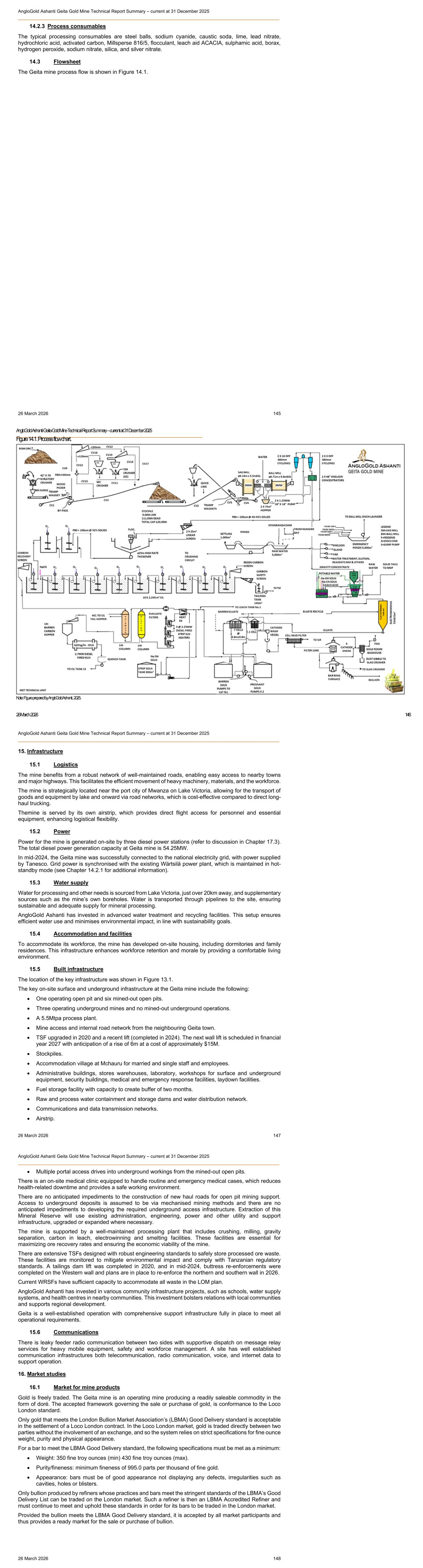
AngloGold Ashanti Geita Gold Mine Technical Report Summary – current at 31 December 2025 _____________________________________________________________________________________ 26 March 2026 145 14.2.3 Process consumables The typical processing consumables are steel balls, sodium cyanide, caustic soda, lime, lead nitrate, hydrochloric acid, activated carbon, Millsperse 816/5, flocculant, leach aid ACACIA, sulphamic acid, borax, hydrogen peroxide, sodium nitrate, silica, and silver nitrate. 14.3 Flowsheet The Geita mine process flow is shown in Figure 14.1. AngloGold Ashanti Geita Gold Mine Technical Report Summary – current at 31 December 2025 _____________________________________________________________________________________ 26 March 2026 146 Figure 14.1. Process flow chart. Note: Figure prepared by AngloGold Ashanti, 2025. AngloGold Ashanti Geita Gold Mine Technical Report Summary – current at 31 December 2025 _____________________________________________________________________________________ 26 March 2026 147 15. Infrastructure 15.1 Logistics The mine benefits from a robust network of well-maintained roads, enabling easy access to nearby towns and major highways. This facilitates the efficient movement of heavy machinery, materials, and the workforce. The mine is strategically located near the port city of Mwanza on Lake Victoria, allowing for the transport of goods and equipment by lake and onward via road networks, which is cost-effective compared to direct long- haul trucking. Themine is served by its own airstrip, which provides direct flight access for personnel and essential equipment, enhancing logistical flexibility. 15.2 Power Power for the mine is generated on-site by three diesel power stations (refer to discussion in Chapter 17.3). The total diesel power generation capacity at Geita mine is 54.25MW. In mid-2024, the Geita mine was successfully connected to the national electricity grid, with power supplied by Tanesco. Grid power is synchronised with the existing Wärtsilä power plant, which is maintained in hot- standby mode (see Chapter 14.2.1 for additional information). 15.3 Water supply Water for processing and other needs is sourced from Lake Victoria, just over 20km away, and supplementary sources such as the mine’s own boreholes. Water is transported through pipelines to the site, ensuring sustainable and adequate supply for mineral processing. AngloGold Ashanti has invested in advanced water treatment and recycling facilities. This setup ensures efficient water use and minimises environmental impact, in line with sustainability goals. 15.4 Accommodation and facilities To accommodate its workforce, the mine has developed on-site housing, including dormitories and family residences. This infrastructure enhances workforce retention and morale by providing a comfortable living environment. 15.5 Built infrastructure The location of the key infrastructure was shown in Figure 13.1. The key on-site surface and underground infrastructure at the Geita mine include the following: • One operating open pit and six mined-out open pits. • Three operating underground mines and no mined-out underground operations. • A 5.5Mtpa process plant. • Mine access and internal road network from the neighbouring Geita town. • TSF upgraded in 2020 and a recent lift (completed in 2024). The next wall lift is scheduled in financial year 2027 with anticipation of a rise of 6m at a cost of approximately $15M. • Stockpiles. • Accommodation village at Mchauru for married and single staff and employees. • Administrative buildings, stores warehouses, laboratory, workshops for surface and underground equipment, security buildings, medical and emergency response facilities, laydown facilities. • Fuel storage facility with capacity to create buffer of two months. • Raw and process water containment and storage dams and water distribution network. • Communications and data transmission networks. • Airstrip. AngloGold Ashanti Geita Gold Mine Technical Report Summary – current at 31 December 2025 _____________________________________________________________________________________ 26 March 2026 148 • Multiple portal access drives into underground workings from the mined-out open pits. There is an on-site medical clinic equipped to handle routine and emergency medical cases, which reduces health-related downtime and provides a safe working environment. There are no anticipated impediments to the construction of new haul roads for open pit mining support. Access to underground deposits is assumed to be via mechanised mining methods and there are no anticipated impediments to developing the required underground access infrastructure. Extraction of this Mineral Reserve will use existing administration, engineering, power and other utility and support infrastructure, upgraded or expanded where necessary. The mine is supported by a well-maintained processing plant that includes crushing, milling, gravity separation, carbon in leach, electrowinning and smelting facilities. These facilities are essential for maximizing ore recovery rates and ensuring the economic viability of the mine. There are extensive TSFs designed with robust engineering standards to safely store processed ore waste. These facilities are monitored to mitigate environmental impact and comply with Tanzanian regulatory standards. A tailings dam lift was completed in 2020, and in mid-2024, buttress re-enforcements were completed on the Western wall and plans are in place to re-enforce the northern and southern wall in 2026. Current WRSFs have sufficient capacity to accommodate all waste in the LOM plan. AngloGold Ashanti has invested in various community infrastructure projects, such as schools, water supply systems, and health centres in nearby communities. This investment bolsters relations with local communities and supports regional development. Geita is a well-established operation with comprehensive support infrastructure fully in place to meet all operational requirements. 15.6 Communications There is leaky feeder radio communication between two sides with supportive dispatch on message relay services for heavy mobile equipment, safety and workforce management. A site has well established communication infrastructures both telecommunication, radio communication, voice, and internet data to support operation. 16. Market studies 16.1 Market for mine products Gold is freely traded. The Geita mine is an operating mine producing a readily saleable commodity in the form of doré. The accepted framework governing the sale or purchase of gold, is conformance to the Loco London standard. Only gold that meets the London Bullion Market Association’s (LBMA) Good Delivery standard is acceptable in the settlement of a Loco London contract. In the Loco London market, gold is traded directly between two parties without the involvement of an exchange, and so the system relies on strict specifications for fine ounce weight, purity and physical appearance. For a bar to meet the LBMA Good Delivery standard, the following specifications must be met as a minimum: • Weight: 350 fine troy ounces (min) 430 fine troy ounces (max). • Purity/fineness: minimum fineness of 995.0 parts per thousand of fine gold. • Appearance: bars must be of good appearance not displaying any defects, irregularities such as cavities, holes or blisters. Only bullion produced by refiners whose practices and bars meet the stringent standards of the LBMA’s Good Delivery List can be traded on the London market. Such a refiner is then an LBMA Accredited Refiner and must continue to meet and uphold these standards in order for its bars to be traded in the London market. Provided the bullion meets the LBMA Good Delivery standard, it is accepted by all market participants and thus provides a ready market for the sale or purchase of bullion.

AngloGold Ashanti Geita Gold Mine Technical Report Summary – current at 31 December 2025 _____________________________________________________________________________________ 26 March 2026 149 16.2 Commodity price forecasts AngloGold Ashanti management determined the gold prices (in US dollars) used for estimating the Mineral Resource and Mineral Reserve. The Mineral Resource and Mineral Reserve are based on the use of economic assumptions that provide a reasonable basis for establishing the prospects of economic extraction for the Mineral Resource as well as the expected price for the Mineral Reserve to be economically viable. These economic assumptions are based on the AngloGold Ashanti’s assessment of multiple factors, including long-range commodity price trends, consensus exchange rate and price forecasts, historical price averages, impacts on inflation and the resulting high-interest rate environment. AngloGold Ashanti selects appropriate prices for the Mineral Reserve mine plan that align to its strategy for each asset. The resultant plan is then tested for economic viability at the stated Mineral Reserve price. A gold price of $1,700/oz was used for the Mineral Reserve estimates. A gold price of $2,000/oz was used for the Mineral Resource estimates. Typically, the price is set higher than the Mineral Reserve price. The metal price assumptions for the mine’s metal products are considered suitable to support the financial analysis of the Mineral Reserve evaluation. 16.3 Contracts Major service contracts in place include: • African Underground Mining Services (AUMS): provides underground mining services (development and stoping) at Nyankanga and Geita Hill underground operations. • Capital Mining Services (Tanzania): provides surface and underground grade control and exploration drilling and provides surface open pit production drilling for open pit blasting operations. • Orica: supplies explosives and provides open pit and underground blasting services. • African Assay Laboratories (SGS): provides on-site geological and metallurgical sample assaying services. All contracts listed above are with unaffiliated third parties as at the Report current date. Contracts are negotiated and renewed as needed. Contract terms are within industry norms, and typical of similar contracts in Tanzania with which AngloGold Ashanti is familiar. 17. Environmental studies, permitting plans, negotiations, or agreements with local individuals or groups No known permitting or social constraints are expected to materially impact the Mineral Reserve production schedule as at the Report current date. 17.1 Permitting The SML was granted under the Mining Act of 1998. The law required an EIA report to accompany the application for the licence. The first EIA study was completed in 1998 to that end, in addition to AngloGold Ashanti’s commitment to environmental protection as a best practice. Over time, several EIAs were conducted for licence enlargement and other projects in compliance with applicable acts and regulations. The EIA also includes a comprehensive evaluation of social and community aspects related to the mine. It assesses potential social and economic impacts on the host community and provides recommendations for appropriate actions, including the implementation of targeted projects and the development of social infrastructure. The following is a list of EIAs conducted to date: • EIA for main Geita mine area (1998). • Supplementary EIA for Kukuluma and Matandani (1998). • EIA for Nyamulilima (2003). • EIA for relocation of air strip (2003). • EIA for Geita Hill (2005). AngloGold Ashanti Geita Gold Mine Technical Report Summary – current at 31 December 2025 _____________________________________________________________________________________ 26 March 2026 150 • EIA for Star and Comet underground project (2016). • EIA for new power plant, Nyankanga and Geita Hill pits underground projects (2016). • EMP update (2016). • EIA for Nyamulilima open pit project (2021). • EIA for Installation of the new incinerator (2021). Approximately 77% of the SML is within the Geita forest reserve. AngloGold Ashanti has permission to carry out mining operations in the reserve from the Ministry of Natural Resources and Tourism and has controls in place to comply with the Forest Act and regulations. Geita mine works closely with the Tanzania Forest Services (an agency under the Ministry) to manage the SML area that falls within the forest reserve. In addition to the SML, the Permission to Mine in the Geita forest reserve, and EIA certificates, AngloGold Ashanti has all of the environmental permits/licences/approvals required for mining operations in compliance with applicable legislation. These include: mining plan approval, water use permits, waste disposal facility, water discharge permits, chemical registration certificate, WRSF construction permits, change of mining method to underground operations, permit to operate waste landfills, permit to operate a waste incinerator, registration of TSF, licence to possess and use medical diagnostic x-ray equipment, petroleum consumer installation licence, electricity own use generation licence and registration of the Nyankanga water dam. Controls are in place to ensure compliance with legal and other requirements such as audits and inspections, legal registries, and compliance evaluations. In addition, AngloGold Ashanti is subject to regulatory audits and inspections. AngloGold Ashanti subscribes to ISO14001 and has maintained this certification since 2001. 17.2 Requirements and plans for waste tailings disposal, site monitoring and water management In Tanzania, TSFs are managed by the Water Resources Management Act, 2009 and the Dam Safety Regulations of 2013. In addition, TSF management must comply with the Mining Act and the Environmental Management Acts, together with their respective regulations. The TSF was registered with the Ministry of Water in compliance with the Dam Safety regulations. It was part of the EIA studies conducted. Water quality monitoring plans cover locations in and around the TSF. AngloGold Ashanti appointed an Approved Professional Person for management of the facility. The Geita mine is certified by the International Cyanide Management Institute for meeting cyanide code requirements and is within the institute’s audit scope. Site monitoring and water management are covered in an approved EMP, which was prepared to comply with relevant legal requirements. The objectives of the water management plan include: • Prevent contamination of surface and groundwater. • Optimise water use in mining and other activities. • Minimise interference with natural drainage systems. • Minimise impact on community water sources. • Ensure availability of water for intended use in the area. 17.3 Socio-economic impacts Geita is an operating mine and has budgets and programmes in place to comply with legislative requirements. Section 105 of the Written Laws (Miscellaneous Amendment) Act 2017 requires a mineral rights holder to prepare a credible Corporate Social Responsibilities plan in consultation with local government authorities that considers the social, economic, cultural, and environmental needs of the host community. AngloGold Ashanti complies with a legal requirement that it commits on an annual basis to spend 0.7% of its total turnover on corporate social investment, estimated to about $4M. The funds are directed to financing of social infrastructure in education, health, water, environmental management, and roads, as well as small and medium enterprises. AngloGold Ashanti Geita Gold Mine Technical Report Summary – current at 31 December 2025 _____________________________________________________________________________________ 26 March 2026 151 In addition to the social investment, the Geita mine also plays a key role as a source of revenue for local government authorities. AngloGold Ashanti pays a statutory local government service levy at the rate of 0.3% equivalent to $3.4M to $3.6M of the net turn over to the local government authorities (district and town councils). At the time mining activities began, the service levy fee was at a fixed amount of $200,000 per annum. However, the fee changed in September 2014, following renegotiation and amendment of the MDA between the Government and Geita mine, resulting to payment of 0.3% of AngloGold Ashanti’s gross turnover. At the Report current date, the extraction of the Mineral Reserve was not anticipated to have any additional socio-economic or cultural impact for which specific mitigations will be required. Impacts from the current on- going operation of the mine are managed through dedicated budgets and teams and these operational costs are included in the Mineral Reserve estimation process. These ongoing programmes include management of artisanal and small-scale mining and securing the SML. In 2022, AngloGold Ashanti conducted a land audit to assess the best way to use land within the concession without impacting the host community. In 2023, another study was done by AngloGold Ashanti in collaboration with the Government to determine the best use of land especially in areas that Geita mine cohabitates with the host community. 17.4 Mine closure and reclamation In Tanzania, mine closure requirements are covered in the Mining Act, the Mining Regulations, and the Mine Closure Guidelines. AngloGold Ashanti has a mine closure plan to guide closure activities. The current mine closure plan was reviewed by the National Mine Closure Committee and approved by the Chief Inspector of Mines in April 2020. Biophysical closure includes restoration and demolition plan over the LOM. Progressive rehabilitation is carried out where disturbed areas are available for rehabilitation. The mine closure plan is an active document which is updated on a regular basis. The Mine Closure Guidelines require the mine closure plan to be updated once in three years where the LOM is more than three years, and annually where the LOM is equal to or less than three years. In addition, the associated closure liability estimate is updated on a quarterly basis. Current at December 2025, the total mine closure liability is estimated at $88.6M. These costs cover the restoration of all facilities and domains and the decommissioning and demolition of infrastructure. Aftercare and maintenance costs are assumed at 10% of rehabilitation and decommissioning costs, while contingency is applied at 5–30% depending on risk and level of certainty to allow for potential oversights and omissions at the time of estimate preparation. 17.5 Qualified Person's opinion on adequacy of current plans The environmental and socio-economic plans in place are adequate ensuring environmental compliance. Any new environmental and socio-economic concerns will be addressed as they arise. 17.6 Commitments to ensure local procurement and hiring GGM complies with Tanzanian labour laws and adheres to international labour organisation conventions ratified by Tanzania and all other labour guidelines and international best human resources practices in dealing with employees. Strategic relations with employees are governed by: • The employment legislations regulating relationship at workplace. • Collective Bargaining Agreement between GGM management and the majority Trade Union. • Disciplinary Policy and Procedures. • Employee's engagements and communication. • A How We Work Programme which is an internal AngloGold Ashanti based approach. GGM’s vision is to be the overall best mining employer in Tanzania in all employment aspects including, but not limited to: • Attraction and retention of critical human capital. AngloGold Ashanti Geita Gold Mine Technical Report Summary – current at 31 December 2025 _____________________________________________________________________________________ 26 March 2026 152 • Occupational Health and Safety. • Employees development aimed at enhancing capabilities of Tanzanian employees to be able to deliver to their full potentials. • Labour relations. • Compensation strategy. The recruitment and selection process starts with the definition of each role description, advertising the position and choosing the most appropriate candidate for the job through a rigorous and objective interview and assessment processes. To date, Geita mine employs 98% Tanzanian Nationals, with 2% being non-citizens. This is a very good ratio for a multinational entity; however, management continues its efforts to build capabilities of local employees to run the mine in full. Currently, 13% of employees at the Geita mine are women, with several initiatives in place to increase the level of female employment, including increased female intake of the mine’s internship programme. Geita mine works closely with the Association of Tanzania Employers through its Female Future programme to enhance managerial and supervisory capabilities of Geita mine’s female employees. On local procurement, Geita mine is committed to empowering local vendors. Goods and services that meet industry standards are first sourced in the local market before looking to foreign vendors. Geita complies with Local Content Regulations of 2018 and its 2022 amendments. All local vendors are given equal chance to express Interest for services and goods with a value of $100,000 and above as they are advertised in the newspapers as per the Regulation 16 (2)(a). For the Corporate Social Responsibility projects, Geita mine is using local vendors to supply goods and services required in the projects. Moreover, GGM is working closely with the Government to conduct capacity building programmes for the local business community to build knowledge and skills to participate in procurement processes. 18. Capital and operating costs 18.1 Capital costs Stay-in-business and exploration sustaining capital expenditure was estimated on a zero-base using the Geita mine’s Mineral Reserve based capital assumptions and is estimated at $231M for the Mineral Reserve. The stay-in-business relates to surface and underground infrastructure, mining fleet replacement, process infrastructure upgrades and other site stay-in-business projects. Exploration capital was categorised by sustaining, non-sustaining, and brownfields; however, only sustaining exploration costs were proportioned using produced ounces. Geita has a long operating history and as such the accuracy of the capital cost estimate developed at a ±15% which meets the S-K1300 requirements of a feasibility level study. The Geita operation reviews the capital inputs and refines them as appropriate as the level of risk in the capital forecasting is low. The stay-in-business provisions are summarised in Table 18.1. Table 18.1. LOM capital cost estimate. Mineral Reserve stay-in-business expectations Units UG GH UG NY UG SC OP NYM Total LOM per operation Years 5 5 3 7 — Stay-in-business capital $M 14.27 22.37 58.53 135.62 230.79 $/t treated 2.85 3.13 46.25 2.18 3.05 Note: LOM: life of mine; UG: underground; GH: Geita Hill; NY: Nyankanga; SC: Star and Comet; OP: open pit; NYM: Nyamulilima. 18.2 Operating costs Operating expenditure is estimated by a first principles budget process, applying known unit costs from mine contracts to physicals, and is estimated at $4,336M for the LOM plan. The average all in costs (AIC) over the Mineral Reserve derived LOM plan equates to $1,379/oz gold. Operating costs per operation are summarised in Table 18.2 and grouped as consolidated total costs for the open pit and underground in Table 18.3. Geita has a long operating history and as such the accuracy of the operating cost estimate developed at a ±15%
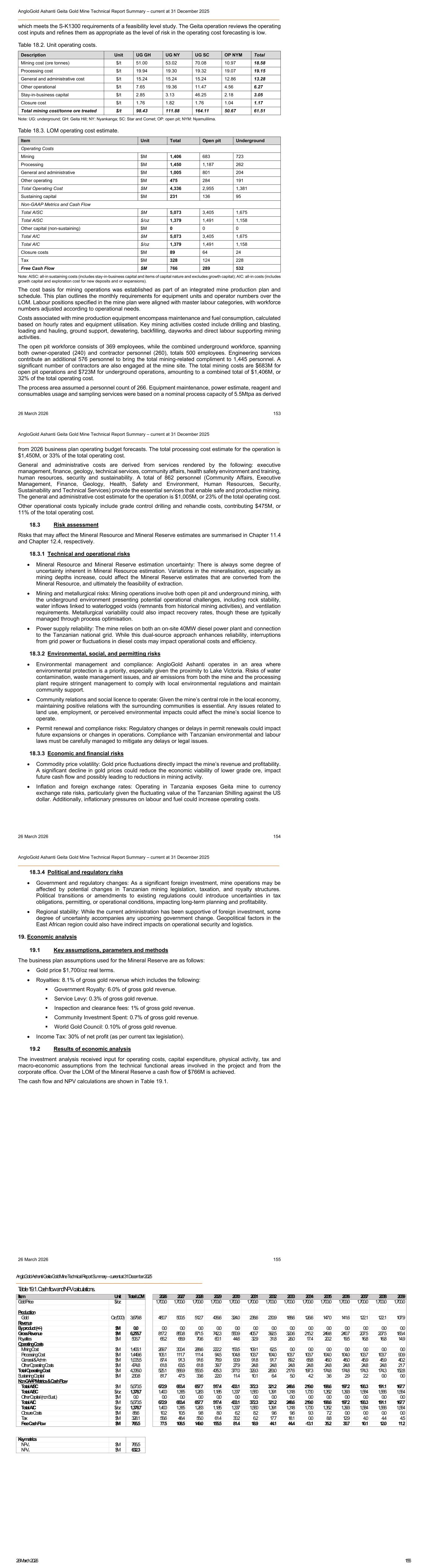
AngloGold Ashanti Geita Gold Mine Technical Report Summary – current at 31 December 2025 _____________________________________________________________________________________ 26 March 2026 153 which meets the S-K1300 requirements of a feasibility level study. The Geita operation reviews the operating cost inputs and refines them as appropriate as the level of risk in the operating cost forecasting is low. Table 18.2. Unit operating costs. Description Unit UG GH UG NY UG SC OP NYM Total Mining cost (ore tonnes) $/t 51.00 53.02 70.08 10.97 18.58 Processing cost $/t 19.94 19.30 19.32 19.07 19.15 General and administrative cost $/t 15.24 15.24 15.24 12.86 13.28 Other operational $/t 7.65 19.36 11.47 4.56 6.27 Stay-in-business capital $/t 2.85 3.13 46.25 2.18 3.05 Closure cost $/t 1.76 1.82 1.76 1.04 1.17 Total mining cost/tonne ore treated $/t 98.43 111.88 164.11 50.67 61.51 Note: UG: underground; GH: Geita Hill; NY: Nyankanga; SC: Star and Comet; OP: open pit; NYM: Nyamulilima. Table 18.3. LOM operating cost estimate. Item Unit Total Open pit Underground Operating Costs Mining $M 1,406 683 723 Processing $M 1,450 1,187 262 General and administrative $M 1,005 801 204 Other operating $M 475 284 191 Total Operating Cost $M 4,336 2,955 1,381 Sustaining capital $M 231 136 95 Non-GAAP Metrics and Cash Flow Total AISC $M 5,073 3,405 1,675 Total AISC $/oz 1,379 1,491 1,158 Other capital (non-sustaining) $M 0 0 0 Total AIC $M 5,073 3,405 1,675 Total AIC $/oz 1,379 1,491 1,158 Closure costs $M 89 64 24 Tax $M 328 124 228 Free Cash Flow $M 766 289 532 Note: AISC: all-in sustaining costs (includes stay-in-business capital and items of capital nature and excludes growth capital); AIC: all-in costs (includes growth capital and exploration cost for new deposits and or expansions). The cost basis for mining operations was established as part of an integrated mine production plan and schedule. This plan outlines the monthly requirements for equipment units and operator numbers over the LOM. Labour positions specified in the mine plan were aligned with master labour categories, with workforce numbers adjusted according to operational needs. Costs associated with mine production equipment encompass maintenance and fuel consumption, calculated based on hourly rates and equipment utilisation. Key mining activities costed include drilling and blasting, loading and hauling, ground support, dewatering, backfilling, dayworks and direct labour supporting mining activities. The open pit workforce consists of 369 employees, while the combined underground workforce, spanning both owner-operated (240) and contractor personnel (260), totals 500 employees. Engineering services contribute an additional 576 personnel to bring the total mining-related compliment to 1,445 personnel. A significant number of contractors are also engaged at the mine site. The total mining costs are $683M for open pit operations and $723M for underground operations, amounting to a combined total of $1,406M, or 32% of the total operating cost. The process area assumed a personnel count of 266. Equipment maintenance, power estimate, reagent and consumables usage and sampling services were based on a nominal process capacity of 5.5Mtpa as derived AngloGold Ashanti Geita Gold Mine Technical Report Summary – current at 31 December 2025 _____________________________________________________________________________________ 26 March 2026 154 from 2026 business plan operating budget forecasts. The total processing cost estimate for the operation is $1,450M, or 33% of the total operating cost. General and administrative costs are derived from services rendered by the following: executive management, finance, geology, technical services, community affairs, health safety environment and training, human resources, security and sustainability. A total of 862 personnel (Community Affairs, Executive Management, Finance, Geology, Health, Safety and Environment, Human Resources, Security, Sustainability and Technical Services) provide the essential services that enable safe and productive mining. The general and administrative cost estimate for the operation is $1,005M, or 23% of the total operating cost. Other operational costs typically include grade control drilling and rehandle costs, contributing $475M, or 11% of the total operating cost. 18.3 Risk assessment Risks that may affect the Mineral Resource and Mineral Reserve estimates are summarised in Chapter 11.4 and Chapter 12.4, respectively. 18.3.1 Technical and operational risks • Mineral Resource and Mineral Reserve estimation uncertainty: There is always some degree of uncertainty inherent in Mineral Resource estimation. Variations in the mineralisation, especially as mining depths increase, could affect the Mineral Reserve estimates that are converted from the Mineral Resource, and ultimately the feasibility of extraction. • Mining and metallurgical risks: Mining operations involve both open pit and underground mining, with the underground environment presenting potential operational challenges, including rock stability, water inflows linked to waterlogged voids (remnants from historical mining activities), and ventilation requirements. Metallurgical variability could also impact recovery rates, though these are typically managed through process optimisation. • Power supply reliability: The mine relies on both an on-site 40MW diesel power plant and connection to the Tanzanian national grid. While this dual-source approach enhances reliability, interruptions from grid power or fluctuations in diesel costs may impact operational costs and efficiency. 18.3.2 Environmental, social, and permitting risks • Environmental management and compliance: AngloGold Ashanti operates in an area where environmental protection is a priority, especially given the proximity to Lake Victoria. Risks of water contamination, waste management issues, and air emissions from both the mine and the processing plant require stringent management to comply with local environmental regulations and maintain community support. • Community relations and social licence to operate: Given the mine’s central role in the local economy, maintaining positive relations with the surrounding communities is essential. Any issues related to land use, employment, or perceived environmental impacts could affect the mine’s social licence to operate. • Permit renewal and compliance risks: Regulatory changes or delays in permit renewals could impact future expansions or changes in operations. Compliance with Tanzanian environmental and labour laws must be carefully managed to mitigate any delays or legal issues. 18.3.3 Economic and financial risks • Commodity price volatility: Gold price fluctuations directly impact the mine’s revenue and profitability. A significant decline in gold prices could reduce the economic viability of lower grade ore, impact future cash flow and possibly leading to reductions in mining activity. • Inflation and foreign exchange rates: Operating in Tanzania exposes Geita mine to currency exchange rate risks, particularly given the fluctuating value of the Tanzanian Shilling against the US dollar. Additionally, inflationary pressures on labour and fuel could increase operating costs. AngloGold Ashanti Geita Gold Mine Technical Report Summary – current at 31 December 2025 _____________________________________________________________________________________ 26 March 2026 155 18.3.4 Political and regulatory risks • Government and regulatory changes: As a significant foreign investment, mine operations may be affected by potential changes in Tanzanian mining legislation, taxation, and royalty structures. Political transitions or amendments to existing regulations could introduce uncertainties in tax obligations, permitting, or operational conditions, impacting long-term planning and profitability. • Regional stability: While the current administration has been supportive of foreign investment, some degree of uncertainty accompanies any upcoming government change. Geopolitical factors in the East African region could also have indirect impacts on operational security and logistics. 19. Economic analysis 19.1 Key assumptions, parameters and methods The business plan assumptions used for the Mineral Reserve are as follows: • Gold price $1,700/oz real terms. • Royalties: 8.1% of gross gold revenue which includes the following: ▪ Government Royalty: 6.0% of gross gold revenue. ▪ Service Levy: 0.3% of gross gold revenue. ▪ Inspection and clearance fees: 1% of gross gold revenue. ▪ Community Investment Spent: 0.7% of gross gold revenue. ▪ World Gold Council: 0.10% of gross gold revenue. • Income Tax: 30% of net profit (as per current tax legislation). 19.2 Results of economic analysis The investment analysis received input for operating costs, capital expenditure, physical activity, tax and macro-economic assumptions from the technical functional areas involved in the project and from the corporate office. Over the LOM of the Mineral Reserve a cash flow of $766M is achieved. The cash flow and NPV calculations are shown in Table 19.1. AngloGold Ashanti Geita Gold Mine Technical Report Summary – current at 31 December 2025 _____________________________________________________________________________________ 26 March 2026 156 Table 19.1. Cash flow and NPV calculations. Item Unit Total LOM 2026 2027 2028 2029 2030 2031 2032 2033 2034 2035 2036 2037 2038 2039 Gold Price $/oz 1,700.0 1,700.0 1,700.0 1,700.0 1,700.0 1,700.0 1,700.0 1,700.0 1,700.0 1,700.0 1,700.0 1,700.0 1,700.0 1,700.0 Production Gold Oz ('000) 3,679.8 480.7 500.5 512.7 436.6 324.0 238.6 230.9 188.6 126.6 147.0 141.6 122.1 122.1 107.9 Revenue By product (+/-) $M 0.0 0.0 0.0 0.0 0.0 0.0 0.0 0.0 0.0 0.0 0.0 0.0 0.0 0.0 0.0 Gross Revenue $M 6,255.7 817.2 850.8 871.5 742.3 550.9 405.7 392.5 320.6 215.2 249.8 240.7 207.5 207.5 183.4 Royalties $M 506.7 66.2 68.9 70.6 60.1 44.6 32.9 31.8 26.0 17.4 20.2 19.5 16.8 16.8 14.9 Operating Costs Mining Cost $M 1,406.1 269.7 300.4 288.6 222.2 153.5 109.1 62.5 0.0 0.0 0.0 0.0 0.0 0.0 0.0 Processing Cost $M 1,449.6 106.1 111.7 111.4 94.5 104.8 103.7 104.0 103.7 103.7 104.0 104.0 103.7 103.7 90.9 General & Admin $M 1,005.5 87.4 91.3 91.6 78.9 90.9 91.8 91.7 89.2 68.8 46.0 46.0 45.9 45.9 40.2 Other Operating Costs $M 474.8 61.8 63.5 61.8 39.7 27.9 24.8 24.8 24.8 24.8 24.8 24.8 24.8 24.8 21.7 Total Operating Cost $M 4,336.0 525.1 566.9 553.5 435.3 377.0 329.3 283.0 217.6 197.3 174.8 174.8 174.3 174.3 152.8 Sustaining Capital $M 230.8 81.7 47.5 33.6 22.0 11.4 10.1 6.4 5.0 4.2 3.6 2.9 2.2 0.0 0.0 Non-GAAP Metrics & Cash Flow Total AISC $M 5,073.5 672.9 683.4 657.7 517.4 433.1 372.3 321.2 248.6 219.0 198.6 197.2 193.3 191.1 167.7 Total AISC $/oz 1,378.7 1,400 1,365 1,283 1,185 1,337 1,560 1,391 1,318 1,730 1,352 1,393 1,584 1,566 1,554 Other Capital (non Sust.) $M 0.0 0.0 0.0 0.0 0.0 0.0 0.0 0.0 0.0 0.0 0.0 0.0 0.0 0.0 0.0 Total AIC $M 5,073.5 672.9 683.4 657.7 517.4 433.1 372.3 321.2 248.6 219.0 198.6 197.2 193.3 191.1 167.7 Total AIC $/oz 1,378.7 1,400 1,365 1,283 1,185 1,337 1,560 1,391 1,318 1,730 1,352 1,393 1,584 1,566 1,554 Closure Costs $M 88.6 10.2 10.5 9.8 8.0 6.2 8.2 9.6 9.6 9.3 7.2 0.0 0.0 0.0 0.0 Tax $M 328.1 56.6 48.4 55.0 61.4 30.2 6.2 17.7 18.1 0.0 8.8 12.9 4.0 4.4 4.5 Free Cash Flow $M 765.5 77.5 108.5 149.0 155.5 81.4 18.9 44.1 44.4 -13.1 35.2 30.7 10.1 12.0 11.2 Key metrics NPV0 $M 765.5 NPV5 $M 632.3

AngloGold Ashanti Geita Gold Mine Technical Report Summary – current at 31 December 2025 _____________________________________________________________________________________ 26 March 2026 157 The investment analysis received input for operating costs, capital expenditure, physical activity, tax and macro-economic assumptions from the technical functional areas involved in the project and from the corporate office. The economic evaluation results show (Figure 19.1): • NPV0% is $765.5M • NPV5% is $632.3M • NPV10% is $536.3M • NPV15% is $464.5M Figure 19.1. Net present value at a $1,700/oz gold Mineral Reserve price. Note: Figure prepared by AngloGold Ashanti, 2025. Inferred Mineral Resource was not included as part of the economic assessment. All Inferred tonnes reporting as part of Reserve estimation are due to partial inclusion in the smallest mining unit, 0g/t was assigned effectively discounting any Inferred Mineral Resource value. 19.3 Sensitivity analysis The $1,700/oz Mineral Reserve estimation schedule was used for the sensitivity runs with the only variable being the gold price. Mineral Reserve sensitivities for the below graph were run at -20% and at +20% for the following criteria: gold price, grade processed, operating cost and capital cost. Sensitivities to gold price and grade processed effectively demonstrated a similar outcome (Figure 19.2). 0.0 100.0 200.0 300.0 400.0 500.0 600.0 700.0 800.0 900.0 NPV0 NPV5 NPV10 NPV15 NPV Outcomes in $M AngloGold Ashanti Geita Gold Mine Technical Report Summary – current at 31 December 2025 _____________________________________________________________________________________ 26 March 2026 158 Figure 19.2. NPV sensitivity analysis. Note: Figure prepared by AngloGold Ashanti, 2025. 20. Adjacent properties This Chapter is not relevant to this Report. 21. Other relevant data and information This Chapter is not relevant to this Report. 22. Interpretation and conclusions The Qualified Persons have reviewed the licensing, geology, exploration, Mineral Resource and Mineral Reserve estimation methods, mining, mineral processing, infrastructure requirements, environmental, permitting, social considerations and financial information and consider the Mineral Resource and Mineral Reserve estimates for the Geita mine, current at 31 December, 2025, are reported in accordance with Regulation S-K 1300. AngloGold Ashanti maintains a process of verifying and documenting the Mineral Resource and Mineral Reserve estimates, information for which is located at the mine site and AngloGold Ashanti corporate offices. AngloGold Ashanti conducts ongoing studies of its ore bodies to optimize economic value and to manage risk. AngloGold Ashanti and the Qualified Persons believe that the geologic interpretation and modelling of exploration data, economic analysis, mine design and sequencing, process scheduling, and operating and capital cost estimation have been developed using accepted industry practices. Periodic reviews by third-party consultants confirm these conclusions. The Mineral Resource and Mineral Reserve represent the amount of gold estimated at 31 December 2025 and are based on information available at the time of estimation. Such estimates are, or will be, to a large extent, based on the prices of the respective commodities and interpretations of geologic data obtained from drill holes and other exploration techniques, which data may not necessarily be indicative of future results. The Mineral Resource and Mineral Reserve estimates are published at 31 December 2025, taking into account economic assumptions, changes to future production and capital costs, depletion, additions as well as any acquisitions or disposals during 2025. The legal tenure of each material property has been verified to the satisfaction of the accountable Qualified Person and all of the Mineral Reserve has been confirmed to be covered by the required mining permits or there exists a realistic expectation, based on applicable laws and regulations, that issuance of permits or resolution of legal issues necessary for mining and processing at a particular deposit will be accomplished in the ordinary course and in a timeframe consistent with AngloGold Ashanti’s (or its joint venture partners’) current mine plans. 632.3 (200.0) 0.0 200.0 400.0 600.0 800.0 1,000.0 1,200.0 1,400.0 -20% Base Case +20% C as h F lo w in $ M Sensitivities on Key Value Drivers +/- 20% Gold Price Grade Processed Operating Costs Capital AngloGold Ashanti Geita Gold Mine Technical Report Summary – current at 31 December 2025 _____________________________________________________________________________________ 26 March 2026 159 If estimations must be revised due to significantly lower commodity prices, increases in operating costs, reductions in metallurgical recovery or other factors, the Mineral Resource or Mineral Reserve may not be mined or processed profitably. In addition, material write-downs of AngloGold Ashanti’s investment in its mining properties may be required, including impacts on goodwill, as well as increased amortisation, reclamation and closure charges. If AngloGold Ashanti determines that certain parts of its Mineral Resource or Mineral Reserve have become uneconomic, this may ultimately lead to a reduction in its reported aggregate Mineral Resource or Mineral Reserve, respectively. Consequently, if AngloGold Ashanti’s actual Mineral Resource and Mineral Reserve is less than current estimates, its business, prospects, results of operations and financial position may be materially impaired. An economic analysis was performed in support of the estimation of the Mineral Reserve; this indicated a positive cash flow using the assumptions detailed in this Report. 23. Recommendations Geita is a mature operating mine with established open pit and underground operations. The Qualified Persons consider the work completed and operating performance data available to be appropriate to support the declaration of Mineral Resources and Mineral Reserves as at the Report current date. To maintain and, where applicable, improve confidence in the estimates, modifying factors, and the supporting LOM plan, the Qualified Persons recommend the following sustaining programmes maintain Mineral Reserve confidence definition/infill drilling in areas scheduled for mining to support geological interpretation, grade continuity, classification, and Mineral Reserve conversion where applicable. Grade control and reconciliation governance for both mining methods to test model performance and confirm key assumptions (including selectivity/SMU, dilution/ore loss, and cut-off application) remain representative; update assumptions where persistent, material deviations are observed. Geotechnical and hydrogeology performance confirmation to validate that observed conditions remain consistent with design assumptions supporting open pit slope designs and underground excavation/stope stability assumptions used for Mineral Reserve conversion, strengthen modifying factors and LOM confidence Metallurgical variability and recovery refresh using testwork and/or plant performance data to confirm recovery assumptions for forecast ore types and blends, and to support blending strategies across open pit and underground ore sources. Underground performance and modifying factor review (as applicable) to confirm dilution, stope performance, ground support assumptions, and productivity inputs remain consistent with planned mining areas and current performance for longhole stoping. 23.1 Continuous improvement The Qualified Persons recommend that the assumptions and modifying factors supporting the Mineral Resource and Mineral Reserve estimates be reviewed through the normal annual planning and reporting cycle and updated where new information becomes available that is reasonably expected to materially affect the estimates, the mine plan, or the supporting economic analysis. 23.2 Costs and schedule These programmes are expected to be implemented through the normal annual planning and budgeting process. Where incremental work beyond routine sustaining activities is required, scope, schedule, and order-of-magnitude costs should be defined and documented in supporting technical memoranda to maintain traceability for subsequent reporting. 24. References 24.1 References 24.1.1 External International Society of Rock Mechanics Commission on Standardization of Laboratory and Field Tests (1978). AngloGold Ashanti Geita Gold Mine Technical Report Summary – current at 31 December 2025 _____________________________________________________________________________________ 26 March 2026 160 24.1.2 Internal AngloGold Ashanti (2025). Guideline for the reporting of Mineral Resource and Mineral Reserve. AngloGold Ashanti (2024). Mineral Resource and Mineral Reserve Reporting Group Standard. AngloGold Ashanti (2025). Resource Prices and FX Rates, updated 12 November 2025. AngloGold Ashanti (2025). Mineral Resource and Mineral Reserve sensitivities. AngloGold Ashanti Geita (2023). Environmental and Social Management Plan (ESMP). AngloGold Ashanti (2025). Geoscience QA/QC Guideline v2.4. AngloGold Ashanti Geita Gold Mine (2023). Mine Closure Plan Volume 1. SRK Consulting (2023). Findings from the 2022 Mineral Resource and Mineral Reserve Audit of Geita Gold Mine. Internal report prepared for Geita Gold Mine. Paterson and Cooke (2018). Geita Gold Mine CAF application – Geotechnical Evaluation. Paterson and Cooke (2019). Geita Mine Cemented Aggregate Backfill, Final Design Report. 24.2 Glossary of terms All-in costs (AIC): All-in cost refers to the total expenses associated with completing a transaction, project, or obtaining a loan, inclusive of all direct and indirect costs. AIC includes growth capital and exploration cost for new deposits and or expansions. All-in sustaining costs (AISC): AISC is a non-GAAP measure which is an extension of the “total cash costs” metric and incorporates all costs related to sustaining production and recognises sustaining capital expenditures associated with developing and maintaining gold mines. In addition, the metric includes the cost associated with corporate office structures that support these operations, the community and environmental rehabilitation costs attendant with responsible mining and any exploration and evaluation cost associated with sustaining current operations. AISC includes stay-in-business capital and items of capital nature and excludes growth capital. By-products: Any potentially economic or saleable products that emanate from the core process of producing gold or copper, including silver, molybdenum and sulphuric acid. Capital expenditure: Capital expenditures are the funds companies allocate to acquire, upgrade, and maintain essential physical assets like property, technology, or equipment, crucial for expanding operational capacity and securing long-term economic benefits. Carbon-in-leach (CIL): Gold is leached from a slurry of ore where cyanide and carbon granules are added to the same agitated tanks. The gold loaded carbon granules are separated from the slurry and treated in an elution circuit to remove the gold. Carbon-in-pulp (CIP): Gold is leached conventionally from a slurry of ore with cyanide in agitated tanks. The leached slurry then passes into the CIP circuit where activated carbon granules are mixed with the slurry and gold is adsorbed on to the activated carbon. The gold-loaded carbon is separated from the slurry and treated in an elution circuit to remove the gold. Comminution: Comminution is the crushing and grinding of ore to make gold available for physical or chemical separation (see also “Milling”). Contained gold: The total gold content (tonnes multiplied by grade) of the material being described. Cut-off grade: Cut-off grade is the grade (i.e., the concentration of metal or mineral in rock) that determines the destination of the material during mining. For purposes of establishing “prospects of economic extraction,” the cut-off grade is the grade that distinguishes material deemed to have no economic value (it will not be mined in underground mining or if mined in surface mining, its destination will be the waste dump) from material deemed to have economic value (its ultimate destination during mining will be a processing facility). Other terms used in similar fashion as cut-off grade include net smelter return, pay limit, and break- even stripping ratio.

AngloGold Ashanti Geita Gold Mine Technical Report Summary – current at 31 December 2025 _____________________________________________________________________________________ 26 March 2026 161 Depletion: The decrease in the quantity of ore in a deposit or property resulting from extraction or production. Development: The process of accessing an orebody through shafts and/or tunnelling in underground mining operations. Development stage property: A development stage property is a property that has Mineral Reserve disclosed, but no material extraction. Diorite: An igneous rock formed by the solidification of molten material (magma). Doré: Impure alloy of gold and silver produced at a mine to be refined to a higher purity. Economically viable: Economically viable, when used in the context of Mineral Reserve determination, means that the Qualified Person has determined, using a discounted cash flow analysis, or has otherwise analytically determined, that extraction of the Mineral Reserve is economically viable under reasonable investment and market assumptions. Electrowinning: A process of recovering gold from solution by means of electrolytic chemical reaction into a form that can be smelted easily into gold bars. Elution: Recovery of the gold from the activated carbon into solution before zinc precipitation or electrowinning. Exploration results: Exploration results are data and information generated by mineral exploration programmes (i.e., programmes consisting of sampling, drilling, trenching, analytical testing, assaying, and other similar activities undertaken to locate, investigate, define or delineate a mineral prospect or mineral deposit) that are not part of a disclosure of Mineral Resource or Mineral Reserve. A registrant must not use exploration results alone to derive estimates of tonnage, grade, and production rates, or in an assessment of economic viability. Exploration stage property: An exploration stage property is a property that has no Mineral Reserve disclosed. Exploration target: An exploration target is a statement or estimate of the exploration potential of a mineral deposit in a defined geological setting where the statement or estimate, quoted as a range of tonnage and a range of grade (or quality), relates to mineralisation for which there has been insufficient exploration to estimate a Mineral Resource. Feasibility study: A feasibility study is a comprehensive technical and economic study of the selected development option for a mineral project, which includes detailed assessments of all applicable modifying factors, as defined by this section, together with any other relevant operational factors, and detailed financial analyses that are necessary to demonstrate, at the time of reporting, that extraction is economically viable. The results of the study may serve as the basis for a final decision by a proponent or financial institution to proceed with, or finance, the development of the project. A feasibility study is more comprehensive, and with a higher degree of accuracy, than a pre-feasibility study. It must contain mining, infrastructure, and process designs completed with sufficient rigour to serve as the basis for an investment decision or to support project financing. The confidence level in the results of a feasibility study is higher than the confidence level in the results of a pre-feasibility study. Terms such as full, final, comprehensive, bankable, or definitive feasibility study are equivalent to a feasibility study. Flotation: Concentration of gold and gold-hosting minerals into a small mass by various techniques (e.g. collectors, frothers, agitation, air-flow) that collectively enhance the buoyancy of the target minerals, relative to unwanted gangue, for recovery into an over-flowing froth phase. Gold produced or gold production: Refined gold in a saleable form derived from the mining process. Grade: The quantity of ore contained within a unit weight of mineralised material generally expressed in grams per metric tonne (g/t) or ounce per short ton for gold bearing material. Greenschist: A schistose metamorphic rock whose green colour is due to the presence of chlorite, epidote or actinolite. AngloGold Ashanti Geita Gold Mine Technical Report Summary – current at 31 December 2025 _____________________________________________________________________________________ 26 March 2026 162 Indicated Mineral Resource: An Indicated Mineral Resource is that part of a Mineral Resource for which quantity and grade or quality are estimated on the basis of adequate geological evidence and sampling. The level of geological certainty associated with an Indicated Mineral Resource is sufficient to allow a Qualified Person to apply modifying factors in sufficient detail to support mine planning and evaluation of the economic viability of the deposit. Because an Indicated Mineral Resource has a lower level of confidence than the level of confidence of a Measured Mineral Resource, an Indicated Mineral Resource may only be converted to a Probable Mineral Reserve. Inferred Mineral Resource: An Inferred Mineral Resource is that part of a Mineral Resource for which quantity and grade or quality are estimated on the basis of limited geological evidence and sampling. The level of geological uncertainty associated with an Inferred Mineral Resource is too high to apply relevant technical and economic factors likely to influence the prospects of economic extraction in a manner useful for evaluation of economic viability. Because an Inferred Mineral Resource has the lowest level of geological confidence of all Mineral Resource, which prevents the application of the modifying factors in a manner useful for evaluation of economic viability, an Inferred Mineral Resource may not be considered when assessing the economic viability of a mining project, and may not be converted to a Mineral Reserve. Initial assessment (also known as concept study, scoping study, conceptual study and preliminary economic assessment): An initial assessment is a preliminary technical and economic study of the economic potential of all or parts of mineralisation to support the disclosure of Mineral Resource. The initial assessment must be prepared by a Qualified Person and must include appropriate assessments of reasonably assumed technical and economic factors, together with any other relevant operational factors, that are necessary to demonstrate at the time of reporting that there are reasonable prospects for economic extraction. An initial assessment is required for disclosure of Mineral Resource but cannot be used as the basis for disclosure of Mineral Reserve. Leaching: Dissolution of gold from crushed or milled material, including reclaimed slime, prior to adsorption on to activated carbon or direct zinc precipitation. Life of mine (LOM): Number of years for which an operation is planning to mine and treat ore, and is taken from the current mine plan. Measured Mineral Resource: A Measured Mineral Resource is that part of a Mineral Resource for which quantity and grade or quality are estimated on the basis of conclusive geological evidence and sampling. The level of geological certainty associated with a Measured Mineral Resource is sufficient to allow a qualified person to apply modifying factors, as defined in this section, in sufficient detail to support detailed mine planning and final evaluation of the economic viability of the deposit. Because a Measured Mineral Resource has a higher level of confidence than the level of confidence of either an Indicated Mineral Resource or an Inferred Mineral Resource, a Measured Mineral Resource may be converted to a Proven Mineral Reserve or to a Probable Mineral Reserve. Metallurgical plant / gold plant / plant: A processing plant constructed to treat ore and extract gold (and, in some cases, often valuable by-products). Metallurgical recovery factor (MetRF): A measure of the efficiency in extracting gold or silver from the ore. Milling: A process of reducing broken ore to a size at which concentrating or leaching can be undertaken (see also “Comminution”). Mine call factor (MCF): The ratio, expressed as a percentage, of the total quantity of recovered and unrecovered mineral product after processing with the amount estimated in the ore based on sampling. The ratio of contained gold delivered to the metallurgical plant divided by the estimated contained gold of ore mined based on sampling. Mineralisation: The process or processes by which a mineral or minerals are introduced into rock, resulting in a potentially valuable deposit. Mineral deposit: A mineral deposit is a concentration (or occurrence) of material of possible economic interest in or on the earth’s crust. AngloGold Ashanti Geita Gold Mine Technical Report Summary – current at 31 December 2025 _____________________________________________________________________________________ 26 March 2026 163 Mineral Reserve: A Mineral Reserve is an estimate of tonnage and grade or quality of Indicated and Measured Mineral Resource that, in the opinion of the Qualified Person, can be the basis of an economically viable project. More specifically, it is the economically mineable part of a Measured or Indicated Mineral Resource, which includes diluting materials and allowances for losses that may occur when the material is mined or extracted. Mineral Reserve is subdivided in order of increasing confidence into Probable Mineral Reserve and Proven Mineral Reserve. Mineral Reserve is aggregated from the Proven and Probable Mineral Reserve categories. A Measured Mineral Resource may be converted to either a Proven Mineral Reserve or a Probable Mineral Reserve depending on uncertainties associated with modifying factors that are taken into account in the conversion from Mineral Resource to Mineral Reserve. The Mineral Reserve tonnages and grades are estimated and reported as delivered to plant (i.e., the point where material is delivered to the processing facility). Mineral Resource: A Mineral Resource is a concentration or occurrence of material of economic interest in or on the Earth's crust in such form, grade or quality, and quantity that there are reasonable prospects for economic extraction. A Mineral Resource is a reasonable estimate of mineralisation, taking into account relevant factors such as cut-off grade, likely mining dimensions, location or continuity, that, with the assumed and justifiable technical and economic conditions, is likely to, in whole or in part, become economically extractable. It is not merely an inventory of all mineralisation drilled or sampled. Mineral Resource is subdivided and must be so reported, in order of increasing confidence in respect of geoscientific evidence, into Inferred, Indicated or Measured categories. The Mineral Resource tonnages and grades are reported in situ and stockpiled material is reported as broken material. Mining recovery factor (MRF): This factor reflects a mining efficiency factor relating the recovery of material during the mining process and is the variance between the tonnes called for in the mining design and what the plant receives. It is expressed in both a grade and tonnage number. Modifying factors: Modifying factors are the factors that a Qualified Person must apply to Indicated and Measured Mineral Resource and then evaluate in order to establish the economic viability of Mineral Reserve. A Qualified Person must apply and evaluate modifying factors to convert Measured and Indicated Mineral Resource to Proven and Probable Mineral Reserve. These factors include but are not restricted to: Mining; processing; metallurgical; infrastructure; economic; marketing; legal; environmental compliance; plans, negotiations, or agreements with local individuals or groups; and governmental factors. The number, type and specific characteristics of the modifying factors applied will necessarily be a function of and depend upon the mineral, mine, property, or project. Non-sustaining capital (expenditure): Non-sustaining capital (expenditure) is a non-GAAP measure comprising capital expenditure incurred at new operations and capital expenditure related to ‘major projects’ at existing operations where these projects will materially increase production. Open pit mining: An excavation made at the surface of the ground for the purpose of extracting minerals, inorganic and organic, from their natural deposits, which excavation is open to the surface. Operating expenditure: An operating expense is an expenditure that a business incurs as a result of performing its normal business operations. Operating expenses differ from capital expenses, which are involved with acquiring or upgrading assets over time, and non-operating expenses, which are not related to core business activities. Ounce (oz) (troy): Used in imperial statistics for the standard measurement of mass specifically for precious metals. A kilogram is equal to 32.1507 ounces. A troy ounce is equal to 31.1035 grams. Pay limit: The grade of a unit of ore at which the revenue from the recovered mineral content of the ore is equal to the sum of total cash costs, closure costs, Mineral Reserve development and sustaining capital. This grade is expressed as an in situ value in grams per tonne or ounces per short ton (before dilution and mineral losses). Precipitate: The solid product formed when a change in solution chemical conditions results in conversion of some pre-dissolved ions into solid state. AngloGold Ashanti Geita Gold Mine Technical Report Summary – current at 31 December 2025 _____________________________________________________________________________________ 26 March 2026 164 Preliminary feasibility study (pre-feasibility study): is a comprehensive study of a range of options for the technical and economic viability of a mineral project that has advanced to a stage where a Qualified Person has determined (in the case of underground mining) a preferred mining method, or (in the case of surface mining) a pit configuration, and in all cases has determined an effective method of mineral processing and an effective plan to sell the product. A pre-feasibility study includes a financial analysis based on reasonable assumptions, based on appropriate testing, about the modifying factors and the evaluation of any other relevant factors that are sufficient for a Qualified Person to determine if all or part of the Indicated and Measured Mineral Resource may be converted to Mineral Reserve at the time of reporting. The financial analysis must have the level of detail necessary to demonstrate, at the time of reporting, that extraction is economically viable. A pre-feasibility study is less comprehensive and results in a lower confidence level than a feasibility study. A pre-feasibility study is more comprehensive and results in a higher confidence level than an initial assessment. Probable Mineral Reserve: A Probable Mineral Reserve is the economically mineable part of an Indicated and, in some cases, a Measured Mineral Resource. The confidence in the modifying factors applying to a Probable Mineral Reserve is lower than that applying to a Proven Mineral Reserve. The degree of assurance, although lower than that for Proven Mineral Reserve, is high enough to assume continuity between points of observation. Production stage property: A production stage property is a property with material extraction of Mineral Reserve. Productivity: An expression of labour productivity based on the ratio of ounces of gold produced per month to the total number of employees in mining operations. Proven Mineral Reserve: A Proven Mineral Reserve is the economically mineable part of a Measured Mineral Resource and can only result from conversion of a Measured Mineral Resource. A Proven Mineral Reserve implies a high degree of confidence in the modifying factors. Qualified Person: A Qualified Person is an individual who is (1) a mineral industry professional with at least five years of relevant experience in the type of mineralisation and type of deposit under consideration and in the specific type of activity that person is undertaking on behalf of the registrant; and (2) an eligible member or licencee in good standing of a recognised professional organisation at the time the technical report is prepared. Section 229.1300 of Regulation S-K 1300 details further recognised professional organisations and also relevant experience. Quartz: A hard mineral consisting of silica dioxide found widely in all rocks. Recovered grade: The recovered mineral content per unit of ore treated. Refining: The final purification process of a metal or mineral. Regulation S-K 1300: Subpart 1300 of Regulation S-K (17 CFR § 229.1300) which contains the SEC’s mining property disclosure requirements for mining registrants. Rehabilitation: The process of reclaiming land disturbed by mining to allow an appropriate post-mining use. Rehabilitation standards are defined by country-specific laws, including but not limited to the US Bureau of Land Management, the US Forest Service, and the relevant Australian mining authorities, and address among other issues, ground and surface water, topsoil, final slope gradient, waste handling and re- vegetation issues. Resource modification factor (RMF): This factor is applied when there is an historic reconciliation discrepancy in the Mineral Resource model. For example, between the Mineral Resource model tonnage and the grade control model tonnage. It is expressed in both a grade and tonnage number. Scats: Within the metallurgical plants, scats is a term used to describe ejected ore or other uncrushable / grinding media arising from the milling process. This, typically oversize material (ore), is ejected from the mill and stockpiled or re-crushed via a scats retreatment circuit. Retreatment of scats is aimed at fracturing the material such that it can be returned to the mills and processed as with the other ores to recover the gold locked up within this oversize material.

AngloGold Ashanti Geita Gold Mine Technical Report Summary – current at 31 December 2025 _____________________________________________________________________________________ 26 March 2026 165 Seismic event: A sudden inelastic deformation within a given volume of rock that radiates detectable seismic energy. Shaft: A vertical or subvertical excavation used for accessing an underground mine; for transporting personnel, equipment and supplies; for hoisting ore and waste; for ventilation and utilities; and/or as an auxiliary exit. Smelting: A pyro-metallurgical operation in which gold precipitate from electro-winning or zinc precipitation is further separated from impurities. Stay-in-business capital (or sustaining capital): Refers to funds used to maintain existing assets and operations to ensure continued service. These expenditures, often categorised as maintenance capital expenditure, are crucial for replacing old equipment, ensuring safety compliance, and improving operational efficiency without necessarily driving growth. Stoping: The process of excavating ore underground. Stripping ratio: The ratio of waste tonnes to ore tonnes mined calculated as total tonnes mined less ore tonnes mined divided by ore tonnes mined. Sustaining capital (expenditure): Sustaining capital (expenditure) is a non-GAAP measure comprising capital expenditure incurred to sustain and maintain existing assets at their current productive capacity in order to achieve constant planned levels of productive output and capital expenditure to extend useful lives of existing production assets. This includes replacement of vehicles, plant and machinery, Mineral Reserve development, deferred stripping and capital expenditure related to financial benefit initiatives, safety, health and the environment. Tailings: Finely ground rock of low residual value from which valuable minerals have been extracted. Tailings storage facility/facilities (TSF): Facilities designed to store discarded tailings. Tonnage: Quantity of material measured in tonnes. Tonne: Used in metric statistics. Equal to 1,000 kilograms. Total cash costs: Total cash costs is a non-GAAP metric and, as calculated and reported by AngloGold Ashanti, includes costs for all mining, processing, onsite administration costs, royalties and production taxes, as well as contributions from by-products, but exclude amortisation of tangible, intangible and right of use assets, rehabilitation costs and other non-cash costs, retrenchment costs, corporate administration, marketing and related costs, capital costs and exploration costs. Underground mining: The extraction of rocks, minerals and industrial materials, other than coal, oil and gas, from the Earth by developing entries or shafts from the surface to the seam or deposit before recovering the product by underground extraction methods. Waste: Material that contains insufficient mineralisation for consideration for future treatment and, as such, is discarded. Yield: The amount of valuable mineral or metal recovered from each unit mass of ore expressed as ounces per short ton or grams per metric tonne. Zinc precipitation: Zinc precipitation is the chemical reaction using zinc dust that converts gold in solution to a solid form for smelting into unrefined gold bars. 24.3 Abbreviations and acronyms ° Degrees > Greater than ≥ Greater than or equal to ″ Inch AngloGold Ashanti Geita Gold Mine Technical Report Summary – current at 31 December 2025 _____________________________________________________________________________________ 26 March 2026 166 < Less than µm Micrometres % Percentage $ United States dollars $/kWh United States dollar per kilo watt hour $/oz United States dollar per ounce $/t United States dollar per tonne $/t/km United States dollar per tonne per kilometre 2D Two dimensional 3D Three dimensional AC Aircore AARL Anglo American Research Laboratory AAS Atomic absorption spectroscopy AGA AngloGold Ashanti ALS Australian Laboratory Services AMT Audio-frequency magnetotellurics AMTEL Advanced Mineral Technology Laboratory AngloGold AngloGold Limited Ashanti Ashanti Goldfields Company Limited Au Gold AUMS African Underground Mining Services BIF Banded iron formation BIF-C Banded iron formation-chemical BIF-S Banded iron formation-sediment BWi Bond work index C Celsius CAF Cemented aggregate fill CRM Certified reference material cm Centimetre(s) CWi Crushability index DD Diamond drilling ECSA Engineering Council of South Africa EIA Environmental impact assessment EMP Environmental management plan EPS Enhanced Production Scheduler FGO Full grade ore g Grams g/t Grams per tonne Ga Giga annum Geita Gold Geita Gold Mine Limited GGM Geita Gold Mine GPS global positioning system HCl Hydrochloric acid Hz hertz i Flow gradient ICP Inductively coupled plasma IFRS International Financial Reporting Standards K Permeability AngloGold Ashanti Geita Gold Mine Technical Report Summary – current at 31 December 2025 _____________________________________________________________________________________ 26 March 2026 167 Kg Kilogram(s) kg/kWh Kilogram per kilo watt hour kg/t Kilogram per tonne Kozpa Kilo (thousand) ounces per annum Kt Kilo (thousand) tonnes Km Kilometre(s) km2 Square kilometre(s) Ktpa Kilo tonne(s) per annum kV Kilo volt(s) kVa Kilo volt ampere(s) kWh/t Kilo watt hour(s) per tonne L/s Litres per second LiDAR Light detection and ranging LMBA London Bullion Market Association LUC Localised uniform conditioning M Metre m/d Metre(s) per day M Million m2 Square metre m3 Cubic metre m3/h Cubic metre per hour m3/t Cubic metre per tonne Mm3 Million cubic metres Ma Million annum MDA Mine development agreement MetRF Metallurgical recovery factor MIDAS High-resolution helicopter-borne airborne magnetic survey Mm millimetre(s) Moz Million ounces Mozpa Million ounces per annum Mpa Metres per annum MPa Megapascal mRL Metres relative level MSO Mineable shape optimiser Mt Million tonnes Mtpa Million tonnes per annum MVA Mega volt ampere(s) MW Megawatt MWh Megawatt hour NAF Non-acid forming NPV Net present value Non-GAAP Non-Generally Accepted Accounting Principles OES Optical emission spectroscopy OPSIM Operational Simulation of Industrial water Management and natural resource systems Oz Ounce(s) PAF Potential acid forming PAFIND Potential acid forming indicator pH Potential of hydrogen AngloGold Ashanti Geita Gold Mine Technical Report Summary – current at 31 December 2025 _____________________________________________________________________________________ 26 March 2026 168 PL Prospecting licence PML Primary mining licence ppb Parts per billion ppm Parts per million Pr. Eng. Professional member of the Engineering Council of South Africa PSD Particle size distribution pXRF Portable X-ray fluorescence QA/QC Quality assurance and quality control QEMSCAN Quantitative evaluation of minerals by scanning electron microscopy RAB Rotary air blast RC Reverse circulation RCDD Reverse circulation pre-collars with a diamond drill tail RM SME Registered Member of the Society for Mining, Metallurgy and Exploration RMU Ring main units ROM Run-of-mine RQD Rock quality designation RTK Trimble global positioning system s Storativity SAG Semi-autogenous grinding SG Specific gravity SML Special mining licence SMU Selective mining unit SQL Structured query language T Transmissivity t/month Tonnes per month t:t Tonne to tonne ratio Tanesco Tanzania Electric Supply Company Limited tCO2e Tonnes of carbon dioxide equivalent TEM Time domain electromagnetic tkm/month Tonne kilometre per month TOTS Total sulphur from geological logging tph Tonnes per hour TSF Tailings storage facility/facilities UC Uniform conditioning UTM Universal Transverse Mercator w/w% Percentage weight concentration WRSF Waste rock storage facilities XRF X-ray fluorescence 25. Reliance on information provided by the registrant The Qualified Persons are of the opinion that AngloGold Ashanti has extensive experience in managing the complex challenges associated with operating at local, regional, national and international levels in support of successful global mining operations. AngloGold Ashanti maintains well-established divisions, departments and multidisciplinary teams organised both at mine sites and at corporate level to meet its operational and business requirements. These closely integrated functions address matters which, while not directly related to the physical production of saleable metals, are essential to fulfilling corporate obligations and navigating the regulatory, financial, environmental and social dimensions of modern mining. By way of illustration of AngloGold Ashanti’s organisational structure, the corporate office includes departments responsible for Financial and Operational Analysis, Information Services, Administration and Sales, Business Development and Growth, Legal, Global Strategic Relations, Government Relations,
AngloGold Ashanti Geita Gold Mine Technical Report Summary – current at 31 December 2025 _____________________________________________________________________________________ 26 March 2026 169 Communications, Finance, Accounting, Tax and Investor Relations. Additional corporate teams are similarly structured to provide broad-based services and oversight. These departments work in coordination with the operating divisions, ensuring alignment of requirements, reporting and information flow. At mine-site level, operating divisions are organised into dedicated management teams, including Mine Management, Operations, Maintenance and Construction, Processing, Finance and Accounting, Social Responsibility and Community Development, Environmental Management, Regional Supply Chain and Human Resources. These teams are staffed with experienced professionals responsible for addressing the full range of technical, regulatory and operational requirements associated with mining activities. As subject- matter specialists within their respective disciplines, they represent reliable sources of information and have been consulted in the preparation, support and characterisation of information contained in this Report. In connection with the preparation of this Report, AngloGold Ashanti departments have provided information in the following areas: • Macroeconomic trends, data, interest rates and related assumptions • Marketing information • Legal matters outside the scope of the Qualified Persons’ expertise • Environmental matters outside the scope of the Qualified Persons’ expertise • Community development initiatives and local stakeholder accommodation • Governmental and regulatory factors outside the scope of the Qualified Persons’ expertise The Qualified Persons have prepared Chapter 16.2 of this Report in reliance on the information provided by AngloGold Ashanti as described above. The Qualified Persons consider it reasonable to rely upon AngloGold Ashanti for the information specified above because it is generated and maintained by AngloGold Ashanti’s responsible corporate and site functions under established governance, control and review processes, and has been checked by the Qualified Persons for consistency and reasonableness in the context of this Report. As noted, the corporate and mine-site divisions contributing information to this Report are business-directed functions responsible for generating accurate and reliable data in support of AngloGold Ashanti’s operational and strategic objectives. This structured organisational framework supports the production of dependable information and provides an appropriate foundation for Mineral Resource and Mineral Reserve estimates.