
EXHIBIT (p)(1)(b)
MORGAN STANLEY INVESTMENT MANAGEMENT
PUBLIC AND PRIVATE SIDE CODE OF ETHICS AND PERSONAL TRADING GUIDELINES
Effective Date: March 23, 2026
| 1 |
TABLE OF CONTENTS
| I. | INTRODUCTION | 3 | |
| A. | General | 3 | |
| B. | Standards of Business Conduct | 3 | |
| C. | Mandatory Training Requirements | 4 | |
| D. | Overview of Code Requirements | 5 | |
| E. | Personal Conflicts | 6 | |
| II. | TYPES OF ACCOUNTS/ACCOUNT OPENING REQUIREMENTS | 6 | |
| A. | Personal Securities Accounts | 6 | |
| B. | Fully Managed Account* | 7 | |
| C. | Other Morgan Stanley Sponsored Accounts | 7 | |
| D. | Non-Morgan Stanley Accounts | 8 | |
| E. | Individual Savings Accounts (“ISAs”) for Employees of MSIM Ltd. and EVAIL | 8 | |
| F. | Mutual Fund Accounts | 8 | |
| G. | Automatic Investment Plan | 9 | |
| H. | Investment Clubs | 9 | |
| I. | Cryptocurrencies | 9 | |
| III. | PRE-CLEARANCE REQUIREMENTS FOR PERSONAL SECURITIES TRANSACTIONS | 10 | |
| A. | General | 10 | |
| B. | Initiating a Trade | 10 | |
| C. | Requirements for Tier 1 Employee | 11 | |
| D | Restrictions and Requiements for Tier 2 Employees and IM Public Side Investment Personnel | 11 | |
| E. | Restrictions and Requirements that apply to Research Recommendations or Conclustions | 11 | |
| F. | Restrictions and Requirements for Omni and Those Who Have Access to Flex One | 12 | |
| G. | IM Private Side Employees and Those Designated to be “Above -the-Wall” | 12 | |
| H. | Transacting in Morgan Stanley Securities | 13 | |
| I. | Trading Derivatives | 13 | |
| J. | Other Restrictions | 15 | |
| K. | Other Activities Requiring Pre-Clearance | 14 | |
| IV. | HOLDING REQUIREMENTS | 15 | |
| A. | Proprietary and Sub-advised Mutual Funds and Single-Stock Exchange-Traded Funds | 15 | |
| B. | Covered Securities | 15 | |
| C. | Holding Requirements Specific to MSIMJ Employees | 15 | |
| D. | Holding Requirements Specific to HK Type 9 License Holder Employees | 15 | |
| V. | REPORTING REQUIREMENTS | 16 | |
| A. | Initial Reporting and Holdings Certification | 16 | |
| B. | Quarterly Reporting and Certification | 17 | |
| C. | Annual Reporting and Holdings Certification | 18 | |
| VI. | OUTSIDE BUSINESS ACTIVITIES AND PRIVATE INVESTMENTS | 19 | |
| A. | Approval to Engage in an Outside Business Activity | 19 | |
| B. | Approval to Invest in a Private Investment | 20 | |
| VII. | REVIEW, INTERPRETATIONS AND EXCEPTIONS | 20 | |
| VIII. | ENFORCEMENT AND SANCTIONS | 20 | |
| IX. | RELATED POLICIES | 21 | |
| X. | RECORDKEEPING | 22 | |
| A. | Firm Requirements | 22 | |
| B. | MSIM Maintenance of Records Relevant to this Code | 22 | |
| SCHEDULE A | 23 | ||
| XI. | DEFINITIONS | 25 | |
| SCHEDULE B | 32 | ||
| 2 |
| I. | INTRODUCTION |
| A. | General |
The Morgan Stanley Investment Management (“MSIM”) Public and Private Side Code of Ethics (the “Code”) is intended to fulfill MSIM’s requirements under Rule 204A-1 of the Investment Advisers Act of 1940, as amended (the “Advisers Act”), Rule 17j-1 under the Investment Company Act of 1940, as amended (the “Company Act”) and similar requirements applicable to our business globally. The Code is reasonably designed to prevent legal, business and ethical conflicts, to guard against the misuse of confidential information, and to avoid even the appearance of impropriety that may arise in connection with your personal trading and Outside Business Activities as an MSIM Employee. It is very important for you to read the “Definitions” section to understand the scope of this Code, including the individuals, accounts, securities and transactions it covers. You are required to acknowledge receipt and your understanding of this Code at the start of your employment at MSIM or when you become a Covered Person, as defined below, and annually thereafter.

In addition to this Code, there are separate Funds Code of Ethics applicable to each of the Morgan Stanley, Eaton Vance, Calvert Mutual Funds and MSIM China Co. Ltd.
| B. | Standards of Business Conduct |
MSIM seeks to comply with the Federal securities laws and regulations applicable to its business. The Code is designed to assist you in fulfilling your regulatory and fiduciary duties as an MSIM Employee as they relate to your personal securities transactions. Please keep in mind that the Code is only a guide and it cannot and does not attempt to cover all possible situations that may arise in the ordinary course of MSIM’s business. In addition, the Code does not supersede, amend or interpret the Morgan Stanley Code of Conduct, the Firm’s Code of Ethics and Business Conduct, Firmwide Global Employee Trading Policy, or any other Morgan Stanley personal employee trading policy or compensation plan to which Covered Persons are subject.
Fiduciary Duties
You have a duty to act in utmost good faith with respect to each Client, particularly where the interests of MSIM may be in conflict with those of a Client. MSIM has a duty to deal fairly and act in the best interests of its Clients at all times. The following fiduciary principles govern your activities and the interpretation / administration of these rules:
| • | The interests of Clients must always be placed first. |
| • | All personal securities transactions must be conducted in compliance with the rules contained in this Code and in such manner as to avoid any actual or potential conflict of interest or any abuse of your position of trust and responsibility. |
| 3 |
| • | You should never use your position with MSIM, or information acquired through your employment, in your personal trading in a manner that may create a conflict—or the appearance of a conflict—between your personal interests and the interests of MSIM and / or its Clients. If such a conflict or potential conflict arises, you must report it immediately to your local Compliance group. |
| • | Ensure investment advice is suitable given the Client’s investment objectives and strategies. |
| • | Provide Clients and the IM Private Side Investment Committee(s) with full and fair disclosure of all material facts, as appropriate; communicate in a way that is clear and not misleading. |
In connection with providing investment advisory services to Clients, this includes avoiding any activity which directly or indirectly:
| • | Defrauds a Client in any manner. |
| • | Misleads a Client, including any statement that omits material facts. |
| • | Operates or would operate as a fraud or deceit of a Client. |
| • | Functions as a manipulative practice with respect to a Client or securities. |
Personal Securities Transactions and Relationship to MSIM Clients
MSIM prohibits you from engaging in personal trading in a manner that would distract you from your daily responsibilities. MSIM strongly encourages you to invest for the long term and discourages short-term, speculative trading. You are cautioned that short- term strategies may attract a higher level of scrutiny. Excessive or inappropriate trading that interferes with job performance or that compromises the duty that MSIM owes to its Clients will not be tolerated.
These standards do not identify all possible conflicts of interest, and literal compliance with each of the specific provisions of this Code will not shield you from liability for personal trading or other conduct that is designed to circumvent its restrictions or violates a fiduciary duty to Clients.
Ignorance of the law or rules is not a defense from, or an excuse for, penalties or sanctions. Any Covered Person who is uncertain about their requirements under this Code of Ethics, or whether certain practices are in compliance with the law, should consult Compliance.
If you become aware that you or someone else may have violated any aspect of this Code, you must report the suspected violation to Compliance, or your Designated Manager immediately in accordance with the Global Speaking Up and Reporting Concerns Policy.
| C. | Mandatory Training Requirements |
| 4 |
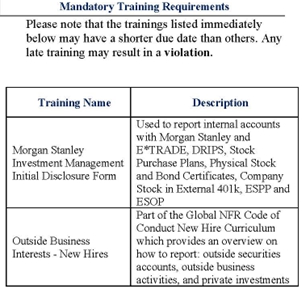
The training of all Covered Persons is one of the various ways that Morgan Stanley exhibits its commitment to maintaining integrity and operating with the highest ethical standards on regulatory and Firm issues at a global, divisional and regional level. Completion of required training is an ongoing focus of the regulators and important to mitigate risk across all areas. In addition, all Covered Persons are responsible for understanding and abiding by all policies, procedures, industry standards, best practices and regulatory requirements discussed and outlined within their assigned Training Requirements.
To ensure compliance, MSIM educates its Covered Persons on laws related to its activities, which may include periodically issuing training, bulletins, manuals and memoranda. Covered Persons are expected to read all such materials and be familiar with their contents.
Covered Persons who fail to complete all or part of their Training Requirements or are repeatedly tardy in their completion may be subject to disciplinary action, up to and including termination of employment. Disciplinary actions can be issued orally or in writing and may include, but are not limited to:
| • | Notifying an employee’s Manager of the delinquency in writing or via the Performance Management Dashboard; |
| • | Issuance of a Letter of Warning / Education to the employee and employee’s Manager; |
| • | Record delinquency in the Compliance Incident Tracking of Employees database; or |
| • | Suspension or termination of employment |
Non-completion of the Code of Conduct or the Code of Ethics training and applicable certifications and supplements can result in additional disciplinary actions prior to suspension or termination of employment, such as, restriction of trading privileges and reduction of discretionary bonus. In addition, non-completion of mandatory training by contingent workers may result in termination of their engagement with Morgan Stanley.
| D. | Overview of Code Requirements |
Compliance with the Code is a matter of understanding its basic requirements and making sure the steps you take regarding activities covered by the Code are in accordance with the letter and spirit of the Code. Generally, you have the following obligations:
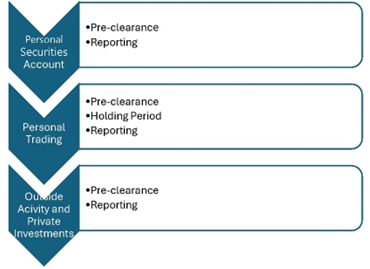
You must examine the specific provisions of the Code for more details on each of these activities. Please contact Compliance if you have any questions.
| 5 |
| E. | Personal Conflicts |
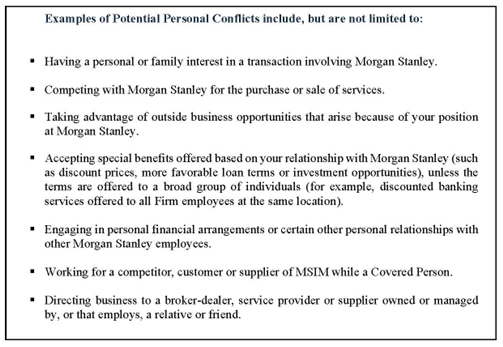
As per the Firm’s Code of Conduct, personal conflicts can arise from your outside activities or investments, or those of your family. You must avoid any investment, activity or relationship that could, or could appear to, impair your judgment or interfere with your responsibilities to Morgan Stanley (the “Firm”) and our Clients.
If you become aware of an actual or potential conflict, you must act in accordance with applicable regulatory requirements and our policies. You also must notify your supervisor, the Conflicts Management Officer (CMO) for your business unit in your region, a member of LCD or the Firm’s Global Conflicts Office (GCO)—including if an actual or potential conflict arises from an investment or activity that was previously approved through the Outside Business Interests (OBI) System. Consult the Conflicts of Interest InfoPage for additional information.
To reinforce our commitment to avoid conflicts of interest and act in the best interest of our Clients, the following rules have been adopted:
| • | Covered Persons may not act on behalf of MSIM or a Client in connection with any transaction in which they have a personal interest. |
| • | Broker-dealers, service providers and suppliers should be selected based on quality, reliability, price, service and technical advantages in accordance with applicable firm policies. |
| II. | TYPES OF ACCOUNTS/ACCOUNT OPENING REQUIREMENTS |
| A. | Personal Securities Accounts |
Generally, you and your Immediate Family must maintain all Personal Securities Accounts that may invest in Covered Securities at a Morgan Stanley Broker or Preferred Brokers, as applicable to the respective jurisdiction.
Requirements may vary in non-U.S. offices. New Employees or newly designated Covered Persons must disclose their Personal Securities Account(s) and accounts of their Immediate Family within 10 calendar days of hire/becoming a Covered Person and transfer their Personal Securities Account(s) to a Morgan Stanley Broker or Preferred Brokers, as applicable in non-US jurisdictions, at their own expense, within 60 calendar days of Compliance’s review. Failure to do so may be considered a significant violation of this Code. New accounts due to marriage, inheritance, etc. are required to be disclosed within 10 calendar days of the event.
| 6 |
Opening a Morgan Stanley or E*TRADE Brokerage Account. When opening a Personal Securities Account, you must notify the Broker that you are an Employee and that the relevant account must be coded as an Employee or Employee-related account. U.S. Employees can open a new account at etrade.com/msemployee or going to my finances/ to open a Morgan Stanley account. Employees do not need prior approval via the OBI system to open accounts with Morgan Stanley or E*TRADE.
| B. | Fully Managed Account* |
With prior approval, Fully Managed Accounts are generally permitted to be maintained outside of the Firm. For Fully Managed Accounts maintained outside of the Firm, Employees must provide Employee Investing and Activities Compliance (“EIAC”) with a copy of the executed management agreement or equivalent documents, with the respective account numbers, which EIAC will review for the relevant provisions. For certain brokers, the management agreement is not required (e.g., robo-advisors). If the account is managed by a firm other than Morgan Stanley, you must submit a request in the OBI System and may be required to periodically upload duplicate copies of statements into the system upon Compliance’s request or where applicable, EIAC will arrange for copies of the statements to be sent to the Firm.
With prior approval, you may open a Fully Managed Account for yourself or an Immediate Family member if the account meets the standards set forth below. In certain circumstances and with approval from Compliance, you may appoint non-Morgan Stanley managers (e.g., trust companies, banks or registered investment advisers) to manage your account.
To establish a Fully Managed Account, you must grant the manager complete investment discretion over your account. Pre-clearance is not required for trades in this account; however, you may not participate, directly or indirectly, in individual investment decisions or be made aware of such decisions before transactions are executed. This restriction does not preclude you from establishing investment guidelines for the manager, such as indicating industries in which you desire to invest, the types of securities you want to purchase or your overall investment objectives. However, those guidelines may not be changed so frequently as to give the appearance that you are directing account investments.
*Pursuant to local regulation, Employees of MSIM Private Limited and IM Public Side Employees of the Global In-house Centers as listed in Schedule B are prohibited from opening Fully Managed Accounts.
| C. | Other Morgan Stanley Sponsored Accounts |
You do not have to pre-clear participation in Morgan Stanley Sponsored Accounts (e.g., Morgan Stanley 401 (k), Employee Incentive Compensation Plan, etc.) with Compliance. However, you must disclose participation in these and similar plans during the annual certification process. Changes made to existing investments in the Morgan Stanley 401(k) Plan that result in funds being moved in or out of the Morgan Stanley Stock Fund are subject to applicable window periods, and if you are an Access Person, to pre-clearance in accordance with Section III.
| 7 |
| D. | Non-Morgan Stanley Accounts |
Exceptions to the requirement to maintain Personal Securities Accounts at a Morgan Stanley Broker are rare and require Compliance approval. If your request is approved, you will be required to ensure that missing statements are uploaded directly into the OBI System periodically upon Compliance’s request. Requirements may vary in non-U.S. offices.
If you open an account other than with a Morgan Stanley Broker (inclusive of E*TRADE) without obtaining the required Compliance pre-approval, you must immediately disclose it to Compliance through the OBI System. You may be required to close such account.
Maintaining a non-Morgan Stanley 401(k) plan or similar account that permits you to trade Covered Securities must be disclosed in the OBI System for review by Compliance. Similar plans that do not have brokerage capabilities, but hold Covered Securities, must be disclosed during the Initial Disclosure Process and as part of the annual certification process.
Any approval to open or maintain a Held-Away Spousal Account, is subject to you, as the employee, providing or arranging to provide relevant account information and duplicate account statements. In addition, at such time as your spouse or domestic partner is no longer employed by another financial institution, you must promptly transfer the account to Morgan Stanley or E*TRADE and update the relevant OBI disclosure.
| E. | Individual Savings Accounts (“ISAs”) for Employees of MSIM Ltd. and EVAIL |
Fully Managed Accounts for ISAs (i.e., an independent manager makes the investment decisions) and non-discretionary ISAs (including single company ISAs) where you make investment decisions, may only be established and maintained as long as the account is pre-approved by Compliance through the OBI System. In addition, for non-discretionary ISAs you must obtain pre-clearance approval for each transaction you wish to undertake via the Trade Pre-Clearance (“TPC”) system. Duplicate statements must be supplied to Compliance and applicable quarterly and yearly reporting requirements must be met. For the avoidance of doubt, Fully Managed Accounts for ISAs do not require pre-clearance approval for each transaction undertaken by the independent investment manager. However, yearly reporting requirements apply.
| F. | Mutual Fund Accounts |
You and your Immediate Family may open an account for the purpose of transacting in affiliated open-end Mutual Funds, including Sub-Advised and Proprietary Mutual Funds (i.e., an account directly with a fund transfer agent) without prior approval from Compliance. You must report participation in these accounts via the Initial Disclosure Process or during the next quarterly certification cycle and as part of the annual certification process. Accounts invested only in non-affiliated open-end Mutual Funds do not require disclosure in the OBI System if the account does not have the ability to trade in Covered Securities.
| 8 |
| G. | Automatic Investment Plans |
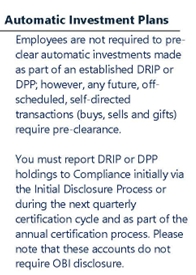
With prior approval, you may open an account directly with an issuer to purchase its shares, such as a dividend reinvestment plan, (“DRIP”) or Direct Purchase Plan (“DPP”) by submitting a pre-clearance request via the TPC system for the initial purchase.
| H. | Investment Clubs |
You may not participate in or solicit transactions on behalf of investment clubs in which members pool their funds to make investments in securities or other financial products.
| I. | Cryptocurrencies |
You are generally not required to disclose accounts for Cryptocurrency (wallets/accounts) if they do not have brokerage capability (i.e., cannot hold Covered Securities) and are not linked to an account with brokerage capability (whether such capability is utilized).
While trading Cryptocurrencies does not require disclosure or pre-clearance, other types of participation in Cryptocurrency activities (e.g., private investments, outside business activities (including mining), and participating in Initial Coin Offerings (“ICOs”)) require disclosure and pre-approval through the OBI System(please see the Global Employee Trading, Investing and Outside Business Activities Policy).
| 9 |
| III. | PRE-CLEARANCE REQUIREMENTS FOR PERSONAL SECURITIES TRANSACTIONS |
| A. | General |
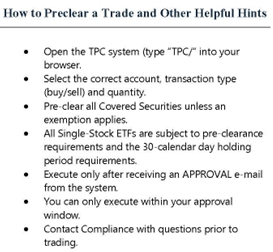
You and your Immediate Family are required to pre-clear and receive prior approval for all personal securities transactions in Covered Securities (including the gifting of Covered Securities) unless your personal securities transaction is subject to an exemption under this Code. Should an Employee be made aware of a proposed transaction in a Fully Managed Account or have personally directed or asked another person to direct a trade in a Fully Managed Account, the Employee is required to pre-clear that trade prior to execution. See the Securities Transaction Matrix in Schedule A for additional information regarding the requirements for pre-clearance. In keeping with the general principles and objectives of the Code, Compliance, in its sole discretion, may refuse to grant approval of a personal securities transaction, without specifying a reason for the refusal.
Personal trade requests for IM Public Side employees will be denied if there is an order for a Client in the same or related security at the time the personal trade request is submitted. Exceptions may be granted if the Covered Security is being purchased or sold for a passively-managed index fund or index portfolio.
Any transaction that is prohibited by the Code may be required to be reversed and any profits (or any differential between the sale price of the personal security transaction and the subsequent purchase or sale price by a Client during the relevant period) are subject to disgorgement. See “Enforcement and Sanctions”.
Please consult with your local Compliance if you have any questions.
| B. | Initiating a Trade |
Transactions requiring pre-clearance may not be executed prior to receiving an “Approval” e-mail from the TPC system. Approval is obtained by entering your trade request into the TPC system. Upon completion of the necessary compliance checks, you will receive a system generated e-mail notification advising whether your request has been approved or rejected and the time frame in which you are permitted to execute your trade. You must wait for notification from the TPC system advising that your trade request has been approved before executing the trade.
| 10 |
| C. | Requirements for Tier 1 Employee |
Covered Persons deemed Tier 1 Employees have until the close of next business day from the date of approval to execute the trade.
Note: Omni Personnel and those who have access to Flex One; see Section III.F “Restrictions and Requirements for Omni Personnel and those who have access to Flex One” below.
| D. | Restrictions and Requirements for Tier 2 Employees and IM Public Side Investment Personnel |
Tier 2 Employees are required to pre-clear Covered Securities through the TPC system during the open market session they intend to execute the trade. Approved requests are valid only during the market session for which it is granted and expires at market session close that same day. Any transaction not completed (whether in whole or in part) during that market session will require a new approval. This means that you are not permitted to enter “good-till-canceled” orders. Only market orders and limit orders for the day are permitted. Open orders, such as limit orders and stop-loss orders, must be pre-cleared each day until the transaction is effected. In the case of trades in international markets where the market has already closed when approval is granted, transactions must be executed by the next close of trading in that market.
In addition, no purchase or sale transaction may be made in any Covered Security or a related investment (i.e., derivatives) by IM Public Side Investment Personnel or other Employees who have knowledge of client trading (excluding Omni Personnel and those who have access to Flex One) for a period of five (5) calendar days before and five (5) calendar days after the IM Public Side Investment Personnel purchases or sells the security on behalf of a Client. Exceptions from the Blackout Period may be granted if the Covered Security was traded for an index fund or index portfolio.
| E. | Restrictions and Requirements that apply to |
Research Recommendations or Conclusions
Where research recommendations or conclusions are involved, IM Public Side Investment Personnel must adhere to the following.
If within the five (5) calendar days prior to and including the day you seek pre-clearance and approval to enter into a personal securities transaction for a security:
| • | that security or a related financial instrument has been added to or removed from the Analyst Select Portfolio (a paper portfolio (non-cash) that enables analysts to express their opinions on their coverage sector or a specific stock within the coverage sector), or an existing position in the Analyst Select Portfolio has been increased or decreased; |
| • | the weighted price potential (“WPP”) of that security (as determined by a Research Analyst) or a related financial instrument has been changed (the amount of the change in order to trigger the restrictions set forth herein as determined from time to time) on the relevant system; |
| • | for purposes of CRM, that security (or its issuer) has been designated as “eligible” or “ineligible” or its designation as a “eligible” or ineligible has changed, then you CANNOT trade the security and your pre-clearance request will be denied. |
| 11 |
Blackout Period related to the Rebalance and Reconstitution of a Calvert Index
If you are an Employee with knowledge of the decisions of the CRM Research, Review and Recommendation Committee or the actions taken by the CRM Index Committee (or any new or successor committees that CRM may form to perform similar functions) as determined by the CRM Chief Compliance Officer or their designee, for the 5 calendar days prior to and including the day that the relevant Calvert Index is rebalanced or reconstituted, you may NOT enter into a Personal Securities Transaction in your personal account. A Compliance Officer will notify you if you are subject to this blackout period.
Additional Requirements Pertaining to Research Analysts in the Eaton Vance Affiliated Entities
Research Analysts and their Immediate Family are subject to the requirements and restrictions listed below.
Personal Securities Transactions for Securities in Your Coverage Area. You and your Immediate Family may not enter into a personal securities transaction in any security for which you have coverage responsibility:
| • | If you are in the process of making a new recommendation, have changed a recommendation or conclusion for the security or a related financial instrument, but have not yet communicated it to the IM Public Side Investment Personnel in your department; or |
| • | Until the 5th calendar day after you have communicated your new or changed recommendation or research conclusion throughout the relevant investment group. |
You may then proceed according to the requirements set forth above under sub-sections A, B and C above.
| F. | Restrictions and Requirements for Omni and Those Who Have Access to Flex One |
IM Public Side Investment Personnel who trade for Omni or those who have access to the Flex One system, are required to receive approval from their Designated Manager, via e-mail, for any personal securities trades one (1) calendar day prior to the intended transaction. Upon receipt of their Designated Managers approval, the employee is then required to request approval, the following trade date, via the TPC system and must wait until they receive notification from the TPC system, prior to executing. Final approval is valid for that day only.
Please consult your local Compliance if you have questions.
| G. | IM Private Side Employees and Those Designated to be “Above-the-Wall” |
IM Private Side Employees and MSIM Employees designated as Above-the-Wall (“ATW”) are required to pre-clear their transactions with their Designated Manager and the Control Group.
| 12 |
| H. | Transacting in Morgan Stanley Securities |
Transacting in, including the gifting of, Morgan Stanley securities and options is subject to the Global Employee Trading, Investing and Outside Business Activities Policy (see section 7) and must take place during the designated window periods. Consult MS Today or MSIM Code of Ethics Employee Jive site for the window period announcement prior to trading.

You may, from time to time, receive or have access to MNPI related to Morgan Stanley BDCs. This could include, for example, information about BDCs’ financial performance or possible strategic transactions. As with any other situation involving MNPI, you are prohibited from transacting in Morgan Stanley BDC securities, including through your Morgan Stanley 401(k) Plan or other deferred compensation or retirement plans (including those held outside the Firm) while in possession of any MNPI. For further information regarding what types of information may constitute MNPI, see the Global Confidential and Material Non- Public Information Policy.
Subject to approval, you, your spouse or domestic partner or dependent may only transact in (e.g. purchase, sell, transfer, or gift) Morgan Stanley BDC securities during specified open window periods (including transactions in the Morgan Stanley Stock Fund option of the 401(k) Plan).
The window period for transactions in Morgan Stanley BDC securities generally begins on the next business day after the Company publicly releases quarterly or annual financial results and extends until the undisclosed financials for the current (or just-completed) quarter become close enough to being finalized to constitute inside information. To the extent, these dates are set in advance, the same will be provided to Control Group for inclusion on the relevant Restricted Lists.
All Morgan Stanley employees (including on behalf of their spouse or domestic partner or dependent) must preclear trading in Morgan Stanley BDC securities as per standard pre-clearance procedure.
There may be a need to close the trading window in case of material non-cyclical (i.e., non-earnings) information, such as potential M&A activity. Each applicable Business Unit is responsible for timely Control Group notification for these non-cyclical situations.
| I. | Trading Derivatives |
MSIM Employees who work in the PPA business and India employees are prohibited from trading ALL Derivatives.
The following is a list of permitted options trading (for non-PPA Employees) that must be pre-cleared by your local Compliance and submitted through the TPC system:
Call Options
Listed Call Options. You may purchase a listed call option on common stock if the call option has a “period to expiration” of at least 30 calendar days from the date of purchase and you hold the call option for at least 30 calendar days prior to sale. If you choose to exercise the option, you must also hold the underlying security delivered pursuant to the exercise for 30 calendar days after the date of option exercise.
| 13 |
Covered Calls. You may also sell (or “write”) a call option only if you have held the underlying security (in the corresponding amount) for at least 30 calendar days.
Put Options
Listed Put Options. You may purchase a listed put option on common stock if the put option has a “period to expiration” of at least 30 calendar days from the date of purchase and you hold the put option for at least 30 calendar days prior to sale. If you purchase a put option on a security you already own, you may exercise the put once you have held the underlying security for 30 calendar days. If you purchase a put on a security that you do not own, you may not exercise the put; and must sell the option prior to its expiration date.
You may not trade futures, forward contracts, including currency forwards, physical commodities and related derivatives, over-the-counter options, warrants or swaps. You are prohibited from selling (“writing”) a put. The prohibition on commodities trading applies to trades directly on commodities markets rather than holding the physical commodity (e.g., gold bullion).
| J. | Other Restrictions |
Primary and Secondary Public Offerings
You and your Immediate Family are generally prohibited from purchasing any equity security in an initial or secondary/follow on public offering. In addition, unless otherwise notified by Compliance, you may not purchase an equity security that is part of a primary or secondary public offering that the Firm is underwriting or selling until the distribution has been completed. This restriction does not apply to rights issuances to which Personal Securities Accounts would be entitled with regard to their existing holdings. Note that this restriction also applies to your Immediate Family, regardless of whether the securities are purchased into a Personal Securities Account.
Purchases of new issue debt are permitted, provided such purchases are pre-cleared by Compliance and meet other relevant requirements of the Code.
Short Sales
You and your Immediate Family may not engage in short selling of Covered Securities.
Restricted List
You and your Immediate Family may not transact in Covered Securities that appear on the Firmwide Restricted List or the MSIM Restricted List. You must check the Restricted Lists prior to submitting a TPC request and executing the trade.
Cross Trades
MSIM Employees and their Immediate Family are not allowed to engage in cross trades or pre-arranged trades between their Personal Securities Accounts, MSIM funds and MSIM Client accounts.
Changes to Normal Settlement Cycles
Hong Kong Type 9 License Holders are not permitted to make changes to normal settlement cycle or delay settlement for any trades in Personal Securities Accounts.
| 14 |
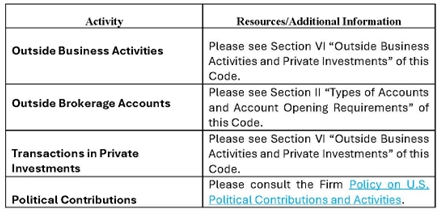
| K. | Other Activities Requiring Pre-Clearance |
| IV. | HOLDING REQUIREMENTS |
| A. | Proprietary or Sub-advised Mutual Funds and Single-Stock Exchange-Traded Funds |
You may not redeem or exchange Proprietary or Sub-advised Mutual Funds or Single-Stock Exchange- Traded Funds until at least 30 calendar days from the purchase trade date.
Employees are subject to the terms and restrictions of an open-end fund’s prospectus, including restrictions such fund may impose on excessive trading. You may not engage in trading of shares of an open-end fund that is inconsistent with the prospectus of that fund. Where a proprietary or sub-advised fund’s prospectus has a holding period that is less than 30 calendar days, Employees are required to hold shares for at least 30 calendar days before selling.
| B. | Covered Securities |
You may not sell a Covered Security until you have held it for at least 30 calendar days. For calculation purposes, the trade date counts as day one and the position may be closed on the 31st calendar day or thereafter.
| C. | Holding Requirements Specific to MSIMJ Employees |
When selling equity (i.e., domestic and foreign equity shares and rights as well as corporate bonds, etc. that can be converted into shares such as corporate bonds with share warrants or share options), Covered Persons at MSIMJ must hold such instruments for at least six months. This includes transactions in Morgan Stanley Securities.
| D. | Holding Requirements Specific to HK Type 9 License Holder Employees |
All personal account investments (including Exempt Securities) made by Hong Kong SFC Type 9 License Holders are required to be held for a minimum of 30 calendar days.
| 15 |
| V. | REPORTING REQUIREMENTS |
| A. | Initial Reporting and Holdings Certification |
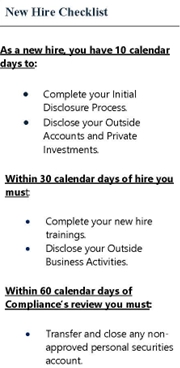
When you commence employment with MSIM or otherwise become a Covered Person, you must complete the Initial Disclosure Process (the “Initial Report”) no later than 10 calendar days after you become a Covered Person. The information you provide must not be more than 45 calendar days old from the day you became a Covered Person and must include:
| • | The title and type, and, as applicable, the exchange ticker symbol or CUSIP number, number of shares and the (current) principal amount of any Covered Security; |
| • | The name of any broker-dealer, bank or financial institution where you maintain an account in which any securities are held; and |
| • | The date you submitted the Initial Report. |
All new Covered Persons will receive training on the principles and procedures of the Code. As a Covered Person, you must also certify that you have reviewed, understand and agree to abide by the terms of this Code, including but not limited to, the disclosure of outside accounts and Private Investments that are required to be logged in the OBI System within 10 calendar days and the transfer or closure of the account within 60 calendar days of Compliance’s review. Your Outside Business Activities must be disclosed within 30 calendar days.
If you have any questions, contact your local Compliance group.
| 16 |
| B. | Quarterly Reporting and Certification |
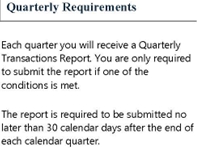
You must submit a Quarterly Transactions Report to Compliance no later than 30 calendar days after the end of each calendar quarter, or in accordance with regulatory requirements applicable to your region. You do not have to submit a Quarterly Transactions Report if it would duplicate information provided in broker account statements that Compliance already receives or may access.
The Quarterly Transactions Report must contain the information set forth below.
| • | For transactions in a Personal Securities Account during the previous quarter you must provide: |
| o | The date of the transaction, the title, and, as applicable, the exchange ticker symbol or CUSIP number, interest rate and maturity date, number of shares and principal amount of any Covered Security; |
| o | The nature of the transaction (i.e., purchase, sale or other type of acquisition or disposition); |
| o | The price of the security at which the transaction was effected; |
| o | The name of the broker-dealer or bank with or through which the transaction was effected; and |
| o | The date you submitted the Quarterly Transaction Report. |
| • | For any new account, including accounts for your Immediate Family, established by you during the previous quarter in which any securities are held for your direct or indirect benefit, you must provide: |
| o | The name of the broker-dealer, bank or financial institution with which you established the account; |
| o | The date the account was established; and |
| o | The date you submitted the Quarterly Transaction Report. |
A reminder to complete the Quarterly Transaction Report will be provided to you by Compliance.
| 17 |
| C. | Annual Reporting and Holdings Certification |
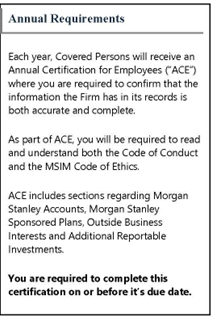
You must update, as applicable, and certify to the following information on an annual basis (the “Annual Report”):
| • | A list of your current brokerage account(s), including those for your Immediate Family; |
| • | A list of all securities and current principal amount Beneficially Owned by you in these account(s); |
| • | A list of all your approved Outside Business Activities, and Private Investments; |
| • | A list of all other additional reportable investments you hold outside of Morgan Stanley (such as DRIPs, other 401(k) accounts and any Covered Securities held in certificate form); |
| • | A list of financial institutions (broker dealers, banks, transfer agents, etc.) with which you maintain an account in which any securities are held; and |
| • | That you have not made, directly or indirectly, any individual investment decision related to any Fully Managed Account(s), nor have you directed another person to make such investments without first pre-clearing those transactions in accordance with Section III. |
The information in the Annual Report must be current as of 45 calendar days before the report is submitted. You must also certify that you have reviewed and agree to abide by the requirements of the Code and that you are in compliance with the Code.
The link to the Annual Report will be provided to you by Compliance.
Hong Kong Type 9 License Holders are required to submit their holdings annually (via Annual report) and semi-annually each year.
| 18 |
| VI. | OUTSIDE BUSINESS ACTIVITIES AND PRIVATE INVESTMENTS |
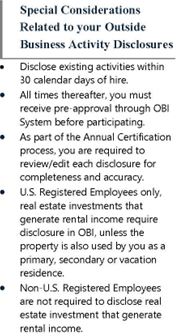
| A. | Approval to Engage in an Outside Business Activity |
You may not engage in any Outside Business Activity, regardless of whether you receive compensation or are asked to engage in such activity by the Firm, without prior approval first from your Designated Manager and then from Compliance. If you receive approval, it is your responsibility to notify Compliance immediately if any conflict or potential conflict of interest arises during the Outside Business Activity or if the nature of the activity changes, materially.
Examples of an Outside Business Activity, as per the Global Employee Trading, Investing and Outside Business Activities Policy, include providing consulting services, organizing a company, giving a formal lecture or publishing a book or article, accepting compensation from any person or organization other than the Firm, serving as an officer, employee, director, partner, member, or advisory board member of a company or organization not affiliated with the Firm, whether or not related to the financial services industry (including charitable organizations or activities for which you do not receive compensation), setting up a holding company for investments, investing in rental properties or acting as power of attorney and receiving compensation for such role. Generally, Compliance will not approve any Outside Business Activity related to the securities or financial services industry other than activities that reflect the interests of the industry as a whole and that are not in competition with those of the Firm.
In the case of employees of Morgan Stanley AIP GP LP (“AIP”), where serving on an advisory board for a company in which AIP invests is part of the AIP employee’s roles and responsibilities as an employee of AIP, such service shall not be considered an Outside Business Activity and approval via the OBI System is not required. The relevant senior business managers are responsible for approving Employees to serve on advisory boards, documenting such approvals, maintaining a list of such Employees, and reviewing the list in consultation with the relevant Compliance officers at least annually.
Employees in Morgan Stanley’s Private Infrastructure, Private Real Estate Investing and Private Credit and Equity business units (“Private Side Investing”) are permitted upon Morgan Stanley’s request to join boards of public or private companies in which Private Side Investing funds have an investment. Private Side Investing maintains a database of directorships held by Private Side
| 19 |
Investing employees on behalf of Private Side Investing funds. Therefore, these employees are not required to disclose these directorships in OBI but through BluePrint and IM Legal Entity Management (LEM) should be informed. However, where a Private Side Investing employee wants to join the board of a company where no Private Side Investing fund has an investment, this must be disclosed through the OBI System.
A request to serve on the board of any company, particularly the board of a public company, will be granted in very limited instances only. If you receive approval, your directorship may be subject to the implementation of information barrier procedures to isolate you from making investment decisions for Clients concerning the company in question, as applicable.
| B. | Approval to Invest in a Private Investment |
You must request and receive approval through the OBI System for all Private Investments that are not offered on the Morgan Stanley platform and not held in a Morgan Stanley account. Private Investments include investments in privately held corporations, limited partnerships, tax shelter programs, hedge funds and holding companies (e.g., LLC, LP, S-Corp, C-Corp, etc.).
Singapore-licensed Employees are prohibited from conducting (by way of Outside Business Activity or Private Investment) the following non-financial advisory activities:
Being engaged in any of the following:
| • | Carrying on or being involved in the business of money lending |
| • | Organizing, promoting or conducting any casino marketing arrangement in or with respect to any casino |
| • | Acting as an associate of an international market agent |
| • | Being engaged in the business of an international market agent |
| • | Being an applicant for an international market agent license |
| • | Carrying on the business of an estate agent, or acting/representing as an estate agent |
| • | Acting or holding himself out as a salesperson for any licensed estate agent |
| • | Marketing any investment that is not an investment product |
Being invested in, or holding any interest in the following:
| • | Any moneylending business |
| • | Any business of an international market agent |
| • | Any business of an estate agent |
| VII. | REVIEW, INTERPRETATIONS AND EXCEPTIONS |
Compliance is responsible for administering the Code and reviewing your Initial, Quarterly and Annual Reports. Compliance has the authority to make final decisions regarding Code policies and may grant an exception to a policy if it determines that no abuse or potential abuse is involved. Exceptions are granted only in rare and unusual circumstances, such as financial hardship. You must contact Compliance with any questions regarding the applicability, meaning or administration of the Code, including requests for an exception, in advance of any contemplated transaction. If Compliance determines that an exception would not be against the interests of any Client and is consistent with applicable laws and regulations, including Rule 204A-1 under the Advisers Act and Rule 17j-1 under the Investment Company Act, Compliance may approve an exception and will document the exception, including the circumstances and rationale.
| 20 |
| VIII. | ENFORCEMENT AND SANCTIONS |
Violations of the Code must be reported promptly to Compliance and, as appropriate, senior management. On a quarterly basis, violations of the Code are reported to the applicable funds’ board of directors. Compliance may issue letters of warning/education or impose sanctions as appropriate, including notifying your Designated Manager, issuing a reprimand (orally or in writing), restricting your trading privileges, reducing your discretionary bonus, if any, requiring reversal of a trade made in violation of the Code or other applicable policies, or taking other disciplinary action, including, but not limited to, suspension or termination of your employment. Violations are considered on a cumulative basis.
The foregoing sanctions are intended to be guidelines only. Compliance, in its discretion, may recommend alternative actions if deemed warranted by the facts and circumstances of each situation. MSIM management, including the Head of MSIM Compliance, is authorized to determine the choice of actions to be taken in specific cases.
Sanctions may vary based on applicable law and regulatory requirements in your jurisdiction.
In addition, pursuant to the terms of Section 9 of the Investment Company Act of 1940, as amended, no director, officer or Employee of MSIM may become, or continue to remain, an officer, director or Employee of MSIM without an exemptive order issued by the U.S. Securities and Exchange Commission, if such director, officer or Employee:
| • | Within the past ten years has been convicted of any felony or misdemeanor (i) involving the purchase or sale of any security; or (ii) arising out of his or her conduct as an underwriter, broker, dealer, investment adviser, municipal securities dealer, government securities broker, government securities dealer, transfer agent, or entity or person required to be registered under the U.S. Commodity Exchange Act, or as an affiliated person, salesman or employee of any investment company, bank, insurance company or entity or person required to be registered under the U.S. Commodity Exchange Act; or |
| • | Is or becomes permanently or temporarily enjoined by any court from: (i) acting as an underwriter, broker, dealer, investment adviser, municipal securities dealer, government securities broker, government securities dealer, transfer agent, or entity or person required to be registered under the U.S. Commodity Exchange Act, or as an affiliated person, salesman or employee of any investment company, bank, insurance company or entity or person required to be registered under the U.S. Commodity Exchange Act; or (ii) engaging in or continuing any conduct or practice in connection with any such activity or in connection with the purchase or sale of any security. |
You are obligated to immediately report any conviction or injunction described here to Compliance.
In addition to the above, you may also be subject to similar fit and proper/conduct related requirements to the extent you are employed or licensed in non-US jurisdictions. Please reach out to your local Compliance coverage if you are unclear about the requirements that apply to you.
| IX. | RELATED POLICIES |
In addition to this Code, you are also subject to the policies and procedures documented in the Compliance Manual applicable to your region; the Global Employee Trading Investing and Outside Business Activities Policy; the Morgan Stanley Code of Conduct; the Global Confidential and Material Non-Public Information Policy; the Policy on U.S. Political Contributions and Activities; and the MSIM Global Gifts, Entertainment and Charitable Giving Policy (requirements may vary in non-U.S. offices).
| 21 |
| X. | RECORDKEEPING |
| A. | Firm Requirements |
Records are retained in accordance with the Firm’s Global Information Management Policy, which establishes general Firm-wide standards and procedures regarding the retention, handling, and destruction of official books and records and other information of legal or operational significance.
The Global Information Management Policy incorporates the Firm’s Master Retention Schedule, which lists various record classes and associated retention periods on a global basis.
| B. | MSIM Maintenance of Records Relevant to this Code |
Compliance shall maintain records relevant to this Code as may be necessary under the provisions of this Code including all educational materials distributed or training sessions held relating to the Code.
Previous versions include: August 16, 2002, February 24, 2004, June 15, 2004, December 31, 2004, December 15, 2006, May 12, 2008, August 19, 2010, September 17, 2010, February 15, 2011, March 1, 2011, September 28, 2011, June 29, 2012, September 16, 2013, October 10, 2014, March 26, 2016, December 7, 2017, December 12, 2018, December 12, 2019, December 11, 2020, January 1, 2022, December 15, 2022, December 12, 2023 December 12, 2024 and July 25, 2025.
| 22 |
SCHEDULE A
SECURITIES TRANSACTION MATRIX
| TYPE OF SECURITY |
Pre-Clearance Required |
Reporting Required |
30 Calendar Days Holding Period Required |
| Covered Securities | |||
| Pooled Investment Vehicles: | |||
| Closed-End Funds | Yes | Yes | Yes |
| Proprietary or Sub-advised Mutual Fund | No | Yes | Yes |
| Unit Investment Trusts | No | Yes | Yes |
| Single-Stock ETFs | Yes | Yes | Yes |
| Exchange-Traded Funds (ETFs) including Commodity ETFs and Cryptocurrency ETFs | No | Yes | No |
| Exchange-Traded Notes (ETNs) | No | Yes | No |
| Hedge Funds | Yes | Yes | No |
| Equities: | |||
| Morgan Stanley Securities1 | Yes | Yes | Yes |
| Listed Morgan Stanley BDC Securities | Yes | Yes | Yes |
| Common Stocks | Yes | Yes | Yes |
| Listed Depository Receipts e.g. ADRs, Ads, GDRs | Yes | Yes | Yes |
| DRIPs2 | Yes | Yes | Yes |
| Corporate Non-Voluntary Actions (e.g., Stock Splits, Mergers, Spin-off, etc.) | No | Yes | No |
| Rights | Yes | Yes | Yes |
| Stock Dividend | No | Yes | No |
| Warrants (Listed and Exercised) | Yes | Yes | Yes |
| Preferred Stock | Yes | Yes | Yes |
| Listed Real Estate Investment Trusts (REITs) | Yes | Yes | Yes |
| Initial Public Offerings (equity IPOs) and Secondary/Follow on offerings | PROHIBITED | ||
1 Employees may transact in Morgan Stanley securities only during designated window periods. Pre-clearance of transactions in Morgan Stanley securities is required for all Access Persons. Non-Access Person are exempt from pre-clearance.
2 Automatic purchases for dividend reinvestment plan are not subject to pre-approval requirements. Only the initial set up/purchase requires preclearance.
| 23 |
| TYPE OF SECURITY |
Pre-Clearance Required |
Reporting Required |
30 Calendar Days Holding Period Required |
|
Private Investments in Public Equity Securities (PIPES) |
Yes | Yes | N/A |
| Derivatives (Employees who work in the PPA businesses and India Employees are prohibited from trading ALL derivatives): | |||
| Morgan Stanley (stock options) | Yes | Yes | Yes |
| Listed Common Stock Options | Yes | Yes | Yes |
| Listed call and put options on broad-based or single sector indices that have at least 30 days to expiration | No | Yes | No |
| Listed call and put options on ETFs | No | Yes | No |
| Forward Contracts (including currency forwards) | PROHIBITED | ||
| Commodities Contracts | PROHIBITED | ||
| OTC options, warrants or swaps | PROHIBITED | ||
| Futures | PROHIBITED | ||
| Fixed Income Instruments: | |||
| Asset Backed Securities | Yes | Yes | Yes |
| Fannie Mae | Yes | Yes | Yes |
| Freddie Mac | Yes | Yes | Yes |
| Corporate Bond | Yes | Yes | Yes |
| Convertible Bonds (converted) | Yes | Yes | Yes |
| Municipal Bonds | Yes | Yes | Yes |
| New Issues (fixed income) | Yes | Yes | Yes |
| Government Sponsored Entities (GSE) / Agency Bonds | Yes | Yes | Yes |
| Structured Notes (Equity-Linked and Credit-Linked) | Yes | Yes | Yes |
| High Yield Sovereign Debt (as rated by S&P) | Yes | Yes | Yes |
| High Yield Securities3 | PROHIBITED | ||
| Private Investment and Outside Activities: | |||
|
Private Investments (e.g. limited partnerships) |
Yes | Yes | N/A |
| Outside Activities | Yes | Yes | N/A |
| Investment Clubs | PROHIBITED | ||
| Exempt Securities (The following are exempt from pre-clearance, reporting and holding requirements, except that for Hong Kong SFC Type 9 licensed employees a 30-calendar day holding period is required for all personal account investments in securities including exempt securities): | |||
| Mutual Funds (open-end) not advised or sub-advised by MSIM | Brokerage CDs | GNMA | Bankers’ Acceptances |
| Direct Obligations of the US and Foreign Governments (US Treasury/Investment Grade Sovereign Debt4) | Money Market Funds (Inclusive of Morgan Stanley Money Market Funds) | Commercial Paper |
Investment Grade Short-Term Debt Instruments5 |
|
Variable Annuity Contracts |
Regulated Collective Investment Schemes | Physical Commodities | Currencies |
3 Securities rated below investment grade by S&P.
4 Sovereign debt security rated below investment grade will be subject to pre-clearance and 30-calendar day holding period requirement. Ratings from other rating agencies besides S&P should not be used to determine whether pre-clearance is required.
5 For these purposes, repurchase agreements and any instrument that has a maturity at issuance of fewer than 366 days that is rated as investment grade by a nationally recognized statistical rating organization.
| 24 |
| XI. | DEFINITIONS |
These definitions are here to help you understand the application of the Code to various activities undertaken by you and other persons related to you who may be covered by the Code. The definitions are an integral part of the Code and a proper understanding of them is essential. Refer back to these definitions as you read the Code.
“Above-the-Wall” is the status of specific identified senior management personnel and the related support groups entitling them to receive and have access on an ongoing basis to MNPI from the Private Side in order to perform their duties without following formal Wall Crossing
procedures.
“Access Persons” (for purposes of transacting in Morgan Stanley securities) is defined in the Global Employee Trading, Investing and Outside Business Activities Policy and means those individuals or divisions that, as part of their job function may receive or have access to Morgan Stanley-related material non-public information that is recurring or cyclical in nature.
“Applicable Laws” means all applicable rules and regulations in the jurisdictions in which MSIM conducts business (which jurisdictions shall include, without limitation, those in North America, Europe and Asia).
“Beneficially Owned” generally means an interest where you or a member of your Immediate Family, directly or indirectly: (i) have investment discretion or the ability (including joint ability or discretion) to purchase or sell securities or direct the disposition of securities; (ii) have voting power over securities, or the right to direct the voting of securities; or (iii) have a direct or indirect financial interest in securities (or other benefit substantially equivalent to ownership of securities). For purposes of this Code, “beneficial ownership” shall be interpreted in the same manner as it would be under Section 16 of the Securities and Exchange Act, as amended, and the rules and regulations thereunder.
“Blackout Period” for purposes of this Code, means a temporary period of time as determined by Compliance during which you may be restricted from all personal securities trading or a temporary or indefinite restriction on transactions in certain specific Covered Securities based upon your job responsibilities.
“Chief Compliance Officer” or “CCO” refers to the Chief Compliance Officers that are selected and appointed from time to time by MSIM’s SEC-registered investment advisers.
“Client” means shareholders or limited partners of registered and unregistered investment companies and other investment vehicles, institutional, high net worth and retail separate account clients, employee benefit trusts and all other types of clients advised by MSIM.
“Closed-End Fund” means any fund with a fixed number of shares and which does not issue and redeem shares on a continuous basis. While Closed-End Funds are often listed and trade on stock exchanges, they are not “Exchange traded funds” as defined below in the Covered Securities definition.
“Compliance” means your applicable local Compliance group (e.g., Atlanta, Boston, Dublin, London, Minneapolis, Mumbai, New York, Paris Seattle, Singapore, Tokyo, and Washington, D.C.).
“Control Group” is a team within Legal and Compliance that is responsible for maintaining the Firm’s Information Barriers (often referred to as “the Wall”). The Control Group serves as a buffer between the Firm’s various business units, controlling and coordinating communications between these areas, as well as conducting global surveillance to ensure that applicable laws and rules are followed.
| 25 |
“Covered Persons” means:
| • | All MSIM Employees; |
| • | All directors and officers of MSIM; |
| • | Any person (such as certain consultants, leased workers or temporary workers and any member of an Investment Committee to an IM Private Side-sponsored fund that is advised by an adviser, including SEC registered investment advisers under the Advisers Act and those advisers authorized under applicable EU law) who provides investment advice to clients on behalf of MSIM, is subject to the supervision and control of MSIM or who has access to nonpublic information regarding any Client’s purchase or sale of securities, or portfolio holdings, or who is involved in making securities recommendations to Clients, or who has access to such recommendations that are nonpublic. Contingents that are hired for positions lasting more than one year or are otherwise classified as a Covered Person by their assignment contacts/managers or Compliance may be required to transfer brokerage accounts to a Morgan Stanley Broker or Firm approved third party broker as applicable to the respective jurisdiction. |
| • | Any person with responsibilities related to MSIM or who supports MSIM as a business and has frequent interaction with Covered Persons or Investment Personnel, as determined by Compliance (e.g., Participating Affiliate Employees and certain designated personnel in IT, Tax, Legal, Compliance, and Human Resources). |
| • | Any other persons falling within the definition of “Access Person” under Rule 17j-1 of the Company Act or Rule 204A-1 under the Advisers Act (such as those supervised persons who have access to nonpublic information regarding the portfolio holdings of a client fund) and such other persons that may be so deemed by Compliance from time to time. |
IM Private Side employees who meet the criteria of Category B Consultant Advisors, as set forth in the Global Advisory Directors and Senior Advisors Policy, shall not be classified Covered Persons as defined above. IM Private Side Compliance, in conjunction with the applicable business unit, shall be responsible for maintaining a schedule of all IM Private Category A and Category B Consultant Advisers.
The definition of “Covered Person” may vary by location. Contact Compliance if you have any question as to your status as a Covered Person.
“Covered Securities” includes generally:
| • | All equity or debt securities (excluding high yield securities, which are prohibited), including but not limited to, derivatives of securities (such as options on securities, on indexes and on currencies, warrants and American depositary receipts); |
| • | Asset-backed securities; |
| • | Closed-End Funds; |
| • | Commodities; |
| • | Corporate and municipal bonds, and similar instruments; |
| • | Exchange-Traded Funds including single-stock Exchange-Traded Funds, Exchange-Traded Notes and Cryptocurrency Exchange-Traded Funds; |
| • | Futures; |
| • | Initial Coin Offerings and Secondary Coin Offerings; |
| • | Investments in all kinds of limited partnerships; |
| • | Investments in real estate investment trusts (REITs); |
| 26 |
| • | Investments in private investment funds, hedge funds, private equity funds, and venture capital funds; |
| • | Open-end mutual funds and Exchange-Traded Funds for which MSIM or Eaton Vance Management or an Eaton Vance Affiliated Entity acts as adviser or sub-adviser (including those funds that consist of Exempt Securities as listed in Schedule A and excluding money market funds); |
| • | Preferred securities; |
| • | Securities indices; |
| • | Structured Notes, such as equity-linked or credit- linked notes; |
| • | Unit investment trusts. |
Covered Securities does not include “Exempt Securities,” as defined below. Refer to Schedule A for application of the Code to various security types.
“Cryptocurrency” means any virtual or digital representation of value, token or other asset in which encryption techniques are used to regulate the generation of such assets and to verify the transfer of assets, which is not a security or otherwise characterized as a security under the relevant law. This includes initial coin offerings (“ICOs”) and secondary coin offerings (“SCOs”).
“Derivative” means (1) any Futures and (2) a forward contract, a “swap”, a “cap”, a “collar”, a “floor” and an over-the-counter option. Questions regarding whether a particular instrument or transaction is a Derivatives for purposes of this Code should be directed to your local Compliance group. For avoidance of doubt, a Derivative on a Cryptocurrency is considered to be a “Derivative” for purposes of this.
“Designated Manager” means manager designated by your business unit or department to supervise your personal trading and investing activities.
“Eaton Vance Affiliated Entity” means each of the following: Atlanta Capital Management LLC (“ACM”); Boston Management and Research; Calvert Research and Management (“CRM”); Eaton Vance Advisers International Ltd.; Eaton Vance Management; Eaton Vance Management (International) Limited; Parametric Portfolio Associates LLC. (“PPA”).
“Employee” means all MSIM employees globally on the Public and Private Sides of the Morgan Stanley Investment Management Division business and, as appropriate, their Immediate Family.
“Exempt Securities” are securities that are not subject to the pre-clearance, holding or reporting requirements. Examples of Exempt Securities include:
| • | Bankers’ acceptances, bank certificates of deposit and commercial paper; |
| • | Investment grade, short-term debt instruments, including repurchase agreements (which for these purposes are repurchase agreements and any instrument that has a maturity at issuance of fewer than 366 days that is rated in one of the two highest categories by a nationally recognized statistical rating organization); |
| • | Direct obligations of the U.S. Government (including securities that are backed by the full faith and credit of the U.S. Government for the timely payment of principal and interest) and equivalent securities issued by non-U.S. governments, such as: |
| o | Ginnie Maes, |
| o | U.S. savings bonds, and U.S. Treasuries; and |
| 27 |
| o | Securities issued by non-U.S. governments e.g., premium bonds, indexed- linked savings certificates, fixed income savings certificates, guaranteed equity bonds, capital bonds, children’s bonus bonds, fixed rate savings bonds, income bonds and pensioner’s guaranteed income bonds issued and sold directly to the public through the National Savings and Investments agency of the United Kingdom’s Chancellor of the Exchequer. Note: Non-U.S. government debt securities must be rated Investment Grade or higher by S&P. Otherwise, they will be subject to pre-clearance and 30-day holding period requirement); |
| • | Shares held in money market funds; |
| • | Variable insurance products that invest in funds for which MSIM does not act as adviser or sub-adviser; |
| • | Open-end mutual funds or equivalent in other jurisdictions (e.g., UCITS, SICAVs, UK Authorized Unit Trusts, open-end investment companies (“OEICS”)) for which MSIM does not act as adviser or sub-adviser; |
| • | Currencies (including Spot FX); |
| • | Holding physical commodities; and |
| • | 529 Plans provided that the plan is not invested in MSIM Sub-Advised or Proprietary Funds |
Refer to Schedule A for application of the Code to various security types and additional requirements for Morgan Stanley Asia Limited Employees who hold a Hong Kong Type 9 license.
“Firm” means Morgan Stanley, MSIM’s parent company.
“Fully Managed Account” means an account (including fully managed Individual Savings Accounts (“ISAs”) and an account managed on a discretionary basis by a professional financial adviser or investment adviser (e.g., a robo-advisor) for which an MSIM Employee or Immediate Family has authorized a professional financial advisor or investment manager, in its sole discretion, to acquire and dispose of assets held in the account. Neither the MSIM Employee nor the Immediate Family may make, directly or indirectly, any investment decision, be made aware of any such decisions before transactions are executed by the advisor or manager, or otherwise direct the advisor or manager to effect any transactions in the account. A Fully Managed Account is not considered a Personal Securities Account.
“Hong Kong Type 9 License Holder” means MSIM Investment Personnel housed in Hong Kong entity Morgan Stanley Asia Limited who holds a Hong Kong Type 9 license.
“Immediate Family” pursuant to this Code includes a Covered Persons spouse or domestic partner, dependents and all other persons for whom the Covered Person, their spouse, or domestic partner contributes substantial financial support. This does not include an unrelated person who shares the same residence with the employee provided that the unrelated person and employee are financially independent of one another.
“Initial Public Offering” (“IPO”) means an offering of securities registered under the Securities Act of 1933, the issuer of which, immediately before the registration, was not subject to the reporting requirements of Sections 13 or 15(d) of the Securities and Exchange Act of 1934. As used in this Code, the term “Initial Public Offering” shall also mean a one- time offering of stock to the public by the issuer of such stock which is not an initial public offering.
| 28 |
“Investment Committee” refers to any committee established to be primarily responsible for making investment decisions on behalf of, or investment recommendations to, a Client of IM Private Side.
“Investment Personnel” means MSIM Employees and any other Covered Persons who (i) obtain or have access to information concerning investment recommendations made to any Client; (ii) any persons designated as Investment Personnel by Compliance; (iii) who, with respect to a Client: (a) provides information or advice with respect to the purchase or sale of a financial instrument for the Client (e.g., portfolio manager, or, in some cases a Research Analyst) or (b) helps execute the investment decisions of a portfolio manager, or, where applicable, Research Analyst on behalf of a Client.
“IM Private Side” refers, individually and collectively, to the regulated investment advisers that provide investment advisory and management services to Clients of the Private Real Estate Investing, Private Infrastructure, and Private Credit and Equity, and AIP Private Markets Fund of Funds business units of MSIM’s division, including SEC registered investment advisers and those advisers authorized under applicable EU law.
“Morgan Stanley Broker” means a broker-dealer affiliated with Morgan Stanley, including E*TRADE.
“Morgan Stanley Investment Management” or “MSIM” or “IM” means the companies and businesses comprising the Public and Private Sides of Morgan Stanley’s Investment Management Division.
“Morgan Stanley Securities” means equity, preferred and debt securities issued by Morgan Stanley, including the Morgan Stanley Stock Fund, but excludes structured products, such as equity-linked or credit- linked notes.
“Mutual Funds” means (i) all open-end mutual funds; and (ii) similar pooled investment vehicles established in non-U.S. jurisdictions, such as registered investment trusts in Japan. For purposes of the Code, Mutual Fund does not include shares of open-end money market mutual funds (unless otherwise advised by Compliance).
“Omni Personnel and Those Who Have Access to Flex One” means designated Omni Investment Personnel who are involved in the portfolio management, trading, and research & strategy, as well as others who may have access to Flex One transactions and may have additional pre-clearance requirements as determined by Compliance.
“Outside Business Activity” means any organized or business activity conducted by a MSIM Employee outside of MSIM. This includes, but is not limited to, participation on a board of directors or advisory board, including that of a charitable organization, working part-time outside of MSIM, establishing a holding company for investments, establishing an LLC that invests in rental properties, or forming a limited partnership.
“Participating Affiliate Employee” means any professional located outside of the U.S. who is employed by or seconded to a foreign affiliate of IM Private Side and who provides investment advisory-related services to IM Private Side, including, without limitation: assisting in sourcing and providing information regarding investment and disposal opportunities, providing information and recommendations to Investment Committees, and/or providing ongoing asset or property management services.
| 29 |
“Personal Securities Accounts” are any accounts in your own name and other accounts you could be expected to influence or control, in whole or in part, directly or indirectly, whether for securities or other financial instruments, and that can hold Covered Securities, whether or not such capability is utilized. Personal Securities Accounts include:
| • | Accounts owned by you; |
| • | Accounts owned by your Immediate Family (as defined above); |
| • | Accounts where you obtain benefits substantially equivalent to ownership of securities; |
| • | Accounts that you or the persons described above could be expected to influence or control, such as: |
| o | Joint accounts; |
| o | Family accounts; |
| o | Retirement accounts; |
| o | Corporate accounts; |
| o | Trust accounts for which you act as trustee where you have the power to effect investment decisions or that you otherwise guide or influence; |
| o | Arrangements similar to trust accounts that benefit you directly; |
| o | Accounts for which you act as custodian; and |
| o | Partnership accounts. |
“Portfolio Managers” means MSIM Employees who are primarily responsible for the day- to-day management of a Client portfolio.
“Preferred Broker” means a Firm-approved third-party broker for Personal Securities Accounts.
“Private Investment” means a securities offering that is exempt from registration under certain provisions of the U.S. securities laws and/or similar laws of non-U.S. jurisdictions. It includes investments in hedge funds, private equity funds, limited partnerships, real estate, peer to peer lending clubs and private businesses.
“Proprietary or Sub-advised Mutual Fund” means any open-end Mutual Fund for which MSIM acts as investment adviser or sub-adviser.
“Proprietary or Sub-advised Exchange-Traded Funds” means any Exchange-Traded Fund for which MSIM acts as the investment adviser or sub-adviser.
“IM Public Side” means the MSIM businesses and entities and their Employees who work in the public securities markets (e.g., equities, fixed income and money markets).
“Research Analysts” are MSIM Employees who (1) perform financial, qualitative and/or quantitative analysis of financial instruments or their issuers that result in a recommendation or conclusion to Investment Personnel regarding investments for a Client; or (2) is involved in the construction or rebalancing of an index (as applicable); or
(3) are assigned to make investment recommendations to, or for the benefit of, any Client portfolio; or (4) anyone deemed by Compliance to have access to investment recommendations.
“Restricted Lists” means any list of issuers or securities maintained by Morgan Stanley where trading in Personal Securities Accounts is restricted due to Firm policies or regulation.
| 30 |
“Single-Stock Exchange-Traded Funds” (“ETFs”)” are exchanged-traded funds that track the performance of a single underlying stock.
“Tier 1 Employee” includes all Covered Persons except those that are deemed Tier 2 Employees (e.g., non-Investment Personnel and IM Private Side).
“Tier 2 Employee” includes all IM “Public Side Investment Personnel”. “Public Side Investment Personnel” refers to (“Investment Personnel” as defined above, such as Portfolio Manager, Traders and Research Analysts who are part of the MSIM “Public Side” businesses as defined above).
| 31 |
SCHEDULE B
INVESTMENT MANAGEMENT
(Excluding Private Side)
Registered Investment Advisers
Mesa West Capital, LLC
Morgan Stanley Infrastructure Inc.
Morgan Stanley Investment Management Inc.*
Morgan Stanley AIP GP LP*
Morgan Stanley Investment Management Limited (MSIM Ltd.)
Morgan Stanley Investment Management Company
Morgan Stanley Private Equity Asia Inc.
Morgan Stanley Real Estate Advisor, Inc.
MS Capital Partners Adviser Inc.
MSREF Real Estate Advisor, Inc.
MSRESS III Manager, L.L.C.
Eaton Vance Management (EVM)*
Boston Management and Research (BMR)
Eaton Vance Advisers International Ltd. (EVAIL)
Parametric Portfolio Associates LLC (PPA)*
Atlanta Capital Management Company, LLC (ACM)
Calvert Research and Management (CRM)
Registered Commodity Pool Operator/Commodity Trading Advisor
Ceres Managed Futures LLC
Investment Advisers that are not registered
MSIM Fund Management (Ireland) Limited
Morgan Stanley Investment Management (ACD) Limited
Morgan Stanley Investment Management Private Limited (MSIM Private Limited) (with respect to Public Side Investment Management Employees only)
Morgan Stanley Investment Management (Australia) Pty Limited
Morgan Stanley Asia Limited (MSAL) (with respect to Public Side Investment Management Employees only)
Morgan Stanley Investment Management (Japan) Co., Ltd. (MSIMJ)
Private Investment Partners, Inc.
Morgan Stanley Investment Management (China) Co. Ltd.
Morgan Stanley Investment Management (China) Co. Ltd.
Morgan Stanley Investment Management Limited
Morgan Stanley Asia (Singapore) PTE
Morgan Stanley Capital K.K.
Morgan Stanley Australia Limited
Morgan Stanley India Financial Services Private Limited
Morgan Stanley Asia Limited
Morgan Stanley Business Consulting (Shanghai) Limited
Morgan Stanley Private Equity Management Korea, Ltd.
Morgan Stanley & Co. International plc
Morgan Stanley Investment Management Private Limited
Morgan Stanley (Thailand) Limited
Parametric SAS
| 32 |
Broker-Dealer
Morgan Stanley Distribution Inc.
Eaton Vance Distributors, Inc. (EVD)
_______________
*The entity is also a registered Commodity Trading Advisor and/or a registered Commodity Pool Operator.
Transfer Agent
Morgan Stanley Services Company Inc.
Others:
Eaton Vance Management International Limited (EVMI)
Eaton Vance Trust Company (EVTC)
MSIP Seoul Branch (“MSK”) (with respect to Public Side Investment Management Employees only)
| 33 |