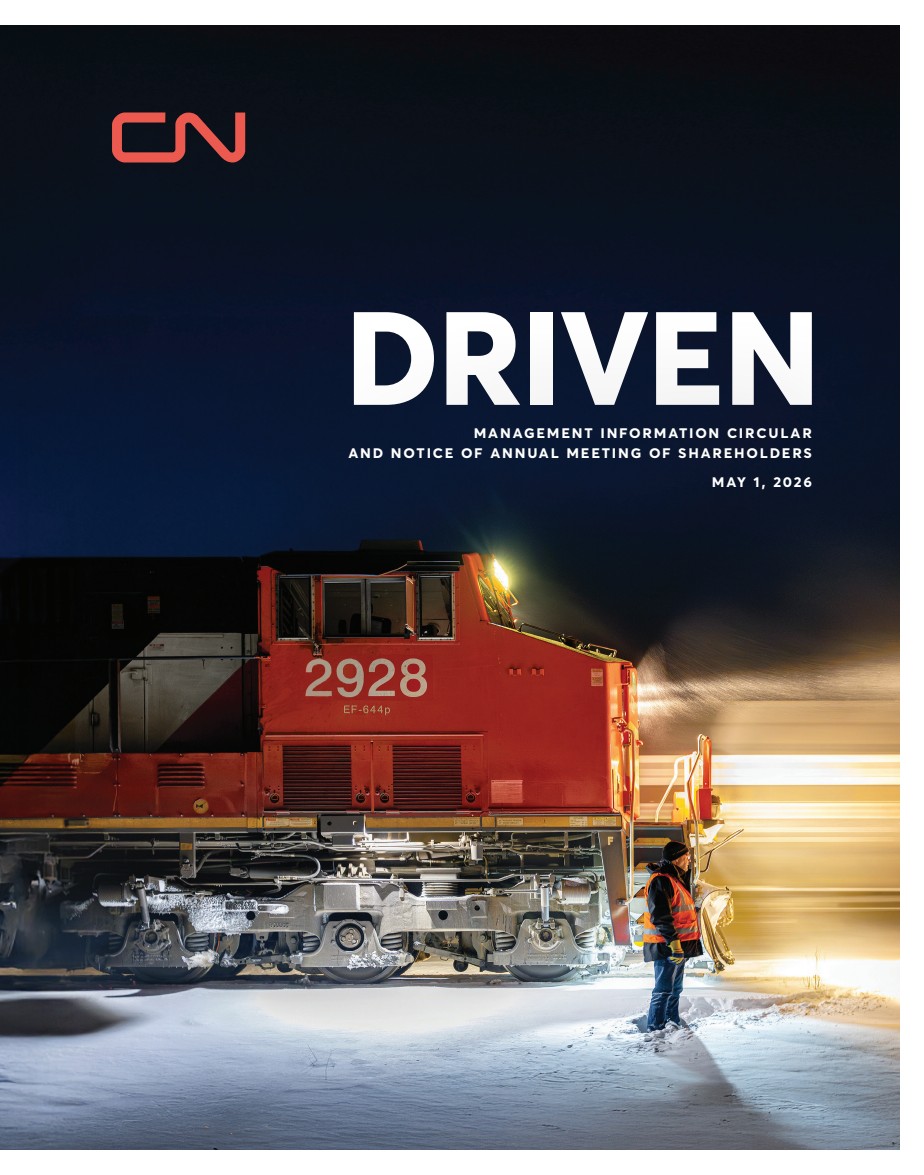
| DRIVEN management information circul ar and notice of annual meeting of shareholders may 1, 2026 |
| Notice of Annual Meeting of Shareholders When Friday, May 1, 2026 at 10:00 a.m. (Eastern Daylight Time) Where Via live webcast online at meetings.lumiconnect.com/400-581-822-621. We look forward to your participation at the meeting. Through our live webcast, you will be able to attend the meeting live, submit questions in writing or orally and vote your shares. Business of the Meeting 1. Receiving our consolidated financial statements for the year ended December 31, 2025, and the auditors’ reports thereon; 2. Electing our directors; 3. Appointing our auditors; 4. Considering and approving, in an advisory, non-binding capacity, a resolution (the full text of which is set out on page 15 of the accompanying management information circular) accepting our approach to executive compensation as disclosed in the “Statement of Executive Compensation” section of the accompanying management information circular; 5. Considering and approving, in an advisory, non-binding capacity, a resolution (the full text of which is set out on page 15 of the accompanying management information circular) accepting our Climate Action Plan as disclosed in the accompanying management information circular; and 6. Transacting such other business as may properly be brought before the meeting or any adjournment or postponement thereof. Your vote is important The Board of Directors has fixed March 6, 2026 as the record date for the determination of the holders of common shares entitled to receive notice of the meeting and vote at the meeting. Your vote is important, even if you do not intend on attending the meeting. Please refer to the section entitled “Voting Procedures, Processes and Restrictions” beginning on page 10 of the accompanying management information circular for detailed instructions on how to vote your shares. As always, we encourage you to cast your vote prior to the annual meeting. By order of the Board of Directors Cristina Circelli Vice-President, Corporate Secretary and General Counsel March 9, 2026 Montreal, Quebec |
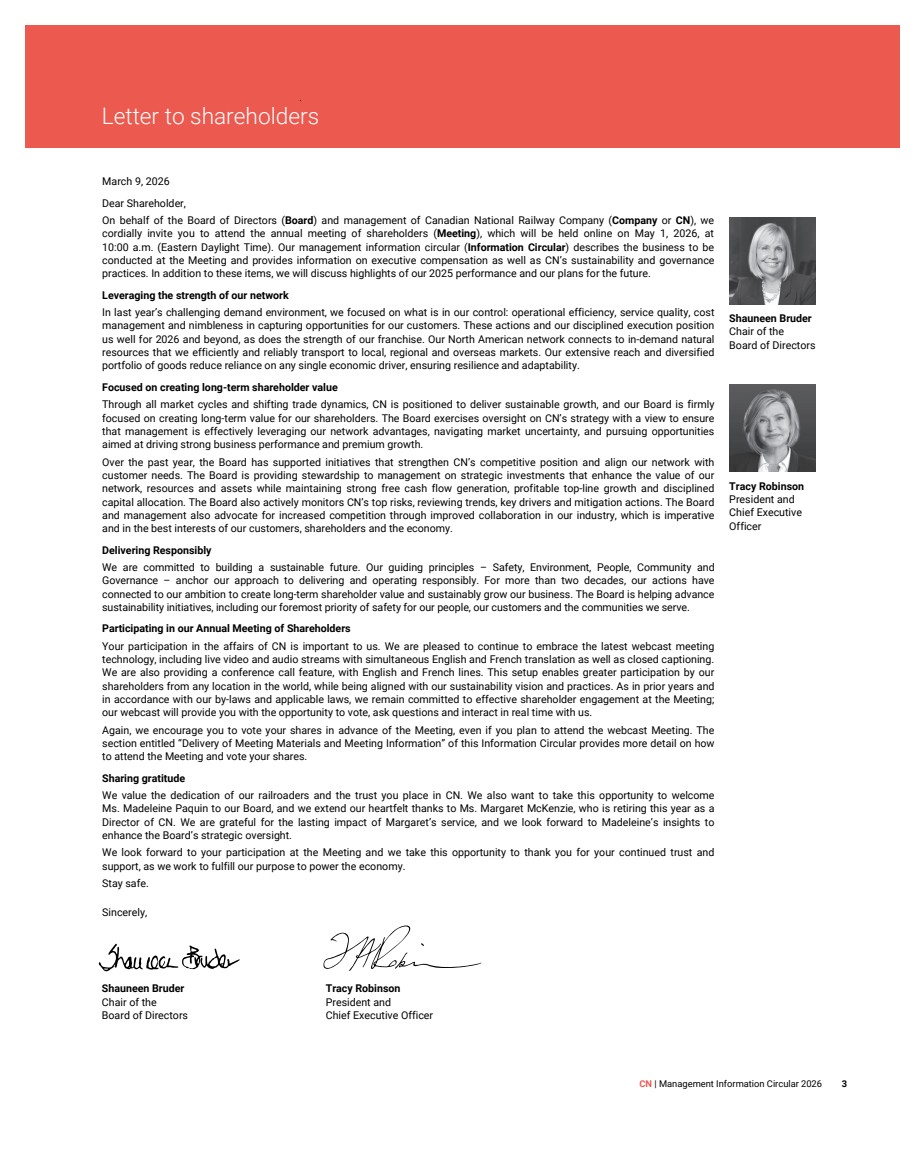
| March 9, 2026 Dear Shareholder, On behalf of the Board of Directors (Board) and management of Canadian National Railway Company (Company or CN), we cordially invite you to attend the annual meeting of shareholders (Meeting), which will be held online on May 1, 2026, at 10:00 a.m. (Eastern Daylight Time). Our management information circular (Information Circular) describes the business to be conducted at the Meeting and provides information on executive compensation as well as CN’s sustainability and governance practices. In addition to these items, we will discuss highlights of our 2025 performance and our plans for the future. Leveraging the strength of our network In last year’s challenging demand environment, we focused on what is in our control: operational efficiency, service quality, cost management and nimbleness in capturing opportunities for our customers. These actions and our disciplined execution position us well for 2026 and beyond, as does the strength of our franchise. Our North American network connects to in-demand natural resources that we efficiently and reliably transport to local, regional and overseas markets. Our extensive reach and diversified portfolio of goods reduce reliance on any single economic driver, ensuring resilience and adaptability. Focused on creating long-term shareholder value Through all market cycles and shifting trade dynamics, CN is positioned to deliver sustainable growth, and our Board is firmly focused on creating long-term value for our shareholders. The Board exercises oversight on CN’s strategy with a view to ensure that management is effectively leveraging our network advantages, navigating market uncertainty, and pursuing opportunities aimed at driving strong business performance and premium growth. Over the past year, the Board has supported initiatives that strengthen CN’s competitive position and align our network with customer needs. The Board is providing stewardship to management on strategic investments that enhance the value of our network, resources and assets while maintaining strong free cash flow generation, profitable top-line growth and disciplined capital allocation. The Board also actively monitors CN’s top risks, reviewing trends, key drivers and mitigation actions. The Board and management also advocate for increased competition through improved collaboration in our industry, which is imperative and in the best interests of our customers, shareholders and the economy. Delivering Responsibly We are committed to building a sustainable future. Our guiding principles – Safety, Environment, People, Community and Governance – anchor our approach to delivering and operating responsibly. For more than two decades, our actions have connected to our ambition to create long-term shareholder value and sustainably grow our business. The Board is helping advance sustainability initiatives, including our foremost priority of safety for our people, our customers and the communities we serve. Participating in our Annual Meeting of Shareholders Your participation in the affairs of CN is important to us. We are pleased to continue to embrace the latest webcast meeting technology, including live video and audio streams with simultaneous English and French translation as well as closed captioning. We are also providing a conference call feature, with English and French lines. This setup enables greater participation by our shareholders from any location in the world, while being aligned with our sustainability vision and practices. As in prior years and in accordance with our by-laws and applicable laws, we remain committed to effective shareholder engagement at the Meeting; our webcast will provide you with the opportunity to vote, ask questions and interact in real time with us. Again, we encourage you to vote your shares in advance of the Meeting, even if you plan to attend the webcast Meeting. The section entitled “Delivery of Meeting Materials and Meeting Information” of this Information Circular provides more detail on how to attend the Meeting and vote your shares. Sharing gratitude We value the dedication of our railroaders and the trust you place in CN. We also want to take this opportunity to welcome Ms. Madeleine Paquin to our Board, and we extend our heartfelt thanks to Ms. Margaret McKenzie, who is retiring this year as a Director of CN. We are grateful for the lasting impact of Margaret’s service, and we look forward to Madeleine’s insights to enhance the Board’s strategic oversight. We look forward to your participation at the Meeting and we take this opportunity to thank you for your continued trust and support, as we work to fulfill our purpose to power the economy. Stay safe. Sincerely, Shauneen Bruder Chair of the Board of Directors Tracy Robinson President and Chief Executive Officer Shauneen Bruder Chair of the Board of Directors Tracy Robinson President and Chief Executive Officer CN | Management Information Circular 2026 3 Letter to shareholders |
| Letter to shareholders ..................................................................... 3 Executive Summary ......................................................................... 6 Our Board of Directors..................................................................... 6 Delivery of Meeting Materials and Meeting Information........... 8 Delivery of Meeting Materials......................................................... 8 Important Information About the Virtual Meeting ....................... 9 Voting Procedures, Processes and Restrictions.......................... 10 Additional Information..................................................................... 13 Business of the Meeting ................................................................. 14 Financial Statements ....................................................................... 14 Election of Directors......................................................................... 14 Appointment of Auditors................................................................. 14 Advisory Vote on Executive Compensation.................................. 15 Advisory Vote on Climate Change ................................................. 15 Other Business.................................................................................. 15 Nominees for Election to the Board.............................................. 16 Board of Directors Compensation................................................. 28 Statement of Corporate Governance Practices .......................... 32 Climate Action Plan Report ............................................................ 50 Statement of Executive Compensation........................................ 55 Compensation Discussion and Analysis (CD&A)........................ 61 Other Information............................................................................. 96 Schedule A | Mandate of the Board............................................... 97 Schedule B | Reports of the Committees ..................................... 100 Report of the Audit, Finance and Risk Committee....................... 100 Report of the Governance and Sustainability Committee .......... 102 Report of the Safety and Environment Committee...................... 103 Report of the Human Resources and Compensation Committee.............................................................. 104 Schedule C | Additional Audit, Finance and Risk Committee Disclosure..................................................................... 105 Election of 11 Directors For more information see page 16 Appointment of KPMG LLP as Auditors For more information see page 14 Advisory Resolution on Executive Compensation For more information see page 15 Advisory Resolution on Climate Action Plan For more information see page 15 4 | Management Information Circular 2026 What’s Inside This Information Circular is provided in connection with the solicitation of proxies by management of Canadian National Railway Company for use at the annual meeting of its shareholders to be held on May 1, 2026, at 10:00 a.m. (Eastern Daylight Time) for the purposes set forth in the foregoing Notice of Meeting or at any adjournment or postponement thereof. In this document you and your refer to the shareholders of the Canadian National Railway Company. In addition, CN, the Company, we, us, or our refer to Canadian National Railway Company. The information contained herein is given as at March 9, 2026, except as indicated otherwise. Other than in instances where CN specifically provides otherwise, information contained on, or accessible through, our website is not incorporated by reference into this Information Circular. Shareholder Voting Matters and Recommendation BOARD VOTE RECOMMENDATION FOR EACH NOMINEE BOARD VOTE RECOMMENDATION FOR BOARD VOTE RECOMMENDATION FOR BOARD VOTE RECOMMENDATION FOR CN |
| Forward-Looking Statements Certain statements included in this Information Circular or incorporated by reference herein are “forward-looking statements” within the meaning of the United States Private Securities Litigation Reform Act of 1995 and under Canadian securities laws, including, but not limited to, statements relating to our operations, priorities and plans, planned capital expenditures, programs and strategies. This forward-looking information also includes, but is not limited to statements based on management’s assessment and assumptions and publicly available information with respect to CN. By their nature, forward-looking statements involve risks, uncertainties and assumptions. CN cautions that its assumptions may not materialize and that current economic conditions render such assumptions, although reasonable at the time they were made, subject to greater uncertainty. These forward-looking statements also include, but are not limited to, statements relating to revenue growth opportunities, including those referring to general economic and business conditions; statements relating to our sustainability-related strategies and goals and commitments, including our climate goals and expected benefits of new technologies; and statements relating to pension contributions. Forward-looking statements may be identified by the use of terminology such as “believes”, “expects”, “anticipates”, “assumes”, “outlook”, “plans”, “targets”, “goals” or other similar words. Forward-looking statements are not guarantees of future performance and involve risks, uncertainties and other factors which may cause actual results, performance or achievements of CN to be materially different from the outlook or any future results, performance or achievements implied by such statements. Accordingly, readers are advised not to place undue reliance on forward-looking statements. Important risk factors that could affect the forward-looking statements include, but are not limited to, general economic and business conditions, including factors impacting global supply chains such as pandemics and geopolitical conflicts or tensions; trade restrictions, trade barriers, or the imposition of tariffs or other changes to international trade arrangements; industry competition; inflation, currency and interest rate fluctuations; changes in fuel prices; legislative and/or regulatory developments; compliance with environmental laws and regulations; actions by regulators and other regulatory claims or proceedings; increases in maintenance and operating costs; security threats; reliance on technology and related cybersecurity risk; transportation of hazardous materials; various events which could disrupt operations, including illegal blockades of rail networks, and natural events such as severe weather, droughts, fires, floods and earthquakes; climate change; labor negotiations and disruptions; environmental claims; uncertainties of investigations, proceedings and other types of claims and litigation; risks and liabilities arising from derailments; timing and completion of capital programs; the availability of and cost competitiveness of renewable fuels and the development of new locomotive propulsion technology; reputational risks; supplier concentration; pension funding requirements and volatility; and other risks detailed from time to time in reports filed by CN with securities regulators in Canada and the United States, including its Annual Information Form and Form 40-F. See the section entitled “Business risks” of the Company’s Management’s Discussion and Analysis for the year ended December 31, 2025 (MD&A), which section is incorporated by reference into this Information Circular, for a description of major risk factors relating to CN. The MD&A may be found online on SEDAR+ at www.sedarplus.ca, on the U.S. Securities and Exchange Commission’s (SEC) website at www.sec.gov through EDGAR, and on CN’s website at www.cn.ca in the “Investors” section. The risks and uncertainties described in the MD&A are not the only ones that could affect the Company. Additional risks and uncertainties not currently known to management or that may currently not be considered material by management, could nevertheless also have an adverse effect on the Company’s business. CN has sustainability-related commitments and climate goals, and continues to assess the impact on its operations of related initiatives, plans and proposals that CN and other stakeholders (including government, regulatory and other bodies) are pursuing in relation to climate change and emissions. The achievement of CN’s climate goals is subject to several risks and uncertainties, including those disclosed in the section entitled “Reputation” in the Business risks discussion located on pages 65 to 66 of the MD&A. CN’s Climate Action Plan Report contains forward-looking statements, including, without limitation, statements relating to CN’s science-based 2030 target to reduce Scope 1 and 2 greenhouse gas (GHG) emissions and to reduce Scope 3 GHG emissions from fuel- and energy-related activities, the Company’s net-zero target, and its ability to neutralize Scope 3 residual emissions by leveraging nature-based solutions. The forward-looking statements contained in the Climate Action Plan Report represent CN’s expectations as of the date of the Climate Action Plan Report (or as of the date they are otherwise stated to be made) and are subject to change after such date. In addition, forward-looking statements contained in the Climate Action Plan Report for periods beyond 2026, such as the Company’s science-based targets, involve longer-term estimates and are subject to greater uncertainty. CN’s science-based targets and climate goals are based on a number of assumptions including, without limitation: no changes in carbon markets; no significant changes to sustainability strategies and scientific, methodological or technological developments, including future investments in and the availability of GHG emissions-reduction tools and technologies; no significant shifts in the science, data, methodology and legal and financial considerations underlying the Company’s climate and sustainability-related analysis and strategy, including those developed and used by organizations such as the Science-Based Targets initiative (SBTi); the ability of the Company to successfully implement its climate and sustainability-related strategies and initiatives; the Company’s ability to work with governments and third parties to mitigate the impacts of climate change; no significant changes in the willingness of customers to acquire the Company’s services; no significant changes in the cost of maintenance or network expansion; and no significant changes in the accuracy, consistency and usefulness of climate or sustainability-related data (including data underlying the Company’s current or future goals and their baselines). The achievement of CN’s science-based targets and climate goals is also subject to circumstances outside of the Company’s control and depends on many factors, including, without limitation: the availability and cost competitiveness of sufficient volumes of renewable fuels and the development and availability of new technologies (such as alternative propulsion locomotive technologies); the successful trials and qualifications of up to 100% renewable fuel blends; and the cooperation of third parties such as suppliers, customers, supply chain partners and regulators. CN has considerably less control impact over the reduction of its Scope 3 GHG emissions than over its Scope 1 and Scope 2 GHG emissions, given that it must rely on the engagement and collaboration of suppliers and supply chain partners in reducing their own GHG emissions. Accordingly, failure to cooperate from these third parties could adversely affect the Company’s ability to meet its Scope 3 GHG emissions reduction target. The successful accomplishment of the Company’s goals could be significantly disrupted by the inability of its suppliers to deliver, whether due to insolvency, logistical challenges, or other unforeseen factors that hinder their capacity to fulfill their respective obligations. In addition, the achievement of its climate goals may expose CN to certain additional heightened financial and operational risks, and is expected to require additional capital or operating costs, which may be higher than anticipated. Moreover, future events could lead CN to prioritize other nearer-term interests over progressing towards the Company’s current climate goals based on business strategy, economic, regulatory and social factors, and potential pressure from investors, activist groups or other stakeholders. There can be no certainty that the Company will achieve any or all of these goals within the stated timeframe, or that achieving any of these goals will meet all of the expectations of its stakeholders or applicable legal requirements. The exact nature of future binding or non-binding legislation, regulations, standards, and agreements remains uncertain, as does their potential financial, operational, or broader impact. The Company’s inability to meet evolving requirements and/or expectations could materially adversely affect CN’s brand and reputation, which could in turn materially adversely affect CN’s results of operations or its financial position. CN’s access to capital could also be negatively affected if financial institutions, rating agencies and/ or lenders adopt more restrictive sustainability policies that the Company may not be able to meet. The industry data presented in the Climate Action Plan Report has been obtained from a combination of third-party information, including third-party disclosures and websites, and estimates of management. While those external sources are believed to be reliable, they have not been independently verified, and management has no assurance that the information contained in third-party websites is current and up to date. While management is not aware of any misstatements regarding the industry data presented in the Climate Action Plan Report, such data involves risks and uncertainties and is subject to change based on various factors, including those discussed in this section on "Forward-Looking Statements" and under the section entitled “Reputation” in the Business risks discussion located on pages 66 to 67 of the MD&A. Forward-looking statements reflect information as of the date on which they are made. CN assumes no obligation to update or revise forward-looking statements to reflect future events, changes in circumstances, or changes in beliefs, unless required by applicable securities laws. In the event CN does update any forward-looking statement, no inference should be made that CN will make additional updates with respect to that statement, related matters, or any other forward-looking statement. Non-GAAP Measures This Information Circular makes reference to non-GAAP measures including adjusted operating income, adjusted net income and adjusted diluted earnings per share that do not have any standardized meaning prescribed by United States generally accepted accounting principles (GAAP) and therefore, may not be comparable to similar measures presented by other companies. From management’s perspective, these non-GAAP measures are useful measures of performance and provide investors with supplementary information to assess the Company’s results of operations and liquidity. These non-GAAP measures should not be considered in isolation or as a substitute for financial measures prepared in accordance with GAAP. For further details of these non-GAAP measures, including a reconciliation to the most directly comparable GAAP financial measures, refer to the section entitled “Non-GAAP measures” on page 16 of the MD&A, which section is incorporated by reference into this Information Circular. The MD&A was filed on February 4, 2026 and may be found online on SEDAR+ at www.sedarplus.ca, on the SEC’s website at www.sec.gov through EDGAR, and on the CN’s website at www.cn.ca in the “Investors” section. CN | Management Information Circular 2026 5 |
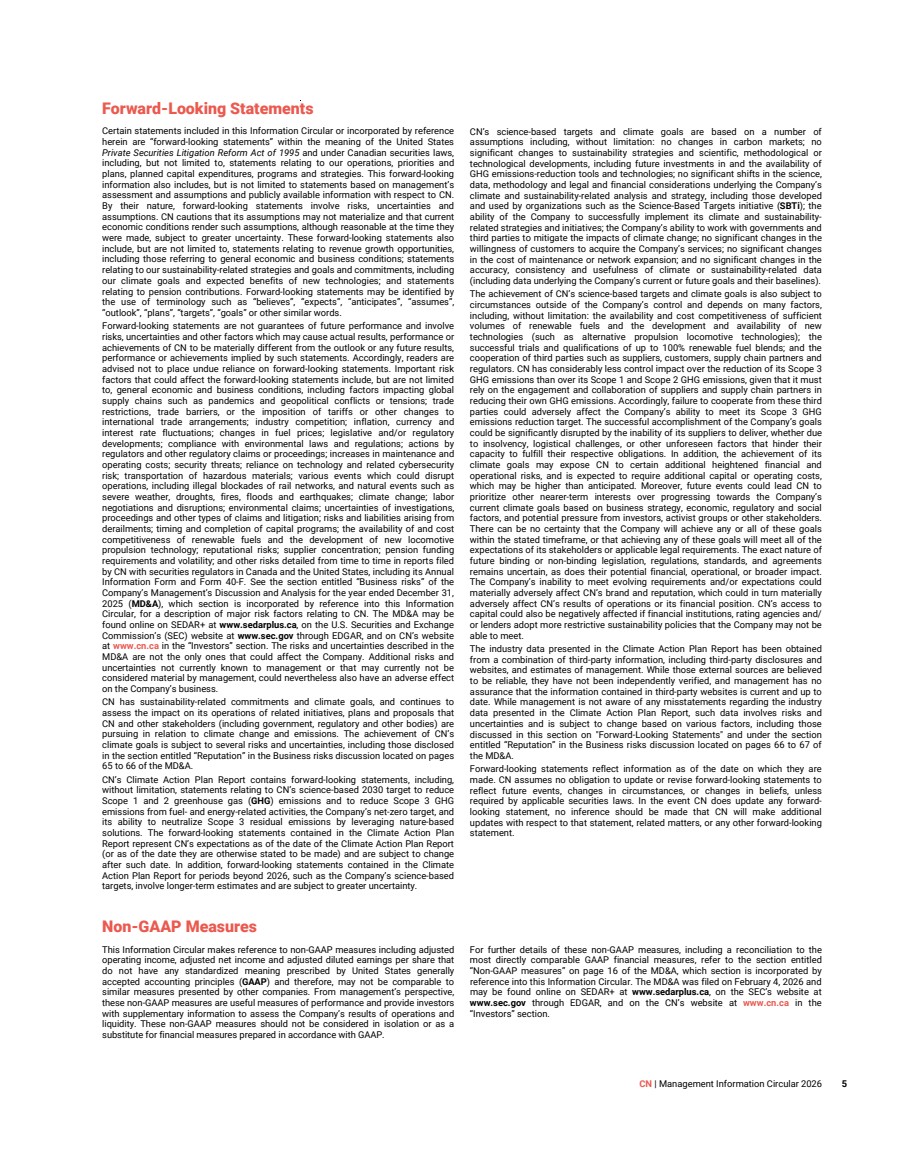
| Our Board of Directors 5× Directors’ minimum share ownership requirement set at 5 times the annual director retainer, to be achieved within 5 years of election to the Board 14 years Term limit for directors from their initial election or appointment date 0 Board members that sit together on the board of another company 4.4 years Average tenure of current Board members All director nominees, except for our President and CEO, are independent 50% Percentage of independent director nominees who are women 100% Attendance at all meetings of the Board of Directors in 2025 99.4% Average shareholder support for director nominees at the 2025 annual general meeting NAME/AGE (1) PRINCIPAL COMPETENCIES (2) DIRECTOR SINCE OCCUPATION OTHER CURRENT PUBLIC BOARDS SHARE OWNERSHIP (3) (MULTIPLE OF REQUIREMENT) % OF VOTES FOR 2025 Shauneen Bruder (66) • CEO/Executive Leadership Experience • Corporate Governance/Public Company Experience • Risk Management • Technology/Innovation/Artificial Intelligence/Cybersecurity 2017 Corporate Director and Chair of the Board, CN 0 1.8 99.01 Jo-ann dePass Olsovsky (61) • Technology/Innovation/Artificial Intelligence/Cybersecurity • CEO/Executive Leadership Experience • Transport Industry/Logistics/Supply Chain/Operations • People and Talent Management/Organized Labour 2021 Corporate Director 1 1.5 98.61 David Freeman (71) • Transport Industry/Logistics/Supply Chain/Operations • Safety • CEO/Executive Leadership Experience • Customer Experience/Sales/Marketing 2022 Corporate Director 0 1.2 99.63 Denise Gray (63) • CEO/Executive Leadership Experience • Corporate Governance/Public Company Experience • Technology/Innovation/Artificial Intelligence/Cybersecurity • Environmental/Social/Corporate Responsibility 2021 Corporate Director 1 1.2 99.28 Justin M. Howell (55) • International/Global Experience and Perspective • Environmental/Social/Corporate Responsibility • Corporate Governance/Public Company Experience • Finance/Accounting/Investor Relations/Capital Markets 2021 Corporate Director 1 1.0 99.16 Susan C. Jones (56) • CEO/Executive Leadership Experience • Government/Public Policy/Regulatory/Legal • Safety • Customer Experience/Sales/Marketing 2022 Corporate Director 1 1.5 99.79 Robert Knight (68) • Finance/Accounting/Investor Relations/Capital Markets • Transport Industry/Logistics/Supply Chain/Operations • Stakeholder Relations/Community Engagement • Corporate Governance/Public Company Experience 2022 Corporate Director 2 0.9 99.6 Michel Letellier (61) • CEO/Executive Leadership Experience • Stakeholder Relations/Community Engagement • Finance/Accounting/Investor Relations/Capital Markets • Environmental/Social/Corporate Responsibility 2022 President and Chief Executive Officer, Innergex Renewable Energy Inc.(5) 0 1.2 99.16 Al Monaco (66) • CEO/Executive Leadership Experience • Safety • Finance/Accounting/Investor Relations/Capital Markets • Transport Industry/Logistics/Supply Chain/Operations 2023 Corporate Director 1 2.0 99.62 Madeleine Paquin (63) • CEO/Executive Leadership Experience • Transport Industry/Logistics/Supply Chain/Operations • People and Talent Management/Organized Labour • International/Global Experience and Perspective 2025 (October 29) Corporate Director 1 0.2 – Tracy Robinson (62) • CEO/Executive Leadership Experience • Transport Industry/Logistics/Supply Chain/Operations • Government/Public Policy/Regulatory/Legal • Customer Experience/Sales/Marketing 2022 President and Chief Executive Officer, CN – Note 4 99.81 (1) For more detailed director nominee profiles, please refer to pages 16 to 27 of this Information Circular. (2) For a more complete description and representation of each director’s competencies, please refer to page 39 of this Information Circular. (3) For a discussion on the shareholding requirements of the Board Chair and independent directors, please see the section on “Share Ownership” on page 30 of this Information Circular. (4) For a discussion on Tracy Robinson’s shareholding requirements, please see the section on “Stock Ownership” on page 70 of this Information Circular. Ms. Robinson is also enrolled in the Employee Share Investment Plan (ESIP). See “Employee Share Investment Plan” on page 70 of this Information Circular. (5) On February 17, 2026, Innergex Renewable Energy announced the retirement of Mr. Letellier as President and Chief Executive Officer, effective March 13, 2026. 6 CN | Management Information Circular 2026 Executive Summary This summary highlights some of the important information in this Information Circular. You are encouraged to read the entire document carefully. |
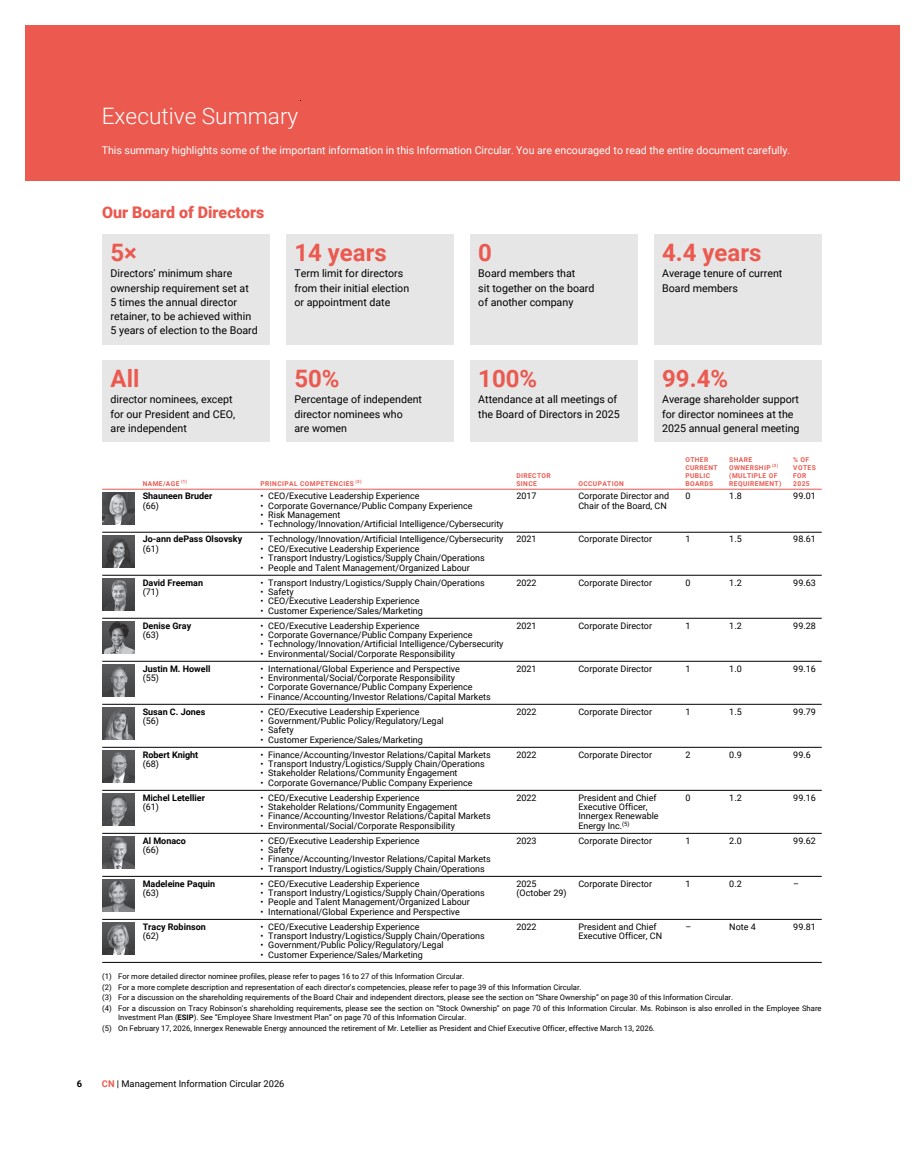
| Governance & Sustainability Governance Highlights and Best Practices at CN P All directors (including our Board Chair) are independent, with the exception of our President and CEO. Board interlock guidelines further strengthen directors’ independence. P Separate Board Chair and President and CEO. P Director term limit is set at 14 years and retirement age is set at 75 years to favour Board refreshment. Term limits for Board and committee Chairs also refresh Board leadership. P Safety briefings are held regularly before meetings of the Board in line with our safety culture. P Robust annual Board evaluation process, incorporating feedback from management, on Board effectiveness with peer reviews. P The Board and each Board committee meet in camera at every meeting, including special meetings. P Written Stakeholder and Indigenous Peoples Engagement Framework solidifying our commitment to engagement across our network in Canada. P Comprehensive orientation program for new directors and continuing education program for existing directors. P Solid ethics program and written Code of Business Conduct which applies to all directors, officers and employees of CN. P Share ownership guidelines adopted for directors, including shareholding requirements which continue for two years after directors leave the Board. Sustainability Leadership & Transparency The annual advisory vote on CN’s Climate Action Plan received an approval rate of 95.23% at the 2025 annual meeting. CN ranked among the Best 50 Corporate Citizens in Canada by Corporate Knights for the 17th consecutive year. Our Board was ranked in 3rd position in Canada in the Globe and Mail’s Board Games, following an annual comprehensive assessment of 206 S&P/TSX Composite Index Members. CN ranked as a leader in the road & rail transport industry on the MSCI ESG rating for 2025. CN was named as one of the top sustainability performers in the transportation industry by S&P Global Sustainability Yearbook 2026. We have been included in the latest Dow Jones Best-in-Class World Index and the Dow Jones Best-in-Class North American Index, for the 13th and 16th consecutive years, respectively. Our biennial Delivering Responsibly sustainability report is part of our commitment to being open about our business and to communicate our progress with focus, clarity and comparability. In 2025, we published our most recent Delivering Responsibly sustainability report and our annual sustainability data supplement report, disclosing our key sustainability performance indicators and progress towards our sustainability ambitions. Both documents, as well as our latest CDP Corporate Questionnaire report, including a Task Force on Climate-Related Financial Disclosures (TCFD) index, are available on our website at www.cn.ca. Executive Compensation Executive Compensation Best Practices at CN P 2025 Annual Incentive Bonus Plan for NEOs based on 3 factors; Corporate Financial component (70%), Corporate Strategic component (20%), and Corporate Safety component (10%), all based on performance against pre-set goals. P Approximately 82.1% of NEOs’ target total direct compensation is at-risk and linked to CN’s performance. P The annual advisory “say-on-pay” vote relating to our approach to executive compensation received 92.89% votes in favour in 2025. P Benchmark compensation against a reasonable/size appropriate peer group. P Incentive payout capped and no guaranteed minimum payout. P The Relative TSR included in the PSUs structure strengthens alignment between executive pay and shareholder return. P Stringent share ownership requirements, with President and CEO post-employment shareholding requirement. P Double trigger change-of-control provisions. P No change-of-control tax gross-up protection. P Employees cannot engage in hedging activity or in any form of transactions in publicly-traded options on securities of CN. Disciplined Approach to Compensation CN’s approach to executive compensation continues to be driven by its goal to incentivize executives to create and deliver sustainable returns to shareholders. CN exercises a disciplined approach by ensuring short- and long‑term incentive plans are structured to align realized pay with shareholder returns. Overall, CN’s approach to executive compensation ensures that target compensation supports the attraction and retention of executive talent while remaining within our executive compensation policy. The 2025 executive compensation policy, which received an approval rate of 92.89% at the 2025 annual meeting of shareholders, aims to position target total direct compensation of our NEOs at the 50th percentile of the NEO comparator group, on average. Current NEOs 2025 Target Pay at Risk In 2025, CN Proudly Celebrated the 30th Anniversary of its Privatization On November 17th, 1995, CN shares were offered in an Initial Public Offering (IPO) on the Toronto and New York Stock Exchanges, raising C$2.25 billion. At the time, it was the largest IPO in Canadian history. The privatization helped propel CN’s transformation into the transportation leader and trade-enabler it is today, powering the economy and North American supply chains from coast to coast to coast. To mark this important anniversary, Shauneen Bruder, Chair of the Board and Tracy Robinson, our President and CEO, alongside senior executives, rang the Opening Bell at the Toronto Stock Exchange and the Closing Bell at the New York Stock Exchange on November 17, 2025. CN | Management Information Circular 2026 7 |
| Delivery of Meeting Materials We use “Notice-and-Access” to deliver this Information Circular to both registered and non-registered shareholders, which allows for quick access to the Information Circular, contributes to the protection of the environment, is consistent with our sustainability strategy and is cost effective. Instead of receiving a paper copy of the Information Circular in the mail, shareholders who hold common shares of CN on the record date of March 6, 2026 (the Record Date) have access to it online. Shareholders will receive a package in the mail with a notice (Notice) explaining how to access the Information Circular electronically and how to request a paper copy, if desired. A proxy form for registered shareholders or a voting instruction form for non-registered shareholders or holders of Employee Shares (as defined herein) will also be included with the Notice, with instructions on how to vote your shares. In addition, shareholders will receive a virtual meeting guide (Virtual AGM User Guide) with detailed instructions on how to attend, vote, and ask questions at the Meeting. Accessing the Information Circular Electronically The Information Circular is available electronically as follows: • CN’s website: www.cn.ca/en/investors • CN’s Transfer Agent, Computershare Trust Company of Canada (Computershare): www.envisionreports.com/CNR2026 • SEDAR+: www.sedarplus.ca • SEC: www.sec.gov through EDGAR Requesting a Paper Copy of the Information Circular and Financial Statements You may request a paper copy of the Information Circular and the consolidated financial statements for the year ended December 31, 2025, as well as the auditors’ report thereon (Financial Statements) and the related MD&A (collectively, the Meeting Materials) at no cost, up to one year from the date the Information Circular was filed on SEDAR+ (on or about March 25, 2026). If you wish to receive a paper copy of the Meeting Materials before the Meeting, your request should be received at least 10 business days prior to the Meeting date (before April 16, 2026) to ensure that you receive the Meeting Materials in advance of the Meeting. Please note that if you request a paper copy of the Meeting Materials, you will not receive another proxy form or voting instruction form. Please retain your current one to vote your common shares before the Meeting. Before the Meeting Registered Shareholders and Holders of Employee Shares (as defined herein) may request paper copies of the Meeting Materials by calling Computershare at 1-866-962-0498 (within North America) or 514-982-8716 (outside North America) and entering your 15-digit control number as indicated on your proxy form or voting instruction form, as applicable, and following the instructions provided. Non-registered Shareholders (as defined herein) may request paper copies of the Meeting Materials by calling 1-877-907-7643 (within North America) or 303-562-9305 (outside North America) and entering the 16-digit control number provided on your voting instruction form and following the instructions provided. Please refer to the “Important Information About the Virtual Meeting–Assessing Shareholder Status” section on page 9 of this Information Circular if you are unsure whether you are a registered shareholder, a holder of Employee Shares or a non-registered shareholder of the Company. After the Meeting You may request paper copies of the Meeting Materials after the Meeting at no cost by contacting Computershare via the following email address: at postagm@computershare.com or by phone at 1-866-964-0492 (within North America) or 514-982-8714 (outside North America). A copy of the Meeting Materials will be sent within 10 calendar days of receiving the request. 8 CN | Management Information Circular 2026 Delivery of Meeting Materials and Meeting Information QUESTIONS If you have any questions regarding Notice-and-Access or the Meeting, you can contact Computershare via their website www.investorcentre.com/service or by phone at 1-866-964-0492. Charlotte, MI Photo by CN Employee Dylan Dowen |
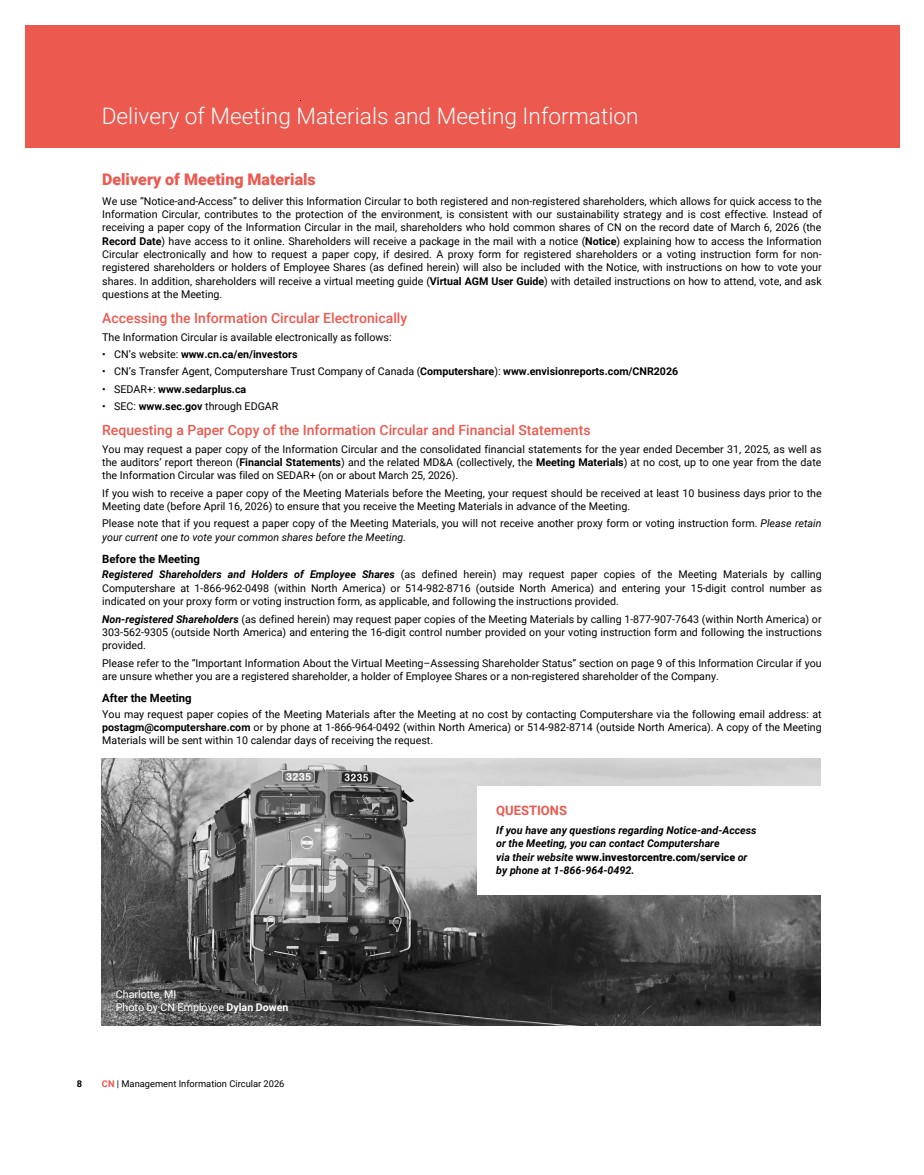
| Important Information About the Virtual Meeting The Meeting will be held virtually via a live video webcast, which facilitates the full and equal participation of our shareholders by providing the flexibility and the opportunity to attend and participate at the Meeting from anywhere. Holding a virtual-only Meeting is also cost effective, and is aligned with our sustainability vision and practices. We are committed to effective shareholder engagement at the Meeting and have engaged an experienced virtual meeting provider to put in place technology-driven measures to enhance shareholder access, participation and communication at the Meeting, namely: • a live video webcast feature; • a conference call feature (with English and French lines); • simultaneous translation (English and French); and • closed captioning. We believe these measures ensure a seamless and fully interactive experience for all shareholders attending the Meeting, in real time. As a result, shareholders are afforded the same rights and opportunities to vote and participate as they would have at an in-person or hybrid meeting. More specifically, during the Meeting, shareholders can vote, propose motions, raise points of order, and engage with other shareholders and with select members of CN’s management and Board through active participation in a live Q&A session. The following section of the Information Circular explains how to prepare for the Meeting, access the Meeting, ask questions and cast your vote. Please also refer to the Virtual AGM User Guide, which was included with the Meeting materials mailed to you and is available on our website www.cn.ca under “Investors/Annual Meeting”. Assessing Shareholder Status How you can attend, vote and participate at the Meeting varies depending on how your common shares of the Company are held. Registered Shareholder: You are a registered shareholder if your name appears on your share certificate or your Direct Registration System confirmation. If you are a registered shareholder, you will receive a proxy form containing the relevant details concerning the business of the Meeting, including a 15-digit control number that is needed to (1) join the live webcast on the day of the Meeting, (2) vote by proxy in advance of the Meeting or vote during the Meeting, and (3) submit questions either in advance or during the Meeting. Holder of Employee Shares: You are a holder of Employee Shares if you are an employee of the Company who purchased common shares (Employee Shares) under the Company’s Canadian and U.S. Employee Share Investment Plans and its Savings Plan for U.S. Operations (collectively, the Plans). Employee Shares remain registered in the name of the Plans’ Custodian (currently Computershare or Fidelity Institutional Retirement Services Company, as applicable), unless the employees withdraw their common shares from the Plans in accordance with the applicable provisions of the Plans. If you are a holder of Employee Shares, you will receive a voting instruction form containing the relevant details concerning the business of the Meeting, including a 15-digit control number that is needed to (1) join the live webcast on the day of the Meeting, (2) vote by proxy in advance of the Meeting or vote during the Meeting, and (3) submit questions either in advance or during the Meeting. Non-registered Shareholder: You are a non-registered shareholder if your common shares are not registered in your name and are held in the name of a nominee such as a trustee, financial institution or securities broker. If your common shares are listed in an account statement provided to you by your broker, such common shares will, in all likelihood, not be registered in your name. Such common shares will more likely be registered under the name of your broker or an agent or nominee of that broker. Without specific instructions, brokers and their agents or nominees are prohibited from voting shares for the broker’s client. If you are a non-registered shareholder, you will receive a voting instruction form containing the relevant details concerning the business of the Meeting, including a 16-digit control number that is needed to (1) join the live webcast as a guest on the day of the Meeting, (2) vote by proxy in advance of the Meeting, and (3) submit questions either in advance or during the Meeting. Important Note: If you are a non-registered shareholder and wish to vote during the Meeting, you will first need to appoint yourself as a proxyholder by following the procedures and deadlines set forth in the “Voting Procedures, Processes and Restrictions” section beginning on page 10 of this Information Circular. CN | Management Information Circular 2026 9 |
| Attending and Participating at the Virtual Meeting If you are a registered shareholder or a proxyholder (including non‑registered shareholders who have appointed themselves as proxyholder), or holder of Employee Shares, you will be able to attend the Meeting online, ask questions and securely vote your shares in real time as follows: 1. Log in online at meetings.lumiconnect.com/400-581-822-621 2. Click “I have a login” and then enter your 15-digit control number or 4-character login code, as applicable, and password CNR2026 (case sensitive). You may participate in the Meeting using any internet-connected device, such as a laptop, computer, tablet, or mobile phone. The Meeting platform is fully supported by the latest versions of Chrome, Safari, Edge and Firefox (Internet Explorer is not supported). Please ensure your browser is up to date and compatible with your device. You should ensure you have a strong, preferably high-speed, internet connection wherever you intend to attend the Meeting. You (or your proxyholder) must remain connected to the internet at all times during the Meeting in order to vote when balloting commences. It is your responsibility to ensure internet connectivity for the duration of the Meeting. If you lose connectivity once the Meeting has commenced, there may be insufficient time to resolve your issue before ballot voting is completed. Therefore, even if you currently plan to access the Meeting and vote during the live webcast, you should consider voting your shares in advance or by proxy to ensure that your vote will be counted in the event you experience any technical difficulties or are otherwise unable to access the virtual Meeting. You should allow ample time to check into the Meeting online and complete the related procedures. It is recommended that you log in at least fifteen minutes prior to the Meeting. Registered Shareholders and Holders of Employee Shares: The 15-digit control number is located on your proxy form or voting instruction form, as applicable, or in the email notification you received. Proxyholders, including Non-registered Shareholders who have duly appointed themselves as proxyholder: Once appointed and registered as proxyholder as described below under “Voting Procedures, Processes and Restrictions”, Computershare will provide you with a 4-character code which will allow you to log in. If you are a non-registered shareholder and you have not duly appointed and registered yourself as proxyholder, you will not be able to vote at the Meeting. You will still be able to attend the virtual Meeting as a guest and ask questions by following the steps highlighted in the “Submitting Questions” section on page 13 of this Information Circular. People who are not shareholders or duly appointed proxyholders may attend as guests, but cannot vote at the Meeting or ask questions. Technical Assistance For any technical difficulties encountered during the check-in process or the Meeting, please contact technical support at support-ca@lumiglobal.com. Voting Procedures, Processes and Restrictions Your vote is important to us While we hope you will take the time to attend the Meeting, we encourage you to cast your vote even if you do not plan on attending. You should read this Information Circular carefully before voting. Who can Vote If you are a holder of common shares of CN as at the close of business on the Record Date (March 6, 2026), you are entitled to vote at the Meeting or at any adjournment or postponement thereof, either live virtually or in advance of the Meeting. As of the close of business on the Record Date, the Company had 610,781,362 common shares issued and outstanding. Subject to the voting restrictions described below, each common share carries the right to one vote. How to Vote If you are eligible to vote as described under “Who can Vote”, you can vote your common shares at the Meeting virtually or by proxy in advance of the Meeting, as explained hereinafter. Please read the following carefully, as different voting procedures apply whether you are a registered shareholder, non-registered shareholder or holder of Employee Shares. 10 CN | Management Information Circular 2026 We encourage you to vote your shares by proxy prior to the Meeting; doing so is the easiest and more convenient way to vote your shares. |
| REGISTERED SHAREHOLDERS (Proxy Form) HOLDERS OF EMPLOYEE SHARES (Voting Instruction Form) Voting by Proxy Before the Meeting BY INTERNET Go to www.investorvote.com and follow the instructions. You will need your 15-digit control number found on your proxy form or voting instruction form, as applicable. BY MAIL Complete and return the proxy form or voting instruction form, as applicable, in the prepaid envelope provided. BY PHONE Call 1 866-732-VOTE (8683) toll-free. You will need your 15-digit control number found on your proxy form or voting instruction form, as applicable. Your duly completed proxy form or voting instruction form, as applicable, must be received by Computershare by mail, or, if you choose to vote by internet or by phone, you must have done so by no later than 5:00 p.m. on April 29, 2026 (Eastern Daylight Time), or if the Meeting is adjourned or postponed, no later than 5:00 p.m. on the second business day prior to the day fixed for the adjourned or postponed Meeting. Voting at the Meeting If you wish to vote at the Meeting, you do not need to complete or return your proxy form or voting instruction form ahead of time. The day of the Meeting, you will be able to vote via the live webcast by completing a ballot online during the Meeting at meetings.lumiconnect.com/400-581-822-621 and check-in using your 15-digit control number and password (CNR2026) (case sensitive). You may appoint a person other than the proxyholder designated by CN (being the Board Chair and the President and CEO of the Company or, in the case of Holders of Employee Shares, Computershare Trust Company of Canada or Fidelity Institutional Retirement Services Company, as applicable) to represent you and vote on your behalf at the Meeting. This person does not have to be a shareholder of CN. To do so, (1) strike out the names already printed on your proxy form or voting instruction form and write the name of the person you are appointing in the space provided; (2) complete your voting instructions; (3) sign and date the form; and (4) return your duly completed proxy form or voting instruction form to Computershare, as instructed in your proxy form or voting instruction form. Please ensure the person you appoint is aware they have been appointed to attend and vote at the virtual Meeting on your behalf. They must attend the Meeting to vote your shares on your behalf. In addition, in order for your proxyholder to participate in the virtual Meeting, you must register their appointment as proxyholder by completing the online form available at www.computershare.com/CNR by 5:00 p.m. (Eastern Daylight Time) on April 29, 2026, to allow your proxyholder to obtain a 4‑character login code for the Meeting. This code will allow your proxyholder to log in to the live webcast and vote at the Meeting using the virtual Meeting platform. Without this code, your proxyholder will not be able to vote at the Meeting. Computershare will provide your duly appointed proxyholder with the 4-character login code on the day prior to the Meeting, provided your duly completed proxy form or voting instruction form has been received by Computershare prior to the voting deadline and you have duly registered them as a proxyholder in accordance with the procedures outlined herein. NON-REGISTERED SHAREHOLDERS (Voting Instruction Form) Voting by Proxy Before the Meeting BY INTERNET Go to www.proxyvote.com and follow the instructions. You will need your 16-digit control number found on your voting instruction form. BY MAIL Complete and return the voting instruction form in the prepaid envelope provided. BY PHONE Call 1-800-474-7493 (English) or 1-800-474-7501 (French). You will need your 16-digit control number found on your voting instruction form. Your vote by internet, by mail or by phone must be received by Computershare by no later than 5:00 p.m. on April 29, 2026 (Eastern Daylight Time), or if the Meeting is adjourned or postponed, no later than 5:00 p.m. on the second business day prior to the day fixed for the adjourned or postponed Meeting. Please follow the instructions from your intermediary (including any deadlines) when returning your voting instructions (whether by phone, by internet or by mail) to ensure that we receive your vote in time. Voting at the Meeting A non-registered shareholder who wishes to vote at the Meeting MUST appoint themselves as proxyholder by inserting their name in the space provided on the voting instruction form and following all the applicable instructions, including the deadline, provided by their intermediary. Computershare must receive your self-appointment no later than 5:00 p.m. on April 29, 2026 (Eastern Daylight Time). In addition, you must also register your self-appointment as proxyholder by completing the online form available at www.computershare.com/CNR by 5:00 p.m. (Eastern Daylight Time) on April 29, 2026, to obtain a 4-character login code for the Meeting. This code will allow you to log in to the live webcast and vote at the Meeting. Without this code, you will not be able to vote at the Meeting. Computershare will provide you with the 4-character code the day prior to the Meeting, provided you have duly completed and returned your voting instruction form and registered your self-appointment as proxyholder in accordance with the procedures set out above. The day of the Meeting, you will need to visit meetings.lumiconnect.com/400-581-822-621 and check-in using your Computershare-assigned 4-character code and the password CNR2026 (case sensitive). You may also appoint a person other than yourself or the proxyholder designated by CN (being the Board Chair and the President and CEO of the Company) to represent you and vote on your behalf at the Meeting. This person does not have to be a shareholder of CN. If you wish to appoint someone else to vote your shares for you at the Meeting, the same procedures outlined herein apply. If you choose to appoint someone else to vote your shares for you at the Meeting, please ensure the person you appoint is aware that they have been appointed to attend the virtual Meeting and vote on your behalf. That person must attend the Meeting to vote your shares on your behalf. Late proxies may be accepted or rejected by the Chair of the Meeting at her discretion, and the Chair of the Meeting is under no obligation to accept or reject any particular late proxy. The Chair of the Meeting may waive or extend the proxy cut-off without notice. NOTE: You cannot appoint anyone other than the directors and officers named on your proxy form as your proxyholder if you vote by telephone. CN | Management Information Circular 2026 11 |
| How Your Shares will be Voted You can choose to vote FOR, WITHHOLD or AGAINST, depending on the item to be voted on. For details on the items being presented at the Meeting, please refer to the “Business of the Meeting” section on page 14 of this Information Circular. If you choose to vote by proxy before the Meeting, your common shares will be voted or withheld from voting in accordance with your instructions as indicated on your completed proxy form or voting instruction form. If no instructions are indicated, your common shares will be voted at the discretion of your duly appointed proxyholder. If you have not appointed a specific proxyholder to vote your shares on your behalf, your shares will be voted by the proxyholders designated by CN in accordance with the Board and management’s recommendations, as follows: (i) FOR the election of each of management’s nominees as Board directors. (ii) FOR the appointment of KPMG LLP (KPMG) as auditors. (iii) FOR, in an advisory, non-binding capacity, the approach to executive compensation disclosed in the “Statement of Executive Compensation” section of this Information Circular. (iv) FOR, in an advisory, non-binding capacity, the Company’s Climate Action Plan as disclosed in this Information Circular. (v) At the discretion of the proxyholder regarding amendments or variations to any of the foregoing matters or on such other business as may properly be brought before the Meeting. As of the date of this Information Circular, CN’s management is not aware of any amendment, variation or other business likely to be brought before the Meeting. If, however, any such amendment, variation or other business properly comes before the Meeting, proxies will be voted at the discretion of the person or persons named in the proxy form or voting instruction form in accordance with their best judgment. Should any nominee named herein for election as a director become unable to accept nomination for election, it is intended that the person acting under proxy in favour of management of the Company will vote for the election in their stead of such other person as management may recommend. As of the date of this Information Circular, management has no reason to believe that any of the nominees for election as directors will be unable to serve if elected to office. A simple majority (50% plus one) of the votes cast will constitute approval of each of these matters. Changing Your Vote You may change your vote by: • voting again by Internet or phone before 5:00 p.m. on April 29, 2026 (Eastern Daylight Time) or, if the Meeting is adjourned or postponed, by no later than 5:00 p.m. on the second business day prior to the day fixed for the adjourned or postponed Meeting; • completing an instrument in writing (which includes another proxy form or voting instruction form, as applicable, with a date later than the date of your initial vote) executed by you or by your attorney (duly authorized in writing), and either (1) deposited with the Corporate Secretary of the Company at the registered office of the Company (935 de La Gauchetière Street West, 16th Floor, Montreal, Quebec, Canada, H3B 2M9) at any time up to and including 5:00 p.m. on April 29, 2026 (Eastern Daylight Time) or, if the Meeting is adjourned or postponed, by no later than 5:00 p.m. on the second business to the day fixed for the adjourned or postponed Meeting; or (2) filed electronically with the Chair of the Meeting (at CN_Chair@cn.ca) prior to the Meeting’s commencement on the day of the Meeting or any adjournment or postponement thereof; or • any other manner permitted by law. Proxies received later than 5:00 p.m. (Eastern Daylight Time) on April 29, 2026, may be accepted or rejected by the Chair of the Meeting at her discretion. The Chair of the Meeting is under no obligation to accept or reject any particular late proxy. The Chair of the Meeting may waive or extend the proxy cut-off without notice. CN’s Voting Restrictions Our articles of continuance, as amended, provide that no person, together with their associates, shall hold, beneficially own or control, directly or indirectly, voting shares to which are attached more than 25% in the aggregate of the votes attached to all our voting shares that may ordinarily be cast to elect directors of the Company. In addition, where the total number of voting shares held, beneficially owned or controlled, directly or indirectly, by any one person together with their associates exceeds such 25% maximum, no person shall, in person or by proxy, exercise the voting rights attached to the voting shares held, beneficially owned or controlled, directly or indirectly, by such person or their associates. To the knowledge of the directors and senior officers of the Company, based on the most recent publicly available information, no person beneficially owns, or directly or indirectly exercises control or direction over, shares carrying 10% or more of the voting rights attached to any class of shares of the Company. 12 CN | Management Information Circular 2026 |
| SUBMITTING QUESTIONS Following the Meeting, we will hold a live Q&A session, during which we intend to answer all questions submitted before or during the Meeting. Only shareholders and duly appointed proxyholders may submit questions, either before or during the Meeting. Guests who are not shareholders will not be able to submit questions. To Ask a Question Before the Meeting Registered Shareholders and Holders of Employee Shares Visit www.investorvote.com and log in using the 15-digit control number included on your proxy form or voting instruction form, as applicable. Once past the login screen, click on “Submit Questions,” complete the question form and click “Submit.” Non-Registered Shareholders Visit www.proxyvote.com and log in using the 16-digit control number included on your voting instruction form. Once past the login screen, click on “Submit Questions,” complete the question form and click “Submit.” To Ask a Question During the Meeting Registered Shareholders, Holders of Employee Shares and Proxyholders (including Non-Registered Shareholders who have appointed themselves as proxyholders) You may ask a question either: (1) in writing through the live webcast at meetings.lumiconnect.com/400-581-822-621 by logging in with your 15-digit control number or 4-character login code, as applicable, and password CNR2026 (case sensitive), typing your question(s) into the “Messaging” field, and clicking “Submit”; or (2) verbally, either through the live webcast by clicking on the “Request to Speak” feature or through the conference call by dialing 1-844-418-2221 (toll-free in Canada and the United States) or (506) 560-2221 (outside of Canada and the United States) and using your 15-digit control number or 4-character login code, as applicable. In each case, a meeting operator will place your question in a queue and open the web or phone line at the appropriate time. Non-Registered Shareholders attending as guests You may ask a question either: (1) in writing through the live webcast at meetings.lumiconnect.com/400-581-822-621 by logging in as guest and completing the “control number” field using your 16-digit control number provided for on your voting instruction form, then typing your question(s) into the “Messaging” field, and clicking “Submit”; or (2) verbally, either through the live webcast or through the conference call by dialing 1-844-418-2221 (toll‑free in Canada and the United States) or (506) 560-2221 (outside of Canada and the United States) and using your 16-digit control number. In each case, a meeting operator will request your 16-digit control number and place your question in a queue and open the webcast or phone line at the appropriate time. The Chair of the Meeting reserves the right to edit or reject questions she deems profane or otherwise inappropriate in accordance with the rules of conduct of the Meeting, which are available at www.cn.ca under “Investors/Annual Meeting” and on the Meeting webpage. Questions on the same topic or that are otherwise related will be grouped, summarized and addressed at the same time in order to avoid repetition. Any questions pertinent to the Meeting that cannot be answered during the Meeting due to time constraints will be posted online and answered at www.cn.ca under “Investors/Annual Meeting” as soon as practical after the Meeting, and will remain available for one week after posting. The Chair of the Meeting has broad authority to conduct the Meeting in a fair and orderly manner. To ensure the Meeting is conducted in a manner that is fair to all shareholders, the Chair of the Meeting may exercise broad discretion regarding the order in which questions are answered and the amount of time devoted to answering any question. Consistent with our prior annual meetings, all questions submitted in accordance with our rules of conduct for the Meeting are generally addressed in the order received. Our virtual meeting provider has been facilitating annual shareholder meetings for over 30 years. Their platform has been designed to be intuitive and easy to use for all shareholders, and allows shareholders to ask questions, make motions and otherwise share feedback, thereby allowing shareholders to engage and participate at meetings. Additional Information Proxy Solicitation CN management is soliciting your proxy primarily by mail, but our directors, officers or employees may also solicit proxies at a nominal cost to the Company. CN has retained and will pay for the services of Morrow Sodali (Canada) Ltd. (Sodali & Co) for the solicitation of proxies in Canada and the U.S. at a cost estimated to be approximately C$40,000 plus additional costs relating to out-of-pocket expenses. If you have questions about the information contained in this Information Circular or require assistance in completing your proxy form or voting instruction form, as applicable, please call the Company’s proxy solicitation agent at 1-833-830-9259 (toll-free in North America) or at 1-289-695-3075 (outside of North America), or contact them by email at assistance@investor.sodali.com. Transfer Agent You can contact the transfer agent at: Computershare Trust Company of Canada 320 Bay Street, 14th Floor, Toronto, Ontario M5H 4A6 Telephone: 1-800-564-6253 Online (English): www.investorcentre.com/service Online (French): www.centredesinvestisseurs.com/service Intermediaries Fees Non-registered shareholders are either objecting beneficial owners who object that intermediaries disclose information about their ownership in the Company, or non-objecting beneficial owners, who do not object to such disclosure. The Company pays intermediaries to send proxy-related materials to both objecting and non-objecting beneficial owners. CN | Management Information Circular 2026 13 |
| Financial Statements Our consolidated financial statements for the year ended December 31, 2025, together with the auditors’ reports thereon, are included in our 2025 Annual Report, available on our website at www.cn.ca, on SEDAR+ at www.sedarplus.ca, in our annual report on Form 40-F available on the SEC’s website at www.sec.gov through EDGAR, and in print, free of charge, to any shareholder who requests a copy by contacting our Corporate Secretary’s Office at (514) 399-7091 or Investor Relations at (514) 399-0052. Election of Directors Our articles of continuance, as amended, provide that our Board shall consist of a minimum of 7 and a maximum of 21 directors. The term of office of each of CN’s current directors expires at the close of the Meeting. Pursuant to a resolution of the Board, 11 persons are to be elected as directors of the Company, each to hold office until the next annual meeting of shareholders or until their earlier retirement or resignation. The persons named in the section entitled “Nominees for Election to the Board–Description of Nominees” will be presented for election at the Meeting as management’s nominees. All of the nominees proposed for election as directors are currently directors of CN, and all persons nominated were recommended for election to the Board by the Governance and Sustainability Committee (the GS Committee). As of the date hereof, the Company has not received notice of any other proposed nominations for election to the Board. Any such nominations must be made in accordance with CN’s By-Law No. 2 relating to the Advance Nominations of Directors of CN, which was ratified by shareholders at our 2024 annual shareholder meeting and is available on our website at www.cn.ca under “Delivering Responsibly–Governance”. The Board recommends that shareholders vote FOR the election of each of the persons named in the section entitled “Nominees for Election to the Board–Description of Nominees”. Unless otherwise instructed, the proxyholders designated by the Company in the accompanying form of proxy or voting instruction form intend to vote FOR the election of each of the nominees. These nominees are, in the opinion of the Board and management, well qualified to act as directors of CN for the ensuing year and have confirmed their willingness to serve as directors. More information on our director selection and evaluation processes can be found in the “Statement of Corporate Governance Practices” section of this Information Circular, particularly under the headings “Board Renewal and Director Selection” and “Board Performance Assessment”. The Board and management do not contemplate that any of these nominees will be unable to serve as directors, but should that occur for any reason before the Meeting, the persons designated in the accompanying form of proxy or voting instruction form shall be entitled to vote for the election in their stead for another nominee that CN may recommend. Majority Voting Requirements The election of directors at the Meeting is governed by the majority voting requirements under the Canada Business Corporations Act (the CBCA) which took effect on August 31, 2022. Pursuant to such requirements, in an uncontested election of directors, a nominee must receive 50% or more of the total votes cast “for” or “against” such nominee by shareholders in favour of their election in order to be elected as a director of CN. If a nominee does not receive a majority of votes cast by shareholders in favour of their election, except in limited circumstances, the nominee will not be elected and the Board position will remain open; however, if such nominee is an incumbent director, they will still be permitted to remain in office until the earlier of: (a) the 90th day after the day of the election; or (b) the day on which their successor is appointed or elected. These statutory majority voting requirements only apply to uncontested elections of directors, meaning elections (such as the election taking place at the Meeting) where the number of director nominees is the same as the number of directors to be elected to the Board and where no proxy material is circulated in support of one or more nominees who are not part of the candidates supported by the Board. Appointment of Auditors The Audit, Finance and Risk Committee (the AFR Committee) is responsible for recommending the appointment of the external auditors, evaluating and monitoring their qualifications, performance and independence, as well as assessing the appropriateness of audit fees. KPMG has served as the Company’s independent auditors since 1992. The AFR Committee continuously assesses CN’s external auditors, and on an annual basis reviews the audit and non-audit fees, audit quality, independence, and tenure of our auditors, including the benefits and risks of having a long-tenured auditor and the controls and processes that help ensure KPMG’s independence. In 2022, the AFR Committee conducted a comprehensive review of CN’s external auditor to assess audit quality and independence standards, as required by the AFR Committee’s mandate and in accordance with guidance published by Chartered Professional Accountants Canada, the Institute of Corporate Directors and the Canadian Public Accountability Board. The AFR Committee determined that a key consideration of the comprehensive review was to address any possible risk of institutional familiarity resulting from KPMG serving as the external auditor of CN since 1992. Based on the results of this comprehensive review, the AFR Committee determined that it was satisfied with the audit quality provided by KPMG and that in light of the regulatory requirements for partner rotations and other independence measures, retaining KPMG was the best option for CN. The AFR Committee proposed certain additional enhancements to the process to further reinforce the quality of the audit including a requirement to restrict the amount of non-audit services that can be awarded to KPMG. Additional information relating to the comprehensive review, including the key factors considered, proposed improvements as well as relating to auditors’ independence can be found in Schedule C of this Information Circular. Given the results of the comprehensive review and following the results of the AFR Committee’s annual evaluation of KPMG’s independence and performance as the Company’s external auditors, the AFR Committee and the Board believe that KPMG is the best choice in the interests of CN and its shareholders, and they recommend that KPMG be appointed to serve as the Company’s auditors until the next annual meeting of shareholders. At our last annual meeting of shareholders in 2025, 447,474,301 (92.29%) of the votes cast were in favour of appointing KPMG as auditors, and 37,360,476 (7.71%) of the votes cast withheld their votes on the matter. 14 CN | Management Information Circular 2026 Business of the Meeting |
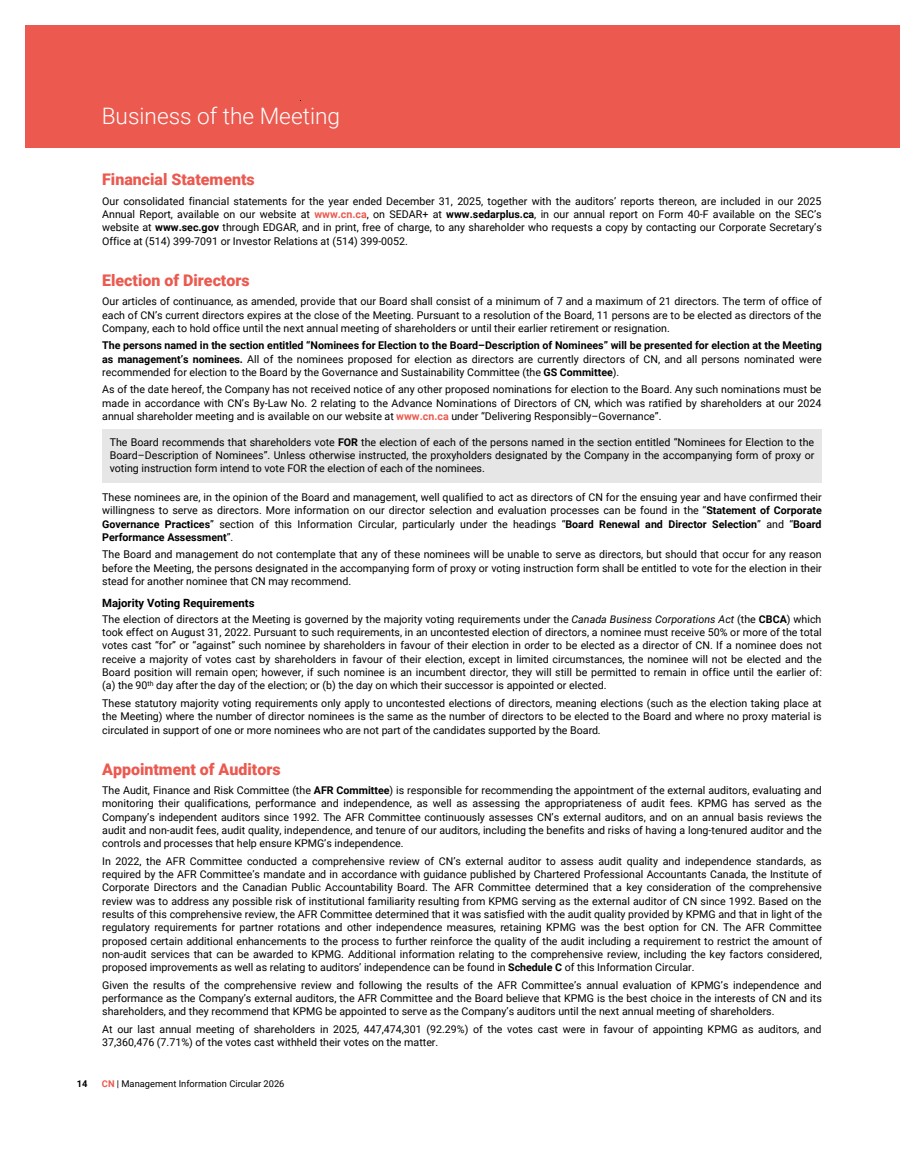
| The AFR Committee approves all audit and audit-related services, audit engagement fees and terms and all non-audit engagements provided by the external auditors. The AFR Committee pre-approved all the services performed by the auditors for audit, audit-related and non-audit related services for the years ended December 31, 2025 and 2024. Additional information relating to the nature of the audit services under each category can be found in Schedule C of this Information Circular. Additional information relating to CN’s AFR Committee and our Auditors can also be found in the Company’s 2025 Annual Information Form, available on SEDAR+ at www.sedarplus.ca, on the SEC website at www.sec.gov through EDGAR and on CN’s website at www.cn.ca. The Board recommends that shareholders vote FOR the appointment of KPMG LLP as auditors of the Company. Unless otherwise instructed, the proxyholders designated by the Company in the accompanying form of proxy or voting instruction form intend to vote FOR the appointment of KPMG LLP as auditors of the Company to hold office until the next annual meeting of shareholders. Advisory Vote on Executive Compensation The Company is providing its shareholders with an opportunity to cast an advisory vote on our approach to executive compensation, as disclosed in the “Statement of Executive Compensation” section of this Information Circular, which describes the role of the Human Resources and Compensation Committee (the HRC Committee) in overseeing compensation of executives and ensuring that it is anchored on a disciplined approach, linked to performance so as to be market competitive. The section also describes CN’s executive compensation principles, the structure of the compensation plans for our named executive officers (NEOs), and the alignment of such plans with the interests of our shareholders. The Board recommends that shareholders vote FOR the resolution set out below and, unless otherwise instructed, the proxyholders designated by the Company in the form of proxy or voting instruction form intend to vote FOR the following resolution: “RESOLVED that, on an advisory basis and not to diminish the role and responsibilities of the Board of Directors, the shareholders accept the approach to executive compensation disclosed in the section entitled “Statement of Executive Compensation” of the Information Circular of the Company dated March 9, 2026.” The Board has adopted a policy to the effect that, if a majority of the shares represented in person or by proxy at a meeting are voted against the above non-binding advisory resolution, the Board Chair or the Chair of the HRC Committee will oversee a process to engage with shareholders with a view to giving them the opportunity to express their specific concerns. The Board and the HRC Committee will consider the results of this process and, if appropriate, review the Company’s approach to executive compensation in the context of shareholders’ specific concerns. At our last annual meeting of shareholders in 2025, 438,168,657 (92.89%) of the votes cast were in favour of our approach to executive compensation, and 33,537,015 (7.11%) of the votes cast were against it. Advisory Vote on Climate Change The Company is providing its shareholders with an opportunity to cast at the Meeting an advisory vote on CN’s Climate Action Plan, as disclosed in the “Climate Action Plan Report” section of this Information Circular, which namely describes the role of the Board and the Safety and Environment Committee (SE Committee) overseeing CN’s GHG emissions reduction plan and ensuring it is linked to the Company’s long-term strategic plan. The section also describes CN’s GHG emission levels in a manner consistent with the TCFD recommendations, and the strategy that CN has adopted, or will adopt, to reduce GHG emissions in the future. The Board recommends that shareholders vote FOR the resolution set out below and, unless otherwise instructed, the proxyholders designated by the Company in the form of proxy or voting instruction form intend to vote FOR the following resolution: “RESOLVED that, on an advisory basis and not to diminish the role and responsibilities of the Board of Directors, the shareholders accept the Company’s Climate Action Plan disclosing the Company’s GHG emissions and the strategy the Company has adopted or will adopt in accordance with its Climate Action Plan to reduce the Company’s GHG emission levels in the future, the whole in a manner consistent with the Task Force on Climate-Related Financial Disclosures recommendations, as disclosed in the section entitled “Climate Action Plan Report” of the Information Circular of the Company dated March 9, 2026.” The Board has adopted a policy to the effect that, if a majority of the shares represented in person or by proxy at a meeting are voted against the above non-binding advisory resolution, the Board Chair or the Chair of the SE Committee will oversee a process to engage with shareholders with a view to giving them the opportunity to express their specific concerns with the Company’s Climate Action Plan. The Board and the SE Committee will consider the results of this process and, if appropriate, review the Company’s Climate Action Plan in the context of shareholders’ specific concerns. At our last annual meeting of shareholders in 2025, 449,205,195 (95.23%) of the votes cast were in favour of our Climate Action Plan, and 22,499,479 (4.77%) of the votes cast were against it. Other Business Following the conclusion of the formal business to be conducted at the Meeting, we will: • discuss highlights of our 2025 performance and plans for the future, and • invite questions and comments from shareholders. As of the date of this Information Circular, management is not aware of any changes to these items and does not expect any other items to be brought forward at the Meeting. If there are changes or new items, your proxyholder can vote your shares on these items as they see fit. CN | Management Information Circular 2026 15 KPMG fees for the years ended December 31 FEE (IN THOUSANDS) 2025 (C$) 2024 (C$) Audit 3,458 3,196 Audit-related 1,362 1,335 Tax 1,022 942 All other – – Total fees 5,842 5,473 |
| AGE 66 (1) Ontario, Canada DIRECTOR SINCE April 25, 2017 Independent LINGUISTIC PROFICIENCY English Shauneen Bruder Corporate Director and Chair of the Board, CN Ms. Bruder was appointed Chair of the Board of CN on May 20, 2022. She was, until her retirement on October 31, 2019, the Executive Vice-President, Operations at the Royal Bank of Canada (RBC) where she was responsible for overseeing operations related to all personal and business clients in Canada. Her previous senior roles at RBC include Executive Vice-President of Business and Commercial Banking, Chief Operating Officer of the Global Wealth Management division and President of RBC Centura Bank, Inc. in North Carolina. She is a member of the Institute of Corporate Directors (ICD.D) and has obtained the Competent Boards Climate & Biodiversity Designation (CCB.D). Previously, she served as Chair of the Board of Governors for the University of Guelph and as the Chairperson of the Canadian Chamber of Commerce and the Canadian American Business Council. She currently sits on the board of directors of the Vector Institute, a leading artificial intelligence institute that empowers researchers, businesses and governments to develop and adopt artificial intelligence responsibly. She serves as Honorary Consul to Luxembourg in Ontario. She has received the Queen‘s Diamond Jubilee Medal and the King Charles III Coronation Medal for her contributions to her community. Ms. Bruder was inducted in the Women’s Executive Network 100 Most Powerful Women in Canada Hall of Fame in 2016. She holds a Bachelor of Arts (B.A.) from the University of Guelph and a Master of Business Administration (MBA) (Gold Medalist) from Queen’s University. Qualifications to sit on the Board Ms. Bruder’s decades-long experience as a senior executive of a large capitalization financial institution and her role as board chair of a major Canadian university and Canadian and U.S. business councils give her invaluable insights into Canadian and U.S. strategic business development and corporate governance, customer experience, financial and risk matters and technology and innovation. Principal Competencies (2) • CEO/Executive Leadership Experience: More than 20 years experience as a senior executive with RBC, including in roles as Executive Vice-President Operations, Executive Vice-President Business and Commercial Banking, Chief Operating Officer of the Global Wealth Management division, President of RBC Centura Bank, Inc. in North Carolina and senior executive roles in Marketing and Strategic Planning. • Corporate Governance/Public Company Experience: Executive Vice-President, Operations and various other senior executive positions at RBC from 1996 to 2019; former Chair of the Governance, Sustainability and Safety Committee of CN; former member of the board of directors of Andrew Peller Limited from 2018–2023. • Risk Management: Decades long career with RBC, including in senior executive roles overseeing compliance, enterprise risk management and risk operations. • Technology/Innovation/Artificial Intelligence/Cybersecurity: Past Executive Vice-President, Operations at RBC until 2019 responsible for large scale digitization of core operations, data management and advanced analytics/machine learning programs, and enterprise fraud management; member of the board of directors of the Vector institute. MEMBER OF ATTENDANCE 2025 (3) Board(Chair) 100% Audit, Finance and Risk Committee 100% Governance and Sustainability Committee 100% Safety and Environment Committee 100% Human Resources and Compensation Committee 100% VOTING RESULTS IN 2025 467,031,198 (99.01%) votes in favour 4,673,975 (0.99%) votes against OTHER CURRENT PUBLIC BOARDS — OTHER PUBLIC BOARD DURING PAST 5 YEARS Andrew Peller Limited (2018–2023) SECURITIES HELD Value at risk C$6,904,108 (4) Common Shares Owned or Controlled (5) 45,765 February 2026 34,864 February 2025 SHARE OWNERSHIP REQUIREMENT (MET OR TARGET DATE TO MEET) (6) Five-year target (C$3,843,950): Met (1.8×). 16 CN | Management Information Circular 2026 Nominees for Election to the Board Description of Nominees There are 11 director nominees standing for election at the Meeting. Each nominee is a current director of the Company and is, in the opinion of the Board and management, well qualified to act as directors of the Company for the ensuing year. More information on our director selection and evaluation processes can be found in the “Statement of Corporate Governance Practices” section of this Information Circular, particularly under the headings “Board of Directors Governance–Board Renewal and Director Selection” and “Board of Directors Governance–Board Performance Assessment”. The present section provides a summary of each director nominee’s profile, their experience and qualifications to sit on the Board including their principal competencies, their attendance at meetings of the Board and of the committees on which they sit, their ownership of securities of CN, and details as to their membership on the boards of other public companies over the last five years. |
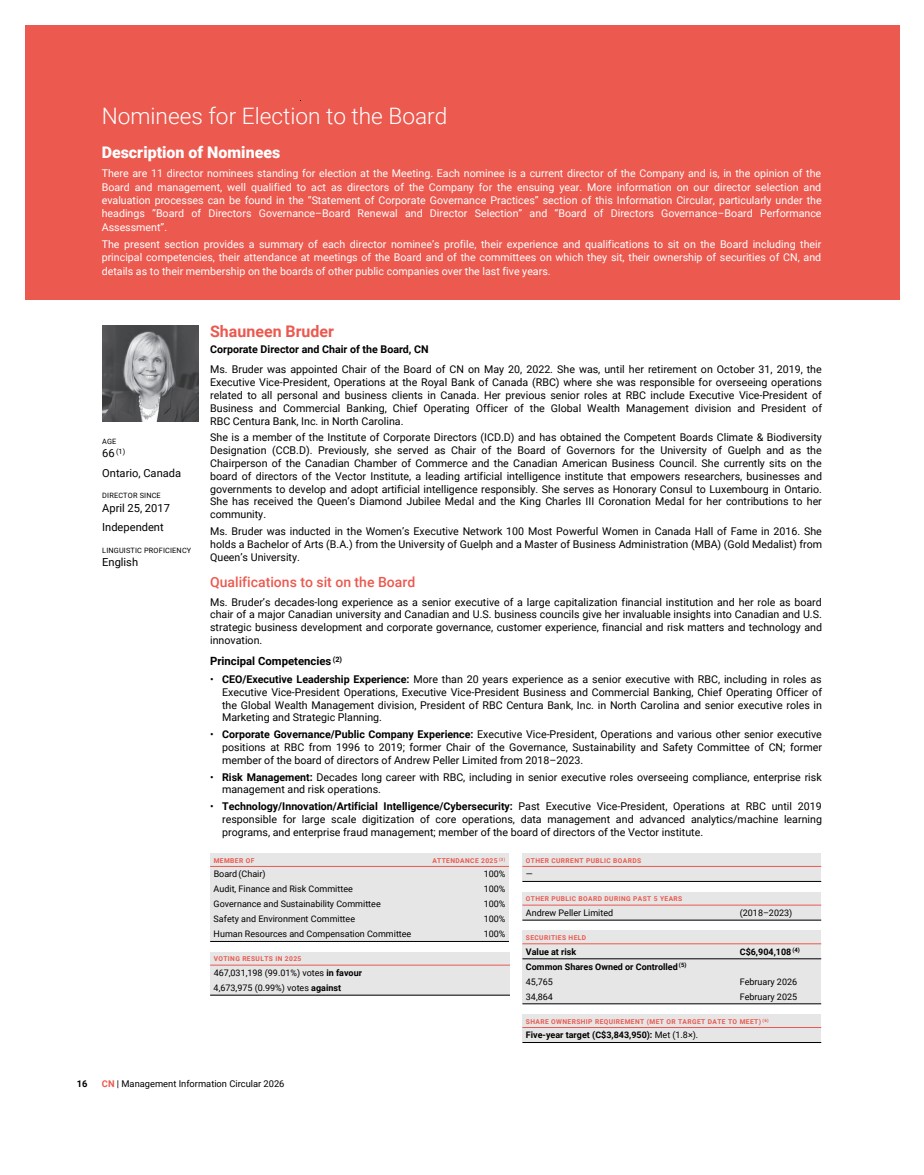
| AGE 61 (1) Texas, USA DIRECTOR SINCE October 27, 2021 Independent LINGUISTIC PROFICIENCY English Jo-ann dePass Olsovsky Corporate Director Ms. dePass Olsovsky is a corporate director with extensive North American railway experience gained at BNSF Railway. She held the position of Executive Vice-President and Chief Information Officer at Salesforce.com, Inc. (Salesforce), a cloud-based software company, from February 2018 to August 2022, when she retired. At Salesforce, she oversaw a global information technology organization responsible for their internal global network, global applications and cyber functions, and leading all internal core systems including advanced applications leveraging artificial intelligence tools. Ms. dePass Olsovsky led the Salesforce team responsible for many successful large scale system implementations, enabled Salesforce to migrate to 100% remote operations globally at the onset of the COVID-19 pandemic, integrated numerous acquisitions eliminating redundant systems infrastructure, and drove global efficiency programs. Prior to Salesforce, Ms. dePass Olsovsky was on the executive team at BNSF Railway for approximately 12 years. As their Senior Vice-President and Chief Information Officer, she led BNSF Railway's enterprise information technology function supporting all freight transportation systems, back-office systems, network technology, and was responsible for cybersecurity, telecommunications, data center and cloud networks, operations research, and artificial intelligence. She led BNSF Railway to greater operational efficiency through a migration to cloud applications and modernization of legacy systems, implemented positive train control (PTC), launched aerial drone operations for enhanced safety applications, and used machine learning within artificial intelligence learning data patterns gathered from the detector network to make predictions needed for safety applications such as predicting advance maintenance of rolling stock and rail infrastructure. Prior to her work at BNSF Railway, Ms. dePass Olsovsky held technology leadership positions at GTE/Verizon and AT&T from 1984 to 2006. Ms. dePass Olsovsky is also a member of the board of directors for Reltio Corp, a high-tech cloud native artificial intelligence-enabled big data management company, and she serves on its finance and audit committee. She was elected to the board of directors of Quanta Services, Inc. (a global energy, electric power, engineering, communications, construction and renewables company listed on the New York Stock Exchange) in May 2024, where she sits on the investment committee, the human resources and compensation committee as well as the safety, operations, and risk committee. Moreover, she is the former chair of the board of directors of Railinc Corporation (Railinc), a North American rail data and messaging services provider, where she sat on various board committees. Ms. dePass Olsovsky has obtained the Competent Boards Climate & Biodiversity Designation (CCB.D). She holds a bachelor’s degree in Business Management and an MBA from Nova Southeastern University, as well as a master’s degree in Project Management from George Washington University. Qualifications to sit on the Board Ms. dePass Olsovsky’s decades long experience and in-depth knowledge of technology, cybersecurity, infrastructure operations, as well as her history in senior executive leadership positions for over a decade at a Class I Railroad, allow her to contribute meaningfully to the Board’s vision and to CN’s strategic development, people and culture, leadership as well as technology and innovation. Principal Competencies (2) • Technology/Innovation/Artificial Intelligence/Cybersecurity: Former Executive Vice-President and Chief Information Officer at Salesforce; Over 30 years of extensive experience in technology architecture, networking, cybersecurity, large scale systems implementation, M&A integrations, new products, cloud migration, digital customer experiences, data management & analytics, artificial intelligence, predictive sciences, and aerial inspection, among others. • CEO/Executive Leadership Experience: 16 years of executive experience, including as Former Executive Vice-President and Chief Information Officer at Salesforce and almost 12 years’ experience in leadership roles at BNSF Railway, including as Senior Vice‑President and Chief Information Officer. • Transport Industry/Logistics/Supply Chain/Operations: Almost 12 years’ experience in senior management at BNSF; 10 years on Railinc board of directors including serving on various committees and as board chair from 2014 to 2018. • People and Talent Management/Organized Labour: 16 years executive experience overseeing large organizations comprised of unionized, salaried, and contract personnel; Former board chair and member of the human resources and compensation committee of Railinc; experience leading global teams of over 3,000 employees with responsibility for operational budgets program worth more than $1B; extensive experience in all aspects of human resources matters for both unionized and management employees globally, including attracting, developing, and retaining union and salaried/management employees, all aspects of unionized labour relations, compensation design, performance management and talent/succession planning. MEMBER OF ATTENDANCE 2025 (3) Board 100% Safety and Environment Committee 100% Human Resources and Compensation Committee (Chair) 100% VOTING RESULTS IN 2025 465,145,961 (98.61%) votes in favour 6,559,711 (1.39%) votes against OTHER CURRENT PUBLIC BOARDS Quanta Services, Inc. (2024–present) OTHER PUBLIC BOARD DURING PAST 5 YEARS – SECURITIES HELD Value at risk C$2,486,633 (4) Common Shares Owned or Controlled (5) 16,486 February 2026 13,108 February 2025 SHARE OWNERSHIP REQUIREMENT (MET OR TARGET DATE TO MEET) (6) Five-year target (C$1,642,415): Met (1.5×). CN | Management Information Circular 2026 17 |
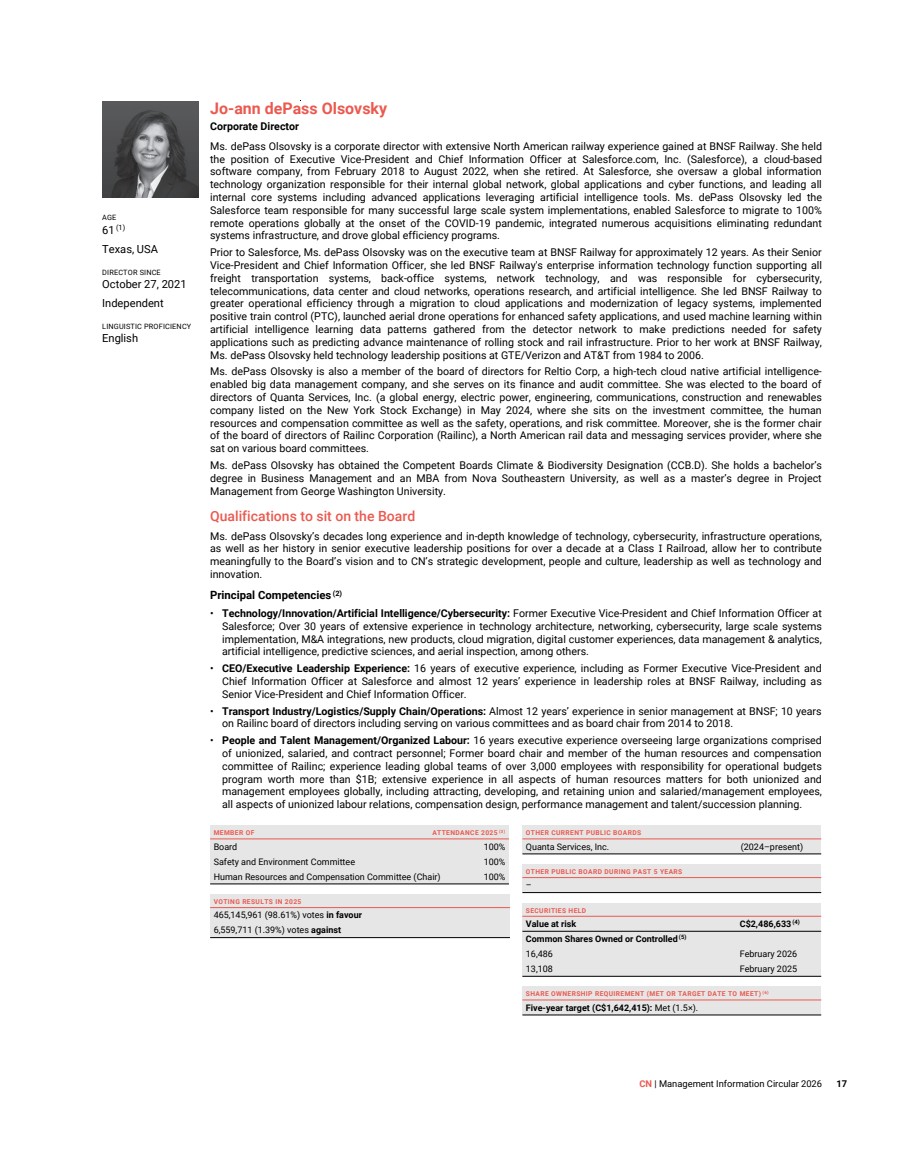
| AGE 71 (1) Tennessee, USA DIRECTOR SINCE May 20, 2022 Independent LINGUISTIC PROFICIENCY English David Freeman Corporate Director Mr. Freeman is the former Executive Vice President of Operations for BNSF Railway. In this capacity, Mr. Freeman oversaw all engineering, environmental, mechanical, operations support, transportation, safety and training, service design and resource protection for the entire railway. After a successful 19-year career at BNSF Railway, during which he held various senior positions, Mr. Freeman retired in early 2020. Prior to joining BNSF Railway, Mr. Freeman worked from 1981 to 2001 in the aluminum industry at Alcoa Corporation and Imco Recycling Inc., where he occupied various roles, including in manufacturing and supply chain. From 1976 to 1981, Mr. Freeman held different functions relating to engineering, mechanical and transportation at the Missouri Pacific Railroad (now a part of Union Pacific Corporation). Mr. Freeman was a member of the board of directors and chair of the human resources and governance committee of Loram Holdings, Inc. until March 2025, a private company involved in the design, build and operations for various maintenance of way equipment and activities in the railroad industry. He is also a member of the board of directors of Direct ChassisLink Inc., a provider of marine and domestic container chassis to the U.S. Intermodal Industry, where he also sits on the operations committee and is chair of the finance committee. He is also a member of the board of directors of Orion Steel (leading North American producer of engineered steel products for rail, energy, infrastructure and industrial end markets) since May 2025. From 2008 to 2011, Mr. Freeman sat on the board of governors of the American Railway Engineering and Maintenance-of-Way Association. Mr. Freeman holds a Bachelor of Science in Civil Engineering from Lehigh University. Qualifications to sit on the Board Drawing on his enduring career in the railroad industry and his former position as Executive Vice President of Operations at BNSF Railway, Mr. Freeman brings a wealth of experience to the Board with regards to leadership in the transportation industry as well as logistics, operations and safety. Principal Competencies (2) • Transport Industry/Logistics/Supply Chain/Operations: Decades-long experience as former Executive Vice President of Operations for BNSF Railway; Former member of the board of directors of Loram Holdings, Inc.; Member of the board of directors and the operations committee of Direct ChassisLink, Inc.; Board of governor’s member of the American Railway Engineering and Maintenance-of-Way Association from 2008 to 2011; 20-year experience at Alcoa Corporation and Imco Recycling Inc., including in manufacturing and supply chain. • Safety: Former Executive Vice President of Operations for BNSF Railway, overseeing, among other matters, safety and training across the entire railway. • CEO/Executive Leadership Experience: Former Executive Vice President of Operations for BNSF Railway. • Customer Experience/Sales/Marketing: Former Executive Vice President of Operations and other senior positions at BNSF Railway solidified a strong understanding of customer perspectives for Class I Railroads. MEMBER OF ATTENDANCE 2025 (3) Board 100% Audit, Finance and Risk Committee 100% Safety and Environment Committee 100% VOTING RESULTS IN 2025 469,972,193 (99.63%) votes in favour 1,733,487 (0.37%) votes against OTHER PUBLIC BOARDS (CURRENT OR DURING THE PAST FIVE YEARS) — SECURITIES HELD Value at risk C$1,926,439 (4) Common Shares Owned or Controlled (5) 12,772 February 2026 9,610 February 2025 SHARE OWNERSHIP REQUIREMENT (MET OR TARGET DATE TO MEET) (6) Five-year target (C$1,642,415): Met (1.2x). 18 CN | Management Information Circular 2026 |
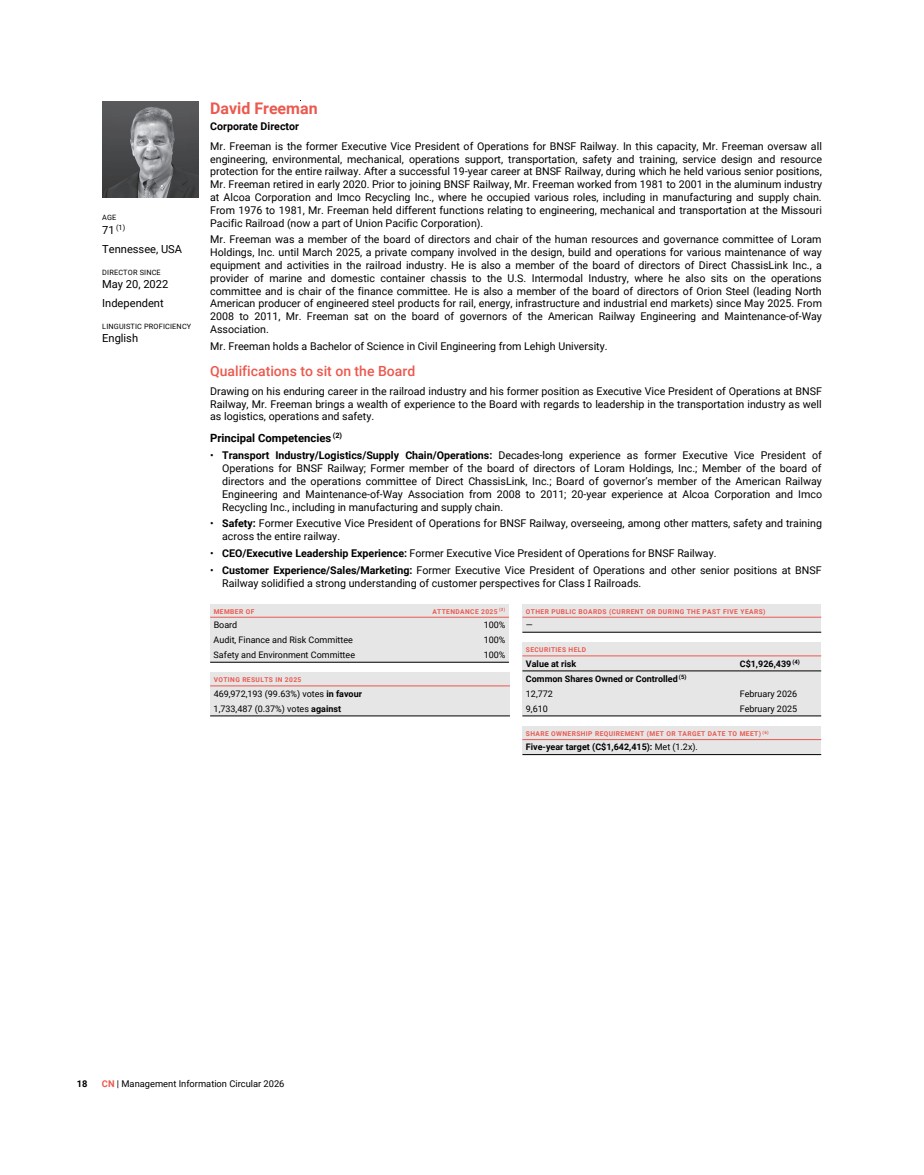
| AGE 63 (1) Michigan, USA DIRECTOR SINCE April 27, 2021 Independent LINGUISTIC PROFICIENCY English Denise Gray Corporate Director Ms. Gray is a corporate director and industry advisor with extensive experience in business leadership. Most recently, she was Director, External Affairs & Government Relations, North America at LG Energy Solution Michigan Inc., U.S., a subsidiary of LG Energy Solution Ltd., one of the world’s largest lithium-ion battery manufacturers, until May 2023. She spent nearly eight years, beginning in 2015, with LG Corporation in various leadership positions, including as President of LG Energy Solution Michigan Inc. Tech Center, as President of LG Chem Michigan Inc. Tech Center and as President and CEO of LG Power Inc. She also sat on the board of all three entities during her tenure in those leadership positions. From March 2013 to September 2015, she was Vice-President, Powertrain Electrification at AVL List GmbH in Graz, Austria and North America. She also has over 30 years of prior experience in roles of increasing responsibility at General Motors, including acting as head of Global Battery Systems Engineering, where she was a driving force behind the Chevrolet Volt Vehicle Battery. Ms. Gray is a member of the board of directors and of the audit committee and the compensation committee of Cheniere Energy, Inc., an international energy company headquartered in Houston, Texas, and is a director of Mitra Chem, a private lithium-ion battery materials manufacturer. She was a member of the board of Tenneco, Inc., a U.S. public company and a manufacturer of automotive products for global markets, including light vehicle, commercial truck, industrial and the aftermarket from 2019 to 2022, and also served as a member of Tenneco, Inc.’s audit and compensation committees. In addition, Ms. Gray served on the board of directors of the Original Equipment Suppliers Association (OESA), a non‑profit trade association that represents original equipment automotive suppliers in North America from 2019 until 2023. Her support of the STEM (science, technology, engineering and mathematics) academic disciplines was recognized when she was awarded the 2017 Women of Color Technologist of the Year Award. Ms. Gray holds a bachelor’s degree in Electrical Engineering from Kettering University and a master’s degree in Engineering Management Technology from Rensselaer Polytechnic Institute. Qualifications to sit on the Board Ms. Gray’s extensive experience in executive management and in leading the development and implementation of new technology in traditional industries allows her to contribute meaningfully to the Board’s vision and to CN’s strategic plan. Principal Competencies (2) • CEO/Executive Leadership Experience: Held various leadership positions at LG Corporation from 2015 until 2023, including as Director, External Affairs & Government Relations, North America, at LG Energy Solution Michigan Inc., U.S., President of LG Energy Solution Michigan Inc. Tech Center, President of LG Chem Michigan Inc. Tech Center and President and CEO of LG Power Inc.; Over 30 years’ experience as an executive with General Motors, a leading multinational automotive corporation. • Corporate Governance/Public Company Experience: Member of the board, audit committee and compensation committee of Cheniere Energy, Inc. since May 2023; Former member of the board of Tenneco, Inc. from 2019 to 2022 as well as member of its audit and compensation committees; chair of the GS Committee. • Technology/Innovation/Artificial Intelligence/Cybersecurity: Experience in the application of innovative technology including lithium-ion batteries within traditional industries; member of the EVWG Advisory Committee, advising the U.S. Departments of Energy and Transportation on matters relating to electric vehicles; member of the board of directors of Mitra Chem, a private lithium-ion battery materials manufacturer working to innovate and commercialize iron-based cathode materials to enable mass-market electrification in transportation and energy storage. • Environmental/Social/Corporate Responsibility: Decades-long experience as an executive, including as President and Chief Executive Officer at the forefront of technological innovation in the transportation industry, which provides valuable insight to the Board on innovation and the use of new, greener technology in CN’s operations; member of the EVWG Advisory Committee, advising the U.S. Departments of Energy and Transportation on matters relating to electric vehicles. MEMBER OF ATTENDANCE 2025 (3) Board 100% Governance and Sustainability Committee 100% Safety and Environment Committee (9) 100% Human Resources and Compensation Committee (10) 100% VOTING RESULTS IN 2025 468,307,761 (99.28%) votes in favour 3,397,913 (0.72%) votes against OTHER CURRENT PUBLIC BOARDS Cheniere Energy, Inc. (2023–present) OTHER PUBLIC BOARD DURING PAST 5 YEARS Tenneco, Inc. (2019–2022) SECURITIES HELD Value at risk C$1,945,294(4) Common Shares Owned or Controlled (5) 12,897 February 2026 9,622 February 2025 SHARE OWNERSHIP REQUIREMENT (MET OR TARGET DATE TO MEET) (6) Five-year target (C$1,642,415): Met (1.2x). CN | Management Information Circular 2026 19 |
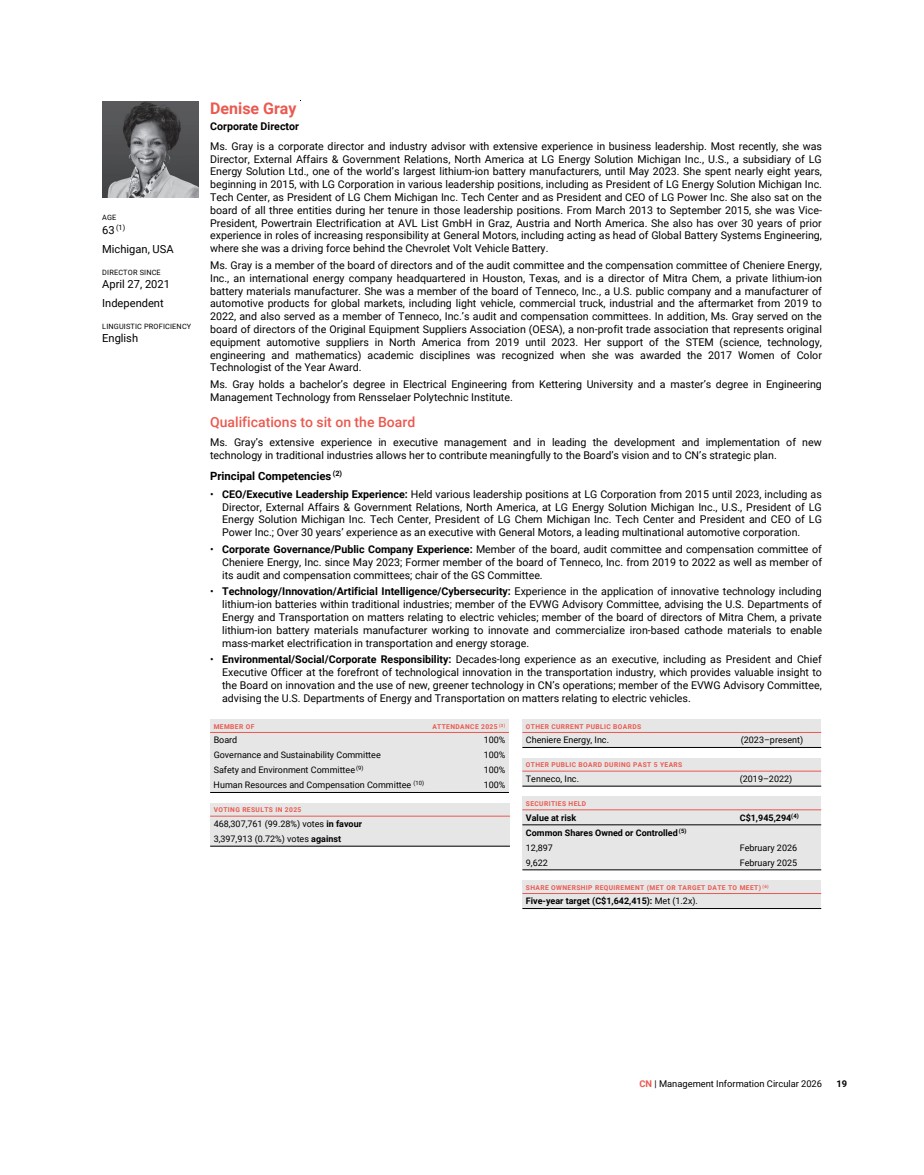
| AGE 55 (1) Washington, USA DIRECTOR SINCE April 27, 2021 Independent LINGUISTIC PROFICIENCY English, French Justin M. Howell Corporate Director Mr. Howell was, until his retirement on March 3, 2025, a senior investment manager with Cascade Asset Management Co., the investment office for the Gates Family and the Gates Foundation Trust. Mr. Howell was formerly an investment banker with Bank of America Merrill Lynch, New York, New York and a lawyer with the law firm Cravath, Swaine & Moore LLP in New York, New York. Mr. Howell is the chair of the nomination and compensation committee and a member of the board of directors of Sika AG, a multinational specialty chemical company listed on the SIX Swiss Exchange and headquartered in Baar, Switzerland. Mr. Howell is also a member of the board of Washington Memory and Brain Wellness Center. Mr. Howell holds an LL.B./B.C.L. degree from McGill University Faculty of Law and a B.A. from the University of Northern British Columbia. He is retired from the New York and Washington State Bars. Qualifications to sit on the Board Mr. Howell’s in-depth knowledge of international financial and capital markets and extensive international experience in corporate finance, investment banking and mergers & acquisitions, together with his wide network across industries, gives him valuable insight into CN’s international strategic development. With nearly 15 years of experience working for a global asset owner with a strong focus on sustainable, long-term investment coupled with his law practice, he brings to the Board broad expertise in the areas of sustainability, environmental, social and corporate responsibility, and corporate governance. Principal Competencies (2) • International/Global Experience and Perspective: Former senior investment manager of Cascade Asset Management Co.; Experience in public and private equity investment for a global portfolio, governance principles in the U.S., Canada, and Europe, and complex transactions with multinational businesses as former investment banker at Bank of America Merrill Lynch. • Environmental/Social/Corporate Responsibility: Experience in sustainable, long-term investment principles as senior investment manager of Cascade Asset Management Co.; member of the GS Committee. • Corporate Governance/Public Company Experience: Experience in strategy-aligned compensation models and international governance principles for a major publicly listed company as chair of the nomination and compensation committee and member of the board of Sika AG; member of the GS Committee. • Finance/Accounting/Investor Relations/Capital Markets: Former senior investment manager of Cascade Asset Management Co.; Experience in investment management, overseeing complex M&A and other financial transactions, and corporate finance as former investment banker at Bank of America Merrill Lynch. MEMBER OF ATTENDANCE 2025 (3) Board 100% Governance and Sustainability Committee 100% Human Resources and Compensation Committee 100% VOTING RESULTS IN 2025 467,731,599 (99.16%) votes in favour 3,974,077 (0.84%) votes against OTHER CURRENT PUBLIC BOARDS Sika AG (2018–present) OTHER PUBLIC BOARD DURING PAST 5 YEARS – SECURITIES HELD Value at risk C$1,565,496 (4) Common Shares Owned or Controlled (5) 10,379 February 2026 7,653 February 2025 SHARE OWNERSHIP REQUIREMENT (MET OR TARGET DATE TO MEET) (6) Five-year target (C$1,642,415): To be met by April 2026. 20 CN | Management Information Circular 2026 |
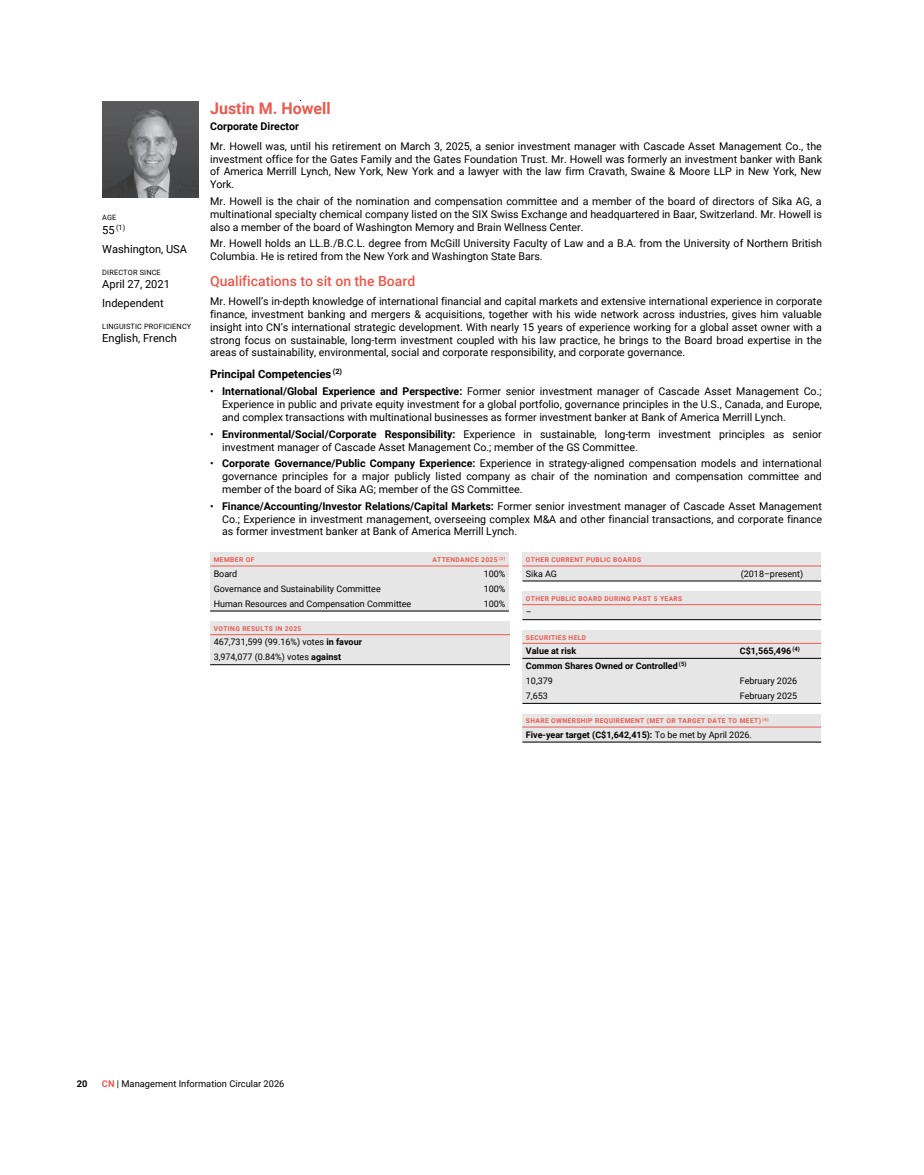
| AGE 56 (1) Alberta, Canada DIRECTOR SINCE May 20, 2022 Independent LINGUISTIC PROFICIENCY English, French Susan C. Jones Corporate Director Ms. Jones is a corporate director having served on numerous public company boards and having held various leadership positions within public companies throughout her career in the energy, mining and agricultural sectors. She also has experience with Class I Railroads from a customer-lens, having dealt with such railways as customers throughout her career. She currently sits on the board and on the audit committee and the human resources committee of TC Energy Corporation, a major North American energy company listed on the TSX and on the New York Stock Exchange. She previously served on the boards of Gibson Energy Inc., Seven Generations Energy Ltd., ARC Resources Ltd. and Piedmont Lithium Inc. Ms. Jones served as Executive Vice President and Chief Executive Officer of the Potash Business Unit at Nutrien Ltd. (Nutrien), the world’s largest provider of crop inputs, services and solutions, until her retirement in 2019. She also held a variety of other leadership roles within Nutrien between 2004 and 2017, including, among others, Chief Legal Officer, Senior Vice-President of the Phosphate Business Unit, and Managing Director of the European Fertilizer trading business. In these roles, she was responsible for running and transforming large businesses, with a focus on safety and operational excellence, people and culture, including leadership in unionized environments. Prior to her career at Nutrien, Ms. Jones was a partner at Jones & Ruud Law Corp from 1996 until 2003. Ms. Jones holds a Bachelor of Arts in Political Science and Hispanic Studies from the University of Victoria, as well as a Bachelor of Laws from the University of Ottawa. She also earned a Leadership Diploma from the University of Oxford and holds a Director Certificate from Harvard University. In 2017, she was named the Osler Purdy Crawford Deal Maker of the Year at the Canadian General Counsel Awards in recognition of her role in the merger of Agrium Inc. and Potash Corporation of Saskatchewan Inc. Ms. Jones has also served on the United Way and the Canadian Bar Association. Qualifications to sit on the Board Ms. Jones’ extensive experience in senior executive positions at a large global mining and agriculture company, along with her experience as a board and committee member of various large public companies combined with her distinguished legal expertise allow her to bring to the Board invaluable insight into strategic business development and transformations, customer experience, as well as into regulatory and legal matters. Principal Competencies (2) • CEO/Executive Leadership Experience: Former Executive Vice President and Chief Executive Officer of the Potash Business Unit of Nutrien; Former Chief Legal Officer of Agrium Inc., predecessor to Nutrien; Former Senior Vice President and President of the Phosphate Business Unit at Nutrien; Generally, held various leadership positions within Nutrien for over 15 years from 2004 until her retirement in 2019. • Government/Public Policy/Regulatory/Legal: Former Chief Legal Officer of Agrium Inc., predecessor to Nutrien, from March 2015 until December 2017; Co-Chair of the Food & Agribusiness Section of the Canadian Bar Association in 2017; Former partner at Jones & Ruud Law Corp for nearly a decade. • Safety: Former Executive Vice President and Chief Executive Officer of the Potash Business Unit at Nutrien and also Senior Vice President and President of the Phosphate Business Unit at Nutrien, overseeing safety and operational matters, among others. • Customer Experience/Sales/Marketing: Various executive roles at Nutrien, including as Executive Vice President and CEO of the Potash Business Unit, and President of the Phosphate Business Unit, and Vice-President Sales, Marketing & Distribution, where in each role, Nutrien was a customer to all the North American Class I Railroads; and Managing Director of the European Fertilizer trading business at Nutrien. MEMBER OF ATTENDANCE 2025 (3) Board 100% Audit, Finance and Risk Committee 100% Safety and Environment Committee (Chair) 100% VOTING RESULTS IN 2025 470,733,139 (99.79%) votes in favour 972,034 (0.21%) votes against OTHER CURRENT PUBLIC BOARDS TC Energy Corporation (2020–present) OTHER PUBLIC BOARD DURING PAST 5 YEARS Piedmont Lithium Inc. (2021–2023) ARC Resources Ltd. (2020–2023)* * Ms. Jones served on the board of Seven Generations Energy Ltd. starting in 2020, and continued on the board of ARC Resources Ltd. after its merger with Seven Generations Energy Ltd. in 2021. SECURITIES HELD Value at risk C$2,543,198 (4) Common Shares Owned or Controlled (5) 16,858 February 2026 10,610 February 2025 SHARE OWNERSHIP REQUIREMENT (MET OR TARGET DATE TO MEET) (6) Five-year target (C$1,642,415): Met (1.5x). CN | Management Information Circular 2026 21 |
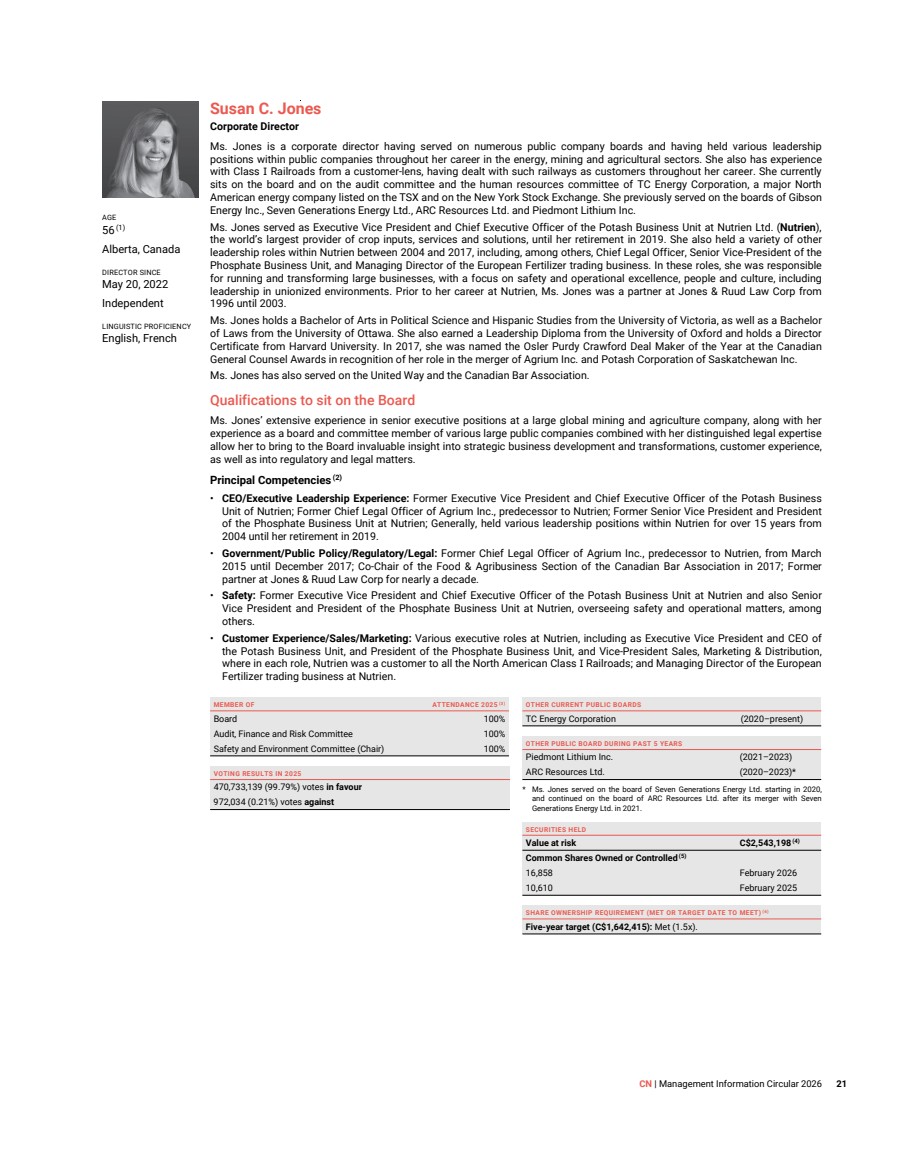
| AGE 68 (1) Florida, USA DIRECTOR SINCE May 20, 2022 Independent LINGUISTIC PROFICIENCY English Robert Knight Corporate Director Mr. Knight is a corporate director and the former Chief Financial Officer of Union Pacific Corporation (the parent company operating Union Pacific Railroad, a Class I Railroad company based in the United States), a position he held for 15 years before retiring in December 2019. For seven consecutive years, Mr. Knight was named to Institutional Investor magazine’s All-America Executive Team as the top CFO in all of transportation. During Mr. Knight’s 40-year tenure at Union Pacific Corporation, he also held a variety of senior executive positions, including General Manager of the company’s energy and automotive business units. As a proven leader with extensive experience in finance, marketing, and human resources, Mr. Knight serves as a director and member of the compensation committee and the governance committee at Schneider National, Inc., a U.S. transportation and logistics company, and as director and chair of the audit committee at Hyliion Holdings Corp., a provider of electrified powertrain solutions headquartered in Austin, Texas. He was previously a director at Carrix Corporation, a private transportation services company. Mr. Knight holds an MBA from Southern Illinois University and a B.A. from Kansas State University. Qualifications to sit on the Board With his decades-long experience in finance and corporate governance as former CFO of a Class I Railroad, Mr. Knight brings to the Board business and strategic leadership, as well as extensive knowledge of the transportation industry. Principal Competencies (2) • Finance/Accounting/Investor Relations/Capital Markets: Former Chief Financial Officer of Union Pacific Corporation from 2004 to 2019; Chair of audit committee of Hyliion Holdings Corp. • Transport Industry/Logistics/Supply Chain/Operations: Former Chief Financial Officer and over 40 years of experience at Union Pacific Corporation; Independent Director at Schneider National, Inc., a transportation and logistics company, since April 2020; Former director of Carrix, Inc., a privately-held marine terminal and rail operator company. • Stakeholder Relations/Community Engagement: Former Chief Financial Officer and over 40 years of experience at Union Pacific Corporation, including in a variety of senior executive positions. • Corporate Governance/Public Company Experience: Former Chief Financial Officer and over 40 years of experience at Union Pacific Corporation, including in a variety of senior executive positions; Member of the board and governance committee of Schneider National, Inc. since April 2020; Member of the board of Hyliion Holdings Corp. since October 2020. MEMBER OF ATTENDANCE 2025 (3) Board 100% Audit, Finance and Risk Committee (Chair) (7) 100% Human Resources and Compensation Committee 100% VOTING RESULTS IN 2025 469,832,913 (99.6%) votes in favour 1,872,766 (0.40%) votes against OTHER CURRENT PUBLIC BOARDS Schneider National, Inc. (2020–present) Hyliion Holdings Corp. (2020–present) OTHER PUBLIC BOARD DURING PAST 5 YEARS – SECURITIES HELD Value at risk C$1,489,024 (4) Common Shares Owned or Controlled (5) 9,872 February 2026 6,572 February 2025 SHARE OWNERSHIP REQUIREMENT (MET OR TARGET DATE TO MEET) (6) Five-year target (C$1,642,415): To be met by May 2027. 22 CN | Management Information Circular 2026 |
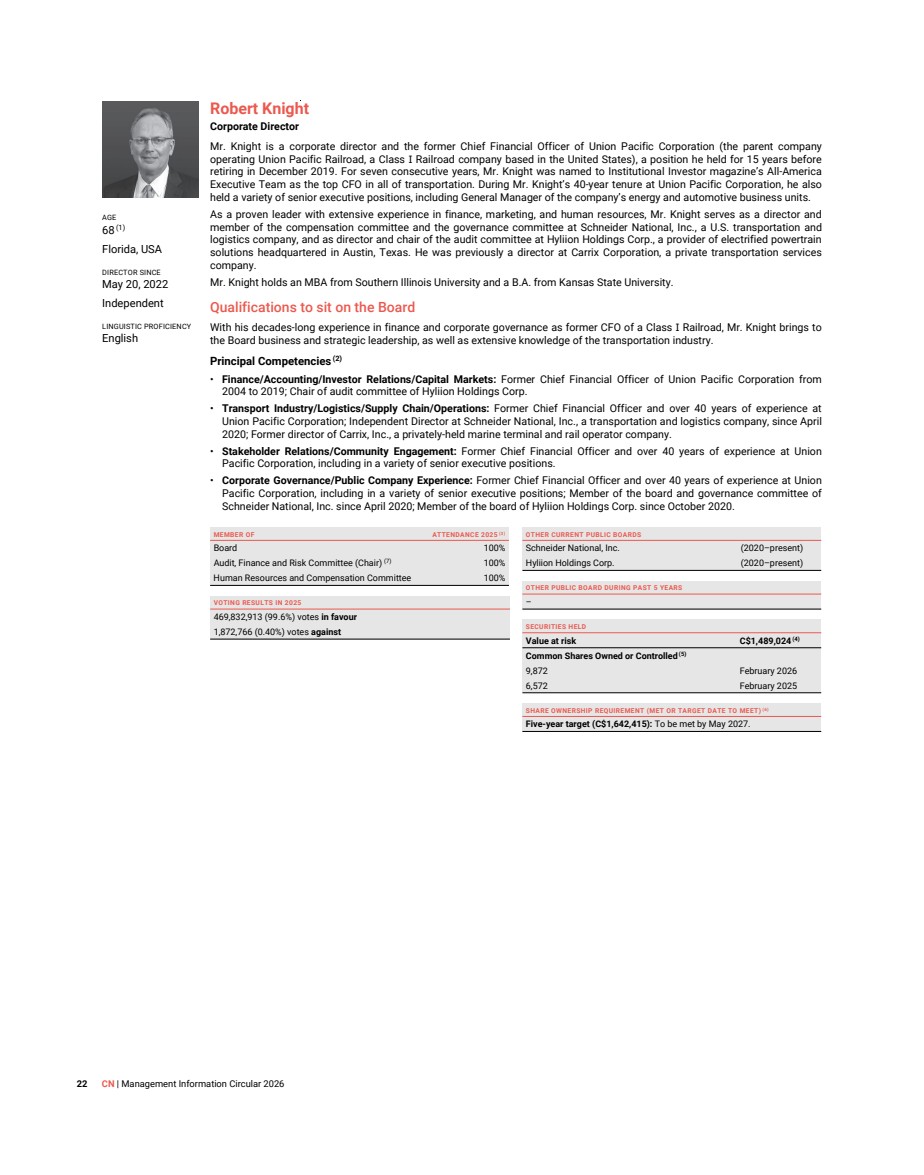
| AGE 61 (1) Quebec, Canada DIRECTOR SINCE October 1, 2022 Independent LINGUISTIC PROFICIENCY French, English Michel Letellier President and Chief Executive Officer, Innergex Renewable Energy Inc.(a) Mr. Letellier is the President and CEO of Innergex Renewable Energy Inc. (Innergex), one of the largest Canadian independent renewable power producers, since October 25, 2007. In this role, Mr. Letellier is responsible for providing strategic leadership and overseeing all of Innergex’s business activities, in order to ensure its sound financial management and long-term sustainability. Prior to his current role, he acted as Executive Vice-President and Chief Financial Officer of Innergex from 2003 until his appointment as President and CEO. From 1997 to 2003, Mr. Letellier was Vice President and Chief Financial Officer of Innergex GP Inc. and was responsible for the financial management of the affairs of Innergex GP Inc., Innergex, Limited Partnership and Innergex Power Income Fund. Prior to joining Innergex, Mr. Letellier worked at Boralex Inc. (Boralex) from 1990 to 1997, where he was involved in the development and operation of several run-of-river hydroelectric projects and where he held positions of increasing responsibility. Prior to that, he spent two years as a member of the Corporate Finance group at Brault Guy O’Brien Inc. Mr. Letellier is an experienced corporate director having served on public and private boards since 2012, including as a current member of the Innergex board of directors, and as a former member of the board of directors and audit committee and former chair of the nominating and governance committee of KP Tissue Inc. Mr. Letellier holds an MBA from Université de Sherbrooke as well as a bachelor’s degree in commerce (finance) from Université du Québec à Montréal. Qualifications to sit on the Board Mr. Letellier has extensive North American business experience, particularly in the renewable energy industry, having been with Innergex since 1997 and its President and Chief Executive Officer since 2007, and previously with Boralex, where he was responsible for the development and operation of hydroelectric projects. He is an accomplished Montreal based business leader who brings to the Board extensive business and strategic experience, sustainability leadership and record of entrepreneurship, combined with financial acumen. Principal Competencies (2) • CEO/Executive Leadership Experience: President and CEO of Innergex; Former Executive Vice-President and Chief Financial Officer of Innergex; Generally, held various senior executive leadership positions within Innergex and Boralex. • Stakeholder Relations/Community Engagement: President and CEO of Innergex overseeing its strategic leadership and business activities, including its stakeholder and Indigenous engagement initiatives. • Finance/Accounting/Investor Relations/Capital Markets: President and CEO of Innergex; Former Executive Vice‑President and Chief Financial Officer of Innergex; Former Vice President and Chief Financial Officer of Innergex GP Inc.; Former member of the audit committee of KP Tissue Inc. • Environmental/Social/Corporate Responsibility: President and CEO of Innergex; Held various positions at Boralex from 1990 to 1997, where he was responsible for the development and operation of several run-of-river hydroelectric projects; Member of the GS Committee. MEMBER OF ATTENDANCE 2025 (3) Board 100% Audit, Finance and Risk Committee 100% Governance and Sustainability Committee 100% VOTING RESULTS IN 2025 467,737,469 (99.16%) votes in favour 3,968,206 (0.84%) votes against OTHER CURRENT PUBLIC BOARDS Innergex Renewable Energy Inc.* (2002–2025) * Innergex was acquired by La Caisse (formerly known as Caisse de dépôt et placement du Québec) in 2025 and therefore Innergex is no longer a publicly-listed company. OTHER PUBLIC BOARD DURING PAST 5 YEARS KP Tissue Inc. (2012–2023) SECURITIES HELD Value at risk C$1,937,193 (4) Common Shares Owned or Controlled (5) 12,841 February 2026 6,722 February 2025 SHARE OWNERSHIP REQUIREMENT (MET OR TARGET DATE TO MEET) (6) Five-year target (C$1,642,415): Met (1.2x). CN | Management Information Circular 2026 23 (a) On February 17, 2026, Innergex Renewable Energy announced the retirement of Mr. Letellier as President and Chief Executive Officer, effective March 13, 2026. |
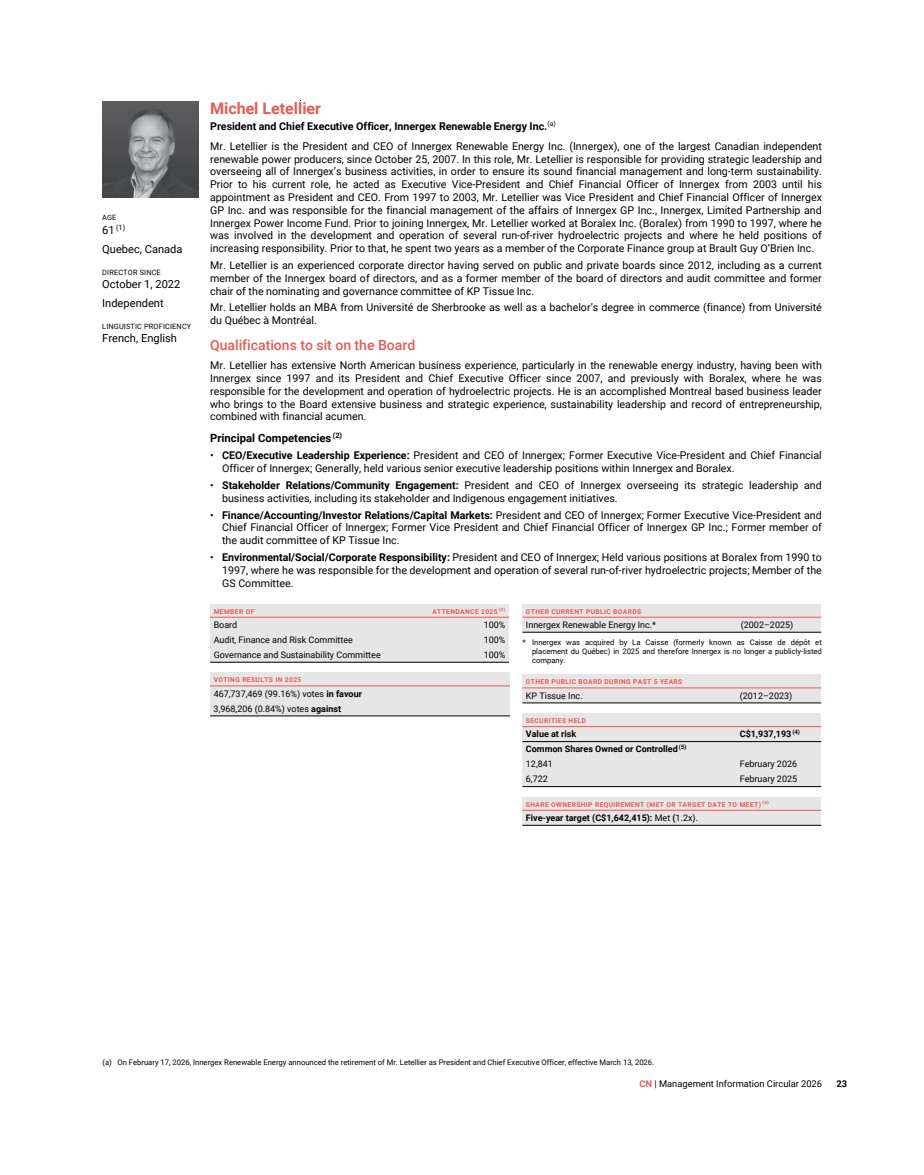
| AGE 66 (1) Alberta, Canada DIRECTOR SINCE April 25, 2023 Independent LINGUISTIC PROFICIENCY English Al Monaco Corporate Director Mr. Monaco was, until his retirement on January 1, 2023, the President and Chief Executive Officer of Enbridge Inc. (Enbridge), an energy infrastructure company. Appointed as President, Chief Executive Officer and as a director of Enbridge in 2012, Mr. Monaco led Enbridge through a period of transformational growth combined with an intensified focus on safety, reliability and environmental protection. Previously, he held a number of executive positions at Enbridge, including President, Gas Pipelines, Renewable Energy & International, President, Gas Distribution and Storage, Executive Vice President, Major Projects & Renewable Energy and Senior Vice President, Corporate Planning and Development. Mr. Monaco is a director and member of the compensation committee of Weyerhaeuser Company, an American timberland and wood products company. He is also a former director and member of the executive committee, and Chair of the Finance Committee, of the American Petroleum Institute, and a former director and member of the Business Council (US), the U.S. National Petroleum Council, the Business Council of Canada, the Business Council of Alberta, and the Catalyst Canada Advisory Board. He was the recipient of the Fraser Institute’s Founders Award (2019) in recognition of his exceptional entrepreneurial achievements and has been recognized, among many other recognitions, as “Canadian Energy Person of the Year” (2017). Most recently, he was awarded the Canadian Chamber of Commerce Canadian Business Leader Lifetime Achievement Award. Mr. Monaco earned his MBA from the Haskayne School of Business at the University of Calgary. He is a CPA and a certified management accountant. He also completed the Advanced Management Program at Harvard Business School. Qualifications to sit on the Board Mr. Monaco brings decades-long experience overseeing a large, complex, federally regulated and geographically diverse industrial organization, including as it relates to the management of capital-intensive operations, development of major infrastructure projects, deployment of operating technology, as well as international operations, sustainability and strategic planning. This experience provides CN with invaluable insight into executive leadership, capital allocation and investment decisions, capital markets, operations and safety, people development and indigenous relations, among other matters. Principal Competencies (2) • CEO/Executive Leadership Experience: Over 20 years of experience as a senior executive at Enbridge, a large, publicly-listed energy infrastructure company, including 11 years in the role of President and Chief Executive Officer. • Safety: Former President and Chief Executive Officer of Enbridge, with an intensified focus on Enbridge’s approach to safety, operational reliability and environmental protection. • Finance/Accounting/Investor Relations/Capital Markets: Former Chief Executive Officer at Enbridge, a large publicly-listed company; CPA and certified management account with an MBA from the Haskayne School of Business at the University of Calgary; experience in attracting and raising significant equity and debt to finance capital investments; significant mergers and acquisitions experience. • Transportation Industry/Logistics/Supply Chain/Operations: Former President & CEO of Enbridge, North America’s largest energy transportation company with significant focus on investing new capital to expand, extend and enhance transportation infrastructure across North America. MEMBER OF ATTENDANCE 2025 (3) Board 100% Governance and Sustainability Committee (Chair) (8) 100% Safety and Environment Committee 100% Human Resources and Compensation Committee (10) 100% VOTING RESULTS IN 2025 469,900,500 (99.62%) votes in favour 1,805,177 (0.38%) votes against OTHER CURRENT PUBLIC BOARDS Weyerhaeuser Company (2020–present) OTHER PUBLIC BOARD DURING PAST 5 YEARS Enbridge Inc. (2012–2023) SECURITIES HELD Value at risk C$3,314,394 (4) Common Shares Owned or Controlled (5) 21,970 February 2026 18,800 February 2025 SHARE OWNERSHIP REQUIREMENT (MET OR TARGET DATE TO MEET) (6) Five-year target (C$1,642,415): Met (2.0×). 24 CN | Management Information Circular 2026 |
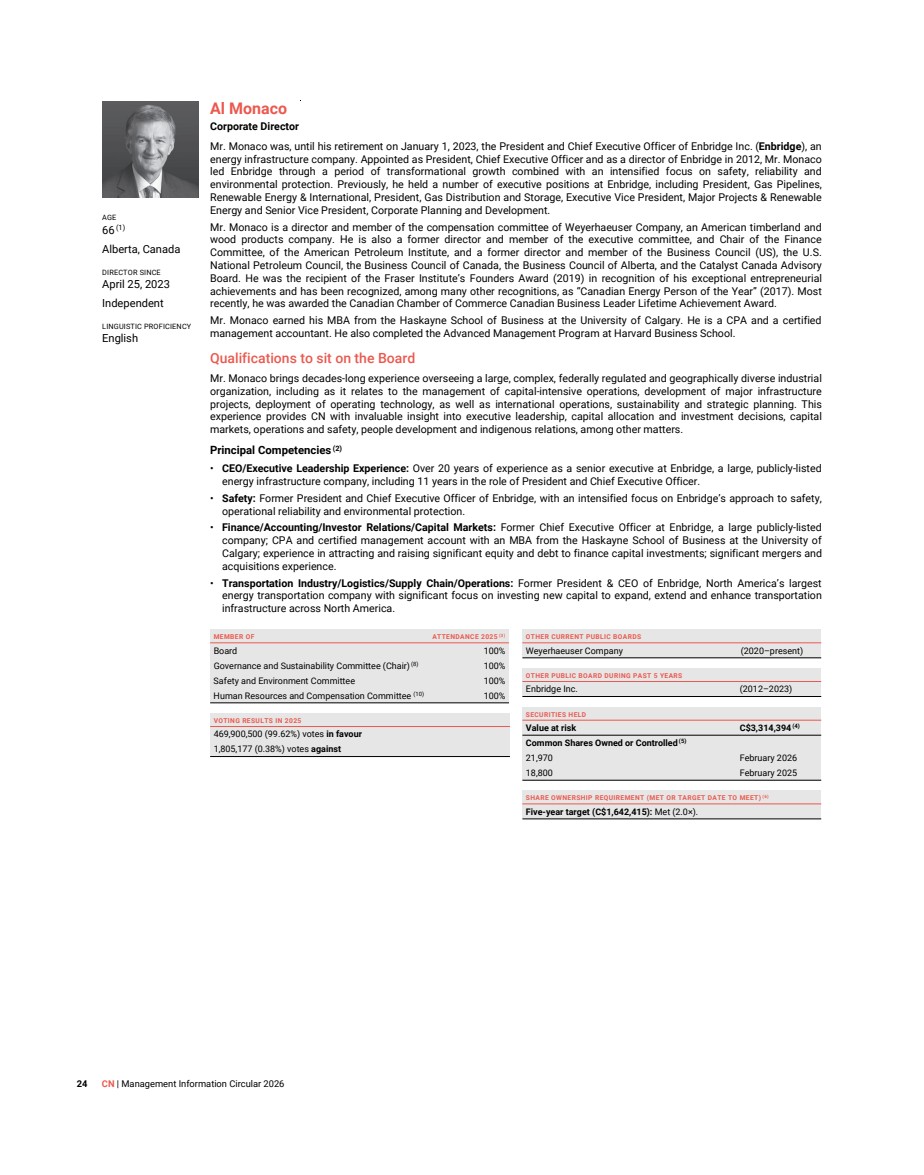
| AGE 63 (1) Quebec, Canada DIRECTOR SINCE October 29, 2025 Independent LINGUISTIC PROFICIENCY French, English Madeleine Paquin Corporate Director Ms. Paquin is a corporate director with extensive experience in business leadership, notably in the transportation, logistics and environmental services industries. She currently serves as an independent corporate director at Air Canada, a role she has held since May 2015. She sits on Air Canada’s Governance and Nominating Committee as well as its Safety, Health, Environment and Security Committee, where she provides oversight on corporate governance matters, operational health and safety, sustainability, and climate-related risk management. From 1996 until 2024, Ms. Paquin was President and Chief Executive Officer of Logistec Corporation, a North American provider of marine and environmental services. Over the course of her nearly three-decade tenure, she led the company through significant growth and transformation, with a focus on innovation in supply chain practices and environmental stewardship. Ms. Paquin has also served on the boards of several listed issuers and other public organizations, including Canadian Pacific Railway, Sun Life Financial, Aéroports de Montréal, the Chamber of Marine Commerce and the Board of Trade of Metropolitan Montréal, contributing her expertise in corporate governance and strategic oversight. She holds an honours degree in Business Administration from the Richard Ivey School of Business at the University of Western Ontario and a graduate diploma in Administrative Sciences from HEC Montréal (formerly known as École des Hautes Études Commerciales) at the Université de Montréal. In 2017, Ms. Paquin was appointed a Member of the Order of Canada in recognition of her leadership in advancing innovation in supply chains and promoting environmental protection. She was named a Companion of the Canadian Business Hall of Fame in 2023 for her enduring contributions to Canadian industry and corporate leadership. Qualifications to sit on the Board Ms. Paquin’s extensive experience at Logistec in senior executive leadership and as a corporate director of major public issuers and organizations brings invaluable insight to the Board on strategic planning, corporate governance and expertise in the logistics and supply chain industry. Principal Competencies (2) • CEO/Executive Leadership Experience: Served as President and CEO of Logistec Corporation from 1996 to 2024, leading the company's growth into a major North American provider of marine and environmental services; nearly 30 years of executive leadership driving innovation and operational excellence. • Transportation Industry/Logistics/Supply Chain/Operations: Deep expertise in marine transportation, supply chain operations, and infrastructure development gained through nearly three decades of leadership at Logistec Corporation and through involvement with industry organizations including the Chamber of Marine Commerce, Marine Industry Forum, Marine Transportation Advisory Council and CargoM, the Logistics and Transportation Metropolitan Cluster of Montréal. • People and Talent Management/Organized Labour: Served as President and CEO of Logistec for nearly three decades, managing a company of over 3000 unionized and non-unionized personnel across multiple jurisdictions; served on multiple public board committees overseeing compensation and nominating matters; acted as a director of the Maritime Employers Association for many years, gaining a transportation industry perspective to compensation and labour relations. • International/Global Experience and Perspective: Oversaw Logistec Corporation’s operations across Canada, the United States, and the Arctic; brings a North American perspective on trade, logistics, environmental compliance, and cross-border corporate strategy. MEMBER OF ATTENDANCE 2025 (3) Board (11) 100% OTHER PUBLIC BOARDS (CURRENT OR DURING THE PAST 5 YEARS) Air Canada (2015–present) SECURITIES HELD Value at risk C$379,564 (4) Common Shares Owned or Controlled (5) 2,516 February 2026 SHARE OWNERSHIP REQUIREMENT (MET OR TARGET DATE TO MEET) (6) Five-year target (C$1,642,415): To be met by October 2030. CN | Management Information Circular 2026 25 |
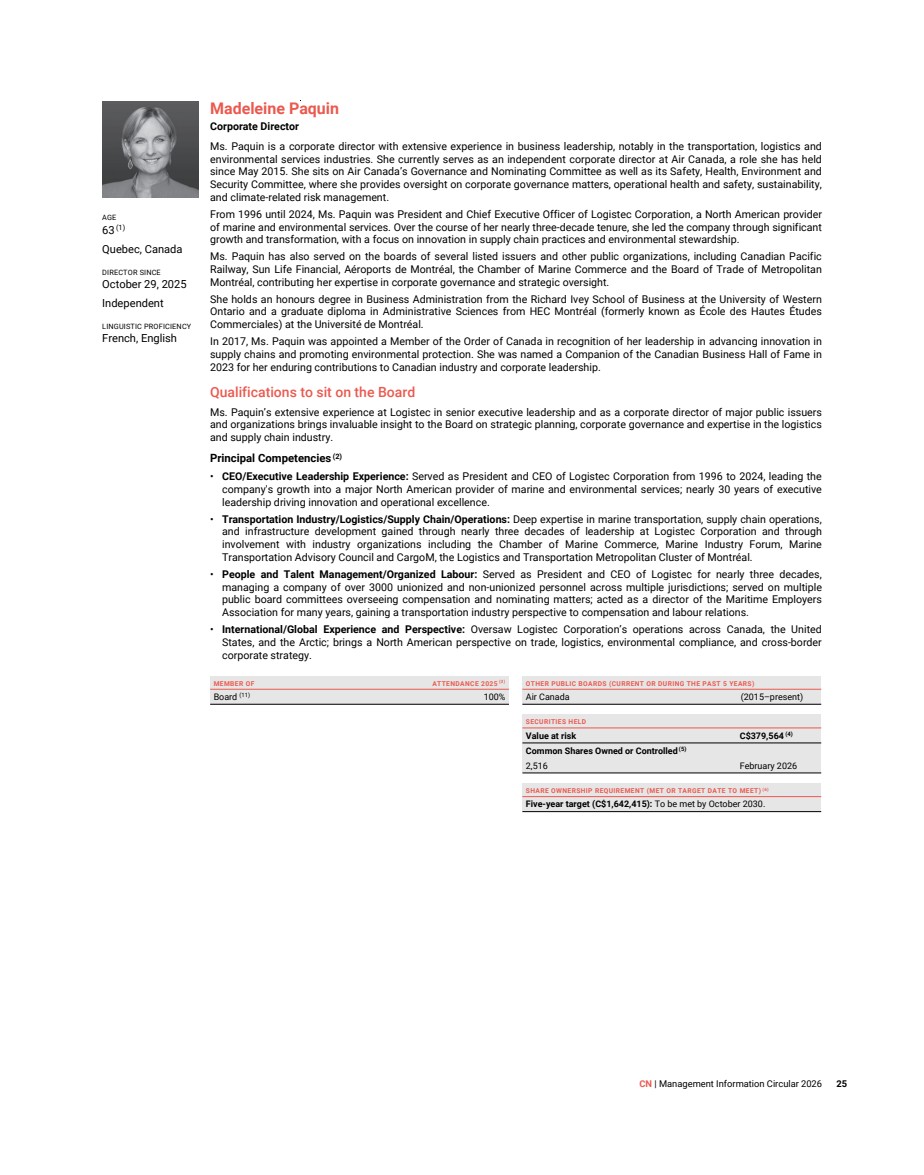
| AGE 62 (1) Alberta, Canada Quebec, Canada DIRECTOR SINCE February 28, 2022 Non-Independent LINGUISTIC PROFICIENCY English Tracy Robinson President and Chief Executive Officer, CN Ms. Robinson was appointed President and CEO of CN on January 25, 2022, effective February 28, 2022. Prior to joining CN, she held various senior and executive positions at TC Energy Corporation (a major North American energy company) between 2014 and 2022, including most recently as Executive Vice-President, President of Canadian Natural Gas Pipelines and President Coastal GasLink from 2018 to 2022. She also previously worked at Canadian Pacific Railway (now Canadian Pacific Kansas City Limited) for nearly three decades. Over the course of her career, Ms. Robinson has developed meaningful experience on private and industry boards. She currently serves as Chair of the Business Council of Canada and previously chaired the board of the Canadian Energy Pipeline Association and served on the boards of the Canadian Gas Association and the Business Council of British Columbia. She also served on the board of Shock Trauma Air Rescue Service (STARS), a charitable and non-profit entity governed by a volunteer board of directors, and acted as a board member of Smart Sand, Inc., a Nasdaq-listed frac sand supply and services company. Ms. Robinson is currently on the Campaign Committee of the University of Saskatchewan (U. of S.) and the Dean’s Advisory Council at the Edward’s School of Business of the U. of S. Ms. Robinson holds an MBA from the University of Pennsylvania’s Wharton School of Business and a Bachelor of Commerce Degree from U. of S. She received her Institute of Corporate Directors (ICD.D) designation in 2015. Qualifications to sit on the Board With her extensive executive experience and past tenure at Canadian Pacific Railway for 27 years, Ms. Robinson brings over 35 years of valuable railroad experience, operational management, strategy development and project execution experience to the Board, which will allow her to contribute to driving CN’s strategic vision in the view of providing value to our stakeholders. Principal Competencies (2) • CEO/Executive Leadership Experience: Former Executive Vice-President, President and various other senior leadership positions at TC Energy Corporation since 2014; extensive senior executive experience in commercial, operations and finance at Canadian Pacific Railway. • Transport Industry/Logistics/Supply Chain/Operations: Nearly three decades of experience, including in senior and executive positions, in roles spanning across commercial, operations and finance at Canadian Pacific Railway. • Government/Public Policy/ Regulatory/Legal: Extensive experience on private and industry boards, including as Chair of the Business Council of Canada, engaging with government actors and stakeholders. • Customer Experience/Sales/Marketing: Various executive roles spanning 35 years, including Executive Vice-President of TC Energy Corporation, President of Canadian Natural Gas Pipelines and President Coastal GasLink from 2019 to 2022; experience at Canadian Pacific Railway, notably as General Manager of Transportation Services and Vice President of Marketing and Sales. MEMBER OF ATTENDANCE 2025 (3) Board 100% VOTING RESULTS IN 2025 470,824,140 (99.81%) votes in favour 881,535 (0.19%) votes against OTHER PUBLIC BOARDS (CURRENT OR DURING THE PAST 5 YEARS) — SECURITIES HELD (12) Value at risk C$6,280,957 (4) Common Shares Owned or Controlled (12) 46,269 December 2025 30,331 December 2024 Stock Options Held (13) 460,677 December 2025 296,600 December 2024 SHARE OWNERSHIP REQUIREMENT (MET OR TARGET DATE TO MEET) (12) Five-year target (C$12,692,024): See Note 12 26 CN | Management Information Circular 2026 |
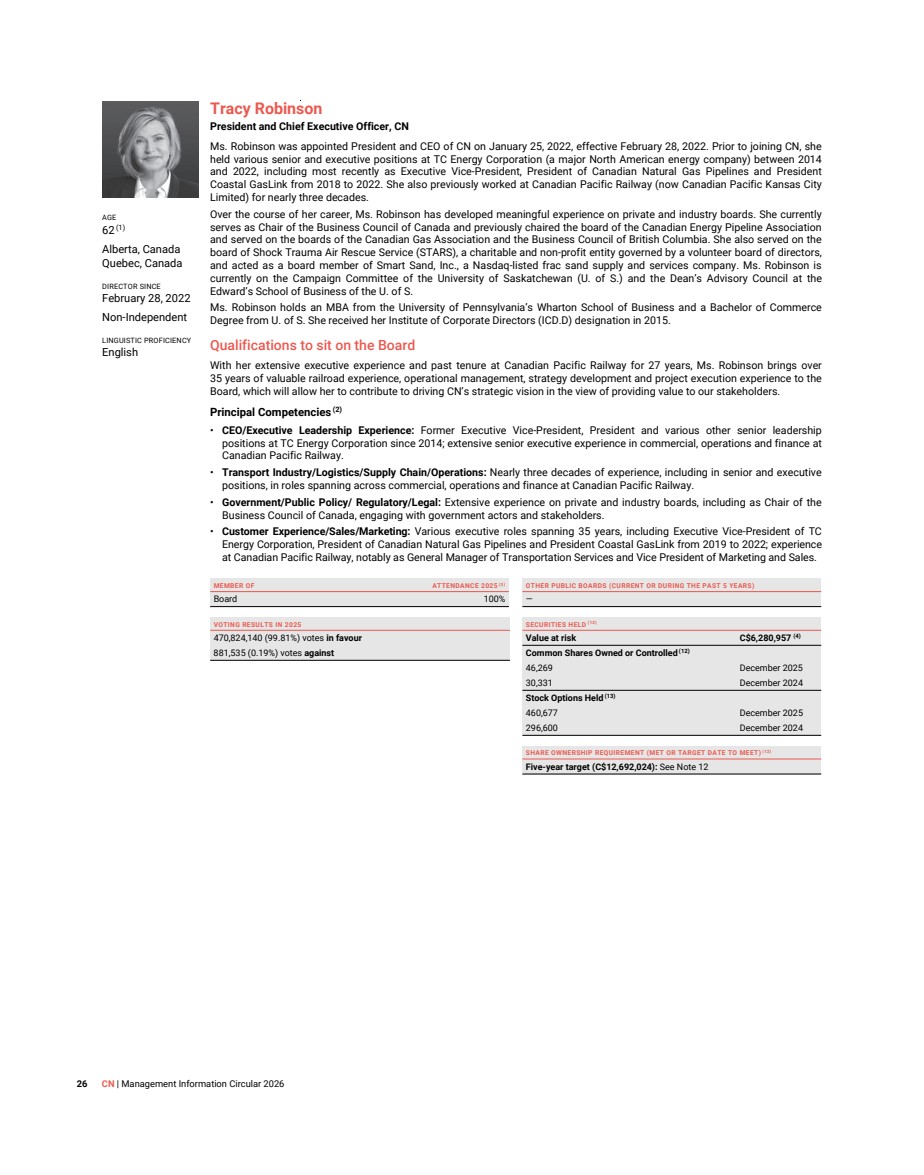
| (1) The age of the directors is provided as at May 1, 2026, the date of the Meeting. (2) For a more complete representation of each director’s competencies and the definitions thereof, please refer to the Competency Matrix on page 39 of this Information Circular. (3) For a detailed review of the 2025 Board and committee attendance by directors, please refer to the Attendance Table found in the “Statement of Corporate Governance Practices–Board and Committee Attendance” section of this Information Circular. (4) The value at risk for independent directors represents the total value of common shares and Deferred Share Units (DSUs) under the Deferred Share Unit Plan for independent directors (DSU Plan), which total value is based on the February 26, 2026, closing price of the common shares on the TSX (C$150.86) or, for Ms. dePass Olsovsky, Mr. Freeman, Ms. Gray, Mr. Howell and Mr. Knight, the closing price of the common shares on the New York Stock Exchange (NYSE) (US$110.25) converted to Canadian dollars using the rate of exchange of Bloomberg (US$1.00 = C$1.3681) on the same date. The value at risk for Ms. Tracy Robinson represents the total value of common shares owned or controlled and vested DSUs under the Company’s Voluntary Incentive Deferral Plan (VIDP), which total value is based on the February 26, 2026 closing price of the common shares on the TSX. (5) The information regarding common shares beneficially owned, controlled or directed, directly or indirectly (including DSUs for independent directors), has been provided by the respective directors individually as at February 26, 2026 and for 2025 as at February 27, 2025. For further information on the DSU Plan, please see the “Board of Directors Compensation–Directors’ Deferred Share Unit Plan” section of this Information Circular. In the case of Ms. Tracy Robinson, the information is reflected as at December 31 2025 and 2024 and common shares owned or controlled include vested DSUs under the VIDP, but do not include common shares under stock options. For further details on the VIDP, please see the “Statement of Executive Compensation” section of this Information Circular. (6) Independent directors are required to own, within five years of joining the Board, common shares, DSUs or similar share equivalents, if any, (collectively, CN Securities) with a value of the Canadian dollar equivalent of five times their annual retainer (being the aggregate of their director cash retainer and director share grant retainer) or, in the case of Ms. Bruder, our Board Chair, the Canadian dollar equivalent of five times of the annual Board Chair retainer (being the aggregate of her Board Chair cash retainer and Board Chair share grant retainer). Independent director and Board Chair retainers are set in U.S. dollars and were converted to Canadian dollars as at February 26, 2026 using the average rate of exchange of the Bank of Canada during the year for 2025 (US$1.00 = C$1.3978) for purposes of calculating each director’s minimum shareholding requirement. For further details on director and Board Chair compensation and on non‑executive director share ownership requirements, please see the “Board of Directors Compensation” section of this Information Circular. (7) Mr. Robert Knight was appointed Chair of the AFR Committee effective May 2, 2025. (8) Mr. Monaco became a member of the GS Committee and appointed its Chair effective May 2, 2025. (9) Ms. Gray stepped down from the SE Committee effective May 2, 2025. (10) Mr. Monaco stepped down from, and Ms. Gray was appointed to, the HRC Committee effective May 2, 2025. (11) Ms. Madeleine Paquin joined the Board effective October 29, 2025 and held no common shares, DSUs or similar share equivalents of CN prior to joining the Board. (12) For a discussion on Ms. Robinson’s shareholding requirements, please see the section on “Stock Ownership” on page 70 of this Information Circular. Ms. Robinson is also enrolled in the ESIP. See “Employee Share Investment Plan” on page 70 of this Information Circular. (13) Stock options granted to Ms. Robinson pursuant to the Management Long-Term Incentive Plan. For further details on the plan, please see the “Management Long-Term Incentive Plan” section beginning on page 88 of this Information Circular. Additional Disclosure Relating to Directors As of the date hereof, to the knowledge of the Company and based upon information provided by the directors, no proposed director is or has been within 10 years before the date hereof, a director, chief executive officer or chief financial officer of any company (including CN) that: (i) was subject to a cease trade order, an order similar to a cease trade order or an order that denied the relevant company access to any exemption under securities legislation, in each case that was in effect for a period of more than 30 consecutive days (each, an order) that was issued while such director was acting in the capacity as director, chief executive officer or chief financial officer; or (ii) was subject to an order that was issued after such director ceased to be a director, chief executive officer or chief financial officer and which resulted from an event that occurred while such director was acting in the capacity as director, chief executive officer or chief financial officer. As of the date hereof, to the knowledge of the Company and based upon information provided by the directors, no proposed director is or has been, in the last 10 years, a director or executive officer of any company (including CN) that, while such person was acting in that capacity or within a year of such person ceasing to act in that capacity, became bankrupt, made a proposal under any legislation relating to bankruptcy or insolvency or was subject to or instituted any proceedings, arrangement or compromise with creditors or had a receiver, receiver manager or trustee appointed to hold its assets. Also as of the date hereof, to the knowledge of the Company and based upon information provided to it by the directors, no proposed director is or has, in the last 10 years, themselves become bankrupt, made a proposal under any legislation relating to bankruptcy or insolvency, or become subject to or instituted any proceedings, arrangement or compromise with creditors, or had a receiver, receiver manager or trustee appointed to hold their assets. To the knowledge of the Company and based upon information provided by the directors, no proposed director has been subject to (i) any penalties or sanctions imposed by a court relating to securities legislation or by a securities regulatory authority or has entered into a settlement agreement with a securities regulatory authority, or (ii) any other penalties or sanctions imposed by a court or regulatory body that would likely be considered important to a reasonable shareholder in deciding whether to vote for a proposed director. CN | Management Information Circular 2026 27 |
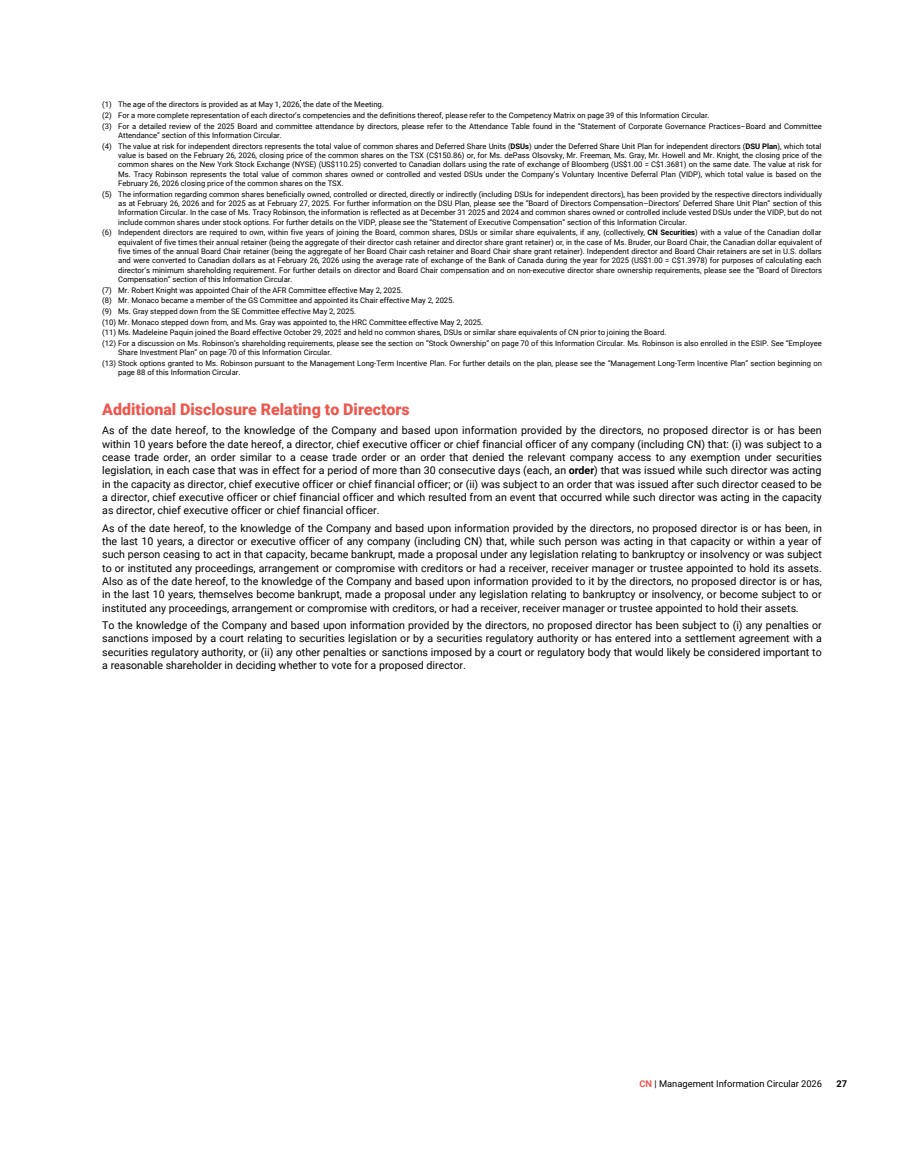
| CN’s director compensation program is designed to attract and retain the most qualified individuals to serve on CN’s Board and its committees while taking into account the risks and responsibilities of being a director. To reflect CN’s extensive operations throughout Canada and the U.S. and the Company’s need to attract and retain directors with experience in doing business in both countries, the compensation of the non-executive directors of the Company is designed to be comparable to that of a broad mix of large Canadian and U.S.-based companies, including other Class I Railroads. The Company’s current compensation structure for non-executive directors consists of an all-inclusive annual retainer structure comprising both a cash and an equity component. This flat-fee approach continues to be consistent with the compensation trends of our comparator groups, adds predictability to compensation paid to non-executive directors, and is more efficient from an administration perspective. This compensation structure was initially adopted following a comprehensive review conducted with the help of external advisors, and is reviewed regularly by the GS Committee and the Board to ensure it continues to be competitive and consistent with compensation trends of CN’s peers. Directors are also reimbursed for reasonable transportation and other out-of-pocket expenses incurred to attend Board and committee meetings. The Board sets the compensation of non-executive directors based on the GS Committee’s recommendations. The GS Committee annually reviews with the Board Chair the compensation structure and levels for non-executive directors, and recommends to the Board such adjustments as it considers appropriate and necessary to recognize the workload, time commitment and responsibility of the Board and of committee members and to remain competitive with director compensation trends in Canada and the U.S. Our approach to non-executive compensation has remained unchanged since 2015, and in 2025, the GS Committee and the Board reviewed the compensation structure and levels for non-executive directors and resolved that they would continue to remain unchanged for the year to come. Any director who is also an employee of the Company or of any of its affiliates does not receive any compensation for their role as a director. Comparator Groups We conduct a market review of the compensation of CN’s non-executive directors on an annual basis with the support of an external firm, with reference to two separate comparator groups of companies of comparable size to CN in terms of revenue and market capitalization, being: (i) selected Canadian and U.S. companies, including Class I railroads, composed of the same companies used for benchmarking the NEO compensation (updated in 2023 to reflect a broader mix of Canadian and U.S. companies comparable to CN, in the view of capturing data from a broader industry perspective), and (ii) other select Canadian companies previously forming part of CN’s benchmark peer group, given that CN is a Canadian company competing to attract and retain Canadian directors. In December 2025, our review confirmed that our compensation structure for non-executive directors was aligned with the lower (3rd) quartile of the NEO comparator group and the highest (1st) quartile of the Canadian comparator group. NEO Peer Group Canadian Pacific Kansas City Limited Class I Railroad (CDN) CSX Corporation Class I Railroad (U.S.) Norfolk Southern Corporation Class I Railroad (U.S.) Union Pacific Corporation Class I Railroad (U.S.) Enbridge Inc. Oil, Gas and Consumable Fuels (CDN) Emerson Electric Co. Technology, software & engineering (U.S.) Fortis Inc. Electric & Gas (CDN) Illinois Tool Works Inc. Industrial products & equipment (U.S.) Republic Services, Inc. Waste management, comprehensive waste & environmental services (U.S.) Rogers Communications Inc. Diversified Telecommunication (CDN) Sempra Energy (U.S.) Telus Corporation Diversified Telecommunication (CDN) TC Energy Corporation Oil, Gas and Consumable Fuels (CDN) The Williams Companies, Inc. Electric & Gas (U.S.) Waste Management, Inc. Waste management, comprehensive waste & environmental services (U.S.) Xcel Energy Inc. Electric & Gas (U.S.) Other Canadian Peer Group of Companies Bank of Montreal Banks Barrick Gold Corporation Metals & Mining BCE Inc. Diversified Telecommunication Canadian Imperial Bank of Commerce Banks Canadian Natural Resources Ltd. Oil, Gas and Consumable Fuels Canadian Tire Corporation Multiline Retail Cenovus Energy Inc. Oil, Gas and Consumable Fuels CGI Inc. IT services Manulife Financial Insurance Corporation Nutrien Ltd Chemicals Sun Life Financial Inc. Insurance Suncor Energy Inc. Oil, Gas and Consumable Fuels Teck Resources Ltd. Metals & Mining Thomson Reuters Corporation Media 28 CN | Management Information Circular 2026 Board of Directors Compensation |
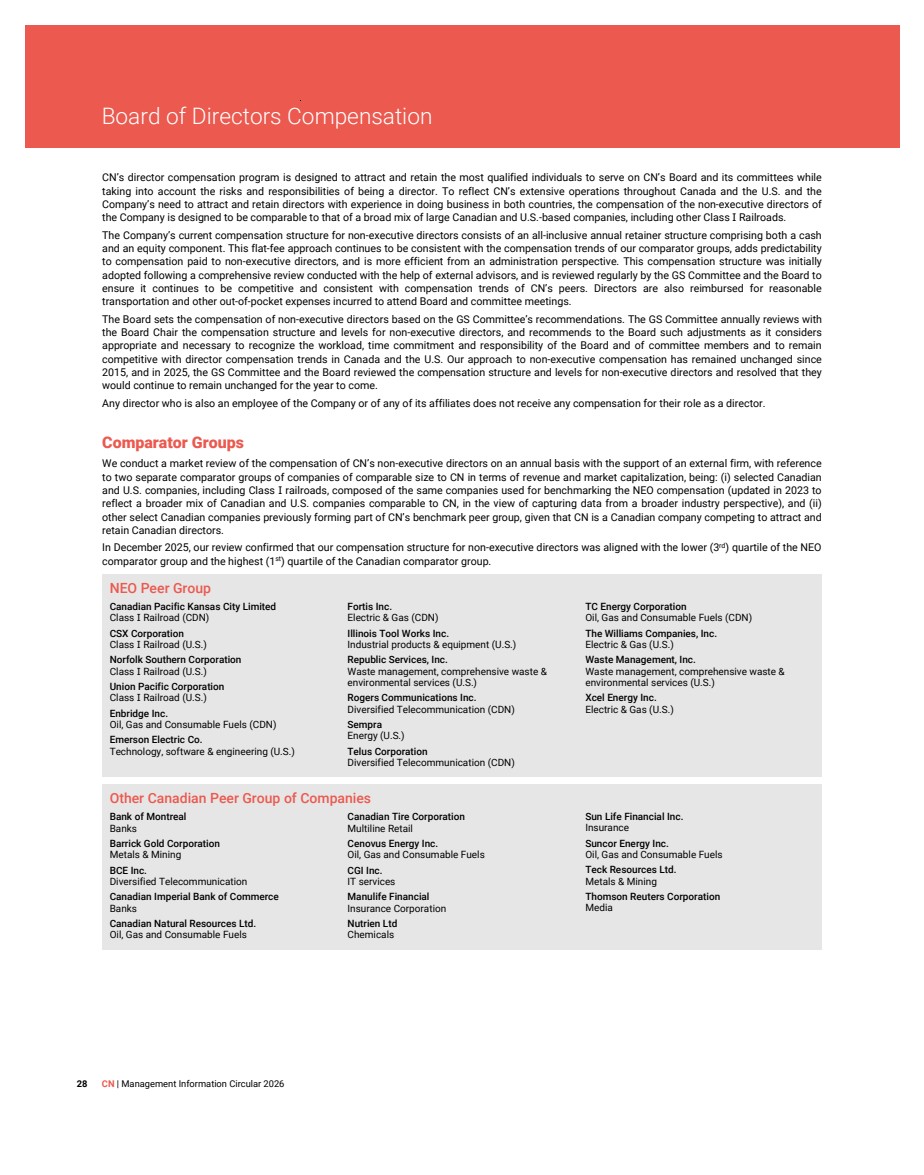
| Compensation Levels The following table shows the compensation levels for CN’s non-executive directors in 2025. TYPE OF FEE (1) FEE (US$) 2025 Board Chair Cash Retainer (2) 175,000 Board Chair Share Grant Retainer (2) 375,000 Director Cash Retainer 35,000 Director Share Grant Retainer 200,000 Committee Chair Cash Retainers (3) AFR Committee and HRC Committee Chairs 75,000 Other Committee Chairs 65,000 Committee Member Cash Retainer 55,000 (1) The non-executive directors (including the Board Chair) may choose to receive all or part of their cash retainers in common shares or DSUs (see the following Compensation Tables for details) and their common share grant retainer can also be received in DSUs. The common shares are purchased on the open market. (2) The Board Chair receives no additional director retainer nor committee chair or committee member retainer. (3) Committee chairs receive no additional committee chair or committee member retainer. Directors’ Deferred Share Unit Plan Subject to the Minimum Shareholding Requirement (as defined herein), non-executive directors may elect to receive all or part of their director, committee member, Board Chair, and committee chair cash retainers either in cash, common shares of CN purchased on the open market or DSUs. They may also elect to receive their common share grant retainer in DSUs. Each DSU entitles the beneficiary thereof to receive upon resignation, retirement or death, one common share of the Company purchased on the open market, plus additional DSUs reflecting notional dividend equivalents. Each non-executive director has an account where DSUs are credited and held until the director leaves the Board. The number of DSUs credited to each non-executive director’s account is calculated by dividing the amount elected to be received in DSUs by the common share price on the day the credit is granted. Grants are made quarterly in arrears, payable on the last trading day of each fiscal quarter. Participants in the DSU Plan are credited additional DSUs that are equivalent to the dividends declared on the Company’s common shares. The number of DSUs is calculated using the methodology described above, using the total notional dividend amount and the share price on the dividend payment date. Such additional DSUs are credited to each non-executive director’s account on each dividend payment date. When a non-executive director leaves the Board, the Company is required to deliver to such director a number of common shares purchased on the open market equivalent to the number of DSUs held by the non-executive director in the DSU Plan, taking into account the appropriate tax withholdings. All administration costs as well as any brokerage fees associated with the purchase and delivery of common shares are supported by CN. Compensation Table in Canadian Dollars The table below reflects in detail the compensation earned by CN’s non-executive directors, expressed in Canadian dollars, in the 12-month period ended December 31, 2025, in accordance with the disclosure rules issued by the Canadian Securities Administrators (the CSA). Directors’ compensation has been set in U.S. dollars since 2002 and the fluctuation in the exchange rate affects year-over-year comparability. Please see footnote 1 in the below table for currency exchange information, and the Compensation Table in U.S. dollars on page 30. Fees Earned (Canadian $) (1) NAME DIRECTOR AND BOARD CHAIR CASH RETAINER COMMITTEE CHAIR & COMMITTEE MEMBER CASH RETAINER TOTAL CASH RETAINER (2) SHARE-BASED AWARDS (3) ALL OTHER COMPENSATION TOTAL COMPENSATION PERCENTAGE OF TOTAL FEE RECEIVED IN COMMON SHARES AND/ DSUS (4) Shauneen Bruder 243,342 – 243,342 521,447 – 764,789 100% Jo-ann dePass Olsovsky 48,668 104,289 152,957 278,105 – 431,062 100% David Freeman 48,668 76,479 125,147 278,105 – 403,252 100% Denise Gray 48,668 81,215 (5) 129,883 278,105 – 407,988 100% Justin M. Howell 48,796 76,679 125,475 278,105 – 403,580 84% Susan C. Jones 48,668 90,384 139,052 278,105 – 417,157 100% Robert Knight 48,668 94,818 (6) 143,486 278,105 – 421,591 100% Michel Letellier 48,668 76,479 125,147 278,105 – 403,252 100% Margaret A. McKenzie 48,668 85,950 (7) 134,618 278,105 – 412,723 100% Al Monaco 48,668 85,648 (8) 134,316 278,105 – 412,421 100% Madeleine Paquin 8,400 13,200 (9) 21,600 48,002 – 69,602 100% Total 689,882 785,141 1,475,023 3,072,394 – 4,547,417 (1) All directors earned compensation in U.S. dollars. The directors and the Board Chair may choose to receive all or part of their cash retainers in common shares or DSUs, and may also choose to receive their common share grant retainer in DSUs. Unless otherwise indicated, compensation received in cash was converted to Canadian dollars using the average rate of exchange of the Bank of Canada for 2025 (US$1.00 = C$1.3978). Compensation elected to be received in common shares or DSUs was converted to Canadian dollars using the rate of exchange of Bloomberg on the applicable purchase or reference days (US$1.00 = C$1.4267 on March 26, 2025; US$1.00 = C$1.3726 on June 25, 2025; US$1.00 = C$1.394 on September 25, 2025 and US$1.00 = C$1.3688 on December 23, 2025). (2) All directors elected to receive their cash retainers in common shares or DSUs with respect to the amounts set forth beside their names, except for Mr. Howell, who elected to receive 50% of his director and committee chair retainers in cash. (3) Represents a common share grant valued at US$200,000 (prorated where applicable) received by each non-executive director as part of the director retainer and US$375,000 for the Board Chair as part of the Board Chair retainer. See Note 1 for currency conversion information. (4) This percentage is calculated by dividing the aggregate of the cash retainers elected by non-executive directors to be received in common shares or DSUs described in notes (1) and (3) above and the value provided under the share-based awards column, by the value provided under the total compensation column. (5) Ms. Gray stepped down as chair of the GS Committee on May 2, 2025. As such, Mrs. Gray’s revised compensation became effective as of that date and accordingly, the compensation of Ms. Gray was prorated in 2025. (6) Mr. Knight became chair of the AFR Committee on May 2, 2025. As such, Mr. Knight’s revised compensation (including the AFR Committee Chair cash retainer) became effective as of that date and accordingly, the compensation of Mr. Knight was prorated in 2025. CN | Management Information Circular 2026 29 |
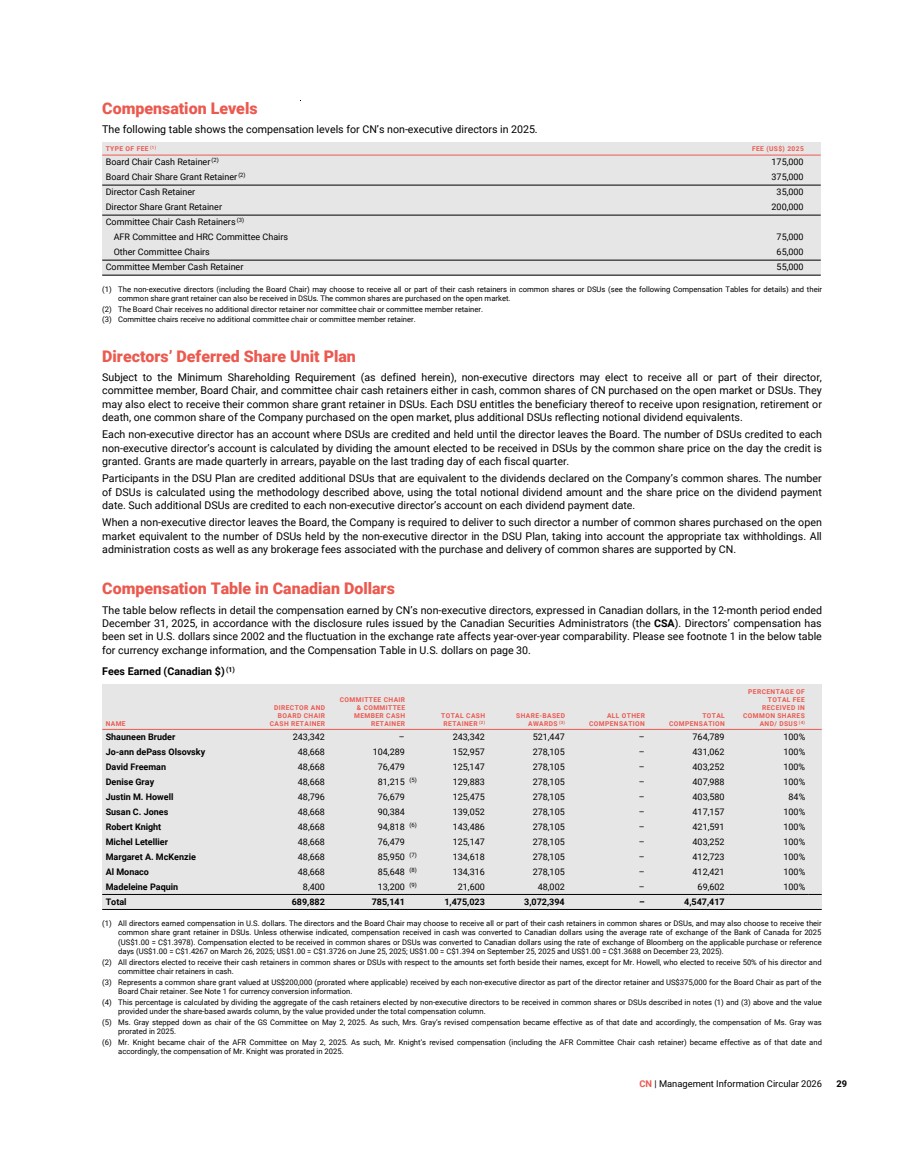
| (7) Ms. McKenzie stepped down as chair of the AFR Committee on May 2, 2025. As such, Ms. McKenzie’s revised compensation became effective as of that date and accordingly, the compensation of Ms. McKenzie was prorated in 2025. (8) Mr. Monaco became chair of the GS Committee on May 2, 2025. As such, Mr. Monaco’s revised compensation (including the GS Committee Chair cash retainer) became effective as of that date and accordingly, the compensation of Mr. Monaco was prorated in 2025. (9) Ms. Madeleine Paquin was appointed to the CN Board on October 29, 2025. As such, the compensation of Ms. Paquin became effective as of that date and accordingly, was prorated in 2025. Compensation Table in U.S. Dollars The table below reflects in detail the compensation earned by CN’s non-executive directors in U.S. dollars in the 12-month period ended December 31, 2025. Fees Earned (US$) NAME DIRECTOR AND BOARD CHAIR CASH RETAINER COMMITTEE CHAIR & COMMITTEE MEMBER CASH RETAINER TOTAL CASH RETAINER SHARE-BASED AWARDS TOTAL Shauneen Bruder 175,000 – 175,000 375,000 550,000 Jo-ann dePass Olsovsky 35,000 75,000 110,000 200,000 310,000 David Freeman 35,000 55,000 90,000 200,000 290,000 Denise Gray 35,000 58,352 (1) 93,352 200,000 293,352 Justin M. Howell 35,000 55,000 90,000 200,000 290,000 Susan C. Jones 35,000 65,000 100,000 200,000 300,000 Robert Knight 35,000 68,297 (2) 103,297 200,000 303,297 Michel Letellier 35,000 55,000 90,000 200,000 290,000 Margaret A. McKenzie 35,000 61,703 (3) 96,703 200,000 296,703 Al Monaco 35,000 61,648 (4) 96,648 200,000 296,648 Madeleine Paquin 6,137 9,644 (5) 15,781 35,068 50,849 Total 496,137 564,644 1,060,781 2,210,068 3,270,849 (1) Ms. Gray stepped down as chair of the GS Committee on May 2, 2025. As such, Mrs. Gray’s revised compensation became effective as of that date and accordingly, the compensation of Ms. Gray was prorated in 2025. (2) Mr. Knight became chair of the AFR Committee on May 2, 2025. As such, Mr. Knight’s revised compensation (including the AFR Committee Chair cash retainer) became effective as of that date and accordingly, the compensation of Mr. Knight was prorated in 2025. (3) Ms. McKenzie stepped down as chair of the AFR Committee on May 2, 2025. As such, Ms. McKenzie’s revised compensation became effective as of that date and accordingly, the compensation of Ms. McKenzie was prorated in 2025. (4) Mr. Monaco became chair of the GS Committee on May 2, 2025. As such, Mr. Monaco’s revised compensation (including the GS Committee Chair cash retainer) became effective as of that date and accordingly, the compensation of Mr. Monaco was prorated in 2025. (5) Ms. Madeleine Paquin was appointed to the CN Board on October 29, 2025. As such, the compensation of Ms. Paquin became effective as of that date and accordingly, was prorated in 2025. Share Ownership The directors of the Company play a central role in enhancing shareholder value and each of them has a substantial investment in CN. Since January 1, 2019, each non-executive director must own, within five years of joining the Board, common shares, DSUs or similar share equivalents of CN, if any, (CN Securities) with a value of the Canadian dollar equivalent of five times their total annual director retainer (which consists of the aggregate of their director cash retainer and director share grant retainer) and in the case of the Board Chair, the Canadian dollar equivalent of five times her total Board Chair retainer (which consists of the aggregate of her Board Chair cash retainer and Board Chair share grant retainer) (the Minimum Shareholding Requirement). Each non-executive director is required to continue to hold such value throughout their tenure as a director and to continue to hold 50% of the Minimum Shareholding Requirement for a period of two years after the director leaves the Board. In addition, the CN Securities held to comply with the Minimum Shareholding Requirement shall not be, during the director’s tenure, the object of specific monetization procedures or other hedging procedures to reduce the exposure related to their holding. Each non-executive director is required to receive at least 50% of their annual director, committee, Board Chair and committee chair cash retainers in CN Securities and may elect to receive up to 100% of such retainers in CN Securities until their Minimum Shareholding Requirement is met. Once the Minimum Shareholding Requirement is met, directors may continue to elect to receive up to 100% of such retainers in CN Securities. Approximately 99% of the total annual compensation of the non-executive directors for 2025 was in the form of CN Securities. The average value of CN Securities owned by the current non-executive directors is approximately C$2,617,213 (based on the February 26, 2026 closing price of the common shares of the Company on the TSX (C$150.86), or the NYSE (US$110.25) for U.S. directors). 30 CN | Management Information Circular 2026 Directors are required to own, within 5 years of joining the Board, CN shares worth 5 times their annual director retainer. Directors continue to be subject to share ownership requirements for 2 years beyond board tenure. |
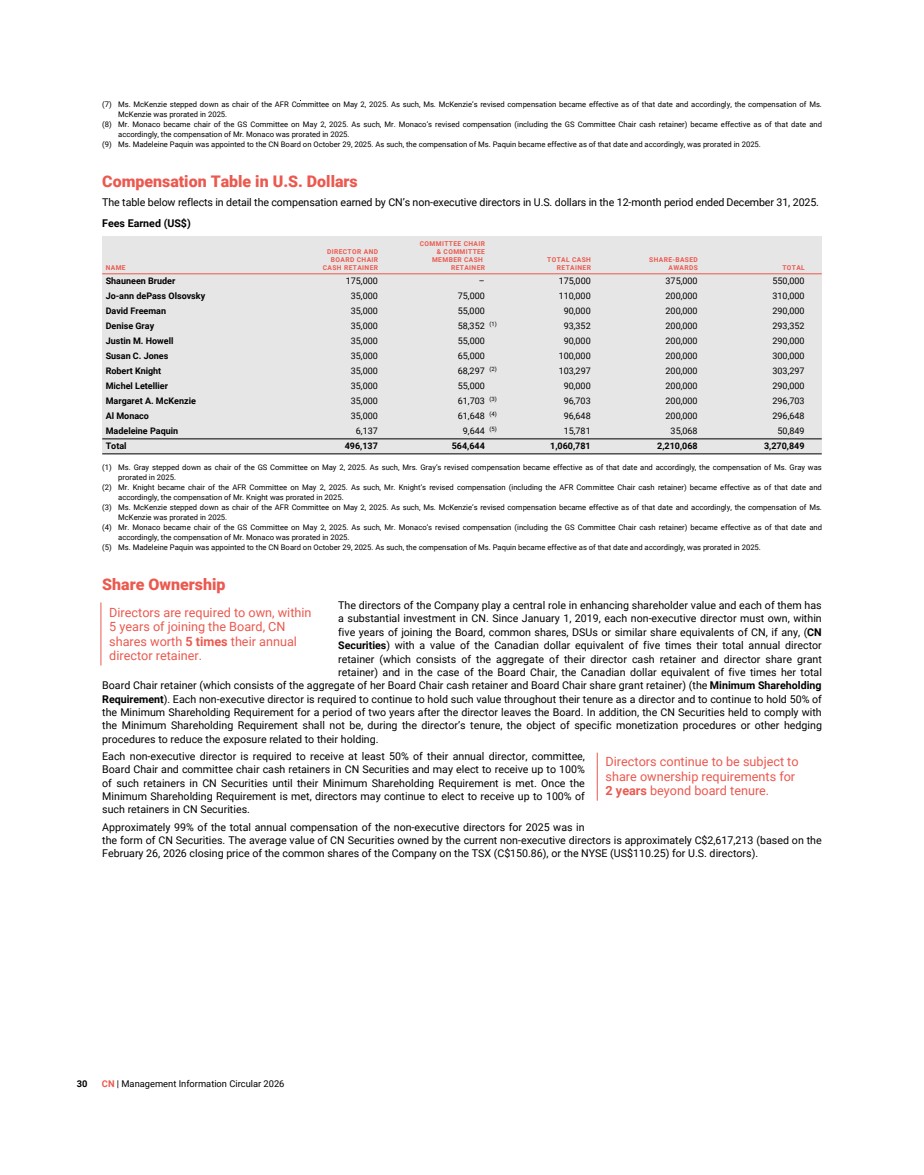
| Share Ownership Table The following table provides information on the number and the value of common shares and DSUs owned by the Company’s current directors as at February 26, 2026, and the Minimum Shareholding Requirement status. Values Expressed in Canadian dollars NAME OF DIRECTOR PERIOD (1) NUMBER OF COMMON SHARES OWNED, CONTROLLED OR DIRECTED TOTAL VALUE OF COMMON SHARES (VALUE AT RISK) (C$) (2) NUMBER OF DSUs HELD (3) TOTAL VALUE OF DSUs (VALUE AT RISK) (C$) (2) TOTAL NUMBER OF COMMON SHARES OWNED, CONTROLLED OR DIRECTED AND DSUs (3) TOTAL VALUE OF COMMON SHARES AND DSUs (VALUE AT RISK) (C$) (2) GUIDELINE MET/ INVESTMENT REQUIRED TO MEET GUIDELINE (C$) VALUE AT RISK AS MULTIPLE OF SHAREHOLDING REQUIREMENT Shauneen Bruder 2026 18,451 2,783,518 27,314 4,120,590 45,765 6,904,108 Met 1.8 2025 8,244 26,620 34,864 Variation 10,207 694 10,901 Jo-ann dePass Olsovsky 2026 6,137 925,662 10,349 1,560,971 16,486 2,486,633 Met 1.5 2025 6,137 6,971 13,108 Variation – 3,378 3,378 David Freeman 2026 3,038 458,231 9,734 1,468,209 12,772 1,926,439 Met 1.2 2025 3,038 6,572 9,610 Variation – 3,162 3,162 Denise Gray 2026 – – 12,897 1,945,294 12,897 1,945,294 Met 1.2 2025 – 9,622 9,622 Variation – 3,275 3,275 Justin M. Howell 2026 – – 10,379 1,565,496 10,379 1,565,496 76,919 1.0 2025 – 7,653 7,653 Variation – 2,726 2,726 Susan C. Jones 2026 6,959 1,049,835 9,899 1,493,363 16,858 2,543,198 Met 1.5 2025 3,978 6,632 10,610 Variation 2,981 3,267 6,248 Robert Knight 2026 – – 9,872 1,489,024 9,872 1,489,024 153,391 0.9 2025 – 6,572 6,572 Variation – 3,300 3,300 Michel Letellier 2026 4,005 604,194 8,836 1,332,999 12,841 1,937,193 Met 1.2 2025 1,025 5,697 6,722 Variation 2,980 3,139 6,119 Margaret A. McKenzie 2026 13,205 1,992,106 15,285 2,305,895 28,490 4,298,001 Met 2.6 2025 13,205 11,916 25,121 Variation – 3,369 3,369 Al Monaco 2026 14,546 2,194,410 7,424 1,119,985 21,970 3,314,394 Met 2.0 2025 14,546 4,254 18,800 Variation – 3,170 3,170 Madeleine Paquin (New Director Nominee) 2026 2,000 301,720 516 77,844 2,516 379,564 1,262,851 0.2 Tracy Robinson 2026 15,136 2,054,667 31,133 4,226,290 46,269 6,280,957 6,411,067 Note 3 2025 8,505 21,826 30,331 Variation 6,631 9,307 15,938 (1) The number of common shares and DSUs held by each independent director for 2026 is set out as at February 26, 2026 and for 2025, is set out as at February 27, 2025. For Ms. Robinson, the number of common shares and DSUs held is set out as at December 31, 2025 and 2024. (2) The total value at risk is based on the February 26, 2026 closing price of the common shares on the TSX (C$150.86) or, for Ms. dePass Olsovsky, Mr. Freeman, Ms. Gray, Mr. Howell and Mr. Knight, the NYSE (US$110.25) converted into Canadian dollars using the Bloomberg closing exchange rate (US$1.00 = C$1.3681) on the same date. (3) For a discussion on Ms. Robinson’s shareholding requirements, please see the section on “Stock ownership” on page 70 of this Information Circular. For Ms. Robinson, the number of DSU’s shown include those held under the Company’s VIDP. Ms. Robinson also participates in the ESIP. Additional information on the ESIP can be found in the “Employee Share Investment Plan” section on page 70 of this Information Circular. CN | Management Information Circular 2026 31 |
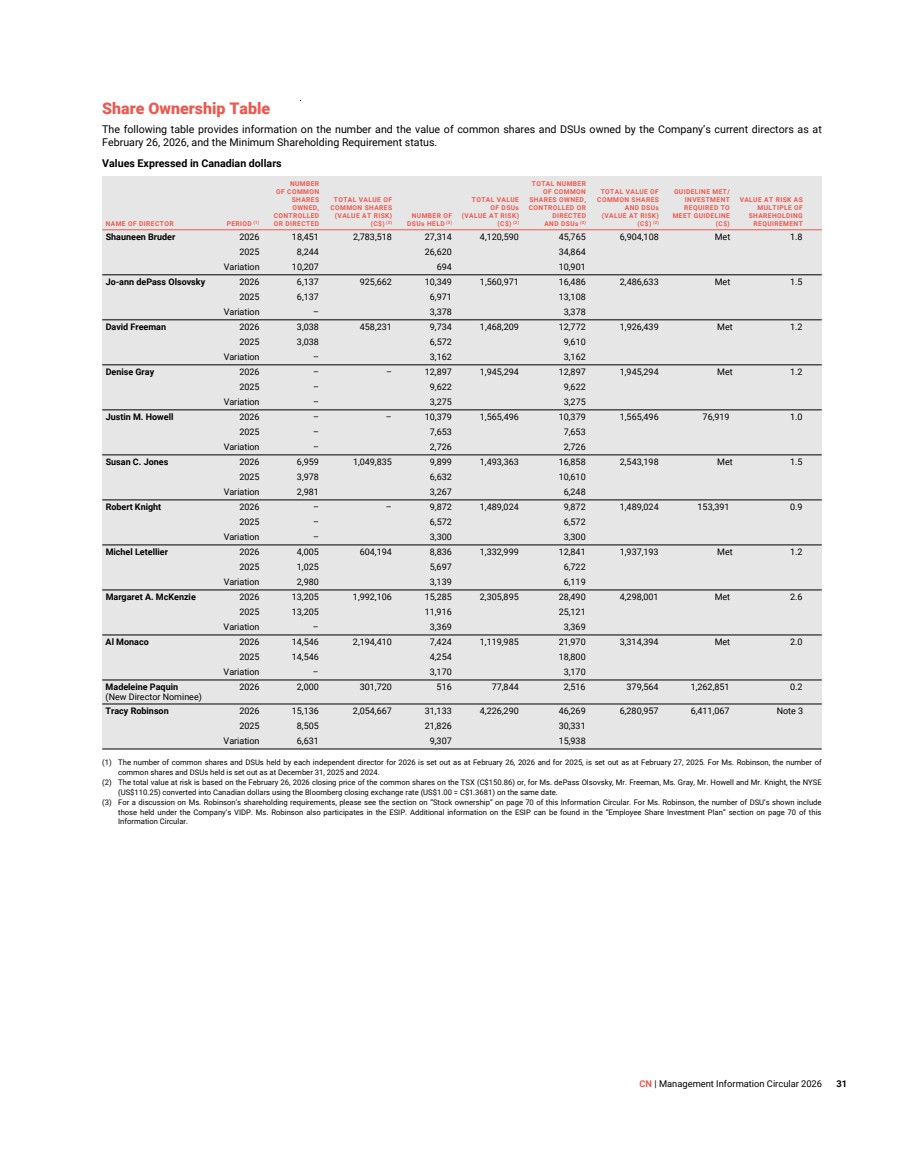
| Delivering Responsibly.................................................................... 33 Culture of Ethical Conduct.............................................................. 33 Our Governance Structure .............................................................. 34 Board of Directors Governance...................................................... 36 Board and Committee Meetings.................................................... 37 Board and Committee Attendance................................................ 38 Board Renewal and Director Selection ......................................... 38 Board Performance Assessment .................................................. 42 Director Orientation and Continuing Education........................... 43 Risk Management Oversight.......................................................... 44 Cybersecurity and Artificial Intelligence Oversight .................... 46 Grow our People............................................................................... 46 Stakeholder and Indigenous Engagement................................... 47 Helpful governance resources Corporate Governance Manual: https://www.cn.ca/en/delivering-responsibly/governance Code of Business Conduct: https://www.cn.ca/en/delivering-responsibly/governance/code-of-business-conduct 2025 Annual Information Form: https://www.cn.ca/en/investors/regulatory-filings Investor Relations: https://www.cn.ca/en/investors We are committed to adhering to the highest standards of corporate governance, and our best-in-class corporate governance practices are designed in a manner consistent with this objective. The role, specific mandate and functioning rules of the Board and its committees are described in our Corporate Governance Manual, which is revised regularly to take into account evolving best practices, changing circumstances as well as our needs. In 2024, we amended our Corporate Governance Manual to, among other matters, re-structure our Board Committees to better focus on enterprise risks as well as on the Company’s priorities, including the safety of our operations and our sustainability strategy. As a Canadian reporting issuer with securities listed on the TSX and on the NYSE, our corporate governance practices comply with applicable rules adopted by the CSA, applicable provisions of the U.S. Sarbanes-Oxley Act of 2002 (the Sarbanes-Oxley Act) and related rules of the SEC. As a “foreign private issuer” under the SEC’s rules, we are exempted from complying with many of the NYSE corporate governance rules, provided that we comply with Canadian governance requirements. As summarized on our website at www.cn.ca, under “Delivering Responsibly/Governance”, our governance practices comply with the NYSE corporate governance rules in all significant respects, as required. National Instrument 58–101–Disclosure of Corporate Governance Practices (the Disclosure Instrument) requires issuers to make the prescribed disclosure regarding their own governance practices and National Policy 58–201–Corporate Governance Guidelines (the National Policy) provides guidance on governance practices to Canadian issuers. The Company believes that its corporate governance practices meet and exceed the requirements of the Disclosure Instrument and the National Policy. The present section of the Information Circular refers to the items of the Disclosure Instrument as well as to the guidelines of the National Policy, where applicable. The Company also refers, where appropriate, to the NYSE Corporate Governance Standards. The Board has approved the disclosure of the Company’s governance practices described hereinafter, on the recommendation of the GS Committee. 32 CN | Management Information Circular 2026 Statement of Corporate Governance Practices The Board regularly reviews its governance practices and updates CN’s Corporate Governance Manual with a view of sustaining its best-in-class corporate governance standards. |
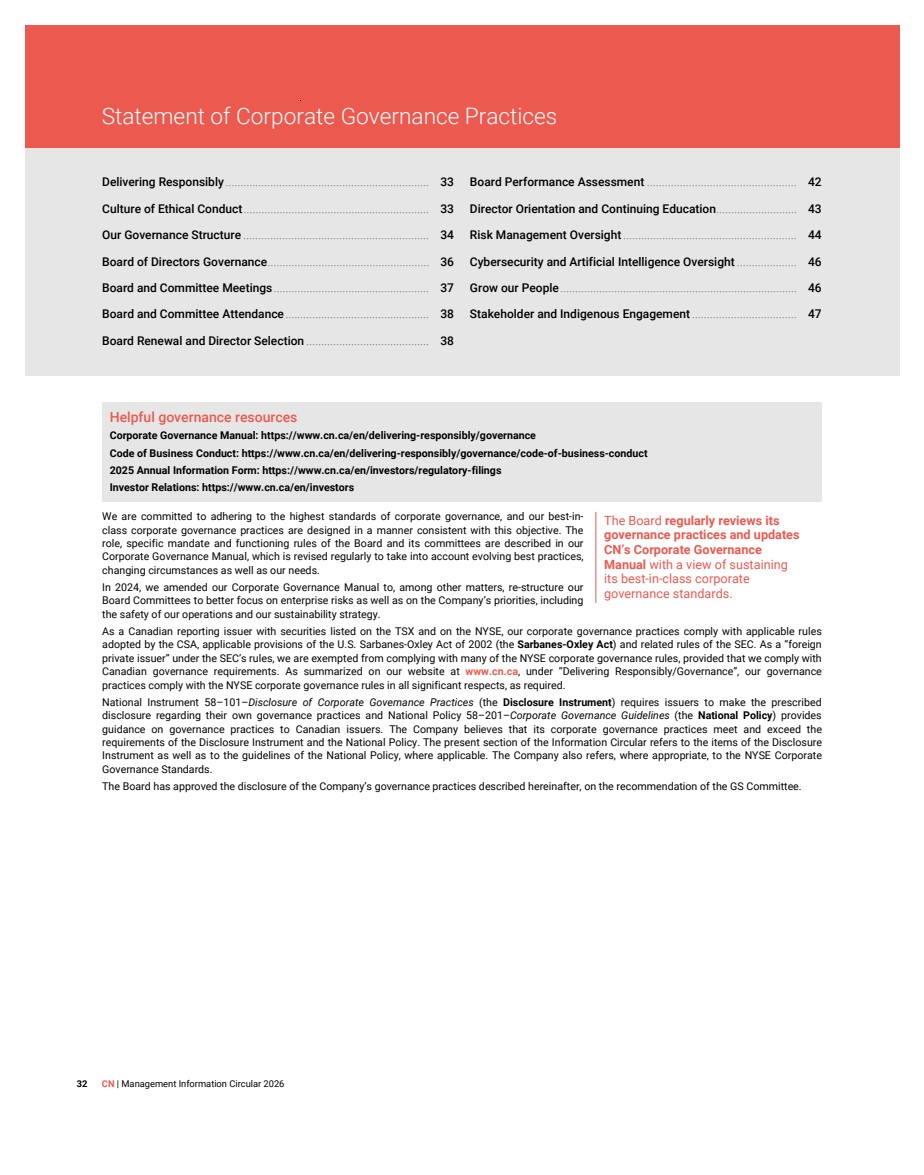
| Delivering Responsibly At CN, we are focused on Delivering Responsibly: moving customer goods safely and efficiently; being environmentally responsible; attracting and developing talented railroaders; and helping build safer, stronger communities, all while adhering to the highest standards of governance and supporting shareholder value. ENVIRONMENT We aim to conduct our operations in a manner that seeks to minimize our environmental impact. One key commitment to our shareholders is an annual advisory vote on the Company’s Climate Action Plan. This vote complements CN’s long-standing and extensive climate change plans and disclosures, its public reporting relating to its GHG emissions, its strategy to reduce emissions, as well as its year-over-year progress. For more information on our Climate Action Plan, please see the “Climate Action Plan Report” section beginning on page 50 of this Information Circular. SAFETY Safety is a core value at CN. Our safety vision underscores every activity that we undertake. Our ambition is to be the safest provider of transportation services in North America, fully devoted to safety as our core value and fostering a culture of safety excellence through leadership engagement, collaboration, and adoption of safety technologies. To continue to strengthen our safety culture, we have adopted various initiatives, including comprehensive training programs for employees, our CN Safety Week, and we are leveraging technological advancements to further support our commitment to our safety culture, where possible and appropriate. PEOPLE We recognize the importance of providing a safe, supportive and inclusive work environment where all of our employees can grow to their full potential, while also ensuring strong succession by developing the leaders of tomorrow. We value the development of a workforce of top talent that reflects the population and stakeholders we serve, and we strive to foster a culture of inclusion where everyone can thrive and contribute toward CN's success, at all levels within the organization. COMMUNITY We recognize the importance of proactively engaging and fostering strong relationships with our stakeholders and with the Indigenous communities along our network in Canada. We also aim to be good neighbors who listen, learn, and do their part to help build safer, stronger, more prosperous communities. As a result, we regularly partner with our communities and financially contribute to causes that align with our core values. For more information on our engagement strategies and frameworks, refer to the section on “Stakeholder and Indigenous Engagement” on page 47 of this Information Circular. GOVERNANCE We are dedicated to adhering to the highest standards in our corporate governance practices and regularly review our Corporate Governance Manual to ensure we continue to meet this commitment. Since CN became a publicly traded company in 1995, our Board has adopted governance practices that have been recognized as meeting the highest governance standards and supporting shareholder value. Culture of Ethical Conduct The Board and management are committed to maintaining and instilling a strong ethical culture at CN, and as such, a comprehensive ethics program was developed based on CN’s core values of integrity and respect. CN believes that ethical business conduct is fundamental. The mandate of the Board, attached as Schedule A to this Information Circular, states that the Board shall take all reasonable steps to ensure the highest quality of ethical standards, including by regularly reviewing the Code of Business Conduct, together with the GS Committee, and monitoring compliance therewith. Code of Business Conduct Our Code of Business Conduct is applicable to all directors, officers and employees of CN. We expect everyone working on our behalf, including consultants, agents, suppliers and business partners, to obey the law and adhere to high ethical standards. The Code of Business Conduct addresses many important matters, including conflicts of interest, protection and proper use of corporate assets and opportunities, confidentiality of corporate information, fair dealing, compliance with laws and reporting of any illegal or unethical behaviour. The GS Committee and the Board review and update the Code of Business Conduct regularly, including most recently in 2024, to ensure that it is consistent with current industry trends and developments, clearly communicates CN’ s organizational mission, core values, and principles, and, most importantly, serves as a reference guide for employees to support everyday decision making. Although waivers to the Code of Business Conduct may be granted in exceptional circumstances, no waiver has ever been granted to a director or executive officer in connection therewith to date. The GS Committee reviews, monitors and oversees the disclosure, reporting and activities relating to the Code of Business Conduct. Management reports to the GS Committee on the implementation of the Code of Business Conduct within the Company and on any significant contravention to the Code of Business Conduct. Those subject to our Code of Business Conduct are encouraged to contact their supervisors, the CN Human Resources department, or the Office of the Ombudsman for information, guidance and assistance with the application of the Code of Business Conduct, or to report a violation thereunder. The Office of the Ombudsman offers an independent, confidential, impartial and informal avenue which facilitates fair and equitable resolutions to concerns arising within the Company. Yearly, the CN Ombudsman presents a report that summarizes all cases logged and handled by the Office of the Ombudsman to the GS Committee. CN | Management Information Circular 2026 33 CN’s Code of Business Conduct clearly communicates CN’s organizational mission, core values, and principles, and, most importantly, serves as a reference guide for employees to support everyday decision making. |
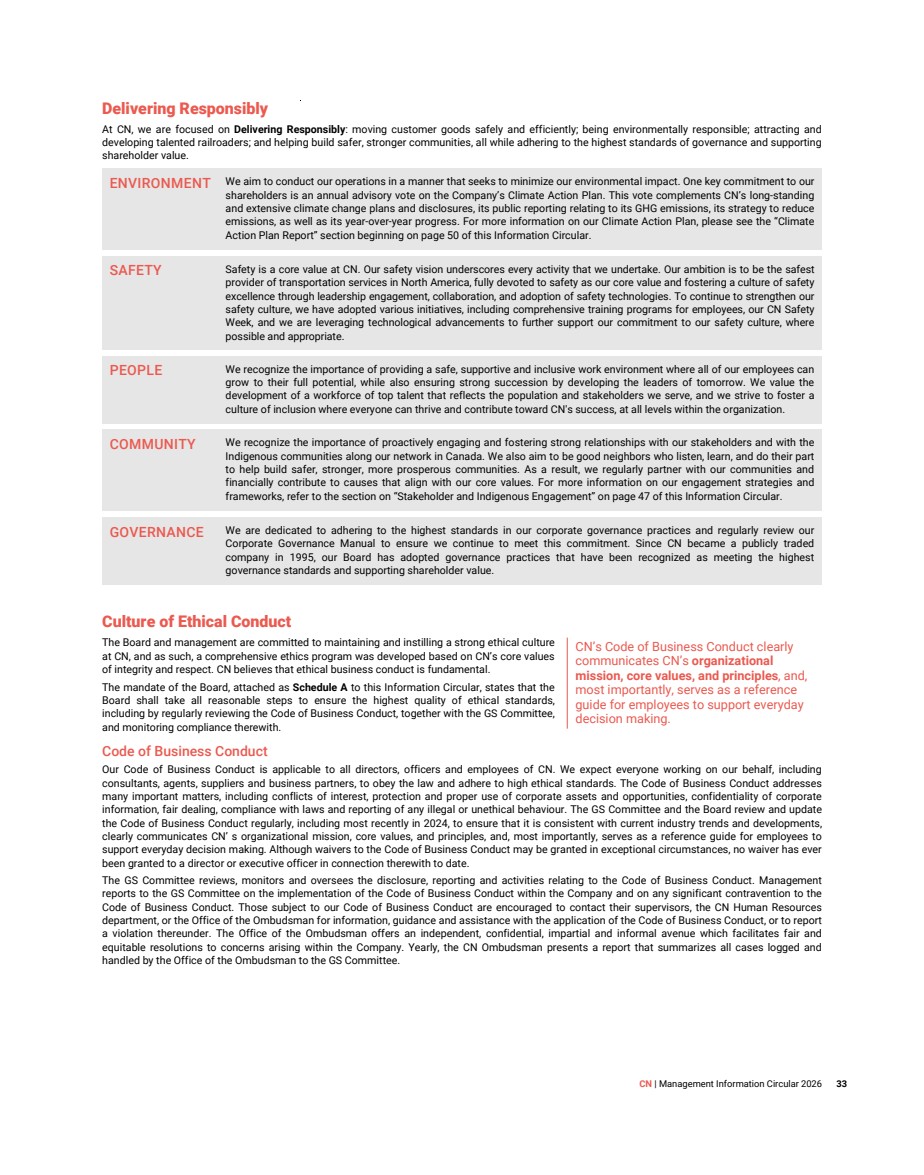
| Each director, executive officer and management employee must certify annually their compliance with the Code of Business Conduct, and employees are required to complete a virtual training on the Code of Business Conduct every second year. An integrity training session is also part of every new employee’s onboarding program on our core values of integrity and respect, and the importance of protecting CN’s reputation, understanding what “Doing the Right Thing” means at CN, and how to identify and avoid potential conflict of interest situations. The Code of Business Conduct is available on our website at www.cn.ca, under “Delivering Responsibly/Governance” and in print to any shareholder who requests a copy by contacting our Corporate Secretary. The Code of Business Conduct has also been filed with the Canadian and U.S. securities regulatory authorities. Conflicts of Interests As part of our ethics program, employees are required to avoid outside interests that may or appear to impair the effective performance of their responsibilities to CN, and be fair and impartial in all dealings with our customers, suppliers and partners. Employees must report to their manager any real or potential conflict of interest, and as required, provide written disclosure of it. Similarly, the Board requests that every director disclose any direct or indirect interests in any organization, business or association, which could place the director in a conflict of interest. Every year, a questionnaire is sent to each director to ensure that all such conflicts have been disclosed. Should there be a discussion or decision relating to an organization, business or association in which a director has an interest, the Board requires that such director not participate or vote in any such discussion or decision. Related-Party Transactions Under CN’s Code of Business Conduct, directors, officers and employees are required to report any related-party transaction. For that purpose, in its Corporate Governance Manual, CN defines a related party as: • A director or officer of CN; • An affiliate, including an immediate family member, of a director or officer; or • A person who beneficially owns more than 10% of CN’s common shares. Any director or officer that has a material interest in a transaction or agreement involving CN must disclose the interest to the Chair of the Board or to the President and CEO, and does not participate in any discussions or votes on the matter. In accordance with our Corporate Governance Manual, any related-party transaction or any situation where a related party has a material interest in a transaction involving CN is submitted to the GS Committee, or if deemed appropriate by the Chair of the Board, to the Board, for review and decision. In 2025, there was no such transaction between CN and a related person as described in Item 404 of Regulation S-K. Insider Trading and Reporting Policy & Communications Policy CN actively promotes compliance with applicable laws and regulations, including securities laws and stock exchange rules. To that end, the Company has notably established a strict prohibition against insider trading, and has adopted communications guidelines applicable to all CN employees in the view of ensuring that the Company’s public communications are open, straightforward, and truthful. All directors, officers, and employees of CN are subject to our Insider Trading and Reporting Policy which provides guidance as to their obligations under applicable insider trading and reporting laws in the view of promoting compliance therewith. Our Communications Policy reflects our commitment to provide complete, accurate and timely communications to the investing public. Among other matters, it establishes CN’s designated spokespersons as the only individuals authorized to speak on our behalf, and sets out the procedures to be followed should material information regarding CN’s business and affairs arise in order to ensure the broad dissemination thereof, to avoid selective disclosure. These policies are regularly reviewed by the Board and the GS Committee, including most recently in 2024, in line with our commitment to ensure that we continue to adhere to the highest governance standards. CN Hotline The Board has adopted procedures allowing interested parties to submit accounting and auditing complaints or concerns to CN; and communicate directly with the Board Chair, who presides over all independent director sessions of the Board. These procedures are described on our website at www.cn.ca, under “Delivering Responsibly/Governance”. The Code of Business Conduct also provides that concerns of employees regarding any potential or real wrongdoing in terms of accounting or auditing matters may be submitted confidentially through CN’s Hotline. Our Governance Structure The Board of Directors The Board has oversight responsibility for the stewardship of CN and its business. The role of the Board is to supervise the management of CN’s business and affairs, with the objective of creating value for shareholders and taking into account the interests of other stakeholders. In doing so, the Board assumes the duties and responsibilities set forth in its mandate, which is attached as Schedule A of this Information Circular. The Board mandate is reviewed and approved annually by the Board, through the GS Committee. The Board, in consultation with management, establishes and is responsible for the Company’s strategic direction and its overall policies, and in doing so, reviews CN’s strategic plan on an annual basis to ensure that it continues to be responsive to the changing business environment in which CN operates. In 2025, the Board agendas include strategy discussions at every meeting with a view to identify the Company’s long-term priorities, risks, and opportunities, while assessing the Company’s strategic plan in relation thereto, and the Board held two comprehensive strategy sessions with management during the year, including presentations by external advisors. The Board fulfills certain of its responsibilities through its standing committees, as further described under the heading “Committees of the Board”. 34 CN | Management Information Circular 2026 |
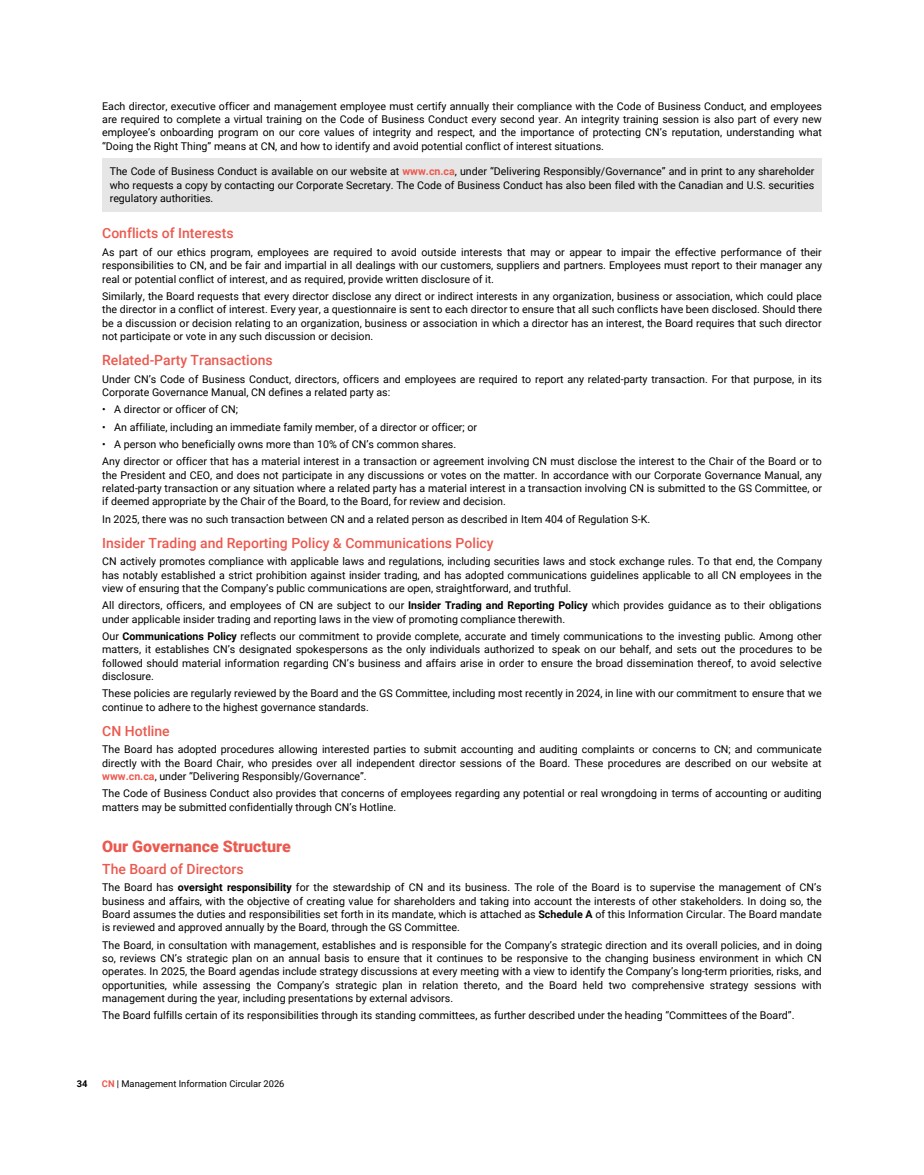
| Committees of the Board In 2024, the Board re‑structured its standing committees to ensure it continues to align with our core values and strategic vision. This committee structure is aligned with corporate governance best practices and remains effective in 2025. It enhances the Board’s focus on current and emerging risks while ensuring that the breadth of experience and expertise of our Board is drawn upon effectively in order for CN to be best positioned to execute on its strategy (including the development and implementation of our environment and climate change strategy and the safety and efficiency of our operations). Given the unique profile of artificial intelligence related technology and its related risks, a specific reference to the GS Committee mandate was added in 2025 to clarify that it is charged with the review and assessment of the governance and ethics practices and policies relating to the use of artificial intelligence, as well as related risks and opportunities. The HRC Committee charter was also amended in 2025 to update the Committee’s oversight over CN Investment Division’s senior executives and Investment Division’s compensation plans. As of the date hereof, the Board has subdivided its supervision mandate into four areas through four standing committees which are: the AFR Committee, the GS Committee, the HRC Committee and the SE Committee. The charters of each committee are included in CN’s Corporate Governance Manual and are available on our website at www.cn.ca under “Delivering Responsibly/Governance”. Each committee reports to the Board and, subject to certain limited exceptions, there are no standing delegations of the Board’s decision-making authority to any committees. A report of each committee’s activities over the past year can be found at Schedule B of this Information Circular. Audit, Finance and Risk Committee The AFR Committee oversees CN’s financial reporting, overall enterprise risk management, monitors internal and external auditors, and oversees the Company’s financial policies and procedures, including policies and procedures related to the disclosure of financial and other material information to investors, and the processes to ensure that such information is accurate, complete and consistent with other public disclosures made by CN. The AFR Committee is also responsible for reviewing and making recommendations to the Board regarding certain of CN’s financial activities. As part of these responsibilities, following the Board’s annual approval of CN’s strategic and business plan and overall capital allocation plan and shareholder distributions (including with respect to dividends and shareholder repurchases), the AFR Committee monitors performance against CN’s annual operating plans, capital expenditures programs and capital allocation plans (including monitoring CN’s capital structure and cash flows) and the alignment of these plans to the Company’s long-term strategy, and reviews the opportunities and parameters for debt or equity financing, among other matters. The AFR Committee is also responsible for overseeing the funding of CN’s pension plans, the investment management performance of the CN Investment Division and the activities of the Pension Advisory Working Committee, a management-level committee. The AFR Committee oversees CN’s overall enterprise risk management program, monitoring management’s assessment of major risk exposures and their potential impact on our ability to achieve its business and financial objectives. The committee reviews management’s oversight of matters relating to non-operating information technology, cyber security or data governance affecting CN and CN’s information technology systems. The committee is also kept informed of any risk reports relating to specific risks which fall within the mandate of, or have been delegated to, other committees, enabling it to have a holistic view of all risks faced by CN. Each member of the AFR Committee is independent and is financially literate, as such term is defined under Canadian securities laws, and as such qualification is interpreted by the Board as required under NYSE corporate governance standards, based on their respective education and experience. No member of the AFR Committee receives, other than in their capacity as a director or member of a Board committee, directly or indirectly, any fee from CN or any of its subsidiaries, nor is an affiliated person of CN or any of its subsidiaries. Additional information relating to the AFR Committee can be found in Schedule C of this Information Circular and in the Company’s 2025 Annual Information Form, available on SEDAR+ at www.sedarplus.ca, on the SEC website at www.sec.gov through EDGAR and on CN’s website at www.cn.ca. Governance and Sustainability Committee The GS Committee is responsible for monitoring the size and composition of the Board and its committees, including identifying candidates for nomination for election as directors, and overseeing corporate governance and sustainability matters. As part of its responsibilities, the GS Committee develops, reviews and monitors criteria for selecting directors, including by regularly assessing required or desired competencies and skills to improve the Board and, in consultation with the Board Chair, identifies candidates qualified to become Board members. The GS Committee also oversees CN’s overall sustainability framework and the development and implementation of CN’s sustainability policies and practices. This includes oversight of CN’s short- and long-term sustainability objectives and policies and practices relating to environmental, social and governance matters, including public and government affairs, lobbying, human and social rights and other corporate responsibility matters. The committee is responsible for overseeing CN’s key sustainability metrics (other than specific goals related to the environment, climate change, and safety, which are reviewed by the SE Committee) and reviewing progress against established goals, as well as key sustainability disclosures and ratings. The committee reviews and assesses the governance and ethics practices and policies relating to the use of artificial intelligence as well as related risks and opportunities. The committee also oversees the development and implementation of CN’s Stakeholder and Indigenous Relations Framework and related practices, including its internal and external stakeholder engagement policies and programs and Indigenous communication, engagement and relationship-building initiatives, including CN’s Indigenous reconciliation action plan. The committee also oversees the Company’s community investment policies and programs, including its donations and sponsorships strategy and budget. The committee also oversees and monitors management’s assessment of CN’s major risk exposures relating to compliance with laws and regulatory requirements, government and public policy concerns, reputation, human and social rights, activism, and such other risks delegated to the committee by the AFR Committee or the Board. The committee is responsible for monitoring CN’s compliance with laws and regulations to which it is subject, and advises the Board on the adequacy of CN’s efforts to ensure that its business is conducted in a way that meets high standards of ethics and corporate responsibility, including by reviewing, on a regular basis, the Code of Business Conduct. The GS Committee reviews the corporate governance guidelines applicable to CN, recommends any change that should be made thereto, and monitors the disclosure of CN's governance practices. The responsibilities, powers and operation of the GS Committee are further described in its charter, which is included in our Corporate Governance Manual. CN | Management Information Circular 2026 35 |
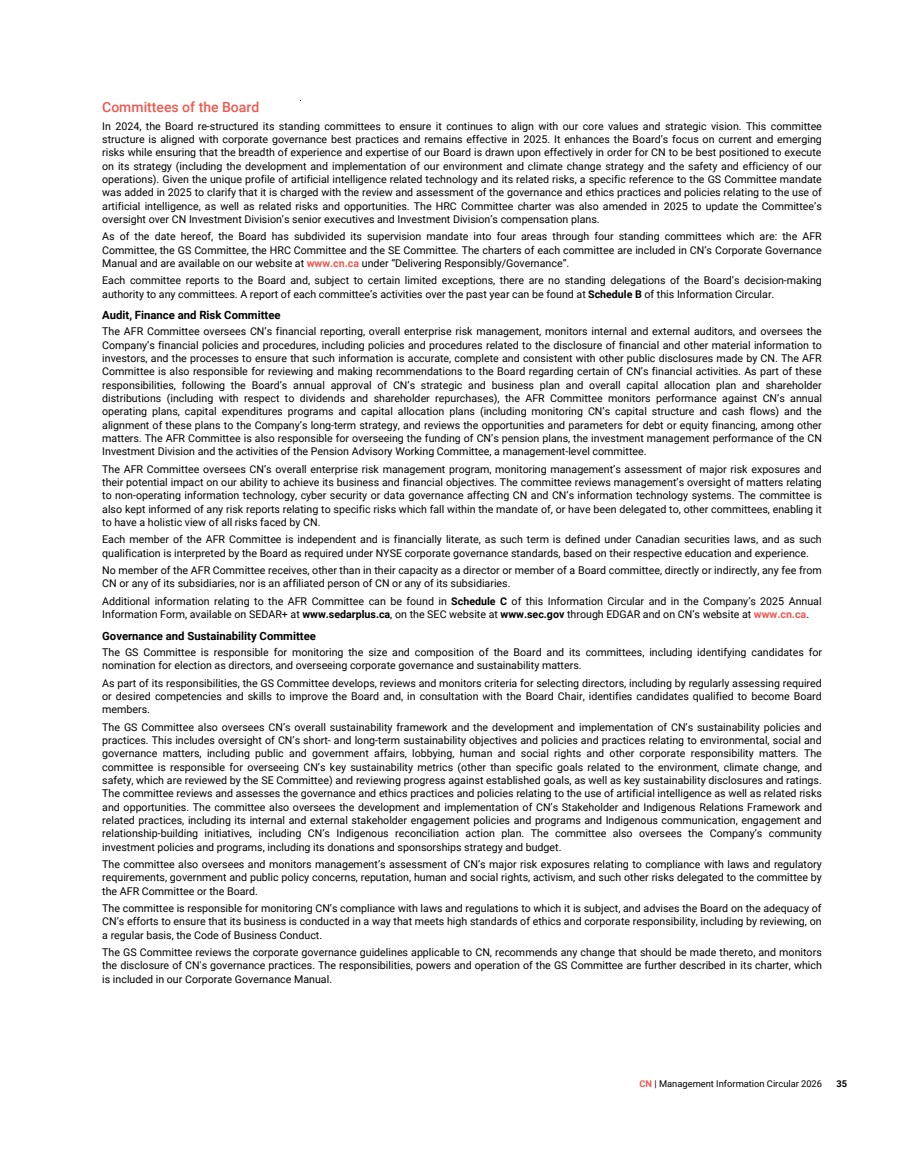
| Human Resources and Compensation Committee The HRC Committee monitors executive management’s performance assessment, compensation and succession planning. The committee also has the mandate to review human resources practices by ensuring, among other matters, that appropriate human resources practices and policies are in place so that the Company can attract, motivate and retain the quality of personnel required to meet its business objectives and to ensure consistency with its strategic direction. Priorities of the HRC Committee include talent management, leadership development, succession planning, and employee engagement. The committee annually reviews short-, medium- and long-term succession plans for the executive team, and develops and implements specific customized plans to address identified gaps therein. The committee is also responsible for overseeing the human resources, compensation and governance structure and design aspects of CN’s pension plans. The HRC Committee oversees and monitors management’s assessment of CN’s major risk exposures relating to executive management, human resources, compensation, succession, culture, pension and investment management and such other risks delegated by the AFR Committee or the Board, and management’s mitigation plans. The Board has adopted a policy, which is included in our Corporate Governance Manual, providing that no more than one member of the HRC Committee shall be a sitting CEO of another company, that at least one member shall be experienced in executive compensation, and that the President and CEO of CN shall be excluded from the committee member selection process. As of the date of this Information Circular, the composition of the committee was in compliance with the conditions of the policy. As permitted under its charter, the HRC Committee retains the services of an executive compensation consultant, as appropriate, to assist in the performance of its functions. For more information on the executive compensation consultant, please refer to the subsection entitled “Statement of Executive Compensation–Mandate of the HRC Committee–Independent Advice” on page 60 of this Information Circular. The mandate of the HRC Committee is further described in the section entitled “Statement of Executive Compensation–Human Resources and Compensation Committee” on page 59 of this Information Circular and in its charter, which is included in our Corporate Governance Manual. Safety and Environment Committee The SE Committee oversees the development and implementation of CN’s policies and practices relating to safety, security and environmental matters. The SE Committee is responsible for overseeing and monitoring CN’s key environmental metrics (including those related to climate change) and progress against established goals and targets, and reviews the Company’s strategic plans and opportunities to ensure alignment with its environmental and climate change objectives. The SE Committee is also responsible for reviewing CN’s environmental metrics and targets set out in its compensation plans. The SE Committee is responsible for reviewing, on an annual basis, the Company’s disclosures regarding environmental and climate change matters, including its Climate Action Plan. The SE Committee also oversees the development of CN’s safety and security policies and reviews performance thereunder. In doing so, it reviews and monitors compliance with CN’s safety program, including training programs, emergency response planning and initiatives that promote safety rule compliance, as well as safety targets and metrics set out in CN’s compensation plans. In addition, the SE Committee is responsible for assessing advancements in operating technology (including artificial intelligence and digital transformation initiatives), including the risks and opportunities of adopting or exploring such technologies or initiatives. The SE Committee oversees and monitors management’s assessment of CN’s major risk exposures relating to environment, climate change, greenhouse gas emissions reduction, biodiversity, safety and security, including related operating technology initiatives, and such other risks delegated to the committee by the AFR Committee or the Board, and management’s mitigation plans. The responsibilities, powers and operation of the SE Committee are further described in its charter, which is included in our Corporate Governance Manual. Board of Directors Governance Independence Independence of Directors To better align the interests of the Board with those of our shareholders, our Corporate Governance Manual provides that independent directors must comprise a substantial majority of our Board. All of our nominees for election to the Board are independent, with the exception of our President and CEO. In determining whether a director is an independent director, the Board applies the standards developed by the CSA, the NYSE and the additional standards adopted by the Board. These standards are set out in CN’s Corporate Governance Manual. The Board also adopted a Directors’ Independence Protocol (the Protocol) which sets out the process and parameters for determining the independence status of directors at the time of appointment and on an ongoing basis. The Protocol is consistent with standards established in CN’s Corporate Governance Manual and also sets out the process for gathering and reviewing relevant information on an ongoing basis. 36 CN | Management Information Circular 2026 Independence Status of nominees to the Board INDEPENDENT NON-INDEPENDENT (REASON FOR NON-INDEPENDENCE) Shauneen Bruder Jo-ann dePass Olsovsky David Freeman Denise Gray Justin M. Howell Susan C. Jones Robert Knight Michel Letellier Al Monaco Madeleine Paquin Tracy Robinson (President and CEO, CN) All of the nominees for election to the Board, except our President and CEO, are independent. |
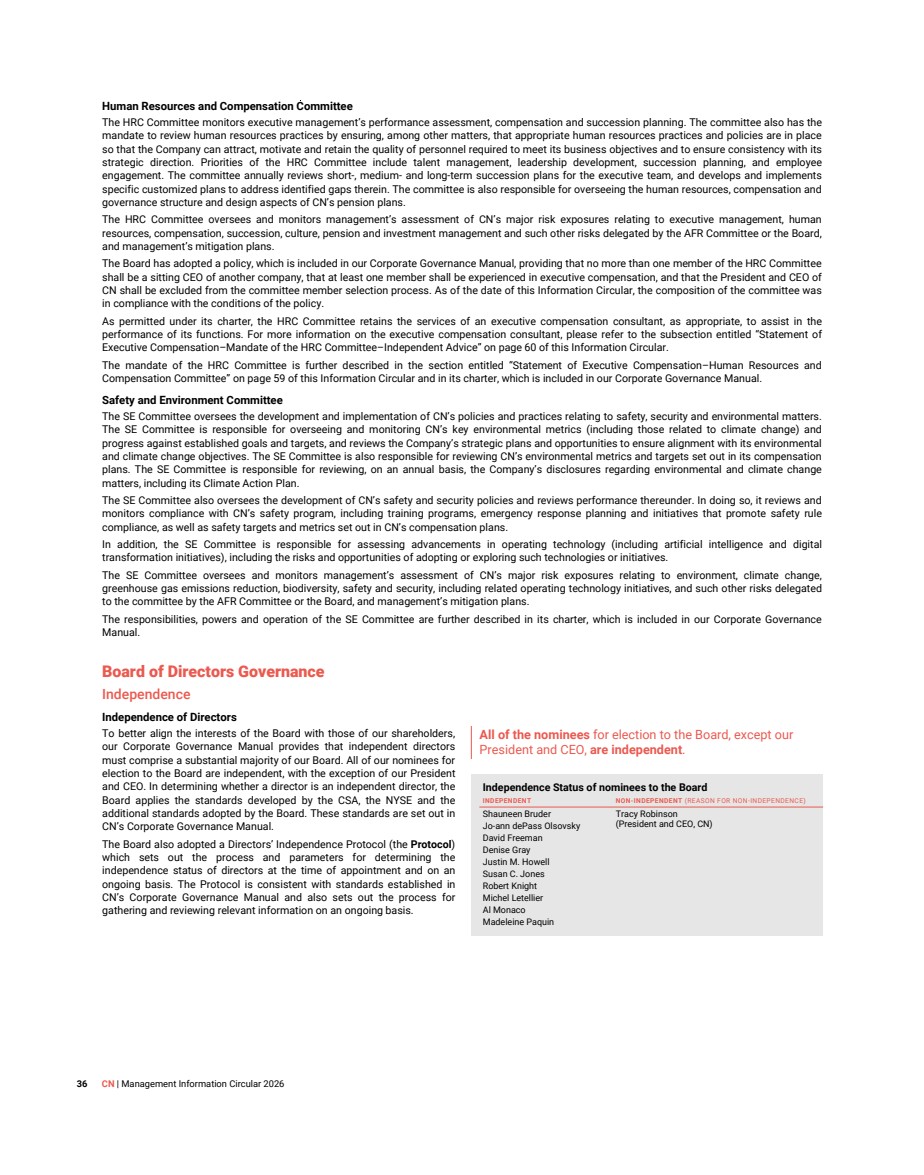
| Independent Chair of the Board The Board has been led by an independent Chair since CN became public in 1995, and we believe that the separation of the positions of President and CEO and Chair of the Board contributes to allowing the Board to function independently of management. Our Corporate Governance Manual provides that the position of Board Chair must be held by an independent director who is designated by the Board. The Corporate Governance Manual also describes the responsibilities of the Chair of the Board. The key role of the Chair of the Board is to take all reasonable measures to ensure that the Board (i) has structures and procedures in place to enable it to function independently of management, (ii) carries out its responsibilities effectively, and (iii) clearly understands and respects the boundaries between the responsibilities of the Board and those of management. Ms. Shauneen Bruder, who is the current independent Chair, became Chair of the Board on May 20, 2022. Independent Committee members The charters of each of the GS Committee, the AFR Committee and the HRC Committee provide that such committees must be composed solely of independent directors, and the charter of the SE Committee provides that a majority of its members shall be independent directors. As of the date of this Information Circular, each member of each committee of the Board is independent. Common Directorships With a view to further strengthen directors’ independence, the Board has adopted a policy pursuant to which a director shall not accept the invitation to join an outside board on which a director of CN already sits without previously obtaining the approval of the GS Committee. It has been our practice not to permit common directorships amongst our board members. In addition, the Board has adopted a policy to the effect that no more than two of CN’s directors should generally serve on the same outside board or outside board committee. As of March 9, 2026, no members of our Board serve together on the boards of other companies. Position Descriptions Our Corporate Governance Manual includes position descriptions for the Board Chair and the committee chairs, as well as a position description for our President and CEO. Board and Committee Meetings Process Our Corporate Governance Manual provides that the Board shall meet at least six times a year, and as necessary. The Board Chair, in collaboration with the CN Corporate Secretary, has the responsibility of establishing a schedule for the meetings of the Board and its committees. In this context, the Corporate Secretary, in collaboration with the Board, the committee Chairs and relevant CN executives, establishes Board and committee working plans for the year. This process is conducive to the preparation of in-depth presentations resulting in meaningful information and discussions, while allowing management to plan ahead. If, during the course of the year, events or circumstances require Board or committee action or consideration, additional meetings are called. The total number of meetings and the attendance record for each director for all Board and committee meetings held during the course of 2025 are set out under the heading “Board and Committee Attendance” of this Information Circular. Communication regularly takes place between the Board Chair and CN executives and, through the Office of the Corporate Secretary, between executive officers having responsibilities for matters placed under the supervision of particular committees and the Chairs of such committees. This open communication ensures that all meaningful information concerning the affairs and progress of the Company is transmitted to those members of the Board or committees having supervisory responsibilities. In Camera Meetings Our Corporate Governance Manual requires that independent directors meet in camera, without the presence of management and under the chairmanship of the Board Chair, at or after every meeting of the Board. The Board met during in camera sessions at all meetings held in 2025, including regular and special meetings. Each of our board committees also meets in camera, without the presence of management, at or after every meeting, including regular and special meetings. CN | Management Information Circular 2026 37 Independent members of the Board hold in camera meetings, without the presence of management, at or after every meeting of the Board and committees of the Board. |
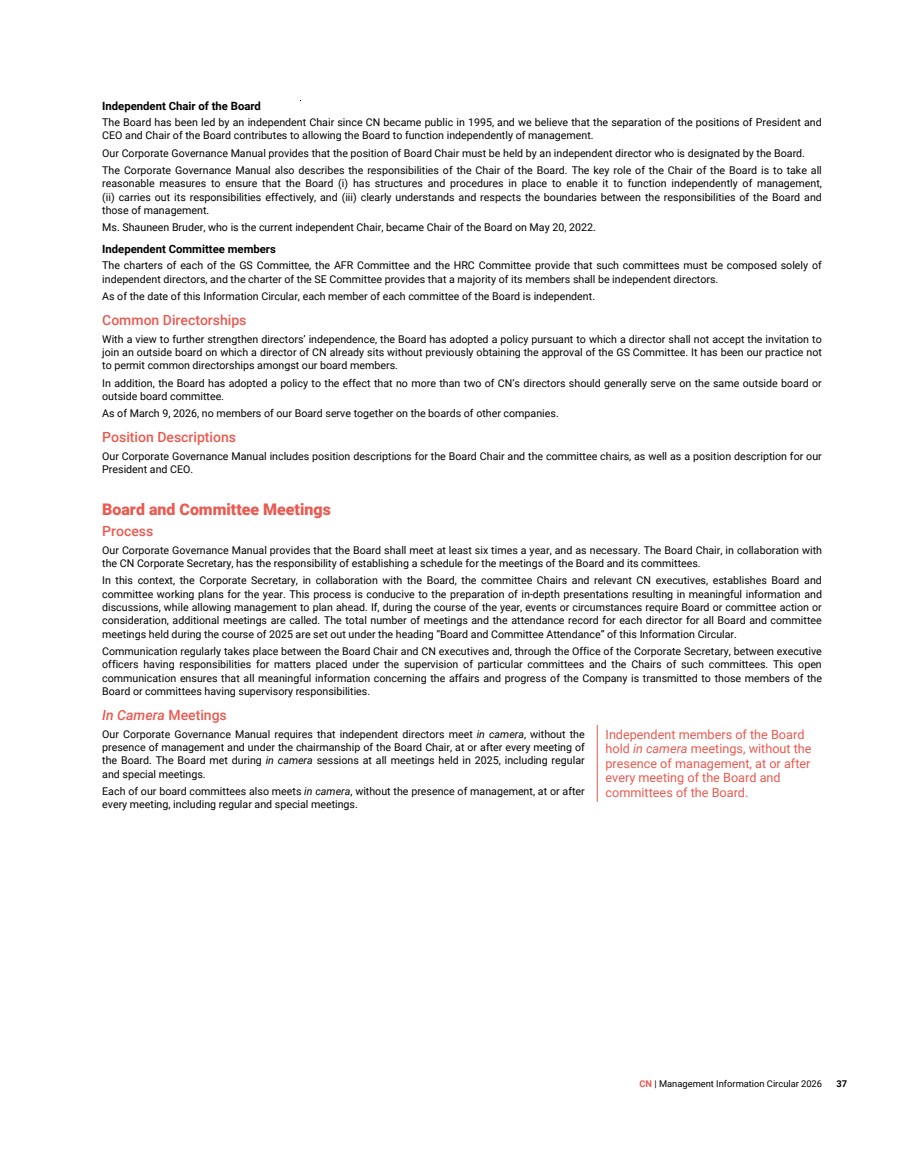
| Board and Committee Attendance Board and Board committee members are expected to attend, rigorously prepare for and actively participate in, all meetings of the Board and of the committees on which they sit. As stated in our Corporate Governance Manual, any director who has attended less than 75% of meetings of the Board or meetings of committees on which they sit, for more than two consecutive years, without a valid reason for the absences, will not be renominated. In 2025, all directors attended all meetings for which their participation was required. The following table shows the record of attendance for each current director at meetings of the Board and the committees of which they were members for the year ended December 31, 2025, as well as the number of Board and committee meetings held during the 12-month period that ended on December 31, 2025. NAME OF DIRECTOR NUMBER AND % OF MEETINGS ATTENDED OVERALL ATTENDANCE/ MEETINGS HELD COMMITTEE MEETINGS BOARD MEETINGS AUDIT, FINANCE AND RISK COMMITTEE GOVERNANCE AND SUSTAINABILITY COMMITTEE SAFETY AND ENVIRONMENT COMMITTEE (1) HUMAN RESOURCES AND COMPENSATION COMMITTEE COMMITTEE (TOTAL) REGULAR SPECIAL (1) BOARD (TOTAL) Shauneen Bruder 6/6 100% 6/6 100% 6/6 100% 7/7 100% 25/25 100% 6/6 100% (Chair) 3/3 100% (Chair) 9/9 100% (Chair) 34/34 100% Jo-ann dePass Olsovsky – – 6/6 100% 7/7 100% (Chair) 13/13 100% 6/6 100% 3/3 100% 9/9 100% 22/22 100% David Freeman 6/6 100% – 6/6 100% – 12/12 100% 6/6 100% 3/3 100% 9/9 100% 21/21 100% Denise Gray – 6/6(3) 100% 3/3(4) 100% 3/3(5) 100% 12/12 100% 6/6 100% 3/3 100% 9/9 100% 21/21 100% Justin M. Howell – 6/6 100% – 7/7 100% 13/13 100% 6/6 100% 3/3 100% 9/9 100% 22/22 100% Susan C. Jones 6/6 100% – 6/6 100% (Chair) – 12/12 100% 6/6 100% 3/3 100% 9/9 100% 21/21 100% Robert Knight 6/6(2) 100% (Chair) – – 7/7 100% 13/13 100% 6/6 100% 3/3 100% 9/9 100% 22/22 100% Michel Letellier 6/6 100% 6/6 100% – – 12/12 100% 6/6 100% 3/3 100% 9/9 100% 21/21 100% Margaret A. McKenzie 6/6(2) 100% 3/3(3) 100% 2/2(4) 100% – 11/11 100% 6/6 100% 3/3 100% 9/9 100% 20/20 100% Al Monaco – 3/3(3) 100% (Chair) 6/6 100% 3/3(5) 100% 12/12 100% 6/6 100% 3/3 100% 9/9 100% 21/21 100% Madeleine Paquin – – – – – 2/2 100% – 2/2 100% 2/2 100% Tracy Robinson – – – – – 6/6 100% 3/3 100% 9/9 100% 9/9 100% Number of meetings held 6 6 6 7 25 6 3 9 34 (1) Special meetings of the Board are occasionally called to discuss time sensitive or other exceptional matters. Due to the nature of these meetings, they are often called on short notice, and must, on occasion, be held at a time and date where the largest number of directors is available. As such, certain directors may unfortunately not be able to attend despite efforts to reconcile agendas and availabilities. Nevertheless, all directors receive meeting materials for special meetings and those who are unable to attend are debriefed as required. (2) Ms. Margaret McKenzie stepped down as Chair and Mr. Robert Knight became Chair of the AFR Committee effective May 2, 2025 (3) Ms. Margaret McKenzie stepped down as member, Ms. Denise Gray stepped down as Chair, and Mr. Al Monaco became member and Chair of the G&S Committee effective May 2, 2025. (4) Ms. Denise Gray stepped down as member and Ms. Margaret McKenzie became member of the SE Committee effective May 2, 2025. (5) Mr. Al Monaco stepped down as member and Ms. Denise Gray became member of the HRC Committee effective May 2, 2025. Board Renewal and Director Selection CN recognizes the importance of board renewal and succession planning to ensure that our Board continues to reflect an optimal balance of skills and experience, promote new ideas and fresh perspectives on the Board, and to generally ensure continued effective decision making by our directors collectively. We strive for our selection process to be fair and inclusive. It is designed to ensure that our Board continues to be comprised of highly-qualified directors with diverse perspectives and backgrounds. In an increasingly complex global marketplace, the ability to draw on a wide range of viewpoints, backgrounds, skills, and experience helps us better understand and respond to the needs of our stakeholders and is critical to our success. The GS Committee, together with the Board Chair, is responsible for determining the needs of the Board in the long term and identifying new candidates to stand as nominees for election or appointment as directors. To do so, the GS Committee monitors the current and future profile of the Board in support of our strategic plan. In addition, in consultation with the Board Chair, the GS Committee annually reviews the criteria for the selection of nominees to be recommended to the Board and the credentials of nominees for election or re-election as members of the Board. The GS Committee regularly considers and discusses Board renewal and succession planning. Notably, in 2025, on the recommendation of the GS Committee, we amended our Board competency matrix to further enhance the alignment of the skills sought from our directors with CN’s priorities and strategic vision, with a view to ensure that the Board continues to benefit from a broad range of valuable perspectives and relevant expertise. 38 CN | Management Information Circular 2026 |
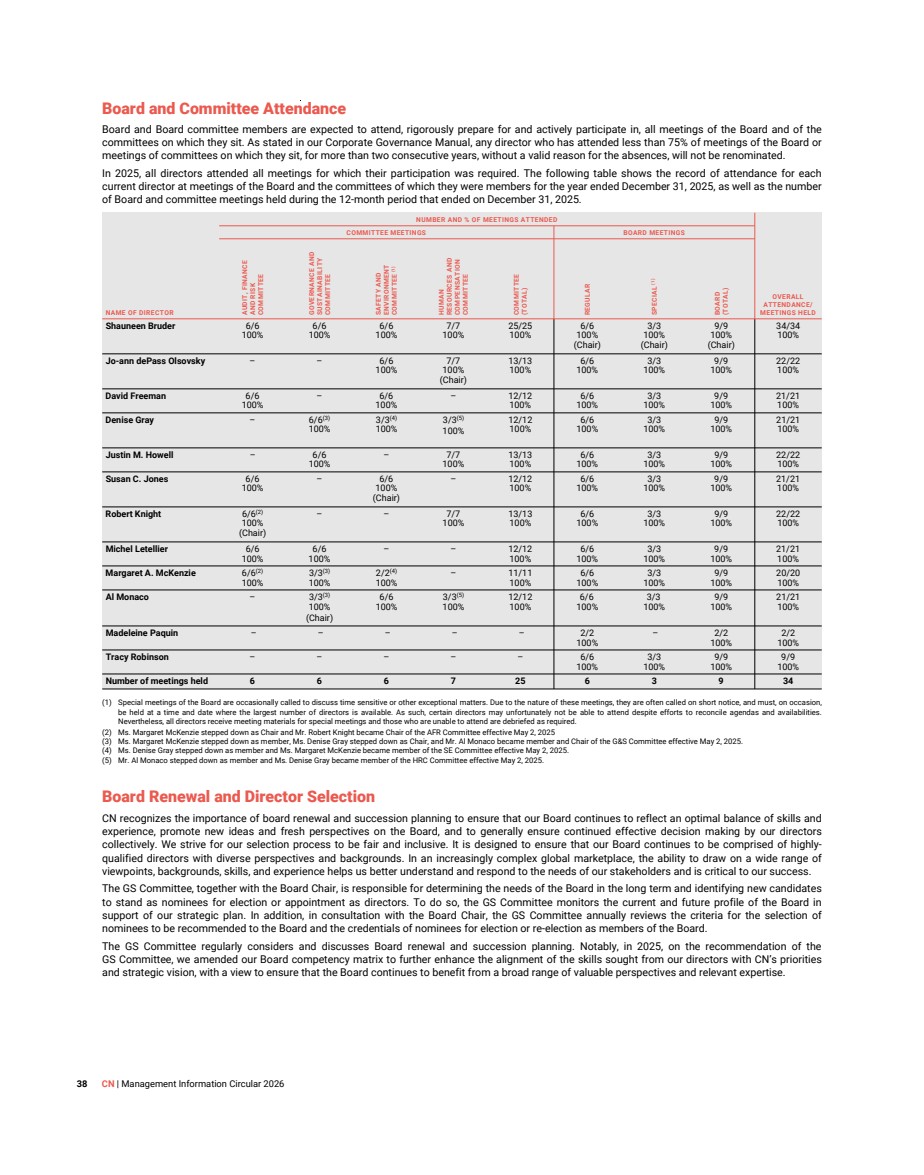
| Director Selection Process When proposing the list of CN Board nominees for election, the Board, through the GS Committee, is guided by the following process: IDENTIFY In consideration of CN’s current strategic and business plans, the opportunities and risks facing us, and the nature of our operating and competitive environment, the Board, through the GS Committee, identifies criteria for the selection of director nominees to be recommended to the Board and the expertise, competencies, skills and knowledge that the Board as a whole and its Committees require in order to understand the business, adequately fulfill their mandates, and enhance shareholder value. The GS Committee has developed a set of criteria for Board membership that strives for the inclusion of diverse groups in order to attain a diversity of background and skills for the Board. The Board Chair, in consultation with the GS Committee, then develops a competency matrix with the knowledge areas, types of expertise, competencies, skills, and other areas of representation that it considers should be reflected on our Board, in the view of ensuring that the skill set of our directors meet the needs of our Board. CN’s current matrix, which was recently updated in 2025, is set out on page 40 of this Information Circular. ASSESS With reference to the competency matrix and based on the results of the most recent director performance assessment at the Board and committee levels (for more information, please see the section on “Statement of Corporate Governance Practices–Board Performance Assessment”), the Board, through the GS Committee, assesses the current Board composition, including as it relates to directors’ skills, personal attributes and other qualities of each director, having regard to the benefits of all aspects of diversity on the Board, availability, geographical representation, language fluency, and diversity in business backgrounds, experiences and perspectives, as well as their independence, while also identifying new trends and emerging risks to be addressed in future director nominations in alignment with the Company's business strategy. Where required, the GS Committee, in consultation with the Board Chair, searches for new, highly qualified director candidates to address these areas of improvement, taking into account diversity considerations (including gender diversity) and with consideration of applicable legal and regulatory requirements (such as director independence requirements and review of potential conflicts of interest). Once potential new candidates have been identified, the Board Chair (as well as the GS Committee Chair and other directors, as appropriate) and the President and CEO meet with and interview each candidate to assess their fit with the Board’s requirements and to discuss their interest and willingness to serve on CN’s Board, identify potential conflicts of interest, and assess their ability to devote sufficient time and energy to the Board. Further to the meetings, a report is submitted to the GS Committee. RECOMMEND The Board, through the GS Committee, then recommends a slate of nominees comprised of highly-qualified candidates that it considers to be well-suited to meet the needs of the Board based on their qualifications and other attributes to be considered for appointment as directors of CN at the next annual meeting of shareholders. In order to assist the GS Committee and the Board Chair in recommending candidates to become directors of CN, the GS Committee has constituted, together with the Board Chair, an evergreen list of potential Board candidates, which it updates from time to time. In this regard, the GS Committee proactively identifies highly-qualified candidates with a view to ensuring the ongoing renewal of required competencies by highly-talented candidates, while considering the importance of assembling a balanced Board from all angles and reflecting diverse backgrounds, experiences and perspectives. The GS Committee also occasionally engages an external search firm to help identify candidates that fit the profile sought by the Board. The GS Committee periodically reviews its recruitment and selection processes to ensure that diversity remains a component of any director search and, throughout the director selection process, endeavors to consider the level of representation of women and other members of the underrepresented groups on the Board in identifying and nominating candidates for election or re-election to the Board. A detailed description of our director selection process is set out in our Corporate Governance Manual. Competency Matrix The GS Committee regularly reviews CN’s competency matrix to assess the Board’s overall strengths and diversity of skills and experience, including when considering the recruitment of new director candidates. In 2024 and 2025, upon recommendation of the GS Committee, we updated our competency matrix further enhance the alignment of the skills and competencies sought from our directors with our current business environment and strategic vision. Notably, we incorporated a new competency on Stakeholder Relations and Community Engagement to emphasize the importance of having directors on our Board with a strong understanding of stakeholder and community perspectives, including those of the Indigenous communities on our network in Canada, in the furtherance of CN’s business strategic vision. We reflected Safety as an independent competency to further emphasize CN’s commitment to safety as a core value, and to ensure that CN continues to seek board members who have direct experience with, and a strong understanding of, employee health and safety processes specifically, particularly in the transportation industry. We also incorporated an explicit reference to strategic oversight within the CEO/Executive Leadership Experience category as well as explicitly made reference to artificial intelligence in the Technology/Innovation/Artificial Intelligence/Cybersecurity category. With a view to enhance the presentation and completeness of the information presented in the Matrix, red dots were also added in an effort to visually illustrate each director’s principal competencies, as listed in their respective biographies. CN | Management Information Circular 2026 39 CN’s competency matrix is based on areas of knowledge, expertise, competency, skill, geography, and other areas of representation considered relevant to our Board, and helps identify any gaps to be addressed in the nomination process. |
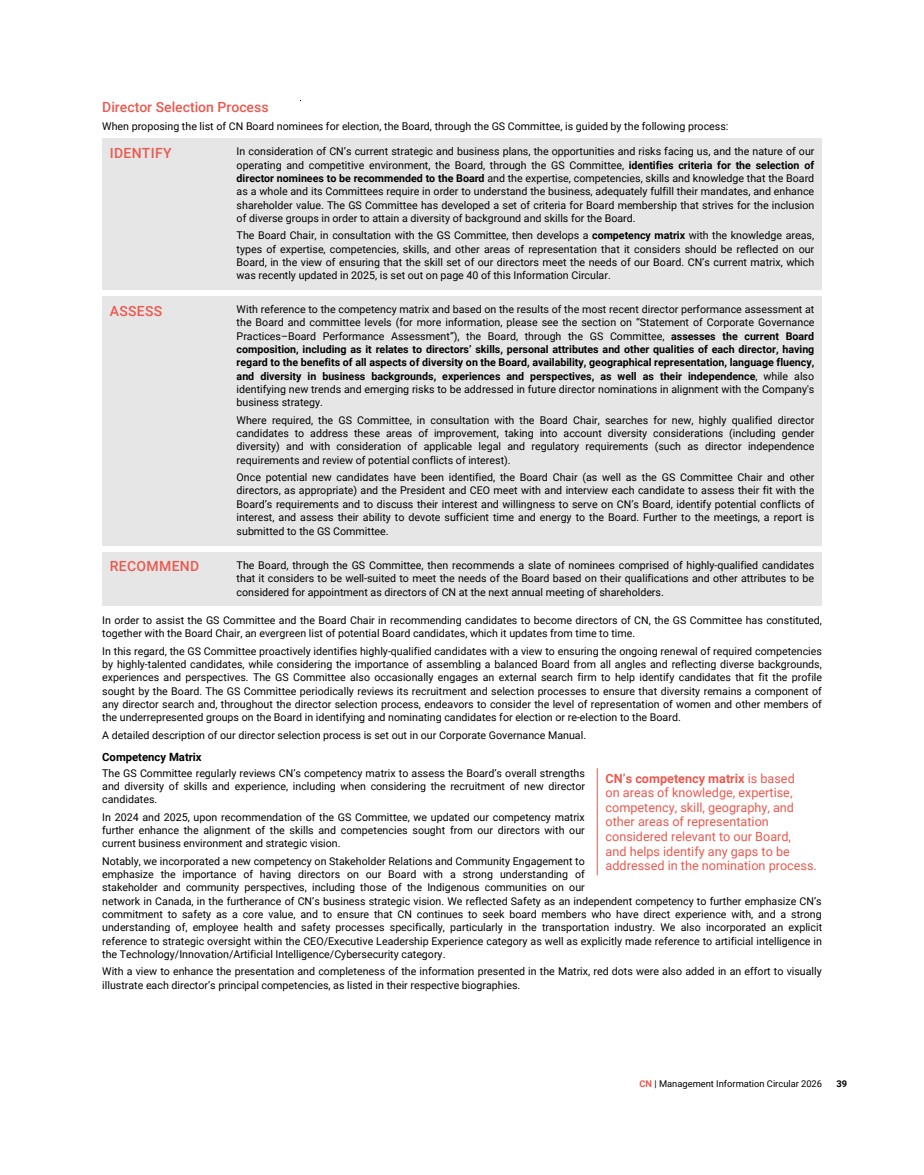
| The following matrix was prepared by the GS Committee in consultation with each director nominee. It sets out the top competencies of each nominee for election to the Board, together with their gender, age range and tenure at CN, and has been approved by the GS Committee and the Board. A summary of each director’s principal competencies and the experience supporting these competencies is highlighted in their respective biographies beginning on page 16 of this Information Circular. BOARD COMPETENCIES SHAUNEEN BRUDER JO-ANN DEPASS OLSOVSKY DAVID FREEMAN DENISE GRAY JUSTIN M. HOWELL SUSAN C. JONES ROBERT KNIGHT MICHEL LETELLIER AL MONACO MADELEINE PAQUIN TRACY ROBINSON FINANCE/ACCOUNTING/INVESTOR RELATIONS/CAPITAL MARKETS Experience in corporate finance, overseeing complex financial transactions, investment management, mergers & acquisitions, and/or capital-raising transactions; experience in financial accounting and reporting and/or auditing, and familiarity with internal financial controls and U.S. GAAP; strong knowledge of investor relations strategy and understanding of major investor perspectives. • • • • • • • • CEO/EXECUTIVE LEADERSHIP EXPERIENCE Experience as a Chief Executive Officer or senior executive officer of a large company. Experience in driving strategic insight and direction into corporate strategies, identifying opportunities, leading growth and overseeing strategic risks. • • • • • • • • • • GOVERNMENT/PUBLIC POLICY/REGULATORY/LEGAL Experience in, or a strong understanding of, the workings of government, government agencies and public policy in Canada and the U.S., or experience as a senior practicing lawyer either in private practice or the legal department of a major publicly listed company. • • • • • • • STAKEHOLDER RELATIONS/COMMUNITY ENGAGEMENT Experience overseeing stakeholder engagement at a major organization of similar size and complexity as CN; strong understanding of stakeholder relations strategy and familiarity with community engagement initiatives, including Indigenous community engagement. • • • • • • RISK MANAGEMENT Experience in the identification, assessment and mitigation of risks and oversight of enterprise risk management programs and practices. • • • • • • • • • • • TECHNOLOGY/INNOVATION/ARTIFICIAL INTELLIGENCE/CYBERSECURITY Strong leadership and experience in assessing and deploying technology, innovation and digital platforms, including disruptive technologies, data management and cybersecurity. Experience in managing and mitigating artificial intelligence and/or cybersecurity risks. • • • TRANSPORTATION INDUSTRY/LOGISTICS/SUPPLY CHAIN/OPERATIONS Experience overseeing cost effective, reliable and efficient operations in the transportation industry or other capital-intensive industries; and/or a strong understanding of the strategic context and key business issues and opportunities in the transportation industry, particularly as it relates to rail operations. • • • • • • • • • • • PEOPLE AND TALENT MANAGEMENT/ORGANIZED LABOUR Experience in oversight of compensation programs for executive level employees and incentive-based compensation programs. Experience with talent recruitment and management, workplace culture, diversity and inclusion, succession planning, leadership development, executive recruitment, management of organized labour in a large operating company. • • • • • • • • • SAFETY Experience overseeing employee health and safety programs and fostering a culture of employee safety, with a strong understanding of employee health and safety processes, regulations and practices, particularly in the transportation industry. • • • • • • CORPORATE GOVERNANCE/PUBLIC COMPANY EXPERIENCE Experience as an executive and/or board member of a publicly listed company that provides a strong understanding of requirements of good corporate governance practices. • • • • • • • • • CUSTOMER EXPERIENCE/SALES/MARKETING Experience in a customer-centric product or service company; strong knowledge of CN’s markets and related market trends and understanding of customer perspectives. • • • • • • INTERNATIONAL/GLOBAL EXPERIENCE AND PERSPECTIVE Experience in, or a strong understanding of, international business, including international trade and overall global perspective. • • • • • • • • • ENVIRONMENTAL/SOCIAL/CORPORATE RESPONSIBILITY Experience in managing or overseeing decarbonization/climate change, environmental, social and sustainability risks and opportunities and impact and performance and their relationship to the company’s business and strategy. Experience in understanding and assessing complex regulatory requirements relating to sustainability, including regulations on climate disclosures and human rights, and related compliance and reporting obligations. • • • • AGE RANGE 59 AND UNDER • • 60–65 • • • • • 66–72 • • • • TENURE 0–5 YEARS • • • • • • • • • • 6–10 YEARS • 11+ YEARS GENDER F F M F M F M M M F F • Red dots identify each director’s principal competencies, as listed in their respective biographies. 40 CN | Management Information Circular 2026 |
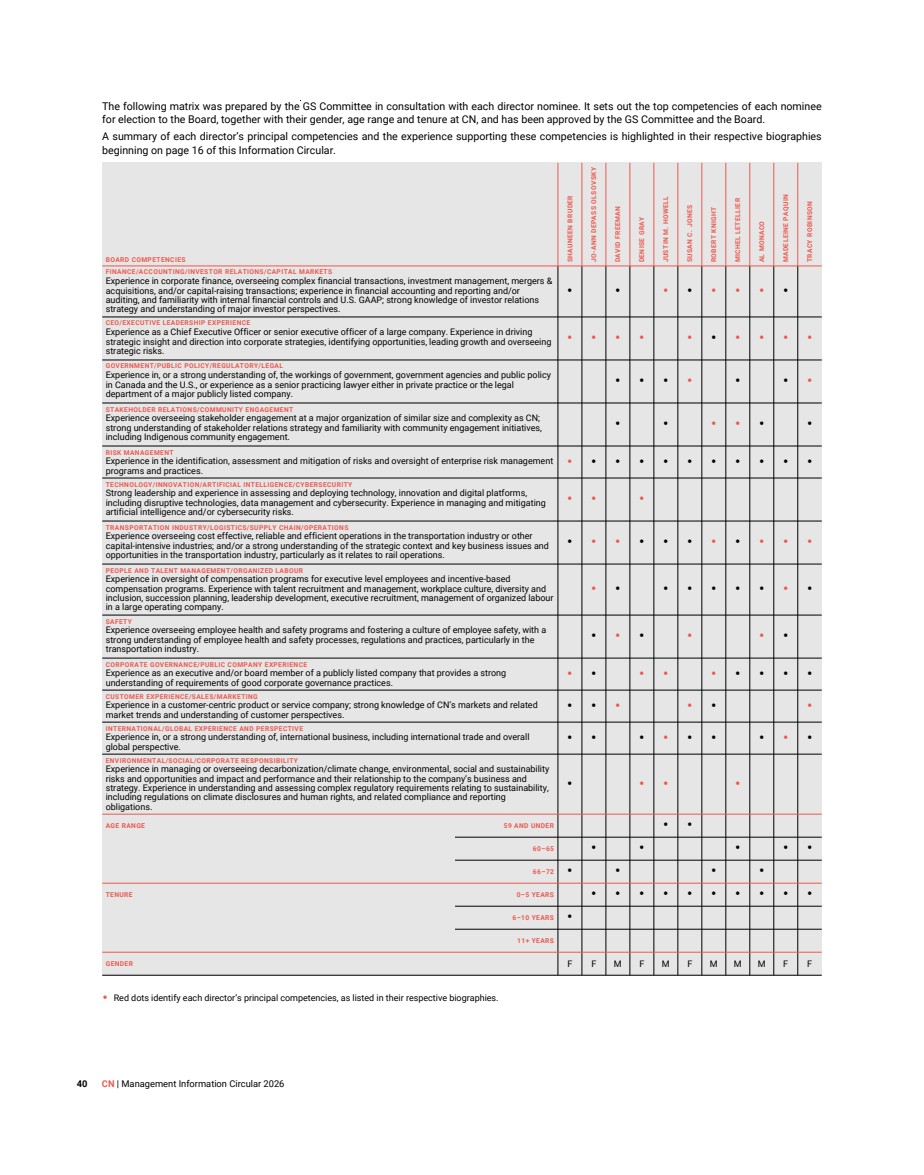
| Number of Directorships CN recognizes that Board membership requires a significant dedication of time. As a result, the number of boards on which an individual can effectively serve is necessarily limited. With a view to taking reasonable steps to ensure the ability of each candidate to make the commitment of time necessary to be a director of CN, the Board applies the following guidelines when considering candidates to become directors of CN: • for candidates that are chief executive officers or other senior executives of public companies, they must only hold their CN Board membership and membership on the board of the company at which the individual is employed; and • for other candidates, they must hold no more than three public company directorships in total (including the CN Board). In addition, because of the AFR Committee’s demanding role and responsibilities, the Board Chair and the GS Committee Chair review any invitations to the AFR Committee members to join the audit committee of another entity. Where a member of the AFR Committee simultaneously serves on the audit committee of more than three public companies, including CN, the Board determines whether such simultaneous service impairs the ability of such member to effectively serve on the AFR Committee. The Board may, in its discretion, authorize a waiver to the above guidelines if deemed in the best interest of CN and only for a transitioning period of up to one year to allow the affected candidate to reduce their board memberships in order to meet CN’s guidelines. The biographies on pages 16 to 27 of this Information Circular identify the other reporting issuers of which each current director of CN is a director. Directors are expected to provide the Board Chair with information as to all boards of directors that they sit on or that they have been asked to join so as to allow the Board to determine whether it is appropriate for such director to continue to serve as a member of the Board or of a Board committee. The GS Committee and the Board Chair will apply Board nominee selection criteria as further described above, including directors’ past contributions to the Board and availability to devote sufficient time to fulfill their responsibilities, prior to recommending directors for re-election for another term. In addition, directors are expected to inform the Board Chair of any major change in their principal occupation, in order to provide the Board with the opportunity to decide the appropriateness of such director’s continuance as a member of the Board or of a Board committee. Board Renewal and Other Practices Retirement from the Board The Board policy on the mandatory retirement age for directors provides that a director will not be nominated for re-election at the annual meeting of shareholders following their 75th birthday, subject to the Board’s ability to approve possible extensions in specific circumstances deemed in the best interest of CN. Board Tenure and Term Limits The tenure of the Board Chair, the committee chairs and individual directors are subject to the following term limits: • CN’s Board Chair will serve for a term of five years, renewable for one further three-year term, subject to the discretion of the Board to further extend the term, if deemed appropriate and in the best interest of the Company and the Board. At the end of the term(s) as Board Chair, the departing Board Chair will not stand for election as a director of CN at the following annual meeting of shareholders. Ms. Shauneen Bruder has been serving as Board Chair since May 20, 2022. • Committee chairs will serve for a term of three years, renewable for one further two-year term, subject to the discretion of the Board to further extend the term, if deemed appropriate and in the best interest of the Company and the Board. • Any current or future member of the Board elected or appointed to the Board will serve for a maximum term of 14 years. The term limit policy does not replace our rigorous performance assessment process, as further described under the heading “Board Performance Assessment”, and directors' qualifications, performance, and contributions to the Board are evaluated annually to ensure they remain suitable for nomination to the Board before they are recommended as nominees for election. The election or appointment of the Board Chair or committee chairs, respectively, is also subject to annual review and election/appointment. The average tenure of the director nominees standing for election at the Meeting is 4.4 years. Directors Appointment Timeline Director Emeritus The Board confers, from time to time, the honorary status of Director Emeritus to retiring or former directors who have made significant contributions to the Board through long and distinguished service and accomplishments. Currently, lifetime emeritus status has been bestowed upon Raymond Cyr, James Gray, Michael Armellino, Charles Baillie, Donald Carty, Gordon Giffin, Edith Holiday, Maureen Kempston Darkes, Denis Losier, James E. O’Connor, Laura Stein, Kevin Lynch, Robert Phillips, the late Hugh Bolton, the late Purdy Crawford, the late Cedric Ritchie and the late Edward Lumley. Lifetime Chairman Emeritus status has been bestowed upon Robert Pace and the late David McLean for their invaluable service to CN. Directors Emeritus are invited to attend the annual meeting of shareholders and certain CN or Board events taking place in their geographic area of residence and are reimbursed for reasonable travel and other out-of-pocket expenses in connection with attendance at such events. CN | Management Information Circular 2026 41 All director nominees being presented for election at the Meeting comply with our policy on outside directorships. None of the directors standing for election at the Meeting meet or exceed our mandatory retirement age. |
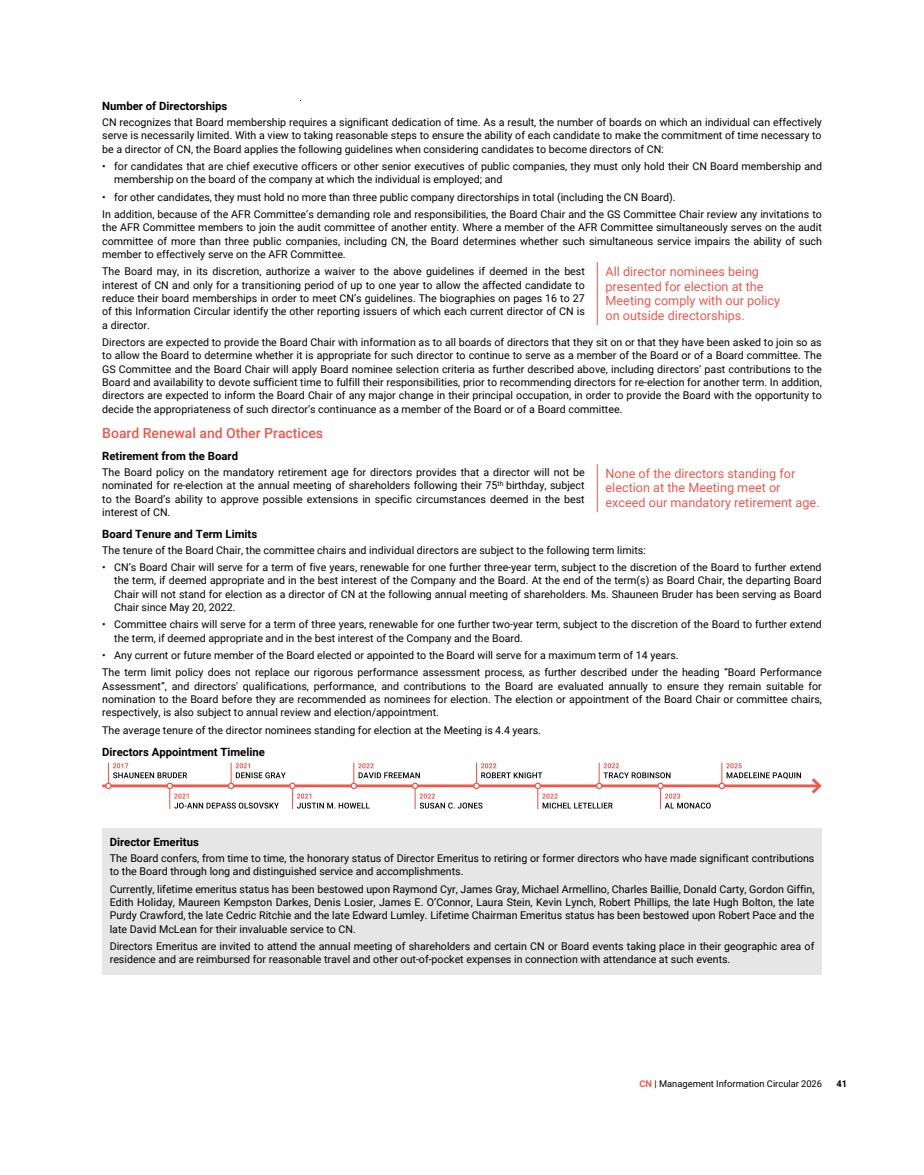
| Board Performance Assessment Process The Board has implemented, and reviews from time to time, a comprehensive process to annually assess its effectiveness, as well as the effectiveness of committees, the Board Chair, the committee chairs and individual directors. In 2023, the Board reviewed, with the help of an external expert, best practices in board effectiveness to ensure that our assessment process continues to be valuable, rigorous, relevant and in line with leading best practices. Following such review, we updated our Corporate Governance Manual to reflect our refreshed and improved approach which remains in place to date. The process of evaluating the Board and the committees, the Board Chair, the committee chairs, and each individual director is under the supervision of the GS Committee and the Board Chair. The process consists of the following steps: CONSULT ANALYZE IMPLEMENT The following questionnaires are prepared by the Office of the Corporate Secretary and approved by the GS Committee and the Board Chair, taking into account current issues, the findings of previous years and input from the Board on the specific objectives for the Board evaluation process and Board priority topics: • Board and committee performance evaluation questionnaires, including a self-assessment by individual directors; • Board Chair evaluation questionnaire; • Committee chair evaluation questionnaires; and • Executive Officers evaluation questionnaires on Board effectiveness through the eyes of management. Each questionnaire is then sent to every director and executive officer, as applicable, and responses are forwarded directly to the Board Chair, except for the responses to the evaluation questionnaire relating to the Board Chair, which are forwarded directly to each of the Chairs of the GS Committee and the HRC Committee. Following receipt of the completed questionnaires, the Board Chair reviews the results with the Chair of the GS Committee and then contacts every director and conducts open and confidential one-on-one meetings. The purpose of these meetings is to discuss the answers received from and in respect of each director, to take into account any comments which the director may have and to review the self-evaluation of each director. One of the GS Committee or HRC Committee Chairs also discusses individually with each director their responses and comments on the Board Chair evaluation questionnaire. Reports are then made by the Board Chair, the GS Committee Chair and the HRC Committee Chair to the Board, with suggestions to improve the effectiveness of the Board, the Board committees, the Board and committee chairs, and separately to individual directors in respect of their personal performance. The Board Chair and committee chairs take into consideration the overall results and suggestions derived from the annual Board performance assessment in order to improve the functioning and activities of the Board and Board committees, and, together with the Board/GS Committee, set priorities and objectives for the Board and its committees going forward in light of these results. At least annually, the Board and each Board committee reviews and assesses their respective mandates. As a result of our recent assessment process, the Board continues to be focused on CN’s long-term business growth and value creation strategy, with direct and frequent director engagement, and on the competitive and macroeconomic environment, disciplined capital allocation, and developing technologies such as artificial intelligence. The Board continues to be also highly focused on talent development and succession planning. The Board will continue its ongoing education, including through site visits of CN’s operations, and its ongoing review of skills and competencies for director succession, and will deepen effective stakeholder engagement, including shareholder engagement. In 2025, our assessment process showed positive results, and the Board was satisfied that our Board and committees, as well as their respective chairs, and individual directors were effective in discharging their mandates and duties. Peer Assessment and Independent Advisor The Board Chair leads, on an annual basis, a peer review process through one-on-one meetings with each individual director. The results are taken into consideration when evaluating the re-nomination of directors to the Board. In 2025, these peer review assessments showed strong results with respect to the performance of each individual director. In addition, the Board may, from time to time, hire an independent advisor to assist the Board in independently assessing the performance of the Board, Board committees, Board and committee Chairs and individual directors. The GS Committee also considers on an annual basis the appropriateness of conducting a peer assessment through an independent advisor. 42 CN | Management Information Circular 2026 The overall results and suggestions derived from the annual Board performance assessment are taken into consideration to improve the functioning and activities of the Board and the committees. |
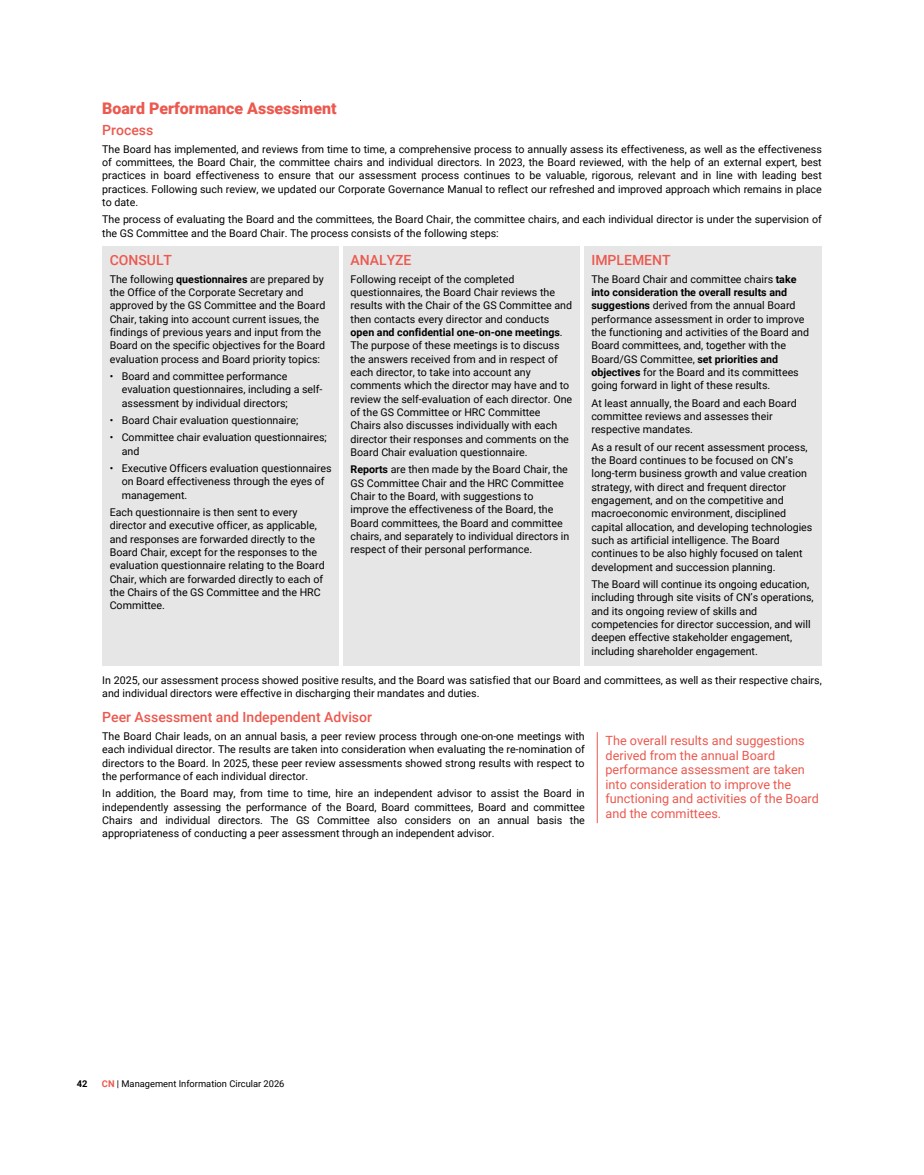
| Director Orientation and Continuing Education Orientation An orientation program is in place for newly elected directors and is periodically reviewed by the GS Committee. The program includes meetings between new directors and the committee chairs, along with presentations by the CN Leadership team on our organizational structure and the nature and operations of our business. These sessions provide an overview of each leader’s areas of responsibility and their respective functions or departments, including finance and treasury, law, stakeholder relations, marketing, operations, strategy, technology, human resources and investor relations and cover key topics such as safety, environment, community outreach initiatives and talent development. New directors are invited to meet with the Board Chair to review the methods of operation and the roles of the Board and its committees, the contribution individual directors are expected to make, and how to access appropriate information or outside resources as required. New directors are provided with the following: a director’s handbook containing the information required to familiarize themselves with CN, its organization and operations as well as CN’s key corporate governance and public disclosure documents, including CN’s Corporate Governance Manual, the Board and committee charters. New directors are also provided with information regarding the review process for the Board, its committees and their chairs, and individual directors; CN’s important policies and procedures, including CN’s Code of Business Conduct; and organizational charts and other business orientation materials, including CN’s Investor Fact Book, sustainability and safety brochures, financial statements and regulatory information. New directors are encouraged to visit sites across CN’s network relating to our operations. These sites may include mechanical and car shops, intermodal and engineering groups, data centres, training centres, railway yards and ports and terminals. Continuing Education To facilitate ongoing education, CN: • maintains, at its cost, a membership for each director in an organization dedicated to corporate governance and ongoing director education; • encourages and funds the attendance of each director at seminars or conferences of interest and relevance; • regularly provides educational materials on corporate governance and other topics in materials provided ahead of Board and committee meetings; • encourages presentations by outside experts to the Board or committees on matters of particular importance or emerging significance, such as governance practices, climate, and Indigenous relations; and • from time to time, as appropriate, the Board holds meetings at or near an operating site or other facility of CN, a key customer, supplier or affiliated company. The Board recognizes the importance of ongoing director education and the need for each director to take personal responsibility for this process. The Board Chair arranges for Board members to have access to education and information on an ongoing basis pertaining to Board effectiveness and the best practices associated with successful boards, briefings on factors or emerging trends that may be relevant to CN’s strategy and other material, as deemed appropriate by the Board Chair. CN also makes available, at its cost, a host of educational programs provided by leading institutions. We encourage directors to attend seminars and other educational programs and to report back to the Board on the quality of such programs, and many do. For instance, in 2025, among other courses that were attended and completed by our directors throughout the year: • our Board Chair, Ms. Shauneen Bruder, completed courses on board oversight of artificial intelligence and the evolving role of board chairs provided by the Institute of Corporate Directors (ICD); • Ms. Jo-ann Olsovsky, Chair of the HRC Committee, completed the following courses provided by the ICD: Boardroom financial essentials and Oversight of cybersecurity in an era of digital acceleration, as well as the following course provided by the National Association of Corporate Directors (NACD): Planning for a Transaction: Compensation and Leadership Considerations; • Ms. Susan Jones, Chair of the SE Committee, completed courses provided by the ICD on Boardroom Financial Essentials and Board oversight of Artificial Intelligence, and Navigating US Policy Shifts - the Implication for Canadian Boards as well as the following course provided by the NACD: A Director’s Guide to AI - Strategy, Governance & Value Creation. • Ms. Denise Gray, member of the GS Committee and HRC Committee, completed courses on strategy and opportunities and challenges in the context of geopolitical trends; technology; and artificial intelligence. Educational reading materials on corporate governance and other topics are also periodically included in the materials provided to the Board and committee members in advance of meetings. In 2025, Board members were provided with educational reading materials and received regular and extensive presentations on a variety of matters and topics of strategic importance to CN’s business, such as safety matters; stakeholder and community outreach initiatives; business growth strategy; operating plans; cybersecurity, technology and artificial intelligence; sustainability and climate change (including CN’s sustainability initiatives and Climate Action Plan); enterprise risk management; and corporate governance matters. As needed, the Board received updates and reports by CN’s internal legal counsel and management on regulatory matters of importance and emerging issues of significance to CN and the railway industry, such as safety, technology and risk mitigation. Directors also interacted with executive and senior management at every Board meeting and met with customers. Our safety culture is embedded in the continuing education of directors. At the beginning of Board meetings, when practicable, a safety briefing is held to specify safety procedures in case of emergency. On occasion, directors and members of management are also guided through “CN safety moments”, which are authentic discussions on daily safety best practices, including personal experiences relating to topics such as prevention of personal injuries and psychological safety. These discussions provide concrete learning experiences, and also represent opportunities to further and collectively drive a culture of safety in which everyone is committed to their personal and collective safety by looking out for each other. The directors have, from time to time, been provided with firsthand opportunities to visit certain sites where CN has made significant investments. Notably, in 2024, the directors visited Harrison Yard in Memphis, Tennessee for a tour of the Intermodal yard as well as the Memphis Car shop, and engaged directly with employees on-site and in 2025 the directors visited Scotford Yard in Edmonton for a tour of the yard as well as visiting customers facilities in Alberta industrial heartland. CN | Management Information Circular 2026 43 |
| The following table lists certain seminars and courses by external providers, as well as certain dedicated internal sessions and presentations on key CN subject matters, that the directors of the Company attended in 2025 and early 2026: SUBJECT MATTER TOPIC PRESENTED PRESENTED/HOSTED BY ATTENDED BY Sustainability Sustainability Disclosure Strategy CN Sustainability GS Committee Members Climate Action Plan CN Sustainability SE Committee Members Environment – Circular Economy Strategy CN Environment SE Committee Members Biodiversity Strategy CN Environment SE Committee Members Future of Freight Locomotives External Speaker SE Committee Members Environmental Update (including Impacts on Operations) CN Environment SE Committee Members Human Resources & Compensation Future of Work External Speaker All directors Inclusion Strategy and Update CN Legal and Human Resources GS and HRC Committee Members Operational Technology (including Cybersecurity) CN Information Technology SE Committee Members Cybersecurity Update CN Information Technology AFR Committee Members Level-setting Artificial Intelligence at CN CN Information Technology All directors Technology Strategy CN Information Technology All directors Information & Technology, Disaster Recovery Plan CN Information Technology AFR Committee Members Risk Management and Safety Safety Performance CN Safety SE Committee Members Security Update CN Corporate Security and CN Police SE Committee Members Geopolitics CN Strategy All directors Review of Operating Technologies, Cyber-Risks and Controls CN Information Technology SE Committee Members Stakeholder/ Indigenous Engagement IRAP Update CN Legal & Indigenous Affairs GS Committee Members Indigenous Training – Indigenous Economic Reconciliation Strategy External Speaker All directors Corporate Community Investments (CCI) CN Donation & Sponsorships GS Committee Members Rail Industry Update CN Strategy and CN Legal; External Speaker All directors Shareholder Activism in Canada and the U.S. External Speaker All directors Voice of Suppliers and Customers External Speakers All directors Risk Management Oversight Oversight of risk is a fundamental responsibility of the Board and a critical consideration in setting the overall corporate strategy and monitoring its progress against business objectives. This responsibility must be paired with the highest governance standards and practices to ensure that comprehensive risk management forms an integral part of the Company’s business and strategy. Our Board is entrusted with the responsibility to ensure that appropriate risk assessment processes are in place to identify, assess and manage the significant business risks that CN is exposed to, and the Board oversees the implementation of processes and programs to manage these risks. A significant risk is generally defined as an exposure that has the potential to materially impact CN’s ability to meet or support its business objectives. The Board achieves this risk oversight through strategic overviews of significant risks and issues as well as business updates with the President and CEO and other executives. The overviews may cover among others, risks related to: • general economic and geopolitical conditions; • environment, including climate change; • human capital; • foreign currency and interest rates; • capital investments; • information technology, cybersecurity and artificial intelligence; • ongoing operations, such as labour disputes and blockades; and • developments in regulations, such as tax legislation and safety and environmental regulations. The delegation of risk management oversight among the Board and committees is designed with a view to bring the right expertise to oversee specific risks, while also ensuring that there is a holistic view of the overall risk profile of the Company. Risk information is reviewed by the Board and/or committees of the Board throughout the year. The governance structure that has been put in place to achieve that objective is the following: Expert Oversight of Specific Risks– Primary responsibility for the oversight of specific risks which naturally fall within the mandate of one of the committees is delegated to that committee. That committee is the best equipped to oversee in-depth analysis by management into the consideration, assessment and management of risks which fall within that committee’s mandate. For example, oversight of risks related to CN's compensation programs is delegated to the HRC Committee, while oversight of risks related to environment, safety and security issues is delegated to the SE Committee. This approach leverages the expertise of each committee and the members of management with whom it regularly engages. Committees are best positioned to oversee management’s assessment of risks within their respective mandates, ensuring that such risks are being considered in the most effective and efficient manner. Centralized Enterprise Risk Management and Governance–The Board, through the AFR Committee, ensures that an appropriate enterprise‑wide risk assessment process is in place to identify, assess and manage the principal risks of CN’s business and strategy. The AFR Committee has overall responsibility for the oversight of Enterprise Risk Management, while the GS Committee exercises an overarching role to ensure that an appropriate governance framework for risk oversight is maintained between the Board and each of its committees. 44 CN | Management Information Circular 2026 For a detailed explanation of the material risks applicable to CN and its affiliates, see the section entitled “Business risks” in CN’s Management’s Discussion and Analysis included in CN’s 2025 Annual Report, filed on February 4, 2026 and available on SEDAR+ at www.sedarplus.ca, on the SEC website at www.sec.gov through EDGAR and on CN’s website at www.cn.ca. Responsibility for overall enterprise risk monitoring, assessment and management is delegated by the Board to the AFR Committee, and oversight responsibility for specific risks is also delegated by the Board to other Board Committees where appropriate. However, the Board retains ultimate responsibility in respect of risk management. |
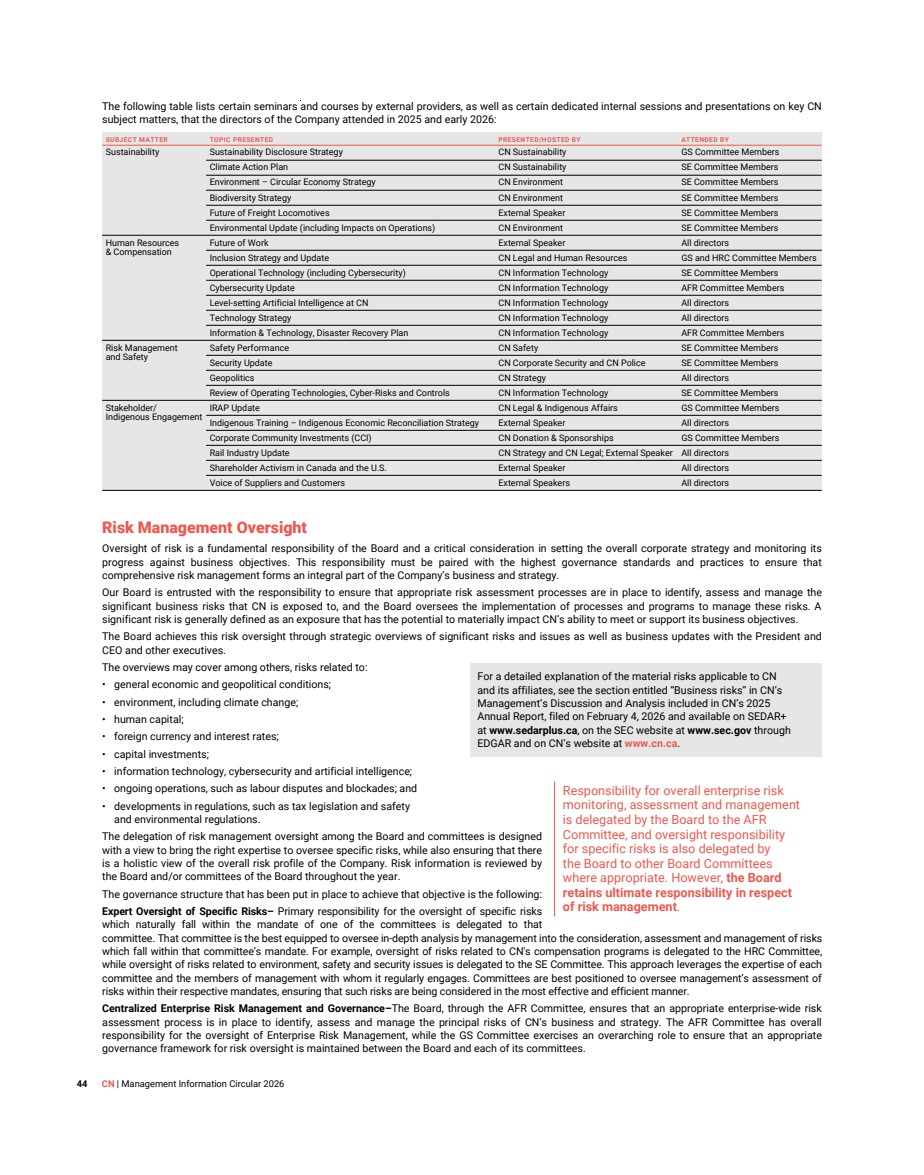
| The AFR Committee is responsible for ensuring that significant risks are appropriately identified, considered, assessed and monitored by management on an ongoing basis and that effective processes are in place to mitigate potential risk exposures. In addition, the AFR Committee oversees the effectiveness of CN’s internal control environment and reviews reports from internal and external auditors. The AFR Committee is provided with a holistic view of CN’s risk profile through regular reporting by management. The AFR Committee may also delegate oversight of specific risks to other committees where such committees possess the most relevant expertise. This delegation structure enables the AFR Committee to maintain a comprehensive, and enterprise-wide perspective on corporate risks, including their potential interdependencies and cumulative impact on CN’s business and strategic objectives. The GS Committee works with the AFR Committee to support effective and coordinated risk oversight across the Board and its committees. Overall Board Strategy–The Board is responsible for establishing CN’s strategic direction and monitoring its progress towards achieving its objectives. An integral component of this responsibility is the consideration of CN’s risks and opportunities. While ongoing oversight of the Enterprise Risk Management is delegated to the AFR Committee, the Board satisfies itself as to the effective oversight of risk management through periodic reporting from the Chair of the AFR Committee and other committees of the Board which have been delegated responsibilities for specific risks. This ensures that the directors remain adequately informed of the principal risks facing CN and facilitates informed discussions with management regarding the pursuit of strategic opportunities while effectively managing associated risks. Periodic reporting by the Chair of the AFR Committee to the Board on the Company’s risk profile and Enterprise Risk Management Program also support the accuracy, timeliness and completeness of CN’s public disclosures. Ultimate Responsibility Board of Directors Ultimately responsible for risk management Overall Oversight Responsibility AFR Committee Responsible for overall enterprise risk monitoring, assessment and management and the identification of major risk exposures and oversight of specific risks including: non-operating information technology, insurance, cybersecurity and data governance, pension, investments, financial risks and fraud. Specific Oversight Responsibility GS Committee Oversees and monitors management’s assessment of major risk exposure relative to: • Compliance with laws and regulatory requirements • Government and public policy • Reputation • Human and social rights • Activism • Sustainability • Ethics • Governance and ethics practices relating to the use of artificial Intelligence The GS Committee also works with the AFR Committee to ensure the proper governance framework of CN’s ERM program SE Committee Oversees and monitors management’s assessment of major risk exposure relative to: • Environment • Climate • GHG emissions reduction • Biodiversity • Operating Technology • Safety • Security HRC Committee Oversees and monitors management’s assessment of major risk exposure relative to: • Executive management • Human resources • Compensation • Talent • Succession • Culture Reporting Responsibility Management Reports to the Board and the committees on key risk areas CN | Management Information Circular 2026 45 |
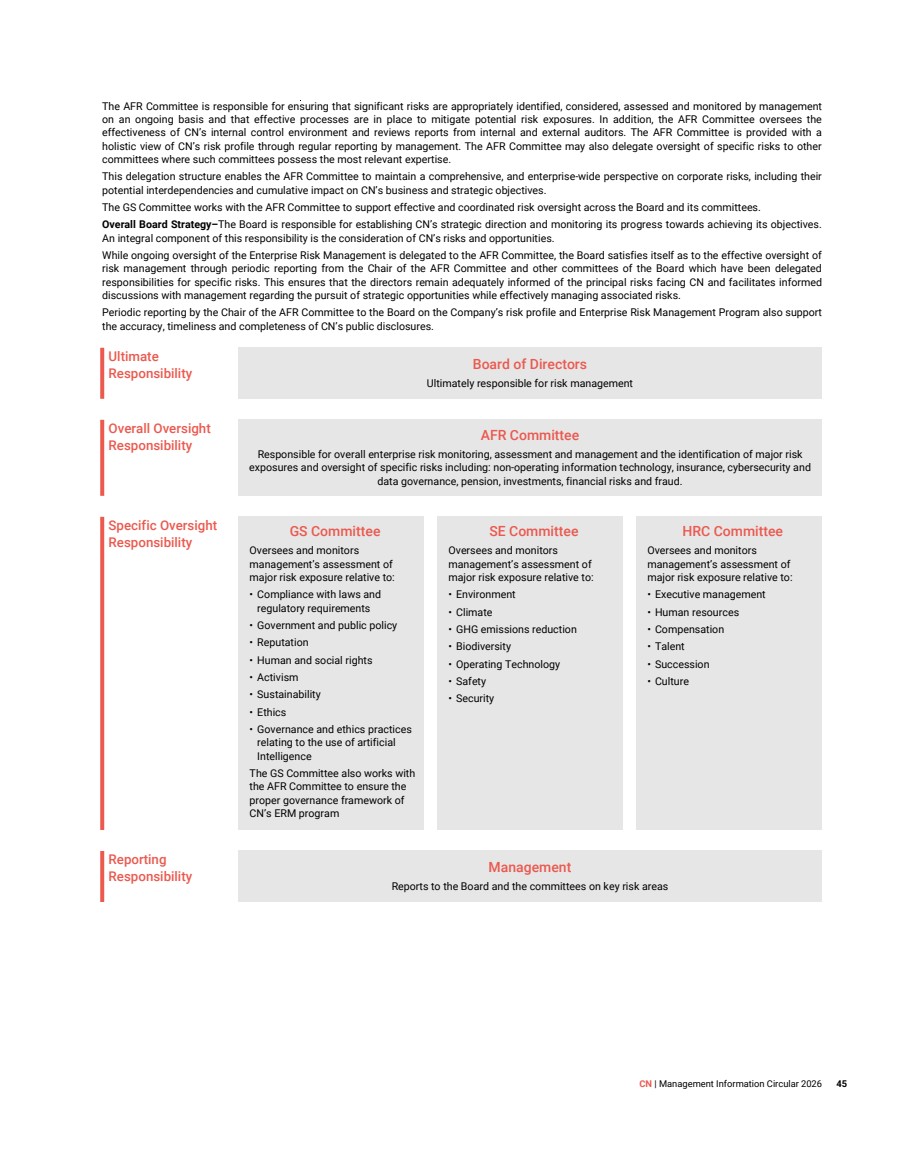
| Cybersecurity and Artificial Intelligence Oversight The Board is responsible for CN’s overall strategic plan, taking into account evolving business conditions, including opportunities and risks arising from emerging trends and technologies, such as artificial intelligence. While the use of artificial intelligence is not currently material to CN’s operations, the Board, through its committees as appropriate in accordance with their respective mandates, regularly reviews, monitors and evaluates technological advancements and initiatives, including artificial intelligence and other digital transformation initiatives, that could be relevant to CN and the rail industry. Many aspects of technology oversight are already explicitly addressed in the mandates of the Board and the committees to which the Board has delegated certain responsibilities to enable more efficient oversight and time allocation. The AFR Committee is responsible for overseeing the management of cybersecurity risks and ensures that our cybersecurity programs and initiatives are appropriately resourced and managed by qualified leadership. Given the unique profile of AI-related technology and its related risks, a specific reference to the GS Committee mandate was added in 2025 to clarify that it is charged with the review and assessment of the governance and ethics practices and policies relating to the use of artificial intelligence, as well as related risks and opportunities. The GS Committee also has oversight responsibility for reviewing the board’s knowledge and skills for oversight of technology, including artificial intelligence, and ongoing training and education programs. The SE Committee reviews and receives reports on advancements in operating technology and initiatives relevant to safety or security matters, including opportunities and risks to CN’s business of adopting or exploring such technologies or initiatives, which could include the adoption and use of artificial intelligence related software and systems. The Board and its committees, as appropriate, are also periodically updated on material technological advancements, risks and opportunities that could impact or be relevant to CN. For example, regular cybersecurity risk updates (including updates on CN’s cybersecurity risk mitigation activities) and updates on evolving cybersecurity-related regulations are provided to the AFR Committee and the SE Committee. Our internal audit team, which reports to the AFR Committee, also develops an internal audit plan which covers cybersecurity-related topics. For more details on relevant presentations received throughout 2025, please refer to page 44 of this Information Circular. CN has not been subject to any material cyber attacks to date. We are nonetheless mindful of the increasing threat of cyberattacks and increasing risk of other cybersecurity incidents (whether accidental or malicious) which may impact CN or any of our third-party vendors and service providers, and of the potential adverse effects that the occurrence of such cyber events can have on our business and operations. Cybersecurity risk oversight and mitigation remains one of our key areas of focus, and we have invested, and continue to invest in, technology security initiatives which include security testing, cybersecurity incident readiness and response programs, employee communication and training, and other security and mitigation programs to meet evolving network and cybersecurity expectations and regulations and to mitigate evolving cybersecurity-related risks. Notably, we emphasize cybersecurity awareness by requiring new employees to complete cybersecurity training as part of their onboarding program, and by providing recurring cybersecurity-related training to employees. Grow our People We recognize the importance of creating a safe and rewarding work environment that welcomes the uniqueness of every employee. We value the development of a workforce of top-talent that reflects the population and stakeholders we serve, and we strive to foster a culture of inclusion where everyone can thrive and be recognized for their contributions toward our success, at all levels within CN. We are undertaking various initiatives aimed at building an inclusive workforce and a rewarding working environment, where every employee feels physically and psychologically safe, while creating value for stakeholders, including: • building on inclusion fundamentals by addressing challenges and creating a roadmap for execution of a revised multiyear inclusion strategy and vision; • running regular reviews of pay and taking proactive steps to review pay and processes to ensure equal pay; and • developing inclusive leaders through training and education, as leaders will be critical in creating and sustaining an inclusive environment. These initiatives are supported through involvement by CN executive management and the Board. Canadian disclosure requirements In accordance with applicable Canadian securities laws and disclosure requirements under the CBCA, reporting issuers such as CN are required to provide disclosures in their information circulars relating to their policies on and levels of representation of under-represented groups (being women, visible minorities, persons with disabilities and Indigenous peoples) on their boards of directors and in senior management positions. CN has adopted a Policy on Inclusion and Diversity with Respect to Director and Executive Management (Diversity Policy) which sets out our goals and strategy for providing equal access to opportunities in an inclusive working environment for all, including Board members and employees, throughout the various stages of their CN journey. The Board, together with the GS Committee and the HRC Committee, regularly reviews this strategy, and annually assesses its effectiveness by evaluating the progress made towards achieving our goals, keeping in mind the importance of remaining aligned with our business strategy and creating value for our shareholders. The table provided herein sets out the current levels of representation of under-represented groups on our Board and in executive management positions, as required in accordance with applicable Canadian corporate and securities laws. It is derived from self-reported information provided by the directors and executive management. In accordance with privacy legislation, such information was collected on a voluntary basis, and where a particular individual chose not to respond, CN did not make any assumptions or otherwise assign data to that individual. 46 CN | Management Information Circular 2026 As at March 9, 2026 CURRENT DIRECTORS (1) EXECUTIVE OFFICERS (4) EXECUTIVE MANAGEMENT Women 7 (58%) 3 (38%) 9 (35%) Visible Minorities 2 (17%) (2) – 3 (12%) Indigenous peoples – – – Persons with Disabilities 1 (8%) – 2 (8%) 2SLGBTQIA+ (3) – – – Total 12 8 26 (1) All current directors (including our President and CEO) with the exception of Ms. McKenzie are standing for re-election at the Meeting. (2) Both members of the Board who self-identify as visible minorities are also women. (3) We define members of the 2SLGBTQIA+ community as members of the two spirit, lesbian, gay, bisexual, transgender, queer, intersex and/or asexual community. (4) The executive officers are a subset of the executive management team comprising 8 positions. In an increasingly complex global marketplace, the ability to draw on a wide range of viewpoints, backgrounds, skills, and experience helps us better understand and respond to the needs of our stakeholders and is critical to the Company’s success. |
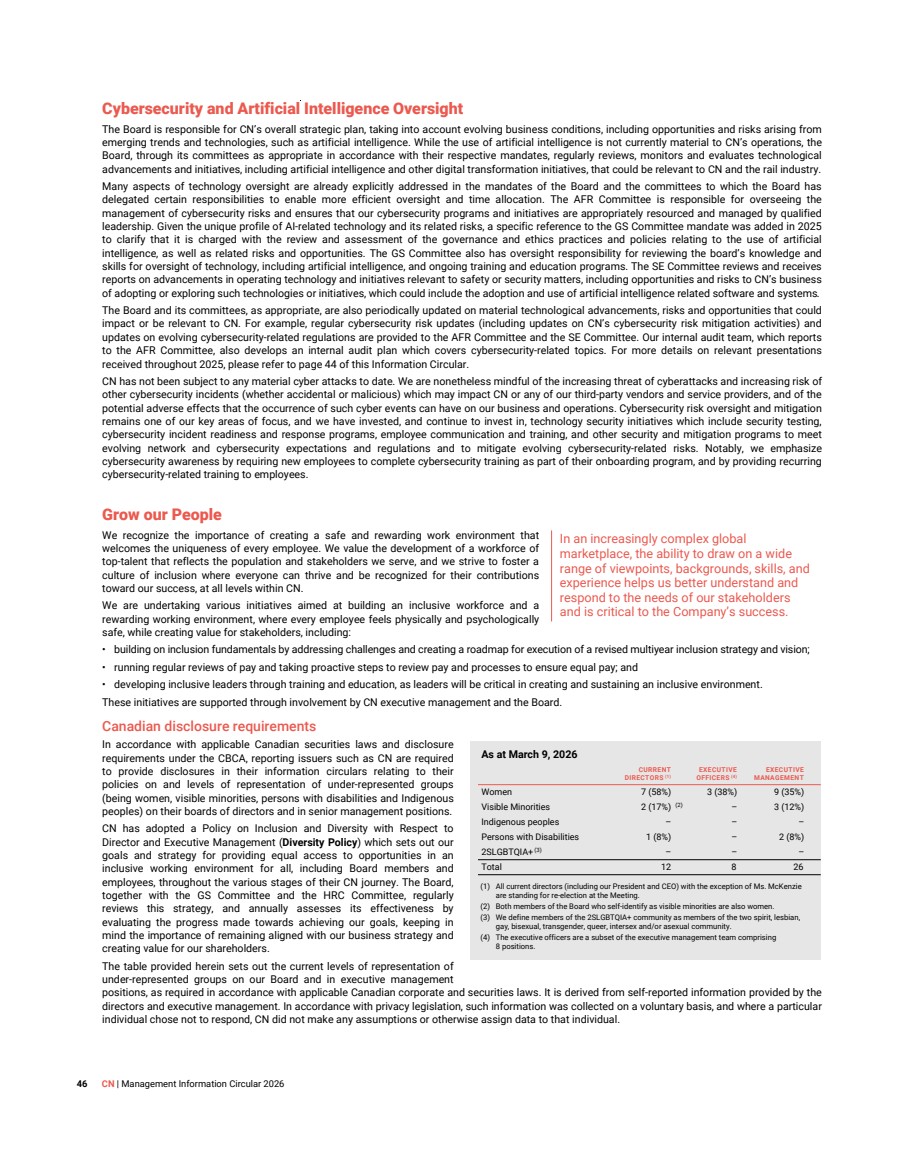
| Board of Directors CN aspires to maintain a highly qualified Board in which independent Board members are comprised of at least 40% of men and women, respectively, and at least two members come from the broader under-represented groups, beyond gender. Currently, five out of 10, or 50% of independent Board members are women and two, or 20% of independent Board members are from the broader under-represented groups, beyond gender. If all of the nominees presented for election at the Meeting are elected to the Board, we will continue to achieve our goals. The GS Committee, in consultation with the Board Chair, is responsible for recommending highly-qualified individuals to serve on the Board who will contribute to enriching discussions as well as effectiveness in decision-making and advisory functions. More detail on our director selection and evaluation processes can be found in the “Board of Directors Governance–Board Renewal and Director Selection” and “Board of Directors Governance– Board Performance Assessment” sections of this Information Circular. Executive Management CN aspires to attain by 2027, and thereafter maintain, an executive management team (Vice-President and more senior positions) in which at least 35% are women. At present, of the 26 members of executive management, nine (35%), including our President and CEO, are women (compared to 10 out of 32 members of executive management, or 31%, as at March 10, 2025). We intend to maintain our standards of hiring and promoting based on merit while working towards achieving our aspirations as to representation in a safe, inclusive and rewarding workplace for all. We aspire to achieve our goals by focusing on the identification, assessment, and development of talent, to ensure that we have potential successors at the executive and management levels representing diverse backgrounds and experiences. The HRC Committee is responsible for considering candidates for executive management appointments that possess the high qualifications, competencies, experience, leadership skills and level of commitment required to fulfill executive functions. In this regard, the HRC Committee regularly reviews CN’s integrated approach to executive and high-potential talent management, leadership development and succession planning. We currently have not adopted specific representation goals beyond gender for executive management. However, we will continue to use the established labour market availability numbers in each province or state as our baseline ambition to measure progress. We define labour market availability as “the share of designated group members in the workforce from which the employers could hire”. Stakeholder and Indigenous Engagement Given the diverse mix of customers and geographies that we serve, our physical presence in communities across North America, and our essential role in powering the economy, we recognize the importance of regularly engaging with our stakeholders (including shareholders, employees, and community groups) and with Indigenous communities along our network in Canada. Our Stakeholder and Indigenous Peoples Engagement Framework, which is overseen by the Board through the GS Committee, guides our approach to proactive, consistent, collaborative and authentic engagement, and in 2025, we further solidified our approach to engagement with Indigenous Communities across our network in Canada with the first implementation year of our Indigenous Relations Policy and our Indigenous Reconciliation Action Plan (IRAP) published in 2024, as further described in this section. In addition to the initiatives described throughout this section with respect to shareholder engagement, Indigenous engagement and community engagement, in 2025, the Company continued its engagement activities by: • engaging with all levels of government as a participant on advisory councils, review boards and regulatory proceedings, • conducting community outreach through regular meetings and event sponsorships, • working collaboratively with supply chain partners, • participating in industry associations (Railway Association of Canada (RAC) and Association of American Railroads (AAR)), • engaging with suppliers at our annual supplier council and through our Sustainable Procurement Excellence program, • strengthening our relationships and improving our communication with customers, • ensuring the opportunity for regular two-way communication with employees, and • addressing regional concerns and unlocking growth opportunities proactively as part of a structured community engagement program. CN | Management Information Circular 2026 47 |
| Shareholder Engagement CN recognizes the importance of consistent year-round engagement with shareholders as a pillar of our corporate governance practices. We value regular, direct dialogue with our shareholders to better understand their perspectives, exchange views on current and emerging issues, and inform CN’s strategic, operational and governance decision-making. Our Investor Relations team is responsible for communicating with the investment community on behalf of CN and actively engages with shareholders, institutional investors, sell-side analysts and potential investors. The Board Chair and the Chair of the HRC Committee also participate regularly in engagement meetings with shareholders. CN engages, as appropriate, with proxy advisory firms, credit rating agencies, ESG raters and rankers, and shareholder advocacy groups. Oversight of CN’s shareholder engagement practices is provided by the GS Committee and the Board, as part of our overall corporate governance program. Feedback from shareholder engagement is regularly shared with management, the Board, and its committees, and is taken into account in our strategy and decision-making processes. Topics Discussed Over the last 12 months, CN’s Board Chair and other Board members, CN executives and the Investor Relations team engaged with our shareholders on various topics, including: • Long-term strategic agenda, • Financial and operating performance and outlook, • Strategic capital allocation, • Economic and trade matters, • Industry structure and competitive dynamics, • Governance matters, such as executive compensation and succession planning, and • Sustainability priorities and Indigenous relations. How we Engage CN engages with shareholders through a variety of channels to support regular and constructive dialogue: • Earnings calls: Quarterly engagement with the investment community led by CN executives; • Non-deal roadshows: Ongoing in-person and virtual meetings with institutional investors throughout the year by CN executives and the Investor Relations team; • Sell-side conferences: Participation by CN executives at industry investor conferences, including public speaking and one-on-one in‑person and group meetings; • Board-level engagement: Direct engagement led by CN’s Board Chair and the HRC Committee Chair with top shareholders; and • Investor meetings: One-on-one and group meetings with shareholders and prospective investors involving CN’s President and Chief Executive Officer, Executive Vice-President and Chief Financial Officer and other executive officers. Quarterly earnings calls and investor conference presentations are webcast and available to listen to live via CN’s website at www.cn.ca, under “Investors/Financial Results”. 2025 Shareholder Engagement Highlights Participated at 11 sell-side analyst conferences, meeting with 240 investor firms Conducted 18 in-person investor events (non-deal roadshows, sell-side facility tours, inhouse Management meetings), hosting 170 investor firms Held 270 virtual investor calls, including 30 calls touching on sustainability and/or governance In 2025, CN executives and our Investor Relations team met over 50 of our top 100 institutional investors, representing approximately 50% of our total shares outstanding. Investor Relations Contacts We have in place various means of communication for receiving feedback from interested parties, such as a toll-free number for general inquiries (1-888-888-5909). Shareholders can also reach out to our investor relations team and other investor contacts in accordance with procedures described on our website at www.cn.ca, under “Investors/ Investor Contacts”. Shareholders and other interested parties may also communicate with the Board and its Chair by calling 1-514-399-6544. The Board also has procedures allowing interested parties (i) to submit accounting and auditing complaints or concerns to us and (ii) to communicate directly with the Chair of the Board, who presides over all independent director sessions. These procedures are described on our website at www.cn.ca, under “Delivering Responsibly/Governance”. Indigenous Engagement CN’s approach to reconciliation is grounded in collaboration, dialogue, and accountability. Following the 2023 acknowledgment of the historical role railways played in colonial policies and their lasting impacts on Indigenous communities, CN launched, in 2024, its first Indigenous Relations Policy and its IRAP to guide its actions from 2025 to 2027. 48 CN | Management Information Circular 2026 In 2025, CN continued its Indigenous Relations initiatives by: • facilitating more than 500 meetings and consultations with Indigenous partners; • participating in over 240 Indigenous community events; • delivering more than 15 in‑person training sessions on rail safety, spill drills, and emergency response; • more than 170 sponsorships and donations to Indigenous communities and organizations. |
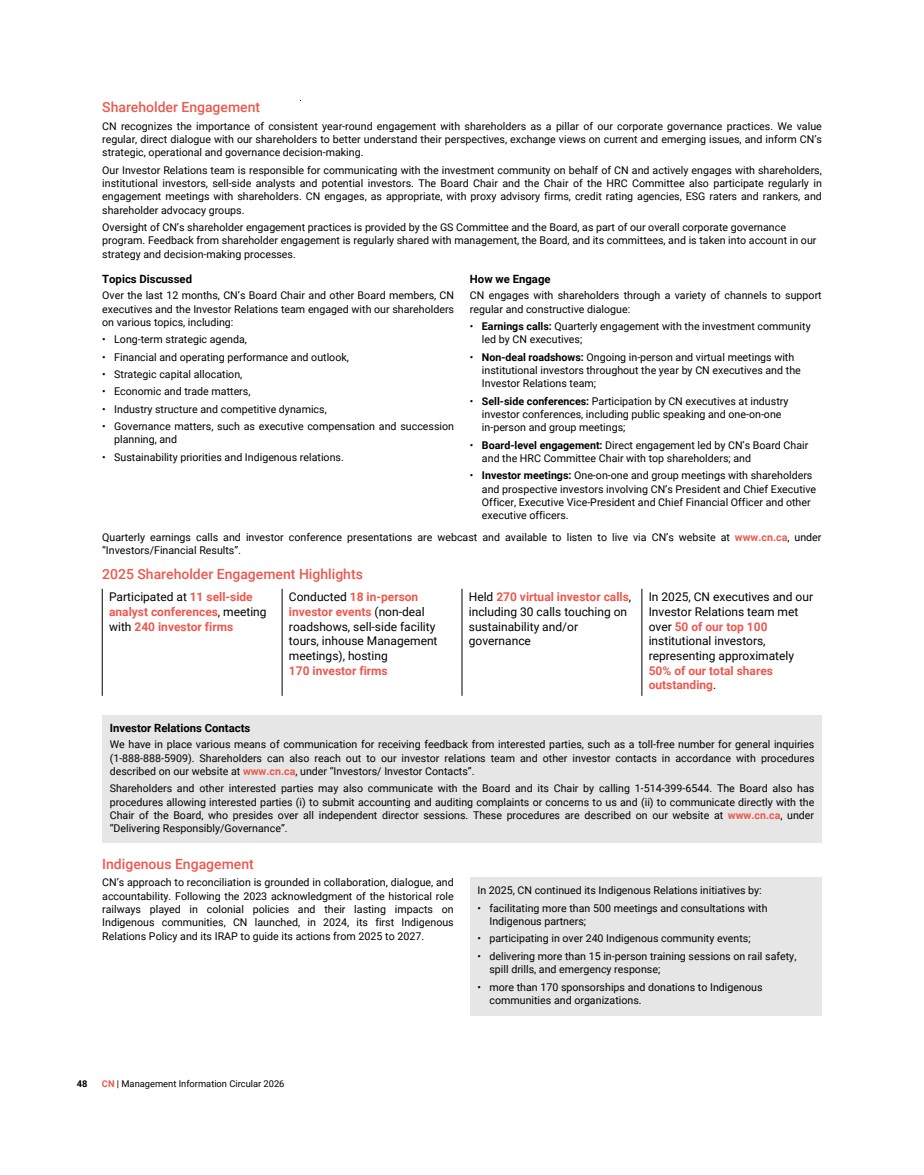
| At CN, reconciliation is woven into our business through inclusive partnerships, respectful engagement, and sustainable economic participation. Building on years of engagement and cultural awareness efforts, CN has strengthened this approach through expanded community collaboration, enhanced training, and reinforced internal governance processes that support measurable and long‑term progress. The IRAP provides additional structure and momentum to this work, guiding departments across the Company in translating commitments into tangible outcomes and ensuring that operational decisions reflect reconciliation objectives. In recent years, CN has advanced several initiatives, including expanding Indigenous participation in rail safety and emergency response training, increasing opportunities for Indigenous businesses within our supply chain, improving access to information through new communication tools, and deepening consultation and relationship‑building activities across our network. Delivering on the IRAP represents only part of CN’s broader reconciliation efforts. Throughout the year, the Indigenous Relations team facilitated more than 500 meetings and consultations with Indigenous partners, including eight formal consultation processes on key projects. The team also actively participated in over 240 Indigenous community events and delivered more than 15 in‑person training sessions on rail safety, spill drills, and emergency response. Community support remained a priority, with more than 170 sponsorships and donations to Indigenous communities and organizations, complemented by strong cross‑departmental participation in sponsored initiatives. Together, these actions demonstrate CN’s commitment to continuous learning, shared progress, and a constructive, long‑term approach to Indigenous relations. CN remains focused on advancing reconciliation through consistent engagement, transparent reporting on both progress and challenges, and a company‑wide culture of respect, understanding, and accountability. For more information on CN’s Indigenous Relations activities, including our Indigenous Relations Policy and IRAP, please visit www.cn.ca/en/delivering-responsibly/community/indigenous-relations/. Community Engagement CN is fully integrated with the communities we serve. Our reputation is our most valuable asset, and we continuously strive to be good neighbours who listen, learn, and do their part to help build safer, stronger, more prosperous communities. As such, we engage across a wide spectrum of initiatives with the aim of fostering two-way communication with community members and ensuring respectful and beneficial exchanges. CN’s Stakeholder Relations and Indigenous Relations teams play an integral role in keeping CN connected to regional issues and ensuring we participate in and support impactful community partnership programs that align with local needs. The Stakeholder Relations and Indigenous Relations teams represent CN at various business events and conferences, such as the Federation of Canadian Municipalities’ Annual Conference and Trade Show, and the Assembly of First Nations Annual General Assembly, where they engage directly with key stakeholders and with Indigenous communities in Canada. Community Safety As part of our year-round effort to save lives and promote safe behaviour around railroad infrastructure, the CN Police Service actively works in communities across our network, including by conducting enforcement initiatives with external agencies at locations prone to incidents and delivering safety presentations to high-risk groups such as youth and commercial drivers. We also regularly share information on crossing safety, corridor risk assessments and dangerous goods traffic with municipal officials and local emergency responders. Corporate Philanthropy Through strategic partnerships with nonprofit organizations, we lead philanthropic initiatives that reinforce CN’s values, elevate our brand, and strengthen connections between railroaders as well as the communities in which we operate. We give because we believe in building safer, more resilient communities; creating opportunities; responding to local needs; and driving meaningful, lasting change. Our approach aligns with CN’s long-term vision. In 2025, guided by our Corporate Giving pillars — Safety, People, and Environment — CN contributed $18 million to more than 700 charities across our North American network. Safety People Environment We built partnerships with 100 safety-focused charities dedicated to protecting vulnerable individuals, restoring dignity and hope for people experiencing or at risk of homelessness, supporting food security and services for survivors of gender-based violence, and strengthening public safety and community resilience. We supported 492 people-focused charities across North America in 2025. This includes 40 health and wellness organizations, such as pediatric hospitals and cancer care services; 42 education partners advancing youth development and skills training across Canada and the United States; and multiple initiatives empowering employees to build community partnerships that drive meaningful change. We partnered with 27 organizations dedicated to protecting the natural environment across North America. These partnerships helped address the impacts of climate change through native tree plantings, habitat restoration, climate education, and sustainable community projects. Across all pillars, our work in 2025 was grounded in intentionality, collaboration, and measurable outcomes. We focused on building long-term partnerships rather than one-time contributions, integrating employee engagement wherever possible, and ensuring our investments responded to real, local needs. By aligning funding, expertise, and local relationships, we strengthened our ability to support communities in ways that are both meaningful and sustainable — while reinforcing CN’s role as a responsible corporate citizen across our network. At the same time, we continued to evolve our corporate giving strategy by enhancing governance, sharpening our focus, and laying the foundation for measurable impact. These efforts reflect a long-term commitment to learning, accountability, and continuous improvement, ensuring our philanthropy delivers enduring value today and into the future. For more information on our Community Engagement initiatives, please refer to our website at www.cn.ca under “Delivering Responsibly/ Community”. CN | Management Information Circular 2026 49 |
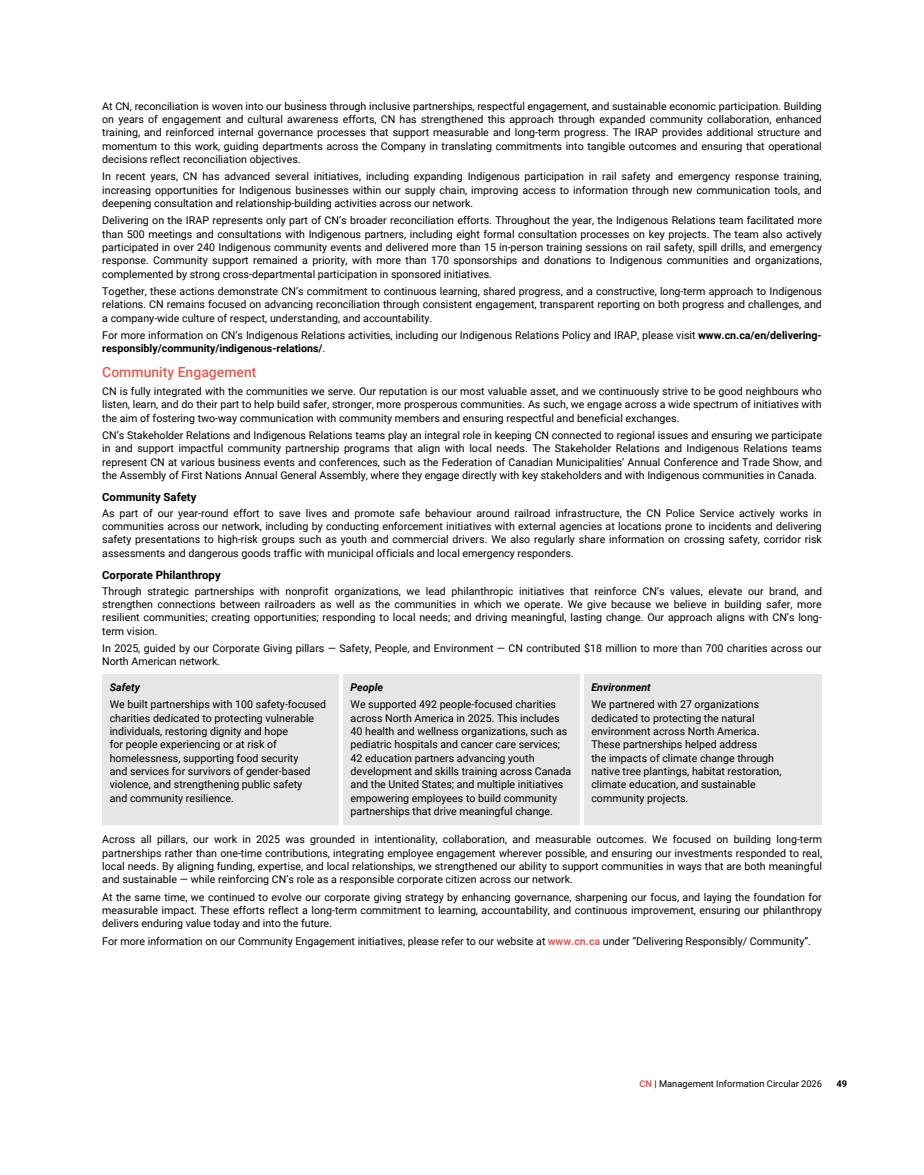
| Our Sustainability Commitments Delivering Responsibly is at the heart of how CN is building for a sustainable future. At CN, our vision is to be the safest and most operationally effective, customer-centric and efficient railroad in North America. Our sustainability vision is anchored on five principles: Environment Conduct our operations in a manner that seeks to minimize our environmental impact, while providing cleaner, more sustainable transportation services to our customers. Safety Strive to be the safest provider of transportation services in North America by fostering a culture of safety excellence. People Provide a safe, supportive and inclusive work environment where our employees can grow to their full potential and be recognized for their contributions to our success. Community Build safer, stronger communities by investing in development, creating socioeconomic benefits, and ensuring open dialogue with all stakeholders and Indigenous peoples. Governance Continuously improve our culture of integrity and ethical business conduct, building trust and confidence with all stakeholders and Indigenous peoples. Our Approach to Sustainability Our approach to sustainability disclosure aligns with international standards, including the Global Reporting Initiative, the World Bank Mobility Goals, and the Greenhouse Gas Protocol, as well as recommendations from the Sustainability Accounting Standards Board (SASB) and the Task Force on Climate-related Financial Disclosures (TCFD), now both managed under the International Sustainability Standards Board (ISSB). Transparency regarding climate-related risks and opportunities is critical to maintaining the trust of our stakeholders and allows our investors to better understand the implications of climate change on our business. Our detailed reports, including those published in 2025, can be found on CN’s website at www.cn.ca under “Delivering Responsibly”. Our approach to sustainability is also aligned with the United Nations Sustainable Development Goals (SDGs). While we aim to contribute directly and indirectly to each of the 17 SDGs, a detailed consideration of the indicators and metrics that comprise the SDGs’ framework has helped us identify eight SDGs upon which we believe we can have the greatest impact and align with our five principles of Delivering Responsibly. The selection of these SDGs is also based on the principles of materiality and stakeholder inclusiveness, to prioritize the topics that matter most to our business and our stakeholders. We recognize that our climate is changing, and that businesses must not merely adapt, but be part of the solution. As a mover of the economy, CN is committed to playing a key role in the transition to a low-carbon economy. CN has been making a positive contribution in the fight against climate change by offering efficient transportation solutions to our customers. With 85% of our Scope 1 GHG emissions generated from rail operations, we believe the best way to reduce our GHG emissions footprint is by continuously improving our rail efficiency. Since 1993, we have reduced our rail locomotive GHG emissions intensity by 48% and we remain a leader in locomotive fuel efficiency among Class I North American railways, consuming approximately 15% less locomotive fuel per gross ton mile than the industry average. The graph below illustrates the improvement of CN’s locomotive GHG emissions intensity since 1993. We recognize that rail has a tremendous potential to reduce the environmental impact of transportation services and we are actively working with many of our customers to help them reduce their transportation supply chain GHG emissions intensity, by leveraging rail for the long haul and trucking over shorter distances. Shipping heavy freight by rail can reduce GHG emissions by up to 75% when compared to trucks. The greater use of combined transportation modes helps lower emissions intensity by allowing each mode to be used for the portion of the trip to which it is best suited. It also helps reduce road traffic congestion, accidents and the burden on public transportation infrastructure. Our strategy to reduce our Scope 1 and 2 emissions intensity will help the Company maintain its position as a key enabler of supply chain decarbonization. In turn, these activities will help contribute to reducing the Scope 3 emissions of our customers. We support the practice of disclosing high-quality climate-related financial information and were the first North American railroad to formally support the TCFD recommendations in 2020. Our approach to sustainability and climate-related reporting incorporates four core elements comprising the TCFD framework: Governance, Metrics and Targets, Strategy, and Risk Management. An index of our conformance to TCFD is part of our 2025 CDP Corporate Questionnaire. Our approach under each of these elements is outlined hereinafter. Decoupling Growth from GHG Emissions GHG Emissions Intensity vs. Gross Ton Miles (GTMs) 50 CN | Management Information Circular 2026 Climate Action Plan Report |
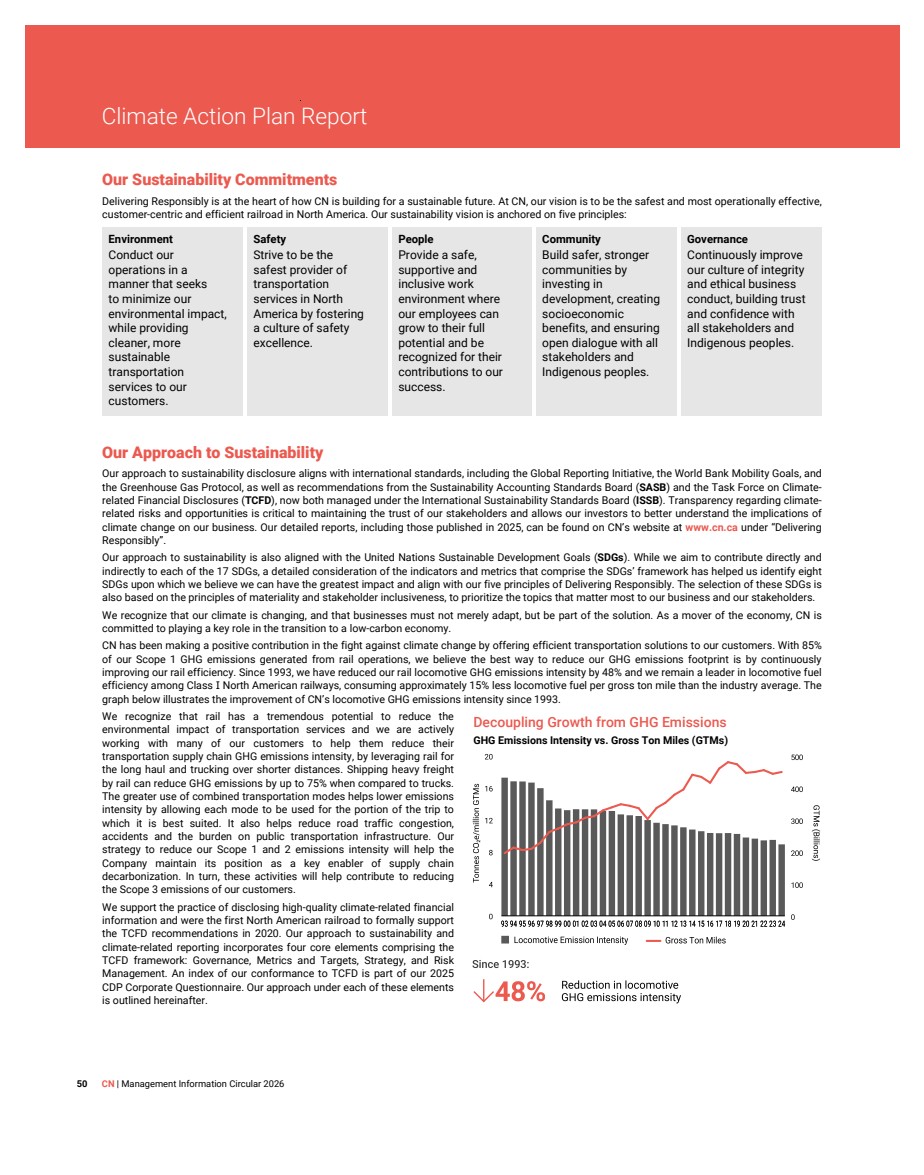
| Governance The Board, through the GS Committee and the SE Committee, has the highest level of responsibility for our sustainability and environmental performance, policies, and practices, including CN’s Climate Action Plan. They are also responsible for the monitoring of CN’s progress against the goals set under such plan, and all related climate matters and risk exposures relating to climate change. The Board has delegated the responsibility for overseeing CN’s overall sustainability framework and the development and implementation of CN’s global sustainability policies and practices to the GS Committee. This responsibility includes assessing and monitoring CN’s key sustainability metrics and goals and reviewing progress against them, as well as key sustainability disclosures and ratings. The GS Committee also has oversight of regulatory and reporting risks, including as it relates to climate matters. Responsibility for the specific oversight of safety and environmental matters, including climate change, has been delegated to the SE Committee. The SE Committee is responsible for overseeing the development and implementation of CN’s environmental and climate change strategy, including its GHG emissions reduction goals and actions, as well as climate change adaptation and resiliency. The SE Committee reviews CN's Climate Action Plan (including the goals set under the plan, its strategy for meeting them and its progress towards achieving them) at least annually. The SE Committee also oversees management's assessment of the major risk exposures, strengths and opportunities associated with the environment. The AFR Committee has centralized responsibility for the overall oversight of enterprise risk management of CN. The Board ensures that the skillset developed by directors through their business expertise, experience and training meet its needs for the oversight of CN’s business and strategic direction. Board members have access to education and information on an ongoing basis; in 2025, an external speaker provided a presentation on the future of freight–specifically, on hybrid locomotive technologies, an opportunity to reduce our emissions intensity, as further described hereinafter–to all Board members. The competency matrix reviewed by the GS Committee and the Board as part of their annual review of the credentials of nominees for election or re-election as members of the Board includes consideration of climate change knowledge. CN’s Executive Vice-President and CFO and its Senior Director Sustainability, who have direct overall responsibility for CN’s sustainability strategy (including the Climate Action Plan) and who are responsible for sustainability and climate-related issues, provide executive oversight. CN’s senior management and executive compensation policies and programs are designed to ensure there is a clear link between the Company’s long-term strategy, its business plan and executive rewards, thus encouraging appropriate behaviours. The attainment of three goals–environmental performance measured through locomotive GHG emissions intensity (a key contributor towards the achievement of our 2030 target, as hereinafter defined), employee engagement and customer centricity–are incorporated into the short-term incentive plan for senior management and executives. The 2025 annual incentive bonus program (AIBP) was based on CN’s performance against preset goals for three corporate components: 70% financial, 20% strategic and 10% safety, with the three strategic goals listed above each weighting 6.67% of the overall bonus target. Metrics and Targets (Science-Based Targets) As we prepare for the future, we are committed to improving our GHG emissions intensity consistent with stabilizing global temperatures. Our current 2030 target aligns to a well-below 2-degrees scenario. The SBTi approved CN’s 2030 target (2030 target) which reflects a commitment to reduce Scope 1 and 2 GHG emissions intensity by 43% by 2030 from a 2019 base year, and to reduce Scope 3 GHG emissions intensity from fuel- and energy-related activities by 40% by 2030 from a 2019 base year. In 2021, we announced our commitment to setting a net-zero 2050 GHG emissions ambition aligned to a 1.5-degree scenario (2050 target). In 2024, CN’s 2050 target was approved by the SBTi and seeks to have CN reduce its absolute Scope 1, 2, and 3 GHG emissions by 90% by the year 2050 from a 2019 base year. Progress Toward Our 2030 Targets (1) Progress Toward Our 2050 Ambition (1) (1) CN has committed to reduce its Scope 1 and 2 GHG emissions by 43% per gross ton mile by 2030 from a 2019 base year, to reduce its Scope 3 GHG emissions from fuel- and energy-related activities by 40% per gross ton mile by 2030 from a 2019 base year, and to reduce its absolute Scope 1, 2, and 3 GHG emissions by 90% by the year 2050 from a 2019 base year. Additional details on CN’s GHG emissions targets, including the full set of notes, are available in CN’s 2024 Data Supplement. (2) From fuel- and energy-related activities from locomotive, truck, and vessel fleets. CN | Management Information Circular 2026 51 |
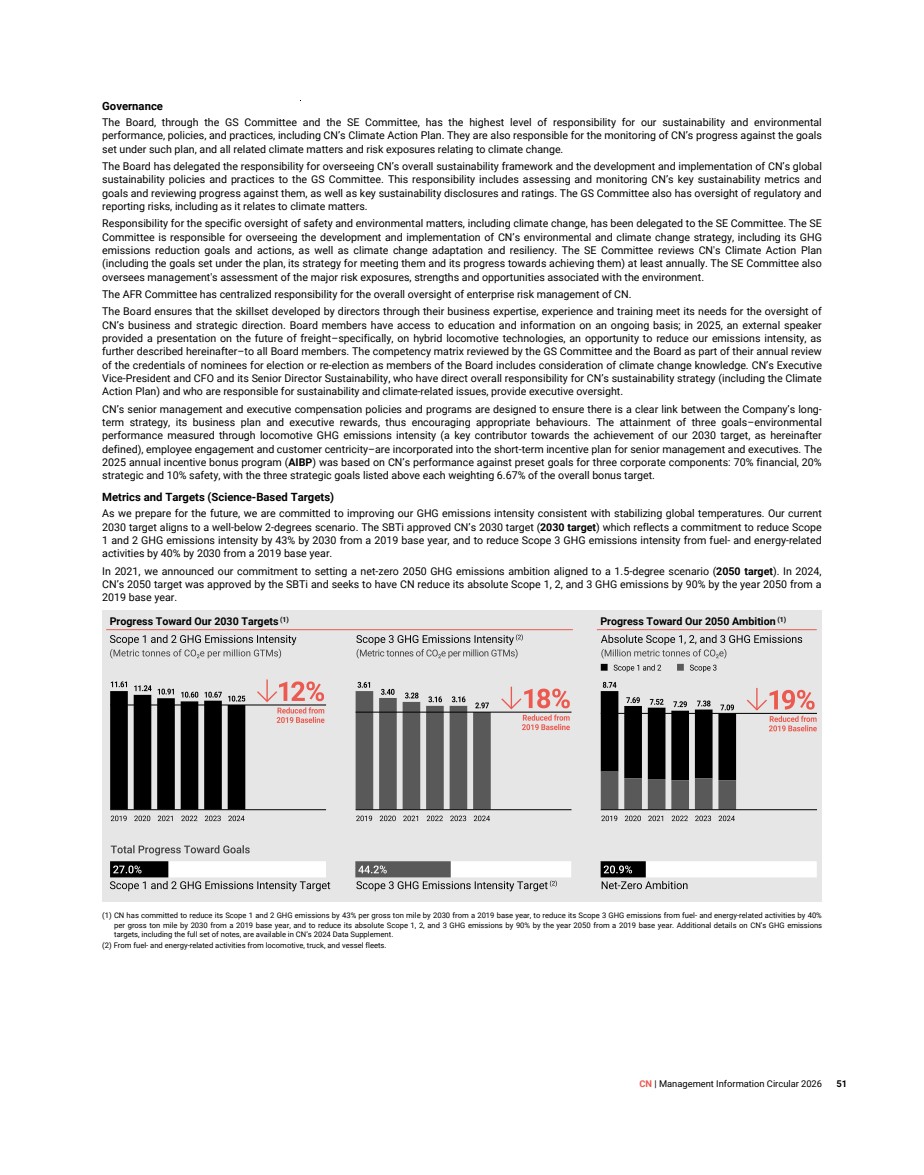
| Strategy Reducing Our Rail GHG Footprint With 85% of our Scope 1 GHG emissions generated from rail operations, we believe the best way to reduce our GHG footprint is by continuously improving our rail efficiency. As such, our 2030 target informs our climate transition plan and business strategy. To achieve our 2030 target, we are focused on five key strategic areas: Fleet Renewal: In 2025, we continued to renew our fleet to the most fuel-efficient high-horsepower locomotives currently available, receiving delivery of 67 units out of a multiyear modernization program, where existing locomotives from the CN fleet are upgraded with the latest technology, extending their life and enhancing fuel efficiency. Innovative Technology and Big Data: We continue to explore and invest in innovative technologies such as energy management and data telemetry systems as well as distributed power functionality, to help us maximize locomotive operating effectiveness and efficiency. Through these systems, we collect large amounts of data to help improve performance and fuel consumption. In addition, CN’s in-house Horsepower Tonnage Analyzer uses the data from the systems to optimize a locomotive’s horsepower-to-tonnage ratio, further minimizing fuel consumption. Operating Practices: CN continues to leverage real-time information on train operations, enabling on-the-job guidance on practices that reduce fuel consumption. In parallel, CN’s disciplined approach to capital allocation supports the safety of our network, improves efficiency and resilience, and enables growth. Capacity upgrades, including lengthening sidings and doubling sections of mainline track, allow us to drive fluidity in our busiest corridors, improving fuel efficiency. Investments in new equipment such as higher-capacity hopper cars also save fuel as such cars can carry more volume per train. Cleaner Fuels: The increased usage of renewable fuels (biodiesel and renewable diesel) between now and 2030 is the key strategic enabler for meeting our 2030 target. Canadian Federal Clean Fuel Regulations and other renewable and low carbon fuel standards in jurisdictions where CN operates will continue to present an important opportunity for us to further reduce our emissions intensity. Over the past few years, CN carried out trials and qualifications of renewable fuel blends, in partnership with locomotive manufacturers, fuel producers and other Class I railroads, allowing CN and the industry to better understand the long-term durability and operational impacts of renewable fuels on locomotives, especially in cold weather, and plan modifications, if any, to leverage their increased usage over the next decade. Overall, achieving our 2030 target is dependent on the availability of sufficient volumes of cost competitive renewable fuels which will require collaboration between locomotive manufacturers, fuel producers, and governments. This ecosystem of collaboration is a key area of focus and potential risk. In 2025, CN’s use of renewable fuels represented close to 12% of our locomotive fuel in the year. Reducing Our Non-Rail GHG Footprint Operating an efficient railroad extends to our non-rail operations, enabling further GHG emissions intensity reductions in our ground and vessel fleets, buildings and yards, through best practice initiatives, new equipment and technologies. We are taking concrete steps to reduce our non-rail GHG footprint, which comprises 15% of our Scope 1 and 2 GHG emissions, focusing on: Driving Ground Fleet Upgrades: Our non-rail ground fleet, comprising CNTL and TransX trucks, intermodal equipment, and On Company Service (OCS) vehicles, makes up 7% of our Scope 1 and 2 emissions. Over the past few years, we have focused on improving the fuel efficiency of these fleets while also increasing our use of renewable fuels. Our Trucking Operations teams continue to be trained on fuel efficiency, from the use of aerodynamic components on trucks to innovative routing optimization initiatives. We also continue to benefit from a driver-centric fleet management system, driving further gains with respect to fuel efficiency. In 2025, we trialed idle-suppression technology and continued to explore technologies and initiatives to drive further fuel efficiency gains. In our intermodal operations, we are exploring the use of renewable fuels and electrification to decarbonize mobile handling equipment, generators, and refrigerated units. We are now operating nine electric shunt trucks at our Brampton and Vancouver terminals, and will be piloting the use of an electric reach stacker in 2026. In 2025, we also installed electric plugs to supply power to refrigerated containers while in our Brampton terminal, reducing the requirement for diesel generators. Finally, we piloted the use of 100% renewable diesel at our Vancouver terminal in 2025. The result of these pilots and projects will inform future expansion to other parts of CN’s intermodal operations. In our OCS fleet, we are gaining valuable information as we continue to pilot five Ford F-150 Lightning trucks, and we will be launching an anti-idling technology pilot targeting light-duty vehicles in 2026. Retrofitting Yards and Buildings: Our CN EcoFund drives energy-efficient upgrades in our buildings and yards. We invest in retrofits to boilers, air compressors, HVAC systems, and LED lighting, enabling us to improve our energy efficiency and reduce costs. In 2025, we continued to deploy the energy-as-a-service business model, a comprehensive approach to reduce energy consumption without incurring upfront investments and realized expected energy savings on prior investments. Decarbonizing our Vessel Fleet: Our marine services extend beyond where track and trucks stop, offering marine shipping in regions like the Great Lakes. Our shipping fleets offer safe, and highly fuel-efficient fleet transportation services. Ship operators are trained on fuel conservation practices, including strict speed protocols and operating parameters resulting in further GHG emissions intensity reductions, and we are exploring the use of biodiesel. 52 CN | Management Information Circular 2026 |
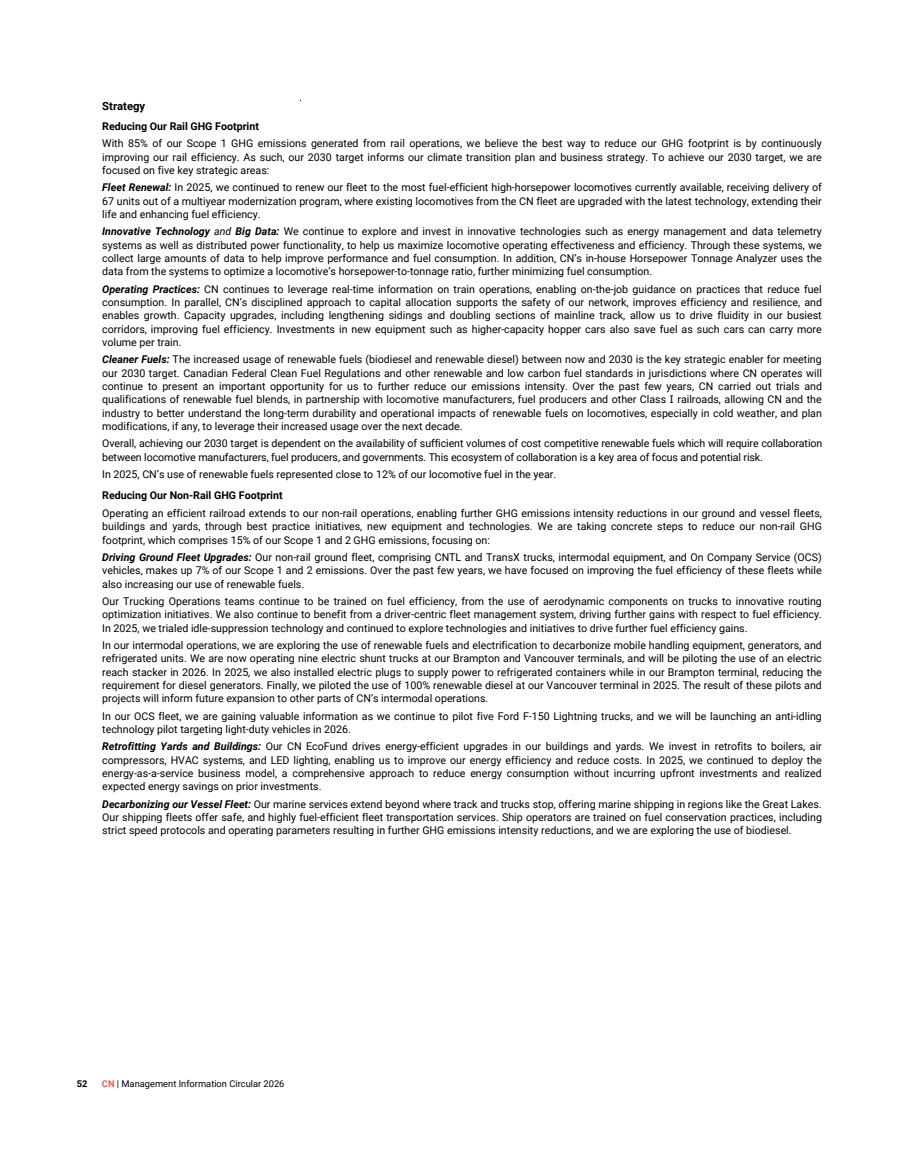
| Risk Management Climate change is integrated into our risk assessment processes, which consider both physical risks, including increased frequency or severity of temperature extremes, flooding and sea level rise, fires, droughts, hurricanes, and tornadoes, as well as transition risks, including legal, policy, technology and market impacts. The Board has ultimate responsibility in respect of CN’s risk management and has delegated to the AFR Committee the centralized responsibility for the overall oversight of the enterprise risk management framework of CN, which includes climate-related risks. The AFR Committee ensures that an appropriate risk assessment process is in place to identify, assess and manage significant risks to CN’s business and strategy, including climate risks. The AFR Committee is made aware of the work of the SE Committee and other committees through regular reporting so it can have a holistic view of the Company’s risks, including their potential interplay and/or cumulative effect on CN’s business and strategy. The GS Committee also works with the AFR Committee to ensure that a proper governance framework over risks is in place between the Board and each of its committees and that specific key risks, which naturally fall within the expertise or mandate of a committee, receive appropriate oversight within such committee. For more information on CN’s overall risk management framework, please refer to the section entitled “Risk Management Oversight” of this Information Circular. The SE Committee has been delegated the responsibility to oversee and monitor management’s assessment of CN’s major risk exposures related to the environment, including climate change, GHG emissions and GHG emissions intensity reduction, biodiversity, renewable fuels, and related operating technology initiatives. In 2025, the SE Committee oversaw and monitored management’s climate risk assessment, including physical risks of climate change, and mitigation controls, and reviewed initiatives to maintain progress towards its climate goals. In 2025, the AFR Committee reviewed management’s assessment of enterprise risks, including the identification of CN’s net risks related to physical and transition climate-related risks. Specifically, the AFR Committee reviewed management’s report to the SE Committee on the risks and opportunities associated with climate change, climate risk mitigation controls and initiatives to integrate climate risk management activities into the business plan. CN has identified six climate change risks and opportunities that could have a substantive effect on our direct operations as well as our upstream/ downstream value chain in the current reporting year, or may have an effect in the future. Please refer to our 2025 CDP Corporate Questionnaire report, which is available on our website at www.cn.ca, for additional information. Summary of Substantive Risks and Opportunities DRIVER IMPACT RISK OPPORTUNITY TIMEFRAME Acute Physical Extreme weather, flooding, and wildfires ✓ Short term Market Changing customer behaviour ✓ Medium term Policy Carbon pricing mechanism ✓ Long term Resource Efficiency Use of more efficient modes of transport ✓ Short term Products & Services Ability to diversify business activities ✓ Medium term Market Expansion onto new markets ✓ Long term Our Phased Approach to Decarbonize Our Activities CN is dedicated to achieving net-zero emissions by 2050. To achieve its decarbonization goals, CN will need to continue improving the fuel efficiency of its fleets, increase its use of renewable fuels as well as test, and eventually deploy, alternative propulsion locomotive technologies. Through a phased approach, CN is focusing its efforts on key levers having the highest potential impact on meeting its 2030 and 2050 targets, recognizing the key dependencies in place, working to better understand and address them where appropriate. Summary of Focus Areas for Scope 1 and 2 GHG Emissions and Emissions Intensity Reductions CATEGORY % OF SCOPE 1&2 GHG EMISSIONS KEY LEVERS DESCRIPTION POTENTIAL IMPACT KEY DEPENDENCIES (1) (NON-EXHAUSTIVE LIST) Rail Locomotives (Scope 1) 83% Driving operational efficiency • Locomotive fleet renewal • Innovative technology and big data • Operating practices Medium • Technology availability, maturity, and cost • Operating conditions Transitioning to cleaner energy sources • Biodiesel and renewable diesel High • Availability and cost of renewable fuels • Regulatory environment • Approval for equipment Advancing technologies • Alternative low-carbon technologies for our 2050 ambition High • Technology availability, maturity, and cost • Infrastructure readiness • Sourcing constraints Non-Rail Operations (Scope 1) 15% Driving operational efficiency • Ground fleet upgrades • Innovative technologies • Operating practices Medium • Technology availability, maturity, and cost • Operating conditions Transitioning to cleaner energy sources • Biodiesel and renewable diesel Medium • Availability and cost of renewable fuels • Regulatory environment • Approval for equipment Facilities (Scope 2) 2% Driving operational efficiency • Retrofitting yards and buildings Low • Technology availability and maturity • Energy supply and sourcing constraints (1) The achievement of CN’s science-based targets and climate goals is subject to several risks and uncertainties, subject to circumstances outside of the Company’s control, including the cooperation of third parties such as suppliers, customers, supply chain partners, and regulators. CN | Management Information Circular 2026 53 |
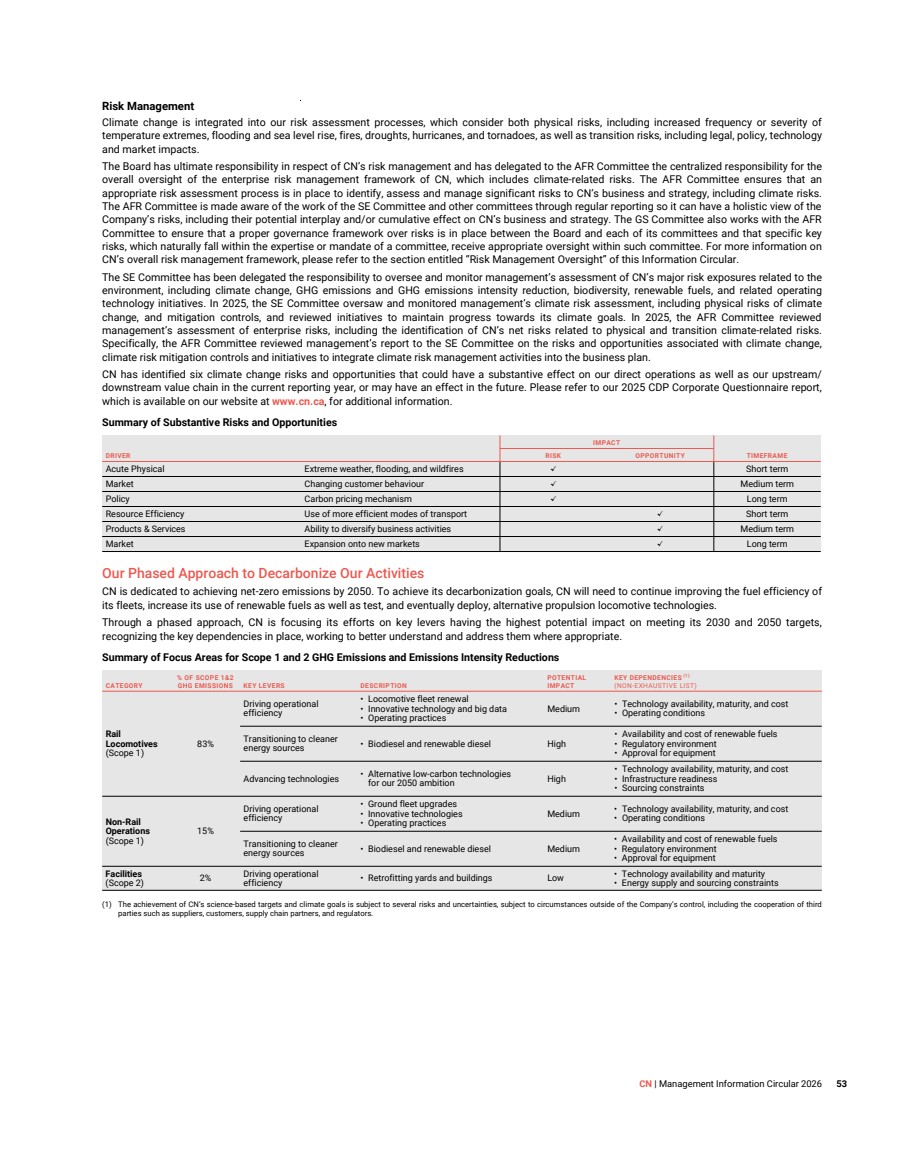
| Our position in the supply chain enables us to lead change towards decarbonizing North America’s transportation sector by leveraging and stimulating the development of low-carbon fuels and technologies. As alternative low-carbon technologies supporting our 2050 ambition will continue to advance, we are looking as part of this approach to demonstrate their long-term technical feasibility and commercial viability before they can be scaled across our operations. Discussions on the prospects of battery and hydrogen technologies, as well as targeted testing activities, are already underway, enabling CN to evaluate efficiency and operating protocols for the locomotive: • In 2021, we announced the purchase of a Wabtec battery-electric freight locomotive, the first 100% battery heavy-haul locomotive in support of our ambitious long-term goals. The anticipated efficiencies and emission reductions from this technology are expected to be significant and will help open the door to new alternatives beyond the diesel-powered locomotives used today. The delivery of our first battery-electric freight locomotive is expected in 2026. • In 2024, we announced the purchase of a plug-in hybrid mainline locomotive, a first of its kind in North America, which will be tested on CN’s mainline in British Columbia. The testing of this locomotive will increase CN’s knowledge of battery technology (which is used in different alternative propulsion options, such as hydrogen fuel cell locomotives, for example) under varying operational and weather conditions. We expect to receive the locomotive in 2026. • We also announced in early 2025 the launch of a new medium horsepower hybrid electric locomotive developed in collaboration with Knoxville Locomotive Works. The hybrid locomotive has been deployed across several CN yards and branch lines, including Western Canada, to test performance, including cold-weather operations. Finally, in line with the SBTi’s Net-Zero Standard, we intend to ‘neutralize’ the hard-to-abate residual emissions that cannot be avoided by leveraging nature-based solutions. In order to support its strategy and to meet its goals, CN has been continuously investing in initiatives and programs that decarbonize our activities and provide other benefits such as improved capacity and service to our customers. CN has also been investing in its intermodal facilities, which support a modal shift towards rail shipping. The table below summarizes the investments made over the past five years. CN 2021–2025 Investments Supporting Decarbonization (1) CATEGORY SPEND ($M CAD) Driving Operational Efficiency $2,320 Investing in our locomotive and hopper fleet $1,440 Expanding network capacity $800 Deploying fuel efficiency technologies $80 Transitioning to Cleaner Energy Sources $15 Piloting renewable fuels $10 Investing in facilities to reduce emissions $5 Advancing Technologies $20 Contributing to Modal Shift by Investing in Intermodal Facilities $330 Total Investment $2,685 (1) Investment figures are approximate. We also recognize the importance of collaborating with governments, supply chain partners, universities, cleantech, fuel producers and locomotive/ engine manufacturers in achieving an effective transition to a low-carbon future. We are actively engaging with other rail companies, directly and through associations such as the AAR’s Emissions Working Group, and the RAC, as well as with diverse locomotive manufacturers, fuel suppliers and customers. Initiatives include our EcoConnexions Partnership Program which recognizes customers, suppliers, and supply chain partners who are committed to sustainability. In 2025, CN actively participated in a number of activities hosted by Clean Fuels Alliance America, a national trade association representing the biodiesel, renewable diesel, and sustainable aviation fuel industries in line with our commitment to promote the use of renewable fuels in our operations. Through the RAC, we have been actively working with the Government of Canada since 1995 to address the impacts of rail activities on the environment through a Memorandum of Understanding (MOU). The 2023–2030 MOU, announced in December 2023, reflects a shared vision of working towards net-zero emissions by 2050 and builds upon the meaningful progress made to date by the Canadian rail sector. In accordance with the MOU, Transport Canada, and RAC members will work together to advance low-carbon fuel use, move more goods by rail where possible, and accelerate the development of advanced net-zero solutions for locomotives. 54 CN | Management Information Circular 2026 |
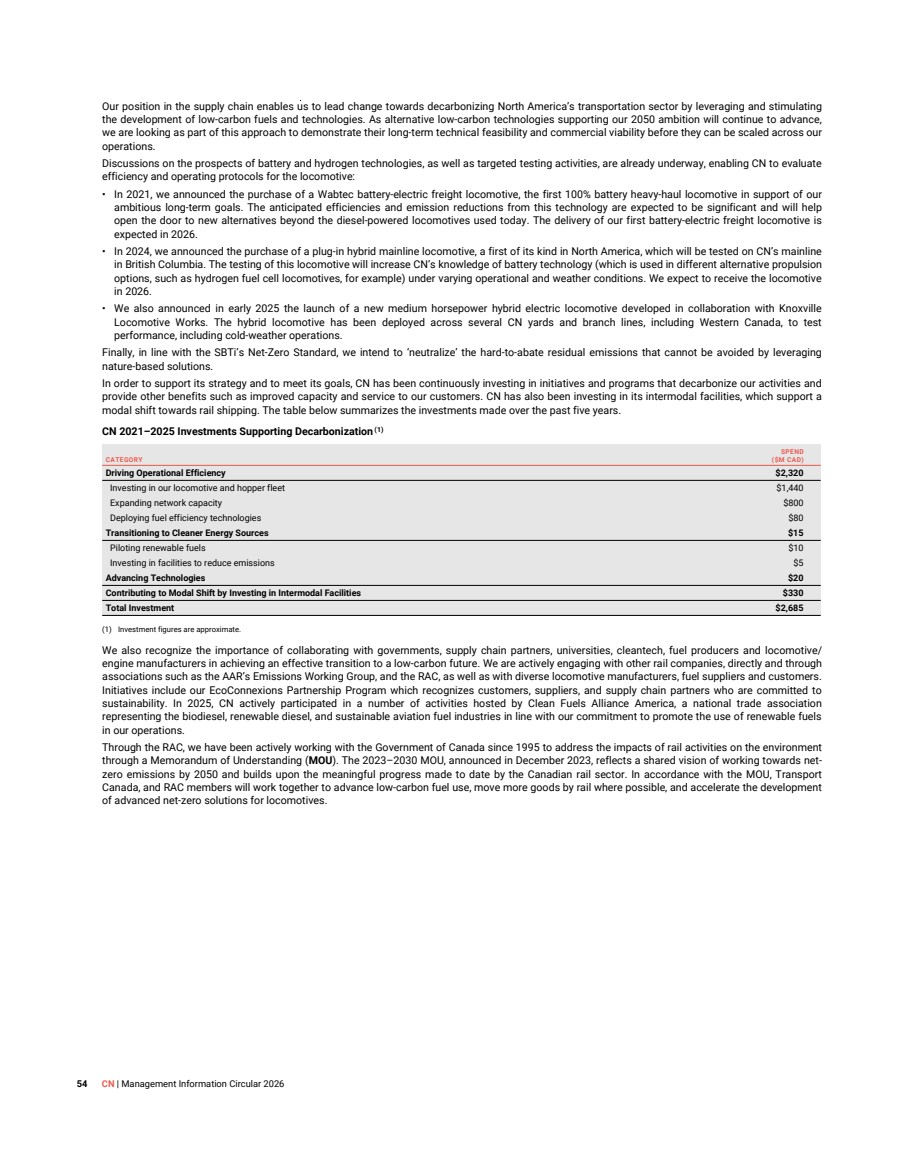
| Statement of Executive Compensation........................................ 55 Human Resources and Compensation (HRC) Committee......... 59 Mandate of the HRC Committee.................................................... 60 Compensation Discussion and Analysis (CD&A)........................ 61 Overview of the 2025 Executive Compensation Program.......... 63 Base Salary .................................................................................... 64 Annual Incentive Bonus Plan (AIBP)........................................... 65 2025 Long-Term Incentives (LTI)................................................ 68 Other Key Compensation Programs of the Company.............. 70 2026 Executive Compensation Framework............................... 72 Risk Mitigation in Our Compensation Program ........................ 72 Compensation of the NEOs............................................................. 74 President and Chief Executive Officer Compensation Look‑Back Table and Five‑Year TSR Comparison ....................... 77 Cost of Management Ratio............................................................. 78 Summary Compensation Table in Canadian Dollars................... 78 Incentive Plan Awards ..................................................................... 84 Management Long-Term Incentive Plan....................................... 88 Deferred Compensation Plans ....................................................... 89 Pension Plan Benefits...................................................................... 90 Termination and Change of Control Benefits............................... 93 Currency Exchange Information..................................................... 95 Dear Shareholder: On behalf of CN’s HRC Committee and the Board, we welcome this opportunity to share our approach to executive compensation. The compensation program’s short- and long-term objectives highlighted below and detailed in the subsequent pages are focused on ensuring sustainable long-term value, delivering pay for performance when achieved on behalf of our shareholders. In April 2025, CN’s annual say-on-pay advisory vote received strong support, with 92.89% of shareholders endorsing our executive compensation practices, reinforcing continued confidence in our approach. This result, along with an average approval rate of 96.36% over the past five years, highlights our consistent alignment of pay with long‑term value creation. We remain committed to transparency and to providing clear, comprehensive disclosure of our executive compensation practices to shareholders. 2025 Overview 2025 was marked by disciplined execution, a strengthened operating model, and the continued commitment of CN’s management and employees across the network. The year unfolded in a difficult operating environment characterized by constrained demand and ongoing tariff and trade pressures. In response, management took a proactive approach focused on rigorous operational discipline, targeted commercial initiatives, and tight financial oversight to manage costs, generate operating leverage in a low‑growth context and to deliver results within the levers available to the Company. Throughout the year, the Company operated a reliable and resilient network, optimized asset utilization, delivered strong customer service, and maintained an industry‑leading safety record. CN also remained aligned with its long‑term strategy under the Board’s oversight and engaged regularly with shareholders. These combined efforts enabled CN to mitigate external headwinds and deliver solid financial results, including the strongest adjusted diluted EPS growth among Class I Railroads and its best quarterly operating ratio of the year in the fourth quarter. A summary of selected financial results is presented below: 2025 2024 CHANGE Revenues (in millions) C$17,304 C$17,046 2% Operating Income (in millions) C$6,587 C$6,247 5% Diluted Earnings per share (EPS) C$7.57 C$7.01 8% Adjusted Diluted EPS (1) C$7.63 C$7.10 7% (1) Adjusted diluted earnings per share is a non-GAAP measure and does not have any standardized meaning prescribed by GAAP and, therefore, may not be comparable to similar measures presented by other companies. For an explanation of adjusted diluted earnings per share, how this non-GAAP measure provides useful information to investors, the additional purposes for which management uses this non-GAAP measure, and a reconciliation to the most directly comparable GAAP measure, see the section titled “Adjusted performance measures” in the MD&A, which is incorporated by reference herein. The MD&A can be found online on SEDAR+ at www.sedarplus.ca, on the SEC’s website at www.sec.gov through EDGAR, and on CN’s website at www.cn.ca under “Investors”. In 2025, CN deployed C$3.7 billion in capital expenditures, before customers reimbursement, to maintain infrastructure integrity, expand capacity, support growth, and advance strategic technology initiatives. These investments included continued progress on major reliability projects, upgrades to key corridors, modernization of rolling stock, and the expansion of advanced inspection and safety technologies across the network at the same time. CN also returned substantial capital to shareholders, repurchasing 14.9 million common shares in 2025 and returning C$2.05 billion in share repurchases (inclusive of brokerage fees and tax). In addition, CN increased its quarterly dividends per share by 5% effective in the first quarter of 2025. CN’s Board subsequently approved a further 3% increase to the 2026 quarterly cash dividend, effective for the first quarter of 2026. This marks the 30th consecutive year of dividend increases and reflects continued confidence in the Company’s long‑term financial strength. Taken together, these actions reflect CN’s balanced approach to investing in the business while continuing to deliver sustainable returns and long‑term value for shareholders. CN | Management Information Circular 2026 55 Statement of Executive Compensation |
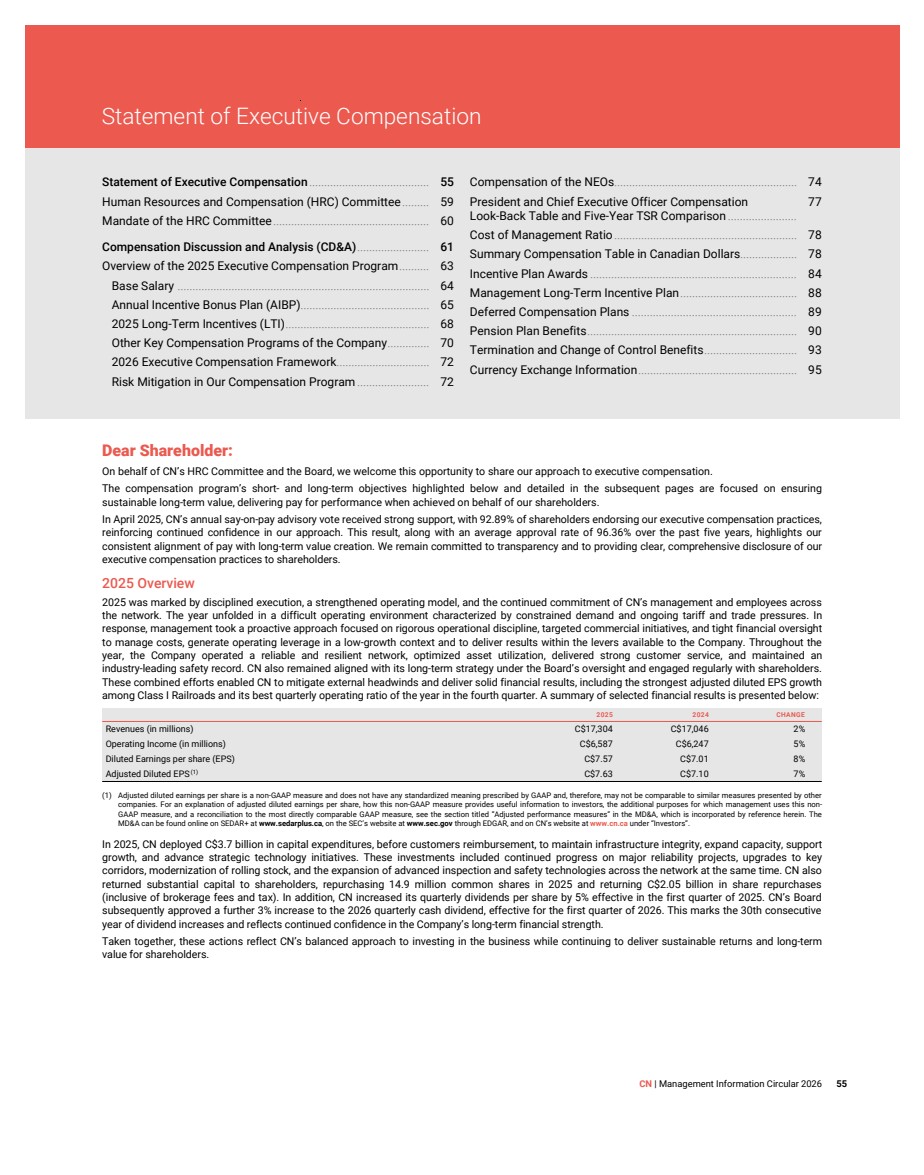
| Disciplined Approach to People, Compensation and Talent Development CN’s compensation programs support the attraction, development, and retention of experienced leaders required to operate a complex, capital‑intensive business. In 2025, the Company continued to strengthen its leadership team by executing a series of planned transitions and strategic appointments. On April 4, 2025, Bhushan Ivaturi was appointed Executive Vice‑President and Chief Information and Technology Officer, succeeding Dominique Malenfant, who retired in 2025, following a smooth and well‑coordinated transition. After the departure, in July 2025, of Rémi Lalonde, Executive Vice‑President and Chief Commercial Officer, Janet Drysdale assumed the role on an interim basis before being appointed permanently in October. As part of the same organizational realignment, Patrick Whitehead was appointed Executive Vice‑President and Chief Operating Officer, and Derek Taylor departed CN. CN’s executive compensation philosophy continues to focus on performance, accountability and market alignment. CN applies a disciplined and transparent approach by ensuring that both short‑ and long‑term incentive plans are designed to closely align realized compensation with shareholder outcomes. Performance targets are calibrated to support long‑term value creation while ensuring that compensation outcomes do not encourage undue risk‑taking. CN’s executive compensation framework is anchored in the following core principles: Alignment with shareholders’ interests, market & best practices and CN’s strategy Attract, motivate and retain talent Drive and reward performance 2025 Executive Compensation Framework In 2025, the HRC Committee continued to strengthen CN’s compensation programs by implementing a few enhancements to the NEO compensation framework. These changes are designed to support CN’s competitiveness in attracting, motivating, and retaining key talent, while also reflecting evolving market practices. The key updates are summarized below and are further detailed throughout the “Compensation Discussion and Analysis” section of this Information Circular. COMPENSATION FRAMEWORK/PLAN CHANGE Annual Incentive Bonus Plan (AIBP) • Increased the bonus target as a percentage of base salary for NEOs from 80% to 100% to better align with the comparator group for NEOs • Replaced the Net Promoter Score used to measure the customer centricity of the corporate strategic component with a customer satisfaction index Compensation Philosophy Our executive compensation policy aims to position target total direct compensation of our NEOs at the 50th percentile of the comparator group, on average. Base Salary The compensation of our NEOs is paid in U.S. dollars to provide a more precise, meaningful and stable comparison with the U.S. dollar-denominated compensation of incumbents in equivalent positions within the comparator group. Annual Incentive Bonus Plan (AIBP) The AIBP is designed to align executive compensation with CN’s financial performance, strategic priorities, and safety outcomes. It incentivizes executives to deliver results that support the Company’s long‑term strategy, sustainability objectives, and employee engagement, while reinforcing accountability for overall business performance. AIBP composition Long-Term Incentive Program (LTI Program) Our LTI program is designed to align with mid‑ and long‑term business performance and shareholder value creation. It provides NEOs with the opportunity to participate in CN’s financial success through equity ownership. The Board grants a combination of stock options and PSUs to NEOs to reinforce alignment with sustainable performance and long‑term value creation. LTI Stock Option and PSU ratio 56 CN | Management Information Circular 2026 |
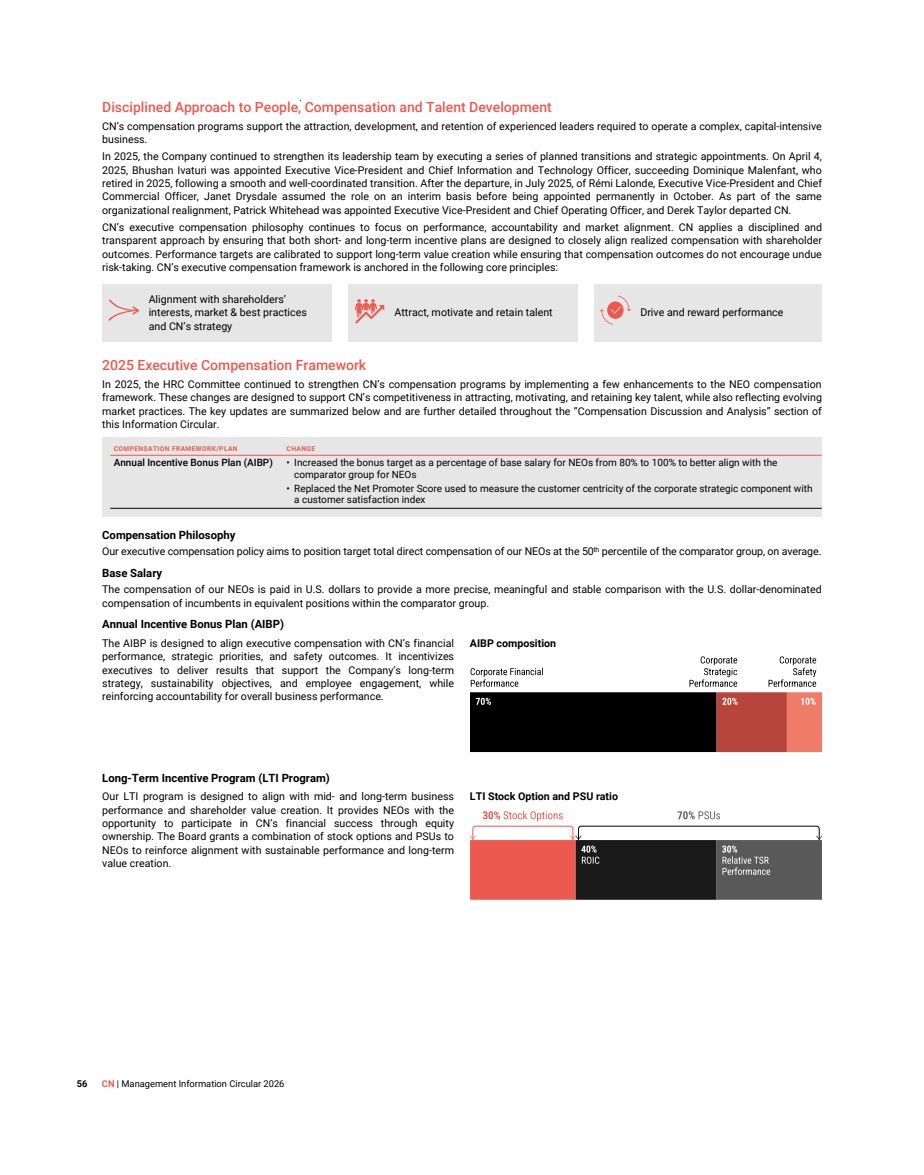
| 2025 Compensation Highlights Management’s deliberate and proactive response to a challenging operating environment directly contributed to strong financial, operational, and safety outcomes. Through disciplined cost management, service optimization, commercial execution, and operational reliability, CN sustained performance and achieved the best injury frequency ratio in the Company’s history. CN’s compensation programs are directly linked to financial and operational performance, with annual incentive targets established prior to the emergence of tariff‑related impacts. Following a comprehensive year‑end assessment, the Board exercised judgment to recognize management’s execution and stewardship while ensuring outcomes remained aligned with shareholder interests and CN’s pay‑for‑performance principles. Adjustment to the overall AIBP Payout CN’s performance for the year resulted in a calculated AIBP payout of 82.4% of target under the AIBP formula. The HRC Committee reviewed the appropriateness of the calculated AIBP result to ensure that it appropriately reflected the overall performance of the Company. The process focused on ensuring pay outcomes remained consistent with CN’s pay-for-performance compensation principles, supported talent retention, and reinforced employee engagement. Throughout the year, management took decisive and proactive actions to protect financial and operating results, managed costs, maintained an industry leading safety record, and mitigated emerging risks in a highly dynamic operating environment. The HRC Committee also reviewed the tariff-related impact on financial performance, as the AIBP targets were set before the tariff policies were announced and implemented. In recognition of management’s actions and their contribution to sustaining overall performance outcomes, the HRC Committee approved a discretionary adjustment to the corporate financial component of the 2025 AIBP, resulting in an overall approved payout factor of 95% for NEOs. To align with shareholder interests, the HRC Committee intentionally capped discretion to a below target payout and no discretion was applied to the PSUs granted in 2023, resulting in a nil payout. Detailed results can be found on pages 65 and 68 of this Information Circular. 2025 Annual Incentive Plan 2023 ROIC PSUs 2023 TSR PSUs Pay for Performance: President and CEO CN’s executive compensation plans align with shareholder value creation, with a significant portion tied to performance. As a result, in a low performance environment, the value received by the President and CEO is reduced accordingly. The table below compares the total direct compensation (TDC) awarded to the President and CEO with the realized value as of December 31, 2025, for the various components of total direct compensation. The realized and realizable values for the 2024 and 2025 LTI programs will be determined over the coming years based on actual performance. (1) Target TDC for the President and CEO consists of Base Salary, annual incentive bonus at target and LTIs (share-based awards under face value and options-based awards under accounting value) as disclosed in the “Supplemental Total Compensation Table” on page 79 of this Information Circular. (2) Realized/realizable compensation for the President and CEO consists of Base Salary and actual annual incentive bonus paid, as disclosed in the “Supplemental Total Compensation Table” on page 79 of this Information Circular, together with the current market value of LTIs as at December 31, 2025. Stock Options awarded in 2023 and 2024 were out-of-the money as at December 31, 2025. CN | Management Information Circular 2026 57 |
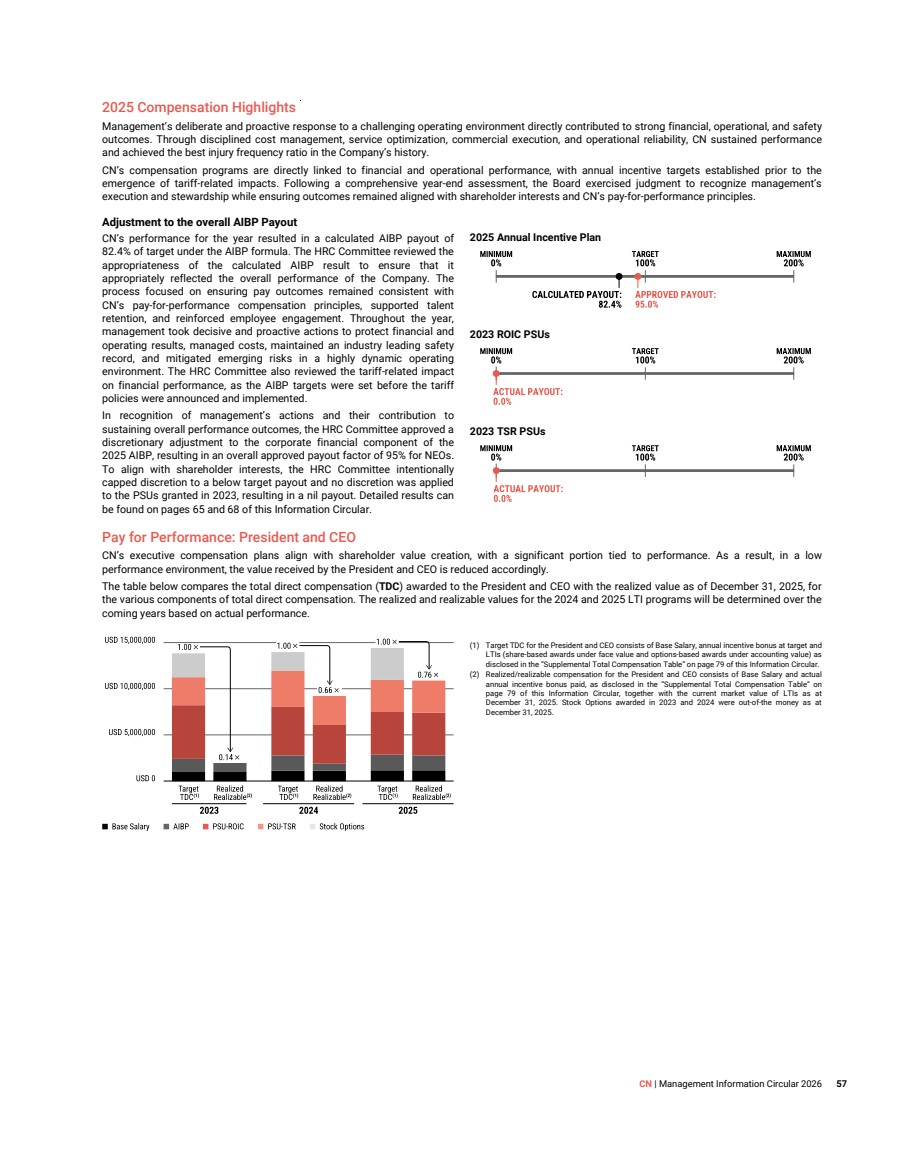
| 2026 Plan Changes In our ongoing commitment to align CN’s compensation framework with evolving market practices and position our programs to drive effective incentivization and long-term success, we regularly review our approach. As a result, key enhancements to our compensation framework came into effect on January 1, 2026. These changes are critical to delivering on our strategic priorities while remaining firmly anchored in our guiding principles: • Driving and rewarding performance to attract, motivate, and retain top talent • Ensuring alignment with shareholder interests and prevailing market practices Through these updates, CN reinforces its commitment to a compensation program that supports sustainable growth, drives engagement, and positions the Company for continued success in a rapidly evolving environment. The table below provides an overview of the changes, with additional details and the rationale behind them presented on page 72 of this Information Circular. COMPENSATION FRAMEWORK/PLAN CHANGE Annual Incentive Bonus Plan • Adjusted weighting of financial and strategic components to reintroduce an individual performance component for the CEO and NEO levels, fostering strong contribution and effort • Updated financial metrics to emphasize increased cash flow and operational efficiency while maintaining long-term growth alignment • Enhanced the customer satisfaction index to incorporate both operational performance metrics and customer sentiment feedback Long-Term Incentives (LTIs) • Revised the weighting of the LTI vehicles to introduce Restricted Share Units (RSUs), enhancing resilience in a volatile environment, aligning with prevailing market practices, and preserving a performance‑linked equity structure that supports long‑term executive engagement • Extended the post-retirement stock option exercise window by one year for both future and outstanding grants, applicable to retirements occurring on or after January 29, 2026 Stock Ownership Guidelines • Reduced stock ownership requirement for the President and CEO to align with prevailing market practices • Expanded calculation criteria to include unvested RSUs and DSUs, in addition to vested DSUs and common shares Conclusion Based on 2025 actual results, we believe the compensation outcomes appropriately reflect Company performance, particularly given the exceptional market conditions that were not anticipated at the start of the financial year, and remain aligned with CN’s disciplined approach to executive compensation. The HRC Committee carefully considered both the challenges presented by the operating environment and the actions taken by management to protect performance, advance strategic priorities, and maintain long‑term resilience. We are confident that the resulting compensation decisions support the continued execution of CN’s strategy while reinforcing employee engagement and retention, along with the long‑term interests of our shareholders. The HRC Committee remains committed to strong governance and ongoing oversight of CN’s executive compensation framework. This includes ensuring that our programs remain competitive, performance‑oriented, and appropriately calibrated to support CN’s talent strategy and evolving business needs. We also remain focused on providing transparent, comprehensive disclosure to support constructive engagement with our shareholders. Members of the HRC Committee will be attending the Meeting to answer questions about CN’s executive compensation. Shauneen Bruder Chair of the Board of Directors Jo-ann dePass Olsovsky Chair of the Human Resources and Compensation Committee 58 CN | Management Information Circular 2026 |
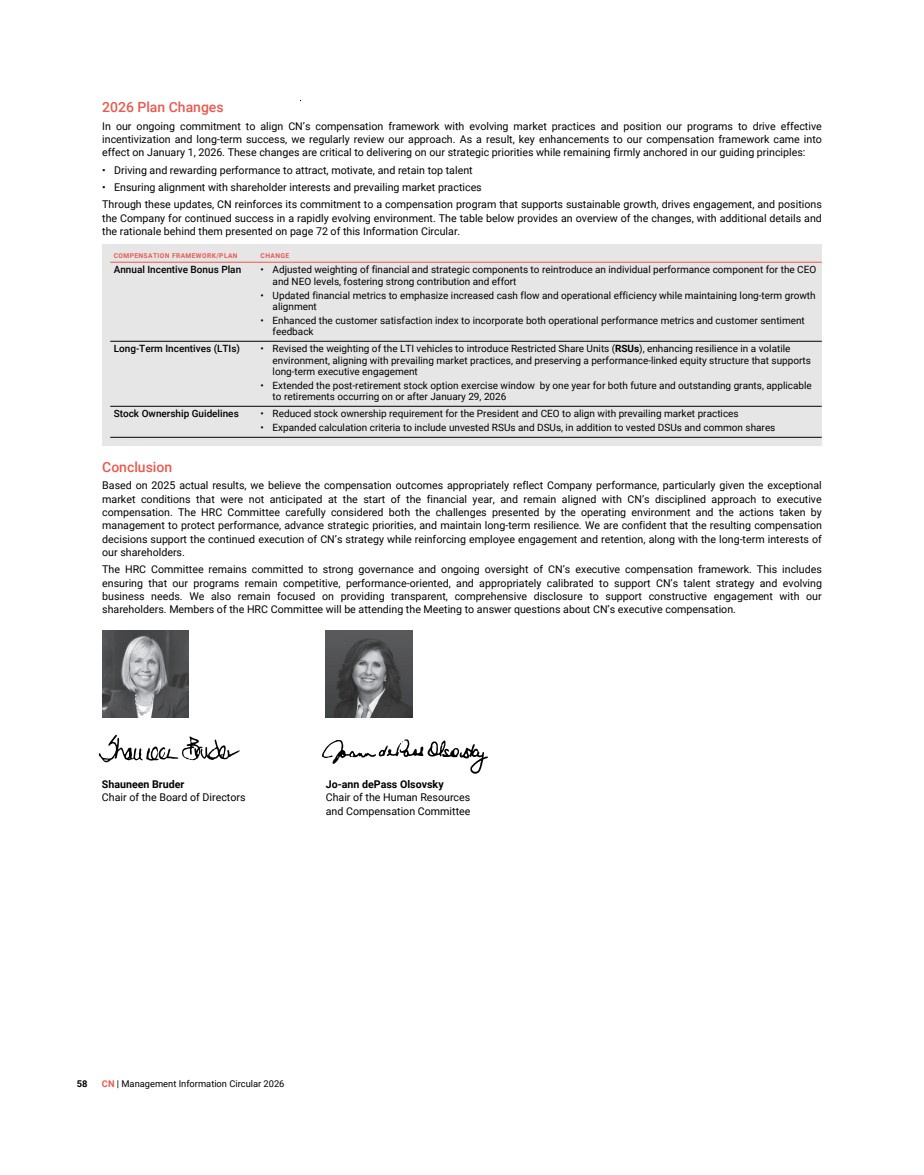
| Human Resources and Compensation (HRC) Committee Composition of the HRC Committee The HRC Committee is composed of five independent members. As of the date of this Information Circular, all members of the HRC Committee have a thorough understanding of compensation policies and principles related to executive compensation and have experience in human resources and compensation matters, including the skills and experience enabling the HRC Committee to make decisions on the suitability of the compensation policies and practices of CN. They are also members of other Board committees, and this overlap provides a strong link with the HRC Committee’s risk oversight responsibilities. • Ms. Jo-ann dePass Olsovsky, Chair of the HRC Committee, was the Executive Vice-President and Chief Information Officer at Salesforce from February 2018 to August 2022, when she retired. She led the global team at Salesforce responsible for their internal systems including applications, Salesforce on Salesforce, global network, cyber security, data centers, big data/AI systems, acquisitions, etc. Prior to Salesforce, Ms. dePass Olsovsky was on the executive team at BNSF Railway for approximately 12 years, leading BNSF Railway’s enterprise information technology function, field telecom team, AI/big data, cybersecurity, etc. She has led global teams of over 3,000 employees with responsibility in excess of $1B program/ operational budgets. In both her corporate and board roles, Ms. dePass Olsovsky has extensive experience in all aspects of human resources matters for both unionized and management employees globally. Experiences include attracting, developing, and retaining union and salaried/management employees, all aspects of unionized labour relations, compensation design, performance management and talent/succession planning. • Ms. Shauneen Bruder, Board Chair, is a corporate director and former Executive Vice-President, Operations at RBC where she was responsible for operations related to all personal and business clients in Canada delivered through more than 8,000 employees. In her corporate and board roles, she gained extensive experience overseeing human resources matters, including compensation design, performance management and talent/succession planning. • Ms. Denise Gray is a corporate director with extensive experience in business leadership. Most recently, she was Director, External Affairs & Government Relations, North America at LG Energy Solution Michigan Inc., U.S., until May 2023. She spent nearly eight years, beginning in 2015, with LG Corporation in various leadership positions, including as President of LG Energy Solution Michigan Inc. Tech Center, as President of LG Chem Michigan Inc. Tech Center, and as President and CEO of LG Chem Power Inc. She also has over 30 years of prior experience in roles of increasing responsibility at General Motors. In addition to her executive experience, Ms. Gray is a member of the board of directors and of the audit committee and the compensation committee of Cheniere Energy, Inc. and she is a director of Mitra Chem, a private lithium-ion battery materials manufacturer. She formerly was a member of the board of Tenneco, Inc. where she also served as a member of the audit and compensation committees. Ms. Gray’s extensive experience in executive management and as a corporate director allows her to contribute meaningfully to the HRC Committee’s oversight responsibilities. • Mr. Justin M. Howell is a corporate director and a former senior investment manager with Cascade Asset Management Co. and was previously an investment banker and a lawyer. Mr. Howell is chair of the nomination and compensation committee and a member of the board of directors of Sika AG, a multinational specialty chemical company listed on the SIX Swiss Exchange and headquartered in Baar, Switzerland. As a corporate director, he gained experience overseeing human resources matters, including compensation design, performance management and talent/succession planning. • Mr. Robert Knight, Chair of the AFR Committee, is a corporate director and the former Chief Financial Officer of Union Pacific Corporation, a position he held for 15 years before retiring in December 2019. During Mr. Knight’s 40-year tenure at Union Pacific Corporation, he also held a variety of senior executive positions, including General Manager of the company’s energy and automotive business units. As a proven leader with extensive experience in finance and human resources having led large teams of professionals throughout his career, Mr. Knight serves as a director and member of the compensation committee at Schneider National, Inc. and director and chair of the audit committee at Hyliion Holdings Corp. The following table summarizes the human resources and compensation-related experience of the HRC Committee members: AREA OF EXPERIENCE NUMBER OF COMMITTEE MEMBERS WITH VERY STRONG OR STRONG EXPERIENCE Membership on HR committees 5/5 100% Organizational exposure to the HR function 5/5 100% Leadership and succession planning, talent development 5/5 100% Approval of employment contracts 5/5 100% Development/oversight of incentive programs 5/5 100% Oversight of stress-testing of incentive programs vs. business/operating performance 5/5 100% Pension plan administration/oversight 3/5 60% Interpretation and application of regulatory requirements related to compensation policies and practices 4/5 80% Engagement with investors and investor representatives on compensation issues 4/5 80% Oversight of financial analysis related to compensation policies and practices 5/5 100% Exposure to market analysis related to compensation policies and practices 5/5 100% Drafting or review of contracts and other legal materials related to compensation policies and practices 5/5 100% Oversight of labour matters 3/5 60% CN | Management Information Circular 2026 59 |
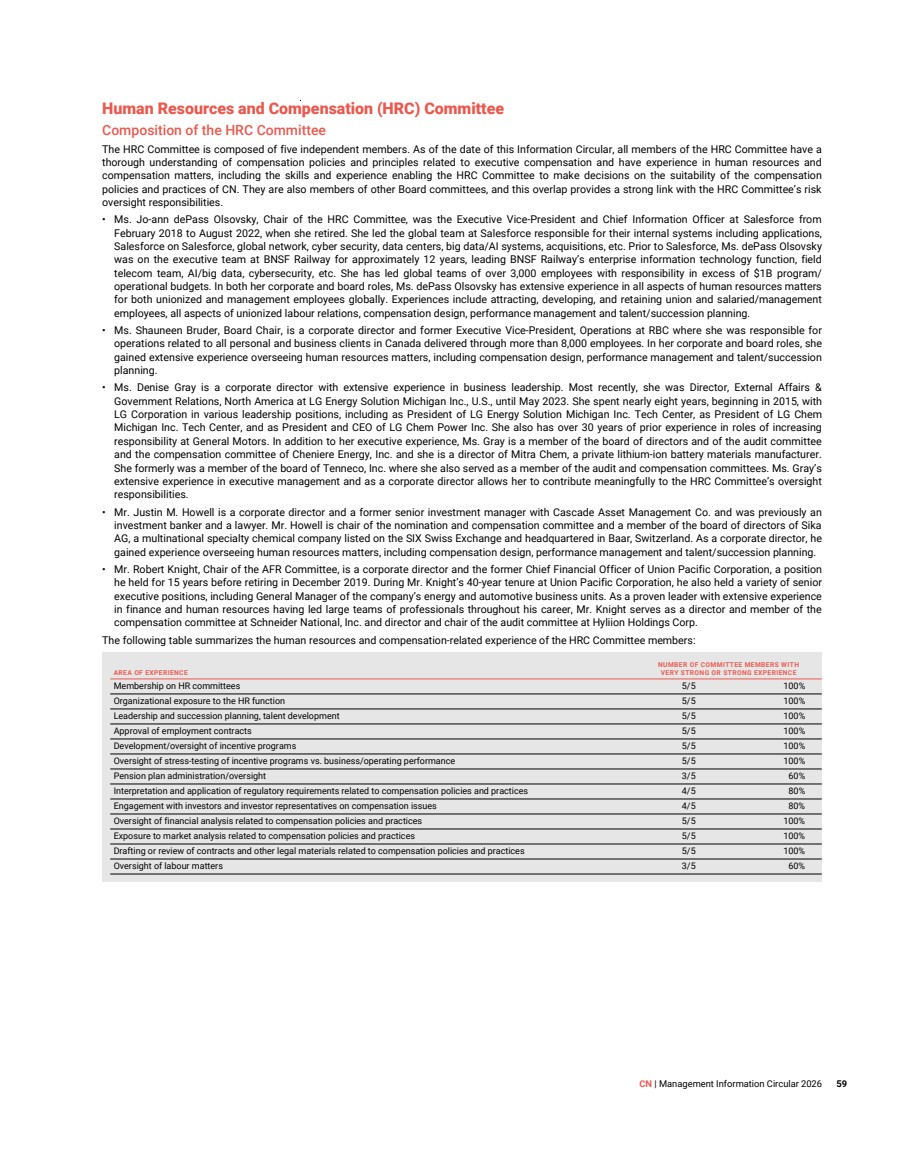
| Mandate of the HRC Committee The responsibilities of the HRC Committee include: • Ensuring appropriate mechanisms are in place regarding succession planning for executive officer positions, including the President and CEO; • Overseeing the process for the selection of executive officers, recommending their appointment, and approving the terms and conditions of appointment and termination or retirement of the President and CEO and other executive officers; • Reviewing corporate goals and objectives relevant to the President and CEO and other executive officers who report directly to the President and CEO, as well as their development, and their performance based on those goals and other factors, and recommending to the Board their compensation based on this evaluation; • Identifying, monitoring and overseeing risks associated with CN’s compensation policies and practices and assessing whether they provide an appropriate balance of risk and reward in relation to the Company’s overall strategic direction, and reviewing disclosure on: (i) the role of in that respect; (ii) any practices that CN uses to identify and mitigate such risks; and (iii) any identified risk arising from CN’s compensation policies and practices that is reasonably likely to have a material adverse effect on CN; • Examining all elements of executive remuneration and reporting annually on compensation practices, including by overseeing the selection of any benchmark group used in determining compensation or any element of compensation, and reviewing disclosure on such group; • Overseeing outside advisors, including compensation consultants, independent legal counsel or other independent advisors, hired to assist in the performance of its functions and responsibilities; • Evaluating the independence of outside advisors in accordance with applicable Canadian and U.S. corporate governance standards, or other applicable laws, rules or regulations; • Reviewing human resources practices and policies by ensuring, among other things, that appropriate human resources systems are in place to allow the Company to attract, motivate and retain the quality and diversity of personnel required to meet its business objectives, including overseeing the establishment and monitoring of the Company’s performance in respect of employee equal opportunity, employment and best practices; • Ensuring regular employee engagement surveys and monitoring the results of the surveys and their implications for effective talent management at CN; • Monitoring on a regular basis CN’s union relations, CN’s labour relations strategy and its consistency with CN’s strategic direction; • Reviewing CN’s pension plans governance structure and design; and • Overseeing CN’s major risk exposures relating to executive management, human resources, compensation, succession, and culture. The HRC Committee’s full charter is available as part of CN’s Corporate Governance Manual at www.cn.ca, under “Delivering Responsibly/Governance”. The HRC Committee met seven times in 2025 and held in camera sessions during each meeting. Talent Management, Inclusion and Succession Planning Talent management, leadership development, succession planning, inclusion, and employee engagement are priorities for the Board and the HRC Committee. An integrated talent framework, focusing on the identification, assessment, and development of leaders, is used to ensure CN has qualified candidates with diverse backgrounds and expertise for potential successors at the executive and management levels. CN prepares talents for broader and more complex roles by customizing development plans to individual, business and leadership needs as well as providing meaningful cross-functional experiences, where applicable. As required, CN also addresses talent gaps and acquires critical skills through external hiring. On a regular basis, the HRC Committee reviews updates on the talent management and leadership development of each function. Throughout the year, the HRC Committee also conducts in-depth executive analysis focused on the strength, gaps and inclusivity of succession readiness for key leadership roles across the organization. CN integrates a more precise development approach for key talents to prepare them for broader and more complex roles in an expedited manner while also developing agility and critical leadership capabilities. CN regularly hones its career development program to provide targeted training and practical work experience that reinforces the development of talent. A complete review of the contingency as well as short-, medium- and long-term succession plans for the executive team is conducted annually, and specific customized plans to address identified gaps are developed and implemented. Regarding CN’s long-term strategic plan, aligning leadership and capability development is key to its successful implementation. Aligning the compensation programs with CN’s strategic goals is a key component to linking shareholder returns with management’s performance. The HRC Committee is satisfied that the proper talent management and succession planning strategies are in place to ensure CN’s ongoing success. Independent Advice The HRC Committee retains the services of executive compensation consultants to provide advice on compensation recommendations that are presented for HRC Committee approval. Since October 2007, the HRC Committee retains the services of Hugessen for that purpose. The HRC Committee mandated Hugessen to review and provide advice directly to the HRC Committee on executive compensation recommendations and related questions. The fees invoiced by Hugessen in 2025 totalled approximately C$168,700. Services performed by Hugessen were compensation-related services provided directly to the HRC Committee. The HRC Committee also reviewed the independence of Hugessen and evaluated its performance for 2025. The HRC Committee is satisfied with the advice received from Hugessen and that such advice is objective and independent. Hugessen also meets the independence requirements of the NYSE Listing Standards and confirmed that, on an annualized basis, the amount of fees received by the firm from CN represents less than 5% of Hugessen’s total fees. Since 2007, the Board has adopted a policy to the effect that the Chair of the HRC Committee must pre-approve all non-compensation services provided to CN by the executive compensation consultant retained by the HRC Committee to perform executive compensation-related services. Pursuant to an understanding between the HRC Committee and Hugessen, the latter has agreed not to perform any work for management. Executive Compensation–Related Fees SERVICES RENDERED IN 2025 (C$) SERVICES RENDERED IN 2024 (C$) EXECUTIVE COMPENSATION–RELATED FEES ALL OTHER FEES EXECUTIVE COMPENSATION–RELATED FEES ALL OTHER FEES Hugessen 168,700 – 238,300 – 60 CN | Management Information Circular 2026 |
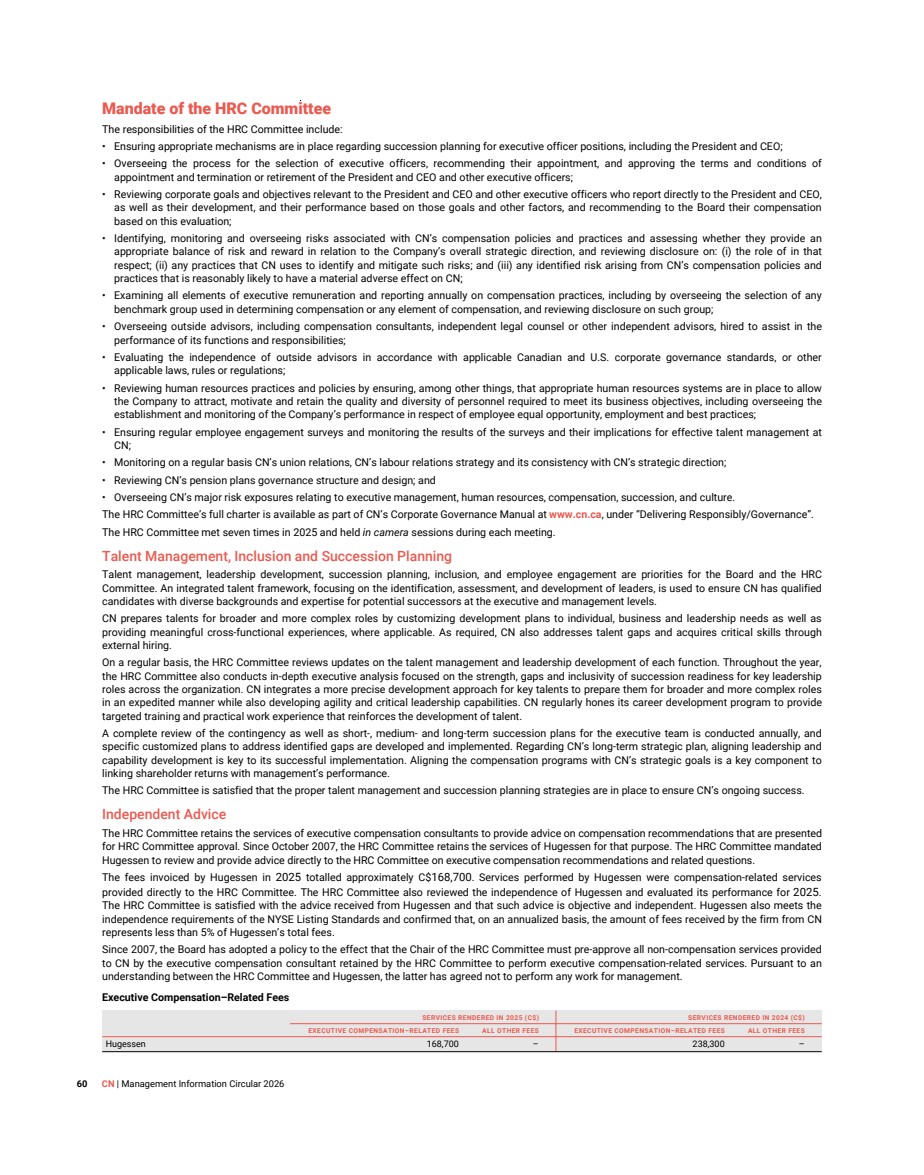
| 2025 Executive Compensation Framework Named Executive Officers This CD&A section covers executive compensation for the year ended December 31, 2025, and relates to the following NEOs who appear in the compensation tables: Tracy Robinson President and Chief Executive Officer (CEO) Ghislain Houle Executive Vice-President and Chief Financial Officer (CFO) Patrick Whitehead Executive Vice-President and Chief Operating Officer (COO) Janet Drysdale Executive Vice-President and Chief Commercial Officer (CCO) Bhushan Ivaturi Executive Vice-President and Chief Information and Technology Officer (CITO) Rémi Lalonde Former Executive Vice-President and Chief Commercial Officer (Former CCO) Derek Taylor Former Executive Vice-President and Chief Field Operating Officer (Former CFOO) Our Executive Compensation Policy and Programs The executive compensation policy and programs of CN are designed to ensure there is a clear link between our long-term strategy, our business plan and executive rewards, thus encouraging appropriate behaviours. Executive incentive compensation is, as a result, tied to key corporate objectives that play a critical role in driving the organization’s short- and long-term profitability and return to shareholders. The executive compensation program is also designed to be competitive to attract, retain and motivate outstanding executive talent while providing for appropriate risk control features. The comprehensive executive compensation program followed by CN is comprised of five elements: (i) base salary; (ii) annual incentive bonus; (iii) long-term incentives; (iv) pension benefits; and (v) executive perquisites. The combination of base salary, annual incentive bonus and long-term incentives defines the total direct compensation offering, which is weighted towards variable, “pay-for-performance” elements. Decisions on how much to pay the NEOs in terms of total direct compensation are based on CN’s executive compensation policy. When determining NEO target total direct compensation, CN’s policy is to set pay in reference to the 50th percentile of the NEO’s comparator group, on average. The HRC Committee is of the view that the compensation policy and its principles provided for competitive and reasonable compensation levels when determining the 2025 compensation for the NEOs. CN | Management Information Circular 2026 61 Compensation Discussion and Analysis (CD&A) |
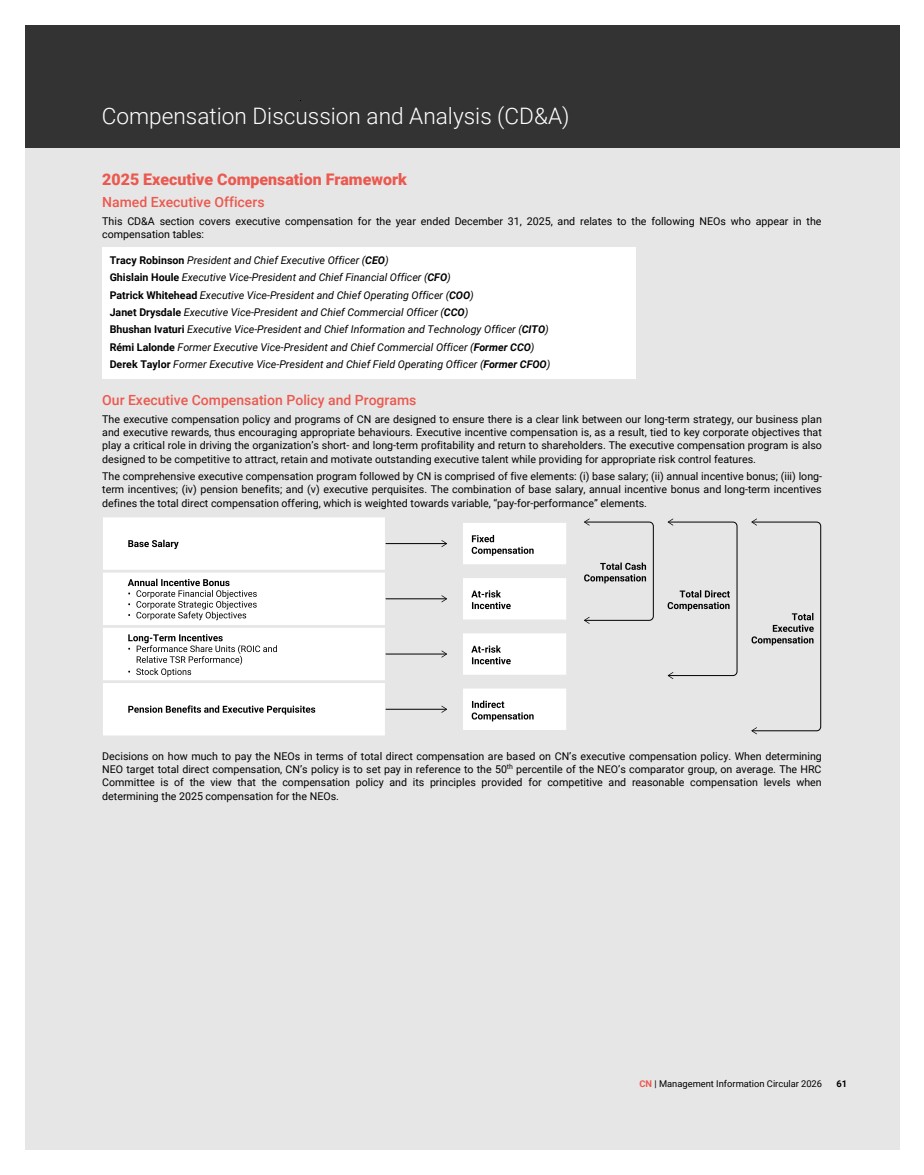
| Compensation Decisions and Process The compensation of the NEOs, other than that of the President and CEO, is recommended by the President and CEO and reviewed and recommended by the HRC Committee for approval by the Board. The compensation of the President and CEO is recommended by the HRC Committee and approved by the independent members of the Board. The President and CEO serves at the discretion of the Board. The 2025 compensation was determined as part of an annual process followed by the HRC Committee and outlined in the chart to the right. Each year, the HRC Committee reviews benchmark information and approves compensation adjustments for the following year by taking into consideration comparator group practices, individual performance, leadership abilities, succession planning, retention considerations and the economic outlook. A vertical pay ratio analysis is also conducted and presented to the HRC Committee, for the purpose of its review of compensation recommendations for the upcoming year. The vertical pay ratio analysis consists of comparing the total direct compensation of each NEO to the median annual total direct compensation for all CN employees. This analysis provides additional context when the HRC Committee reviews the compensation programs of CN. As part of the annual compensation review process, WTW provides an assessment of how total direct compensation offered to all executives during the year compared with that of the comparator group. In December 2025, WTW reported that the overall aggregate positioning of the total direct compensation of NEOs was generally aligned with CN’s compensation policy. The HRC Committee reviews and recommends for approval by the Board the performance targets related to both the AIBP and the PSUs in January. Aside from the Relative TSR targets, the financial targets are derived from CN’s annual business plan, which is prepared by management and reviewed and approved by the Board. Business planning is an extensive process during which management examines, with the Board, the economic, business, regulatory and competitive conditions that affect or can be expected to affect CN’s business in the following three-year period. Throughout the year, members of the HRC Committee are provided with updates related to CN’s performance against targets. The Board and HRC Committee also have access to executive management throughout the year should they wish to discuss specific business issues or seek clarification. The Board and HRC Committee are, therefore, confident they have detailed visibility of CN’s financial performance and are appropriately equipped to recommend executive compensation decisions. Finally, throughout the annual executive compensation review process, the HRC Committee also receives and considers advice from its independent compensation consultant, Hugessen. The annual grant of PSUs and stock options to NEOs and other eligible employees is reviewed and approved by the Board in January for the current year. In determining the appropriate LTI fair value granted to each NEO, the HRC Committee considers external market data, as discussed in the “Benchmarking Using Comparator Group” section below, as well as other factors such as individual performance, leadership, and talent retention. Step 1–September to January • Business plan review and approval by the Board • Definition of performance criteria and targets based on the business plan Step 2–December to January • Annual review of risk and assessment of risk mitigation features • Evaluation of the individual performance assessment for the NEOs • Review of the compensation benchmark and pay positioning • Review of annual bonus and LTI payouts for the prior year • Review of compensation programs and annual compensation adjustments • Review of new annual targets and LTI awards and performance-vesting conditions • Stress-testing of incentive grants Step 3–March to October • Monitoring and evaluation of progress and performance of compensation programs Benchmarking Using Comparator Group Each year, the HRC Committee determines competitive pay levels by utilizing a comparator group, which is regularly reviewed and endorsed as appropriate for the level and nature of the benchmarked positions. The HRC Committee benchmarks base salary, Total Target Cash Compensation, and Total Target Direct Compensation for the NEOs against relevant competitive market data. The comparator group for NEOs reflects a balanced mix of 16 North American companies, including Class I Railroads, selected to capture a broader industry perspective while maintaining discipline on relative size and scale. The companies included are comparable in industry and/or complexity, taking into account factors such as size, revenues, capital investment, and market capitalization, and they represent organizations with which CN competes for key talent. Additionally, the HRC Committee considered selected Class I Railroads for rail-specific positions for purposes of verifying the alignment with compensation trends specifically for this group. The following chart shows CN’s positioning relative to the comparator group for the NEOs as at December 31, 2025. PERCENTILE RANK CN MEDIAN PROFILE (1)(2) 25TH 50TH 75TH (C$ MILLIONS) Revenues 17,304 20,346 Net Income 4,720 3,785 Market Capitalization 83,554 90,037 Employees 23,839 23,839 (1) Revenues, Net Income and Market Capitalization in C$ Millions. U.S. company information converted to Canadian dollars using the average exchange rate for 2025 of US$1.00 = C$1.3978, except for Market Capitalization where the December 31, 2025 exchange rate of US$1.00 = C$1.3724 was used. (2) Revenues, Net Income, Market Capitalization and Employees are as at December 31, 2025 or the most recent year-end, as applicable. Comparator group for NEOs Canadian Pacific Kansas City Limited CSX Corporation Emerson Electric Co. Enbridge Inc. Fortis Inc. Illinois Tool Works Inc. Norfolk Southern Corporation Republic Services, Inc. Rogers Communications Inc. Sempra TC Energy Corporation TELUS Corporation The Williams Companies, Inc. Union Pacific Corporation Waste Management, Inc. Xcel Energy Inc. 62 CN | Management Information Circular 2026 |
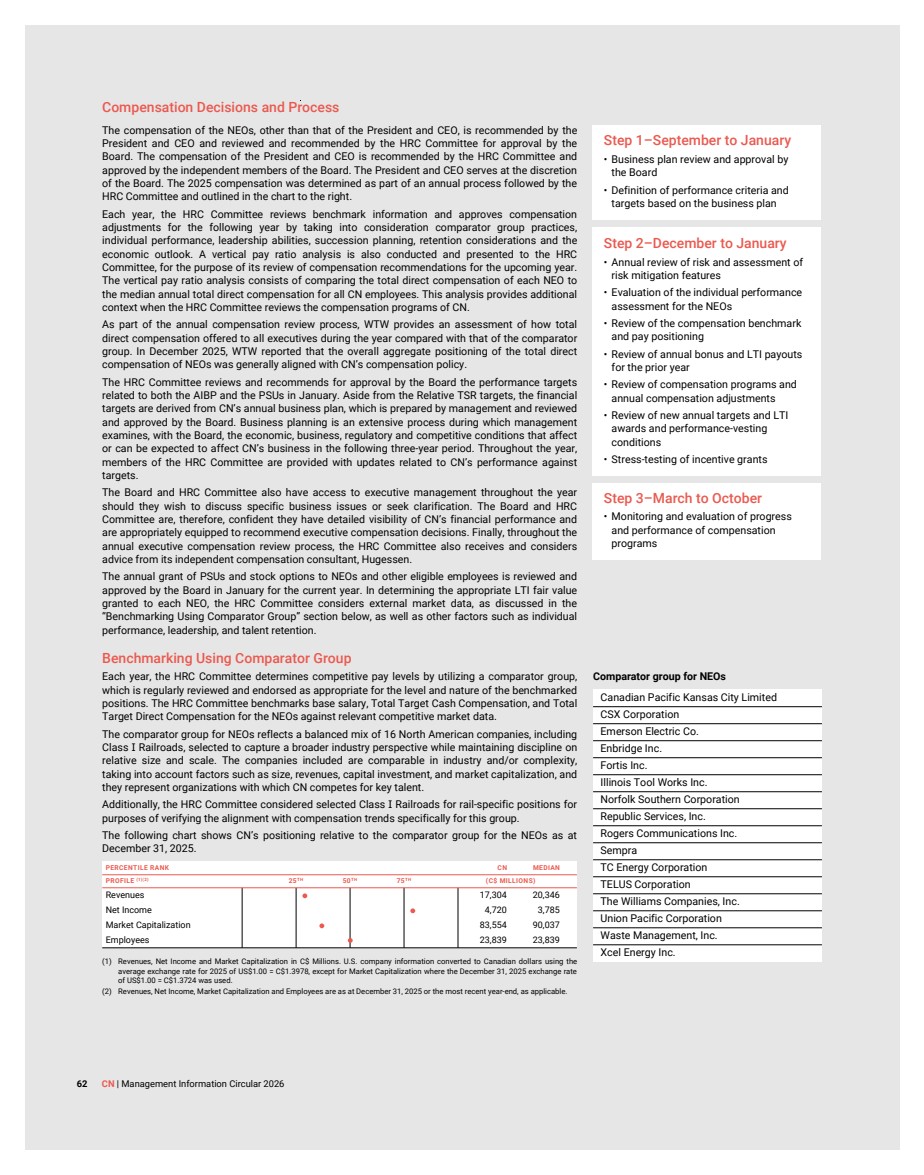
| Overview of the 2025 Executive Compensation Program The following table summarizes the components of the Company’s 2025 NEO executive compensation program, which were driven by the executive compensation policy and weighted towards variable “pay-for-performance” elements. Each component is then further detailed in this section. COMPONENT AND FORM 2025 DESIGN SUMMARY OPPORTUNITY RISK-MITIGATING ELEMENTS OBJECTIVES AND RATIONALE Base Salary Cash • Fixed rate of pay • Individual salary recommendations based on competitive assessment and economic outlook, leadership, retention and succession considerations • Set with reference to median of comparator group • Provides for a balanced mix of pay components (fixed vs. variable) • Use of external advisor and peer group analysis • Provides competitive level of fixed compensation • Recognizes sustained individual performance • Reflects role and responsibility and/or growth in role Annual Incentive Bonus Cash-based performance pay • Annual awards based 100% on Company achievement of two pre-determined corporate financial performance objectives (70%), three pre-determined corporate strategic performance objectives (20%), and two pre-determined corporate safety performance objectives (10%) • Performance period: one year • 2025 targets are 150% of base salary for the President and CEO and 100% for the other NEOs. Maximum payout is limited to 2.0 times the target • Use of multiple performance measures • Plan targets reviewed and approved annually based on in-depth review of annual business plan • Payout trigger based on corporate performance • Increased diversification with the safety and strategic component • Payouts are capped • No guaranteed minimum payout • Payouts subject to clawback policies • Payouts for executives are subject to a three-month notice period in the year of retirement • Reward the achievement of pre-set annual corporate financial. strategic and safety performance objectives • Drive superior corporate financial, strategic and safety performance LTIs Performance-based share units payable in equity, purchased in the market PERFORMANCE SHARE UNITS (70% of LTIs) • 40% of the LTI value is subject to the attainment of three-year average PSU-ROIC targets • 30% of the LTI value is subject to CN’s relative performance against the S&P North America LargeMidCap Transportation Index • Quarterly dividend equivalents are earned during the three‑year vesting period for the PSUs and are reinvested into additional PSUs. In the case of retirement, NEOs must remain in active and continuous service until March 31 of the year following the year in which the grant was made to be eligible for payout • Performance period: three years cliff vesting • LTI grant date fair value determined with reference to the 50th percentile of the applicable comparator group • PSU performance vesting factor capped at 200% • Significant weighting toward long-term incentive compensation • Overlapping multi-year performance periods • Mix of financial, market and relative performance measures • PSU payouts are capped and there is no minimum guaranteed payout • Payouts subject to clawback policies • Payouts subject to non‑compete provisions • Align management interests with shareholder value growth and total return relative to comparable groups • Reward the achievement of sustained financial performance and creation of shareholder value • Contribute to retention of key talent • Recognize individual contribution and potential • Increased alignment with Total Shareholder Return Stock options STOCK OPTIONS (30% of LTIs) (1) • Conventional stock options that vest over four years at a rate of 25% per year • In the case of retirement, NEOs must remain in active and continuous service until the last day of the year in which the grant was made to be eligible for payout • Performance period: four-year ratable vesting, 10-year term (1) The MLTIP limitation that capped individual stock option grants at a maximum of 20% of all stock options awarded in a given year was removed for long‑term incentive awards starting in 2025, following shareholder approval at the April 26, 2024 annual meeting. CN | Management Information Circular 2026 63 |
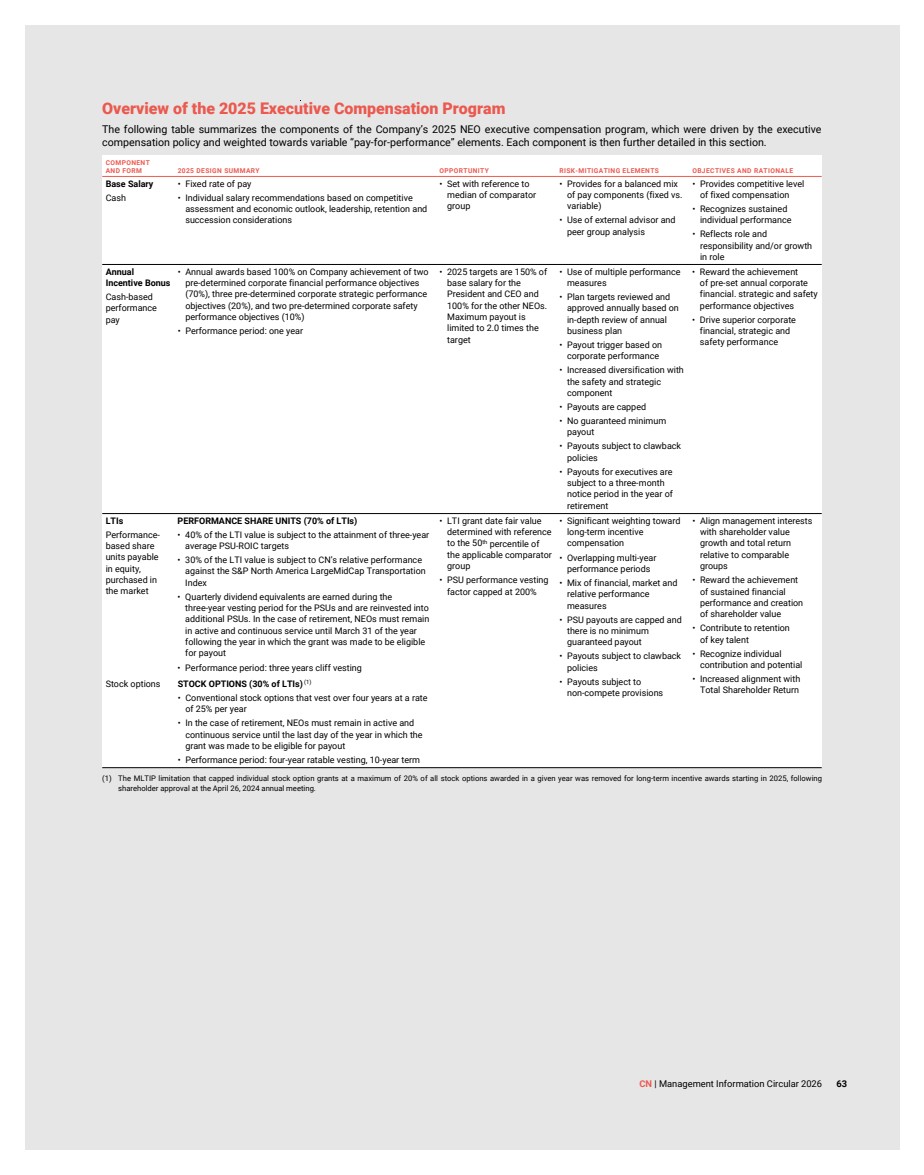
| COMPONENT AND FORM 2025 DESIGN SUMMARY OPPORTUNITY RISK-MITIGATING ELEMENTS OBJECTIVES AND RATIONALE Pension Benefits Cash payments following retirement CANADIAN PENSION PLANS • Defined Benefit component of the CN Pension Plan (1): benefits payable calculated as a percentage of the highest five-year average earnings multiplied by pensionable service • Pensionable service period for most defined benefit plans: maximum of 35 years • Defined Contribution component of the CN Pension Plan (2): benefits based on the participant’s contributions and on Company-matched contributions • Non-registered plans: supplement to the registered plans and provide benefits in excess of the Canadian Income Tax Act limits • Non-registered plans restricted to executives and senior management employees • Most retirement benefits for executives and senior management employees are calculated using base salary and annual bonus (up to target levels) • NEOs accrue benefits in a Defined Contribution Plan, which limits CN’s exposure to pension plan insolvency risk • Payouts subject to non-compete provisions for non-registered plans • Provide an effective and attractive executive compensation program U.S. PENSION PLANS • Defined Benefit Plan (2): benefits payable calculated as a percentage of the highest five-year average earnings (out of the last 10 years) multiplied by credited service • Maximum of 35 years of credited service for most defined benefit plans • Savings Plan: 401(k) benefits based on the participant’s voluntary contributions and 50% matching by the Company, limited to 3% of base pay • Defined Contribution Feature (2): additional benefits included in the Savings Plan based on Company contributions equal to 3.5% of base pay • Non-registered plans: supplement to the qualified plans and provide benefits in excess of Internal Revenue Service and Railroad Retirement Board limits Executive Perquisites Non-cash perquisites • Company-leased vehicles, parking, financial counselling and tax services, flexible allowance spending account to emphasize health and wellness, certain healthcare benefits, including an annual executive physical services and life insurance, personal security monitoring and personal use of the corporate aircraft for the President and CEO. • Competitive (1) Applies to non-unionized employees hired prior to 2006. Effective on March 31, 2024, CN’s defined benefit plans were frozen for all non-unionized employees. Accumulation of pensionable service and increases in pensionable earning are not included in the calculation of defined benefit pension after that date. (2) Prior to April 1, 2024: applies to non-unionized employees hired after 2005 or who have elected to convert from a defined benefit plan. Starting April 1, 2024: applies to all non-unionized employees. Base Salary The base salaries of the President and CEO and other NEOs are paid in U.S. dollars to provide a more precise, meaningful and stable comparison with U.S. dollar-denominated salaries in equivalent positions within the comparator group. As part of the annual compensation review of the NEOs, base salaries were set with reference to the median of the comparator group. Salary increases reflect market competitiveness, leadership abilities, retention considerations and succession plans. 64 CN | Management Information Circular 2026 |
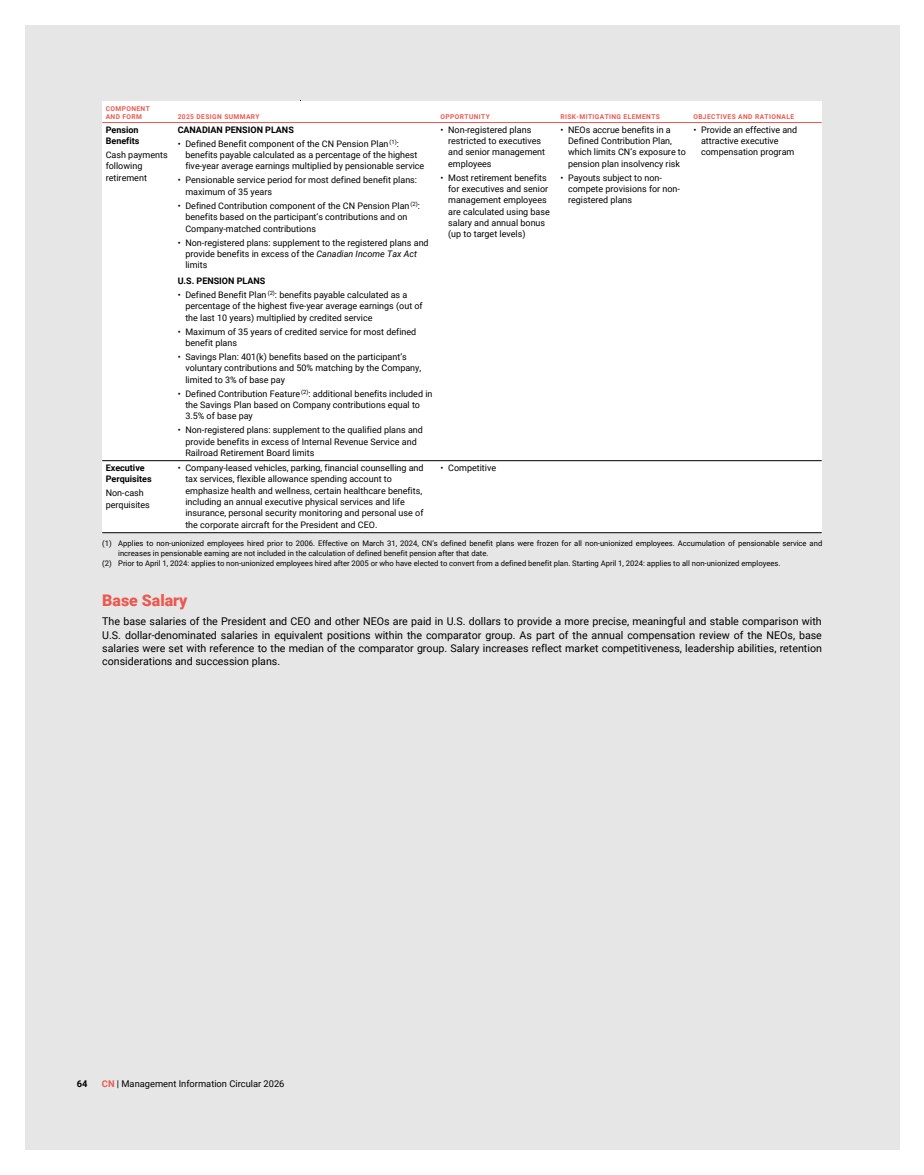
| Annual Incentive Bonus Plan (AIBP) In 2025, the AIBP for executives is based on Company performance against pre-set objectives for three corporate components: financial, strategic and safety. Performance factors and ranges for threshold, target and maximum incentive opportunities for the three corporate components of the AIBP (financial, strategic and safety) are determined by the HRC Committee at the beginning of the year. The corporate performance objectives are reviewed annually to select targets that align with our business plan. The same corporate components and objectives apply to each NEO. The Board may also exercise discretion to adjust AIBP outcomes, positively or negatively, when extraordinary events or other factors not captured in the original performance metrics materially distort the formulaic result. The Board’s use of discretion is rare, clearly bounded, and applied only when objective and verifiable circumstances indicate that the calculated outcome significantly overstates or understates underlying performance due to factors outside management’s control. Under the terms of the AIBP, the performance factors for each individual corporate component can range from 0% to 200% depending on the results compared to the pre-established objectives, as illustrated in the table below. AIBP COMPONENT BELOW THRESHOLD THRESHOLD TARGET MAXIMUM Corporate Financial/ Strategic/Safety Component Achievement (1) 0% 50% 100% 200% (1) Interpolation between points. The target awards and payout ranges reflect the level of responsibility associated with their role, aim to be aligned with the comparator group, and are established as a percentage of base salary. Under the Company’s AIBP for 2025, minimum, target and maximum payouts, expressed as a percentage (%) of base salary, were as follows for the NEOs (President and CEO and Executive Vice-Presidents): 2025 AIBP for the NEOs POSITION MINIMUM(1) TARGET(1) MAXIMUM(1) President & CEO 0% 150% 300% Executive Vice-Presidents 0% 100% 200% (1) As a percentage of base salary as at December 31, 2025. The 2025 AIBP was comprised of the following three components: 1. Corporate Financial Performance: Seventy percent (70%) of the bonus for NEOs was linked to Company performance against two measures that directly contribute to CN’s long-term financial growth and profitability. The HRC Committee ensures that performance targets and conditions are aligned with the achievement of CN’s corporate objectives as set out in CN’s business plan, which is reviewed and approved by the Board. These corporate objectives are taken into account in establishing CN’s targets under the AIBP. In addition, when setting the AIBP targets for the upcoming year, CN generally excludes items from the prior year that did not necessarily arise as part of the normal business of CN, which can impact the comparability of CN’s year-over-year financial performance and the Company’s current year targets in relation to the prior year’s results. In 2025, the Board assessed CN’s corporate financial performance against targets for revenues and adjusted operating income. These metrics were chosen for their ability to quantify the organization’s growth and long-term profitability, both of which are key drivers of profitability and shareholder returns and are aligned with the Company’s strategy. The 2025 targets were approved by the Board at the beginning of 2025 based on CN’s business and financial outlook at that time. 2. Corporate Strategic Performance: The corporate strategic objectives account for 20% of the bonus of the NEOs and align with CN’s long-term strategic vision as well as its sustainability priorities. The corporate strategic objectives included three quantitative strategic measures: environmental performance measured through locomotive greenhouse gas emission intensity, employee engagement and a customer satisfaction index, each weighing 6.67% of the overall bonus target. A review of the 2025 results for the three corporate strategic measures was conducted by Internal Audit. • Environmental performance is measured through improvement of locomotive fuel efficiency (US gallons of locomotive fuel consumed per 1,000 gross ton miles (GTMs)), which is directly correlated to greenhouse gas emissions intensity and a key contributor towards the achievement of CN’s 2030 science-based climate target. • Employee engagement is measured through the annual engagement survey which is outsourced to a third-party company who manages the survey for governance and data integrity purposes. The employee engagement measure in 2025 was comprised of two equally weighted targets: (i) management workforce and (ii) unionized workforce. • Customer centricity in 2025 was assessed using the Customer Satisfaction Index, which measures customer sentiment related to CN’s communication and overall ease of doing business. The Customer Satisfaction Index is based on the average results of two customer surveys conducted during the year and is subject to a performance evaluation by the HRC Committee using both the survey results and contextual insights provided by the Executive Vice‑President and Chief Commercial Officer to determine the final Customer Satisfaction Index outcome. 3. Corporate Safety Performance: The corporate safety objectives account for 10% of the bonus of the NEOs. The Board assessed CN's annual corporate safety performance against two safety performance measures with equal weighting: accident rate and injury frequency rate. CN | Management Information Circular 2026 65 |
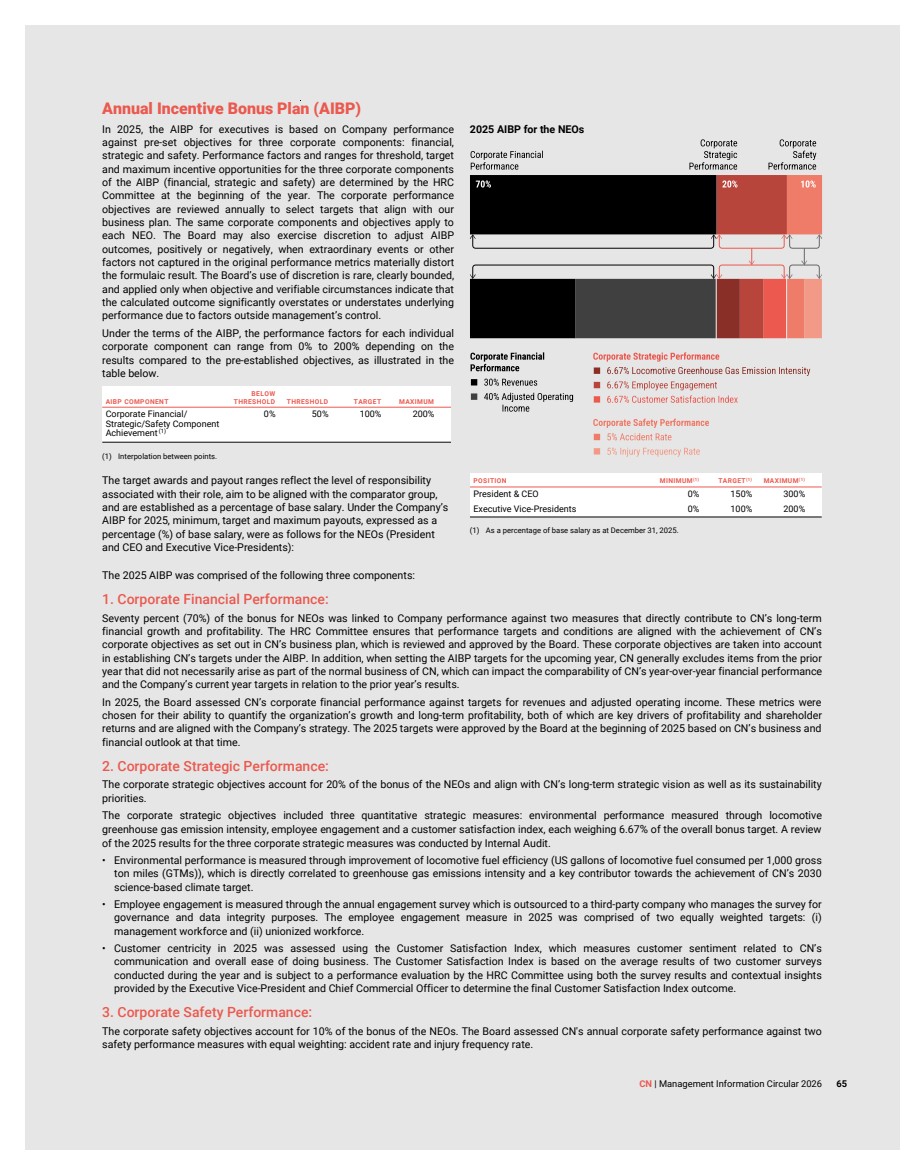
| 2025 Corporate Financial Performance Objectives and Results: In 2025, CN faced extraordinary challenges as tariff policy changes and heightened uncertainty had a substantial impact on CN’s operations given its strong ties to international trade. These measures disrupted supply chains, softened demand, and increased operational costs, placing considerable pressure on revenues and overall financial performance. Consequently, CN did not fully meet its pre-established financial performance objectives for both corporate financial components (revenues and adjusted operating income), resulting in a payout of 65.0% of target for the corporate financial component under the present formula. Following a comprehensive review of the unforeseen tariff‑related impacts and management’s performance leading to prompt mitigation efforts, the HRC Committee and Board approved a discretionary adjustment to increase the 2025 Corporate Financial component of the AIBP from 65.0% to 83.0%. This decision was grounded in rigorous analysis and governance to ensure alignment with compensation principles, performance realities, talent retention considerations, and stakeholder expectations. At the beginning of 2025, the performance targets were set assuming an exchange rate of US$1.00 = C$1.4286. During the year, the actual average exchange rate was US$1.00 = C$1.3978. At the end of 2025, AIBP targets under the corporate financial component were adjusted, as per plan, to take into consideration the difference between actual and forecasted foreign exchange for both targets and, in the case of revenues, the target was also adjusted to take into consideration the difference between actual and forecasted diesel prices with respect to CN’s fuel surcharges. These adjustments are recurring on an annual basis and are made to ensure comparability to CN’s financial performance from operations. Adjustments to the targets could impact, either favorably or unfavorably, the performance factors. The following table shows the 2025 performance targets set at the beginning of 2025, in addition to the 2025 performance targets adjusted to reflect actual 2025 foreign exchange rates and diesel prices. CORPORATE OBJECTIVES AS OF JANUARY 1, 2025 (1) CORPORATE OBJECTIVES AS ADJUSTED (2)(3) IN MILLIONS WEIGHT RESULTS 2024 (C$) THRESHOLD 2025 (C$) Δ VS 2024 TARGET 2025 (C$) Δ VS 2024 MAXIMUM 2025 (C$) Δ VS 2024 THRESHOLD 2025 (C$) TARGET 2025 (C$) MAXIMUM 2025 (C$) RESULTS 2025 (2) (C$) PERFORMANCE FACTOR Revenues 30% of 70% 17,046 17,400 +2.1% 18,300 +7.4% 19,100 +12.0% 17,047 17,928 18,712 17,304 64.6% Adjusted Operating Income (4) 40% of 70% 6,325 6,670 +5.5% 7,100 +12.3% 7,560 +19.5% 6,523 6,944 7,393 6,652 65.3% Overall Weighted Performance Factor 65.0% Overall Weighted Performance Factor, including discretionary adjustment 83.0% (1) Corporate objectives assume an average exchange rate of US$1.00 = C$1.4286. (2) Corporate objectives and results reflect an actual average exchange rate for 2025 of US$1.00 = C$1.3978. (3) Revenue target also reflects actual 2025 diesel prices. (4) This non-GAAP measure does not have any standardized meaning prescribed by GAAP and therefore, may not be comparable to similar measures presented by other companies. The following table reconciles operating income as reported for the year ended December 31, 2025 to the adjusted operating income used for the bonus payout ratio. Operating income adjustments IN MILLIONS 2025 (C$) Operating income 6,587 Adjustments: Workforce reduction program 34 Advisory costs related to rail consolidation matters 15 Adjusted operating income (a) 6,636 Impact of discretionary bonus adjustment approved by the Board (b) 16 Adjusted Operating Income - for bonus payout ratio 6,652 (a) See the section entitled “Adjusted performance measures” in the MD&A, which section is incorporated by reference herein. The MD&A may be found online on SEDAR+ at www.sedarplus.ca, on the SEC’s website at www.sec.gov through EDGAR, and on CN’s website at www.cn.ca under “Investors”. (b) The discretionary bonus adjustment approved by the Board resulted in a C$16 million impact on adjusted operating income. 2025 Corporate Strategic Performance Objectives and Results: For 2025, the Locomotive Greenhouse Gas Emission Intensity measure achieved the maximum payout level, while the employee engagement measures resulted in an average payout of 50%. The 2025 targets for the Customer Satisfaction Index were established to guide HRC Committee discussions and to account for external factors influencing customer sentiment. The final assessment for this metric was determined by the HRC Committee based on both survey results and contextual input from the Executive Vice-President and Chief Commercial Officer. Following this review, the HRC Committee assessed performance at target for the Customer Satisfaction Index. Based on these outcomes relative to the established corporate strategic objectives, the Board approved a payout of 116.7% of target for the corporate strategic component of the AIBP for NEOs. STRATEGIC OBJECTIVES AS OF JANUARY 1, 2025 WEIGHT THRESHOLD TARGET MAXIMUM RESULTS 2025 (2) PERFORMANCE FACTOR Locomotive Greenhouse Gas Emission Intensity (Improvement) 33.33% 0.50% 1.25% 2.00% 2.34% 200.0% Employee Engagement (Improvement) (1) Management & Subsidiaries 16.67% -1.40% 1.40% 4.10% Below (1.40%) 0.0% Union 16.67% -1.90% 1.90% 5.80% On target at 1.90% 100.0% Customer Satisfaction Index 33.33% – – – – 100.0% Overall Weighted Performance Factor 116.7% (1) 2025 objectives for employee engagement metrics presented as year-over-year variation compared to 2024 actual results. (2) Strategic measures are unaudited and based on estimated data available as at December 31, 2025 and are subject to change as more complete information becomes available. A review of the 2025 results of the three corporate strategic measures was conducted by Internal Audit. CN is not providing the quantified targets and results of the employee engagement measure (other than percentage improvement targets) and the customer centricity measure, as the targets and results for these measures contain confidential and commercially sensitive information. The Customer Satisfaction Index is highly sensitive in nature as it relates to CN’s relationship with its customers. As such, detailed disclosure of this metric would seriously prejudice the Company in the competitive market in which it operates, as it contains information that could be valuable to its competitors. Similarly, the employee engagement measure is derived from confidential information and the disclosure of the quantified target and result thereof would be detrimental to CN’s business and employee relations. The targets related to these two performance measures are intended to be challenging, neither impossible nor easy to achieve, in line with CN’s disciplined approach to compensation. 66 CN | Management Information Circular 2026 |
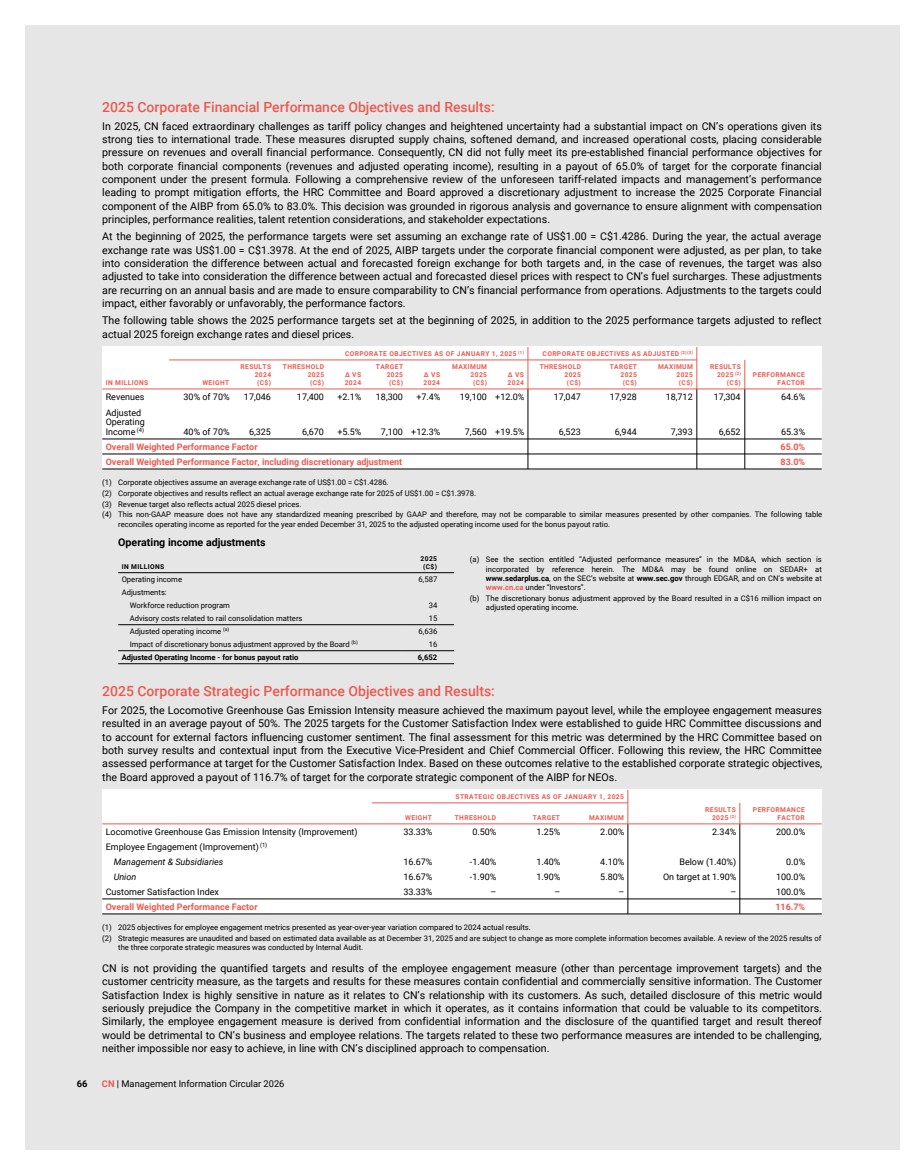
| The percentage of total bonus target attributable to the employee engagement measure and the Customer Satisfaction Index for 2025 is 13.33%, while the percentage of total compensation related to the employee engagement measure and the Customer Satisfaction Index of the corporate strategic component of the AIBP for 2025 is 1.1% for Ms. Robinson, 1.6% for Messrs. Houle and Ivaturi, 1.8% for Mr. Whitehead, 2.1% for Ms. Drysdale, 1.2% for Mr. Lalonde, and 1.1% for Mr. Taylor. 2025 Corporate Safety Performance Objectives and Results: In 2025, CN achieved the lowest injury frequency rates in its history. While the accident rate narrowly missed the target, resulting in a bonus payout of 96.2%, the injury frequency rate surpassed expectations, generating a payout of 175.0%. Based on these outcomes, the Board approved a 135.6% payout of target for the corporate safety component of the AIBP. SAFETY OBJECTIVES AS OF JANUARY 1, 2025 WEIGHT THRESHOLD TARGET MAXIMUM RESULTS 2025 (2) PERFORMANCE FACTOR Accident Rate (1) (per million train miles) 50% 1.96 1.83 1.71 1.84 96.2% Injury Frequency Rate (1) (per 200,000 person hours) 50% 1.09 1.02 0.94 0.96 175.0% Overall Weighted Performance Factor 135.6% (1) Based on Federal Railroad Administration (FRA) reporting criteria. (2) Results for the year ended December 31, 2025. Safety indicators are unaudited and based on estimated data available at such time and are subject to change as more complete information becomes available. A review of the 2025 results of the two safety measures was conducted by Internal Audit. CN has an unwavering commitment to the health and safety of its employees, customers, and the communities and environments in which it operates. This commitment is rooted in a strong, values‑based culture and reinforced through disciplined programs, practices, and continuous improvements in training, leadership, and technology. CN remains focused on improving accident and injury frequency rates, aligned with FRA reporting criteria. In 2025, the Company further strengthened its safety culture through targeted infrastructure investments, rigorous safety processes, and focused exposure‑reduction initiatives. CN also advanced the deployment of safety‑enhancing technologies, including autonomous track inspection cars, automated inspection portals, expanded wayside detection systems, and the Electronic Track Authority Verification application, to enhance inspection quality and enable earlier risk identification. These efforts were supported by expanded safety leadership training and enhanced safety communications through the Train Tube platform and the “Your Actions Matter” campaign. Reflecting this sustained and disciplined focus on safety excellence, CN achieved its best injury frequency rate to date. Summary The following formula illustrates how NEOs’ annual base salary (as at December 31, 2025), target payout (expressed as a percentage of base salary), corporate financial, corporate strategic, and corporate safety performance factors interact in the determination of the actual annual bonus payout: Annual Bonus Payout Formula (1) (1) Annual bonus is prorated to account for time in grade and active service during the year. The calculated average bonus payout for the NEOs (consisting of the corporate financial performance factor, the corporate strategic performance factor, and the corporate safety performance factor) was 95.0% of target bonus in 2025, including the discretionary adjustment approved by the HRC Committee and the Board to the corporate financial component. 2025 Annual Bonus Payout NAMED EXECUTIVE OFFICER ANNUAL BASE SALARY (US$) (1) BONUS TARGET CORPORATE FINANCIAL CORPORATE STRATEGIC CORPORATE SAFETY OVERALL PAYOUT (2) BONUS PAYOUT US$ BONUS PAYOUT C$ WEIGHT (3) PAYOUT (2) WEIGHT PAYOUT WEIGHT PAYOUT Tracy Robinson 1,135,000 150.0% 70% 83.0% 20% 116.7% 10% 135.6% 95.0% 1,617,375 2,219,685 Ghislain Houle 710,000 100.0% 70% 83.0% 20% 116.7% 10% 135.6% 95.0% 674,500 925,684 Patrick Whitehead 700,000 100.0% 70% 83.0% 20% 116.7% 10% 135.6% 95.0% 665,000 912,646 Janet Drysdale (4) 675,000 72.1% 70% 83.0% 20% 116.7% 10% 135.6% 95.0% 462,389 634,583 Bhushan Ivaturi (5) 550,000 72.0% 70% 83.0% 20% 116.7% 10% 135.6% 95.0% 376,360 516,516 Rémi Lalonde (6) 654,000 55.2% 70% 83.0% 20% 116.7% 10% 135.6% 95.0% 342,771 470,419 Derek Taylor (7) 600,000 79.7% 70% 83.0% 20% 116.7% 10% 135.6% 95.0% 454,253 623,417 (1) Annual base salary as at December 31, 2025. (2) The bonus payout includes the discretionary adjustment to the corporate financial component of the 2025 AIBP, as approved by the Board increasing the overall payout from 82.4% to 95.0%. (3) Bonus payouts in US$ were converted to Canadian dollars based on the December 31, 2025, exchange rate of US$1 = C$1.3724. (4) Bonus target for Ms. Drysdale was prorated for her promotion date and was equivalent to 65% of base salary from January 1, 2025 to October 19, 2025 and 100% of base salary from October 20, 2025 to December 31, 2025. For the purposes of this table, the bonus target has been rounded to one decimal place; however, the calculated bonus payout uses the precise figures. (5) Bonus target for Mr. Ivaturi was prorated for his hire date and was equivalent to 100% of base salary from April 14, 2025 to December 31, 2025. For the purposes of this table, the bonus target has been rounded to one decimal place; however, the calculated bonus payout uses the precise figures. (6) Bonus target for Mr. Lalonde was prorated for his departure date and was equivalent to 100% of base salary from January 1, 2025 to July 21, 2025. For the purposes of this table, the bonus target has been rounded to one decimal place; however, the calculated bonus payout uses the precise figures. (7) Bonus target for Mr. Taylor was prorated for his departure date and was equivalent to 100% of base salary from January 1, 2025 to October 19, 2025. For the purposes of this table, the bonus target has been rounded to one decimal place; however, the calculated bonus payout uses the precise figures. Even though individual performance is not a factor in the determination of their AIBP payout, the NEOs’ performance continues to be monitored throughout the year and is one of the factors considered for the annual salary review and LTI award sizing. The actual payouts are shown below and are reported in the “Summary Compensation Table in Canadian Dollars” on page 79 of this Information Circular, under the column “Non-equity incentive plan compensation - Annual incentive plans”. CN | Management Information Circular 2026 67 |
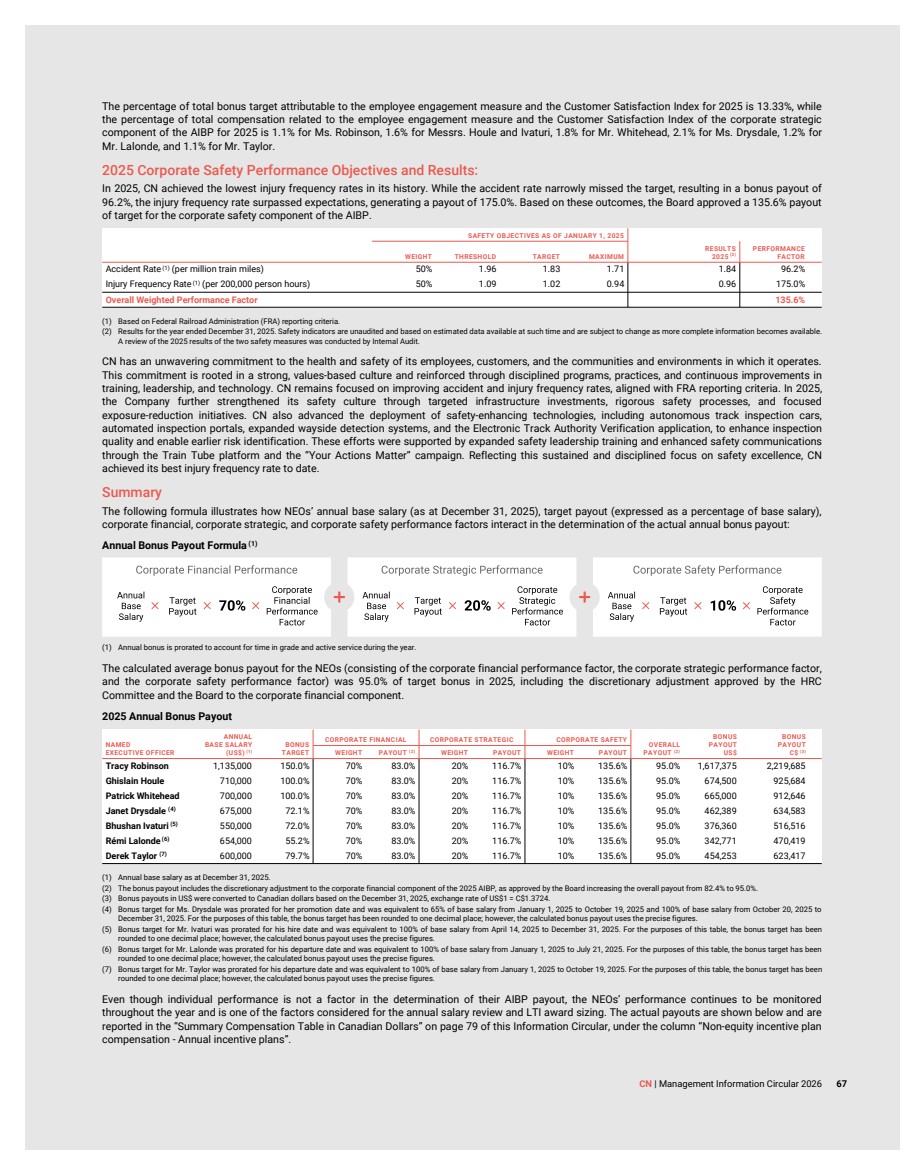
| 2025 Long-Term Incentives (LTI) The Board considers several factors when assessing CN’s LTI strategy, including the balance between long-term value creation and the protection of shareholder interests, executive stock ownership position versus stock option holdings, executive retention risk, as well as the dilution impact of different LTI vehicles. The Board grants a combination of stock options and PSUs to NEOs to align with mid- and long-term business performance and shareholder value creation. PSUs are subject to the achievement of performance criteria that are determined by the HRC Committee at the beginning of the vesting period and the performance vesting factor can range from 0% to 200%. Stock options align the executives’ compensation with shareholder value growth, allowing them to benefit from future share appreciation and to acquire financial interest in the Company over time. It further aligns their compensation to CN’s long-term success. The annual grant of PSUs and stock options to NEOs is reviewed and approved at the meetings of the HRC Committee and the Board, which occur each year in January. To determine each NEO’s LTI award, the HRC Committee takes into consideration, among other factors, individual performance, retention risk and succession plans, as well as CN’s compensation policy and the value of LTIs granted by the applicable comparator group (refer to section “Benchmarking Using Comparator Group” on page 62 of this Information Circular). The fair value of LTI grants for NEOs is determined with reference to the 50th percentile of the comparator group. The HRC Committee does not consider previous executive grants when setting the individual awards, as the LTI plans are inherently performance-based. The Board may also, at its discretion, approve additional grants of PSUs and stock options to NEOs during the year. The exercise price of the stock options granted is equal to the closing price of CN’s common shares on the TSX or the NYSE on the grant date. A minimum active service condition exists for stock options and PSUs to support the retention of key talent approaching retirement. NEOs must remain in active service until December 31 of the year of the grant for stock options, and until March 31 of the year following the year of grant for PSUs. Should a NEO retire prior to the end of the minimum service condition in the award agreement, PSUs and stock options awarded pursuant to that agreement would be forfeited. Valuation Methodology: 2025 Award In 2024, the HRC Committee reviewed the methodology used for disclosing share‑based and options‑based awards and approved a transition to using the face value of share‑based awards and the accounting value of options‑based awards for compensation disclosure, aligning CN with prevailing market practice. Prior to 2024, CN applied the WTW expected‑life binomial methodology, which adjusts the award value and share price to reflect the attributes of the underlying instruments, including the minimum share‑price condition applicable to certain awards. For 2025 awards, CN continues to use the new valuation methodology adopted in 2024. Performance Share Units: 2025 Award The objective of the PSUs is to enhance CN’s ability to attract and retain talented executives and to provide alignment of interests between such executives and our shareholders. PSUs vest after three years and the grant date fair value of the PSUs awarded to each NEO in 2025 is included in the “Summary Compensation Table in Canadian Dollars” on page 79 of this Information Circular, under the Share-Based Awards column. The vesting of PSUs is subject to the achievement of performance measures defined at the beginning of the cycle and the performance vesting factor can range from 0% to 200%. At the end of the performance cycle, the number of PSUs will be adjusted based on the achievement of the performance conditions detailed below. Quarterly dividend equivalents during the three-year vesting period for PSUs are reinvested into additional PSUs to strengthen the shareholder-like mindset. Dividend equivalents are paid only on PSUs that vest; no dividends are paid on unearned or forfeited units. PSUs will be settled in CN common shares purchased on the open market. PSUs awarded in 2025 are subject to two performance measures, as outlined below and the grant date fair value in the “Summary Compensation Table in Canadian Dollars” on page 79 of this Information Circular, under the “Share-Based Awards” column. 1. ROIC PSUs Forty percent (40%) of the LTI award value is tied to achieving a target based on CN’s average three‑year PSU‑ROIC performance over the plan period. The HRC Committee establishes the threshold, target, and maximum performance ranges for this metric at the start of each award cycle, ensuring alignment with CN’s business plan. The same target objectives apply to all NEOs. The PSU-ROIC for each of the applicable plan years is generally calculated as net income before interest expense, divided by the total of CN’s average net indebtedness and the average shareholders’ equity, and may, in certain instances, be adjusted for certain items as determined by the HRC Committee. ROIC measures CN’s efficiency in the use of its capital funds and is viewed as a key measure of long-term value generation to its shareholders. CN has elected not to disclose the 2025 PSU-ROIC targets given these are forward-looking targets that are commercially sensitive. 2025 PSU-ROIC targets and CN’s performance against the targets will be disclosed at the end of the vesting period. 2. Relative TSR PSUs Thirty percent (30%) of the LTI award value is subject to CN’s Relative TSR, measured against the S&P North America LargeMidCap Transportation Index, which includes Canadian and U.S. companies, including the Class I Railroads. Relative TSR performance reflects CN’s share price appreciation, including dividends, over the three‑year plan period relative to the companies within this comparator group, and determines the vesting of Relative TSR PSUs awarded in 2025 to NEOs based on the Company’s TSR percentile ranking within the comparator group, over the plan period, as set forth in the following table: CNR PAYOUT (1) 75th Percentile and above 200% 50th Percentile 100% 25th Percentile 50% Less than the 25th Percentile 0% (1) Relative TSR performance is calculated using CNR 20-day share price average immediately prior to January 1, 2025 (including dividend reinvestment) and CNR 20-day share price average ending on December 31, 2027 (including dividend reinvestment). The same calculation is used for each company in the comparator group. 68 CN | Management Information Circular 2026 |
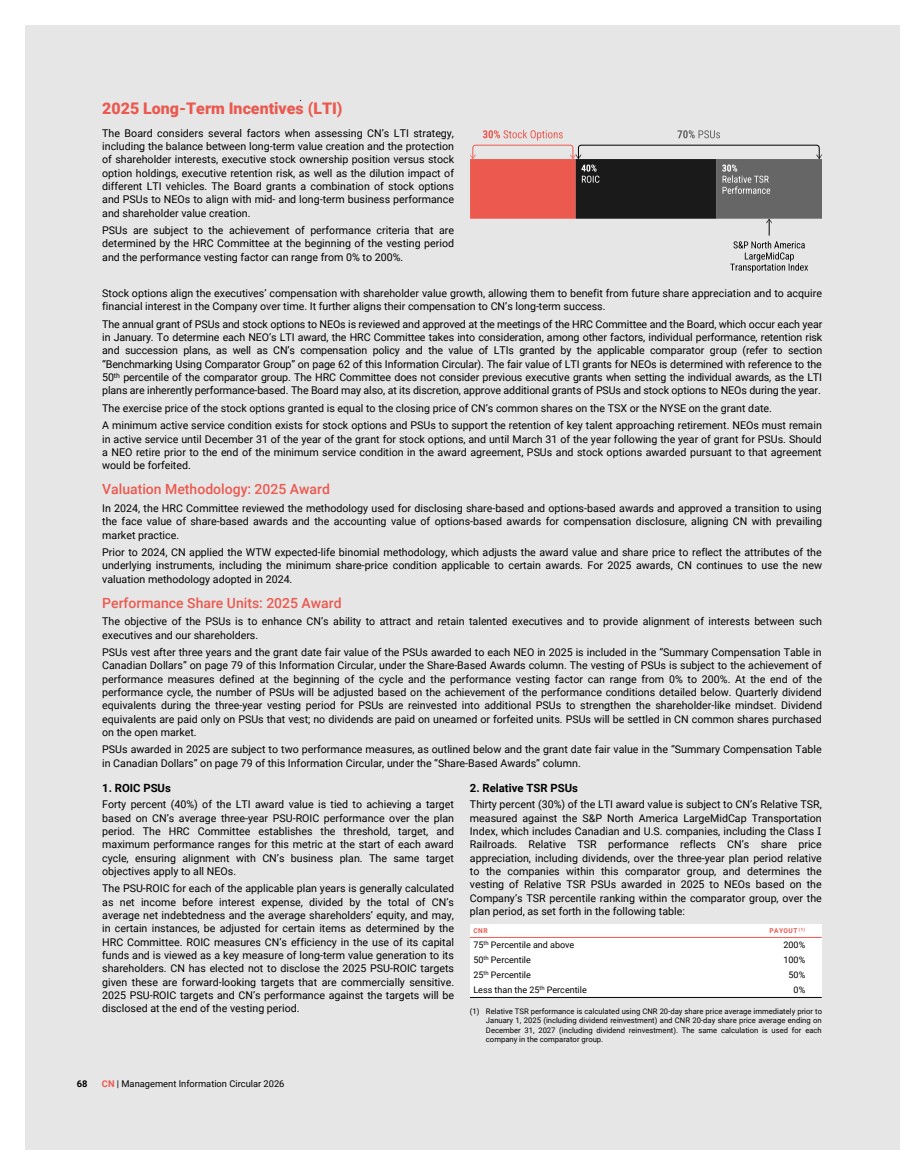
| Performance Share Units: 2023 Award Payout The HRC Committee reviewed the vesting of the NEOs’ 2023 PSU award against the performance targets for each measure: • ROIC PSUs: CN achieved a three‑year average PSU‑ROIC of 14.2% for the period from January 1, 2023 to December 31, 2025, resulting in a nil payout (0.0%) for the PSUs-ROIC awarded in 2023, as both the performance threshold and the minimum average closing share price condition were not met over the period. • Relative TSR PSUs: CN delivered a TSR of -13.7% over the period from January 1, 2023 to December 31, 2025, resulting in an overall nil payout (0.0%), reflecting the weighted-average performance vesting factor of both measures (0.0% vesting factor relative to the Class I Railroads and 0.0% performance vesting factor relative to the S&P/TSX 60). 2023 PSUs will not result in a settlement given the nil payout factor for both the ROIC and TSR components. Performance Objectives and Results–Performance Share Units–2023 Award ROIC PSUs–60% of the PSU grant value: OBJECTIVE PERFORMANCE VESTING FACTOR (1) RESULTS OVERALL RESULTS PERFORMANCE OBJECTIVE: Average PSU-ROIC for the three‑year period ended on December 31, 2025 17.5% and above 200% 14.2% translating into a performance vesting factor of 0.0% Payout factor of 0.0% 16.5% 100% 15.5% 50% Below 15.5% 0% PAYOUT CONDITION: Minimum average closing share price (2) for the last three months of 2025 C$167.77 on the TSX or US$123.06 on the NYSE C$133.98 US$96.14 minimum share price condition was not achieved (1) Interpolation applies between objectives. (2) Minimum share price condition for the 2023 award established as the average closing share price for 20-day period ending on December 31, 2022. Relative TSR PSUs–40% of the PSU grant value: TSR relative to S&P/TSX 60 (20% of the PSU grant value) CNR PAYOUT (1) RESULTS 75th Percentile and above 200% -13.7% (2) TSR resulting in the 4th Percentile and translating into a payout factor of 0.0% 50th Percentile 100% 25th Percentile 50% Less than the 25th Percentile 0% (1) Interpolation applies between objectives. (2) TSR performance is calculated using CNR 20-day share price average immediately prior to January 1, 2023 (including dividend reinvestment) and CNR 20-day share price average ending on December 31, 2025 (including dividend reinvestment). The same calculation is used for each company part of the comparator groups. TSR relative to selected Class I Railroads (20% of the PSU grant value) CNR PAYOUT RESULTS 1st 200% -13.7% (1) TSR resulting in the 5th place ranking and translating into a payout factor of 0.0% 2nd 150% 3rd 100% 4th 50% 5th 0% (1) TSR performance is calculated using CNR 20-day share price average immediately prior to January 1, 2023 (including dividend reinvestment) and CNR 20-day share price average ending on December 31, 2025 (including dividend reinvestment). The same calculation is used for each company in the comparator groups. 2025 EPS Performance Share Unit Award for Non‑NEOs In 2025, a one-time award was granted to executives below the NEO level, including 50% in RSUs and 50% in Earnings per share-based PSUs (EPS - PSUs). The award vests on a ratable basis, with 30% scheduled to vest on December 31, 2025 and 70% on December 31, 2026, and was introduced to balance strong incentivization with shareholder expectations. Accordingly, Ms. Drysdale, while serving as Senior Vice-President prior to her appointment as Executive Vice-President and Chief Commercial Officer in October 2025, received additional RSUs and EPS-PSUs under this program. The HRC Committee reviewed the vesting of the 2025 EPS-PSU award relative to the EPS performance target for the tranche vesting on December 31, 2025. For the performance period from January 1 to December 31, 2025, CN achieved an EPS of $7.57, resulting in a 91.3% payout for the EPS-based PSUs granted in 2025. 2025 EPS-PSU MINIMUM (50%) TARGET (100%) MAXIMUM (200%) 2025 RESULTS PAYOUT (1) Year 1 - Vesting December 31, 2025 7.29 7.63 7.97 7.57 91.3% (1) Interpolation applies between objectives. The value vested during the year for each NEO is included in the table “Incentive Plan Awards–Value Vested or Earned During the Year”, and under the “Share-Based Awards–Value Vested During the Year” column on page 87 of this Information Circular. Stock Options Stock options were granted in 2025 to NEOs pursuant to the MLTIP (refer to page 88 of this Information Circular for details of the MLTIP). The stock options granted in 2025 vest over four years at a rate of 25% at each anniversary date and have a 10-year term. Grants were made in the currency of the recipient’s salary. Stock options are granted with the objective of rewarding NEOs for creating sustainable, long-term shareholder value. If the share price increases between the grant date and the vesting date, stock options will have a realizable value. Gains are realized once the stock options are exercised. The gain will be equivalent to the difference between the share price on the date of exercise and the grant date share price, multiplied by the number of stock options exercised. The grant date fair value of the stock options awarded to NEOs in 2025 is included in the “Summary Compensation Table in Canadian Dollars” on page 79 of this Information Circular, under the “Option-Based Awards” column. CN | Management Information Circular 2026 69 |
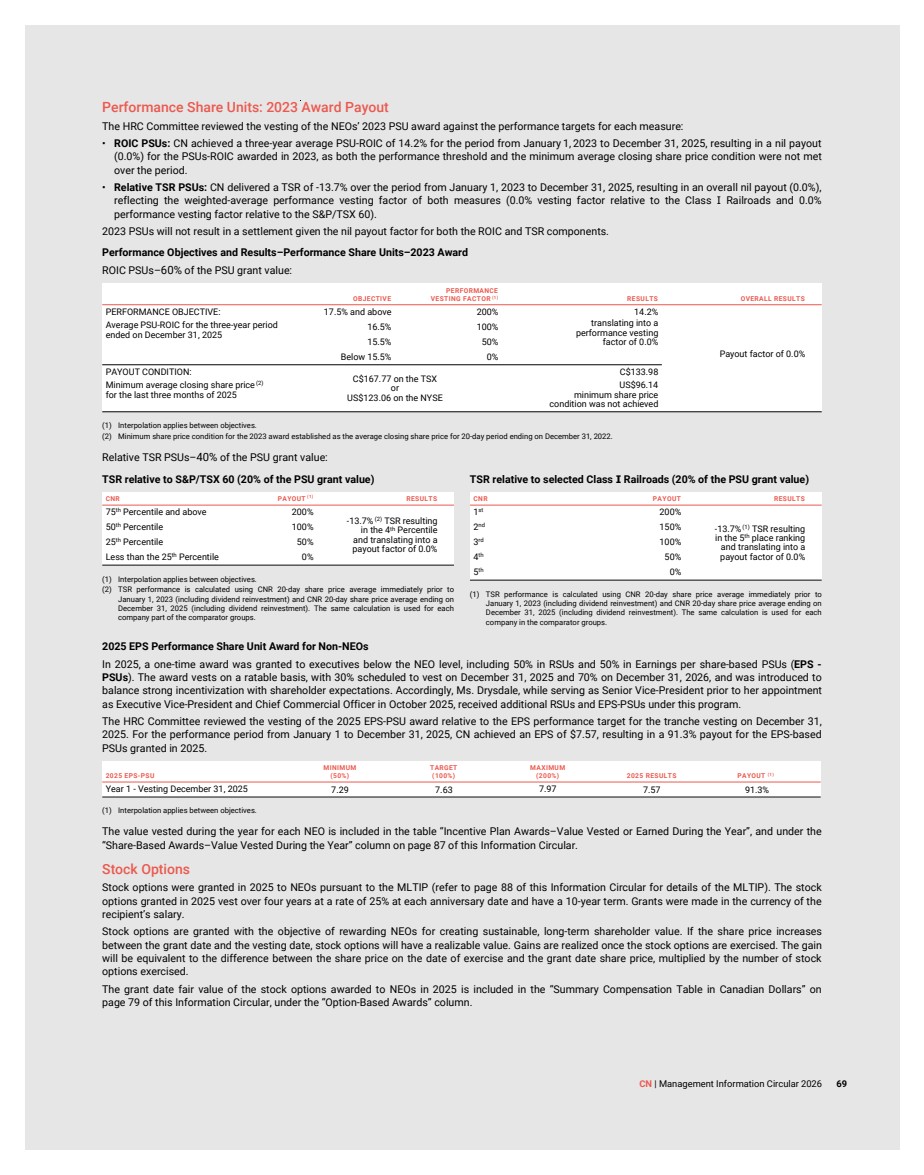
| Other Key Compensation Programs of the Company Executive Perquisites & Security NEOs and other executives are eligible to receive perquisites and personal benefits in accordance with CN’s policy and in line with general market practice. These typically include the use of a Company-leased vehicle, parking, financial counselling and tax services, flexible allowance spending account to emphasize health and wellness, certain healthcare benefits, including an annual executive physical services and life insurance, and personal use of the corporate aircraft to the President and CEO for business efficiency and safety purposes. Due to increased security risks inherent in senior executive positions, CN may provide NEOs with personal security as needed, based on risk assessments. The type and value of the perquisites are generally determined by the grade of the employee’s position. Employee Share Investment Plan The Employee Share Investment Plan (ESIP), available to all CN employees, provides the opportunity to participate in CN’s ownership through the purchase of CN common shares on the open market via payroll deductions. Employees may contribute between 1% and 10% of their gross base salary to the ESIP every pay period. CN provides a 35% match on the first 6% of employee contributions. CN contributions to the ESIP are subject to a one-year vesting period and are forfeited should certain participant contributions be sold or disposed of prior to vesting. Over 80% of CN’s employees are shareholders of the Company through participation in the ESIP, and in 2025, all NEOs participated in the ESIP. The value of the Company match received by NEOs in 2025 under the ESIP is indicated in the Details of “All Other Compensation Amounts” table on page 83 of this Information Circular. Stock Ownership CN recognizes that its senior leaders have a significant influence on the Company’s financial performance, operational execution, and long‑term growth. Accordingly, the HRC Committee supports robust executive share ownership to reinforce alignment between executives’ interests and those of long‑term shareholders. Under CN’s stock ownership guidelines, NEOs are required to attain a minimum level of share ownership, expressed as a multiple of base salary, within a five‑year period. Once a NEO has met the required ownership level, they must remain compliant on an ongoing basis. Compliance is reviewed and reported annually to the HRC Committee. In addition, the President and CEO must maintain the required ownership level until one year after cessation of employment. NEOs may meet the ownership requirement through holdings of common shares and vested deferred share units (DSUs) under CN’s Voluntary Incentive Deferral Plan (VIDP). Until a NEO achieves their required ownership level, a mandatory 50% hold applies to vested shares, including vested PSUs, vested ESIP shares, and shares acquired upon exercising stock options. Stock options, vested or unvested, and unvested PSUs and DSUs are excluded from the ownership calculation. Effective January 1, 2026, the HRC Committee approved the inclusion of unvested restricted share units (RSUs) and unvested DSUs in the ownership calculation for all NEOs and reduced the stock ownership guidelines for the President and CEO. These updates were made to align with practices across the comparator group. As at December 31, 2025, Mr. Houle had achieved his share ownership requirement. Ms. Robinson, Ms. Drysdale, Mr. Whitehead, and Mr. Ivaturi had not yet achieved their required ownership levels and have a five‑year period from their date of hire or appointment to do so. 2025 GUIDELINES 2026 GUIDELINES President and CEO 8 times base salary 7 times base salary Executive Vice-Presidents 4 times base salary 4 times base salary Ms. Robinson has participated in the ESIP since joining CN and contributes a fixed percentage of her base salary to purchase common shares. She has also elected to defer her entire AIBP bonuses for 2022, 2023, 2024, and 2025 into the VIDP to accelerate progress toward her ownership requirement, and she has purchased common shares on two occasions since her appointment. In addition, PSUs settled in equity, further encouraging share ownership. Stock Ownership Status as at December 31, 2025 NAMED EXECUTIVE OFFICER NUMBER OF SHARES HELD (1) VALUE OF HOLDINGS (2) (C$) VALUE REQUIRED TO MEET GUIDELINES (3) (C$) HOLDINGS AS A MULTIPLE OF BASE SALARY ESIP (6) VESTED PSU (7) VESTED DSU CN SHARES HELD OUTSIDE OF CN PLANS Tracy Robinson (4) 46,269 6,280,957 12,692,024 4.0× 2,889 5,646 31,133 6,600 Ghislain Houle 204,405 27,747,934 3,969,752 28.0× 2,439 – 45,942 156,024 Patrick Whitehead (4) 2,487 337,637 3,913,840 0.4× 1,152 1,335 – – Janet Drysdale(5) 11,566 1,570,040 3,774,060 1.7x 7,177 1,146 3,243 – Bhushan Ivaturi (4) 304 41,245 3,075,160 0.1× 304 – – – (1) Common shares and/or vested deferred share units as at December 31, 2025. (2) Value is based on the closing share price of the common shares on December 31, 2025, on the TSX (C$135.75). (3) US$ salaries as at December 31, 2025, were converted to Canadian dollars using the average rate during the year (US$1.00 = C$1.3978). (4) Ms. Robinson, Mr. Whitehead and Mr. Ivaturi joined the Company in February 2022, March 2021 and April 2025 respectively. (5) Following her promotion to Executive Vice-President and Chief Commercial Officer in October 2025, Ms. Drysdale became subject to updated stock ownership guidelines, thereby reinstating the five‑year compliance period. (6) CN shares acquired under the Employee Share Investment Plan through the purchase of CN common shares on the open market via payroll deductions. In 2025, all NEOs participated in the ESIP. (7) Vested PSUs do not include the 2023 PSU award granted under the Share Units Plan for the purpose of stock ownership requirements at December 31, 2025 since they were not yet settled on that date. With the HRC Committee’s 2025 approval of the inclusion of unvested RSUs and unvested DSUs, effective beginning in 2026, Ms. Robinson’s ownership level as a multiple of base salary increases to 4.4×, and Ms. Drysdale’s increases to 2.4× under the updated methodology. The updated methodology does not impact the other NEOs’ holdings as a multiple of salary at this time. 70 CN | Management Information Circular 2026 |
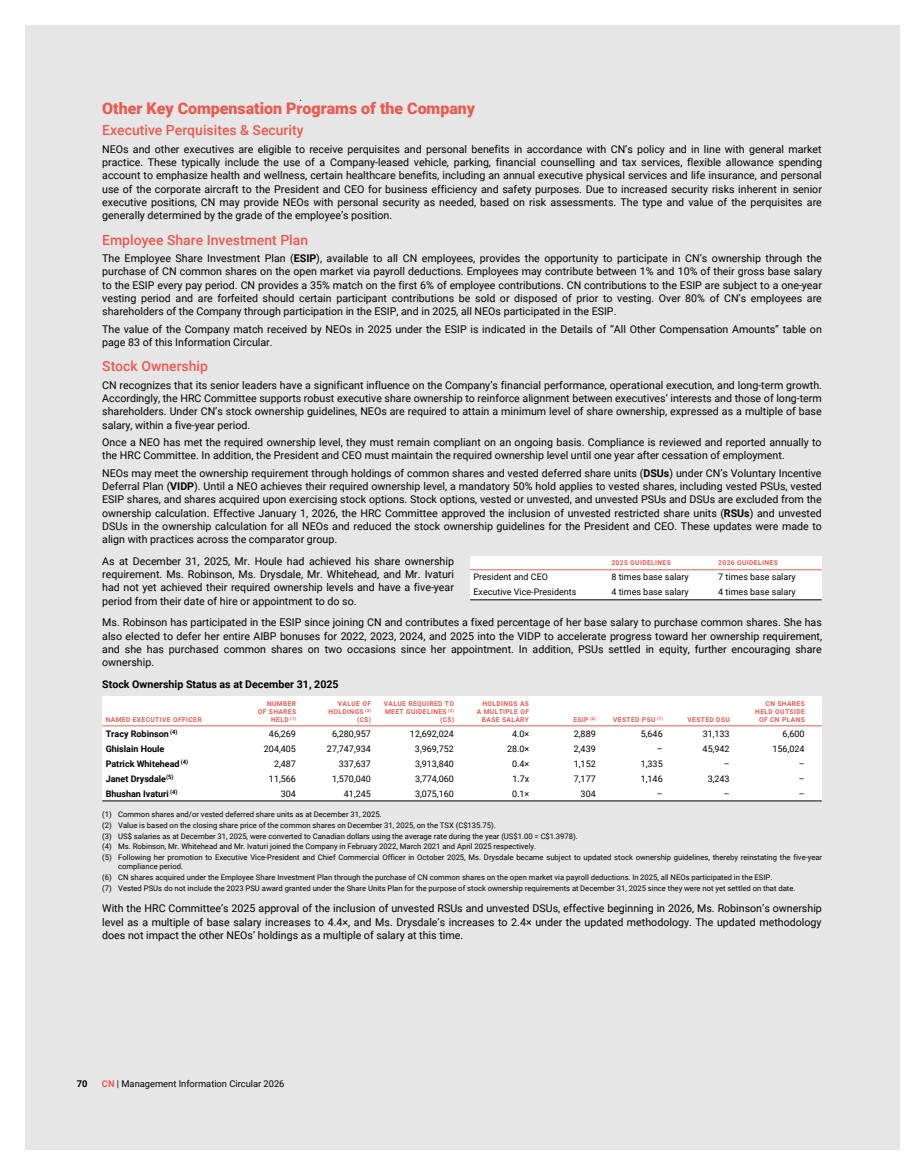
| Change of Control Provisions The MLTIP and the Share Units Plan include “double trigger provisions”. Pursuant to such provisions, the vesting of stock options or PSUs held by a participant would not accelerate upon a Change of Control, unless the participant is terminated without cause or resigns for good reason. A “Change of Control” means any of the following events: a) In the event the ownership restrictions in the CN Commercialization Act are repealed, a formal bid for a majority of CN’s outstanding common shares; b) Approval by the Company’s shareholders of an amalgamation, merger or consolidation of CN with or into another corporation, unless the definitive agreement of such transaction provides that at least 51% of the directors of the surviving or resulting corporation immediately after the transaction are the individuals who, at the time of such transaction, constitute the Board and that, in fact, these individuals continue to constitute at least 51% of the Board of the surviving or resulting corporation during a period of two consecutive years; or c) Approval by CN’s shareholders of a plan of liquidation or dissolution of CN. The provisions state that acceleration of vesting would not occur if a proper substitute to the original stock options or PSUs is granted to the participant. If such a substitute is granted and a participant is terminated without cause or submits a resignation for good reason within 24 calendar months after a Change of Control, all outstanding substitute stock options or PSUs that are not then exercisable shall vest and become exercisable or payable in full upon such termination or resignation. In the case of PSUs, the accelerated payout will include a proration based on the participant’s active service during the performance cycle and will be further adjusted to reflect performance against goals measured as of the date of the event. Substitute stock options that are vested and exercisable shall remain exercisable for a period of 24 calendar months from the date of such termination or resignation, and PSUs shall be remitted within 30 days. Discretion is left to the Board to consider special circumstances. The definition of a resignation for good reason is included in the “Termination and Change of Control Benefits” table on page 93 of this Information Circular. Non-Compete/Non-Solicitation/Non-Disclosure Provisions The railroad industry operates in a highly competitive market. In recent years, CN has continued its efforts to protect its interests and its confidential information. Accordingly, CN’s LTI award agreements for all executives, as well as its non-registered retirement plans, contain non-compete, non-solicitation, non-disclosure of confidential information and other restrictive covenants. Payouts under the LTI plans or the non-registered retirement plans are conditional upon current or former executives continuing to comply with these restrictive commitments for defined periods following their termination of employment or retirement from CN. In 2010, the Board approved the inclusion of non-compete and non-solicitation provisions in certain supplemental retirement plans and arrangements. Such provisions were also harmonized in 2010 and 2011 across the non-registered pension plans that apply to all executives and were further updated in 2023. Non-compete and non-solicitation provisions will be applied if a recipient fails to comply with certain commitments for a period of one year and two years, respectively, following termination of employment. Those commitments prohibit, as detailed in such provisions: a) The use of confidential CN information for any purpose other than performing duties with CN; b) Engaging in any business that competes with CN; c) Soliciting or accepting the business of a customer, client, supplier or distributor of CN or hiring or engaging employees of CN; d) Taking advantage or profiting from any business opportunity of which they became aware in the course of employment with CN; and e) Taking any action that will cause relations between CN and its consultants, customers, clients, suppliers, distributors, employees or others to be impaired or might otherwise be detrimental to the business interests or reputation of CN. Executive Compensation Clawback CN’s clawback policy applies to all of CN’s executive management and provides that the Board may, at its sole discretion, to the full extent permitted by governing laws and to the extent it determines it is in CN’s best interest to do so, require reimbursement of all or a portion of annual and LTI compensation received by an executive. The Board may seek reimbursement of full or partial compensation from an executive or former executive in situations where the: a) Amount of incentive compensation received by the executive or former executive was calculated based on, or contingent on, the achievement of certain financial results that were subsequently the subject of or affected by a restatement of all or a portion of CN’s financial statements; b) Executive engaged in gross negligence, intentional misconduct or fraud that caused or partially caused the need for the restatement; and c) Incentive compensation payment received would have been lower had the financial results been properly reported. In addition, with respect to bonus or LTI awarded after March 7, 2017, in the event that any member of executive management is found to have engaged in gross negligence, intentional misconduct, fraud, theft or embezzlement, whether or not there is a financial restatement, the Board may at its discretion, to the full extent permitted by governing laws and to the extent it determines to be in CN’s best interest to do so, require the reimbursement of some or all of the after‑tax amount of any incentive compensation already paid in the previous 24 months or forfeit their vested or unvested incentive awards in accordance with plan terms. In 2023, the HRC Committee and the Board also approved the Financial Statement Compensation Recoupment Policy, effective as of October 2, 2023, which requires the recovery of incentive-based compensation that, as a result of a financial restatement, is discovered to have been erroneously awarded to current or former executive officers as well as the Vice-President and Corporate Comptroller, in response to new listing standards rules adopted by the NYSE. Under such policy, the Board may not exercise discretion in the event of a financial restatement that triggers the requirement to claw back compensation. CN | Management Information Circular 2026 71 |
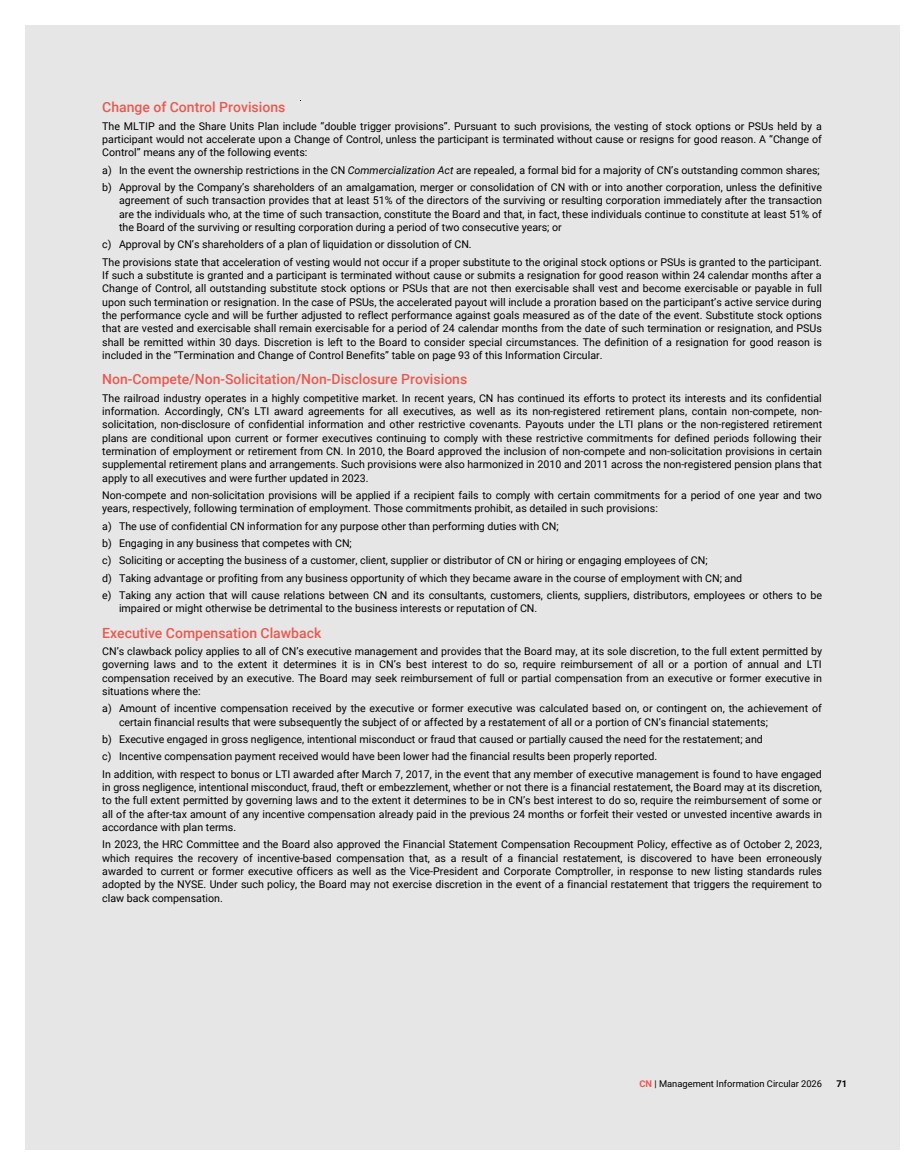
| 2026 Executive Compensation Framework The HRC Committee approved the following changes to its short-term and LTI plans effective January 1, 2026. These enhancements are intended to ensure CN’s compensation programs remain aligned with evolving market practices, reinforce CN’s strategic priorities, and maintain a robust alignment between pay and performance. The updates support CN’s ability to attract, motivate, and retain top talent while maintaining strong alignment with shareholder interests and promoting long‑term, sustainable value creation. Additional details on the updated framework will be provided in the normal course in CN’s management information circular. Annual Incentive Bonus Plan: • Adjusted the weighting of the corporate financial and strategic components to 60% and 15%, respectively, and reintroduce a 15% individual performance component to strengthen accountability and encourage discretionary effort. • Updated the financial metrics to include Free Cash Flow at 30% and Operating Ratio at 15% to reinforce the focus on cash generation and operational efficiency, while maintaining long‑term growth alignment through a 15% weighting on operating income. • Enhanced the Customer Satisfaction Index by integrating operational performance metrics - specifically the Local Service Commitment Performance (LSCP) and Customer Car Order Supply (CCOS) - alongside customer sentiment insights collected through a bi‑annual, three‑question survey. Long-Term Incentives: • Adjusted the LTI mix to introduce RSUs at the NEO level, strengthening resilience in a volatile environment, aligning with prevailing market practices, and maintaining a performance‑linked equity vehicle that supports long‑term engagement. This change replaces the current LTI mix of 70% PSUs (40% ROIC PSUs and 30% relative TSR PSUs) and 30% stock options. A distinct mix will apply to the President and CEO: • President and CEO’s revised mix will include: 60% PSUs (35% ROIC PSUs and 25% relative TSR PSUs), 30% stock options and 10% RSUs • Other NEOs’ vehicle mix will include: 60% PSUs (35% ROIC PSUs and 25% relative TSR PSUs), 20% stock options and 20% RSUs • Applicable to retirements occurring on or after January 29, 2026, and subject to TSX approval, the post‑retirement stock option exercise window is extended to five years for both future and outstanding grants, replacing the current three‑year window for options granted before January 1, 2020, and the four‑year window for options granted on or after January 1, 2020. Stock Ownership Guidelines: The Company places a strong emphasis on fostering an ownership culture to further align the interests of senior leaders with those of CN’s shareholders. While all executives remain subject to stock ownership requirements, the SOG for the President and CEO has been adjusted to better reflect prevailing market practice. • Reduced the SOG requirement for the President and CEO from eight (8) times to seven (7) times base salary, which remains at the higher end of market practice. • Include unvested RSUs and DSUs in the stock ownership calculation for all NEOs. Risk Mitigation in Our Compensation Program CN maintains a formalized compensation policy designed to support sustained shareholder value creation, encourage appropriate executive behaviours, and mitigate compensation‑related risks. Guided by this framework, the HRC Committee oversees an executive compensation program that aligns with CN’s business strategy and reinforces a strong pay‑for‑performance philosophy; therefore the HRC Committee ensures the following: Structured Process and Governance • An annual review of the performance measures under CN’s AIBP and Share Units Plan takes place to ensure their continued relevance. • A formal assessment of performance is completed each year, and then uses discretion to increase or decrease any compensation awards if it deems appropriate based on market factors or other extenuating circumstances. • Stress-testing exercises are performed annually for proposed LTI grants and results are presented to the HRC Committee for its consideration prior to the HRC Committee and the Board approving such grants. • In‑camera sessions of independent directors are held at HRC Committee meetings to discuss compensation and risk‑related matters. • Overlapping membership between the HRC Committee and the AFR Committee enhances coordination on compensation‑related risk oversight. Balanced Program • The compensation program appropriately balances fixed and variable pay, as well as short- and long-term incentives (in aggregate, approximately 82.1% of NEOs’ target total direct compensation is directly linked to CN’s performance). • The corporate financial component of the AIBP includes performance measures that are appropriately balanced, thus diversifying the risk associated with the use of any single performance measure (refer to section “Annual Incentive Bonus Plan” on page 65 of this Information Circular for more information). • The corporate strategic and corporate safety components of the AIBP include three strategic measures and two standard safety measures, respectively, which further increases diversification of the plan, thus mitigating potential risk associated with the plan. • The LTI awards, which constitute a significant portion of NEO compensation, motivate executives to create longer-term value. • There are multi-year, overlapping performance periods for the PSUs and stock options, which encourages consistent, long-term behaviour and mitigates risk. • The performance measures used within the Share Units Plan reflect an appropriate balance between financial and share price conditions. • Relative TSR performance serves as a key mechanism to ensure that executive pay outcome align with shareholders’ interests. 72 CN | Management Information Circular 2026 |
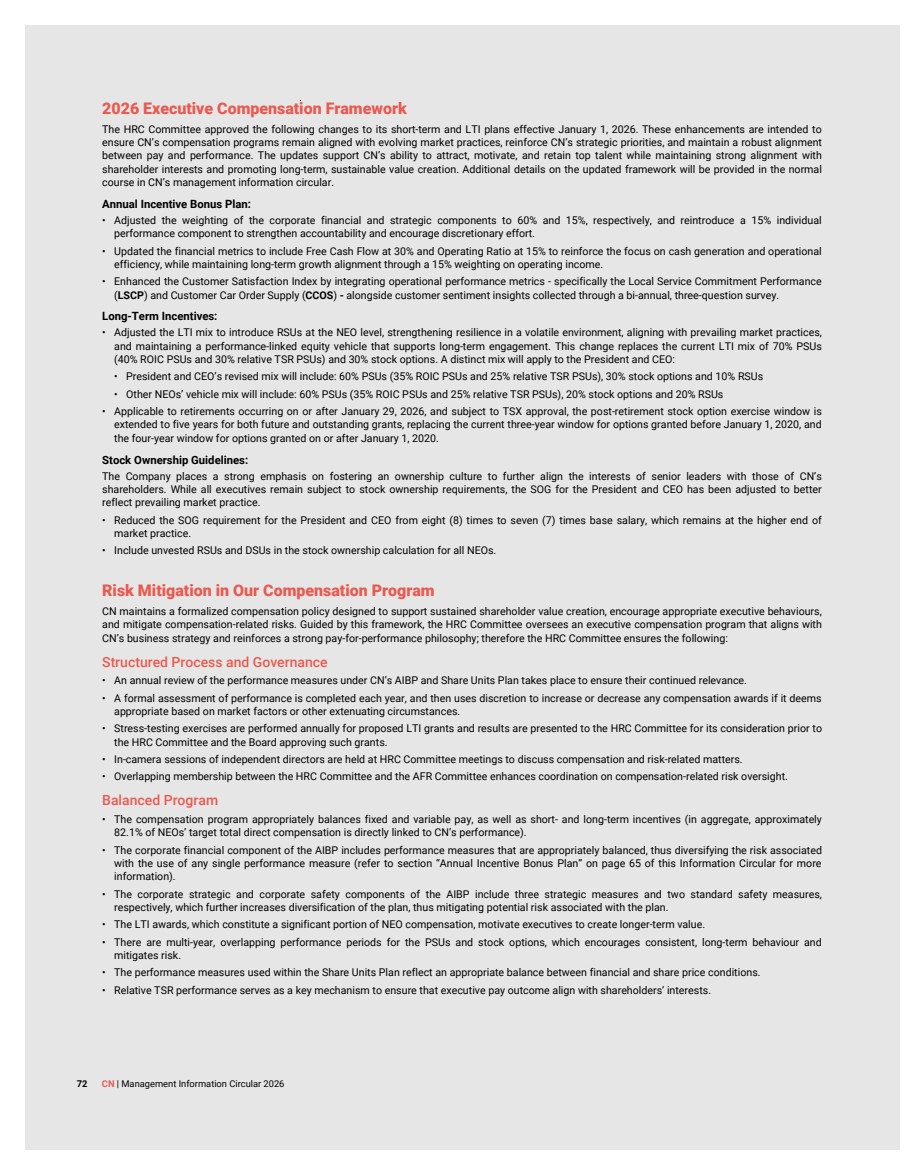
| Fixed Limits on Variable Compensation • The AIBP and the Share Units Plan are designed to include the possibility of a zero payout, as well as a pre-defined maximum. • Executives accrue benefits in a Defined Contribution Plan, which limits CN’s exposure to pension plan insolvency risk. Protection Mechanisms • CN’s executive compensation clawback policies allow the Board, in certain situations, to request the full or partial reimbursement of annual and LTI awards received by executives (refer to section “Executive Compensation Clawback” on page 71 of this Information Circular for more information). • A 2017 policy enabling recovery of incentive compensation in cases of gross negligence, intentional misconduct, fraud, theft, or embezzlement, without requiring a financial restatement; and • A Financial Statement Compensation Recoupment Policy, effective October 2, 2023, which requires recovery of erroneously awarded incentive‑based compensation following a financial restatement, in accordance with NYSE rules. • The LTI plans include “double-trigger provisions”, such that the vesting of LTI awards would generally not accelerate upon a Change of Control. • Under CN’s Insider Trading and Reporting Policy, directors, executives and employees are prohibited from engaging in hedging activities or in any form of transactions in publicly-traded options against CN securities. This relates to all forms of derivatives, including “puts” and “calls”. • To further align their interests with those of shareholders, executives are required to meet specific stock ownership guidelines. In addition, the President and CEO must maintain their stock ownership level for one year after cessation of employment (refer to section “Stock Ownership” on page 70 of this Information Circular for more information). • For executive management, the payout of LTI awards and the payment of supplemental retirement benefits under CN’s non-registered pension plans are conditional on compliance with the conditions of their benefit plans, award or employment agreements, including, but not limited to, non-compete, non-solicitation, non-disclosure of confidential information and other restrictive covenants (refer to section “Non-Compete/Non-Solicitation/Non-Disclosure Provisions” on page 71 of this Information Circular for more information). Independent Advice Management retains the services of an external executive compensation consultant to assist in compensation-related matters for its executives. The HRC Committee retains the services of Hugessen as independent executive compensation consultant to provide advice on compensation recommendations that are presented for the HRC Committee approval. In 2025, WTW was mandated by management to review CN’s compensation policy, programs and practices and assessed any potential risk implications. WTW concluded that there does not appear to be significant risks arising from CN’s compensation programs that are reasonably likely to have a material adverse effect on the Company. The HRC Committee played an active role in reviewing the risk assessment report and in discussing the findings provided by WTW. The HRC Committee supports the conclusion from the WTW risk assessment report and in its own assessment determined that proper risk mitigation features are in place within CN’s compensation programs. Throughout the year, the HRC Committee plays an important oversight role related to the identification and management of risks associated with CN’s compensation programs and practices. For example, in camera sessions, restricted to independent members of the HRC Committee, are held at the start or end of each regularly scheduled HRC Committee meeting to allow for discussion regarding any compensation or risk-related issue. The HRC Committee also believes in the benefits of a certain level of overlapping membership between the AFR Committee and the HRC Committee, particularly with regard to risk monitoring. As such, Shauneen Bruder and Robert Knight, members of the HRC Committee, are also members of the AFR Committee. This overlap effectively provides a link between committees’ risk oversight responsibilities. CN | Management Information Circular 2026 73 |
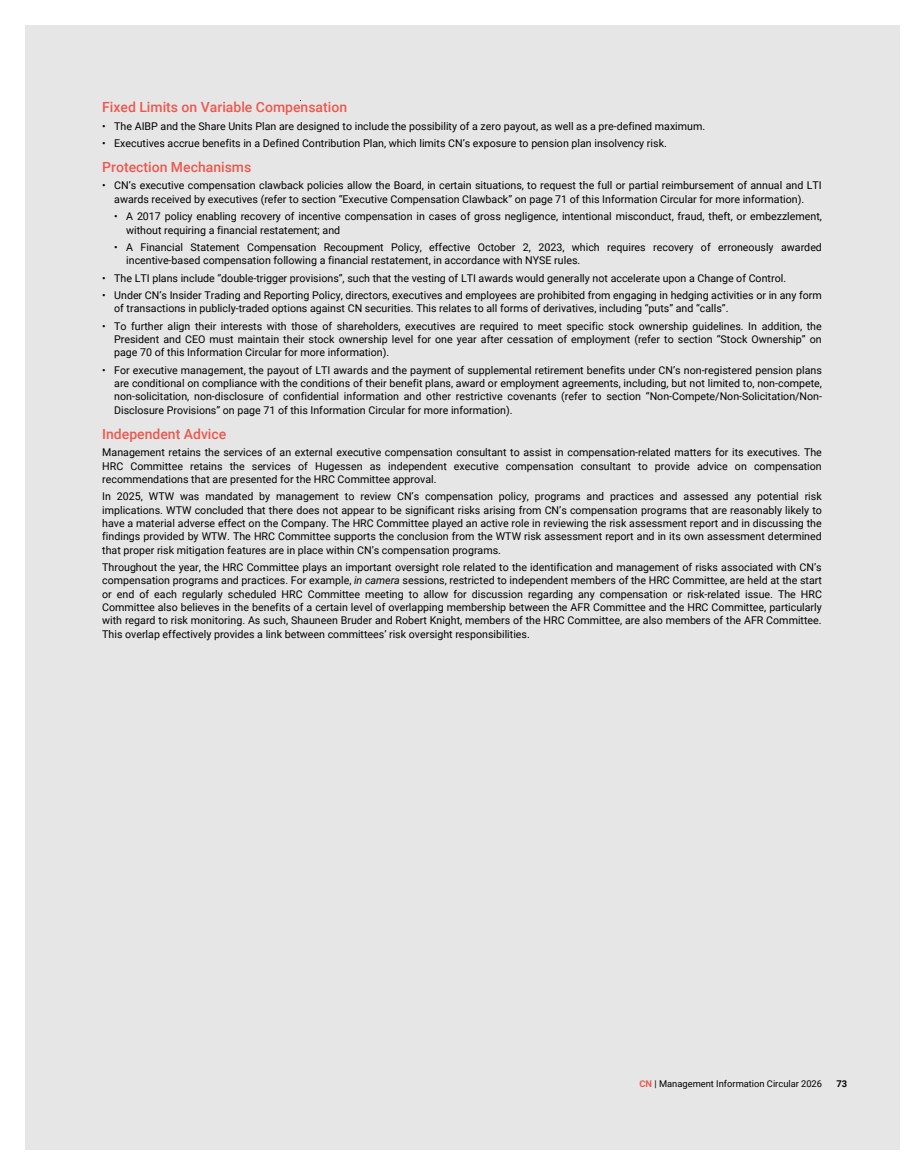
| Compensation of the NEOs Tracy Robinson President and Chief Executive Officer Tracy Robinson was appointed as CN’s President and Chief Executive Officer (CEO) effective February 28, 2022. Ms. Robinson was previously Executive Vice-President of TC Energy Corporation, President of Canadian Natural Gas Pipelines and President Coastal GasLink. Ms. Robinson also has extensive railway experience, as she spent 27 years at Canadian Pacific Railway (now Canadian Pacific Kansas City Limited), where she held executive roles spanning operations, finance and commercial. Ms. Robinson is a well-respected and seasoned executive who brings more than 35 years of operational management, strategy development, and project execution experience. As President and CEO of CN, Ms. Robinson is responsible for providing leadership and vision for CN, driving growth and profitability, as well as advancing strategic and operational goals to build long-term shareholder value. Ms. Robinson holds an MBA from the University of Pennsylvania’s Wharton School of Business and a Bachelor of Commerce from the University of Saskatchewan. Compensation The annual compensation of the President and CEO considers factors such as competitive positioning against market, economic outlook and leadership abilities, and is recommended by the HRC Committee and approved by the independent members of the Board. The President and CEO serves at the discretion of the Board. In 2025, Ms. Robinson’s base salary was increased to US$1,135,000 (C$1,586,503). Under the AIBP, Ms. Robinson’s target bonus for 2025 was 150% of her base salary. PSUs and stock options are granted to the President and CEO pursuant to the Share Units Plan and the MLTIP. Grants to the President and CEO are made on the same basis and conditions as those of the other NEOs of the Company. In 2025, Ms. Robinson received 81,930 PSUs and 164,077 stock options, in accordance with the terms of the Share Units Plan and the MLTIP, respectively. 2025 Target Total Direct Compensation Summary 2025 TOTAL DIRECT COMPENSATION (AT TARGET) US$ AS A% OF TOTAL DIRECT COMPENSATION Salary 1,135,000 7.9% AT-RISK COMPENSATION Annual Incentive Bonus (target) 1,702,500 11.8% Performance Share Units 8,088,130 56.2% Stock Options 3,466,947 24.1% Total Direct Compensation (target) 14,392,577 2025 Target Pay Mix Ghislain Houle Executive Vice-President and Chief Financial Officer Mr. Houle was appointed Executive Vice-President and Chief Financial Officer (CFO) on July 1, 2016. His responsibilities at CN include financial management, financial planning, procurement and supply management, investor relations, sustainability and facilities management. Mr. Houle joined the Company in 1997 as Chief Internal Audit and occupied various executive roles, including Vice-President Treasurer, Vice-President and Corporate Comptroller and Vice-President Financial Planning before being appointed to his current position. Prior to joining CN, Mr. Houle held positions in tax and audit at a major accounting firm. Mr. Houle is a CPA and holds a Bachelor of Commerce degree from Laval University and an MBA from McGill University. In 2025, Mr. Houle’s base salary was increased to US$710,000 (C$992,438). His target bonus under the AIBP was increased from 80% to 100% of base salary. In addition, Mr. Houle received 21,345 PSUs and 42,744 stock options in 2025, in accordance with the terms of the Share Units Plan and the MLTIP, respectively. 2025 Target Total Direct Compensation Summary 2025 TOTAL DIRECT COMPENSATION (AT TARGET) US$ AS A% OF TOTAL DIRECT COMPENSATION Salary 710,000 16.0% AT-RISK COMPENSATION Annual Incentive Bonus (target) 710,000 16.0% Performance Share Units 2,107,178 47.6% Stock Options 903,181 20.4% Total direct compensation (target) 4,430,359 2025 Target Pay Mix 74 CN | Management Information Circular 2026 |
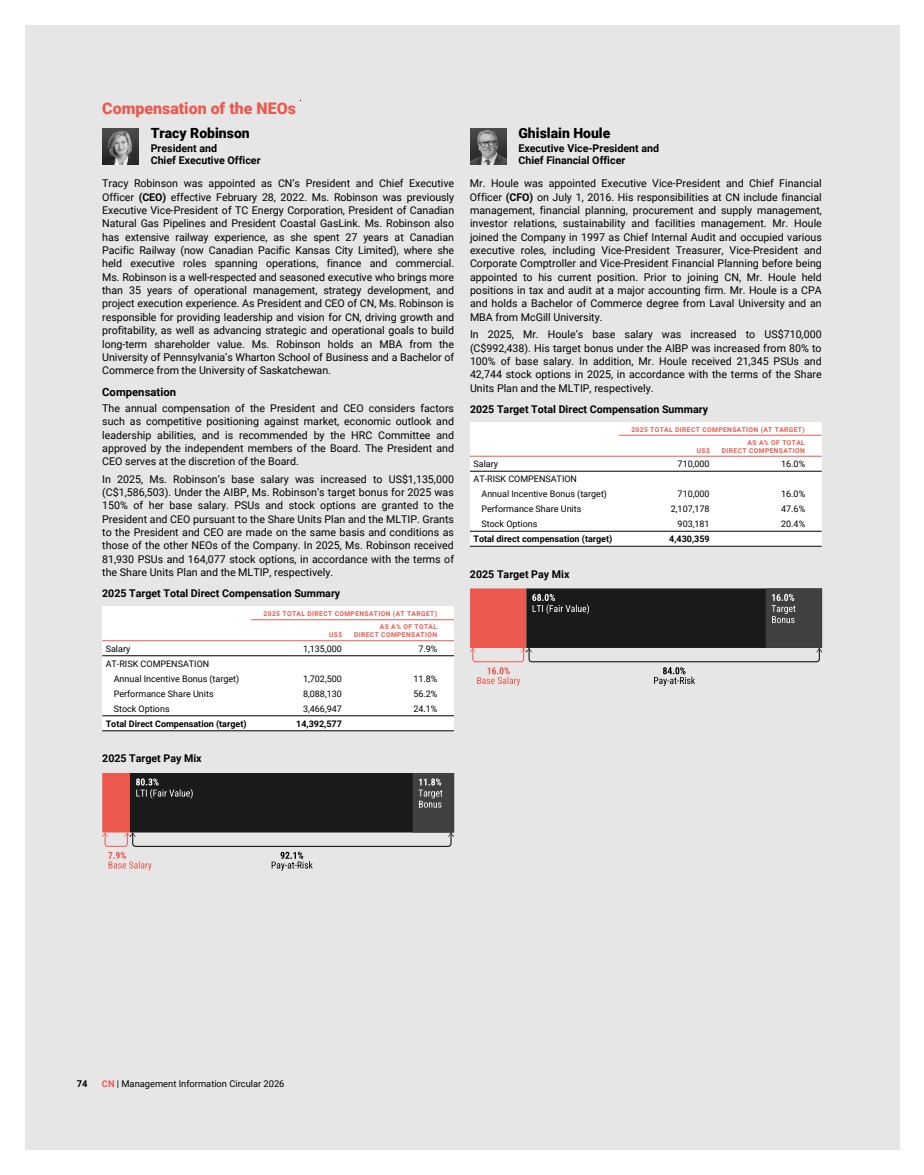
| Patrick Whitehead Executive Vice-President and Chief Operating Officer Mr. Whitehead was appointed Executive Vice-President and Chief Operating Officer (COO) in October 2025, after serving as Executive Vice-President and Chief Network Operating Officer since November 15, 2023. Mr. Whitehead is responsible for developing and executing CN’s operational plan and oversees the Company’s Transportation, Safety, Mechanical, Engineering, Supply Chain Operations and Intermodal Operations departments. Mr. Whitehead joined CN in March 2021 as General Manager and was promoted to Vice-President, Eastern Region in September 2021. He then served as Senior Vice-President, Network Transportation beginning in June 2022, before assuming the role of Executive Vice-President and Chief Network Operating Officer in November 2023. With over 30 years of experience in the rail industry, Mr. Whitehead brings to CN leadership that allows him to drive safety and training and to ensure discipline around scheduled operations and longer-term network and capital planning. Mr. Whitehead has completed the University of Pennsylvania’s Wharton School of Business Advanced Management Program and holds a Master of Science degree in Transportation Management from the University of Denver. In 2025, Mr. Whitehead’s base salary was increased to US$700,000 (C$978,460). His target bonus under the AIBP was increased from 80% to 100% of base salary. In addition, Mr. Whitehead received 15,955 PSUs and 31,952 stock options in 2025, in accordance with the terms of the Share Units Plan and the MLTIP, respectively. 2025 Target Total Direct Compensation Summary 2025 TOTAL DIRECT COMPENSATION (AT TARGET) (1) US$ AS A% OF TOTAL DIRECT COMPENSATION Salary 700,000 19.2% AT-RISK COMPENSATION Annual Incentive Bonus (target) 700,000 19.2% Performance Share Units 1,575,078 43.1% Stock Options 675,146 18.5% Total direct compensation (target) 3,650,224 (1) Amount for salary is on an annualized basis and reflects Mr. Whitehead’s compensation since being appointed Executive Vice-President and COO. 2025 Target Pay Mix Janet Drysdale Executive Vice-President and Chief Commercial Officer Janet Drysdale was appointed Executive Vice-President and Chief Commercial Officer (CCO) in October 2025, after serving as Interim CCO beginning in July 2025. With nearly 30 years of cross‑functional executive experience at CN, she leads the Company’s commercial strategy, overseeing sales, marketing, and the development of profitable growth opportunities while ensuring strong alignment with operations to meet customer needs. Ms. Drysdale has held senior roles across Sales & Marketing, Finance, Sustainability, Corporate and Business Development, Investor Relations, and Stakeholder Relations. Recognized as one of Canada’s Top 100 Most Powerful Women by WXN in 2020, she has been a strong advocate for the rail industry and North America’s supply chains. Ms. Drysdale holds an Honours Bachelor of Science from Queen’s University, an MBA from McGill University, and the Global Competent Boards Designation (GCB.D). As Executive Vice-President and CCO, Ms. Drysdale’s base salary was set at US$675,000 (C$943,515). Under the AIBP, her 2025 target bonus was equivalent to 65% of base salary from January 1, 2025 to October 19, 2025 and 100% of base salary from October 20, 2025 to December 31, 2025. In 2025, prior to her appointment as Executive Vice-President and CCO, Ms. Drysdale received the following LTI awards: 4,979 PSUs, 1,228 special EPS-PSUs, 1,228 special RSUs, 1,245 RSUs and 9,691 stock options. Following her appointment, she received an additional 1,313 PSUs and 2,628 stock options, granted in accordance with the terms of the Share Units Plan and the MLTIP, respectively. 2025 Target Total Direct Compensation Summary 2025 TOTAL DIRECT COMPENSATION (AT TARGET) (1) US$ AS A% OF TOTAL DIRECT COMPENSATION Salary 675,000 26.1% AT-RISK COMPENSATION Annual Incentive Bonus (target) 675,000 26.1% Performance Share Units and Restricted Share Units 979,634 37.9% Stock Options 255,299 9.9% Total direct compensation (target) 2,584,933 (1) Amounts are on an annualized basis for salary and target bonus and reflect Ms. Drysdale’s compensation since being appointed Executive Vice-President and CCO. 2025 Target Pay Mix CN | Management Information Circular 2026 75 |
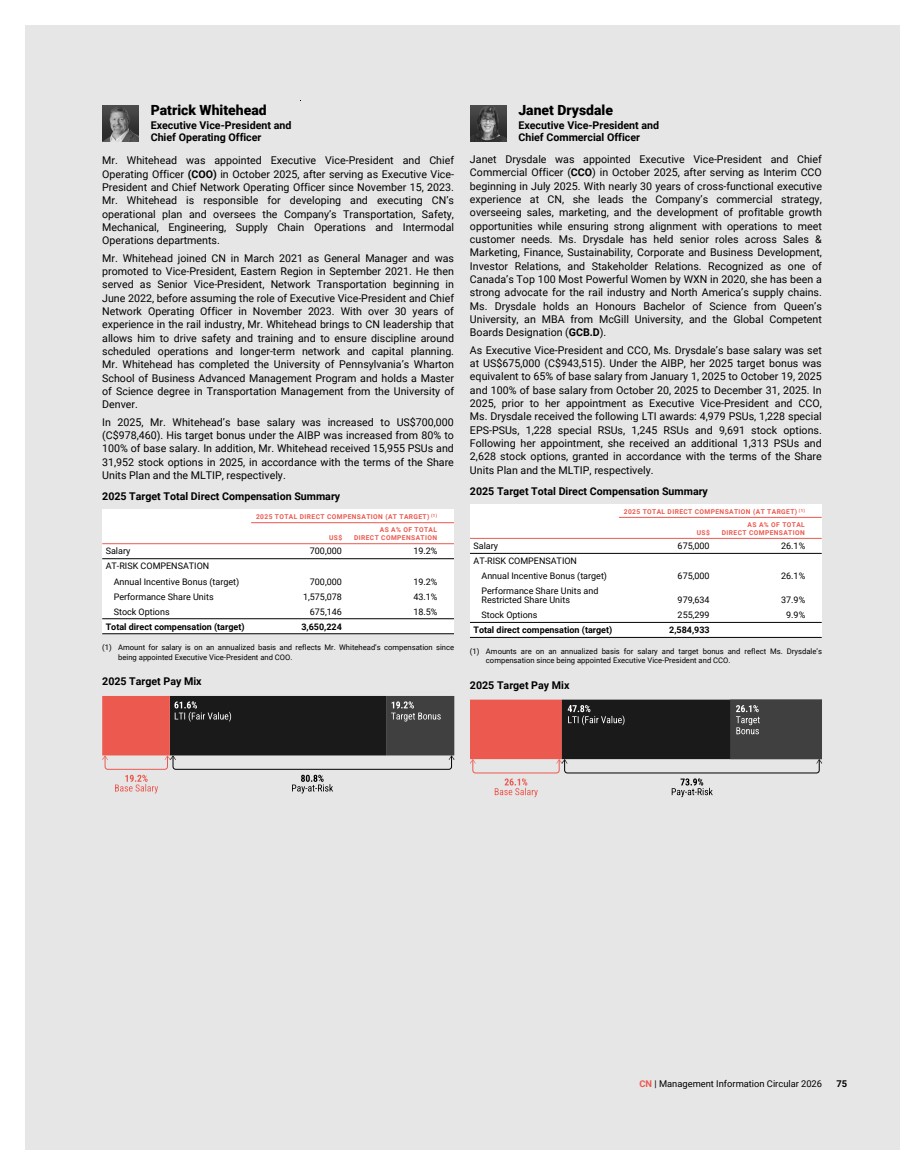
| Bhushan Ivaturi Executive Vice-President and Chief Information and Technology Officer Bhushan Ivaturi joined CN in April 2025 as Executive Vice-President and Chief Information and Technology Officer (CITO). As a seasoned global technology leader with more than two decades of experience, he brings deep expertise in digital strategy, cybersecurity, artificial intelligence, innovation, supply chain optimization, product management, and software engineering. At CN, he leads the Company’s digital transformation agenda, leveraging technology and innovation to strengthen operational efficiency, customer collaboration, and service excellence. Previously Senior Vice President and CIO at Enbridge, he also held leadership roles at AP Moller Maersk, General Electric, and in the high‑tech sector. Mr. Ivaturi serves on the Boards of the TELUS Spark Science Centre and the TBM Council and holds advanced degrees in information systems and mechanical engineering, complemented by executive education at Harvard, MIT, and Stanford. In 2025, Mr. Ivaturi’s annual base salary was US$550,000 (C$768,790). Mr. Ivaturi’s target bonus for 2025 was 100% of base salary under the AIBP. In addition, Mr. Ivaturi received 11,349 PSUs and 22,728 stock options in 2025, in accordance with the terms of the Share Units Plan and the MLTIP, respectively. 2025 Target Total Direct Compensation Summary 2025 TOTAL DIRECT COMPENSATION (AT TARGET) (1) US$ AS A% OF TOTAL DIRECT COMPENSATION Salary 550,000 20.4% AT-RISK COMPENSATION Annual Incentive Bonus (target) 550,000 20.4% Performance Share Units 1,120,033 41.5% Stock Options 480,015 17.8% Total direct compensation (target) 2,700,048 (1) Amounts are on an annualized basis for salary and target bonus and reflect Mr. Ivaturi’s compensation since being appointed Executive Vice-President and CITO. 2025 Target Pay Mix Rémi Lalonde Former Executive Vice-President and Chief Commercial Officer Mr. Lalonde joined CN in January 2024 as Executive Vice-President and Special Advisor to the CEO and was appointed as Executive Vice-President and Chief Commercial Officer on April 18, 2024. Mr. Lalonde left the Company on July 21, 2025. As former EVP & CCO, Mr. Lalonde was responsible for providing the strategic direction and leadership for CN’s Sales, Marketing, Supply Chain Solutions, and the Intermodal and Automotive terminal operations groups, until his departure from CN. In 2025, Mr. Lalonde’s base salary was increased to US$654,000 (C$914,161). His 2025 target bonus under the AIBP was raised from 80% to 100% of base salary, which was pro-rated based on active service prior to departure. In addition, Mr. Lalonde’s received 12,765 PSUs, which were partially forfeited upon his departure, and 25,561 stock options, which were forfeited upon his departure, in accordance with the terms of the Share Units Plan and the MLTIP, respectively. Derek Taylor Former Executive Vice-President and Chief Field Operating Officer Mr. Taylor was appointed Executive Vice-President and Chief Field Operating Officer on November 15, 2023. Mr. Taylor left the Company on October 19, 2025. As former EVP & CFOO, Mr. Taylor was responsible for running the operational plan for the Western, Eastern and Southern regions and for Multimodal Operations, until his departure from CN. In 2025, Mr. Taylor’s base salary was increased to US$600,000 (C$838,680). His 2025 target bonus under the AIBP was raised from 80% to 100% of base salary, which was prorated based on active service prior to departure. In addition, Mr. Taylor received 15,955 PSUs, which were partially forfeited upon his departure, and 31,952 stock options, which were forfeited upon his departure, in accordance with the terms of the Share Units Plan and the MLTIP, respectively. 76 CN | Management Information Circular 2026 |
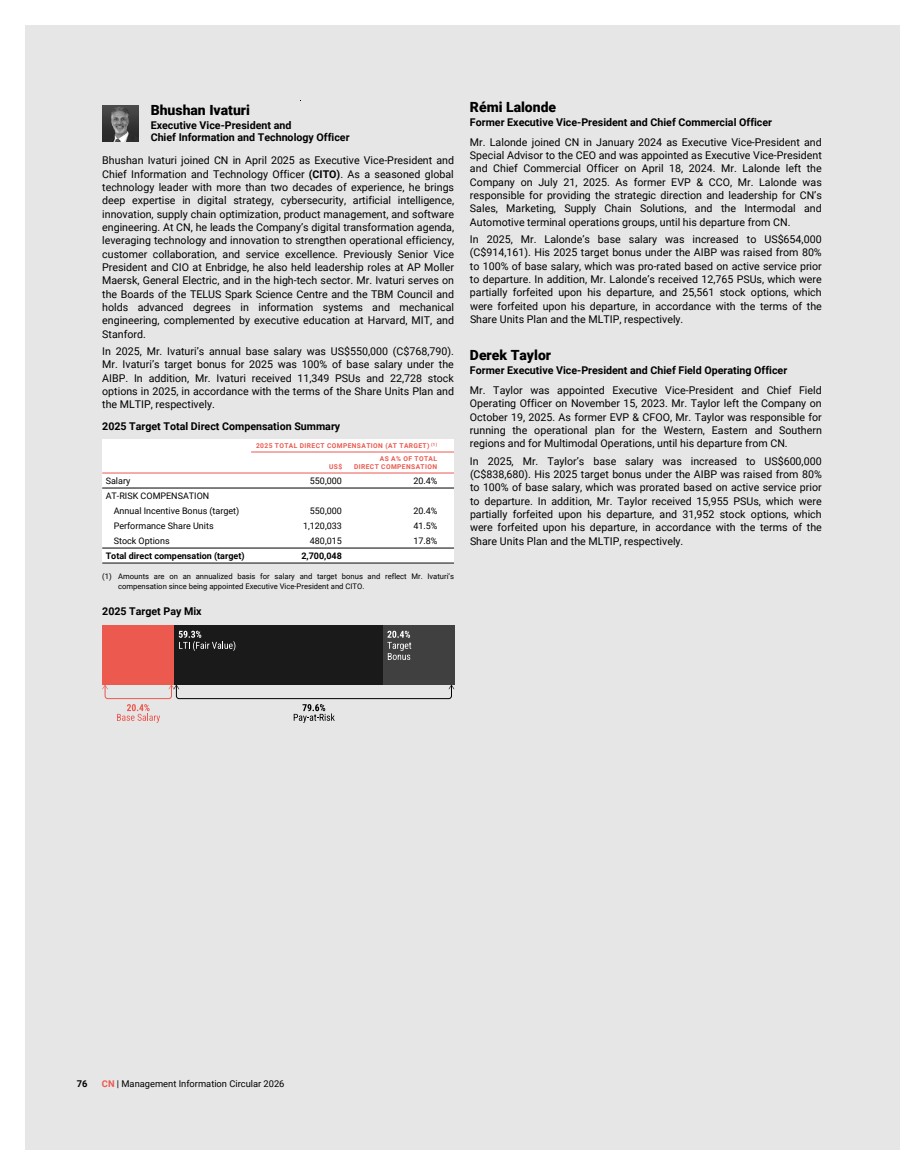
| President and Chief Executive Officer Compensation Look‑Back Table and Five‑Year TSR Comparison CN’s compensation plans are designed to align compensation with the creation of shareholder value. As a result, a significant portion of compensation is at risk and LTIs are structured to deliver compensation value to the President and CEO if value is created for shareholders. In a low share performance environment, lower value would be realized for the President and CEO. The Company’s performance in 2025 resulted in lower actual realized compensation for the President and CEO compared to the compensation awarded over the last three years, reinforcing our pay-for-performance culture. The following table compares the total direct compensation awarded to CN’s President and CEOs over the past five years, as reflected in the “Summary Compensation Table”, to the current value (both realized and realizable) as at December 31, 2025. TOTAL DIRECT COMPENSATION AWARDED (1) (C$000S) CURRENT VALUE AS AT DEC. 31, 2025 (2) (C$000S) Jean-Jacques Ruest 2021 12,515 25,878 Jean-Jacques Ruest (3) 2022 841 841 Tracy Robinson (4) 2022 13,070 4,699 Tracy Robinson (5) 2023 13,512 3,017 Tracy Robinson (6) 2024 18,006 12,922 Tracy Robinson (6) 2025 20,905 15,192 (1) Includes salary and variable compensation awarded during the year, as reported in the “Summary Compensation Table” each year. (2) For any given year, the current value includes salary and annual incentive awarded and the value of LTIs (realized and realizable). LTIs for any given year include the value of any exercised stock options, the value of unexercised “in-the-money” stock options as at December 31, 2025, based on the common share price on the TSX on that date, the value attributed to vested PSUs and the value of unvested PSUs as at December 31, 2025, assuming a 100% performance factor and the value of DSUs which represent the 25% Company-match awarded under the VIDP as at December 31, 2025. (3) The compensation awarded for Mr. Ruest (salary and annual incentive) was prorated to reflect his departure date. Mr. Ruest did not receive a LTI award in 2022 given his retirement in 2022. (4) The compensation awarded in 2022 for Ms. Robinson was prorated to reflect her hire date of February 28, 2022 as President and CEO, and includes the make-whole award provided upon hire. The current value as at December 31, 2025 reflects stock options that are out-of-the-money and actual PSU payout factors of 0.0% and 50% for ROIC PSUs and TSR PSUs respectively. (5) The current value as at December 31, 2025 reflects stock options that are out-of-the-money and actual PSU payout factors of 0% and 0% for ROIC PSUs and TSR PSUs respectively. (6) The compensation awarded to Ms. Robinson in 2024 and 2025 reflects the face value of the share-based awards and the accounting value of the options-based awards, whereas the compensation awarded in prior years reflects the WTW expected life binomial approach. Compensation outcomes are set against the performance graph under the heading "Five-Year TSR Comparison", which indicates the yearly cumulative total shareholder return on a $100 investment in CN’s common shares compared with the cumulative total return of the S&P/TSX and the S&P 500 Indices from the period beginning December 31, 2020 to the period ended December 31, 2025. The following graph assumes reinvestment of all dividends during the covered period. It shows that CN shares have not outperformed the S&P/TSX Composite Index. The total compensation for our NEOs over that period was generally aligned with the experience of our shareholders, as a substantial portion of NEOs total compensation is at risk and linked to CN’s share price performance. Total Direct Compensation represents the value awarded to NEOs rather than the actual value realized. The HRC Committee believes that the Company’s executive compensation policy is effective and appropriately supports a strong relationship between the compensation earned by the NEOs and the investment return of shareholders. The total compensation paid over the last five years, as per the “Summary Compensation Table”, is presented in the table in the “Cost of Management Ratio” section hereinafter. DEC-20 DEC-21 DEC-22 DEC-23 DEC-24 DEC-25 CNR (C$) 100 113 119 126 113 107 CNI (US$) 100 112 109 117 97 97 S&P/TSX (C$) 100 122 111 120 142 182 S&P 500 (US$) 100 127 102 127 157 182 TDC (C$ thousands) 24,500 29,157 30,294 29,622 39,784 (1) 40,137 (1) (1) Total Direct Compensation for the years 2020 to 2023 reflects the fair value of share- and option-based awards at the grant date using the WTW expected life binomial methodology, as previously disclosed in the Summary Compensation Tables. For the 2024 and 2025 Total Direct Compensation, the fair value of share-based awards reflects the face value methodology and the fair value of option-based awards reflects the accounting valuation factor (Black Scholes model). Under the WTW expected‑life binomial methodology, Total Direct Compensation for 2024 would have been C$34,008. For 2025, because awards were granted using the face value methodology for share‑based awards and the accounting valuation methodology (Black‑Scholes model) for option‑based awards, the expected life binomial methodology result is no longer available. The table reports TDC amounts solely for the active NEOs at year end. CN | Management Information Circular 2026 77 |
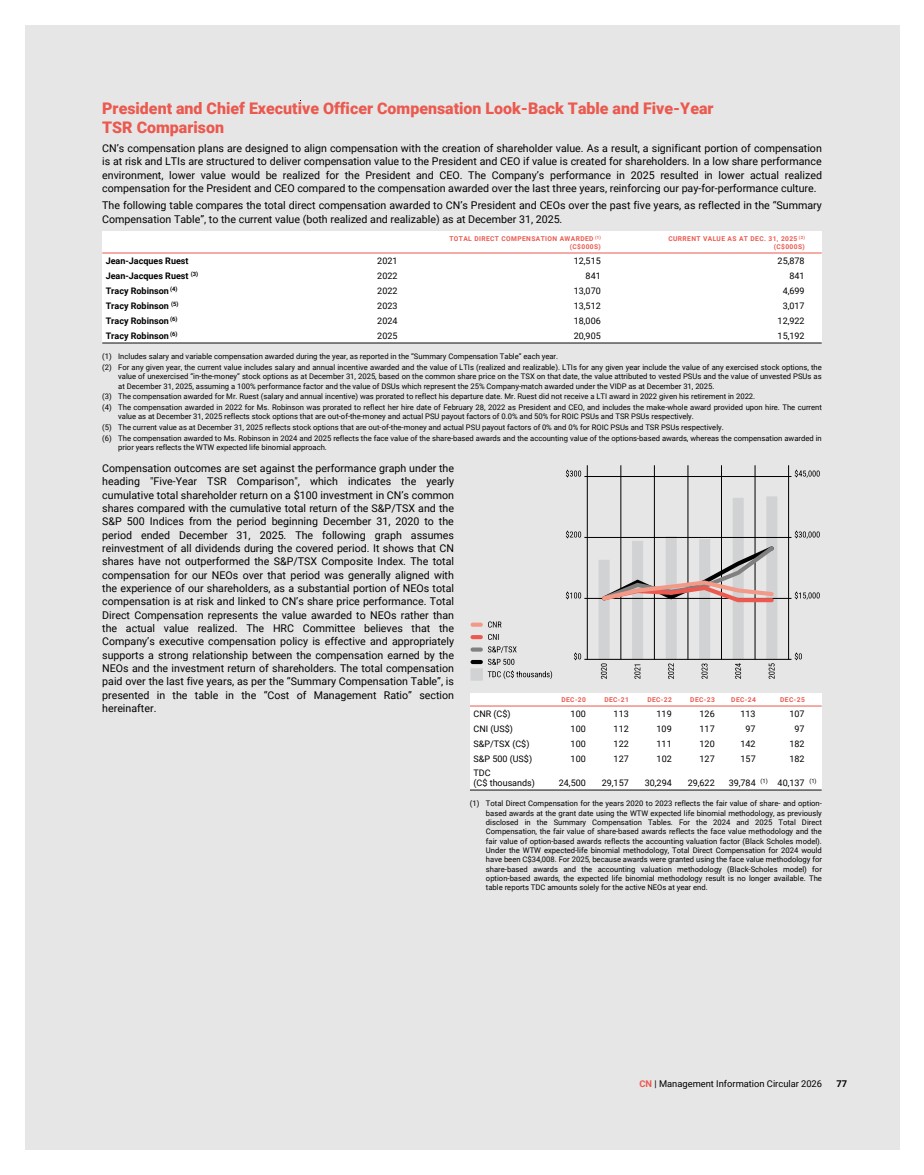
| Cost of Management Ratio The cost of management ratio expresses the total compensation reported for the NEOs as a percentage of the Company’s adjusted net income. 2021 2022 2023 2024 2025 (3) Total Compensation Reported for the NEOs (C$ million) (1) 29.2 30.3 29.6 39.8 40.1 Adjusted Net Income (C$ million) (2) 4,225 5,134 4,800 4,506 4,756 Net Income (C$ million) 4,899 5,118 5,625 4,448 4,720 Cost of Management Ratio using Adjusted Net Income (2) 0.7% 0.6% 0.6% 0.9% 0.8% Cost of Management Ratio using Net Income 0.6% 0.6% 0.5% 0.9% 0.8% (1) Total compensation as reported in the Summary Compensation Table each year (including only the five active NEOs as at December 31, 2025). (2) Adjusted Net Income is a non-GAAP measure and does not have any standardized meaning prescribed by GAAP and therefore, may not be comparable to similar measures presented by other companies. See the section entitled “Adjusted performance measures” in the MD&A and the section entitled “Non-GAAP Measures” in the “Selected financial information restated for change in accounting policy” filed on September 9, 2022, which sections are incorporated by reference herein. These filings may be found online on SEDAR+ at www.sedarplus.ca, on the SEC’s website at www.sec.gov through EDGAR, and on CN’s website at www.cn.ca under “Investors”. (3) Total Compensation reported for the NEOs for the years 2021 to 2023 reflects the fair value of share- and option-based awards at the grant date using the WTW expected life binomial methodology, as previously disclosed in the Summary Compensation Table each year. For the 2024 Total Compensation reported for the NEOs, the fair value of share-based awards reflects the face value methodology and the fair value of option-based awards reflects the accounting valuation factor (Black Scholes model). Under the WTW expected‑life binomial methodology, Total Direct Compensation for 2024 would have been C$34.0 million. For 2025, because awards were granted using the face value methodology for share‑based awards and the accounting valuation methodology (Black‑Scholes model) for option‑based awards, the expected life binomial methodology result is no longer available. Compensation of the NEOs has been paid in U.S. dollars since 2002 as it provides a more precise, meaningful and stable comparison basis for compensation decisions with U.S. dollar-denominated compensation from the NEOs comparator group. A table presenting the compensation paid in U.S. dollars for the NEOs is presented on page 81 of this Information Circular under “Total Compensation for the NEOs in U.S. Dollars”. Summary Compensation Table in Canadian Dollars The following table sets forth the annual total compensation in Canadian dollars for the NEOs, in accordance with the Canadian securities disclosure rules issued by the CSA, for the years ended December 31, 2025, 2024 and 2023. Fluctuation in the exchange rate affects year-over-year comparability. In 2024, the HRC Committee reviewed the methodology used for the disclosure of the share-based and options-based awards. The HRC Committee determined that CN would transition to reflecting the face value of the share-based awards and the accounting value of the options-based awards starting in 2024 for disclosing the value of share-based awards, options-based awards and total compensation. The face value represents the number of share-based units awarded multiplied by the share price at time of grant and the number of stock options awarded multiplied by the accounting valuation factor (Black-Scholes model). In prior years, the WTW expected life binomial was used. This methodology adjusts the award value and share price in light of the attributes of the share-based and options-based award instruments, for instance the minimum share price condition on share-based awards. The figures in the following table reflect the face value of the share-based awards, accounting value of the options-based awards and total compensation for 2025 and 2024, while the WTW expected life binomial value is reflected for 2023, as previously disclosed. For comparability of methodologies for year-over-year information, 2023 figures using the face value of the share-based awards, the accounting value of the options-based awards and total compensation are presented in the Supplemental Total Compensation Table. 78 CN | Management Information Circular 2026 |
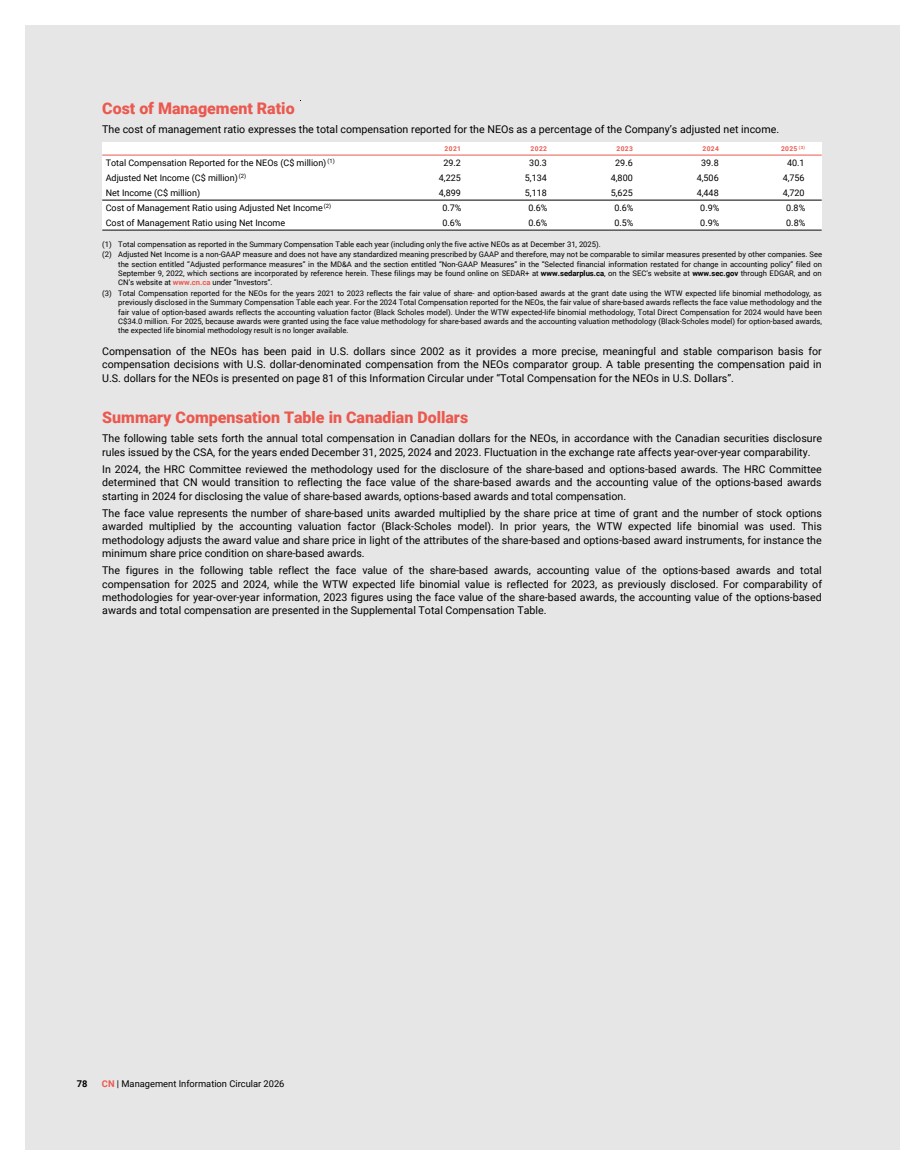
| Summary Compensation Table In Canadian Dollars NAME AND PRINCIPAL POSITION YEAR SALARY (C$) SHARE-BASED AWARDS (1) (C$) OPTION-BASED AWARDS (2) (C$) NON-EQUITY INCENTIVE PLAN COMPENSATION– ANNUAL INCENTIVE PLANS (3) (C$) PENSION VALUE (4) (C$) ALL OTHER COMPENSATION (5) (C$) TOTAL COMPENSATION (C$) Tracy Robinson President and Chief Executive Officer 2025 1,586,503 12,048,529 (6) 5,050,290 (7) 2,219,685 458,433 101,198 21,464,638 2024 1,506,780 12,728,065 (6) 2,703,190 (7) 1,068,012 494,242 99,627 18,599,916 2023 1,282,215 8,249,247 (6) 2,671,039 (7) 1,309,100 470,231 26,870 14,008,702 Ghislain Houle Executive Vice-President and Chief Financial Officer 2025 992,438 3,070,265 1,315,660 925,684 225,256 23,873 6,553,176 2024 943,792 2,561,333 1,147,850 356,781 45,464 22,694 5,077,914 2023 902,949 1,392,509 1,139,374 491,671 235,000 21,341 4,182,844 Patrick Whitehead Executive Vice-President and Chief Operating Officer 2025 866,830 (8) 2,294,967 983,483 912,646 103,445 376,399 (10) 5,537,770 2024 786,265 1,801,000 807,080 297,231 108,776 400,876 (10) 4,201,228 2023 633,950 (8) 457,396 374,000 344,190 (9) 82,483 111,575 (10) 2,003,594 Janet Drysdale Executive Vice-President and Chief Commercial Officer 2025 617,130 (11) 1,390,192 (12) 360,199 634,583 (13) 194,901 (14) 14,982 3,211,987 2024 489,000 437,092 (12) 152,283 143,033 57,207 12,785 1,291,400 2023 465,271 (11) 554,090 (12) 207,657 211,265 (13) 89,000 11,706 1,538,989 Bhushan Ivaturi Executive Vice-President and Chief Information and Technology Officer 2025 550,384 (15) 1,546,869 662,976 516,516 (15) 81,209 11,325 3,369,279 2024 – – – – – – – 2023 – – – – – – – Rémi Lalonde Former Executive Vice‑President and Chief Commercial Officer 2025 507,867 (16) 1,836,118 (17) 786,768 (18) 470,419 (19) 132,435 (20) 467,833 (21) 4,201,440 2024 859,820 (16) 1,801,000 (17) 807,080 (18) 322,543 (19) 137,277 (20) 17,911 3,945,631 2023 – – – – – – – Derek Taylor Former Executive Vice‑President and Chief Field Operating Officer 2025 668,344 (22) 2,294,967 (23) 983,483 (24) 623,417 (25) 200,638 (26) 1,691,425 (27) 6,462,274 2024 786,265 1,844,799 (23) 807,080 (24) 297,231 142,531 75,835 3,953,741 2023 655,883 (22) 860,573 (23) 373,724 (24) 344,190 (25) 147,618 14,753 2,396,741 Supplemental Total Compensation Table (all years showing face value for equity awards) For comparability of methodologies for year-over-year information, restatement of prior figures under face value for the share-based awards, accounting value for the options-based awards and total compensation are presented in the following table: NAME AND PRINCIPAL POSITION YEAR SALARY (C$) SHARE-BASED AWARDS (C$) OPTION-BASED AWARDS (C$) NON-EQUITY INCENTIVE PLAN COMPENSATION- ANNUAL INCENTIVE PLANS (C$) PENSION VALUE (C$) ALL OTHER COMPENSATION (C$) TOTAL COMPENSATION (C$) Tracy Robinson President and Chief Executive Officer 2025 1,586,503 12,048,529 5,050,290 2,219,685 458,433 101,198 21,464,638 2024 1,506,780 12,728,065 2,703,190 1,068,012 494,242 99,627 18,599,916 2023 1,282,215 12,278,034 3,455,657 1,309,100 470,231 26,870 18,822,107 Ghislain Houle Executive Vice-President and Chief Financial Officer 2025 992,438 3,070,265 1,315,660 925,684 225,256 23,873 6,553,176 2024 943,792 2,561,333 1,147,850 356,781 45,464 22,694 5,077,914 2023 902,949 2,115,891 1,474,065 491,671 235,000 21,341 5,240,917 Patrick Whitehead Executive Vice-President and Chief Operating Officer 2025 866,830 2,294,967 983,483 912,646 103,445 376,399 5,537,770 2024 786,265 1,801,000 807,080 297,231 108,776 400,876 4,201,228 2023 633,950 694,972 483,863 344,190 82,483 111,575 2,351,033 Janet Drysdale Executive Vice-President and Chief Commercial Officer 2025 617,130 1,390,192 360,199 634,583 194,901 14,982 3,211,987 2024 489,000 437,092 152,283 143,033 57,207 12,785 1,291,400 2023 465,271 685,991 268,657 211,265 89,000 11,706 1,731,890 Bhushan Ivaturi Executive Vice-President and Chief Information and Technology Officer 2025 550,384 1,546,869 662,976 516,516 81,209 11,325 3,369,279 2024 – – – – – – – 2023 – – – – – – – Rémi Lalonde Former Executive Vice-President and Chief Commercial Officer 2025 507,867 1,836,118 786,768 470,419 132,435 467,833 4,201,440 2024 859,820 1,801,000 807,080 322,543 137,277 17,911 3,945,631 2023 – – – – – – – Derek Taylor Former Executive Vice-President and Chief Field Operating Officer 2025 668,344 2,294,967 983,483 623,417 200,638 1,691,425 6,462,274 2024 786,265 1,844,799 807,080 297,231 142,531 75,835 3,953,741 2023 655,883 1,097,915 483,506 344,190 147,618 14,753 2,743,865 (1) Valuation Disclosure for Share‑Based Awards — For 2023, the fair value of share‑based awards at the grant date, as shown in the “Summary Compensation Table,” reflects the number of PSUs awarded multiplied by the value calculated using the WTW expected‑life binomial methodology. For 2024 and 2025, the fair value of share‑based awards at the grant date reflects the face value of PSUs, calculated as the number of PSUs awarded multiplied by the share price at the time of grant. For 2023 and 2024, the number of share‑based awards granted was determined using the WTW expected‑life binomial methodology. Beginning in 2025, CN transitioned to a face‑value methodology for determining the number of units granted. CN | Management Information Circular 2026 79 |
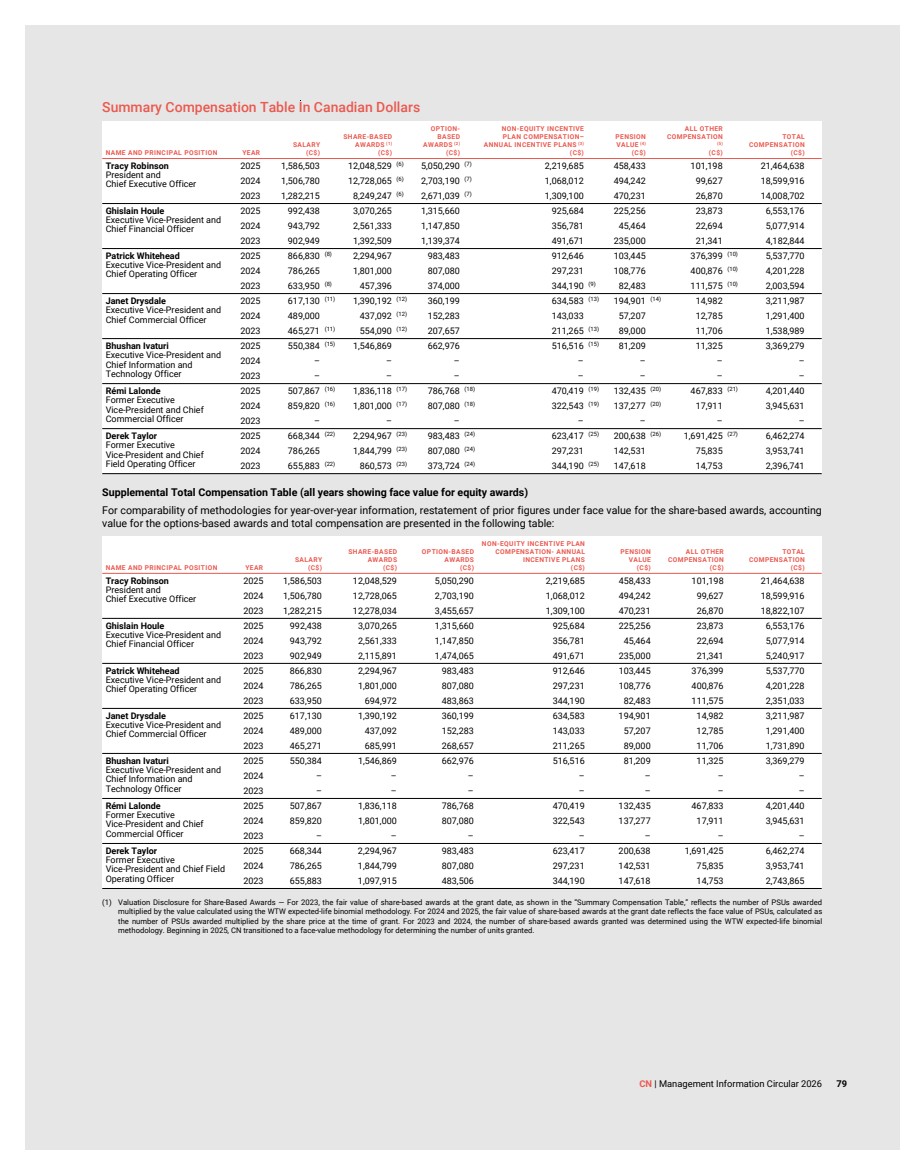
| A summary of the valuation factors calculated using the face value methodology, the WTW expected life binomial methodology as well as under the accounting valuation methodology is presented in the following table. Detailed assumptions and valuation factors are presented in the table below. FACE VALUE METHODOLOGY ACCOUNTING VALUATION METHODOLOGY VARIANCE VALUATION FACTOR GRANT DATE FAIR VALUE VALUATION FACTOR GRANT DATE FAIR VALUE FACE VALUE VS. ACCOUNTING 2025 SHARE-BASED AWARDS ROIC 100.0% February 3 – C$143.84 100.0% February 3 – C$143.84 February 3 – C$0 100.0% May 5 – C$136.30 100.0% May 5 – C$136.30 May 5 – C$0 100.0% July 24 – C$130.17 100.0% July 24 – C$130.17 July 24 – C$0 100.0% November 5 – C$135.50 100.0% November 5 – C$135.50 November 5 – C$0 TSR 100.0% February 3 – C$143.84 129.5% February 3 – C$186.32 February 3 – (C$42.48) 100.0% May 5 – C$136.30 148.4% May 5 – C$202.21 May 5 – (C$65.91) 100.0% July 24 – C$130.17 110.8% July 24 – C$144.21 July 24 – (C$14.04) 100.0% November 5 – C$135.50 122.2% November 5 – C$165.55 November 5 – (C$30.05) EPS 100.0% February 17 – C$144.04 100.0% February 17 – C$144.04 February 17 – C$0 RSU 100.0% February 3 – C$143.84 100.0% February 3 – C$143.84 February 3 – C$0 100.0% February 17 – C$144.04 100.0% February 17 – C$144.04 February 17 – C$0 100.0% July 24 – C$130.17 100.0% July 24 – C$130.17 July 24 – C$0 2024 SHARE-BASED AWARDS ROIC 100.0% January 25 – C$166.67 100.0% January 25 – C$166.67 January 25 – C$0 TSR 100.0% January 25 – C$166.67 130.6% January 25 – C$217.75 January 25 – (C$51.08) RSU 100.0% January 25 – C$166.67 100.0% January 25 – C$166.67 January 25 – C$0 WTW EXPECTED LIFE BINOMIAL METHODOLOGY ACCOUNTING VALUATION METHODOLOGY VARIANCE VALUATION FACTOR GRANT DATE FAIR VALUE VALUATION FACTOR GRANT DATE FAIR VALUE WTW VS. ACCOUNTING 2023 SHARE-BASED AWARDS ROIC 60.0% January 26 – C$94.75 56.6% January 26 – C$89.40 January 26 – C$5.35 March 8 – C$97.30 56.6% March 8 – C$91.79 March 8 – C$5.51 May 5 – C$97.84 56.5% May 5 – C$92.16 May 5 – C$5.68 November 15 – C$93.73 53.2% November 15 – C$83.12 November 15 – C$10.61 TSR 77.0% January 26 – C$121.59 110.3% January 26 – C$174.11 January 26 – (C$52.52) March 8 – C$124.87 110.3% March 8 – C$178.87 March 8 – (C$54.00) May 5 – C$125.56 110.4% May 5 – C$179.95 May 5 – (C$54.39) November 15 – C$120.28 103.4% November 15 – C$161.57 November 15 – (C$41.29) RSU 100.0% June 1 – C$154.77 100.0% June 1 – C$154.77 June 1 – C$0 (2) Valuation Disclosure for Option‑Based Awards — For 2023, the fair value of option‑based awards at the grant date, as shown in the “Summary Compensation Table in Canadian Dollars,” reflects the number of stock options awarded multiplied by the value calculated using the WTW expected‑life binomial methodology. For 2024 and 2025, the fair value of option‑based awards at the grant date reflects the number of stock options awarded multiplied by the Black‑Scholes methodology. For 2023 and 2024, the number of option‑based awards granted was determined using the WTW expected‑life binomial methodology. Beginning in 2025, CN transitioned to a face‑value approach for granting stock options, under which the number of stock options awarded is calculated using the Black-Scholes methodology. A summary of the valuation factors calculated using the Black Scholes methodology, WTW expected life binomial methodology as well as under the accounting valuation methodology is presented in the following table. Detailed assumptions for both methodologies are presented in the table below. BLACK SCHOLES METHODOLOGY ACCOUNTING VALUATION METHODOLOGY VARIANCE VALUATION FACTOR GRANT DATE FAIR VALUE VALUATION FACTOR GRANT DATE FAIR VALUE BLACK SCHOLES VS. ACCOUNTING 2025 OPTION-BASED AWARD 21.4% February 3 – C$30.78 18.4% February 3 – C$26.51 February 3 – C$4.27 May 5 – C$29.17 18.8% May 5 – C$25.60 May 5 – C$3.57 July 24 – C$27.86 17.3% July 24 – C$22.46 July 24 – C$5.40 November 5 – C$29.00 16.2% November 5 – C$21.89 November 5 – C$7.11 2024 OPTION-BASED AWARD 21.9% January 25 – C$36.58 21.9% January 25 – C$36.58 January 25 – C$0 WTW EXPECTED LIFE BINOMIAL METHODOLOGY ACCOUNTING VALUATION METHODOLOGY VARIANCE VALUATION FACTOR GRANT DATE FAIR VALUE VALUATION FACTOR GRANT DATE FAIR VALUE WTW VS. ACCOUNTING 2023 OPTION-BASED AWARD 16.0% January 26 – C$25.27 20.7% January 26 – C$32.73 January 26 – (C$7.46) 16.0% March 8 – C$25.95 20.7% March 8 – C$33.57 March 8 – (C$7.62) 16.0% May 5 – C$26.09 21.2% May 5 – C$34.55 May 5 – (C$8.46) 16.0% November 15 – C$24.99 22.9% November 15 – C$35.86 November 15 – (C$10.85) (3) Represents the incentive award earned under the AIBP for the applicable year. Refer to page 65 of this Information Circular for the details of the AIBP. (4) Represents the compensatory value of pension benefits as reported in the “Defined Benefit benefits” and “Defined Contribution benefits” tables in the “Pension Plan Benefits” section on page 90 of this Information Circular. (5) Includes the value of perquisites, personal benefits, and other compensation (as applicable), such as post-retirement benefits or the employer contribution under the ESIP. Perquisites and other personal benefits that, in aggregate, amount to less than C$50,000 or 10% of the total salary for any of the NEOs are not reported in this column. Details are provided in the table on page 83. (6) Ms. Robinson’s share-based awards include DSUs representing the 25% Company‑match under the VIDP, each vesting over four years. In 2025, she received 1,783 DSUs upon deferral of her 2024 AIBP, with a grant date fair value based on the C$147.94 share price. In 2024, she received 1,904 DSUs upon deferral of her 2023 AIBP, using a C$175.06 share price. In 2023, she received 3,141 DSUs upon deferral of her 2022 AIBP, using a C$157.22 share price. (7) Following shareholder approval at the April 26, 2024 annual meeting, the MLTIP limitation that capped individual stock option grants at a maximum of 20% of all stock options awarded in a given year was removed for long‑term incentive awards. As a result, Ms. Robinson’s 2025 LTI award reflects the full intended LTI mix, with stock options representing 30% of her annual grant. By comparison, stock options represented 18% of her award in 2024 and 26% in 2023 due to the prior limitation. (8) For 2025, Mr. Whitehead was appointed Executive Vice‑President and COO effective October 20, 2025. His 2025 salary reflects nine months and nineteen days as Executive Vice‑President and Chief Network Operating Officer and two months and twelve days as Executive Vice‑President and COO. For 2023, Mr. Whitehead was appointed Executive Vice‑President and Chief Network Operating Officer effective November 15, 2023. His 2023 salary reflects ten and a half months as Senior Vice‑President, Network Operations and one and a half months as Executive Vice‑President and Chief Network Operating Officer. (9) Mr. Whitehead’s target bonus under the AIBP was 65% of his base salary from January 1, 2023 to November 14, 2023 and 80% of his base salary from November 15, 2023 to December 31, 2023. (10) For 2025, 2024, and 2023, Mr. Whitehead was provided a benefit to maintain his compensation on a post‑tax basis at a level comparable to what he would have received had he remained in the U.S. following his relocation to Canada in 2022. The amount shown for 2025 reflects the value known as of the record date of the Meeting and remains subject to change upon finalization of his 2025 tax return, whereas the amounts shown for 2024 and 2023 represent the values known at the respective record dates. These amounts are included under “All Other Compensation” for each applicable year. 80 CN | Management Information Circular 2026 |
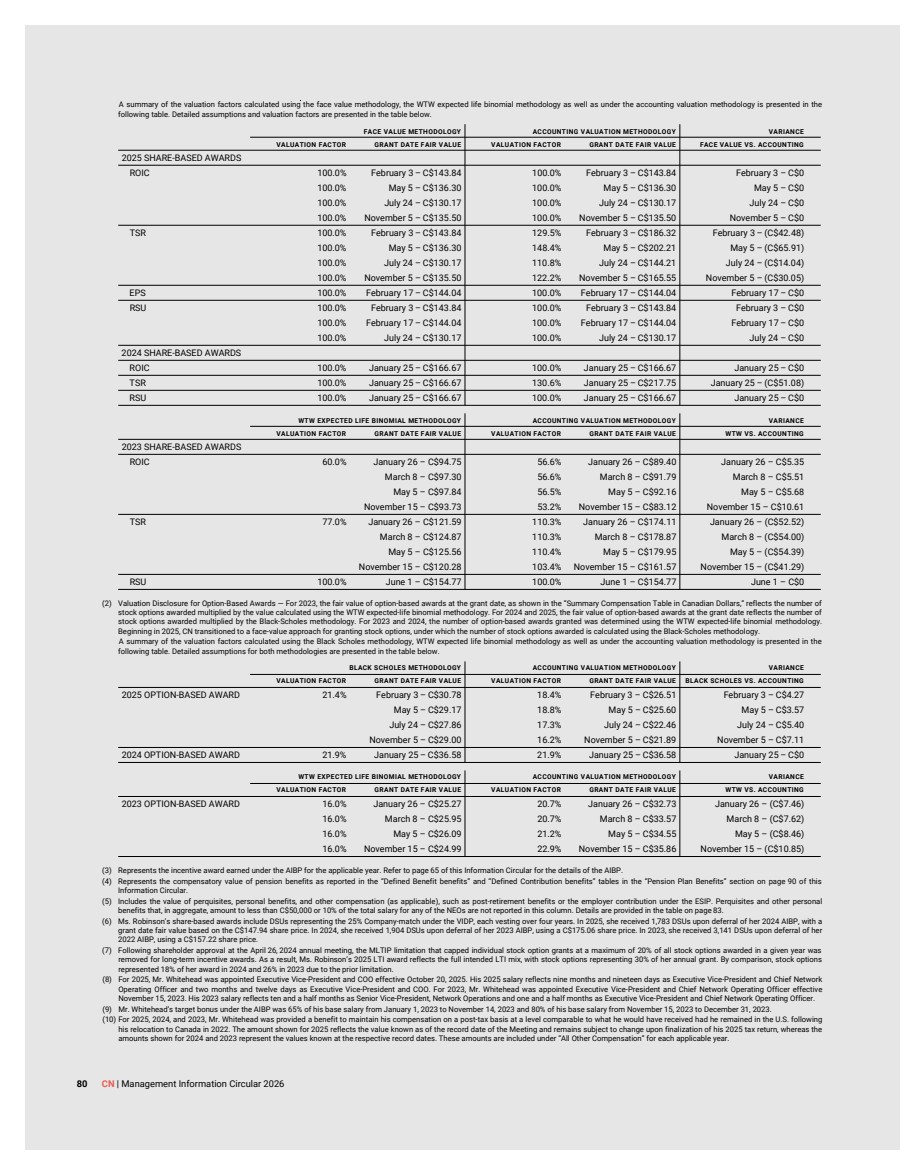
| (11) For 2025, Ms. Drysdale was appointed Interim Senior Vice-President and CCO effective July 21, 2025, and Executive Vice-President and CCO effective October 20, 2025. Her 2025 salary reflects six months and twenty days as Senior Vice-President and Stakeholder Relations Officer, two months and twenty‑nine days as Interim Senior Vice-President and CCO, and two months and ten days as Executive Vice-President and CCO. For 2023, she was appointed Vice-President Investor Relations and Sustainability effective February 13, 2023, and Senior Vice-President and Stakeholder Relations Officer effective March 7, 2023. Her 2023 salary reflects one month and twelve days as Vice-President Financial Planning and Sustainability, twenty‑two days as Vice-President Investor Relations and Sustainability, and nine months and twenty‑five days as Senior Vice-President and Stakeholder Relations Officer. (12) For 2025, Ms. Drysdale’s share‑based awards include 1,245 RSUs granted in February and July 2025, which vest on a three‑year cliff basis, and 1,228 special EPS‑PSUs and 1,228 special RSUs granted on February 17, 2025, which vest on a two‑year ratable schedule. All awards were granted prior to her appointment as Executive Vice‑President and Chief Commercial Officer. Her 2025 share‑based awards also include 42 DSUs representing the 25% Company match under the VIDP, vesting over four years following the deferral of her 2024 AIBP, valued at the grant‑date share price of C$147.94. For 2024, her awards include 488 RSUs granted in January 2024, also prior to her appointment, as well as 36 DSUs representing the 25% Company match under the VIDP, vesting over four years following the deferral of her 2023 AIBP and valued at C$175.06. For 2023, her share‑based awards include 1,939 RSUs granted in June 2023, awarded prior to her appointment as Executive Vice‑President and CCO. (13) For 2025, Ms. Drysdale’s target bonus under the AIBP was 65% of her base salary from January 1 to October 19, and 100% from October 20 to December 31. For 2024, her target bonus was 65% of base salary. For 2023, her target bonus was 60% of base salary from January 1 to March 6, and 65% from March 7 to December 31. (14) Represent a one-time value increase as a result of Ms. Drysdale’s appointment as Executive Vice-President and CCO. (15) Mr. Ivaturi was hired on April 14, 2025 and as such, his salary and bonus for 2025 reflect less than one year of service. (16) For 2025, the amount shown represents the actual base salary earned until Mr. Lalonde’s departure in July 2025. For 2024, Mr. Lalonde was hired on January 8, 2024, and therefore his 2024 salary reflects less than a full year of service. (17) Amounts shown include awards that were forfeited as per the terms of the plan. As per the Share Units Plan, the 2024 and 2025 share-based awards to Mr. Lalonde were prorated upon his departure in July 2025, based on active service over the three-year period applicable to the respective PSUs. Actual share-based awards after pro-ration are C$306,020 for 2025 and C$900,500 for 2024. (18) Amounts shown include awards which were forfeited as per the terms of the plans. As per the MLTIP, for awards made since January 2019, unvested stock options at the time of departure are forfeited. Mr. Lalonde’s 2025 option-based award was forfeited upon his departure and the actual option-based award is C$201,770 for 2024. (19) For 2025 and 2024, Mr. Lalonde’s AIBP payouts were prorated based on his active service during each respective year. (20) Amounts shown represent employer contributions made in 2024 and 2025 to the CN Defined Contribution Component of the CN Pension Plan for Senior Management (DCSM) and the CN Defined Contribution Supplemental Executive Retirement Plan (DC SERP). The 2025 amount reflects employer contributions made to the DCSM and DC SERP until Mr. Lalonde’s termination of employment as of July 21, 2025. In accordance with plan provisions, DC SERP benefits were forfeited as of his termination date. As such, DC SERP contributions of C$115,530 for 2025 and C$121,032 for 2024 were forfeited upon termination. (21) Includes a separation payment of US$327,000 (C$457,081), made pursuant to the terms of his separation agreement with the Company. (22) For 2025, the amount shown represents the actual base salary earned until Mr. Taylor’s departure in October 2025. For 2023, Mr. Taylor was appointed Executive Vice-President and CFOO effective November 15, 2023, and his 2023 salary reflects ten and a half months as Senior Vice-President, Transportation, and one and a half months as Executive Vice-President and CFOO. (23) Amounts shown include awards that were forfeited in accordance with the terms of the applicable plans. Under the Share Units Plan, Mr. Taylor’s 2023, 2024, and 2025 share‑based awards were prorated upon his departure in October 2025, based on his active service during the respective three‑year PSU performance periods. His 2024 share‑based awards also include 250 DSUs, representing the 25% Company match under the VIDP, which vest over four years following the deferral of his 2023 AIBP. The grant date fair value of this award was calculated by multiplying the number of units by C$175.06, the share price on the grant date. In accordance with plan provisions, 75% of these DSUs were forfeited upon his departure. Mr. Taylor’s 2023 share‑based awards also include 2,608 RSUs granted in June 2023, which vest over forty‑two months. This award was similarly prorated upon his departure based on active service over the vesting period. After applying the required pro‑ration, the final grant date fair values of Mr. Taylor’s share‑based awards are C$573,742 for 2025, C$1,061,473 for 2024, and C$662,843 for 2023. (24) Amounts shown include awards which were forfeited as per the terms of the plans. As per the MLTIP, for awards made since January 2019, unvested stock options at the time of departure are forfeited. Mr. Taylor’s 2025 option-based award was forfeited upon his departure and the actual option-based award is C$201,770 for 2024 and C$134,716 for 2023. (25) For 2025, Mr. Taylor’s AIBP payout was prorated based on his active service during the year. For 2023, his target bonus under the AIBP was 65% of base salary from January 1 to November 14 and 80% from November 15 to December 31. (26) The amount shown represents employer contributions made in 2025 to the Canadian National Railway Company Savings Plan for U.S. Operations and the Canadian National Railway Defined Contribution Supplemental Executive Retirement Plan until Mr. Taylor’s termination of employment as of October 19, 2025. (27) Includes a separation payment of US$1,200,000 (C$1,677,360), made pursuant to the terms of his separation agreement with the Company. Total Compensation for the NEOs in U.S. Dollars The following table sets forth the annual total compensation in U.S. dollars for the NEOs, for the years ended December 31, 2025, 2024 and 2023. Compensation of the NEOs has been paid in U.S. dollars since 2002 as it provides a more precise, meaningful and stable comparison basis with U.S. dollar-denominated compensation from the NEO comparator group. NAME AND PRINCIPAL POSITION YEAR SALARY (US$) SHARE-BASED AWARDS (US$) OPTION-BASED AWARDS (US$) NON-EQUITY INCENTIVE PLAN COMPENSATION– ANNUAL INCENTIVE PLANS (US$) PENSION VALUE (US$) ALL OTHER COMPENSATION (US$) TOTAL COMPENSATION (US$) Tracy Robinson President and Chief Executive Officer 2025 1,135,000 8,273,502 3,466,947 1,617,375 318,710 72,398 14,883,932 (1) 2024 1,100,000 9,443,222 2,005,685 742,500 373,210 72,731 13,737,348 (1) 2023 950,000 6,187,331 2,004,072 988,522 346,932 19,908 10,496,765 (1) Ghislain Houle Executive Vice-President and Chief Financial Officer 2025 710,000 2,107,178 903,181 674,500 156,602 17,079 4,568,540 2024 689,000 1,900,320 851,670 248,040 34,331 16,567 3,739,928 2023 669,000 1,045,110 854,868 371,269 173,381 15,812 3,129,440 Patrick Whitehead Executive Vice-President and Chief Operating Officer 2025 620,139 1,575,078 675,146 665,000 71,917 269,280 3,876,560 2024 574,000 1,336,209 598,829 206,640 82,138 292,653 3,090,469 2023 469,697 341,268 278,996 259,903 60,855 82,667 1,493,386 Janet Drysdale Executive Vice-President and Chief Commercial Officer 2025 441,501 984,027 255,299 462,389 135,498 10,718 2,289,432 2024 356,986 324,297 112,984 99,439 43,198 9,333 946,237 2023 344,722 413,045 155,252 159,530 65,663 8,673 1,146,885 Bhushan Ivaturi Executive Vice-President and Chief Information and Technology Officer 2025 393,750 1,120,033 480,015 376,360 56,458 8,102 2,434,718 2024 – – – – – – – 2023 – – – – – – – Rémi Lalonde Former Executive Vice-President and Chief Commercial Officer 2025 363,333 1,260,161 540,104 342,771 92,071 334,692 2,933,132 2024 627,697 1,336,209 598,829 224,237 103,660 13,076 2,903,708 2023 – – – – – – – Derek Taylor Former Executive Vice-President and Chief Field Operating Officer 2025 478,140 1,575,078 675,146 454,253 139,487 1,210,062 4,532,166 2024 574,000 1,368,696 598,829 206,640 107,627 55,362 2,911,154 2023 485,947 641,254 278,985 259,903 108,911 10,931 1,785,931 (1) Ms. Robinson’s Total Compensation for the years 2023 reflects the WTW expected life binomial methodology for share-based and options-based awards. Total Compensation for the years 2023 would have been US$14,109,121 if share-based awards reflected the face value approach and options-based awards reflected the accounting value. Extension to Notes (1) and (2) of the Summary Compensation Table on the Calculation of Units Granted and Disclosure of Grant Date Fair Value of Awards Units granted for share‑based and option‑based awards in 2023 and 2024 were calculated using WTW’s expected‑life binomial methodology. This methodology adjusts the share price to reflect factors such as vesting and forfeiture assumptions, payout‑adjustment provisions, the absence of dividends, and other plan design features. These adjustments were applied consistently to both the binomial value and the share price to determine the number of units granted. Beginning with the 2025 award cycle, the number of share‑based awards granted is determined using the face‑value approach, calculated as the number of PSUs awarded divided by the share price on the grant date. The number of option‑based awards granted is calculated using the Black‑Scholes methodology, where the valuation factor was determined using a 3-year average of the accounting factor. The calculation of units granted under WTW’s expected‑life binomial methodology for PSUs and stock options granted in 2023 and 2024 incorporates several assumptions, as disclosed below. The valuation of share‑based and option‑based awards is sensitive to changes in these assumptions, particularly the risk‑free interest rate and stock‑price volatility. No assumptions are disclosed for 2025 due to the adoption of the face‑value approach. CN | Management Information Circular 2026 81 |
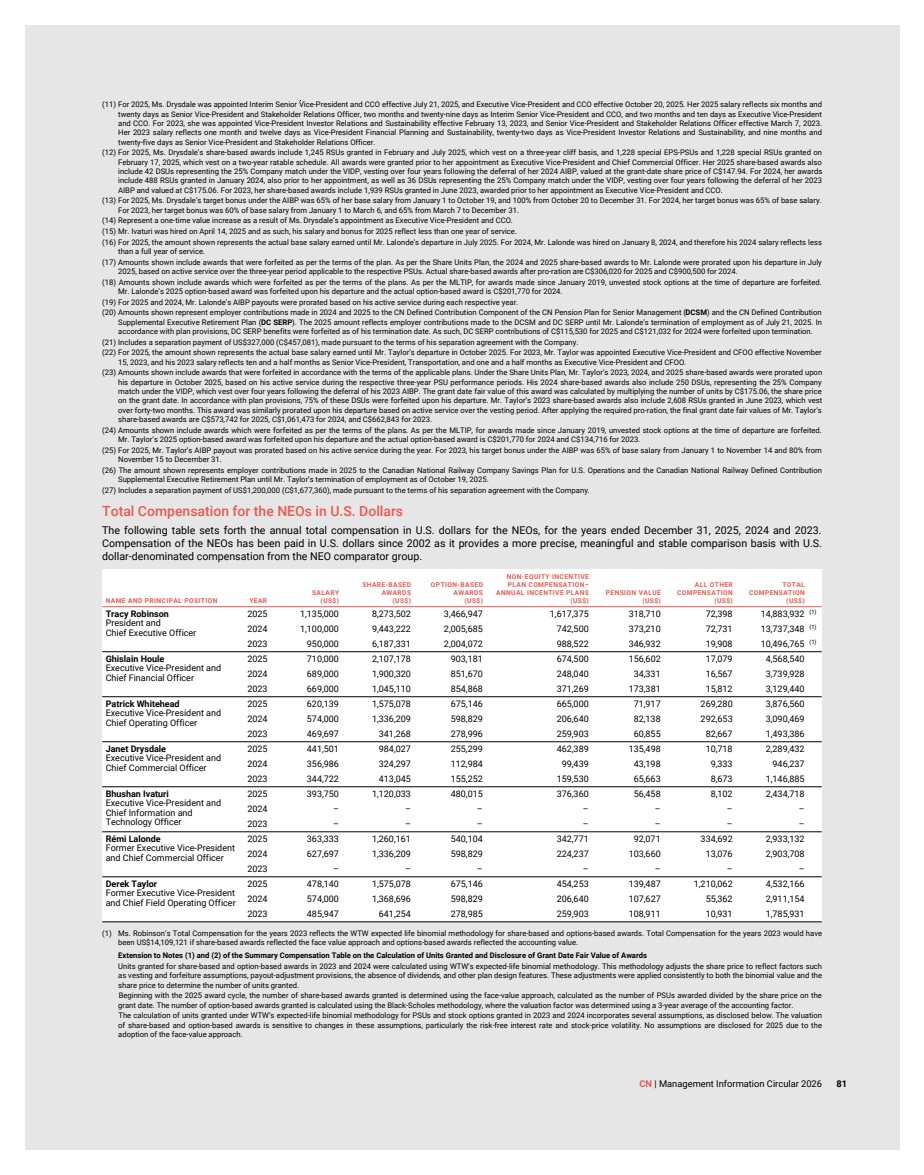
| Share-Based Awards (PSUs) 2023 (JANUARY 26) 2023 (MARCH 8) 2023 (MAY 5) 2023 (NOVEMBER 15) 2024 (JANUARY 25) 2025 (FEBRUARY 3) 2025 (FEBRUARY 17) 2025 (MAY 5) 2025 (JULY 24) 2025 (NOVEMBER 5) Closing share price on grant date (C$) 157.91 162.17 163.07 156.21 166.67 143.84 144.04 136.30 130.17 135.50 Risk-free interest rate over term of the award (1) 0.25% to 0.75% based on yield curve 0.25% to 0.75% based on yield curve 0.25% to 0.75% based on yield curve 0.25% to 0.75% based on yield curve 3.75% based on yield curve N/A N/A N/A N/A N/A Expected stock price volatility over term of the award (2) 24% 24% 24% 24% 22% N/A N/A N/A N/A N/A Expected annual dividends per share (C$) 2.93 2.93 2.93 2.93 3.16 N/A N/A N/A N/A N/A Expected term (3) 3 years 3 years 3 years 3 years 3 years 3 years 1 year & 2 years 3 years 3 years 3 years Resulting fair value per unit (C$)(4) ROIC–94.75 TSR–121.59 ROIC–97.30 TSR–124.87 ROIC–97.84 TSR–125.56 ROIC–93.73 TSR–120.28 ROIC–135.00 TSR–135.00 ROIC–143.84 TSR–143.84 EPS–144.04 ROIC–136.30 TSR–136.30 ROIC–130.17 TSR–130.17 ROIC–135.50 TSR–135.50 Option-Based Awards 2023 (JANUARY 26) 2023 (MARCH 8) 2023 (MAY 5) 2023 (NOVEMBER 15) 2024 (JANUARY 25) 2025 (FEBRUARY 3) 2025 (MAY 5) 2025 (JULY 24) 2025 (NOVEMBER 5) Closing share price on grant date (C$) 157.91 162.17 163.07 156.21 166.67 143.84 136.30 130.17 135.50 Risk-free interest rate over term of the award (1) 0.25% to 1.50% based on yield curve 0.25% to 1.50% based on yield curve 0.25% to 1.50% based on yield curve 0.25% to 1.50% based on yield curve 3.5% to 3.75% based on yield curve 2.65% 2.80% 3.13% 2.75% Expected stock price volatility over term of the award (2) 21% 21% 21% 21% 21% 23% 23% 21% 20% Expected annual dividends per share (C$) 2.93 2.93 2.93 2.93 3.16 3.55 3.55 3.55 3.55 Expected term (3) 6.5 years 6.5 years 6.5 years 6.5 years 6.25 years 5.33 years 5.33 years 5.33 years 5.33 years Resulting fair value per stock option (C$)(4) 25.27 25.95 26.09 24.99 28.33 30.78 29.17 27.86 29.00 (1) Based on the zero coupon yield curve rate commensurate with the expected term of a given award. The WTW expected life binomial model uses a yield curve for the risk-free interest rate (with different interest rates applying depending on the lattice node) rather than one particular rate. (2) Based on daily share prices, dividend data and average of volatilities for CN’s NYSE and TSX-listed shares for a period commensurate with the expected term of a given award. (3) Represents the period of time that awards are expected to be outstanding. For option-based awards, the Company uses the SEC Safe Harbor calculation. (4) Beginning with the 2025 award cycle, the resulting fair value per share‑based awards will be equal to the share price on the grant date, while the resulting fair value per stock-option awards will be equal to the grant‑date share price multiplied by the applicable Black‑Scholes factor. 82 CN | Management Information Circular 2026 |
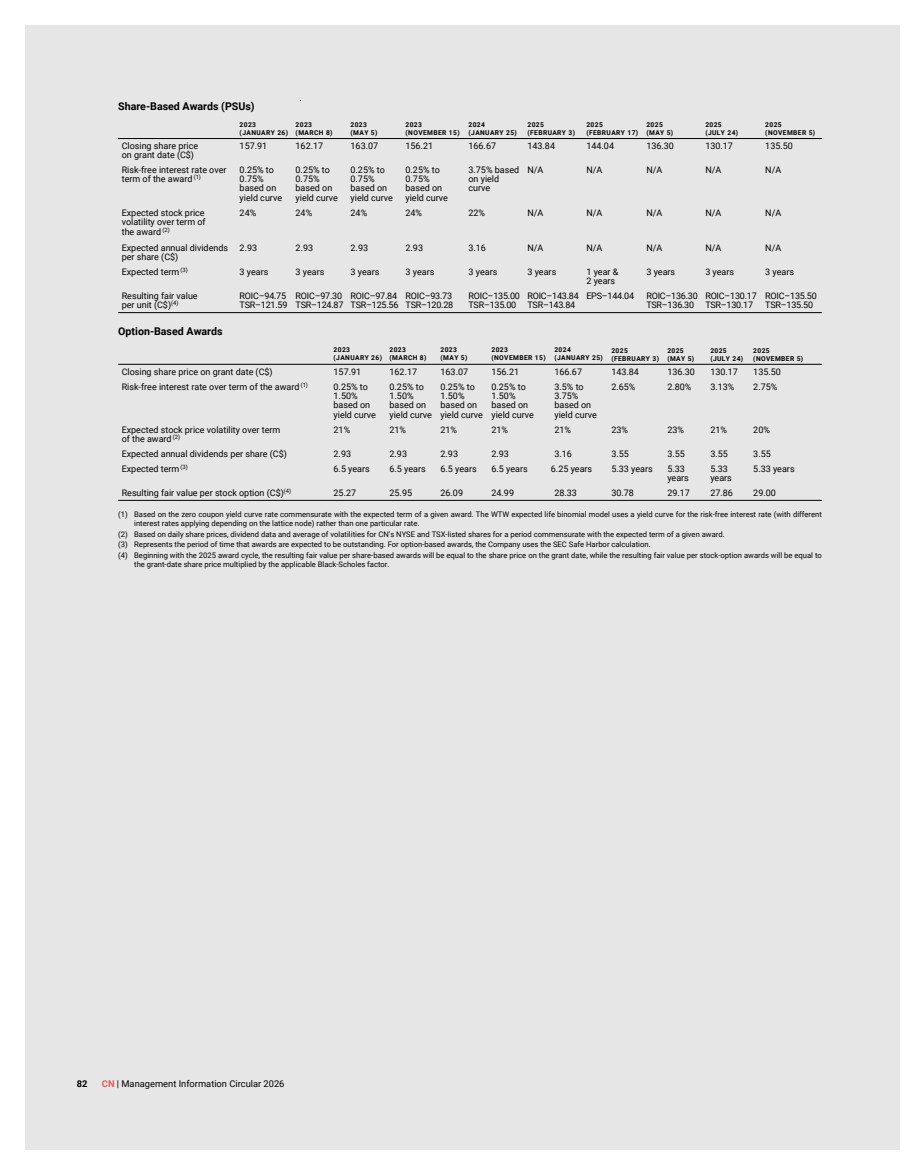
| Details of “All Other Compensation” Amounts for 2025, 2024 and 2023 (1) NAME YEAR PERQUISITES AND OTHER PERSONAL BENEFITS (C$) OTHER COMPENSATION (C$) ALL OTHER COMPENSATION (TOTAL OF THE TWO PREVIOUS COLUMNS) (C$) Tracy Robinson 2025 Use of company-leased vehicle: 28,317 Flex Allowance: 20,000 Other perquisites: 19,513 (5) ESIP employer contribution: 33,368 (2) 101,198 2024 Flex Allowance: 20,000 Use of company-leased vehicle: 17,846 Other perquisites: 30,180 (5) ESIP employer contribution: 31,601 (2) 99,627 2023 Nil ESIP employer contribution: 26,870 (2) 26,870 Ghislain Houle 2025 Nil ESIP employer contribution: 20,873 (2) 23,873 Post-retirement benefits: 3,000 (3) 2024 Nil ESIP employer contribution: 19,794 (2) 22,694 Post-retirement benefits: 2,900 (3) 2023 Nil ESIP employer contribution: 18,941 (2) 21,341 Post-retirement benefits: 2,400 (3) Patrick Whitehead 2025 Nil ESIP employer contribution: 18,155 (2) 376,399 Tax Equalization Amount: 358,244 (4) 2024 Nil ESIP employer contribution: 15,773 (2) 400,876 Tax Equalization Amount: 385,103 (4) 2023 Nil ESIP employer contribution: 9,746 (2) 111,575 Tax Equalization Amount: 101,829 (4) Janet Drysdale 2025 Nil ESIP employer contribution: 12,882 (2) 14,982 Post-retirement benefits: 2,100 (3) 2024 Nil ESIP employer contribution: 10,688 (2) 12,788 Post-retirement benefits: 2,100 (3) 2023 Nil ESIP employer contribution: 9,706 (2) 11,706 Post-retirement benefits: 2,000 (3) Bhushan Ivaturi 2025 Nil ESIP employer contribution: 11,325 (2) 11,325 Rémi Lalonde 2025 Nil ESIP employer contribution: 10,752 (2) 467,833 Separation Payment: 457,081 (7) 2024 Nil ESIP employer contribution: 17,911 (2) 17,911 Derek Taylor 2025 Nil ESIP employer contribution: 14,065 (2) 1,691,425 Separation Payment: 1,677,360 (8) 2024 Use of company-leased vehicle: 22,978 (6) Other perquisites: 35,851 ESIP employer contribution: 15,773 (2) 75,835 Post-retirement benefits: 1,233 (3) 2023 Nil ESIP employer contribution: 13,673 (2) 14,753 Post-retirement benefits: 1,080 (3) (1) This table outlines the perquisites and other compensation received by NEOs in 2025, 2024 and 2023. The amounts are calculated based on the incremental cost to CN. Perquisites and other personal benefits include the use of a Company-leased vehicle, parking, flexible allowance, executive physical exam, financial counselling and tax services, personal use of the corporate aircraft for the President and CEO, personal and home security services, and certain healthcare benefits and life insurance coverage. The incremental cost to CN is determined by the actual cost of the Company-leased vehicle (including gas and maintenance fees), parking, flexible allowance, security services, annual executive physical exam, financial counselling and tax services and by the cost of certain healthcare benefits and life insurance coverage in excess of that offered to salaried employees if applicable. See section “Executive Perquisites and Security” on page 70 of this Information Circular for more details. Perquisites and other personal benefits that amount to less than C$50,000 (in aggregate) or 10% of total salary for any of the NEOs are reported as “Nil” in this column. (2) Represents the value of the Company-match under the ESIP. See section “Employee Share Investment Plan” on page 70 of this Information Circular for more details. (3) Represents the service cost for post-retirement benefits, if applicable. (4) Mr. Whitehead was provided a benefit to maintain his compensation on a post-tax basis at a similar level had he remained in the U.S. to relocate to Canada in 2022. The amount shown for 2025 represents the amount known at the record date of the Meeting and is subject to change upon finalization of his 2025 tax return. (5) Perquisites and other personal benefits for the President and CEO for 2025 and 2024 include flexible allowance for health and wellness, use of a company-leased vehicle and other perquisites comprising of financial counselling, executive physical exam, healthcare benefits, personal use of the corporate aircraft, home security and personal security as needed, based on risk assessment. Starting in 2024, the Board approved an annual allowance for the President and CEO to use the Company’s aircraft for personal use for efficiency and security reasons, as well as to align with perquisites offered to Presidents and CEOs in the comparator group. This perquisite is a taxable benefit and represents the incremental cost of the personal use of the aircraft, based on variable operating costs to CN such as fuel costs, trip-related maintenance, landing fees and other miscellaneous variable costs. (6) Other perquisites for 2024 for Mr. Taylor were in-line with the entitlement provided to NEOs and include financial counselling services, flexible allowance and executive physical exam. Entitlement of perquisites for Mr. Taylor are in U.S. dollars given his primary work location is in the U.S., as opposed to the other NEOs whose primary work location is Canada, and are converted to Canadian dollars using the average 2024 exchange rate of US$1.00 = C$ 1.3698. Total perquisites for Mr. Taylor for 2024 were equal to US$42,947. (7) Represents a separation payment of US$327,000 (C$457,081), made pursuant to the terms of his separation agreement with the Company. (8) Represents a separation payment of US$1,200,000 (C$1,677,360), made pursuant to the terms of his separation agreement with the Company. CN | Management Information Circular 2026 83 |
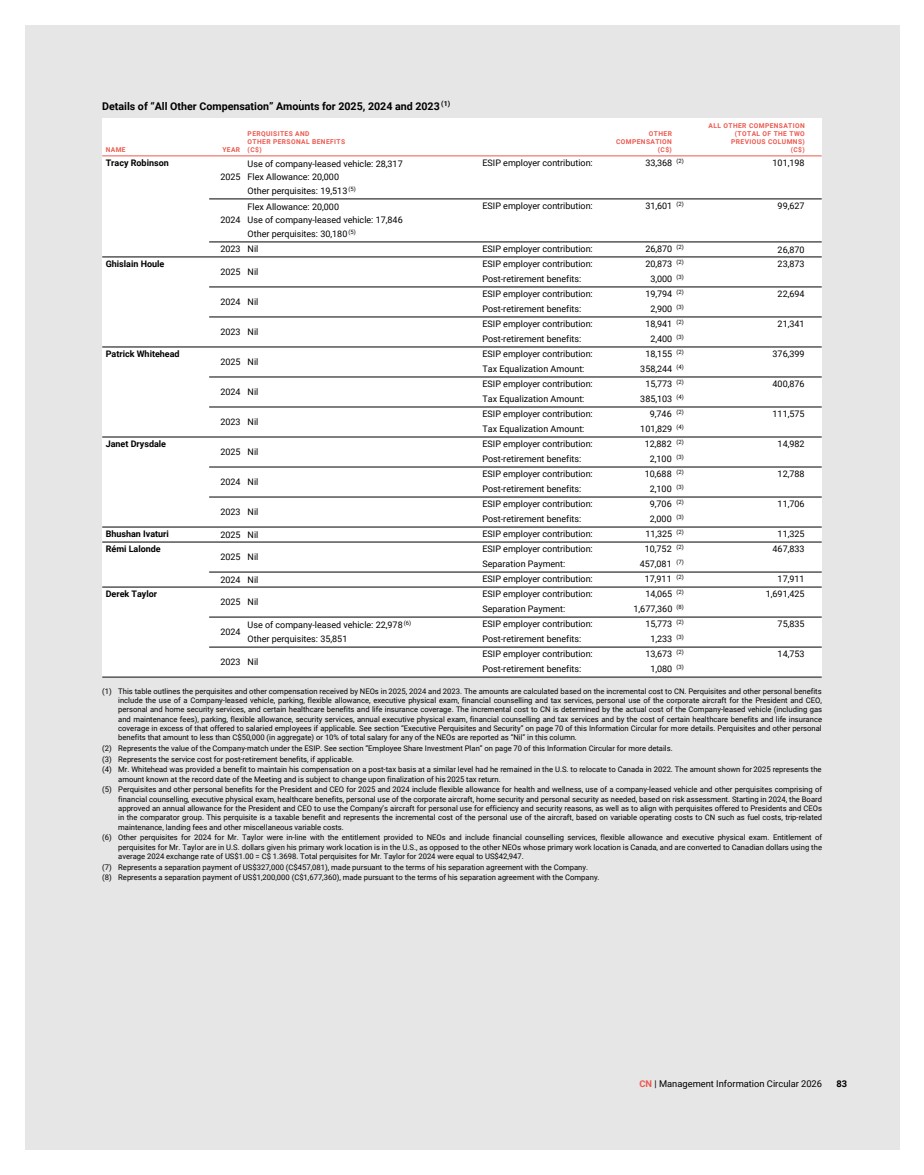
| Incentive Plan Awards Share-Based and Option-Based Awards in 2025 The following table shows information regarding grants of PSUs made to NEOs under the Share Units Plan, grants of stock options made under the MLTIP and awards of Company-matched deferred share units under the VIDP in 2025, if any. NAME GRANT DATE AWARD TYPE SECURITIES, UNITS OR OTHER RIGHTS (#) END OF PLAN PERIOD OR EXPIRY DATE SHARE PRICE ON DATE OF GRANT (C$) AWARD’S GRANT DATE FAIR VALUE (1) (C$) Tracy Robinson February 3, 2025 PSUs (2) 81,930 December 31, 2027 143.84 11,784,811 Options (3) 164,077 February 3, 2035 143.84 5,050,290 February 21, 2025 DSUs (4) 1,783 Cessation of Employment 147.94 263,717 Ghislain Houle February 3, 2025 PSUs (2) 21,345 December 31, 2027 143.84 3,070,265 Options (3) 42,744 February 3, 2035 143.84 1,315,660 Patrick Whitehead February 3, 2025 PSUs (2) 15,955 December 31, 2027 143.84 2,294,967 Options (3) 31,952 February 3, 2035 143.84 983,483 Janet Drysdale February 3, 2025 PSUs (2) 2,463 December 31, 2027 143.84 354,278 RSUs(5) 616 December 31, 2027 143.84 88,605 Options (3) 4,793 February 3, 2035 143.84 147,529 February 17, 2025 EPS-PSUs(6) 368 December 31, 2025 144.04 53,007 RSUs(5) 368 December 31, 2025 144.04 53,007 EPS-PSUs(7) 860 December 31, 2026 144.04 123,874 RSUs(5) 860 December 31, 2026 144.04 123,874 February 21, 2025 DSUs(4) 42.25 Cessation of Employment 147.94 6,250 July 24, 2025 PSUs(2) 2,516 December 31, 2027 130.17 327,508 RSUs(5) 629 December 31, 2027 130.17 81,877 Options(3) 4,898 July 24, 2035 130.17 136,458 November 5, 2025 PSUs(2) 1,313 December 31, 2027 135.50 177,912 Options(3) 2,628 November 5, 2035 135.50 76,212 Bhushan Ivaturi May 5, 2025 PSUs (2) 11,349 December 31, 2027 136.30 1,546,869 Options (3) 22,728 May 5, 2035 136.30 662,976 Rémi Lalonde February 3, 2025 PSUs (2)(8) 12,765 December 31, 2027 143.84 1,836,118 Options (3)(9) 25,561 February 3, 2035 143.84 786,768 Derek Taylor February 3, 2025 PSUs (2)(8) 15,955 December 31, 2027 143.84 2,294,967 Options (3)(9) 31,952 February 3, 2035 143.84 983,483 (1) The fair value of share‑based awards at the grant date reflects the face value of PSUs, calculated as the number of PSUs awarded multiplied by the share price at the time of grant. The fair value of option‑based awards at the grant date reflects the number of stock options awarded multiplied by the accounting valuation factor (Black‑Scholes model). (2) The PSUs granted in 2025 were made under the Share Units Plan. The payout of PSUs granted in 2025 to NEOs is subject to two distinct performance measures: 40% of the LTI award is subject to the achievement of PSU-ROIC objectives for the period ending on December 31, 2027, while 30% of the LTI award is subject to the TSR performance of CN measured against one comparator group, the S&P North America LargeMidCap Transportation Index for the period ending on December 31, 2027. Details are described under “Performance Share Units: 2025 Award” on page 68 of this Information Circular. (3) The stock options granted in 2025 were made under the MLTIP and vest over a period of four years, with 25% of the stock options vesting at each anniversary date of the award. Unexercised stock options shall expire on the tenth anniversary of the date of the award. See section “Management Long-Term Incentive Plan” on page 88 of this Information Circular for a description of the plan. (4) The DSUs represent the 25% Company-match granted upon the deferral of AIBP payouts. The Company-matched DSUs vest over four years, at a rate of 25% per year. See section “Deferred Compensation Plans” on page 89 of this Information Circular for a description of the plan. (5) The RSUs granted in 2025 were made under the Share Units Plan and were granted to Ms. Drysdale prior to her appointment as Executive Vice-President and CCO. The payout of RSUs granted in 2025 is time-based and not subject to performance measures or the attainment of a minimum average closing share price. (6) The PSUs granted on February 17, 2025 were made under the Share Units Plan and were granted to Ms. Drysdale prior to her appointment as Executive Vice-President and CCO. The payout of these PSUs is subject to the achievement of an EPS performance measure for the period ending December 31, 2025. (7) The PSUs granted on February 17, 2025 were made under the Share Units Plan and were granted to Ms. Drysdale prior to her appointment as Executive Vice-President and CCO. The payout of these PSUs is subject to the achievement of an EPS performance measure for the period ending December 31, 2026 (8) As per the Share Units Plan, the 2025 share‑based awards for Mr. Lalonde and Mr. Taylor were partially forfeited upon their departures in July and October 2025, respectively, based on their active service during the three‑year performance period. (9) As per the MLTIP, the 2025 option‑based awards for Mr. Lalonde and Mr.Taylor were forfeited upon their departures in July and October 2025, respectively. 84 CN | Management Information Circular 2026 |
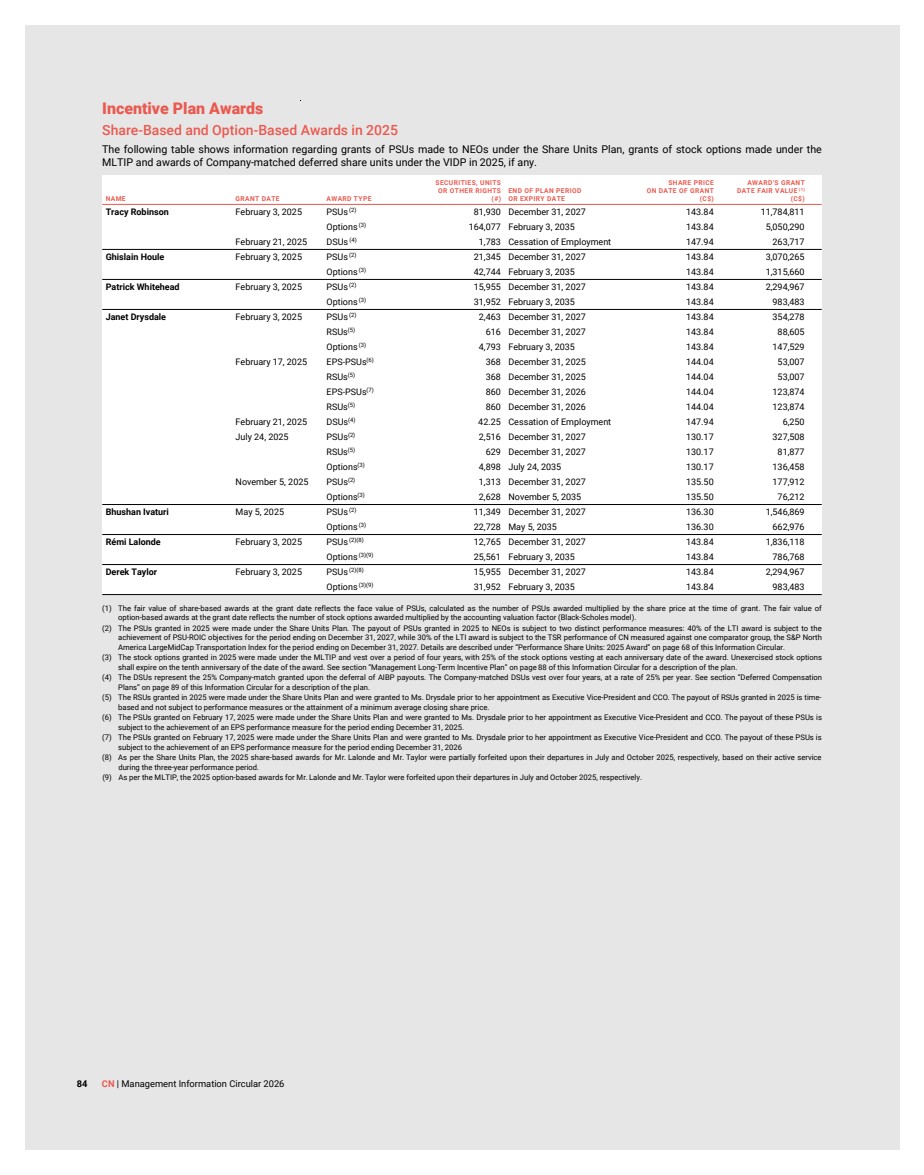
| Outstanding Share-Based Awards and Option-Based Awards The following table shows all awards made to NEOs and outstanding on December 31, 2025. OPTION-BASED AWARDS (1) SHARE-BASED AWARDS NAME NUMBER OF SECURITIES UNDERLYING UNEXERCISED OPTIONS (#) GRANT CURRENCY OPTION EXERCISE PRICE (2) (C$) OPTION EXPIRATION DATE VALUE OF UNEXERCISED IN-THE-MONEY OPTIONS (3) (C$) NUMBER OF SHARES OR UNITS OF SHARES THAT HAVE NOT VESTED (4) (#) MARKET OR PAYOUT VALUE OF SHARE-BASED AWARDS THAT HAVE NOT VESTED (5) (C$) MARKET OR PAYOUT VALUE OF VESTED SHARE-BASED AWARDS NOT PAID OUT OR DISTRIBUTED (6) (C$) Tracy Robinson 164,077 US$ 135.48 2035/02/03 29,273 161,080 21,852,791 300,441 73,900 US$ 169.71 2034/01/25 105,700 US$ 162.66 2033/01/26 111,154 US$ 170.16 2032/02/28 5,846 C$ 157.24 2027/02/28 Ghislain Houle 42,744 US$ 135.48 2035/02/03 6,401,266 36,713 4,980,549 – 31,380 US$ 169.71 2034/01/25 45,088 US$ 162.66 2033/01/26 43,765 US$ 163.16 2032/01/27 47,079 US$ 142.76 2031/01/28 54,690 US$ 130.57 2030/01/30 62,298 US$ 114.62 2029/01/31 60,908 US$ 107.73 2028/01/25 56,618 US$ 96.25 2027/01/26 18,047 US$ 87.35 2026/07/27 Patrick Whitehead 31,952 US$ 135.48 2035/02/03 5,701 26,761 3,630,444 – 22,064 US$ 169.71 2034/01/25 2,956 US$ 156.73 2033/11/15 2,309 US$ 167.19 2033/05/05 9,493 US$ 162.66 2033/01/26 638 US$ 151.40 2032/06/15 6,388 US$ 163.16 2032/01/27 896 US$ 158.25 2031/09/21 1,815 US$ 160.15 2031/03/15 Janet Drysdale 2,628 US$ 131.78 2035/11/05 1,296,433 13,858 1,881,091 100,270 4,898 C$ 130.17 2035/07/24 4,793 C$ 143.84 2035/02/03 4,163 C$ 166.67 2034/01/25 838 C$ 162.17 2033/03/08 7,357 C$ 157.91 2033/01/26 7,334 C$ 151.59 2032/01/27 7,889 C$ 133.11 2031/01/28 9,165 C$ 125.47 2030/01/30 10,440 C$ 109.65 2029/01/31 10,749 C$ 97.02 2028/01/25 10,380 C$ 91.91 2027/01/26 Bhushan Ivaturi 22,728 US$ 135.44 2035/05/05 4,991 11,349 1,539,625 – Rémi Lalonde 7,528 1,021,262 – Derek Taylor 5,516 US$ 169.71 2034/01/25 – 12,031 1,632,146 9,604 592 US$ 156.73 2033/11/15 4,747 US$ 162.66 2033/01/26 223 US$ 172.95 2032/11/28 3,549 US$ 163.16 2032/01/27 4,123 US$ 142.76 2031/01/28 (1) Includes all stock options granted under the MLTIP and outstanding on December 31, 2025. CN | Management Information Circular 2026 85 |
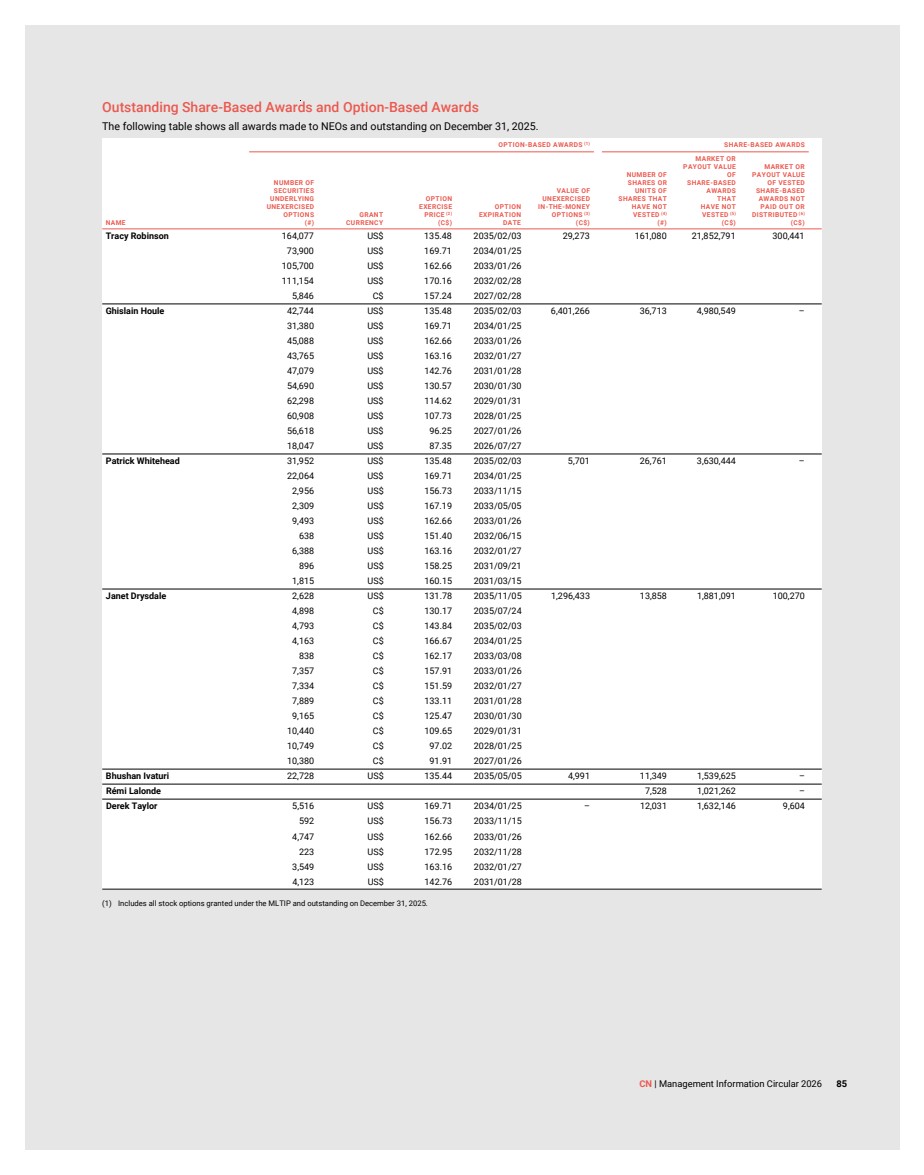
| (2) Where applicable, stock option exercise prices in U.S. dollars resulting from stock option grants to NEOs made in U.S. dollars were converted to Canadian dollars using the December 31, 2025, exchange rate of US$1.00 = C$1.3724. The conversion of these option exercise prices results in different Canadian dollars equivalent values for stock option grants made in U.S. dollars when compared to the values presented in the “Share-Based and Option-Based Awards in 2025” table on page 84 of this Information Circular, under the “Share Price on Date of Grant” column. The following table presents the option exercise prices that were converted to Canadian dollars based on the December 31, 2025 exchange rate: OPTION EXPIRATION DATE OPTION EXERCISE PRICE (US$) OPTION EXERCISE PRICE (C$) 2035/11/05 96.02 131.78 2035/05/05 98.69 135.44 2035/02/03 98.72 135.48 2034/01/25 123.66 169.71 2033/11/15 114.20 156.73 2033/05/05 121.82 167.19 2033/01/26 118.52 162.66 2032/11/28 126.02 172.95 2032/06/15 110.32 151.40 2032/02/28 123.99 170.16 OPTION EXPIRATION DATE OPTION EXERCISE PRICE (US$) OPTION EXERCISE PRICE (C$) 2032/01/27 118.89 163.16 2031/09/21 115.30 158.24 2031/03/15 116.69 160.15 2031/01/28 104.02 142.76 2030/01/30 95.14 130.57 2029/01/31 83.52 114.62 2028/01/25 78.50 107.73 2027/01/26 70.13 96.25 2026/07/27 63.65 87.35 (3) The value of unexercised in-the-money stock options at financial year end for stock options granted to NEOs in Canadian dollars is the difference between the closing share price of the common shares on December 31, 2025, on the TSX (C$135.75) and the exercise price. The value of unexercised in-the-money stock options at financial year-end for stock options granted to NEOs in U.S. dollars is the difference between the closing share price of the common shares on December 31, 2025, on the NYSE (US$98.85) converted to Canadian dollars based on the December 31, 2025, exchange rate of US$1 = C$1.3724 (i.e. US$98.85 × 1.3724 = C$135.66) and the exercise price converted to Canadian dollars using this same exchange rate. Please refer to Note 2 of this table for additional details. This value has not been and may never be realized. The actual gains, if any, will depend on the value of the common shares on the date of exercise. (4) Includes all PSUs outstanding on December 31, 2025 that had not vested as of that date under the Share Units Plan. Payouts for these units are conditional upon achieving performance measures, which may or may not be met. For Ms. Drysdale and Mr. Taylor, the value also includes all RSUs outstanding on December 31, 2025 that had not vested under the Share Units Plan. RSU payouts are not subject to performance conditions. For Ms. Robinson and Ms. Drysdale, the value also includes Company‑matched DSUs outstanding on December 31, 2025 (4,781 and 77 respectively) that had not vested under the VIDP. Company‑matched DSUs vest over four years at a rate of 25% per year (5) The value of outstanding share units awarded under the Share Units Plan in Canadian dollars is based on the closing price of the common shares on the TSX on December 31, 2025 (C$135.75). The value of outstanding share units awarded under the Share Units Plan in U.S. dollars is based on the closing price of the common shares on the NYSE on December 31, 2025 (US$98.85), converted to Canadian dollars based on the December 31, 2025 exchange rate of US$1 = C$1.3724 (i.e. US$98.85 × 1.3724 = C$135.66). The PSU values assume that the target average Relative TSR, PSU-ROIC and EPS objectives (i.e. 100%) are met. In accordance with the Share Units Plan, a performance vesting factor between 0% and 200% will apply to the awarded share units. For Ms. Drysdale and Mr. Taylor, the RSU value is not conditional upon meeting performance measures. For Ms. Robinson and Ms. Drysdale, the value of the Company-matched DSUs awarded under the VIDP is based on the closing price of the common shares on the TSX on December 31, 2025, and is equivalent to C$648,997 and C$10,436 respectively. (6) Includes the value, as at December 31, 2025, of the 2023 PSU awards granted under the Share Units Plan. The payout value for the 2023 PSUs is nil, as neither of the required performance measures were achieved. Also includes, for Ms. Drysdale only, the value as at December 31, 2025 of the 2025 PSU‑EPS award granted under the Share Units Plan. The value is based on the closing price of the common shares on the TSX on December 31, 2025 (C$135.75). The payout of the 2025 PSU‑EPS award was tied to an EPS performance measure. EPS for the period was $7.57 compared to a target of $7.63, resulting in a payout factor of 91.3%. Also includes the value as at December 31, 2025 of the DSUs that are vested (including quarterly dividends accumulated) under the terms of the VIDP based on the closing share price of the Company’s common shares on the TSX of C$135.75. Units held under this deferred compensation plan are only payable upon cessation of employment (please refer to page 89 of this Information Circular for more details on the Deferred Compensation Plans). Also includes for Ms. Drysdale only the value as at December 31, 2025 of the 2025 RSU granted under the Share Units Plan. The RSU value is not conditional upon meeting performance measures, and the value is based on the closing price of the common shares on the TSX on December 31, 2025 (C$135.75). The 2025 PSU-EPS and the 2025 RSUs awards were equity- settled on February 24, 2026. The following table provides the breakdown, for each of the NEOs, of the market value of vested share-based awards that were not paid out or distributed on December 31, 2025: Market or Payout Value of Vested Share-Based Awards Not Paid Out or Distributed NAME PSUS (C$)(1) RSUS (C$)(2) ACCUMULATED DSUS (C$) TOTAL (C$) Tracy Robinson – – 300,441 300,441 Ghislain Houle – – – – Patrick Whitehead – – – – Janet Drysdale 45,610 49,956 4,704 100,270 Bhushan Ivaturi – – – – Rémi Lalonde – – – – Derek Taylor – – 9,604 9,604 (1) Includes the value, as at December 31, 2025, of the 2023 PSU awards granted under the Share Units Plan. The payout value for the 2023 PSUs is nil, as neither of the required performance measures were achieved. Also includes, for Ms. Drysdale only, the value as at December 31, 2025 of the 2025 PSU‑EPS award granted under the Share Units Plan. The value is based on the closing price of the common shares on the TSX on December 31, 2025 (C$135.75). The payout of the 2025 PSU‑EPS award was tied to an EPS performance measure. EPS for the period was $7.57 compared to a target of $7.63, resulting in a payout factor of 91.3%. (2) Includes for Ms. Drysdale only the RSUs granted in 2025. The RSU value is not conditional upon meeting performance measures, and the value is based on the closing price of the common shares on the TSX on December 31, 2025 (C$135.75). 86 CN | Management Information Circular 2026 |
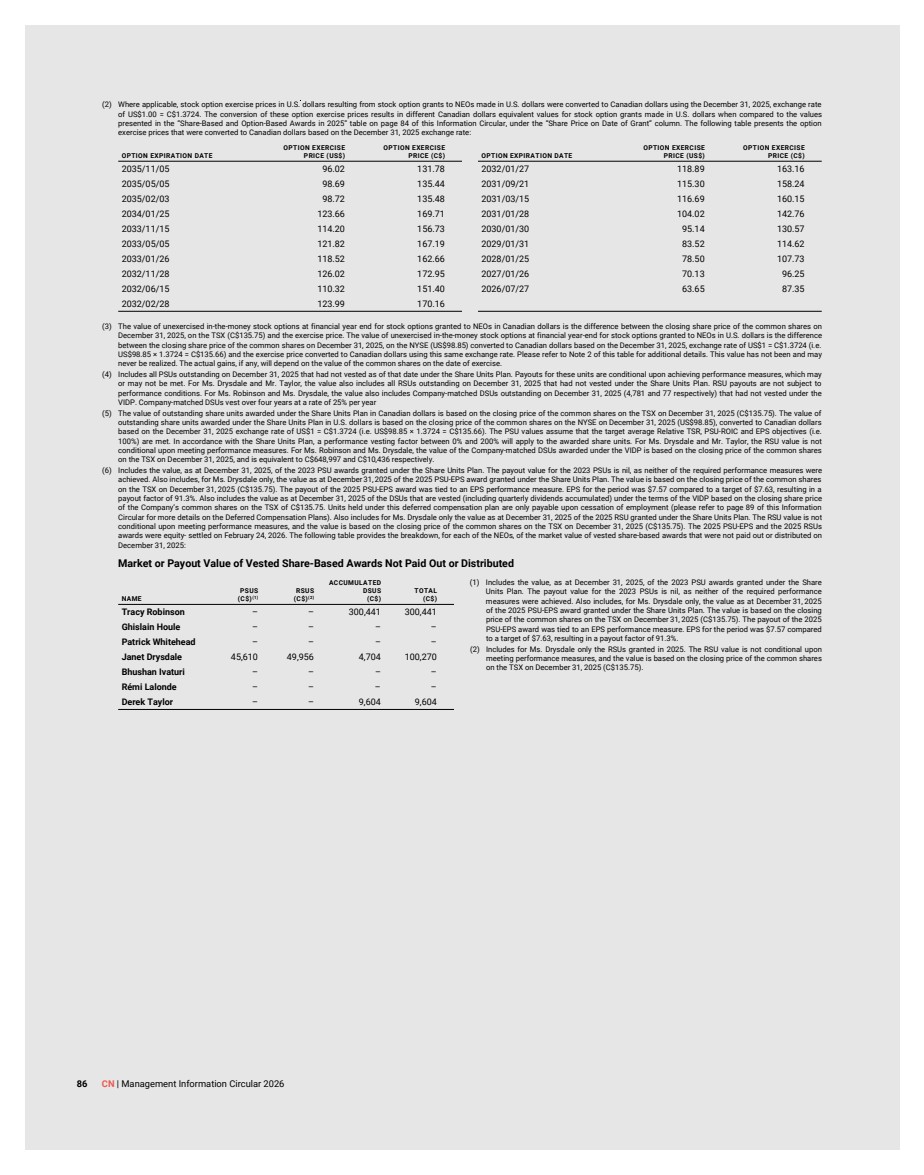
| Incentive Plan Awards–Value Vested or Earned During the Year The following table shows the value from incentive plans vested or earned by NEOs under CN’s incentive plans, including the annual incentive bonus, PSUs, RSUs, DSUs and stock options earned during the financial year ended December 31, 2025. NAME OPTION-BASED AWARDS– VALUE VESTED DURING THE YEAR (1) (C$) SHARE-BASED AWARDS– VALUE VESTED DURING THE YEAR (2) (C$) NON-EQUITY INCENTIVE PLAN COMPENSATION–VALUE EARNED DURING THE YEAR (3) (C$) Tracy Robinson – 203,718 2,219,685 Ghislain Houle – – 925,684 Patrick Whitehead – – 912,646 Janet Drysdale 31,468 377,292 634,583 Bhushan Ivaturi – – 516,516 Rémi Lalonde – – 470,419 Derek Taylor – 356,317 623,417 (1) Represents the value of the potential gains (in-the-money only) from stock options granted under the MLTIP in 2021, 2022, 2023 and 2024 that vested during the 2025 financial year. Grants made prior to 2020 all vest over four years, with 25% of stock options vesting on each anniversary date, grants made in or after 2020 and before 2024 vest over five years, with 20% of stock options vesting on each anniversary date, and grants made in or after 2024 vest over four years, with 25% of stock options vesting on each anniversary date (see section “Management Long-Term Incentive Plan” starting on page 88 of the Information Circular for a description of the plan). The potential gains are calculated as the difference between the closing price of the common shares on each of the stock option grant anniversary dates in 2025 and the exercise price, converted to Canadian dollars when applicable using the exchange rate on such vesting date (see “Currency Exchange Information” on page 95 of the Information Circular). This value has not been and may never be realized. The actual gains, if any, will depend on the value of the common shares on the date of exercise. (2) For Ms. Robinson, Ms. Drysdale and Mr. Taylor, it includes the value of the Company‑matched DSUs that vested during the year, based on the closing share price of the Company’s common shares on the TSX on February 16, 2025 (C$145.76). Also includes, for Ms. Drysdale only, the value as at December 31, 2025 of the 2025 PSU‑EPS award granted under the Share Units Plan, based on the closing price of the common shares on the TSX on December 31, 2025 (C$135.75). The payout for the 2025 PSU‑EPS award was tied to an EPS performance measure. EPS for the period was $7.57 compared to a target of $7.63, resulting in a payout factor of 91.3%. Also includes, for Ms. Drysdale only, the value as at December 31, 2025 of the 2025 RSUs granted under the Share Units Plan. RSUs are not subject to performance conditions, and their value is based on the closing price of the common shares on the TSX on December 31, 2025 (C$135.75). The 2025 PSU‑EPS and 2025 RSU awards were equity‑settled on February 24, 2026. Also includes the value of the RSUs granted to Ms. Drysdale and Mr. Taylor in 2022 under the Share Units Plan, which vested on November 30, 2025. These RSUs are not subject to performance conditions, and the value is based on the closing price of the common shares on the TSX on the settlement date of December 2, 2025 (C$134.21). It would normally also include the value, as at December 31, 2025, of the 2023 PSU awards granted under the Share Units Plan, however the payout value for the 2023 PSUs is nil, as neither of the required performance measures was achieved. (3) Represents the amount of bonus earned under the AIBP for the financial year ended on December 31, 2025. Incentive Plan Awards–Value of Exercised Stock Options and Share-Based Awards Paid During the Year The following table lists the number of shares acquired and the value realized as a result of stock options exercised by NEOs in 2025 as well as share-based awards (PSUs, RSUs and DSUs) that vested on December 31, 2025. For stock options exercised, the value realized is calculated by multiplying the number of shares acquired by the difference between the exercise price and the market price of CN common shares on the exercise date. STOCK OPTIONS SHARE-BASED AWARDS NAME NUMBER OF SHARES ACQUIRED ON EXERCISE VALUE REALIZED ON EXERCISE (C$) VALUE REALIZED ON DECEMBER 31, 2025 (C$) TOTAL VALUE REALIZED (C$) Tracy Robinson – – 300,441 300,441 Ghislain Houle 10,546 624,517 – 624,517 Patrick Whitehead – – – – Janet Drysdale – – 100,270 100,270 Bhushan Ivaturi – – – – Rémi Lalonde – – – – Derek Taylor 6,540 45,552 9,604 55,156 CN | Management Information Circular 2026 87 |
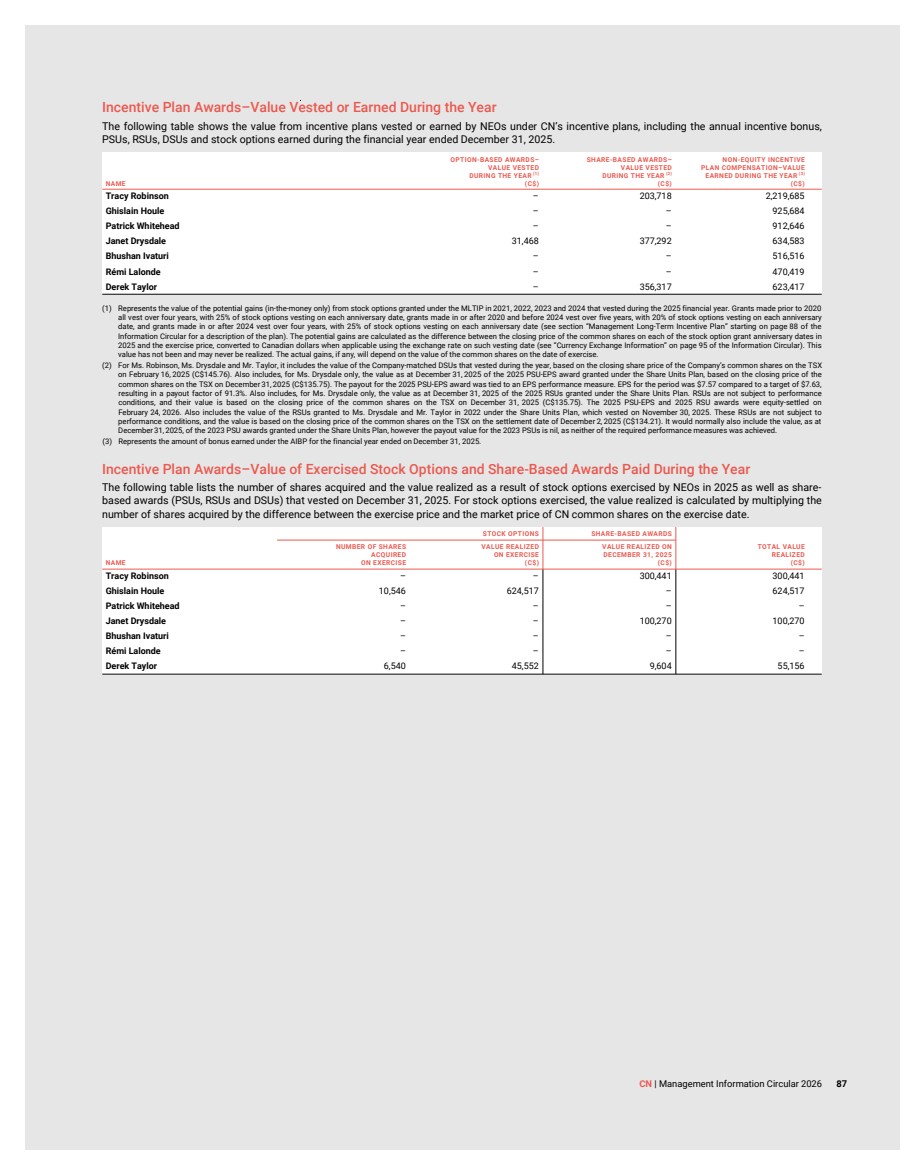
| Management Long-Term Incentive Plan The MLTIP was approved by the Company’s shareholders on May 7, 1996 and amended on April 28, 1998; April 21, 2005; April 24, 2007; March 4, 2008; January 27, 2015; January 1, 2019, January 1, 2020, January 1, 2024, April 26, 2024 and on January 29, 2026. Eligible participants under the MLTIP are employees of CN or its affiliates as determined by the Board. Grants cannot be made to non-executive directors under the MLTIP. The maximum number of common shares that may be issued under the MLTIP is 120,000,000. The following table provides information on the status of the reserve and the number of shares issued and issuable under the MLTIP, as at December 31, 2025. Stock Options Outstanding and Available for Grant as of December 31, 2025 NUMBER OF COMMON SHARES (#) % OF OUTSTANDING COMMON SHARES Stock options already granted and outstanding 3,050,002 0.4964% Stock options issuable under the MLTIP 12,152,726 1.9779% Shares issued following the exercise of stock options 104,797,272 17.0559% Stock Options Granted under the MLTIP as at December 31, 2025, 2024 and 2023 The following table presents information concerning stock options granted under the MLTIP as at December 31 of the years indicated. 2025 2024 2023 Number of stock options granted during the year 577,046 387,310 581,379 Number of employees who were granted stock options 219 207 189 Number of stock options outstanding at year end 3,050,002 3,214,964 3,280,755 Weighted average exercise price of stock options outstanding C$141.35 C$142.55 C$127.64 Number of stock options granted as a % of outstanding shares (1) 0.09% 0.06% 0.09% Number of stock options exercised 483,143 407,949 514,106 (1) Annual burn rate, as calculated in accordance with Section 613(p) of the TSX Company Manual. As per the terms of the MLTIP, the maximum aggregate number of common shares with regard to which awards may be made to any participant under the MLTIP and under any other plan, which CN has or may eventually have, shall not exceed 5% of the common shares issued and outstanding. The maximum number of common shares issuable to insiders, at any time, under all security-based compensation, cannot exceed 10% of the issued and outstanding common shares and the number of common shares issued to insiders, within any one-year period, under the MLTIP and any other share compensation arrangements of CN, shall be less than 10% of the issued and outstanding common shares. The maximum number of common shares with regard to which awards may be made during a calendar year is limited to 1% of the outstanding common shares at the beginning of that year. As demonstrated in the table under the heading "Stock Options Granted under the MLTIP as at December 31, 2025, 2024 and 2023", the number of stock options granted as a percentage of outstanding shares is well below the 1% limitation. Stock options are non-transferable except, in certain circumstances, upon the death of the holder of such stock options. Stock Option Features The following section provides an overview of the features of the grants made under the MLTIP as currently in effect, reflecting all amendments adopted to date. Grant Currency Same currency as the recipient’s salary. Exercise Price At least equal to the closing share price of the common shares on the TSX or the NYSE (depending on the grant currency) on the grant date. Term 10 years (1) Vesting Criteria Stock options may become exercisable on the anniversary date (conventional stock options) and/or upon meeting performance targets (performance options) as established for each grant. Grants are of conventional stock options, which vest over four years, with 25% of stock options vesting on each anniversary. Termination Conditions Stock options shall be cancelled upon the termination of a participant’s employment for cause or if the participant voluntarily terminates employment. In the event that a participant’s employment is terminated by the Company other than for cause, all vested stock options held by such participant at the time of termination shall be cancelled three months after termination of the participant’s employment, and all unvested stock options at time of termination shall be cancelled at termination. In the case of retirement, stock options continue to vest and shall be cancelled five(2) years after the retirement date. In the event of a participant’s death, all available stock options immediately vest and may be exercised by the estate within a period of twelve months from the date of death. In the event non-compete, non-solicitation, confidentiality or other conditions of the grant are breached, stock options shall be forfeited and cancelled. These conditions are subject to the discretion of the HRC Committee. (1) The stock option period in respect of a particular award shall be specified by the HRC Committee, but in all cases shall end no later than the day preceding the tenth anniversary of the date of the award. Notwithstanding the foregoing, should the stock option period end during a blackout period or within ten business days after the end of a blackout period, the stock option period shall be extended by a period of 10 business days from the end of a blackout period. (2) Applicable to retirements occurring on or after January 29, 2026; this amendment is subject to TSX approval. 88 CN | Management Information Circular 2026 |
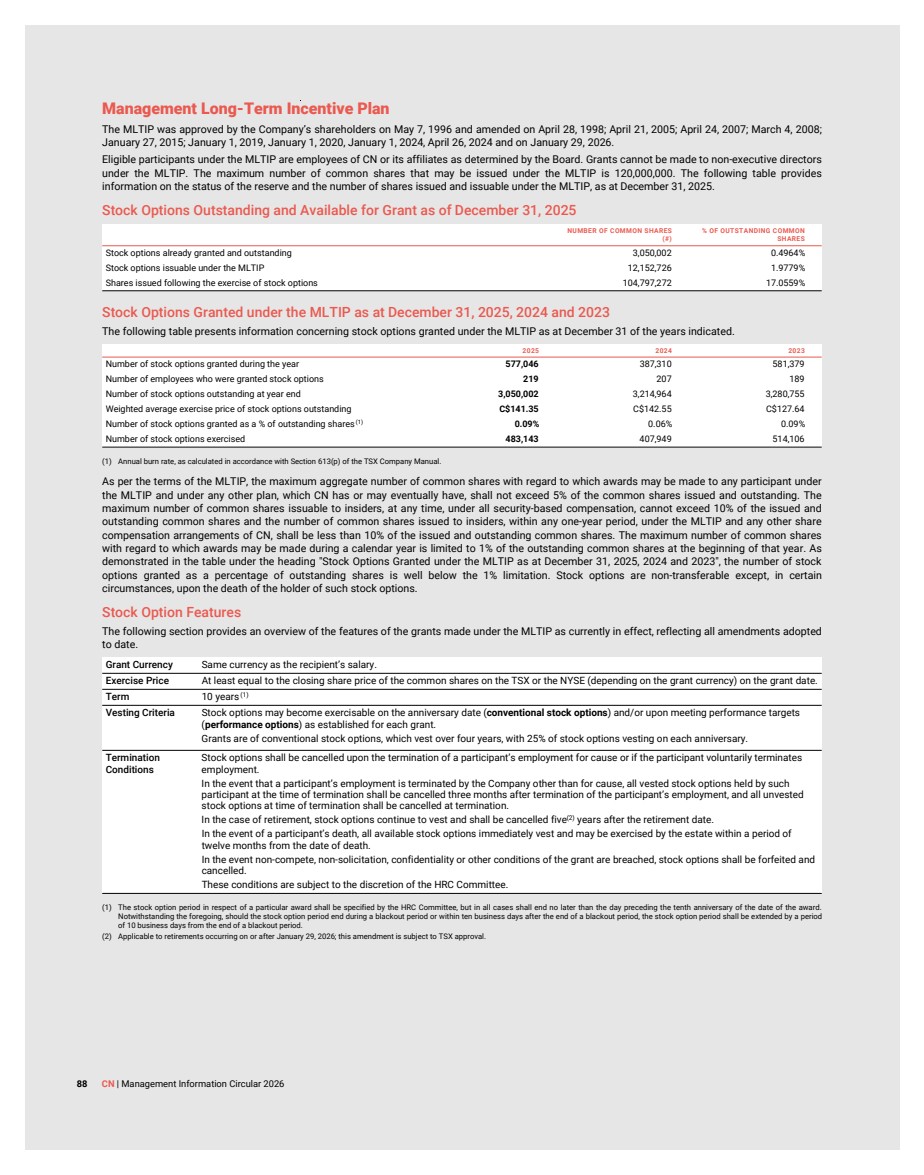
| At the 2007 annual meeting, shareholders approved an ordinary resolution confirming the addition of new amendment provisions to the MLTIP. Such amendment provisions state that the Board or the HRC Committee, as provided in the MLTIP or pursuant to a specific delegation and in accordance with applicable legislation and regulations, may amend any of the provisions of the MLTIP or suspend or terminate the MLTIP or amend the terms of any then outstanding award of stock options under the MLTIP provided the Company obtains shareholder approval for: (i) Any amendment to the maximum number of common shares issuable under the MLTIP, except for adjustments in the event that such shares are subdivided, consolidated, converted or reclassified by the Company or that any other action of a similar nature affecting such shares is taken by the Company (a Share Adjustment); (ii) Any amendment which would allow non-employee directors to be eligible for new awards under the MLTIP; (iii) Any amendment which would permit any option granted under the MLTIP to be transferable or assignable other than by will or pursuant to succession laws (estate settlements); (iv) The addition of a cashless exercise feature, payable in cash or common shares, which does not provide for a full deduction of the number of underlying shares from the MLTIP reserve; (v) The addition in the MLTIP of deferred or performance share unit provisions or any other provisions which result in participants receiving common shares while no cash consideration is received by the Company; (vi) Any reduction in the exercise price of an option after the option has been granted to a participant or any cancellation of an option and the substitution of that option by a new option with a reduced exercise price granted to the same participant, except in the case of a Share Adjustment; (vii) Any extension to the term of an outstanding option beyond the original expiry date, except in the case of an extension due to a blackout period; (viii) Any increase to the maximum number of common shares that may be issued: a. Under the MLTIP to any participant during any calendar year; or b. Under the MLTIP and under any other plan to any participant; and (ix) The addition in the MLTIP of any form of financial assistance and any amendment to a financial assistance provision, which is more favourable to participants. The terms of the MLTIP provide that the Board or the HRC Committee, may, in their sole discretion, amend the MLTIP without shareholder approval, including, without limitation, with respect to the following: (i) amendments of a “housekeeping” or clerical nature as well as any amendment clarifying any provision of the MLTIP; (ii) a change to the vesting provisions of an option or of the MLTIP; (iii) a change to the termination provisions of an option or the MLTIP which does not entail an extension beyond the original expiry date; (iv) any change described in section 10 of the MLTIP (“Reorganization of share capital”); and (v) suspending or terminating the MLTIP. No amendment, suspension or termination shall, except with the written consent or the deemed consent of the participants concerned, affect the terms and conditions of options previously granted under the MLTIP, unless the rights of the participants have terminated in accordance with the MLTIP. The MLTIP includes a “double-trigger provision”. Pursuant to such provisions, provided that a proper substitute is granted, the vesting of non-performance-based stock options held by a participant would not accelerate upon a Change of Control, unless the participant is terminated without cause or resigns for good reason (refer to “Change of Control Provisions” section of this Information Circular for more details on such amendments). Under the MLTIP, retirement is defined as the earlier of (i) 55 years of age and 10 years of continuous service, (ii) 60 years of age and 5 years of continuous service, or (iii) 65 years of age. The vesting period of stock options granted under the MLTIP is four years, with 25% of the stock options vesting on each anniversary date over the first four years of the grant. In January 2026, the Board approved amendments to the MLTIP to extend the stock option exercise window upon retirement to five years. This extension applies to both future and outstanding grants and replaces the previous three‑year exercise window for options granted before January 1, 2020, and the four‑year window for options granted on or after January 1, 2020. The revised five‑year period applies to retirements occurring after the approval date of January 29, 2026. The amendment did not require shareholder approval as it is not covered by shareholder approval requirements under the above-described amendment provisions of the MLTIP or under the rules of The Toronto Stock Exchange. Deferred Compensation Plans The VIDP was introduced by CN in 2002. This plan allows NEOs and other executives to elect to defer up to 100% of their annual bonus into DSUs remitted upon retirement or termination of employment. A DSU is equivalent to a common share of CN and earns notional dividends, which are re-invested into additional DSUs, when cash dividends are paid on the Company’s common shares. The amount deferred is converted into a number of units at the deferral date, using the closing share price on the deferral date. Deferral elections are made at least six months prior to the end of the performance period of the incentive plan. The maximum total amount executives can defer to DSUs is equivalent to their ownership requirement under the Stock Ownership guidelines (see section on “Stock Ownership” under “Other Key Compensation Programs of the Company” on page 70 of this Information Circular for a detailed description). CN also credits a Company match equal to 25% of the number of DSUs resulting from an eligible deferral. These Company-matched DSUs vest over a period of four years (25% per year) from the deferral date. Due to its tax effectiveness and the additional match provided by CN, this plan offers an opportunity for executives to increase their ownership in the Company, linking their future returns to CN's share price performance. In October 2014, CN modified its VIDP to settle future award payouts in CN common shares purchased on the open market rather than cash. The changes affect DSU awards made in 2016 and after. As a result, amounts deferred in DSUs after January 1, 2016 are settled in shares upon retirement or termination (including vested Company-matched DSUs as well as notional dividends accrued over the deferral period and subject to mandatory waiting periods or monthly instalments for eligible U.S. taxpayers). Following the modification of the VIDP, eligible employees were offered a one-time election to settle past DSU awards in CN common shares purchased on the open market rather than cash and according to the plan terms. No modification to the nature of the deferrals under the AIBP plan can be made, unless the Board approves an amendment to the plans. CN | Management Information Circular 2026 89 |
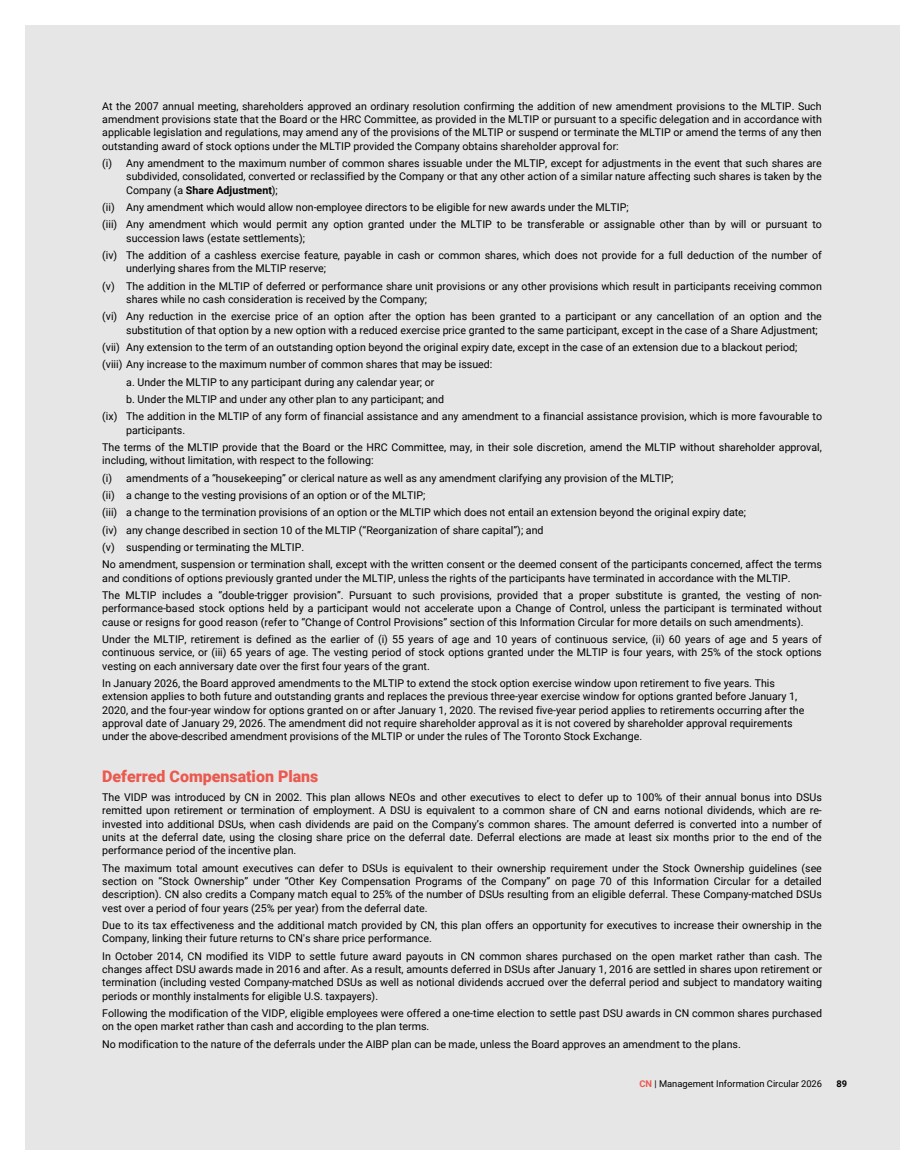
| Pension Plan Benefits Pension Plans and Other Retirement Arrangements CN Pension Plan (CNPP) and CN Pension Plan for Senior Management (CNPPSM) Effective February 1, 2025, the CN Defined Contribution Pension Plan merged with the CN Pension Plan (CNPP) and the CN Defined Contribution Pension Plan for Senior Management merged with the CN Pension Plan for Senior Management (CNPPSM). Accordingly, the CNPP and the CNPPSM were amended to reflect the pension plans’ merger by adding respectively a defined contribution (DC) component replicating the prior defined contribution pension plans’ provisions. Defined Benefit Component of the CNPP (DBPP) and Defined Benefit Component of the CNPPSM (DBSM) Prior to April 1, 2024, Ms. Drysdale and Mr. Houle accrued benefits in the DBPP and DBSM. Effective April 1, 2024, all non-unionized employees participating in the DBPP and DBSM transferred to the DC components for future accruals. The CNPP and CNPPSM are federally-registered pension plans. Their Defined Benefit (DB) components are designed to provide retirement benefits based on pensionable years of service and highest average earnings. Highest average earnings are defined as the average pensionable earnings during the last 60 months of compensated service or the best five consecutive calendar years, whichever is greater. Under the DBPP, pensionable earnings consist of base salary and overtime. Under the DBSM, pensionable earnings include base salary, overtime, and bonuses paid by the Company under the AIBP, up to the employee’s target bonus level. In 2025, the aggregate annual retirement benefit payable under both plans was subject to a maximum of C$3,757 per year of pensionable service and was calculated as follows: • 1.7% of highest average earnings up to the average year’s maximum pensionable earnings (the YMPE) as defined under the Quebec/Canada Pension Plan, multiplied by the number of years of pensionable service (maximum 35 years) Plus, • 2.0% of highest average earnings in excess of the YMPE, multiplied by the number of years of pensionable service (maximum 35 years). Accumulation of pensionable service and increases in pensionable earnings after March 31, 2024 are not included in the calculation of DBPP and DBSM benefits. Under both the DBPP and DBSM, if the sum of the participant’s age and years of pensionable service is at least 85 and the participant is age 55 or over at the time of retirement from active employment, the participant is eligible to receive an immediate, unreduced pension, subject to the Company’s consent. Retirement benefits vest immediately when participation begins. Defined Contribution Component of the CNPPSM (DCSM) Mss. Robinson and Drysdale, Messrs. Houle and Ivaturi participate and Mr. Lalonde participated in the DCSM. Mss. Robinson and Drysdale, Messrs. Houle and Ivaturi contribute and Mr. Lalonde contributed 9% of their pensionable earnings in the DCSM and CN matches 100% of their contributions. Ms. Drysdale receives an additional transition contribution of 10% of pensionable earnings, to which certain executives and senior management employees who transferred from the DBSM to the DCSM on April 1, 2024 are eligible. Total contributions are subject to the maximum contribution imposed by the Canadian Income Tax Act (C$33,810 in 2025). Pensionable earnings include base salary and bonuses payable under the AIBP up to the employee’s target level. All contributions vest immediately and are invested in various investment funds as selected by the participant. No withdrawal or distribution is permitted prior to employment termination. Special Retirement Stipend (SRS) Prior to April 1, 2024, Ms. Drysdale and Mr. Houle also accrued benefits under the SRS. Effective April 1, 2024, all participants of the SRS were transferred to the Defined Contribution Supplemental Executive Retirement Plan. SRS participants enter into an agreement with CN, which includes confidentiality, non‑compete, and non-solicitation clauses. Ms. Drysdale and Mr. Houle signed an SRS agreement. The annual amount payable under the SRS equals 2% of the employee’s highest average earnings in excess of the average earnings that result in the maximum pension payable under the DBPP and DBSM (C$198,529 in 2025), multiplied by the number of years of pensionable service (maximum 35 years). Accumulation of pensionable service and increases in pensionable earnings after March 31, 2024 are not included in the calculation of SRS benefits. Earnings consist of base salary and bonuses paid by the Company under the AIBP, up to the employee’s target bonus level. If the sum of the participant’s age and years of pensionable service is at least 85 and the participant is age 55 or over at the time of retirement, the participant is eligible to receive an immediate, unreduced SRS benefit, subject to the conditions set out in the SRS agreement. SRS benefits for employees who entered into an SRS agreement prior to July 1, 2002, vest after two years of employment. For employees who entered into an SRS agreement on or after July 1, 2002, the SRS benefits become vested if the employee remains in active service for two years and until the age of 55. In any case, SRS benefits become vested if the employee is involuntarily terminated from employment without cause. SRS retirement benefits are paid out of operating funds. CN Defined Contribution Supplemental Executive Retirement Plan (DC SERP) Mss. Robinson and Drysdale, Messrs. Houle and Ivaturi participate and Mr. Lalonde participated in the DC SERP. The DC SERP is a non-registered defined contribution pension plan designed to provide executives and senior management employees with retirement benefits in excess of the Canadian Income Tax Act limit applicable to the DCSM described above. Once contributions have reached the limit prescribed by the Canadian Income Tax Act in the DCSM in a given year, an amount equal to employer and employee contributions in excess of the limit is gradually credited by the Company into a notional account under the DC SERP. These notional contributions vest after two years of employment. Employees do not contribute to the DC SERP. By default, notional contributions accrue investment credits using investment options as selected by the participant in the DCSM. However, participants can make a different investment election under the DC SERP. No withdrawal or distribution is permitted prior to employment termination. Payment of DC SERP benefits accrued since January 1, 2011 are subject to certain confidentiality, non-compete, non-solicitation, and other covenants. 90 CN | Management Information Circular 2026 |
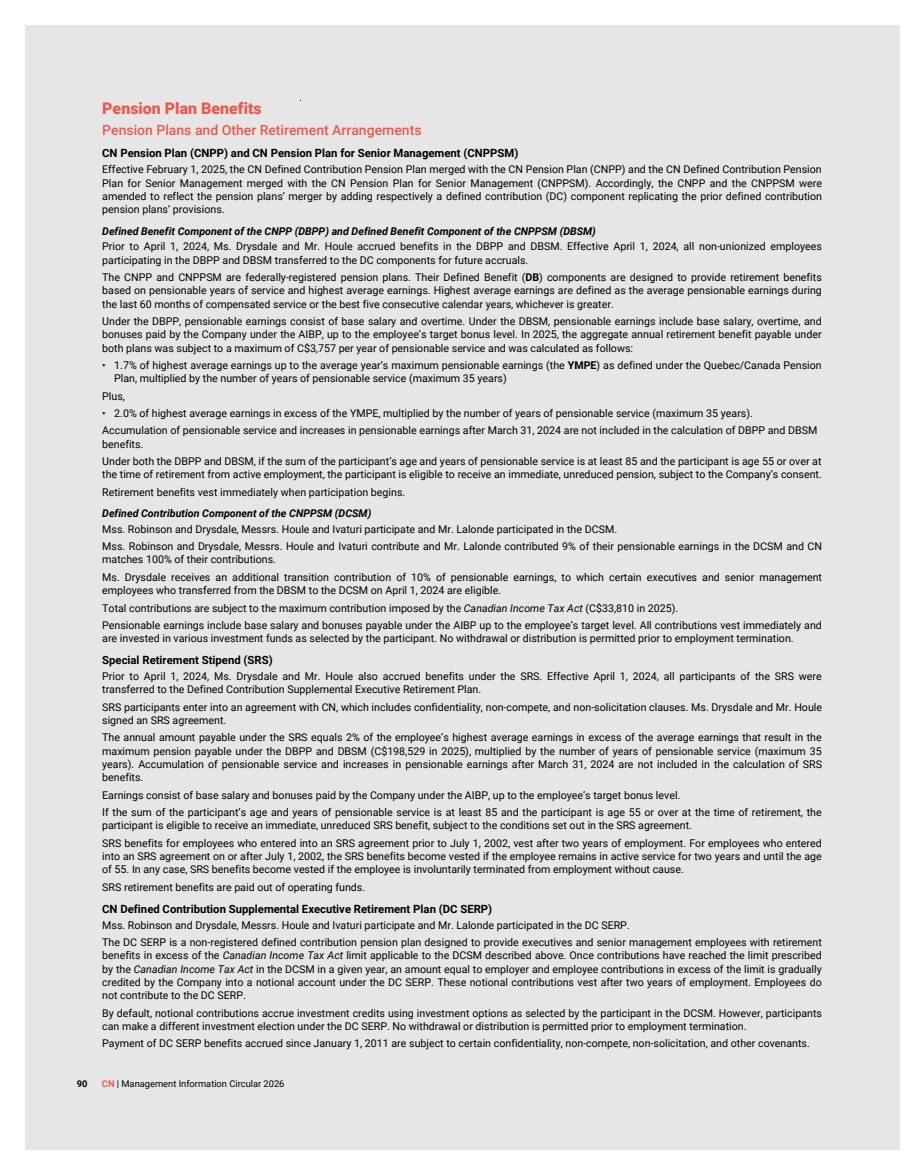
| Canadian National Railway Company Savings Plan for U.S. Operations (401(k) Plan) Mr. Whitehead participates and Mr. Taylor participated in the 401(k) Plan, which is a defined contribution retirement plan qualified under Section 401(a) of the Internal Revenue Code offered to U.S.-based CN employees. Non-unionized employees participating in the 401(k) Plan may elect to defer up to 100% of their pensionable earnings in the plan and the Company contributes an amount equal to 50% of the first 6% of the pensionable earnings an employee elects to defer to the 401(k) Plan (Matching Contribution). Both employee deferrals and Matching Contributions are subject to annual limits imposed by the U.S. Internal Revenue Code. All Matching Contributions vest immediately. Mr. Whitehead receives and Mr. Taylor received an additional non elective contribution for non-unionized employees of 3.5% of pensionable earnings (Management Contribution). Management Contributions vest after three years of employment. Pensionable earnings include base salary and are subject to the annual compensation limit imposed by the Internal Revenue Code (C$480,340 in 2025). The total of all contributions to the 401(k) Plan-employee deferrals, Matching Contributions and Management Contributions for any employee in a plan year are subject to an annual limit imposed by the Internal Revenue Code (C$96,068 in 2025). All contributions are invested in investment funds as selected by the participant. Canadian National Railway Defined Contribution Supplemental Executive Retirement Plan (US DC SERP) Mr. Whitehead participates and Mr. Taylor participated in the US DC SERP. The US DC SERP is a non-qualified defined contribution pension plan designed to provide U.S.-based CN executives and senior management employees with supplemental retirement benefits in addition to the 401(k) Plan described above. CN credits contributions to a notional account under the US DC SERP. Employees do not contribute to the US DC SERP. The annual contribution percentage credited to executives by the Company depends on age and service as follows: POINTS (SUM OF AGE AND SERVICE) % OF PENSIONABLE EARNINGS Up to 39 5% 40–49 6% 50–59 7% 60 and above 8% Mr. Taylor received an additional transition contribution of 10% of pensionable earnings, to which certain executives and senior management employees who transferred from the DB SERP to the US DC SERP on April 1, 2024 are eligible. Pensionable earnings include base salary and bonuses payable under the AIBP up to the employee’s target level. These notional contributions vest after two years of employment. A participant’s notional contributions accrue investment credits as if invested in a default investment option unless the participant makes other investment elections. No withdrawal or distribution is permitted prior to employment termination. Distributions after termination of employment are made in the number of instalments elected by the participant. Payment of US DC SERP benefits accrued since January 1, 2011 are subject to certain confidentiality, non-compete, non-solicitation, and other covenants. Pension Plan for Employees of CN US Subsidiaries (USDBPP) Prior to April 1, 2024, Mr. Taylor accrued benefits in the USDBPP. Effective April 1, 2024, all participants in the USDBPP ceased to accrue future benefits in the plan and were transferred to the 401(k) Plan for all future accruals and have since been eligible to the Management Contribution. Accumulation of pensionable service and increases in pensionable earnings after March 31, 2024 are not included in the calculation of USDBPP benefits. The USDBPP is a qualified defined benefit pension plan designed to provide retirement benefits equal to 0.4% of the highest average earnings plus 0.3% of the highest average earnings in excess of the Railroad Retirement Board average covered compensation (C$161,971 in 2025) multiplied by the number of years of credited service (maximum 35 years). Highest average earnings are defined as the average pensionable earnings during the best 60 full consecutive months in the last 120 full consecutive months of employment. Pensionable earnings consist of base salary and overtime and are capped at the average of the US Internal Revenue Code limit, over the last five years (C$444,658 in 2025). The retirement benefit is payable without reduction at age 65 or age 60 if the employee has 30 years of credited service or 30 years of Railroad Retirement Board service at termination of employment. Retirement benefits vest after five years of employment. 2001 Supplemental Retirement Plan for Employees of CN US Subsidiaries (DB SERP) Prior to April 1, 2024, Mr. Taylor accrued benefits in the DB SERP. Effective April 1, 2024, all DB SERP participants ceased to accrue future benefits in the plan and were transferred to the US DC SERP for all future accruals. Accumulation of pensionable service and increases in pensionable earnings after March 31, 2024 are not included in the calculation of DB SERP benefits. The DB SERP is a non‑qualified, unfunded defined benefit pension plan. It is designed to provide executives and senior management employees with retirement benefits equal to 2% of their highest average earnings, multiplied by the number of years of credited service (maximum 35 years) minus the offsets described hereinafter. Highest average earnings are defined as the average pensionable earnings during the best 60 full consecutive months in the last 120 full consecutive months of employment. Earnings consist of base salary and bonuses paid by the Company under the AIBP, up to the employee’s target level. The DB SERP pension is offset by: i. the pension accrued under the USDBPP; ii. the U.S. Railroad Retirement Board Tier 2 pension; and iii. the amount of a single life annuity that can be purchased with the 3% maximum employer matching contributions available under the 401(k) plan. DB SERP benefits for employees who joined the plan prior to July 1, 2002 vest after five years of employment. For employees who joined the plan on or after July 1, 2002, DB SERP benefits vest only if the employee remains in active service for five years and until the age of 55. In any case, DB SERP benefits vest if the employee is involuntarily terminated from employment without cause. Generally, the DB SERP pension benefit is payable without reduction at age 65 or age 60 if the participant has 30 years of credited service or 30 years of Railroad Retirement Board service at termination of employment. Participants had until December 31, 2008 to elect to receive their lifetime pension benefit at a different age than the above retirement ages, but no earlier than six months after retirement or termination of employment. Retirement benefits accrued and vested prior to January 1, 2005 are not subject to the six-month delay. Retirement benefits cannot be paid earlier than age 55. Effective July 15, 2010, the DB SERP was amended to include certain confidentiality, non-compete, non-solicitation and other covenants as a condition of payment of retirement benefits accruing as of the effective date. CN | Management Information Circular 2026 91 |
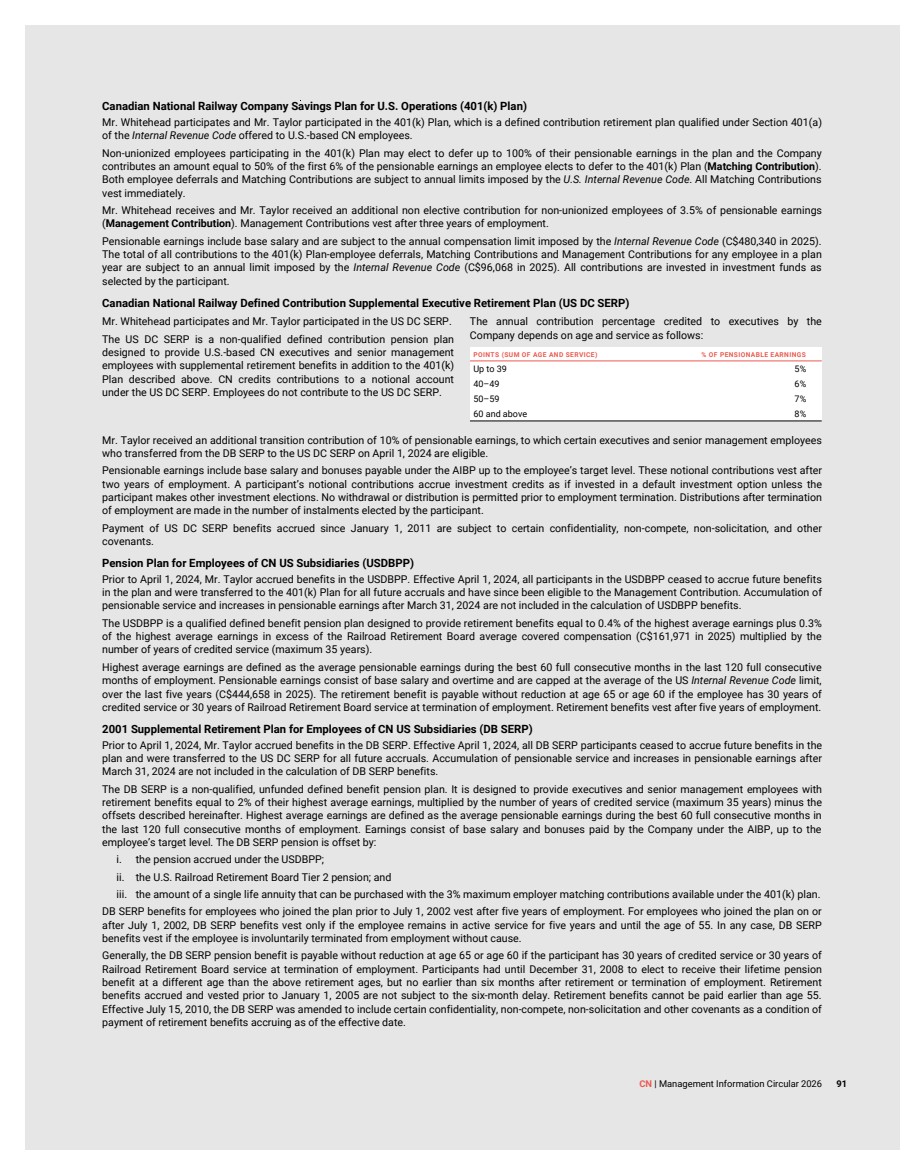
| Defined Benefit benefits Table The following amounts have been calculated using the actuarial assumptions disclosed in Note 17–Pensions and Other Post-retirement Benefits of the 2025 Annual Report and in Note 17–Pensions and Other Post-retirement Benefits of the 2024 Annual Report, available on the CN’s website at www.cn.ca and on SEDAR+ at www.sedarplus.ca. The amounts calculated in this table are estimates only and are based on assumptions, which may or may not materialize. Amounts shown in this table include Defined Benefit retirement benefits from the CN’s registered pension plans and non-registered supplemental pension arrangements for 2025 and are in Canadian dollars. NAME NUMBER OF YEARS OF CREDITED SERVICE AS OF DECEMBER 31, 2025 (#) ANNUAL BENEFITS PAYABLE OPENING PRESENT VALUE OF DEFINED BENEFIT OBLIGATION (4) (C$) COMPENSATORY CHANGE (C$) (1) NON-COMPENSATORY CHANGE (5) (C$) CLOSING PRESENT VALUE OF DEFINED BENEFIT OBLIGATION (4) (C$) AT YEAR END (2) (C$) AT AGE 65 (3) (C$) SERVICE COST IMPACT OF SALARY/ BONUS IMPACT OF PLAN CHANGES TOTAL Ghislain Houle 26.57 691,000 691,000 10,412,000 – – – – (726,000) 9,686,000 Janet Drysdale 27.29 304,000 304,000 4,240,000 – – – – 45,000 4,285,000 Derek Taylor 23.83 312,000 312,000 2,157,718 – – – – (833,882) 1,323,836 (1) The change in present value that is attributable to compensation includes the service cost net of employee contributions and, the impact of any increase in earnings in excess or below what was assumed to be granted in the future. The service cost net of employee contributions is the estimated value of the employer portion of benefits accrued during the calendar year. Following the hard freeze on DB benefits effective March 31, 2024, compensatory change is now nil. (2) Annual benefits payable at year end represent accrued benefits as at December 31, 2025 (based on pensionable earnings and service up to March 31, 2024 as per retirement plan changes effective on April 1, 2024), payable at age 65 or at unreduced retirement date, if earlier. Actual benefits payable at year end would have been reduced for employees not yet eligible for unreduced benefits. Mr. Taylor’s employment with the Company terminated effective October 19, 2025, and accordingly, the amounts shown for him reflect benefits accrued through his termination date. (3) The projected pension reflects the retirement plans changes effective on April 1, 2024. Pensionable earnings and service up to March 31, 2024, are used in the calculation. Mr. Taylor’s employment with the Company terminated effective October 19, 2025, and accordingly, the amounts shown for him reflect benefits accrued through his termination date. (4) The present value of the defined benefit obligation is the value of the benefits accrued for all service to the specified point in time. (5) The change in present value that is attributable to non-compensatory elements includes changes in assumptions, change in currency, interest cost, employee contributions (if any) and experience gains and losses (other than for difference in earnings). Defined Contribution benefits Table The table below includes Defined Contribution retirement benefits from the Company’s registered and non-registered plans. NAME ACCUMULATED VALUE AT START OF YEAR (C$) COMPENSATORY AMOUNT (1) (C$) NON-COMPENSATORY AMOUNT (2) (C$) ACCUMULATED VALUE AT YEAR END (C$) Tracy Robinson 1,327,616 458,433 153,468 1,939,517 Ghislain Houle 133,600 225,256 40,452 399,308 Patrick Whitehead 410,236 103,445 94,838 608,519 Janet Drysdale 108,438 194,901 42,886 346,225 Bhushan Ivaturi – 81,209 21,600 102,809 Rémi Lalonde (3) 166,397 132,435 27,295 326,127 Derek Taylor (4) 1,874,378 200,638 251,392 2,326,408 (1) Represents employer contributions and notional contributions in the non-registered defined contribution plan. (2) Represents employee contributions, if any, investment gains and losses and notional investment credits and losses. (3) Mr. Lalonde’s employment with CN terminated effective July 21, 2025. The amounts shown reflect his accumulated DCSM and DC SERP account balances as of his termination date. In accordance with the plan terms, all unvested DC SERP employer contributions and related investment returns were forfeited as of that date. As such, an amount of $251,832 of unvested DC SERP employer contributions and related investment returns were forfeited upon termination. This forfeited amount is provided for information purposes only and is not included in the amounts reported in the table (i.e., not deducted as a negative amount). (4) Mr. Taylor’s employment with the Company terminated effective October 19, 2025. The amounts shown reflect his accumulated 401(K) and US DC SERP account balances as of his termination date. 92 CN | Management Information Circular 2026 |
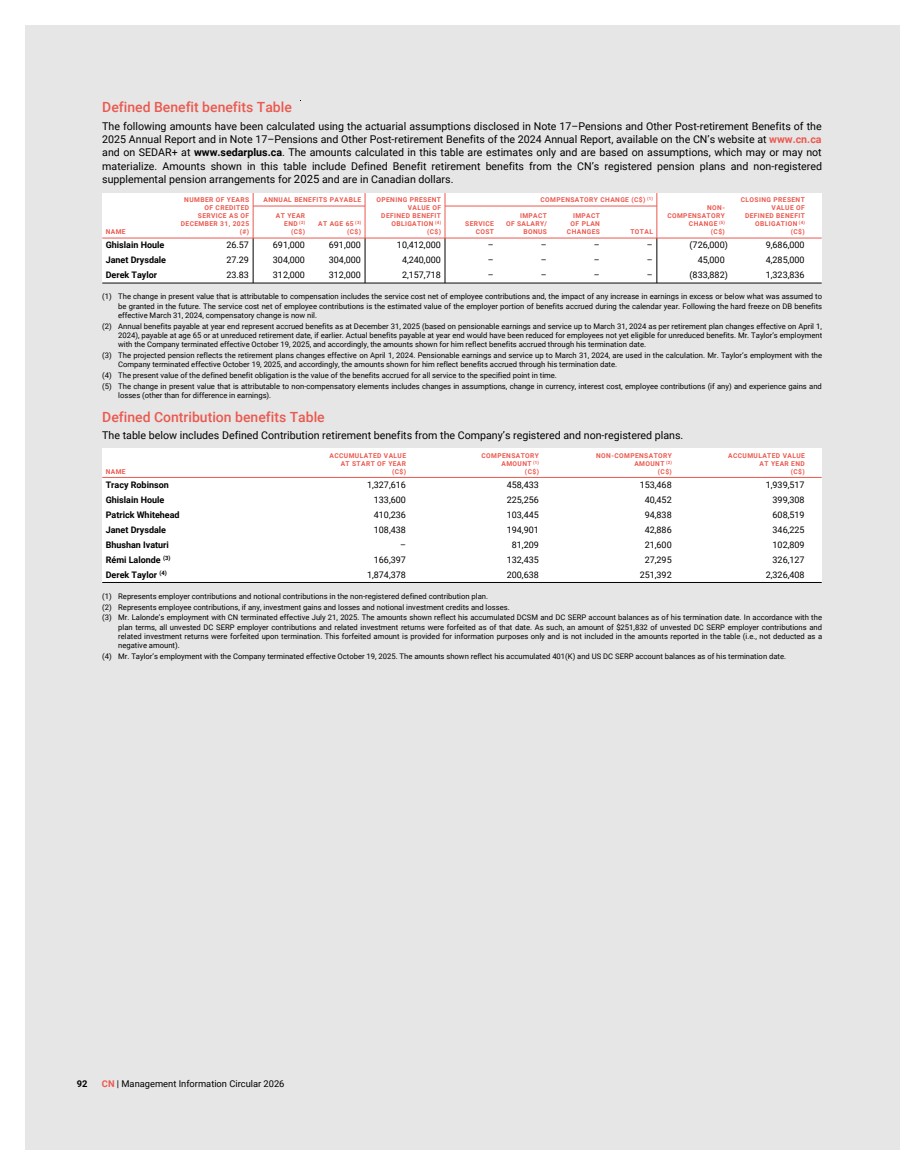
| Non-Registered Plans Table The following table provides the total present value of CN’s non-registered defined benefit and defined contribution plans. These amounts were determined using the actuarial assumptions disclosed in Note 17–“Pensions and Other Post-retirement Benefits”, on page 98 of the 2025 Annual Report and in Note 17–Pensions and Other Post-retirement Benefits, on page 98 of the 2024 Annual Report, available on CN’s website at www.cn.ca and on SEDAR+ at www.sedarplus.ca. Amounts include the value of pension benefits for active, deferred and retired executive and senior management participants for 2025. PLANS OPENING PRESENT VALUE OF BENEFIT OBLIGATION (C$) CLOSING PRESENT VALUE OF BENEFIT OBLIGATION (C$)(1) Non-Registered Defined Benefit Plans in Canada and the U.S. 361,600,000 341,900,000 Non-Registered Defined Contribution Plans in Canada and the U.S. 17,022,000 22,133,000 (1) The decrease in the present value at the end of 2025 for defined benefit plans was mainly due to an increase in the discount rates and the change in the currency exchange rate. This was partially offset by experience losses and by the interest on the benefit obligations. Termination and Change of Control Benefits The Company does not have contractual arrangements or other agreements in connection with termination, resignation, retirement, Change of Control or a change in responsibilities of a NEO other than the conditions provided in the compensation plans, and summarized as follows: RESIGNATION INVOLUNTARY TERMINATION RETIREMENT (3) CHANGE OF CONTROL TERMINATION FOR CAUSE Annual Incentive Bonus Plan Forfeits eligibility for the plan Entitled to a bonus based on corporate financial, safety and strategic performance metrics and prorated on active service in plan year (minimum of three months) Entitled to a bonus based on corporate financial, safety and strategic performance metrics and prorated on active service in plan year (minimum of three months), subject to providing a three-month notice period prior to retirement No specific provision Forfeits eligibility for the plan Stock Options (1) All stock options are cancelled Exercise of vested stock options upon involuntary termination within three months or otherwise forfeited Subject to compliance with the non-compete, non-solicitation and confidentiality provisions Continued vesting for four years if the executive remains in continuous and active service until the last day of the year in which the grant was made Grants made before January 2020 Exercise of vested stock options within three years or otherwise forfeited Grants made since January 2020 Exercise of vested stock options within four years or otherwise forfeited For Retirement on or after January 29, 2026 (regardless of grant date)(4) Exercise of vested stock options within five years or otherwise forfeited Subject to compliance with the non-compete, non-solicitation and confidentiality provisions If proper substitute is granted, immediate vesting would occur only if participant is terminated without cause or resigns for good reason (2) within two years of the Change of Control All stock options are cancelled Performance Share Units (1) All PSUs are cancelled Partial payout if performance measures are met and prorated based on the number of months of active service during the plan period Subject to compliance with the non-compete, non-solicitation and confidentiality provisions Full payout if performance measures are met and if the executive remains in continuous and active service until March 31 of the year following the year in which the grant was made Subject to compliance with the non-compete, non-solicitation and confidentiality provisions If proper substitute is granted, immediate vesting would occur only if participant is terminated without cause or resigns for good reason (2) within two years of the Change of Control. In such cases, the award would vest on a prorated basis, reflecting the participant’s active service and the performance‑vesting factor applicable at the time of the event. All PSUs are cancelled Deferred Share Units Payment of all vested units, including the vested Company-matched DSUs Payment of all vested units, including the vested Company-matched DSUs Payment of all vested units, including the vested Company-matched DSUs Immediate vesting of unvested Company-matched DSUs Payment of all vested units, including the vested Company-matched DSUs Registered Pension Plans Payment of vested benefits Payment of vested benefits Payment of vested benefits Payment of vested benefits Payment of vested benefits Non-Registered Pension Plans and Arrangements (1) Payment of vested benefits Payment of vested benefits Subject to compliance with the non-compete, non-solicitation and confidentiality provisions Payment of vested benefits Subject to compliance with the non-compete, non-solicitation and confidentiality provisions Payment of vested benefits Payment of vested benefits, except for SRS benefits which are forfeited (1) In the event of resignation, involuntary termination, retirement or Change of Control, the payment of awards or vested benefits is subject to certain non-compete, non-solicitation, non-disclosure of confidential information and other restrictive provisions as per the respective plan rules and arrangements. (2) A resignation for good reason may take place only during the 24 months following a Change of Control if (i) the executive is required to relocate one’s office or home base to a location that is outside a 100‑kilometre radius of one’s office or home base immediately prior to the Change of Control or (ii) the executive is assigned a set of responsibilities and/or the employment or continued employment of the executive on terms and conditions that are not the substantial equivalent of such executive’s set of responsibilities and/or terms and conditions of employment in effect immediately prior to the Change of Control. (3) For awards made between 2019 and 2023, the retirement definition for the PSUs and the stock options refers to the earlier of (i) 55 years of age and 12 years of continuous service, or (ii) 60 years of age and 7 years of continuous service. The same definition also applies to the AIBP starting on January 1, 2020. For awards made in 2024 and after under the MLTIP, the retirement definition refers to the earlier of (i) 55 years of age and 10 years of continuous service, (ii) 60 years of age and 5 years of continuous service, or (iii) 65 years of age. Refer to “Management Long-Term Incentive Plan”. The same definition also applies to the AIBP starting on January 1, 2025. (4) This amendment is subject to TSX approval. CN | Management Information Circular 2026 93 |
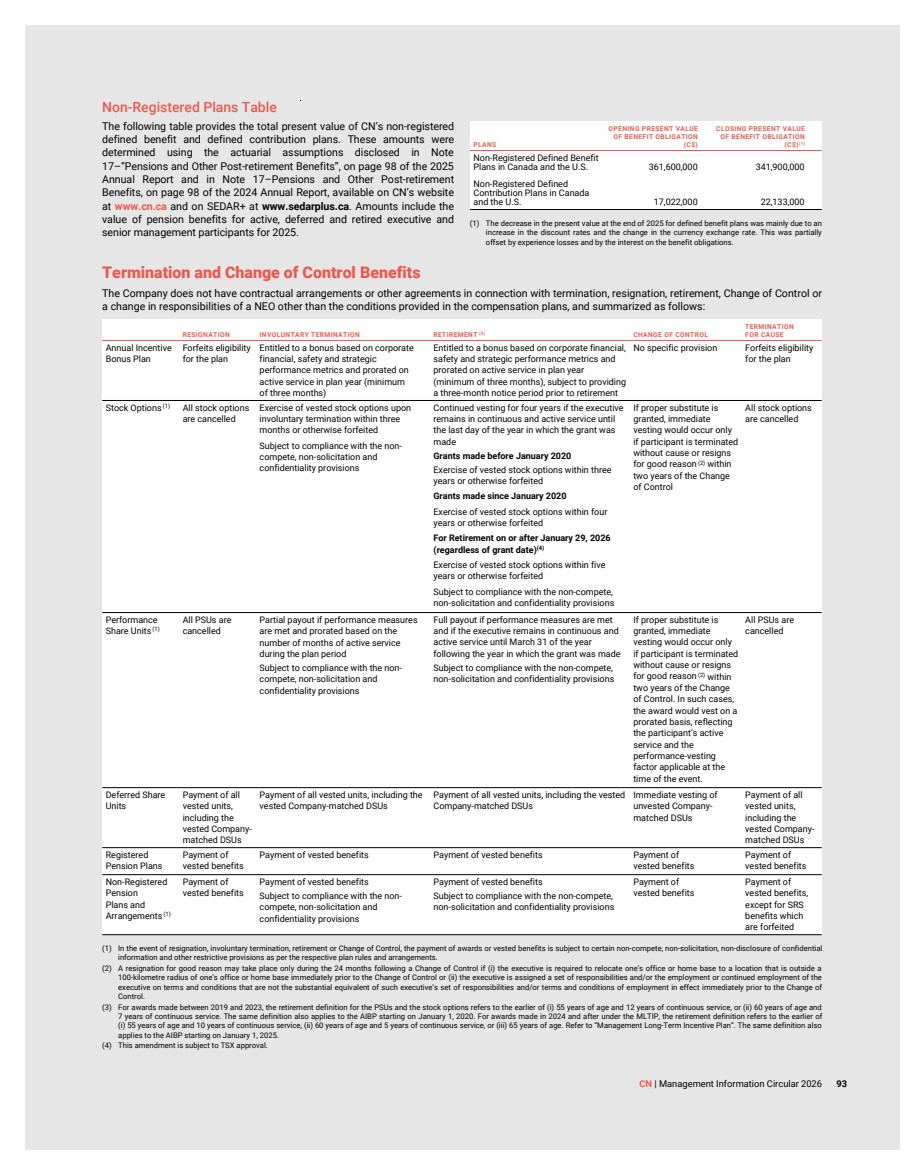
| Involuntary Termination In the event of an involuntary termination, the President and CEO and the other NEOs would receive a severance amount generally in line with applicable legal requirements. No incremental amounts would be payable. Share-based awards, option-based awards and other benefits will be treated according to the terms of the plans under which they were granted, as described in the summary “Termination and Change of Control Benefits” table on page 93 of this Information Circular. Retirement Had Ms. Robinson retired on December 31, 2025, she would have been eligible to receive her accumulated DCSM and DC SERP account balances. Ms. Drysdale was not eligible to retire as at December 31, 2025 under the DBPP, DBSM nor SRS. She would have been eligible to a deferred benefit under the DBPP and DBSM and would have forfeited her SRS benefits. She would have been eligible to receive her accumulated DCSM and DC SERP account balances had she retired on December 31, 2025. Mr. Houle was eligible for unreduced retirement benefits under the DBPP, DBSM and SRS as at December 31, 2025, and he would have been eligible to receive his accumulated DCSM and DC SERP account balances. Mr. Ivaturi would have been eligible to receive his accumulated DCSM account balance but would have forfeited his DC SERP benefits had he retired on December 31, 2025. Had Mr. Whitehead retired on December 31, 2025, he would have been eligible to receive his accumulated 401(k) and US DC SERP account balances. Had Mss. Robinson and Drysdale, Messrs. Houle, Ivaturi and Whitehead retired on December 31, 2025, no other material payments or benefits would have been payable. Share-based awards, option-based awards and other benefits are treated according to the terms of the plans under which they were granted, as described in the summary “Termination and Change of Control Benefits” table on page 93 of this Information Circular. Change of Control The following table shows the incremental benefits that the five active NEOs would have been entitled to had there been a Change of Control on December 31, 2025. NAME SHARE UNITS PLAN (1) (C$) STOCK OPTIONS (1) (C$) DEFERRED SHARE UNITS (2) (C$) TOTAL (C$) Tracy Robinson – – 648,997 648,997 Ghislain Houle – – – – Patrick Whitehead – – – – Janet Drysdale – – 10,436 10,436 Bhushan Ivaturi – – – – (1) NEOs would be eligible for immediate vesting only if no proper substitute is granted, or if the executive is terminated without cause or resigns for good reason within two years of the Change of Control. (2) NEOs would be eligible for immediate vesting of the unvested CN-matched deferred share units allocated to an executive following the deferral of compensation in previous years (see “Deferred Compensation Plans” section on page 89 of this Information Circular for a description of the VIDP). The value shown is equal to the number of deferred share units that would vest multiplied by the closing share price of common shares on December 31, 2025 (C$135.75). 94 CN | Management Information Circular 2026 |
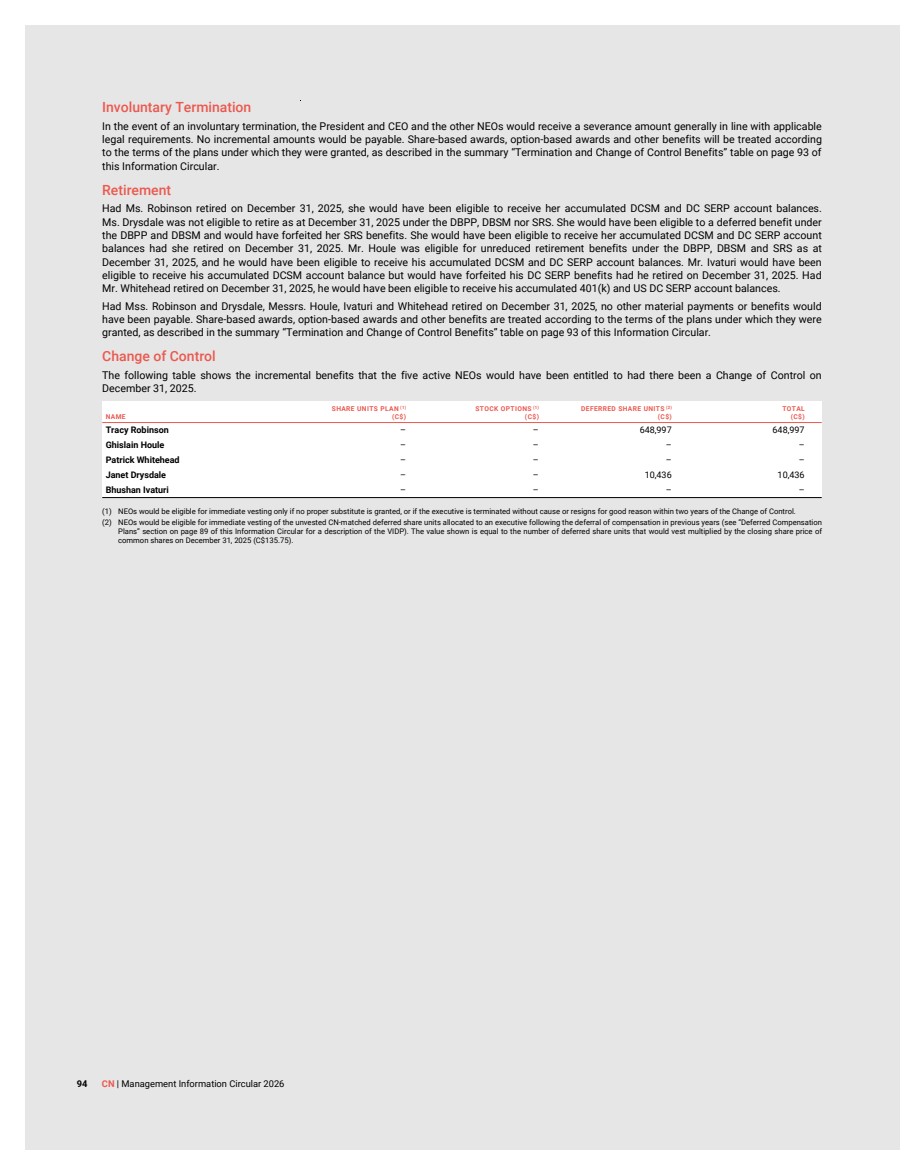
| Currency Exchange Information Compensation disclosed in the “Statement of Executive Compensation” section that is paid in U.S. dollars was converted to Canadian dollars using the following currency exchange rates: EXCHANGE RATE USED ACTUAL RATE US$1 = C$X Salary All other compensation AVERAGE RATE DURING THE YEAR: 2025 1.3978 2024 1.3698 2023 1.3497 Annual incentive bonus plan WHEN BONUS IS EARNED (I.E. DECEMBER 31): December 31, 2025 1.3724 December 31, 2024 1.4384 December 31, 2023 1.3243 Pension value, Value of unexercised in-the-money options, Market value of share-based awards that have not vested, Non-equity incentive plan compensation - Value earned during the year, Termination scenarios - incremental costs DECEMBER 31 (DECEMBER 31 OF PRIOR YEAR FOR PENSION VALUE): December 31, 2025 1.3724 December 31, 2024 1.4384 December 31, 2023 1.3243 December 31, 2022 1.3554 Option-based awards - Value vested during the year ACTUAL VESTING DATE OF APPLICABLE GRANTS: January 25, 2025 1.4341 January 26, 2025 1.4341 January 27, 2025 1.4374 January 28, 2025 1.4399 January 30, 2025 1.4486 January 31, 2025 1.4541 February 3, 2025 1.4428 February 28, 2025 1.4461 March 8, 2025 1.4372 March 15, 2025 1.4366 May 5, 2025 1.3825 June 15, 2025 1.3588 July 24, 2025 1.3638 July 27, 2025 1.3703 September 21, 2025 1.3785 November 5, 2025 1.4109 November 15, 2025 1.4023 November 28, 2025 1.3977 CN | Management Information Circular 2026 95 |
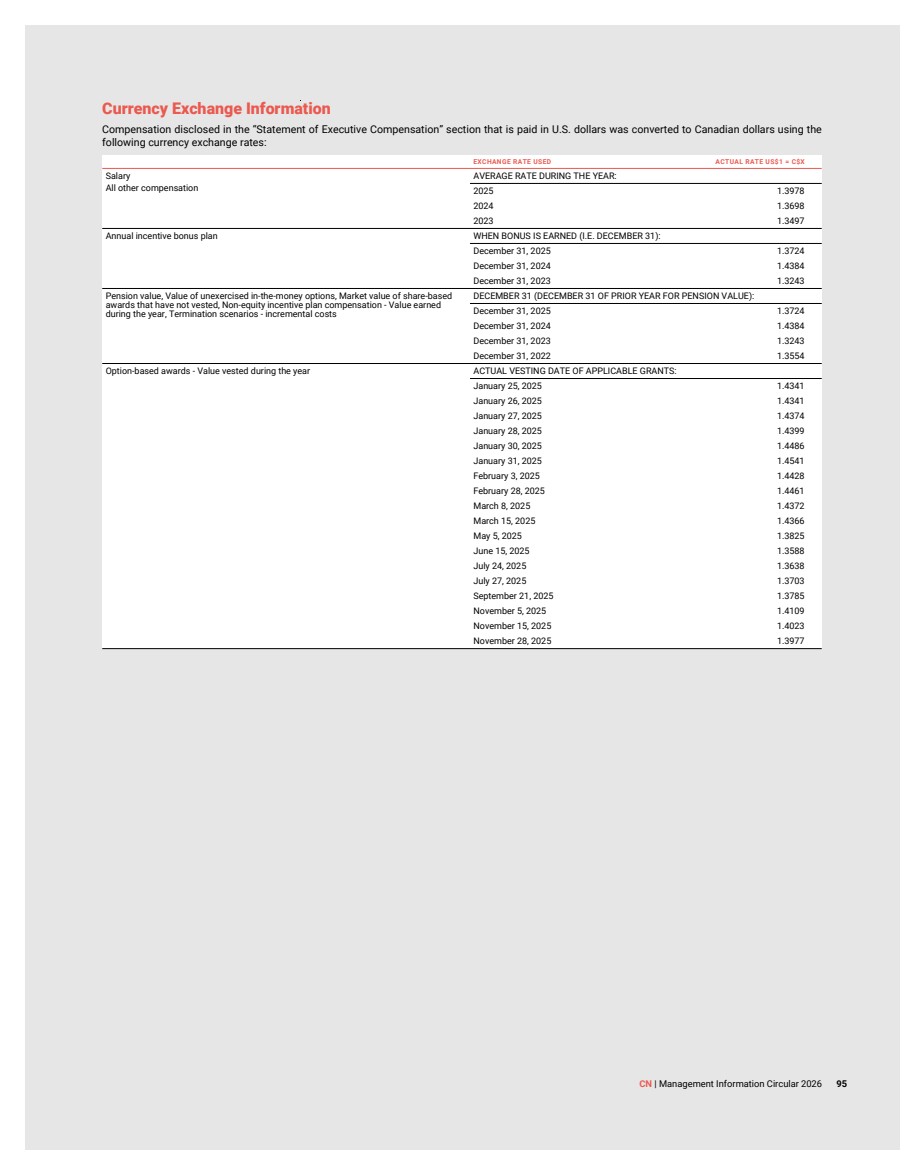
| Securities Authorized for Issuance Under Equity Compensation Plans The table below indicates, as at December 31, 2025, certain information with respect to the MLTIP. PLAN CATEGORY NUMBER OF SECURITIES TO BE ISSUED UPON EXERCISE OF OUTSTANDING OPTIONS, WARRANTS AND RIGHTS (#) WEIGHTED AVERAGE EXERCISE PRICE OF OUTSTANDING OPTIONS, WARRANTS AND RIGHTS (C$) NUMBER OF SECURITIES REMAINING AVAILABLE FOR FUTURE ISSUANCE UNDER EQUITY COMPENSATION PLANS (EXCLUDING SECURITIES REFLECTED IN THE FIRST COLUMN) (#) Equity compensation plans approved by securityholders 3,050,002 141.35 12,152,726 Equity compensation plans not approved by securityholders Nil Nil Nil TOTAL 3,050,002 141.35 12,152,726 Indebtedness of Directors and Executive Officers As at the date hereof, none of CN’s (or any of its subsidiaries) current or former directors or officers are indebted towards CN or any of its subsidiaries, whether in connection with the purchase of common shares of CN or otherwise. Interest of Informed Persons and Others in Material Transactions Management of CN is not aware of any material interest, direct or indirect, of any informed person (as such term is defined in National Instrument 51-102–Continuous Disclosure Obligations) of CN, any proposed director or any associate or affiliate of any informed person or proposed director in any transaction since the commencement of CN’s most recently completed financial year, or in any proposed transaction, that has materially affected or would materially affect CN or any of its affiliates or subsidiaries. Shareholder Proposals Shareholder proposals to be considered at the 2027 annual meeting of shareholders must be received at the head office of CN between December 2, 2026 and January 31, 2027 (inclusively) to be included in the Information Circular for such annual meeting. Proposals should be sent by email to corporate.secretary@cn.ca or by mail to the attention of the Corporate Secretary’s Office at the following address: Corporate Secretary’s Office, Law Department Canadian National Railway Company 935 de La Gauchetière Street West, 16th Floor Montreal, Quebec, Canada H3B 2M9 Availability of Documents CN is a reporting issuer in Canada and the U.S. and is required to file various documents, including an annual information form and financial statements. Financial information is provided in CN’s comparative financial statements and MD&A for its most recently completed financial year. Copies of these documents and additional information relating to CN are available on SEDAR+ at www.sedarplus.ca and on the SEC website at www.sec.gov through EDGAR, or may be obtained on request from the Corporate Secretary of the Company by calling (514) 399-7091 or Investor Relations at (514) 399-0052. Approval The Board has approved the contents of this Information Circular and its sending to the shareholders, to each director and to the auditors of CN. Cristina Circelli Vice-President, Corporate Secretary and General Counsel March 9, 2026 96 CN | Management Information Circular 2026 Other Information |
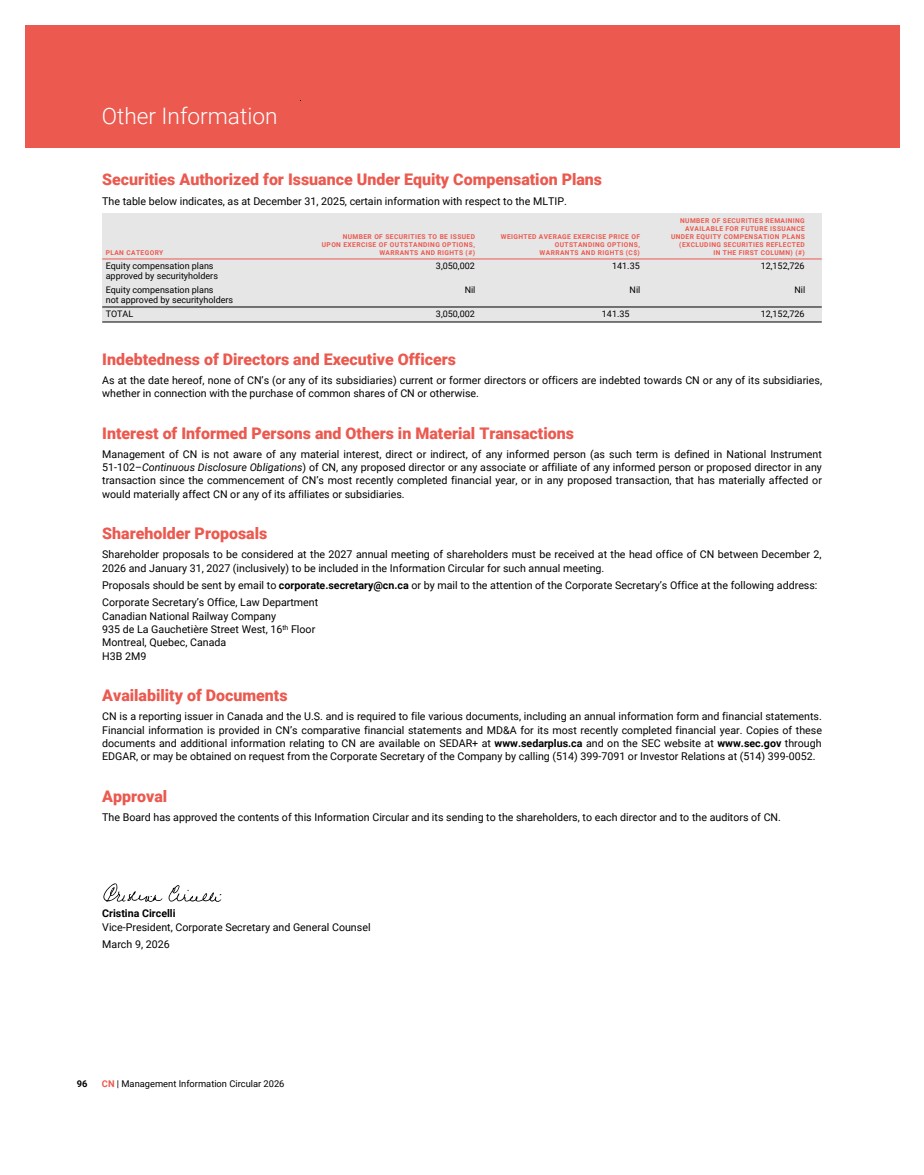
| A. Strategic Planning • Strategic Planning. The Board will, in consultation with management, establish and approve CN’s strategic direction and objectives. In this regard, the Board will: • adopt a strategic planning process and oversee the formulation of CN’s strategic direction; • review and approve, on at least an annual basis, CN’s strategic plan and framework which take into account, among other things, the opportunities and risks of the business, environment, social and governance matters, emerging trends, including emerging technologies and artificial intelligence, and the competitive environment in the rail industry; • develop an in-depth knowledge of the business, understand and question the assumptions underlying CN’s strategic and business plans and framework and reach an independent judgment as to the probability that the strategic plan and framework can be realized; • review and approve all major initiatives, corporate decisions and transactions, as well as applicable funding transactions; • approve strategic, business and capital allocation plans and policies within which management will operate in relation to capital expenditures, acquisitions and dispositions; • monitor the implementation and effectiveness of the execution and fulfillment of CN’s approved strategic, business and capital allocation plans and policies; and • review, monitor and evaluate material technological advancements and initiatives which may impact the Company and the rail industry and ensure alignment with CN’s strategic direction and objectives. • Corporate Performance Evaluation. Having regard to CN’s broad strategic objectives, the Board will review and, if advisable, approve goals or metrics against which corporate performance will be measured. In this regard, the Board will: • determine, from time to time, the appropriate criteria, targets and budgets against which to evaluate corporate and executive performance; • monitor and evaluate performance against such criteria; and • review and approve management’s operational plans so that they are consistent with CN’s long-term goals. CN | Management Information Circular 2026 97 Schedule A | Mandate of the Board The Board has oversight responsibility for the stewardship of CN and its business and is accountable to shareholders for the performance of CN. The Board has clearly delineated its role and the role of management. The role of the Board is to supervise the management of CN’s business and affairs, with the objective of creating value for shareholders and taking into account the interests of other stakeholders. Management’s role is to conduct the day-to-day operations in a way that will meet this objective. The Board, in consultation with management, establishes and is responsible for the company’s strategic direction and its overall policies. In doing so, the Board provides governance and stewardship to CN which consists of reviewing corporate strategy, assigning responsibility to management for achievement of that strategy, establishing limitations on the authority delegated to management and overseeing performance against approved objectives and overseeing the appropriate capital allocation framework for CN. The Board regularly reviews CN’s strategic plan to ensure that it continues to be responsive to the changing business environment in which CN operates. The Board has decision making responsibility and approves all matters expressly required herein, under the Canada Business Corporations Act and other applicable legislation and CN’s Articles of Continuance and By-laws. The Board may assign to Board committees the prior review of any issues it is responsible for, or as required by applicable laws. The Board can delegate approval of matters to a committee or seek a recommendation from a committee for approval by the Board. The Board has delegated the approval of certain matters to management pursuant to its Standing Resolutions on Delegation of Authority, as amended from time to time. As the Board has overall plenary power, this mandate is intended not to limit the powers of the Board but to assist the Board in the exercise of its powers and the fulfillment of its duties. The Board shall meet at least six times a year and as necessary. The non-executive Board members shall meet at or after every Board meeting without the presence of management and under the chairmanship of the Board Chair. If such group includes directors who are not independent, an executive session including only independent directors shall be held at every Board meeting. Board members are expected to demonstrate a high level of professionalism in discharging their responsibilities. They are expected to attend the meetings of the Board and of the Board committees on which they sit and to rigorously prepare for and actively participate in such meetings. They should review all meeting materials in advance. They are also expected to be available to provide advice and counsel to the President and CEO or other executive management of CN upon request. In fulfilling its oversight and decision-making responsibilities, the Board shall have unrestricted access to management and authority to select, retain, terminate, and approve the fees of any independent legal, accounting, or other advisor to assist it in fulfilling its responsibilities. Among its activities that derive from its stewardship and decision-making responsibilities, are the following responsibilities: |
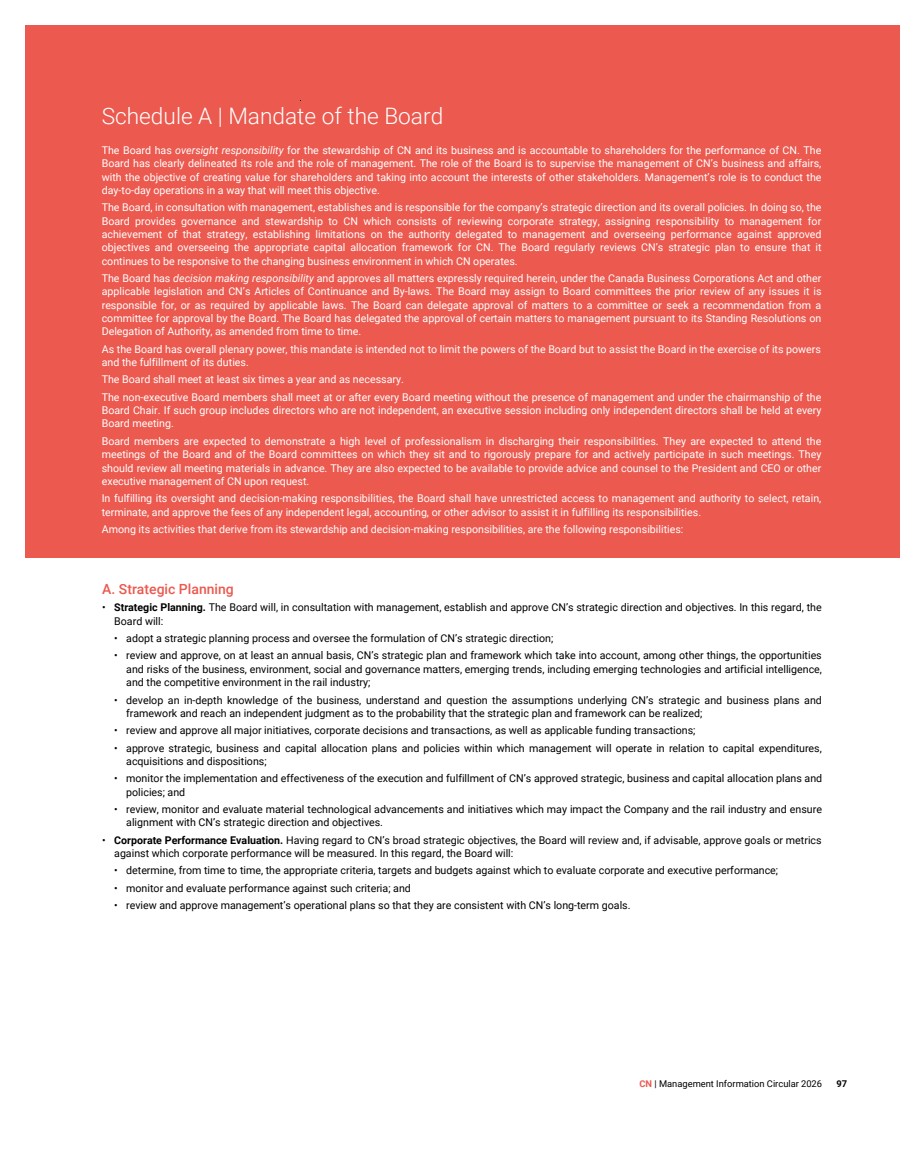
| B. Executive Oversight • Succession Planning. The Board shall, through the HRC Committee, oversee the succession planning processes of CN and shall choose the President and Chief Executive Officer (the “President and CEO”) and oversee the process for the selection of the President and CEO and each of the executive officers and their development. The Board shall monitor and review the performance of the President and CEO and of the executive officers who report directly to the President and CEO taking into consideration Board expectations and fixed objectives and is kept informed of the performance of all other executive officers. The Board shall approve the President and CEO’s corporate strategic goals and objectives and approve annually the compensation of the President and CEO and each of the executive officers who report directly to the President and CEO. • Appointment of Officers. The Board shall appoint as officers of the Company all the executive officers as well as, pursuant to CN’s By-Laws, the Treasurer and Corporate Secretary and, from time to time, such other executive management, as it deems appropriate. • Management Incentives. The Board shall, through the HRC Committee, ensure that an appropriate portion of the President and CEO and executive management compensation is tied to both the short and longer-term performance of CN and aligned to the Company’s strategic goals and objectives. • Training and Retention. The Board shall, through the HRC Committee, take all reasonable steps to ensure that processes are in place for the recruitment, training, development and retention of executives who exhibit the highest standards of competence and integrity. C. Corporate Governance • Governance. The Board shall, through the GS Committee, monitor and review CN’s corporate governance policies and practices. In this regard, the Board will: • annually review and approve its mandate; • monitor the size and composition of the Board to favour effective decision-making; • ensure that a majority of CN’s directors have no direct or indirect material relationship with CN and determine who, in the reasonable opinion of the Board, are independent pursuant to applicable legislation, regulation and listing requirements; • develop appropriate qualifications and criteria for the selection of Board members, including criteria for determining director independence; • approve the list of Board nominees for election by shareholders and fill Board vacancies, as applicable; • adopt and review orientation and continuing education programs for directors;. • oversee the disclosure of a method for interested parties to communicate directly with the Board Chair or with the non‑executive directors as a group; • ensure a Board succession and renewal plan is in place; • take all reasonable measures to satisfy itself as to the integrity of management and that management creates a culture of integrity throughout CN; • monitor and review, as appropriate, CN’s approach to governance issues and monitor and review, as appropriate, CN’s Corporate Governance Manual and policies and measures for receiving shareholder feedback; • monitor and review, as appropriate, stakeholder and Indigenous feedback, and the potential for shareholder activism; and • take all reasonable steps to ensure the highest quality of ethical standards, including reviewing, on a regular basis, the Code of Business Conduct applicable to CN’s directors, its President and CEO, senior financial officers, other executives and employees, monitoring compliance with such code, approving any waiver from compliance with the code for directors and executive officers and ensuring appropriate disclosure of any such waiver, including transactions involving CN and related parties. • Committees. The Board shall establish such committees as it deems necessary or desirable, to assist it in the fulfillment of its duties and responsibilities. In this regard, the Board will: • develop and review as appropriate such mandates as the Board may determine and delegate from time to time to such committees or other persons any of the Board’s responsibilities that lawfully may be delegated; • appoint the Chair from among the independent directors; • appoint members of each committee of the Board, in consultation with the relevant committee chair; and • consider recommendations of the GS Committee from time to time regarding the composition and mandates of the committees of the Board. • Position Descriptions. The Board shall develop, adopt and regularly review position descriptions for the Chair of the Board and Committee Chairs. • Director Evaluation. The Board shall develop appropriate qualifications and criteria for the regular performance assessment of the Board, Board committees, Board and Committee Chairs and individual directors and determine their remuneration. D. Risk Management, Financial Reporting, Internal Controls • Risk Management. The Board shall, through the AFR Committee, ensure that an appropriate risk assessment process is in place to identify, assess and manage the principal risks of CN’s business and strategy, including climate change and other environmental, social and governance risks. The Board shall satisfy itself as to the effective oversight of risk management of individual risks, through the receipt of periodic reporting from the Chair of the AFR Committee and the Chairs of such other committees of the Board which have been delegated responsibilities for specific risks. • Financial Reporting and Internal Controls. The Board shall, through the AFR Committee, monitor the quality and integrity of CN’s accounting and financial reporting systems, disclosure controls and procedures, internal controls and management information systems, including by overseeing: • the integrity and quality of CN’s financial statements and other financial information and the appropriateness of their disclosure; • the review of the AFR Committee on external auditors’ independence and qualifications; • the performance of CN’s internal audit function and of CN’s external auditors; and • CN’s compliance with applicable legal and regulatory requirements (including those related to environment, safety and security). • Communications. The Board shall adopt communications and disclosure policies and monitor CN’s investor relations programs. 98 CN | Management Information Circular 2026 |
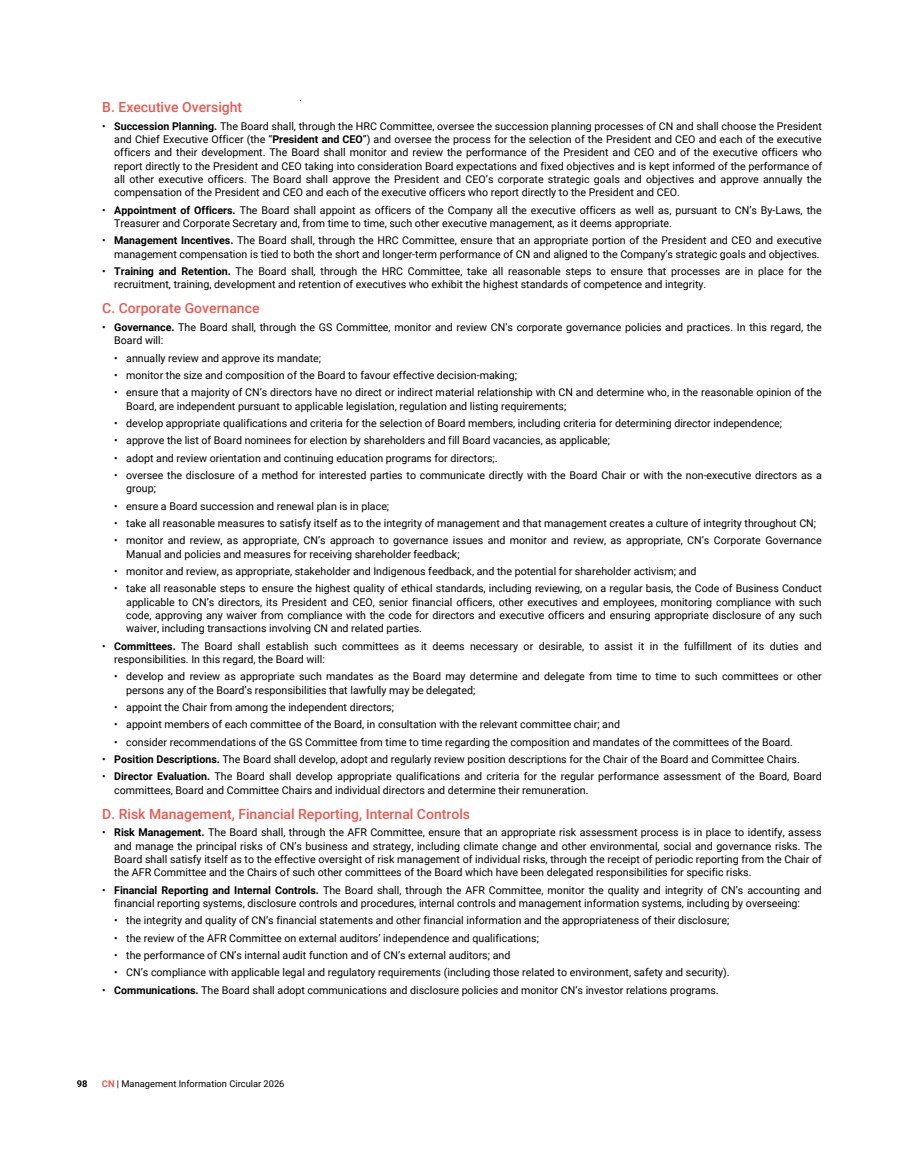
| E. Capital Allocation • Operating and Capital Plans. Following the Board’s approval of CN’s strategic plan, the Board shall review and approve CN’s annual operating plans, capital expenditures programs and capital allocation plans, including CN’s capital structure and cash flows and the alignment of these plans to CN’s long-term strategy. The Board shall also monitor performance against these plans through the AFR Committee. • Significant Expenditures. The Board shall review and approve significant capital (budgeted and non-budgeted) and other expenditures, sales and leases of assets and any other transactions, including any mergers and acquisition transactions, that could alter, impact or otherwise materially affect CN’s financial or corporate structure, and off-balance sheet items, as well as projected and actual returns from investments, in each case that exceed any delegation of authority to management. • Dividends and Share Repurchases. The Board shall review and approve CN’s shareholder distributions, including with respect to dividends and share repurchases. • Significant Investments. The Board shall, through the AFR Committee, receive regular reports from management on the status and risks related to CN’s significant or strategic investments, such that the Board may monitor the execution of such investments against objectives and oversee any related risks. F. Sustainability, Environment, Safety and Security • Sustainability, Environment, Safety and Security Policies and Practices. The Board shall, through the GS Committee and the SE Committee (as specified in their respective mandates), monitor and review CN’s sustainability, environment, safety and security policies and practices. In this regard, the Board will: • evaluate on an ongoing basis, the Company’s sustainability strategy, goals, targets, and performance against such goals and targets, and whether CN’s resources are being managed in a manner consistent with ethical considerations and stakeholder’s interests and in order to enhance shareholder value; • assess and monitor CN’s overall sustainability and environmental, safety and security policies and practices, including CN’s Climate Action Plan and the company’s progress against its set targets under such plan; • review, monitor and evaluate technological advancements, artificial intelligence and digital transformation initiatives, including related to sustainability and safety; • review and monitor human rights matters that have the potential to affect CN and its supply chain (including forced labour or child labour) and annually review and approve, based on the recommendation of the GS Committee, CN’s annual statement and report regarding the prevention and reduction of risks associated with the use of forced labour or child labour; and • as part of the strategic planning process, evaluate and review public issues of significance that may affect CN’s business, operations and stakeholders, including social, political and environmental trends and both the opportunities and risks to CN’s business that each presents. G. Pension Fund Matters • Pension Policies and Practices. The Board shall, through the AFR Committee and the Pension Advisory Working Committee (a management level committee), monitor and review, as appropriate, CN’s pension fund policies and practices, including the investment policies of the Canadian National Railway Pension Trust Funds or any other pension trust fund established in connection with a new pension plan or any other pension plan offered or administered by CN (“CN’s Pension Trust Funds”). CN | Management Information Circular 2026 99 |
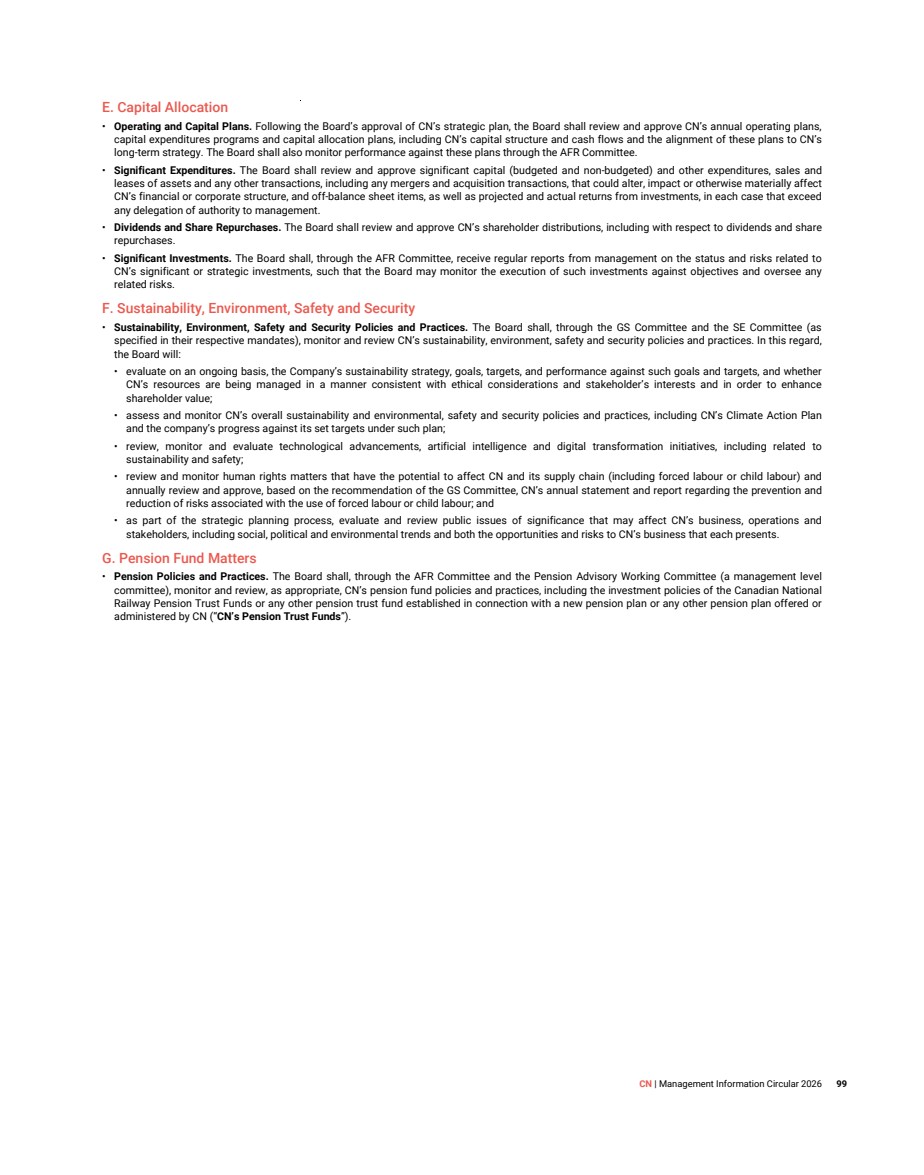
| Report of the Audit, Finance and Risk Committee The role of the Audit, Finance and Risk (AFR) Committee is to assist the Board in fulfilling its oversight responsibilities with respect to the Company’s financial reporting, enterprise risk management monitoring, financing plans and programs, internal controls, and internal and external auditors. CURRENT MEMBERS Robert Knight (Chair), Shauneen Bruder, David Freeman, Susan C. Jones, Michel Letellier and Margaret A. McKenzie Highlights The AFR Committee, in accordance with its mandate: Financial Information • reviewed and recommended for approval annual and quarterly results, Management’s Discussion and Analysis and the Annual Report and the earnings press releases of the Company, including with respect to financial outlook and guidance; • reviewed the independent auditors’ reports on the consolidated financial statements and the internal controls over financial reporting of the Company; • reviewed financial information contained in the Annual Information Form, the Form 40-F and other reports requiring Board approval; • reviewed and approved the AFR Committee Report and other AFR Committee‑related information appearing in the Information Circular; • reviewed the compliance of management’s certification of financial reports with applicable legislation; • reviewed, with the external auditors and management, the quality, appropriateness and disclosure of the Company’s critical accounting principles and policies, underlying assumptions and reporting practices, and any proposed changes thereto; • reviewed judgments made in connection with the preparation of the financial statements, if any, including analyses of the effect of alternative generally accepted accounting principles and/or methods; and • held private meetings with certain members of management. Internal Auditors • reviewed internal audit activities throughout 2025; • reviewed and approved the Internal Audit Plan, including the Internal Audit Charter; • monitored the Internal Audit function’s performance, its responsibilities, staffing, budget and the compensation of its members; and • held private meetings with internal auditors. External Auditors • reviewed and approved the results of the external audit; • reviewed the formal statement from the external auditors confirming their independence and reviewed hiring policies for employees or former employees of the Company’s external auditors; • evaluated and monitored the qualifications, performance and independence of the external auditors, and discussed audit partner rotation; • recommended to the Board the appointment, remuneration and other terms of engagement of the Company’s external auditors as well as CN's Canadian Pension Plans and U.S. Pension Plans auditors; • reviewed the external auditors’ audit planning report; • discussed, approved and oversaw the disclosure of all audit, review and attestation services provided by the external auditors; • determined which non-audit services the external auditors are prohibited from providing, and pre-approved and oversaw the disclosure of permitted non-audit services by the external auditors to the Company, in accordance with applicable laws and regulations; and • held private meetings with external auditors. Risk Management • reviewed the Company’s risk assessment process, including risk oversight and risk management policies under the Enterprise Risk Management program, including as it relates to information technology and cybersecurity and data governance management, pension management, and crisis management; • received periodic updates from management on ongoing legal matters; and • assisted the Board with the oversight of the Company’s compliance with applicable legal and regulatory requirements. . 100 CN | Management Information Circular 2026 Schedule B | Reports of the Committees The following are reports of each Board committee for the meetings held during 2025 and up to March 9, 2026. These reports provide details on the activities of each committee, but are not meant to be exhaustive. The full Charter of each Committee is available in our Corporate Governance Manual which is available on our website at www.cn.ca. |
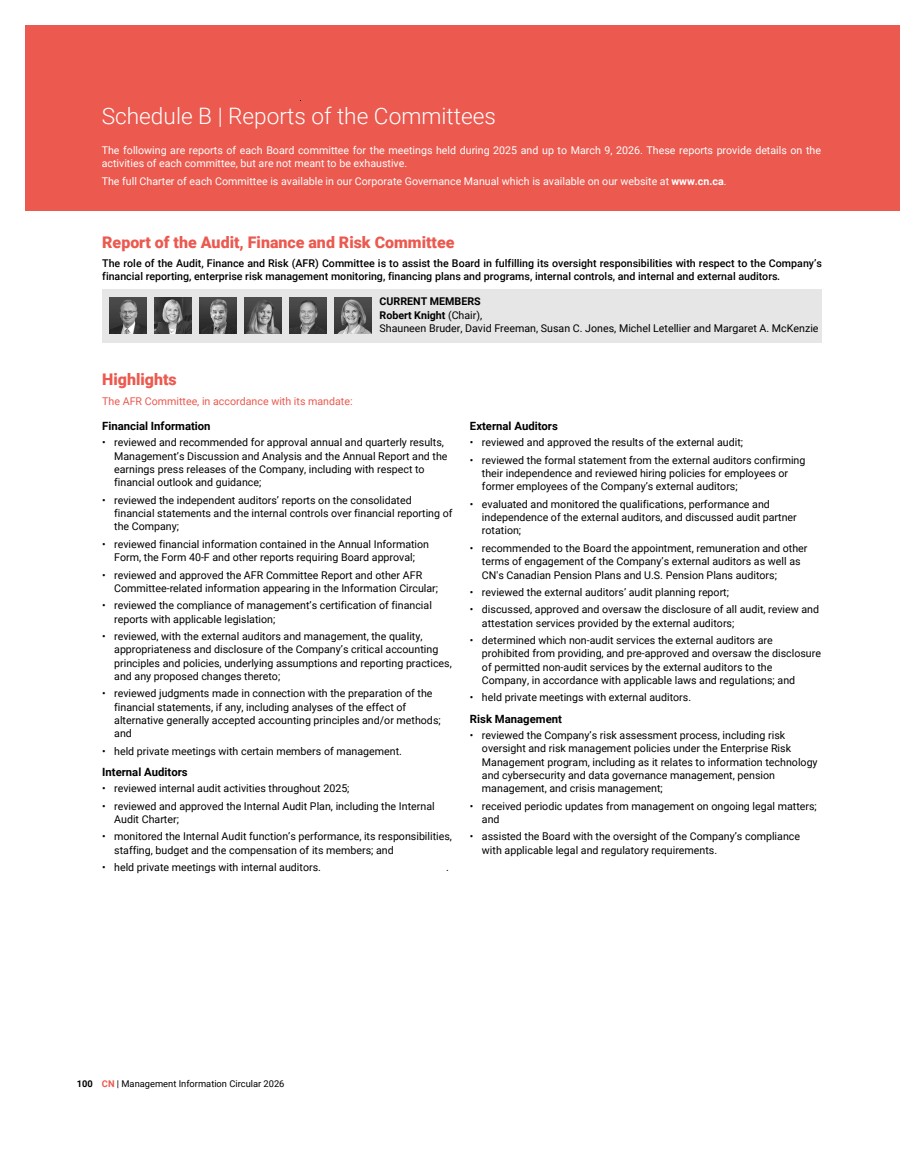
| Internal Control • received management’s report assessing the adequacy and effectiveness of disclosure controls and procedures and systems of internal control; • received a report on non-financial metric assurance for the purpose of the annual incentive bonus plan; • reviewed procedures established for the receipt, retention and treatment of complaints received by the Company regarding accounting, internal controls or auditing matters and employee concerns regarding accounting or auditing matters; and • reviewed minutes of the Corporate Disclosure Committee meetings. Financial Policies and Strategy • provided oversight with respect to CN’s capital structure, cash flows and key financial ratios; • made recommendations to the Board with respect to the Company’s financial policies and practices and financial matters affecting the Company including the capital allocation strategy, capital performance plan and capital budget; • reviewed and recommended for approval amendments to the CN Standing Resolutions on Delegation of Authority; • reviewed CN’s capital allocation plan and strategy regarding distributions to shareholders, including strategy with respect to dividends and share repurchases; • reviewed the integration of sustainability initiatives in the Company’s procurement strategy; • monitored general economic and industry developments; and • reviewed the Company’s credit ratings and monitored the Company’s activities with respect to credit rating agencies. Financing • reviewed the Company’s liquidity position, including the Company’s capital expenditures, capital structure, financing plan and short-term investments; • recommended for approval a new base shelf prospectus for the issuance of debt securities; and • approved potential debt offerings in the Canadian and U.S. markets and related hedging transactions. Financial Activities • reviewed Treasury and transactional activities, including Financial Risk Management activities reports; • reviewed decisions related to derivative financial instruments; • reviewed and recommended for approval new share repurchase programs and reviewed related repurchasing approaches and progress reports; • made recommendations to the Board with respect to the declaration of dividends; • reviewed and recommended for approval the rolling three-year sourcing strategy and reviewed progress made under such plan; • monitored significant capital and other expenditures for strategic projects, equipment and rail infrastructure, as well as material purchases of products and services; • reviewed and recommended for approval the continued use of the end user exemption for derivative instruments under the Dodd Frank Act. Pension and Investment • approved the overall pension risk management strategy and reporting thereon to the Board; • reviewed and recommended to the Board actuarial valuations and funding of CN’s pension plans; • reviewed the independent auditors’ reports on the financial statements of CN’s Canadian Pension Plans; and • reviewed and recommended for approval amendments to the mandate of the Pension Advisory Working Committee, including its membership, and to the Standing Resolution on CN investments. Other • reviewed and received periodic updates on investor relations and overall investor expectations; and • monitored the tax affairs of the Company. • reviewed the casualty and property insurance program renewals. Committee Mandate Performance • reviewed and recommended for approval the revised mandate of the AFR Committee; and • reviewed the processes in place to evaluate the performance of the AFR Committee and assessed the committee’s performance, and was satisfied therewith. Submitted by the members of the AFR Committee. CN | Management Information Circular 2026 101 |
| Report of the Governance and Sustainability Committee The role of the GS Committee is to assist the Board in fulfilling its oversight responsibilities in relation to governance and sustainability which includes, among other matters, developing, reviewing and monitoring criteria for selecting directors and identifying candidates for nomination for election as directors; reviewing the corporate governance guidelines applicable to the Company; and overseeing the Company’s overall sustainability framework. CURRENT MEMBERS Al Monaco (Chair), Shauneen Bruder, Denise Gray, Justin M. Howell and Michel Letellier Highlights The GS Committee, in accordance with its mandate: Composition of the Board and its Committees • reviewed the size and composition of the Board and assisted the Board in determining Board committee size, composition and mandate; • reviewed and recommended updates to the Corporate Governance Manual, including to reflect the revised committee structure and mandates; • reviewed directors’ independence and financial literacy; • reviewed the Board retirement age and tenure policy; • conducted a review of the Company’s Board competency matrix and recommended for approval updates thereto for better alignment with the Company’s circumstances and needs taking into account market practice; • identified potential Board candidates with a focus on the Board’s desired skills and competencies, geographical representation and inclusion goals, and recommended director nominees for the next annual meeting of shareholders; and • reviewed director succession and board renewal. Performance of the Board and its Committees • reviewed the performance of the Board, Board committees, Board and committee chairs and Board members. Director Compensation • reviewed and recommended for approval the compensation structure and levels for non-executive Board members. Continuing Education for Directors • monitored and reviewed the orientation and continuing education programs for directors. Corporate Governance Initiatives • monitored disclosure of corporate governance practices, including the Statement of Corporate Governance Practices disclosure in the Information Circular, in accordance with applicable rules and regulations; • reviewed and recommended for approval the Company’s corporate disclosure, including the Information Circular, the Annual Information Form, and the Annual Report; • recommended to the Board a date and format for the annual meeting of shareholders; • received updates on relevant legal and regulatory developments, including as it relates to sustainability disclosure requirements in Canada and the United States; • assisted the Board with the oversight of the Company’s corporate governance and monitored legal and regulatory requirements, as well as best practices; • reviewed and discussed the Board's terms of reference for crisis engagement; • reviewed, monitored and oversaw compliance with CN’s Code of Business Conduct; • reviewed and recommended for approval the Company’s revised Aircraft Utilization Policy; • received a report on the Company's Technology Governance and Oversight; • received a report on related-party transactions. None were identified; • reviewed the D&O’s form indemnification agreement and D&O insurance policy; • reviewed the annual report of CN’s Ombudsman; and • ensured CN adopted a proper risk governance framework across Board committees. Sustainability • reviewed the Company’s sustainability strategy and goals (other than specific goals related to the environment, climate change and safety), including evolving investor expectations related thereto, and monitored CN’s performance thereon; • reviewed CN’s inclusion strategy and related progress reports • periodically reviewed the Company’s sustainability performance, including the CN CDP Climate Response Report, the Data Supplement Report, CN’s Delivery Responsibility Report; and • oversaw the Company’s sustainability and governance disclosures, including CN’s statement of corporate governance practices, and the Company’s 2025 annual report pursuant to Canada’s Fighting Against Forced Labour and Child Labour in Supply Chains Act. Stakeholder and Indigenous Relations • reviewed feedback from shareholders and shareholder associations; • reviewed and discussed with management the investor engagement plan for 2025 and looking ahead to 2026; • reviewed and discussed with management the overall stakeholder engagement strategy for 2025 and looking ahead to 2026; and • reviewed and discussed with external advisors the Indigenous Reconciliation Action Plan and the ambitions thereunder. Community Investment • reviewed and approved the Company’s general donations and sponsorships strategy and objectives; and • reviewed and approved the Company’s 2025 budget for donations and sponsorships, as well as its renewed strategy. Committee Performance • reviewed and recommended for approval the revised mandate of the GS Committee; and • reviewed the processes in place to evaluate the performance of the GS Committee and assessed the committee’s performance, and was satisfied therewith. Submitted by the members of the GS Committee. 102 CN | Management Information Circular 2026 |
| Report of the Safety and Environment Committee The role of the SE Committee is to assist the Board in fulfilling its oversight responsibilities in relation to environmental matters and safety, including, among other matters, overseeing, assessing and monitoring the Company’s policies, practices and metrics relating to safety and environmental matters, including climate change and reviewing performance thereunder; assessing advancements in operating technology, including the risks and opportunities of adopting or exploring such technologies; and assessing risks related to the environment (including those presented due to climate change), safety, and security. CURRENT MEMBERS Susan C. Jones (Chair), Shauneen Bruder, David Freeman, Margaret A. McKenzie, Al Monaco and Jo-ann dePass Olsovsky Highlights The SE Committee, in accordance with its mandate: Safety • reviewed CN’s safety strategy and oversaw the review of CN’s safety performance, including an external safety performance assessment, and related management action plans, and ensured safety initiatives were fully aligned with and reinforced CN’s safety culture and ambition to be the safest Class I Railroad in North America; • reviewed material regulatory developments as it relates to safety and discussed the anticipated impact thereof on operations; • assessed the Company’s key safety metrics and monitored its progress against its goals; • reviewed safety targets set out in CN’s compensation plan; • reviewed and discussed the Company’s key safety initiatives and readiness plans; • received periodic safety briefings and “CN safety moments”; • received a presentation on CN Police operations; and • received periodic updates on significant safety and security matters from management, including updates on cybersecurity risk management. Environment • oversaw and monitored the Company’s environmental strategy, including its decarbonization strategy and reviewed the Company’s Climate Action Plan, and biodiversity strategy; • assessed and monitored the Company’s key environmental metrics (including those relating to climate change) and progress against established goals; • reviewed environmental targets set out in CN’s compensation plan; • reviewed and recommended for approval the Company’s material sustainability disclosures, including its Climate Action Plan Report; • reviewed material legal and regulatory developments on climate risk management and governance; • received an update on CN's waste diversion targets and operational waste programs; and • assessed and reviewed material environmental and climate-related risks and discussed the Company’s risk mitigation strategy. Operating Technology • reviewed the Company’s operating technology strategy and monitored such operating technologies and initiatives, including related material investments and risks. Committee Mandate and Performance • reviewed and recommended for approval the mandate of the SE Committee; and • reviewed the processes in place to evaluate the performance of the SE Committee and assessed the committee’s performance, and was satisfied therewith. Submitted by the members of the SE Committee. CN | Management Information Circular 2026 103 |
| Report of the Human Resources and Compensation Committee The role of the Human Resources and Compensation (HRC) Committee is to assist the Board in fulfilling its oversight responsibility in relation to human resources and compensation matters, including, among other matters, monitoring executive management’s performance assessment, compensation, and succession planning and reviewing and overseeing the Company’s human resources practices. CURRENT MEMBERS Jo-ann dePass Olsovsky (Chair), Shauneen Bruder, Denise Gray, Justin M. Howell and Robert Knight Highlights The HRC Committee, in accordance with its mandate: Succession Planning • analyzed succession pipeline to mitigate risk and bring greater emphasis on diverse talent, including in-depth functional talent reviews; • reviewed leadership teams and functional organizational structures to ensure strong incumbent fit, including supplementing talent and skills with external hires; and • identified how best to monitor performance and create key indicators to assess and measure delivery against value allocation. President and CEO Compensation • reviewed corporate goals, objectives and priorities relevant to the President and CEO; and • evaluated the President and CEO’s annual performance based on the established corporate goals, objectives and priorities and recommended compensation based on this evaluation, for approval by the independent Board members. Appointment of Executive Officers • recommended the appointment of executive officers and approved the terms and conditions of their appointment and termination or retirement, as needed. Executive Compensation • conducted a comprehensive market review of CN’s compensation practices for executive management to ensure the Company’s compensation strategy was aligned with CN’s goal of attracting and retaining strong talent, and recommended for approval amendments to the Company’s Compensation Program; • reviewed the validity of CN’s benchmark group used in determining the compensation of executives; • reviewed and discussed the shareholder engagement plan as it relates to executive compensation matters; • reviewed and recommended for approval amendments to CN’s incentive plans, including the U.S. ESIP and to metrics under the AIBP; • reviewed the evaluation of the performance of the President and CEO’s direct reports and recommended to the Board their compensation; • monitored and discussed with external advisors any potential risks that could arise from CN’s compensation programs and practices, while ensuring proper risk identification and mitigation practices were in place; • reviewed and recommended proposed targets under the AIBP, performance targets related to PSUs as well as the aggregate LTI grant envelope; and • closely monitored bonus outlook, as well as PSU vesting outlook and recommended to the Board payout under the AIBP. Executive Compensation Disclosure • reviewed new material legal and regulatory requirements regarding human resources and executive compensation matters, notably regarding executive compensation disclosure and best practices; and • reviewed and recommended for approval by the Board the report on executive compensation for inclusion in the Information Circular. Compensation Philosophy • monitored the compensation philosophy and policy that rewards the creation of shareholder value and reflects the appropriate balance between the short- and longer-term performance of the Company; and • reviewed and recommended for approval amendments to the policy relating to the positioning of total direct compensation for executives. Pension Plans • in conjunction with the Executive Vice-President and CFO, evaluated the annual performance assessment of the President and Chief Executive Officer of the CN Investment Division; • conducted a comprehensive market review of the defined contribution pension plans; • reviewed and recommended for approval the consolidation of CN’s pension plan and the CN Pension Plan for Senior Management; and • reviewed and recommended for approval the terms of reference of the Canadian Defined Contribution Pension Plans Committee. Human Resources Initiatives • monitored pension and strategic labour and social issues, including periodic updates on labour relations and negotiations; • monitored the Company’s inclusion strategy, goals and progress thereon with respect to executive management positions; • reviewed and recommended for approval the adoption of a new human capital management system; • reviewed and discussed strategies for hiring, training, engaging, and developing talent; • received an update on bilingualism at CN; and • reviewed culture and engagement strategies and programs and relevant survey results. Committee Mandate and Performance • reviewed and approved amendments to the HRC charter; • retained the service of independent compensation advisors to help it carry out its responsibilities and approved appropriate fees for such services and reviewed the independence and performance assessment report of the advisors; and • reviewed the processes in place to evaluate the performance of the HRC Committee and assessed the HRC Committee’s performance, and was satisfied therewith. Submitted by the members of the HRC Committee. 104 CN | Management Information Circular 2026 |
| Audit Quality and Comprehensive Review of External Auditor The AFR Committee oversees and monitors the qualifications, independence and performance of our external auditor. In 2022, the AFR Committee conducted a comprehensive review of CN’s external auditor to ensure audit quality as required by the AFR Committee’s Mandate. The comprehensive review was prepared in accordance with guidance published by Chartered Professional Accountants Canada, the Institute of Corporate Directors and the Canadian Public Accountability Board. The review covered the five-year period ended December 31, 2021 with emphasis on the last two years. The comprehensive review was broader and deeper than the AFR Committee’s annual auditor assessment and focused on the following key factors affecting audit quality: • independence, objectivity and professional skepticism of the external auditor; • quality of the external auditor’s engagement team; and • quality of the communications and interactions between the AFR Committee and the external auditor. The comprehensive review was led by the Chair of the AFR Committee with discussion and review by the full committee at three committee meetings in 2022. The AFR Committee engaged CN’s internal auditor to collect data, conduct interviews and summarize findings in connection with the comprehensive review. In total, interviews were conducted with 19 participants including representatives from CN management, KPMG and AFR Committee members (including two former Chairs of the committee). The interview questions and the additional documents and data collected were all linked to an Audit Quality Indicators Framework to facilitate the AFR Committee’s review and discussion. The AFR Committee determined that a key consideration of the comprehensive review was to address any possible risk of institutional familiarity resulting from KPMG serving as the external auditor of CN since 1992. The AFR Committee reviewed this item through the following lenses: • Regulatory Requirements and Trends–in Canada and the U.S., the regulatory requirement continues to be audit partner rotation every seven and five years, respectively, with a five year cooling off period. Recent publications and research in both countries continue to support this practice along with the periodic comprehensive review of the external auditor rather than broadening the statutory scope to require periodic audit firm rotation; • Audit Tenure Benchmarking–as part of the data gathered in connection with the comprehensive review, the auditor tenure of the top 25 TSX listed companies and the Class I North American Railroads was reviewed. In both cases, the average audit tenure was greater than 25 years; • Analysis of audit partner rotation–the AFR Committee reviewed a detailed analysis of the partner rotation schedule including rotations and cooling off periods for each of the lead engagement partner as well as all other audit partners assigned to the CN audit to confirm that mandatory rotation schedules had been followed. The AFR Committee completed the comprehensive review in July 2022 and determined it was satisfied with the audit quality provided by KPMG. To further enhance the quality of the audit, the AFR Committee recommended the following improvements to the process: • Beginning in 2022, the amount of non-audit services provided to CN by KPMG must be less than 25% of the total. This threshold is reviewed annually by the AFR Committee as part of its ongoing oversight. • Audit partner rotation to include partners from offices other than Montreal, even if not required by rules, to further enhance audit partner independence. • Comprehensive review to be conducted every five years with annual assessments based on audit quality indicators following each audit. • Enhanced communication to shareholders and other stakeholder with respect to AFR Committee oversight of external auditor. CN | Management Information Circular 2026 105 Schedule C | Additional Audit, Finance and Risk Committee Disclosure In complaince with National Instrument 52-110—Audit Committees, we include the charter of our audit committee and disclose information with respect to the composition, education and experience of the members of our audit committees, as well as all fees paid to external auditors in the CN annual information form. In addition to the information provided in Schedule C thereafter, we refer to our Annual Information Form—section “9.2 Audit, Finance and Risk (AFR) Committee Disclosure” and “Schedule A–Charter of the Audit, Finance and Risk Committee”—available on SEDAR+ at www.sedarplus.ca and on our website at www.cn.ca. The AFR Committee met six times in 2025, and held in camera sessions at each meeting. The report of the AFR Committee, set forth in Schedule B of this Information Circular, outlines the major subject areas reviewed by the AFR Committee during the year, in compliance with its mandate. |
| Audit and Non-Audit Services The AFR Committee approves all audit and audit-related services, audit engagement fees and terms and all non-audit engagements provided by the external auditors. The AFR Committee pre-approved all the services performed by the auditors for audit, audit-related and non-audit related services for the years ended December 31, 2025 and 2024. The nature of the services under each category is described below. • Audit Fees–Audit fees are for services rendered in relation to the audits of the Company’s consolidated annual financial statements and internal control over financial reporting, review of quarterly reports and audits of the financial statements of certain of the Company’s subsidiaries. • Audit-Related Fees–Audit-related fees are for services related to the audits of the Company’s various pension plan financial statements, attestation and assurance services in connection with sustainability-related reports and other reports required by statute or regulation and services rendered in connection with the issuance of debt. • Tax Fees–Tax fees are for services related to tax compliance including assistance with the preparation and review of tax returns for expatriate employees, corporate tax returns and other tax compliance services related to transfer pricing and indirect tax. • All Other Fees–All Other fees are for advisory services related to non-audit projects. The AFR Committee also determines which non-audit services the external auditors are prohibited from providing, approves audit services and pre-approves permitted non-audit services to be provided by the external auditors. CN’s AFR Committee and the Board have adopted resolutions prohibiting CN from engaging KPMG to provide certain non-audit services to CN and its subsidiaries, including bookkeeping or other services related to the accounting records or financial statements, financial information systems design and implementation, appraisal or valuation services, fairness opinions, or contribution in-kind reports, actuarial services, internal audit outsourcing services, management functions or human resources functions, broker or dealer, investment adviser, or investment banking services and legal services and expert services unrelated to the audit. CN may engage KPMG to provide non-audit services, including tax services, other than the prohibited services listed above, but only if the services have specifically been pre-approved by the AFR Committee. AFR Committee Report Regarding Internal Control Over Financial Reporting The AFR Committee periodically received management’s report assessing the adequacy and effectiveness of disclosure controls and procedures as well as systems of internal control in respect of the 2025 fiscal year. As our external auditors, KPMG, is responsible for performing an independent audit of our consolidated financial statements in accordance with Canadian generally accepted auditing standards and the standards of the Public Company Accounting Oversight Board (PCAOB) in the U.S. as well as an independent audit of the effectiveness of internal controls over financial reporting, in accordance with the standards of the PCAOB. These audits serve as a basis for KPMG’s opinions addressing whether the consolidated financial statements fairly present our financial position, results of operations, and cash flows in conformity with U.S. GAAP. The AFR Committee discussed with KPMG the matters required in accordance with the PCAOB Auditing Standards No. 16 (Communication With audit committees) and CPA Handbook–Assurance Section 260 (Communications With Those Charged With Governance), including matters relating to the conduct of the audit of our financial statements and the assessment of the effectiveness of our internal control over financial reporting under section 404 of the Sarbanes-Oxley Act. KPMG provided the AFR Committee with written disclosures required by Rule 3526 of the PCAOB. The AFR Committee discussed with KPMG the firm’s independence from CN. A formal written statement describing all relationships between KPMG and CN was remitted to the AFR Committee, including a written confirmation that KPMG is independent within the meaning of the applicable legislation, regulations, professional rules and related interpretations in Canada, and KPMG are independent public accountants with respect to CN within the meaning of all relevant U.S. professional and regulatory standards, including those adopted by the SEC pursuant to the Sarbanes-Oxley Act, and Rule 3520 of the PCAOB. As a result, the AFR Committee recommended to the Board that CN’s audited consolidated financial statements be filed with Canadian securities regulators and be included in the Company’s annual report on Form 40-F for the year ended December 31, 2025 filed with the SEC. Education and Relevant Experience of the AFR Committee Members The Board believes that the composition of the AFR Committee reflects a high level of financial literacy and experience. Based on the education and experience of each member of the AFR Committee, the Board has determined that all members of the AFR Committee are financially literate, as such term is defined under Canadian and U.S. securities laws and regulations and the NYSE Corporate Governance Standards, and several members of the AFR Committee meet all criteria to be designated as “audit committee financial expert” under the rules of the SEC. To determine if a director is an “audit committee financial expert” under the rules of the SEC, the Board considers if the director is a person who has: (a) an understanding of generally accepted accounting principles and financial statements; (b) the ability to assess the general application of such accounting principles in connection with the accounting for estimates, accruals and reserves; (c) experience preparing, auditing, analyzing or evaluating financial statements that present a breadth and level of complexity of accounting issues that are generally comparable to the breadth and complexity of issues that can reasonably be expected to be raised by the Company’s financial statements, or experience actively supervising one or more persons engaged in such activities; (d) an understanding of internal controls and procedures for financial reporting; and (e) an understanding of audit committee functions. Additional information relating to the Company’s AFR Committee can be found in the Company’s 2025 Annual Information Form, available on SEDAR+ at www.sedarplus.ca, on the SEC website at www.sec.gov through EDGAR and on CN’s website at www.cn.ca. 106 CN | Management Information Circular 2026 All members of the AFR Committee are financially literate and several members are audit committee financial experts under the rules of the SEC. KPMG fees for the years ended December 31 FEE (IN THOUSANDS) 2025 (C$) 2024 (C$) Audit 3,458 3,196 Audit-related 1,362 1,335 Tax 1,022 942 All other – – Total fees 5,842 5,473 |
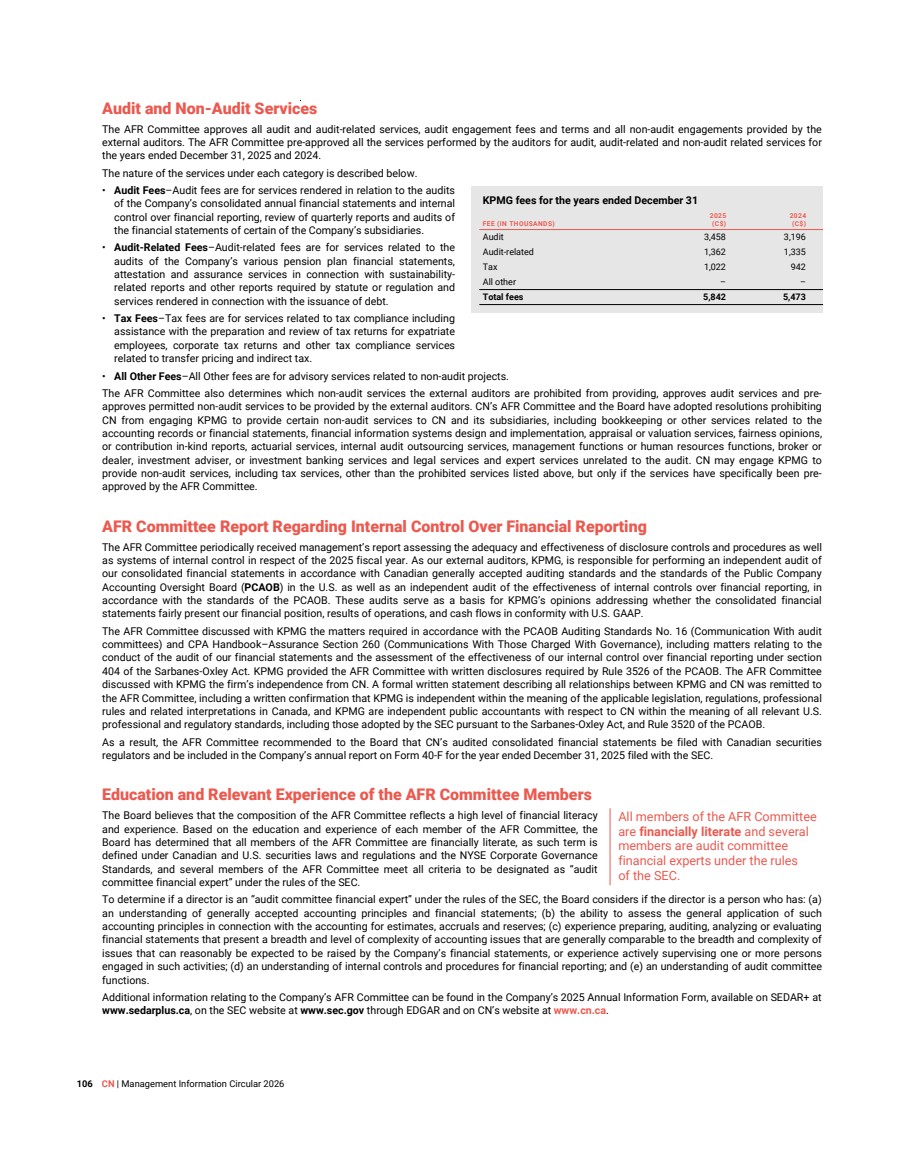
| PRINTED IN CANADA |

| 935 de La Gauchetière Street West Montreal, Quebec H3B 2M9 www.cn.ca |