
Exhibit 99.2

Fighting Against Forced Labour and Child Labour: Steps Taken by Franco-Nevada in 2025
Annual Report
(January 1, 2025 – December 31, 2025)
The Fighting Against Forced Labour and Child Labour in Supply Chains Act (the “Act”) requires certain governmental and larger private-sector entities to submit an annual report describing their supply chains, policies relating to forced and child labour, and the steps taken to prevent and reduce the risk of forced and child labour. As a company incorporated under the Canada Business Corporations Act, Franco-Nevada Corporation is required to provide its report to shareholders who have requested to receive its annual financial statements, and the report will also be made available on Franco-Nevada’s website.
While Public Safety Canada has issued guidance regarding the application of the Act that may potentially exclude Franco-Nevada Corporation and its business from mandatory reporting, Franco-Nevada views reporting under the Act as part of an ongoing, multi-year journey to strengthen its governance framework, risk identification processes, and alignment with evolving best practices in responsible business conduct. Accordingly, while the Company continues to assess its reporting obligations under the Act, it has elected to report voluntarily, as a matter of good governance and best practice, and this report documents Franco-Nevada’s efforts during the 2025 financial year to safeguard human rights and to minimize the risk of forced labour and child labour within its operations and supply chains.
A. | Structure, activities and supply chains |
|
* Intermediate holding companies have been omitted. |
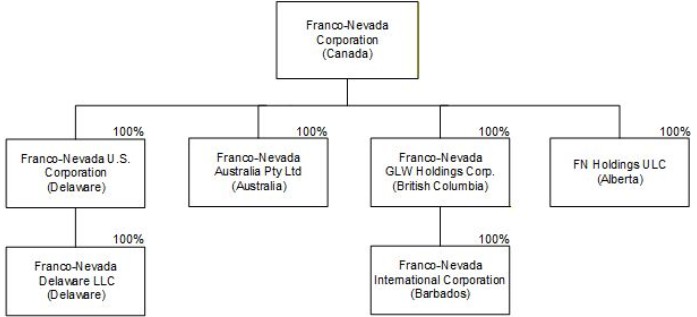
Franco-Nevada Corporation was incorporated under the Canada Business Corporations Act on October 17, 2007 and was amalgamated with Franco-Nevada Canada Corporation, its wholly-owned subsidiary, on January 1, 2008. Franco-Nevada Corporation’s head office and registered office is located in Toronto, Ontario. Franco-Nevada has additional offices in (i) Hastings, Christ Church, Barbados, (ii) Denver, Colorado and (iii) Perth, Australia, all of which are used to manage its asset portfolio and pursue new investment opportunities. The chart to the left depicts significant subsidiaries and/or subsidiaries in jurisdictions in which Franco-Nevada Corporation maintains an office that are wholly owned by Franco-Nevada Corporation (together, “Franco-Nevada” or the “Company”) either directly or indirectly, and are existing under the laws of the jurisdictions set out therein.
As a royalty and stream company, the primary focus of Franco-Nevada's business is to create exposure to gold and precious metal resource optionality. This principally involves investments in gold projects and providing funding to copper and other base metal projects to obtain exposure to by-product gold, silver and platinum group metals production. Franco-Nevada also invests, albeit to a lesser extent, in other metals and diversified assets to expose its shareholders to additional resource optionality. Franco-Nevada's revenue is generated from various forms of agreements, ranging from net smelter return royalties, streams,
net profits interests, net royalty interests, working interests and other types of arrangements. Franco-Nevada does not mine or extract metals or energy products, nor does it operate mining or energy projects or exercise control over such operations. Franco-Nevada receives metal credits pursuant to its stream arrangements and, in certain instances, receives its royalty payments in-kind, which credits and in-kind deliveries are then sold to intermediaries.
Franco-Nevada has limited suppliers of office and kitchen supplies for its global corporate operations. Franco-Nevada also regularly retains technical, environmental, social, political and other consultants who provide information and advice to the Company to support and supplement its due diligence when evaluating royalty, stream and other investment opportunities.
B. | Policies and due diligence processes in relation to forced labour and child labour |
Due Diligence Process
As Franco-Nevada does not operate mining or energy projects and does not exercise control over such operations, Franco-Nevada believes that the most critical time for assessing and mitigating risks, including labour risks, relating to an asset is at the outset, prior to entering into royalty and stream agreements.
This due diligence review involves utilizing the extensive experience of the Company’s multi-disciplinary management team and leverages the oversight and involvement of the board of directors to evaluate risks specific to a mining or energy operation and the plans adopted by the operator to manage such risks, including, but not limited to: the impacts of mining, operations and related activities on surrounding communities, including women, children, employees and migrant workers; an operator’s ethical track record and any history of corruption; the reputation of the operator, locally and internationally; workplace standards, protections and policies; and the commitments by, and track record of, the operator with respect to fundamental freedoms of individuals (including relating to freedom of association, non-discrimination and equal opportunity, and freedom from forced labour, human trafficking, and child labour).
Franco-Nevada also routinely engages external experts to assess risks as part of its diligence processes. If forced labour or child labour are identified in the Company’s due diligence processes, this would result in the Company’s decision not to proceed with an opportunity.
Policies
Franco-Nevada has adopted policies that either directly or indirectly relate to forced labour or child labour in respect of its business and operations. The most pertinent policy that describes the steps the Company takes to prevent and reduce the risk that forced labour or child labour is used in connection with its business is its Human Rights Policy, which sets out the Company's commitment to the following, among others:
| ● | complying with human rights laws in regions in which the Company conducts business; |
| ● | supporting fundamental freedoms of all individuals, including the freedom of thought, belief, opinion and expression, the freedom of peaceful assembly, the freedom of association and other rights and freedoms; |
| ● | formalizing the Company’s commitment to the fundamental labour standards and rights at work set out in the International Labour Organization’s Declaration on Fundamental Principles and Rights at Work; |
| ● | complying with proper labour laws and standards including in respect of legal age limits, minimum wages and benefits, and working hours and working day limits; |
| ● | not using any forced, involuntary, compulsory, indentured or slave labour in any of its business activities or operations; |
| ● | conducting appropriate human rights due diligence when making investments; |
| ● | consulting with the Company’s stakeholders regarding human rights and other social issues; |
| ● | reviewing and assessing the Company’s human rights policies, practices and procedures on a regular basis; |
2
| ● | organizing appropriate training and educational programs for Franco-Nevada personnel to address human rights issues and to properly implement the Company’s Human Rights Policy; |
| ● | expecting that the Company’s suppliers and service providers conduct their business practices in accordance with Franco-Nevada’s values, including in respect of human rights; and |
| ● | disclosing Franco-Nevada’s progress and initiatives on human rights. |
In addition to Franco-Nevada's Human Rights Policy, the Company's Supplier Code of Conduct sets out the Company’s expectations for organizations, including their employees and representatives, who supply goods and services to Franco-Nevada (collectively, its “Suppliers”). The Supplier Code of Conduct is to be delivered to Suppliers, who must acknowledge in their contractual arrangements with the Company that they have received and will comply with the Supplier Code of Conduct. Although Franco-Nevada has certain suppliers of office and kitchen supplies for the Company’s corporate operations, most of the Company’s Suppliers are technical, environmental, social, political and other consultants who provide information and advice to Franco-Nevada to support and supplement the Company’s due diligence when evaluating royalty, stream and other investment opportunities. Suppliers are expected to, among other things:
| ● | conduct their business activities in compliance with laws and standards in the jurisdictions in which they operate; |
| ● | employ individuals above the legal age of employment, not to use forced or slave labour, meet minimum wage requirements and not exceed working hour and day regulations; |
| ● | recognize freedom of association and the right to collective bargaining; |
| ● | refrain from discriminating against their employees; |
| ● | respect the dignity of their own employees and others, adhere to principles of diversity and maintain a respectful workplace; and |
| ● | afford equality of opportunity to all people. |
Failure by any Supplier to comply with Franco-Nevada’s Supplier Code of Conduct, including the requirements relating to the prohibition of forced labour, human trafficking and child labour, may result in corrective action up to and including the termination of the Company’s relationship with such Supplier, subject to applicable contractual rights. To date, Franco-Nevada has not identified any failure by its Suppliers to comply with the Supplier Code of Conduct through its assessment of Suppliers’ performance under contractual arrangements, nor has the Company been made aware of any such failure through third-party complaints or whistleblower reports. As a result, no corrective actions to address Supplier non-conformance have been required during the reporting period.
Additional policies adopted by the Company that directly or indirectly relate to the elimination of forced labour or child labour include a Code of Business Conduct and Ethics; a Whistleblower Policy; an Investment Principles (Environmental, Social and Governance) Policy; a Responsible Gold Mining Principles Policy; a Corporate Responsibility Policy; and a Health and Safety Policy. These and the other policies referenced in this report can be found on Franco-Nevada’s website at www.franco-nevada.com and are summarized in Franco-Nevada’s most recent Sustainability Report.
C. | Steps taken to prevent and reduce the risk that forced labour or child labour is used at any step of the production of goods in Canada or elsewhere, or of goods imported into Canada, by Franco-Nevada |
Franco-Nevada has not identified any forced labour or child labour in its activities and supply chains. As mentioned earlier in this report, Franco-Nevada currently does not operate any of the mining or diversified assets in which it has royalty, stream or other interests, and as such, does not directly produce or import goods in connection with its business.
3
Notwithstanding, in addition to the policies and due diligence measures outlined earlier in this report, when negotiating all new royalty and stream acquisitions, the Company includes provisions to afford the Company with access to ongoing reporting in respect of a project, audit and inspection rights, and security and remedies. Additionally, Franco-Nevada includes operating covenants (e.g. requirements for operators to conduct operations in accordance with responsible practices and applicable laws) and transfer restrictions in its agreements, intended to ensure that the Company remains partnered with responsible actors when it comes to labour-related issues.
Franco-Nevada is a long-standing member of the World Gold Council and has committed to encourage the adoption of the Responsible Gold Mining Principles (the “RGMPs”) by operators of mining assets in which the Company holds interests. Although the RGMPs are not directly applicable to Franco-Nevada given its non-operating business model, the Company considers alignment with recognized responsible mining standards to be an important component of its engagement with operators. Franco-Nevada notes that the responsible mining standards landscape continues to evolve. In particular, the forthcoming Consolidated Mining Standard (the “Standard”) initiative responds to growing demand for responsible mining practices by bringing together the attributes of four leading standards—The Copper Mark, the Mining Association of Canada’s Towards Sustainable Mining, the World Gold Council’s RGMPs and the International Council on Mining and Metals’ Mining Principles. The Standard is intended to reduce duplication, fill gaps, and consolidate expectations into a single, global framework applicable to mining companies of all sizes, commodities and jurisdictions. Franco-Nevada will continue to monitor developments related to the Standard and other industry initiatives and expects to continue adopting and encouraging best practices in its engagement with operators, consistent with its business model and governance framework.
Franco-Nevada is also a corporate participant of the United Nations Global Compact (the “UNGC”), the world’s largest corporate sustainability initiative, whereby the Company is required to submit, on an annual basis, a “Communication on Progress” describing the practical actions that the Company has taken and the qualitative and quantitative results of the Company in furtherance of the UNGC’s Ten Principles, which includes (i) the elimination of all forms of forced and compulsory labour (Principle 4) and (ii) the effective abolition of child labour (Principle 5). Franco-Nevada’s most recent Communication on Progress is available on the UNGC website.
D. | Parts of Franco-Nevada’s business and supply chains that carry a risk of forced labour or child labour being used and the steps taken to assess and manage that risk |
As noted above in this report, Franco-Nevada currently does not operate any of the mining or other assets in which it has royalty, stream or other interests and, as such, does not directly produce or import goods. Franco-Nevada has also not identified any forced labour or child labour in its activities and supply chains and considers that there is a low risk of forced labour or child labour in its current supply chains given their nature and the limited size and scope of such supply chains. Notwithstanding its non-operating business model and the resulting limited indirect exposure to labour-related risks, Franco-Nevada recognizes that its long-term success is dependent on responsible practices across the mining industry and will continue to support industry initiatives and apply its due diligence processes, contractual protections and ongoing engagement to support the identification and management of such risks over time.
E. | Measures taken to remediate any forced labour or child labour |
Franco-Nevada has not identified any instances of forced labour or child labour, nor any material risks thereof, in its activities or supply chains. Accordingly, no remediation measures have been required or undertaken during the reporting period. This conclusion is based on the Company’s due diligence processes, contractual oversight mechanisms, and the absence of any identified incidents, complaints or reports of non-compliance during the reporting period.
4
F. | Measures taken to remediate the loss of income to the most vulnerable families that results from any measure taken to eliminate the use of forced labour or child labour in Franco-Nevada’s activities and supply chain |
As Franco-Nevada has not identified any instances of forced labour or child labour, nor implemented any measures to remediate such practices, no measures have been required or undertaken to remediate any associated loss of income to vulnerable families during the reporting period. This conclusion is based on the Company’s due diligence processes, contractual oversight mechanisms, and the absence of any identified incidents, complaints or reports of forced labour or child labour in its activities or supply chains.
G. | Training provided to employees on forced labour and child labour |
Employees are trained annually on the content of, and are required to acknowledge in writing, Franco-Nevada's key corporate policies. As discussed above, these policies address the use and elimination of forced labour and child labour and the training covers such matters.
H. | How Franco-Nevada assesses its effectiveness in ensuring that forced labour and child labour are not being used in its business and supply chains |
As Franco-Nevada has not identified any forced labour or child labour or material risks thereof in its activities and supply chains, the Company has not implemented a standalone effectiveness assessment framework specific to forced labour and child labour at this time. Notwithstanding, Franco-Nevada assesses the effectiveness of its approach through existing governance mechanisms, including periodic reviews of its policies, employee training completion, Supplier acknowledgements of the Supplier Code of Conduct, and the integration of human rights considerations into its investment due diligence processes. The Company will continue to evaluate whether additional measures are appropriate as its risk profile, regulatory expectations or industry best practices evolve.
* * * * *
Attestation by Franco-Nevada Corporation
In accordance with the requirements of the Act, and in particular section 11 thereof, I attest that the Board of Directors of Franco-Nevada Corporation has approved this report and that I have reviewed the information contained herein. Based on my knowledge, and having exercised reasonable diligence, I attest, on behalf of Franco-Nevada Corporation, that the information in the report is true, accurate and complete in all material respects for the purposes of the Act, for the reporting year listed above.
| /s/ David Harquail | | |
| I have authority to bind Franco-Nevada Corporation | | |
Name | David Harquail | Date | March 19, 2026 |
Position Title | Director and Chair of the Board | | |
5