
Exhibit 99.10
Highlights
Following strong growth in 2024 (+1.7%), the Québec economy faced a difficult geopolitical environment in 2025. It has gradually adapted to the new trade situation. Although real GDP growth slowed, it remained slightly positive (+0.7% after 11 months in 2025). Real GDP growth of 0.8% is forecast for 2025.
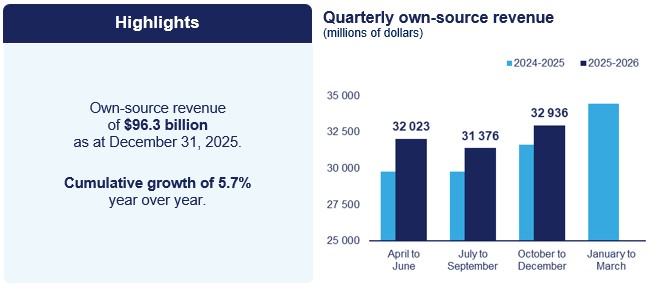
For the first three quarters of fiscal 2025-2026, own-source revenue increased by 5.7%, due in particular to the resilience of businesses and individuals in the face of economic uncertainty, while portfolio expenditures grew at a more moderate rate of 1.4%, reflecting initiatives taken to ensure sound management of public finances. As at December 31, 2025, the accounting balance shows a surplus of $994 million.
However, the more moderate growth in economic activity expected in the coming months will slow the growth in own-source revenue by the end of the fiscal year. In addition, expenditures are expected to be higher in the last quarter, which is consistent with observations made in previous years. This will accelerate the growth in expenditures by the end of the fiscal year.
As a result, the anticipated accounting deficit1 for 2025-2026 is $7.7 billion (1.2% of GDP). This represents an improvement of $2.2 billion compared with the forecast in the Update on Québec's Economic and Financial Situation - Fall 2025. The improvement is mainly due to the non-utilization of the $2.0-billion contingency reserve, in particular because of the strong performance of own-source revenue.
Revenues are expected to reach $160.5 billion2 in 2025-2026 while expenditures are projected at $168.2 billion.2 Furthermore, the debt burden is expected to stand at 38.8%2 of GDP as at March 31, 2026.
As at March 6, 2026, the financing program was completed for 2025-2026, and $9.3 billion in pre-financing had been carried out.2,3
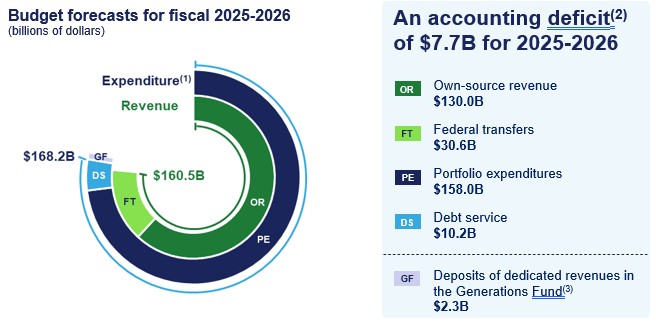
(1) The deposits of dedicated revenues in the Generations Fund are presented under expenditures for illustrative purposes.
(2) This is the operating surplus (deficit) as presented in the public accounts.
(3) Including $2.3 billion deposits of dedicated revenues in the Generations Fund, the budgetary deficit within the meaning of the Balanced Budget Act stands at $9.9 billion (1.5% of GDP).
____________________________________
1. This is the operating surplus (deficit) as presented in the public accounts.
2. These are the same data as those published in the March 2026 budget.
3. Long-term borrowings contracted between April 1, 2025 and March 6, 2026.
Section 1: Recent Developments and Budgetary Outlook in Brief
Recent developments in the economic situation
After a 1.7% increase in 2024, economic growth in Québec is slowing due to the trade dispute and resulting uncertainty. Real GDP growth by industry was 0.7% after 11 months in 2025, compared to the corresponding period in 2024. Real GDP growth is projected to reach 0.8% for 2025.
Although economic activity in Québec moderated in 2025, inflation, as measured by growth in the Consumer Price Index (CPI), edged up from 2.3% in 2024 to 2.4% in 2025. Despite monthly fluctuations, inflation generally remained within the Bank of Canada's target range of 1% to 3%.
▪ In January 2026, the CPI posted an annual change of 3.0% in Québec, driven in particular by a significant rise in the Shelter component.
The Bank of Canada has kept its policy rate unchanged at 2.25% since its announcement on October 29, 2025. This is its lowest policy rate since July 2022.
In Québec, growth in nominal GDP is slowing but remains robust. After a gain of 5.9% in 2024, an increase of 4.9% was observed in the first three quarters of 2025 compared to the corresponding period in 2024 (4.5% forecast for 2025).
Amid ongoing trade uncertainty, Québec's labour market remained resilient in 2025. The unemployment rate in Québec rose slightly, from an average of 5.3% in 2024 to an average of 5.6% in 2025. For the first two months of 2026, the average stood at 5.5% (6.6% in Canada).
▪ Despite this increase in 2025, Québec's unemployment rate remained below the Canadian average (6.8% in 2025). The employment rate for people aged 15 to 64 averaged 77.4% in Québec in 2025, the highest in the country (74.2% in Canada).
For 2025, compared with 2024, wages and salaries grew by 4.4% in Québec (+6.0% in 2024).
Household consumption posted growth of 4.7% in nominal terms during the first three quarters of 2025 compared to the corresponding period in 2024 (4.0% forecast in 2025 compared to 5.1% recorded in 2024).
On the business side, despite the climate of continued uncertainty, the net operating surplus of corporations rose by 5.3% during the first three quarters of 2025 compared to the same period in 2024 (5.7% forecast in 2025 compared to 3.1% recorded in 2024).
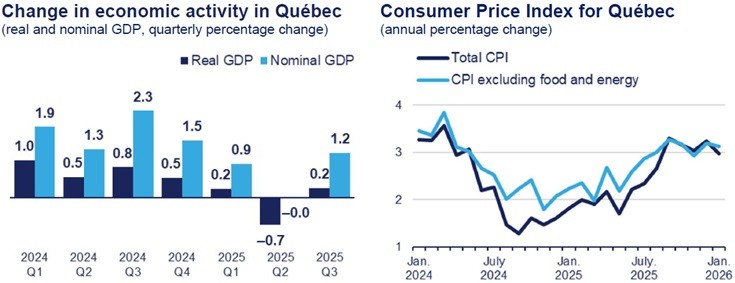
Note: The chart on the left shows the data from the economic accounts published on December 19, 2025 by the Institut de la statistique du Québec.
Section 1: Recent Developments and Budgetary Outlook in Brief
Summary of results and budgetary outlook for 2025-2026
► Results as at December 31, 2025
For the first nine months of 2025-2026, the accounting surplus stood at $994 million. This is a $3.3-billion improvement compared to the same period last year.
This surplus is explained by the following factors:
Moreover, the budgetary deficit within the meaning of the Balanced Budget Act, that is, after deposits of dedicated revenues of $1.8 billion in the Generations Fund, stands at $779 million.
| Summary of results as at December 31, 2025 and budgetary outlook for 2025‑2026 |
|||||||||||
| (unaudited data, millions of dollars, year-over-year change) | |||||||||||
| April to December | Forecast for fiscal 2025-2026 | ||||||||||
| Fall 2025 update |
New estimate(1) |
||||||||||
| 2024- 2025 |
2025- 2026 |
Change (M$) |
Change (%) |
Level (M$) |
Change (%) |
Adjustment (M$) |
Level (M$) |
Change (%) |
|||
| Own-source revenue | 91 133 | 96 335 | 5 202 | 5.7 | 127 541 | 1.6 | 2 411 | 129 952 | 3.5 | ||
| Federal transfers | 22 428 | 22 165 | −263 | −1.2 | 31 194 | 2.3 | −617 | 30 577 | 0.3 | ||
| Total revenue | 113 561 | 118 500 | 4 939 | 4.3 | 158 735 | 1.7 | 1 794 | 160 529 | 2.8 | ||
| Portfolio expenditures | −108 418 | −109 933 | −1 515 | 1.4 | −156 435 | 3.4 | −1 594 | −158 029 | 4.5 | ||
| Debt service | −7 447 | −7 573 | −126 | 1.7 | −10 198 | 2.3 | 43 | −10 155 | 1.9 | ||
| Total expenditure | −115 865 | −117 506 | −1 641 | 1.4 | −166 633 | 3.3 | −1 551 | −168 184 | 4.3 | ||
| Contingency reserve | - | - | - | - | −2 000 | - | 2 000 | - | - | ||
| ACCOUNTING SURPLUS (DEFICIT)(2) | −2 304 | 994 | 3 298 | - | −9 898 | - | 2 243 | −7 655 | - | ||
| Deposits of dedicated revenues in the Generations Fund | −1 795 | −1 773 | 22 | - | −2 461 | - | 172 | −2 289 | - | ||
| BUDGETARY BALANCE(3) | −4 099 | −779 | 3 320 | - | −12 359 | - | 2 415 | −9 944 | - | ||
(1) These forecasts correspond to those published in the March 2026 budget.
(2) This is the operating surplus (deficit) as presented in the public accounts.
(3) Budgetary balance within the meaning of the Balanced Budget Act.
Section 1: Recent Developments and Budgetary Outlook in Brief
► Budgetary outlook for 2025-2026
The accounting deficit forecast for 2025-2026 is adjusted downward by $2.2 billion from the forecast in the Update on Québec's Economic and Financial Situation - Fall 2025 and now stands at $7.7 billion. This improvement is mainly due to the non-utilization of the $2.0 billion contingency reserve.
Revenues are adjusted upward by $1.8 billion from the Update on Québec's Economic and Financial Situation - Fall 2025. As a result, they stand at $160.5 billion, with annual growth of 2.8%.
Expenditures are adjusted upward by $1.6 billion from the Update on Québec's Economic and Financial Situation - Fall 2025. As a result, they stand at $168.2 billion, with annual growth of 4.3%.
Moreover, the budgetary deficit within the meaning of the Balanced Budget Act, that is, after deposits of dedicated revenues of $2.3 billion in the Generations Fund, stands at $9.9 billion.
► Additional information
The net debt burden is expected to stand at 38.8% of GDP as at March 31, 2026, the same level as that presented in the March 2026 budget.
________________________________________
4. The value of the Québec special abatement is shown as a deduction of federal transfers.
5. Adjustments to federal transfer revenue based on the pace of infrastructure projects that receive federal funding have no impact on the budgetary balance, since an offsetting entry is recorded under expenditures.
Section 2: Detailed Results and Budgetary Outlook
Revenue
Own-source revenue
► Results as at December 31, 2025
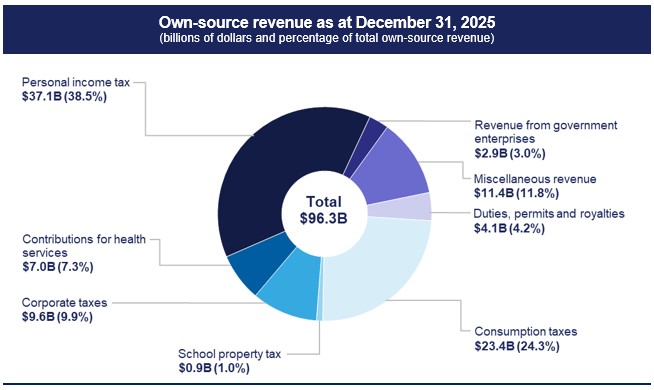
As at December 31, that is, for the first nine months of 2025-2026, own-source revenue stood at $96.3 billion. This represents an increase of $5.2 billion (5.7%) compared with the same period last year.
Tax revenue rose by $5.2 billion (7.2%) to $78.0 billion due, in particular, to increases of:
Section 2: Detailed Results and Budgetary Outlook
Other own-source revenue increased by $211 million (1.4%) to $15.4 billion, due to:
Revenue from government enterprises decreased by $242 million (−7.7%) to $2.9 billion.
| Own-source revenue | |||||||||||
| (unaudited data, millions of dollars, year-over-year change) | |||||||||||
| April to December | Forecast for fiscal 2025-2026 | ||||||||||
| Fall 2025 update |
New estimate(1) |
||||||||||
| 2024- 2025 |
2025- 2026 |
Change (M$) |
Change (%) |
Level (M$) |
Change (%) |
Adjustment (M$) |
Level (M$) |
Change (%) |
|||
| Income and property taxes | |||||||||||
| − Personal income tax | 34 157 | 37 093 | 2 936 | 8.6 | 47 838 | 4.7 | 1 165 | 49 003 | 7.3 | ||
| − Contributions for health services | 6 737 | 6 989 | 252 | 3.7 | 9 082 | 2.6 | 93 | 9 175 | 3.6 | ||
| − Corporate taxes | 8 720 | 9 577 | 857 | 9.8 | 13 552 | 1.6 | 550 | 14 102 | 5.7 | ||
| − School property tax | 894 | 932 | 38 | 4.3 | 1 255 | 4.9 | - | 1 255 | 4.9 | ||
| Consumption taxes | 22 261 | 23 411 | 1 150 | 5.2 | 28 821 | 1.6 | 543 | 29 364 | 3.5 | ||
| Tax revenue | 72 769 | 78 002 | 5 233 | 7.2 | 100 548 | 3.2 | 2 351 | 102 899 | 5.6 | ||
| Duties, permits and royalties | 4 219 | 4 079 | −140 | −3.3 | 6 040 | −2.4 | 271 | 6 311 | 1.9 | ||
| Miscellaneous revenue | 11 005 | 11 356 | 351 | 3.2 | 15 511 | −4.6 | −116 | 15 395 | −5.3 | ||
| Other own-source revenue | 15 224 | 15 435 | 211 | 1.4 | 21 551 | −4.0 | 155 | 21 706 | −3.3 | ||
| Total own-source revenue excluding revenue from government enterprises | 87 993 | 93 437 | 5 444 | 6.2 | 122 099 | 1.8 | 2 506 | 124 605 | 3.9 | ||
| Revenue from government enterprises | 3 140 | 2 898 | −242 | −7.7 | 5 442 | −4.3 | −95 | 5 347 | −6.0 | ||
| TOTAL | 91 133 | 96 335 | 5 202 | 5.7 | 127 541 | 1.6 | 2 411 | 129 952 | 3.5 | ||
(1) These forecasts correspond to those published in the March 2026 budget.
Section 2: Detailed Results and Budgetary Outlook
► Budgetary outlook for 2025-2026
Own-source revenue is expected to reach $130.0 billion in 2025-2026 (annual growth of 3.5%). This represents an upward adjustment of $2.4 billion compared to the forecast in the Update on Québec's Economic and Financial Situation - Fall 2025.
Tax revenue is adjusted upward by $2.4 billion in 2025-2026. This adjustment is mainly due to:
Other own-source revenue is adjusted upward by $155 million in 2025-2026. This adjustment is mainly due to :
Section 2: Detailed Results and Budgetary Outlook
|
Composition of own-source revenue excluding revenue from government enterprises Own-source revenue excluding revenue from government enterprises consists mainly of tax revenue, that is, personal income tax, contributions for health services, corporate taxes, school property tax and consumption taxes.
Own-source revenue excluding revenue from government enterprises also includes other sources of revenue:
|
|
Composition of revenue from government enterprises Government enterprises consist of public corporations that play a commercial role, have managerial autonomy and are financially self-sufficient.
|
Revenue
Federal transfers
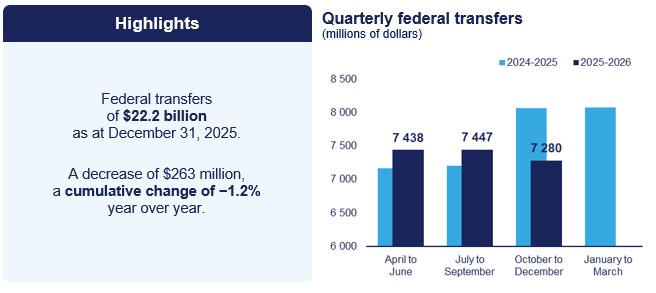
► Results as at December 31, 2025
As at December 31, that is, for the first nine months of 2025-2026, federal transfers totalled $22.2 billion. This represents a decrease of $263 million (−1.2%) compared to the same period last year. This change is largely explained by the non-recurrence of the reimbursement of Québec's costs related to refugee protection claimants, announced by the federal government in June 2024.
| Federal transfers | |||||||||||
| (unaudited data, millions of dollars, year-over-year change) | |||||||||||
| April to December | Forecast for fiscal 2025-2026 | ||||||||||
| Fall 2025 update |
New estimate(1) |
||||||||||
| 2024- 2025 |
2025- 2026 |
Change (M$) |
Change (%) |
Level (M$) |
Change (%) |
Adjustment (M$) |
Level (M$) |
Change (%) |
|||
| Equalization | 9 987 | 10 175 | 188 | 1.9 | 13 567 | 1.9 | - | 13 567 | 1.9 | ||
| Health transfers | 6 301 | 6 542 | 241 | 3.8 | 8 793 | 4.3 | −108 | 8 685 | 3.0 | ||
| Transfers for post-secondary education and other social programs | 992 | 994 | 2 | 0.2 | 1 370 | 1.5 | −55 | 1 315 | −2.6 | ||
| Other programs | 5 148 | 4 454 | −694 | −13.5 | 7 464 | 0.9 | −454 | 7 010 | −5.3 | ||
| TOTAL | 22 428 | 22 165 | −263 | −1.2 | 31 194 | 2.3 | −617 | 30 577 | 0.3 | ||
(1) These forecasts correspond to those published in the March 2026 budget.
Section 2: Detailed Results and Budgetary Outlook
► Budgetary outlook for 2025-2026
Federal transfers total $30.6 billion (annual change of 0.3%) in 2025-2026. This represents a downward adjustment of $617 million compared to the forecast in the Update on Québec's Economic and Financial Situation - Fall 2025 due to, among other factors, the upward adjustment of the value of the Québec special abatement, which reduces Québec's cash transfers,6 as well as the pace of implementation for infrastructure projects that receive federal funding.7
|
Composition of federal transfers Revenue from federal transfers consists of federal government revenues paid to Québec under the Federal-Provincial Fiscal Arrangements Act, in addition to revenues from other programs under bilateral agreements. These revenues mainly come from:
|
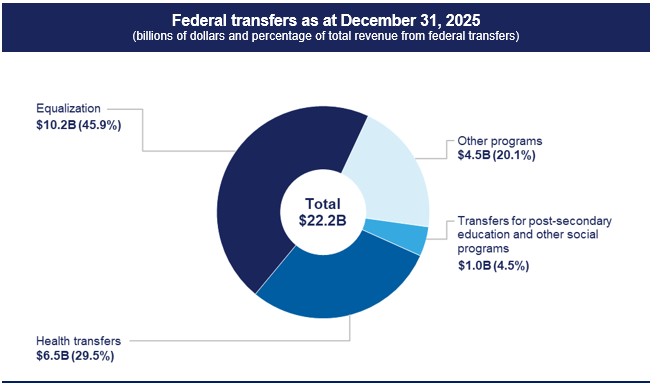
Note: Totals may not add due to rounding.
____________________________________
6. The value of the Québec special abatement is shown as a deduction of federal transfers.
7. Adjustments to federal transfer revenue based on the pace of infrastructure projects that receive federal funding have no impact on the budgetary balance, since an offsetting entry is recorded under expenditures.
Section 2: Detailed Results and Budgetary Outlook
Expenditure
Portfolio expenditures and debt service
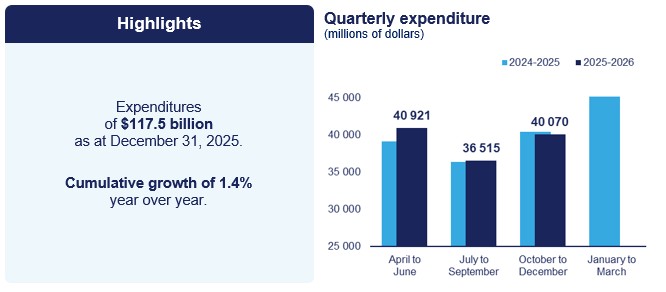
► Results as at December 31, 2025
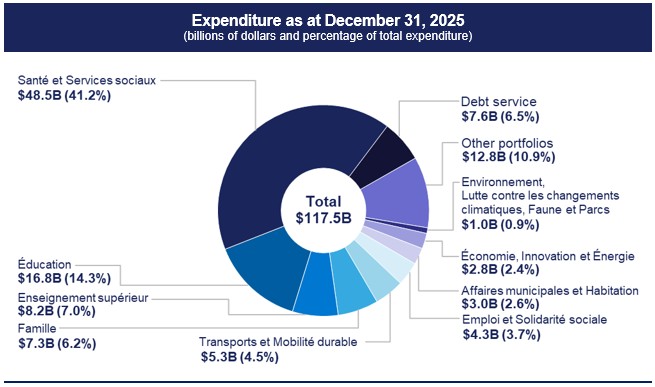
As at December 31, for the first nine months of 2025-2026, expenditures totalled $117.5 billion. This represents an increase of $1.6 billion (1.4%) compared with the same period last year.
Portfolio expenditures rose by $1.5 billion (1.4%) to $109.9 billion. The growth observed as at December 31 is explained by the expected change in costs related to the delivery of public services, but also by the following factors:
Section 2: Detailed Results and Budgetary Outlook
Debt service expenditures increased by $126 million (1.7%) to $7.6 billion. This increase stems mainly from a decrease in investment revenue, in particular due to the drop in short-term interest rates in 2025-2026.
| Expenditure | |||||||||||
| (unaudited data, millions of dollars, year-over-year change) | |||||||||||
| April to December | Forecast for fiscal 2025-2026 | ||||||||||
| Fall 2025 update |
New estimate(1) |
||||||||||
| 2024- 2025 |
2025- 2026 |
Change (M$) |
Change (%) |
Level (M$) |
Change (%) |
Adjustment (M$) |
Level (M$) |
Change (%) |
|||
| Santé et Services sociaux | 47 647 | 48 481 | 834 | 1.8 | 65 799 | 2.5 | 192 | 65 991 | 2.7 | ||
| Éducation | 16 753 | 16 847 | 94 | 0.6 | 23 384 | 0.1 | 123 | 23 516 | 0.7 | ||
| Enseignement supérieur | 8 003 | 8 166 | 163 | 2.0 | 11 280 | −0.9 | 55 | 11 335 | −0.4 | ||
| Famille | 6 632 | 7 263 | 631 | 9.5 | 9 746 | 8.1 | −5 | 9 741 | 8.1 | ||
| Transports et Mobilité durable |
4 740 | 5 253 | 513 | 10.8 | 7 508 | −2.3 | 1 754 | 9 262 | 20.5 | ||
| Emploi et Solidarité sociale |
4 293 | 4 332 | 39 | 0.9 | 5 845 | 2.4 | −42 | 5 803 | 1.7 | ||
| Affaires municipales et Habitation |
2 908 | 2 953 | 45 | 1.5 | 5 730 | 16.6 | 28 | 5 758 | 15.0 | ||
| Économie, Innovation et Énergie |
3 097 | 2 780 | −317 | −10.2 | 4 451 | −5.5 | 416 | 4 867 | 2.1 | ||
| Environnement, Lutte contre les changements climatiques, Faune et Parcs |
1 496 | 1 019 | −477 | −31.9 | 2 005 | −8.1 | −16 | 1 989 | −8.8 | ||
| Other portfolios | 12 849 | 12 839 | −10 | −0.1 | 20 687 | 13.9 | −920 | 19 767 | 10.0 | ||
| Portfolio expenditures | 108 418 | 109 933 | 1 515 | 1.4 | 156 435 | 3.4 | 1 594 | 158 029 | 4.5 | ||
| Debt service | 7 447 | 7 573 | 126 | 1.7 | 10 198 | 2.3 | −43 | 10 155 | 1.9 | ||
| TOTAL | 115 865 | 117 506 | 1 641 | 1.4 | 166 633 | 3.3 | 1 551 | 168 184 | 4.3 | ||
(1) These forecasts correspond to those published in the March 2026 budget.
Section 2: Detailed Results and Budgetary Outlook
► Budgetary outlook for 2025-2026
Expenditures are expected to stand at $168.2 billion in 2025-2026 (annual growth of 4.3%). This represents an upward adjustment of $1.6 billion compared to the forecast in the Update on Québec's Economic and Financial Situation - Fall 2025.
Section 2: Detailed Results and Budgetary Outlook
|
Composition of portfolio expenditures Portfolio expenditures represent the total resources allocated to the delivery of public services. The government implements programs that are administered directly by government entities such as departments and organizations.
Portfolio expenditures are made up of:
The composition and expenditure level of each portfolio vary according to the nature of the function and programs under the minister’s responsibility. As a result, some portfolios will incur more expenses than others, depending on their mission. In 2025 2026, there are 25 ministerial portfolios. For the first nine months, the three main ones, Santé et Services sociaux, Éducation, and Enseignement supérieur, account for 67% of portfolio expenditures. |
|
Composition of debt service Debt service represents the sum of interest on direct debt and interest on other employee future benefits liabilities in the public and parapublic sectors. It depends in particular on the size of the debt and interest rates on financial markets. Each year, the government must devote a portion of its revenues to making interest payments. |
Debt
As at March 31, 2026, net debt is expected to stand at $250.3 billion, or 38.8% of GDP. Compared to the Update on Québec's Economic and Financial Situation - Fall 2025, this represents a downward adjustment of the net debt of 0.9 percentage points, due in particular to the lower-than-expected accounting deficit
| Net debt as at March 31, 2026 | |||
| (millions of dollars, unless otherwise indicated) | |||
| Fall 2025 update |
Adjustment | New estimate(1) |
|
| NET DEBT, BEGINNING OF YEAR | 236 163 | - | 236 163 |
| % OF GDP | 38.3 | - | 38.3 |
| Accounting deficit (surplus) | 9 898 | −2 243 | 7 655 |
| Capital investments | 8 799 | −694 | 8 105 |
| Accounting adjustment | −349 | −1 285 | −1 634 |
| Total change | 18 348 | −4 222 | 14 126 |
| NET DEBT, END OF YEAR | 254 511 | −4 222 | 250 289 |
| % OF GDP | 39.7 | −0.9 | 38.8 |
(1) These forecasts correspond to those published in the March 2026 budget.
As at March 31, 2025, Québec's net debt burden stood at 38.3% of GDP, compared with the provincial average of 28.9%.8
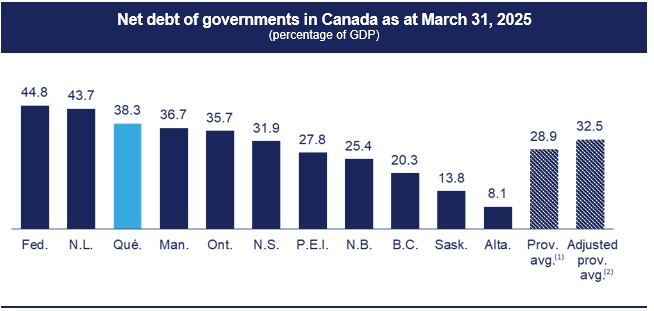
(1) GDP weighted average.
(2) GDP weighted average excluding the least indebted province, Alberta, and the most indebted province, Newfoundland and Labrador.
Sources: Governments’ public accounts and Statistics Canada.
___________________________________
8. Provincial average as at March 31, 2024 was 28.6%.
Section 3: Additional Information
Net financial surpluses or requirements
For the period April to December 2025, net financial requirements amount to $16.2 billion and are attributable to:
| Net financial surpluses or requirements |
||
| (unaudited data, millions of dollars) | ||
| April to December | ||
| 2024-2025 | 2025-2026 | |
| ACCOUNTING SURPLUS (DEFICIT) | −2 304 | 994 |
| Non-budgetary transactions | ||
| Investments, loans and advances | −2 780 | −863 |
| Capital investments | −6 940 | −4 861 |
| Retirement plans and other employee future benefits | −2 190 | −2 905 |
| Other accounts(1) | −3 036 | −6 825 |
| Deposits in the Generations Fund | −1 795 | −1 773 |
| Total non-budgetary transactions | −16 741 | −17 227 |
| NET FINANCIAL SURPLUSES (REQUIREMENTS) | −19 045 | −16 233 |
(1) The financial surpluses or requirements pertaining to other accounts can vary significantly from one month to the next, in particular according to the time when the government collects or disburses funds related to its activities. For example, when the last day of the month is not a business day, QST remittances are collected at the beginning of the following month, such that the equivalent of two months' remittances can be collected in a given month.
______________________________________
9. These items, which are included in the government's budgetary surplus (deficit), are eliminated in non-budgetary transactions because they have no effect on cash flow.
10. The financial surpluses or requirements pertaining to other accounts can vary significantly from one month to the next, in particular according to the time when the government collects or disburses funds related to its activities. For example, when the last day of the month is not a business day, QST remittances are collected at the beginning of the following month, such that the equivalent of two months' remittances can be collected in a given month.
Section 3: Additional Information
|
Composition of net financial surpluses or requirements The government’s revenues and expenditures are established on the accrual basis of accounting.
Net financial surpluses or requirements, on the other hand, consist of the difference between receipts and disbursements resulting from government activities. To meet its net financial requirements, the government uses a variety of financing sources, including cash and borrowings. The various items for net financial requirements represent net receipts and disbursements generated by the government’s loans, interests in its enterprises, and fixed assets, by retirement plans and other employee future benefits, as well as by other accounts.
|
Section 3: Additional Information
Financing program and borrowings
The financing program consists of long-term borrowings contracted during the fiscal year. Among other things, the program is used to repay maturing borrowings and meet net financial requirements. The latter mainly comprise the budgetary deficit as well as the government's capital investments.
As presented in the March 2026 budget, the 2025-2026 financing program stands at $32.1 billion. As at March 6, 2026, the latter was completed for 2025-2026, and $9.3 billion in pre-financing had been carried out.11
| Summary of long-term borrowings contracted in 2025-2026(1) | ||
| Currencies | $million | % |
| CANADIAN DOLLAR | ||
| Conventional bonds | 15 186 | 47.4 |
| Floating-rate notes | 1 500 | 4.7 |
| Savings products issued by Épargne Placements Québec | 164 | 0.5 |
| Immigrant investors(2) | 4 | - |
| Subtotal | 16 854 | 52.6 |
| OTHER CURRENCIES | ||
| U.S. dollar | 8 972 | 28.0 |
| Euro | 4 669 | 14.6 |
| Australian dollar | 798 | 2.5 |
| Swiss franc | 765 | 2.4 |
| Subtotal | 15 205 | 47.4 |
| TOTAL | 32 058 | 100.0 |
Notes: Long-term borrowings issued between April 1, 2025 and March 6, 2026.
Totals may not add due to rounding.
(1) An updated list of new borrowings for the 2025-2026 fiscal year is available.
(2) These borrowings come from sums advanced by immigrant investors. These sums are loaned to the government through Investissement Québec.
| Summary of long-term borrowing repayments in 2025-2026 | ||
| Currencies | $million | |
| CANADIAN DOLLAR | ||
| Conventional bonds | 8 352 | |
| Other | 538 | |
| Subtotal | 8 890 | |
| OTHER CURRENCIES | ||
| U.S dollar | 4 396 | |
| Euro | 4 123 | |
| Others | - | |
| Subtotal | 8 520 | |
| TOTAL | 17 410 |
Note: Long-term borrowing repayments from April 1, 2025 to December 31, 2025.
____________________________________
11. Long-term borrowings contracted between April 1, 2025 and March 6, 2026.
Appendix
Appendix 1: Results and budgetary outlook for 2025-2026
| Results and budgetary outlook for 2025-2026 - Budgetary balance | |||||||||||||||
| (level and adjustment in millions of dollars, percentage change compared to the same period last year) | |||||||||||||||
| |
April to December | Forecast for fiscal 2025-2026 | |||||||||||||
| March 2025 budget |
Fall 2025 update |
New estimate(1) |
Adjustment since the March 2025 budget (M$) |
||||||||||||
| Level (M$) |
Change (%) |
Level (M$) |
Change (%) |
Adjustment (M$) |
Level (M$) |
Change (%) |
Adjustment (M$) |
Level (M$) |
Change (%) |
||||||
| Revenue | |||||||||||||||
| Own-source revenue | 96 335 | 5.7 | 125 732 | 1.0 | 1 809 | 127 541 | 1.6 | 2 411 | 129 952 | 3.5 | 4 220 | ||||
| Federal transfers | 22 165 | −1.2 | 30 610 | −0.1 | 584 | 31 194 | 2.3 | −617 | 30 577 | 0.3 | −33 | ||||
| Subtotal - Revenue | 118 500 | 4.3 | 156 342 | 0.7 | 2 393 | 158 735 | 1.7 | 1 794 | 160 529 | 2.8 | 4 187 | ||||
| Expenditure | |||||||||||||||
| Portfolio expenditures | −109 933 | 1.4 | −156 102 | 1.8 | −333 | −156 435 | 3.4 | −1 594 | −158 029 | 4.5 | −1 927 | ||||
| Debt service | −7 573 | 1.7 | −9 670 | −1.9 | −528 | −10 198 | 2.3 | 43 | −10 155 | 1.9 | −485 | ||||
| Subtotal - Expenditure | −117 506 | 1.4 | −165 772 | 1.5 | −861 | −166 633 | 3.3 | −1 551 | −168 184 | 4.3 | −2 412 | ||||
| Contingency reserve | - | - | −2 000 | - | - | −2 000 | - | 2 000 | - | - | 2 000 | ||||
| ACCOUNTING SURPLUS (DEFICIT)(2) | 994 | - | −11 430 | - | 1 532 | −9 898 | - | 2 243 | −7 655 | - | 3 775 | ||||
| Deposits of dedicated revenues in the Generations Fund | −1 773 | - | −2 177 | - | −284 | −2 461 | - | 172 | −2 289 | - | −112 | ||||
| BUDGETARY BALANCE(3) | −779 | - | −13 607 | - | 1 248 | −12 359 | - | 2 415 | −9 944 | - | 3 663 | ||||
(1) These forecasts correspond to those published in the March 2026 budget.
(2) This is the operating surplus (deficit) as presented in the public accounts.
(3) Budgetary balance within the meaning of the Balanced Budget Act.
Appendix
Appendix 1: Results and budgetary outlook for 2025-2026 (cont.)
| Results and budgetary outlook for 2025-2026 – Revenue | |||||||||||||||
| (level and adjustment in millions of dollars, percentage change compared to the same period last year) | |||||||||||||||
| |
April to December | Forecast for fiscal 2025-2026 | |||||||||||||
| March 2025 budget |
Fall 2025 update |
New estimate(1) |
Adjustment since the March 2025 budget (M$) |
||||||||||||
| Level (M$) |
Change (%) |
Level (M$) |
Change (%) |
Adjustment (M$) |
Level (M$) |
Change (%) |
Adjustment (M$) |
Level (M$) |
Change (%) |
||||||
| Own-source revenue | |||||||||||||||
| Income and property taxes | |||||||||||||||
| − Personal income tax | 37 093 | 8.6 | 46 944 | 3.3 | 894 | 47 838 | 4.7 | 1 165 | 49 003 | 7.3 | 2 059 | ||||
| − Contributions for health services | 6 989 | 3.7 | 9 242 | 3.2 | −160 | 9 082 | 2.6 | 93 | 9 175 | 3.6 | −67 | ||||
| − Corporate taxes | 9 577 | 9.8 | 12 491 | −3.8 | 1 061 | 13 552 | 1.6 | 550 | 14 102 | 5.7 | 1 611 | ||||
| − School property tax | 932 | 4.3 | 1 346 | 14.1 | −91 | 1 255 | 4.9 | — | 1 255 | 4.9 | −91 | ||||
| Consumption taxes | 23 411 | 5.2 | 28 922 | 3.4 | −101 | 28 821 | 1.6 | 543 | 29 364 | 3.5 | 442 | ||||
| Subtotal – Tax revenue | 78 002 | 7.2 | 98 945 | 2.5 | 1 603 | 100 548 | 3.2 | 2 351 | 102 899 | 5.6 | 3 954 | ||||
| Duties, permits and royalties | 4 079 | −3.3 | 6 220 | 5.1 | −180 | 6 040 | −2.4 | 271 | 6 311 | 1.9 | 91 | ||||
| Miscellaneous revenue | 11 356 | 3.2 | 15 299 | −8.2 | 212 | 15 511 | −4.6 | −116 | 15 395 | −5.3 | 96 | ||||
| Subtotal – Other own-source revenue | 15 435 | 1.4 | 21 519 | −4.7 | 32 | 21 551 | −4.0 | 155 | 21 706 | −3.3 | 187 | ||||
| Total own-source revenue excluding revenue from government enterprises |
93 437 | 6.2 | 120 464 | 1.1 | 1 635 | 122 099 | 1.8 | 2 506 | 124 605 | 3.9 | 4 141 | ||||
| Revenue from government enterprises | 2 898 | −7.7 | 5 268 | −2.6 | 174 | 5 442 | −4.3 | −95 | 5 347 | −6.0 | 79 | ||||
| Total own-source revenue | 96 335 | 5.7 | 125 732 | 1.0 | 1 809 | 127 541 | 1.6 | 2 411 | 129 952 | 3.5 | 4 220 | ||||
| Federal transfers | |||||||||||||||
| Equalization | 10 175 | 1.9 | 13 567 | 1.9 | — | 13 567 | 1.9 | — | 13 567 | 1.9 | — | ||||
| Health transfers | 6 542 | 3.8 | 8 942 | 6.1 | −149 | 8 793 | 4.3 | −108 | 8 685 | 3.0 | −257 | ||||
| Transfers for post-secondary education and other social programs |
994 | 0.2 | 1 330 | −1.5 | 40 | 1 370 | 1.5 | −55 | 1 315 | −2.6 | −15 | ||||
| Other programs | 4 454 | −13.5 | 6 771 | −10.3 | 693 | 7 464 | 0.9 | −454 | 7 010 | −5.3 | 239 | ||||
| Subtotal – Federal transfers | 22 165 | −1.2 | 30 610 | −0.1 | 584 | 31 194 | 2.3 | −617 | 30 577 | 0.3 | −33 | ||||
| TOTAL REVENUE | 118 500 | 4.3 | 156 342 | 0.7 | 2 393 | 158 735 | 1.7 | 1 794 | 160 529 | 2.8 | 4 187 | ||||
(1) These forecasts correspond to those published in the March 2026 budget.
Appendix
Appendix 1: Results and budgetary outlook for 2025-2026 (cont.)
| Results and budgetary outlook for 2025-2026 - Expenditure | |||||||||||||||
| (level and adjustment in millions of dollars, percentage change compared to the same period last year) | |||||||||||||||
| April to December | Forecast for fiscal 2025-2026 | ||||||||||||||
| March 2025 budget |
Fall 2025 update |
New estimate(1) |
Adjustment since the March 2025 budget (M$) |
||||||||||||
| Level (M$) |
Change (%) |
Level (M$) |
Change (%) |
Adjustment (M$) |
Level (M$) |
Change (%) |
Adjustment (M$) |
Level (M$) |
Change (%) |
||||||
| Portfolio expenditures | |||||||||||||||
| Santé et Services sociaux | 48 481 | 1.8 | 65 527 | 3.0 | 272 | 65 799 | 2.5 | 192 | 65 991 | 2.7 | 464 | ||||
| Éducation | 16 847 | 0.6 | 23 517 | 2.2 | −133 | 23 384 | 0.1 | 132 | 23 516 | 0.7 | −1 | ||||
| Enseignement supérieur | 8 166 | 2.0 | 11 311 | 2.1 | −31 | 11 280 | −0.9 | 55 | 11 335 | −0.4 | 24 | ||||
| Famille | 7 263 | 9.5 | 9 308 | 7.2 | 438 | 9 746 | 8.1 | −5 | 9 741 | 8.1 | 433 | ||||
| Transports et Mobilité durable | 5 253 | 10.8 | 7 308 | −3.5 | 200 | 7 508 | −2.3 | 1 754 | 9 262 | 20.5 | 1 954 | ||||
| Emploi et Solidarité sociale | 4 332 | 0.9 | 5 804 | 0.1 | 41 | 5 845 | 2.4 | −42 | 5 803 | 1.7 | −1 | ||||
| Affaires municipales et Habitation | 2 953 | 1.5 | 5 623 | 9.3 | 107 | 5 730 | 16.6 | 28 | 5 758 | 15.0 | 135 | ||||
| Économie, Innovation et Énergie | 2 780 | −10.2 | 4 521 | −6.9 | −70 | 4 451 | −5.5 | 416 | 4 867 | 2.1 | 346 | ||||
| Environnement, Lutte contre les changements climatiques, Faune et Parcs | 1 019 | −31.9 | 2 436 | 0.0 | −431 | 2 005 | −8.1 | −16 | 1 989 | −8.8 | −447 | ||||
| Other portfolios | 12 839 | −0.1 | 20 747 | −2.2 | −60 | 20 687 | 13.9 | −920 | 19 767 | 10.0 | −980 | ||||
| Subtotal - Portfolio expenditures | 109 933 | 1.4 | 156 102 | 1.8 | 333 | 156 435 | 3.4 | 1 594 | 158 029 | 4.5 | 1 927 | ||||
| Debt service | 7 573 | 1.7 | 9 670 | −1.9 | 528 | 10 198 | 2.3 | −43 | 10 155 | 1.9 | 485 | ||||
| TOTAL EXPENDITURE | 117 506 | 1.4 | 165 772 | 1.5 | 861 | 166 633 | 3.3 | 1 551 | 168 184 | 4.3 | 2 412 | ||||
(1) These forecasts correspond to those published in the March 2026 budget.
Appendix
Appendix 2: Change in certain economic variables
| Recent economic indicators in Québec | ||||||||||||||
| (year-over-year percentage change, unless otherwise indicated) | ||||||||||||||
| Nov. 2025 |
Dec. 2025 |
Jan. 2026 |
Feb. 2026 |
Quarters of 2025 | |
2025 | ||||||||
| Q1 | Q2 | Q3 | Q4 | Fcst. | (1) | Obs. | (2) | |||||||
| Real GDP by industry | −0.3 | - | - | - | 0.3 | −0.8 | 0.1 | - | 0.8 | 0.7 | ||||
| Job creation (thousands) |
−0.6 | 14.3 | 3.7 | −57.3 | 23.1 | 7.5 | −3.7 | 19.4 | 78.8 | 78.8 | ||||
| Unemployment rate (per cent) |
5.1 | 5.3 | 5.2 | 5.9 | 5.6 | 6.0 | 5.7 | 5.2 | 5.6 | 5.6 | ||||
| Retail sales (nominal terms) |
0.4 | 0.6 | - | - | −0.8 | 1.0 | 1.4 | −0.1 | 3.5 | 3.5 | ||||
| Consumer price index(3) | 3.0 | 3.2 | 3.0 | - | 1.9 | 2.0 | 2.8 | 3.1 | 2.4 | 2.4 | ||||
| Housing starts (thousands) |
58.8 | 62.5 | 47.7 | - | 57.5 | 59.9 | 59.7 | 59.8 | 59.9 | 59.9 | ||||
| Real GDP | - | - | - | - | 0.2 | −0.7 | 0.2 | - | 0.8 | 1.1 | ||||
| GDP (nominal terms) |
- | - | - | - | 0.9 | 0.0 | 1.2 | - | 4.5 | 4.9 | ||||
| Household consumption (nominal terms) |
- | - | - | - | −0.2 | 1.1 | 0.9 | - | 4.0 | 4.7 | ||||
| Wages and salaries (nominal terms) |
−0.6 | 0.7 | - | - | 1.2 | −0.2 | 1.5 | 0.2 | 4.4 | 4.4 | ||||
| Net operating surplus of corporations (nominal terms) |
- | - | - | - | 1.2 | −0.3 | 0.5 | - | 5.7 | 5.3 | ||||
(1) These forecasts correspond to those published in the March 2026 budget.
(2) Cumulative of available periods compared to the same period of the previous year.
(3) Change compared to the previous year.
Sources: Institut de la statistique du Québec, Statistics Canada, Canada Mortgage and Housing Corporation and Ministère des Finances.
► Note to the reader
The Report on Québec's Financial Situation provides an overview of the Québec government's financial results. It is prepared with a view to increasing the transparency of public finances and regularly monitoring the achievement of the budgetary balance target for the fiscal year. The financial information presented in the report is not audited and is based on the accounting policies in the government's annual financial statements.
► Consolidated financial information
Consolidated results include the results of all entities that are part of the government's reporting entity, i.e., that are under its control. To determine consolidated results, the government eliminates transactions carried out between entities in the reporting entity. Additional information on the government's financial organization and the funding of public services can be found on pages 14 to 19 of the document titled "Processus et documentation budgétaires : une reddition de comptes sur les finances publiques de l'État" (in French only).
► Preliminary results as at March 31
Starting this year, the quarterly report presenting the preliminary results of the year will no longer be published. Indeed, the public accounts, which will be brought forward to July, will replace this report.
► Publication date of next quarterly report
The Report on Québec's Financial Situation − First Quarter of 2026-2027 will be published in September 2026.
| For more information, contact the Direction des communications of the Ministère des Finances at info@finances.gouv.qc.ca. The report is available on the Ministère des Finances website at www.finances.gouv.qc.ca. |