Surface Pressure Control Special Purpose Financial Statements for the Year Ended December 31, 2024 (Audited) and for the Nine Months Ended September 30, 2025 (Unaudited) (With Independent Auditors' Report Thereon)
Surface Pressure Control Table of Contents Page No. Independent Auditors' Report 1 Special Purpose Financial Statements: Special Purpose Statements of Revenue and Direct Expenses 3 Special Purpose Statements of Assets Acquired and Liabilities Assumed 4 Notes to Special Purpose Financial Statements 5 i
Independent Auditors’ Report The Board of Directors Baker Hughes Company: Opinion We have audited the special purpose financial statements of the Surface Pressure Control Business of Baker Hughes Company (the Business), which comprise the Special Purpose Statements of Assets Acquired and Liabilities Assumed as of December 31, 2024 and the related Special Purpose Statements of Revenue and Direct Expenses for the year then ended, and the related notes (collectively referred to as the “special purpose financial statements”). In our opinion, the accompanying special purpose financial statements present fairly, in all material respects, the assets acquired and liabilities assumed of the Business as of December 31, 2024, and its revenue and direct expenses for the year then ended, in accordance with U.S. generally accepted accounting principles. Basis for Opinion We conducted our audit in accordance with auditing standards generally accepted in the United States of America (GAAS). Our responsibilities under those standards are further described in the Auditors’ Responsibilities for the Audit of the Special Purpose Financial Statements section of our report. We are required to be independent of Baker Hughes Company and to meet our other ethical responsibilities, in accordance with the relevant ethical requirements relating to our audits. We believe that the audit evidence we have obtained is sufficient and appropriate to provide a basis for our audit opinion. Emphasis of Matter We draw attention to Note 1 to the special purpose financial statements, which describes that the accompanying special purpose financial statements were prepared for the purpose of complying with the rules and regulations of the Securities and Exchange Commission and are not intended to be a complete presentation of the financial position or results of operations of the Business. As a result, the financial statements may not be suitable for another purpose. Our opinion is not modified with respect to this matter. Responsibilities of Management for the Special Purpose Financial Statements Management is responsible for the preparation and fair presentation of the special purpose financial statements in accordance with U.S. generally accepted accounting principles, and for the design, implementation, and maintenance of internal control relevant to the preparation and fair presentation of the special purpose financial statements that are free from material misstatement, whether due to fraud or error. In preparing the special purpose financial statements, management is required to evaluate whether there are conditions or events, considered in the aggregate, that raise substantial doubt about the Business’s ability to continue as a going concern for one year after the date that the special purpose financial statements are issued. KPMG LLP 811 Main Street Houston, TX 77002 KPMG LLP, a Delaware limited liability partnership and a member firm of the KPMG global organization of independent member firms affiliated with KPMG International Limited, a private English company limited by guarantee. 1
Auditors’ Responsibilities for the Audit of the Special Purpose Financial Statements Our objectives are to obtain reasonable assurance about whether the special purpose financial statements as a whole are free from material misstatement, whether due to fraud or error, and to issue an auditors’ report that includes our opinion. Reasonable assurance is a high level of assurance but is not absolute assurance and therefore is not a guarantee that an audit conducted in accordance with GAAS will always detect a material misstatement when it exists. The risk of not detecting a material misstatement resulting from fraud is higher than for one resulting from error, as fraud may involve collusion, forgery, intentional omissions, misrepresentations, or the override of internal control. Misstatements are considered material if there is a substantial likelihood that, individually or in the aggregate, they would influence the judgment made by a reasonable user based on the special purpose financial statements. In performing an audit in accordance with GAAS, we: • Exercise professional judgment and maintain professional skepticism throughout the audit. • Identify and assess the risks of material misstatement of the special purpose financial statements, whether due to fraud or error, and design and perform audit procedures responsive to those risks. Such procedures include examining, on a test basis, evidence regarding the amounts and disclosures in the special purpose financial statements. • Obtain an understanding of internal control relevant to the audit in order to design audit procedures that are appropriate in the circumstances, but not for the purpose of expressing an opinion on the effectiveness of the Business’s internal control. Accordingly, no such opinion is expressed. • Evaluate the appropriateness of accounting policies used and the reasonableness of significant accounting estimates made by management, as well as evaluate the overall presentation of the special purpose financial statements. • Conclude whether, in our judgment, there are conditions or events, considered in the aggregate, that raise substantial doubt about the Business’s ability to continue as a going concern for a reasonable period of time. We are required to communicate with those charged with governance regarding, among other matters, the planned scope and timing of the audit, significant audit findings, and certain internal control related matters that we identified during the audit. Houston, Texas November 26, 2025 2
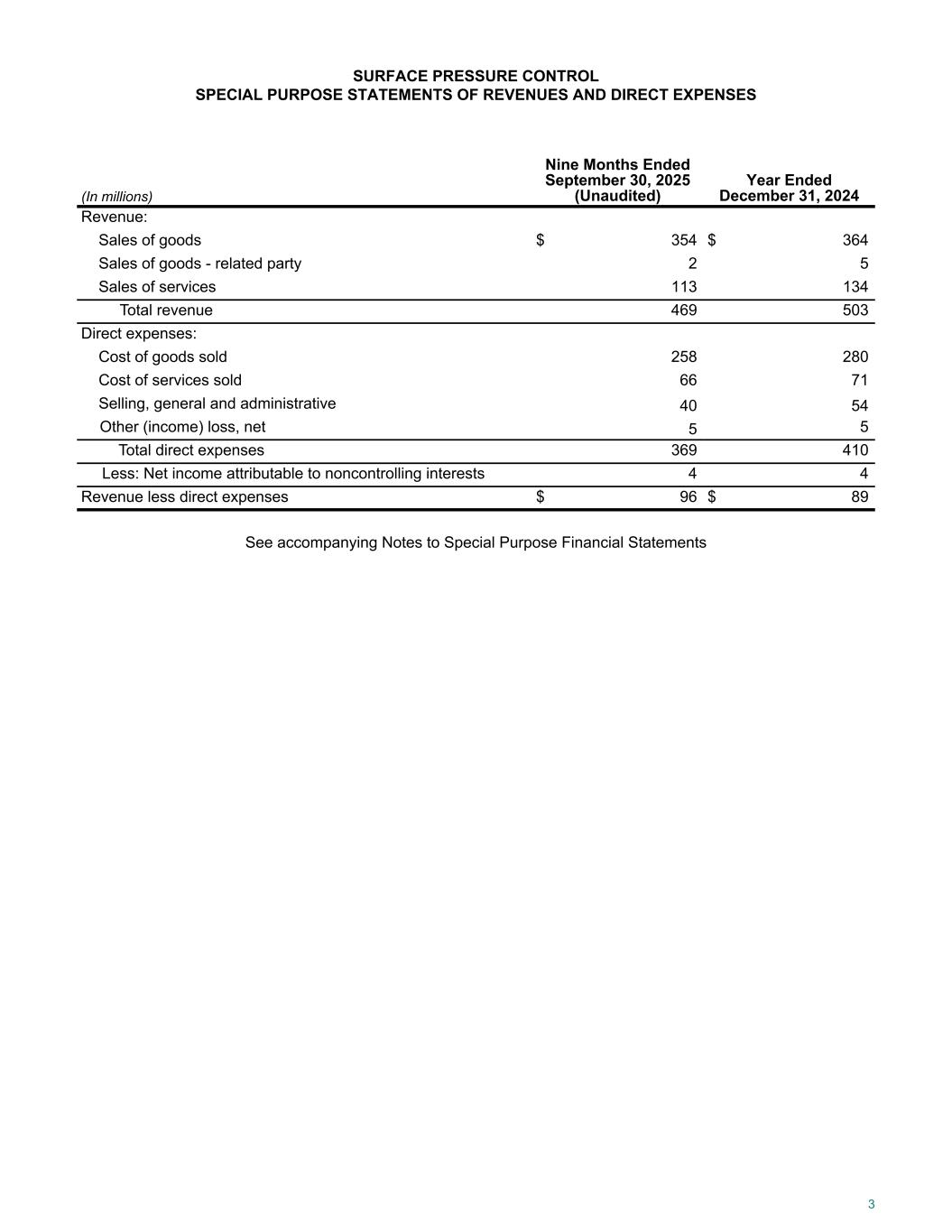
SURFACE PRESSURE CONTROL SPECIAL PURPOSE STATEMENTS OF REVENUES AND DIRECT EXPENSES (In millions) Nine Months Ended September 30, 2025 (Unaudited) Year Ended December 31, 2024 Revenue: Sales of goods $ 354 $ 364 Sales of goods - related party 2 5 Sales of services 113 134 Total revenue 469 503 Direct expenses: Cost of goods sold 258 280 Cost of services sold 66 71 Selling, general and administrative 40 54 Other (income) loss, net 5 5 Total direct expenses 369 410 Less: Net income attributable to noncontrolling interests 4 4 Revenue less direct expenses $ 96 $ 89 See accompanying Notes to Special Purpose Financial Statements 3
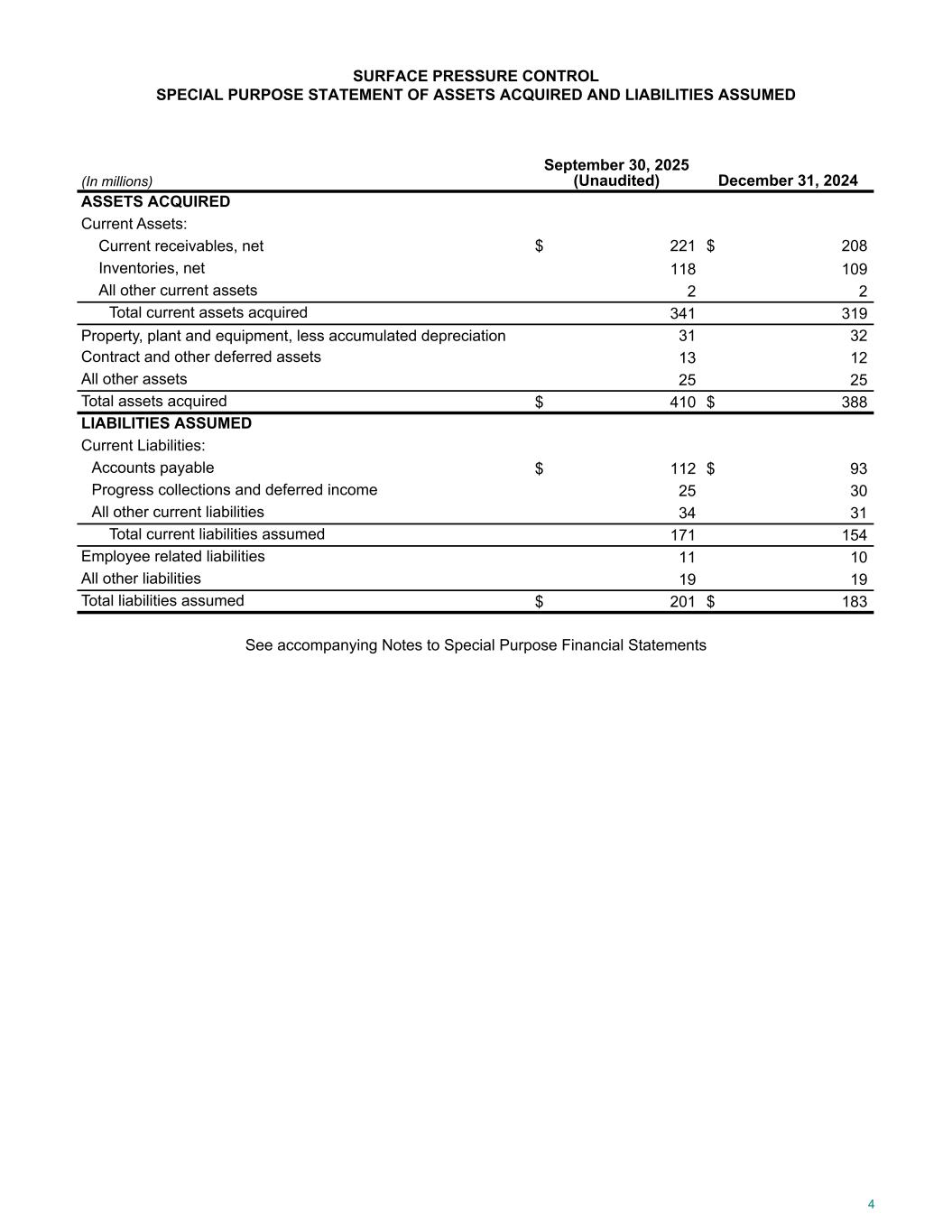
SURFACE PRESSURE CONTROL SPECIAL PURPOSE STATEMENT OF ASSETS ACQUIRED AND LIABILITIES ASSUMED (In millions) September 30, 2025 (Unaudited) December 31, 2024 ASSETS ACQUIRED Current Assets: Current receivables, net $ 221 $ 208 Inventories, net 118 109 All other current assets 2 2 Total current assets acquired 341 319 Property, plant and equipment, less accumulated depreciation 31 32 Contract and other deferred assets 13 12 All other assets 25 25 Total assets acquired $ 410 $ 388 LIABILITIES ASSUMED Current Liabilities: Accounts payable $ 112 $ 93 Progress collections and deferred income 25 30 All other current liabilities 34 31 Total current liabilities assumed 171 154 Employee related liabilities 11 10 All other liabilities 19 19 Total liabilities assumed $ 201 $ 183 See accompanying Notes to Special Purpose Financial Statements 4
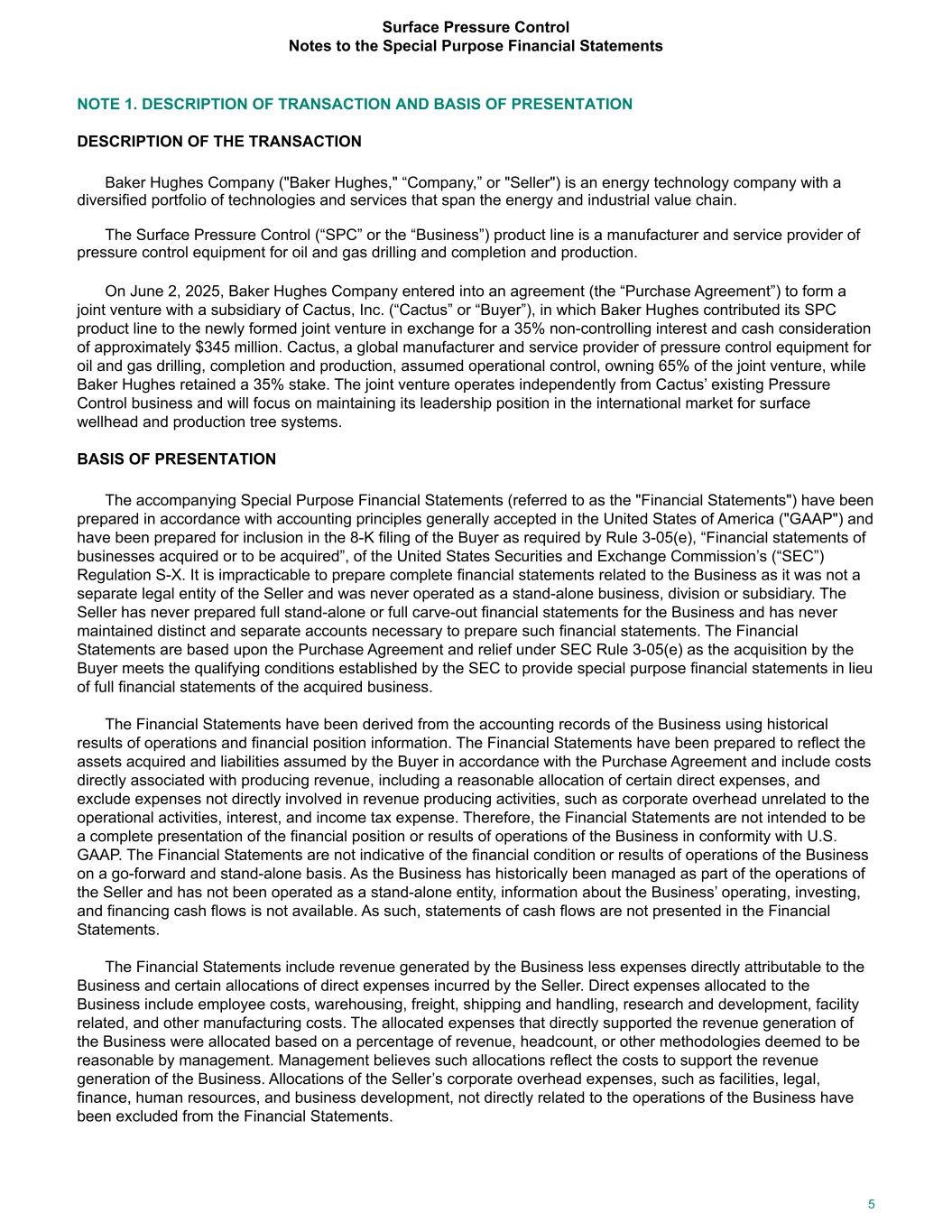
NOTE 1. DESCRIPTION OF TRANSACTION AND BASIS OF PRESENTATION DESCRIPTION OF THE TRANSACTION Baker Hughes Company ("Baker Hughes," “Company,” or "Seller") is an energy technology company with a diversified portfolio of technologies and services that span the energy and industrial value chain. The Surface Pressure Control (“SPC” or the “Business”) product line is a manufacturer and service provider of pressure control equipment for oil and gas drilling and completion and production. On June 2, 2025, Baker Hughes Company entered into an agreement (the “Purchase Agreement”) to form a joint venture with a subsidiary of Cactus, Inc. (“Cactus” or “Buyer”), in which Baker Hughes contributed its SPC product line to the newly formed joint venture in exchange for a 35% non-controlling interest and cash consideration of approximately $345 million. Cactus, a global manufacturer and service provider of pressure control equipment for oil and gas drilling, completion and production, assumed operational control, owning 65% of the joint venture, while Baker Hughes retained a 35% stake. The joint venture operates independently from Cactus’ existing Pressure Control business and will focus on maintaining its leadership position in the international market for surface wellhead and production tree systems. BASIS OF PRESENTATION The accompanying Special Purpose Financial Statements (referred to as the "Financial Statements") have been prepared in accordance with accounting principles generally accepted in the United States of America ("GAAP") and have been prepared for inclusion in the 8-K filing of the Buyer as required by Rule 3-05(e), “Financial statements of businesses acquired or to be acquired”, of the United States Securities and Exchange Commission’s (“SEC”) Regulation S-X. It is impracticable to prepare complete financial statements related to the Business as it was not a separate legal entity of the Seller and was never operated as a stand-alone business, division or subsidiary. The Seller has never prepared full stand-alone or full carve-out financial statements for the Business and has never maintained distinct and separate accounts necessary to prepare such financial statements. The Financial Statements are based upon the Purchase Agreement and relief under SEC Rule 3-05(e) as the acquisition by the Buyer meets the qualifying conditions established by the SEC to provide special purpose financial statements in lieu of full financial statements of the acquired business. The Financial Statements have been derived from the accounting records of the Business using historical results of operations and financial position information. The Financial Statements have been prepared to reflect the assets acquired and liabilities assumed by the Buyer in accordance with the Purchase Agreement and include costs directly associated with producing revenue, including a reasonable allocation of certain direct expenses, and exclude expenses not directly involved in revenue producing activities, such as corporate overhead unrelated to the operational activities, interest, and income tax expense. Therefore, the Financial Statements are not intended to be a complete presentation of the financial position or results of operations of the Business in conformity with U.S. GAAP. The Financial Statements are not indicative of the financial condition or results of operations of the Business on a go-forward and stand-alone basis. As the Business has historically been managed as part of the operations of the Seller and has not been operated as a stand-alone entity, information about the Business’ operating, investing, and financing cash flows is not available. As such, statements of cash flows are not presented in the Financial Statements. The Financial Statements include revenue generated by the Business less expenses directly attributable to the Business and certain allocations of direct expenses incurred by the Seller. Direct expenses allocated to the Business include employee costs, warehousing, freight, shipping and handling, research and development, facility related, and other manufacturing costs. The allocated expenses that directly supported the revenue generation of the Business were allocated based on a percentage of revenue, headcount, or other methodologies deemed to be reasonable by management. Management believes such allocations reflect the costs to support the revenue generation of the Business. Allocations of the Seller’s corporate overhead expenses, such as facilities, legal, finance, human resources, and business development, not directly related to the operations of the Business have been excluded from the Financial Statements. Surface Pressure Control Notes to the Special Purpose Financial Statements 5
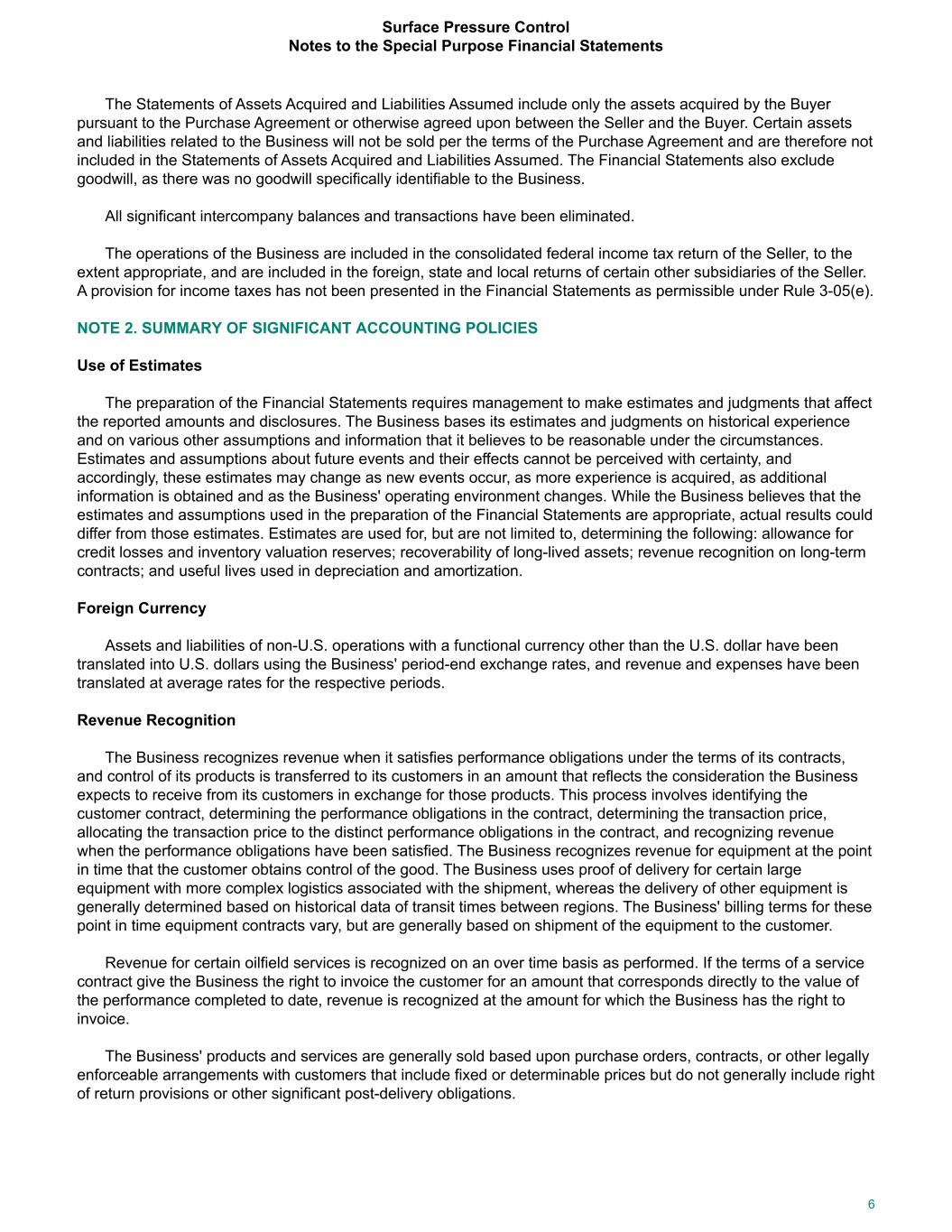
The Statements of Assets Acquired and Liabilities Assumed include only the assets acquired by the Buyer pursuant to the Purchase Agreement or otherwise agreed upon between the Seller and the Buyer. Certain assets and liabilities related to the Business will not be sold per the terms of the Purchase Agreement and are therefore not included in the Statements of Assets Acquired and Liabilities Assumed. The Financial Statements also exclude goodwill, as there was no goodwill specifically identifiable to the Business. All significant intercompany balances and transactions have been eliminated. The operations of the Business are included in the consolidated federal income tax return of the Seller, to the extent appropriate, and are included in the foreign, state and local returns of certain other subsidiaries of the Seller. A provision for income taxes has not been presented in the Financial Statements as permissible under Rule 3-05(e). NOTE 2. SUMMARY OF SIGNIFICANT ACCOUNTING POLICIES Use of Estimates The preparation of the Financial Statements requires management to make estimates and judgments that affect the reported amounts and disclosures. The Business bases its estimates and judgments on historical experience and on various other assumptions and information that it believes to be reasonable under the circumstances. Estimates and assumptions about future events and their effects cannot be perceived with certainty, and accordingly, these estimates may change as new events occur, as more experience is acquired, as additional information is obtained and as the Business' operating environment changes. While the Business believes that the estimates and assumptions used in the preparation of the Financial Statements are appropriate, actual results could differ from those estimates. Estimates are used for, but are not limited to, determining the following: allowance for credit losses and inventory valuation reserves; recoverability of long-lived assets; revenue recognition on long-term contracts; and useful lives used in depreciation and amortization. Foreign Currency Assets and liabilities of non-U.S. operations with a functional currency other than the U.S. dollar have been translated into U.S. dollars using the Business' period-end exchange rates, and revenue and expenses have been translated at average rates for the respective periods. Revenue Recognition The Business recognizes revenue when it satisfies performance obligations under the terms of its contracts, and control of its products is transferred to its customers in an amount that reflects the consideration the Business expects to receive from its customers in exchange for those products. This process involves identifying the customer contract, determining the performance obligations in the contract, determining the transaction price, allocating the transaction price to the distinct performance obligations in the contract, and recognizing revenue when the performance obligations have been satisfied. The Business recognizes revenue for equipment at the point in time that the customer obtains control of the good. The Business uses proof of delivery for certain large equipment with more complex logistics associated with the shipment, whereas the delivery of other equipment is generally determined based on historical data of transit times between regions. The Business' billing terms for these point in time equipment contracts vary, but are generally based on shipment of the equipment to the customer. Revenue for certain oilfield services is recognized on an over time basis as performed. If the terms of a service contract give the Business the right to invoice the customer for an amount that corresponds directly to the value of the performance completed to date, revenue is recognized at the amount for which the Business has the right to invoice. The Business' products and services are generally sold based upon purchase orders, contracts, or other legally enforceable arrangements with customers that include fixed or determinable prices but do not generally include right of return provisions or other significant post-delivery obligations. Surface Pressure Control Notes to the Special Purpose Financial Statements 6
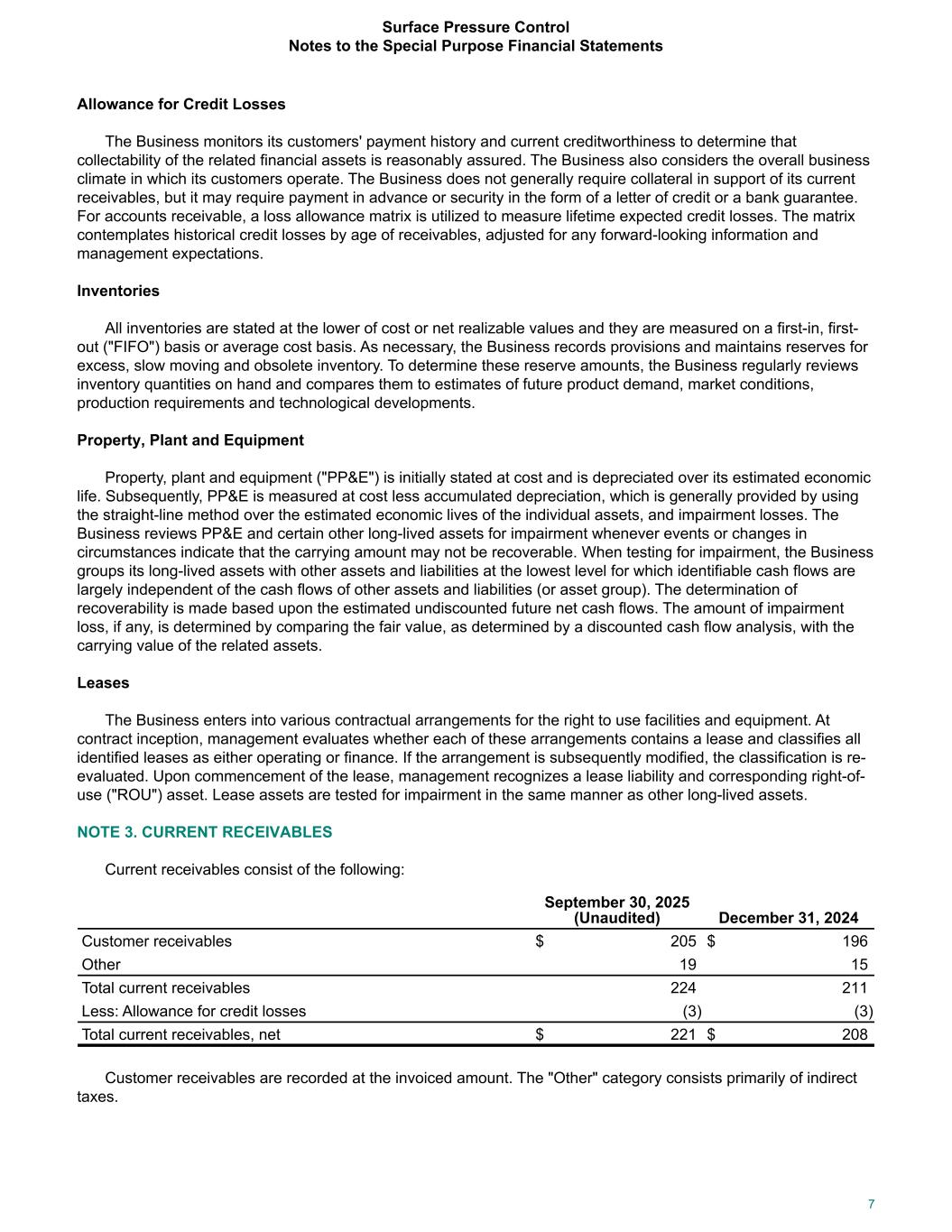
Allowance for Credit Losses The Business monitors its customers' payment history and current creditworthiness to determine that collectability of the related financial assets is reasonably assured. The Business also considers the overall business climate in which its customers operate. The Business does not generally require collateral in support of its current receivables, but it may require payment in advance or security in the form of a letter of credit or a bank guarantee. For accounts receivable, a loss allowance matrix is utilized to measure lifetime expected credit losses. The matrix contemplates historical credit losses by age of receivables, adjusted for any forward-looking information and management expectations. Inventories All inventories are stated at the lower of cost or net realizable values and they are measured on a first-in, first- out ("FIFO") basis or average cost basis. As necessary, the Business records provisions and maintains reserves for excess, slow moving and obsolete inventory. To determine these reserve amounts, the Business regularly reviews inventory quantities on hand and compares them to estimates of future product demand, market conditions, production requirements and technological developments. Property, Plant and Equipment Property, plant and equipment ("PP&E") is initially stated at cost and is depreciated over its estimated economic life. Subsequently, PP&E is measured at cost less accumulated depreciation, which is generally provided by using the straight-line method over the estimated economic lives of the individual assets, and impairment losses. The Business reviews PP&E and certain other long-lived assets for impairment whenever events or changes in circumstances indicate that the carrying amount may not be recoverable. When testing for impairment, the Business groups its long-lived assets with other assets and liabilities at the lowest level for which identifiable cash flows are largely independent of the cash flows of other assets and liabilities (or asset group). The determination of recoverability is made based upon the estimated undiscounted future net cash flows. The amount of impairment loss, if any, is determined by comparing the fair value, as determined by a discounted cash flow analysis, with the carrying value of the related assets. Leases The Business enters into various contractual arrangements for the right to use facilities and equipment. At contract inception, management evaluates whether each of these arrangements contains a lease and classifies all identified leases as either operating or finance. If the arrangement is subsequently modified, the classification is re- evaluated. Upon commencement of the lease, management recognizes a lease liability and corresponding right-of- use ("ROU") asset. Lease assets are tested for impairment in the same manner as other long-lived assets. NOTE 3. CURRENT RECEIVABLES Current receivables consist of the following: September 30, 2025 (Unaudited) December 31, 2024 Customer receivables $ 205 $ 196 Other 19 15 Total current receivables 224 211 Less: Allowance for credit losses (3) (3) Total current receivables, net $ 221 $ 208 Customer receivables are recorded at the invoiced amount. The "Other" category consists primarily of indirect taxes. Surface Pressure Control Notes to the Special Purpose Financial Statements 7
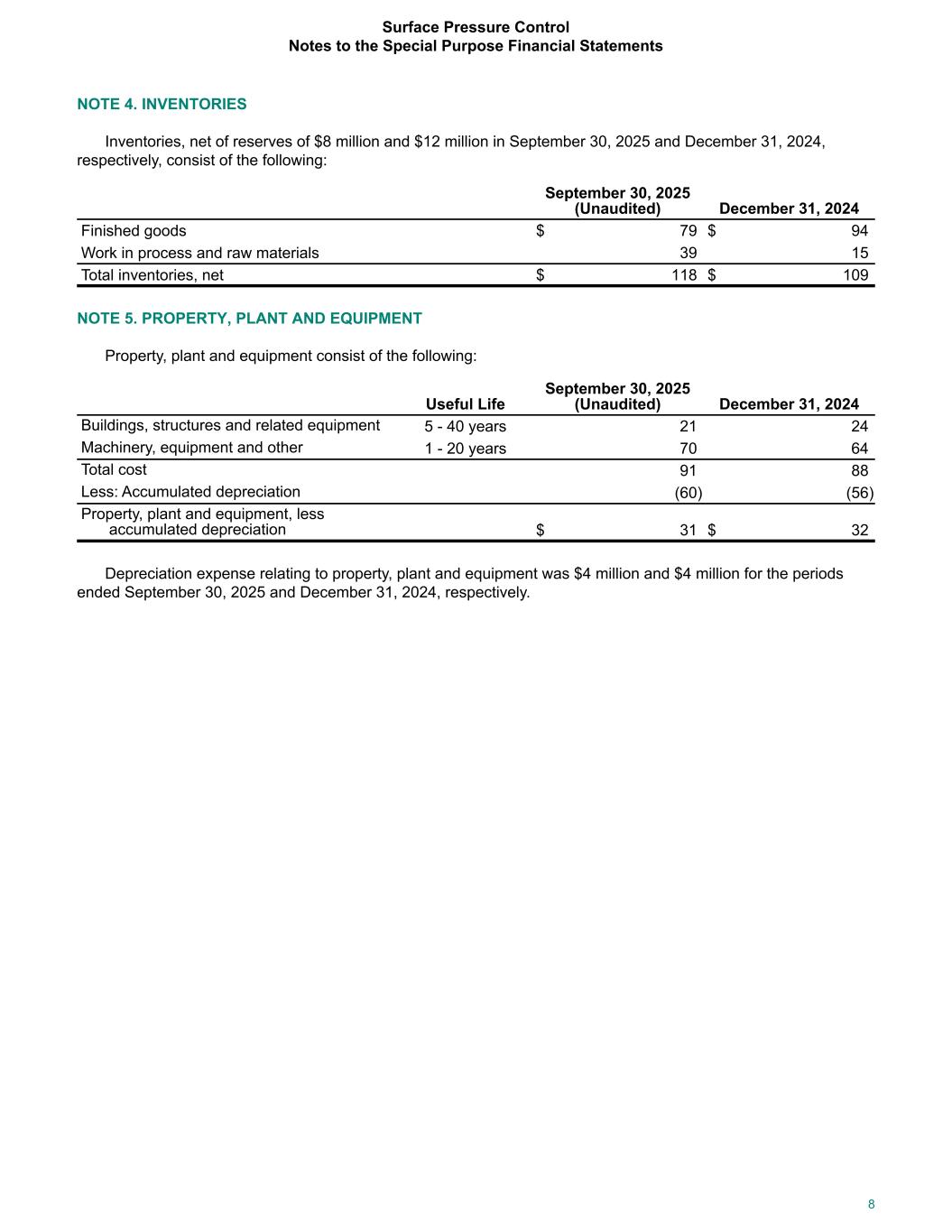
NOTE 4. INVENTORIES Inventories, net of reserves of $8 million and $12 million in September 30, 2025 and December 31, 2024, respectively, consist of the following: September 30, 2025 (Unaudited) December 31, 2024 Finished goods $ 79 $ 94 Work in process and raw materials 39 15 Total inventories, net $ 118 $ 109 NOTE 5. PROPERTY, PLANT AND EQUIPMENT Property, plant and equipment consist of the following: Useful Life September 30, 2025 (Unaudited) December 31, 2024 Buildings, structures and related equipment 5 - 40 years 21 24 Machinery, equipment and other 1 - 20 years 70 64 Total cost 91 88 Less: Accumulated depreciation (60) (56) Property, plant and equipment, less accumulated depreciation $ 31 $ 32 Depreciation expense relating to property, plant and equipment was $4 million and $4 million for the periods ended September 30, 2025 and December 31, 2024, respectively. Surface Pressure Control Notes to the Special Purpose Financial Statements 8
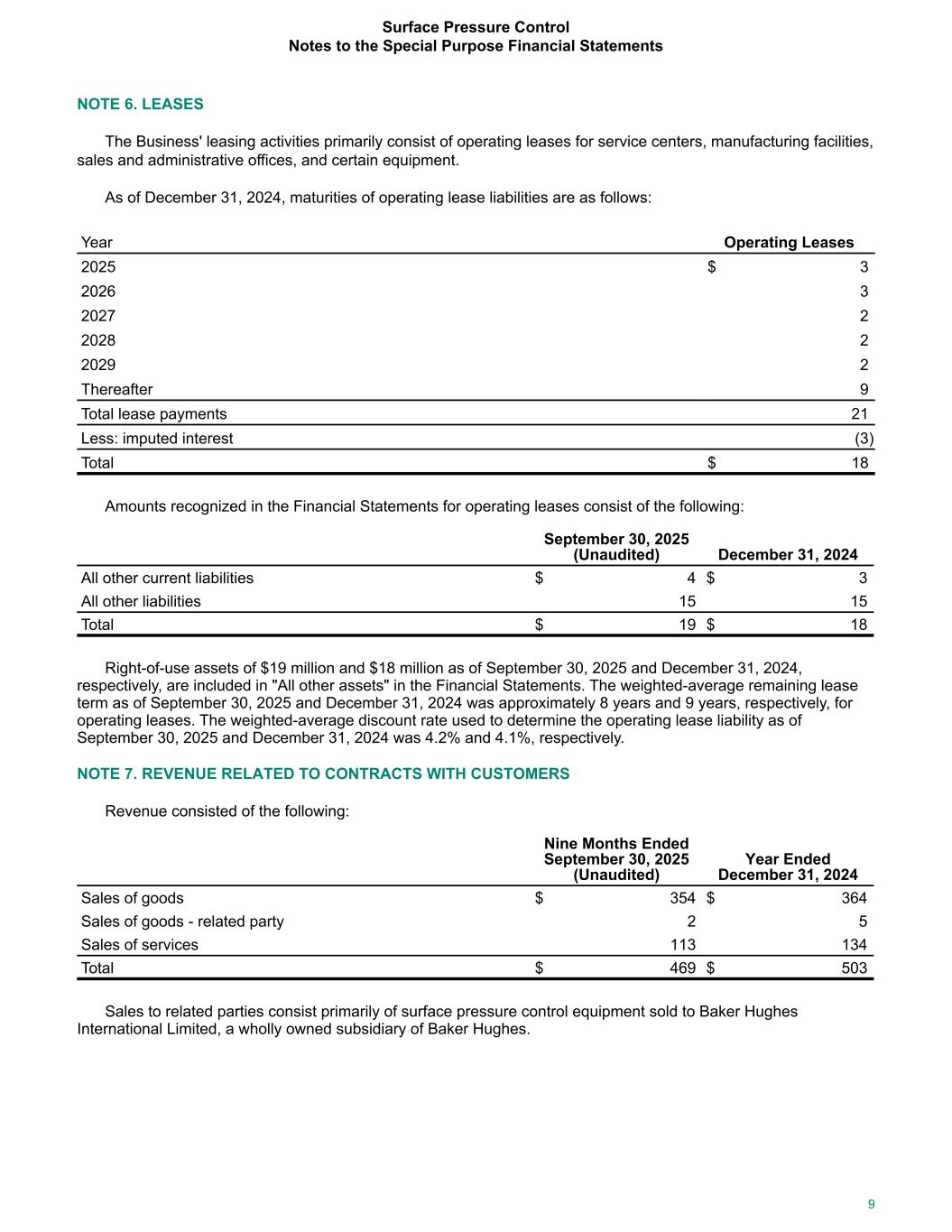
NOTE 6. LEASES The Business' leasing activities primarily consist of operating leases for service centers, manufacturing facilities, sales and administrative offices, and certain equipment. As of December 31, 2024, maturities of operating lease liabilities are as follows: Year Operating Leases 2025 $ 3 2026 3 2027 2 2028 2 2029 2 Thereafter 9 Total lease payments 21 Less: imputed interest (3) Total $ 18 Amounts recognized in the Financial Statements for operating leases consist of the following: September 30, 2025 (Unaudited) December 31, 2024 All other current liabilities $ 4 $ 3 All other liabilities 15 15 Total $ 19 $ 18 Right-of-use assets of $19 million and $18 million as of September 30, 2025 and December 31, 2024, respectively, are included in "All other assets" in the Financial Statements. The weighted-average remaining lease term as of September 30, 2025 and December 31, 2024 was approximately 8 years and 9 years, respectively, for operating leases. The weighted-average discount rate used to determine the operating lease liability as of September 30, 2025 and December 31, 2024 was 4.2% and 4.1%, respectively. NOTE 7. REVENUE RELATED TO CONTRACTS WITH CUSTOMERS Revenue consisted of the following: Nine Months Ended September 30, 2025 (Unaudited) Year Ended December 31, 2024 Sales of goods $ 354 $ 364 Sales of goods - related party 2 5 Sales of services 113 134 Total $ 469 $ 503 Sales to related parties consist primarily of surface pressure control equipment sold to Baker Hughes International Limited, a wholly owned subsidiary of Baker Hughes. Surface Pressure Control Notes to the Special Purpose Financial Statements 9

NOTE 8. SUBSEQUENT EVENTS Subsequent events have been evaluated through November 26, 2025, the date the Financial Statements were available for issuance. There are no subsequent events which have not been disclosed in the Financial Statements. Surface Pressure Control Notes to the Special Purpose Financial Statements 10