Exhibit 99.1
|
|
|
| Announcement |
|

|
|
|
| Monday, 16 March 2026 |
|
Woodside Energy Group Ltd.
ACN 004 898 962 Mia Yellagonga
11 Mount Street Perth WA 6000
Australia T +61 8 9348
4000 www.woodside.com
ASX: WDS NYSE: WDS |
SUSTAINABILITY BRIEFING 2026
At Woodside’s Sustainability Briefing 2026 today, Acting Chief Executive Officer Liz Westcott outlined the central role of sustainability in
Woodside’s strategy and delivery of long-term shareholder value.
Ms Westcott said the briefing highlights how Woodside’s sustainability
priorities drive business performance and deliver value for shareholders and the communities in which Woodside operates.
“Our performance is
supported by strong governance and risk management at the Board and senior management levels of Woodside.
“By providing energy the world needs,
and doing so responsibly and sustainably, we are well placed to build a resilient, profitable business that delivers long-term value for our shareholders.”
Woodside’s Sustainability Report (released as part of the Annual Report) and 2025 Climate and Sustainability Summary were released on 24 February
2026.
Webcast
To access the live webcast of the
Sustainability Briefing Day, please follow the link at https://meetings.lumiconnect.com/300-700-100-662.
The webcast will commence at 11:00 AEDT / 8:00 AWST Monday, 16 March 2026 (19:00 CDT on Sunday, 15 March 2026).
A copy of Woodside’s Sustainability Briefing 2026 slide pack is attached.
|
|
|
|
|
| INVESTORS
Vanessa Martin M: +61 477 397 961
E: investor@woodside.com |
|
MEDIA
Christine Abbott M: +61 484 112 469
E: christine.abbott@woodside.com |
|
|
This announcement was approved and authorised for release by Woodside’s Disclosure Committee.
Sustainability Briefing 2026 16 March
2026 www.woodside.com
Disclaimer, important notes and
assumptions The purpose of this presentation is to enable readers to obtain a high-level understanding of Woodside’s sustainability strategy and performance in 2025. It also includes extracts of broader market analysis relating to the
potential demand for Woodside’s products and services and other information. This presentation does not contain all of the underlying context and detail that is included in the 2025 Climate and Sustainability Summary or section 3.6 of
Woodside’s 2025 Annual Report. This presentation should be read in conjunction with the 2025 Climate and Sustainability Summary and section 3.6 of Woodside’s 2025 Annual Report which includes more fulsome explanation of the underpinning
assumptions, uncertainties and context relevant to the information in this presentation. Information This presentation has been prepared by Woodside Energy Group Ltd (“Woodside”). All information included in this presentation, including
any forward-looking statements, reflects Woodside’s views held as at the date of this presentation and, except as required by applicable law, neither Woodside, its related bodies corporate, nor any of their respective officers, directors,
employees, advisers or representatives (“Beneficiaries”) intends to, undertakes to, or assumes any obligation to, provide any additional information or update or revise any information or forward-looking statements in this presentation
after the date of this presentation, either to make them conform to actual results or as a result of new information, future events, changes in Woodside’s expectations or otherwise. Past performance (including historical financial and
operational information) is not necessarily a reliable indicator of future performance. This presentation may contain industry, market and competitive position data that is based on industry publications and studies conducted by third parties as
well as Woodside’s internal estimates and research. While Woodside believes that each of these publications and third-party studies is reliable and has been prepared by a reputable source, Woodside has not independently verified the market and
industry data obtained from these third-party sources and cannot guarantee the accuracy or completeness of such data. Accordingly, undue reliance should not be placed on any of the industry, market and competitive position data contained in this
presentation. To the maximum extent permitted by law, neither Woodside, its related bodies corporate, nor any of their respective Beneficiaries, assume any liability (including liability for equitable, statutory or other damages) in connection with,
any responsibility for, or make any representation or warranty (express or implied) as to, the fairness, currency, accuracy, adequacy, reliability or completeness of the information or any opinions expressed in this presentation or the
reasonableness of any underlying assumptions. No offer or advice This presentation is not intended to and does not constitute, form part of, or contain an offer or invitation to sell to Woodside shareholders (or any other person), or a solicitation
of an offer from Woodside shareholders (or any other person) or a solicitation of any vote or approval from Woodside shareholders (or any other person) in any jurisdiction. This presentation has been prepared without reference to the investment
objectives, financial and taxation situation or particular needs of any Woodside shareholder or any other person. The information contained in this presentation does not constitute, and should not be taken as, financial product or investment advice.
Woodside encourages you to seek independent legal, financial, taxation and other professional advice before making any investment decision. This presentation and the information contained herein may not be taken or transmitted, in, into or from and
may not be copied, forwarded, distributed or transmitted in or into any jurisdiction in which such release, publication or distribution would be unlawful. The release, presentation, publication or distribution of this presentation, in whole or in
part, in certain jurisdictions may be restricted by law or regulation, and persons into whose possession this presentation comes should inform themselves about, and observe, any such restrictions. Any failure to comply with these restrictions may
constitute a violation of the laws of the relevant jurisdiction. Woodside does not accept liability to any person in relation to the distribution or possession of this document in or from any such jurisdiction. Forward-looking statements This
presentation contains forward-looking statements with respect to Woodside’s business and operations, market conditions, results of operations and financial condition, including, for example, but not limited to, outcomes of transactions,
statements regarding long-term demand for Woodside’s products and services, development, completion and execution of Woodside’s projects, new energy products, expectations and plans for new energy products and lower-carbon services and
investments in, and development of, new energy products and lower-carbon services, and expectations regarding the achievement of Woodside’s net equity Scope 1 and 2 greenhouse gas emissions reduction and Scope 3 investment and emissions
abatement targets and other climate and sustainability goals. All statements, other than statements of historical or present facts, are forward-looking statements and generally may be identified by the use of forward-looking words such as
‘aim’, ‘anticipate’, ‘aspire’, ‘believe’, ‘enable’, ‘estimate, ‘expect’, ‘forecast’, ‘foresee’, ‘guidance’, ‘intend’,
‘likely’, ‘may’, ‘outlook’, ‘plan’, ‘potential’, ‘project’, ‘schedule’, ‘seek’, ‘should’, ‘strategy’, ‘target’,
‘will’ and other similar words or expressions. Similarly, statements that describe the objectives, plans, goals or expectations of Woodside are forward-looking statements. Forward looking statements in this presentation are not guidance,
forecasts, guarantees or predictions of future events or performance. No representation or warranty, express or implied, is given as to the accuracy, completeness or correctness, likelihood of achievement or reasonableness of any forward looking
information in this document. Readers should not place undue reliance on any forward looking statements contained in this document, particularly in light of the long time horizon this document discusses and inherent uncertainty in policy, market and
technological developments in the future. Those statements and any assumptions on which they are based are subject to change without notice and are subject to inherent known and unknown risks, uncertainties, assumptions and other factors, many of
which are beyond the control of Woodside, its related bodies corporate and their respective officers, directors, employees, advisers or representatives. Forward looking information in this presentation may be affected by variables and changes in
underlying assumptions which could cause actual results to differ materially from those expressed in this document. In addition to the risks referenced above these include price fluctuations, actual demand, currency fluctuations, drilling and
production results, reserve estimates, loss of market, industry competition, environmental risks, transition risks, physical risks, legislative, policy, fiscal and regulatory developments, changes in accounting standards, economic and financial
market conditions in various countries and regions, political risks, abatement able to be delivered through engineering or operational changes, project delay or advancement, approvals, cost estimates and risks associated with acquisitions, mergers
and joint ventures, including difficulties integrating or separating businesses, uncertainty associated with financial projections, restructuring, increased costs and adverse tax consequences, and uncertainties and liabilities associated with
acquired and divested properties and businesses. Some matters are subject to approval of joint venture participants.
Disclaimer, important notes and
assumptions (continued) Forward-looking statements (continued) A detailed summary of the key risks relating to Woodside and its business can be found in the “Risk” section of Woodside’s most recent Annual Report released to the
Australian Securities Exchange and in Woodside’s most recent Annual Report on Form 20-F filed with the United States Securities and Exchange Commission and available on the Woodside website at
https://www.woodside.com/investors/reports-investor-briefings. You should review and have regard to these risks when considering the information contained in this presentation. If any of the assumptions on which a forward-looking statement is based
were to change or be found to be incorrect, this would likely cause outcomes to differ from the statements made in this presentation. Investors are strongly cautioned not to place undue reliance on any forward-looking statements. Actual results or
performance may vary materially from those expressed in, or implied by, any forward-looking statements. All forward-looking statements contained in this presentation reflect Woodside’s views held as at the date of this presentation and, except
as required by applicable law, Woodside does not intend to, undertake to, or assume any obligation to, provide any additional information or update or revise any of these statements after the date of this presentation, either to make them conform to
actual results or as a result of new information, future events, changes in Woodside’s expectations or otherwise. Climate strategy and emissions data All greenhouse gas emissions data in this presentation are estimates, due to the inherent
uncertainty and limitations in measuring or quantifying greenhouse gas emissions, and our methodologies for measuring or quantifying greenhouse gas emissions may evolve as best practices continue to develop and data quality and quantity continue to
improve. Woodside “greenhouse gas” or “emissions” information reported are net equity Scope 1 greenhouse gas emissions, Scope 2 greenhouse gas emissions, and/or Scope 3 greenhouse gas emissions, unless otherwise stated. For
more information on Woodside's climate strategy and performance, including further details regarding Woodside's targets, aspirations and goals and the underlying methodology, judgements, assumptions and contingencies, refer to Woodside’s 2025
Climate and Sustainability Summary, available on the Woodside website at https://www.woodside.com/sustainability and section 3.6 of Woodside’s 2025 Annual Report. The glossary and footnotes to this presentation provide clarification regarding
the use of terms such as "lower-carbon“ under Woodside's strategy. A full glossary of terms used in connection with Woodside's strategy is contained in Woodside’s 2025 Annual Report. Other important information All references to dollars,
cents or $ in this presentation are to US currency, unless otherwise stated. References to “Woodside” may be references to Woodside Energy Group Ltd and/or its applicable subsidiaries (as the context requires). This presentation does not
include any express or implied prices at which Woodside will buy or sell financial products. A securities rating is not a recommendation to buy, sell or hold securities and may be subject to revision or withdrawal at any time.
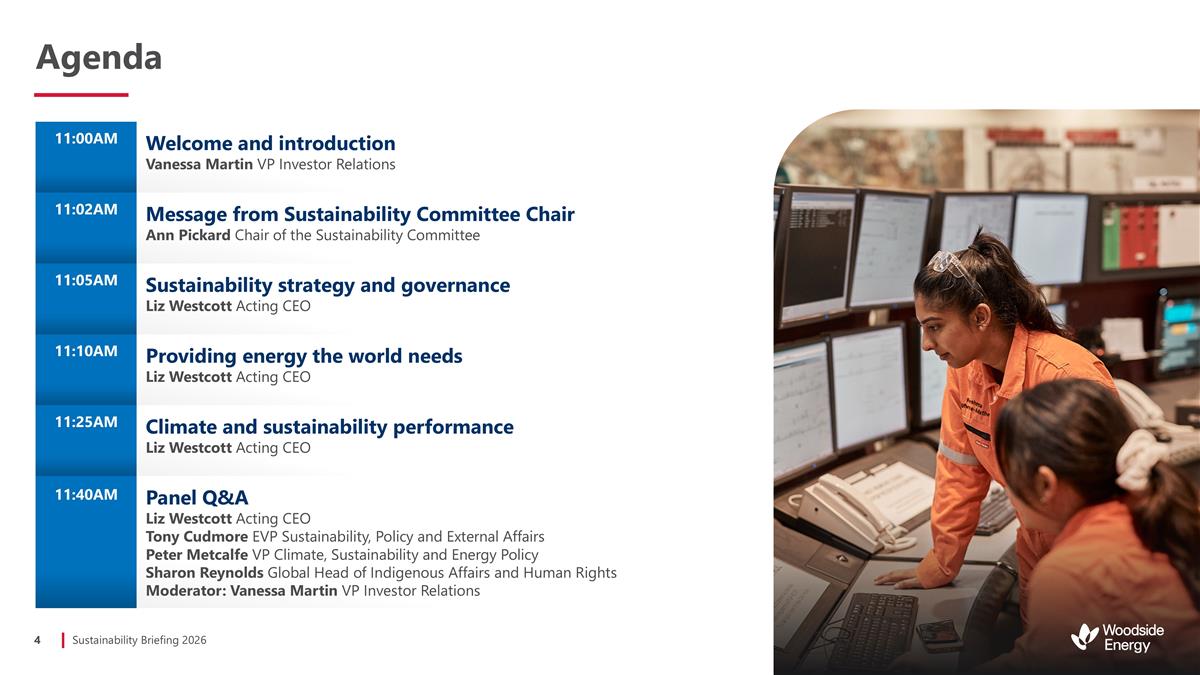
11:00AM Welcome and introduction
Vanessa Martin VP Investor Relations 11:02AM Message from Sustainability Committee Chair Ann Pickard Chair of the Sustainability Committee 11:05AM Sustainability strategy and governance Liz Westcott Acting CEO 11:10AM Providing energy the world
needs Liz Westcott Acting CEO 11:25AM Climate and sustainability performance Liz Westcott Acting CEO 11:40AM Panel Q&A Liz Westcott Acting CEO Tony Cudmore EVP Sustainability, Policy and External Affairs Peter Metcalfe VP Climate, Sustainability
and Energy Policy Sharon Reynolds Global Head of Indigenous Affairs and Human Rights Moderator: Vanessa Martin VP Investor Relations Agenda
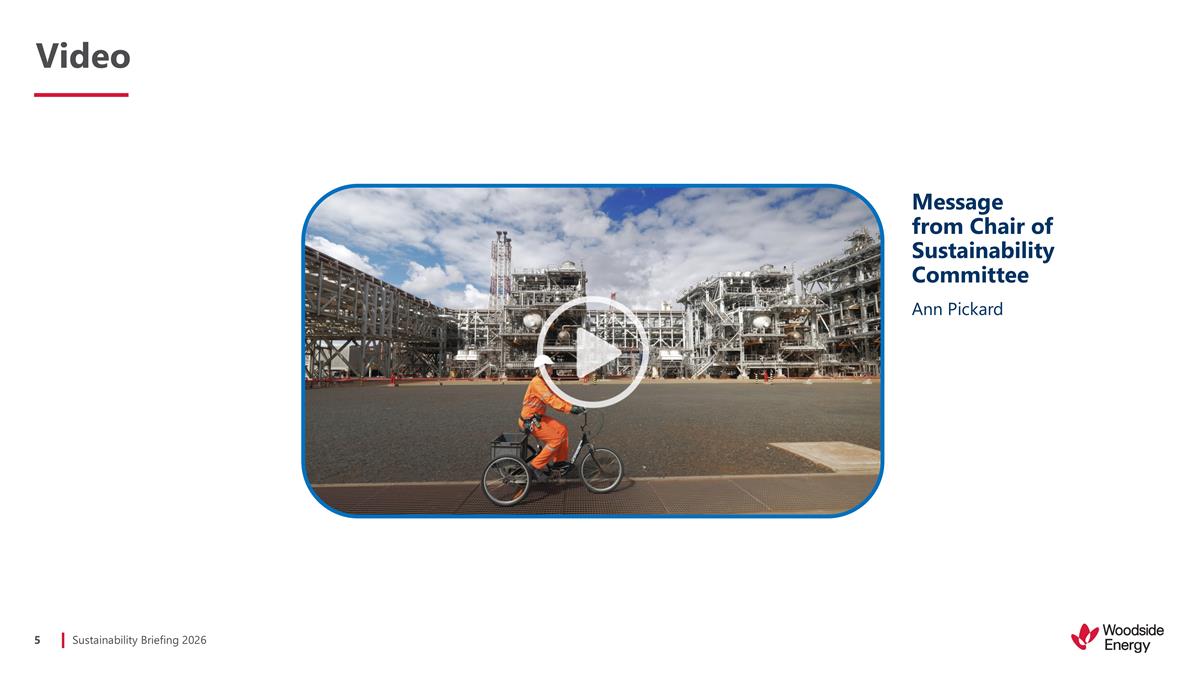
Video Message from Chair of
Sustainability Committee Ann Pickard
Liz Westcott Acting CEO Sustainability
strategy and governance
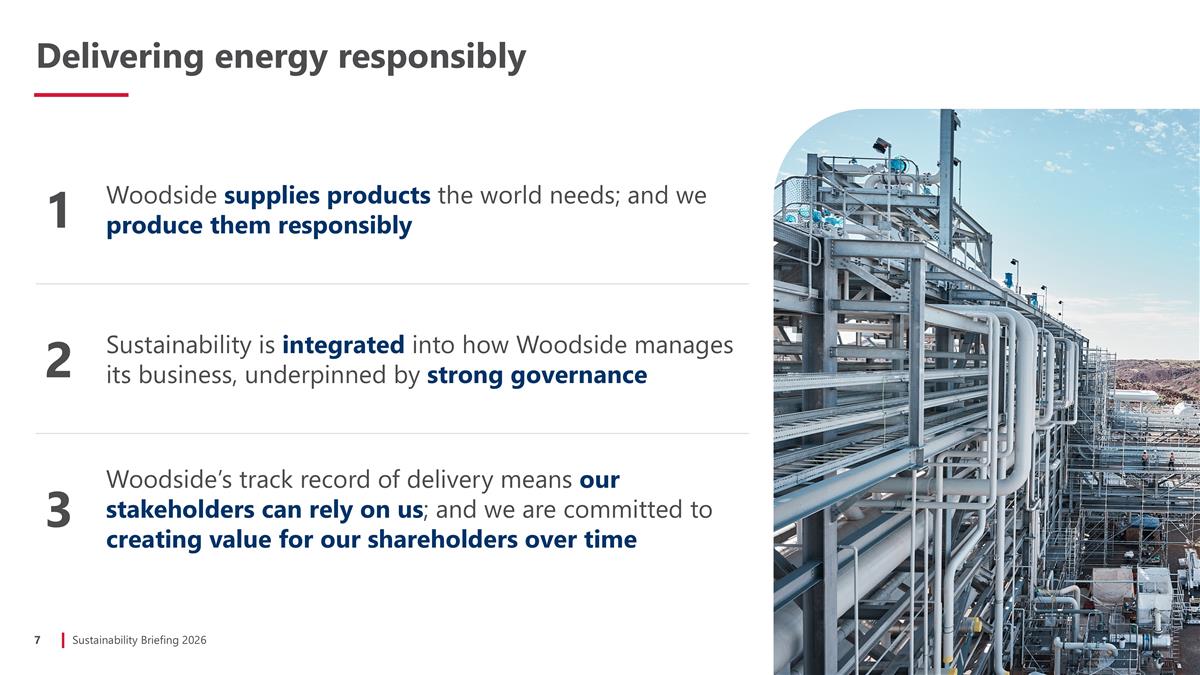
Delivering energy responsibly 1
Woodside supplies products the world needs; and we produce them responsibly 2 Sustainability is integrated into how Woodside manages its business, underpinned by strong governance 3 Woodside’s track record of delivery means our stakeholders
can rely on us; and we are committed to creating value for our shareholders over time
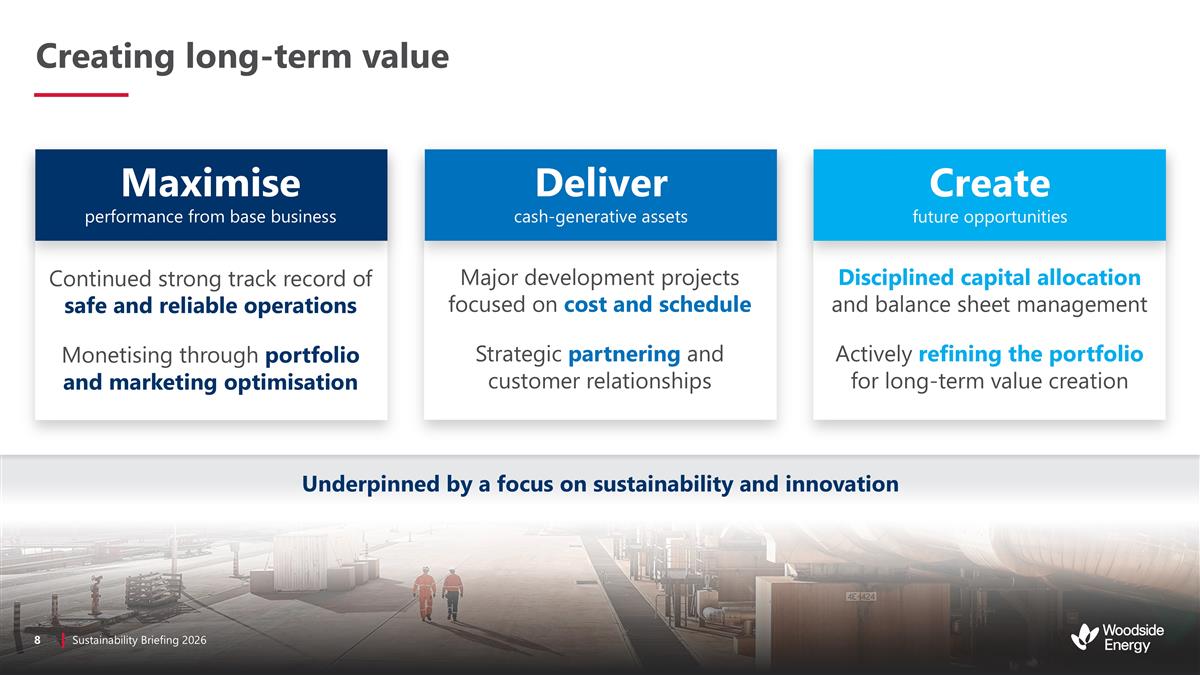
Creating long-term value Continued
strong track record of safe and reliable operations Monetising through portfolio and marketing optimisation Major development projects focused on cost and schedule Strategic partnering and customer relationships Disciplined capital allocation and
balance sheet management Actively refining the portfolio for long-term value creation Maximise performance from base business Deliver cash-generative assets Create future opportunities Sustainability Briefing 2026 Underpinned by a focus on
sustainability and innovation
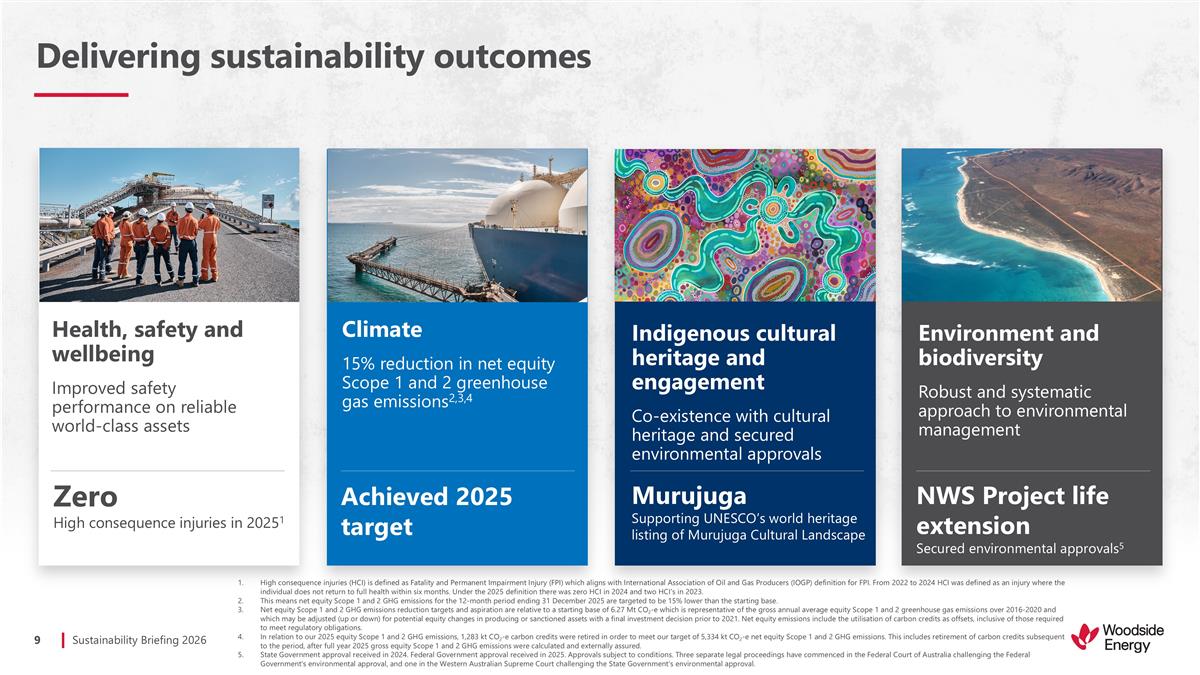
Delivering sustainability and
innovation outcomes Delivering sustainability outcomes High consequence injuries (HCI) is defined as Fatality and Permanent Impairment Injury (FPI) which aligns with International Association of Oil and Gas Producers (IOGP) definition for FPI. From
2022 to 2024 HCI was defined as an injury where the individual does not return to full health within six months. Under the 2025 definition there was zero HCI in 2024 and two HCI’s in 2023. This means net equity Scope 1 and 2 GHG emissions for
the 12-month period ending 31 December 2025 are targeted to be 15% lower than the starting base. Net equity Scope 1 and 2 GHG emissions reduction targets and aspiration are relative to a starting base of 6.27 Mt CO2-e which is representative of the
gross annual average equity Scope 1 and 2 greenhouse gas emissions over 2016-2020 and which may be adjusted (up or down) for potential equity changes in producing or sanctioned assets with a final investment decision prior to 2021. Net equity
emissions include the utilisation of carbon credits as offsets, inclusive of those required to meet regulatory obligations. In relation to our 2025 equity Scope 1 and 2 GHG emissions, 1,283 kt CO2‑e carbon credits were retired in order to meet
our target of 5,334 kt CO2‑e net equity Scope 1 and 2 GHG emissions. This includes retirement of carbon credits subsequent to the period, after full year 2025 gross equity Scope 1 and 2 GHG emissions were calculated and externally
assured. State Government approval received in 2024. Federal Government approval received in 2025. Approvals subject to conditions. Three separate legal proceedings have commenced in the Federal Court of Australia challenging the Federal
Government's environmental approval, and one in the Western Australian Supreme Court challenging the State Government's environmental approval. Climate 15% reduction in net equity Scope 1 and 2 greenhouse gas emissions2,3,4 Indigenous cultural
heritage and engagement Co-existence with cultural heritage and secured environmental approvals Environment and biodiversity Robust and systematic approach to environmental management Health, safety and wellbeing Improved safety performance on
reliable world-class assets Zero High consequence injuries in 20251 Murujuga Supporting UNESCO’s world heritage listing of Murujuga Cultural Landscape Achieved 2025 target NWS Project life extension Secured environmental approvals5
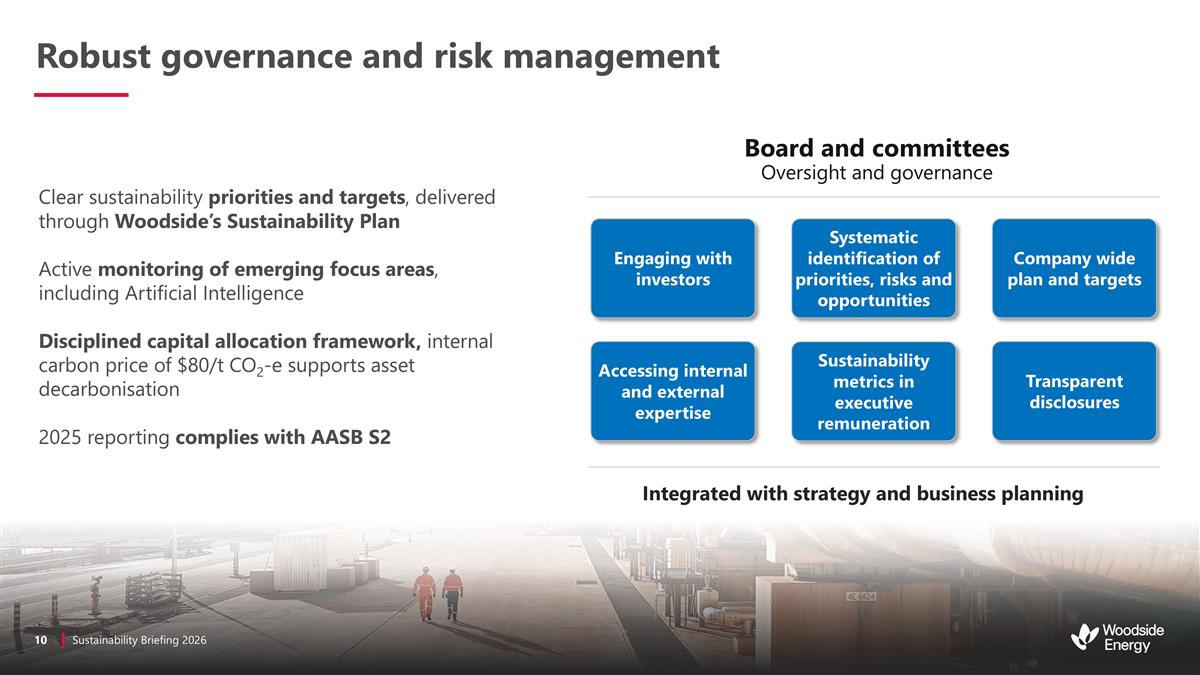
Robust governance and risk
management Sustainability Briefing 2026 Board and committees Oversight and governance Engaging with investors Systematic identification of priorities, risks and opportunities Company wide plan and targets Accessing internal and external expertise
Sustainability metrics in executive remuneration Transparent disclosures Integrated with strategy and business planning Clear sustainability priorities and targets, delivered through Woodside’s Sustainability Plan Active monitoring of emerging
focus areas, including Artificial Intelligence Disciplined capital allocation framework, internal carbon price of $80/t CO2-e supports asset decarbonisation 2025 reporting complies with AASB S2
Liz Westcott Acting CEO Providing
energy the world needs
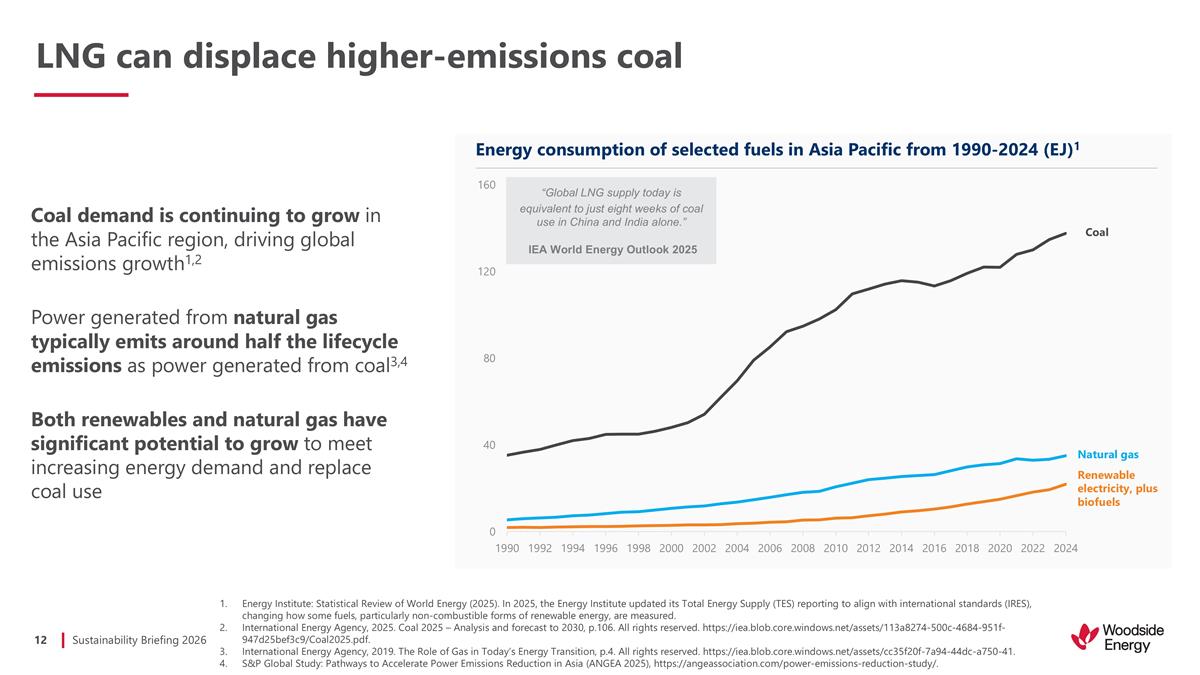
LNG can displace higher-emissions
coal Energy Institute: Statistical Review of World Energy (2025). In 2025, the Energy Institute updated its Total Energy Supply (TES) reporting to align with international standards (IRES), changing how some fuels, particularly non-combustible forms
of renewable energy, are measured. International Energy Agency, 2025. Coal 2025 – Analysis and forecast to 2030, p.106. All rights reserved. https://iea.blob.core.windows.net/assets/113a8274-500c-4684-951f-947d25bef3c9/Coal2025.pdf.
International Energy Agency, 2019. The Role of Gas in Today’s Energy Transition, p.4. All rights reserved. https://iea.blob.core.windows.net/assets/cc35f20f‑7a94‑44dc‑a750‑41. S&P Global Study: Pathways to
Accelerate Power Emissions Reduction in Asia (ANGEA 2025), https://angeassociation.com/power‑emissions‑reduction‑study/. Coal demand is continuing to grow in the Asia Pacific region, driving global emissions growth1,2 Power
generated from natural gas typically emits around half the lifecycle emissions as power generated from coal3,4 Both renewables and natural gas have significant potential to grow to meet increasing energy demand and replace coal use Energy
consumption of selected fuels in Asia Pacific from 1990-2024 (EJ)1 Coal Natural gas Renewable electricity, plus biofuels “Global LNG supply today is equivalent to just eight weeks of coal use in China and India alone.” IEA World Energy
Outlook 2025
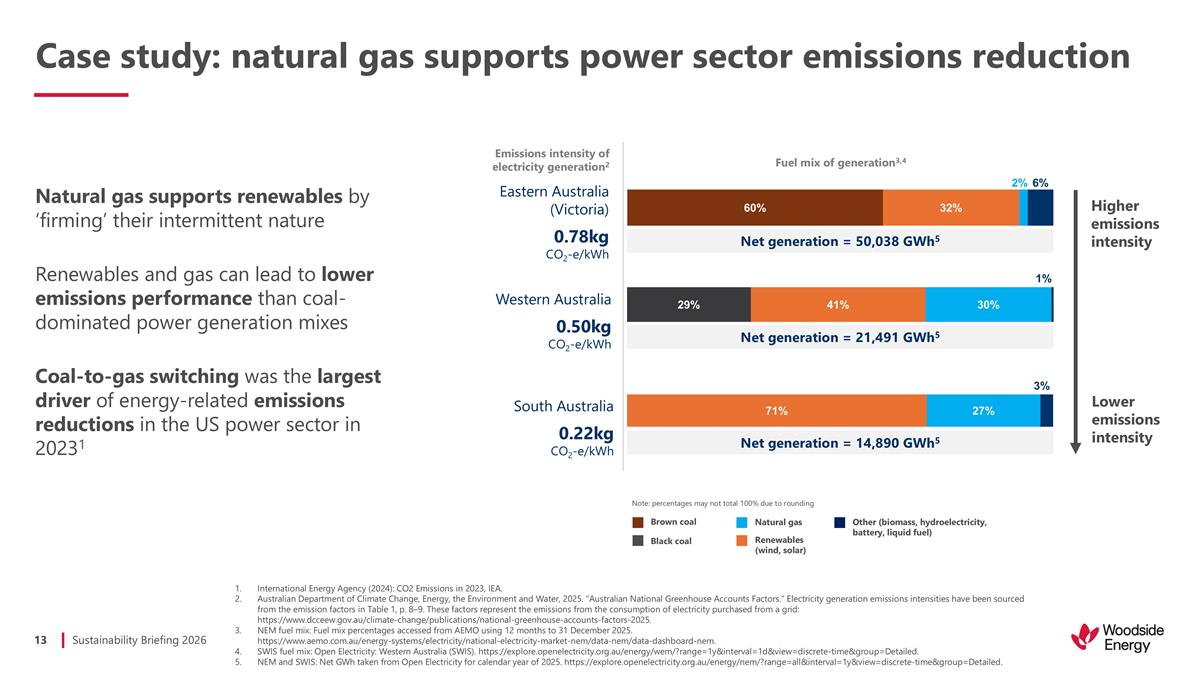
South Australia 0.22kg CO2-e/kWh
Eastern Australia (Victoria) 0.78kg CO2-e/kWh Western Australia 0.50kg CO2-e/kWh Case study: natural gas supports power sector emissions reduction Natural gas supports renewables by ‘firming’ their intermittent nature Renewables and
gas can lead to lower emissions performance than coal-dominated power generation mixes Coal-to-gas switching was the largest driver of energy-related emissions reductions in the US power sector in 20231 Emissions intensity of electricity generation2
Net generation = 50,038 GWh5 Net generation = 21,491 GWh5 Net generation = 14,890 GWh5 Higher emissions intensity Lower emissions intensity Brown coal Black coal Natural gas Renewables (wind, solar) Other (biomass, hydroelectricity, battery, liquid
fuel) Fuel mix of generation3,4 International Energy Agency (2024): CO2 Emissions in 2023, IEA. Australian Department of Climate Change, Energy, the Environment and Water, 2025. “Australian National Greenhouse Accounts Factors.”
Electricity generation emissions intensities have been sourced from the emission factors in Table 1, p. 8–9. These factors represent the emissions from the consumption of electricity purchased from a grid:
https://www.dcceew.gov.au/climate‑change/publications/national‑greenhouse‑accounts‑factors‑2025. NEM fuel mix: Fuel mix percentages accessed from AEMO using 12 months to 31 December 2025.
https://www.aemo.com.au/energy‑systems/electricity/national‑electricity‑market‑nem/data‑nem/data‑dashboard‑nem. SWIS fuel mix: Open Electricity: Western Australia (SWIS).
https://explore.openelectricity.org.au/energy/wem/?range=1y&interval=1d&view=discrete‑time&group=Detailed. NEM and SWIS: Net GWh taken from Open Electricity for calendar year of 2025.
https://explore.openelectricity.org.au/energy/nem/?range=all&interval=1y&view=discrete‑time&group=Detailed. Note: percentages may not total 100% due to rounding
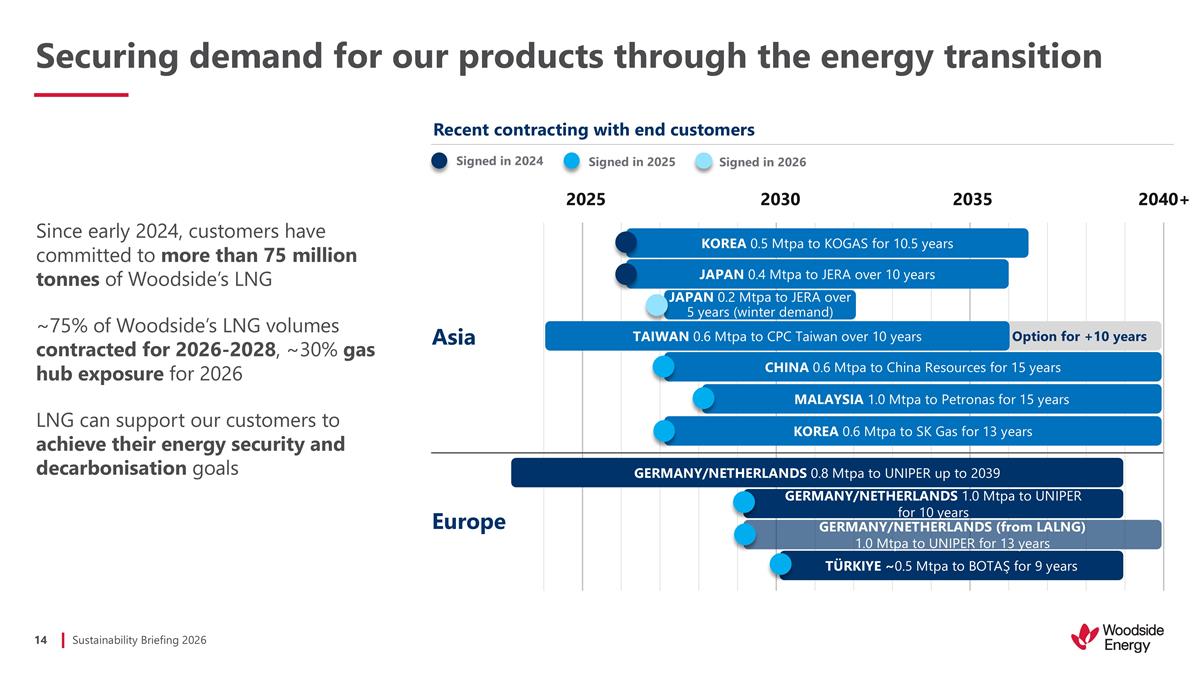
Securing demand for our products
through the energy transition 2025 2030 2035 2040+ JAPAN 0.4 Mtpa to JERA over 10 years KOREA 0.5 Mtpa to KOGAS for 10.5 years GERMANY/NETHERLANDS 0.8 Mtpa to UNIPER up to 2039 CHINA 0.6 Mtpa to China Resources for 15 years MALAYSIA 1.0 Mtpa to
Petronas for 15 years TÜRKIYE ~0.5 Mtpa to BOTAŞ for 9 years GERMANY/NETHERLANDS (from LALNG) 1.0 Mtpa to UNIPER for 13 years Option for +10 years TAIWAN 0.6 Mtpa to CPC Taiwan over 10 years JAPAN 0.2 Mtpa to JERA over 5 years (winter
demand) GERMANY/NETHERLANDS 1.0 Mtpa to UNIPER for 10 years KOREA 0.6 Mtpa to SK Gas for 13 years Recent contracting with end customers Signed in 2025 Since early 2024, customers have committed to more than 75 million tonnes of Woodside’s LNG
~75% of Woodside’s LNG volumes contracted for 2026-2028, ~30% gas hub exposure for 2026 LNG can support our customers to achieve their energy security and decarbonisation goals Asia Europe Signed in 2026 Signed in 2024
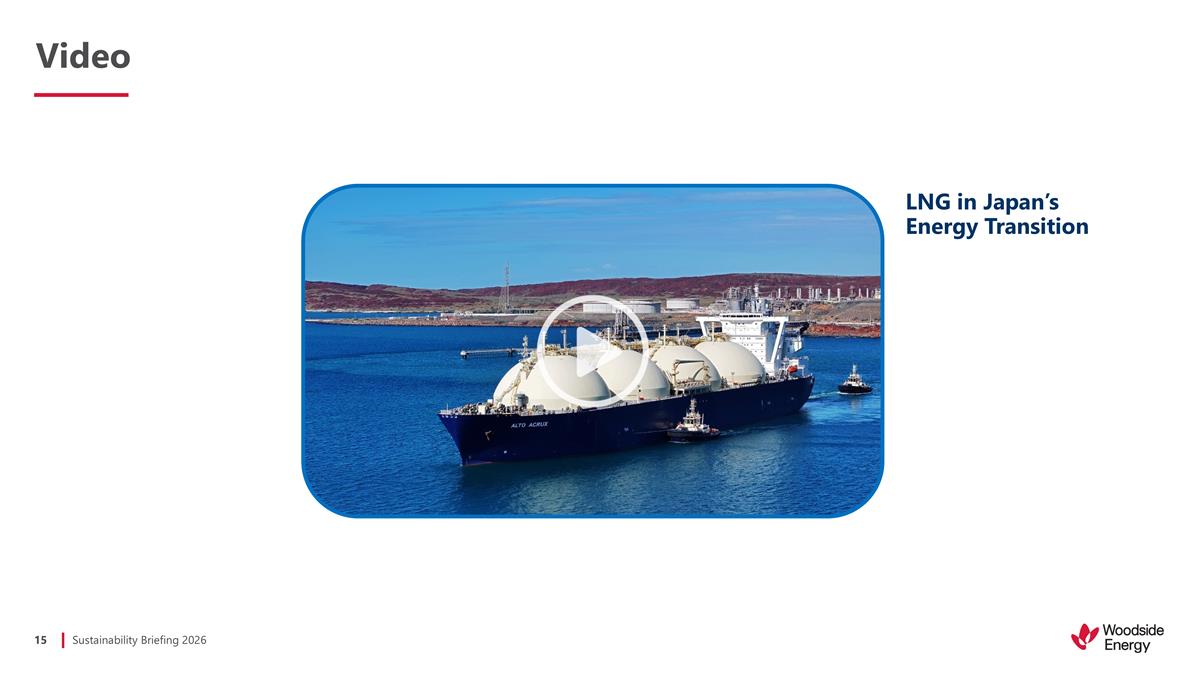
Video LNG in Japan’s Energy
Transition
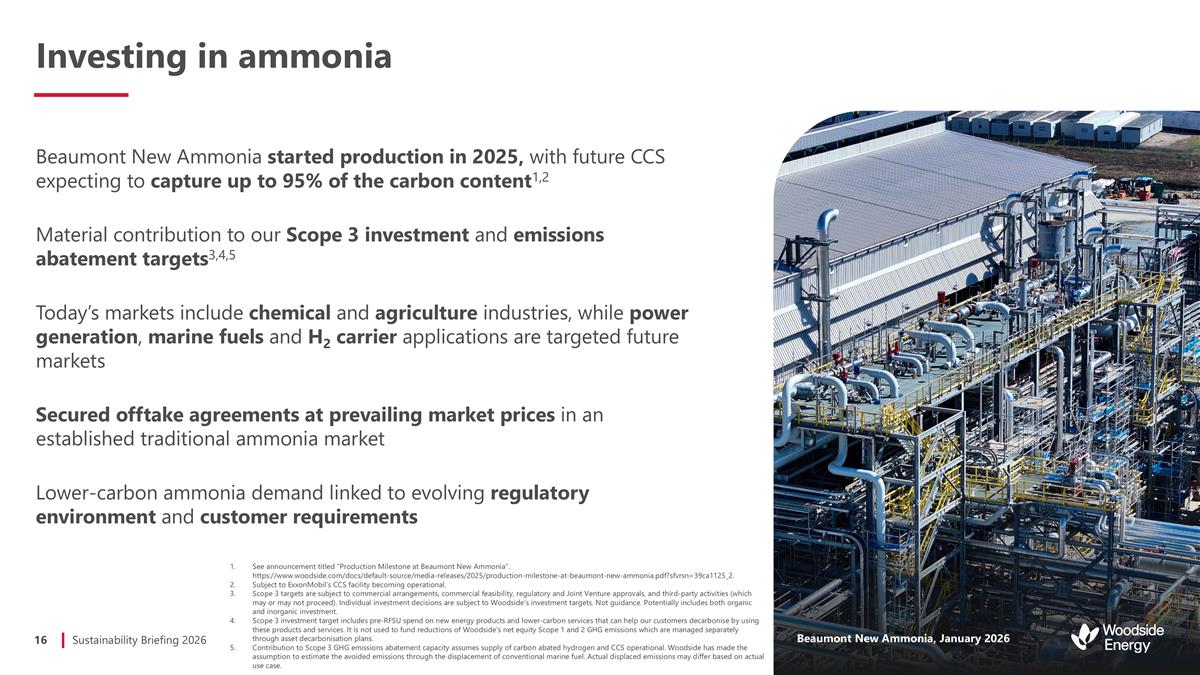
Investing in ammonia Beaumont New
Ammonia started production in 2025, with future CCS expecting to capture up to 95% of the carbon content1,2 Material contribution to our Scope 3 investment and emissions abatement targets3,4,5 Today’s markets include chemical and agriculture
industries, while power generation, marine fuels and H2 carrier applications are targeted future markets Secured offtake agreements at prevailing market prices in an established traditional ammonia market Lower-carbon ammonia demand linked to
evolving regulatory environment and customer requirements See announcement titled “Production Milestone at Beaumont New Ammonia”.
https://www.woodside.com/docs/default‑source/media‑releases/2025/production‑milestone‑at‑beaumont‑new‑ammonia.pdf?sfvrsn=39ca1125_2. Subject to ExxonMobil’s CCS facility becoming operational. Scope 3
targets are subject to commercial arrangements, commercial feasibility, regulatory and Joint Venture approvals, and third-party activities (which may or may not proceed). Individual investment decisions are subject to Woodside’s investment
targets. Not guidance. Potentially includes both organic and inorganic investment. Scope 3 investment target includes pre‑RFSU spend on new energy products and lower‑carbon services that can help our customers decarbonise by using these
products and services. It is not used to fund reductions of Woodside’s net equity Scope 1 and 2 GHG emissions which are managed separately through asset decarbonisation plans. Contribution to Scope 3 GHG emissions abatement capacity assumes
supply of carbon abated hydrogen and CCS operational. Woodside has made the assumption to estimate the avoided emissions through the displacement of conventional marine fuel. Actual displaced emissions may differ based on actual use case. Beaumont
New Ammonia, January 2026
Liz Westcott Acting CEO Climate and
sustainability performance
Improved safety performance
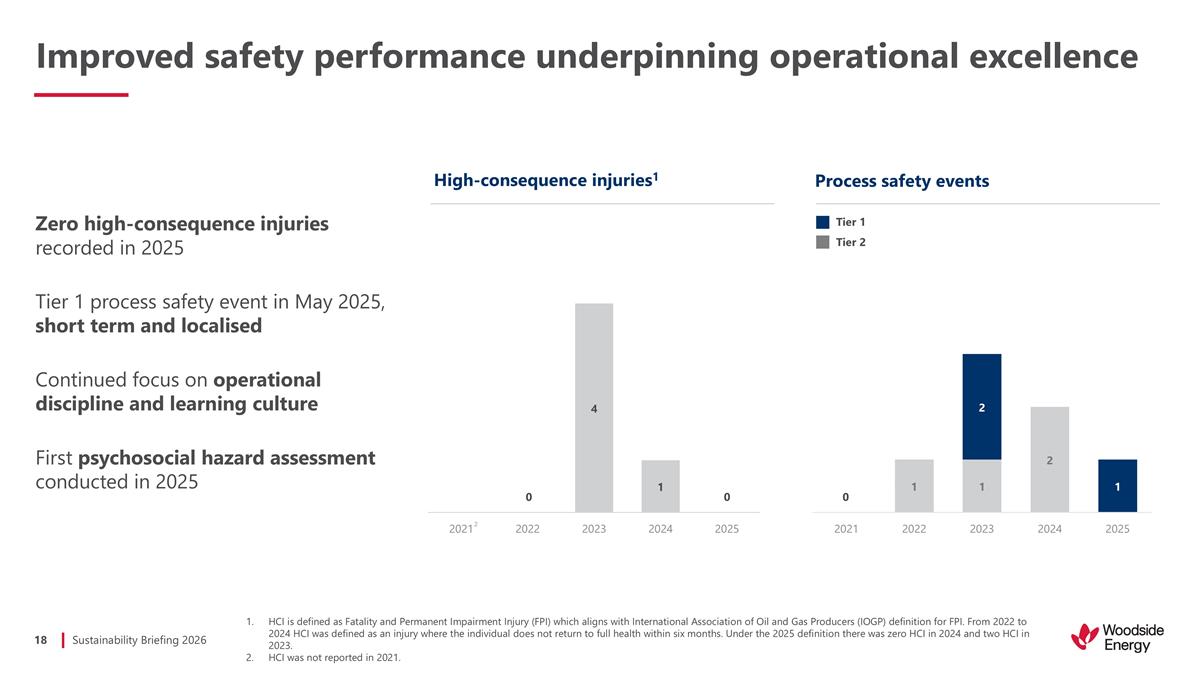
underpinning operational excellence HCI is defined as Fatality and Permanent Impairment Injury (FPI) which aligns with International Association of Oil and Gas Producers (IOGP) definition for FPI. From 2022 to 2024 HCI was defined as an injury where
the individual does not return to full health within six months. Under the 2025 definition there was zero HCI in 2024 and two HCI in 2023. HCI was not reported in 2021. High-consequence injuries1 Process safety events Zero high-consequence injuries
recorded in 2025 Tier 1 process safety event in May 2025, short term and localised Continued focus on operational discipline and learning culture First psychosocial hazard assessment conducted in 2025 Tier 1 Tier 2 0 2
Climate: delivered emissions
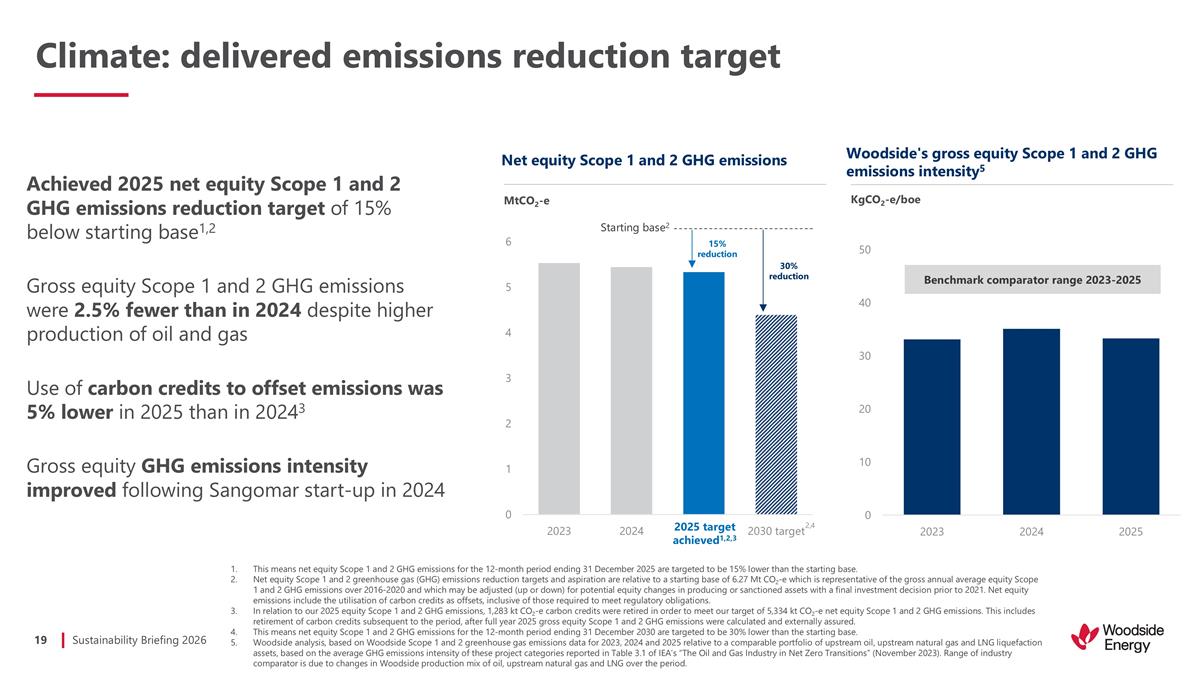
reduction target Achieved 2025 net equity Scope 1 and 2 GHG emissions reduction target of 15% below starting base1,2 Gross equity Scope 1 and 2 GHG emissions were 2.5% fewer than in 2024 despite higher production of oil and gas Use of carbon credits
to offset emissions was 5% lower in 2025 than in 20243 Gross equity GHG emissions intensity improved following Sangomar start-up in 2024 MtCO2-e Net equity Scope 1 and 2 GHG emissions KgCO2-e/boe Woodside's gross equity Scope 1 and 2 GHG emissions
intensity5 This means net equity Scope 1 and 2 GHG emissions for the 12-month period ending 31 December 2025 are targeted to be 15% lower than the starting base. Net equity Scope 1 and 2 greenhouse gas (GHG) emissions reduction targets and
aspiration are relative to a starting base of 6.27 Mt CO2-e which is representative of the gross annual average equity Scope 1 and 2 GHG emissions over 2016-2020 and which may be adjusted (up or down) for potential equity changes in producing or
sanctioned assets with a final investment decision prior to 2021. Net equity emissions include the utilisation of carbon credits as offsets, inclusive of those required to meet regulatory obligations. In relation to our 2025 equity Scope 1 and 2 GHG
emissions, 1,283 kt CO2‑e carbon credits were retired in order to meet our target of 5,334 kt CO2‑e net equity Scope 1 and 2 GHG emissions. This includes retirement of carbon credits subsequent to the period, after full year 2025
gross equity Scope 1 and 2 GHG emissions were calculated and externally assured. This means net equity Scope 1 and 2 GHG emissions for the 12-month period ending 31 December 2030 are targeted to be 30% lower than the starting base. Woodside
analysis, based on Woodside Scope 1 and 2 greenhouse gas emissions data for 2023, 2024 and 2025 relative to a comparable portfolio of upstream oil, upstream natural gas and LNG liquefaction assets, based on the average GHG emissions intensity of
these project categories reported in Table 3.1 of IEA’s “The Oil and Gas Industry in Net Zero Transitions” (November 2023). Range of industry comparator is due to changes in Woodside production mix of oil, upstream natural gas and
LNG over the period. Benchmark comparator range 2023-2025 1 2,4 2025 target achieved1,2,3 15% reduction Starting base2
Video Methane Management
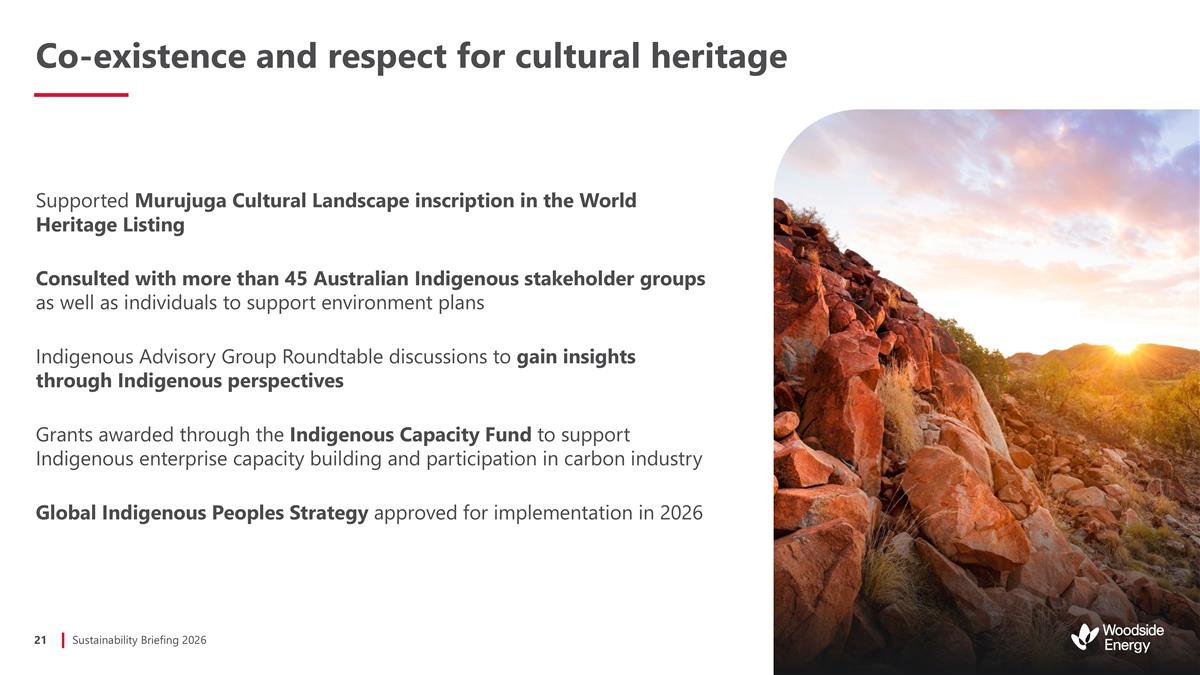
Co-existence and respect for
cultural heritage Supported Murujuga Cultural Landscape inscription in the World Heritage Listing Consulted with more than 45 Australian Indigenous stakeholder groups as well as individuals to support environment plans Indigenous Advisory Group
Roundtable discussions to gain insights through Indigenous perspectives Grants awarded through the Indigenous Capacity Fund to support Indigenous enterprise capacity building and participation in carbon industry Global Indigenous Peoples Strategy
approved for implementation in 2026
Strong environmental processes and
performance Secured critical environmental approvals for business operations (North West Shelf Project Extension, Trion)1 Established an Australian-based biodiversity project in Western Australia, focused on delivering positive biodiversity
outcomes2 Strengthened our approach to water stewardship by assessing catchment area risks across onshore assets Zero hydrocarbon or hazardous non‑hydrocarbon spills that resulted in a “Moderate” environmental impact3 Delivered
strategic investment in scientific research with agencies such as the Australian Institute of Marine Science With regards to the North West Shelf Project Extension: State Government approval received in 2024. Federal Government approval received in
2025. Approvals subject to conditions. Three separate legal proceedings have commenced in the Federal Court of Australia challenging the Federal Government's environmental approval, and one in the Western Australian Supreme Court challenging the
State Government's environmental approval. Please see the definition of “positive biodiversity outcomes” in the Glossary. This metric is determined utilising Woodside’s risk matrix. For Woodside’s definition of
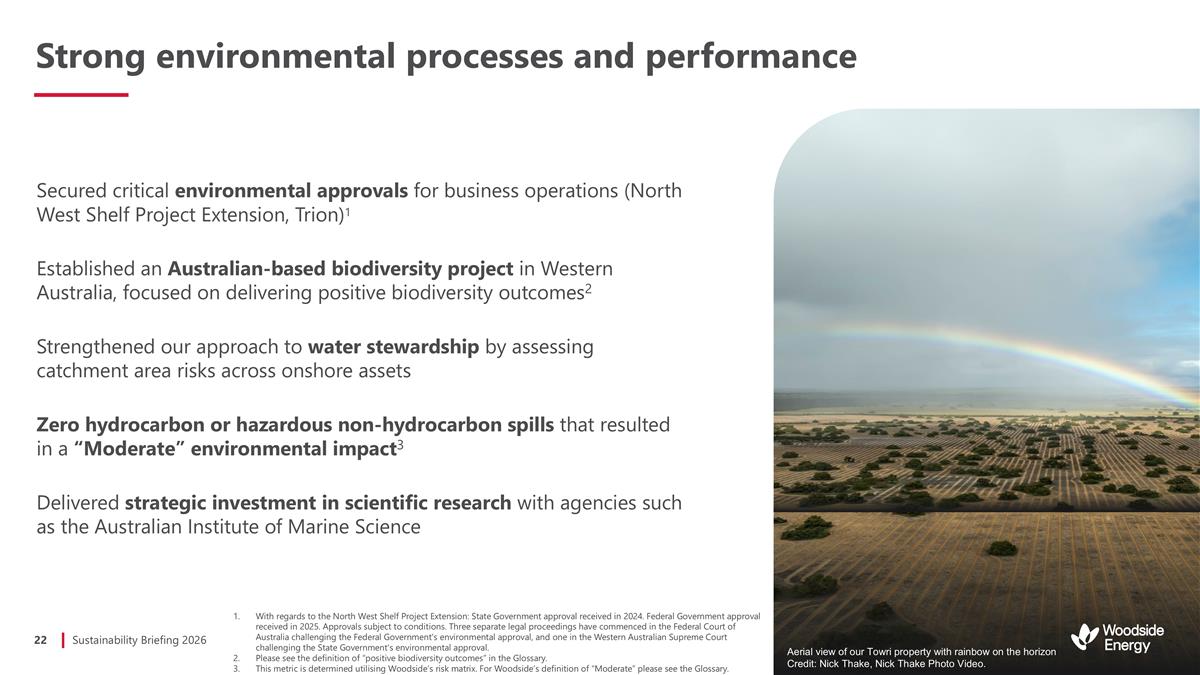
“Moderate” please see the Glossary. Aerial view of our Towri property with rainbow on the horizon Credit: Nick Thake, Nick Thake Photo Video.
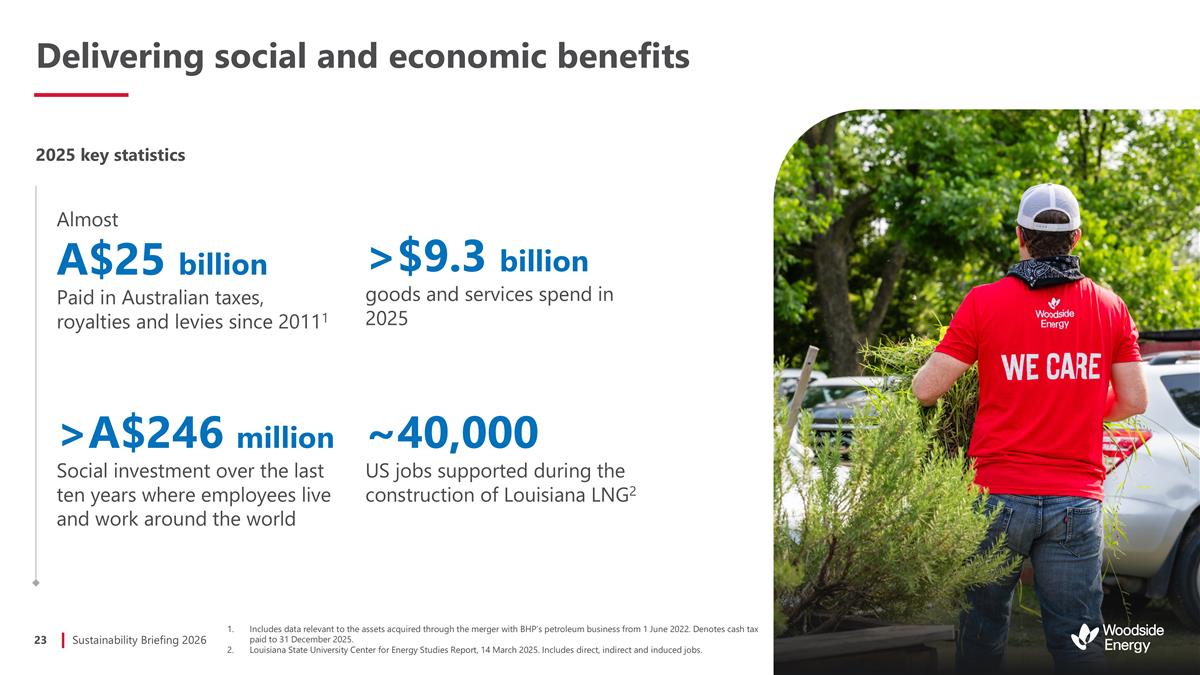
Delivering social and economic
benefits Includes data relevant to the assets acquired through the merger with BHP’s petroleum business from 1 June 2022. Denotes cash tax paid to 31 December 2025. Louisiana State University Center for Energy Studies Report, 14 March 2025.
Includes direct, indirect and induced jobs. Almost A$25 billion Paid in Australian taxes, royalties and levies since 20111 ~40,000 US jobs supported during the construction of Louisiana LNG2 >A$246 million Social investment over the last ten
years where employees live and work around the world 2025 key statistics >$9.3 billion goods and services spend in 2025 Material topic: Social and economic impact Climate Indigenous Environment
Video Social and Economic
Impact
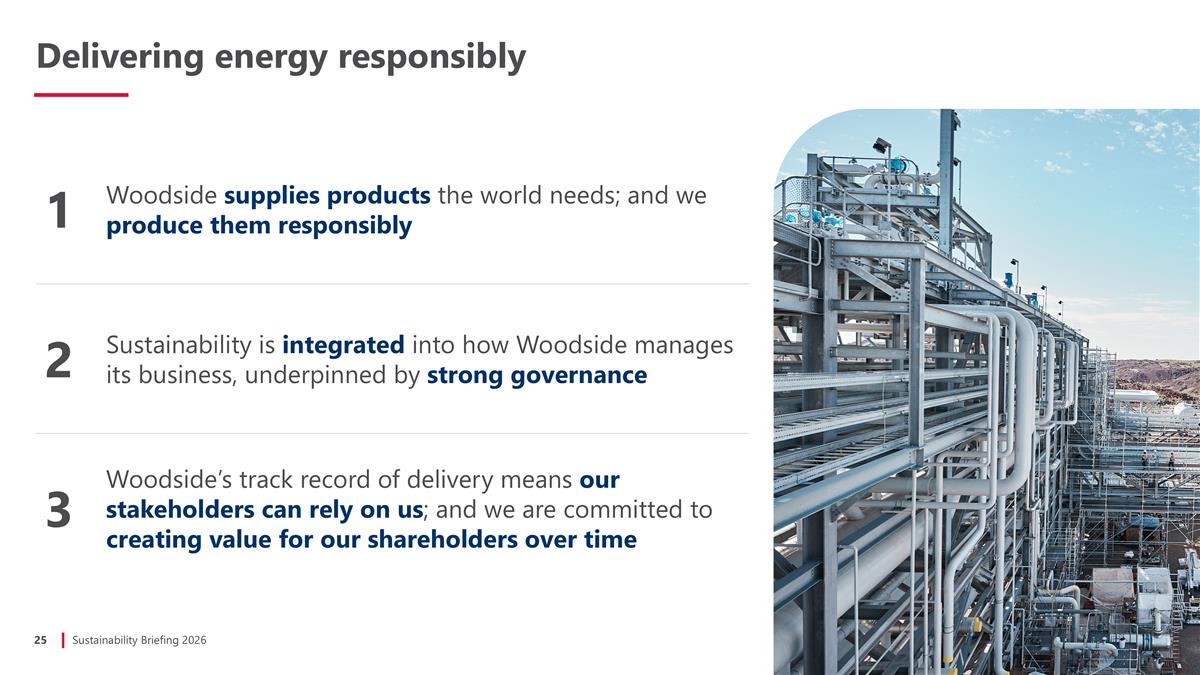
Delivering energy responsibly 1
Woodside supplies products the world needs; and we produce them responsibly 2 Sustainability is integrated into how Woodside manages its business, underpinned by strong governance 3 Woodside’s track record of delivery means our stakeholders
can rely on us; and we are committed to creating value for our shareholders over time
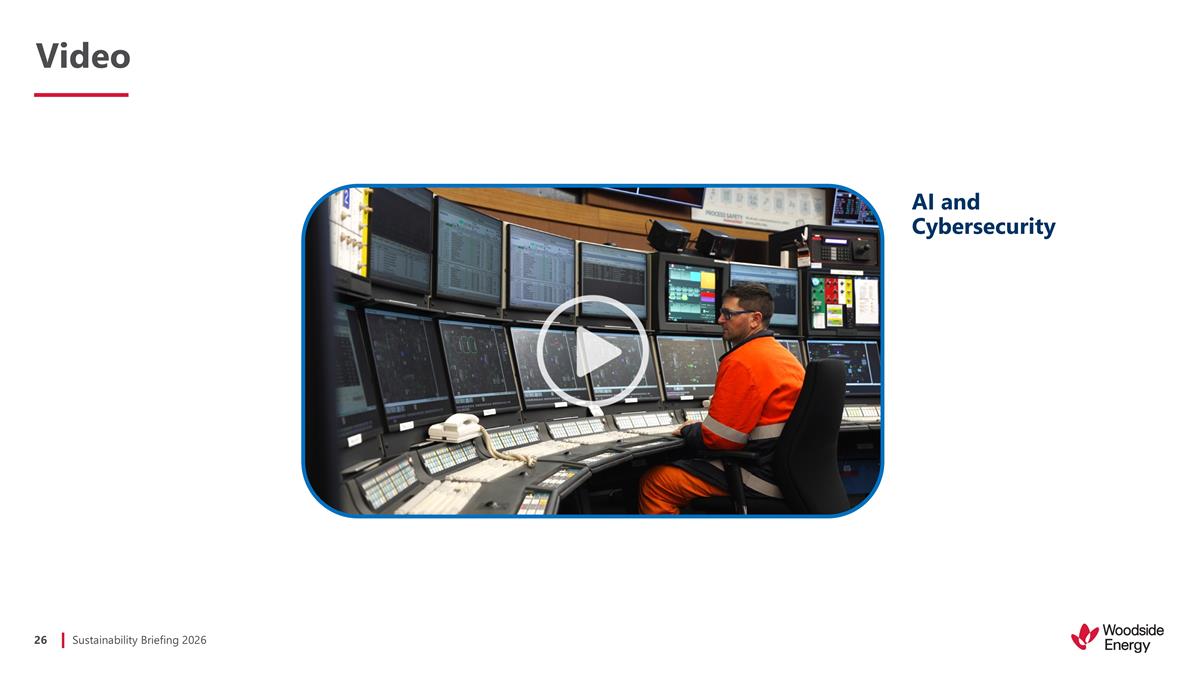
Video AI and
Cybersecurity
Panel Q&A Liz Westcott | Acting
Chief Executive Officer Tony Cudmore | EVP Sustainability, Policy and External Affairs Peter Metcalfe | VP Climate, Sustainability and Energy Policy Sharon Reynolds | Global Head of Indigenous Affairs and Human Rights Moderator: Vanessa Martin | VP
Investor Relations

Annexure
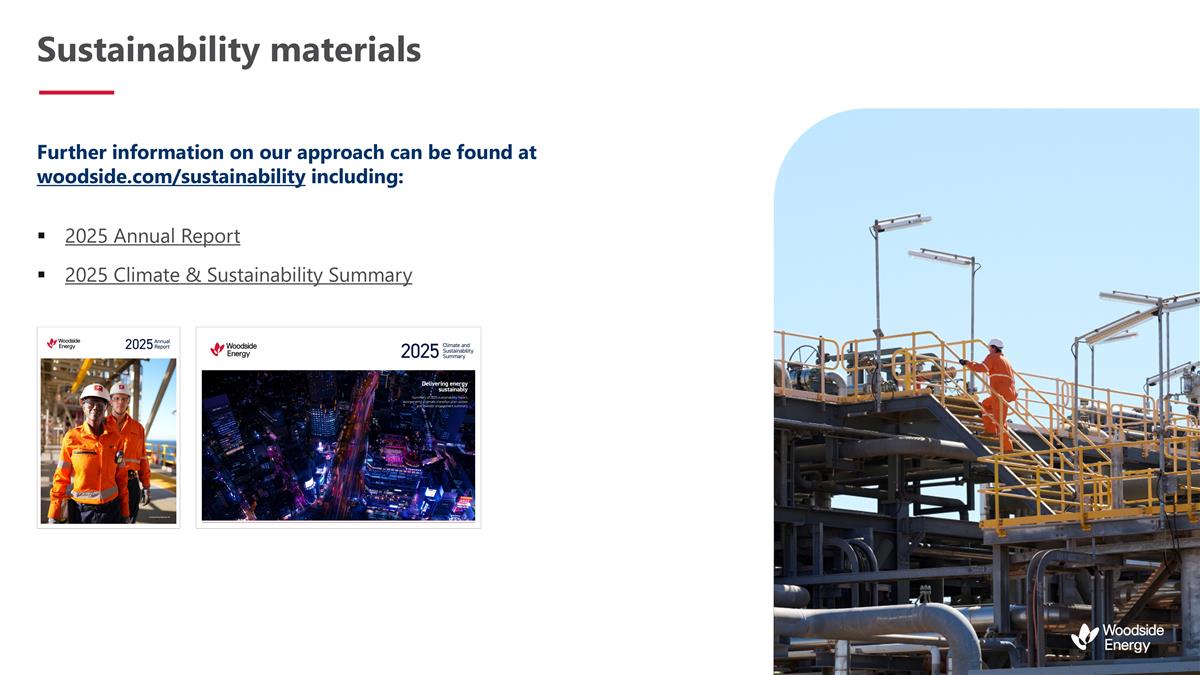
Sustainability materials Further
information on our approach can be found at woodside.com/sustainability including: 2025 Annual Report 2025 Climate & Sustainability Summary
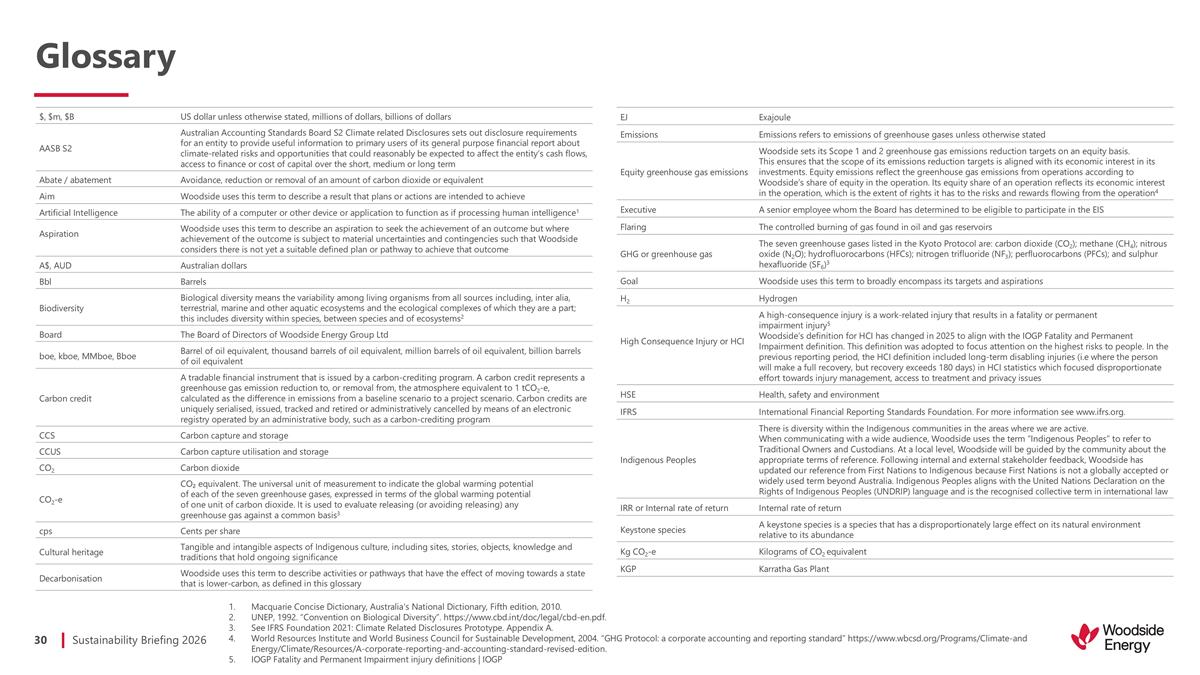
Glossary $, $m, $B US dollar unless
otherwise stated, millions of dollars, billions of dollars AASB S2 Australian Accounting Standards Board S2 Climate related Disclosures sets out disclosure requirements for an entity to provide useful information to primary users of its general
purpose financial report about climate-related risks and opportunities that could reasonably be expected to affect the entity’s cash flows, access to finance or cost of capital over the short, medium or long term Abate / abatement Avoidance,
reduction or removal of an amount of carbon dioxide or equivalent Aim Woodside uses this term to describe a result that plans or actions are intended to achieve Artificial Intelligence The ability of a computer or other device or application to
function as if processing human intelligence1 Aspiration Woodside uses this term to describe an aspiration to seek the achievement of an outcome but where achievement of the outcome is subject to material uncertainties and contingencies such
that Woodside considers there is not yet a suitable defined plan or pathway to achieve that outcome A$, AUD Australian dollars Bbl Barrels Biodiversity Biological diversity means the variability among living organisms from all sources including,
inter alia, terrestrial, marine and other aquatic ecosystems and the ecological complexes of which they are a part; this includes diversity within species, between species and of ecosystems2 Board The Board of Directors of Woodside Energy Group Ltd
boe, kboe, MMboe, Bboe Barrel of oil equivalent, thousand barrels of oil equivalent, million barrels of oil equivalent, billion barrels of oil equivalent Carbon credit A tradable financial instrument that is issued by a carbon-crediting program. A
carbon credit represents a greenhouse gas emission reduction to, or removal from, the atmosphere equivalent to 1 tCO2-e, calculated as the difference in emissions from a baseline scenario to a project scenario. Carbon credits are uniquely
serialised, issued, tracked and retired or administratively cancelled by means of an electronic registry operated by an administrative body, such as a carbon-crediting program CCS Carbon capture and storage CCUS Carbon capture utilisation and
storage CO2 Carbon dioxide CO2-e CO₂ equivalent. The universal unit of measurement to indicate the global warming potential of each of the seven greenhouse gases, expressed in terms of the global warming potential of one unit of carbon
dioxide. It is used to evaluate releasing (or avoiding releasing) any greenhouse gas against a common basis3 cps Cents per share Cultural heritage Tangible and intangible aspects of Indigenous culture, including sites, stories, objects, knowledge
and traditions that hold ongoing significance Decarbonisation Woodside uses this term to describe activities or pathways that have the effect of moving towards a state that is lower-carbon, as defined in this glossary Macquarie Concise Dictionary,
Australia's National Dictionary, Fifth edition, 2010. UNEP, 1992. “Convention on Biological Diversity”. https://www.cbd.int/doc/legal/cbd-en.pdf. See IFRS Foundation 2021: Climate Related Disclosures Prototype. Appendix A. World
Resources Institute and World Business Council for Sustainable Development, 2004. “GHG Protocol: a corporate accounting and reporting standard” https://www.wbcsd.org/Programs/Climate-and
Energy/Climate/Resources/A-corporate-reporting-and-accounting-standard-revised-edition. IOGP Fatality and Permanent Impairment injury definitions | IOGP EJ Exajoule Emissions Emissions refers to emissions of greenhouse gases unless otherwise stated
Equity greenhouse gas emissions Woodside sets its Scope 1 and 2 greenhouse gas emissions reduction targets on an equity basis. This ensures that the scope of its emissions reduction targets is aligned with its economic interest in its
investments. Equity emissions reflect the greenhouse gas emissions from operations according to Woodside’s share of equity in the operation. Its equity share of an operation reflects its economic interest in the operation, which is the
extent of rights it has to the risks and rewards flowing from the operation4 Executive A senior employee whom the Board has determined to be eligible to participate in the EIS Flaring The controlled burning of gas found in oil and
gas reservoirs GHG or greenhouse gas The seven greenhouse gases listed in the Kyoto Protocol are: carbon dioxide (CO2); methane (CH4); nitrous oxide (N2O); hydrofluorocarbons (HFCs); nitrogen trifluoride (NF3); perfluorocarbons (PFCs); and
sulphur hexafluoride (SF6)3 Goal Woodside uses this term to broadly encompass its targets and aspirations H2 Hydrogen High Consequence Injury or HCI A high-consequence injury is a work-related injury that results in a fatality or permanent
impairment injury5 Woodside’s definition for HCI has changed in 2025 to align with the IOGP Fatality and Permanent Impairment definition. This definition was adopted to focus attention on the highest risks to people.
In the previous reporting period, the HCI definition included long-term disabling injuries (i.e where the person will make a full recovery, but recovery exceeds 180 days) in HCI statistics which focused disproportionate effort towards injury
management, access to treatment and privacy issues HSE Health, safety and environment IFRS International Financial Reporting Standards Foundation. For more information see www.ifrs.org. Indigenous Peoples There is diversity within the Indigenous
communities in the areas where we are active. When communicating with a wide audience, Woodside uses the term “Indigenous Peoples” to refer to Traditional Owners and Custodians. At a local level, Woodside will be guided by the
community about the appropriate terms of reference. Following internal and external stakeholder feedback, Woodside has updated our reference from First Nations to Indigenous because First Nations is not a globally accepted or widely used term
beyond Australia. Indigenous Peoples aligns with the United Nations Declaration on the Rights of Indigenous Peoples (UNDRIP) language and is the recognised collective term in international law IRR or Internal rate of return Internal rate of return
Keystone species A keystone species is a species that has a disproportionately large effect on its natural environment relative to its abundance Kg CO2-e Kilograms of CO2 equivalent KGP Karratha Gas Plant
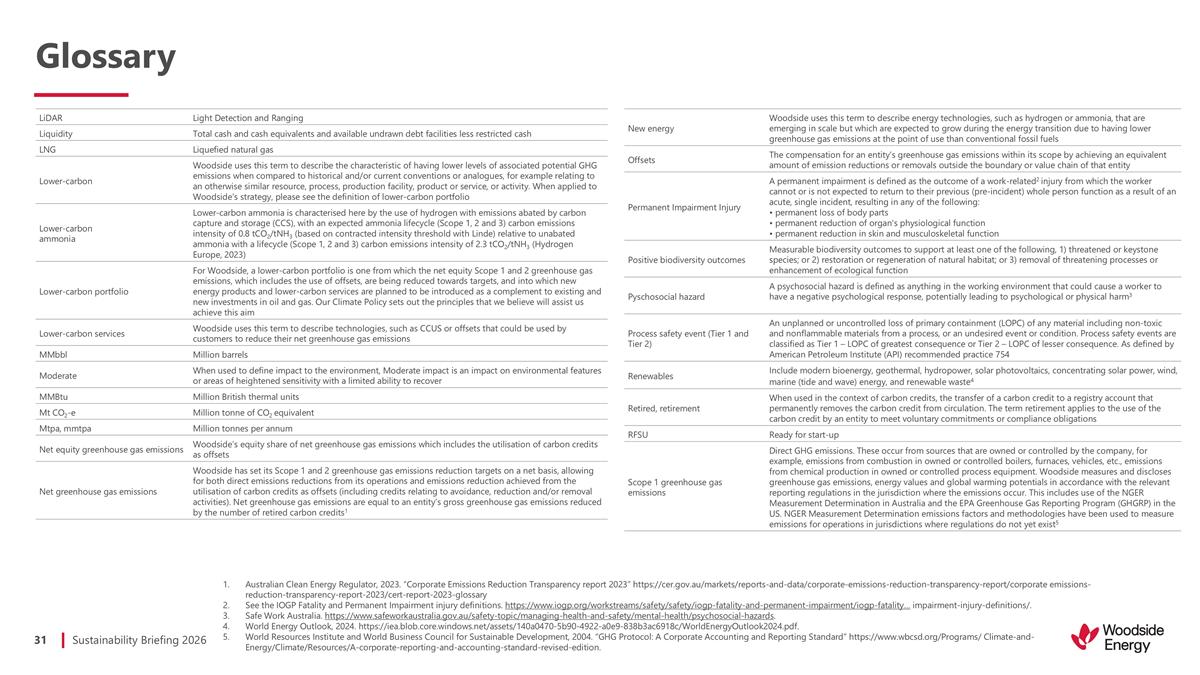
Glossary Australian Clean Energy
Regulator, 2023. “Corporate Emissions Reduction Transparency report 2023” https://cer.gov.au/markets/reports-and-data/corporate-emissions-reduction-transparency-report/corporate
emissions-reduction-transparency-report-2023/cert-report-2023-glossary See the IOGP Fatality and Permanent Impairment injury definitions. https://www.iogp.org/workstreams/safety/safety/iogp-fatality-and-permanent-impairment/iogp-fatality…
impairment-injury-definitions/. Safe Work Australia. https://www.safeworkaustralia.gov.au/safety-topic/managing-health-and-safety/mental-health/psychosocial-hazards. World Energy Outlook, 2024.
https://iea.blob.core.windows.net/assets/140a0470-5b90-4922-a0e9-838b3ac6918c/WorldEnergyOutlook2024.pdf. World Resources Institute and World Business Council for Sustainable Development, 2004. “GHG Protocol: A Corporate Accounting and
Reporting Standard” https://www.wbcsd.org/Programs/ Climate-and-Energy/Climate/Resources/A-corporate-reporting-and-accounting-standard-revised-edition. New energy Woodside uses this term to describe energy technologies, such as hydrogen
or ammonia, that are emerging in scale but which are expected to grow during the energy transition due to having lower greenhouse gas emissions at the point of use than conventional fossil fuels Offsets The compensation for an entity’s
greenhouse gas emissions within its scope by achieving an equivalent amount of emission reductions or removals outside the boundary or value chain of that entity Permanent Impairment Injury A permanent impairment is defined as the outcome of a
work-related2 injury from which the worker cannot or is not expected to return to their previous (pre-incident) whole person function as a result of an acute, single incident, resulting in any of the following: • permanent loss of body
parts • permanent reduction of organ's physiological function • permanent reduction in skin and musculoskeletal function Positive biodiversity outcomes Measurable biodiversity outcomes to support at least one of the following, 1)
threatened or keystone species; or 2) restoration or regeneration of natural habitat; or 3) removal of threatening processes or enhancement of ecological function Pyschosocial hazard A psychosocial hazard is defined as anything in the working
environment that could cause a worker to have a negative psychological response, potentially leading to psychological or physical harm3 Process safety event (Tier 1 and Tier 2) An unplanned or uncontrolled loss of primary containment (LOPC) of any
material including non-toxic and nonflammable materials from a process, or an undesired event or condition. Process safety events are classified as Tier 1 – LOPC of greatest consequence or Tier 2 – LOPC of lesser consequence. As defined
by American Petroleum Institute (API) recommended practice 754 Renewables Include modern bioenergy, geothermal, hydropower, solar photovoltaics, concentrating solar power, wind, marine (tide and wave) energy, and renewable waste4 Retired, retirement
When used in the context of carbon credits, the transfer of a carbon credit to a registry account that permanently removes the carbon credit from circulation. The term retirement applies to the use of the carbon credit by an entity to meet voluntary
commitments or compliance obligations RFSU Ready for start-up Scope 1 greenhouse gas emissions Direct GHG emissions. These occur from sources that are owned or controlled by the company, for example, emissions from combustion in owned or controlled
boilers, furnaces, vehicles, etc., emissions from chemical production in owned or controlled process equipment. Woodside measures and discloses greenhouse gas emissions, energy values and global warming potentials in accordance with the relevant
reporting regulations in the jurisdiction where the emissions occur. This includes use of the NGER Measurement Determination in Australia and the EPA Greenhouse Gas Reporting Program (GHGRP) in the US. NGER Measurement Determination emissions
factors and methodologies have been used to measure emissions for operations in jurisdictions where regulations do not yet exist5 LiDAR Light Detection and Ranging Liquidity Total cash and cash equivalents and available undrawn debt facilities less
restricted cash LNG Liquefied natural gas Lower-carbon Woodside uses this term to describe the characteristic of having lower levels of associated potential GHG emissions when compared to historical and/or current conventions or analogues, for
example relating to an otherwise similar resource, process, production facility, product or service, or activity. When applied to Woodside’s strategy, please see the definition of lower-carbon portfolio Lower-carbon ammonia Lower-carbon
ammonia is characterised here by the use of hydrogen with emissions abated by carbon capture and storage (CCS), with an expected ammonia lifecycle (Scope 1, 2 and 3) carbon emissions intensity of 0.8 tCO2/tNH3 (based on contracted intensity
threshold with Linde) relative to unabated ammonia with a lifecycle (Scope 1, 2 and 3) carbon emissions intensity of 2.3 tCO2/tNH3 (Hydrogen Europe, 2023) Lower-carbon portfolio For Woodside, a lower-carbon portfolio is one from which the net equity
Scope 1 and 2 greenhouse gas emissions, which includes the use of offsets, are being reduced towards targets, and into which new energy products and lower-carbon services are planned to be introduced as a complement to existing and new investments
in oil and gas. Our Climate Policy sets out the principles that we believe will assist us achieve this aim Lower-carbon services Woodside uses this term to describe technologies, such as CCUS or offsets that could be used by customers to reduce
their net greenhouse gas emissions MMbbl Million barrels Moderate When used to define impact to the environment, Moderate impact is an impact on environmental features or areas of heightened sensitivity with a limited ability to recover MMBtu
Million British thermal units Mt CO2-e Million tonne of CO2 equivalent Mtpa, mmtpa Million tonnes per annum Net equity greenhouse gas emissions Woodside’s equity share of net greenhouse gas emissions which includes the utilisation of carbon
credits as offsets Net greenhouse gas emissions Woodside has set its Scope 1 and 2 greenhouse gas emissions reduction targets on a net basis, allowing for both direct emissions reductions from its operations and emissions reduction achieved from the
utilisation of carbon credits as offsets (including credits relating to avoidance, reduction and/or removal activities). Net greenhouse gas emissions are equal to an entity’s gross greenhouse gas emissions reduced by the number of retired
carbon credits1
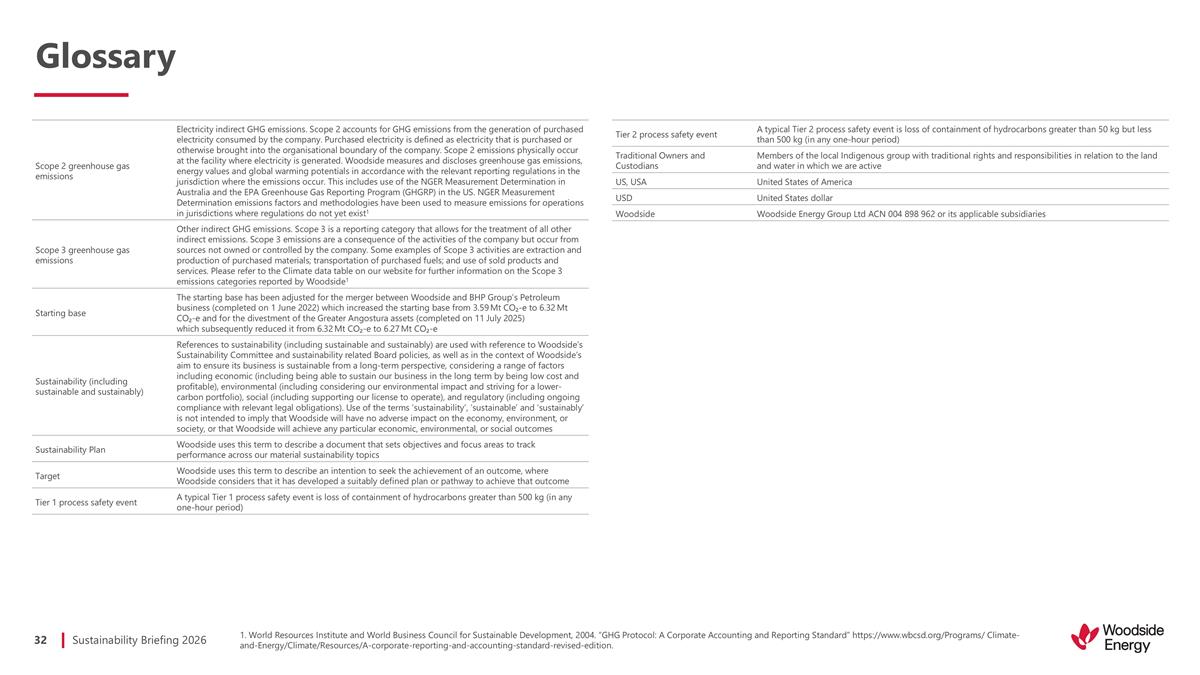
Glossary Scope 2 greenhouse gas
emissions Electricity indirect GHG emissions. Scope 2 accounts for GHG emissions from the generation of purchased electricity consumed by the company. Purchased electricity is defined as electricity that is purchased or otherwise brought into the
organisational boundary of the company. Scope 2 emissions physically occur at the facility where electricity is generated. Woodside measures and discloses greenhouse gas emissions, energy values and global warming potentials in accordance with the
relevant reporting regulations in the jurisdiction where the emissions occur. This includes use of the NGER Measurement Determination in Australia and the EPA Greenhouse Gas Reporting Program (GHGRP) in the US. NGER Measurement Determination
emissions factors and methodologies have been used to measure emissions for operations in jurisdictions where regulations do not yet exist1 Scope 3 greenhouse gas emissions Other indirect GHG emissions. Scope 3 is a reporting category that allows
for the treatment of all other indirect emissions. Scope 3 emissions are a consequence of the activities of the company but occur from sources not owned or controlled by the company. Some examples of Scope 3 activities are extraction and production
of purchased materials; transportation of purchased fuels; and use of sold products and services. Please refer to the Climate data table on our website for further information on the Scope 3 emissions categories reported by Woodside1
Starting base The starting base has been adjusted for the merger between Woodside and BHP Group’s Petroleum business (completed on 1 June 2022) which increased the starting base from 3.59 Mt CO₂‑e to 6.32 Mt
CO₂‑e and for the divestment of the Greater Angostura assets (completed on 11 July 2025) which subsequently reduced it from 6.32 Mt CO₂‑e to 6.27 Mt CO₂‑e Sustainability (including
sustainable and sustainably) References to sustainability (including sustainable and sustainably) are used with reference to Woodside’s Sustainability Committee and sustainability related Board policies, as well as in the context of
Woodside’s aim to ensure its business is sustainable from a long-term perspective, considering a range of factors including economic (including being able to sustain our business in the long term by being low cost and profitable),
environmental (including considering our environmental impact and striving for a lower-carbon portfolio), social (including supporting our license to operate), and regulatory (including ongoing compliance with relevant legal obligations). Use of the
terms ‘sustainability’, ‘sustainable’ and ‘sustainably’ is not intended to imply that Woodside will have no adverse impact on the economy, environment, or society, or that Woodside will achieve any particular
economic, environmental, or social outcomes Sustainability Plan Woodside uses this term to describe a document that sets objectives and focus areas to track performance across our material sustainability topics Target Woodside uses this term to
describe an intention to seek the achievement of an outcome, where Woodside considers that it has developed a suitably defined plan or pathway to achieve that outcome Tier 1 process safety event A typical Tier 1 process safety event is loss of
containment of hydrocarbons greater than 500 kg (in any one-hour period) Tier 2 process safety event A typical Tier 2 process safety event is loss of containment of hydrocarbons greater than 50 kg but less than 500 kg (in any one-hour period)
Traditional Owners and Custodians Members of the local Indigenous group with traditional rights and responsibilities in relation to the land and water in which we are active US, USA United States of America USD United States dollar Woodside
Woodside Energy Group Ltd ACN 004 898 962 or its applicable subsidiaries 1. World Resources Institute and World Business Council for Sustainable Development, 2004. “GHG Protocol: A Corporate Accounting and Reporting
Standard” https://www.wbcsd.org/Programs/ Climate-and-Energy/Climate/Resources/A-corporate-reporting-and-accounting-standard-revised-edition.