Exhibit 99.1
TABLE OF CONTENTS
| Presentation of Information | 2 | |
| FORWARD-LOOKING INFORMATION | 5 | |
| CORPORATE STRUCTURE | 8 | |
| GENERAL DEVELOPMENT OF THE BUSINESS | 9 | |
| PROJECTS OVERVIEW | 11 | |
| INFRASTRUCTURE AND MARKETING OVERVIEW | 12 | |
| aDDITIONAL DETAILS OF THE BUSINESS | 14 | |
| STATEMENT OF RESERVES DATA AND OTHER OIL AND GAS INFORMATION | 18 | |
| DESCRIPTION OF CAPITAL STRUCTURE | 25 | |
| DIVIDENDS | 27 | |
| MARKET FOR SECURITIES | 28 | |
| INDUSTRY CONDITIONS | 28 | |
| RISK FACTORS | 37 | |
| DIRECTORS AND EXECUTIVE OFFICERS | 64 | |
| AUDIT COMMITTEE INFORMATION | 66 | |
| LEGAL PROCEEDINGS AND REGULATORY ACTIONS | 68 | |
| INTEREST OF MANAGEMENT AND OTHERS IN MATERIAL TRANSACTIONS | 68 | |
| AUDITORS, TRANSFER AGENTS AND REGISTRARS | 68 | |
| MATERIAL CONTRACTS | 68 | |
| INTERESTS OF EXPERTS | 69 | |
| ADDITIONAL INFORMATION | 69 | |
| Glossary and definitions | 69 | |
| ABBREVIATIONS AND Conversions | 72 |
APPENDICES
| Appendix A | – | Report on Reserves Data by Independent Qualified Reserves Evaluator or Auditor |
| Appendix B | – | Report of Management and Directors on Reserves Data and Other Information |
| Appendix C | – | Audit Committee Mandate |
| Greenfire Resources Ltd. | 2025 Annual Information Form | i |

Presentation of Information
Throughout this Annual Information Form, the terms, we, us, our, the Company and Greenfire mean Greenfire Resources Ltd. (“GRL”) and its subsidiaries. In particular, Greenfire includes references to Greenfire Resources Operating Corporation (“GROC”).
Unless otherwise noted, the information contained in this Annual Information Form is given at or for the year ended December 31, 2025. Amounts are expressed in Canadian dollars, unless otherwise indicated. Financial information is presented in accordance with IFRS Accounting Standards.
Unless otherwise defined herein, defined terms in this Annual Information Form have the meanings set forth in “Glossary” at the back of this Annual Information Form.
Disclosure of Reserves and Production Information
All oil and gas information presented in this Annual Information Form has been prepared and is presented in accordance with the Canadian disclosure standards set forth in NI 51-101.
The oil and gas reserves and operational information of Greenfire contained in this Annual Information Form contains the information required to be included in the Statement of Reserves Data and Other Oil and Gas Information pursuant to NI 51-101. Readers should also refer to the Report on Reserves Data by McDaniel attached as Appendix A and the Report of Management and Directors on Oil and Gas Disclosure and Other Information attached hereto as Appendix B. The effective date for the Statement of Reserves Data and Other Oil and Gas Information contained in this Annual Information Form is December 31, 2025 and the preparation date for such information is March 12, 2026.
This Annual Information Form contains metrics commonly used in the oil and gas industry, including “reserves life index”. These terms do not have a standardized meaning and may not be comparable to similar measures presented by other companies, and therefore should not be used to make such comparisons. Readers are cautioned as to the reliability of oil and gas metrics used in this Annual Information Form. Management of Greenfire uses these oil and gas metrics for its own performance measurements and to provide investors with measures to compare the Greenfire’s projected performance over time; however, such measures are not reliable indicators of the Greenfire’s future performance, which may not compare to the Greenfire’s performance in previous periods, and therefore should not be unduly relied upon. “Reserves life index” is calculated by dividing the applicable reserves and/or contingent resources by expected production.
Notice to U.S. Readers
Data on oil and natural gas reserves contained in this Annual Information Form has generally been prepared in accordance with Canadian disclosure standards and specifically in accordance with NI 51-101, which are not comparable in all respects to United States disclosure standards under Subpart 1200 of Regulation S-K or other foreign disclosure standards. For example, although the SEC generally permits oil and gas issuers, in their filings with the SEC, to disclose both proved reserves and probable reserves (each as defined in the SEC rules), the SEC definitions and estimation of proved reserves and probable reserves may differ from the definitions and estimation of “proved reserves” and “probable reserves” under Canadian securities laws. In addition, under Canadian disclosure requirements and industry practice, reserves and production are reported using gross (or, as noted above with respect to production information, “company interest”) volumes, which are volumes prior to deduction of applicable royalties and similar payments. The practice in the United States is to report reserves and production using net volumes, after deduction of applicable royalties and similar payments, plus royalty interests. Moreover, in accordance with Canadian disclosure requirements, the Company has determined and disclosed estimated future net revenue from its reserves using forecast prices and escalating costs, whereas the SEC generally requires that reserves estimates be prepared using an unweighted average of the closing prices for the applicable commodity on the first day of each of the twelve months preceding the Company’s fiscal year-end, with the option of also disclosing reserves estimates based upon future or other prices and constant costs. As a consequence of the foregoing, the Company’s reserves estimates and production volumes may not be comparable to those made by companies utilizing United States reporting and disclosure standards.
| Greenfire Resources Ltd. | 2025 Annual Information Form | 2 |
Interests in Reserves, Production, Wells and Properties
Certain of the following definitions and guidelines are contained in the glossary to NI 51-101 contained in CSA Notice 51-324, which incorporates certain definitions from the COGE Handbook. Readers should consult CSA Notice 51-324 and the COGE Handbook for additional explanation and guidance.
In addition to the terms having defined meanings set forth in CSA Notice 51-324, the terms set forth below have the following meanings when used in this Annual Information Form:
“gross” means:
| (a) | in relation to Greenfire’s interest in production or reserves, its working interest (operating or non-operating) share before deduction of royalties and without including any royalty interests of Greenfire; |
| (b) | in relation to wells, the total number of wells in which Greenfire has an interest; and |
| (c) | in relation to properties, the total area in which Greenfire has an interest. |
“net” means:
| (a) | in relation to Greenfire’s interest in production or reserves, its working interest (operating or non-operating) share after deduction of royalty obligations, plus Greenfire’s royalty interests in production or reserves; |
| (b) | in relation to Greenfire’s interest in wells, the number of wells obtained by aggregating Greenfire’s working interest in each of its gross wells; and |
| (c) | in relation to Greenfire’s interest in a property, the total area in which Greenfire has an interest multiplied by the working interest owned by Greenfire. |
“working interest” means the percentage of undivided interest held by Greenfire in the oil and/or natural gas or mineral lease granted by the mineral owner (Crown or freehold), which interest gives Greenfire the right to “work” the property (lease) to explore for, develop, produce and market the leased substances.
Reserves Categories and Levels of Certainty for Reported Reserves
In this Annual Information Form, the following terms have the meaning assigned thereto in CSA Notice 51-324 and the COGE Handbook:
“reserves” are estimated remaining quantities of crude oil and natural gas and related substances anticipated to be recoverable from known accumulations, as of a given date, based on: analysis of drilling, geological, geophysical and engineering data; the use of established technology; and specified economic conditions, which are generally accepted as being reasonable, and shall be disclosed. Reserves may be divided into proved and probable categories according to the degree of certainty associated with the estimates.
“proved reserves” are those reserves that can be estimated with a high degree of certainty to be recoverable. It is likely that the actual remaining quantities recovered will exceed the estimated proved reserves.
“probable reserves” are those additional reserves that are less certain to be recovered than proved reserves. It is equally likely that the actual remaining quantities recovered will be greater or less than the sum of the estimated proved plus probable reserves.
| Greenfire Resources Ltd. | 2025 Annual Information Form | 3 |
The qualitative certainty levels referred to in the definitions above are applicable to individual reserves entities (which refers to the lowest level at which reserves calculations are performed) and to reported reserves (which refers to the highest-level sum of individual entity estimates for which reserves estimates are presented). Reported reserves should target the following levels of certainty under a specific set of economic conditions:
| ● | at least a 90% probability that the quantities actually recovered will equal or exceed the estimated proved reserves; and |
| ● | at least a 50% probability that the quantities actually recovered will equal or exceed the sum of the estimated proved plus probable reserves. |
Development and Production Status
Each of the reserves categories reported by Greenfire (proved and probable) may be divided into developed and undeveloped categories:
“developed reserves” are those reserves that are expected to be recovered from existing wells and installed facilities or, if facilities have not been installed, that would involve a low expenditure (for example, when compared to the cost of drilling a well) to put the reserves on production. The developed category may be subdivided into producing and non-producing.
| ● | “developed producing reserves” are those reserves that are expected to be recovered from completion intervals open at the time of the estimate. These reserves may be currently producing or, if shut-in, they must have previously been on production, and the date of resumption of production must be known with reasonable certainty. |
| ● | “developed non-producing reserves” are those reserves that either have not been on production, or have previously been on production, but are shut-in, and the date of resumption of production is unknown. |
“undeveloped reserves” are those reserves that are expected to be recovered from known accumulations where a significant expenditure (for example, when compared to the cost of drilling a well) is required to render them capable of production. They must fully meet the requirements of the reserves classification (proved or probable) to which they are assigned.
Description of Price and Cost Assumptions
“forecast prices and costs” means future prices and costs that are:
| (a) | generally accepted as being a reasonable outlook of the future; and |
| (b) | if, and only to the extent that, there are fixed or presently determinable future prices or costs to which Greenfire is legally bound by a contractual or other obligation to supply a physical product, including those for an extension period of a contract that is likely to be extended, those prices or costs rather than the prices or costs referred to in paragraph (a). |
| Greenfire Resources Ltd. | 2025 Annual Information Form | 4 |
FORWARD-LOOKING INFORMATION
This Annual Information Form contains forward-looking information and forward-looking statements (collectively, “forward-looking information”) within the meaning of applicable securities laws. The forward-looking information in this Annual Information Form is based on Greenfire’s current internal expectations, estimates, projections, assumptions and beliefs. Such forward-looking information is not a guarantee of future performance and involves known and unknown risks, uncertainties and other factors that may cause actual results or events to differ materially from those anticipated in such forward-looking information. The Company believes the material factors, expectations and assumptions reflected in the forward-looking information are reasonable as of the time of such information, but no assurance can be given that these factors, expectations and assumptions will prove to be correct, and such forward-looking information included in this Annual Information Form should not be unduly relied upon.
The use of any of the words “expect”, “anticipate”, “estimate”, “objective”, “ongoing”, “may”, “will”, “should”, “project”, “believe”, “depends”, “could”, “guidance”, “plan”, “strategy” and similar expressions are intended to identify forward-looking information. In particular, but without limiting the generality of the foregoing, this Annual Information Form contains forward-looking information pertaining to the following:
| ● | the Company’s business strategy and future plans, including prospects for future production; |
| ● | Greenfire’s future operating and financial results; |
| ● | bitumen production levels; |
| ● | the Company’s expectations regarding the accessibility, capacity and availability of pipelines; |
| ● | oil and natural gas prices and differentials, foreign currency exchange rates and interest rates; |
| ● | the quantity of, and future net revenues from, Greenfire’s reserves; |
| ● | capital spending programs, drilling programs, operating and reservoir management techniques, development plans and other future expenditures; |
| ● | sources of funding for the Company’s capital program and the terms of Greenfire’s future contractual obligations, including its obligations under the Senior Credit Facility; |
| ● | the Company’s ability to meet current and future obligations, including making scheduled principal and interest payments and to fund the other needs of the business; |
| ● | the Company’s compliance with applicable regulatory permits and authorizations; |
| ● | future growth potential and future potential acquisitions and divestments; |
| ● | expectations regarding Greenfire’s ability to raise capital and to continually add to reserves and/or resources through acquisitions and development; |
| ● | future liquidity and financial capacity; |
| ● | the amount of estimated future income tax deductions as well as the timing and magnitude of future income tax payments; |
| ● | abandonment and reclamation costs; |
| ● | treatment of, and compliance by Greenfire with, existing and proposed governmental and other regulatory regimes and tax, environmental and other laws; and |
| ● | expectations about changes to laws and the impact thereof. |
In addition, statements relating to “reserves” are deemed to be forward-looking information as they involve the implied assessment, based on certain estimates and assumptions, that the reserves described exist in the quantities predicted or estimated and can be profitably produced in the future. Forward-looking information in this Annual Information Form relating to oil and gas exploration, development and production, and management’s general expectations relating to the oil and gas industry are based on estimates prepared by management using data from publicly available industry sources as well as from market research and industry analysis and on assumptions based on data and knowledge of the industry which management believes to be reasonable. Although generally indicative of relative market positions, market shares and performance characteristics, this data is inherently imprecise. Management is not aware of any misstatements regarding any industry data presented in this Annual Information Form. Oil and gas exploration, development and production involves risks and uncertainties and industry data is subject to change based on various factors. See “Risk Factors” in this Annual Information Form.
| Greenfire Resources Ltd. | 2025 Annual Information Form | 5 |
All forward-looking information reflects Greenfire’s beliefs and assumptions based on information available at the time the applicable forward-looking information is disclosed and in light of the Company’s current expectations with respect to such matters as: the success of Greenfire’s operations and growth and expansion projects; expectations regarding production growth, future well production rates and reserves volumes; expectations regarding Greenfire’s capital program; the outlook for general economic trends, industry trends, prevailing and future commodity prices, foreign exchange rates and interest rates; prevailing and future royalty regimes and tax laws; expectations regarding differentials and realized prices; future well production rates and reserves volumes; fluctuations in energy prices based on worldwide demand and geopolitical events; the impact of inflation; the integrity and reliability of Greenfire’s assets; decommissioning obligations; Greenfire’s ability to comply with its financial covenants; Greenfire’s ability to comply with applicable regulations, including those related to various emissions; the governmental, regulatory and legal environment; and Greenfire’s retention of personnel with the necessary specialized skills and knowledge to successfully carry out its business and operations. Management believes that its assumptions and expectations reflected in the forward-looking information contained herein are reasonable based on the information available on the date such information is provided and the process used to prepare the information. However, Greenfire cannot assure readers that these expectations will prove to be correct.
The forward-looking information included in this Annual Information Form is not a guarantee of future performance and involves known and unknown risks, uncertainties and other factors that may cause actual results or events to differ materially from those anticipated in such forward-looking information, including, without limitation:
| ● | changes in oil and gas prices and differentials; |
| ● | changes in the demand for or supply of Greenfire’s products; |
| ● | the continued impact, or further deterioration, in global economic and market conditions, including from inflation and/or certain geopolitical conflicts, such as the ongoing war in Eastern Europe and the conflicts in the Middle East, and other heightened geopolitical risks, including imposition of tariffs or other trade barriers, and the ability of the Company to carry on operations as contemplated in light of the foregoing; |
| ● | determinations by OPEC and other countries as to production levels, including the potential revival of the Venezuelan oil market and its impact on demand for Canadian crude in the U.S. Gulf Coast and globally; |
| ● | unanticipated operating results or production declines; |
| ● | changes in tax or environmental laws, climate change regulations, royalty rates or other regulatory matters; |
| ● | changes in Greenfire’s operating and development plans; |
| ● | reliability of third party facilities, infrastructure and pipelines required for Greenfire’s operations and production; |
| ● | competition for, among other things, capital, acquisitions of reserves and resources, undeveloped lands, access to services, third party processing capacity and skilled personnel; |
| ● | inability to retain drilling rigs and other services; |
| ● | severe weather conditions, including wildfires, impacting Greenfire’s operations and third party infrastructure; |
| ● | availability of diluent, natural gas and power to operate Greenfire’s facilities; |
| ● | failure to realize the anticipated benefits of the Company’s acquisitions; |
| ● | incorrect assessment of the value of acquisitions; |
| ● | delays resulting from or inability to obtain required regulatory approvals; |
| ● | increased debt levels or debt service requirements; |
| Greenfire Resources Ltd. | 2025 Annual Information Form | 6 |
| ● | inflation; |
| ● | changes in foreign exchange rates; |
| ● | inaccurate estimation of Greenfire’s bitumen reserves volumes; |
| ● | limited, unfavourable or a lack of access to capital markets or other sources of capital; |
| ● | increased costs; |
| ● | failure to comply with applicable regulations, including relating to the Company’s emissions, and potentially significant impact on the Company’s business, operations, production, reserves estimates and financial condition as a result of any penalties and orders associated therewith; |
| ● | a lack of adequate insurance coverage; and |
| ● | the other factors discussed under the “Risk Factors” section in this Annual Information Form. |
The foregoing risks should not be construed as exhaustive. Many of these risk factors and other specific risks and uncertainties are discussed in further detail throughout this Annual Information Form and in the Company’s MD&A, which is available on the Company’s SEDAR+ profile at www.sedarplus.ca, and in the Company’s annual report on Form 40-F filed with the SEC (together with this Annual Information Form), which is available on the Company’s EDGAR profile at www.sec.gov.
The forward-looking information contained in this Annual Information Form speaks only as of the date of this Annual Information Form and Greenfire does not assume any obligation to publicly update or revise such forward-looking information to reflect new events or circumstances, except as may be required pursuant to applicable laws. Any forward-looking information contained herein is expressly qualified by this cautionary statement.
| Greenfire Resources Ltd. | 2025 Annual Information Form | 7 |
CORPORATE STRUCTURE
Greenfire’s head office is located at Suite 800 – 350 7th Ave SW, Calgary, AB T2P 3N9 and its registered office is located at Suite 3500, 855 – 2nd Street S.W., Calgary, Alberta T2P 4J8.
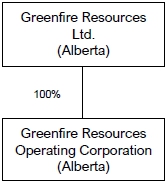
GRL was incorporated under the Business Corporations Act (Alberta) on December 9, 2022. GRL was incorporated in connection with a business combination transaction (the “Business Combination”) involving, among others, GRL, Greenfire Resources Inc. (“GRI”) and M3-Brigade Acquisition III Corp. (“MBSC”), a NYSE listed special purpose acquisition company, which was completed on September 20, 2023. Following completion of the Business Combination, GROC carries on Greenfire’s business as the principal operating subsidiary of GRL.
Organizational Structure
The following organizational chart illustrates the intercorporate relationship between GRL and its sole subsidiary, GROC, including the percentage of votes attached to all voting securities of GROC beneficially owned, controlled or directed, directly or indirectly, by GRL, and the jurisdiction of incorporation or formation of GROC, as at the date of this AIF. See “General Development of the Business – Recent Developments – Internal Reorganization” in this Annual Information Form.
| Greenfire Resources Ltd. | 2025 Annual Information Form | 8 |
GENERAL DEVELOPMENT OF THE BUSINESS
Summarized below are significant developments that have occurred in our business, and certain acquisitions, dispositions, events or conditions which have had an influence on those developments, during the last three financial years and year to date in 2025.
2023
Completion of the Business Combination
On December 14, 2022, GRL, GRI and MBSC, among others, entered into a business combination agreement pursuant to which GRL would become the parent of both GRI and MBSC, with the combined company continuing to operate Greenfire’s production and facilities.
Concurrently with the execution of the business combination agreement, GRL and MBSC entered into subscription agreements with certain investors (the “PIPE Investors”) for the purchase of equity securities of MBSC for an aggregate closing purchase price of US$42 million (the “PIPE Financing”).
On September 20, 2023, the Company, GRI and MBSC completed the Business Combination by way of a plan of arrangement under the ABCA and closed the PIPE Financing. On closing of the Business Combination, former equity holders of GRI were issued approximately 86% of the outstanding Common Shares and received their pro rata share of US$75 million, and former MBSC equity holders and PIPE Investors were issued approximately 14% of the outstanding Common Shares.
At closing of the Business Combination, certain private placement warrants of MBSC were exchanged for warrants to purchase Common Shares at an exercise price of US$11.50 per Common Share (each, a “Warrant”), with such Warrants governed by the terms a warrant agreement and an amended and restated warrant agreement, each dated as of September 20, 2023, by and between GRL, Computershare Inc. and Computershare Trust Company, N.A. (the “Warrant Agreements”). Each Warrant expires on September 20, 2028.
Following completion of the Business Combination, on September 21, 2023, the Common Shares commenced trading on the NYSE under the symbol “GFR” and Greenfire became an SEC registrant.
2028 Notes
Concurrently with the closing of the Business Combination, the Company redeemed GRI’s 12.00% senior secured notes due 2025 and issued US$300 million aggregate amount of 2028 Notes.
Credit Facilities
Concurrently with the closing of the Business Combination, the Company entered into the Senior Credit Agreement to provide for the Senior Credit Facility. On November 1, 2023, the Company entered into the Letter of Credit Facility. The Letter of Credit Facility replaced the Company’s cash collateralized letter of credit facility, which was terminated and cancelled upon the Letter of Credit Facility coming into effect.
2024
TSX Listing and Becoming a Reporting Issuer in Canada
On February 2, 2024, Greenfire filed a final non-offering prospectus with the Alberta Securities Commission resulting in the Company becoming a reporting issuer in the Province of Alberta. On February 8, 2024, the Common Shares commenced trading on the TSX under the symbol “GFR” and Greenfire became a reporting issuer in the provinces of Alberta and Ontario.
| Greenfire Resources Ltd. | 2025 Annual Information Form | 9 |
Partial Redemption of 2028 Notes
On July 10, 2024, the Company redeemed approximately US$61 million of the 2028 Notes.
Acquisition of Control by Waterous Energy Fund
On November 8, 2024, WEF acquired 29,988,854 Common Shares, representing approximately 43.3% of the issued and outstanding Common Shares, from certain former shareholders of Greenfire. On December 23, 2024, WEF completed an acquisition of an additional 9,311,424 Common Shares and 2,654,179 Warrants from MBSC and Brigade Capital Management LP, increasing WEF’s interest in the Company to approximately 56.5% of the issued and outstanding Common Shares on an undiluted basis. Collectively these acquisitions are referred to as “WEF Acquisition”.
On December 23, 2024, the Company announced that it had entered into an investor agreement (the “Investor Agreement”) with WEF, among others, pursuant to which WEF agreed to, among other things, continue the Company’s strategic review process. Under the terms of the Investor Agreement, certain former directors of the Company resigned from the Board and six nominees proposed by WEF were appointed to the Board, with Adam Waterous appointed as the Chairman of the Board. The Investor Agreement terminated in accordance with its terms on May 6, 2025.
Change of Control Offer and Amendment to the 2028 Note Indenture
On December 27, 2024, the Company announced the initiation of a change of control offer pertaining to its outstanding 2028 Notes. The offer concluded on February 19, 2025. A total of US$5,000 of aggregate principal amount of the Notes were validly tendered and redeemed.
Furthermore, effective March 1, 2025, the Company completed an amendment to the indenture governing the 2028 Notes, which had received requisite approval of the holders of the 2028 Notes, to increase the permitted capital expenditures from $100 million to US$150 million in any twelve-month period.
2025
Changes in Leadership
On February 11, 2025, the Company announced the appointment of Adam Waterous as Executive Chairman and Colin Germaniuk as President of the Company. As part of this leadership transition, certain former executive officers of the Company departed the Company on the same day.
On August 7, 2025, the Company announced the appointment of Travis Belak as Vice President, Finance of the Company and the departure of the former Chief Financial Officer.
Reporting of Sulphur Dioxide Exceedances
Following the changes in Greenfire’s board of directors as a result of the WEF Acquisition, it was brought to the Company’s attention that Greenfire’s sulphur dioxide emissions may have been underreported. Greenfire takes its regulatory obligations very seriously and immediately reported the potential exceedance to the Alberta Energy Regulator (“AER”). Greenfire has since installed sulphur removal facilities, with commissioning occurring in December 2025. These facilities are now fully operational, and the Company believes the Expansion Asset has returned to compliance with applicable sulphur dioxide emission limits.
Refinancing Initiatives
On December 19, 2025, the Company completed a series of refinancing initiatives, which included: (a) upsizing its Senior Credit Facility from $50 million to $275 million, (ii) the completion of a $300 million offering of rights (the “Rights”) to all eligible shareholders to purchase additional Common Shares of the Company (the “Rights Offering”), and (iii) the redemption of the Company’s outstanding US$237.5 million aggregate principal amount of 2028 Notes.
| Greenfire Resources Ltd. | 2025 Annual Information Form | 10 |
At the completion of the Rights Offering and pursuant to the exercise of Rights, the Company issued an aggregate of 55,147,055 Common Shares, representing the maximum allotment available, without reliance on the standby commitment provided by certain limited partnerships comprising WEF pursuant to a Standby Purchase Agreement entered into among the Company and such limited partnerships on November 5, 2025 (the “Standby Purchase Agreement”). Each Right entitled the holder thereof to acquire 0.7849 of a Common Share, with no fractional Common Shares issued. Common Shares acquired pursuant to the exercise of Rights were issued at a price of C$5.44 or US$3.85 per Common Share for aggregate gross proceeds of approximately C$298.7 million (after conversion of U.S. dollar subscriptions).
Warrant Adjustment
As a result of the completion of the Rights Offering, the terms of the Company’s outstanding Warrants were adjusted effective December 17, 2025, pursuant to automatic adjustment provisions contained in the Warrant Agreements. Following such adjustments, the number of Common Shares issuable upon exercise of each Warrant increased from 1.0000 to 1.1707, and the warrant price was adjusted from US$11.50 to US$9.82 per Common Share.
Recent Developments
Internal Reorganization
Effective January 2, 2026, the Company completed an internal reorganization involving the elimination of a limited partnership structure through which the Expansion Asset and the Demo Asset were held, and the amalgamation of Greenfire Resources Employment Corporation and the general partners of such limited partnerships with GROC.
PROJECTS OVERVIEW
Greenfire is an oil sands producer focused on the development of its long-life and low decline thermal oil assets in the Athabasca region of Alberta, Canada. The Company is actively developing its Hangingstone Facilities using SAGD, an enhanced oil recovery extraction method.
Hangingstone Expansion Asset
The Company owns a 75% working interest in the Expansion Asset, with the remaining 25% being owned by CNOOC Petroleum North America ULC. The Company operates the Expansion Asset pursuant to the joint operating and ownership agreement dated effective October 16, 2012 between JACOS, as predecessor to the Company, and Nexen Inc., as predecessor to CNOOC Limited (the “JV Agreement”). The Expansion Asset is located in the southern Athabasca region of Northeastern Alberta, approximately 50 kilometers southwest of Fort McMurray.
The Expansion Asset was originally constructed by Japan Canada Oil Sands Limited (“JACOS”), with Phase I construction commenced in 2013. The Expansion Asset’s first steam occurred in April 2017 and first production occurred in July 2017. Since the commencement of production in 2017, 32 well pairs have been developed at the Expansion Asset, including 18 producer re-drills. In 2025, the annual average gross production from the Expansion Asset was 14,320 bbls/d (approximately 10,740 bbls/d net to Greenfire’s working interest) of bitumen. The Expansion Asset produces bitumen that is blended with condensate to create Western Dilbit Blend, or WDB, which is a diluted bitumen that is widely accepted by refiners in Canada and the United States.
Greenfire has an interest in 17,730 gross hectares (13,298 net hectares) of land at the Expansion Asset. McDaniel, an independent qualified reserves and resources evaluator, estimated that the Expansion Asset contained approximately 389 million barrels of gross proved plus probable (“2P”) bitumen reserves, as at December 31, 2025. The Expansion Asset has a 2P reserves life index of approximately 99 years based on 2025 average daily production volumes.
| Greenfire Resources Ltd. | 2025 Annual Information Form | 11 |
The Company expects that its future development plans will include drilling new well pairs on undeveloped reservoir at the Expansion Asset to grow production while emphasizing operational stability and safety.
Hangingstone Demo Asset
The Company owns a 100% working interest in the Demo Asset, which is located approximately five kilometers from the Expansion Asset.
The Demo Asset, initially commissioned in 1999 by JACOS, was established as a demonstration project to validate the economic feasibility of enhanced thermal oil recovery. Since production began in 1999, a total of 25 well pairs have been developed at the facility, including 8 producer re-drills. In 2025, the annual average bitumen production from the Demo Asset was 5,429 bbls/d.
Greenfire holds an interest in 974 hectares of land at the Demo Asset. McDaniel, an independent qualified reserves and resources evaluator, assessed the Demo Asset’s 2P bitumen reserves at approximately 20 million barrels as of December 31, 2025. The Demo Asset’s 2P reserves life index is estimated at approximately 10 years based on 2025 average daily production volumes.
Unlike other thermal oil assets in western Canada, bitumen production from the Demo Asset is distinctive because it is currently extracted without the addition of diluent or synthetic oils, which enhances flexibility in marketing and sales options. The primary destination for the Demo Asset’s bitumen is the truck offloading facility at the Expansion Asset, where trucked volumes are blended with condensate and transported via pipeline through the WDB stream. Additionally, the diluent-free bitumen from the Demo Asset can be trucked to alternative sales points, such as other terminals or refineries in Alberta, and transported by rail to the United States for WTI-indexed pricing, when economically advantageous.
The Company expects that its future development plans will prioritize optimizing base production at the Demo Asset.
INFRASTRUCTURE AND MARKETING OVERVIEW
Infrastructure at the Hangingstone Facilities
There is significant infrastructure in place at the Hangingstone Facilities to support reliable operations and long-term production growth.
The Expansion Asset is equipped with pipeline connections for both diluted bitumen and diluent transportation. Consequently, all production from the Expansion Asset, along with the majority of production from the Demo Asset—after being transported by truck from the Demo Asset to the truck offloading facility at the Expansion Asset—is moved to market via pipeline.
For the SAGD process, natural gas is utilized to generate steam. The Company purchases natural gas from the AECO hub which is then supplied through a pipeline on the Nova Gas Transmission Limited system. All electricity required for the Company’s operations is purchased from the Alberta electricity grid.
| Greenfire Resources Ltd. | 2025 Annual Information Form | 12 |
Marketing Strategy at the Hangingstone Facilities
The Company transports its production to market through long-term transportation service agreements. The Expansion Asset is connected by pipeline for diluted bitumen transportation via an Enbridge owned lateral pipeline to the Enbridge Cheecham Terminal. The Cheecham terminal is a 3.3 million barrel facility, which provides access to key hubs in Edmonton, Alberta, via the Waupisoo Pipeline, and Hardisty, Alberta, via the Athabasca and Wood Buffalo pipelines. Greenfire maintains both committed and interruptible long-term transportation agreements on these dilbit egress pipelines, ensuring access to the Edmonton and Hardisty transfer points. At these transfer points, the Company realizes its pricing based on the WDB pooled benchmark price.
For its blending operations, the Expansion Asset sources condensate through a pipeline connection from major diluent supplies in Edmonton, Alberta, via the Polaris Pipeline. The Company has secured long-term transportation commitments on the Polaris Pipeline to ensure consistent and reliable access to diluent supply.
Marketing Agreements
The Company maintains three distinct marketing agreements with Trafigura Canada Limited (successor to Trafigura Canada General Partnership), hereinafter referred to as the “Petroleum Marketer.” Under these agreements, the Petroleum Marketer acquires all of the Company’s bitumen and blend products and arranges transportation via pipelines and trucks for the Company’s products and condensate, in return for a marketing fee. The agreements are outlined as follows:
| 1. | Demo Marketing Agreement: Pursuant to a marketing agreement dated April 1, 2021, between the Company and the Petroleum Marketer, as amended periodically (the “Demo Marketing Agreement”), the Petroleum Marketer is obligated to purchase, and the Company is obligated to sell, 100% of the monthly bitumen production from the Demo Asset. The purchase price is determined by the weighted average of all third-party sales of the product acquired by the Petroleum Marketer, subject to adjustments based on various factors. Additional fees and payments are also payable by the Company, subject to production rates, revenues and commodity pricing at the Demo Asset. Portions of this agreement are set to expire on April 1, 2026, with certain fees payable until the Demo Asset reaches agreed upon production. Following the termination of this agreement, Greenfire intends to market its own production volumes from the Demo asset. |
| 2. | Expansion Marketing Agreement: Under a marketing agreement dated September 17, 2021, between the Company and the Petroleum Marketer, as amended periodically (the “Expansion Marketing Agreement”), the Petroleum Marketer is committed to purchasing 100% of the monthly diluted bitumen volumes from the Expansion Asset. The purchase price is calculated as the weighted average of all third-party sales of the product acquired by the Petroleum Marketer, with adjustments based on various factors. This agreement is scheduled to terminate on October 1, 2028. |
| 3. | Expansion Diluent Condensate Agreement: Pursuant to a marketing agreement dated September 17, 2021, between the Company and the Petroleum Marketer, as amended periodically (the “Expansion Diluent Condensate Agreement”), the Petroleum Marketer agrees to supply 100% of the condensate required by the Company for blending with its bitumen production to meet pipeline specifications. The purchase price is based on the weighted average market price for condensate at the time of sale, subject to adjustments based on various factors. This agreement is set to expire on October 1, 2028. |
Infrastructure Connectivity to North American Heavy Oil Markets
The Company realizes pricing for its production at transfer points in Edmonton and Hardisty, Alberta, which are key hubs for heavy oil in western Canada. These locations are interconnected via pipelines to major refining regions in Canada, as well as the United States, including the Midwest and Gulf Coast, providing access to broad markets for Canadian heavy oil.
| Greenfire Resources Ltd. | 2025 Annual Information Form | 13 |
McKay Central Processing Facility
The Company holds a 100% working interest in the McKay Asset, located approximately 45 kilometers north of Fort McMurray. Operations at the McKay Asset have been suspended since March 2023. Although no significant capital investment is planned for the McKay Asset in the near term, the Company is actively evaluating options to optimize and maximize the facility’s value.
aDDITIONAL DETAILS OF THE BUSINESS
Production History
The following table sets forth Greenfire’s share of average gross daily production volumes by product type for each fiscal quarter in 2025 and for the entire year.
| Year Ended December 31, 2025 | ||||||||||||||||||||
| Product Type | First Quarter | Second Quarter | Third Quarter | Fourth Quarter | Annual | |||||||||||||||
| Bitumen (bbl/d) | 17,495 | 15,748 | 15,757 | 15,699 | 16,169 | |||||||||||||||
The following table sets forth the average daily production volumes for the year ended December 31, 2025 for Greenfire’s two producing assets at the Hangingstone Facilities.
| Area | Bitumen (bbl/d) | |||
| Demo Asset | 5,429 | |||
| Expansion Asset | 10,740 | |||
| Total | 16,169 | |||
Quarterly Netback History
The following tables set forth Greenfire’s average netbacks received for each quarter in the year ended December 31, 2025 and for the entire year. Netbacks are calculated on the basis of prices received but before the effects of commodity derivative instruments, less related royalties, production costs and transportation costs.
| Year Ended December 31, 2025 | ||||||||||||||||||||
| First | Second | Third | Fourth | |||||||||||||||||
| ($ thousands, unless otherwise noted) | Quarter | Quarter | Quarter | Quarter | Annual | |||||||||||||||
| Oil sales, net of royalties | 176,813 | 140,610 | 136,599 | 130,373 | 584,395 | |||||||||||||||
| Gain (loss) on risk management contracts | 5,248 | 35,662 | (9,805 | ) | 11,474 | 42,579 | ||||||||||||||
| 182,061 | 176,272 | 126,794 | 141,847 | 626,974 | ||||||||||||||||
| Diluent expense | (73,994 | ) | (56,290 | ) | (49,011 | ) | (53,498 | ) | (232,793 | ) | ||||||||||
| Transportation and marketing | (14,185 | ) | (12,415 | ) | (11,459 | ) | (11,865 | ) | (49,924 | ) | ||||||||||
| Operating expenses | (37,929 | ) | (31,823 | ) | (31,936 | ) | (27,322 | ) | (129,010 | ) | ||||||||||
| Depletion | (21,561 | ) | (19,915 | ) | (19,862 | ) | (22,018 | ) | (83,355 | ) | ||||||||||
| Gross profit(1) | 34,392 | 55,829 | 14,526 | 27,144 | 131,892 | |||||||||||||||
| Depletion | 21,561 | 19,915 | 19,862 | 22,018 | 83,355 | |||||||||||||||
| Loss (gain) on risk management contracts | (5,248 | ) | (35,662 | ) | 9,805 | (11,474 | ) | (42,579 | ) | |||||||||||
| Operating netback, excluding realized gain (loss) on risk management contracts(2) | 50,705 | 40,082 | 44,193 | 37,688 | 172,668 | |||||||||||||||
| Realized gain (loss) on risk management contracts | (1,101 | ) | 9,823 | 9,135 | 13,458 | 31,315 | ||||||||||||||
| Operating netback(2) | 49,604 | 49,905 | 53,328 | 51,146 | 203,983 | |||||||||||||||
| Operating netback, excluding realized gain (loss) on risk management contracts ($/bbl)(2) | 32.37 | 28.16 | 31.16 | 25.98 | 29.47 | |||||||||||||||
| Operating netback ($/bbl)(2) | 31.67 | 35.06 | 37.60 | 35.26 | 34.82 | |||||||||||||||
Notes:
| (1) | Supplementary financial measure. Refer to the “Non-GAAP and Other Financial Measures – Supplementary Financial Measures” section of this Annual Information Form. |
| (2) | Non-GAAP measures without a standardized meaning under IFRS Accounting Standards. Refer to the “Non-GAAP and Other Financial Measures” section in this Annual Information Form. |
| Greenfire Resources Ltd. | 2025 Annual Information Form | 14 |
Costs Incurred
In the financial year ended December 31, 2025, Greenfire made the following expenditures in the categories noted, as prescribed by NI 51-101:
| Costs Incurred ($ millions) | ||||
| Property acquisition costs | ||||
| Proved properties | 0.0 | |||
| Unproved properties | 0.0 | |||
| Exploration costs | 0.0 | |||
| Development costs | 115.1 | |||
| Total | 115.1 | |||
Exploration and Development Activities
The following table summarizes the number and type of wells that Greenfire drilled or participated in the drilling of for the year ended December 31, 2025. Wells have been classified in accordance with the definitions of such terms in NI 51-101.
| Exploratory Wells | Development Wells | |||||||||||||||
| Category of Well | Gross | Net | Gross | Net | ||||||||||||
| Oil wells | - | - | 4 | 4.00 | ||||||||||||
| Natural gas wells | - | - | - | - | ||||||||||||
| Service wells | - | - | - | - | ||||||||||||
| Dry wells | - | - | - | - | ||||||||||||
| Stratigraphic wells | - | - | 7 | 5.25 | ||||||||||||
| Water disposal wells | - | - | 1 | 0.75 | ||||||||||||
| Total wells(1) | - | - | 12 | 10.00 | ||||||||||||
Note:
| (1) | Greenfire has 100% working interest at the Demo Asset & 75% working interest at the Expansion Asset. |
For a description of the Company’s current and likely exploration and development activities see “Projects Overview”.
Oil and Gas Properties and Wells
The following table sets forth Greenfire’s producing and non-producing bitumen production wells as of December 31, 2025, all of which are in Alberta, Canada:
| Producing Wells(1) | Non-Producing Wells(1) | |||||||||||||||
| Expansion Asset | Gross | Net | Gross | Net | ||||||||||||
| SAGD Well Pairs(2) | 32 | 24 | - | - | ||||||||||||
| Infill Wells | - | - | - | - | ||||||||||||
| Demo Asset | ||||||||||||||||
| SAGD Well Pairs(3) | 18 | 18 | 6 | 6 | ||||||||||||
| Infill Wells | - | - | - | - | ||||||||||||
| Total | 50 | 42 | 6 | 6 | ||||||||||||
Note:
| (1) | All of Greenfire’s wells are located onshore. |
| (2) | These SAGD wells include 0 redevelopment wells at the Expansion Asset in 2025. |
| (3) | These SAGD wells include 4 redevelopment wells drilled at the Demo Asset in 2025. |
| Greenfire Resources Ltd. | 2025 Annual Information Form | 15 |
Greenfire maintained a total of 56 gross (48 net) horizontal wells capable of producing bitumen as of December 31, 2025. By the end of 2025, the Company has drilled 4 redevelopment wells, which are accounted for within its SAGD well pair inventory. Over the past three fiscal years, Greenfire has not drilled any exploratory wells or recorded any dry exploratory or development wells.
As evaluated by McDaniel as of December 31, 2025, Greenfire’s proved undeveloped reserves are associated with planned well locations within an AER approved development area. These locations are situated within three miles of existing bitumen-producing wells at the Company’s Expansion Asset and Demo Asset. The development of Greenfire’s proved undeveloped reserves is planned to proceed systematically. Additional well pairs, and infill wells will be drilled, as required, to utilize available steam capacity as existing well pairs complete their steam injection phases. The reserves life index on Greenfire’s proved reserves is approximately 39 years from the evaluation date based on 2025 average daily production volumes. As of December 31, 2025, Greenfire has no properties with attributed reserves that are capable of production but are not producing.
Land Acreage
All of Greenfire’s acreage is located in the Province of Alberta and is held indefinitely. There are no near-term acreage expirations. The following table shows Greenfire’s total gross and net mineral rights acreage by asset location as of December 31, 2025:
Properties with Reserves
| Area | Property | Interest (%) | Gross Area (Hectares) | Net Area (Hectares) | ||||||||||
| Hangingstone | Expansion | 75 | 17,730 | 13,298 | ||||||||||
| Hangingstone | Demo | 100 | 974 | 974 | ||||||||||
| Total Acreage | 18,704 | 14,272 | ||||||||||||
Geology
Greenfire’s reserves at the Hangingstone Facilities are located in the McMurray Formation, a geological deposit from the Cretaceous period. This formation consists of sands and shales that were deposited in river and coastal environments. The sands, where thick, comprise the reservoir, which hold a mix of bitumen and water that has migrated into the pore space. Marine mudstones sit atop the reservoir forming a competent caprock that provides containment of fluids and pressure. The bitumen in this formation is notably dense, with an average API gravity of approximately 8 degrees.
The McMurray Formation’s loose sand is well-suited for the in-situ recovery method of SAGD. The SAGD extraction method heats up the bitumen by injecting steam, reducing its viscosity and allowing it to flow within the reservoir to ultimately be extracted to the surface. The reservoir lies at an average depth of 360 meters (about 1,180 feet) below ground, with thickness ranging from 10 to 48 meters (32 to 157 feet), with an average thickness of approximately 19 meters (62 feet). The sand is saturated with bitumen at levels ranging from 75% to 85%, with an average porosity of 33%, providing significant pore space to hold the bitumen. The permeability of the sand, a measure of how easily fluids can flow through it, ranges from 3,500 to 6,100 millidarcies, indicating strong flow potential. The reservoir’s initial pressure is 2,100 kPa (approximately 300 psi), and its temperature is approximately 10°C (50°F). At this temperature, the bitumen is extremely thick, with a viscosity exceeding 1,000,000 centipoise, comparable to cold tar at initial reservoir conditions.
| Greenfire Resources Ltd. | 2025 Annual Information Form | 16 |
Properties with No Attributed Reserves
The following table sets out Greenfire’s properties with no attributed reserves as of December 31, 2025:
| Undeveloped Acres | ||||||||
| Region | Gross Interest | Net Interest | ||||||
| Alberta | 117,271 | 79,028 | ||||||
Greenfire holds significant undeveloped leases at five locations, Chard, Corner, Liege, McKay and E63, all of which are in the Athabasca region of Alberta, Canada. The Company believes that the Chard and Corner properties are potential prospects for future in-situ bitumen production using SAGD processes.
Unproved Properties
| Area | Property | Interest (%) | Gross Area (Hectares) | Net Area (Hectares) | ||||||||||
| Corner | Corner North | 100 | 6,516 | 6,516 | ||||||||||
| Corner | Corner South | 12 | 12,004 | 1,440 | ||||||||||
| Chard | Chard North | 100 | 7,318 | 7,318 | ||||||||||
| Chard | Chard West | 25 | 7,800 | 1,950 | ||||||||||
| Chard | Chard East | 25 | 7,250 | 1,812 | ||||||||||
| Chard | Chard | 25 | 8,031 | 2,008 | ||||||||||
| Hangingstone | Gas | 100 | 1,024 | 1,024 | ||||||||||
| Liege | Liege | 25 | 13,824 | 3,456 | ||||||||||
| McKay | McKay | 100 | 15,104 | 15,104 | ||||||||||
| E63 | E63 | 100 | 38,400 | 38,400 | ||||||||||
| Total Acreage | 117,271 | 79,028 | ||||||||||||
Greenfire does not anticipate any material expirations of its rights to explore, develop, or produce on its unproved properties before December 31, 2026. Additionally, the company has no significant work commitments associated with these properties.
For any properties with no reserves or on unproved lands, Greenfire does not have unusually high expected development costs or operating costs, or contractual obligations to produce and sell a significant portion of production at prices substantially below those which could be realized but for those contractual obligations. Operating expenditures and abandonment and reclamation costs for all properties with no reserves or on unproved lands are included in the Company’s asset retirement disclosures in the financial statements of the Company.
Competition
The petroleum industry is competitive in all of its phases. Greenfire competes with numerous other entities in the exploration, development, production and marketing of oil. Greenfire’s competitors include oil and natural gas companies that have substantially greater financial resources, workforce and facilities than those of Greenfire. Some of these companies not only explore for, develop and produce oil, but also carry on refining operations and market oil and natural gas on an international basis. As a result of these complementary activities, some of these competitors may have greater and more diverse competitive resources to draw on than Greenfire. Greenfire’s ability to increase its reserves in the future will depend not only on its ability to explore and develop its present properties, but also on its ability to select and acquire other suitable producing properties or prospects for exploratory drilling. Competitive factors in the distribution and marketing of oil include price, process, and reliability of delivery and storage.
Greenfire also faces competition from companies that supply alternative resources of energy, such as wind or solar power. Other factors that could affect competition in the marketplace include additional discoveries of Hydrocarbon reserves by Greenfire’s competitors, changes in the cost of production, and political and economic factors and other factors outside of Greenfire’s control.
| Greenfire Resources Ltd. | 2025 Annual Information Form | 17 |
The petroleum industry is characterized by rapid and significant technological advancements and introductions of new products and services utilizing new technologies that may increase the viability of reserves or reduce production costs. Other companies may have greater financial, technical and personnel resources that allow them to implement and benefit from such technological advantages. Greenfire may not be able to respond to such competitive pressures and implement such technologies on a timely basis, or at an acceptable cost. If Greenfire does implement such technologies, Greenfire may not do so successfully. One or more of the technologies currently used or implemented in the future by Greenfire may become obsolete or uneconomic. If Greenfire is unable to employ the most advanced commercially available technology, or is unsuccessful in implementing certain technologies, its business, financial condition and results of operations could also be adversely affected in a material way.
Seasonality
The level of activity in the Canadian oil and gas industry is influenced by seasonal weather patterns. A mild winter or wet spring may result in limited access and, as a result, reduced operations or a cessation of operations. Greenfire operates in an area of extreme weather conditions. Cold temperatures affect the properties of diluent and bitumen and may contribute to production difficulties, delivery problems and increased operating costs. Winter driving conditions in Northern Alberta can affect truck transportation of Greenfire’s bitumen, and cold weather can lead to equipment failure and slowdown. Warmer temperatures can lead to equipment failures and slowdowns not only at the Expansion Asset and Demo Asset but can also affect delivery of operating inputs such as natural gas and cause power price surges.
Municipalities and provincial transportation departments enforce road bans that restrict the movement of drilling rigs and other heavy equipment during periods of wet weather, thereby reducing activity levels. Also, certain oil and natural gas producing areas are located in areas that are inaccessible other than during the winter months because the ground surrounding the sites in these areas consists of swampy terrain. Seasonal factors and unexpected weather patterns may lead to increases or declines in exploration and production activity as well as increases or declines in the demand for the goods Greenfire produces.
Specialized Skill and Knowledge
Greenfire employs individuals with various professional skills in the course of pursuing its business plan. These professional skills include, but are not limited to, experience in geology, geophysics, engineering, data analytics, financial and business skills. In addition, various consultants are engaged in specialized skills as required. Greenfire believes it has adequate personnel with the necessary specialized skills and knowledge to successfully carry out its business and operations.
Employees
As at December 31, 2025, Greenfire had 76 full-time employees and 10 consultants located at its Calgary office, and 121 full-time employees and 20 contracted operators in various field locations.
STATEMENT OF RESERVES DATA AND OTHER OIL AND GAS INFORMATION
Summary of Oil and Gas Reserves Data
As at December 31, 2025, all of Greenfire’s reserves were located in Canada and, specifically, in the Province of Alberta. The Company’s reserves have been evaluated, and all of Greenfire’s reserves and other oil and gas information has been prepared and presented, in accordance with NI 51-101. McDaniel, an independent petroleum consulting firm based in Calgary, Alberta, has evaluated the petroleum reserves associated with all of Greenfire’s properties. McDaniel used the average of the commodity price forecasts and inflation rates of Sproule Associates Limited (“Sproule”), McDaniel and GLJ Ltd. (“GLJ”) as of January 1, 2026 to prepare the McDaniel Report. The reserves data presented in the McDaniel Report, which include reserves volumes and net present values, were prepared in accordance with the COGE Handbook.
| Greenfire Resources Ltd. | 2025 Annual Information Form | 18 |
The McDaniel Report adheres in all material aspects to the principles and definitions established by the Calgary Chapter of the Society of Petroleum Evaluation Engineers regarding annual reserves reports that are being released in the public domain. The standards in the COGE Handbook require McDaniel to plan and perform an assessment of the Company’s reserves data in order to obtain reasonable assurance as to whether such reserves data is free of material misstatement.
The following sections and tables summarize, as at December 31, 2025, Greenfire’s reserves and the estimated net present values of future net revenues associated with such reserves, together with certain information, estimates and assumptions associated with such reserves estimates. The data contained in the tables is a summary of the evaluations and, as a result, the tables may contain slightly different numbers than the evaluations themselves due to rounding. Additionally, the columns and rows in the tables may not add due to rounding. For information relating to the changes in the volumes of the Company’s reserves from December 31, 2024 to December 31, 2025, see “—Reconciliation of Changes in Reserves” below.
All evaluations of future revenue are stated after the deduction of royalties, operating costs, development costs and abandonment, decommission and reclamation costs.
All estimates of future net revenues are stated prior to provision for interest and after deduction of royalties and estimated future capital expenditures and are presented both before and after deducting income taxes. For additional information, see “—Tax Horizon”, “Industry Conditions” and “Risk Factors” in this Annual Information Form.
With respect to pricing information in the following reserves information, the wellhead oil prices were adjusted for quality and transportation based on historical actual prices.
It should not be assumed that the estimates of future net revenues presented in the tables below represent the fair market value of the reserves. There are numerous uncertainties inherent in estimating quantities of bitumen reserves and the future cash flows attributed to such reserves. The reserves and associated cash flow information set forth herein are estimates only. There is no guarantee that the estimated reserves will be recovered. Actual bitumen reserves may be greater than or less than the estimates provided herein.
The following table sets forth the estimated gross and net volumes attributable to Greenfire’s reserves as at December 31, 2025, using forecast prices and costs:
Summary of Oil and Gas Reserves (Forecast Prices
and Costs)
As of December 31, 2025
| Bitumen | ||||||||
| Reserves Category | Gross (Mbbl) | Net (Mbbl) | ||||||
| Proved | ||||||||
| Developed Producing | 23,488 | 21,268 | ||||||
| Developed Non- Producing | - | - | ||||||
| Undeveloped | 208,314 | 166,628 | ||||||
| Total Proved | 231,802 | 187,896 | ||||||
| Total Probable | 177,093 | 134,540 | ||||||
| Total Proved Plus Probable | 408,895 | 322,436 | ||||||
| Greenfire Resources Ltd. | 2025 Annual Information Form | 19 |
The following table sets forth the net present value of future net revenue attributable to Greenfire’s reserves as at December 31, 2025 on a before- and after-tax basis using forecast prices and costs:
Summary of Net Present Value of Future Net Revenue
(Forecast Prices and Costs)
As of December 31, 2025
| Before Deducting Income Taxes | After Deducting Income Taxes | Unit | ||||||||||||||||||||||||||||||||||||||||||
| 0% | 5% | 10% | 15% | 20% | 0% | 5% | 10% | 15% | 20% | Value(2) | ||||||||||||||||||||||||||||||||||
| Reserves Category | (in $ millions)(1) | (in $ millions)(1) | $/bbl | |||||||||||||||||||||||||||||||||||||||||
| Proved | ||||||||||||||||||||||||||||||||||||||||||||
| Developed Producing | 497 | 523 | 484 | 442 | 406 | 497 | 523 | 484 | 442 | 406 | 22.74 | |||||||||||||||||||||||||||||||||
| Developed Non- Producing | - | - | - | - | - | - | - | - | - | - | - | |||||||||||||||||||||||||||||||||
| Undeveloped | 5,236 | 2,550 | 1,360 | 775 | 456 | 4,146 | 2,055 | 1,112 | 639 | 377 | 8.16 | |||||||||||||||||||||||||||||||||
| Total Proved | 5,733 | 3,073 | 1,844 | 1,217 | 862 | 4,643 | 2,579 | 1,596 | 1,082 | 783 | 9.81 | |||||||||||||||||||||||||||||||||
| Total Probable | 6,636 | 1,484 | 512 | 272 | 190 | 4,971 | 1,114 | 397 | 222 | 163 | 3.81 | |||||||||||||||||||||||||||||||||
| Total Proved plus Probable | 12,368 | 4,557 | 2,356 | 1,489 | 1,052 | 9,614 | 3,693 | 1,993 | 1,303 | 946 | 7.31 | |||||||||||||||||||||||||||||||||
Notes:
| (1) | Net present value of future net revenue includes all resource income, including the sale of oil, gas, by-product reserves, processing third party reserves and other income. |
| (2) | Calculated using net present value of future net revenue before deducting income taxes, discounted at 10% per year, and net reserves. The unit values are based on net reserves volumes. |
Forecast Prices and Costs
The forecast prices and costs assume no legislative or regulatory amendments and include the effects of inflation. The estimated future net revenue to be derived from the production of the reserves is based on the average forecast price and costs of Sproule, McDaniel and GLJ, each qualified reserves evaluators or auditors who are independent of Greenfire within the meaning of NI 51-101, as of January 1, 2026 for the future crude oil, natural gas and natural gas product prices, and the following inflation and exchange rate assumptions:
Crude Oil
| Year | WTI Crude Oil US$/bbl | Edmonton MSW(1) CDN$/bbl | WCS at Hardisty(2) CDN$/bbl | Alberta Bow River Heavy at Hardisty(3) CDN$/bbl | Edmonton C5+(4) CDN$/bbl | Natural Gas at AECO CDN$/MMBtu | AB TIER Emissions Cost $/tonne CO2e | U.S./ Canada Exchange | Inflation %/year(5) | |||||||||||||||||||||||||||
| 2026 | 59.92 | 77.54 | 65.13 | 67.03 | 80.01 | 3.00 | 110.00 | 0.728 | 0.0 | |||||||||||||||||||||||||||
| 2027 | 65.10 | 83.60 | 70.43 | 71.80 | 86.19 | 3.30 | 125.00 | 0.737 | 2.0 | |||||||||||||||||||||||||||
| 2028 | 70.28 | 90.17 | 76.90 | 78.55 | 92.83 | 3.49 | 140.00 | 0.740 | 2.0 | |||||||||||||||||||||||||||
| 2029 | 71.93 | 92.32 | 78.71 | 80.12 | 95.04 | 3.58 | 155.00 | 0.740 | 2.0 | |||||||||||||||||||||||||||
| 2030 | 73.37 | 94.17 | 80.29 | 81.72 | 96.94 | 3.65 | 170.00 | 0.740 | 2.0 | |||||||||||||||||||||||||||
| 2031 | 74.84 | 96.06 | 81.90 | 83.35 | 98.89 | 3.72 | 170.00 | 0.740 | 2.0 | |||||||||||||||||||||||||||
| 2032 | 76.34 | 97.98 | 83.53 | 85.02 | 100.86 | 3.80 | 170.00 | 0.740 | 2.0 | |||||||||||||||||||||||||||
| 2033 | 77.87 | 99.93 | 85.20 | 86.72 | 102.88 | 3.88 | 170.00 | 0.740 | 2.0 | |||||||||||||||||||||||||||
| 2034 | 79.42 | 101.93 | 86.91 | 88.46 | 104.94 | 3.95 | 170.00 | 0.740 | 2.0 | |||||||||||||||||||||||||||
| 2035 | 81.01 | 103.97 | 88.65 | 90.22 | 107.04 | 4.03 | 170.00 | 0.740 | 2.0 | |||||||||||||||||||||||||||
| 2036 | 82.63 | 106.05 | 90.42 | 92.03 | 109.18 | 4.11 | 170.00 | 0.740 | 2.0 | |||||||||||||||||||||||||||
| 2037 | 84.29 | 108.17 | 92.23 | 93.87 | 111.36 | 4.20 | 170.00 | 0.740 | 2.0 | |||||||||||||||||||||||||||
| 2038 | 85.97 | 110.34 | 94.07 | 95.75 | 113.59 | 4.28 | 170.00 | 0.740 | 2.0 | |||||||||||||||||||||||||||
| 2039 | 87.69 | 112.54 | 95.96 | 97.66 | 115.86 | 4.37 | 170.00 | 0.740 | 2.0 | |||||||||||||||||||||||||||
| 2040 | 89.44 | 114.80 | 97.87 | 99.61 | 118.18 | 4.45 | 170.00 | 0.740 | 2.0 | |||||||||||||||||||||||||||
| 2041 | 91.23 | 117.09 | 99.83 | 101.61 | 120.54 | 4.54 | 170.00 | 0.740 | 2.0 | |||||||||||||||||||||||||||
Notes:
| (1) | 40 degree API, 0.5 wt% sulphur. |
| Greenfire Resources Ltd. | 2025 Annual Information Form | 20 |
| (2) | WCS at Hardisty with density of 928.7 kg/m3, API of 20.7° and sulphur of 3.52 wt% as per 5 year average crude assay, www.crudemonitor.ca. |
| (3) | BRN at Hardisty with density of 923.2kg/m3, API of 21.7° and sulphur of 2.77 wt% as per 5 year average crude assay, www.crudemonitor.ca. |
| (4) | Edmonton C5+ price is based EPL segregated condensate price (725 kg/m3 and 0.2 wt% sulphur) and historical average premium to Edmonton MSW. Diluent price includes a premium to the posted price and has been adjusted for naphtha-quality diluent of 720 kg/m3. |
| (5) | Inflation rates for forecasting only. |
Greenfire received a weighted average price for the year ended December 31, 2025 of $73.47/bbl for bitumen.
Reconciliation of Changes in Reserves
The following table provides a reconciliation of the changes in Greenfire’s gross reserves as at December 31, 2025 against its gross reserves as at December 31, 2024, based on forecast prices and costs assumptions:
| Bitumen (Mbbl) | ||||||||||||
| Proved | Probable | Proved Plus Probable | ||||||||||
| December 31, 2024 | 234,726 | 173,861 | 408,587 | |||||||||
| Extensions and improved recovery | 869 | 549 | 1,418 | |||||||||
| Technical revisions(1) | 2,102 | 2,683 | 4,785 | |||||||||
| Discoveries | - | - | - | |||||||||
| Acquisitions | - | - | - | |||||||||
| Dispositions | - | - | - | |||||||||
| Economic factors | - | - | - | |||||||||
| Production | (5,895 | ) | - | (5,895 | ) | |||||||
| December 31, 2025 | 231,802 | 177,093 | 408,895 | |||||||||
Note:
| (1) | Technical revisions are associated with the decommissioning of production from existing well-bores that are to be re-drilled as part of the upcoming drilling program, as well as changes to the future development plan. |
Undiscounted Future Net Revenue by Reserves Category
The undiscounted total future net revenue by reserves category as of December 31, 2025, using forecast prices and costs, is set forth below:
| Reserves Category ($ millions) | Revenue(1) | Royalties(2) | Operating Costs | Development Costs | Abandonment and Reclamation Costs(3) | Future Net Revenue Before Income Taxes | Income Taxes | Future Net Revenue After Income Taxes | ||||||||||||||||||||||||
| Total Proved | 16,289 | 3,247 | 4,860 | 2,227 | 221 | 5,733 | 1,090 | 4,643 | ||||||||||||||||||||||||
| Total Proved plus Probable | 34,953 | 7,675 | 9,708 | 4,911 | 290 | 12,368 | 2,754 | 9,614 | ||||||||||||||||||||||||
Notes:
| (1) | Includes all product revenues and other revenues as forecast. |
| (2) | Royalties include any net profits interests paid. |
| (3) | Abandonment and reclamation costs include but are not limited to items such as: producing wells, suspended wells, service wells, gathering systems, facilities, and surface land development. |
| Greenfire Resources Ltd. | 2025 Annual Information Form | 21 |
Net Present Value of Future Net Revenue by Product Type
The net present value of future net revenue before income taxes by reserves category as of December 31, 2025, using forecast prices and costs and discounted at 10% per year, is set forth below:
| Reserves Category | Product Type | Future Net Revenue Before Income Taxes (Discounted at 10% / Year) (in $ millions) | Unit Value Before Income Taxes (Discounted at 10% / Year)(1) ($/bbl) |
|||||||
| Proved | Bitumen | 1,844 | 9.81 | |||||||
| Proved plus Probable | Bitumen | 2,356 | 7.31 | |||||||
Note:
| (1) | Unit values are based on net reserves volumes. |
Estimated Production for Gross Reserves Estimates
The volume of total production for Greenfire estimated for 2026 in preparing the estimates of gross proved reserves and gross probable reserves of bitumen is set forth below. Actual 2026 production of bitumen may vary from the estimates provided as Greenfire’s actual development programs, timing and priorities may differ from the forecast of development.
| Gross Proved Reserves | Gross Probable Reserves | |||||||||||||||
| Bitumen | Estimated 2026 Aggregate Production (Mbbl) | Estimated 2026 Average Daily Production (bbl/d) | Estimated 2026 Aggregate Production (Mbbl) | Estimated 2026 Average Daily Production (bbl/d) | ||||||||||||
| Alberta | ||||||||||||||||
| Expansion Asset | 4,632 | 12,690 | 308 | 844 | ||||||||||||
| Demo Asset | 1,998 | 5,475 | 174 | 475 | ||||||||||||
Future Development Costs
The amount of net development costs deducted in the estimation of net present value of future net revenue is set forth below. Greenfire intends to fund its development activities through cash, internally generated cash flow and/or debt. Greenfire does not anticipate that the cost of obtaining the funds required for these development activities will have a material effect on Greenfire’s disclosed oil and gas reserves or future net revenue attributable to those reserves. For additional information, see “Description of the Business –Costs Incurred” in this Annual Information Form.
| Year | Proved Reserves ($ millions) | Proved Plus Probable Reserves ($ millions) | ||||||
| 2026 | 164 | 164 | ||||||
| 2027 | 121 | 102 | ||||||
| 2028 | 219 | 184 | ||||||
| 2029 | 51 | 62 | ||||||
| 2030 | 55 | 68 | ||||||
| Remainder | 1,617 | 4,330 | ||||||
| Total (Undiscounted) | 2,227 | 4,911 | ||||||
| Greenfire Resources Ltd. | 2025 Annual Information Form | 22 |
Undeveloped Reserves
The following tables disclose the volumes of proved undeveloped bitumen reserves and probable undeveloped bitumen reserves of Greenfire that were first attributed in the years indicated.
Proved Undeveloped Reserves
| Bitumen (Mbbl) | ||||||||
| Year | Attributed in year | Total at year-end | ||||||
| 2023 | 6,797 | 152,396 | ||||||
| 2024 | 60,225 | 207,907 | ||||||
| 2025 | 869 | 208,314 | ||||||
Proved undeveloped reserves are assigned to lands inside the approved development areas. These areas also contain sufficient stratigraphic drilling to demonstrate with a high degree of certainty the presence of bitumen in commercially recoverable volumes. McDaniel’s standard for sufficient drilling in a fluvial SAGD formation is a minimum of eight stratigraphic wells per section with 3D seismic or 16 stratigraphic wells per section with no seismic. Greenfire has approximately 208 MMbbls of proved undeveloped reserves.
Development of the proved undeveloped reserves is expected to occur over the next 33 years. Timing of the investment and the desired pace of development will depend to a large extent on economic conditions, including, in particular, world commodity prices.
Probable Undeveloped Reserves
| Bitumen (Mbbl) | ||||||||
| Year | Attributed in year | Total at year-end | ||||||
| 2023 | 2,173 | 48,364 | ||||||
| 2024 | 120,423 | 167,567 | ||||||
| 2025 | 549 | 171,398 | ||||||
Probable undeveloped reserves are assigned to lands outside the development areas where the Company has firm development intent with sufficient levels of delineation. The lands assigned probable reserves are in close proximity to the initial developments and contain sufficient drilling of stratigraphic wells to establish reservoir suitability for SAGD. McDaniel’s standard for probable reserves is a minimum of four stratigraphic wells per section. Greenfire has 171 MMboe of probable undeveloped reserves.
Development of the probable undeveloped reserves is expected to occur over the next 50 years. Timing of the investment and the desired pace of development will depend to a large extent on performance of new and existing wells and economic conditions, including, in particular, world commodity prices.
See “Statement of Reserves Data and Other Oil and Gas—Future Development Costs” for a description of Greenfire’s exploration and development plans and expenditures.
| Greenfire Resources Ltd. | 2025 Annual Information Form | 23 |
Significant Factors or Uncertainties
The process of evaluating reserves is inherently complex. It requires significant judgments and decisions based on available geological, geophysical, engineering and economic data. These estimates may change substantially as additional data from ongoing development activities and production performance becomes available and as economic conditions impacting oil and gas prices and costs change. The reserves estimates contained herein are based on current production forecasts, prices and economic conditions and other factors and assumptions that may affect the reserves estimates and the present worth of the future net revenue therefrom. These factors and assumptions include, among others: (i) historical production in the area compared with production rates from analogous producing areas; (ii) initial production rates; (iii) production decline rates; (iv) ultimate recovery of reserves; (v) success of future development activities; (vi) marketability of production; (vii) effects of government regulations; and (viii) other government levies imposed over the life of the reserves. Although every reasonable effort is made to ensure that reserves estimates are accurate, reserves estimation is an inferential science. As a result, subjective decisions, new geological or production information and a changing environment may impact these estimates.
Greenfire has a significant amount of proved undeveloped and probable undeveloped reserves assigned to its properties. As circumstances change and additional data becomes available, reserves estimates also change. Estimates are reviewed and revised, either upward or downward, as warranted by new information. Revisions are often required due to changes in well performance, prices, economic conditions and government restrictions. Revisions to reserves estimates can arise from changes in year-end prices, reservoir performance and geologic conditions or production. These revisions can be either positive or negative. Degradation in future commodity price forecasts relative to the forecast in the McDaniel Report can also have a negative impact on the economics and timing of development of undeveloped reserves, unless significant reduction in the future costs of development are realized.
Other than the foregoing, Greenfire does not anticipate any significant economic factors or significant uncertainties that may affect any particular components of this statement of reserves data and other oil and gas information. However, reserves can be affected significantly by fluctuations in product pricing, capital expenditures, operating costs, royalty regimes and well performance that are beyond Greenfire’s control.
Abandonment and Reclamation Costs
The Company follows IFRS to account for and report the estimated cost of future site abandonment and reclamation. This standard requires liability recognition for retirement obligations associated with long-lived assets, which would include abandonment of wells and related facilities, natural gas wells and related facilities, removal of equipment from leased acreage and returning such land to a condition equivalent to its original condition. Under the standard, the estimated cost of each decommissioning obligation is recorded in the period a well or related asset is drilled, constructed or acquired. The obligation is estimated using the present value of the estimated future cash outflows to abandon the asset at the Company’s credit-adjusted risk-free rate. The obligation is reviewed regularly by management based upon current regulations, costs, technologies and industry standards. The discounted obligation is recognized as a liability and is accreted against income until it is settled, or the property is sold and is included as a component of net finance expense. Actual restoration expenditures are charged to the accumulated obligation as incurred.
The Company’s decommissioning obligation is the estimated cost of future abandonment and reclamation of the Company’s existing long-lived assets. As of December 31, 2025, the estimated total inflated but undiscounted amount required to settle the decommissioning obligations in respect of all the Company’s facilities and wells, was $342.8 million. This obligation is estimated to be settled in periods up to 2078. The discounted present value of this amount is $19.9 million as reported in the financial statements of the Company for the year ended December 31, 2025.
The McDaniel Report estimate of abandonment and reclamation costs is an estimate of the amount required to abandon and reclaim the entire development (including well sites, gathering systems and processing facilities) over the life of the reserves. In the McDaniel Report, abandonment and reclamation costs for total proved plus probable reserves were estimated to be $290 million, undiscounted, and $12 million, discounted at 10%. These costs include the abandonment, decommissioning and reclamation of the entire Hangingstone Facilities, infrastructure, currently drilled SAGD and observation wells plus the future well pairs, infills and observation wells anticipated to be required to develop the assigned reserves over the life of the Hangingstone Facilities. These estimates do not include abandonment and reclamation costs or other liabilities outside of the Hangingstone Facilities, which the Company has included in determining its total decommissioning provision.
| Greenfire Resources Ltd. | 2025 Annual Information Form | 24 |
Tax Horizon
In 2025, Greenfire was not required to pay any Canadian income related taxes. It is expected, based upon current legislation, the projections contained in the McDaniel Report, proved plus probable analysis and various other assumptions, that no income taxes will be required to be paid by Greenfire until 2032. A higher level of capital expenditures than those contained in the McDaniel Report, or further additional acquisitions, could further extend the estimated tax horizon.
Forward Contracts
Greenfire may use financial derivatives to manage its exposure to fluctuations in commodity prices, foreign exchange and interest rates. These include contracts for management of price exposures associated with crude oil, crude oil differentials, condensate, natural gas liquids, natural gas, electricity, carbon and renewable power contracts and may include contracts for exposure management unrelated to crude oil sales price risk management. Refer to the Company’s annual consolidated financial statements for the year ended December 31, 2025 for additional details on outstanding risk management contracts.
DESCRIPTION OF CAPITAL STRUCTURE
Share Capital
Greenfire’s authorized share capital is comprised of an unlimited number of Common Shares and an unlimited number of preferred shares, issuable in series (the “Preferred Shares”). As at the date of this Annual Information Form, there were 125,427,654 Common Shares and no Preferred Shares issued and outstanding. The following is a summary of the rights, privileges, restrictions and conditions attaching to the Common Shares and the Preferred Shares.
Common Shares
Greenfire has an unlimited number of Common Shares authorized. The holders of Common Shares are entitled to: dividends if, as and when declared by the Board; to vote at any meetings of the Greenfire’s shareholders; and upon liquidation, dissolution or winding up of Greenfire, receive the remaining property and assets of Greenfire. All of the Common Shares issued and outstanding are fully paid and non-assessable.
Voting Rights
The holders of the Common Shares are entitled to receive notice of, to attend and to one vote per Common Share held at any meeting of Greenfire’s shareholders, but not at meetings at which only holders of a different class or series of shares of Greenfire are entitled to vote.
Dividend Rights
Subject to the prior satisfaction of all preferential rights and privileges attached to any other class or series of shares of Greenfire ranking in priority to the Common Shares in respect of dividends, the holders of the Common Shares are entitled to receive dividends at such times and in such amounts as the Board may determine from time to time.
Liquidation
Subject to the prior satisfaction of all preferential rights and privileges attached to any other class or series of shares of Greenfire ranking in priority to the Common Shares in respect of return of capital on dissolution, upon the voluntary or involuntary liquidation, dissolution or winding-up of Greenfire or any other distribution of its assets among the shareholders of Greenfire for the purpose of winding up its affairs (such event, a “Distribution”), holders of the Common Shares shall be entitled to receive all declared but unpaid dividends thereon and thereafter to share ratably in such assets of Greenfire as are available with respect to such Distribution.
| Greenfire Resources Ltd. | 2025 Annual Information Form | 25 |
Preferred Shares
Issuance in Series
The Board may: (a) at any time and from time to time issue Preferred Shares in one or more series, each series to consist of such number of shares as may, before the issuance thereof, be determined by the Board; and (b) from time to time fix, before issuance, the designation, rights, privileges, restrictions and conditions attaching to each series of the Preferred Shares including, without limiting the generality of the foregoing: the amount, if any, specified as being payable preferentially to such series on a Distribution; the extent, if any, of further participation on a Distribution; voting rights, if any; and dividend rights (including whether such dividends be preferential, or cumulative or non-cumulative), if any.
Dividend Rights
The holders of each series of the Preferred Shares will be entitled, in priority to holders of the Common Shares and any other shares of Greenfire ranking junior to the Preferred Shares from time to time with respect to the payment of dividends, to be paid ratably with holders of each other series of the Preferred Shares, the amount of accumulated dividends, if any, specified as being payable preferentially to the holders of such series.
Liquidation
In the event of a Distribution, the holders of each series of the Preferred Shares will be entitled, in priority to holders of the Common Shares and any other shares of Greenfire ranking junior to the Preferred Shares from time to time with respect to payment on a Distribution, to be paid ratably with holders of each other series of the Preferred Shares the amount, if any, specified as being payable preferentially to the holders of such series on a Distribution.
Warrants
As at the date of this Annual Information Form, there were 7,526,667 Warrants outstanding, each of which entitles the holders thereof to purchase 1.1707 Common Share at an exercise price of US$9.82 per Common Share. The Warrants are governed by the Warrant Agreements and expire on September 20, 2028.
Senior Credit Facility
Greenfire’s Senior Credit Facility comprised of a $30 million revolving operating credit facility and a $245 million revolving syndicated facility. The Senior Credit Facility is a committed facility available on a revolving basis until maturity. The current maturity date for the Senior Credit Facility is November 30, 2027, which is extendable from time to time for a period of up to two years, subject to applicable lender consents. The Senior Credit Facility is reserve-based and is subject to semi-annual borrowing base reviews occurring in May and November of each year. The borrowing base is determined based on the lenders’ assessment and evaluation of the Company’s hydrocarbon reserves, commodity price outlooks and other factors determined by the lenders, in each case, at the time of each borrowing base review, and determines the available lending limit under the Senior Credit Facility. As at December 31, 2025, the borrowing base limit was $275 million.
The Senior Credit Facility is not subject to any financial covenants or scheduled amortization payments, and no mandatory principal payments (other than at maturity) are required under the Senior Credit Facility. The Senior Credit Agreement contains standard non-financial covenants and events of default for customary facilities of this nature. The lenders may accelerate payment of any borrowings or terminate their commitments upon the occurrence of and during the continuance of an event of default.
| Greenfire Resources Ltd. | 2025 Annual Information Form | 26 |
As at December 31, 2025, Greenfire had approximately $275 million of remaining availability under the Senior Credit Facility.
Advances under the Senior Credit Facility may be drawn and repaid from time to time by the Company in Canadian or U.S. dollars and are available on a floating rate basis by way of: (a) Canadian prime rate loans and U.S. base rate loans with interest rates between 1.75% and 5.25% per annum over the applicable Canadian prime rate or U.S. base rate, as applicable; (b) secured overnight financing rate (“SOFR”) loans and Canadian overnight repo rate average (“CORRA”) loans with interest rates between 2.75% and 6.25% per annum over the applicable adjusted SOFR and adjusted CORRA, as applicable; and (c) letters of credit with issuance fees between 2.75% and 6.25% per annum, in each case, based upon the Company’s debt to trailing twelve-month EBITDA ratio calculated quarterly. The Company pays standby fees on the undrawn portion of the Senior Credit Facility.
The Senior Credit Facility is guaranteed by all of the material subsidiaries of the Company and is secured by a lien over substantially all of the present and future assets of the Company and such material subsidiaries.
Letter of Credit Facility
The Letter of Credit Facility is a $55 million letter of credit facility with a financial institution that is supported by a performance security guarantee from Export Development Canada. Greenfire and its subsidiaries have indemnified Export Development Canada for the amount of any payment made by Export Development Canada to the financial institution pursuant to those guarantees; however, the obligations under such indemnity are unsecured. The Letter of Credit Facility is uncommitted and made available at the sole discretion of the financial institution. The financial institution can demand repayment and/or cancel the availability of the Letter of Credit Facility at any time. Letters of credit issued under the Letter of Credit Facility do not reduce the borrowing capacity under the Senior Credit Facility.
DIVIDENDS
There is no dividend or distribution policy in place for the Company. Historically, except in connection with the Business Combination, neither the Company nor its predecessors, has paid any dividends. The Company currently intends to retain future earnings, if any, for future operations, expansion and debt repayment. Any decision to declare and pay dividends will be made at the discretion of the Board and will depend on, among other things, the Company’s results of operations, current and anticipated cash requirements and surplus, financial condition, contractual restrictions and financing agreement covenants, solvency tests imposed by corporate law and other factors that the Board may deem relevant.
In addition to the foregoing, the Company’s ability to pay dividends now or in the future may be limited by covenants contained in the agreements governing any indebtedness that the Company has incurred or may incur in the future, including the terms the Senior Credit Agreement.
Further, the Company’s ability to pay dividends will be subject to applicable laws, the covenants and restrictions under the Senior Credit Agreement and to any prior right to dividend, interest or other distribution payments in favour of any other securityholders. The Senior Credit Agreement contains certain restrictions on the Company’s ability to pay dividends. See “Description of Capital Structure—Senior Credit Facility” in this Annual Information Form.
| Greenfire Resources Ltd. | 2025 Annual Information Form | 27 |
MARKET FOR SECURITIES
The Common Shares are listed and posted for trading on the TSX and the NYSE under the trading symbol “GFR”. The following table sets forth the monthly market price ranges and the trading volumes of the Common Shares on the TSX and the NYSE for 2025.
| TSX | NYSE | |||||||||||||||||||||||
| Month | High (C$/Common Share) | Low (C$/Common Share) | Volume (Common Shares) | High (US$/Common Share) | Low (US$/Common Share) | Volume (Common Shares) | ||||||||||||||||||
| January | 9.36 | 8.24 | 530,194 | 6.52 | 5.67 | 383,053 | ||||||||||||||||||
| February | 8.49 | 7.56 | 347,159 | 5.92 | 5.23 | 351,546 | ||||||||||||||||||
| March | 7.65 | 6.21 | 1,068,450 | 5.37 | 4.30 | 526,530 | ||||||||||||||||||
| April | 7.77 | 5.48 | 756,494 | 5.41 | 3.87 | 772,152 | ||||||||||||||||||
| May | 5.99 | 4.74 | 2,474,022 | 4.31 | 3.46 | 651,992 | ||||||||||||||||||
| June | 6.22 | 5.14 | 451,311 | 4.59 | 3.75 | 305,163 | ||||||||||||||||||
| July | 5.77 | 4.99 | 486,360 | 4.18 | 3.64 | 198,608 | ||||||||||||||||||
| August | 6.40 | 5.17 | 520,477 | 4.66 | 3.71 | 180,824 | ||||||||||||||||||
| September | 6.73 | 5.69 | 650,853 | 4.88 | 4.10 | 292,410 | ||||||||||||||||||
| October | 6.44 | 5.56 | 472,341 | 4.53 | 3.96 | 211,645 | ||||||||||||||||||
| November | 7.72 | 5.38 | 1,437,125 | 5.49 | 3.82 | 713,544 | ||||||||||||||||||
| December | 7.40 | 5.72 | 3,156,059 | 5.34 | 4.15 | 1,584,285 | ||||||||||||||||||
INDUSTRY CONDITIONS
Companies operating in the Canadian oil and gas industry are subject to extensive regulation and control of operations (including with respect to land tenure, exploration, development, production, refining and upgrading, transportation, and marketing) as a result of legislation enacted by various levels of government as well as with respect to the pricing and taxation of petroleum and natural gas through legislation enacted by, and agreements among, the federal and provincial governments of Canada, all of which should be carefully considered by investors in the Company. All current legislation is a matter of public record and the Company is unable to predict what additional legislation or amendments governments may enact in the future.
The Company’s assets and operations are regulated by administrative agencies that derive their authority from legislation enacted by the applicable level of government. Regulated aspects of the Company’s upstream oil and natural gas business include all manner of activities associated with the exploration for and production of oil and natural gas, including, among other matters: (i) permits for the drilling of wells and construction of related infrastructure; (ii) technical drilling and well requirements; (iii) permitted locations and access to operation sites; (iv) operating standards regarding conservation of produced substances and avoidance of waste, such as restricting flaring and venting; (v) minimizing environmental impacts, including by reducing emissions; (vi) storage, injection and disposal of substances associated with production operations; and (vii) the abandonment and reclamation of impacted sites. To conduct oil and natural gas operations and remain in good standing with the applicable federal or provincial regulatory scheme, producers must comply with applicable legislation, regulations, orders, directives and other directions (all of which are subject to governmental oversight, review and revision, from time to time). Compliance in this regard can be costly and a breach of the same may result in fines or other sanctions.
The discussion below outlines some of the principal aspects of the legislation, regulations, approvals, agreements, orders, and directives, and a summary of other pertinent conditions that impact the oil and gas industry in Western Canada, specifically in the province of Alberta where the Company’s assets are located. While these matters do not affect the Company’s operations in any manner that is materially different than the manner in which they affect other similarly sized industry participants with similar assets and operations, investors should consider such matters carefully.
| Greenfire Resources Ltd. | 2025 Annual Information Form | 28 |
Pricing and Marketing in Canada
The price of crude oil, natural gas, and NGLs is negotiated by buyers and sellers. A number of factors may influence prices, including (global, in some instances) supply and demand, quality of product, distance to market, availability of transportation, value of refined products, prices of competing products, price of competing stock, contract terms, weather conditions, supply/demand balance and contractual terms of sale.
Exports from Canada
The CER regulates the export of oil, natural gas and NGLs from Canada through the issuance of short-term orders and long-term export licenses pursuant to its authority under the Canadian Energy Regulator Act (the “CERA”). Exporters are free to negotiate prices and other terms with purchasers, provided that the export contracts continue to meet certain criteria prescribed by the CER and the federal government. The Company does not directly enter into contracts to export its production outside of Canada.
Draft federal regulations related to the issuance of export orders by the CER were released for comment on December 14, 2024, with the comment period closing on January 28, 2025. The draft federal regulations, including the proposed Export Applications (Licenses and Permits) Regulations and the Export and Import (Orders, Licenses and Permits) Regulations, are expected to be enacted in 2026 and are intended to simplify and streamline regulatory requirements for businesses involved in the export and import of oil and natural gas in accordance with the provisions of the CERA.
Under Canadian constitutional law, the development and operation of interprovincial and international pipelines fall within the federal government’s jurisdiction and, under the CERA, new interprovincial and international pipelines require a federal regulatory review and Cabinet approval before they can proceed. However, recent years have seen a perceived lack of policy and regulatory certainty in this regard such that, even when projects are approved, they may face delays due to, for example, actions taken by provincial and municipal governments and opposition related to issues such as Indigenous rights and title, the government’s duty to consult and accommodate Indigenous peoples and the sufficiency of all relevant environmental review processes. Export pipelines from Canada to the United States face additional unpredictability as such pipelines also require approvals from various levels of government in the United States.
The federal government’s jurisdiction over interprovincial and international pipelines is not exclusive. For example, provincial environmental laws set requirements for pipeline construction, operation, and abandonment, and set standards for pipeline safety and environmental incidents. Such provincial laws may apply to an interprovincial or international pipeline to the extent that the law does not interfere with the “core” of the federal government’s jurisdiction, pursuant to the constitutional doctrine of interjurisdictional immunity. However, pursuant to the constitutional doctrine of federal paramountcy, where federal and provincial enactments are inconsistent with one another, the federal law will prevail.
Producers transport their products to market via pipeline on a firm or interruptible basis depending on the specific pipeline and the specific substance. Transportation availability is highly variable across different jurisdictions and regions. This variability can determine the nature of transportation commitments available, the number of potential customers and the price received.
Transportation Constraints and Market Access
Capacity to transport production from Western Canada to Eastern Canada, the United States and other international markets has been, and continues to be, a major constraint on the exportation of crude oil, natural gas and NGLs. Although certain pipeline and other transportation projects have been announced or are underway, many proposed projects have been cancelled or delayed due to regulatory hurdles, court challenges and economic and socio-political factors. Due in part to growing production and a lack of new and expanded pipeline and rail infrastructure capacity, producers in Western Canada have experienced low commodity pricing relative to other markets in the last several years.
| Greenfire Resources Ltd. | 2025 Annual Information Form | 29 |
Oil Pipelines
The Edmonton and Fort Saskatchewan area of Alberta is the largest crude oil refining centre in Western Canada. The primary crude oil export pipelines originating in the Edmonton and Fort Saskatchewan area are the Trans Mountain Pipeline System (“TMPL”) (discussed below) and the Enbridge Mainline. The Company’s ability to sell crude oil depends, in large part, on the accessibility, availability, proximity, and capacity of pipeline systems. Where a company can secure firm access to pipelines to transport oil out of Western Canada, it may be able to access more markets and obtain better pricing. However, limited pipeline capacity, and the resulting pro-rationing of capacity, has affected the ability to export crude oil out of Western Canada. As a result, companies have been prevented from achieving the full economic value of their products.
Select Oil Pipeline Updates
On June 1, 2023, Trans Mountain Pipeline ULC (“Trans Mountain”) submitted an application to the CER for approval of a final interim toll for service on the expanded TMPL, which continues to be underway. Final toll approval will follow on a subsequent application by Trans Mountain to the CER. On November 30, 2023, the CER approved the preliminary interim tolls which currently apply to transportation service on the expanded TMPL system. The Trans Mountain Expansion Project was declared by TMPL to be in-service on May 1, 2024. The federal government currently owns the TMPL (through subsidiaries) and has been in discussions with Indigenous groups and businesses regarding selling significant equity stakes in the pipeline, however no agreements have yet been reached.
On January 7, 2025, the Government of Alberta announced that it had signed a Letter of Intent with Enbridge Inc. (“Enbridge”) to evaluate future egress, transport, storage, terminalling and market access opportunities across Enbridge’s North American network. The Government of Alberta plans to guarantee oil volumes that will be shipped on Enbridge’s network with the goal of encouraging pipeline expansion, thereby providing access to additional markets.
On November 27, 2025, the federal government and Government of Alberta signed a Memorandum of Understanding (“Canada/Alberta MOU”) which addressed, among other things, the construction of one or more pipelines (to be constructed and financed by the private sector) with capacity of at least one million barrels a day of bitumen and a route to the West Coast that increases export access to Asian markets as a priority. Pursuant to the Canada/Alberta MOU, Alberta committed to act as a proponent for advancing the development of the pipeline. Preparatory work related to the Canada/Alberta MOU is underway, with a pipeline proposal to be submitted by Alberta by July 1, 2026.
Natural Gas Pipelines and LNG
Natural gas prices in Western Canada have been constrained in recent years due to increasing North American supply, limited access to markets and limited storage capacity. Companies that secure firm access to infrastructure to transport their natural gas production out of Western Canada may be able to access more markets and obtain better pricing. Companies without firm access may be forced to accept spot pricing in Western Canada for their natural gas, which is generally lower than the prices received in other North American regions. The Company consumes natural gas for its SAGD operations and has entered into firm transportation delivery contracts to mitigate its risk of not receiving sufficient amounts of natural gas for its operations.
Select Natural Gas Pipeline and Proposed LNG Export Terminal Updates
While a number of LNG export plants have been proposed in Canada, regulatory and legal uncertainty, social and political opposition and changing market conditions have resulted in the cancellation or delay of many of these projects. Nonetheless, there are currently multiple LNG export projects in various stages of development. For example, LNG Canada Development Inc. (“LNG Canada”), a joint venture of global LNG companies, has developed Canada’s first large-scale LNG export facility (“LNG Canada Facility”). The LNG Canada Facility, located in Kitimat, British Columbia, receives natural gas from producers in northeastern British Columbia via the Coastal GasLink pipeline (“CGL Pipeline”). In June 2025, the first shipment of LNG was exported from the LNG Canada Facility.
| Greenfire Resources Ltd. | 2025 Annual Information Form | 30 |
With more Alberta and northeastern British Columbia gas moving through the CGL Pipeline, it is expected that the NGTL System will have more capacity which is, in turn, expected to result in a narrower price relationship between the AECO and New York Mercantile Exchange gas prices. The Company anticipates it will see higher AECO pricing, more in line with the United States market, and generally, higher gas prices overall.
Woodfibre LNG Limited is currently constructing the “Woodfibre LNG Facility” in Squamish, British Columbia. Upon completion, the Woodfibre LNG Facility will produce approximately 2.1 million tonnes of LNG per year. Completion of the project is currently expected to occur in late 2027.
Cedar LNG Partners LP is currently constructing the “Cedar LNG Facility” in Kitimat, British Columbia. Upon completion, the Cedar LNG Facility will have a capacity of 3 million tonnes of LNG per year. Completion of the project is currently expected to occur in late 2028.
In addition to the LNG Canada Facility, the CGL Pipeline and the Woodfibre LNG Facility, a number of other LNG projects are underway at varying stages of progress, though none have reached a positive final investment decision.
International Trade Agreements
Canada is party to a number of international trade agreements with other countries around the world that generally provide for, among other things, preferential access to various international markets for certain Canadian export products. Examples of such trade agreements include the Comprehensive Economic and Trade Agreement, the United Kingdom and Canada entered into the Canada-United Kingdom Trade Continuity Agreement, the Comprehensive and Progressive Agreement for Trans-Pacific Partnership and, most prominently, the Canada-United States-Mexico Agreement (“CUSMA”). However, despite these trade agreements, the lack of available infrastructure for the offshore export of crude oil and natural gas may limit the ability of Canadian crude oil and natural gas producers to benefit from such trade agreements.
On March 4, 2025, a 25% tariff on all goods originating in Canada and imported into the U.S. and a 10% tariff on “energy and energy resources” from Canada, became effective. In response, the Government of Canada imposed 25% tariffs on an aggregate of $155 billion in goods imported from the U.S., coming into effect in two phases starting on March 4, 2025. On March 6, 2025, the U.S. agreed to exempt from tariffs imports of Canadian goods subject to CUSMA. On August 1, 2025, the U.S. increased the previous 25% tariff on Canadian goods to 35%, however goods subject to CUSMA remain exempt. On August 22, 2025, the Government of Canada announced that effective September 1, 2025, it will lift its 25% retaliatory tariffs on U.S. goods that had been in place since March 4, 2025, as well as on miscellaneous consumer products that had been enacted as part of the countermeasures in place since March 13, 2025. Revisions to tariff rates and applications have been fluctuating since such time and remain uncertain. The implementation of tariffs and/or further retaliatory trade measures, if implemented, could increase the costs for Canadian exporters and may substantially impact the trade relationship between the United States and Canada. See “Risk Factors – Trade Relations and Tariffs”.
In 2026, the Free Trade Commission, composed of government representatives from Canada, U.S. and Mexico, are expected to conduct a formal joint review of CUSMA to determine if the parties wish to extend CUSMA beyond its expiration in 2032. This review may result in material revisions to CUSMA and may substantially alter the trade relationship between the United States, Canada and Mexico.
Land Tenure
In Alberta, the rights to crude oil and natural gas are predominantly owned by the provincial government. The provincial government grants rights to explore for and produce crude oil and natural gas pursuant to leases, licenses, and permits for varying terms, and on conditions set forth in provincial legislation, including requirements to perform specific work or make payments. Private ownership of crude oil and natural gas also exists in Western Canada.
| Greenfire Resources Ltd. | 2025 Annual Information Form | 31 |
Government and private leases are generally granted for an initial fixed term but may generally be continued provided certain minimum levels of drilling operations or production have been achieved and all lease rentals have been timely paid, subject to certain exceptions. To develop minerals, including crude oil and natural gas, it is necessary for the mineral estate owner(s) to have access to the surface estate. Under common law in Canada, the mineral estate is considered the “dominant” estate with the right to extract minerals subject to reasonable use of the surface. Alberta has developed and adopted its own statutes that operators must follow both prior to drilling and following drilling, including notification requirements and the provision of compensation for lost land use and surface damages. The surface rights required for pipelines and facilities are generally governed by leases, easements, rights-of-way, permits or licenses granted by landowners or governmental authorities.
Royalties and Incentives
Royalties
In addition to federal regulation, each province has legislation and regulations which govern royalties, production rates and other matters. The royalty regime in a given province is a significant factor in the profitability of oil, natural gas, and NGL production. Royalties from production on Crown lands are determined by governmental regulation and are generally calculated as a percentage of the value of gross production. The royalties that Greenfire may pay on production from lands other than Crown lands are determined by negotiation between the mineral freehold owner and Greenfire, although production from such lands is subject to certain provincial taxes and royalties.
Greenfire’s Hangingstone Facilities are subject to the Alberta oil sands royalty framework. Prior to the payout of an oil sands project, the royalty is calculated based on the gross revenues of the project. The gross revenue royalty rates vary between 1% and 9%, depending on the market price of crude oil. These rates are determined by the average monthly price of Western Texas Intermediate crude oil at Cushing, Oklahoma, expressed in Canadian dollars. When the market price of crude oil is less than or equal to $55 per barrel, the royalty rate is 1%. However, for every dollar increase in the market price of crude oil above $55, the royalty rate increases up to a maximum of 9%. After the payout of an oil sands project, the royalty payable is determined by comparing the gross revenue royalty and the net revenue royalty. The gross revenue royalty is calculated based on the gross revenue royalty rate of 1% to 9%, while the net revenue royalty is calculated based on the net revenue royalty rate, which starts at 25% and increases for every dollar increase in the market price of crude oil above $55, up to a maximum of 40% when the crude oil price is $120 or higher. The Expansion Asset is currently assessed as pre-payout and the Demo Asset is post payout under the Alberta oil sands royalty framework. At the Demo Asset, recent capital expenditures have resulted in total project costs being greater than total revenues, which has enabled the site to receive lower pre-payout royalty rates, despite the oil sands project being at post payout status.
Incentives
The Government of Alberta has from time-to-time implemented drilling credits, incentives or transitional royalty programs to encourage crude oil and natural gas development and new drilling. In addition, the Government of Alberta has implemented certain initiatives intended to accelerate technological development and facilitate the development of unconventional resources, including coalbed methane wells, shale gas wells and horizontal crude oil and natural gas wells.
| Greenfire Resources Ltd. | 2025 Annual Information Form | 32 |
Regulatory Authorities and Environmental Regulation
General
The Canadian oil and gas industry is subject to environmental regulation under a variety of Canadian federal, provincial, territorial, and municipal laws and regulations, all of which are subject to governmental review and revision from time-to-time. Such regulations provide for, among other things, restrictions and prohibitions on release or emission of various substances produced in association with certain oil and gas industry operations, such as sulphur dioxide and nitrous oxide. The regulatory regimes set out the requirements with respect to oilfield waste handling and storage, habitat protection and the satisfactory operation, maintenance, abandonment and reclamation of well, facility and pipeline sites. Compliance with such regulations can require significant expenditures and a breach of such requirements may result in suspension or revocation of necessary licenses and authorizations, civil liabiltiy or the imposition of material fines and penalties. In addition, potential future changes to environmental regulations, including greenhouse gas (GHG) management policy, may result in additional requirements on the oil and gas industry.
Federal
Canadian environmental regulation is the responsibility of both the federal and provincial governments. While provincial governments and their delegates are responsible for most environmental regulation, the federal government can regulate environmental matters where they impact matters of federal jurisdiction or when they arise from projects that are subject to federal jurisdiction, such as interprovincial transportation undertakings, including pipelines and railways, and activities carried out on federal lands. Where there is a direct conflict between federal and provincial environmental legislation in relation to the same matter, the federal law prevails.
The CERA provides a number of important elements to the regulation of federally regulated major projects and their associated environmental assessments. The CERA separates the CER’s administrative and adjudicative functions. The CER has jurisdiction over matters such as the environmental and economic regulation of pipelines, transmission infrastructure and certain offshore renewable energy projects. In its adjudicative role, the CERA tasks the CER with reviewing applications for the development, construction and operation of many of these projects, culminating in their eventual abandonment.
The Impact Assessment Act (the “IAA”) sets out the scheme for federal environmental assessments in Canada. In 2023, after various court challenges, the Supreme Court of Canada found that certain aspects of the IAA were unconstitutional largely on the basis that they represented federal overreach into provincial affairs. The federal government amended the IAA via the Budget Implementation Act, 2024, No. 1, which received royal assent on June 20, 2024. The amendments, among other things, limit the range of project effects that could require an assessment under the IAA. On November 20, 2024, the Province of Alberta filed a reference application with the Alberta Court of Appeal asking again whether the amended IAA is constitutional.
In June 2025, the federal government enacted the Building Canada Act which is intended to accelerate regulatory approvals for projects that the government deems to be in the national interest. In late 2025, the federal government identified multiple energy projects for potential designation as projects in the national interest.
Alberta
The AER is the principal regulator responsible for all energy resource development in Alberta. It derives its authority from the Responsible Energy Development Act and a number of related statutes including the Oil and Gas Conservation Act, Oil Sands Conservation Act, Pipeline Act, and Environmental Protection and Enhancement Act. The AER is responsible for ensuring the safe, efficient, orderly and environmentally responsible development of Hydrocarbon and mineral resources, including allocating and conserving water resources, managing public lands, and protecting the environment. The AER’s responsibilities exclude the functions of the Alberta Utilities Commission and the Land and Property Rights Tribunal, as well as the Alberta Ministry of Energy and Minerals’ responsibility for mineral tenure.
| Greenfire Resources Ltd. | 2025 Annual Information Form | 33 |
The Government of Alberta relies on regional planning to accomplish its resource development goals. Its approach to natural resource management provides for engagement and consultation with stakeholders and the public and examines the cumulative impacts of development on the environment and communities. While the AER is the primary regulator for energy development, several other governmental departments and agencies may be involved in land use issues, including the Alberta Ministry of Environment and Protected Areas, the Alberta Ministry of Energy and Minerals, the Aboriginal Consultation Office and the Land Use Secretariat.
The Government of Alberta’s land-use policy sets out an approach to managing public and private land use and natural resource development in a manner that is consistent with the long-term economic, environmental and social goals of the province. It calls for the development of seven region-specific land use plans in order to manage the combined impacts of existing and future land use within a specific region and the incorporation of a cumulative effects management approach into such plans.
Liability Management
Alberta has implemented a liability management program with respect to most conventional upstream oil and gas wells, facilities and pipelines designed to prevent or minimize the occurrence of orphaned wells and facilities and to manage the financial risk of its orphan well fund. These programs can require a licensee to provide a security deposit, including when deemed liabilities exceed deemed assets within Alberta. Alberta has made its liability management programs more stringent in recent years, shifting to a licensee capability assessment that considers, among other things, the general financial health of the licensee, the remaining lifespan of a licensee’s mineral resources and infrastructure, and the rate at which the licensee has abandoned, remediated, and reclaimed their inactive oil and gas sites.
In Alberta, the shift from the Liability Management Rating Program (the “AB LMR Program”) to the Liability Management Framework is being implemented in phases, and started with the release of Directive 088: Licensee Life-Cycle Management in December 2021 (“Directive 088”), followed by the release of Manual 023: Licensee Life Cycle Management in May 2022. Directive 088 has been and will continue to be subject to periodic updates at the discretion of the AER, the most recent of which was in August 2025. Directive 088 institutes a holistic assessment regime with several different regulatory tools not limited to the use of security deposits as has historically been the case. This holistic regime currently applies to licence transfers. This holistic regime also implements the Inventory Reduction Program, which became effective on January 1, 2022. Under that program, all licensees that have liability associated with inactive infrastructure are required to spend a specified amount each year on reclamation activities or post equivalent security with the AER. In February 2025, the AER announced amendments to the Oil and Gas Conservation Rules, Pipeline Rules and various AER Directives to formally eliminate the AB LMR Program and Licensee Liability Rating.
The capability assessment model generally results in licensees being held to a higher standard when accepting the transfer of licenses from a third party, which has resulted in limiting the number of parties who can reasonably acquire assets. See “Risk Factors – Risks Related to Climate Change and Related Regulation— The Company may have to pay certain costs associated with abandonment and reclamation in excess of amounts currently estimated in its consolidated financial statements” in this Annual Information Form.
Climate Change Regulation
Climate change regulation at each of the international, federal and provincial levels has the potential to significantly affect the future of the oil and gas industry in Canada. These impacts are uncertain, and it is not possible to predict what future policies, laws and regulations will entail. Any new laws and regulations (or additional requirements to existing laws and regulations) could have a material impact on the Company’s operations and cash flow.
| Greenfire Resources Ltd. | 2025 Annual Information Form | 34 |
Federal
Canada has been a signatory to the United Nations Framework Convention on Climate Change (the “UNFCCC”) since 1992. Since its inception, the UNFCCC has instigated numerous policy changes with respect to climate governance. On April 22, 2016, 197 countries, including Canada, signed the Paris Agreement, committing to prevent global temperatures from rising more than 2° Celsius above pre-industrial levels and to pursue efforts to limit this rise to no more than 1.5° Celsius. To date, 189 of the 197 parties to the UNFCCC have ratified the Paris Agreement, including Canada. In 2016, Canada committed to reducing its emissions by 30% below 2005 levels by 2030. In 2021, Canada updated its original commitment by pledging to reduce emissions by 40 – 45% below 2005 levels by 2030, and to net-zero by 2050.
During the course of the 2021 United Nations Climate Change Conference, Canada pledged to: (i) reduce methane emissions in the oil and gas sector to 75% of 2012 levels by 2030; (ii) cease to export thermal coal by 2030; (iii) impose a cap on emissions from the oil and gas sector; (iv) halt direct public funding to the global fossil fuel sector by the end of 2022; and (v) commit that all new vehicles sold in the country will be zero-emission on or before 2040. During the 2023 United Nations Climate Change Conference, which concluded on December 12, 2023, Canada signed an agreement with nearly 200 other parties, which includes renewed commitments to transitioning away from fossil fuels and further cutting GHG emissions.
The Government of Canada released the Pan-Canadian Framework on Clean Growth and Climate Change in 2016, setting out a plan to meet the federal government’s 2030 emissions reduction targets. On June 21, 2018, the federal government enacted the Greenhouse Gas Pollution Pricing Act (the “GGPPA”), which came into force on January 1, 2019. The regime initially had two parts: an output-based pricing system (“OBPS”) for large industry (enabled by the Output-Based Pricing System Regulations) and a fuel charge (enabled by the Fuel Charge Regulations), both of which impose a price on CO2e emissions. On June 5, 2025, the federal government introduced Bill C-4 to repeal the fuel charge portion of the GGPPA pertaining to the consumer-facing carbon price, which was reduced to $0 per tonne on April 1, 2025.
This OBPS applies in provinces and territories that request it and in those that do not have their own equivalent emissions pricing systems in place that meet the federal standards and ensure that there is a uniform price on emissions across the country. The benchmark price per tonne of CO2e increases by $15 per year until it reaches $170/tonne of CO2e in 2030. In 2026, the minimum price permissible under the GGPPA will increase to $100/tonne of CO2e. On November 4, 2025, the federal government announced that it will take steps to strengthen the OBPS, including the development of a long term price trajectory past 2030 and the imposition of a federal backstop where provincial systems fall short of the federal equivalency benchmark.
While several provinces challenged the constitutionality of the GGPPA following its enactment, the Supreme Court of Canada confirmed its constitutional validity in a judgment released on March 25, 2021.
The federal government has also enacted the Multi-Sector Air Pollutants Regulation under the authority of the Canadian Environmental Protection Act, 1999, which regulates certain industrial facilities and equipment types, including boilers and heaters used in the upstream oil and gas industry, to limit the emission of air pollutants such as nitrogen oxides and sulphur dioxide.
On June 29, 2021, the Canadian Net-Zero Emissions Accountability Act (“CNEAA”) received royal assent. The CNEAA legislates the federal government’s commitment to achieving net-zero GHG emissions by 2050, with a shorter-term target of a 40-50 percent GHG emissions reduction by 2030.
It establishes rolling five-year emissions-reduction targets and requires the government to develop plans to reach each target and support these efforts by creating a Net-Zero Advisory Body. The CNEAA also requires the federal government to publish an Emissions Reduction Plan and annual reports that describe how departments and crown corporations are considering the financial risks and opportunities of climate change in their decision-making. A comprehensive review of the CNEAA is required every five years from the date the CNEAA came into force.
| Greenfire Resources Ltd. | 2025 Annual Information Form | 35 |
The Government of Canada introduced its 2030 Emissions Reduction Plan (the “2030 ERP”) on March 29, 2022. In the 2030 ERP, the Government of Canada proposes a roadmap for Canada to reduce its GHG emissions to 40-45% below 2005 levels by 2030. As the first emissions reduction plan issued under the CNEAA, the 2030 ERP aims to reduce emissions by incentivizing electric vehicles and renewable electricity, and capping emissions from the oil and gas sector, among other measures. On December 7, 2023, the federal government released the “2023 Progress Report on the 2030 Emissions Reduction Plan,” and mentioned that Canada’s ability to meet its long-term climate goals depends on key regulatory initiatives, such as an oil and gas emissions cap and methane reduction requirements.
The Regulations Respecting Reduction in the Release of Methane and Certain Volatile Organic Compounds (Upstream Oil and Gas Sector) came into force on January 1, 2020 (“Methane Regulations”). The Methane Regulations are intended to achieve a 40 percent to 45 percent reduction in methane levels from 2012 levels by 2025. The Methane Regulations originally included requirements for reducing fugitive equipment leaks and venting from well completion and compressors and have since expanded to include restrictions on facility production and pneumatic equipment venting. On December 16, 2023, the federal government released draft amendments to the Methane Regulations which include further reduction targets, a mandatory third-party annual inspection and a performance-based compliance option. The amendments are schedule to take effect in 2027 and apply across the oil and gas sector by 2030.
On June 8, 2022, the Canadian Greenhouse Gas Offset Credit System Regulations were published in the Canada Gazette. The regulations established a regulatory framework to allow certain kinds of projects to generate and sell offset credits for use in the federal OBPS through Canada’s Greenhouse Gas Offset Credit System. The system enables project proponents to generate federal offset credits through projects that reduce GHG emissions under a published federal GHG offset protocol. Offset credits can then be sold to those seeking to meet limits imposed under the OBPS or those seeking to meet voluntary targets.
On June 20, 2022, the Clean Fuel Regulations came into force and in July 2023 they took effect. The Clean Fuel Regulations aim to discourage the use of fossil fuels by increasing the price of those fuels when compared to lower-carbon alternatives, imposing obligations on primary suppliers of transportation fuels in Canada, and requiring fuels to contain a minimum percentage of renewable fuel content and meet emissions caps calculated over the life cycle of the fuel. The Clean Fuel Regulations also established a market for compliance credits. Compliance credits can be generated by primary suppliers, among others, through carbon capture and storage (“CCUS”), producing or importing low-emission fuel, or through end-use fuel switching (for example, operating an electric vehicle charging network).
Additionally, on December 7, 2023, the Minister of Environment and Climate Change and the Minister of Energy and Natural Resources, introduced Canada’s draft cap-and-trade framework to limit emissions from the oil and gas sector. On November 4, 2024, the federal government published its proposed regulations which will implement a cap on GHG emissions from the upstream oil and gas sector and the LNG sector. The proposed regulations proposes capping 2030 emissions at 35 percent below 2019 levels between 2030 and 2032. The proposed regulations introduce a cap-and-trade system that covers specific activities, such as onshore and offshore oil and gas production, oil sands extraction and upgrading, natural gas production and processing, and LNG production. GHG emissions from certain activities will be capped while GHG emissions from other activities will be prohibited unless the operator registers in accordance with the regulations. The federal government completed public consultations on the draft regulations and initially indicated that it expected to publish the final regulations in 2025. However, on November 4, 2025, the federal government announced that, under its new Climate Competitiveness Strategy, a GHG emissions cap may no longer be necessary. In addition, pursuant to the Canada/Alberta MOU, the federal government stated that it will not implement an oil and gas emission cap in light of the mutual commitments set out in that agreement.
On September 27, 2023, the federal government released Canada’s Carbon Management Strategy, which articulates how carbon management, such as CCUS, will contribute to Canada’s net-zero goals. The strategy provides the following priority areas for the Government of Canada regarding carbon management: accelerating innovation and research, development and demonstration; advancing predictable policies and regulations, including Canada’s economy-wide carbon pricing system; attracting investment and trade opportunities; scaling up projects and infrastructure to meet the evolving capacity needs of the carbon management sector; and building partnerships and growing inclusive workforces. The federal government has also introduced the Carbon Capture, Utilization, and Storage (CCUS) Investment Tax Credit, which is a tax credit that applies to eligible expenditures incurred for qualified CCUS projects.
As noted above, in 2025, the federal government introduced Canada’s Climate Competitiveness Strategy – a new climate change strategy. While specific legislative changes have not yet been announced, the new strategy will likely have impacts on the climate change related legislation and regulations mentioned above.
| Greenfire Resources Ltd. | 2025 Annual Information Form | 36 |
Alberta
In December 2016, the Oil Sands Emissions Limit Act came into force, establishing an annual 100 megatonne limit for GHG emissions from all oil sands sites, but the regulations necessary to enforce the limit have not yet been developed. The delay in drafting these regulations has been inconsequential thus far, as Alberta’s oil sands emit roughly 81 megatonnes of GHG emissions per year, well below the 100 megatonne limit.
In December 2019, the federal government approved Alberta’s Technology Innovation and Emissions Reduction Regulation (“TIER”), which applies to large emitters. The TIER regulation came into effect on January 1, 2020 (as amended January 1, 2023) and replaced the previous Carbon Competitiveness Incentives Regulation. In May 2025, the government of Alberta announced that it would pause its industrial carbon price under TIER at $95 per tonne, rather than increasing it to $110 per tonne in 2026 in line with the federal OBPS. However, under the Canada/Alberta MOU, the federal government committed to working with Alberta to develop a new industrial carbon pricing agreement by April 1, 2026, which is anticipated to increase the stringency of the TIER regime to better align with the federal OBPS.
The TIER regulation applies to emitters that emit more than 100,000 tonnes of CO2e per year in 2016 or any subsequent year. The initial target for most TIER-regulated facilities is to reduce emissions intensity by 10% as measured against that facility’s individual benchmark, with a further 2% reduction in each subsequent year. The annual reduction rate applied to oil sands mining, in-situ and upgrading is 4% in 2029 and 2030. The facility-specific benchmark does not apply to all facilities, such as those in the electricity sector, which are compared against the good-as-best-gas standard. Similarly, for facilities that have already made substantial headway in reducing their emissions, a different “high-performance” benchmark is available. Under the TIER, certain facilities in high-emitting or trade exposed sectors can opt-in to the program in specified circumstances if they do not meet the 100,000 tonne threshold. To encourage compliance with the emissions intensity reduction targets, TIER-regulated facilities must provide annual compliance reports. Facilities that are unable to achieve their targets may either purchase credits from other facilities, purchase carbon offsets, or pay a levy to the Government of Alberta. On September 16, 2025, the government of Alberta announced that the TIER will be amended to recognize on-site emissions reductions investments as a way for entities to meet their compliance obligations, thereby introducing a new compliance method.
The Government of Alberta enacted the Methane Emission Reduction Regulation on January 1, 2020, and in November 2020, the Government of Canada and the Government of Alberta announced an equivalency agreement regarding the reduction of methane emissions such that the federal Methane Regulations will not apply in Alberta. Prior to the October 26, 2025 expiry of the original equivalency agreement, the federal and Alberta governments entered into a new equivalency agreement, which will remain in effect until 2030. However, under the Canada/Alberta MOU, the parties agreed to enter into a new long term methane equivalency agreement on or before April 1, 2026, with a 2035 target date and a 75% reduction target relative to 2014 emissions levels.
RISK FACTORS
The risks set out below are not an exhaustive list and should not be taken as a complete summary or description of all of the risks associated with Greenfire’s business and its industry generally. Any of the following risks could materially and adversely affect Greenfire’s business, financial condition or results of operations. Additional risks and uncertainties not currently known to Greenfire or those it currently views to be immaterial may also materially and adversely affect Greenfire’s business, financial condition or results of operations.
| Greenfire Resources Ltd. | 2025 Annual Information Form | 37 |
Risks Related to the Company’s Operations and the Oil and Gas Industry
The prices of crude oil, diluted bitumen, non-diluted bitumen and the differentials among various crude oil prices, natural gas and power are volatile and outside of the Company’s control and affect its revenues, profitability, cash flows and future rate of growth.
The Company’s revenues, profitability, cash flows and future rate of growth are highly dependent on commodity prices, including with respect to crude oil, diluted bitumen, non-diluted bitumen and the differentials among various crude oil prices, natural gas and power. Commodity prices may fluctuate widely in response to relatively minor changes in the supply of, and demand for, crude oil, diluted bitumen and non-diluted bitumen, natural gas, power, market uncertainty and a variety of additional factors that are beyond the Company’s control, such as:
| ● | domestic and global supply of, and demand for, crude oil, diluted bitumen, non-diluted bitumen and natural gas, as impacted by economic factors that affect gross domestic product growth rates of countries around the world, including impacts from international trade and tariffs, pandemics and related concerns; |
| ● | market expectations with respect to the future supply of, and demand for, crude oil, NGLs and natural gas and price changes; |
| ● | global crude oil, diluted bitumen, non-diluted bitumen and natural gas inventory levels; |
| ● | volatility and trading patterns in the commodity-futures markets; |
| ● | the proximity, capacity, cost and availability of pipelines and other transportation facilities; |
| ● | the capacity of refiners to utilize available supplies of crude oil and condensate; |
| ● | weather conditions affecting supply and demand; |
| ● | overall domestic and global political and economic conditions, including the continued impact of certain geopolitical conflicts, such as the ongoing war in Eastern Europe and the conflicts in the Middle East; |
| ● | actions of OPEC, its members and other state-controlled oil companies relating to oil price and production controls, including the potential revival of the Venezuelan oil market and its impact on demand for Canadian crude in the U.S. Gulf Coast and globally; |
| ● | fluctuations in the value of the U.S. dollar relative to the Canadian dollar; |
| ● | the price and quantity of crude oil, diluent and LNG imports to and exports from the U.S. and other countries; |
| ● | the development of new Hydrocarbon exploration, production and transportation methods or technological advancements in existing methods, including hydraulic fracturing and SAGD; |
| ● | capital investments by oil and gas companies relating to the exploration, development and production of Hydrocarbons; |
| ● | social attitudes or policies affecting energy consumption and energy supply; |
| ● | domestic and foreign governmental regulations, including environmental regulations, climate change regulations and applicable tax regulations; |
| ● | shareholder activism or activities by organizations to limit certain sources of capital for the energy sector or restrict the exploration, development and production of crude oil and natural gas; and |
| ● | the effect of energy conservation efforts and the price, availability and acceptance of alternative energies, including renewable energy. |
The Company makes price assumptions regarding commodity prices that are used for planning purposes, and a significant portion of its cash outlays, including capital, operating and transportation commitments, are largely fixed in nature. Accordingly, if commodity prices are below the expectations on which these commitments were based, the Company’s financial results are likely to be adversely affected because these cash outlays are not variable in the short term and cannot be quickly reduced to respond to unanticipated decreases in commodity prices. The Company’s risk management arrangements will not fully mitigate the effects of unexpected price fluctuations.
| Greenfire Resources Ltd. | 2025 Annual Information Form | 38 |
Significant or extended price declines could also materially and adversely affect the amount of diluted and non-diluted bitumen that the Company can economically produce, require the Company to make significant downward adjustments to its reserves estimates or result in the deferral or cancellation of the Company’s growth projects. A reduction in production could also result in a shortfall in expected cash flows and require the Company to reduce capital spending or borrow funds or access the capital markets to cover any such shortfall. Any of these factors could negatively affect the Company’s ability to replace its production and its future rate of growth.
The Company’s financial condition is substantially dependent on, and highly sensitive to, the prevailing prices of crude oil and the differentials among various crude oil prices and natural gas. Low prices for crude oil produced by the Company could have a material adverse effect on the Company’s operations, financial condition and the value and amount of the Company’s reserves.
The Company’s financial performance also depends on revenues from the sale of commodities which differ in quality and location from underlying commodity prices quoted on financial exchanges. The market prices for heavy oil (which includes bitumen blends) are lower than the established market prices for light and medium grades of oil, principally due to the cost of diluent and the higher transportation and refining costs associated with heavy oil. In addition, there is limited pipeline egress capacity for Canadian crude oil to access the American refinery complex or tidewater to access world markets, relative to production rates in Western Canada, and the availability of additional transport capacity via rail is more expensive and variable; therefore, the price for Canadian crude oil is very sensitive to pipeline and refinery outages, which contributes to this volatility. The market for heavy oil is also more limited than for light and medium grades of oil making it further susceptible to supply and demand fluctuations. These factors all contribute to price differentials. Future price differentials are uncertain and any widening in heavy oil differentials specifically could have an adverse effect on the Company’s results of operations, financial condition and prospects.
Decreases to or prolonged periods of low commodity prices, particularly for oil, may negatively impact the Company’s ability to meet guidance targets, maintain our business and meet all of the Company’s financial obligations as they come due and could reduce the Company’s carrying value of its reserves and borrowing capacity. It could also result in the shut-in of currently producing wells without an equivalent decrease in expenses due to fixed costs, a delay or cancellation of existing or future drilling, development or construction programs, unutilized long-term transportation commitments and a reduction in the value and amount of the Company’s reserves.
The Company conducts assessments of the carrying value of the Company’s assets in accordance with IFRS. If crude oil and natural gas forecast prices decline, the carrying value of the Company’s assets could be subject to downward revisions and the Company’s net earnings could be adversely affected.
Risks associated with SAGD operations could adversely affect the Company’s operating results.
The Company’s operating results and the value of its reserves and resources depend, in part, on the price received for diluted bitumen and non-diluted bitumen, as well as the operating costs of the Demo Asset and the Expansion Asset, all of which may significantly vary from the prices and costs that the Company currently anticipates. If such operating costs increase, or if the Company does not achieve its expected production volumes or revenue, the Company’s earnings and cash flow will be reduced, and its business and financial condition may be materially adversely affected. In addition to the other factors and variables discussed herein, principal factors which could adversely affect the Company’s operating results or financial condition include (without limitation):
| ● | increases in the price applied to carbon emissions; |
| ● | lower than expected reservoir performance, including, but not limited to, lower oil production rates and/or higher steam oil ratio; |
| ● | the reliability and maintenance of the Company’s facilities, including turnaround activities; |
| ● | the safety and reliability of pipelines, tankage, trucks, railways and railcars and barges that transport the Company’s products; |
| Greenfire Resources Ltd. | 2025 Annual Information Form | 39 |
| ● | the need to replace significant portions of existing wells, referred to as “workovers”, or the need to drill additional wells; |
| ● | the cost to transport bitumen, diluent and bitumen blend, and the cost to dispose of certain by-products; |
| ● | changes in operations or operation practices, including to address well pressure conditions and / or otherwise optimize operations; |
| ● | reliance on the Petroleum Marketer as our sole third-party commodity marketer to market bitumen blend sales, procure diluent supply and perform logistics management for the Demo Asset and Expansion Asset; |
| ● | reliance on the Petroleum Marketer as our sole third-party commodity marketer for timely payment of bitumen blend marketed on behalf of the Company; |
| ● | inability to retain our existing suppliers; |
| ● | labor disputes or disruptions, declines in labor productivity or the unavailability of, or increased cost of, skilled labor; |
| ● | increases in the cost of materials, including in the current inflationary environment or as a result of trade disputes or tariffs; |
| ● | the availability of water supplies; |
| ● | effects of inclement and severe weather events, including fire, drought and flooding; |
| ● | inability to comply with applicable regulations, permits and authorizations, including relating to the Company’s emissions and water handling, and any associated orders from regulatory authorities, including the AER, aimed at remedying any such non-compliance; |
| ● | the ability to comply with existing approvals, or obtain and comply with further approvals and permits for future potential projects; |
| ● | engineering and/or procurement performance falling below expected levels of output or efficiency; |
| ● | refining markets for the Company’s bitumen blend; and |
| ● | the cost of chemicals used in the Company’s operations, including, but not limited to, in connection with water and/or oil treatment facilities. |
The Company relies on approved authorizations and limits in relation to its air emissions as part of its operations.
The Company relies on various approvals and authorizations relating to sulphur dioxide, GHG and other air emissions produced as part of its operations. Such authorizations may be reviewed, withdrawn, rescinded or additional conditions may be added to these authorizations. Further, if the Company is not in compliance with any such authorizations, the AER or any other applicable regulator may levy penalties and / or other orders, such as to shut in production, any of which could be significant and / or have a material adverse effect on the Company’s business, operations, reserves estimates, financial condition and prospects. In early 2025, the Company reported a potential exceedance in its sulphur dioxide emissions to the AER. See “General Development of the Business – Recent Developments – 2025 – Reporting of Sulphur Dioxide Exceedances” in this Annual Information Form.
The recovery of bitumen using SAGD processes is subject to uncertainty.
Current SAGD technologies for in situ extraction of bitumen or for reservoir injection require significant consumption of natural gas or other inputs to produce steam for use in the recovery process. There can be no assurance that the Company’s operations will produce bitumen at the expected levels or on schedule. The quality and performance of a bitumen reservoir can also impact the steam oil ratio and the timing and levels of production. In addition, the geological characteristics and integrity of bitumen reservoirs are inherently uncertain. The injection of steam into reservoirs under significant pressure may cause fluid containment issues and unforeseen damage to reservoirs, resulting in large steam losses in parts of the reservoir where caprock is compromised. Should these adverse reservoir conditions occur, they would have a negative impact on the Company’s ability to recover bitumen.
| Greenfire Resources Ltd. | 2025 Annual Information Form | 40 |
The Company’s future performance may be affected by the financial, operational, environmental and safety risks associated with the exploration, development and production of oil and natural gas.
The long-term commercial success of the Company depends on its ability to find, acquire, develop and commercially produce oil reserves. Without the continual addition of new reserves, the Company’s existing reserves, and the production from them, will decline over time as the Company produces from such reserves. A future increase in the Company’s reserves will depend on both the ability of the Company to explore and develop its existing properties and its ability to select and acquire suitable producing properties or prospects. The Company may not be able to continue to find satisfactory properties to acquire or participate in. Moreover, management of the Company may determine that current markets, terms of acquisitions, participation or pricing conditions make potential acquisitions or participation uneconomic. The Company may not discover or acquire further commercial quantities of oil and natural gas.
Future oil and natural gas exploration may involve unprofitable efforts from dry wells or wells that are productive but do not produce sufficient petroleum substances to return a profit after drilling, completing, operating and other costs. The completion of a well does not ensure a profit on the investment or recovery of drilling, completion and operating costs.
Drilling hazards, environmental damage and various field operating conditions could greatly increase the cost of operations and adversely affect the production from successful wells. Field operating conditions include, but are not limited to, delays in obtaining governmental approvals or consents and/or failure to comply with any such approvals and consents, shut-ins of wells (including resulting from regulatory non-compliance or extreme weather conditions), insufficient storage or transportation capacity or geological and mechanical conditions. It is difficult to eliminate production delays and declines from normal field operating conditions, which can negatively affect revenue and cash flow levels to varying degrees.
Oil and natural gas exploration, development and production operations are subject to all the risks and hazards typically associated with such operations, including blowouts, craterings, explosions, uncontrollable flows of natural gas, NGLs or well fluids, fires, pipe, casing or cement failures, abnormal pressure, pipeline leaks, ruptures or spills, vandalism, pollution, releases of toxic gases, adverse weather conditions or natural disasters and other environmental hazards and risks. These typical risks and hazards could result in substantial damage to oil and natural gas wells, production facilities, other property and the environment and cause personal injury or threaten wildlife, all of which could result in liability to the Company.
Oil and natural gas production operations are also subject to geological and seismic risks, including encountering unexpected formations, pressures, reservoir thief zones such as bottom water and top gas and/or water, caprock integrity, premature decline of reservoirs and the invasion of water into producing formations. Losses resulting from the occurrence of any of these risks may have a material adverse effect on the Company’s business, financial condition, results of operations and prospects.
Shortages and volatility of pricing on commodity inputs could negatively impact the Company’s operating results.
The nature of the Company’s operations results in exposure to fluctuations in diluent, natural gas and electricity prices. Natural gas is a significant component of the Company’s cost structure, as it is used to generate steam for the SAGD process. Diluent, such as condensate, is also one of the Company’s significant commodity inputs and is used to decrease the viscosity of bitumen to allow it to be transported. Electricity is required to power facilities and wells. Historically, the markets for bitumen, diluent, natural gas and electricity have been volatile, and they are likely to continue to be volatile. Shortages of, and increased costs for, these inputs could increase the Company’s marketing and operating costs.
Reserves Estimates
There are numerous uncertainties inherent in estimating quantities of proved and probable reserves and future net revenues to be derived therefrom, including many factors beyond Greenfire’s control. The reserves and future net cash flow summarized herein have been independently evaluated by McDaniel. These evaluations include a number of factors and assumptions made as of the date on which the evaluation is made such as geological and engineering estimates which have inherent uncertainties, the effects of regulation by governmental agencies, initial production rates, production decline rates, ultimate recovery of reserves timing and amount of capital expenditures, marketability of production, current and forecast prices of crude oil, Greenfire’s ability to transport its product to various markets, operating costs, abandonment and salvage values and royalties and other government levies that may be imposed over the producing life of the reserves. Many of these assumptions are subject to change and may not, over time, prove to be accurate. Furthermore, different reserves engineers may make different estimates of reserves based on the same data. Greenfire’s actual production, revenues, taxes, and development and operating expenditures with respect to its reserves will vary from estimates and such variations could be material.
| Greenfire Resources Ltd. | 2025 Annual Information Form | 41 |
Estimates with respect to reserves that may be developed and produced in the future are often based upon volumetric calculations, probabilistic and deterministic methods and analogy to similar types of reserves, rather than upon actual production history. Estimates based on these methods generally are less reliable than those based on actual production history. Subsequent evaluation of the same reserves based on production history will result in variations, which may be material, from current estimated reserves.
Reserves estimates may require revision based on actual production experience. Such figures have been determined based on assumed commodity prices and operating costs. Market price fluctuations of bitumen, diluent and natural gas may impact the recovery of certain grades of bitumen. The present value of Greenfire’s estimated future net revenue disclosed herein and in the McDaniel Report should not be construed as the fair market value of Greenfire’s reserves.
There is uncertainty associated with non-producing or undeveloped reserves.
The Company’s reserves may not ultimately be developed or produced in their entirety, either because it may not be commercially viable to do so or for other reasons. Furthermore, not all of the Company’s undeveloped or developed non-producing reserves may be ultimately produced on the Company’s projected timelines, at the costs the Company has budgeted, or at all. A shortfall in production below could have an adverse effect on the Company’s business, financial condition, results of operations and prospects.
The Company may require additional financing, from time to time, to fund the acquisition, exploration and development of properties, and its ability to obtain such financing in a timely fashion and on acceptable terms may be negatively impacted by the current economic and global market volatility.
The Company’s cash flow from operations may not be sufficient to fund its ongoing activities at all times and, from time to time, the Company may require additional financing in order to carry out its acquisition, exploration and development activities. Failure to obtain financing on a timely basis could cause the Company to forfeit its interest in certain properties, miss certain acquisition opportunities and reduce its operations. Due to the conditions in the oil and natural gas industry and/or global economic and political volatility, the Company may, from time to time, have restricted access to capital and increased borrowing costs. The current conditions in the oil and natural gas industry have negatively impacted the ability of oil and natural gas companies to access, or the cost of, additional financing.
As a result of global economic and political conditions and the domestic lending landscape, the Company may, from time to time, have restricted access to capital and increased borrowing costs. If the Company’s cash flow from operations decreases as a result of lower commodity prices or otherwise, it will affect the Company’s ability to expend the necessary capital to replace its reserves or to maintain its production. To the extent that external sources of capital become limited, unavailable or available on onerous terms, the Company’s ability to make capital investments and maintain existing assets may be impaired, and its assets, liabilities, business, financial condition and results of operations may be affected materially and adversely. In addition, the future development of the Company’s properties may require additional financing, and such financing may not be available or, if available, may not be available upon acceptable terms. Alternatively, any available financing may be highly dilutive to existing securityholders. Failure to obtain any financing necessary for the Company’s capital expenditure plans may result in a delay in development or production on the Company’s properties.
| Greenfire Resources Ltd. | 2025 Annual Information Form | 42 |
The anticipated benefits of acquisitions may not be achieved, and the Company may dispose of non-core assets for less than their carrying value on the financial statements as a result of weak market conditions.
The Company evaluates and, where appropriate, pursues acquisitions of additional mineral leases or oil and gas assets in the ordinary course of business. Acquisitions of mineral leases, as well as the exploration and development of land subject to such leases, may require substantial capital or the incurrence of substantial additional indebtedness. Furthermore, the acquisition of any additional mineral leases may not ultimately increase the Company’s reserves or result in any additional production of bitumen. If the Company consummates any future acquisitions of mineral leases, it may need to change its anticipated capital expenditure programs and the use of the Company’s capital resources. Management continually assesses the value and contribution of services provided by third parties and the resources required to provide such services. In this regard, non-core assets may be periodically disposed of so the Company can focus its efforts and resources more efficiently. Depending on the market conditions for such non-core assets, certain non-core assets of the Company may realize less on disposition than their carrying value on the financial statements of the Company.
Global political events may adversely affect commodity prices, which in turn affect the Company’s cash flow.
Political events throughout the world that cause disruptions in the supply of oil continuously affect the marketability and price of oil and natural gas acquired or discovered by the Company. Conflicts, or conversely peaceful developments, arising outside of Canada, including changes in political regimes or the parties in power, have a significant impact on the price of oil and natural gas. Any particular event could result in a material decline in prices and result in a reduction of the Company’s net production revenue.
The successful operation of a portion of the Company’s properties is dependent on third parties.
The Company’s projects will depend on the availability and successful operation of certain infrastructure, equipment and services owned, operated or provided by third parties or joint ventures with third parties, including (without limitation):
| ● | pipelines for the transport of natural gas, diluent and diluted bitumen; |
| ● | refinery operators; |
| ● | power transmission grids supplying and exporting electricity; |
| ● | other third-party transportation infrastructure such as roads, rail, airstrips, terminals and vessels; and |
| ● | equipment and services including drilling rigs, geological and geophysical services, engineering and construction services, major equipment items for infrastructure projects and construction materials generally. |
The unavailability or decreased capacity of any or all of the infrastructure, equipment or services described above could negatively impact the operation of the Company’s projects and its ability to undertake exploration, development and construction projects, which, in turn, may have a material adverse effect on the Company’s results of operations, financial condition and prospects. A failure to secure the services and equipment necessary for the Company’s operations for the expected price, on the expected timeline, or at all, may also have an adverse effect on the Company’s financial performance and cash flows.
In addition, if any of the Company’s various counterparties experience financial difficulty, it could impact their ability to fund and pursue capital expenditures, carry out their operations in a safe and effective manner and satisfy regulatory requirements with respect to abandonment and reclamation obligations. If such companies fail to satisfy regulatory requirements with respect to abandonment and reclamation obligations, the Company may be required to satisfy such obligations and seek reimbursement from such companies. To the extent that any of such companies go bankrupt, become insolvent or make a proposal or institute any proceedings relating to bankruptcy or insolvency, it could result in such assets being shut-in, the Company potentially becoming subject to additional liabilities relating to such assets and the Company having difficulty collecting revenue due from such operators or recovering amounts owing to the Company from such operators for their share of abandonment and reclamation obligations. Any of these factors could have a material adverse effect on the Company’s financial and operational results.
| Greenfire Resources Ltd. | 2025 Annual Information Form | 43 |
Firm transportation and storage agreements require the Company to pay demand charges for firm transportation and storage capacities that it does not use.
The Company pays fixed charges for storage and transportation of operating inputs such as natural gas, diluent and electricity, regardless of whether bitumen and blend are being produced. If the Company fails to use its firm transportation and storage capacities due to production shortfalls or otherwise, margins, results of operations and financial performance could be adversely affected.
The Company is heavily reliant on the Petroleum Marketer as its sole third-party commodity marketer and a failure of the Petroleum Marketer to fulfill its obligations to the Company could have a significant negative impact on the Company’s operations, costs and cashflow.
The Company has contracted with the Petroleum Marketer as its sole third-party petroleum marketer and as a result faces concentrated counterparty risk if the Petroleum Marketer cannot, or refuses to, fulfill its contractual obligations. The Petroleum Marketer markets all of the Company’s product to buyers and thus is the sole source of all of the Company’s revenue. The Petroleum Marketer also sources and pays for diluent for the Company’s operations, provides security for key pipeline assignments, schedules and executes delivery of blend and diluent by pipeline and is responsible for transport of the Company’s bitumen when product is transported by truck. A failure of the Petroleum Marketer to provide any of those contracted services, in a safe and reliable manner or at all, could have a significant negative impact on the Company’s operations, costs and cashflow.
The Company may be unable to retain existing suppliers.
The Company may be unable to retain existing suppliers, contractors or employees, unless it provides letters of credit or other financial assurances, the quantum of which may eventually prove to be higher than the Company’s current estimates. The Company may have restricted access to capital and increased borrowing costs. Failure to obtain financing on a timely basis could impair the Company’s ability to retain such suppliers, contractors or employees, which could have a material adverse effect on its operations.
The Company relies on groundwater licenses, which, if rescinded or the conditions of which are amended, could disrupt its business and have a material adverse effect on its business, financial condition, results of operations and prospects.
The Company relies on access to groundwater, which is obtained under government licenses, to provide the substantial quantities of water required for certain of its operations. The licenses to withdraw water may be rescinded or additional conditions may be added to these licenses. Further, the Company may have to pay increased fees for the use of water in the future, and any such fees may be uneconomic. Finally, new projects or the expansion of existing projects may be dependent on securing licenses for additional water withdrawal, and these licenses may be granted on terms not favorable to the Company, or at all, and such additional water may not be available to divert under such licenses. Any prolonged droughts in the Fort McMurray area could result in the Company’s groundwater licenses being subject to additional conditions or rescission. The Company’s inability to secure groundwater licenses in the future and any amendment to or rescission of, its current licenses may disrupt its business and have a material adverse effect on the Company’s business, financial condition, results of operations and prospects.
| Greenfire Resources Ltd. | 2025 Annual Information Form | 44 |
The Company may not be able to obtain or comply with the regulatory approvals it needs for general operating activities or compliance for decommissioning.
The construction, operation and eventual decommissioning of the Demo Asset and the Expansion Asset and other potential future projects are and will be conditional upon various environmental and regulatory approvals, permits, leases and licenses issued by governmental authorities, including but not limited to the approval of the Alberta Energy Regulator and the Alberta Ministry of Environment and Protected Areas. There can be no assurance that such approvals, permits, leases and licenses will be granted or, once granted, that they will subsequently be renewed or will not be cancelled or contain terms and conditions which the Company cannot comply with and make the Company’s projects uneconomic, or cause the Company to significantly curtail production or alter its projects. Further, the construction, operation and decommissioning of the Demo Asset and Expansion Asset projects and other potential future projects will be subject to regulatory approvals and statutes and regulations relating to environmental protection and operational safety. There can be no assurance that third parties will not object during applicable regulatory processes.
Due to the geographical concentration of the Company’s assets, the Company may be disproportionately impacted by delays or interruptions in the region in which it operates.
The Company’s properties and production are focused in the Southern Athabasca region of Northeastern Alberta. As a result, the Company may be disproportionately exposed to the impact of delays or interruptions of production caused by transportation capacity constraints, curtailment of production, availability of equipment, facilities, personnel or services, water shortages, significant governmental regulation, natural disasters, fires, adverse weather conditions, plant closures for scheduled maintenance or interruption of transportation of oil or natural gas produced from the wells in these areas.
In addition, the effect of fluctuations on supply and demand may become more pronounced within the specific geographic oil and gas-producing areas in which the Company’s properties are located, which may cause these conditions to occur with greater frequency or magnify the effect of these conditions on the Company. Due to the concentrated nature of the Company’s portfolio of properties, a number of the Company’s properties could experience one or more of the same conditions at the same time, resulting in a relatively greater impact on the Company’s results of operations than they might have on other companies that have a more diversified portfolio of properties. Such delays or interruptions could have a material adverse effect on the operating results and financial condition of the Company.
Entrance into new industry-related activities or geographical areas could adversely affect the Company’s future operational and financial conditions.
In the future, the Company may acquire or move into new industry-related activities or new geographical areas or acquire different energy-related assets, and as a result, may face unexpected risks or alternatively, significantly increase its exposure to one or more existing risk factors, which may in turn result in the Company’s future operational and financial conditions being adversely affected.
The Company’s operations may be negatively impacted by factors outside of its control, including weather events, resulting in operational delays and cost overruns.
A portion of the Company’s production costs are fixed regardless of current operating levels. The Company’s operating levels can be subject to factors beyond its control that can delay deliveries or increase the cost of operation at particular sites for varying lengths of time. These factors include weather conditions (e.g., extreme winter weather, tornadoes, floods, and the lack of availability of process water due to drought), fires and other natural and man-made disasters, unanticipated geological conditions, including variations in the amount and type of rock and soil overlying the oil or natural gas deposits, variations in rock and other natural materials and variations in geologic conditions.
Fire in the Athabasca region has been a recurring issue and has, in the past, resulted in the suspension of operations at the Hangingstone Facilities as well as suspension of operations at surrounding SAGD facilities due to safety concerns.
| Greenfire Resources Ltd. | 2025 Annual Information Form | 45 |
The processes that take place in the Company’s facilities and those facilities owned by third parties through which the Company’s production is transported and processed depend on critical pieces of equipment. This equipment may, on occasion, be out of service because of unanticipated failures. In addition, some of these facilities have been in operation for several decades, and the equipment is aged. In the future, the Company may experience additional material shutdowns or periods of reduced production because of equipment failures. Further, remediation of any interruption in production capability may require the Company to make large capital expenditures that could have a negative effect on profitability and cash flows. The Company’s business interruption insurance may not cover all or any of the lost revenues associated with equipment failures. Longer-term business disruptions could result in a loss of customers, which adversely could affect future sales levels and profitability.
Lack of capacity and/or regulatory constraints on gathering and processing facilities, pipeline systems, trucking and railway lines may have a negative impact on the Company’s ability to produce and sell its oil and natural gas.
The Company delivers its products through gathering and processing facilities, pipeline systems and may in certain circumstances, deliver by truck and rail. The amount of bitumen that the Company can produce and sell is subject to the accessibility, availability, proximity and capacity of these gathering and processing facilities, pipeline systems, trucking and railway lines. The lack of availability of capacity in any of the gathering and processing facilities, pipeline systems, trucking and railway lines could result in the Company’s inability to realize the full economic potential of its production or in a reduction of the price offered for the Company’s production. The lack of firm pipeline capacity continues to affect the oil and natural gas industry and limit the ability to transport produced oil and gas to market. In addition, the pro-rationing of capacity on inter-provincial and international pipeline systems continues to affect the ability to export oil and natural gas. Unexpected shutdowns or curtailment of the capacity of pipelines for maintenance or integrity work or because of actions taken by regulators could also affect the Company’s production, operations and financial results.
A portion of the Company’s production may, from time to time, be processed through facilities owned by third parties and over which the Company does not have control. From time to time, these facilities may discontinue or decrease operations as a result of normal servicing requirements or unexpected events. A discontinuation or decrease of operations could have a material adverse effect on the Company’s ability to process its production and deliver the same to market. Midstream and pipeline companies may take actions to maximize their return on investment, which may in turn adversely affect producers and shippers, especially when combined with a regulatory framework that may not always align with the interests of particular shippers.
The Company competes with other oil and natural gas companies, many of which have greater financial and operational resources.
The Canadian and international petroleum industry is highly competitive in all aspects, including the exploration for, and the development of, new sources of supply, the acquisition of oil production leases and the distribution and marketing of petroleum products. The Company competes with producers of bitumen, synthetic crude oil blends and conventional crude oil. Some of the conventional producers have lower operating costs than the Company, and many of them have greater resources to source, attract and retain the personnel, materials and services that the Company requires to conduct its operations. Other producers may also have substantially greater financial resources, staff and facilities than the Company. Some of these companies not only explore for, develop and produce oil and natural gas, but also carry on refining operations and market oil and natural gas on an international basis. As a result of these complementary activities, some of these competitors may have greater and more diverse competitive resources to draw on than the Company. The Company’s ability to increase its reserves in the future will depend not only on its ability to explore and develop its present properties, but also on its ability to select and acquire other suitable producing properties or prospects for exploratory drilling.
The petroleum industry is characterized by rapid and significant technological advancements and introductions of new products and services using new technologies that may increase the viability of reserves or reduce production costs. Other companies may have greater financial, technical and personnel resources that allow them to implement and benefit from such technological advantages. The Company may not be able to respond to such competitive pressures and implement such technologies on a timely basis, or at an acceptable cost. If the Company does implement such technologies, it may not do so successfully. One or more of the technologies currently used by the Company or implemented in the future may become obsolete. If the Company is unable to use the most advanced commercially available technology, or is unsuccessful in implementing certain technologies, its business, financial condition and results of operations could also be adversely affected in a material way.
| Greenfire Resources Ltd. | 2025 Annual Information Form | 46 |
The Company also faces competition from companies that supply alternative resources of energy, such as wind and solar power.
Other factors that could affect competition in the marketplace include additional discoveries of Hydrocarbon reserves by the Company’s competitors, changes in the cost of production, political and economic factors and other factors outside the Company’s control.
Changes to royalty regimes could adversely affect the profitability of the Company’s operations.
The Province of Alberta receives royalties on the production of natural resources from lands in which it owns the mineral rights that are linked to price and production levels and that apply to both new and existing thermal oil production projects. There can be no assurances that the Government of Alberta will not adopt new royalty regimes or alter existing royalty regimes, which may render the Company’s projects uneconomical or otherwise adversely affect its results of operations, financial condition or prospects.
Oil and natural gas operations are subject to seasonal weather conditions, and the Company may experience significant operational delays or costs as a result.
The level of activity in the Canadian oil and natural gas industry is influenced by seasonal weather patterns. Wet weather and spring thaw may make the ground unstable. Consequently, municipalities and provincial transportation departments enforce road bans that restrict the movement of rigs and other heavy equipment, thereby reducing activity levels. Certain oil and natural gas producing areas are located in areas that are inaccessible other than during the winter months because the ground surrounding the sites in these areas consists of swampy terrain. Extreme cold weather, heavy snowfall and heavy rainfall may restrict the Company’s ability to access its properties and cause operational difficulties. In addition, low temperatures increase the viscosity of diluent and bitumen. With higher viscosities, more diluent is required to blend bitumen for pipeline transportation, and bitumen becomes thicker and more difficult to transport by truck, in each case, resulting in increased operating costs. Higher than normal temperatures can negatively affect the operation of equipment used for processing and cooling of product and for inputs, such as natural gas delivery from third parties. Seasonal factors and unexpected weather patterns may lead to declines in exploration and production activity and increased operating costs, which may have an adverse effect on the Company’s business, financial condition and results of operations.
Changes to applicable tax laws or government incentive programs may affect the Company’s operations, financial condition or prospects.
Income tax laws or government incentive programs relating to the oil and gas industry and in particular, the oil sands sector, may in the future be changed or interpreted in a manner that adversely affects the Company’s result of operations, financial condition or prospects. In addition, corporate tax pools may be adjusted due to changes with respect to changes of tax law interpretation or audit.
Defects in the title or rights to produce the Company’s properties may result in a financial loss.
The Company’s actual title to and interest in its properties, and its right to produce and sell the products therefrom, may vary from the Company’s records. In addition, there may be valid legal challenges or legislative changes, or prior unregistered agreements, interests or claims of which the Company is currently unaware, that affect the Company’s title to and right to produce petroleum from its properties, which could impair the Company’s activities and result in a reduction of the revenue received by the Company.
If a defect exists in the chain of title or in the Company’s right to produce, or a legal challenge or legislative change arises, it is possible that the Company may lose all, or a portion of, the properties to which the title defect relates and/or its right to produce from such properties. This may have a material adverse effect on the Company’s business, financial condition, results of operations and prospects.
| Greenfire Resources Ltd. | 2025 Annual Information Form | 47 |
The Company may be required to surrender lands to the Province of Alberta if annual lease payments are not made.
The Company has two project regions in the Athabasca region of Alberta consisting of oil sands leases, either acquired from the Government of Alberta or from third parties. All of the Company’s leases require annual lease payments to the Alberta provincial government. If the Company does not maintain the annual lease payments, it will lose its ability to explore and develop the properties, and the Company will not retain any kind of interest in the properties.
Risk management activities expose the Company to the risk of financial loss and counter-party risk.
The Company has and continues to use physical and financial instruments to hedge a portion of its exposure to fluctuations in commodity prices (potentially including, but not limited to, hedging the index price that approximates the Company’s realized price for its bitumen and benchmark pricing that approximates the price the Company pays for diluent, natural gas and power) and may also use such instruments in respect of exchange and interest rates. If bitumen, diluent, natural gas, power prices, exchange or interest rates increase above or decrease below levels contracted for in any hedging agreements, such hedging arrangements may prevent the Company from realizing the full benefit of such increases or decreases. In addition, the Company’s risk management arrangements may expose it to the risk of financial loss or otherwise have a negative impact on the Company’s results of operations or prospects in certain circumstances, including instances in which:
| ● | production falls short of the contracted volumes or prices fall significantly lower than projected; |
| ● | there is a widening of price-basis differentials between delivery points for production and the delivery point assumed in the arrangement; |
| ● | the Company is required to pay a margin call on a derivative instrument based on a market or reference price that is higher than the hedged price; |
| ● | counterparties to the arrangements or other price risk management contracts become insolvent or otherwise fail to perform under those arrangements; or |
| ● | a sudden or unexpected event materially impacts market prices for bitumen, diluent, natural gas, power or exchange or interest rates. |
Not all risks of conducting oil and natural gas opportunities are insurable and the occurrence of an uninsurable event may have a material adverse effect on the Company.
The operation of the Company’s SAGD production properties and projects have experienced and will continue to be subject to the customary hazards of recovering, transporting and processing Hydrocarbons, such as fires, explosions, gaseous leaks, migration of harmful substances, equipment failures, blowouts, spills and other accidents.
In addition, the geological characteristics and integrity of the bitumen reservoirs are inherently uncertain. The injection of steam into reservoirs under significant pressure may result in unforeseen damage to reservoirs that could result in steam blowouts or oil or gaseous leaks. A casualty occurrence might result in the loss of equipment or life, as well as injury, environmental or property damage or the interruption of the Company’s operations.
Although the Company maintains insurance in accordance with industry standards to address certain of these risks, such insurance has limitations on liability and may not be sufficient to cover the full extent of such liabilities. In addition, certain risks are not, in all circumstances, insurable or, in certain circumstances, the Company may elect not to obtain insurance to deal with specific risks due to the high premiums associated with such insurance or other reasons. The payment of any uninsured liabilities would reduce the funds available to the Company. The occurrence of a significant event that the Company is not fully insured against, or the insolvency of the insurer of such event, may have a material adverse effect on the Company’s business, financial condition, results of operations and prospects.
| Greenfire Resources Ltd. | 2025 Annual Information Form | 48 |
The Company’s insurance policies are generally renewed on an annual basis and, depending on factors such as market conditions, the premiums, policy limits and/or deductibles for certain insurance policies can vary substantially. In some instances, certain insurance may become unavailable or available only for reduced amounts of coverage. Significantly increased costs could lead the Company to decide to reduce or possibly eliminate coverage. In addition, insurance is purchased from a number of third-party insurers, often in layered insurance arrangements, some of whom may discontinue providing insurance coverage for their own policy or strategic reasons. Should any of these insurers refuse to continue to provide insurance coverage, the Company’s overall risk exposure could be increased, and the Company could incur significant costs.
The Company relies on its reputation to continue its operations and to attract and retain investors and employees.
Oil sands development receives significant political, media and activist commentary regarding GHG emissions, pipeline transportation, water usage, harm to Indigenous communities and potential for environmental damage. Public concerns regarding such issues may directly or indirectly harm the Company’s operations and profitability in a number of ways, including by: (i) creating significant regulatory uncertainty that could challenge the economic modelling of future development; (ii) motivating extraordinary environmental regulation by governmental authorities that could result in changes to facility design and operating requirements, thereby increasing the cost of construction, operation and abandonment; (iii) imposing restrictions on production from oil sands operations that could reduce the amount of bitumen, crude oil and natural gas that the Company is ultimately able to produce from its reserves; and (iv) resulting in proposed pipelines not being able to receive the necessary permits and approvals, which, in turn, may limit the market for the Company’s crude oil and natural gas and reduce its price. Concerns over these issues may also harm the Company’s corporate reputation and limit its ability to access land and joint venture opportunities.
The Company’s business, operations or financial condition may be negatively impacted as a result of any negative public opinion towards the Company or as a result of any negative sentiment toward, or in respect of, the Company’s reputation with stakeholders, special interest groups, political leadership, the media or other entities. Public opinion may be influenced by certain media and special interest groups’ negative portrayal of the industry in which the Company operates as well as their opposition to certain oil sands and other oil and natural gas projects. Potential impacts of negative public opinion or reputational issues may include delays or interruptions in operations, legal or regulatory actions or challenges, blockades, increased regulatory oversight, reduced support for, delays in, challenges to, or the revocation of regulatory approvals, permits and/or licenses, and increased costs and/or cost overruns. The Company’s reputation and public opinion could also be impacted by the actions and activities of other companies operating in the oil and natural gas industry, particularly other producers, over which the Company has no control. Similarly, the Company’s reputation could be impacted by negative publicity related to loss of life, injury or damage to property and environmental damage caused by the Company’s operations. In addition, if the Company develops a reputation of having an unsafe work site, it may impact the ability of the Company to attract and retain the necessary skilled employees and consultants to operate its business. Opposition from special interest groups opposed to oil and natural gas development and the possibility of climate-related litigation against governments and Hydrocarbon companies may impact the Company’s reputation.
Reputational risk cannot be managed in isolation from other forms of risk. Credit, market, operational, insurance, regulatory and legal risks, among others, must all be managed effectively to safeguard the Company’s reputation. Damage to the Company’s reputation could result in negative investor sentiment towards the Company, which may result in limiting the Company’s access to capital, increasing the cost of capital, and decreasing the price and liquidity of the Company’s securities.
| Greenfire Resources Ltd. | 2025 Annual Information Form | 49 |
Opposition by Indigenous groups to the conduct of the Company’s operations, development or exploratory activities may negatively impact the Company.
Opposition by Indigenous groups to the conduct of the Company’s operations, development or exploratory activities, and successful claims for treaty rights or Aboriginal title on lands used by the Company, may negatively impact the Company in terms of public perception, diversion of management’s time and resources, and legal and other advisory expenses, and could adversely impact the Company’s progress and ability to explore and develop properties.
The Canadian federal and provincial governments have a duty to consult with Indigenous people when contemplating actions that may adversely affect the asserted or proven Aboriginal or treaty rights and, in certain circumstances, accommodate their concerns. The scope of the duty to consult by federal and provincial governments varies with the circumstances and is often the subject of ongoing litigation. The fulfillment of the duty to consult Indigenous people and any associated accommodations may adversely affect the Company’s ability to, or increase the timeline to, obtain or renew, permits, leases, licenses and other approvals, or to meet the terms and conditions of those approvals.
In addition, the Canadian federal government has introduced legislation to implement UNDRIP. Other Canadian jurisdictions have also introduced or passed similar legislation, or begun considering the principles and objectives of UNDRIP, or may do so in the future. The means and timelines associated with UNDRIP’s implementation by the government are uncertain; additional processes may be created, or legislation amended or introduced associated with project development and operations, further increasing uncertainty with respect to project regulatory approval timelines and requirements.
An inability to recruit and retain a skilled workforce and key personnel may negatively impact the Company.
The operations and management of the Company require the recruitment and retention of a skilled workforce, including engineers, technical personnel and other professionals. The loss of key members of such workforce, or a substantial portion of the workforce as a whole, could result in the failure to implement the Company’s business plans which could have a material adverse effect on the Company’s business, financial condition, results of operations and prospects. While changes in leadership of the Company announced in 2025 were intended to remedy any then current or future personnel issues, such changes may not be sufficient to fully mitigate any potential adverse effects described here. See “General Development of the Business—2025—Changes in Leadership”.
The labor force in Alberta, and in the surrounding area, is limited and there can be no assurance that all the required employees with the necessary expertise will be available. Competition for qualified personnel in the oil and natural gas industry is high and the Company may not be able to continue to attract and retain all personnel necessary for the development and operation of its business. The Company does not have any key personnel insurance in effect. Contributions of the existing management team to the immediate and near-term operations of the Company are likely to be of central importance. In addition, certain of the Company’s current employees may have significant institutional knowledge that must be transferred to other employees prior to their departure from the workforce. If the Company is unable to: (i) retain current employees; (ii) successfully complete effective knowledge transfers; and/or (iii) recruit new employees with the requisite knowledge and experience, the Company could be negatively impacted. In addition, the Company could experience increased costs to retain and recruit these professionals.
| Greenfire Resources Ltd. | 2025 Annual Information Form | 50 |
Restrictions on operational activities intended to protect certain species of wildlife may adversely affect the Company’s ability to conduct drilling and other operational activities in some of the areas where it operates.
Operations in the Company’s operating areas can be adversely affected by seasonal or permanent restrictions on construction, drilling and well completions activities designed to protect various wildlife. Seasonal restrictions may limit the Company’s ability to operate in protected areas and can intensify competition for drilling rigs, oilfield equipment, services, supplies and qualified personnel, which may lead to periodic shortages when drilling and completion activities are allowed. These constraints and the resulting shortages or high costs could delay the Company’s operations and materially increase the Company’s operating and capital costs. Permanent restrictions imposed to protect endangered species could prohibit development in certain areas or require the implementation of expensive mitigation measures. The designation of previously unprotected species as threatened or endangered in areas where the Company operates could cause the Company to incur increased costs arising from species protection measures or could result in limitations on the Company’s exploration and production activities that could have an adverse impact on the Company’s ability to develop and produce its reserves.
Risks Related to Climate Change and Related Regulation
Physical and Transitional Climate Change Risks
Physical risks associated with climate change may include severe changes to weather patterns or catastrophic events such as fires, lightning, earthquakes, extreme cold weather, storms or floods, changes to seasonal weather patterns and the corresponding effects of seasonal conditions and temperatures, any of which may impact Greenfire’s operations.
Transitional risks include risks associated with a global transition to a less carbon-intensive economy, including changes to laws and regulations, increased activism and public opposition to fossil fuels and oil sands, reduced demand for Greenfire’s products and services as new energy technologies are developed and gain prominence, and reputational risks. Reputational risks include numerous factors which could negatively affect Greenfire’s reputation, including general public perceptions of the energy industry, negative publicity relating to pipeline incidents, unpopular expansion plans or new projects, opposition from organizations and populations opposed to fossil fuels development, specifically oil sands projects and pipeline projects, including expansions thereof. A negative impact from transitional risks could result in loss of customers, revenue loss, delays in obtaining regulatory approvals for pipelines and other projects, increased operating, capital, financing or regulatory costs, diminished shareholder confidence, continuing changes to laws and regulations affecting Greenfire’s business or erosion or loss of public support towards the hydrocarbon-based energy sector. Negative public perception of the Alberta oil sands, where Greenfire’s thermal oil production operations are located, may impair the profitability of Greenfire’s current or future oil sands projects.
Development of the Alberta oil sands has received considerable attention on the subjects of environmental impact, climate change, water usage, GHG emissions and Indigenous engagement. The influence of anti-fossil fuels activists (with a focus on oil sands) targeting equity and debt investors, lenders and insurers may result in policies which reduce support for or investment in the Alberta oil sands sector. Concerns about oil sands, including but not limited to heightened GHG emissions and water and land use practices in oil sands developments may, directly or indirectly, impair the profitability of Greenfire’s current thermal oil production projects, and the viability of future thermal oil production projects, by creating significant regulatory uncertainty leading to economic uncertainty in current and future projects and delays relating to the permitting and construction of future projects. In addition, evolving decarbonization policies of institutional investors, lenders and insurers could affect Greenfire’s ability to access capital and insurance markets.
In recent years, certain institutional investors have stopped or reduced their investments in the Canadian energy industry or only invested in companies that satisfy their green, renewable energy, sustainability or environment, social and governance criteria. Similarly, certain insurance companies have taken actions or announced policies to limit available coverage for companies which derive some or all of their revenue from the oil sands sector. As a result of these policies, premiums and deductibles for some or all of Greenfire’s insurance policies could increase substantially. In some instances, coverage may become unavailable or available only for reduced amounts of coverage. As a result, Greenfire may not be able to extend or renew existing policies, or procure other desirable insurance coverage, either on commercially reasonable terms, or at all.
Other negative consequences which could arise as a result of changes to the current regulatory environment include, but are not limited to, changes in environmental and emissions regulation of current and future projects by governmental authorities, which could result in changes to facility design and operating requirements, potentially increasing the cost of construction, operation and abandonment. In addition, legislation or policies that limit the purchase of crude oil produced from the oil sands may be adopted in domestic and/or foreign jurisdictions, which, in turn, may limit the demand for this crude oil, reduce its price and may result in stranded assets or an inability to further develop such crude oil resources.
| Greenfire Resources Ltd. | 2025 Annual Information Form | 51 |
Compliance with environmental regulations requires the dedication of a portion of the Company’s financial and operational resources.
Compliance with environmental legislation may require significant expenditures, some of which may be material. Environmental compliance requirements may result in a curtailment of production or a material increase in the costs of production, development or exploration activities or otherwise have a material adverse effect on the Company’s business, financial condition, results of operations and prospects.
The direct and indirect costs of the various GHG regulations, current and emerging in both Canada and the United States, including any limits on oil sands emissions through the Canadian federal government’s implementation of the Paris Agreement through the GGPPA, the Clean Fuel Regulations, the Alberta TIER regulation and any other federal or provincial carbon emission pricing system, may adversely affect the Company’s business, operations and financial results.
Environmental regulation of GHG emissions in the United States could result in increased costs and/or reduced revenue for oil sands companies such as the Company. While federal oversight is currently undergoing a period of significant contraction, the regulatory landscape remains fragmented and unpredictable. In February 2026, the US. Environmental Protection Agency (the “EPA”) finalized the rescission of its 2009 Endangerment Finding, the core legal mechanism used to regulate GHGs as pollutants under the Clean Air Act. This action has triggered the repeal of several federal emission standards for mobile and stationary sources, potentially reducing immediate federal compliance burdens. The EPA continues to manage the Renewable Fuel Standard (RFS), with recent 2026-2027 proposals prioritizing domestic biofuels. Adjustments to blending requirements and the valuation of compliance credits (RINs) could disadvantage foreign feedstocks or imported fuel products, affecting the Company’s competitive position in the U.S. market. Recent EPA actions have scaled back the Greenhouse Gas Reporting Program (GHGRP), suspending reporting requirements for many petroleum and natural gas segments until 2034. Additionally, compliance deadlines for methane emission controls have been extended, providing temporary operational relief but creating long-term uncertainty regarding future enforcement. Despite federal rollbacks, individual states (such as California and those in the Northeast) continue to enforce and expand their own Low Carbon Fuel Standards (LCFS) and cap-and-trade programs. These state-level mandates, combined with ongoing climate-related litigation against fossil fuel companies, could impose significant costs on direct and indirect users of the Company’s products, potentially reducing overall demand. The current deregulatory trend is subject to intense legal challenges and could be reversed by future administrations or congressional actions. Any such reversal could result in the sudden imposition of more stringent GHG regulations, requiring the Company to incur substantial capital expenditures to remain compliant.
The direct and indirect costs of various GHG regulations, existing and proposed, may adversely affect the Company’s business, operations and financial results, including demand for the Company’s products.
The Company’s exploration and production facilities and other operations and activities emit GHGs, which require the Company to comply with federal and/or provincial GHG emissions legislation in Canada. Climate change policy is evolving at regional, national and international levels, and political and economic events may significantly affect the scope and timing of climate change measures that are ultimately put in place to prevent climate change or mitigate its effects. The direct or indirect costs of compliance with GHG-related regulations may have a material adverse effect on the Company’s business, financial condition, results of operations and prospects. The Company’s facilities may ultimately be subject to future regional, provincial and/or federal climate change regulations to manage GHG emissions. Although it is not possible at this time to predict how new laws or regulations in the United States and Canada would impact the Company’s business, any such future laws, regulations or legal requirements imposing reporting or permitting obligations on, or limiting emissions of GHGs from, the Company’s equipment and operations could require the Company to incur costs to reduce emissions of GHGs associated with its operations or to purchase emission credits or offsets as well as delays or restrictions in its ability to permit GHG emissions from new or modified sources. The direct or indirect costs of compliance with these regulations may have a material adverse effect on the business, financial condition, results of operations and prospects of the Company. Any such regulations could also increase the cost of consumption, and thereby reduce demand for the bitumen the Company produces. Given the evolving nature of the discourse related to climate change and the control of GHGs and resulting regulatory requirements, it is not possible to predict with certainty the impact on the Company and its operations and financial condition.
| Greenfire Resources Ltd. | 2025 Annual Information Form | 52 |
Abandonment and Reclamation
The Company will need to comply with the terms and conditions of environmental and regulatory approvals and all legislation regarding the abandonment of its projects and reclamation of the project lands at the end of their economic life, which may result in substantial abandonment and reclamation costs. Any failure to comply with the terms and conditions of the Company’s approvals and legislation may result in the imposition of fines and penalties, which may be material. Generally, abandonment and reclamation costs are substantial and, while the Company accrues a reserve in its financial statements for such costs in accordance with IFRS, such accruals may be insufficient.
In the future, the Company may determine it prudent or be required by applicable Laws, regulations or regulatory approvals to establish and fund one or more reclamation funds to provide for payment of future abandonment and reclamation costs. If the Company establishes a reclamation fund, its liquidity and cash flow may be adversely affected.
Alberta has developed a liability management framework designed to prevent taxpayers from incurring costs associated with suspension, abandonment, remediation and reclamation of wells, facilities and pipelines if a licensee or permit holder is unable to satisfy its regulatory obligations. The implementation of, or changes to, the requirements of the liability management framework may result in significant increases to the security that must be posted by licensees, increased and more frequent financial disclosure obligations or may result in the denial of license or permit transfers, which could impact the availability of capital to be spent by such licensees which could in turn materially adversely affect the Company’s business and financial condition. In addition, this liability management framework may prevent or interfere with a licensee’s ability to acquire or dispose of assets, as both the vendor and the purchaser of oil and natural gas assets must be in compliance with the liability management framework for the applicable regulatory agency to allow for the transfer of such assets.
Protection of Wildlife
Crude oil operations in Greenfire’s operating areas can be adversely affected by seasonal or permanent restrictions on drilling, well completion or construction activities designed to protect certain species of wildlife. Such restrictions may limit Greenfire’s ability to operate in protected areas and can intensify competition for drilling rigs, oilfield equipment, services, supplies and qualified personnel, which may lead to periodic shortages when drilling and well completion activities are allowed. These constraints and the resulting shortages or high costs could delay Greenfire’s operations and materially increase its operating and capital costs. Permanent restrictions imposed to protect threatened or endangered species could prohibit drilling and completions in certain areas or require the implementation of expensive mitigation measures. The designation of previously unprotected species as threatened or endangered in areas where Greenfire operates could cause it to incur increased costs arising from species protection measures or could result in limitations on Greenfire’s exploration and production activities that could have an adverse impact on its ability to develop and produce its reserves.
Proposed Import Restrictions
Some foreign jurisdictions have attempted to introduce carbon fuel standards that require a reduction in life cycle GHG emissions from vehicle fuels. Some standards propose a system to calculate the life cycle of GHG emissions of fuels to permit the identification and use of lower-emitting fuels.
Any foreign import restrictions or financial penalties imposed on the use of bitumen may restrict the markets in which Greenfire may sell its products and/or result in Greenfire receiving a lower price for such products.
| Greenfire Resources Ltd. | 2025 Annual Information Form | 53 |
Additional Regulation and Regulatory Compliance
The crude oil industry in Canada operates under Canadian federal, provincial, territorial and municipal legislation and regulations governing such matters as land tenure, lease extensions, Indigenous consultation, prices, royalties, taxes, production rates, environmental protection controls, operating practices, income, the production, transportation, sale and export of crude oil and other products, the use of subsurface water, land use, expropriation and other matters. In addition, there are many international rules, regulations and requirements relating to the shipping of crude oil products, via land or sea.
Government regulations may be changed from time to time in response to economic or political conditions. The exercise of discretion by governmental authorities under existing regulations, the implementation of new regulations or the modification of existing regulations affecting the thermal oil production industry may have a material adverse effect on Greenfire’s business, financial condition, results of operations and prospects.
Risks Related to Political and other Legal Matters and Regulations
The Company’s business may be adversely affected by political and social events and decisions made in Canada.
The Company’s results can be adversely impacted by political, legal, or regulatory developments in Canada that affect local operations and local and international markets. Changes in government, government policy or regulations, changes in law or interpretation of settled law, third-party opposition to industrial activity generally or projects specifically, and duration of regulatory reviews could impact the Company’s existing operations and planned projects. This includes actions by regulators or political actors to delay or deny necessary licenses and permits for the Company’s activities or restrict the operation of third-party infrastructure that the Company relies on. Additionally, changes in environmental regulations, assessment processes or other laws, and increasing and expanding stakeholder and Indigenous consultation, may increase the cost of compliance or reduce or delay available business opportunities and adversely impact the Company’s results.
Other government and political factors that could adversely affect the Company’s financial results include increases in taxes or government royalty rates (including retroactive claims) and changes in trade policies and agreements. Further, the adoption of regulations mandating efficiency standards, and the use of alternative fuels or uncompetitive fuel components could affect the Company’s operations. Many governments are providing tax advantages and other subsidies to support alternative energy sources or are mandating the use of specific fuels or technologies. Governments and others are also promoting research into new technologies to reduce the cost and increase the scalability of alternative energy sources, and the success of these initiatives may decrease demand for the Company’s products.
A change in federal, provincial or municipal governments in Canada may have an impact on the directions taken by such governments on matters that may impact the oil and natural gas industry, including the balance between economic development and environmental policy. The oil and natural gas industry has become an increasingly politically polarizing topic in Canada, which has resulted in a rise in civil disobedience surrounding oil and natural gas development — particularly with respect to infrastructure projects. Protests, blockades and demonstrations have the potential to delay and disrupt the Company’s activities.
| Greenfire Resources Ltd. | 2025 Annual Information Form | 54 |
The handling of secure information for destruction exposes the Company to potential data security risks that could result in monetary damages against the Company and could otherwise damage its reputation, and adversely affect its business, financial condition and results of operations.
The protection of customer, employee, and company data is critical to the Company’s business. The regulatory environment in Canada surrounding information security and privacy is increasingly demanding, with the frequent imposition of new and constantly changing requirements. Certain legislation, including the Personal Information Protection and Electronic Documents Act in Canada, require documents to be securely destroyed to avoid identity theft and inadvertent disclosure of confidential and sensitive information. A significant breach of customer, employee, or company data could attract a substantial amount of media attention, damage the Company’s customer relationships and reputation, and result in lost sales, fines, or lawsuits. In addition, an increasing number of countries have introduced and/or increased enforcement of comprehensive privacy laws or are expected to do so. The continued emphasis on information security as well as increasing concerns about government surveillance may lead customers to request the Company to take additional measures to enhance security and/or assume higher liability under its contracts. As a result of legislative initiatives and customer demands, the Company may have to modify its operations to further improve data security. Any such modifications may result in increased expenses and operational complexity, and adversely affect its reputation, business, financial condition and results of operations.
Failure to comply with anti-corruption, economic sanctions, and anti-money laundering laws could subject the Company to penalties and other adverse consequences.
The Company is subject to governmental export and import control laws and regulations, as well as laws and regulations relating to foreign ownership and economic sanctions. The Company’s failure to comply with these laws and regulations and other anti-corruption laws that prohibit companies, their officers, directors, employees and third-party intermediaries from directly or indirectly promising, authorizing, offering, or providing improper payments or benefits to any person or entity, including any government officials, political parties, and private-sector recipients, for the purpose of obtaining or retaining business, directing business to any person, or securing any advantage could have an adverse effect on the Company’s business, prospects, financial condition and results of operations. Changes to trade policy, economic sanctions, tariffs, and import/export regulations may have a material adverse effect on the Company’s business, financial condition and results of operations. The Company will likely be subject to, and will be required to remain in compliance with, numerous laws and governmental regulations concerning the production, use, and distribution of its products and services. Potential future customers may also require that Greenfire complies with their own unique requirements relating to these matters, including provision of data and related assurance for ESG-related standards or goals. Existing and future environmental, health and safety laws and regulations could result in increased compliance costs or additional operating costs or construction costs and restrictions. Failure to comply with such laws and regulations may result in internal and/or government investigations, substantial fines, or other limitations that may adversely impact the Company’s financial results or results of operation. The Company’s business may also be adversely affected by changes in the regulation of the global energy industry.
Foreign markets may impose import restrictions and penalties on high carbon fuels which may impact the price the Company receives for its products.
Some foreign jurisdictions have attempted to introduce carbon fuel standards that require a reduction in life cycle GHG emissions from vehicle fuels. Some standards propose a system to calculate the life cycle of GHG emissions of fuels to permit the identification and use of lower-emitting fuels. Any foreign import restrictions or financial penalties imposed on the use of bitumen or bitumen blend products may restrict the markets in which the Company may sell its bitumen and bitumen blend products and/or result in the Company receiving a lower price for such products.
| Greenfire Resources Ltd. | 2025 Annual Information Form | 55 |
Trade Relations and Tariffs
Recent developments in U.S.–Canada trade relations, including the threat and, in some cases, the imposition of tariffs on certain Canadian goods, highlight the uncertainty associated with international trade policy. As the United States remains Canada’s primary trading partner and the largest international market for the export of crude oil, natural gas and NGL from Canada, any changes to, or developments in U.S. – Canada trade relations could have an impact on Canada’s oil and natural gas industry at large, including the Company’s business. Potential measures could include increased tariffs on Canadian energy exports, restrictions on cross-border supply chains, or additional regulatory barriers to trade.
The implementation or continuation of tariffs and/or further retaliatory trade measures could have a significant impact on the economy and market for bitumen and other products required to carry on our operations and could result in, among other things, a high degree of both cost and price volatility, a relative weakening of the Canadian dollar, widening differentials, and decreased demand for our products. Any or all of such effects may have a material adverse impact on our business, results of operations and financial condition.
Failure to comply with laws relating to labor and employment could subject the Company to penalties and other adverse consequences.
The Company is subject to various employment-related laws in the jurisdictions in which its employees are based. It faces risks if it fails to comply with applicable Canadian federal or provincial wage law or applicable Canadian federal or provincial labor and employment laws, or wage, labor or employment laws applicable to any employees outside of Canada. Any violation of applicable wage laws or other labor or employment-related laws could result in complaints by current or former employees, adverse media coverage, investigations, and damages or penalties which could have a materially adverse effect on the Company’s reputation, business, operating results, and prospects. In addition, responding to any such proceeding may result in a significant diversion of management’s attention and resources, significant defense costs, and other professional fees.
Risks Relating to the Company’s Technology, Intellectual Property and Infrastructure
Unauthorized use of intellectual property may cause the Company to engage in, or be the subject of, litigation.
Due to the rapid development of oil and natural gas technology, including with respect to recovering in situ oil sands resources, in the normal course of the Company’s operations, the Company may become involved in, named as a party to, or be the subject of, various legal proceedings in which it is alleged that the Company has infringed, misappropriated or otherwise violated the intellectual property or proprietary rights of others. The Company may also initiate similar claims against third parties if it believes that such parties are infringing, misappropriating or otherwise violating its intellectual property or proprietary rights. The Company’s involvement in any intellectual property litigation or legal proceedings could (i) result in significant expense, (ii) adversely affect the development of its assets or intellectual property, or (iii) otherwise divert the efforts of its technical and management personnel, whether or not such litigation or proceedings are resolved in the Company’s favor. In the event of an adverse outcome in any such litigation or proceeding, the Company may, among other things, be required to:
| ● | pay substantial damages and/or cease the development, use, sale or importation of processes that infringe or violate upon the intellectual property rights of a third party; |
| ● | expend significant resources to develop or acquire the non-infringing intellectual property; |
| ● | discontinue processes incorporating the infringing technology; or |
| ● | obtain licenses to the non-infringing intellectual property. |
However, the Company may not be successful in such development or acquisition of the applicable non-infringing intellectual property, or such licenses may not be available on reasonable terms. In the event of a successful claim of infringement, misappropriation or violation of third-party intellectual property rights against the Company and its failure or inability to obtain a license to continue to use such technology on reasonable terms, the Company’s business, prospects, operating results and financial condition could be materially adversely affected.
| Greenfire Resources Ltd. | 2025 Annual Information Form | 56 |
Breaches of the Company’s cyber-security and loss of, or unauthorized access to, data may adversely impact the Company’s operations and financial position.
The Company is increasingly dependent upon the availability, capacity, reliability and security of the Company’s information technology infrastructure, and the Company’s ability to expand and continually update this infrastructure, to conduct daily operations. the Company depends on various information technology systems to estimate reserves quantities, process and record financial data, manage the Company’s land base, manage financial resources, analyze seismic information, administer contracts with operators and lessees and communicate with employees and third-party partners. The Company currently uses, and may use in the future, outsourced service providers to help provide certain information technology services, and any such service providers may face similar security and system disruption risks. Moreover, some of the Company’s employees and service providers may be working from home and connecting to its networks remotely on less secure systems, which may further increase the risk of, and vulnerability to, a cyber security attack or security breach to the Company’s network. In addition, the Company’s ability to monitor its outsourced service providers’ security measures is limited and third parties may be able to circumvent those security measures, resulting in the unauthorized access to, misuse, acquisition, disclosure, loss, alteration, or destruction of the Company’s personal, confidential, or other data, including data relating to individuals.
Further, the Company is subject to a variety of information technology and system risks as a part of its operations including potential breakdowns, invasions, viruses, cyber-attacks, cyber-fraud, security breaches, and destruction or interruption of the Company’s information technology systems by third parties or employees. Unauthorized access to these systems by employees or third parties could lead to corruption or exposure of confidential, fiduciary or proprietary information, interruption to communications or operations or disruption to business activities or the Company’s competitive position. In addition, cyber phishing attempts have become more widespread and sophisticated in recent years. If the Company becomes a victim to a cyber phishing attack, it could result in a loss or theft of the Company’s financial resources or critical data and information, or could result in a loss of control of the Company’s technological infrastructure or financial resources. The Company’s employees are often the targets of such cyber phishing attacks by third parties using fraudulent “spoof” emails to misappropriate information or to introduce viruses or other malware through “Trojan horse” programs to the Company’s computers.
Increasingly, social media is used as a vehicle to carry out cyber phishing attacks by nefarious actors. Information posted on social media sites, for business or personal purposes, may be used by attackers to gain entry into the Company’s systems and obtain confidential information. There are significant risks that the Company may not be able to properly regulate social media use by its employees and preserve adequate records of business activities and client communications conducted through the use of social media platforms.
The Company maintains policies and procedures that address and implement employee protocols with respect to electronic communications and electronic devices and conducts annual cyber-security risk assessments. The Company also employs encryption protection of its confidential information, and all computers and other electronic devices. Despite the Company’s efforts to mitigate such cyber phishing attacks through employee education and training, cyber phishing activities may result in unauthorized access, data theft and damage to its information technology infrastructure. The Company applies technical and process controls in line with industry-accepted standards to protect its information, assets and systems. However, these controls may not adequately prevent cyber-security breaches or attacks. As such, the Company may need to continuously develop, modify, upgrade or enhance its information technology infrastructure and cyber-security measures to secure its business, which can lead to increased cyber-security protection costs. Such costs may include making organizational changes, deploying additional personnel and protection technologies, training employees, and engaging third party experts and consultants. These efforts may come at the potential cost of revenues and human resources that could be used to continue to enhance the Company’s business, and such increased costs and diversion of resources may adversely affect operating margins. Disruption of critical information technology services, or breaches of information security, could have a negative effect on the Company’s performance and earnings, as well as its reputation, and any damages sustained may not be adequately covered by the Company’s current insurance coverage, or at all. The impact of any such cyber-security event could have a material adverse effect on the Company’s business, financial condition and results of operations.
| Greenfire Resources Ltd. | 2025 Annual Information Form | 57 |
The Company is subject to laws, rules, regulations and policies regarding data privacy and security. Many of these laws and regulations are subject to change and reinterpretation, and could result in claims, changes to its business practices, monetary penalties, increased cost of operations or other harm to its business.
The Company is subject to certain laws, regulations, standards, and other actual and potential obligations relating to privacy, data hosting and transparency of data, data protection, and data security. Such laws are evolving rapidly, and the Company expects to potentially be subject to new laws and regulations, or new interpretations of laws and regulations, in the future in various jurisdictions. These laws, regulations, and other obligations, and changes in their interpretation, could require the Company to modify its operations and practices, restrict its activities, and increase its costs. Further, these laws, regulations, and other obligations are complex and evolving rapidly, and despite the Company’s reasonable efforts to monitor its potential obligations, the Company may face claims, allegations, or other proceedings related to its obligations under applicable privacy, data protection, or data security laws and regulations. The interpretation and implementation of these laws, regulations, and other obligations are uncertain for the foreseeable future and could be inconsistent with one another, which may complicate and increase the costs for compliance. As a result, the Company anticipates needing to dedicate substantial resources to comply with such laws, regulations, and other obligations relating to privacy and cyber-security. Despite the Company’s reasonable efforts to comply, any failure or alleged or perceived failure to comply with any applicable Laws, regulations, or other obligations relating to privacy, data protection, or data security could also result in regulatory investigations and proceedings, and misuse of or failure to secure data relating to individuals could also result in claims and proceedings against the Company by governmental entities or other third parties, penalties, fines and other liabilities, and may potentially damage the Company’s reputation and credibility, which could adversely affect the Company’s business, operating results, financial condition and prospects.
General Risk Factors Related to the Company
The Company is exposed to exchange and interest rate risks.
The Company is exposed to exchange rate risks from its U.S dollar-denominated debts. The Company’s revenues are based on the U.S. dollar, since revenue received from the sale of diluted bitumen and non-diluted bitumen is referenced to a price denominated in U.S. dollars, and the Company incurs most of its operating and other costs in Canadian dollars. As a result, the Company is impacted by exchange rate fluctuations between the U.S. dollar and the Canadian dollar, and any strengthening of the Canadian dollar relative to the U.S. dollar could negatively impact the Company’s operating margins and cash flows.
From time to time, the Company may enter into agreements to fix the exchange rate of Canadian to U.S. dollars or other currencies to offset the risk of revenue losses if the Canadian dollar increases in value compared to other currencies. However, if the Canadian dollar declines in value compared to such fixed currencies, the Company would not benefit from the fluctuating exchange rate.
Default under any of the Company’s debt instruments could result in the Company being required to repay amounts outstanding thereunder.
The Company is required to comply with covenants under the Senior Credit Agreement and Letter of Credit Facility and in the event it does not comply with these covenants, the Company’s access to capital could be restricted or repayment could be required. Events beyond the Company’s control may contribute to its failure to comply with such covenants. The acceleration of indebtedness under one agreement may permit acceleration of indebtedness under other agreements that contain cross default or cross-acceleration provisions.
If repayment of all or a portion of the amounts outstanding under the Senior Credit Agreement or Letter of Credit Facility is required for any reason, including for a default of a covenant, there is no certainty that the Company would be in a position to make such repayment. Even if the Company is able to obtain new financing in order to make any required repayment under the Senior Credit Agreement or Letter of Credit Facility, it may not be on commercially reasonable terms, or terms that are acceptable to the Company. If the Company is unable to repay amounts owing under the Senior Credit Agreement, the lenders under such facility could proceed to foreclose or otherwise realize upon the collateral granted to them to secure the indebtedness.
| Greenfire Resources Ltd. | 2025 Annual Information Form | 58 |
The Company’s indebtedness could adversely affect the Company’s financial health.
As of December 31, 2025, the Company had no debt outstanding, with the Senior Credit Facility remaining undrawn.
The Senior Credit Agreement includes restrictive covenants which restrict the Company’s ability to, among other things, incur additional indebtedness; provide financial assistance; pay dividends, redeem stock or make other distributions; make investments; create liens on assets; transfer or sell assets; engage in mergers, amalgamations or consolidations; and engage in certain transactions with affiliates.
Those restrictive covenants could restrict the Company’s ability to carry on its business and operations or raise additional capital. Interference with the business and operations of the Company or the Company’s ability to raise additional capital could have a material adverse effect on the Company’s business, prospects and its financial and operational condition.
Increased debt levels may impair the Company’s ability to borrow additional capital on a timely basis to fund opportunities as they arise.
From time to time, the Company may enter into transactions to acquire assets or shares of other entities. These transactions may be financed in whole, or in part, with debt, which may increase the Company’s debt levels above industry standards for oil and natural gas companies of similar size. Depending on future exploration and development plans, the Company may require additional debt financing that may not be available or, if available, may not be available on favorable terms. The Company’s constating documents do not limit the amount of indebtedness that the Company may incur. The level of the Company’s indebtedness from time to time could impair the Company’s ability to obtain additional financing on a timely basis to take advantage of business opportunities that may arise.
Some of Greenfire’s directors may become subject to conflicts of interest from time to time.
Some of Greenfire’s directors are engaged and will continue to be engaged in, other activities in the oil and gas industry from time to time, including the employment by, or other involvement in or with, WEF and Strathcona Resources Ltd. As a result of these and other activities, certain directors of Greenfire may become subject to conflicts of interest from time to time. Conflicts of interest, if any, are subject to and governed by procedures prescribed by the ABCA, which provide that in the event that an officer or director is a party to, or has a material interest in any person who is a party to, a material contract or material transaction or proposed material contract or proposed material transaction, such officer or director shall disclose such officer’s or director’s interest and, with respect to a director, to refrain from voting on any matter in respect of such contract or transaction unless otherwise permitted under the ABCA.
Investor confidence and share value may be adversely impacted if the Company concludes that our internal control over financial reporting is not effective.
Effective internal controls are necessary for the Company to provide reliable financial reports and to help prevent fraud. Although the Company undertakes a number of procedures in order to help ensure the reliability of its financial reports, including those imposed on it under U.S. and Canadian securities laws, the Company cannot be certain that such measures will ensure that it will maintain adequate control over financial processes and reporting. Failure to implement required new or improved controls, or difficulties encountered in their implementation, could harm the Company’s results of operations or cause it to fail to meet its reporting obligations. If the Company discovers a material weakness, the disclosure of that fact, even if quickly remedied, could reduce investor confidence in its consolidated financial statements and effectiveness of our internal controls, which ultimately could negatively impact the market price of our Common Shares.
| Greenfire Resources Ltd. | 2025 Annual Information Form | 59 |
The Company is an “emerging growth company” and the reduced disclosure requirements applicable to emerging growth companies may make the Common Shares less attractive to investors.
The Company is an “emerging growth company”, as defined in the JOBS Act, and is eligible for certain exemptions from various requirements that are applicable to other public companies that are not “emerging growth companies”, including, but not limited to, including: (i) the exemption from the auditor attestation requirements with respect to internal control over financial reporting under Section 404 of the Sarbanes-Oxley Act; (ii) the exemptions from say-on-pay, say-on-frequency and say-on-golden parachute voting requirements; and (iii) reduced disclosure obligations regarding executive compensation in the Company’s periodic reports and proxy statements. As a result, the Greenfire’s shareholders may not have access to certain information they deem important. The Company will remain an “emerging growth company” until the earliest of: (a) the last day of the first fiscal year in which the Company’s annual gross revenues exceed US$1.235 billion; (b) the date that the Company becomes a “large accelerated filer” as defined in Rule 12b-2 under the Exchange Act, which would occur if the market value of the Common Shares that are held by non-affiliates exceeds US$700 million as of the last business day of the Company’s most recently completed second fiscal quarter; (c) the date on which the Company has issued more than US$1.0 billion in nonconvertible debt during the preceding three-year period; or (d) the last day of the Company’s fiscal year containing the fifth anniversary of the date of the Company’s first public offering of securities. The Company may choose to rely upon some or all of the available exemptions. When the Company is no longer deemed to be an emerging growth company, the Company will not be entitled to the exemptions provided in the JOBS Act discussed above. The Company cannot predict if investors will find the Common Shares less attractive as a result of the Company’s reliance on exemptions under the JOBS Act. If investors find the Common Shares less attractive as a result, there may be a less active trading market for the Common Shares and the Company share price may be more volatile.
Canadian and U.S. investors may find it difficult or impossible to effect service of process and enforce judgments against the Company, the Company directors and executive officers.
Certain directors of the Company reside outside of Canada. Consequently, it may not be possible for Canadian investors to enforce judgments obtained in Canada against any person who resides outside of Canada, even if the party has appointed an agent for service of process. Furthermore, it may be difficult to realize upon or enforce in Canada any judgment of a court of Canada against the directors of Greenfire who reside outside of Canada since a substantial portion of the assets of such person may be located outside of Canada.
Similarly, the Company is incorporated under the laws of Alberta, Canada, and most of its officers and directors are not residents of the United States, and substantially all of the assets of the Company are located outside the United States. As a result, it may be difficult for U.S. investors to: (i) effect service of process within the United States upon the Company or those directors and officers who are not residents of the United States; or (ii) realize in the United States upon judgments of courts of the United States predicated upon the civil liability provisions of the United States federal securities laws.
The Company is a “foreign private issuer” under U.S. securities laws and therefore will be exempt from certain requirements applicable to U.S. domestic registrants listed on the NYSE.
Greenfire is a “foreign private issuer” as defined in the Exchange Act, and is exempt from certain rules under the Exchange Act that impose certain disclosure obligations and procedural requirements for proxy solicitations under Section 14 of the Exchange Act. In addition, Greenfire’s officers, directors and principal shareholders are exempt from the reporting and “short-swing” profit recovery provisions under Section 16 of the Exchange Act. Moreover, we are not required to file periodic reports and financial statements with the SEC as frequently or as promptly as U.S. companies whose securities are registered under the Exchange Act. Additionally, the NYSE rules allow foreign private issuers to follow home country practices in lieu of certain of the NYSE’s corporate governance rules.
| Greenfire Resources Ltd. | 2025 Annual Information Form | 60 |
Although the Company is subject to the periodic reporting requirement of the Exchange Act, the periodic disclosure required of foreign private issuers under the Exchange Act is different from periodic disclosure required of U.S. domestic registrants. Therefore, there may be less publicly available information about the Company than is regularly published by or about other companies in the United States. The Company is exempt from certain other sections of the Exchange Act to which U.S. domestic issuers are subject, including the requirement to provide its shareholders with information statements or proxy statements that comply with the Exchange Act.
In June 2025, the SEC issued a concept release soliciting public comment on the definition of “foreign private issuer” to determine whether the current definition should be amended in light of significant changes in the foreign private issuer population over the last two decades. Any rulemaking in this area could result in changes to the eligibility criteria for foreign private issuer status, and if adopted, could have an impact on the Company’s U.S. reporting obligations.
Management estimates are subject to uncertainty.
In preparing consolidated financial statements in conformity with IFRS Accounting Standards, estimates and assumptions are used by management in determining the reported amounts of assets and liabilities, revenues and expenses recognized during the periods presented and disclosures of contingent assets and liabilities known to exist as of the date of the financial statements. These estimates and assumptions must be made because certain information that is used in the preparation of such financial statements is dependent on future events, cannot be calculated with a high degree of precision from data available, or is not capable of being readily calculated based on generally accepted methodologies. In some cases, these estimates are particularly difficult to determine, and the Company must exercise significant judgment. Estimates may be used in management’s assessment of items such as fair values, income taxes, stock-based compensation and asset retirement obligations. Actual results for all estimates could differ materially from the estimates and assumptions used by the Company, which could have a material adverse effect on the Company’s business, financial condition, results of operations, cash flows and future prospects.
Risks Related to Ownership of the Company’s Securities
The market price of the Common Shares may be subject to fluctuations and/or decline.
Fluctuations in the price of the Common Shares could contribute to the loss of all or part of your investment. If an active market for the Common Shares develops and continues, the trading price of the Common Shares could be volatile and subject to wide fluctuations in response to various factors, some of which are beyond the Company’s control. Any of the factors listed below could have a material adverse effect on the Common Shares and, as such, Common Shares may trade at prices significantly below the price you paid for them. In such circumstances, the trading price of the Common Shares may not recover and may experience a further decline.
Factors affecting the trading price of the Common Shares may include:
| ● | actual or anticipated fluctuations in its financial results or the financial results of companies perceived to be similar to the Company; |
| ● | changes in the market’s expectations about the Company’s operating results; |
| ● | success of competitors; |
| ● | the Company’s operating results failing to meet the expectation of securities analysts or investors in a particular period; |
| Greenfire Resources Ltd. | 2025 Annual Information Form | 61 |
| ● | changes in financial estimates and recommendations by securities analysts concerning the Company or the market in general; |
| ● | operating and stock price performance of other companies that investors deem comparable to the Company; |
| ● | changes in laws and regulations affecting the Company’s business; |
| ● | the Company’s ability to meet and maintain compliance requirements; |
| ● | commencement of, or involvement in, litigation involving the Company; |
| ● | changes in the Company’s capital structure, such as future issuances of securities or the incurrence of additional debt; |
| ● | the volume of Common Shares available for public sale; |
| ● | any major change in the Board or management of the Company; |
| ● | sales of substantial amounts of Common Shares by the WEF, or the perception that such sale could occur; and |
| ● | general economic and political conditions such as recessions; fluctuations in interest rates, fuel prices and international currency; and acts of war or terrorism. |
Broad market and industry factors may materially harm the market price of the Common Shares irrespective of their operating performance. The stock market in general and the NYSE and the TSX have experienced price and volume fluctuations that have often been unrelated or disproportionate to the operating performance of the particular companies affected. The trading prices and valuations of these stocks, and of the Common Shares, may not be predictable. A loss of investor confidence in the market for retail stocks or the stocks of other companies which investors perceive to be similar to the Company could depress the Company’s share price regardless of its business, prospects, financial conditions or results of operations. A decline in the market price of the Company’s securities also could adversely affect the Company’s ability to issue additional securities and its ability to obtain additional financing in the future.
The trading price of the securities of oil and natural gas issuers is subject to substantial volatility often based on factors related and unrelated to the financial performance or prospects of the issuers involved. Factors unrelated to the Company’s performance could include macroeconomic developments nationally, within North America or globally, domestic and global commodity prices, and/or current perceptions of the oil and natural gas market. Similarly, the market price of the Common Shares could be subject to significant fluctuations in response to variations in the Company’s operating results, financial condition, liquidity and other internal factors. Accordingly, the price at which the Common Shares will trade cannot be accurately predicted.
WEF’s significant ownership of Common Shares may adversely impact Greenfire’s other shareholders.
WEF holds approximately 72.0% of the Common Shares. As a result, WEF has the ability to control (or veto) certain matters submitted to shareholders for approval, including, without limitation, the election and removal of directors. This may negatively affect the attractiveness of Greenfire or cause the market price of the Common Shares to decline. The interests of WEF may not in all cases be aligned with interests of Greenfire’s other shareholders. In addition, WEF may have an interest in pursuing acquisitions, divestitures and other transactions that, in the judgment of its management, could enhance its equity investment, even though such transactions might involve risks to all of Greenfire’s shareholders and may ultimately affect the market price of the Common Shares. So long as WEF continues to own, directly or indirectly, a significant amount of the Common Shares, WEF will continue to be able to strongly influence or effectively control Greenfire’s decisions.
WEF is in the business of making investments in companies and has and may acquire other interests in businesses that may directly or indirectly compete with certain portions of Greenfire’s business or which are suppliers or customers of Greenfire.
| Greenfire Resources Ltd. | 2025 Annual Information Form | 62 |
The Company’s sole material asset is its direct equity interest in GROC, and the Company is accordingly dependent upon distributions from GROC to pay taxes and cover its corporate and other overhead expenses and pay dividends, if any, on Common Shares.
The Company has no material assets other than its direct equity interest in GROC. The Company has no independent means of generating revenue. To the extent GROC has available cash, the Company will cause GROC to make distributions of cash to the Company to pay taxes, cover the Company’s corporate and other overhead expenses and pay dividends, if any, on Common Shares. To the extent that the Company needs funds and GROC fails to generate sufficient cash flow to distribute funds to the Company or is restricted from making such distributions or payments under applicable law or regulation or under the terms of its financing arrangements, or is otherwise unable to provide such funds, the Company’s liquidity and financial condition could be materially adversely affected.
In the future, the Company may need to raise additional funds which may result in the dilution of shareholders, and such funds may not be available on favorable terms or at all.
The Company may need to raise additional capital in the future and may elect to issue shares or engage in fundraising activities for a variety of reasons, including funding acquisitions or growth initiatives. Shareholders may be diluted as a result of such fundraisings.
Additionally, the Company may raise additional funds through the issuance of debt securities or through obtaining credit from government or financial institutions. The Company cannot be certain that additional funds will be available on favorable terms when required, or at all. If the Company cannot raise additional funds when needed, its financial condition, results of operations, business and prospects could be materially and adversely affected. If the Company raises funds through the issuance of debt securities or through loan arrangements, the terms of such securities or loans could require significant interest payments, contain covenants that restrict the Company’s business, or other unfavorable terms.
The Company may not pay dividends or make other distributions in the future.
Historically, except in connection with the Business Combination, neither the Company nor its predecessors, has paid any dividends. The Company’s ability to pay dividends or make other distributions in the future is contingent on profits and certain other factors, including the capital and operational expenditure requirements of the Company’s business. In addition, the payment of dividends is subject to the approval of the Board and even if the Company is generating profit it may choose to utilize such profit for other purposes, such as paying down debt, capital expenditures or acquisitions, instead of paying dividends. Under the ABCA, a dividend may not be declared or paid by the Company if there are reasonable grounds for believing that the Company is, or would after the payment be, unable to pay its liabilities as they become due, or the realizable value of the Company’s assets would thereby be less than the aggregate of its liabilities and stated capital of all classes. Therefore, dividends may not be paid.
An active trading market may not develop or be sustained for the Common Shares.
Although the Common Shares are currently listed on the NYSE and the TSX, an active trading market for Common Shares may not develop or the price of Common Shares may not increase. There may be relatively few potential buyers or sellers of Common Shares on the NYSE or the TSX at any time. This may increase the volatility of the market price of Common Shares. It may also affect the prevailing market price at which shareholders are able to sell their Common Shares. This may result in shareholders receiving a market price for their Common Shares that is less than the value of their initial investment.
| Greenfire Resources Ltd. | 2025 Annual Information Form | 63 |
The NYSE or the TSX may delist Common Shares from trading on its exchange, which could limit investors’ ability to make transactions in the Common Shares and subject the Company to additional trading restrictions.
The Common Shares may not continue to be listed on the NYSE or the TSX. If this were to occur, the Company could face significant material adverse consequences, including:
| ● | a limited availability of market quotations for the Common Shares; |
| ● | reduced liquidity for the Common Shares; |
| ● | a limited amount of news and analyst coverage; and |
| ● | a decreased ability to issue additional securities or obtain additional financing in the future. |
The National Securities Markets Improvement Act of 1996, which is a United States federal statute, prevents or preempts the states from regulating the sale of certain securities, which are referred to as “covered securities.” If the Common Shares are not listed on the NYSE or another United States national securities exchange, the Common Shares would not qualify as covered securities and the Company would be subject to regulation in each state in which the Company offers its Common Shares because states are not preempted from regulating the sale of securities that are not covered securities.
DIRECTORS AND EXECUTIVE OFFICERS
Directors of the Company
The name, jurisdiction of residence, year of appointment and principal occupation for the past five years for each director of the Company are set forth below. All directors serve until the next annual meeting or until a successor is elected or appointed or until the director is removed at a meeting of shareholders.
| Name and Jurisdiction of Residence | Director Since | Principal Occupation during the Past Five Years | ||
| Adam Waterous(3) Chair of the Board Alberta, Canada |
December 2024 | Managing Partner & Chief Executive Officer, WEF since 2016. Mr. Waterous is also the Executive Chair of Strathcona Resources Ltd, an oil and gas producer. | ||
| Tom Ebbern(1)(2) Lead Director Alberta, Canada |
December 2024 | Executive Strategic Advisor for North West Refining since 2019. | ||
| David Roosth(3) Texas, United States |
December 2024 | Managing Director, WEF since 2018. | ||
| Brian Heald(1)(2) Alberta, Canada |
December 2024 | Investment Banking/Capital Markets Principal | ||
| Henry Hager(2) Connecticut, United States |
December 2024 | Managing Director, WEF since 2018. | ||
| Andrew Kim(3) Ontario, Canada |
December 2024 | Chief Financial Officer, WEF since 2016. | ||
| David Knight Legg(1) Hong Kong, China |
December 2024 | Elements Global Advisors, Executive Chairman; Board Special Advisor, InvestAlberta Corporation |
Notes:
| (1) | Member of the Audit Committee. Brian Heald is the Chair of the Audit Committee. |
| (2) | Member of the Reserves Committee. Tom Ebbern is the Chair of the Reserves Committee. |
| (3) | Member of the Compensation and Governance Committee. Adam Waterous is the Chair of the Compensation and Governance Committee. |
| Greenfire Resources Ltd. | 2025 Annual Information Form | 64 |
Executive Officers of the Company
The name, jurisdiction of residence, position held and principal occupation for the past five years for each executive officer of the Company are set forth below.
| Name and Jurisdiction of Residence | Position | Principal Occupation during the Five Preceding Years | ||
| Adam Waterous Alberta, Canada |
Executive Chairman | Managing Partner & Chief Executive Officer, WEF since December 2016; Executive Chairman of Strathcona Resources Ltd. since October 2023; Executive Chairman of Greenfire since February 2025. | ||
| Colin Germaniuk Alberta, Canada |
President | President of Greenfire since February 2025; prior thereto VP Subsurface, VP Engineering and HSE from 2016 through 2022 at Serafina Energy Ltd. | ||
| Travis Belak Alberta, Canada |
Vice President, Finance | Vice President, Finance of Greenfire since August 2025; prior thereto was Corporate Controller, Senior Financial Reporting Specialist at HWN Energy from 2024 to 2025; Senior Financial Advisor of Strathcona Resources Ltd. from 2023 to 2024; Senior Manager Financial Reporting & Taxation of Pipestone Energy Corp. from 2019 to 2023. |
Note:
| (1) | Jonathan Kanderka was Chief Operating Officer as of December 31, 2025 to January 21, 2026. |
Common Share Ownership of Directors and Executive Officers
As of March 12, 2026, excluding Common Shares owned by WEF, the current directors and executive officers of Greenfire as a group beneficially own, or control or direct, directly or indirectly, an aggregate of 463,595 Common Shares, representing approximately 0.4% of the issued and outstanding Common Shares as of such date.
Mr. A. Waterous is the Managing Partner and Chief Executive Officer of WEF and, accordingly, may be considered to indirectly exercise some degree of control and direction over Common Shares owned by WEF. WEF beneficially owns, directly or indirectly, or exercises control or direction over, an aggregate of 90,317,640 Common Shares, representing approximately 72.0% of the issued and outstanding Common Shares, and 2,654,179 Warrants, and the business and affairs of WEF are managed by Waterous Energy Fund Management Corp., which is owned indirectly and controlled by Mr. A. Waterous.
Cease Trade Orders, Bankruptcies, Penalties or Sanctions
Except as described below, no director or executive officer of Greenfire is, as at the date of this Annual Information Form, or has been, within the 10 years before the date of this Annual Information Form, a director, chief executive officer or chief financial officer of any company (including Greenfire) that: (a) was subject to a cease trade order, an order similar to a cease trade order or an order that denied the relevant company access to any exemption under securities legislation, in each case, that was in effect for a period of more than 30 consecutive days (an “Order”), that was issued while the director or executive officer was acting in the capacity as director, chief executive officer or chief financial officer; or (b) was subject to an Order that was issued after the director or executive officer ceased to be a director, chief executive officer or chief financial officer and which resulted from an event that occurred while that person was acting in the capacity as director, chief executive officer or chief financial officer.
Except as described below, no director or executive officer of Greenfire, or, to the knowledge of Greenfire, a shareholder holding a sufficient number of securities of Greenfire to materially affect the control of the Company, is, as at the date of this Annual Information Form, or has been within 10 years before the date of this Annual Information Form, a director or executive officer of any company (including Greenfire) that, while that person was acting in that capacity, or within a year of that person ceasing to act in that capacity, became bankrupt, made a proposal under any legislation relating to bankruptcy or insolvency or was subject to or instituted any proceedings, arrangement or compromise with creditors or had a receiver, receiver manager or trustee appointed to hold its assets.
Mr. Ebbern resigned as a director of Live Out There Inc. on November 6, 2017. Following Mr. Ebbern’s resignation, Live Out There Inc. consented to the court appointment of a receiver and manager of its assets, undertakings and properties. The receivership order was granted on November 9, 2017.
| Greenfire Resources Ltd. | 2025 Annual Information Form | 65 |
No director or executive officer of Greenfire, or, to the knowledge of Greenfire, a shareholder holding a sufficient number of securities of Greenfire to materially affect the control of the Company, has, within the 10 years before the date of this Annual Information Form, become bankrupt, made a proposal under any legislation relating to bankruptcy or insolvency, or become subject to or instituted any proceedings, arrangement or compromise with creditors, or had a receiver, receiver manager or trustee appointed to hold the assets of such director, executive officer, or shareholder.
No director or executive officer of Greenfire, or, to the knowledge of Greenfire, a shareholder holding a sufficient number of securities of Greenfire to materially affect the control of the Company, has been subject to: (a) any penalties or sanctions imposed by a court relating to securities legislation or by a securities regulatory authority or has entered into a settlement agreement with a securities regulatory authority; or (b) any other penalties or sanctions imposed by a court or regulatory body that would likely be considered important to a reasonable investor in making an investment decision.
Conflicts of Interest
There are no existing material conflicts of interest between Greenfire or any subsidiaries of Greenfire and any directors or officers of Greenfire. However, certain directors and officers of Greenfire are engaged in, and will continue to be engaged in, other activities in the oil and gas industry from time to time, including the employment by, or other involvement in or with, WEF and Strathcona Resources Ltd. As a result of these and other activities, certain directors and officers of Greenfire may become subject to conflicts of interest from time to time. Directors and officers of Greenfire are required to disclose the existence of potential conflicts in accordance with Greenfire’s policies and in accordance with the ABCA.
AUDIT COMMITTEE INFORMATION
Audit Committee Mandate
The written mandate for the audit committee of the Board (the “Audit Committee”) setting out the Audit Committee’s responsibilities and composition requirements, is attached as Appendix C to this Annual Information Form.
Composition of the Audit Committee
The Audit Committee is comprised of Messrs. Heald (Chair), Ebbern and Knight-Legg, whom are all considered independent and financially literate as such terms are set out in National Instrument 52-110 – Audit Committees, the rules of the NYSE and Rule 10A-3 of the Exchange Act.
| Name | Relevant Education and Experience | |
| Brian Heald | Mr. Heald has a 30-year track record in the Canadian energy and capital markets sector with lengthy experience as a Managing Director, Investment Banking, with CIBC World Markets, HSBC Securities, Nesbitt Thomson, Deloitte and ATB Capital Markets. He has authored numerous valuations and fairness opinions arising from related party and restructuring transactions and has acted as an expert witness before securities regulators. Mr. Heald has a Bachelor of Science, Honours from Queen’s University, a Master of Science from the University of Alberta in geotechnical engineering, and an MBA from the Ivey Business School at Western University. Mr. Heald holds Chartered Financial Analyst and ICD.D designations. Mr. Heald previously served as a Director of Kick Energy Corporation, Post Energy Corp. and the Alberta Economic Development Authority. | |
| Tom Ebbern | Mr. Ebbern has been with North West Refinancing since 2012, initially serving as Chief Financial Officer until 2019 and now as Executive Strategic Advisor. Mr. Ebbern also served on the board of directors of Athabasca Oil Corporation from 2018 to 2023, Repsol Canada (formerly Talisman Energy Inc.) from 2013 to 2017, and Nexen Inc. from 2011 to 2013. Mr. Ebbern holds a Bachelor of Science degree in Geological Engineering from Queen’s University and an MBA from the Ivey Business School at Western University. | |
| David Knight Legg | Mr. Knight-Legg served as the Principal Advisor to the Premier of Alberta, focused on economic development, tax and foreign direct investments from 2019 to 2021. Prior to that, Mr. Knight-Legg served as Group Head of Strategy, after previously serving as Head of Business Development and Strategy for the International Bank, of the Commonwealth Bank of Australia from 2015 to 2019. Prior to that, Mr. Knight Legg worked at McKinsey and Company, an international consulting firm. Mr. Knight Legg created the Alberta Indigenous Opportunities Corporation to secure equity financing for First Nations into energy infrastructure, and was the founding Chief Executive Officer of Invest Alberta Corporation, a foreign direct investment platform on whose board he still sits. Mr. Knight Legg has a BA from University of Lethbridge, a Masters degree in law from the University of Oxford and his Ph.D. from Yale University where he was a Morse fellow. |
| Greenfire Resources Ltd. | 2025 Annual Information Form | 66 |
The Company believes that each of the members of the Audit Committee possesses: (a) an understanding of the accounting principles used by the Company to prepare its financial statements; (b) the ability to assess the general application of such accounting principles in connection with the accounting for estimates, accruals and reserves; (c) experience preparing, auditing, analyzing or evaluating financial statements that present a breadth and level of complexity of accounting issues that are generally comparable to the breadth and complexity of issues that can reasonably be expected to be raised by the Company’s financial statements, or experience actively supervising one or more individuals engaged in such activities; and (d) an understanding of internal controls and procedures for financial reporting.
Mr. Heald is considered an “audit committee financial expert” as defined in applicable SEC rules.
Pre-Approval Policies and Procedures
On an annual basis, the Audit Committee reviews the scope and terms of the external auditor’s engagement, including engagement terms, its annual audit plan and proposed fees. The Audit Committee is responsible for overseeing and recommending for Board approval the external auditor to be nominated for appointment by the shareholders of Greenfire and the compensation of the external auditor engaged by Greenfire.
The Audit Committee is also responsible for the pre-approval of all non-audit services to be provided by the external auditor to Greenfire or any of its subsidiaries provided that such services are not prohibited under the Rules of Professional Conduct governing the external auditor. If desired, the Audit Committee may adopt specific pre-approval policies and procedures for the engagement of non-audit services. The Audit Committee may delegate this responsibility to one or more members of the Audit Committee to the extent permitted by applicable law, provided that such member or members present any non-audit services so approved to the Audit Committee at its first scheduled meeting following such approval.
External Audit Service Fees
The following table sets out the fees billed to Greenfire by Deloitte LLP in the years ended December 31, 2025 and December 31, 2024.
| Item | 2025 ($) | 2024 ($) | ||||||
| Audit Fees(1) | 709,713 | 593,315 | ||||||
| Audit-Related Fees(2) | 86,001 | 68,266 | ||||||
| Tax Fees(3) | 286,138 | 120,086 | ||||||
| All Other Fees(4) | 124,828 | 58,850 | ||||||
| Total | 1,206,680 | 840,517 | ||||||
Notes:
| (1) | “Audit Fees” include the aggregate fees billed for the audit of Greenfire’s annual financial statements and review of Greenfire’s quarterly financial statements in respect of the applicable financial year. |
| (2) | “Audit-Related Fees” are for assurance and related services that are reasonably related to the performance of the audit or review of Greenfire’s financial statements and are not reported under “Audit Fees” above. |
| (3) | “Tax Fees” include the aggregate fees related to tax compliance, tax advice and tax planning. |
| (4) | “All Other Fees” are fees for products and services provided other than those described as “Audit Fees”, “Audit-Related Fees” and “Tax Fees”. Costs in this category relate primarily to annual oil sands royalty audits. |
| Greenfire Resources Ltd. | 2025 Annual Information Form | 67 |
LEGAL PROCEEDINGS AND REGULATORY ACTIONS
To Greenfire’s knowledge, except as set forth in this Annual Information Form, there are no legal proceedings in respect of which Greenfire is or was a party, or in respect of which any of the Company’s property is or was the subject during the year ended December 31, 2025, nor are there any such proceedings known by the Company to be contemplated, that involve a claim for damages exceeding 10% of the Company’s current assets. In addition, there have not been any: (a) penalties or sanctions imposed against the Company by a court relating to securities legislation or by a securities regulatory authority during the year ended December 31, 2025; (b) other penalties or sanctions imposed by a court or regulatory body against the Company that would likely be considered important to a reasonable investor in making an investment decision; or (c) settlement agreements entered into by the Company before a court relating to securities legislation or with a securities regulatory authority during the year ended December 31, 2025.
INTEREST OF MANAGEMENT AND OTHERS IN MATERIAL TRANSACTIONS
Other than as disclosed elsewhere in this Annual Information Form, to the knowledge of the directors and officers of Greenfire, none of the directors or executive officers of Greenfire, nor any person or company that beneficially owns, controls or directs, directly or indirectly, more than 10% of the voting rights attached to all outstanding Common Shares, nor any of their respective associates or affiliates, has or has had any material interest, direct or indirect, in any transaction within the three years before the date of this Annual Information Form which has materially affected or is reasonably expected to materially affect Greenfire or a subsidiary thereof.
AUDITORS, TRANSFER AGENTS AND REGISTRARS
The independent auditor of Greenfire is Deloitte LLP, Suite 700, 850 – 2nd Street S.W., Calgary, Alberta, T2P 0R8.
The registrar and transfer agent for the Common Shares in Canada is Odyssey Trust Company of Canada at its principal offices in Calgary, Alberta.
The co-transfer agent for the Common Shares in the United States is Odyssey Transfer and Trust Company at its principal office in Woodbury, Minnesota.
The warrant agent for the Warrants is Computershare Trust Company, N.A. at its principal office in Caton, Massachusetts.
MATERIAL CONTRACTS
The following are the only material contracts, other than those contracts entered into in the ordinary course of business, that the Company has entered into since January 1, 2025, or has entered into before that time that are still in effect:
| ● | the Demo Marketing Agreement (see “Description of the Business—Marketing Agreements”); |
| ● | the Expansion Marketing Agreement (see “Description of the Business—Marketing Agreements”); |
| ● | the Expansion Diluent Agreement (see “Description of the Business—Marketing Agreements”); |
| ● | the Warrant Agreements (see “General Development of the Business—2023—Completion of Business Combination” and “Description of Capital Structure—Warrants”); |
| ● | the Letter of Credit Facility (see “Description of Capital Structure—Letter of Credit Facility”); |
| ● | the Senior Credit Agreement (see “Description of Capital Structure—Senior Credit Facility”); and |
| ● | the Standby Purchase Agreement (see “General Development of the Business—2025— Refinancing Initiatives”). |
Copies of each of the material contracts are available on Greenfire’s SEDAR+ profile and under Greenfire’s EDGAR profile at www.sec.gov.
| Greenfire Resources Ltd. | 2025 Annual Information Form | 68 |
INTERESTS OF EXPERTS
McDaniel are the Company’s independent engineers and have prepared the McDaniel Report. The principals of McDaniel do not beneficially own, directly or indirectly, securities of the Company.
Deloitte LLP is independent of the Company within the meaning of the U.S. Securities Act of 1933, as amended, and the applicable rules and regulations thereunder adopted by the SEC and the PCAOB and within the meaning of the rules of professional conduct of the Chartered Professional Accountants of Alberta.
ADDITIONAL INFORMATION
Additional information regarding Greenfire may be found on the Company’s website at www.greenfireres.com, under Greenfire’s profile on SEDAR+ at www.sedarplus.ca or on EDGAR at www.sec.gov. Additional information, including directors’ and officers’ remuneration and indebtedness and the principal holders of Common Shares, will be contained in the Company’s information circular with respect to its 2026 annual meeting of shareholders. Additional financial information relating to the Company is provided in the financial statements of the Company for the year ended December 31, 2025 and the accompanying management’s discussion and analysis of financial condition and results of operations.
Glossary and definitions
Capitalized terms used throughout this Annual Information Form but not otherwise defined herein have the meanings given to such terms set forth below.
General Terms
“2028 Notes” means the $300 million aggregate principal amount 12.00% senior secured notes due on October 1, 2028, which were redeemed in full on December 19, 2025.
“Board” means the board of directors of GRL.
“Common Shares” means the common shares in the capital of GRL.
“Demo Asset” means the Company’s Hangingstone Demonstration Facility.
“Expansion Asset” means the Company’s Hangingstone Expansion Facility.
“GHG” means greenhouse gas.
“Hangingstone Facilities” means, together, the Demo Asset and the Expansion Asset.
“Hydrocarbons” mean crude oil, natural gas, condensate, drip gas and natural gas liquids, coalbed gas, ethane, propane, iso-butane, nor-butane, gasoline, scrubber liquids and other liquids or gaseous hydrocarbons or other substances (including minerals or gases) or any combination thereof, produced or associated therewith.
“in situ” means “in place” and, when referring to oil sands, means a process for recovering bitumen from oil sands by means other than surface mining, such as SAGD.
“Letter of Credit Facility” means the unsecured $55.0 million letter of credit facility with a Canadian bank that is supported by a performance security guarantee from Export Development Canada.
“LNG” means liquified natural gas.
“McDaniel” means McDaniel & Associates Consultants Ltd.
| Greenfire Resources Ltd. | 2025 Annual Information Form | 69 |
“McDaniel Report” means the independent engineering evaluation of Greenfire’s bitumen reserves in the Hangingstone Facilities prepared by McDaniel effective December 31, 2025 utilizing the average of the commodity price forecasts and inflation rates of GLJ, McDaniel and Sproule as of January 1, 2026.
“McKay Asset” means the Company’s McKay Facility.
“NGL” means natural gas liquids.
“OPEC” means the Organization of the Petroleum Exporting Countries.
“Petroleum Marketer” means Trafigura Canada General Partnership and Trafigura Canada Limited, collectively.
“SAGD” means steam-assisted gravity drainage.
“Senior Credit Agreement” means the amended and restated credit agreement made as of December 19, 2025 between the Company, as borrower, Bank of Montreal, as agent, and a syndicate of certain other financial institutions as lenders which provides for the Senior Credit Facility, as amended, supplemented or otherwise modified.
“Senior Credit Facility” means, collectively, the facilities provided for, under and governed by the Senior Credit Agreement.
“WDB” means Western Dilbit Blend.
“WEF” means Waterous Energy Fund.
“WTI” means West Texas Intermediate.
Regulatory Terms
“ABCA” means the Business Corporations Act (Alberta) and the regulations promulgated thereunder, as amended.
“AER” means the Alberta Energy Regulator.
“CER” means the Canada Energy Regulator.
“COGE Handbook” means the Canadian Oil and Gas Evaluation Handbook.
“Exchange Act” means the U.S. Securities Exchange Act of 1934, as amended.
“IFRS Accounting Standards” means IFRS Accounting Standards as issued by the International Accounting Standards Board.
“JOBS Act” means the U.S. Jumpstart Our Business Startups Act of 2012, as amended.
“NI 51-101” means National Instrument 51 101 – Standards of Disclosure for Oil and Gas Activities.
“NYSE” means the New York Stock Exchange.
“PCAOB” means the Public Company Accounting Oversight Board (United States).
“SEC” means the United States Securities and Exchange Commission.
“Sarbanes-Oxley Act” means the U.S. Sarbanes-Oxley Act of 2002, as amended.
“TSX” means the Toronto Stock Exchange.
| Greenfire Resources Ltd. | 2025 Annual Information Form | 70 |
NON-GAAP AND OTHER FINANCIAL MEASURES
Certain financial measures in this Annual Information Form are non-GAAP financial measures or ratios. These measures do not have a standardized meaning under IFRS Accounting Standards and therefore may not be comparable to similar measures provided by other companies. These non-GAAP measures should not be considered in isolation or as an alternative for measures of performance prepared in accordance with IFRS Accounting Standards. This Annual Information Form also contains supplementary financial measures and ratios. Supplementary financial measures are derived from IFRS Accounting Standards. Non-GAAP and supplementary financial measures are not intended to represent or replace measures prepared in accordance with IFRS Accounting Standards.
Non-GAAP financial measures and ratios include: operating netback, operating netback, excluding realized gain (loss) on risk management contracts, and per barrel figures associated with non-GAAP financial measures.
Supplementary financial measures and ratios include: gross profit (loss) and depletion.
While these measures are commonly used in the oil and natural gas industry, the Company’s determination of these measures may not be comparable with calculations of similar measures presented by other reporting issuers.
Non-GAAP Financial Measures & Ratios
Operating Netback (including per barrel ($/bbl)) and Operating Netback, excluding realized gain (loss) risk management contracts (including per barrel ($/bbl))
Operating netback and operating netback, excluding realized gain (loss) on risk management contracts are financial measures widely used in the oil and gas industry as supplementary measures of a company’s efficiency and ability to generate cash flow for debt repayments, capital expenditures or other uses. When operating netback is expressed on a per barrel basis it is a non-GAAP ratio.
Operating netback, excluding realized gain (loss) on risk management contracts is comprised of gross profit (loss), plus loss on risk management contracts, less gain on risk management contracts and plus depletion expense on the Company’s operating assets. Operating netback, excluding realized gain (loss) on risk management contracts per barrel ($/bbl) is calculated by dividing operating netback, excluding realized gain (loss) on risk management contracts by the Company’s bitumen sales volume in a specified period. Operating netback is further adjusted for realized gain (loss) risk management contracts, as appropriate. Operating netback per barrel ($/bbl) is calculated by dividing operating netback by the Company’s bitumen sales volume in a specified period.
Gross profit (loss) is the most directly comparable GAAP measure to operating netback and operating netback, excluding realized (gain) loss on risk management contracts. See the “Additional Details of the Business – Quarterly Netback History” section in this Annual Information Form for a reconciliation of gross profit (loss) to operating netback and operating netback, excluding realized gain (loss) on risk management contracts.
Supplementary Financial Measures
Gross Profit (Loss)
Gross profit (loss) is a supplementary financial measure prepared on a consistent basis with IFRS Accounting Standards. Greenfire uses gross profit (loss) to assess its core operating performance before considering other expenses such as general and administrative costs, financing costs, and income taxes. Gross profit (loss) is calculated as oil sales, net of royalties, plus gains on risk management contracts, less losses on risk management contracts, diluent expense, operating expense, depletion expense on the Company’s operating assets, transportation expenses and marketing expenses. Management believes that gross profit (loss) provides investors, analysts, and other stakeholders with useful insight into the Company’s ability to generate profitability from its core operations before non-operating expenses.
Depletion
The term “depletion” or “depletion expense” is the portion of depletion and depreciation expense reflecting the cost of development and extraction of its bitumen reserves. Management uses depletion to analyze those costs directly associated with capital cost of different property, plant and equipment types.
| Greenfire Resources Ltd. | 2025 Annual Information Form | 71 |
ABBREVIATIONS AND Conversions
Abbreviations
In this Annual Information Form, the following abbreviations have the meanings set forth below.
| bbl | barrels of oil | |
| bbls/d | barrels of oil or natural gas per day | |
| boe(1) | barrels of oil equivalent | |
| Mbbl | thousand barrels of oil | |
| MMbbl | Millions barrel of oil | |
| MMboe(1) | million barrels of oil equivalent | |
| Mcf | thousand cubic feet |
Note:
| (1) | Greenfire has adopted the standard of six thousand cubic feet of gas to one barrel of oil (6 Mcf: 1 bbl) when converting natural gas to boe. For further information, see “Presentation of Information – Barrels of Oil Equivalent”. |
Conversions
The following table sets forth certain Standard Imperial Units and International System of Units conversions:
| From | To | Multiply By | ||
| Mcf | cubic metres | 28.174 | ||
| Mcf | GJ | 1.055 | ||
| cubic metres | cubic feet | 35.494 | ||
| bbls | cubic metres | 0.159 | ||
| acres | hectares | 0.405 |
Note:
| (1) | Conversion using the above factors on rounded numbers appearing in this Annual Information Form may produce small differences from reported amounts as a result of rounding. |
Barrels of Oil Equivalent
Greenfire has adopted the standard of six thousand cubic feet of gas to one barrel of oil (6 Mcf: 1 bbl) when converting natural gas to boe. Boe and MMboe may be misleading, particularly if used in isolation. The foregoing conversion ratio is based on an energy equivalency conversion method primarily applicable at the burner tip and does not represent a value equivalency at the wellhead. Given that the value ratio based on the current price of oil as compared to natural gas is significantly different from the energy equivalent of 6:1, utilizing a conversion on a 6:1 basis may be misleading.
| Greenfire Resources Ltd. | 2025 Annual Information Form | 72 |
Appendix A
Report On Reserves Data By Independent Qualified Reserves Evaluator Or Auditor
To the Board of Directors of Greenfire Resources Ltd. (the “Company”):
| 1. | We have evaluated the Company’s reserves data as at December 31, 2025. The reserves data are estimates of proved reserves and probable reserves and related future net revenue as at December 31, 2025 estimated using forecast prices and costs. |
| 2. | The reserves data are the responsibility of the Company’s management. Our responsibility is to express an opinion on the reserves data based on our evaluation. |
| 3. | We carried out our evaluation in accordance with standards set out in the Canadian Oil and Gas Evaluation Handbook as amended from time to time (the “COGE Handbook”) maintained by the Society of Petroleum Evaluation Engineers (Calgary Chapter). |
| 4. | Those standards require that we plan and perform an evaluation to obtain reasonable assurance as to whether the reserves data are free of material misstatement. An evaluation also includes assessing whether the reserves data are in accordance with principles and definitions presented in the COGE Handbook. |
| 5. | The following table shows the net present value of future net revenue (before deduction of income taxes) attributed to proved + probable reserves, estimated using forecast prices and costs and calculated using a discount rate of 10 percent, included in the reserves data of the Company evaluated for the year ended December 31, 2025, and identifies the respective portions thereof that we have evaluated and reported on to the Company’s Board of Directors: |
| Independent Qualified Reserves | Effective Date of Evaluation |
Location of | Net Present Value of Future Net
Revenue $M (before income taxes, 10% discount rate) |
|||||||||||||||||||
| Evaluator | Price Case | Report | Reserves | Audited | Evaluated | Reviewed | Total | |||||||||||||||
| McDaniel | Jan. 2026 Consultant Avg. | December 31, 2025 | Canada | - | 2,356,158 | - | 2,356,158 | |||||||||||||||
| 6. | In our opinion, the reserves data respectively evaluated by us have, in all material respects, been determined and are in accordance with the COGE Handbook, consistently applied. We express no opinion on the reserves data that we reviewed but did not audit or evaluate. |
| 7. | We have no responsibility to update our report referred to in paragraph 5 for events and circumstances occurring after the effective date of our report. |
| 8. | Because the reserves data are based on judgments regarding future events, actual results will vary and the variations may be material. |
Executed as to our report referred to above:
| MCDANIEL & ASSOCIATES CONSULTANTS LTD. | |
Mike Verney, P.Eng. |
|
| Executive Vice President | |
| Calgary, Alberta, Canada | |
| March 12, 2026 |
| Greenfire Resources Ltd. | 2025 Annual Information Form | A-1 |
Appendix B
REPORT OF MANAGEMENT AND DIRECTORS ON RESERVES DATA AND OTHER INFORMATION
Management of Greenfire Resources Ltd. (the “Company”) are responsible for the preparation and disclosure of information with respect to the Company’s oil and gas activities in accordance with securities regulatory requirements. This information includes reserves data.
An independent qualified reserves evaluator has evaluated the Company’s reserves data. The report of the independent qualified reserves evaluator is presented as Appendix A to this Annual Information Form.
The Reserves Committee of the Board of Directors of the Company has:
| (a) | reviewed the Company’s procedures for providing information to the independent qualified reserves evaluator; |
| (b) | met with the independent qualified reserves evaluator to determine whether any restrictions affected the ability of the independent qualified reserves evaluator to report without reservation; and |
| (c) | reviewed the reserves data with management and the independent qualified reserves evaluator. |
The Reserves Committee of the board of directors has reviewed the Company’s procedures for assembling and reporting other information associated with oil and gas activities and has reviewed that information with management. The board of directors has, on the recommendation of the Reserves Committee, approved:
| (a) | the content and filing with securities regulatory authorities of Form 51-101F1 containing reserves data and other oil and gas information; |
| (b) | the filing of Form 51-101F2 which is the report of the independent qualified reserves evaluator on the reserves data; and |
| (c) | the content and filing of this report. |
Because the reserves data are based on judgments regarding future events, actual results will vary, and the variations may be material.
| /s/ Colin Germaniuk | /s/ Travis Belak | |||
| Name: | Colin Germaniuk | Name: | Travis Belak | |
| Title: | President | Title: | Vice President, Finance | |
| /s/ Tom Ebbern | /s/ Brian Heald | |||
| Name: | Tom Ebbern | Name: | Brian Heald | |
| Title: | Director | Title: | Director | |
| Greenfire Resources Ltd. | 2025 Annual Information Form | B-1 |
Appendix C
Audit Committee Mandate
EFFECTIVE DATE: MARCH 5, 2025
| 1. | PURPOSE AND SCOPE |
The Audit Committee (the “Committee”) of Greenfire Resources Ltd. (the “Corporation”) is a committee of the Board of Directors (the “Board”). As delegated by the Board, the Committee shall attend to the responsibilities set out in this mandate of the Committee (this “Mandate”).
| 2. | MEMBERSHIP |
Number of Members
The Committee shall be composed of three or more members of the Board. The Board may fill vacancies in the Committee by appointment, and if and whenever a vacancy shall exist in the Committee, the remaining members may exercise all of its powers so long as a quorum remains in office.
Independence of Members
Each member of the Committee shall be independent within the meaning of (i) National Instrument 52-110 – Audit Committees, as may be amended or replaced from time to time (“NI 52-110”) (unless the Board determines that an individual qualifies under an exception contained in NI 52-110); and if applicable, Rule 10A-3 (“Rule 10A-3”) under the United States Securities Exchange Act of 1934, as amended (unless the Board determines that an exemption contained in Rule 10A-3 is available and determines to rely thereon).
Term of Members
The members of the Committee shall be appointed by the Board. Each member of the Committee shall serve at the pleasure of the Board until the member resigns, is removed, or ceases to be a member of the Board.
Committee Chair
The Board may appoint a chair of the Committee (the “Committee Chair”). If a Committee Chair is not appointed by the Board, the members of the Committee shall designate a Committee Chair by majority vote of the full Committee membership. Notwithstanding any of the foregoing, the Committee Chair must be: (a) a member of the Committee; and (b) independent within the meaning of NI 52-110 and if applicable, Rule 10A-3.
In the absence of the Committee Chair at a meeting of the Committee, the members of the Committee present may appoint a chair from their number for such meeting.
Financial Literacy of Members
At the time of their appointment to the Committee, each member of the Committee shall have, or shall acquire within a reasonable time following appointment to the Committee, the ability to read and understand a set of financial statements that present a breadth and level of complexity of accounting issues that are generally comparable to the breadth and complexity of the issues that can reasonably be expected to be raised by the Corporation’s financial statements.
| Greenfire Resources Ltd. | 2025 Annual Information Form | C-1 |
| 3. | MEETINGS |
Frequency of Meetings
The Committee shall meet as often as the Committee considers appropriate to fulfill its responsibilities, but in any event at least once per fiscal quarter.
Quorum
No business may be transacted by the Committee at a meeting of the Committee unless a quorum of the Committee is present. A majority of members of the Committee shall constitute a quorum. Members may participate in a meeting of the Committee by electronic means, and a member participating in such a meeting by electronic means is deemed to be present at the meeting.
Calling of Meetings
The Committee Chair, any member of the Committee, the Corporation’s external auditor’s (the “External Auditors”), the Chair of the Board, the Corporation’s Chief Executive Officer, President or Chief Financial Officer may call a meeting of the Committee by notifying the Corporation’s Corporate Secretary who will notify the members of the Committee.
Minutes; Reporting to the Board
The Corporation’s Corporate Secretary shall act as secretary at any meeting of the Committee, unless an alternative secretary is appointed by the Committee (who need not be a member of the Committee). Minutes and other records of meetings and activities of the Committee shall be recorded and maintained in sufficient detail to convey the substance of all discussions held. Upon approval of the minutes by the Committee, the minutes shall be circulated to the members of the Board. However, the Committee Chair may report orally to the Board on any matter in their view requiring the immediate attention of the Board.
Attendance of Non-Members
The External Auditors are entitled to receive notice of each Committee meeting and, at the expense of the Corporation, to attend and be heard at the meeting, and, if so requested by a member of the Committee, shall attend every meeting of the Committee held during the term of office of the External Auditor. In addition, the Committee may invite to a meeting of the Committee any officers or employees of the Corporation, legal counsel, advisors and other persons whose attendance it considers necessary or desirable in order to carry out its responsibilities.
At least once per year, the Committee or the Committee Chair is entitled to meet with the internal auditor, if any, and management in separate sessions to discuss matters that the Committee, the Committee Chair or such individuals consider appropriate.
| Greenfire Resources Ltd. | 2025 Annual Information Form | C-2 |
Meetings Without Management and Executive Sessions
The independent directors of the Committee may, at their discretion, hold ad hoc meetings, either during or outside of a meeting of the Committee that are not attended by management or non-independent directors of the Committee.
The Committee may also meet separately, at unscheduled or regularly scheduled meetings or portions of meetings, in executive session or otherwise with each of the External Auditor and management, as the Committee deems appropriate.
Access to Management and Books and Records
The Committee shall have free and unrestricted access at all times, either directly or through its duly appointed representatives, to the Corporation’s management and employees and the books and records of the Corporation.
| 4. | RESPONSIBILITIES |
The Committee shall have the responsibilities outlined below as well as any other responsibilities that are specifically delegated to the Committee by the Board and that the Board is authorized to delegate by applicable laws and regulations. In addition to these responsibilities, the Committee shall perform the responsibilities required of an audit committee by the Corporation’s governing corporate statute, applicable Canadian and/or United States securities laws, any exchange upon which securities of the Corporation are listed, or any governmental or regulatory body exercising authority over the Corporation, as are in effect from time to time (collectively, the “Applicable Requirements”) or as the Board otherwise deems necessary or appropriate.
Financial Reports
| (A) | General |
The Committee is responsible for overseeing the Corporation’s financial statements and financial disclosures. Management is responsible for the preparation, presentation and integrity of the Corporation’s financial statements and financial disclosures and for the appropriateness of the accounting principles and the financial reporting policies used by the Corporation. The External Auditors are responsible for auditing the annual financial statements of the Corporation and for reviewing the unaudited interim financial statements of the Corporation.
| (B) | Review of Annual Financial Reports |
The Committee shall review the annual audited financial statements of the Corporation, the auditors’ report thereon and the related management’s discussion and analysis of the Corporation’s financial condition and financial performance (“MD&A”). After completing its review, if advisable, the Committee shall approve and recommend the annual financial statements and the related MD&A for Board approval.
| (C) | Review of Interim Financial Reports |
The Committee shall review the interim financial statements of the Corporation, the auditors’ review report thereon, if any, and the related MD&A. After completing its review, if advisable, the Committee shall approve and recommend the interim financial statements and the related MD&A for Board approval.
| (D) | Review Considerations |
In conducting its review of the annual financial statements or the interim financial statements, the Committee shall:
| (i) | meet with management and the External Auditors to discuss the financial statements and related MD&A; review the disclosures in the financial statements and the related MD&A and earnings press release before the Corporation publicly discloses such information; |
| (ii) | review the audit report or interim review report, if any, thereon prepared by the External Auditors; |
| Greenfire Resources Ltd. | 2025 Annual Information Form | C-3 |
| (iii) | discuss with management, the External Auditors and legal counsel, as requested, any litigation claim or other contingency that could have a material effect on the financial statements unless such matter has been dealt with at the Board level; |
| (iv) | review the Corporation’s critical accounting policies followed and critical accounting and other significant estimates and judgements underlying the financial statements as presented by management; |
| (v) | consider the effect of significant accounting policies in controversial or emerging areas for which there is a lack of authoritative guidance or consensus; |
| (vi) | review management’s process for formulating sensitive accounting estimates and the reasonableness of these estimates; |
| (vii) | review significant recorded and unrecorded audit adjustments; |
| (viii) | review any material financial outlooks and future-oriented financial information before the Corporation publicly discloses such information; |
| (ix) | review any material effects of regulatory accounting initiatives or off-balance sheet structures on the financial statements as presented by management, including requirements relating to complex or unusual transactions, significant changes to accounting principles and alternative treatments under applicable generally accepted accounting principles (“GAAP”); |
| (x) | review any material changes in accounting policies and any significant changes in accounting practices and their impact on the financial statements as presented by management; |
| (xi) | inquire at least annually of both the Corporation’s management, accounting group and the Corporation’s auditors as to whether either has any concerns relative to the quality or aggressiveness of management’s accounting policies; |
| (xii) | review with the auditors alternative accounting treatments that have been discussed with management; |
| (xiii) | review with management any significant changes in GAAP, as well as emerging accounting and auditing issues, and their potential effects; |
| (xiv) | review with management matters that may have a material effect on the financial statements; |
| (xv) | review management’s report on the effectiveness of internal controls over financial reporting; |
| (xvi) | review the factors identified by management as factors that may affect future financial results; |
| (xvii) | review results of the Audit Committee’s whistleblower hotline program, if any; and |
| (xviii) | review any other matters, related to the financial statements, that are brought forward by the auditors, management or which are required to be communicated to the Committee under accounting policies, auditing standards or Applicable Requirements. |
External Auditors
| (A) | General |
The Committee shall be directly responsible for oversight of the work of the External Auditors, including the External Auditors’ work in preparing or issuing an audit report, performing other audit, review or attest services or any other related work. When a change of External Auditors is proposed, the Committee shall review all issues related to the change, including the information required to be disclosed by applicable legal requirements and the planned steps for an orderly transition.
| (B) | Nomination and Compensation |
The Committee shall review and, if advisable, recommend for Board approval the External Auditors to be nominated for appointment by the shareholders of the Corporation and the compensation of such External Auditors. The Committee shall have ultimate authority to approve all audit engagement terms, including the External Auditors’ audit plan.
| Greenfire Resources Ltd. | 2025 Annual Information Form | C-4 |
| (C) | Resolution of Disagreements |
The Committee shall assess the effectiveness of the working relationship of the External Auditors with management and resolve any disagreements between management and the External Auditors as to financial reporting matters brought to its attention.
The Committee shall review all reportable events, including disagreements, unresolved issues and consultations with the External Auditors, whether or not there is to be a change of External Auditors, and receive and review all reports prepared by the External Auditors.
| (D) | Discussions with External Auditors |
At least annually, the Committee shall discuss with the External Auditors such matters as are required by applicable auditing standards to be discussed by the External Auditors with the Committee.
| (E) | Audit Plan |
At least annually, the Committee shall review a summary of the External Auditors’ annual audit plan. The Committee shall consider and review with the External Auditors any material changes to the scope of the plan.
| (F) | Independence of External Auditors |
At least annually, and before the External Auditors issue their report on the annual financial statements of the Corporation, the Committee shall obtain from the External Auditors a formal written statement describing all relationships between the External Auditors and the Corporation; discuss with the External Auditors any disclosed relationships or services that may affect the objectivity and independence of the External Auditors; and obtain written confirmation from the External Auditors that they are objective and independent within the meaning of the applicable Rules of Professional Conduct/Code of Ethics adopted by the provincial institute or order of chartered accountants to which the External Auditors belong and other Applicable Requirements. The Committee shall take appropriate action to oversee the independence of the External Auditors.
| (G) | Evaluation of Lead Partner |
At least annually, the Committee shall review the qualifications and performance of the lead partner(s) of the External Auditors and determine whether it is appropriate to adopt a policy of rotating lead partners of the External Auditors.
| (H) | Requirement for Pre-Approval of Non-Audit Services |
The Committee shall approve in advance any and all audit services and permissible non-audit services to be performed by the External Auditors for the Corporation or its subsidiary entities that it deems advisable in accordance with Applicable Requirements and Board approved policies and procedures, and adopt and implement policies for such pre-approval. The Committee shall consider the impact of such service and fees on the independence of the External Auditors. The Committee may delegate pre-approval authority to a member of the Committee, provided that the decisions of any member of the Committee to whom this authority has been delegated must be presented to the full Committee at its next scheduled Committee meeting.
| (I) | Approval of Hiring Policies |
The Committee shall review and approve the Corporation’s hiring policies regarding partners, employees and former partners and employees of the present and former External Auditors of the Corporation.
Internal Auditors and Financial Executives
| (A) | Internal Auditor |
The Committee shall periodically review, assess, and consider the approval of the creation and the mandate, plan, budget and staffing of an internal audit department. The Committee shall direct management of the Corporation to make changes it deems advisable in respect of the internal audit function. The Committee shall review the appointment, performance and replacement of a senior internal auditing executive and the activities, organization structure and qualifications of the persons responsible for such internal audit function.
| Greenfire Resources Ltd. | 2025 Annual Information Form | C-5 |
| (B) | Financial Executives |
The Committee shall review and discuss with management the appointment of key financial executives and recommend qualified candidates to the compensation and governance committee of the Board, as appropriate.
Internal Controls
| (A) | General |
The Committee shall review the Corporation’s system of internal controls.
| (B) | Establishment, Review and Approval |
The Committee shall require management to implement and maintain appropriate systems of internal controls in accordance with Applicable Requirements, including internal controls over financial reporting and disclosure and to review, evaluate and approve these procedures. At least annually, the Committee shall periodically consider and review with management and the External Auditors:
| (i) | the adequacy of the procedures in place for the Corporation’s disclosure of financial information extracted or derived from the Corporation’s financial statements; |
| (ii) | the effectiveness of, or weaknesses or deficiencies in: the design or operation of the Corporation’s internal controls (including computerized information system controls and security); the overall control environment for managing business risks; and accounting, financial and disclosure controls (including, without limitation, controls over financial reporting), non-financial controls, and legal and regulatory controls and the impact of any identified weaknesses in internal controls on management’s conclusions; |
| (iii) | any significant changes in internal controls over financial reporting that are disclosed, or considered for disclosure, including those in the Corporation’s periodic regulatory filings; |
| (iv) | any material issues raised by any inquiry or investigation by the Corporation’s regulators; |
| (v) | the Corporation’s fraud prevention and detection program, including deficiencies in internal controls that may impact the integrity of financial information, or may expose the Corporation to other significant internal or external fraud losses and the extent of those losses and any disciplinary action in respect of fraud taken against management or other employees who have a significant role in financial reporting; and |
| (vi) | any related significant issues and recommendations of the External Auditors together with management’s responses thereto, including the timetable for implementation of recommendations to correct weaknesses in internal controls over financial reporting and disclosure controls. |
Risk Management
The Committee shall be responsible for overseeing management’s identification and assessment of the principal risks to the operations of the Corporation and the establishment and management of appropriate systems to manage such risks with a view to achieving a proper balance between risks incurred and potential return to holders of securities of the Corporation and to the long-term viability of the Corporation. In this regard, the Committee shall require management to report at least annually to the Committee, and the Committee shall review such reports provided by management and report to the board at least annually, on the principal risks associated with the Corporation’s business and operations (including, but not limited to, risks related to information security, as well as environmental, social and governance matters), the implementation by management of appropriate systems to identify, assess, manage and mitigate these risks, and the operation of, and any material deficiencies in, these systems.
Compliance with Legal and Regulatory Requirements
The Committee shall review reports from the Corporation’s Corporate Secretary and other management members on: (a) legal or compliance matters that may have a material impact on the Corporation; (b) the effectiveness of the Corporation’s compliance policies; and (c) any material communications received from regulators. The Committee shall review management’s evaluation of and representations relating to compliance with specific applicable laws and guidance, and management’s plans to remediate any deficiencies identified.
| Greenfire Resources Ltd. | 2025 Annual Information Form | C-6 |
Whistleblower Procedures
The Committee shall establish procedures for: (a) the receipt, retention, and treatment of complaints received by the Corporation regarding accounting, internal accounting controls, or auditing matters; and (b) the confidential, anonymous submission by employees of the Corporation of concerns regarding questionable accounting or auditing matters.
Any such complaints or concerns that are received shall be reviewed by the Committee and Lead Director and, if the Committee and Lead Director determines that the matter requires further investigation, it will direct the Lead Director to engage outside advisors, as necessary or appropriate, to investigate the matter and will work with management and the Corporation’s legal counsel to reach a satisfactory conclusion.
Audit Committee Disclosure
The Committee shall prepare, review and approve any audit committee disclosures required by Applicable Requirements in the Corporation’s disclosure documents.
Delegation
The Committee may, to the extent permissible by Applicable Requirements, designate a sub- committee or any member of the Committee to review any matter within this Mandate as the Committee deems appropriate.
| 5. | CONFLICTS OF INTEREST |
The Committee, in consultation with the Lead Director, shall review the Corporation’s policies relating to the avoidance of conflicts of interest and review and approve all payments to be made pursuant to any related party transactions involving executive officers and members of the Board or any significant shareholders of the Corporation, as may be necessary or desirable under the Applicable Requirements. The Committee shall consider the results of any review of these policies and procedures by the External Auditors.
| 6. | OUTSIDE ADVISORS |
The Committee shall have the authority to seek, retain and terminate external accounting, legal, consulting or other advisors from a source independent of management, at the expense of the Corporation, with notice to either the Chair of the Board, the Lead Director of the Board or the Corporation’s Chief Executive Officer, President or Chief Financial Officer, as deemed appropriate by the Committee, to assist it in fulfilling its responsibilities and to set and pay the respective compensation for these advisors. The Corporation shall provide appropriate funding, as determined by the Committee, for the services of these advisors.
| 7. | NO RIGHTS CREATED |
This Mandate is a statement of broad policies and is intended as a component of the flexible governance framework within which the committees of the Board assist the Board in directing the affairs of the Corporation. While it should be interpreted in the context of all Applicable Requirements, as well as in the context of the Corporation’s constating documents, it is not intended to establish any legally binding obligations.
| 8. | MANDATE REVIEW |
The Committee shall periodically review and assess the adequacy of this Mandate and recommend any proposed changes to this Mandate to the Board for consideration.
| Greenfire Resources Ltd. | 2025 Annual Information Form | C-7 |