Precision Sensors & Instrumentation (a business of Baker Hughes) Combined Financial Statements for the Year Ended December 31, 2024 (Audited) and for the Nine Months Ended September 30, 2025 (Unaudited) (With Independent Auditors' Report Thereon)
Precision Sensors & Instrumentation (a business of Baker Hughes) Table of Contents Page No. Report of Independent Registered Public Accounting Firm 1 Combined Statements of Income (Loss) 3 Combined Statements of Comprehensive Income (Loss) 4 Combined Statements of Financial Position 5 Combined Statements of Changes in Equity 6 Combined Statements of Cash Flows 7 Notes to Combined Financial Statements 8
KPMG LLP 811 Main Street Houston, TX 77002 KPMG LLP, a Delaware limited liability partnership and a member firm of the KPMG global organization of independent member firms affiliated with KPMG International Limited, a private English company limited by guarantee. Independent Auditors’ Report Board of Directors Baker Hughes Company: Opinion We have audited the combined financial statements of Precision Sensors & Instrumentation Business of Baker Hughes Company (the Business), which comprise the combined statements of financial position as of December 31, 2024, and the related combined statements of income (loss), combined statements of comprehensive income (loss), and combined statements of changes in equity, and cash flows for the year then ended, and the related notes to the combined financial statements. In our opinion, the accompanying combined financial statements present fairly, in all material respects, the financial position of the Business as of December 31, 2024, and the results of its operations and its cash flows for the year then ended in accordance with U.S. generally accepted accounting principles. Basis for Opinion We conducted our audit in accordance with auditing standards generally accepted in the United States of America (GAAS). Our responsibilities under those standards are further described in the Auditors’ Responsibilities for the Audit of the Combined Financial Statements section of our report. We are required to be independent of the Business and to meet our other ethical responsibilities, in accordance with the relevant ethical requirements relating to our audit. We believe that the audit evidence we have obtained is sufficient and appropriate to provide a basis for our audit opinion. Emphasis of Matter As discussed in Note 1 to the combined financial statements, which describes that the accompanying combined financial statements were prepared for the purpose of complying with the rules and regulations of the Securities and Exchange Commission for inclusion in the Current Report on Form 8-K of Crane Company. As a result, the combined financial statements may not be suitable for another purpose. Our opinion is not modified with respect to this matter. Responsibilities of Management for the Combined Financial Statements Management is responsible for the preparation and fair presentation of the combined financial statements in accordance with U.S. generally accepted accounting principles, and for the design, implementation, and maintenance of internal control relevant to the preparation and fair presentation of combined financial statements that are free from material misstatement, whether due to fraud or error. In preparing the combined financial statements, management is required to evaluate whether there are conditions or events, considered in the aggregate, that raise substantial doubt about the Business’s ability to continue as a going concern for one year after the date that the combined financial statements are issued. Auditors’ Responsibilities for the Audit of the Combined Financial Statements Our objectives are to obtain reasonable assurance about whether the combined financial statements as a whole are free from material misstatement, whether due to fraud or error, and to issue an auditors’ report that includes our opinion. Reasonable assurance is a high level of assurance but is not absolute assurance and
2 therefore is not a guarantee that an audit conducted in accordance with GAAS will always detect a material misstatement when it exists. The risk of not detecting a material misstatement resulting from fraud is higher than for one resulting from error, as fraud may involve collusion, forgery, intentional omissions, misrepresentations, or the override of internal control. Misstatements are considered material if there is a substantial likelihood that, individually or in the aggregate, they would influence the judgment made by a reasonable user based on the combined financial statements. In performing an audit in accordance with GAAS, we: ● Exercise professional judgment and maintain professional skepticism throughout the audit. ● Identify and assess the risks of material misstatement of the combined financial statements, whether due to fraud or error, and design and perform audit procedures responsive to those risks. Such procedures include examining, on a test basis, evidence regarding the amounts and disclosures in the combined financial statements. ● Obtain an understanding of internal control relevant to the audit in order to design audit procedures that are appropriate in the circumstances, but not for the purpose of expressing an opinion on the effectiveness of the Business’s internal control. Accordingly, no such opinion is expressed. ● Evaluate the appropriateness of accounting policies used and the reasonableness of significant accounting estimates made by management, as well as evaluate the overall presentation of the combined financial statements. ● Conclude whether, in our judgment, there are conditions or events, considered in the aggregate, that raise substantial doubt about the Business’s ability to continue as a going concern for a reasonable period of time. We are required to communicate with those charged with governance regarding, among other matters, the planned scope and timing of the audit, significant audit findings, and certain internal control related matters that we identified during the audit. Houston, Texas December 17, 2025
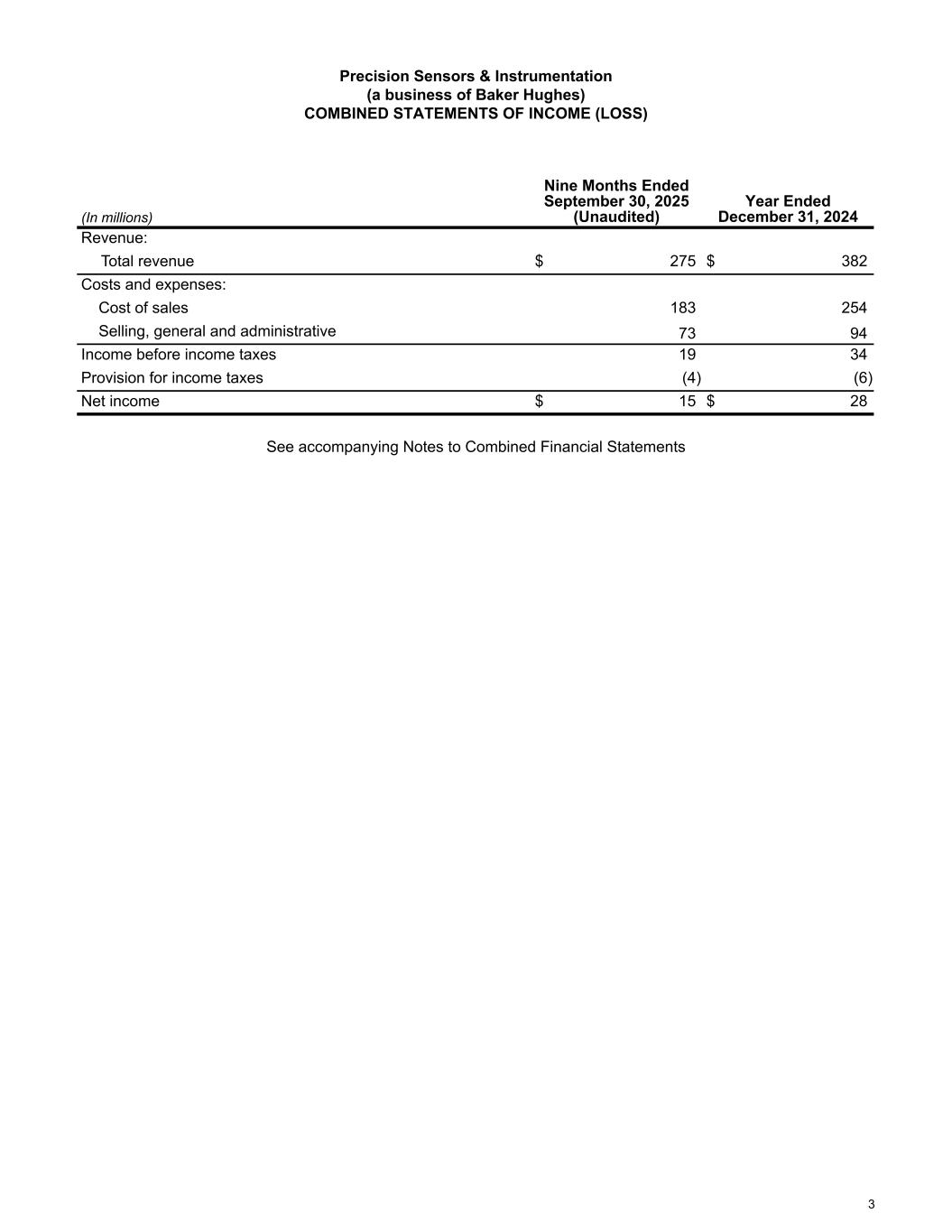
Precision Sensors & Instrumentation (a business of Baker Hughes) COMBINED STATEMENTS OF INCOME (LOSS) (In millions) Nine Months Ended September 30, 2025 (Unaudited) Year Ended December 31, 2024 Revenue: Total revenue $ 275 $ 382 Costs and expenses: Cost of sales 183 254 Selling, general and administrative 73 94 Income before income taxes 19 34 Provision for income taxes (4) (6) Net income $ 15 $ 28 See accompanying Notes to Combined Financial Statements 3
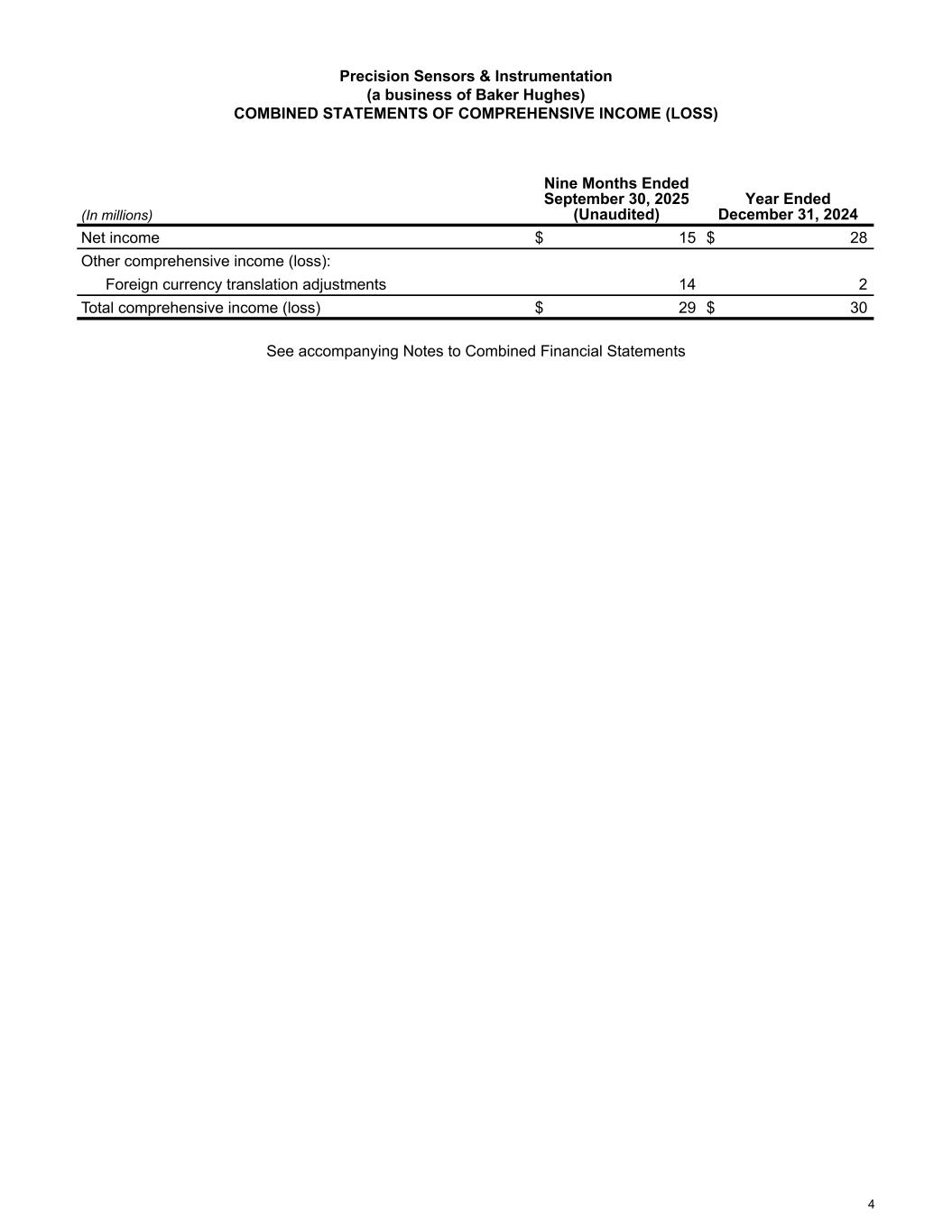
Precision Sensors & Instrumentation (a business of Baker Hughes) COMBINED STATEMENTS OF COMPREHENSIVE INCOME (LOSS) (In millions) Nine Months Ended September 30, 2025 (Unaudited) Year Ended December 31, 2024 Net income $ 15 $ 28 Other comprehensive income (loss): Foreign currency translation adjustments 14 2 Total comprehensive income (loss) $ 29 $ 30 See accompanying Notes to Combined Financial Statements 4
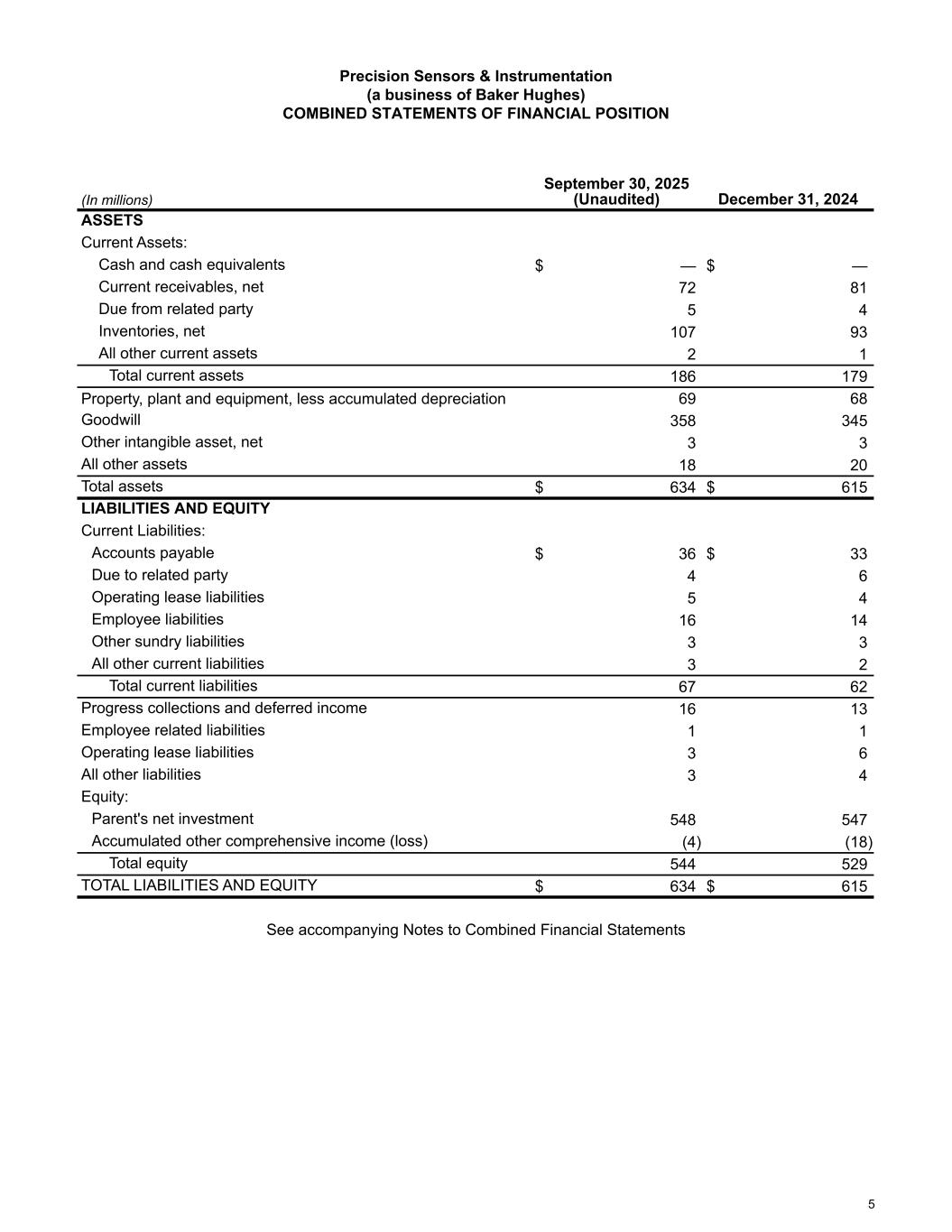
Precision Sensors & Instrumentation (a business of Baker Hughes) COMBINED STATEMENTS OF FINANCIAL POSITION (In millions) September 30, 2025 (Unaudited) December 31, 2024 ASSETS Current Assets: Cash and cash equivalents $ — $ — Current receivables, net 72 81 Due from related party 5 4 Inventories, net 107 93 All other current assets 2 1 Total current assets 186 179 Property, plant and equipment, less accumulated depreciation 69 68 Goodwill 358 345 Other intangible asset, net 3 3 All other assets 18 20 Total assets $ 634 $ 615 LIABILITIES AND EQUITY Current Liabilities: Accounts payable $ 36 $ 33 Due to related party 4 6 Operating lease liabilities 5 4 Employee liabilities 16 14 Other sundry liabilities 3 3 All other current liabilities 3 2 Total current liabilities 67 62 Progress collections and deferred income 16 13 Employee related liabilities 1 1 Operating lease liabilities 3 6 All other liabilities 3 4 Equity: Parent's net investment 548 547 Accumulated other comprehensive income (loss) (4) (18) Total equity 544 529 TOTAL LIABILITIES AND EQUITY $ 634 $ 615 See accompanying Notes to Combined Financial Statements 5
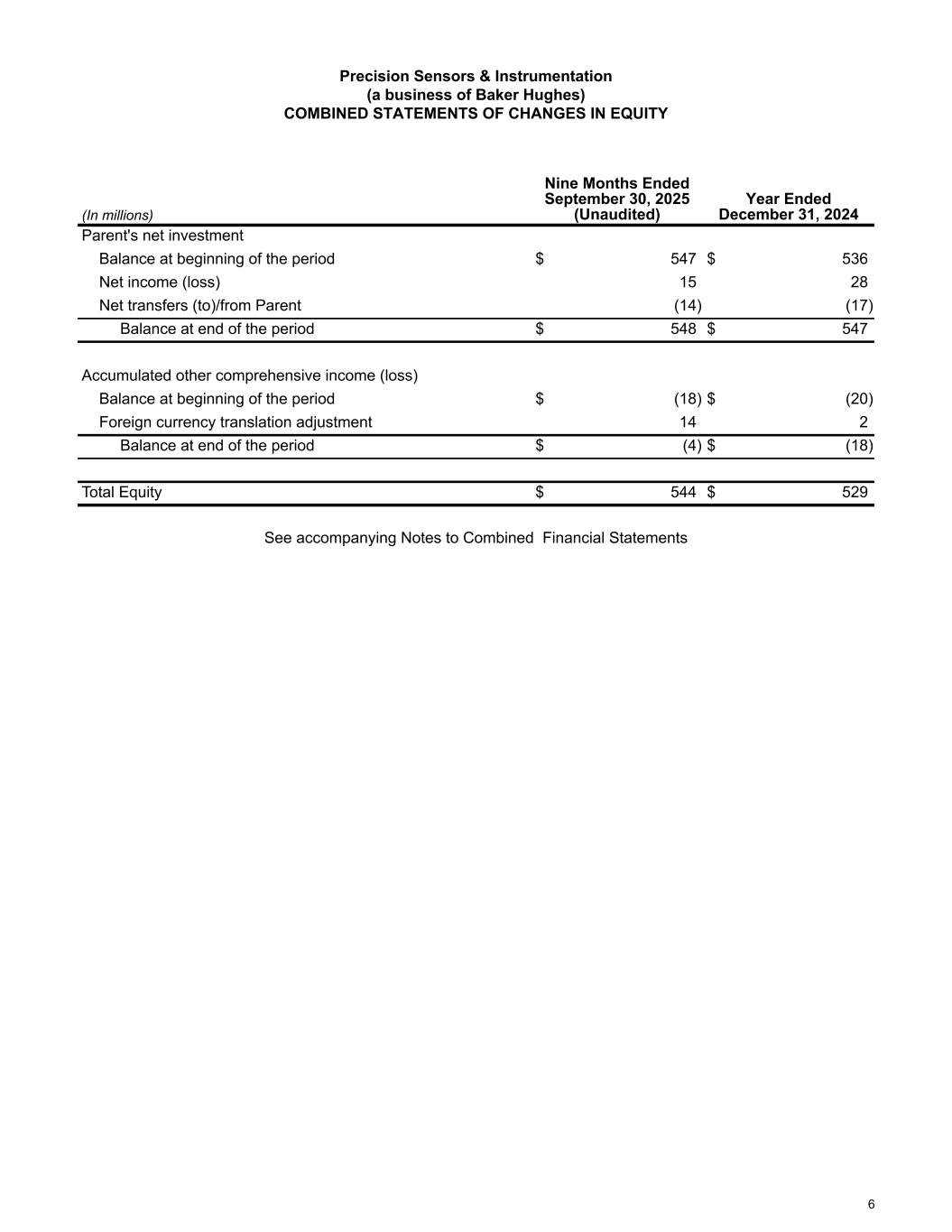
Precision Sensors & Instrumentation (a business of Baker Hughes) COMBINED STATEMENTS OF CHANGES IN EQUITY (In millions) Nine Months Ended September 30, 2025 (Unaudited) Year Ended December 31, 2024 Parent's net investment Balance at beginning of the period $ 547 $ 536 Net income (loss) 15 28 Net transfers (to)/from Parent (14) (17) Balance at end of the period $ 548 $ 547 Accumulated other comprehensive income (loss) Balance at beginning of the period $ (18) $ (20) Foreign currency translation adjustment 14 2 Balance at end of the period $ (4) $ (18) Total Equity $ 544 $ 529 See accompanying Notes to Combined Financial Statements 6
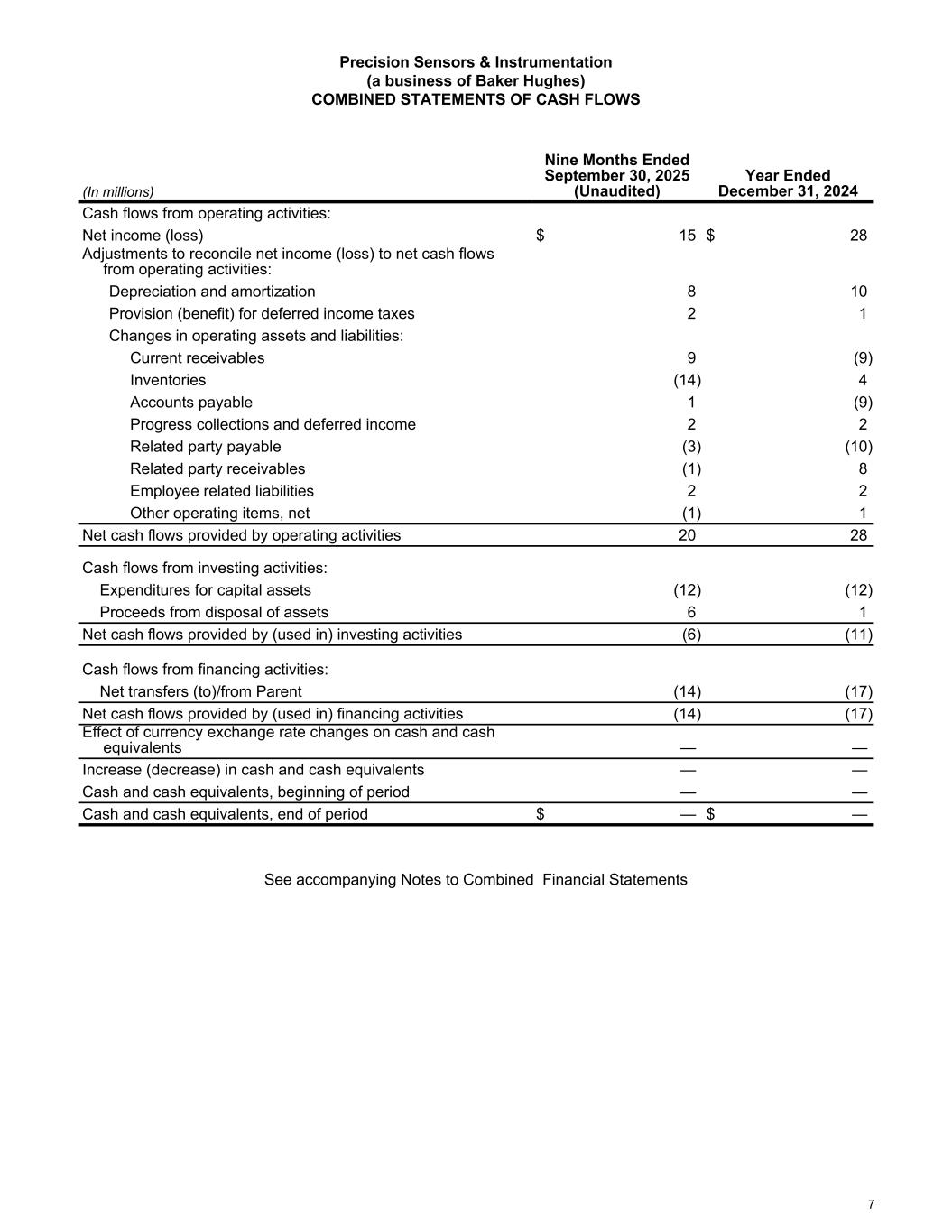
Precision Sensors & Instrumentation (a business of Baker Hughes) COMBINED STATEMENTS OF CASH FLOWS (In millions) Nine Months Ended September 30, 2025 (Unaudited) Year Ended December 31, 2024 Cash flows from operating activities: Net income (loss) $ 15 $ 28 Adjustments to reconcile net income (loss) to net cash flows from operating activities: Depreciation and amortization 8 10 Provision (benefit) for deferred income taxes 2 1 Changes in operating assets and liabilities: Current receivables 9 (9) Inventories (14) 4 Accounts payable 1 (9) Progress collections and deferred income 2 2 Related party payable (3) (10) Related party receivables (1) 8 Employee related liabilities 2 2 Other operating items, net (1) 1 Net cash flows provided by operating activities 20 28 Cash flows from investing activities: Expenditures for capital assets (12) (12) Proceeds from disposal of assets 6 1 Net cash flows provided by (used in) investing activities (6) (11) Cash flows from financing activities: Net transfers (to)/from Parent (14) (17) Net cash flows provided by (used in) financing activities (14) (17) Effect of currency exchange rate changes on cash and cash equivalents — — Increase (decrease) in cash and cash equivalents — — Cash and cash equivalents, beginning of period — — Cash and cash equivalents, end of period $ — $ — See accompanying Notes to Combined Financial Statements 7
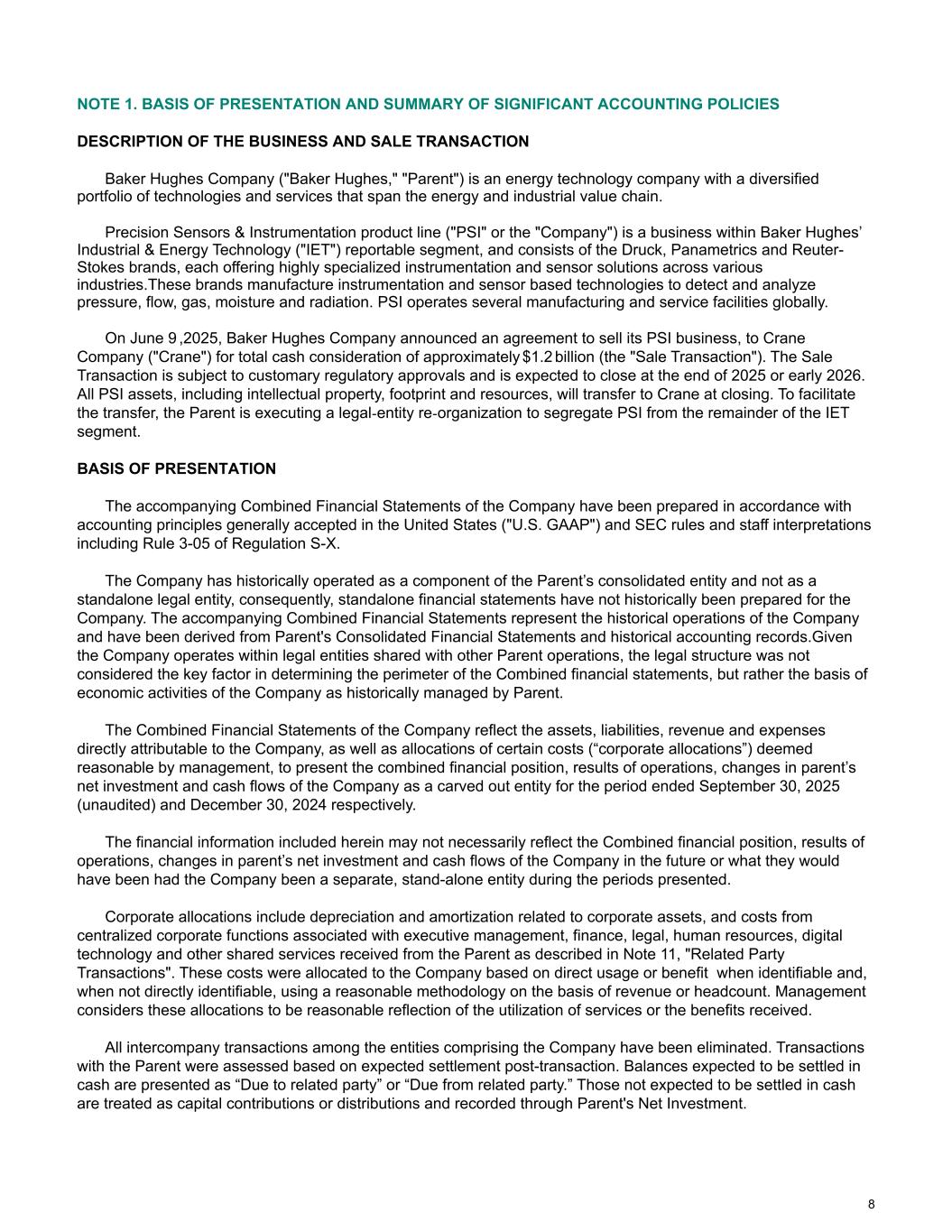
NOTE 1. BASIS OF PRESENTATION AND SUMMARY OF SIGNIFICANT ACCOUNTING POLICIES DESCRIPTION OF THE BUSINESS AND SALE TRANSACTION Baker Hughes Company ("Baker Hughes," "Parent") is an energy technology company with a diversified portfolio of technologies and services that span the energy and industrial value chain. Precision Sensors & Instrumentation product line ("PSI" or the "Company") is a business within Baker Hughes’ Industrial & Energy Technology ("IET") reportable segment, and consists of the Druck, Panametrics and Reuter- Stokes brands, each offering highly specialized instrumentation and sensor solutions across various industries.These brands manufacture instrumentation and sensor based technologies to detect and analyze pressure, flow, gas, moisture and radiation. PSI operates several manufacturing and service facilities globally. On June 9 ,2025, Baker Hughes Company announced an agreement to sell its PSI business, to Crane Company ("Crane") for total cash consideration of approximately $1.2 billion (the "Sale Transaction"). The Sale Transaction is subject to customary regulatory approvals and is expected to close at the end of 2025 or early 2026. All PSI assets, including intellectual property, footprint and resources, will transfer to Crane at closing. To facilitate the transfer, the Parent is executing a legal-entity re-organization to segregate PSI from the remainder of the IET segment. BASIS OF PRESENTATION The accompanying Combined Financial Statements of the Company have been prepared in accordance with accounting principles generally accepted in the United States ("U.S. GAAP") and SEC rules and staff interpretations including Rule 3-05 of Regulation S-X. The Company has historically operated as a component of the Parent’s consolidated entity and not as a standalone legal entity, consequently, standalone financial statements have not historically been prepared for the Company. The accompanying Combined Financial Statements represent the historical operations of the Company and have been derived from Parent's Consolidated Financial Statements and historical accounting records.Given the Company operates within legal entities shared with other Parent operations, the legal structure was not considered the key factor in determining the perimeter of the Combined financial statements, but rather the basis of economic activities of the Company as historically managed by Parent. The Combined Financial Statements of the Company reflect the assets, liabilities, revenue and expenses directly attributable to the Company, as well as allocations of certain costs (“corporate allocations”) deemed reasonable by management, to present the combined financial position, results of operations, changes in parent’s net investment and cash flows of the Company as a carved out entity for the period ended September 30, 2025 (unaudited) and December 30, 2024 respectively. The financial information included herein may not necessarily reflect the Combined financial position, results of operations, changes in parent’s net investment and cash flows of the Company in the future or what they would have been had the Company been a separate, stand-alone entity during the periods presented. Corporate allocations include depreciation and amortization related to corporate assets, and costs from centralized corporate functions associated with executive management, finance, legal, human resources, digital technology and other shared services received from the Parent as described in Note 11, "Related Party Transactions". These costs were allocated to the Company based on direct usage or benefit when identifiable and, when not directly identifiable, using a reasonable methodology on the basis of revenue or headcount. Management considers these allocations to be reasonable reflection of the utilization of services or the benefits received. All intercompany transactions among the entities comprising the Company have been eliminated. Transactions with the Parent were assessed based on expected settlement post-transaction. Balances expected to be settled in cash are presented as “Due to related party” or “Due from related party.” Those not expected to be settled in cash are treated as capital contributions or distributions and recorded through Parent's Net Investment. 8
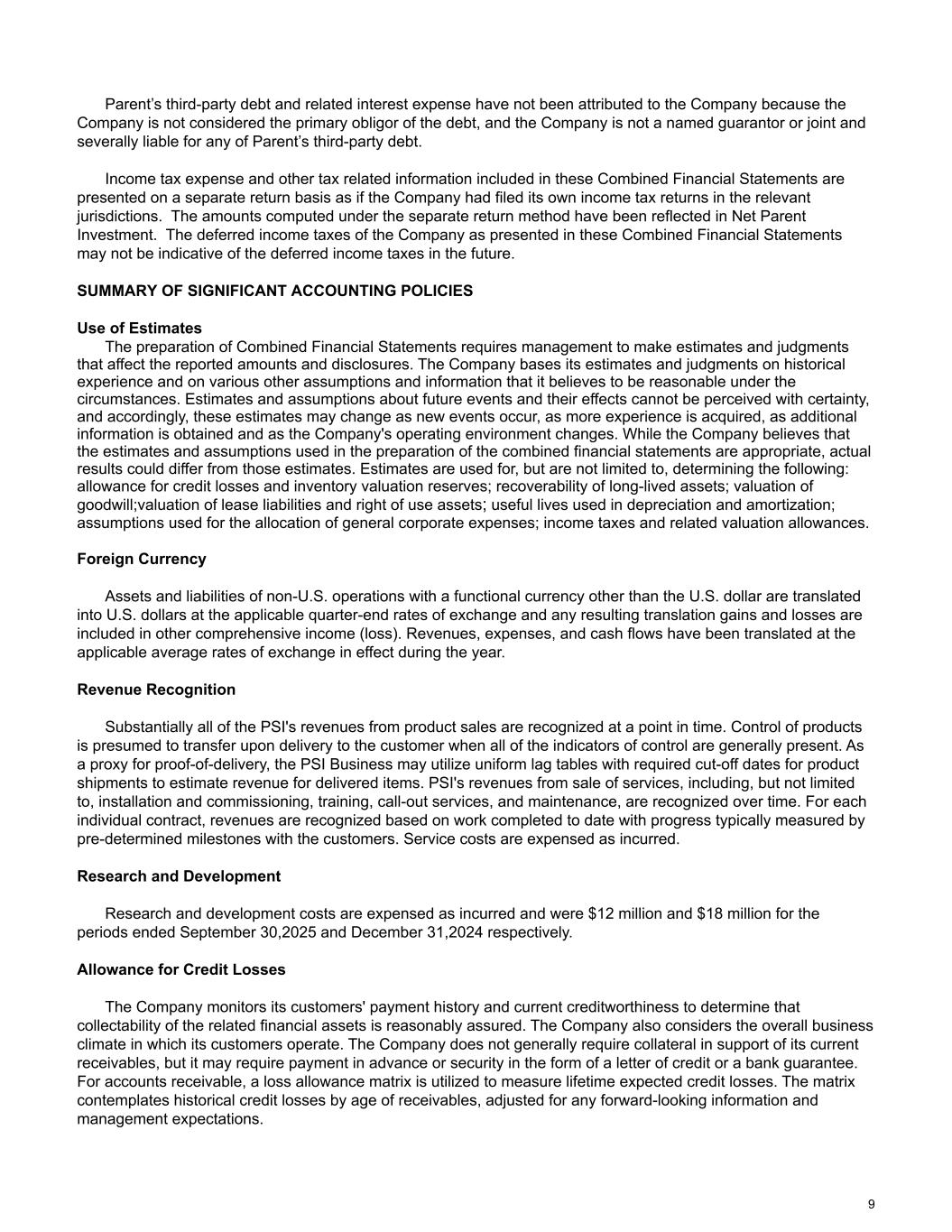
Parent’s third-party debt and related interest expense have not been attributed to the Company because the Company is not considered the primary obligor of the debt, and the Company is not a named guarantor or joint and severally liable for any of Parent’s third-party debt. Income tax expense and other tax related information included in these Combined Financial Statements are presented on a separate return basis as if the Company had filed its own income tax returns in the relevant jurisdictions. The amounts computed under the separate return method have been reflected in Net Parent Investment. The deferred income taxes of the Company as presented in these Combined Financial Statements may not be indicative of the deferred income taxes in the future. SUMMARY OF SIGNIFICANT ACCOUNTING POLICIES Use of Estimates The preparation of Combined Financial Statements requires management to make estimates and judgments that affect the reported amounts and disclosures. The Company bases its estimates and judgments on historical experience and on various other assumptions and information that it believes to be reasonable under the circumstances. Estimates and assumptions about future events and their effects cannot be perceived with certainty, and accordingly, these estimates may change as new events occur, as more experience is acquired, as additional information is obtained and as the Company's operating environment changes. While the Company believes that the estimates and assumptions used in the preparation of the combined financial statements are appropriate, actual results could differ from those estimates. Estimates are used for, but are not limited to, determining the following: allowance for credit losses and inventory valuation reserves; recoverability of long-lived assets; valuation of goodwill;valuation of lease liabilities and right of use assets; useful lives used in depreciation and amortization; assumptions used for the allocation of general corporate expenses; income taxes and related valuation allowances. Foreign Currency Assets and liabilities of non-U.S. operations with a functional currency other than the U.S. dollar are translated into U.S. dollars at the applicable quarter-end rates of exchange and any resulting translation gains and losses are included in other comprehensive income (loss). Revenues, expenses, and cash flows have been translated at the applicable average rates of exchange in effect during the year. Revenue Recognition Substantially all of the PSI's revenues from product sales are recognized at a point in time. Control of products is presumed to transfer upon delivery to the customer when all of the indicators of control are generally present. As a proxy for proof-of-delivery, the PSI Business may utilize uniform lag tables with required cut-off dates for product shipments to estimate revenue for delivered items. PSI's revenues from sale of services, including, but not limited to, installation and commissioning, training, call-out services, and maintenance, are recognized over time. For each individual contract, revenues are recognized based on work completed to date with progress typically measured by pre-determined milestones with the customers. Service costs are expensed as incurred. Research and Development Research and development costs are expensed as incurred and were $12 million and $18 million for the periods ended September 30,2025 and December 31,2024 respectively. Allowance for Credit Losses The Company monitors its customers' payment history and current creditworthiness to determine that collectability of the related financial assets is reasonably assured. The Company also considers the overall business climate in which its customers operate. The Company does not generally require collateral in support of its current receivables, but it may require payment in advance or security in the form of a letter of credit or a bank guarantee. For accounts receivable, a loss allowance matrix is utilized to measure lifetime expected credit losses. The matrix contemplates historical credit losses by age of receivables, adjusted for any forward-looking information and management expectations. 9
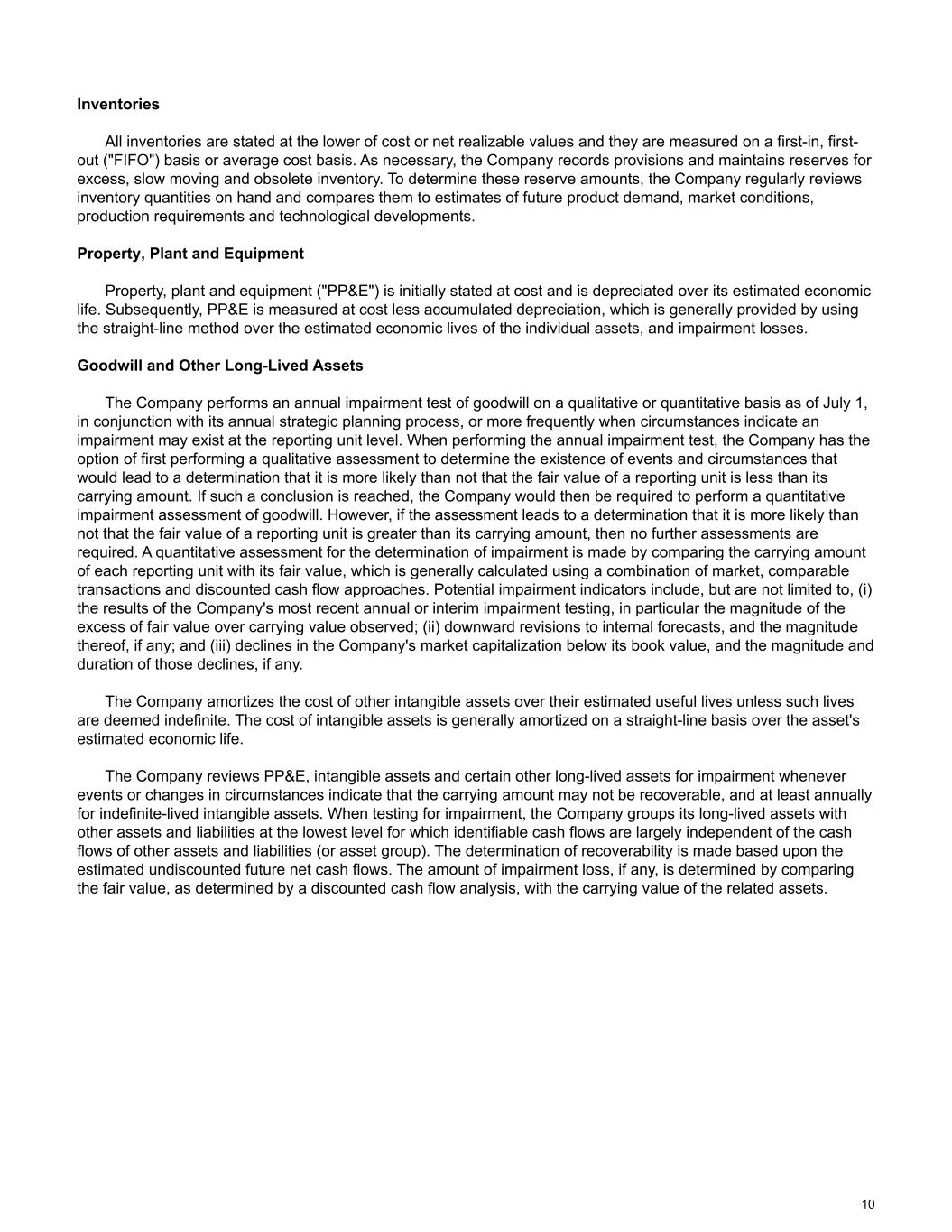
Inventories All inventories are stated at the lower of cost or net realizable values and they are measured on a first-in, first- out ("FIFO") basis or average cost basis. As necessary, the Company records provisions and maintains reserves for excess, slow moving and obsolete inventory. To determine these reserve amounts, the Company regularly reviews inventory quantities on hand and compares them to estimates of future product demand, market conditions, production requirements and technological developments. Property, Plant and Equipment Property, plant and equipment ("PP&E") is initially stated at cost and is depreciated over its estimated economic life. Subsequently, PP&E is measured at cost less accumulated depreciation, which is generally provided by using the straight-line method over the estimated economic lives of the individual assets, and impairment losses. Goodwill and Other Long-Lived Assets The Company performs an annual impairment test of goodwill on a qualitative or quantitative basis as of July 1, in conjunction with its annual strategic planning process, or more frequently when circumstances indicate an impairment may exist at the reporting unit level. When performing the annual impairment test, the Company has the option of first performing a qualitative assessment to determine the existence of events and circumstances that would lead to a determination that it is more likely than not that the fair value of a reporting unit is less than its carrying amount. If such a conclusion is reached, the Company would then be required to perform a quantitative impairment assessment of goodwill. However, if the assessment leads to a determination that it is more likely than not that the fair value of a reporting unit is greater than its carrying amount, then no further assessments are required. A quantitative assessment for the determination of impairment is made by comparing the carrying amount of each reporting unit with its fair value, which is generally calculated using a combination of market, comparable transactions and discounted cash flow approaches. Potential impairment indicators include, but are not limited to, (i) the results of the Company's most recent annual or interim impairment testing, in particular the magnitude of the excess of fair value over carrying value observed; (ii) downward revisions to internal forecasts, and the magnitude thereof, if any; and (iii) declines in the Company's market capitalization below its book value, and the magnitude and duration of those declines, if any. The Company amortizes the cost of other intangible assets over their estimated useful lives unless such lives are deemed indefinite. The cost of intangible assets is generally amortized on a straight-line basis over the asset's estimated economic life. The Company reviews PP&E, intangible assets and certain other long-lived assets for impairment whenever events or changes in circumstances indicate that the carrying amount may not be recoverable, and at least annually for indefinite-lived intangible assets. When testing for impairment, the Company groups its long-lived assets with other assets and liabilities at the lowest level for which identifiable cash flows are largely independent of the cash flows of other assets and liabilities (or asset group). The determination of recoverability is made based upon the estimated undiscounted future net cash flows. The amount of impairment loss, if any, is determined by comparing the fair value, as determined by a discounted cash flow analysis, with the carrying value of the related assets. 10
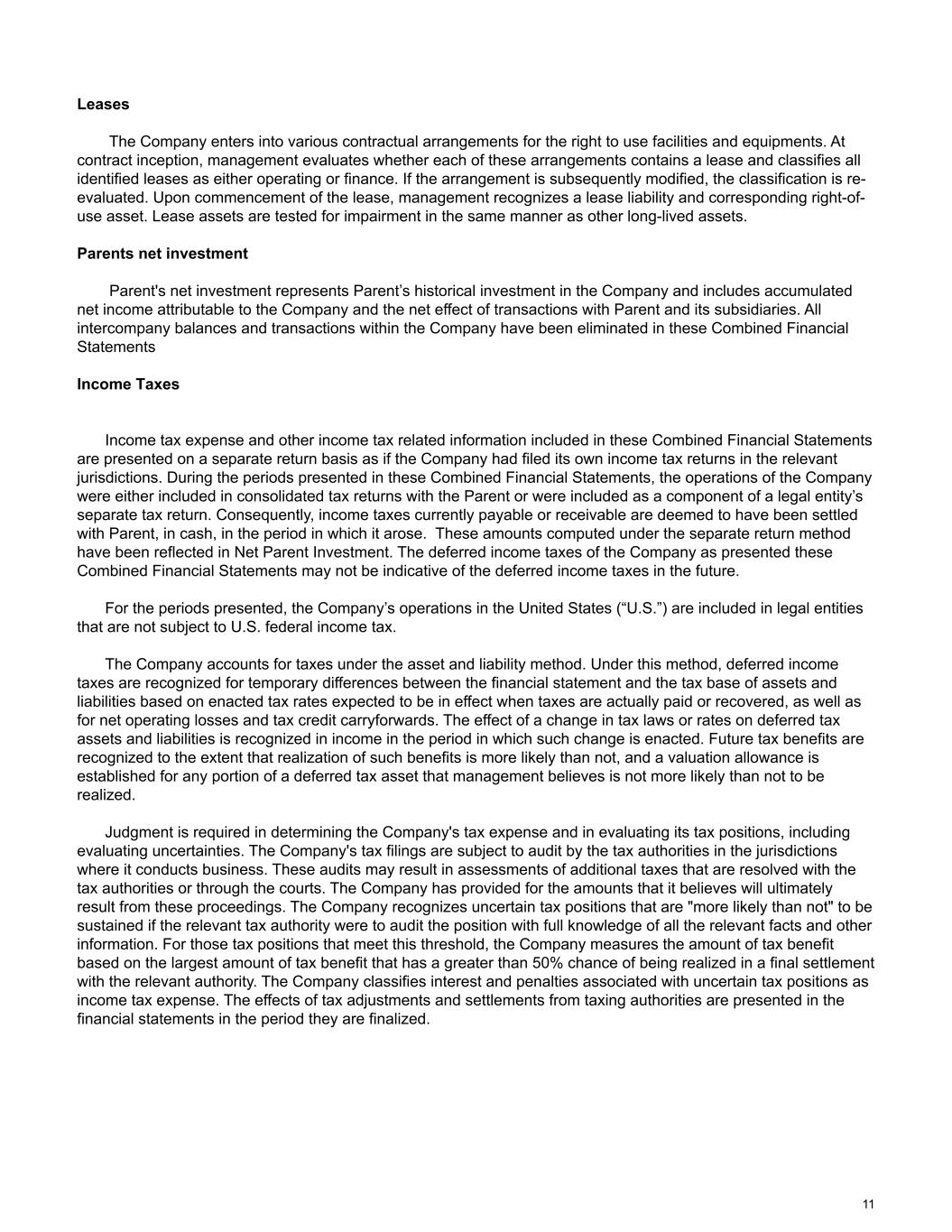
Leases The Company enters into various contractual arrangements for the right to use facilities and equipments. At contract inception, management evaluates whether each of these arrangements contains a lease and classifies all identified leases as either operating or finance. If the arrangement is subsequently modified, the classification is re- evaluated. Upon commencement of the lease, management recognizes a lease liability and corresponding right-of- use asset. Lease assets are tested for impairment in the same manner as other long-lived assets. Parents net investment Parent's net investment represents Parent’s historical investment in the Company and includes accumulated net income attributable to the Company and the net effect of transactions with Parent and its subsidiaries. All intercompany balances and transactions within the Company have been eliminated in these Combined Financial Statements Income Taxes Income tax expense and other income tax related information included in these Combined Financial Statements are presented on a separate return basis as if the Company had filed its own income tax returns in the relevant jurisdictions. During the periods presented in these Combined Financial Statements, the operations of the Company were either included in consolidated tax returns with the Parent or were included as a component of a legal entity’s separate tax return. Consequently, income taxes currently payable or receivable are deemed to have been settled with Parent, in cash, in the period in which it arose. These amounts computed under the separate return method have been reflected in Net Parent Investment. The deferred income taxes of the Company as presented these Combined Financial Statements may not be indicative of the deferred income taxes in the future. For the periods presented, the Company’s operations in the United States (“U.S.”) are included in legal entities that are not subject to U.S. federal income tax. The Company accounts for taxes under the asset and liability method. Under this method, deferred income taxes are recognized for temporary differences between the financial statement and the tax base of assets and liabilities based on enacted tax rates expected to be in effect when taxes are actually paid or recovered, as well as for net operating losses and tax credit carryforwards. The effect of a change in tax laws or rates on deferred tax assets and liabilities is recognized in income in the period in which such change is enacted. Future tax benefits are recognized to the extent that realization of such benefits is more likely than not, and a valuation allowance is established for any portion of a deferred tax asset that management believes is not more likely than not to be realized. Judgment is required in determining the Company's tax expense and in evaluating its tax positions, including evaluating uncertainties. The Company's tax filings are subject to audit by the tax authorities in the jurisdictions where it conducts business. These audits may result in assessments of additional taxes that are resolved with the tax authorities or through the courts. The Company has provided for the amounts that it believes will ultimately result from these proceedings. The Company recognizes uncertain tax positions that are "more likely than not" to be sustained if the relevant tax authority were to audit the position with full knowledge of all the relevant facts and other information. For those tax positions that meet this threshold, the Company measures the amount of tax benefit based on the largest amount of tax benefit that has a greater than 50% chance of being realized in a final settlement with the relevant authority. The Company classifies interest and penalties associated with uncertain tax positions as income tax expense. The effects of tax adjustments and settlements from taxing authorities are presented in the financial statements in the period they are finalized. 11
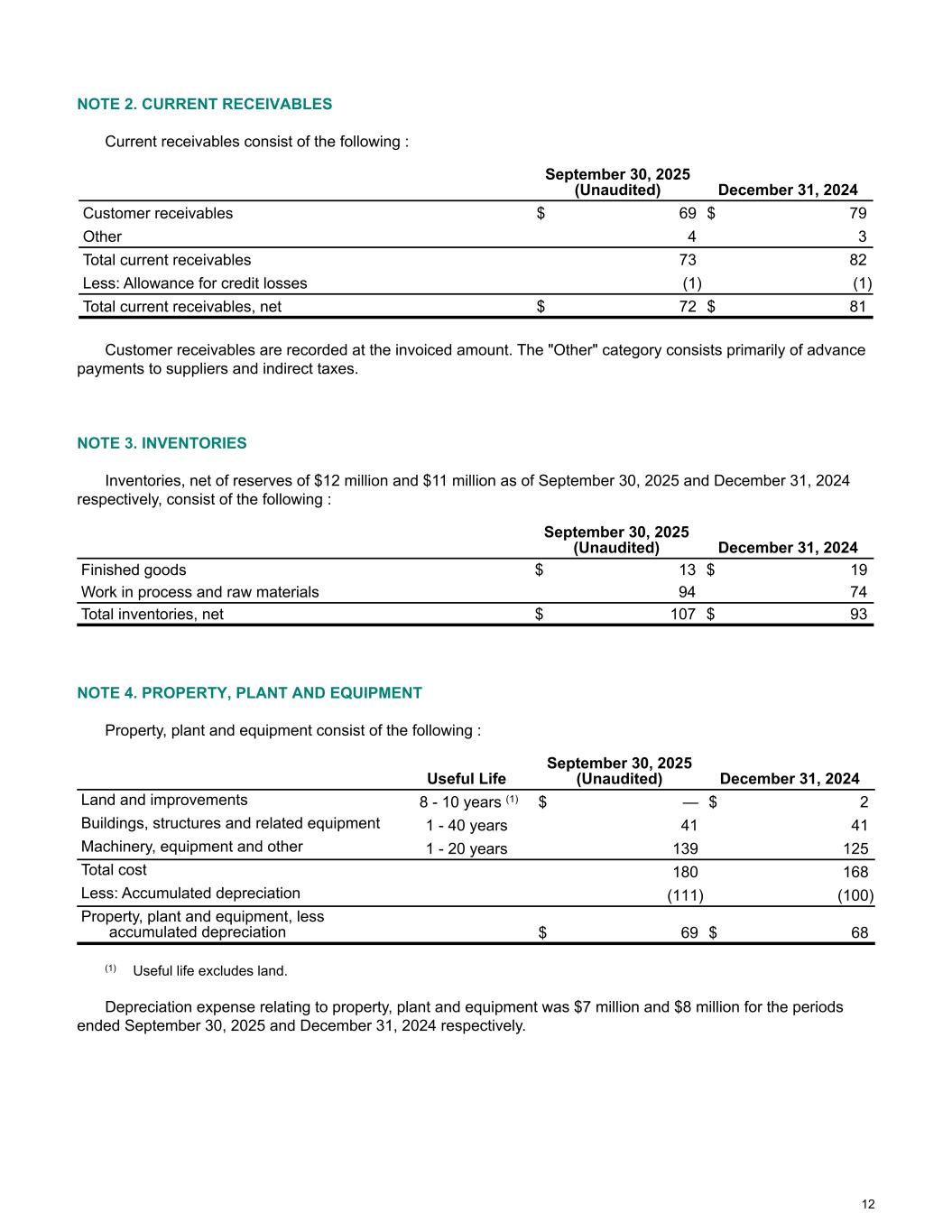
NOTE 2. CURRENT RECEIVABLES Current receivables consist of the following : September 30, 2025 (Unaudited) December 31, 2024 Customer receivables $ 69 $ 79 Other 4 3 Total current receivables 73 82 Less: Allowance for credit losses (1) (1) Total current receivables, net $ 72 $ 81 Customer receivables are recorded at the invoiced amount. The "Other" category consists primarily of advance payments to suppliers and indirect taxes. NOTE 3. INVENTORIES Inventories, net of reserves of $12 million and $11 million as of September 30, 2025 and December 31, 2024 respectively, consist of the following : September 30, 2025 (Unaudited) December 31, 2024 Finished goods $ 13 $ 19 Work in process and raw materials 94 74 Total inventories, net $ 107 $ 93 NOTE 4. PROPERTY, PLANT AND EQUIPMENT Property, plant and equipment consist of the following : Useful Life September 30, 2025 (Unaudited) December 31, 2024 Land and improvements 8 - 10 years (1) $ — $ 2 Buildings, structures and related equipment 1 - 40 years 41 41 Machinery, equipment and other 1 - 20 years 139 125 Total cost 180 168 Less: Accumulated depreciation (111) (100) Property, plant and equipment, less accumulated depreciation $ 69 $ 68 (1) Useful life excludes land. Depreciation expense relating to property, plant and equipment was $7 million and $8 million for the periods ended September 30, 2025 and December 31, 2024 respectively. 12
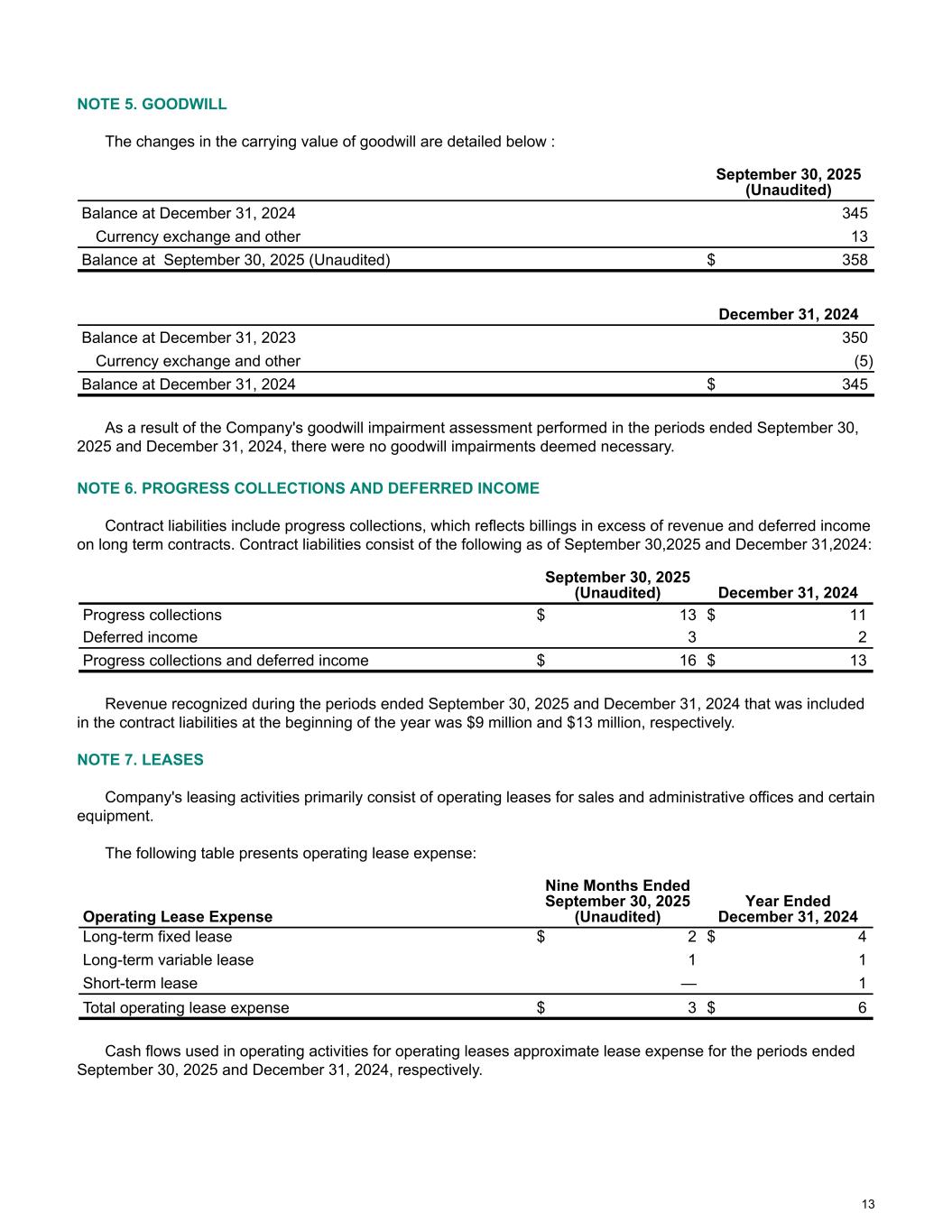
NOTE 5. GOODWILL The changes in the carrying value of goodwill are detailed below : September 30, 2025 (Unaudited) Balance at December 31, 2024 345 Currency exchange and other 13 Balance at September 30, 2025 (Unaudited) $ 358 December 31, 2024 Balance at December 31, 2023 350 Currency exchange and other (5) Balance at December 31, 2024 $ 345 As a result of the Company's goodwill impairment assessment performed in the periods ended September 30, 2025 and December 31, 2024, there were no goodwill impairments deemed necessary. NOTE 6. PROGRESS COLLECTIONS AND DEFERRED INCOME Contract liabilities include progress collections, which reflects billings in excess of revenue and deferred income on long term contracts. Contract liabilities consist of the following as of September 30,2025 and December 31,2024: September 30, 2025 (Unaudited) December 31, 2024 Progress collections $ 13 $ 11 Deferred income 3 2 Progress collections and deferred income $ 16 $ 13 Revenue recognized during the periods ended September 30, 2025 and December 31, 2024 that was included in the contract liabilities at the beginning of the year was $9 million and $13 million, respectively. NOTE 7. LEASES Company's leasing activities primarily consist of operating leases for sales and administrative offices and certain equipment. The following table presents operating lease expense: Operating Lease Expense Nine Months Ended September 30, 2025 (Unaudited) Year Ended December 31, 2024 Long-term fixed lease $ 2 $ 4 Long-term variable lease 1 1 Short-term lease — 1 Total operating lease expense $ 3 $ 6 Cash flows used in operating activities for operating leases approximate lease expense for the periods ended September 30, 2025 and December 31, 2024, respectively. 13
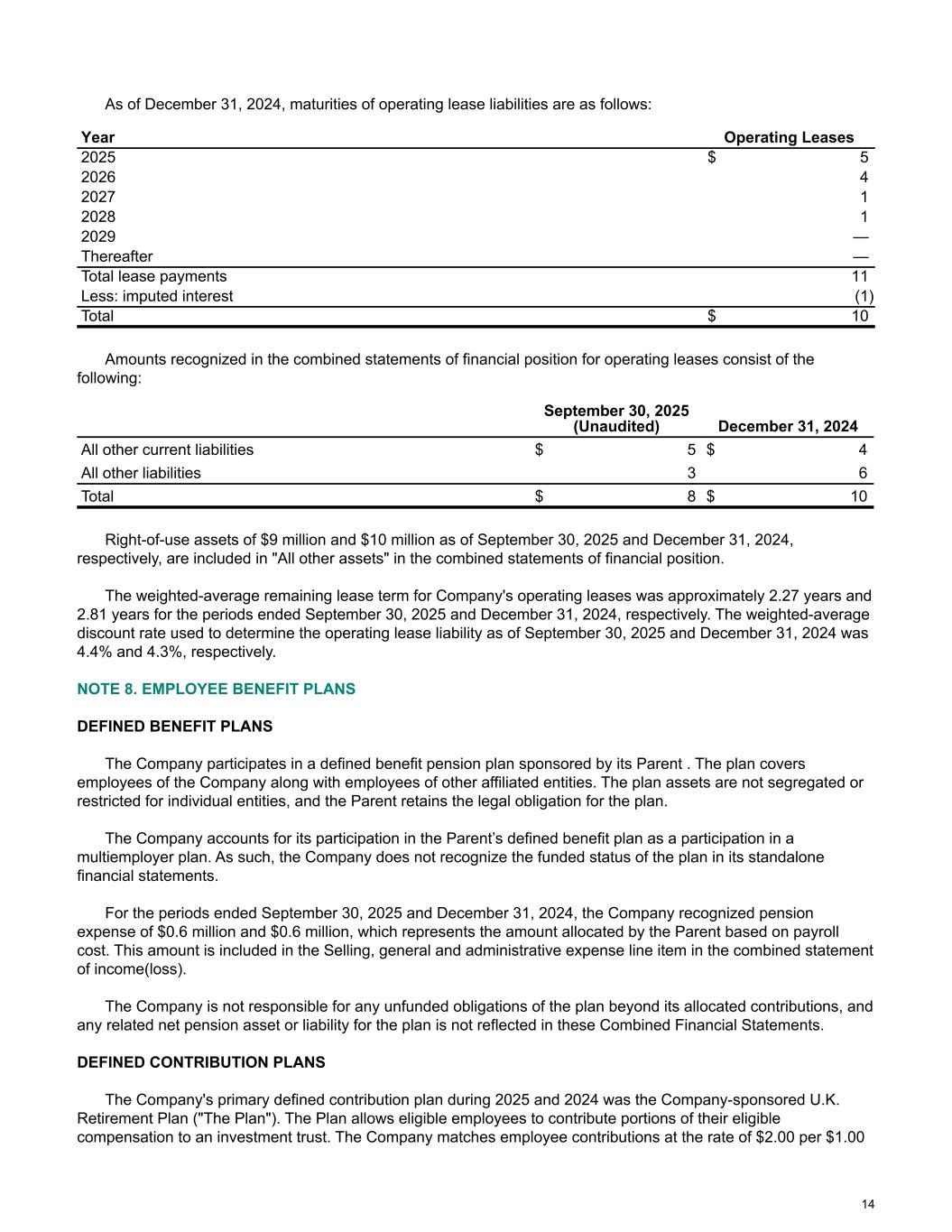
As of December 31, 2024, maturities of operating lease liabilities are as follows: Year Operating Leases 2025 $ 5 2026 4 2027 1 2028 1 2029 — Thereafter — Total lease payments 11 Less: imputed interest (1) Total $ 10 Amounts recognized in the combined statements of financial position for operating leases consist of the following: September 30, 2025 (Unaudited) December 31, 2024 All other current liabilities $ 5 $ 4 All other liabilities 3 6 Total $ 8 $ 10 Right-of-use assets of $9 million and $10 million as of September 30, 2025 and December 31, 2024, respectively, are included in "All other assets" in the combined statements of financial position. The weighted-average remaining lease term for Company's operating leases was approximately 2.27 years and 2.81 years for the periods ended September 30, 2025 and December 31, 2024, respectively. The weighted-average discount rate used to determine the operating lease liability as of September 30, 2025 and December 31, 2024 was 4.4% and 4.3%, respectively. NOTE 8. EMPLOYEE BENEFIT PLANS DEFINED BENEFIT PLANS The Company participates in a defined benefit pension plan sponsored by its Parent . The plan covers employees of the Company along with employees of other affiliated entities. The plan assets are not segregated or restricted for individual entities, and the Parent retains the legal obligation for the plan. The Company accounts for its participation in the Parent’s defined benefit plan as a participation in a multiemployer plan. As such, the Company does not recognize the funded status of the plan in its standalone financial statements. For the periods ended September 30, 2025 and December 31, 2024, the Company recognized pension expense of $0.6 million and $0.6 million, which represents the amount allocated by the Parent based on payroll cost. This amount is included in the Selling, general and administrative expense line item in the combined statement of income(loss). The Company is not responsible for any unfunded obligations of the plan beyond its allocated contributions, and any related net pension asset or liability for the plan is not reflected in these Combined Financial Statements. DEFINED CONTRIBUTION PLANS The Company's primary defined contribution plan during 2025 and 2024 was the Company-sponsored U.K. Retirement Plan ("The Plan"). The Plan allows eligible employees to contribute portions of their eligible compensation to an investment trust. The Company matches employee contributions at the rate of $2.00 per $1.00 14
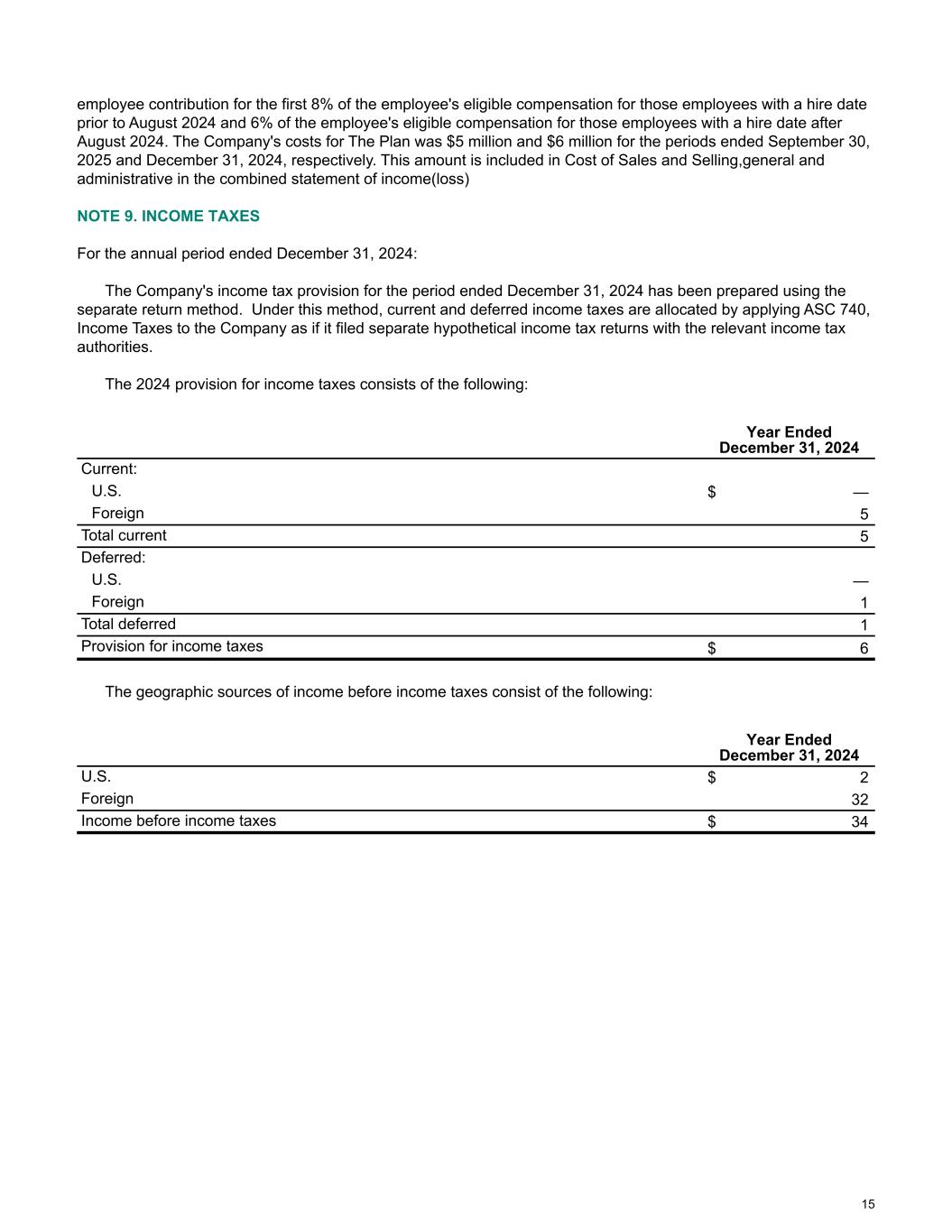
employee contribution for the first 8% of the employee's eligible compensation for those employees with a hire date prior to August 2024 and 6% of the employee's eligible compensation for those employees with a hire date after August 2024. The Company's costs for The Plan was $5 million and $6 million for the periods ended September 30, 2025 and December 31, 2024, respectively. This amount is included in Cost of Sales and Selling,general and administrative in the combined statement of income(loss) NOTE 9. INCOME TAXES For the annual period ended December 31, 2024: The Company's income tax provision for the period ended December 31, 2024 has been prepared using the separate return method. Under this method, current and deferred income taxes are allocated by applying ASC 740, Income Taxes to the Company as if it filed separate hypothetical income tax returns with the relevant income tax authorities. The 2024 provision for income taxes consists of the following: Year Ended December 31, 2024 Current: U.S. $ — Foreign 5 Total current 5 Deferred: U.S. — Foreign 1 Total deferred 1 Provision for income taxes $ 6 The geographic sources of income before income taxes consist of the following: Year Ended December 31, 2024 U.S. $ 2 Foreign 32 Income before income taxes $ 34 15
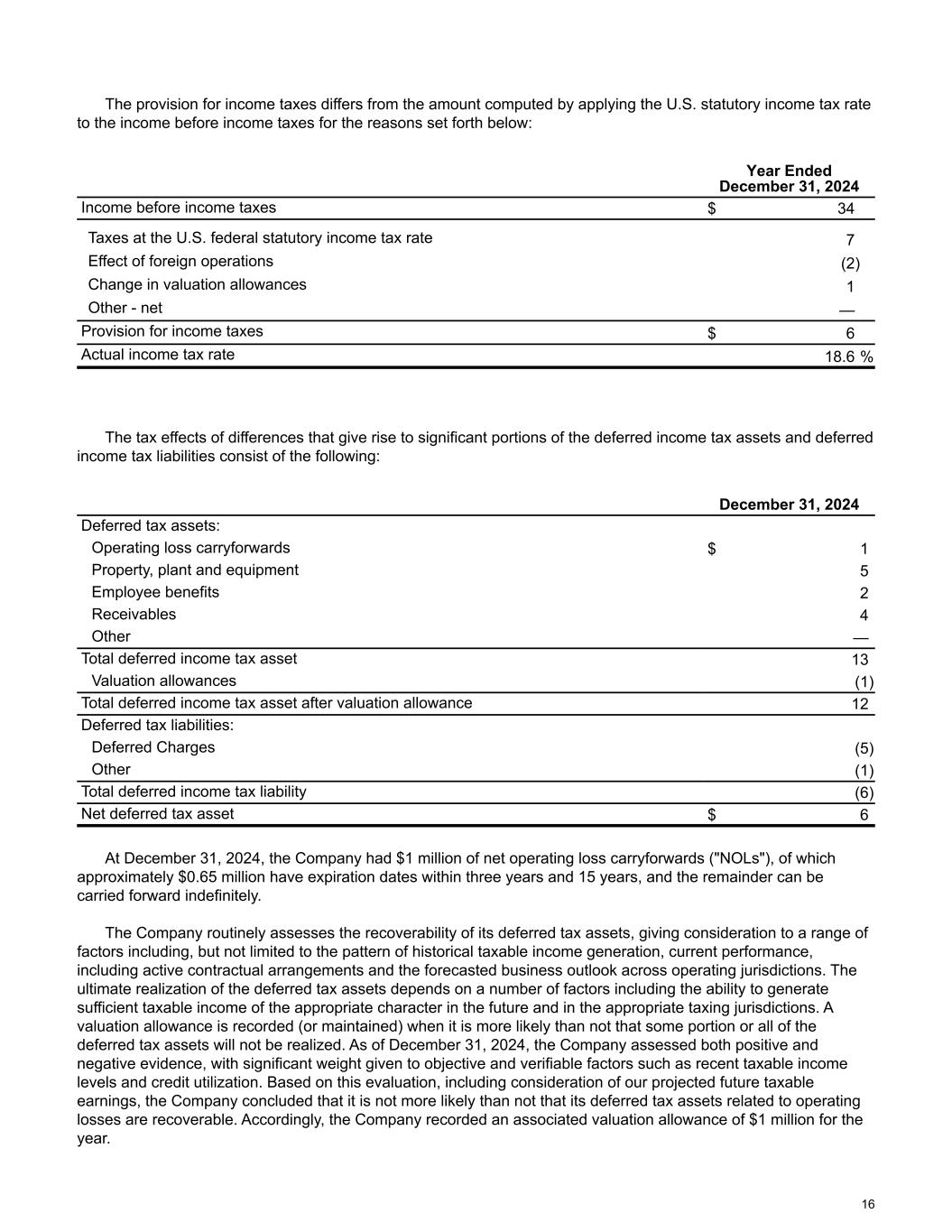
The provision for income taxes differs from the amount computed by applying the U.S. statutory income tax rate to the income before income taxes for the reasons set forth below: Year Ended December 31, 2024 Income before income taxes $ 34 Taxes at the U.S. federal statutory income tax rate 7 Effect of foreign operations (2) Change in valuation allowances 1 Other - net — Provision for income taxes $ 6 Actual income tax rate 18.6 % The tax effects of differences that give rise to significant portions of the deferred income tax assets and deferred income tax liabilities consist of the following: December 31, 2024 Deferred tax assets: Operating loss carryforwards $ 1 Property, plant and equipment 5 Employee benefits 2 Receivables 4 Other — Total deferred income tax asset 13 Valuation allowances (1) Total deferred income tax asset after valuation allowance 12 Deferred tax liabilities: Deferred Charges (5) Other (1) Total deferred income tax liability (6) Net deferred tax asset $ 6 At December 31, 2024, the Company had $1 million of net operating loss carryforwards ("NOLs"), of which approximately $0.65 million have expiration dates within three years and 15 years, and the remainder can be carried forward indefinitely. The Company routinely assesses the recoverability of its deferred tax assets, giving consideration to a range of factors including, but not limited to the pattern of historical taxable income generation, current performance, including active contractual arrangements and the forecasted business outlook across operating jurisdictions. The ultimate realization of the deferred tax assets depends on a number of factors including the ability to generate sufficient taxable income of the appropriate character in the future and in the appropriate taxing jurisdictions. A valuation allowance is recorded (or maintained) when it is more likely than not that some portion or all of the deferred tax assets will not be realized. As of December 31, 2024, the Company assessed both positive and negative evidence, with significant weight given to objective and verifiable factors such as recent taxable income levels and credit utilization. Based on this evaluation, including consideration of our projected future taxable earnings, the Company concluded that it is not more likely than not that its deferred tax assets related to operating losses are recoverable. Accordingly, the Company recorded an associated valuation allowance of $1 million for the year. 16
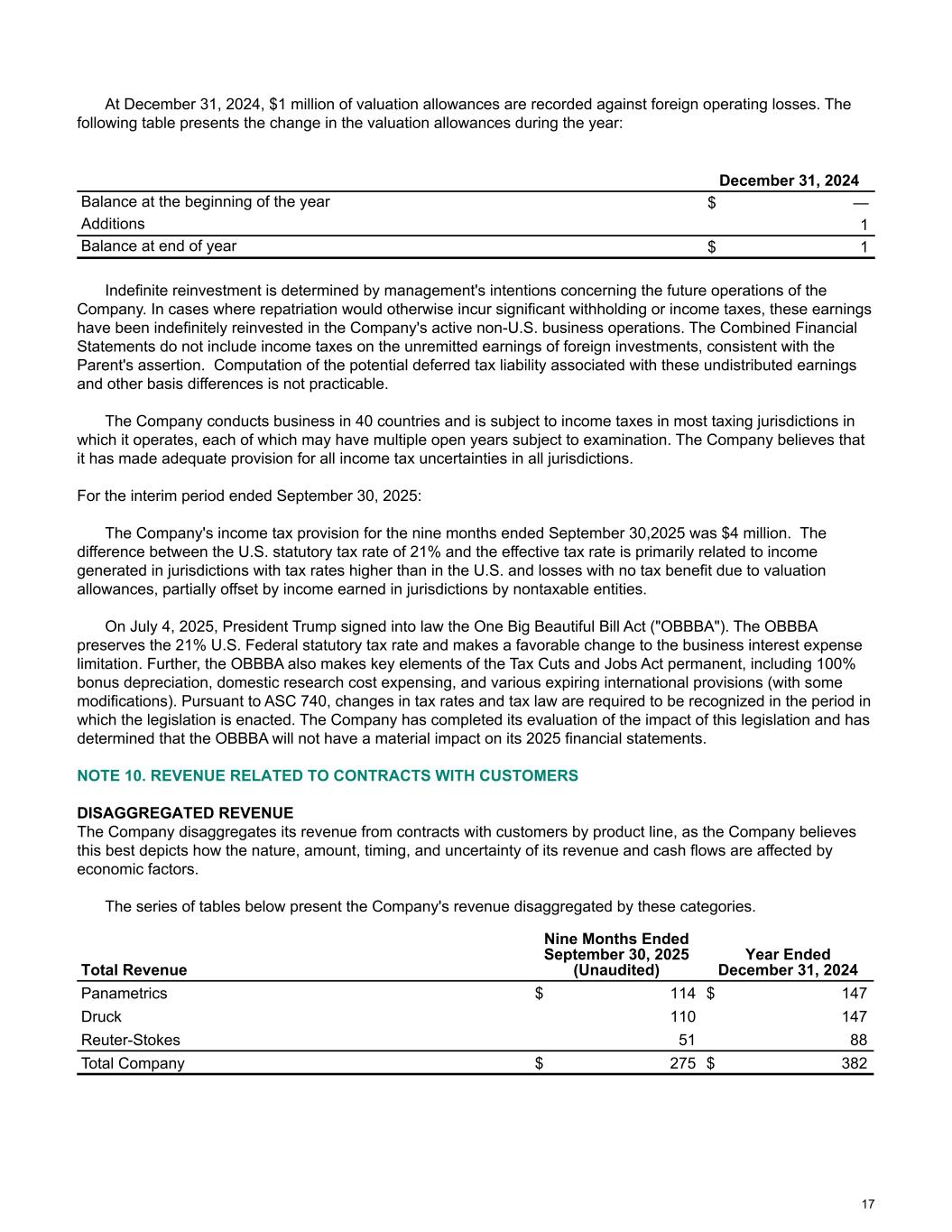
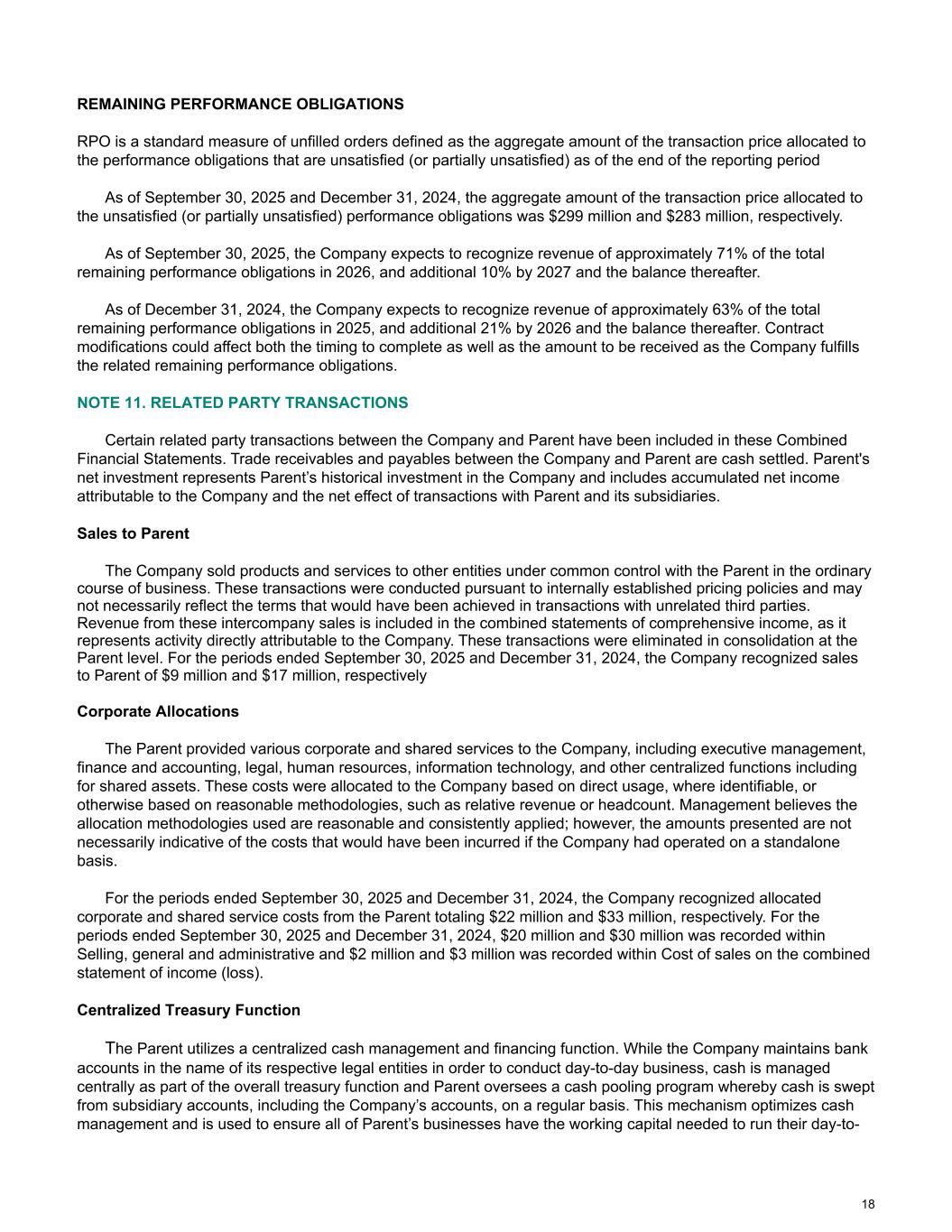
At December 31, 2024, $1 million of valuation allowances are recorded against foreign operating losses. The following table presents the change in the valuation allowances during the year: December 31, 2024 Balance at the beginning of the year $ — Additions 1 Balance at end of year $ 1 Indefinite reinvestment is determined by management's intentions concerning the future operations of the Company. In cases where repatriation would otherwise incur significant withholding or income taxes, these earnings have been indefinitely reinvested in the Company's active non-U.S. business operations. The Combined Financial Statements do not include income taxes on the unremitted earnings of foreign investments, consistent with the Parent's assertion. Computation of the potential deferred tax liability associated with these undistributed earnings and other basis differences is not practicable. The Company conducts business in 40 countries and is subject to income taxes in most taxing jurisdictions in which it operates, each of which may have multiple open years subject to examination. The Company believes that it has made adequate provision for all income tax uncertainties in all jurisdictions. For the interim period ended September 30, 2025: The Company's income tax provision for the nine months ended September 30,2025 was $4 million. The difference between the U.S. statutory tax rate of 21% and the effective tax rate is primarily related to income generated in jurisdictions with tax rates higher than in the U.S. and losses with no tax benefit due to valuation allowances, partially offset by income earned in jurisdictions by nontaxable entities. On July 4, 2025, President Trump signed into law the One Big Beautiful Bill Act ("OBBBA"). The OBBBA preserves the 21% U.S. Federal statutory tax rate and makes a favorable change to the business interest expense limitation. Further, the OBBBA also makes key elements of the Tax Cuts and Jobs Act permanent, including 100% bonus depreciation, domestic research cost expensing, and various expiring international provisions (with some modifications). Pursuant to ASC 740, changes in tax rates and tax law are required to be recognized in the period in which the legislation is enacted. The Company has completed its evaluation of the impact of this legislation and has determined that the OBBBA will not have a material impact on its 2025 financial statements. NOTE 10. REVENUE RELATED TO CONTRACTS WITH CUSTOMERS DISAGGREGATED REVENUE The Company disaggregates its revenue from contracts with customers by product line, as the Company believes this best depicts how the nature, amount, timing, and uncertainty of its revenue and cash flows are affected by economic factors. The series of tables below present the Company's revenue disaggregated by these categories. Total Revenue Nine Months Ended September 30, 2025 (Unaudited) Year Ended December 31, 2024 Panametrics $ 114 $ 147 Druck 110 147 Reuter-Stokes 51 88 Total Company $ 275 $ 382 17
REMAINING PERFORMANCE OBLIGATIONS RPO is a standard measure of unfilled orders defined as the aggregate amount of the transaction price allocated to the performance obligations that are unsatisfied (or partially unsatisfied) as of the end of the reporting period As of September 30, 2025 and December 31, 2024, the aggregate amount of the transaction price allocated to the unsatisfied (or partially unsatisfied) performance obligations was $299 million and $283 million, respectively. As of September 30, 2025, the Company expects to recognize revenue of approximately 71% of the total remaining performance obligations in 2026, and additional 10% by 2027 and the balance thereafter. As of December 31, 2024, the Company expects to recognize revenue of approximately 63% of the total remaining performance obligations in 2025, and additional 21% by 2026 and the balance thereafter. Contract modifications could affect both the timing to complete as well as the amount to be received as the Company fulfills the related remaining performance obligations. NOTE 11. RELATED PARTY TRANSACTIONS Certain related party transactions between the Company and Parent have been included in these Combined Financial Statements. Trade receivables and payables between the Company and Parent are cash settled. Parent's net investment represents Parent’s historical investment in the Company and includes accumulated net income attributable to the Company and the net effect of transactions with Parent and its subsidiaries. Sales to Parent The Company sold products and services to other entities under common control with the Parent in the ordinary course of business. These transactions were conducted pursuant to internally established pricing policies and may not necessarily reflect the terms that would have been achieved in transactions with unrelated third parties. Revenue from these intercompany sales is included in the combined statements of comprehensive income, as it represents activity directly attributable to the Company. These transactions were eliminated in consolidation at the Parent level. For the periods ended September 30, 2025 and December 31, 2024, the Company recognized sales to Parent of $9 million and $17 million, respectively Corporate Allocations The Parent provided various corporate and shared services to the Company, including executive management, finance and accounting, legal, human resources, information technology, and other centralized functions including for shared assets. These costs were allocated to the Company based on direct usage, where identifiable, or otherwise based on reasonable methodologies, such as relative revenue or headcount. Management believes the allocation methodologies used are reasonable and consistently applied; however, the amounts presented are not necessarily indicative of the costs that would have been incurred if the Company had operated on a standalone basis. For the periods ended September 30, 2025 and December 31, 2024, the Company recognized allocated corporate and shared service costs from the Parent totaling $22 million and $33 million, respectively. For the periods ended September 30, 2025 and December 31, 2024, $20 million and $30 million was recorded within Selling, general and administrative and $2 million and $3 million was recorded within Cost of sales on the combined statement of income (loss). Centralized Treasury Function The Parent utilizes a centralized cash management and financing function. While the Company maintains bank accounts in the name of its respective legal entities in order to conduct day-to-day business, cash is managed centrally as part of the overall treasury function and Parent oversees a cash pooling program whereby cash is swept from subsidiary accounts, including the Company’s accounts, on a regular basis. This mechanism optimizes cash management and is used to ensure all of Parent’s businesses have the working capital needed to run their day-to- 18
day activities. Under this arrangement, participating subsidiaries maintain pooling accounts at a common financial institution, allowing for the offset of overdrafts of one participant against excess cash balances of another. While these pooling balances fluctuated over time,no maturity dates nor payment schedules are outlined in the agreements governing the cash pooling program and there is no periodic cash settlement as part of the cash pooling program. Accordingly, historical cash pooling receivables and payables have been reflected as part of Parent’s Net Investment in the combined financial statements. As of September 30, 2025 and December 31, 2024, the Company had receivables due from the Parent of $5 million and $4 million, respectively, and payables due to the Parent of $4 million and $6 million, respectively, which are reflected in “Due from related party” and “Due to related party” in the combined statement of financial position. NOTE 12. SUBSEQUENT EVENTS Subsequent events have been evaluated through December 17, 2025 the date the Combined Financial Statements were available for issuance. There are no subsequent events which have not been disclosed in the Combined Financial Statements. 19