Exhibit 4.1
table of contents
| Introduction | 1 |
| Corporate Structure | 2 |
| Recent Developments | 4 |
| General Development of the Business | 4 |
| Description of the Business | 10 |
| Risk Factors | 28 |
| Dividends | 59 |
| Description of Capital Structure | 59 |
| Market for Securities | 61 |
| Prior Sales | 62 |
| Escrowed Securities and Securities Subject to Contractual Restriction on Transfer | 62 |
| Directors and Executive Officers | 62 |
| Legal Proceedings and Regulatory Actions | 72 |
| Interest of Management and Others in Material Transactions | 73 |
| Transfer Agent and Registrar | 73 |
| Material Contracts | 73 |
| Experts | 73 |
| Additional Information | 74 |
| Glossary of Terms | 75 |
| Appendix A Charter of the Audit Committee | A-1 |
Introduction
GENERAL
In this Annual Information Form (the “AIF”), unless the context otherwise requires, “MDA Space”, the “Company”, “we”, “us”, or “our” refers to MDA Space Ltd., its subsidiaries and divisions, and their respective predecessors. For an explanation of the capitalized terms and expressions, please refer to the “Glossary of Terms” at the end of this AIF. Unless otherwise indicated, all references to “dollars” and “$” are to Canadian dollars. Unless otherwise indicated, the information contained herein is given as of December 31, 2025.
FORWARD-LOOKING INFORMATION
This AIF contains “forward-looking information” and “forward-looking statements” (collectively, “forward-looking information”) within the meaning of applicable Canadian securities laws. In some cases, forward-looking information can be identified by words or phrases such as “forecast”, “target”, “goal”, “may”, “might”, “will”, “expect”, “anticipate”, “estimate”, “intend”, “plan”, “indicate”, “seek”, “believe”, “predict”, or “likely”, or the negative of these terms, or other similar expressions intended to identify forward-looking information. Statements containing forward-looking information are based on our current expectations and projections about future events and financial trends that we believe might affect our financial condition, results of operations, business strategy, and financial needs. This forward-looking information includes, among other things, statements relating to our financial position, business strategy, growth strategies, addressable markets, budgets, operations, financial results, taxes, dividend policy, plans and objectives. In particular, information regarding our expectations of future results, performance, achievements, prospects, financial targets or outlook, intentions, opportunities, and the markets in which we operate, is forward-looking information.
Statements containing forward-looking information are based on management’s assumptions and analyses in light of their experience and perception of historical trends, current conditions and expected future developments and other factors we believe are appropriate and are subject to risks and uncertainties. Although we believe that the assumptions underlying these statements are reasonable as of the date of this AIF, they may prove to be incorrect and there can be no assurance that actual results will be consistent with the forward-looking information. Given these risks, uncertainties and assumptions, readers should not place undue reliance on the forward-looking information. Whether actual results, performance, or achievements will conform to our expectations and predictions is subject to a number of known and unknown risks, uncertainties, assumptions and other factors, including, but not limited to, those listed in this AIF under “Risk Factors”, which factors should not be considered exhaustive and should be read together with the other cautionary statements in our disclosure documents. See the detailed discussion below under the heading “Risk Factors” for more information regarding the applicable risk factors.
If any of these risks or uncertainties materialize, or if assumptions underlying the forward-looking information prove incorrect, actual results might vary materially from those anticipated in the forward-looking information.
Although the forward-looking information contained herein is based on assumptions that we believe are reasonable when made, we caution readers that statements containing forward-looking information are not guarantees of future performance and that our actual results of operations, financial condition and liquidity, and the development of the industry in which we operate may differ materially from those made in or suggested by the forward-looking information contained in this AIF. In addition, even if our results of operations, financial condition and liquidity, and the development of the industry in which we operate are consistent with the forward-looking information contained in this AIF, those results or developments may not be indicative of results or developments in subsequent periods.
| MDA SPACE ANNUAL INFORMATION FORM 1 |
Given these risks and uncertainties, investors are cautioned not to place undue reliance on the forward-looking information. Any forward-looking information that is made in this AIF speaks only as of the date of such statement, and we undertake no obligation to update any forward-looking information or to publicly announce the results of any revisions to any of those statements to reflect future events or developments, except as required by applicable securities laws. Comparisons of results for current and any prior periods are not intended to express any future trends or indications of future performance, unless specifically expressed as such, and should only be viewed as historical data.
MARKET AND INDUSTRY DATA
Unless otherwise indicated, information contained in this AIF concerning our industry and the geographies in which we operate, including our general expectations, industry position, and opportunities, is based on information from independent industry organizations, other third-party sources (including industry publications, surveys, and forecasts), and management studies and estimates.
Unless otherwise indicated, our market and industry estimates are derived from publicly available information released by independent industry analysts and third-party sources, as well as data from our internal research, and include assumptions made by us which we believe to be reasonable based on our knowledge of our industry and the geographies in which we operate. Although we believe these sources to be generally reliable, market and industry data is subject to interpretation and cannot be verified with complete certainty due to limits on the availability and reliability of raw data, the voluntary nature of the data gathering process, and other limitations and uncertainties inherent in any statistical survey. Our internal research and assumptions have not been verified by any independent source, and we have not independently verified such third-party information. While we believe the industry information included in this AIF is generally reliable, such information is inherently imprecise. In addition, projections, assumptions, and estimates of our future performance and the future performance of the industry and geographies in which we operate are necessarily subject to a high degree of uncertainty and risk due to a variety of factors, including those described under the headings “Forward-Looking Information” and “Risk Factors”.
Corporate Structure
NAME, ADDRESS AND INCORPORATION
MDA Space Ltd. is a corporation incorporated under the Business Corporations Act (Ontario) (the “OBCA”) on June 2, 2020. On March 19, 2021, our articles were amended to change our name from “Neptune Acquisition Holdings Inc.” to “MDA Ltd.” On April 6, 2021, we amalgamated with 2828330 Ontario Inc., a corporation incorporated under the OBCA, as part of certain transactions undertaken in connection with the closing of the initial public offering of our Common Shares on April 7, 2021 (the “IPO”). On May 9, 2024, our articles were amended to change our name from “MDA Ltd.” to “MDA Space Ltd.”
Our head and registered office is located at 7500 Financial Drive, Brampton, Ontario, Canada, L6Y 6K7.
| MDA SPACE ANNUAL INFORMATION FORM 2 |
INTERCORPORATE RELATIONSHIPS
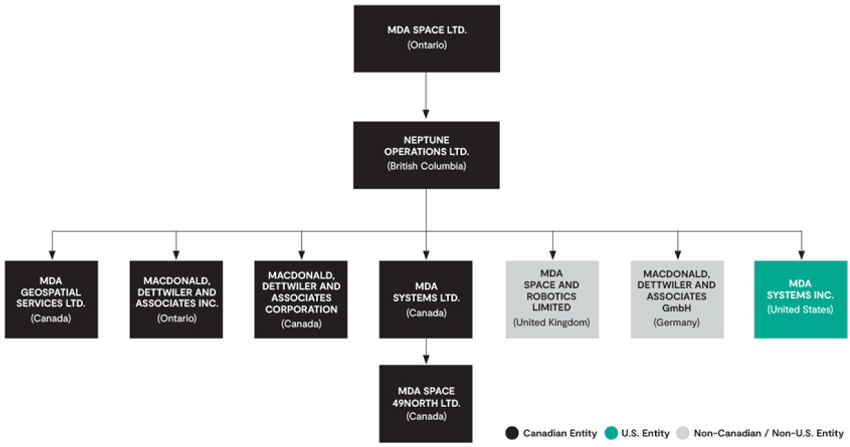
The following chart identifies our material subsidiaries (including jurisdiction of formation or incorporation of the various entities) as of the date of this AIF. All of our subsidiaries are wholly-owned, either directly or indirectly, unless otherwise stated.
| MDA SPACE ANNUAL INFORMATION FORM 3 |
Recent Developments
| February 2026 | We announced the launch of 49North, a Canada-focused defence business, led by defence industry executive Joe Armstrong, as President, 49North. This announcement highlights 49North’s capacity to deliver secure, multi-domain C4ISR (Command, Control, Communications, Computers, Intelligence, Surveillance and Reconnaissance) and mission critical capabilities for Canada’s national defence priorities outside the space domain. |
| January 2026 | We signed a memorandum of understanding (“MOU”) with Hanwha Systems Col., Ltd. (“Hanwha”), a global leader in smart technologies and aerospace solutions. Through this MOU, we and Hanwha will explore opportunities to collaborate on the development of Korea's sovereign low earth orbit (K-LEO) defence constellation, leveraging MDA's AURORA™ software-defined digital satellites. |
| January 2026 | We received an indefinite delivery/indefinite quantity contract from the Missile Defense Agency for the U.S. Scalable Homeland Innovative Enterprise Layered Defense (SHIELD) program. This contract award positions us to bid on future tasks and services that support the expansive U.S. defence initiative, which covers a broad range of work to strengthen defence against threats from land, sea, air, cyberspace and space. |
General Development of the Business
The following is a description of certain of our material developments over the last three financial years:
General Developments
| SEPTEMBER 2025 | We were named one of Canada's Top Growing Companies by The Globe and Mail’s Report on Business for the second consecutive year. The ranking recognizes Canadian companies with outstanding three-year revenue growth, celebrating entrepreneurial achievement and business excellence. We earned our place in the Technology category with verified growth of 126% from 2021 to 2024. |
| SEPTEMBER 2025 | We were named the 2025 Global Satellite Business of the Year by Novaspace. The award celebrates extraordinary accomplishments and positive contributions to the space and satellite sectors worldwide. |
| SEPTEMBER 2025 | We were named to the 2025 TSX30, TMX Group’s flagship annual ranking of the 30 top-performing TSX-listed companies based on dividend-adjusted share price appreciation. |
| SEPTEMBER 2025 | We appointed Andrew Stanniland as Managing Director, MDA Space U.K. Mr. Stanniland brings more than 30 years of multidisciplinary and international management experience in the space sector, from Thales Alenia Space, Inmarsat, and Airbus Defence and Space. |
| MDA SPACE ANNUAL INFORMATION FORM 4 |
| JULY 2025 | We appointed Rob Singh as Vice President, Strategic Solutions. Mr. Singh brings over 30 years of experience defining and delivering complex space solutions and service strategies for customers from companies including Axta Space, SpaceLink and Maxar Technologies. |
| November 2024 | We appointed Guillaume Lavoie to the role of Chief Financial Officer. Mr. Lavoie brings over 20 years of financial experience from large publicly traded and privately owned companies including Pratt & Whitney, Bombardier Inc., Woodbridge Group, and Sofina Foods Inc. |
| July 2024 | Mr. Karl Smith was appointed to our Board. Mr. Smith brings over 30 years of experience in a variety of executive roles including President and Chief Executive Officer of FortisAlberta and Newfoundland Power. |
| March 2024 | We were added to the S&P/TSX Composite Index, a list that includes the largest and most liquid publicly traded companies in Canada and represents the principal benchmark measure for Canadian equity markets. |
| February 2024 | Mr. Yung Wu was appointed to our Board. Mr. Wu is the former Chief Executive Officer of the MaRS Discovery District and has had a lengthy career as a serial entrepreneur and private equity investor. |
Contract Awards and Partnerships
| DECEMBER 2025 | We signed a strategic partnership agreement with the Government of Canada and Telesat Corporation to develop and deliver military satellite communications (MILSATCOM) capabilities as part of the Enhanced Satellite Communications Project – Polar (ESCP-P). The project will support Canada and North America defence and security with enhanced ability to conduct sovereignty operations in the Arctic. |
| DECEMBER 2025 | We were awarded a contract by Public Services and Procurement Canada on behalf of the Canadian Space Agency (the “CSA”) valued at $44.7 million, to procure long lead parts in support of the RADARSAT Constellation Mission (“RCM”) replenishment satellite development. The Government of Canada also announced its intention to contract our services to build, test, and launch this additional satellite for the RCM. These contracts are part of the Government’s $1.012 billion RADARSAT+ initiative, a 15-year investment announced in October 2023 to support immediate and future satellite Earth observation needs. |
| NOVEMBER 2025 | We made a $10 million equity investment in Maritime Launch Services Inc. becoming an equity owner and a strategic partner. The equity investment will accelerate Spaceport Nova Scotia’s readiness for orbital launch operations, providing reliable domestic launch capability for commercial, civil, government, and defence clients in Canada. |
| MDA SPACE ANNUAL INFORMATION FORM 5 |
| SEPTEMBER 2025 | We were selected to deliver enhanced space situational awareness data services to the Canadian Department of National Defence. The standing offer, in partnership with Canadian-based ThothX Group, underscores the growing importance of Space Domain Awareness in safeguarding Canada’s critical space assets amid an evolving and increasingly congested orbital environment. |
| AUGUST 2025 | We were awarded two contracts to equip the Royal Canadian Navy’s (“RCN”) Halifax-class ships with up to six new Uncrewed Aircraft Systems. Part of the Intelligence, Surveillance, Target Acquisition and Reconnaissance Uncrewed Aircraft Systems (ISTAR UAS) project, these new systems will enhance the RCN’s ability to detect and monitor potential maritime threats, both at home and abroad. |
| AUGUST 2025 | We were selected by EchoStar as the prime contractor for EchoStar’s non-terrestrial network LEO direct-to-device satellite constellation. The initial contract, valued at approximately US$1.3 billion, included the design, manufacturing, and testing of over 100 software-defined MDA AURORA™ direct-to-device satellites. In September 2025, we received a termination for convenience notification from EchoStar Corporation related to the constellation contract announced on August 1, 2025. The contract termination was the result of a sudden change to EchoStar’s business strategy and plan in the wake of spectrum allocation discussions with the Federal Communications Commission in the United States. |
| JULY 2025 | A team led by MDA Space was selected by the CSA to conduct an early-phase study for Canada’s proposed Lunar Utility Vehicle (“LUV”). This team brings together best-in-class Canadian expertise and is a critical first step in defining the LUV mission concept and technology development plan to provide scalable, autonomous mobility solutions on the lunar surface to deliver operations in challenging lunar environments. |
| JULY 2025 | We were selected to be the prime contractor for SkyPhi, a mission that will enable regenerative 5G direct-to-device (D2D) satellite communications from low Earth orbit (LEO). The mission is funded by the European Space Agency and the United Kingdom Space Agency and is part of the ARTES (Advanced Research in Telecommunications Systems) program. |
| JUNE 2025 | The Government of Canada extended our contract to provide continuous space-based maritime awareness and security with the Department of Fisheries and Oceans Canada (“DFO”). As part of the contract renewal, DFO also amended our contract to enable future utilization of data and services from MDA CHORUS™, our next generation Earth observation constellation. |
| JUNE 2025 | We were awarded $60 million in next phase contracts for the delivery and integration of two critical sensor systems for the Royal Canadian Navy’s River-Class Destroyer program. The contracts are for the delivery and integration of sensor systems for the first three ships that improve situational awareness and protect the ships against laser and optical guided threats. |
| MDA SPACE ANNUAL INFORMATION FORM 6 |
| February 2025 | We announced a US$750 million (approximately C$1.1 billion) contract with Globalstar Inc. (“Globalstar”) to be the prime contractor for the satellite operator’s next generation LEO constellation. The contract includes the manufacturing of more than 50 MDA AURORA™ software-defined digital satellites for the constellation. This followed a US$180 million Authorization to Proceed contract entered into in November 2023 to immediately commence engineering and programmatic activities, including the procurement of long-lead items for this Globalstar constellation. |
| September 2024 | We were awarded a contract by SWISSto12 to provide antenna systems for three of the company’s HummingSat satellites in geostationary orbit. The contract includes designing and building high-performance L-Band navigation antennas to be deployed as part of the Inmarsat-8 program to provide crucial safety services and support advances in emergency tracking. |
| June 2024 | We were awarded a $1 billion contract by the CSA for the Phase C (final design) and Phase D (construction, system assembly, integration and test) of the full robotics system of the Canadarm3 program. Canadarm3 will be used aboard Gateway, a multinational collaboration led by NASA to establish a space station in lunar orbit to support human and robotic missions to the surface of the Moon. |
| June 2024 | We were awarded a contract by the National Research Council of Canada to support the development, construction, and integration of radio telescope technology for the Square Kilometre Array Observatory, an international space exploration and astronomy project. |
| May 2024 | We joined Starlab Space LLC as a strategic partner and equity owner in a global commercial space station joint venture between, among others, Voyager Space, Airbus, and Mitsubishi Corporation. As a strategic partner in this joint venture, MDA Space will provide the full range of MDA SKYMAKERTM external robotics, robotics interfaces and robotic mission operations to the Starlab space station. |
| April 2024 | We were awarded a $250 million contract extension from the CSA to continue supporting robotics operations on the International Space Station from 2025 to 2030. As part of the contract, we will fulfil robotics flight-controlled duties to support mission operations on the ISS. |
| February 2024 | We received a $74 million contract from General Atomics Aeronautical Systems, Inc. (GA-ASI) to help deliver the fleet of MQ-9B SkyGuardian Remotely Piloted Aircraft Systems (RPAS) ordered by the Canadian Armed Forces. |
| August 2023 | We were selected as prime satellite contractor for Telesat Corporation’s LEO satellite constellation, Telesat Lightspeed. The contract, valued at approximately $2.1 billion (which has subsequently been revised to $2.4 billion), includes the design, manufacturing, assembly and testing of 198 satellites with options for Telesat to purchase up to 100 additional satellites. |
| MDA SPACE ANNUAL INFORMATION FORM 7 |
| June 2023 | We were awarded a Government of Canada contract to help in the fight against illegal, unreported and unregulated (“IUU”) fishing in the Indo-Pacific region. Our Maritime Insights platform, which leverages our RADARSAT-2 Synthetic Aperture Radar (SAR), combines multiple satellite data sources to track and identify IUU fishing activity including dark vessel detection. |
| June 2023 | We were selected by L3Harris Technologies as part of the U.S Department of Defense Space Development Agency’s (“SDA”) Tranche 1 Tracking Layer program. We were tasked with designing and building 14 flight sets of Ka-Band steerable antennas and control electronics for LEO satellites. |
| May 2023 | We announced that we were working with Thoth Technology Inc. to create a made-in-Canada deep space radar surveillance and space domain awareness capability. As part of a strategic cooperation agreement, MDA Space commercial data services will be integrated with Thoth’s ground-based radar technology to provide sovereign monitoring in deep space over Canada. |
| February 2023 | We secured a new contract to supply Ka-Band Multibeam Antennas for Argentina’s ARSAT-SG1 satellite to provide high-speed internet and digital video and voice services across the country and to Bolivia, Paraguay, and Chile. |
Corporate Transactions
| december 2025 | We completed a private placement offering (the “Offering”) of $250 million principal amount of 7.00% senior unsecured notes due 2030 (the “Notes”). The Notes are senior unsecured obligations, ranking pari passu in right of payment with all of our existing and future senior unsecured indebtedness and guaranteed by certain of our subsidiaries. We also announced that we entered into a second Amended and Restated Credit Agreement providing for a $150,000,000 accordion feature, potentially increasing the aggregate credit facilities to $850,000,000 if exercised in the future. |
| august 2025 | On August 7, 2025, we filed a short form base shelf prospectus with the securities regulatory authorities in each of the provinces and territories of Canada allowing us to qualify the offering and issuance of Common Shares, preference shares, debentures, notes or other evidence of indebtedness, subscription receipts, warrants or any combination thereof, during the 25-month period that the base shelf prospectus is valid. |
| july 2025 | We completed the acquisition of SatixFy Communications Ltd., a leader in next-generation satellite communications solutions based on in-house-designed chipsets. SatixFy’s operations and full technology portfolio have been integrated into our Satellite Systems business, further enhancing the company's end-to-end satellite offering. |
| March 2024 | We completed a divestiture pursuant to which Calian Group Ltd. purchased assets associated with our nuclear services. |
| MDA SPACE ANNUAL INFORMATION FORM 8 |
| October 2023 | We acquired SatixFy Space Systems UK Ltd., the digital payload division of SatixFy Communications Ltd. The division, which was integrated into our U.K. operations, helped accelerate our market expansion in the United Kingdom and added strategic in-country capability to produce satellite payloads. |
Program and Operational Updates
| JULY 2025 | We achieved an industry first in satellite digital beam forming with MDA AURORA™. Digitally formed beams, multiple simultaneous beams, and electronically steered beams are among the key features of the MDA AURORA™ Ka-band direct radiating array. The successful validation marks a breakthrough in satellite communication systems that support broadband connectivity and 5G networks. |
| JUNE 2025 | We assumed operations of the David Florida Laboratory in Ottawa, Ontario, ensuring this world-class testing facility remained open to industry and under sovereign Canadian control. The facility houses essential infrastructure that enables the assembly, integration, and testing of spacecraft and satellite systems and subsystems to ensure their ability to operate in the harsh conditions of space. |
| December 2024 | In collaboration with Telesat, we concluded a key phase in Telesat Lightspeed LEO constellation with successful completion of the spacecraft and multiple major subsystems Preliminary Design Review (PDR). With PDRs completed, Telesat and MDA Space transitioned to the program’s detailed engineering and manufacturing phase, including the Critical Design Review. |
| September 2024 | We announced that construction was underway on a 185,000 square foot expansion at our satellite production facility in Sainte-Anne-de-Bellevue, Quebec. Once completed, it will be one of the world’s largest high-volume manufacturing facilities in its satellite class. |
| April 2024 | We announced MDA SKYMAKER™, a new suite of space robotics purpose-built to meet the diverse needs of our customers’ most ambitious missions. Derived from Canadarm technology, MDA SKYMAKERTM supports a diverse range of missions including lunar surface rovers and landers, space stations, satellite servicing in all orbits, and in-space assembly and manufacturing. |
| March 2024 | We moved into our new global headquarters and Space Robotics Centre of Excellence in Brampton, Ontario. These new facilities support our ongoing growth and lay the groundwork for long-term success in the evolving commercial space robotics market. |
| March 2024 | We announced MDA AURORA™ as the name of our new software-defined satellite product line. Designed to meet the changing and highly competitive technical and business requirements of the satellite industry to provide operators with exceptional flexibility and functionality, which enhances constellation performance at reduced cost and time to market. |
| MDA SPACE ANNUAL INFORMATION FORM 9 |
| March 2024 | We announced the rebranding of our company from ‘MDA’ to ‘MDA Space’, further positioning us to lead in a new era of space innovation. |
| October 2023 | We announced our selection of SpaceX to launch the MDA CHORUS™, our next generation Earth observation constellation. |
| September 2023 | We announced details of our new software-defined satellites designed to target operator pain points with digital solutions. The technology transition from analog to digital satellite solutions offers benefits to satellite operators looking to improve performance, and drive cost and complexity out of their LEO constellation networks. |
Description of the Business
OVERVIEW
We are a trusted mission partner for the world’s most advanced space programs, delivering a suite of dual-use technology and services to civil, commercial, defence and national security customers. Our deep engineering expertise, broad portfolio of space-system capabilities, and end-to-end mission experience make us the partner of choice for government and private-sector clients. We leverage these capabilities to enable next-generation, space-based communications that empower our hyper-connected world; to build and operate critical space infrastructure for exploration, scientific research and on-orbit servicing; and to develop, operate and deliver data and analytic services from both Earth and space observation satellites and ground infrastructure. In an era where industries, technologies, people, and places are impacted every day by space technology, our mission is to build the space between proven and possible and to provide the space economy with our trusted, flight-tested, and human-rated solutions.
We have three business areas: Satellite Systems, Robotics & Space Operations, and Geointelligence. Our diversified portfolio of solutions position our customers to achieve mission success. We are differentiated by factors including:
| · | our long track record of mission success and innovation in space spanning over 55 years and more than 450 successful space missions; |
| · | our global reach, with operations and significant customer base in Canada and the United States and expanding customer base in the United Kingdom and other markets; |
| · | our profitable operations, strong liquidity and disciplined capital structure that enables pursuit of market growth opportunities; |
| · | the breadth of our customer relationships, with a diversified civil government, defence and commercial customer base; |
| · | our experienced team of over 4,000 colleagues, comprised of experienced space engineers, scientists, technicians, business and space industry leaders, which includes approximately 2,000 engineers; |
| · | our extensive portfolio of intellectual property and technologies including over 60 trademarks and over 700 patents which underpin our development capabilities and products, systems and services; |
| · | consistent investment in research and development (“R&D”) and innovation, ranking us in the top 35 corporate R&D investors in Canada; and |
| · | some of the most advanced equipment and facilities in the industry. |
| MDA SPACE ANNUAL INFORMATION FORM 10 |
In Satellite Systems, we partner or prime space communication missions across LEO, medium Earth orbit (“MEO”), and geosynchronous equatorial orbit (“GEO”), in addition to providing a range of satellite subsystems and communication systems for human rated spacecraft. These missions span a growing number of applications including broadband access, direct-to-device satellite communication, and Internet of Things (“IoT”) connectivity across the full communication frequency spectrum. In Robotics & Space Operations, we partner on space infrastructure missions to facilitate the exploration and development of space. We provide autonomous robotics and rover solutions along with proximity operation sensors that are used to operate in orbit and on the surface of the Moon and Mars, as well as operational services to plan, support, and operate these missions remotely. In Geointelligence, we develop, build and operate Earth observation (“EO”) and space observation missions, as well as providing key products in the areas of EO synthetic aperture radar (“SAR”) data and services, EO ground stations and multi-sensor fusion-based analytics products and services. All of these activities serve a wide range of use cases, including in the areas of national security, maritime surveillance, and climate change monitoring.
Our established position as a trusted mission partner can be traced to our investment in our people as well as our broad suite of technology and full lifecycle services. We work collaboratively with our customers in the early engineering phases of product and program development and provide services throughout a mission’s life, including engineering, manufacturing, integration, mission operation, and ongoing maintenance services, enabling valuable customer intimacy that drives repeat revenue opportunities.
Our market position allows us to serve a broad range of customers, including governments and space agencies, commercial space companies and defence and aerospace prime contractors in the space industry. Our long and proven track record enables us to compete successfully for major space projects globally and to continue to grow our customer base beyond Canada. As an independent supplier of space technology products, we are also able to pursue a larger set of opportunities with U.S. prime contractors, which we believe can meaningfully enhance our revenue potential from U.S. government space programs.
INDUSTRY OVERVIEW AND TRENDS
All over the world, governments, defence agencies and corporations are finding new and valuable ways of using the capabilities of space to make the world a safer, healthier and more connected place. The benefits of space-based solutions are expected to grow significantly in the coming years, driven by continuous government and commercial investment in the increasing capabilities enabled by a burgeoning space economy.
The space economy reached US$626 billion in 20251 and is projected to surpass US$1.8 trillion by 2035.2 This growth is driven by a confluence of factors, including significant commercial and government investment, private sector innovation, and a profound transformation in the global economic and geopolitical landscape. As the world becomes increasingly interconnected and reliant on data-driven technologies, the strategic importance of space is intensifying. Nations are investing resources into space-domain awareness, resilient dual-use constellations, and space-based defence capabilities – including secure LEO communications, high-resolution Intelligence Surveillance and Reconnaissance, navigation-jamming resistance, and counterspace technologies.3 The pace of progress is also being influenced by a number of secular trends including a ten-fold reduction in launch costs over the past decade, a growing number of satellite launches, the emergence of new and mission-critical applications for secure communications services and real-time Earth observation data, and the development of
1 Source: Global Space Economy Reaches $626 Billion, Marking a New Phase of Growth, Spacenews, January 29, 2026.
2 Source: World Economic Forum: The $1.8 Trillion Opportunity for Global Economic Growth, April 8, 2024.
3 Source: The Cost of Space Flight Before and After SpaceX: Visual Capitalist, January 27, 2022.
| MDA SPACE ANNUAL INFORMATION FORM 11 |
space-based defence capabilities to safeguard national interests in a rapidly evolving geopolitical environment.
Moreover, advances in space-related materials, processes, and capabilities and adoption of advanced technologies are enhancing the sector’s strategic value by improving efficiency, reducing costs, and enabling new applications. Space innovation is having a transformative impact across multiple traditional industries, including communications, transportation, agriculture, finance & insurance, and energy & utilities, and is providing new opportunities and solutions for government and commercial organizations to navigate the challenges of a dynamic global economy. Collectively, these developments are creating new opportunities and imperatives for space-based solutions and services, highlighting the need for timely and strategic investment to capitalize on the significant potential of the space economy.
Lower Costs and New Technologies are Driving the Commercialization of Space
New commercial space-based businesses are increasingly becoming prevalent due to lower launch costs and more powerful satellite technologies.4 Additionally, the development of satellites with new digital technologies and advanced capabilities has resulted in significant performance improvement and cost reduction. This combination of technology advancements and reduced launch and satellite costs has improved the economic feasibility of many space-based activities and services, including space-based broadband Internet, direct-to-device (D2D) connectivity, EO, manned spaceflight, and In-Space Servicing, Assembly, and Manufacturing (“ISAM”). This trend was demonstrated in 2025 with a record 329 launch attempt (up 25% over 2024), which successfully delivered a record 4,526 payloads to orbit (up 58% over 2024).5
Space is Enabling Global Connectivity
We live in an increasingly interconnected and data-dependent world with data usage expected to grow as available bandwidth expands to enable universal connectivity and next generation technologies. Universal internet access and global broadband connectivity are fundamental to ensuring equal access globally and are critical pillars for socioeconomic development. Broadband Internet connectivity is estimated to have grown from 51% of the global population in 2019 to 68% in 20246, and the Broadband Commission for Sustainable Development and United Nations have set a global goal of achieving universal connectivity by 2030.7
Satellites represent one of the most efficient methods to support universal connectivity and provide a complimentary capability to enhance the offerings of traditional terrestrial broadband providers. The proliferation of satellite constellations is expected to drive the majority of new satellite capacity. Operators such as OneWeb, Telesat, SpaceX, and Amazon are collectively expected to deploy at least 16,000 satellites for their constellations this decade. As of December 2025, it is estimated that there are over 13,000 active satellites orbiting the Earth, more than 90% of which are in LEO8. Novaspace estimates that more than 43,000 satellites will be launched between 2025 and 20349. These communication constellations are critical to supporting global connectivity needs and enabling next generation technologies, including IoT applications, connected vehicles, direct-to-device and 5G communications.
4 Source: Ibid.
5 Source: Space Activities in 2025, Jonathan McDowell, January 2026.
6 Source: The State of Broadband Advocacy Targets, Broadband Commission for Sustainable Development, June 2025.
7 Source: Achieving Universal Connectivity by 2030, United Nations, 2025.
8 Source: Orbital Traffic Surges, as 13,000 Active Satellites Recorded: Critical Comms, October 30, 2025.
9 Source: Novaspace Projects $665B in Satellite Build and Launch Activity: Novaspace, October 7, 2025.
| MDA SPACE ANNUAL INFORMATION FORM 12 |
Space is Critical to National Defence and Security
Space is now a critical and established military domain complementing the traditional fields of air, land, and sea. Space-based assets are employed in a broad range of essential military applications and operations including communications, intelligence and surveillance, missile warning and tracking, and navigation. The 25th Edition of Novaspace’s Government Space Programs report notes a US$137.4 billion government space market in 2025, signaling a structural shift toward defense-driven investment and commercial procurement models. Defense now accounts for 54% of global spending (US$73.5 billion), surpassing civil budgets (US$63.7 billion) and cementing space as a core national security domain alongside land, air, maritime, cyber and information.10
In 2025, defence spending on space by the world’s leading powers surged to unprecedented levels. The United States dedicated a historic US$175 billion to its “Golden Dome” space-defence architecture11, while Germany pledged €35 billion (~US$41 billion) for next-generation satellite and SSA capabilities.12 France earmarked an additional €4.2 billion (~US$5 billion) for its Space Force13, Japan allocated ¥560 billion (~US$3.5 billion) to a dedicated space-operations command14, and Canada confirmed that space will be a core element of its NATO-mandated 2% defence-budget target, adding several billion dollars to the tally.15 Additionally, the European Space Agency secured a €22.3 billion budget (a 32% increase) at its November 2025 Ministerial Council, which included funding for defence-related projects for the first time.16 Collectively, these commitments signal a clear, multi-year acceleration of in-space defence investment.
In addition to traditional space-related defence spending that leverages space assets to support and complement terrestrial defence efforts, over the last decade several countries have begun developing offensive capabilities in space which have the ability to disrupt or destroy strategic space assets. In response to this threat, many governments are increasing military funding for space-based initiatives and creating independent space commands to reinforce national security priorities.17
Furthermore, militaries have begun to shift their satellite constellation architecture from a few large satellites to many cost-effective, but powerful satellites, a strategy that was previously too expensive to employ. The deployment of many satellites in a distributed network versus the deployment of a limited number of large satellites significantly improves the resiliency of strategic space assets. Governments are also increasingly leveraging the capabilities of commercial space companies to innovate and deliver cost-effective solutions to enable this distributed satellite constellation strategy.
Robotics and On-Orbit Infrastructure is Critical to the Expanding Earth to Moon Economy and Future of Space
Utilizing robotics and on-orbit solutions to keep satellites and other space infrastructure operating efficiently will be critical to enabling the growth of the new space economy. Autonomous robotics are expected to drive on-orbit applications, including ISAM, satellite refueling, repositioning, repair, and de-orbiting services, with a view to reducing costs and improving safety and mission continuity.
10 Source: Global Space Spending Reaches $137B, Marking a Defense-Led Era: Novaspace, January 20, 2026.
11 Source: Trump selects $175 billion Golden Dome defense shield design, appoints leader: Reuters, May 20, 2025.
12 Source: Germany pledges $41 billion for space defence against Russia, China: NDTV World, September 25, 2025.
13 Source: 'Space is Now a Battlefield': Macron Unveils 4.3B Defense Plan and Appeals to Startups: The French Tech Journal, November 14, 2025.
14 Source: Japan boosts defense satellite investments to strengthen space resilience, communications: Indo-Pacific Defense Forum, February 26, 2025.
15 Source: What does greater defense spending mean for Canada's economy?: RBC Wealth Management, July 3, 2025.
16 Source: ESA raises more than 22 billion euros at ministerial: SpaceNews, November 27, 2025.
17 Source: In historic shift, ESA poised to take on defense role: Breaking Defense, October 31, 2025.
| MDA SPACE ANNUAL INFORMATION FORM 13 |
With geopolitical, defence and commercial imperatives expected to propel the rapid emergence of an in-space economy and drive demand for on-orbit servicing solutions and in-space manufacturing capabilities, ISAM will be essential to ensuring national mission success and economic expansion and viability. Advancements in uncrewed and autonomous robotics and in-space platforms are fundamental to supporting the growth of in-space manufacturing and assembly capabilities, and the ability to construct, reconfigure, repair and refuel spacecraft while in space will enable longer space missions with greater flexibility and a wider range of in-space economic activity.
Earth Observation is Critical to Improving Global Sustainability and Economic Productivity
EO uses data from space to answer questions about conditions on Earth. Novaspace estimates that the global market for EO data and services will reach US$8.4 billion by 2034, growing from US$5.4 billion in 2024.18 Defence & intelligence contracts and advanced EO products are critical drivers behind the markets sustained expansion. As demand for EO data grows, analytics services are becoming increasingly important for synthesizing data and producing actionable insights to support decision-making.
Additionally, EO data allows governments and institutions to achieve sustainability objectives, including the monitoring of IUU fishing activity, ocean pollution and oil spill detection, deforestation and dumping, and tracking pollution, shoreline erosion and arctic ice levels. EO is also becoming an increasingly important driver of economic productivity across a broad range of sectors. Agricultural industries use EO data and analytics to monitor crop conditions, estimate yields, and optimize production and cost. Providers of critical infrastructure use EO technology to monitor remote assets, plan new installations, and predict requirements for future expansion. Global commercial and trade organizations use EO analytics to make informed decisions related to economic activity, increased supply chain visibility and the assessment of various market dynamics.
Space Exploration is Becoming Interplanetary
Space has become a truly borderless frontier, with approximately 94 countries investing in the space sector and approximately 75 countries that already have established some form of national space agency. Over the next decade, the number of space exploration missions is expected to increase by 185% to 855 missions as countries pursue manned lunar and Martian missions and other deep space exploration.19
Government funding for space exploration is projected to increase from approximately US$26 billion in 2023 to US$33 billion by 2032.20 The moon is the fastest-growing area of sustained investment by governments engaged in space exploration, with Novaspace estimating that there will be over 328 missions to the moon alone over the next decade. The increasing frequency of lunar missions will be driven by a diverse number of countries, with 60 countries now signed on to the Artemis Accords as of December 2025. Missions to explore Mars are also on the rise.
18 Source: Defense and Security Agencies Propel Demand for Earth-observation Data: SpaceNews, September 18, 2025.
19 Source: Novaspace Forecasts Global Space Exploration Investment to Reach $31 Billion by 2034: SpaceNews, April 30, 2025.
20 Source: Lunar ambitions boost space exploration funding as investment set to reach 33 billion by 2032, Novaspace, October 2, 2023.
| MDA SPACE ANNUAL INFORMATION FORM 14 |
BUSINESS AREA DESCRIPTIONS
We offer solutions and capabilities to meet global market demand through three business areas:
Satellite Systems 68%
of 2025 Revenue |
Robotics & Space Operations 19%
of 2025 Revenue |
Geointelligence 13%
of 2025 Revenue |
 |
 |
 |
Satellite Systems
Satellite communications have transformed the way people connect and communicate on Earth and have continued to evolve and improve global connectivity across the globe. We serve our commercial and government mission partners worldwide as a prime contractor and supplier of satellite systems and sub-systems for communication networks in LEO, MEO, and GEO. With our acquisition of SatixFy complete and our space grade ASICs now in production in-house, our commercial digital satellite business is highly vertically integrated, down to the silicon chip level, further strengthening our competitive advantage and solidifying our industry lead. These communication missions span a growing number of use cases including space-based broadband Internet, direct-to-device satellite communication, and IoT connectivity across the full communication frequency spectrum. Our technology has been integrated into more than 350 satellite missions, and we expect this number to continue to grow.
Our continued transition to a satellite prime contractor for LEO and MEO constellations has been enabled by the development of MDA AURORA™, our new leading-edge software-defined digital satellite product line. Designed to meet the changing and highly competitive technical and business requirements of the satellite industry, the fully integrated MDA AURORA™ portfolio provides operators with exceptional flexibility and functionality. These software-defined, dynamic beam forming satellites provide a new level of performance and efficiency in space-based networks for our customers. The fully integrated digital satellite capability includes a complete range of modular digital products and components for space-based communication solutions coupled with advanced high-volume manufacturing production capability – dramatically enhancing constellation performance while reducing production costs and time to market.
Through our participation in multiple major satellite constellations and investments in our new state-of-the art high volume satellite production facility in Montreal, we have solidified our position as a trusted mission partner for space communications. Our strong market position is reflected in a series of recent key contract awards including our selection in 2025 by Globalstar as the prime contractor for the satellite operator’s next generation LEO constellation of at least 50 satellites, our selection in 2023 as the prime contractor for Telesat’s LEO satellite constellation Telesat Lightspeed (198 satellites) and our selection in 2022 as the prime contractor to expand Globalstar’s existing LEO constellation with an additional 17 satellites. In 2025, we also signed a partnership agreement with the Government of Canada and Telesat Corporation to develop and deliver Arctic military satellite communications (MILSATCOM) capabilities as part of the Enhanced Satellite Communications Project – Polar (ESCP-P), one of the key procurements being led by Canada’s newly formed Defence Investment Agency.
| MDA SPACE ANNUAL INFORMATION FORM 15 |
We have also provided satellite subsystems to enable next generation military and commercial LEO communication constellations for end-users including the US Space Development Agency as well as for O3b mPower, Iridium Next, and OneWeb. The next generation LEO communication segment of the communication satellite market is driving meaningful growth for the Company. To support these high-volume satellite customers, we have continually adapted our satellite manufacturing base, which now includes Industry 5.0 robotics-based technologies capable of manufacturing dozens of satellites and satellite sub-systems each month.
As we continue to evolve the Satellite Systems business, we are doubling our manufacturing capacity to meet growing global demand, adding high-volume satellite production capabilities with capacity for large-scale standardized satellite production. At the end of December 2025, construction on a 185,000 square foot expansion at our satellite production facility in Montreal, Quebec was nearing completion. Once operational, it will be the one of the world’s largest high-volume manufacturing facilities in its satellite class. This new facility is also designed to be a LEED (Leadership in Energy and Environmental Design) certified building and the production line at this facility will start ramping-up operations in 2026.
In 2025, we assumed operations of David Florida Laboratory in Ottawa, Ontario, ensuring this world-class testing facility remained open to industry and under sovereign Canadian control. The facility houses essential infrastructure that enables the assembly, integration and testing of spacecraft and satellite systems and subsystems to ensure their ability to operate in the harsh conditions of space. We also made a $10 million equity investment in Maritime Launch Services Inc., to accelerate Spaceport Nova Scotia’s readiness for orbital launch operations and development of reliable sovereign Canadian launch capability for commercial, civil, government and defence clients.
In addition to leveraging fifty years of accumulated background intellectual property in space hardware manufacturing, our industry-leading satellite manufacturing facilities also integrate automated production lines and robots, cobots, and high-skilled assemblers using augmented reality to accelerate mass production. Our advanced manufacturing environment also contains one of the largest near field ranges and largest compact ranges for satellite testing in the world. In addition, this facility includes a wide range of thermal, environmental, Passive Inter Modulation (PIM), and vibration test facilities.
Our principal customers in the Satellite Systems business include a variety of customers operating in multiple markets including Globalstar, Telesat, Airbus, Lanteris Space Systems, OneWeb, Sierra Space, Thales Alenia Space, Boeing, Lockheed Martin, Northrop Grumman, OHB SE, York Space Systems, L3Harris and Rocket Lab.
Robotics & Space Operations
In our Robotics & Space Operations business, we partner with customers in critical, leading-edge space infrastructure missions. We facilitate the exploration and development of space by providing autonomous robotics systems and services used to operate in space and on the surfaces of the Moon and Mars. We are a world leader in space-based robotics including partnering on over 90 space shuttle missions, contributing to the assembly of the ISS, managing life-cycle operation of the ISS, and delivering our rover technology on Mars. The space infrastructure missions we partner on span broad space-based applications, including space station assembly and maintenance, ISAM, planetary rovers, and emerging markets such as space tourism, space mining, and space defence. Our differentiated capabilities include robotic systems, robotic interfaces, tooling, robotic ground control stations and operations services, electro-optic and light detection and ranging (“LiDAR”) sensors, vision and targeting systems, guidance, navigation and control subsystems and planetary rover locomotion subsystems. Our LiDAR sensors are critical to spacecraft proximity operations supporting mission elements such as rendezvous, docking, inspection, and robotic capture of satellites in orbit, as well as spacecraft landing and autonomous rover navigation activities during planetary missions. Our LiDAR sensors and optical sensors also support future military space control applications.
| MDA SPACE ANNUAL INFORMATION FORM 16 |
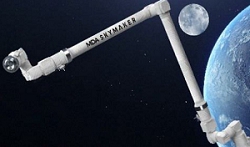
We are also developing commercial space robotic solutions that serve the evolving needs of the new space market. This includes MDA SKYMAKER™, a new suite of space robotics announced in 2024 that are purpose-built to meet the diverse needs of our customers’ most ambitious missions. Derived from Canadarm technology, MDA SKYMAKER™ provides our customers with solutions based on the world’s most flight-proven space robotics solutions and services, supporting a range of missions including lunar surface rovers and landers, space stations, satellite servicing in all orbits, and ISAM. Our products and services support logistics delivery, satellite servicing, debris removal, asset relocation, and infrastructure maintenance. Through focused investment in R&D, we have developed integrated space robotic systems, technologies, interfaces, tools, operational techniques, and control algorithms to enable on-orbit servicing solutions for commercial space businesses. We have completed multiple commercial sales of products derived from Canadarm3 technology. We are also a strategic partner and equity owner in Starlab Space LLC, a global joint venture that is designing and building the Starlab commercial space station and will provide the full range of MDA SKYMAKERTM external robotics, robotics interfaces and robotics mission operations to the station.
Demand for space robotics and mission-support services is primarily driven by increasing activity in LEO, lunar and deep space exploration, all of which are expected to expand with the introduction of new commercial space stations and commercial planetary missions in the coming years. The increase in the number of satellites and other spacecraft is driving demand for emerging solutions in on-orbit servicing (e.g., the upgrade and repair, relocation and refueling of satellites in orbit) and manufacturing. Our long history in space robotics includes development of the Canadarm for NASA’s Space Shuttle program, and Canadarm2, which is currently in service on the ISS.
We are continuing to work on the Canadarm3 program, our third generation Canadarm that will provide autonomous and uncrewed robotics for the NASA-led Gateway, the lunar-orbiting outpost of the Artemis program. Current projects, including Canadarm3, are expanding our mission partner scope to now include on-orbit mission operations. We moved into our new headquarters and Space Robotics Centre of Excellence in March 2024. Our investment and construction of these new facilities included the creation of multiple mission control centers enabling us to provide on-orbit mission operations for our customers in the future.
We have developed technology for multiple Mars missions, including the Phoenix Lander, the Curiosity Rover, and the ExoMars Rover, with our sensors first operating on Mars in 2008. We also built the LiDAR instrument for the OSIRIS-Rex mission that completed the world’s first 3D scan of an asteroid from an orbiting spacecraft.
Our principal customers in our Robotics & Space Operations business are Canadian, U.S., and international government space agencies, including the CSA, NASA, United Kingdom Space Agency and the European Space Agency. We also serve a wide variety of commercial customers in multiple markets, including Starlab Space, Northrop Grumman, Lanteris Space Systems, Airbus, Intuitive Machines, Astroscale and Mitsubishi Electric Corporation.
Geointelligence
As a Geointelligence mission partner, we are an owner, operator, and prime contractor for both EO and space observation missions, in addition to providing key technologies and products. We also use satellite-generated imagery and data to deliver critical and value-added insights for a wide range of end uses, including in the areas of national security, climate change monitoring and maritime surveillance.
Our Geointelligence business is a leader in SAR missions, which we both own and operate ourselves as well as deliver to customers and operate for them. We have designed and built three generations of SAR satellites (RADARSAT-1, RADARSAT-2, and the RADARSAT Constellation Mission (RCM)). As part of the RADARSAT+ initiative, in 2025 we were awarded an initial contract by the CSA to support the RCM
| MDA SPACE ANNUAL INFORMATION FORM 17 |
replenishment satellite development, with the Government of Canada announcing its intention to contract MDA Space to build, test, and launch this additional satellite.
We are currently developing MDA CHORUS™, our next-generation collaborative multi-sensor satellite constellation that will provide data continuity for RADARSAT-2 and is expected to expand our SAR solutions offering. MDA CHORUS™ will enable us to fuse data from multiple sensors and to leverage machine learning in order to manage larger volumes of data and provide enhanced analytics services. MDA CHORUS™ is expected to operate in an inclined LEO and will provide frequent radar imaging day or night and in all weather conditions over the areas of most interest to our customers. The mission is expected to include significant innovations that result in improved access, better revisit, broader swath coverage, lower noise, less data compression, faster data rates, high-resolution and tip-and-cue capabilities. The MDA CHORUS™ constellation will include a powerful C-band SAR satellite that will provide broad area coverage in concert with a smaller trailing X-band SAR satellite for higher resolution data collection and near real-time cross-cueing. MDA CHORUS™ will also enable us to offer customers a cloud-based ground station solution as a next-generation offering. The capital expenditure for MDA CHORUS™ is substantially complete.
We also specialize in space observation satellites including the Sapphire mission that we developed and delivered to Canada’s Department of National Defence. Following delivery of observation missions to customers, we are regularly entrusted to operate those missions for customers. We are currently operating most of the Canadian government’s Earth and space observation satellites.
A key enabling product suite in EO is our full range of multi-satellite ground stations that receive, process, distribute, archive, and exploit imagery from RADARSAT-2, our own commercial EO satellite, as well as other satellites. We have installed more than 70 receiving ground stations in more than 25 different countries, which have processed data from over 20 different satellites.
Our EO business includes the collection, processing and dissemination of Earth imagery data from space. As the operator and owner of global commercial data distribution for the RADARSAT-2 satellite we are one of the largest radar information providers worldwide. Our extensive data archive is comprised of approximately 110 billion square kilometers of Earth imagery data and more than one million images of Earth. We also distribute high resolution optical imagery, satellite-based Automatic Identification System (AIS) data, and Radio-Frequency (RF) data from many other third-party missions. Our analytics-based information products regularly fuse these different sensor types into the information our customers require. As a result, our imagery solutions provide customers with timely, accurate and mission-critical information about our changing planet and support a wide variety of uses and sectors.
The largest market for our EO data and services today is maritime domain awareness, where governments and commercial organizations rely on us for real-time data. The data is used to track maritime activity, visualize maritime crime patterns, identify and monitor IUU fishing, track ice floes, shorelines and ocean winds, detect possible oil spills and monitor vessels. We have been a provider of these mission critical data and services for over 25 years and we play an integral role in our customers’ surveillance strategies. We have also developed the Maritime Insights analytics platform that provides users with a software to monitor maritime areas of interest through the fusion and display of multiple sensor inputs.
We also provide a number of defence C4ISR (Command, Control, Communications, Computers, Intelligence, Surveillance and Reconnaissance) solutions, including command and control systems and airborne surveillance solutions, for which we are the original solution provider of many of these systems. Part of our offerings include advanced aeronautical navigation information solutions that increase safety and efficiency of aircraft landings and departures. We also operate a long endurance uncrewed aerial vehicle (“UAV”) surveillance service that provides real-time, multi-sensor intelligence to support critical operations for the Royal Canadian Air Force as a partner with General Atomics for Canada’s Remotely Piloted Aircraft System (RPAS). Additionally, we are the prime contractor for the Royal Canadian Navy to
| MDA SPACE ANNUAL INFORMATION FORM 18 |
enhance maritime operations for the Intelligence, Surveillance, Target Acquisition and Reconnaissance Uncrewed Aircraft Systems (ISTAR UAS) project as well as a key contributor to the River-class Destroyer program. While these defence services and offerings were historically operated as part of our Geointelligence business, we announced in February 2026 that we had launched 49North, a Canada-focused defence business to deliver secure, multi-domain C4ISR and mission critical capabilities for Canada’s national defence priorities outside the space domain.
Our principal customers in our Geointelligence business are Canadian, U.S., and international government agencies (primarily defence and intelligence agencies), as well as a wide variety of commercial customers across multiple markets.
GROWTH STRATEGY
With established industry leadership in diverse space markets, we are currently executing on specific strategies that will allow us to capitalize on the multiple waves of growth in the expanding space market.
The primary pillars of our strategy include:
| · | Investing in next generation space technology and services |
| · | Developing MDA AURORA™, our new software-defined digital satellite product line, which will provide critical next generation solutions to communications satellite operators and prime manufacturers to support the industry’s transition from analog to digital satellites. |
| · | Developing MDA SKYMAKER™, our new commercial robotic products based on pre-qualified and multipurpose space robotics components derived from Canadarm3 technology to support a range of missions including lunar surface rovers and landers, space stations, satellite servicing in all orbits, and ISAM. |
| · | Developing MDA CHORUS™, our next generation EO satellite constellation, which is expected to provide the broadest area SAR coverage on the market and include a trailing X-band SAR satellite with high-resolution capability. The enhanced capabilities of MDA CHORUS™ will help strengthen our EO data and service offerings and reinforce our competitive position as a mission prime for upcoming customer funded EO missions. |
| · | Establishing mission control centers to provide on-orbit operations of our mission elements to our mission partners. |
| · | Expanding our presence in attractive markets and geographies |
| · | Expanding our role to a satellite prime for commercial communication satellite constellations while continuing to support other primes as a proven supplier of payloads, antennas and other satellite subsystems. |
| · | Engaging in emerging commercial space markets to support growth and capture recurring revenue opportunities as markets develop. |
| · | Enhancing our offerings and resources to fully participate in the national security and defence space markets, both domestic and international. |
| · | Leveraging and expanding our existing presence in the United Kingdom and the U.S. to access new opportunities and evaluating other countries and select geographies such as Europe, Asia and the Middle East to expand our international footprint. |
| · | Leveraging our incumbent position as a trusted mission partner to maximize opportunity in addressable national and international defence and security markets. |
| MDA SPACE ANNUAL INFORMATION FORM 19 |
| · | Scaling and expanding operations, skills and talent |
| · | Investing in new facilities, technology and capacity to meet growing market demand. |
| · | Scaling our employee base to execute on our current work and maximize the capture of future business opportunities. |
| · | Fostering an innovative and inclusive work environment that helps attract, support and develop world-class talent. |
| · | Leveraging strategic mergers and acquisitions to complement organic growth |
| · | Accelerating our technology roadmap and growing manufacturing capabilities to support strategic initiatives and our expansion into market adjacencies. |
| · | Expanding our presence in international geographies to access new market sectors, customers, and talent. |
| · | Augmenting our existing capabilities to increase vertical integration and domain expertise. |
| · | Incumbent position as Canada’s National Defence and Space Champion and a Trusted Supplier to Partners and Allies Globally |
| · | Maintaining deep, long-standing collaborations with the Department of National Defence, Canadian Space Agency, Department of Fisheries and Oceans and numerous other national and international security and intelligence departments and agencies that count on our sovereign and mission critical capabilities. |
| · | Enhancing in-house sovereign capabilities through expanding our Canadian production capacity, investing in new facilities and classified program capabilities, hiring and training local engineers, and establishing national supply chains for critical components to reduce reliance on foreign suppliers. |
| · | Investing in Canadian technology companies to develop and strengthen critical upstream and downstream capabilities such as sovereign launch services, rover logistics and next generation satellite electronics. |
| · | Leveraging world class manufacturing partnerships to serve Canadian needs by reducing lead times and delivering best-in-class solutions. |
COMPETITION
We sell our products and services into a highly competitive global market.
In the Satellite Systems business, our competitors include Airbus, Lockheed Martin, Northrop Grumman, Thales Alenia Space, L3Harris, Lanteris Space Systems, RocketLab and York Space Systems.
In our Robotics & Space Operations business, we view the competitive market dynamics as bifurcated between well-known providers with a track record of proven on-orbit performance and newer providers offering unproven, low-cost solutions. Our major existing and potential competitors for our Robotics & Space Operations business include Airbus, GITAI, Lanteris Space Systems, Motiv Space Systems and Redwire.
In our Geointelligence business, we compete with major existing SAR satellite imagery providers, such as Airbus, ICEYE and e-GEOS, as well as other commercial satellite imagery companies, government-owned imagery providers, free sources of imagery, and UAVs. We also compete with companies that provide geospatial analytic information and services to government agencies, including defence prime contractors.
| MDA SPACE ANNUAL INFORMATION FORM 20 |
Competitive Strengths
While the markets we serve are competitive, we believe that we are well positioned to provide differentiated solutions to customers, driven by the following competitive strengths:
A Trusted Mission Partner with a Track Record of Execution
As more governments and organizations begin to participate in space, a hostile and unforgiving operating environment with a high cost of failure, it is paramount to engage with trusted partners to ensure mission success. With our reputation and history of successful performance, we have earned the trust of some of the world’s largest participants in space-based activities. With a strong track record of excellence in high-stakes, complex, mission-critical applications, we are well positioned to help our customers leverage the insights and opportunities of space for their applications and missions.
In addition to winning new business, our track record of execution drives customer loyalty, which leads to repeat business. Every program we develop further reinforces our domain expertise and establishes the Company as a recognized leader in our industry.
Specific Expertise and Technological Resources Tailored for the New Space Economy
We provide innovative, end-to-end offerings of technologies and solutions in each of our business areas. We anticipate the needs of our customers and partner with them as they navigate the space economy.
In Satellite Systems, we offer full satellite design and delivery capabilities, with our new MDA AURORA™ digital satellite product line, all enabled by high volume assembly, integration, and testing facilities with differentiated technologies and expertise across the full frequency spectrum. Our advanced manufacturing facilities, technologies, expertise and capacity enable us to deliver solutions and aftermarket and replacement services at a pace that we believe is faster than our competitors. They are also critical in enabling us to address next generation space-based missions for broadband communications, IoT and direct-to-device satellite communication services.
In Robotics & Space Operations, our industry-leading end-to-end technological capabilities are underscored by an established patent portfolio and extensive on-orbit operational expertise. Customers come to us seeking mission-critical solutions for advanced space applications, including space station operations, on-orbit servicing, surface infrastructure and mobility and ISAM. The introduction of MDA SKYMAKERTM also enables customers to derisk their missions with flight-tested and human-rated robotics technology not currently available from other vendors.
In Geointelligence, the technological sophistication of our integrated satellite and ground station network, combined with our value-added analytics capabilities, enables us to deliver a fully integrated EO solution to our customers. This is a key differentiator from competitors who lack a fully integrated solution. This integration allows us to provide seamless access to actionable insights in near real-time for a unique value proposition. MDA CHORUSTM is designed to enhance and ensure critical service continuity for customers.
Agility and Scale Position Us to Serve Customers of all Levels of Size and Experience
Our culture and organizational structure provide us with a competitive advantage over our large prime contractor competitors in terms of our ability to be responsive and to efficiently deliver solutions and products across our business areas. We believe the pace of space innovation has accelerated and that agility is critical to our customers’ success. By focusing on agility, we are able to collaborate with partners to iterate quickly and achieve optimal outcomes.
We have significant scale with over 1,000,000 square feet of design, laboratories, office space, manufacturing and test facilities and the support of a supply chain of over 750 proven suppliers and subcontractors. This provides us with the engineering capabilities necessary to deliver on large and complex missions in a way that smaller, emerging space companies would be challenged to match.
| MDA SPACE ANNUAL INFORMATION FORM 21 |
The combination of our agility and scale positions us well to service both commercial and government customers, allowing us to deliver a range of solutions from those that require customization and high-volume capabilities to those that require cost-efficient and fast delivery.
Deep Team with a Winning Culture
We have a highly experienced management team and workforce of over 4,000 colleagues, which provides us with the critical expertise to execute complex space missions. Our position as a recognized innovation leader in the growing space economy is an advantage in premium talent attraction and retention, as evidenced by the average tenure of our workforce. Our people embody our core values of putting the customer mission first, being exceptional, doing the right thing, always delivering and recognizing we are better together, a culture that drives successful delivery on customer missions.
Entrepreneurial Go-to-Market Strategy
We generate business opportunities by utilizing an entrepreneurial go-to-market strategy. We empower our business development teams and encourage them to find creative ways to support the success of our customers. For instance, we provide R&D support during proposal phases to jointly develop a mission and assist customers to obtain mission financing. This entrepreneurial strategy and ability to demonstrate our value with our customers early in the life cycles of their missions differentiates us from competitors who may have a more traditional approach.
We build on our relationships with customers to find additional opportunities to deliver mission-enabling solutions. While working closely with customers in the development phases of missions, our engineers discuss future mission ideas and proactively recommend potential solutions and enhancements to meet our customers’ evolving needs. This forward-thinking approach regularly results in awards for follow-on solutions on subsequent missions.
PEOPLE, SPECIALIZED SKILLS, AND KNOWLEDGE
Our people are the lifeblood of our organization. As a global leader in technology and innovation, our success is linked to our ability to attract and develop a highly skilled workforce. We believe our location in Canada, our access to some of the most advanced equipment and resources available, and our commitment to growth and innovation enable us to attract and retain top talent. Our workforce comprises approximately 4,000 people throughout our operations in Canada, the United States, the United Kingdom and Israel, with these employees working across sixteen facilities in these countries.
We are committed to investing in our people and R&D to stay at the forefront of technological innovation. Our commitment to advancing innovation and R&D in Canada was again recognized in 2025, when we were ranked in the top 35 of Canada’s top 100 corporate research and development spenders by Research Infosource Inc. for the third straight year.
INTELLECTUAL PROPERTY
Our portfolio of successful projects, technologies, and patents positions us well to continue our leadership role in the growing space economy.
Our substantial portfolio of intellectual property assets includes registered patents, designs, copyrights, trademarks and service marks, as well as unregistered trade secrets, know-how, data and software. We actively pursue patent protection for our innovation, advanced designs, and specialized services, with the goal of being a Canadian leader in intellectual property protection. Our current consolidated patent filing activity places MDA Space among the top wholly owned Canadian companies filing patents in Canada. We remain committed to internal development of high-tech innovation and strengthening our intellectual property position. Since MDA Space’s IPO in 2021, we have increased our patent portfolio by over 400% through organic patent filings as well as strategic acquisition. Over 30% of our patent portfolio consists of granted patents, evidencing the novel and inventive nature of our technology. With our track record of
| MDA SPACE ANNUAL INFORMATION FORM 22 |
successful development in all our business areas, we believe our portfolio of intellectual property assets and strong internal culture of intellectual property protection brings a high level of value to our customers and partners.
We rely on licenses of certain intellectual property to conduct our business operations, including certain proprietary rights to and from third parties. While our intellectual property rights in the aggregate are important to our operations, we do not believe that any particular trade secret, patent, trademark, copyright, license, or other intellectual property right is of such importance that its loss, expiration or termination would have a material effect on our business.
RESEARCH AND TECHNOLOGY DEVELOPMENT
We recognize that investing in R&D is vital to driving innovation and technological advancement in all aspects of the space economy. Our business depends on expanding the horizons of what is currently possible to develop new possibilities for the next generation of products and services. Our research and development expenses (after customer reimbursement for certain expenses) were $38.1 million for fiscal 2025. Combined with the capitalized development costs for new proprietary and software intangible technologies $93.3 million and Property, Plant and Equipment (PPE) Capital-in-Progress non-recurring costs associated with the design of the MDA CHORUS™ constellation $7.4 million, our overall investment in research and new technology development was $138.8 million in 2025. This investment in R&D supports each of our three business areas.
Our R&D efforts are a critical differentiator for MDA Space. Research Infosource Inc., a leading research and consulting firm focused on the Canadian R&D ecosystem, ranked MDA Space in the top 35 of Canada’s Top 100 Corporate R&D Spenders, based on R&D investment in fiscal 2025. We intend to continue our focus on R&D and product and service enhancements as a key strategy for innovation and growth.
NEW PRODUCTS
MDA AURORA™
In our Satellite Systems business, MDA AURORA™, a software-defined digital satellite product line to support customer demand as the industry transitions from analog to digital satellite technologies, has gained strong market interest and is now being integrated into next-generation satellite programs. Our investment in MDA AURORA™ includes the development of Direct Radiating Array (DRA) antenna technology and on-board processing technologies. This combination will enable flexible routing/channelization, beamforming, and signal regeneration. Designed to meet the changing and highly competitive technical and business requirements of the satellite industry, the fully integrated MDA AURORA™ portfolio includes a complete range of modular digital products and components for space-based communication solutions along with full vertical integration of payload technologies including space-based radiation hardened modem and beamforming ASIC chipsets. Telesat, through its initial order of 198 satellites powered by MDA AURORA™ technology for Telesat Lightspeed, is the anchor customer for this new digital satellite product line. In 2025, Globalstar also finalized an order of over 50 MDA AURORA™ satellites for its next generation LEO constellation.
MDA SKYMAKER™
In our Robotics and Space Operations business, MDA SKYMAKER™ is a suite of space robotics that addresses the diverse needs of our customers’ most ambitious missions. MDA SKYMAKER™ is derived from Canadarm technology and provides innovative space companies with solutions based on the world’s most flight-proven space robotics solutions and services, supporting a diverse range of missions including lunar surface rovers and landers, space stations, satellite servicing in all orbits, and ISAM.
| MDA SPACE ANNUAL INFORMATION FORM 23 |
MDA CHORUS™
In our Geointelligence business, we continue to advance technical work on MDA CHORUS™, which will build on our RADARSAT heritage to provide continuity of services and enhanced capabilities. Expected to be the world’s first commercial dual-band SAR constellation, MDA CHORUS™ will support time-critical applications such as national security, climate change monitoring and maritime surveillance by permitting faster, high-resolution data collection at any time of day and in any weather conditions. To support MDA CHORUS™, we are using breakthrough component technologies to develop updated SAR designs. This will integrate the reliability of C-band satellites with the narrowband capability of X-band satellites and onboard processing capabilities to provide one of the most extensive radar imaging capacities available on the market in one system, along with faster, higher-resolution data collection, and enhanced analytics services.
We have also unveiled a vessel detection onboard processing demonstration system (“VDOP”) to be added to CHORUS™. The VDOP direct satellites-to-ship service offers defence and intelligence organizations rapid access to the data and insights they need to support critical and time sensitive maritime defence and security missions including countering piracy, narcotics smuggling, IUU fishing and human trafficking. The manufacturing of MDA CHORUS™ continued to be advanced throughout 2025, including the completion of the assembly of the main structure of the spacecraft and the flight software and the commencement of integration and testing of the spacecraft. We are currently targeting a launch window for MDA CHORUS™ in late 2026.
RAW MATERIALS
The Satellite Systems and Robotics & Space Operations businesses are involved in hardware production and therefore have increased reliance on raw materials. The Geointelligence business has minimal exposure to fluctuations in the supply of raw materials. In manufacturing our products, we use our own production capabilities as well as third-party suppliers and subcontractors.
Key raw materials used include metals such as aluminum and titanium, which are usually procured by suppliers who manufacture parts in accordance with our drawings. We also purchase materials such as: chemicals, composites, electronic, electro-mechanical, and mechanical components, subassemblies, and subsystems that are integrated with the manufactured parts for final assembly into finished products and systems. We are impacted by increases in the prices of raw materials used in production on fixed-price contracts. We monitor sources of supply to attempt to assure availability of sufficient raw materials and other supplies needed in manufacturing processes are available and, where possible, pass through cost fluctuations in raw material prices to our customers.
See “Risk Factors” for a discussion of the risks associated with the raw materials used in our business and the suppliers we engage.
FACILITIES AND FOREIGN OPERATIONS
Our head office is located in Brampton, Ontario. The majority of our business operates out of offices in Richmond, British Columbia, Brampton, Ontario, Montreal, Quebec and other areas of Canada. Our Canadian facilities encompass approximately 561,000 square feet of leased space and 490,000 square feet of owned space. The following table provides an overview of our facilities.
| British
Columbia |
Nova Scotia |
Ontario | Quebec | United
Kingdom |
U.S. | israel | |
| Type (Engineering / Manufacturing) |
Eng | Eng | Eng / Mfg | Eng / Mfg | Eng / Mfg | Eng | Eng |
| MDA SPACE ANNUAL INFORMATION FORM 24 |
| British
Columbia |
Nova Scotia |
Ontario | Quebec | United
Kingdom |
U.S. | israel | |
| Leased / Owned | Leased | Leased | Leased | Leased
/ Owned |
Leased | Leased | Leased |
| Sq. Ft. | 181,588 | 22,794 | 302,070 | 54,613
/ 490,439 |
37,440 | 7,916 | 3,025 |
While our business operates primarily out of Canada, it also has international operations incorporating approximately 48,866 square feet of leased space in the United States, the United Kingdom and Israel. Our international facilities offer a strong supplement to our business offerings and provide inroads into both U.S. and U.K. space markets.
Within our satellite systems business, construction is nearing completion on a 185,000 square foot expansion at our satellite production facility in Sainte-Anne-de-Bellevue, Quebec. Once completed, it will be the one of the world’s largest high-volume manufacturing facilities in its satellite class. This new facility is designed to be a LEED (Leadership in Energy and Environmental Design) certified building and the production line at this facility will start ramping-up operations in January 2026.
CYCLES AND ECONOMIC DEPENDENCE
We have not historically experienced cyclicality or seasonality in our operations. Some of our business areas are project-driven and, therefore, may vary from quarter to quarter as the result of large projects being at varying stages of completion.
A significant portion of our expected revenue over the next several years is concentrated in a relatively small number of contracts, including the contracts for Telesat Lightspeed, Canadarm3, Globalstar’s LEO constellation, and Globalstar’s next generation LEO Constellation. See “General Development of the Business” for a description of these contracts and “Risk Factors” for a discussion of the risks of loss, termination, breach, or reduction of services under such contracts.
Sustainability
One of our core values at MDA Space is to “do the right thing”. We act ethically in all that we do, take ownership of our work and responsibility for the outcomes. As a core part of our business, we contribute to impactful and responsible sustainability initiatives that are important to us and our stakeholders.
Impactful Innovation and Technology
Through our capabilities, we play a critical role in delivering data and insights to inform decisions that protect people and the planet. We gather imagery and data that is used for environmental monitoring including natural disaster and response management, tracking ice floes and shoreline erosion, deforestation, IUU fishing, and providing maritime protection awareness.
Of the 50 Essential Climate Variables identified by the World Meteorological Organization to monitor climate change, 26 variables can only be effectively observed from space. In addition, according to the United Nations, IUU fishing is the planet’s 6th largest crime, with 20% of the over 90 million tonnes of fish caught globally each year being captured illegally. We work to fight against IUU fishing every day, providing near real-time monitoring of fishing activity. Our company has worked with Canadian and international agencies for years to provide actionable maritime intelligence data that addresses dark vessel detection and supports maritime enforcement initiatives.
Our technology also supports search and rescue efforts and facilitates space-based science, such as NASA’s OSIRIS-REx mission that in 2023 returned physical samples from asteroid Bennu, providing
| MDA SPACE ANNUAL INFORMATION FORM 25 |
researchers unprecedented insight into Earth origins from roughly 4.5 billion years ago when our planet was forming.
In 2025, we continued to make steady progress to build a sustainable foundation in our organization, focused on addressing critical business risks and opportunities. See “Risk Factors” for a discussion of these business risks.
Maintaining Sustainable Operations
Our operations are regulated under various federal, provincial, municipal, and international laws governing the environment, including laws related to the discharge of pollutants into the soil, air and water, the management and disposal of hazardous substances and wastes, and the cleanup of contaminated sites.
Our operations comply with applicable environmental regulations, and we aim to continuously improve our environmental practices. In 2025, we scheduled third-party environmental compliance assessments for our major operations to strengthen the management of compliance activities. Additionally, we completed the company’s second enterprise-wide greenhouse gas (GHG) emissions baseline assessment, submitting our data to the Carbon Disclosure Project (CDP).
Harnessing Human Capital
We are consistently investing in opportunities that enable all employees to reach their full potential and thrive at MDA Space. Taking action on our engagement survey feedback, we launched a series of activities, including our ‘JUST ASK’ initiative that is designed to support a culture of open feedback, holding more than a dozen sessions globally, led by our executive leadership team.
We also emphasized the importance of mental health, raising awareness of our benefits program with comprehensive mental health support available to employees. To promote these resources and create a community space for our employees to engage, we launched the Wellness at Work and Beyond online hub, featuring a suite of tools and services to help employees succeed, including a comprehensive list of employee benefits and numerous wellness webinars on a variety of topics including practicing resilience, self-care strategies, and improving mental health at work. In addition, we conducted a global discussion on the importance of mental health and wellness, highlighting our commitment to fostering a positive and supportive work environment that enables our employees to thrive.
Ensuring broad and inclusive hiring practices within our processes allow us to attract the best talent from a diverse pool of candidates. Operationally, to support our rapid growth while enabling a diverse candidate pool, our talent acquisition team have been certified in diversity sourcing under the Advanced Internet Recruitment Strategy (AIRS) Certified Diversity and Inclusion program. In 2025, over 240 managers across MDA Space underwent unconscious bias training, equipping them with the skills and awareness to make informed and inclusive hiring decisions. As our company expands globally, we prioritized cultural awareness training for our employees, facilitating a seamless integration of new team members into our values and culture.
Board of Directors
Our Board is composed of qualified professionals who have the requisite industry, financial, and commercial experience and expertise to fulfill the Board’s mandate. Our current directors have a broad range of skills and experiences that have been highlighted in the director profiles skills matrix set out in our management information circular. We believe that an important part of our Board effectiveness includes the unique perspectives of our directors resulting from the combination of diverse backgrounds.
Currently, following the resignation of Alison Alfers from the Board on March 3, 2026, two of the eight directors (25%) identify as women. We have not yet adopted a written Board diversity policy; however, the Nominating & Governance Committee continuously monitors diversity on our Board, as part of our
| MDA SPACE ANNUAL INFORMATION FORM 26 |
overall recruitment and selection process to fill Board positions, as the need arises, through vacancies, growth, or otherwise.
Additionally, the Human Resources, Development & Compensation Committee considers diversity in the appointment of executive officers and within ordinary course succession planning.
Management
Currently, three of seven executive officers (43%) identify as women and two out of three commercial Business Areas are led by women. In 2025 our Chief People, Culture and Transformation Officer Stephanie McDonald was named one of Canada’s Best Executives by The Globe and Mail’s Report on Business Magazine, reflecting an ongoing legacy of achievements in leadership excellence.
Employees
We have a highly educated workforce where over 80% of our employees hold bachelor’s degrees and 35% also hold either a master’s degrees or doctorate level degree. Within our highly technical workforce, approximately 25% identify as women. Our total workforce is made up of four different generations (Baby Boomers, X, Millennials, Z), with millennials representing approximately 40% of our total workforce.
Health and Safety (H&S)
With advanced manufacturing facilities in multiple operational locations, we place a high priority on health and safety (“H&S”). Dedicated employees in our primary manufacturing facilities in Brampton, Ontario and Montreal, Quebec actively review, revise, and monitor the implementation of H&S policies and procedures. In 2025, several focused H&S initiatives were implemented in line with the significant new investments we are making to expand and modernize our facilities. Highlights include the hiring of a global leader for Environment, Health and Safety and the formalization of an EHS management framework, which set the standards for the enterprise. Additionally, our teams continued to conduct risk assessments, update multiple H&S policies and procedures, and develop and test an updated Emergency Response Plan - all in line with the company’s strategy, risk management, and in compliance with applicable laws, regulations and best practices.
Cybersecurity
We prioritize the effective management of cybersecurity risks through a strategy focused on identifying, assessing, and responding to cybersecurity vulnerabilities, threats, and incidents. Our primary objectives are to safeguard information assets, prevent their misuse or loss, and minimize business disruptions, through a comprehensive cybersecurity program intended to detect, analyze, contain, and address cybersecurity risk exposures, threats, and incidents.
Our Board devotes significant time and attention to information security and risk management, including cybersecurity, data privacy, and regulatory compliance. Our Audit Committee is mandated to provide cybersecurity oversight including ensuring regulatory compliance and appropriate risk management. The Board and Audit Committee periodically receive reports and presentations from management regarding our information and technology security program, which address a variety of topics, including recent developments and technological trends, evolving standards, any material findings of vulnerability assessments and third-party reviews, the threat environment, and other relevant cybersecurity considerations.
We have implemented several cybersecurity processes to manage and assess material risks, including but not limited to:
| · | Adoption of the NIST Cybersecurity Framework (CSF) developed by the National Institute of Standards and Technology (NIST) to guide our cybersecurity program and ensure strong governance and consistent processes; |
| MDA SPACE ANNUAL INFORMATION FORM 27 |
| · | Mandatory cybersecurity and information security compliance training for all employees on a regular basis, tracking completion and required attestations, which are designed to reinforce employee knowledge and culture surrounding cybersecurity risks; |
| · | Implementation of third-party risk management procedures to assess third-party suppliers and vendors; |
| · | Leveraging external security risk rating services to measure and monitor our IT security rating; |
| · | Regular network and endpoint monitoring, including periodic vulnerability assessments and penetration testing; |
| · | Tabletop exercises to simulate cybersecurity incident responses to identify gaps in processes and technologies; |
| · | Regular phishing email simulations for employees and contractors to enhance awareness and responsiveness to possible phishing threats; |
| · | Implementation of back-up systems and contingency plans in place to respond to cyber attacks and reduce the likelihood of disruptions to our systems; and |
| · | An incident response and reporting protocol. |
In 2025, we continued to enhance risk mitigation efforts to address cybersecurity and insider risks including: improving process initiatives relating to managing and monitoring, rigorous systems and network tracking, and other management systems improvements. We also implemented operational threat intelligence capabilities to ensure management and our Board have the necessary contextual information when making cybersecurity decisions.
Governance
We are committed to running our business ethically and responsibly and have a number of important policies to maintain our high level of business trust and integrity, including a Disclosure and Confidential Information Policy, Anti-Corruption Policy, Anti-Harassment Policy, Whistleblower Policy, Insider Trading Policy, Supplier Code of Conduct and a Code of Ethics and Business Conduct Policy. Further, we require our employees to undergo annual training on ethical standards, including sessions on Ethics & Business Conduct, Anti-Corruption and Anti-Harassment. In addition, we conduct mandatory continuous security awareness training for our current and new employees in areas such as phishing, social engineering, and data security.
Risk Factors
Our business is subject to a variety of risks and special considerations. As a result, prospective investors should carefully consider the risks described below and the other information included in this AIF and any information gathered as a result of the prospective investor’s own independent evaluation of our business. The following summary of “risk factors” does not purport to be exhaustive or to summarize all the risks that may be associated with purchasing or owning our Common Shares. Additional risks and uncertainties not presently known to us, or that we believe to be immaterial, may impair our business. If any of the following risks actually occur, our business, financial condition, and results of operations could suffer.
| MDA SPACE ANNUAL INFORMATION FORM 28 |
RISKS RELATED TO OUR BUSINESS AND OUR INDUSTRY
Uncertain economic, political and geopolitical conditions could materially adversely affect our results of operations and financial condition.
Customer demand for our products and services may be affected by economic and political conditions on an international and local level. For example, changes in interest rates, foreign exchange rates, the future rate of inflation, tariffs or other import and export duties and taxes, credit availability, the level of government spending, changes in the business market affecting our customers, and political decisions, including funding decisions that may impact our customers, may influence our sales, our ability to refinance our credit facilities, or our ability to access certain funding. Current or potential customers may delay, decrease or terminate spending on our products and services as their business and/or budgets are impacted by economic conditions. The inability of current and potential customers to pay us for our products and services may adversely affect our revenue, earnings, and cash flows. New economic policies, immigration policies, trade agreements, and defense strategies implemented by the United States could materially impact the Company’s markets. The factors leading to, and the severity and length of, a business downturn are difficult to predict, and it is possible that we will not appropriately anticipate changes in the underlying end markets we serve. It is also difficult to predict whether any increased levels of business activity will continue as a trend into the future. Geopolitical developments and decisions, or the perception that any of them could occur, can have potentially wide-ranging consequences for global market volatility and economic conditions, and the resulting impacts could disrupt our operations and have a significant impact on our results of operations and financial position. The ongoing conflicts between Russia and Ukraine and in the Middle East, along with related sanctions and trade restrictions, create risks across the global economy. These include fluctuations in commodity prices, foreign exchange rates, supply chain disruptions, delays or cancellations of orders, deliveries or projects, and potential slowdowns in various industries. As we now operate an Israeli subsidiary, these risks may directly impact our operations, workforce safety and ability to conduct business in the region. Heightened instability could lead to increased costs, operational delays, or restrictions on cross-border transactions, which may adversely affect our results of operations and financial condition.
Catastrophic space events, natural disasters, and other significant disruptions could materially adversely affect our results of operations and financial condition and impact our ability to effectively perform our daily operations and provide and produce our products and services.
Our business may be materially adversely affected by the occurrence of various catastrophic natural phenomena or other significant events outside of our control. For example, the occurrence of a catastrophic space event, such as a meteor shower or a collision with space debris, or other significant disruption affecting the space stations or spacecraft that we service (including for example, the ISS or the Gateway), could have a material adverse effect on our results of operations and financial condition. In addition, orbital debris could render certain orbits unusable impacting our assets in those orbits or our ability to provide products or services in those orbits. We are also vulnerable to other natural disasters and significant disruptions, including tsunamis, floods, earthquakes, hurricanes, fires, water shortages, other extreme weather conditions, power shortages, blackouts and telecommunications failures, and business interruptions resulting from geopolitical actions, including acts or threats of war (including the ongoing conflicts between Russia and Ukraine and in the Middle East) or terrorism, international conflicts, political instability, and the actions taken by governments. Natural disasters or other disruptions could result in disruptions to our business operations or the operations of suppliers, subcontractors, distributors, or customers, destruction of facilities, economic instability, and loss of life, all of which could materially increase our costs and expenses, delay or decrease orders and revenue from our customers, result in customers terminating their contracts with us and/or have a material adverse effect on our business, financial condition, results of operations and cash flows. The availability of some of our products and services depends on the continuing operation of our satellite operations infrastructure, information technology and communications systems. Any downtime, damage to or failure of our systems
| MDA SPACE ANNUAL INFORMATION FORM 29 |
could result in lengthy interruptions in our service, which could damage our reputation and have a material adverse effect on our financial condition and results of operations.
Our business is subject to the policies, priorities, mandates, and funding levels of governmental entities and may be negatively or positively impacted by any changes thereto.
Changes in government policies, priorities or regulations, funding levels through agency or program budget reductions, the imposition of budgetary constraints or the lack of government appropriations, the delay and/or deferment in governmental contract approvals or in government programs or disruptions in government operations (including shutdowns) could have a material adverse effect on our financial condition, results of operations, or future growth. Our business is dependent on governments continuing to create, support and fund the programs in which we and our customers participate. A decline or shift in governmental support and funding for such programs could result in contract terminations, delays in contract awards, the failure to exercise contract options, the cancellation of planned procurements and fewer new business opportunities, any of which could have a material adverse effect on our financial condition and results of operation. Although we have rarely experienced cancellations of previously awarded significant government contracts in the past, there can be no assurance that any contract with a government will not be terminated, reduced in scope or suspended in the future. The cancellation of, or a significant disruption to, any program that is material to our business could have a significant negative impact on our business, prospects, and profitability.
Our contracts with customers may be terminated or suspended at any time and government contracts are frequently the subject of formal competitive bidding processes.
Most contracts with our customers, including but not limited to government customers, are capable of being suspended by the customer or terminated for convenience at any time , or upon the provision of prior notice following an event of default. There can be no assurance that any such contracts will not be terminated or suspended in the future. Amounts payable to us under such contracts upon termination for convenience are not assured and may not be sufficient to fully compensate us for any early termination of a contract, which may impact the results of our operations and our financial condition. In addition, we may not be able to secure new contracts to offset the revenue or backlog lost as a result of any termination of customer contracts. The loss of one or more large contracts could have a material adverse impact on our business, financial condition, results of operations and cash flows.
In addition, government contracts are frequently awarded only after formal competitive bidding processes, which have been, and may continue to be, protracted and typically impose provisions that permit cancellation in the event that necessary funds are unavailable to the government agency. We may compete directly with other suppliers or align with a prime or subcontractor competing for a contract. We may not be awarded the contract if the pricing or product offering is not competitive, either at our level or the prime or subcontractor level. Competitive procurements impose substantial costs and managerial time and effort on the design, development and marketing of bids and proposals for contracts that may not be awarded to us. In many cases, unsuccessful bidders for government contracts are provided the opportunity to formally protest certain contract awards through various agencies, administrative and judicial channels. The protest process may substantially delay a successful bidder’s contract performance, result in cancellation of the contract award entirely and distract management. We may not be awarded contracts for which we bid, and substantial delays or cancellation of purchases may follow our successful bids as a result of such protests.
Certain government contracts also contain “organizational conflict of interest” clauses that could limit our ability to compete for certain related follow-on contracts. There can be no guarantee that we will be able to avoid the perception of organizational conflict of interest issues when pursuing future government contracts.
| MDA SPACE ANNUAL INFORMATION FORM 30 |
Our business is subject to government regulation and may be negatively impacted by our ability to comply with changing regulations.
Some areas in which we operate are subject to significant government regulation. These regulations are subject to change. Our failure to keep current and compliant with these changes could result in sanctions, financial penalties, or termination of customer contracts that may have a material adverse effect on our results of operations or limit our ability to operate in a specific market. Furthermore, we are regularly audited and reviewed by government entities and agencies in our performance of contracts with such entities. These entities review our performance under such contracts, our cost structure and compliance with applicable laws, regulations and standards, as well as the adequacy of, and compliance with, our internal control systems and policies. If an audit uncovers improper or illegal activities, we may be subject to civil and criminal penalties, sanctions, suspensions, or decreases or withholding of certain payments by the applicable government entity. In addition, we could suffer serious reputational harm if allegations of impropriety were made against us.
Any significant disruption in or unauthorized access to our IT networks and related systems or those of third parties that we utilize in our operations, including those relating to cybersecurity or arising from cyber-attacks, could result in a loss or degradation of service, unauthorized disclosure of data, or theft of intellectual property, any of which could materially adversely impact our business.
We face the risk of a security breach or other significant disruption of our IT networks and related systems, whether through system failures, cyber-attack or cyber intrusion via the Internet, cyber extortion (including ransomware), breaches of system security, electronic crime, software bugs or defects, malware or spyware, computer viruses, hacking, phishing, malicious code, identity theft, denial-of-service attacks aimed at causing network failures and interruptions, deliberate malfeasance of persons with access to our systems and email attachments to persons with access to our systems. Such threats may originate from a number of sources including but not limited to human error, hostile third parties including sophisticated state supported actors, and accidental technological failure. We also face the added risk of a security breach or other serious disruption of the systems that we develop and install for customers or that we develop and provide in any of our products, and those of the third parties that we utilize in our operations. As a provider of complex systems, we face a heightened risk of security breach or disruption from threats to gain unauthorized access to our partners, employees, suppliers and vendors proprietary or classified information, and our customers stored on our networks and related systems and to certain of the equipment used in a customers’ network or related systems. We have in the past experienced a data breach caused by a vulnerability in a third-party application. The data breach was not material to our financial position, results of operations and/or cash flows. Since then, we migrated to a new application with enhanced protections and safeguards.
These types of information and IT networks and related systems are critical to the operation of our business and essential to our ability to perform day-to-day operations, and, in some cases, are critical to the operations of certain of our customers. There can be no assurance that our security efforts and measures will be effective or that attempted security breaches or disruptions will not be successful or damaging. Even the most well protected information, networks, systems and facilities remain potentially vulnerable because attempted security breaches, particularly cyber-attacks and intrusions, or disruptions will occur in the future, and because the techniques used in such attempts are constantly evolving and generally are not recognized until launched against a target, and in some cases are designed not to be detected and, in fact, may not be detected. For example, the adoption of emerging technologies such as AI, deep fake enabled social engineering, quantum threats and use of automated techniques and the increasing use of “frontier” or cutting-edge cyber offensive techniques, require continued focus to effectively manage. We may be unable to anticipate these techniques or to implement adequate security barriers or other preventative measures, and thus it is virtually impossible for us to entirely mitigate this risk. A security breach or other significant disruption involving these types of information and IT networks and related systems could: disrupt the proper functioning of these networks and systems and therefore
| MDA SPACE ANNUAL INFORMATION FORM 31 |
our operations and/or those of certain of our customers; result in the unauthorized access to, and destruction, loss, theft, misappropriation, or release of our, our customers, or suppliers’ proprietary, confidential, sensitive, or otherwise valuable information, including trade secrets, which others could use to compete against us or for disruptive, destructive, or otherwise harmful purposes and outcomes; compromise other sensitive government functions; damage our reputation with our customers (particularly agencies of various governments) and the public generally; drive cost hikes to maintain and upgrade technological infrastructures and systems; require remediation and incident response costs; and lead to regulatory inquiries, litigation and third party claims, and potential liability, all of which could have a material adverse effect on our results of operation, reporting capabilities, financial profitability, and reputation.
We also rely on our subcontractors and suppliers to effectively mitigate the risk of cyber and security threats to the information entrusted to them by us and our customers. We cannot guarantee the level of cybersecurity safeguards our suppliers and subcontractors maintain against possible failures to their networks and systems, including as the result of any potential cyber-attack or cyber intrusion via the Internet, cyber extortion (including ransomware), breaches of system security, electronic crime, software bugs or defects, malware or spyware, computer viruses, hacking, phishing or malicious code. Some of our suppliers and subcontractors may also be subject to an increased threat risk due to their involvement in government and defence-related contracts, which may indirectly elevate our exposure to cybersecurity risks. If our suppliers or subcontractors are the subject of cyber or other security threats or disruptions, it could have impacts on our operations or on our customers, which could result in potential terminations by our customers, either for convenience or as the result of an event of default, which could have a material adverse effect on our financial position, results of operations and/or cash flows. See the risk factor entitled “We often rely on a single supplier or a limited number of suppliers, including indirect suppliers…” below for further discussion on the possible impacts of supplier breaches.
While we maintain insurance policies that cover certain aspects of cybersecurity risks and incidents, such insurance coverage may not be adequate to cover all losses resulting from such incidents.
Our business could be impacted by tariffs or other international trade disputes.
Our business is subject to risks associated with doing business in foreign jurisdictions including, but not limited to, trade protection measures such as the imposition of or increase in tariffs. Future changes to trade or investment policies, treaties, international trade agreements, and tariffs imposed by other countries, or the perception that these changes could occur, could adversely affect our financial condition and results of operations. In addition, actions by foreign governments to implement further trade policy changes, including limiting foreign investment or trade, increasing regulatory scrutiny, imposing quotas or supply limitations or taking other actions which could apply to the jurisdictions in which we operate, could negatively impact our business, which may be material.
The U.S. government’s current economic policy with respect to trade protection, and tariffs and the re-negotiation of The Canada-United States-Mexico Agreement (CUSMA) create additional uncertainty in the global economic outlook and the possibility of increasing input costs for companies in North America, which could lead to higher prices for our customers and reduce regional or global economic activity. In addition, any retaliatory trade measures taken by the Canadian government could result in disruptions to our supply chain and increased costs of materials and components, which could have a material negative impact on our business, customers, and suppliers.
The loss, failure or performance degredation of RADARSAT-2 could have a material adverse effect on our results of operations and financial condition.
The loss, failure or performance degradation of RADARSAT-2 could have a material adverse effect on our results of operations and financial condition, including revenue and EBITDA. RADARSAT-2 has surpassed its expected design life and its performance may begin to decline or stop working abruptly. RADARSAT-2
| MDA SPACE ANNUAL INFORMATION FORM 32 |
also employs advanced technologies and sensors that are exposed to severe environmental stresses in space that could affect its performance. Generally, satellites may cease to function or their performance may be materially degraded (and those cessations may be permanent in nature) for various reasons, some of which are beyond our control, including the quality of design and construction, the supply of fuel, the expected gradual environmental degradation of solar panels, the durability of various satellite components and the orbits and space environments in which the satellites are placed and operated. Satellites have certain redundant systems which can fail partially or in their entirety and accordingly satellites can operate for extended periods with single points of failure. Hardware component problems in space could lead to deterioration in performance or loss of functionality of a satellite. The failure or substantial degradation of satellite components could cause damage to or loss of the use of a satellite before the end of its operational life. In addition, human operators may execute improper implementation commands that may negatively impact a satellite’s performance.
Electrostatic storms or an unanticipated catastrophic event, such as a meteor shower or a collision with space debris, could reduce the performance of, damage or destroy RADARSAT-2 or any other satellite that may be owned and/or operated by us in the future. Additionally, in certain instances, governments may discontinue the access to or operation of a satellite for periods of time for any particular area on the Earth and for various reasons may not permit transmission of certain data, whether from a satellite owned by the government or not. We cannot offer assurances that RADARSAT-2 or any other satellite that we may own and/or operate in the future will remain in operation until the end of its expected operational life. Furthermore, we can offer no assurance that RADARSAT-2 or any other satellite will maintain its prescribed orbit.
In January of 2021, we announced that we would be building a next-generation EO commercial satellite, MDA CHORUS™, which will be a follow-on to RADARSAT-2, offering service continuity to our existing customers and expanded capabilities. However, if we suffer a partial or total loss of RADARSAT-2 prior to the deployment of MDA CHORUS™, it would significantly impact our business, prospects, and profitability. During any period of time in which RADARSAT-2 is not fully operational and has not been replaced, we may lose most, or all, revenue derived from RADARSAT-2. Our inability to repair or correct any other technical problem in a timely manner could result in a significant loss of revenue.
A significant portion of our expected revenue over the next several years is expected to continue to be concentrated in a relatively small number of contracts. The loss or reduction in scope of any such contract or the loss of one or more of our largest customers or programs would materially reduce revenue.
We are dependent on a relatively small number of customers for a large portion of our revenues, including but not limited to the Government of Canada, Telesat and Globalstar. In fiscal 2025, our top 10 customers accounted for 87.2% of our total revenues. A significant decrease in the sales to or loss of any of our major customers would have a material adverse effect on our business and results of operations.
Building on the Phase A contract that we received from the CSA in December 2020 to develop Canadarm3 for the Gateway mission, we received a Phase B contract from the CSA in March 2022 and a contract for Phase C and Phase D from the CSA in July 2024. The Canadarm3 will be designed and built over a five-year period and is expected to generate estimated total revenue of $1.8 billion, including 15 years of ongoing service and support revenue. Over the past three years, we have also been selected as the prime contractor for several new LEO satellite constellations, including: (i) Globalstar’s constellation of 17 satellites, with options for Globalstar to purchase up to nine additional satellites valued at US$327 million (approximately C$415 million in 2022), (ii) Telesat’s LEO satellite constellation Telesat Lightspeed, valued at approximately C$2.4 billion, and (iii) Globalstar’s LEO satellite constellation, valued at approximately US$750 million (approximately C$1.1 billion).
| MDA SPACE ANNUAL INFORMATION FORM 33 |
The loss or termination of, or a breach or reduction of services under, any of these or any other material customer contracts could have a material adverse effect on our business, financial condition and results of operations. It is also possible that these contracts may be terminated by the counterparty at any time for convenience. Amounts payable to us under such contracts upon termination for convenience are not assured and may not be sufficient to fully compensate us for any early termination of a contract, which may impact the results of our operations and our financial condition. In addition, our expectations for future renewals of, and other opportunities arising from, these contracts may prove to be incorrect. There can be no assurance that such renewals or opportunities will materialize. Various factors may affect the performance, duration and renewal of these contracts, including changes or shifts in government policies, priorities or funding levels or budgets in respect of these programs and the other risk factors described hereunder. Should these contracts not be renewed at expiry, cancelled or terminated by customers or should a competitor win the renewal, our future revenue stream and overall profitability could be significantly reduced.
In addition, certain of our revenues are largely dependent upon the ability of customers to develop and sell products or services that incorporate our products or services. No assurance can be given that our customers will not experience financial, technical or other difficulties that could adversely affect their operations and, in turn, our results of operations.
Certain commercial satellite customers are highly leveraged or not fully funded and may not fulfill their contractual payment obligations, including repayment obligations if vendor financing is provided.
We have certain commercial customers that are either highly leveraged or are in the development stages and may not be fully funded. There is a risk that these customers will be unable to meet their payment obligations under their contracts. In the event that any of our customers encounter financial difficulties, our cash flows and liquidity may be materially and adversely affected.
Pursuant to certain satellite contracts, we may be required to provide vendor financing to or on behalf of our customers, including guarantees or a combination of these contractual terms. To the extent that we provide vendor financing to or on behalf of our customers, our financial exposure is further increased. In some cases, these arrangements are provided to: (i) customers that are new companies; (ii) companies in the early stages of building new businesses; or (iii) highly leveraged companies, and in some cases, with near-term debt maturities. These companies or their businesses may not be successful and accordingly, they may not be able to fulfil their payment obligations under their contracts.
Failure to successfully implement our growth strategy could reduce, or reduce the growth of, our revenue and net income.
The successful implementation of our growth strategy could depend on various factors, including:
| · | competition in current and future markets; |
| · | general economic, business and regulatory conditions; |
| · | government agencies and other third parties continuing to implement programs and missions on anticipated terms and timelines; |
| · | ability to respond rapidly to technological change; and |
| · | the quality of new products. |
Failure to successfully implement our growth strategy could reduce, or reduce the growth of, our revenue and net income and adversely affect our business, financial condition, and results of operations. See “Description of the Business – Growth Strategy” above for a discussion of these strategies.
| MDA SPACE ANNUAL INFORMATION FORM 34 |
We often rely on a single supplier or a limited number of suppliers, including indirect suppliers. The inability of these key suppliers to meet our needs and compliance requirements could have a material adverse effect on our business.
We rely on other companies to provide major components for our products and services. Historically, we have contracted with a single supplier or a limited number of suppliers to provide certain key products or services, such as construction of launch vehicles. In addition, our manufacturing operations depend on specific technologies and companies for which there may be a limited number of alternative suppliers. If these suppliers are unable to meet our needs, are unable to match new technological requirements or problems, or are unable to dedicate engineering and other resources necessary to provide the services or products at the volume required, our business, financial position and results of operations may be adversely affected. In addition, changes in economic conditions, including changes in government budgets or credit availability, or other changes impacting a supplier (including changes in ownership or operations) could adversely affect the financial stability of our suppliers and/or their ability to perform. While alternative sources for most of these products, services, and technologies may exist, we may not be able to identify these alternative sources quickly and cost-effectively, which could materially impair our ability to operate our business. In some cases, there may be only one supplier for certain components or the provision of certain services. If a sole-source supplier cannot meet our needs or is otherwise unavailable, we may be unable to find a suitable alternative. There is also an ongoing risk of consolidation of suppliers within our industry, which may reduce competition and increase the costs of products and materials.
Deficiencies in the performance of our subcontractors and/or suppliers could result in increased costs or delays to a program, liquidated damages or our customers terminating their contract with us, including for convenience where delays do not trigger a termination for default right under the customer’s contract, or for material breach where the subcontractor or supplier’s performance has caused the Company to default under its customer contract. A termination for default could expose us to liability and adversely affect our financial performance and our ability to win new contracts. Suppliers are in most cases also selected through a competitive bid or negotiated process. Where applicable, major development subcontracts are established as firm fixed price contracts, generally with liquidated damages or other penalties for non-performance. However, some suppliers have limitations or exclusions from certain liabilities. We cannot protect ourselves against all potential failures or breaches by subcontractors, particularly those related to financial insolvency of the subcontractors, cost overruns by subcontractors, or cybersecurity risks caused by the actions of third-party subcontractors. In addition, a significant price increase in those subcontracts which are not firm fixed price, delays in performance, a subcontractor’s failure to perform or the inability to obtain replacement subcontractors at a reasonable price, could have a material adverse effect on our business, results of operations and financial condition.
We also rely on indirect suppliers and such dependence also poses an oversight risk. While direct suppliers must comply with our standard contract terms and conditions, which are designed to uphold our legal and ethical standards, we cannot guarantee compliance from indirect suppliers. Violations of applicable laws and regulations or our business standards or cybersecurity events may not be reported in a timely matter, prolonging non-compliance. Continued violations may negatively impact our business and reputation and may result in certain fines and penalties.
Disruptions in the supply of key raw materials or components and difficulties in the supplier qualification process, as well as increases in prices of raw materials, could have an adverse impact on operating results, financial condition, or cash flows.
Many raw materials, major components, and product equipment items we use are procured or subcontracted on a single or sole-source basis. It is difficult to predict what effects shortages or price increases in raw materials, components and product equipment items may have in the future due to inflation or other factors. Our ability to manage inventory and meet delivery requirements may be
| MDA SPACE ANNUAL INFORMATION FORM 35 |
constrained by our suppliers’ inability to scale production and adjust delivery of long-lead time products during times of volatile demand, or if sole-source suppliers are unable to meet our supply needs. Our inability to fill our supply needs would jeopardize our ability to fulfill obligations under commercial and government contracts, which could, in turn, result in reduced sales and profits, contract penalties or terminations, and damage to customer relationships and could have a material adverse effect on our operating results, financial condition, or cash flows.
Key raw materials used in our operations include metals such as aluminum and titanium, which are usually procured by suppliers who manufacture parts in accordance with our drawings. We also purchase materials such as chemicals, composites, electronic, electro-mechanical, and mechanical components, subassemblies, and subsystems that are integrated with the manufactured parts for final assembly into finished products and systems. We are impacted by increases in the prices of raw materials used in production on fixed-price contracts.
We monitor sources of supply to attempt to ensure that adequate raw materials and other supplies needed in manufacturing processes are available. Difficulty completing qualification of new sources of supply, implementing use of replacement materials, components or new sources of supply, or a continuing increase in the prices of raw materials, energy or components could have a material adverse effect on our operating results, financial condition, or cash flows.
We operate in highly competitive industries and in various jurisdictions across the world which may cause us to have to reduce our prices.
We operate in highly competitive industries and some of our current or future competitors may have superior technologies or greater financial and other resources. The pace of technological innovation, including the continued evolution of artificial intelligence and machine learning capabilities, may also create new and unanticipated competitors that are able to offer competing products at lower costs or may lead to unanticipated changes in the needs of our customers. In addition, some of our foreign competitors currently, or may in the future, benefit from enhanced protective measures by their respective home country’s government providing increased financial support, including significant investments in the development of new technologies. Government support of this nature greatly reduces the commercial risks associated with satellite development activities for these competitors. This market environment and the pace at which our industry is evolving may result in increased pressures on our pricing and other competitive factors. The Canadian competitive landscape may change for a number of reasons, including but not limited to the increased consolidation of the space industry, and it is possible that a new space prime contractor in Canada will emerge over time. Furthermore, government agencies may at any time decide to perform similar work to our services, either for themselves or for other government agencies, effectively competing with us.
Our competitors or potential competitors could, in the future, offer products and services with more attractive features, capabilities and technologies, or at lower prices, than our products and services. For example, the emergence of new remote imaging technologies or the continued growth of low-cost imaging satellites, could negatively affect our marketing efforts. Due to competitive pricing pressures, such as new product introductions by our competitors or other factors, the selling price of our products and services may further decrease. If we are unable to offset decreases in our average selling prices by increasing our sales volumes or by adjusting our product mix, our revenue and operating margins may decline and our financial position may be harmed.
We may not be successful in developing new technology and the technology we succeed in developing may not meet the needs of our customers or potential new customers or achieve market acceptance.
The markets in which we operate are characterized by changing technology and evolving industry standards. We have derived, and we expect to continue to derive, a substantial portion of our revenues
| MDA SPACE ANNUAL INFORMATION FORM 36 |
from providing innovative engineering services and technical solutions that are based upon today’s leading technologies and are capable of adapting to future technologies. For example, the Canadarm3, Globalstar and Lightspeed constellations and MDA CHORUS™ all involve the development of leading edge, next generation technologies in their respective areas. Advances in technology may impact future demand for the products and systems we offer. Consequently, we need to invest in technology to meet our customers’ changing needs. Technological development and research are expensive and require long lead time. We may not be successful in identifying, developing and marketing products or systems that respond in time to rapid technological change, evolving technical standards and systems developed by others, and changing customer preferences. Our competitors may develop technology that better meets the needs of our customers. If we do not continue to develop, manufacture, and market innovative technologies or applications that meet customers’ requirements in a timely and cost-effective way, sales may suffer and our business may not continue to grow in line with historical rates or at all. If we are unable to achieve sustained growth, we may be unable to execute our business strategy, expand our business or fund other liquidity needs and our business prospects, financial condition and results of operations could be materially and adversely affected.
We may experience design, manufacturing, marketing and other difficulties that could delay or prevent the development, introduction or acceptance of new products, systems and enhancements. There can be no assurance that we will be able to anticipate and achieve the technological advances necessary to remain competitive and profitable, that new products or systems will be developed and manufactured on schedule or on a cost-effective basis, or that our existing products or systems will not become technologically obsolete. Our failure to accurately predict the needs of current and prospective customers, and to develop products, systems or enhancements that address those needs and gain market acceptance, may result in the loss of current customers or the inability to secure new customers. To the extent that we adopt new technologies and introduce new solutions, we may face additional risks, such as increased R&D expenses, new data security risks, and lack of personnel with relevant experience.
We have invested and may continue to invest significant resources in our R&D efforts. However, there can be no assurance that our investments will lead to successful new technologies or products. If our R&D efforts are unsuccessful, we will not be able to recover the costs incurred. Results of R&D investments may be impacted negatively by products that are not accepted in the market, the changing demands of customers, and delays in obtaining regulatory approvals.
We cannot accurately predict whether our products and services will achieve significant market acceptance or whether there will be a market for our products and services on terms we find acceptable. Market acceptance of our products and services depends on a number of factors, including the quality, scope, timeliness, sophistication, price and the availability of substitute products and services. Lack of significant market acceptance of our offerings, delays in acceptance, failure of certain markets to develop or our need to make significant investments to achieve acceptance by the market would negatively affect our business, financial condition. and results of operations. If we are unable to achieve sustained growth, we might be unable to execute our business strategy, expand our business, or fund other liquidity needs and our business prospects, financial condition, and results of operations could be materially and adversely affected.
Our revenue, results of operations and reputation may be negatively impacted if our products contain defects or fail to operate in the expected manner.
We sell complex and technologically advanced space systems, products, hardware and software that can contain defects in design, manufacture and software implementation. The sophisticated software we develop may contain defects that can unexpectedly interfere with the software’s intended operation. Defects may also occur in components and products that we purchase from third parties. In addition, many of our products must function under demanding and unpredictable operating conditions and in harsh and potentially destructive environments. We employ sophisticated design and testing processes
| MDA SPACE ANNUAL INFORMATION FORM 37 |
and practices which include a range of stringent factory and on-site acceptance tests with criteria and requirements jointly developed with our customers. However, there can be no assurance that our products will be successfully implemented, will pass required acceptance criteria, or will operate or will provide the desired outputs or other results. We may also agree to the in-orbit delivery of services, adding further risks to our ability to perform under the contract due to defects or complications that may occur in the delivery process. Failure to achieve successful in-orbit delivery of such products could result in significant penalties, revenue impacts, and other obligations. Despite testing, our products have at times contained defects and errors and may in the future contain defects or errors, or experience performance problems when first introduced, when new versions or enhancements are released, or even after these products have been used by our customers for a period of time. These problems could result in expensive and time-consuming design modifications, delays in the introduction of new products or enhancements, significant increases in our service and maintenance costs, and diversion of our personnel’s attention from our product development efforts. There can be no assurance that we will be able to detect and fix all defects in the products, hardware and software we sell or resolve any delays or availability issues in the launch services we procure. Failure to do so could result in lost revenue, harm to reputation, and significant warranty and other expenses, and could have a material adverse impact on our financial condition and operating results. In addition, a failure with respect to any satellite may adversely affect the perception by our customers of the quality of our products and may materially and adversely affect our ability to win new awards of contracts.
We may have potential contractual liability for errors or defects in our products or systems.
As described above, there is a risk that our products and services may contain errors or defects or fail to perform as intended. While we strive to contractually limit liability for damages arising from our provision of products and services, such limitations of liability may not have been included in all of our past contractual arrangements or sales nor may any such limitations of liability be at levels that if incurred, would not have an adverse effect on our operating results and financial condition. Additionally, where such limitations have been included, there can be no assurance that they will be enforceable in all circumstances or in all jurisdictions or that they otherwise will protect us from liability for any claims or damages except as any insurance coverage applies. Furthermore, the existence of defects, errors or failures in our products or services could lead to litigation against us, which, regardless of contractual terms, could result in substantial cost, divert management’s attention and resources from our operations, and result in negative publicity that may impair our ongoing marketing efforts. Our product liability insurance (covering risk of property damage and personal injury), errors and omissions insurance, and warranty limitations in our contracts may not cover any or all of the potential claims brought against us.
We are dependent on our ability to attract, train and retain employees. Our inability to do so, or the loss of key personnel, would cause serious harm to our business.
Our growth and success are largely dependent on the abilities and experience of our executive officers and other highly qualified personnel. We continue to improve our talent acquisition team and associated systems, and to bring processes and systems together to identify, recruit, onboard, and integrate new talent on a continual basis. We rely on our senior management to generate business and execute programs successfully, and in order to maintain our ability to compete, we must continuously retain the services of a core group of specialists in a wide variety of disciplines. In addition, some projects require a significant number of highly skilled personnel. Competition for highly skilled management and technical, research and development and other personnel is intense in our industry. In addition, there has been an increase in wage inflation. We may not be able to retain current executive officers or key personnel or attract and retain additional executive officers or key personnel as needed to deliver on our corporate strategy. As a result, we may experience difficulties in project execution, which could have a material adverse impact upon our growth, operations and profitability. We will also need to increase hiring if we are not able to offset our attrition rate through current recruiting and retention policies. To the extent that the demand for qualified personnel exceeds supply, we could experience higher labour, recruiting, or training costs in
| MDA SPACE ANNUAL INFORMATION FORM 38 |
order to attract and retain such employees or could experience difficulties in performing under contracts if our need for such employees is unmet. If we are not successful in hiring and retaining qualified engineers and other personnel, future product development efforts could be adversely affected, and we may be unable to implement our growth strategy.
We are subject to inflation risk.
Global economies recently experienced elevated inflation, which curtailed levels of economic activity, including in our primary markets. The general rate of inflation impacts the general economic and business environment, which in turn has an impact on our business. The imposition of higher interest rates could negatively impact our business, financial condition and results of operations. There can be no assurance that any governmental action will be taken to control inflationary or deflationary cycles, that any governmental action taken will be effective or whether any governmental action may contribute to economic uncertainty. Governmental action to address inflation or deflation may also affect currency values. Higher interest rates as a result of inflation could negatively impact future borrowing costs or make debt financing less attractive, which could in turn have a material adverse effect on our cash flow and ability to service debt obligations.
Some of our workforce and our suppliers’ workforces are represented by labour unions, which may lead to work stoppages.
Approximately 55% of our total workforce are represented by labour unions as of the date of this AIF. We may experience work stoppages organized by labour unions, which could adversely affect our business. To date, we have not experienced any work stoppages which have had a significant impact to our business. While we have historically maintained positive relationships with labour unions, we cannot predict how stable our relationships with labour unions will be or whether we will be able to meet any labour unions’ requirements without impacting our financial condition. On renewal, collective bargaining agreements could call for higher wages or benefits paid to union members, which would increase our operating costs. The labour unions may also limit our flexibility in dealing with our workforce. We can also be affected by labour union actions at our suppliers. Work stoppages and instability in our relationships with labour unions could delay the production and/or development of our products, which could strain relationships with customers and cause a loss of revenues which would adversely affect operations. The renegotiation of any collective agreements presents a risk of labour disruption if we are not able to satisfactorily renegotiate such agreements. There is no guarantee that we will be able to renegotiate agreements with the labour unions at all or on favourable terms.
We cannot determine with certainty whether our technology may infringe the proprietary rights of third parties.
A number of competitors and third parties have been issued patents and may have filed patent applications or obtained additional patents and proprietary rights for technologies similar to those used in our services and solutions. Some of these patents may grant very broad protection to the owners of the patents. Due to the broad nature of certain patents, we cannot determine with certainty whether any existing third-party patents or the issuance of any third-party patents would require us to alter our technology, obtain licenses or cease certain activities.
We may become subject to claims from third parties that software and other forms of intellectual property that we use in delivering services and solutions to our customers infringe upon intellectual property rights of such third parties. We use software modules and other intellectual property in our satellites systems and products, which use or incorporate licensed software components and other licensed technology. We have no control over the third parties that develop these components, and we have no assurance that those components or the combination that they are used, do not infringe upon the intellectual property rights of others. We could be exposed to infringement claims and liability in connection with the use of those software or technology components. We may be forced to replace
| MDA SPACE ANNUAL INFORMATION FORM 39 |
those components with internally developed, purchased or other licensed software or technology, pay royalties or be liable to indemnify our customers on the use of the software components, or suffer loss of business due to outstanding intellectual property infringement legal claims.
It is also possible that we may infringe current or future third-party patents or third-party trade secrets. In the event of infringement, we could be required to pay royalties or damages and/or obtain a license from the rights holder, refund money to customers for components that are not useable or redesign our products to avoid infringement, all of which would increase our costs. We could also be subject to injunctions prohibiting us from using components or methods. We may also be required under the terms of our customer contracts to indemnify our customers for damages relating to infringement. Any claim of infringement could result in substantial costs incurred defending against the claim, even if the claim is invalid and could distract management from other business.
Our use of open-source software may expose us to additional risks and harm our intellectual property.
Our services and solutions make use of and incorporate so-called “open-source” software components. These components are developed by third parties that we do not have control over. We have no assurances that those components do not infringe on the intellectual property rights of others. In addition to risks related to license requirements, usage of open-source software can lead to greater risks, including potential cybersecurity vulnerabilities, than use of third-party commercial software, as some open-source licensors do not provide warranties or controls on the origin of the software. Additionally, open-source licenses typically require that source code subject to the license be made available to the public and that any modifications or derivative works to open-source software continue to be licensed under open-source licenses. These open-source licenses typically mandate that proprietary software, when combined in specific ways with open-source software, become subject to the open-source license. If we combine our proprietary software with open-source software, we could be required to release the source code of our proprietary software, including to our competitors.
We could be exposed to infringement claims and liability regarding the use of those open-source software components, and we may be forced to replace those components with internally developed software or software obtained from another supplier, which may increase our expenses. The developers of open-source software are usually under no obligation to maintain or update that software, and we may be forced to maintain or update such software ourselves or replace such software with internally developed software or software obtained from another supplier, which may increase our expenses. Making replacements could also delay enhancements to our services and solutions.
There is little or no legal precedent governing the interpretation of many of the terms of these licenses. An incorrect determination as to whether a combination is governed by these provisions will result in non-compliance with the terms of the open-source license. Such non-compliance could result in the termination of our license to use, modify and distribute copies of the affected open-source software.
Our intellectual property may be misappropriated or infringed upon by third parties.
To protect our proprietary rights, we rely on a combination of patent protections, copyrights, trade secrets, trademark laws, confidentiality agreements with employees, independent contractors and third parties, and protective contractual provisions such as those contained in license agreements with consultants, subcontractors, vendors and customers. There can be no assurance that the steps taken to protect our technology will prevent misappropriation or infringement. An infringement or misappropriation could harm any competitive advantage we currently derive or may derive from our proprietary rights. In addition, any changes in, or unexpected interpretations of, intellectual property laws may compromise our ability to enforce our trade secret and intellectual property rights. Our patents include those relating to communications, robotics, power control systems, antennas, filters and oscillators, phased arrays and
| MDA SPACE ANNUAL INFORMATION FORM 40 |
thermal control as well as assembly and inspection technology. Our patents expire at various times. There is a risk that competitors could challenge or infringe our patents.
Litigation may be necessary to enforce or protect our intellectual property rights, our trade secrets or determine the validity and scope of the proprietary rights of others. Such litigation may be time-consuming and expensive to prosecute or defend and could result in the diversion of time and resources. In addition, competitors may design around our technology or develop competing technologies, or others may independently discover our trade secrets and proprietary information, and in such cases we could not assert any trade secret rights against such parties. The loss of trade secret protection could make it easier for third parties to compete with our services by copying functionality. If we do not obtain sufficient protection for our intellectual property, or if we are unable to effectively enforce our intellectual property rights, our competitiveness could be impaired, which would limit our growth and future revenue.
We are dependent on data and systems and cannot prevent all possible errors or threats.
We maintain, at various locations, databases of information and systems infrastructure. Such systems are required to be available without interruption on a continuous basis to meet contractual service level obligations, and to ensure our communications, data, and operational needs are met. System security network threats are frequent, and mechanical or software errors may cause system corruption or failure. In addition, the databases are subject to similar security threats and data corruption or loss may occur as a result of such security threats or malfunction of software or hardware. Errors in data could lead to significant liability if our customers relied on such incorrect data. Although we provide for redundancy, disaster recovery, tested systems, and network security, such systems and procedures may not operate as expected and cannot prevent all possible errors or threats.
Certain of the products we offer are dependent on data supplied by third parties.
Certain of the products we offer rely on data supplied by third parties. Contracts for data supply normally have provisions which permit either party to terminate the agreement in the event of a breach by the other party. There may, however, be costs associated with a breach of such contracts and the acquisition of software and/or data to be provided in our products. In the event that any of such contracts are terminated, or a data provider is not otherwise able to provide data, we may experience delays in obtaining data from alternative sources which may affect our operations or financial condition. We also source data from various third parties without formal contracts applying to such transactions. There can be no assurance that we will be able to continually acquire data from all government or other sources at a cost that permits us to realize a profit. If we are unable to protect sensitive information, our customers and governmental authorities could question the adequacy of our threat and error mitigation and detection systems and procedures. The costs related to system security network threats and disruptions may not be fully insured or indemnified by other means. Any occurrence of these events could have a material adverse impact on our operations, reputation, competitive advantages and financial condition.
The growth of Artificial Intelligence (“AI”) introduces complex risks and competitive pressures.
Technological advancements, including the adoption of disruptive technologies such as AI, present both opportunities and risks. These risks require continued monitoring and investment to manage. The use of AI-generated data may disrupt our business by generating incorrect or incomplete information and we could be exposed to cybersecurity and privacy-related incidents. Such incidents may lead to remediation and incident response costs, in addition to causing reputational harm. As well, the use of AI may raise ethical concerns, which are the subject of increased legal and regulatory scrutiny. Compliance with the changing legal landscape of AI may also lead to direct and indirect costs being incurred.
We may also be negatively impacted if we cannot successfully integrate emerging AI with both our existing business processes, tools, and data systems. In particular, third parties and competitors that are able to more efficiently and successfully integrate AI into their operations and/or products could prevent us from competing effectively. In addition to the costs of managing risks associated with the growth of AI, we may
| MDA SPACE ANNUAL INFORMATION FORM 41 |
need to divert resources and management’s attention to successfully capitalize on our AI investments, which may lead to unexpected consequences in other parts of the business.
Our business is subject to various regulatory risks that could adversely affect our operations.
The environment in which we operate is highly regulated due to the sensitive nature of the complex and technologically advanced systems, products, hardware, and software, in addition to those regulations broadly applicable to publicly listed corporations. There are numerous regulatory risks that could adversely affect operations, including but not limited to:
| · | Export Restrictions. Certain of the systems, products, services, and technologies we have developed require the implementation or acquisition of products or technologies from third parties, including those in other jurisdictions. In addition, certain of our systems, products, services or technologies may be required to be forwarded or exported to other jurisdictions. In certain cases, if the use of the technologies can be viewed by the jurisdiction in which that supplier or subcontractor resides as being subject to export constraints or restrictions relating to national security, we may not be able to obtain the technologies and products that we require from subcontractors who would otherwise be the preferred choice or may not be able to obtain the export permits necessary to transfer or export technology. To the extent that we are able, we obtain pre-authorization for re-export prior to signing contracts, which requires us to export subject technologies, including specific foreign government approval as needed. In the event of export restrictions, we may have the ability through contract force majeure provisions to be excused from our obligations. Notwithstanding these provisions, the inability to obtain export approvals, export restrictions or changes during contract execution or non-compliance by customers could have an adverse effect on our revenues and margins. |
| · | Government Approval Requirements. For certain aspects of our business operations, we are required to obtain government licenses and approvals and to enter into agreements with various government bodies in order to export satellites and related equipment, to disclose technical data, or to provide defence services to foreign persons. The delayed receipt of or the failure to obtain the necessary government licenses, approvals or agreements or certain employees maintaining appropriate security clearances may prohibit entry into or interrupt the completion of contracts which could lead to a customer’s termination of a contract for default, monetary penalties, and/or the loss of incentive payments. The operation of certain systems, such as satellites or other devices, which are or will be operated by us, require regulatory approvals, such as those relating to licences and communication frequencies. In certain circumstances, third parties may be required to obtain such approvals or licences. There can be no assurance that the approvals or licences will be obtained by either us or third parties on a timely basis or retained for continuous operations. A failure to obtain the necessary approvals or licences could materially adversely affect our results of operations and financial condition. |
| · | Anti-Corruption Laws. As part of the regulatory and legal environments in which we operate, we are subject to global anti-corruption laws that prohibit improper payments directly or indirectly to government officials, authorities or persons defined in those anti-corruption laws in order to obtain or retain business or other improper advantages in the conduct of business. Our policies and Supplier Code of Conduct also mandate compliance with anti-corruption laws. We may from time to time engage agents and other third parties in various jurisdictions in connection with our contracts and operations in those jurisdictions. While we have measures in place to select and oversee such agents and third parties, we cannot control or monitor all activities of such agents and third parties. Failure by our employees, agents, subcontractors, suppliers, and/or partners to comply with anti-corruption laws could impact us in various ways including, but not limited to, criminal, civil, and administrative fines, legal sanctions, and/or the inability to bid for or enter into contracts with certain entities, all of which could have a significant adverse effect on our reputation, operations and financial results. |
We rely on our subcontractors and suppliers to comply with applicable laws and regulations. In some circumstances, we rely on certifications and/or contractual commitments provided by subcontractors and suppliers regarding their compliance. If our subcontractors or suppliers do not comply with all
| MDA SPACE ANNUAL INFORMATION FORM 42 |
applicable laws and regulations or if the certifications received from them are inaccurate or they breach their contractual commitments, it could have a material adverse effect on our financial position, results of operations and/or cash flows.
Our operations are subject to governmental laws and regulations relating to environmental matters, which may expose us to significant costs and liabilities that could negatively impact our financial condition.
We are subject to various federal, provincial, state and local environmental laws and regulations relating to the operation of our businesses, including those governing pollution, the handling, storage, disposal and transportation of hazardous substances, and the ownership and operation of real property. Such laws and regulations may result in significant liabilities and costs and the loss of permits required to conduct certain operations. There can be no assurance that a failure to comply with such laws and regulations would not have a material adverse effect on our business in the future. The regulatory bodies in charge of environmental matters may conduct periodic compliance reviews. If we receive any notice of non-compliance, or any containment, mitigation or remedial order, we may be required to commit financial and technical resources we deem necessary, including outside consultants, to develop action plans in accordance with the requirements of the various jurisdictions within which we operate. In addition, new laws and regulations, more stringent enforcement of existing laws and regulations or the discovery of previously unknown contamination could result in additional costs.
Our international business exposes us to risks relating to increased regulation, and political or economic instability in foreign markets, which could adversely affect our revenue.
For the year ended December 31, 2025, approximately 37.4% of our revenue was derived from non-Canadian sales, and we intend to continue to pursue international contracts. Conducting and launching operations on an international scale requires close coordination of activities across multiple jurisdictions and time zones and consumes significant management resources. International operations are also subject to certain risks, such as: changes in domestic and foreign governmental regulations and licensing requirements; deterioration of relations between Canada and a particular foreign country; increases in tariffs and taxes and other trade barriers; foreign currency fluctuations; changes in political and economic stability in the countries in which we conduct business; effects of austerity programs or similar significant budget reduction programs; potential preferences by prospective customers to purchase from local (non-Canadian) sources; new and different sources of competition; the costs of complying with a variety of Canadian, U.S. and international laws and regulations; difficulties in managing and staffing international operations, including differences in labour laws; reduced or varied protection for intellectual property rights in some countries; the complexity and necessity of using foreign representatives and consultants; the inability to obtain required Canadian, U.S. or foreign country export licenses; and difficulties in obtaining or enforcing judgments in foreign jurisdictions.
In addition, our international contracts may include industrial cooperation agreements requiring specific in-country purchases, investments, manufacturing agreements or other financial obligations, known as offset obligations, and provide for penalties if we fail to meet such requirements. The impact of these factors is difficult to predict, but one or more of them could adversely affect our financial position, results of operations, or cash flows.
Employees or others acting on our behalf may engage in misconduct or other improper activities, which could cause us to lose contracts or incur costs.
We are exposed to risks from misconduct by employees, agents or other insiders. Such misconduct could include intentional failures to comply with government procurement regulations, engaging in unauthorized activities or misappropriating company property, insider threats to our cybersecurity, or falsifying time records. Misconduct by employees or others acting on our behalf could also involve the improper use of customers’ sensitive or classified information, which could result in regulatory sanctions, serious harm to
| MDA SPACE ANNUAL INFORMATION FORM 43 |
our reputation, a loss of contracts and a reduction in revenues, or result in incurred costs to respond to any related governmental inquiries. Particularly, the increasing size of our operations and activities raise the possibility that a member of our personnel will engage in fraudulent activity, breach our contractual obligations, or otherwise expose us to business risks. It is not always possible to deter misconduct, and the precautions we take to prevent and detect this activity may not be effective in controlling unknown or unmanaged risks or losses, which could cause us to lose contracts or cause a reduction in revenues. In addition, alleged or actual misconduct by employees or others acting on our behalf could result in investigations or prosecutions of persons engaged in the subject activities, which could result in unanticipated consequences or expenses and management distraction regardless of whether it is alleged we have any responsibility.
We may experience such misconduct despite our various compliance programs. Misconduct or improper actions by our employees and agents, or the employees or agents of subcontractors, suppliers, business partners, and/or joint ventures could subject us to administrative, civil, or criminal investigations and enforcement actions, monetary and non-monetary penalties, liabilities, and the loss of privileges and other sanctions, including suspension and debarment, which could negatively impact our reputation and ability to conduct business and could have a material adverse effect on our financial position, results of operations and/or cash flows.
We may not be able to successfully consummate or integrate acquisitions, which may harm our ability to develop and grow our business and operations.
We have in the past and may continue to expand our operations and business by acquiring additional businesses, products, or technologies. There can be no assurance that we will be able to identify, acquire, obtain the required regulatory approvals, or profitably manage additional businesses or successfully integrate any acquired businesses, products, or technologies without substantial expenses, delays, or other operational, regulatory, or financial problems. Furthermore, acquisitions may involve a number of additional risks, including diversion of management’s attention, failure to retain key personnel, unanticipated events or circumstances, or unidentified pre-closing liabilities and other legal liabilities, some or all of which could have an adverse effect on our business, results of operations, and financial condition. In addition, there can be no assurance that acquired businesses, products or technologies, if any, will achieve expected synergies or anticipated revenues and income growth. Acquisitions could also result in potentially dilutive issuances of equity securities. Our failure to manage our M&A strategy successfully could have a material adverse effect on our business, results of operations, and financial condition.
We may be subject to ongoing liabilities in connection with divestitures.
If we are divesting certain parts of its businesses, we may not be able to obtain releases from counterparties under contracts for such divested businesses and may be required to provide indemnities to third parties or the purchaser with respect to such divested businesses. We will have little control over any divested businesses and may be called on to perform under contracts or indemnities without control. There can be no certainty that we will be indemnified by a purchaser for these continuing obligations. These obligations could result in liability payment of damages and costs and penalties related to non-performance of a contract. The sale agreement for a divested business may contain indemnification provisions pursuant to which we may be required to indemnify the purchaser of the divested business for liabilities, losses, or expenses arising out of breaches of covenants and certain breaches of representations and warranties (including breaches of representations and warranties stated to be based on the knowledge of specified persons) relating to the condition of the divested business prior to and at the time of sale. There is a possibility that other facts may become known in the future, and we may be subject to claims for additional liabilities or expenses beyond those presently anticipated and provided for. In addition, a purchaser may make allegations relating to disclosures made to it as part of any sale process, in addition to any contractual obligations that we may have to the purchaser. We may also not
| MDA SPACE ANNUAL INFORMATION FORM 44 |
be able to invest or utilize the net proceeds realized in the divestiture of a business, in a manner to achieve the same return that had been historically realized by the divested business. Any action taken against us on any continuing obligations related to a divested business, any claim of a material amount under any indemnity, and the inability to utilize the net proceeds of a divestiture in a manner that maximizes our return could have a material adverse effect on our business and results of operations.
We have significant goodwill and identifiable intangible assets recorded on our balance sheet which may be subject to impairment losses that would reduce our reported assets and earnings.
Identifiable intangible assets and goodwill, arising from acquired businesses, comprise a substantial portion of our total assets. At December 31, 2025, our total assets were $3,356.2 million, of which $800.4 million, or 23.8% was goodwill and $876.7 million, or 26.1%, was identifiable intangible assets. Economic, legal, regulatory, competitive, contractual and other factors may affect the value of goodwill and identifiable intangible assets. If any of these factors impair the value of these assets, accounting standards require us to reduce their carrying value and recognize an impairment charge, which would reduce our reported assets and earnings in the year the impairment charge is recognized. Goodwill is tested for impairment annually, or whenever events or changes in circumstances indicate that our carrying amount may be less than our recoverable amount. Our intangibles are all finite lived intangible assets, and as a result, are required to be tested for impairment whenever indicators of impairment arise. Any impairment charges in the future may have a material adverse impact on our financial results.
We may not receive the full amounts estimated under the contracts in our backlog, which could reduce revenue in future periods below the levels anticipated. This makes backlog an uncertain indicator of future operating results.
Backlog is typically subject to large variations from quarter to quarter and comparisons of backlog from period to period are not necessarily indicative of future revenues. We may not be able to convert our backlog into revenue and cannot guarantee that the revenues projected in our backlog will be realized or, if realized, will result in profits. The timing of receipt of revenues, if any, on projects included in backlog could change because many factors affect the scheduling of projects. Cancellation of or adjustments to contracts may occur. The failure to realize all amounts in our backlog could adversely affect revenues and gross margins. As a result, our funded, unfunded, and total backlog as of any particular date may not be an accurate indicator of our future earnings.
Our revenue pipeline may not result in firm contracts or realized revenue.
Our revenue pipeline, which includes opportunities that either exist as options under current customer agreements or new opportunities with government customers that have down-selected MDA Space, is built on a pipeline of customer opportunities at varying stages, which may not be awarded or ultimately translate into realized revenues. Our ability to achieve the pipeline and successfully translate the expected customer opportunities into firm contracts and revenue is dependent on various factors, including our ability to negotiate and agree to terms that are mutually satisfactory to the parties (including pricing that is consistent with our expectations) and our successful execution and delivery of contracted services and products in a timely matter. Certain factors are beyond our control, including our customers’ evaluation of our technologies and offerings, budgetary constraints, timing of our customers’ approval processes, changes in customer and government priorities, actions of our competitors, broader economic and geopolitical conditions and other risk factors described herein which may lead to customers terminating our contracts with them or otherwise impact our ability to successfully execute and deliver services and products under our customer contracts. Anticipated contracts reflected in our pipeline may not ultimately be awarded or may be delayed, reduced in scope, renegotiated, or cancelled, and there can be no assurance that any such contracts will result in revenue in the expected period, in the expected amounts or at all. In addition, revenues may be recognized over time rather than upon contract execution, and may be subject to deferrals, phased implementations, performance obligations, or customer acceptance criteria, which could cause actual revenues to differ materially from expectations. Our
| MDA SPACE ANNUAL INFORMATION FORM 45 |
pipeline may also be impacted by contract non-renewals, delays in implementation, or the failure to expand existing customer relationships as anticipated. As a result, opportunities in our pipeline may not close on terms and/or timing in line with our expectations or may not close at all. Any impacts to these anticipated contracts reflected in our pipeline may have a material adverse effect on our anticipated revenues in any given period.
A large portion of our contracts are firm fixed price contracts, which puts us at risk for cost overruns and contractual terminations for default, and some of our contracts provide for payments contingent upon successful operation of a satellite, system or product.
A large portion of our contracts are firm fixed price contracts. These firm fixed price contracts, which require us to deliver all contractual obligations for a set price with any costs incurred above that price being the responsibility of the Company, involve the completion of satellite system development and manufacturing, large-scale system engineering, software, hardware and product development projects. There is a risk in every firm fixed price contract that we will be unable to deliver under the contract within the time specified and at a cost that is less than the contract price. The technical nature and complexity of the satellite systems and products deliverable under these contracts may require amendments to be negotiated from time to time, subject to agreed contract change processes. In the absence of any agreement to such amendments which increase the price payable or extend delivery times when deliveries are late, cost overruns may occur and customers may be in a position to terminate the contract, or to demand repayments or trigger penalties including liquidated damages. A termination of a contract for default or a significant cost overrun that is caused by our actions or inactions could adversely affect our results of operations and financial condition.
In addition, most of our contracts may be terminated for convenience by the customer. See the risk factor entitled “Our contracts with customers may be terminated or suspended at any time” above. In the event of such termination, we may, in some cases, be entitled to recover the purchase price for delivered items, reimbursement for allowable costs for work in process and/or an allowance for profit or an adjustment for loss, depending on whether completion of the project would have resulted in a profit or loss.
Some of our contracts provide for payments contingent upon successful operation of a satellite, system or product. While we may procure insurance policies that we believe would indemnify us against the loss of fees that are not earned and for performance refund obligations, insurance may not continue to be available on economical terms, if at all. Further, we may elect not to procure such insurance for commercial reasons. In addition, some of our contracts require payment of penalties or damages in the event that satellites, systems, or products are not delivered on a timely basis, or to refund cash receipts if a contract is terminated for default prior to delivery. Our failure to receive incentive payments, or a requirement that we refund amounts previously received or pay delay penalties, could have a material adverse effect on our financial condition and results of operations.
Our cash flow and profitability could be reduced if expenditures are incurred prior to the final receipt of a contract.
We provide various professional services, specialized products, and sometimes procure equipment and materials on behalf of customers under various contractual arrangements. From time to time, in order to ensure that we satisfy customers’ delivery requirements and schedules, we may elect to initiate procurement in advance of receiving final authorization from the government customer or a prime contractor. In addition, from time to time, we may build production units in advance of receiving an anticipated contract award. If a government or prime contractor customer’s requirements should change, if the government or the prime contractor should direct the anticipated procurement to another contractor, if the anticipated contract award does not materialize, or if the equipment or materials become obsolete or require modification before we are under contract for the procurement, the investment in the equipment or materials might be at risk if we cannot efficiently resell them. This could reduce anticipated earnings or result in a loss, negatively affecting our cash flow and profitability.
| MDA SPACE ANNUAL INFORMATION FORM 46 |
Our ability to obtain additional debt or equity financing or government grants to finance operating working capital requirements and growth initiatives may be limited or difficult to obtain, which could adversely affect our operations and financial condition.
We require capital to finance operating working capital requirements, future growth, and to pay outstanding debt obligations as they come due. If the cash generated from our business, together with the credit available under existing bank facilities, is not sufficient to fund future capital requirements, we will require additional debt or equity financing. Our ability to access capital markets on terms that are acceptable will be dependent on prevailing market conditions, as well as our future financial condition. Further, our ability to increase our debt financing and/or renew existing facilities may be limited by our financial covenants, our credit objectives, or debt capital market conditions. There can be no assurance that capital will be available on suitable terms and conditions, or that borrowing costs will not be adversely affected.
Our current financing arrangements contain certain restrictive covenants that impact our future operating and financial flexibility. These financing arrangements also contain a series of positive and negative covenants with which we must comply, including the achievement or maintenance of stated financial ratios. If we fail to comply with any covenants and are unable to obtain a waiver, our lenders may be able to take certain actions with respect to the amounts owed under such agreements, including early payment thereof. Any such actions could have a material adverse effect on our financial condition. These covenants could also have the effect of limiting our flexibility in planning for or reacting to changes in our business and the markets in which we operate.
In addition, we enter into various financial derivative contracts with banks as counterparties. Failure of a counterparty to meet our obligations under a derivative contract could result in a material adverse effect to our results of operations and financial condition. We limit our counterparty exposure to that of large banks and monitor their financial standing.
We also depend on certain financing arrangements to be completed by some of our key customers. The inability by our customers to arrange satisfactory financing on a timely basis could have an impact on our business, results of operations and financial condition.
Furthermore, we have in the past, and may continue in the future to, receive government grants for research and development activities and other business initiatives. Any agreement or grant of this nature with government may be accompanied by contractual obligations applicable to us, which may result in the grant money becoming repayable if certain requirements are not met. A failure to meet contractual obligations under such agreements and grants and a consequent requirement to repay money received could negatively impact our results of operations and financial condition.
Our indebtedness and other contractual obligations could adversely affect our financial condition, our ability to raise additional capital to fund our operations, our ability to operate our business, our ability to react to changes in the economy or our industry and our ability to pay our debts and could divert our cash flow from operations for debt payments.
Our level of indebtedness may increase the possibility that we may be unable to generate cash sufficient to pay the principal of, interest on, or other amounts due with respect to our indebtedness. Our long-term debt under our first lien credit facilities bears interest at floating rates, plus a margin. As a result, our interest payment obligations on such indebtedness will increase if such interest rates increase. Our leverage and debt service obligations could adversely impact our business, including by:
| · | impairing our ability to meet one or more of the financial ratios contained in our credit facilities or to generate cash sufficient to pay interest or principal, including periodic principal payments; |
| · | increasing our vulnerability to general adverse economic and industry conditions; |
| MDA SPACE ANNUAL INFORMATION FORM 47 |
| · | limiting our ability to obtain additional debt or equity financing on favorable terms, if at all; |
| · | requiring the dedication of a portion of our cash flow from operations to service our debt, thereby reducing the amount of our cash flow available for other purposes, including capital expenditures or to pursue future business opportunities; |
| · | requiring us to sell debt or equity securities or to sell some of our core assets, possibly on unfavorable terms, to meet payment obligations; and |
| · | limiting our flexibility in planning for, or reacting to, changes in our business and the industries in which we compete. |
Any of the forgoing factors could have negative consequences on our financial condition and results of operation.
Our credit ratings are not conclusive and may be lowered or withdrawn.
The credit rating assigned to our Notes may not reflect all risks associated therewith. The credit rating reflects an assessment by rating agencies of our ability to meet our financial obligations as of the date of the rating. Consequently, the ratings do not address other investment risks such as liquidity risk or market volatility risks.
While credit ratings are an independent measure of the credit quality of our Notes, they are subjective statements of opinion by nature and not statements of fact as to creditworthiness.
In addition, any rating assigned to our Notes may be lowered or withdrawn entirely by a rating agency due to our financial performance and other adverse changes to the Company in the rating agencies’ judgement. A downgrade in rating could restrict our ability to access capital markets and increase borrowing costs.
If tax laws change or if we experience adverse outcomes resulting from examination by the tax authorities of our income tax returns, our results of operations could be adversely affected.
We are subject to federal, provincial, and local income taxes in Canada and in foreign jurisdictions. Our future effective tax rates and the value of deferred tax assets could be adversely affected by changes in tax laws. In addition, we are subject to the examination of our income tax returns by Canada Revenue Agency and other tax authorities and may be subject to assessments for additional taxes. In computing our tax obligations, we are required to take various tax accounting and reporting positions on matters that are not entirely free from doubt and for which we have not received rulings from the governing authorities. We regularly assess the likelihood of adverse outcomes resulting from such examinations to determine the adequacy of our provision for income tax. Significant judgment is required in determining our worldwide provision for income taxes. Changes in the tax laws or challenges from tax authorities under existing tax laws could adversely affect our business, financial condition and results of operations.
We routinely make accounting estimates and judgments. If these are proven to be incorrect, we could be required to restate our historical financial statements.
Contract accounting requires us to exercise judgment when assessing risks, estimating contract revenues and costs, and making assumptions for scheduling and technical issues. Due to the nature of many of our contracts, the estimation of total revenues and costs at completion is complicated and subject to many variables. Incentives and penalties related to performance on contracts are considered in estimating revenue and profit rates and are recorded when there is sufficient information to reasonably assess anticipated performance. Suppliers’ expected performance is also assessed and considered in estimating costs and profit rates.
Because of the significance of factors outside of our control in the estimation processes described above, it is possible that materially different amounts could be obtained if different assumptions were used or if the underlying circumstances or estimates were to change or ultimately be different from our
| MDA SPACE ANNUAL INFORMATION FORM 48 |
expectations. Changes or inaccuracies in underlying assumptions, circumstances or estimates may have a material adverse effect upon the financial results of future periods.
The adoption of new accounting standards or interpretations could adversely affect our financial results.
Our implementation of and compliance with changes in accounting rules and interpretations could adversely affect our operating results or cause unanticipated fluctuations in our results in future periods. The accounting rules and regulations that we must comply with are complex and continually changing. We cannot predict the impact of future changes to accounting principles on our financial statements going forward.
Failure to establish and maintain effective internal controls in accordance with NI 52-109 could have a material adverse effect on our business and the market price of the Common Shares.
As a publicly-traded company with our Common Shares admitted to trading on the TSX, we are subject to reporting and other obligations under applicable Canadian securities laws and the rules of the TSX, including National Instrument 52-109 – Certification of Disclosure in Issuers’ Annual and Interim Filing (“NI 52-109”). These reporting and other obligations place significant demands on our management, administrative, operational and accounting resources. In order to meet such requirements, we have, among other things, established systems, implemented financial and management controls, reporting systems and procedures and may, if necessary, hire qualified accounting and finance staff. However, if we are unable to accomplish any such necessary objectives in a timely and effective manner, our ability to comply with our financial reporting obligations and other rules applicable to reporting issuers could be impaired. Moreover, any failure to maintain effective internal controls could result in our inability to satisfy our reporting obligations or result in material misstatements in our financial statements. If we cannot provide reliable financial reports or prevent fraud, our reputation and operating results could be materially adversely affected which could also cause investors to lose confidence in our reported financial information, which could result in a reduction in the trading price of the Common Shares.
We do not expect that our disclosure controls and procedures and internal controls over financial reporting will prevent all error and fraud. A control system, no matter how well-designed and implemented, can provide only reasonable, not absolute, assurance that the control system’s objectives will be met. Further, the design of a control system must reflect the fact that there are resource constraints, and the benefits of controls must be considered relative to their costs. Due to the inherent limitations in all control systems, no evaluation of controls can provide absolute assurance that all control issues within an organization are detected. The inherent limitations include the realities that judgments in decision making can be faulty, and that breakdowns can occur because of simple errors or mistakes. Controls can also be circumvented by individual acts of certain persons, by collusion of two or more people or by management override of the controls. Due to the inherent limitations in a cost-effective control system, misstatements due to error or fraud may occur and may not be detected in a timely manner or at all.
Epidemics, pandemics or other crises or public health concerns could impact or disrupt our business.
The future emergence and spread of infectious diseases, epidemics, pandemics, viruses or other crises or public health concerns, could have a material adverse effect on global economic conditions and adversely impact our business and operations, as well as the operations of our suppliers and service providers, and impact the demand for raw materials. The global effects of an epidemic, pandemic or other crises or public health concern could have impacts to revenue, earnings and cash flows, increased volatility in financial markets and foreign currency exchange rates. The effects could have a negative impact on aluminum and titanium prices and result in governmental actions to contain the outbreak which may impact our ability to transport or market our deliverables or cause disruptions in our supply chains or interruption to the production of our products.
| MDA SPACE ANNUAL INFORMATION FORM 49 |
We have provided, and may provide in the future, partial financing of working capital to or on behalf of our customers to remain competitive in certain contracts.
We have in the past, or currently, implemented investments in the form of work-in-progress, performance guarantees, or bridge financing indemnification of third-party lenders. We may also arrange for partial or full third-party financing with Export Credit Agencies to be provided to our customers, which we may partially guarantee. If a customer defaults on an obligation or to an indemnified third party, this could have a significant impact on our business and results of operations. Financing provided or third-party financing arranged by us may be linked to our ability to deliver a product or could cause delay. If we cannot achieve a successful delivery, we could be liable for repayment of amounts received from third party finance providers and could forfeit amounts financed and any future amounts that would otherwise have been earned. We undertake significant customer due diligence prior to providing any financial support to customers and may attempt to limit our exposure through the use of insurance products and other contractual measures but there can be no assurance that such products will be available or will be at a cost that is economically viable.
Future satellites may be subject to construction and launch delays, launch failures, damage or destruction during launch, the occurrence of which could materially and adversely affect our operations.
Delays in the construction of future satellites and the procurement of requisite components and launch vehicles, limited availability of appropriate launch windows, possible delays in obtaining regulatory approvals, satellite damage or destruction during launch, launch failures, or incorrect orbital placement could have a material adverse effect on our business, financial condition and results of operations. The loss of, or damage to, a future satellite due to a launch failure could result in significant delays in anticipated revenue to be generated by that satellite. Any significant delay in the commencement of service of a satellite would delay or potentially permanently reduce the revenue anticipated to be generated by that satellite. In addition, if the loss of a satellite were to occur, we may not be able to accommodate affected customers with our other satellites or data from another source until a replacement satellite is available, and we may not have on hand, or be able to obtain in a timely manner, the necessary funds to cover the cost of any necessary satellite replacement. Any launch delay, launch failure, underperformance, delay or perceived delay could have a material adverse effect on our results of operations, business prospects and financial condition. Delays may also allow customers to terminate their contracts subject to the applicable terms of such contracts. Any such termination may require us to (among other things) refund any prepayment received in connection with the contract, pay liquidated damages, result in a reduction of contracted backlog and prevent us from securing the associated commercial benefits of the new satellite. In addition, we may not be able to secure new contracts to offset the revenue or backlog lost as a result of any termination of customer contracts. The loss of one or more large contracts could have a material adverse impact on our business, financial condition, results of operations and cash flows.
Our continued growth in the commercial satellite market is dependent on the growth in the sales of services provided by our customers as well as the development by our customers of new services.
Our growth in the commercial satellite market is dependent on the growth in the sales of services provided by our customers as well as the development by our customers of new services. If we fail to anticipate changes in the businesses of our customers and their changing needs, or fail to successfully identify and enter new markets, our results of operations and financial position could be adversely affected. A decline in demand in one or several end-user markets of our customers could have a material adverse effect on the demand for our products and services and have a material adverse effect on our business, results of operations and financial condition.
| MDA SPACE ANNUAL INFORMATION FORM 50 |
Our business strategy is in part dependent on our ability to formulate corporate alliances with leading companies.
A key element of our business strategy is the formation of corporate alliances with leading companies. We invest significant resources to develop these relationships. We believe that our success in penetrating new markets for our products will depend in part on our ability to maintain these relationships and to cultivate additional or alternative relationships. There can be no assurance that we will be able to develop additional corporate alliances with such companies, that existing relationships will continue or be successful in achieving their purposes or that such companies will not form competing arrangements. Any elimination or change of alliances or the formation by others of competing alliances could have an adverse effect on our revenues and financial condition.
Estimates on projected growth of the market and industry are not certain.
The markets we serve may not grow in the future and we may not be able to maintain adequate gross margins or profits in these markets. While estimates of market and industry growth are made in good faith and based on assumptions and benefits that are believed to be reasonable, they may prove to be inaccurate. Developments that we anticipate will support the growth in demand for our products and services may not materialize to the extent projected or occur entirely, leading to oversupply. An oversupply may place competitive pressures to decrease prices and rates charged, which could negatively affect our cash flows and profitability.
We have certain fixed costs, which may reduce flexibility to make certain reductions or changes in the event of a slowdown or downturn in the business.
We require a large staff of highly skilled and specialized workers, as well as specialized manufacturing and test facilities in order to perform under our satellite construction contracts. In order to maintain our ability to compete as one of the prime contractors for technologically advanced space satellites, we must continuously retain the services of a core group of specialists in a wide variety of disciplines for each phase of the design, development, manufacture, and testing of our products. This reduces our flexibility to reduce workforce costs in the event of a slowdown or downturn in our business. In addition, the manufacturing and test facilities that we own or lease under long-term agreements are fixed costs that cannot be adjusted quickly to account for significant variance in production requirements or economic conditions.
Many of our customers have specific security requirements that can change quickly and with little notice.
Many of our customers, including governments, have specific security clearances, protocols and other requirements relating to the work that can be performed for them. These requirements can change quickly and with little notice causing reduction or even elimination of potential work and our ability to participate in future business. Any reduction or elimination of work could have an adverse effect on our revenues and margins.
Fluctuations in foreign exchange rates could have a negative impact on our business.
Our financial results are reported in Canadian dollars. A substantial portion of our revenues and expenses are denominated in U.S. dollars.
We use hedging strategies to manage and minimize the impact of exchange rate fluctuations on its cash flow and economic profits. There are complexities inherent in determining whether and when foreign exchange exposures will materialize, in particular given the possibility of unpredictable revenue variations arising from schedule delays and contract postponements. Furthermore, we could be exposed to the risk of non-performance of our hedging counterparties. We may also have difficulty in fully implementing our hedging strategy depending on the willingness of hedging counterparties to extend credit. Accordingly,
| MDA SPACE ANNUAL INFORMATION FORM 51 |
no assurances may be given that our exchange rate hedging strategy will protect us from significant changes or fluctuations in revenues and expenses denominated in non-Canadian dollars.
Our revenues, expenses, assets, and liabilities denominated in currencies other than the Canadian dollar are translated into Canadian dollars for the purposes of compiling our consolidated financial statements. Changes in the value of these currencies relative to the Canadian dollar will have an effect on the Canadian dollar value of our reported consolidated revenues, expenses, assets, liabilities, and earnings. In addition, the strengthening of the Canadian dollar relative to other foreign currencies may negatively impact our competitiveness and increase pressure on margins for new work.
Our business involves significant risks and uncertainties that may not be covered by insurance.
We maintain an extensive program of insurance coverage in the normal course of business, consistent with similar businesses. In addition, the insurance program covers some of the unique risks we encounter. There can be no assurance that such insurance will remain available at commercially reasonable rates or that the amount of such coverage will be adequate to cover all liability incurred. If we are held liable for amounts exceeding the limits of our insurance coverage or for claims outside the scope of that coverage, our business, results of operations, and financial condition could be adversely affected.
The price and availability of insurance fluctuates significantly, and we may not be able to obtain insurance coverage for in-orbit satellites in the future. Any determination that we make as to whether to obtain insurance coverage will depend on a variety of factors, including the availability of insurance in the market, the cost of available insurance, and the redundancy of any operating satellites. Insurance market conditions or factors outside our control at the time we are in the market for the required insurance, such as failure of a satellite using similar components, could cause premiums to be significantly higher than current estimates and could reduce amounts of available coverage. The cost of our insurance may increase in the future. Higher premiums on insurance policies will reduce our operating income by the amount of such increased premiums. If the terms of in-orbit insurance policies become less favorable than those currently available, there may be limits on the amount of coverage that we can obtain or we may not be able to obtain insurance at all.
Current or future litigation could substantially harm our business.
In the course of our business, we are, and in the future may be, party to legal proceedings, investigations and other claims or disputes, which have related and may relate to subjects including commercial transactions, intellectual property, securities, employee relations, or compliance with applicable laws and regulations. The outcome of legal proceedings, investigations and other claims and disputes are inherently difficult to predict and as a result there is the risk that an unfavourable outcome could negatively affect our business, results of operations and financial condition. In addition, litigation can result in substantial costs and diversion of the resources. Insurance may not cover such investigations and claims, may not be sufficient for one or more such investigations or claims and may not continue to be available on acceptable terms.
In connection with any government investigations, in the event the government takes action against us or the parties resolve or settle the matter, we may be required to pay substantial fines or civil and criminal penalties and/or be subject to equitable remedies, including disgorgement or injunctive relief. Other legal or regulatory proceedings, including lawsuits filed by private litigants, may also follow as a consequence. These matters are likely to be expensive and time consuming to defend, settle and/or resolve, and may require us to implement certain remedial measures that could prove costly or disruptive to our business and operations. They may also cause damage to our business reputation. The unfavorable resolution of one or more of these matters could have a material adverse effect on our business, results of operations, financial condition or cash flows.
| MDA SPACE ANNUAL INFORMATION FORM 52 |
Some of our contracts are classified, which may limit investor insight into portions of our business.
We derive a portion of our revenues from programs with governments that are subject to security restrictions that preclude the dissemination of information that is classified for national security purposes or other reasons. We are limited in our ability to provide details about these classified programs, the risks, or any disputes or claims relating to such programs. As a result, investors and others might have less insight into our classified programs than our other businesses and, therefore, less ability to fully evaluate the risks related to our classified business.
We are required to post letters of credit or other forms of bonds and parental guarantees under a number of our contracts.
Under some of our contracts, letters of credit or other forms of bonds and parental guarantees are required to be posted to cover advance payments or progress payments we receive, or to cover our performance obligations. If these letters of credit or other bonds or parental guarantees are called in accordance with the terms and conditions included therein, the effect of such calls could have an adverse effect on our results of operations and financial condition.
The forward-looking information contained herein may prove to be incorrect.
The forward-looking information relating to, among other things, our future results, performance, achievements, prospects, or opportunities included in this AIF are based on opinions, assumptions and estimates in light of our experience and perception of historical trends, current conditions, and expected future developments, as well as other factors we believe are appropriate and reasonable in the circumstances. However, there can be no assurance that such estimates and assumptions will prove to be correct. Actual results in the future may vary significantly from our historical and estimated results and those variations may be material. We make no representation that actual results achieved in the future will be the same, in whole or in part, as those included in this AIF. See “Introduction – Forward-Looking Information” above for a discussion on the forward-looking information in this AIF.
Growth may place significant demands on our management and infrastructure.
Our growth may place significant demands on our management and our operational and financial infrastructure. The expansion of our infrastructure, including the development our improved satellite production facility in Sainte-Anne-de-Bellevue, Quebec, may require the commitment of financial, operational, and technical resources in advance of an increase in the volume of business, with no assurance that the volume of business will actually increase or that our expanded facilities and increased manufacturing capabilities will actually operate as planned. Continued growth could also strain our ability to maintain reliable products and service levels for our clients, develop and improve our operational, financial and management controls, enhance our reporting systems and procedures, and recruit, train, and retain highly-skilled personnel. Managing our growth will require expenditures and allocation of valuable management resources. Failure to effectively manage growth could result in difficulty or delays in serving clients, declines in quality or client satisfaction, increases in costs, difficulties in introducing new features or other operational difficulties, and any of these difficulties could adversely impact our business performance and results of operations.
We incur costs and demands upon management as a result of complying with the laws and regulations affecting public companies, which could harm our operating results.
As a public company, we incur significant legal, accounting, and other costs to ensure our ongoing compliance with public company requirements. We are subject to the reporting requirements of the Ontario Securities Commission (“OSC”) and the rules and regulations of the TSX. These requirements have increased and will continue to increase our legal, accounting, and financial compliance costs and have made, and will continue to make, some activities more time-consuming and costly. These rules and regulations make it more expensive for us to obtain director and officer liability insurance on an ongoing basis, and we may in the future be required to accept reduced policy limits and coverage or incur
| MDA SPACE ANNUAL INFORMATION FORM 53 |
substantially higher costs to maintain the same or similar coverage. It may also be more difficult for us to attract and retain qualified individuals to serve on our Board or as our executive officers. As a result of the foregoing, we expect to incur legal, accounting, insurance and certain other expenses, which may negatively impact our financial performance and could cause our results of operations and financial condition to suffer.
Our safety protocols may not protect against all risks of accidents in the workplace.
While we are committed to maintaining a safe working environment for our employees and subcontractors, individuals may be exposed to hazardous situations in the course of their work, particularly where manufacturing is involved. Notwithstanding compliance with strict safety protocols, there is an inherent risk of accidents, potentially resulting in serious injury or death to impacted individuals, within our workplace. Such incidents could result in operational disruptions, liabilities, increased costs, and reputational harm.
If MDA Space cannot maintain its corporate culture, MDA Space could lose valuable qualities from its workforce.
MDA Space believes that its corporate culture is a critical component of its success. As MDA Space continues to grow, we may find it difficult to maintain these valuable aspects of our corporate culture. Failure to preserve MDA Space's corporate culture could negatively impact our future success, including our ability to attract and retain employees, encourage innovation and teamwork and effectively focus on and pursue our corporate objectives.
Increased public awareness and growing concerns about climate change and the global transition to a low carbon economy could result in a broad range of impacts and may adversely impact our operations.
Increased public awareness and growing concerns about climate change and the global transition to a low carbon economy could result in a broad range of impacts, including potential strategic, reputational, and structural related risks for us and our business partners, and the emergence and evolvement of additional environmental and climate change regulations, frameworks, and guidance. Increasing regulatory expectations and policy guidelines from proxy advisory services create a new set of compliance risks that need to be managed. Global climate change also results in regulatory risks which vary according to the national and local requirements implemented by each jurisdiction in which we operate.
Claims for indemnification by our directors and officers may reduce our available funds to satisfy successful third-party claims against us and may reduce the amount of money available to it.
We have indemnification agreements with each of our directors and officers. The indemnification agreements require that we indemnify and hold the indemnitees harmless to the fullest extent permitted by law for liabilities arising out of the indemnitees’ service as directors and officers, provided that the indemnitees acted honestly and in good faith with a view to the best interests of the Company and in the case of a criminal or administrative proceeding that is enforced by a monetary penalty, the indemnitees’ had reasonable grounds for believing that his or her conduct was lawful. The indemnification agreements will also provide for the advancement of defence expenses to the indemnitees by the Company, provided that the indemnitees must repay all advances if it is finally determined that the indemnitees are not entitled to indemnification under the agreements or the payment of any costs is prohibited by applicable law. The obligation to repay advances of defence expenses will be unsecured and no interest will be charged thereon. Any claims for indemnification by our directors and officers may reduce our available funds to satisfy successful third-party claims against us and may reduce the amount of money available to it.
| MDA SPACE ANNUAL INFORMATION FORM 54 |
We may not realize our anticipated return on capital commitments made to expand our capabilities.
From time to time, we make significant capital expenditures to implement new processes and to increase both efficiency and capacity. Some of these projects require additional training for our employees and not all projects may be implemented as anticipated. If any of these projects do not achieve the anticipated increase in efficiency or capacity, our returns on these capital expenditures may not be as expected.
Negative publicity could result in a decline in our client growth and our business could suffer.
There has been a marked increase in the use of social media platforms and similar channels, including weblogs (blogs), social media websites and other forms of Internet-based communications that provide individuals with access to a broad audience of consumers and other interested persons. The availability and impact of information on social media platforms is virtually immediate, and the accuracy of such information is not independently verified. The opportunity for dissemination of information, including inaccurate information, is seemingly limitless and readily available. Our reputation is very important to attracting new clients as well as reaching additional agreements with existing clients. There can be no assurance that we will continue to maintain good relationships with clients or avoid negative publicity. Any damage to our reputation, whether arising from our conduct of business, negative publicity, regulatory, supervisory or enforcement actions, matters affecting our financial reporting or compliance with the OSC and TSX listing requirements, security breaches, or otherwise could have a material adverse effect on our business.
Our risk management efforts may not be effective.
We could incur substantial losses, and our business operations could be disrupted if we are unable to effectively identify, manage, monitor, and mitigate financial risks, such as credit risk, interest rate risk, liquidity risk, and other market-related risk, as well as operational risks related to our business, assets, and liabilities. Our risk management policies, procedures, and techniques may not be sufficient to identify all of the risks we are exposed to, mitigate the risks that we have identified, or identify concentrations of risk or additional risks to which we may become subject in the future.
We may incur operating losses in the future.
We expect our operating expenses to increase in the future as we expand our operations. Furthermore, as a public company, we incur legal, accounting, and other expenses that a private company may not incur. See the risk factor entitled “We incur costs and demands upon management as a result of complying with the laws and regulations affecting public companies, which could harm our operating results” above. If our revenue does not grow to offset these increased expenses, we may not be profitable. We cannot assure investors that we will be able to achieve or maintain profitability. Investors should not consider current or historical revenue growth as indicative of our future performance.
Pension and other postretirement benefit obligations may materially impact our earnings, shareholders’ equity and cash flows from operations, and could have a significant adverse impact in future periods.
We maintain defined benefit, pension, and other postretirement benefits plans for some of our employees. Potential pension contributions include discretionary contributions to improve the plans’ funded status. The extent of future contributions depends heavily on market factors such as the discount rate and the actual return on plan assets. We estimate future contributions to these plans using assumptions with respect to these and other items. Changes to those assumptions could have a significant effect on future contributions, annual pension and other postretirement costs, the value of plan assets and our benefit obligations.
Significant changes in actual return on pension assets, discount rates, and other factors could adversely affect our results of operations and require cash pension contributions in future periods. Changes in discount rates and actual asset returns different than our expected asset returns can result in significant
| MDA SPACE ANNUAL INFORMATION FORM 55 |
non-cash actuarial gains or losses which we record in the fourth quarter of each fiscal year, and, if applicable, in any quarter in which an interim re-measurement is triggered. With regard to cash pension contributions, funding requirements for our pension plans are largely dependent upon interest rates, actual investment returns on pension assets and the impact of legislative or regulatory changes related to pension funding obligations.
We also provide other postretirement benefits to certain employees, consisting principally of health care and dental and life insurance for eligible retirees and qualifying dependents. Our estimates of future costs associated with these benefits are also subject to assumptions, including estimates of the level of medical cost increases and discount rates.
Our by-laws provide that any derivative actions, actions relating to breach of fiduciary duties and other matters relating to our internal affairs will be required to be litigated in Canada, which could limit an investor’s ability to obtain a favourable judicial forum for disputes.
Our by-laws include a forum selection provision that provides that, unless we consent in writing to the selection of an alternative forum, the Superior Court of Justice of the Province of Ontario, Canada, and appellate Courts therefrom (or, failing such Court, any other “court” (as defined in the OBCA) having jurisdiction and the appellate Courts therefrom), shall, to the fullest extent permitted by law, be the sole and exclusive forum for: (a) any derivative action or proceeding brought on our behalf; (b) any action or proceeding asserting a claim of breach of a fiduciary duty owed by any of our directors, officers, or other employees; (c) any action or proceeding asserting a claim arising pursuant to any provision of the OBCA or our articles or the by-laws (as either may be amended from time to time); or (d) any action or proceeding asserting a claim otherwise related to the relationships among us, our affiliates and their respective shareholders, directors, and/or officers, but excluding claims related to our business carried on by us or our affiliates and their respective shareholders, directors and/or officers. Our by-laws also provide that our shareholders are deemed to have consented to personal jurisdiction in the Province of Ontario and to service of process on their counsel in any foreign action initiated in violation of our by-laws. Therefore, it may not be possible for shareholders to litigate any action relating to the foregoing matters outside of the Province of Ontario. While forum selection clauses in corporate charters and by-laws are becoming more commonplace for public companies in the U.S. and have been upheld by courts in certain states, they are untested in Canada. It is possible that the validity of our forum selection by-law could be challenged and that a court could rule that such by-law is inapplicable or unenforceable. If a court were to find our forum selection by-law inapplicable to, or unenforceable in respect of, one or more of the specified types of actions or proceedings, we may incur additional costs associated with resolving such matters in other jurisdictions and we may not obtain the benefits of limiting jurisdiction to the courts selected.
It may be difficult or impossible for investors to enforce judgements against foreign subsidiaries and our non-Canadian resident directors or officers.
Certain of our wholly-owned subsidiaries are organized under the laws of foreign jurisdictions and certain of our directors and officers are residents of countries other than Canada. As a result, it may be difficult or impossible for investors to effect service within Canada upon such persons, or to realize against them in Canada upon judgments of courts of Canada predicated upon the civil liability provisions of applicable Canadian provincial securities laws. There is some doubt as to the enforceability in the United States or other foreign courts by a court in original actions, or in actions to enforce judgments of Canadian courts, of civil liabilities predicated upon such applicable Canadian provincial securities laws.
| MDA SPACE ANNUAL INFORMATION FORM 56 |
RISKS RELATED TO OUR COMMON SHARES
There is no guarantee that our Common Shares will earn any positive return in the short term or long term.
A holding of our Common Shares is speculative and involves a high degree of risk and should be undertaken only by holders whose financial resources are sufficient to enable them to assume such risks and who have no need for immediate liquidity in their investment. A holding of our Common Shares is appropriate only for holders who have the capacity to absorb a loss of some or all of their holdings.
The price of our Common Shares may be volatile and may decline regardless of our operating performance.
The price of our Common Shares has fluctuated in the past and we expect it to fluctuate in the future, and it may decline. The trading prices of securities of companies in the aerospace and technology space have been, and we expect them to continue to be, highly volatile. The market price of our Common Shares may fluctuate significantly in response to numerous factors, many of which are beyond our control, including, among others:
| · | actual or anticipated fluctuations in our revenue and other results of operations, including as a result of the addition or loss of any number of customers; |
| · | announcements by us or our competitors of significant technical innovations, acquisitions, strategic partnerships, joint ventures, or capital commitments; |
| · | actual or anticipated government actions or decisions that impact funding of space or defence initiatives, programs, and trade relations; |
| · | the financial projections we may provide to the public, any changes in these projections, or our failure to meet these projections; |
| · | failure of securities analysts to initiate or maintain coverage of us, changes in ratings and financial estimates and the publication of other news by any securities analysts who follow our company, or our failure to meet these estimates or the expectations of investors; |
| · | the size of our public float; |
| · | price and volume fluctuations in the trading of our Common Shares and in the overall stock market, including as a result of trends in the economy as a whole; |
| · | changes in global financial markets and global economies and general market conditions, such as interest rates; |
| · | new laws or regulations or new interpretations of existing laws or regulations applicable to our business or industry, including data privacy, data protection, information security and the application of import and export duties and taxes; |
| · | lawsuits threatened or filed against us for claims relating to intellectual property, employment issues, or otherwise; |
| · | changes in our Board or management; |
| · | short sales, hedging, and other derivative transactions involving our Common Shares; |
| · | sales or perceived sales, or announcement of potential future sales, of our Common Shares including sales by our executive officers, directors, and significant shareholders; |
| · | sales or perceived sales of additional Common Shares; |
| MDA SPACE ANNUAL INFORMATION FORM 57 |
| · | release or expiration of transfer restrictions on outstanding Common Shares (including Common Shares subject to lock-up restrictions); |
| · | news reports relating to trends, concerns, technological or competitive developments, regulatory changes and other related issues in our industry or target markets; and |
| · | other events or factors, including changes in general economic, industry, political, social, and market conditions, and trends, as well as any natural disasters, which may affect our operations. |
In addition, the stock markets have experienced price and volume fluctuations that have affected and continue to affect the market prices of equity securities of many companies. Share prices of many companies in the aerospace and technology space have fluctuated in a manner unrelated or disproportionate to the operating performance of those companies. In the past, shareholders have instituted securities class action litigation following periods of market volatility. We also are currently the subject of a potential securities class action as described under the heading “Legal Proceedings and Regulatory Actions”. Such securities class action and other securities litigation, could subject us to substantial costs, divert resources and the attention of management, and harm our business.
Future sales, or the perception of future sales of Common Shares by existing shareholders could cause the price of our Common Shares to decline.
In addition, certain holders of options and other share-based awards will have an immediate income inclusion for tax purposes when they exercise their options or when their other awards are share-settled (that is, tax is not deferred until they sell the underlying Common Shares). As a result, these holders may need to sell Common Shares purchased on the exercise of options or issued upon share settlement of share-based awards in the same year that they exercise their options or in which their share-based awards are share-settled. This might result in a greater number of Common Shares being sold in the public market and reduced long-term holdings of Common Shares by our management and employees.
If securities or industry analysts do not publish research or reports about our business, or if they downgrade our Common Shares, the price of our Common Shares could decline.
The trading market for our Common Shares depends, in part, on the research and reports that securities or industry analysts publish about us or our business. We do not have any control over these analysts. If one or more of the analysts who cover us downgrade our stock or publish inaccurate or unfavorable research about our business, the price of our Common Shares would likely decline. In addition, if our results of operations fail to meet the forecast of analysts, the price of our Common Shares would likely decline. If one or more of these analysts cease coverage of our company or fail to publish reports on us regularly, demand for our Common Shares could decrease, which might cause the price and trading volume of our Common Shares to decline.
Our constating documents permit us to issue additional securities in the future, including Common Shares, without additional shareholder approval, and our issuance of additional Common Shares or other securities that are convertible or exchangeable into Common Shares in connection with financings, acquisitions, investments, our equity incentive plans, or otherwise will dilute other shareholders.
Our articles permit us to issue an unlimited number of Common Shares. We anticipate that we will, from time to time, issue additional Common Shares, including in connection with potential acquisitions. Subject to the requirements of the TSX, we will not be required to obtain the approval of shareholders for the issuance of Common Shares.
We expect to continue to issue additional securities in the future that will result in dilution to other shareholders. We expect to grant equity awards to employees, directors, and consultants under our omnibus equity incentive plan (the “Omnibus Plan”). As part of our business strategy, we may acquire or make investments in complementary companies, products, or technologies, and issue equity securities
| MDA SPACE ANNUAL INFORMATION FORM 58 |
to pay for any such acquisitions or investments. Any such issuances of additional Common Shares or other securities that are convertible or exchangeable into Common Shares may cause shareholders to experience significant dilution of their ownership interests and the per share value of our Common Shares to decline.
We may also raise capital through equity financings in the future. Any additional capital raised through the sale of equity may dilute existing shareholders’ voting power and percentage ownership of our Common Shares and shareholders could be asked in the future to approve the creation of new equity securities which could have rights, preferences and privileges superior to those of holders of our Common Shares. Capital raised through debt financing would require us to make periodic interest payments and may impose restrictive covenants on the conduct of our business. Furthermore, additional financings may not be available on terms favourable to us, or at all. A failure to obtain additional funding could prevent us from making expenditures that may be required to implement our growth strategy and grow or maintain our operations.
We generally do not intend to pay dividends for the foreseeable future.
We generally do not intend to pay dividends to the holders of our Common Shares for the foreseeable future. Our ability to pay dividends on our Common Shares is limited by our existing indebtedness and may be further restricted by the terms of any future debt incurred or preferred securities issued by us or our subsidiaries or law. Payments of future dividends, if any, will be at the discretion of our Board after taking into account various factors, including our business, financial condition, results of operations, current and anticipated cash needs, plans for expansion, and any legal or contractual limitation on our ability to pay dividends. As a result, any capital appreciation in the price of our Common Shares may be your only source of gain on your investment in our Common Shares.
Shareholders have limited control over our operations.
Shareholders have limited control over changes in our policies and operations, which increases the uncertainty and risks of an investment in our Common Shares. The Board determines major policies, including policies regarding financing, growth, debt capitalization and any future dividends to shareholders. Generally, the Board may amend or revise these and other policies without a vote of the shareholders. Shareholders only have a right to vote in certain circumstances. The Board’s broad discretion in setting policies and the limited ability of shareholders to exert control over those policies increases the uncertainty and risks of an investment in our shares.
Dividends
We currently intend to retain any future earnings to fund the development and growth of our business and/or to pay down debt and do not currently anticipate paying dividends on the Common Shares. Any determination to pay dividends in the future will be at the sole discretion of our Board and will be dependent upon our results of operations, financial condition, cash requirements, contractual restrictions and financing agreement covenants, solvency tests imposed by applicable corporate law and other relevant factors. We cannot assure investors as to the amount or timing of any dividends in the future.
Description of Capital Structure
The following description of our share capital summarizes certain provisions contained in our articles and by-laws. These summaries do not purport to be complete and are subject to, and are qualified in their entirety by reference to, all of the provisions of our articles and by-laws, which have been filed under our profile on SEDAR+ at www.sedarplus.ca.
| MDA SPACE ANNUAL INFORMATION FORM 59 |
SHARE CAPITAL INFORMATION OF MDA SPACE
We are currently authorized to issue an unlimited number of Common Shares. As of December 31, 2025, there were 126,321,001 Common Shares issued and outstanding.
RIGHTS OF HOLDERS OF COMMON SHARES
The holders of the Common Shares are entitled to receive notice of and to attend any shareholders’ meetings and are entitled to one vote in respect of each Common Share held at such meetings.
The holders of the Common Shares are entitled to participate equally in dividends, if any, declared in the Common Shares.
In the event of the liquidation, dissolution, or wind-up of the Company or other distribution of assets among shareholders for the purpose of winding-up the Company’s affairs, the Common Shares shall rank equally as to priority of distribution. Such distribution shall be made in equal amount per Common Share on all the Common Shares outstanding without preference or distinction.
NOTES
On December 23, 2025, we issued $250 million aggregate principal amount of senior unsecured notes due 2030. The Notes will mature on December 23, 2030 and will accrue interest at the rate of 7.00% per annum, payable in cash in equal payments semi-annually in arrears on June 23 and December 23 of each year, commencing on June 23, 2026. The Notes are senior unsecured obligations of the Company and will rank pari passu in right of payment with all existing and future senior unsecured Indebtedness of the Company and are guaranteed, jointly and severally, by certain of our subsidiaries in accordance with the terms of the trust indenture between the Company and TSX Trust Company dated December 23, 2025 (the “Trust Indenture”).
At any time prior to December 23, 2027, we may on any one or more occasions redeem all or any part of the Notes, upon not less than 10 nor more than 60 days’ notice, at a redemption price equal to 100% of the aggregate principal amount of the Notes redeemed plus the Applicable Premium and accrued and unpaid interest, if any, to but excluding the date of redemption (subject to the right of holders of Notes on the relevant record date to receive interest on the relevant interest payment date).
On or after December 23, 2027, we may on any one or more occasions redeem all or any part of the Notes, upon not less than 10 nor more than 60 days’ notice, at the redemption prices set forth in the Trust Indenture, plus accrued and unpaid interest, if any, to but excluding the applicable date of redemption (subject to the right of holders of Notes on the relevant record date to receive interest on the relevant interest payment date).
At any time prior to December 23, 2027, we may, on any one or more occasions, redeem up to 40% of the aggregate principal amount of the Notes issued under the Trust Indenture, upon not less than 10 nor more than 60 days’ notice, at a redemption price equal to 107.00% of the principal amount of the Notes redeemed, plus accrued and unpaid interest, if any, to but excluding the date of redemption (subject to the right of holders of Notes on the relevant record date to receive interest on the relevant interest payment date), with the Net Cash Proceeds of one or more Equity Offerings by the Company; provided that: (i) at least 60% of the aggregate principal amount of Notes originally issued under the Trust Indenture (excluding Notes held by the Company and certain of our subsidiaries) remains outstanding immediately after the occurrence of such redemption; and (ii) the redemption occurs within 180 days of the date of the closing of such Equity Offering.
In addition, upon the occurrence of a Change of Control Triggering Event, the holders of the Notes may require us to repurchase the Notes at a purchase price equal to 101% of the aggregate principal amount of the Notes plus accrued and unpaid interest (but excluding any optional redemption premium), if any,
| MDA SPACE ANNUAL INFORMATION FORM 60 |
on the Notes repurchased to but excluding the date of purchase (subject to the right of holders of Notes on the relevant record date to receive interest due on the relevant interest payment date).
The Notes are:
| · | senior unsecured obligations of the Company; |
| · | pari passu in right of payment with all existing and future senior unsecured Indebtedness of the Company; |
| · | senior in right of payment to any Subordinated Indebtedness of the Company; |
| · | unconditionally guaranteed by the Guarantors; |
| · | effectively subordinated to all senior secured Indebtedness incurred from time to time by the Company, including Indebtedness under the Credit Agreement and the IQ Loan, to the extent of the value of the assets of the Company securing such Indebtedness; and |
| · | structurally subordinated to all Indebtedness and other liabilities of the Company’s subsidiaries that do not guarantee the Notes. |
We may issue additional Notes in an unlimited principal amount under the Trust Indenture from time to time after the Issue Date, having the same terms (other than the issue price and the first interest payment date) as the Notes issued in the Offering. The Notes and any Additional Notes subsequently issued under the Trust Indenture will be treated as a single class for all purposes under the Trust Indenture, including, without limitation, waivers, amendments, consents, redemptions and offers to purchase.
The description of Notes set out above is a summary of their material attributes and characteristics, which does not purport to be complete and is qualified in entirety by reference to the Trust Indenture. Capitalized terms used in this section which are not otherwise defined herein have the meaning ascribed thereto in the Trust Indenture. For full particulars, please refer to the Trust Indenture.
Market for Securities
Common Shares
The Common Shares are listed and posted for trading on the TSX under the symbol “MDA”. The following table shows the monthly range of high and low prices per Common Share and total monthly volumes traded on the TSX for the periods indicated:
| Month | High (C$) | Low (C$) | Volume | |||||||||
| January 2025 | 30.00 | 19.96 | 10,963,377 | |||||||||
| February 2025 | 25.84 | 20.11 | 9,348,345 | |||||||||
| March 2025 | 29.23 | 20.22 | 12,809,071 | |||||||||
| April 2025 | 27.99 | 22.01 | 7,496,684 | |||||||||
| May 2025 | 29.33 | 21.77 | 9,932,463 | |||||||||
| June 2025 | 36.26 | 27.62 | 9,834,289 | |||||||||
| July 2025 | 45.10 | 34.86 | 11,696,053 | |||||||||
| August 2025 | 48.31 | 41.49 | 13,961,167 | |||||||||
| MDA SPACE ANNUAL INFORMATION FORM 61 |
| Month | High (C$) | Low (C$) | Volume | |||||||||
| September 2025 | 44.81 | 30.57 | 24,390,188 | |||||||||
| October 2025 | 38.59 | 26.66 | 17,644,919 | |||||||||
| November 2025 | 28.54 | 20.85 | 19,764,032 | |||||||||
| December 2025 | 27.58 | 22.69 | 20,152,238 | |||||||||
Prior Sales
During the year ended December 31, 2025, we did not grant any stock options to acquire Common Shares.
During the year ended December 31, 2025, we granted an aggregate of 517,714 restricted share units with a weighted average issue price of $27.09, an aggregate of 38,983 deferred share units with a weighted average issue price of $29.16 and an aggregate of 166,905 performance share units with a weighted average issue price of $24.94.
Escrowed Securities and Securities Subject to Contractual Restriction on Transfer
EMPLOYEE TRUST
In connection with the IPO, we settled the Employee Share Trust Agreement arrangement (the “Employee Trust”), the beneficiaries of which are certain executive officers and employees as of the date of closing of the IPO. The Employee Trust was established in consideration for past and ongoing services to the Company by such executive officers and employees and in some cases in furtherance of agreements in offers of employment to such executive officers and employees. The Common Shares held in the Employee Trust vest in tranches over time from the date of the closing of the IPO until December 31, 2025, and are subject to certain other vesting conditions and forfeiture upon the occurrence of certain events, including termination for cause, resignation, termination without cause, disability, death, or retirement, in a manner similar to the vesting of awards and the impact on awards as a result of the occurrence of such events under our Omnibus Plan. As at December 31, 2025, all Common Shares held in the Employee Trust have been released to its participants.
Directors and Executive Officers
Pursuant to our articles, our Board shall consist of a minimum of three and a maximum of 20 directors. Our directors shall hold office until the next annual meeting of shareholders or until their resignation or removal or until their respective successors have been duly elected or appointed.
NAME, OCCUPATION AND SECURITY HOLDINGS
The following are the names and municipalities of residence of our directors and executive officers as of December 31, 2025, their positions and offices and corresponding start dates, and their principal occupations during the last five years:
| MDA SPACE ANNUAL INFORMATION FORM 62 |
| Name,
Province or State and Country of Residence |
Office
held with MDA Space |
Director
and/or Executive Officer since |
Present
principal occupation and positions held(2) |
| Directors | |||
| Alison
Alfers(6)(7) Wyoming, United States |
Director | May 11, 2022 | Corporate Director |
| Yaprak
Baltacioğlu, CM, ICD.D(5)(6)(8) Ontario, Canada |
Director | March 18, 2021 | Corporate Director |
| Darren
Farber(4) Maryland, United States |
Director | March 18, 2021 | Founder and Managing Partner of Albion River LLC |
| Michael
Greenley(1)(9) Ontario, Canada |
Chief Executive Officer and Director | March 18, 2021 | Chief Executive Officer and Director of MDA Space |
| Brendan
Paddick, ICD.D(3) Freeport, Bahamas |
Director | March 18, 2021 | Chief Executive Officer of Columbus Capital Corporation |
| John
Risley(5) Nova Scotia, Canada |
Director | March 18, 2021 | Chief Executive Officer of CFFI Ventures Inc. |
| Jill
Smith(5)(6)(10) Massachusetts, United States |
Director | March 18, 2021 | Corporate Director |
| Karl
Smith(4)(11) Newfoundland, Canada |
Director | July 2, 2024 | Corporate Director |
| Yung
Wu, ICD.D(4)(12) Ontario, Canada |
Director | February 14, 2024 | Chair of NFQ Ventures Ltd. |
| Officers | |||
| Guillaume
Lavoie(13) Ontario, Canada |
Chief Financial Officer | November 4, 2024 | Chief Financial Officer of MDA Space |
| Luigi
Pozzebon(14) Quebec, Canada |
Vice President, Satellite Systems | April 24, 2023 | Vice President, Satellite Systems of MDA Space |
| Holly
Johnson(15) Ontario, Canada |
Vice President, Robotics & Space Operations | June 23, 2022 | Vice President, Robotics & Space Operations of MDA Space |
| Minda
Suchan(16) British Columbia, Canada |
Vice President, Geointelligence | November 9, 2020 | Vice President, Geointelligence of MDA Space |
| MDA SPACE ANNUAL INFORMATION FORM 63 |
| Name,
Province or State and Country of Residence |
Office
held with MDA Space |
Director
and/or Executive Officer since |
Present
principal occupation and positions held(2) |
| David
Snarch(17) British Columbia, Canada |
Vice President, General Counsel & Corporate Secretary | November 2, 2023 | Vice President, General Counsel & Corporate Secretary of MDA Space |
| Other Executive Officers | |||
| Stephanie
McDonald(18) Ontario, Canada |
Chief People, Culture and Transformation Officer | July 4, 2023 | Chief People, Culture and Transformation Officer of MDA Space |
Notes:
| (1) | The Board has determined that Michael Greenley, the Chief Executive Officer of MDA Space, is not considered independent. |
| (2) | Each of the persons has held these positions for five years other than as described below. |
| (3) | Chair of the Board. |
| (4) | Member of the Audit Committee. |
| (5) | Member of the Nominating & Governance Committee. |
| (6) | Member of the Human Resources, Development & Compensation Committee. |
| (7) | Alison Alfers most recently served as Chief Legal and Risk Officer for Study Group. Prior to joining Study Group, Ms. Alfers held executive positions including Chief Legal and Administrative Officer for HawkEye 360 Inc., General Counsel and VP Defense and Intelligence for Digital Globe, Inc., General Counsel for Space Imaging, Inc., and Chief Legal Officer for Cherwell Software. As announced by the Company, Ms. Alfers has resigned from our Board due to unexpected family circumstances effective March 3, 2026. |
| (8) | Yaprak Baltacioğlu was the Deputy Minister of a number of Federal Government Departments, including the Treasury Board, Transport and Infrastructure from 2004-2018. |
| (9) | Prior to becoming the Chief Executive Officer and Director of MDA Space, Michael Greenley was Group President of MDA (subsidiary of Maxar Technologies ULC) from January 2018 to April 2020, Sector President of L-3 WESCAM from September 2016 to January 2018, and Vice President and General Manager of CAE Canada from September 2013 to September 2016. |
| (10) | Jill Smith was the Chair, Chief Executive Officer, and President of DigitalGlobe, Inc. from November 2005 to April 2011 and President and Chief Executive Officer of Allied Minds Inc. from May 2017 to April 2019. |
| (11) | Prior to becoming a Director of MDA Space, Karl Smith served as Executive Vice President and Chief Financial Officer at Fortis Inc. |
| (12) | Yung Wu is the former CEO of MaRS Discovery District, one of the world’s largest innovation hubs with over 1,200 companies in the health, cleantech, fintech, and platform technologies sectors, at all stages of growth and scale. |
| (13) | Prior to becoming the Chief Financial Officer of MDA Space, Guillaume Lavoie was the Executive Vice President and Chief Financial Officer of Sofina Foods Inc. |
| (14) | Prior to becoming the Vice President, Satellite Systems of MDA Space, Luigi Pozzebon was Vice President, Payloads at MDA Space for 16 years. |
| MDA SPACE ANNUAL INFORMATION FORM 64 |
| (15) | Prior to becoming the Vice President, Robotics & Space Operations of MDA Space, Holly Johnson was Acting Vice President, Robotics & Space Operations, and previously held various positions of increasing responsibility within MDA Space, including Vice President, Operations. |
| (16) | Prior to becoming the Vice President, Geointelligence of MDA Space, Minda Suchan was the managing director at Riverside Research. |
| (17) | Prior to becoming the Vice President, General Counsel, and Corporate Secretary of MDA Space, David Snarch was Assistant General Counsel of MDA Space and previously held various positions of increasing responsibility within MDA Space. |
| (18) | Prior to becoming the Chief People, Culture, and Transformation Officer of MDA Space, Stephanie McDonald most recently served as Chief Human Resources Officer at Ontex, a leading global manufacturer of personal hygiene products with over 9,000 employees and customers in more than 110 countries. Prior to Ontex, she served in several executive and leadership roles within international companies including Parkland Corporation and Holcim. |
| MDA SPACE ANNUAL INFORMATION FORM 65 |
Security Holdings
As of March 2, 2026, as a group, the directors and executive officers owned, controlled, or directed, directly or indirectly, 1,510,016 Common Shares, representing approximately 1.19% of the issued and outstanding Common Shares. The foregoing does not take into account Common Shares to be issued upon the potential exercise of stock options, or Common Shares held by the Employee Trust.
DIRECTORS
Alison Alfers
Ms. Alfers most recently served as Chief Legal and Compliance Officer for Study Group Ltd., a global higher education company based in London, England. Prior to joining Study Group, Ms. Alfers spent more than fifteen years in the commercial space and software sectors. Ms. Alfers has held various executive positions, including Chief Legal and Administrative Officer for HawkEye 360, Inc., an early-stage growth company in spectrum-based radio frequency analytics, General Counsel and VP Defense and Intelligence for Digital Globe, Inc., General Counsel for Space Imaging, Inc., as well as Chief Legal Officer for Cherwell Software. Ms. Alfers holds a Juris Doctor from the University of Arizona, a Master of Public Health from George Washington University and a Bachelor of Arts from Arizona State University.
Yaprak Baltacioğlu, CM, ICD.D
Ms. Baltacioğlu has had a distinguished public service career that spans more than 25 years within the federal government. She has directly impacted the direction of government affairs through shaping policy, directing programs and overseeing operations. Ms. Baltacioğlu was the Secretary of the Treasury Board from 2012 and 2018, and under her direction, the Treasury Board of Canada Secretariat was recognized as one of Canada’s Top 100 Employers. She has also served as Deputy Minister of Transport, Infrastructure and Communities, Deputy Minister of Agriculture and Agri-Food and Deputy Secretary Operations to Cabinet. Ms. Baltacioğlu is a member of the Order of Canada and a member of the IFRS Foundation Trustees. Ms. Baltacioğlu holds a Bachelor of Law from Istanbul University, an ICD.D designation from the Rotman School of Management at the University of Toronto, as well as a Master of Arts from the Carleton University, School of Public Administration.
Darren Farber
Mr. Farber currently serves on a number of boards and is the Founder and Managing Partner of Albion River, a private direct investment firm that focuses on Aerospace, Defense, and Government related businesses. Previously, Mr. Farber was Co-Founder of NAWAH LLC, a Pritzker Organization enterprise focused on project finance in the Middle East and Southwest Asia. Mr. Farber was formerly a special advisor to the Deputy Under Secretary of Defense – Business Transformation and a member of the U.S. Department of Defense Task Force for Business and Stability Operations where he received the Secretary of Defense Medal for Outstanding Public Service. Mr. Farber holds a Quebec Diploma of College Studies from Dawson College.
Michael Greenley
Mr. Greenley is the Chief Executive Officer of MDA Space. With over 30 years of executive experience in the defence and security business, Mr. Greenley has deep expertise in the land, air, maritime, public safety and space sectors. Prior to MDA Space, Mr. Greenley was Sector President of L-3 WESCAM. He also served as Vice President and General Manager of CAE Canada, Vice President, Strategy and Business Development for General Dynamics (GD) Canada, and Vice President, International for GD Mission Systems. Prior to GD he was Vice President of the modeling and simulation business at CAE. Mr. Greenley is Chair of Space Canada’s board of directors, a member of the Business Council of Canada, and a member of the Global Satellite Operators Association (GSOA). He has served as the Vice-Chair of the Government of Canada’s Economic Strategy Table for Advanced Manufacturing, a Board member of the Aerospace Industries Association of Canada (AIAC) and of the Ontario Aerospace Council. Previously he
| MDA SPACE ANNUAL INFORMATION FORM 66 |
served as Chair of the Advisory Board for Defence and Security Export to the Department of Foreign Affairs and International Trade (DFAIT) in Canada, as a member of the Industry Advisory Boards to the Department of National Defence, Defence R&D Canada, and Public Services and Procurement Canada and to the CEO of Export Development Canada (EDC). Mr. Greenley has also served on a number of non-profit boards including six years as the Chair of the Board of the Canadian Association of Defence and Security Industries (CADSI), and Chair of the Board for the Elmwood School for Girls. Mr. Greenley received the 2023 Satellite Executive of the Year award at the Satellite 2024 Conference and the 2024 Innovator of the Year award and recognition as one of Canada’s Top CEOs by the Globe and Mail’s Report on Business. Earlier in his career, Mr. Greenley was recognized as an Ottawa Top 40 under 40 business leader, and a PROFIT 100 CEO for leading one of Canada’s fastest growing companies. Mr. Greenley holds a Bachelor of Science and a Master of Science from the University of Waterloo, as well as an Executive Leadership Development certificate from The Wharton School.
Brendan Paddick, ICD.D
Mr. Paddick is the Chief Executive Officer of Columbus Capital Corporation and the Founder and former Chief Executive Officer of Columbus Communications Inc. Mr. Paddick is the former Chair of the Board of Directors of Nalcor Energy and Churchill Falls (Labrador) Corporation from 2016 to 2022 and is a director and member of the audit committee of Liberty Latin America Ltd. (Nasdaq: LILA), a leading telecommunications company with operations in over 40 countries across Latin America and the Caribbean. He is also a director and chair of the audit committee of Bahamas Telecommunications Corporations (BTC). Mr. Paddick has also served on the board and as a member of the audit committee of Clearwater Seafoods (formerly listed on the TSX) and Cable & Wireless Communications PLC (formerly listed on the London Stock Exchange). He has been recognized through a variety of awards, including Canada’s Top 40 under 40 in 2000, induction into the Junior Achievement Newfoundland and Labrador Business Hall of Fame in 2018, and received EY Canada’s Special Citation Award for Master Entrepreneur in 2019 for his career body of work. He was invested into the Order of Canada in 2025. Mr. Paddick holds Bachelor of Commerce and Master of Business Administration degrees from Memorial University of Newfoundland (Alumnus of the Year in 2013) and graduated from the Advanced Management Program at Harvard University. Mr. Paddick also holds his ICD.D designation from the Rotman School of Management/Institute of Corporate Directors. In 2025, Mr. Paddick also received the degree of Doctor of Laws honoris causa in recognition of his entrepreneurial success and unwavering support of Memorial.
John Risley
Mr. Risley was the co-founder of Clearwater Seafoods and serves as Chairman, President and Chief Executive Officer of CFFI Ventures Inc., an active investment and holding company with its major investments in renewable energy, financial services ventures and Northern Private Capital, an investment fund co-formed by CFFI Ventures Inc. Mr. Risley has been recognized with a number of awards, including Atlantic Canadian Entrepreneur of the Year and a Canada Award for Business Excellence in Entrepreneurship. He was named an Officer of the Order of Canada and was inducted into the Nova Scotia Junior Achievement Business Hall of Fame in 1997. Mr. Risley is a graduate of Harvard University’s President’s Program on Leadership.
Jill Smith
Ms. Smith brings more than 25 years of experience as an international business leader, including 17 years as chief executive officer of private and public companies in the technology and information services markets. Most recently, Ms. Smith served as the President and Chief Executive Officer of Allied Minds, a technology commercialization company, and prior to that she served as Chairman, Chief Executive Officer and President of DigitalGlobe Inc., a global provider of satellite imagery products and services. Ms. Smith started her career as a consultant at Bain & Company, where she rose to become Partner. She subsequently joined Sara Lee as Vice President and went on to serve as President and Chief Executive Officer of SRDS, a business-to-business publishing firm, and eDial, a VoIP collaboration company. She
| MDA SPACE ANNUAL INFORMATION FORM 67 |
also served as Chief Operating Officer of Micron Electronics, and co-founded Treacy & Company, a consulting and boutique investment business. Ms. Smith currently serves as a director of Check Point Software Technologies Ltd, Securitas AB and Evolent. She previously served as a director of Aspen Technology Inc., R1 RCM, Circor International Inc., Gemalto NV, Endo International, and Hexagon AB. Ms. Smith earned a Master of Science in Management from MIT Sloan School of Management.
Karl Smith
Mr. Smith held a variety of executive roles over a career spanning more than 30 years. Mr. Smith was President and Chief Executive Officer of FortisAlberta and President and Chief Executive Officer of Newfoundland Power. As Executive Vice President and Chief Financial Officer of Fortis Inc., as part of the company’s growth strategy, Mr. Smith helped to secure its New York Stock Exchange listing and was actively involved in and led the financial strategy for a number of significant acquisitions. Mr. Smith began his career with five years at Deloitte as a Chartered Public Accountant. Mr. Smith currently serves as a member on the Board at Raleigh Solar Tech and CSA (formerly the Canadian Standards Association). He also sits on the Board of the Genesis Centre in St. John’s, Newfoundland where he chairs the Audit and Risk Committee, and was Co-Chair of the St. John’s 2025 Summer Games. Mr. Smith earned a Bachelor of Commerce (Honours) from Memorial University of Newfoundland.
Yung Wu, ICD.D
Mr. Wu is a serial entrepreneur, private equity investor, and former CEO of MaRS Discovery District. With decades of experience founding, scaling and investing into technology companies, he has led organizations through major cycles of growth and transformation. Mr. Wu deeply engaged in Canada’s business community as the recent Chair of the Toronto Region Board of Trade, a member of the Mayor of Toronto’s Economic Action Team, an inaugural member of Canada’s Net Zero Advisory Body (NZAB) and a Director on the Board of the OMERS Pension Plan. Mr. Wu has previously been recognized as one of Canada's “Top 40 under 40” and for leading one of Canada’s “50 Best Managed Private Companies”. He holds a B.Sc. in Computer Science, Economics and Mathematics from the University of Toronto and is a graduate of the Entrepreneurial Masters Program at the Massachusetts Institute of Technology. Mr. Wu is also a member of MENSA, the Young Presidents Organization (YPO), the Institute of Corporate Directors (ICD.D) and the National Association of Corporate Directors (NACD.DC). Mr. Wu holds a Bachelor of Science in Computer Science, Economics and Mathematics from the University of Toronto and is a graduate of the Entrepreneurial Masters Program from the Massachusetts Institute of Technology.
OFFICERS
Guillaume Lavoie, Chief Financial Officer
Mr. Lavoie joined MDA Space in November 2024, bringing over 20 years of financial expertise from large publicly traded and privately owned companies with proven experience as a CFO and expertise across financial and business functions, including strategic and financial planning, mergers and acquisitions, investor relations, capital deployment, business transformation, and P&L ownership. Mr. Lavoie joined MDA Space from Sofina Foods Inc., a global food manufacturer, where he served as Executive Vice President and CFO and played an instrumental role in executing the company’s growth strategy, including the integration of Sofina Europe. Prior to Sofina Foods Inc., Mr. Lavoie served as Senior Vice President and CFO of the Woodbridge Group, a global automotive supplier where he delivered significant free cash flow improvements for the business by executing key business projects, in addition to renegotiating financing for the company. Prior to this, Mr. Lavoie was the Vice President and CFO for Bombardier Transportation, a global leader in rail transportation, from 2018 to 2020 and the Vice President of Financial Planning & Analysis at Bombardier Inc. from 2015 to 2018. Mr. Lavoie is a Chartered Professional Accountant (CPA) and holds a Bachelor of Business Administration from the Université du Québec à Montréal.
| MDA SPACE ANNUAL INFORMATION FORM 68 |
Luigi Pozzebon, Vice President, Satellite Systems
Mr. Pozzebon is a long-term member of MDA Space’s Satellite Systems engineering and management team and is a widely respected executive in the global satellite industry. Mr. Pozzebon brings more than 33 years of experience to his current role as MDA Space’s Vice-President of Satellite Systems. He is responsible for MDA Space’s state-of-the art satellite design and manufacturing facilities, including its high-volume satellite production facility. In his decades-long career, he has played an instrumental role in some of the most complex satellite technology programs that have fundamentally changed the space industry in the fields of robotics, SAR, navigation, and satellite communications, in a wide range of functions including digital engineering, system engineering, engineering management, chief architect, business execution, business leadership and strategy development. Prior to working at MDA Space, he was Project Engineer at CMC Electronics where he was responsible for the design of an all-glass large-format high resolution cockpit display product, with night vision (NVIS) option, and a family of Flight Management Systems products for modern digital cockpits in fixed and rotary wing aircraft for both civil and military applications. In April 2024, Mr. Pozzebon was named to the prestigious “Best Executives” list by the Globe and Mail’s Report on Business, a program established to celebrate exceptional non-CEO leaders at Canadian corporations. Mr. Pozzebon holds an Honours Bachelor of Engineering degree from McGill University.
Holly Johnson, Vice President, Robotics & Space Operations
Ms. Johnson has had an extensive 15-year career in the robotics and space operations industry, with experience in systems engineering, business development, business leadership, operations management and strategy development. In 2022, she was appointed Vice President, Robotics and Space Operations at MDA Space. Prior to that, Ms. Johnson led business transformation initiatives as the Vice President of Operations at MDA Space, working with the executive leadership team to modernize and harmonize practices and systems in human resources, finance, information technology, marketing and business operations. During her tenure in the Operations group, Ms. Johnson played a key role in corporate development initiatives, including the sale of MDA Space in 2019 to a Canadian-based private equity group, the subsequent divestiture and establishment of stand-alone operations as a private company, taking MDA Space through its initial public offering and other mergers and acquisitions activity. Ms. Johnson started her career at MDA Space in 2010 as a systems engineer working on Canadarm space robotics programs, medical robotics technology and early design concepts for Canadarm3 and other large projects. Following this, she leveraged her engineering skills and industry expertise as Business Development Manager in the robotics division, where she engaged with commercial space customers to develop solutions for on-orbit robotics systems and interfaces. Ms. Johnson has a Bachelor of Applied Science degree in Mechanical Engineering from the University of Toronto and is a member of Professional Engineers Ontario. In 2023, Ms. Johnson was named to the prestigious “Best Executives” list by the Globe and Mail’s Report on Business, a program established to celebrate exceptional non-CEO leaders at Canadian corporations. In 2019, Ms. Johnson received a top 40 under 40 recognition and was presented with the University of Toronto Alumni Network’s Early Career Award. She was also recognized for her professional accomplishments in 2016 when she received the Northern Lights Aero Foundation Rising Star Award.
Dr. Minda Suchan, Vice President, Geointelligence
Dr. Suchan has an extensive leadership background in the U.S. defence and intelligence community with over 30 years of experience in business operations, strategy and development, acquisition integration, engineering management, and technology portfolio investments. Prior to joining MDA Space in 2020, Dr. Suchan was the managing director at Riverside Research, where she led a team advancing critical capabilities in the U.S. Intelligence Community. Prior to Riverside Research, she was the Vice President of Technology, Strategy & Business Development for Harris Electronic Systems segment and the executive business director for Harris Geospatial Government Systems. Earlier in her career, Dr. Suchan was responsible for capturing new business opportunities in the area of Intelligence, Surveillance and
| MDA SPACE ANNUAL INFORMATION FORM 69 |
Reconnaissance (ISR) and served as the deputy director for Center for Innovation, Technology and Development where she coordinated a multifunctional team involving advocacy, planning and analysis, strategic operations, corporate strategy, investment innovation development and marketing communications. Dr. Suchan also held a number of roles with the Raytheon Company, beginning as a senior physics engineer specializing in novel electro-optical sensors, serving as National Reconnaissance Office (NRO) Technology Fellow at various government sites, holding progressively senior positions in business development and strategy, including the National Reconnaissance Office account manager with Raytheon Corporate U.S. business development. Currently Dr. Suchan sits on the Board of Trustees for St. Catherine University, as well as on the H.R. Macmillan Space Centre Board of Directors in addition to being a member of the Canadian Defence Industry Advisory Group. Dr. Suchan earned a Bachelor of Arts Degree from the College of St. Catherine, followed by a Ph.D. at the University of Southern California.
Stephanie McDonald, Chief People, Culture and Transformation Officer
Ms. McDonald joined MDA Space in July 2023 in a newly created executive role with a mandate to drive MDA Space’s transformation strategy and initiatives. With global responsibility for MDA Space’s people, culture and transformation agenda and associated functions, Ms. McDonald brings a demonstrated track record of long-term strategic planning and value creation in publicly traded companies. A seasoned executive with a background in large multinationals undergoing transformation, Ms. McDonald has served in multiple executive and leadership roles as a trusted strategic business leader. Before joining MDA Space, Ms. McDonald was the Chief Human Resources Officer at Ontex, a global private label manufacturer of personal hygiene products. Previously, she was the Senior Vice President of People & Culture at Parkland, an international fuel distributor and retailer with operations in 25 countries. Ms. McDonald also spent over 16 years in progressive leadership roles while working at Holcim, a global leader in sustainable construction. Throughout her career, Ms. McDonald has led a series of organizations through a variety of significant transformations and corporate events, including rapid scaling and growth, complex business integrations and corporate turnarounds. Ms. McDonald is a past Committee Chair and former Board Member for HR People & Strategy (HRPS), now called the SHRM Executive Network, an exclusive community of practicing senior HR leaders dedicated to revolutionizing the world of work. In 2025, Ms. McDonald was named one of Canada’s best executives by the Globe & Mail’s Report on Business Magazine. Ms. McDonald holds a Master of Business Administration (Academic Distinction) from Georgetown University in Washington, DC, and a Bachelor of Commerce from the University of Saskatchewan. She is also a certified Culture Coach from the Maslow Research Center.
David Snarch, Vice President, General Counsel and Corporate Secretary
Mr. Snarch has an extensive background in corporate law, with experience in mergers & acquisitions, corporate securities, financing transactions, regulatory matters, litigation, and general corporate and commercial law. Mr. Snarch joined MDA Space in April 2016 and has held various positions of increasing responsibility within MDA Space’s Legal team. Prior to joining MDA Space in 2016, Mr. Snarch was a practicing corporate lawyer at a leading Canadian law firm. Mr. Snarch received a Bachelor of Arts degree in International Relations from the University of British Columbia in 2006 and a Juris Doctor degree from the University of Ottawa Law School in 2011. He was admitted to the British Columbia Bar in 2012. Mr. Snarch was named as a finalist for the 2025 Canadian General Counsel Awards in the Deal Making award category.
AUDIT COMMITTEE INFORMATION
As of the date of this AIF, our Audit Committee consists of Karl Smith (Chair), Darren Farber, and Yung Wu, each of whom is and must be at all times financially literate. All of the Audit Committee members are considered independent within the meaning of National Instrument 52-110 – Audit Committees. In addition to each member’s general business experience, the relevant education and experience of each member of the Audit Committee is described as part of their respective biographies above under “Directors and Executive Officers – Directors”. Each of the Audit Committee members has adequate
| MDA SPACE ANNUAL INFORMATION FORM 70 |
education and/or experience that will be relevant to his performance as an Audit Committee member, including broad experience reviewing financial statements and dealing with related accounting and auditing issues.
Our Board has adopted a written Charter for the Audit Committee, which sets out the Audit Committee’s responsibility in reviewing and approving our financial statements and public disclosure documents containing financial information and reporting on such review to the Board, ensuring that adequate procedures are in place for the reviewing of our public disclosure documents that contain financial information, overseeing the work and reviewing the independence of the external auditors. The text of the current Charter of the Audit Committee is appended hereto as Appendix A.
The members of the Audit Committee will be appointed annually by the Board, and each member of the Audit Committee will serve at the request of our Board until the member resigns, is removed, or ceases to be a member of the Board.
All non-audit services exceeding $50,000 in any fiscal year to be provided by our external auditor are required to be pre-approved by the Audit Committee.
EXTERNAL AUDIT SERVICE FEES
The fees billed by our auditor for fiscal 2025 and fiscal 2024 were as follows:
| Year | Audit Fees(1) | Audit-Related Fees(2) | Tax Fees(3) | All Other Fees(4) | ||||||||||||
| 2025 | $ | 2,089,759 | $ | 105,490 | $ | 165,319 | $ | 66,000 | ||||||||
| 2024 | $ | 1,698,794 | $ | 46,795 | $ | 84,544 | $ | 150,033 | ||||||||
Notes:
| (1) | Total fees incurred for professional services provided by the external auditor for the review of the interim financial statements, audits of the annual financial statements, the review of financial accounting and reporting matters and auditor involvement with filings. Annual audit fees are reported in the above table as billed. |
| (2) | Total fees incurred for special assurance services and agreed upon procedures engagements. |
| (3) | The aggregate fees incurred for professional services rendered for tax compliance, tax advice and tax planning, including the preparation of corporate tax returns and general tax advisory services. |
| (4) | The aggregate fees incurred for products and services other than set out under the headings, “Audit Fees”, “Audit Related Fees” and “Tax Fees”. For 2025, “All Other Fees” is comprised of fees related to strategic transaction activities and other projects of a one-time nature. |
CEASE TRADE ORDERS, BANKRUPTCIES, PENALTIES OR SANCTIONS
To our knowledge, except as set forth below:
| (a) | no director or executive officer of MDA Space (or a personal holding company of such person) is, as at the date of this AIF or was within the last 10 years, a director, chief executive officer or chief financial officer of any company (including MDA Space) that was subject to a cease trade order or similar order, or an order that denied the relevant company access to any exemption under securities legislation, that was in effect for a period of more than 30 consecutive days that was issued: (i) while the person was acting in the capacity as director, chief executive officer or chief financial officer; or (ii) after the person ceased to be a director, chief executive officer or chief financial officer and which resulted from an event that occurred while that person was acting in the capacity as director, chief executive officer or chief financial officer; |
| MDA SPACE ANNUAL INFORMATION FORM 71 |
| (b) | no director or executive officer of MDA Space, and no shareholder holding a sufficient number of securities of MDA Space to affect materially the control of MDA Space, (i) is, as at the date of this AIF, or has been within the last 10 years, a director or executive officer of any company (including MDA Space) that, while that person was acting in that capacity, or within a year of that person ceasing to act in that capacity, became bankrupt, made a proposal under any legislation relating to bankruptcy or insolvency or was subject to or instituted any proceedings, arrangement or compromise with creditors or had a receiver, receiver manager or trustee appointed to hold its assets; (ii) has in the last 10 years before the date of this AIF, become bankrupt, made a proposal under any legislation relating to bankruptcy or insolvency, or become subject to or instituted any proceedings, arrangement or compromise with creditors, or had a receiver, receiver manager or trustee appointed to hold such person’s assets; (iii) has been subject to any penalties or sanctions imposed by a court relating to securities legislation or by a securities regulatory authority or has entered into a settlement agreement with a securities regulatory authority; or (iv) has been subject to any other penalties or sanctions imposed by a court or regulatory body that would likely be considered important to a reasonable investor in making an investment decision. |
On July 13, 2018, two holding companies (directly or indirectly) controlled by John Risley, entered into a settlement agreement with the United States Securities and Exchange Commission with respect to a failure to timely file a report under the reporting provisions of Section 13(d) of the Securities Exchange Act of 1934. The settlement agreement included a cease and desist order and a fine of US$92,383 for each entity.
Yung Wu served as a director of Antibe Therapeutics Inc. (“Antibe”), a clinical-stage biotech company developing a non-addictive opioid replacement drug candidate. Antibe, a reporting issuer listed on the TSX, initiated proceedings under the Companies’ Creditors Arrangement Act (CCAA) on April 9, 2024. The Ontario Superior Court of Justice appointed a receiver and manager, without security, of the assets, undertakings and properties of Antibe, effective April 22, 2024. All directors, including Yung Wu resigned as directors of Antibe on April 22, 2024 to allow the court-appointed receiver to assume control. Antibe’s shares were suspended from trading on April 9, 2024 and delisted on May 24, 2024. On January 16, 2025, Sun Pharmaceutical Industries Limited, through its subsidiary Taro Pharmaceuticals Inc., entered into an agreement to acquire a 100% stake in Antibe. The acquisition was completed on March 18, 2025.
CONFLICTS OF INTEREST
To our knowledge, there are no existing or potentially material conflicts of interest between us or a subsidiary and any director or officer of ours or a subsidiary, other than as described elsewhere in this AIF.
Legal Proceedings and Regulatory Actions
We were served with a Statement of Claim that was filed in the Ontario Superior Court of Justice on November 17, 2025 seeking certification of a proposed class action against the Company, our CEO, CFO and the Board of Directors. The allegations in the claim relate to the Company’s announcement and subsequent cancellation of the EchoStar constellation contract that we announced in September 2025 and the sales by certain insiders of shares after the announcement of the contract and before its termination. The plaintiffs seek damages for statutory and/or common law misrepresentation estimated in the amount of $225 million, punitive damages in the amount of $25 million, and damages against certain insiders for insider trading estimated in the amount of $90 million. The Company believes that all of the allegations that have been made in the claim are unfounded and without merit. The claims for damages have also not been substantiated. The Company intends to vigorously defend itself and the individual defendants. Due to the inherent uncertainties of litigation, it is not possible to predict the outcome of this proposed class action or determine the amount of potential losses, if any.
| MDA SPACE ANNUAL INFORMATION FORM 72 |
We are otherwise from time to time involved in legal proceedings of a nature considered normal to our business. We believe that none of the litigation in which we are currently involved, including the shareholder class action claim described above, or have been involved since the beginning of the most recently completed financial year, individually or in the aggregate, is material to our consolidated financial condition or results of operations. There are similarly no regulatory actions in which we are currently involved, or have been involved since the beginning of the most recently completed financial year, individually or in the aggregate, that would be material to our consolidated financial condition or results of operations.
Interest of Management and Others in Material Transactions
To our knowledge, there are no material interests, direct or indirect, of any of our directors or executive officers, any shareholder that beneficially owns, or controls or directs (directly or indirectly), more than 10% of any class or series of our outstanding voting securities, or any associate or affiliate of any of the foregoing persons, in any transaction within the three years before the date hereof that has materially affected or is reasonably expected to materially affect us or any of our subsidiaries.
Transfer Agent and Registrar
Our transfer agent and registrar is TSX Trust Company located at 100 Adelaide Street West, Suite 301, Toronto, Ontario M5H 4H1.
Material Contracts
This AIF includes a summary description of certain of our material contracts. The summary describes the material attributes of each of the material contracts and is subject to and qualified by reference to the terms of the relevant material contract, which have been filed with the Canadian securities regulatory authorities and made available under our profile on SEDAR+ at www.sedarplus.ca.
The following are the only material agreements we entered into within the last financial year or which are still in effect, other than contracts entered into in the ordinary course of business:
| · | the second amended and restated credit agreement between Neptune Operations Ltd. and a syndicate of lenders dated November 25, 2025, for a revolving term credit facility in the aggregate amount of $700,000,000, as may be amended from time to time; and |
| · | the Trust Indenture in respect of the Notes, described under the heading “Description of Capital Structure – Notes”. |
Experts
Our auditor, KPMG LLP, Chartered Accountants, located at 100 New Park Place, Suite 1400, Vaughan, ON, L4K 0J3 has audited our consolidated financial statements as at December 31, 2025 and for the year then ended. KPMG LLP has advised us that they are independent within the meaning of the relevant rules and related interpretations prescribed by the relevant professional bodies in Canada and any applicable legislation or regulations.
To our knowledge, none of the experts so named (or any of the designated professionals thereof) held securities representing more than 1% of all issued and outstanding Common Shares as at the date of the statement, report, or valuation in question.
| MDA SPACE ANNUAL INFORMATION FORM 73 |
Additional Information
Additional information may be found on SEDAR+, which can be accessed at www.sedarplus.ca. Additional information, including directors’ and officers’ remuneration and indebtedness, principal holders of our securities and securities authorized for issuance under equity compensation plans, if applicable, will be contained in our information circular for our upcoming annual meeting of shareholders. Additional financial information is provided in our financial statements and management’s discussion and analysis for the financial year ending December 31, 2025.
| MDA SPACE ANNUAL INFORMATION FORM 74 |
Glossary of Terms
“AIF” means this Annual Information Form.
“Board” means the board of directors of MDA Space.
“Common Shares” means the common shares of MDA Space.
“Company” or “MDA Space” means MDA Space Ltd., its subsidiaries or its predecessors, as the context requires.
“CSA” means the Canadian Space Agency.
“EO” means Earth observation.
“forward-looking information” has the meaning set out under the heading “Introduction – Forward-Looking Information”.
“GEO” means geosynchronous equatorial orbit.
“Globalstar” means Globalstar Inc.
“IoT” has the meaning set out under the heading “Description of the Business – Industry Overview And Trends”.
“ISAM” means in-space servicing, assembly and manufacturing.
“ISS” means International Space Station.
“IPO” refers to MDA Space’s initial public offering of our Common Shares on April 7, 2021, following which the Common Shares began trading on the Toronto Stock Exchange under the symbol “MDA”. At closing of the IPO, MDA Space issued 28,571,500 Common Shares at a price of $14.00 per Common Share for total gross proceeds of $400 million. On April 14, 2021, MDA Space closed on the full exercise of the over-allotment option granted in connection with the IPO, issuing an additional 4,285,725 Common Shares for additional proceeds of $60 million to the company.
“IUU” means illegal, unreported and unregulated.
“LEO” means low Earth orbit.
“LiDAR” has the meaning set out under the heading “Description of the Business – Robotics & Space Operations”.
“MEO” means medium Earth orbit.
“NI 52-109” means National Instrument 52-109 – Certification of Disclosure in Issuers’ Annual and Interim Filing.
“Notes” has the meaning set out under the heading “General Development of the Business”.
“OBCA” means the Business Corporations Act (Ontario).
“Offering” has the meaning set out under the heading “General Development of the Business”.
“Omnibus Plan” means MDA Space’s omnibus equity incentive plan, pursuant to which MDA Space may grant long-term incentives consisting of stock options, performance share units and/or restricted share units to our executive officers and employees.
| MDA SPACE ANNUAL INFORMATION FORM 75 |
“OSC” means the Ontario Securities Commission.
“R&D” means research & development.
“SAR” means Synthetic Aperture Radar.
“SDA” means the U.S. Department of Defense Space Development Agency.
“Trust Indenture” has the meaning set out under the heading “Description of Capital Structure – Notes”.
“TSX” means the Toronto Stock Exchange.
“UAV” means uncrewed aerial vehicle.
“VDOP” means new vessel detection onboard processing system.
| MDA SPACE ANNUAL INFORMATION FORM 76 |
Appendix
A
Charter of the Audit Committee
This Charter of the Audit Committee (the “Charter”) was adopted by the board of directors of MDA Space Ltd. (the “Corporation”) on January 1, 2022, as amended on November 10, 2022 and August 7, 2024.
| 1. | Purpose |
The Audit Committee (the “Committee”) is a committee of the Board of Directors (the “Board”) of the Corporation. The members of the Committee and the chair of the Committee (the “Chair”) are appointed by the Board on an annual basis (or until their successors are duly appointed) for the purpose of overseeing the Corporation’s financial controls and reporting and monitoring whether the Corporation complies with financial covenants and legal and regulatory requirements governing financial disclosure matters and financial risk management.
| 2. | Composition |
The Committee should be comprised of a minimum of three directors of the Corporation.
All members of the Committee must (except to the extent permitted by NI 52-110 – Audit Committees, as it may be amended or replaced from time to time (“NI 52-110”)) be independent (as defined by NI 52-110), and free from any relationship that, in the view of the Board, could be reasonably expected to interfere with the exercise of his or her independent judgment as a member of the Committee.
No members of the Committee shall receive, other than for service on the Board or the Committee or other committees of the Board, any consulting, advisory, or other compensatory fee from the Corporation or any of its subsidiaries.
All members of the Committee must be financially literate (which is defined as the ability to read and understand a set of financial statements that present a breadth and level of complexity of accounting issues that are generally comparable to the breadth and complexity of the issues that can reasonably be expected to be raised by the Corporation’s financial statements).
Any member of the Committee may be removed or replaced at any time by the Board and will cease to be a member of the Committee on ceasing to be a director of the Corporation. The Board may fill vacancies on the Committee by election from among the Board. If and whenever a vacancy will exist on the Committee, the remaining members may exercise all powers of the Committee so long as a quorum remains.
| 3. | Limitations on Committee’s Duties |
In contributing to the Committee’s discharge of its duties under this Charter, each member of the Committee will be obliged only to exercise the care, diligence and skill that a reasonably prudent person would exercise in comparable circumstances. Nothing in this Charter is intended or may be construed as imposing on any member of the Committee a standard of care or diligence that is in any way more onerous or extensive than the standard to which any member of the Board may be otherwise subject.
Members of the Committee are entitled to rely, absent actual knowledge to the contrary, on (a) the integrity of the persons and organizations from whom they receive information, (b) the accuracy and completeness of the information provided, (c) representations made by the Chief Executive Officer and each of the other individuals who are from time to time appointed to offices of the Corporation by resolution of the Board (together with the Chief Executive Officer, collectively, the “Executive Officers”) as to the non-audit services provided to the Corporation by the external auditor, (d) financial statements of the Corporation represented to them by an Executive Officer or in a written report of the external auditors to present fairly the financial position of the Corporation in accordance with applicable generally
| MDA SPACE ANNUAL INFORMATION FORM A-1 |
accepted accounting principles, and (e) any report of a lawyer, accountant, engineer, appraiser or other person whose profession lends credibility to a statement made by any such person.
| 4. | Meetings |
The Committee shall meet regularly, but not less frequently than quarterly. A quorum for the transaction of business at any meeting of the Committee will be a majority of the members of the Committee or such greater number as the Committee will by resolution determine. The Committee will keep minutes of each meeting of the Committee. A copy of the minutes will be provided to each member of the Committee.
Meetings of the Committee will be held from time to time and at such place as any member of the Committee will determine upon two days’ prior notice to each of the other Committee members. The members of the Committee may waive the requirement for notice. In addition, each of the Chief Executive Officer, the Chief Financial Officer and the external auditor will be entitled to request that the Chair call a meeting.
The Chief Financial Officer and the Director, Internal Audit are required to attend all meetings of the Committee.
The Committee may ask the Executive Officers and employees of the Corporation (including, for greater certainty, its affiliates and subsidiaries) or others (including the external auditor) to attend meetings and provide such information as the Committee requests. Members of the Committee will have full access to information of the Corporation (including, for greater certainty, its affiliates, subsidiaries and their respective operations) and will be permitted to discuss such information and any other matters relating to the results of operations and financial position of the Corporation with the Executive Officers, employees, the external auditor and others as they consider appropriate.
The Committee or its Chair should meet at least once per year with the Executive Officers, the Director, Internal Audit, and the external auditor in separate sessions to discuss any matters that the Committee or either of these groups desires to discuss privately. In addition, the Committee or its Chair should meet with the Executive Officers quarterly in connection with the Corporation’s interim financial statements. The Committee shall hold executive sessions without management present at each Committee meeting.
The Chair will determine any desired agenda items in consultation with the members of the Committee, the Chief Financial Officer, and the Director, Internal Audit.
| 5. | Committee Activities |
As part of its function in assisting the Board in fulfilling its oversight responsibilities (and without limiting the generality of the Committee’s role), the Committee will have the power and authority to:
| A. | Financial Disclosure |
| (a) | Review and recommend for Board approval the Corporation’s interim financial statements, including any certification, report, opinion or review rendered by the external auditor and, if applicable, the related management’s discussion & analysis and press release; |
| (b) | Review and recommend for Board approval the Corporation’s annual financial statements, including, if applicable, any certification, report, opinion or review rendered by the external auditor, the annual information form and the related management’s discussion & analysis and press release; |
| (c) | Review and recommend for Board approval any other material press releases that contain financial information and such other financial information of the Corporation provided to the public or any governmental body as the Committee requires; |
| MDA SPACE ANNUAL INFORMATION FORM A-2 |
| (d) | Satisfy itself that adequate procedures have been put in place by the Executive Officers for the review of the Corporation’s public disclosure of financial information extracted or derived from the Corporation’s financial statements and the related management’s discussion & analysis; |
| (e) | Review any litigation, claim or other contingency and any regulatory or accounting initiatives that could have a material effect upon the financial position or operating results of the Corporation and the appropriateness of the disclosure thereof in the documents reviewed by the Committee; and |
| (f) | Receive periodically reports from the Executive Officers assessing the adequacy and effectiveness of the Corporation’s disclosure controls and procedures. |
| B. | Internal Control and Oversight of the Corporation’s Enterprise and Financial Risk Management |
| (a) | Review, monitor, report and, where appropriate, provide recommendations to the Board on the Corporation’s major enterprise and financial risk exposures and the guidelines, policies and practices regarding enterprise and financial risk assessment and management, including the Corporation’s processes for identifying, assessing and managing an effective and comprehensive risk management framework that covers financial, operational, and strategic risks (including regarding those risks related to information security, cyber security and data protection), and crisis management and business continuity planning, and the steps taken by the Corporation to monitor and control such risk exposures; |
| (b) | Review, monitor, report and, where appropriate, provide recommendations to the Board on the Corporation’s compliance with internal policies and practices regarding enterprise and financial risk assessment and management and the Corporation’s progress in remedying any material deficiencies thereto; |
| (c) | Review the effectiveness of the internal control systems for monitoring compliance with financial disclosure matters, enterprise and financial risk management, laws and regulations; |
| (d) | Review with the Executive Officers the credit worthiness, liquidity and important treasury matters including financial plans and strategies of the Corporation; |
| (e) | Review the Corporation’s tax strategy, including its tax planning and compliance with applicable tax laws; |
| (f) | Review with the Executive Officers any hedging strategy that may be in place from time to time, including with respect to foreign exchange and interest rate hedging, financial or physical, intended to manage, mitigate or eliminate risks relation to foreign exchange and interest rate fluctuations; |
| (g) | Receive periodical reports from the Executive Officers assessing the adequacy and effectiveness of the Corporation’s internal control systems; |
| (h) | Assess the overall effectiveness of the internal control and enterprise risk management frameworks through discussions with the Chief Financial Officer, the Director, Internal Audit, other applicable Executive Officers, and the external auditors and assess whether recommendations made by the Chief Financial Officer, the Director, Internal Audit or the external auditors have been effectively implemented by the Executive Officers; |
| (i) | Review an annual report on the Executive Officers’ implementation and maintenance of an appropriate enterprise wide risk management process from the Director, Internal Audit; and |
| (j) | To obtain reasonable assurance with respect to the organization’s procedures for the prevention and detection of fraud, the Committee will: |
| MDA SPACE ANNUAL INFORMATION FORM A-3 |
| (A) | oversee management’s processes and controls for the prevention, detection and prosecution of fraud; |
| (B) | ensure that appropriate action is taken against known perpetrators of fraud; and |
| (C) | challenge the Executive Officers and internal and external auditors to ensure that the Corporation has appropriate antifraud programs and controls in place to identify potential fraud and ensure that investigations are undertaken if fraud is detected. |
| C. | Relationship with the External Auditor |
| (a) | Recommend to the Board the selection of the external auditor and the fees and other compensation to be paid to the external auditor; |
| (b) | Have the authority to communicate directly with the external auditor independent of management, and arrange for the external auditor to be available to the Committee and the Board as needed; |
| (c) | Advise the external auditor that it is required to report to the Committee and not to the Executive Officers; |
| (d) | Monitor the relationship between the Executive Officers and the external auditor, including reviewing any Executive Officer letters or other reports of the external auditor discussing any material differences of opinion between the Executive Officers and the external auditor, and resolving disagreements between the external auditor and the Executive Officers; |
| (e) | Review and discuss with the external auditor all critical accounting policies and practices to be used in the Corporation’s financial statements, all alternative treatments of financial information within generally accepted accounting principles that have been discussed with management, the ramifications of the use of such alternative treatments and the treatment preferred by the external auditor; |
| (f) | Review any material issues regarding accounting principles and financial statement presentation with the external auditor and management, including any significant changes in the Corporation’s selection or application of accounting principles and any significant financial reporting issues and judgments made in connection with the preparation of the Corporation’s financial statements; |
| (g) | If considered appropriate, establish separate systems of reporting to the Committee by each of the Executive Officers and the external auditor; |
| (h) | Review and discuss on an annual basis with the external auditor all significant relationships they have with the Corporation, the Executive Officers, the external asset manager or employees that might interfere with the independence of the external auditor; |
| (i) | Approve all non-audit services provided by the external auditor and the associated fees (or delegate such approval, as the Committee may determine and as permitted by applicable laws) in accordance with the Board Administrative and Approval Guidelines dated March 16, 2022 (as amended on May 9, 2022, and as may be further amended from time to time); |
| (j) | Review the performance of the external auditor and recommend any discharge of the external auditor when the Committee determines that circumstances warrant; |
| MDA SPACE ANNUAL INFORMATION FORM A-4 |
| (k) | Periodically consult with the external auditor without the Executive Officers present about (i) any significant risks or exposures facing the Corporation, (ii) internal controls and other steps that the Executive Officers have taken to control such risks, and (iii) the fullness and accuracy of the financial statements of the Corporation, including the adequacy of internal controls to expose any payments, transactions or procedures that might be deemed illegal or otherwise improper; and (iv) and any other matters deemed appropriate by the Committee; and |
| (l) | Review and approve any proposed hiring of current or former partners or employees of the current (and any former) external auditor of the Corporation that worked on the Corporation’s account. |
| D. | Audit Process |
| (a) | Review the scope, plan and results of the external auditor’s audit and reviews, including the auditor’s engagement letter, the post-audit management letter, if any, and the form of the audit report. The Committee may authorize the external auditor to perform supplemental reviews, audits or other work as deemed desirable; |
| (b) | Following completion of the annual audit and quarterly reviews, review separately with each of the Executive Officers and the external auditor any significant changes to planned procedures, any difficulties encountered during the course of the audit and, if applicable, reviews, including any restrictions on the scope of work or access to required information and the cooperation that the external auditor received during the course of the audit and, if applicable, reviews; |
| (c) | Review any significant disagreements among the Executive Officers and the external auditor in connection with the preparation of the financial statements; |
| (d) | Where there are significant unsettled issues between the Executive Officers and the external auditor that do not affect the audited financial statements, the Committee will seek to ensure that there is an agreed course of action leading to the resolution of such matters; |
| (e) | Review with the external auditor and the Executive Officers significant findings and the extent to which changes or improvements in financial or accounting practices, as approved by the Committee, have been implemented; |
| (f) | If applicable, review the system in place to seek to ensure that the financial statements, management’s discussion & analysis and other financial information disseminated to regulatory authorities and the public satisfy applicable requirements; and |
| (g) | Review the external auditors’ proposed audit scope and approach, including coordination of audit effort with the internal audit activity. |
| E. | Oversight of Internal Audit Activity |
| (a) | Review and approve the annual internal audit plan, including the charter, staffing, scope and objectives of the internal audit activity, and receiving regular reports on the internal audit results and access to all internal audit reports, including the status of all findings; |
| (b) | Annually review the budget of the internal audit activity; |
| (c) | Annually review the performance and independence of the internal audit activity; |
| (d) | Inquire of the Director, Internal Audit about steps taken to ensure that the internal audit activity conforms with The IIA’s International Standards for the Professional Practice of Internal Auditing (Standards); and |
| (e) | Review the results of an independent external quality assurance review, performed every five years by a qualified assessor or assessment team, of the internal audit activity’s conformance with The |
| MDA SPACE ANNUAL INFORMATION FORM A-5 |
| IIA’s International Standards for the Professional Practice of Internal Auditing (Standards) and monitor the implementation of the internal audit activity’s action plans to address any recommendations. |
| F. | Financial Reporting Processes |
| (a) | Review the integrity of the Corporation’s financial reporting processes, both internal and external, in consultation with the external auditor; |
| (b) | Approve any changes to the internal auditor, if applicable, or to the reporting lines of the internal auditor; |
| (c) | Review all material financial statement issues, off balance sheet issues, material contingent obligations and material related party transactions; and |
| (d) | Review with the Executive Officers and the external auditor the Corporation’s accounting policies and any changes that are proposed to be made thereto, including all critical accounting policies and practices used, any alternative treatments of financial information that have been discussed with the Executive Officers, the ramification of their use and the external auditor’s preferred treatment and any other material communications with the Executive Officers with respect thereto. Review the disclosure and impact of contingencies and the reasonableness of the provisions, reserves and estimates that may have a material impact on financial reporting. |
| G. | Pension/Retirement Plans |
| (a) | Review and oversee the Corporation’s pension plans, the coverage afforded by the plans and changes to the plans; |
| (b) | Review the funding policies for the Corporation’s defined benefit plans and where appropriate, recommend the Board’s approval of these policies; |
| (c) | Review the level of the Corporation’s contributions to its defined contribution plans and any proposed changes thereto and where appropriate recommend approval of such changes to the Board; |
| (d) | Overseeing the Corporation’s administration of each of the pension plans in accordance with the terms of the plans and applicable law; |
| (e) | Review compliance with minimum funding requirements (if any) prescribed by applicable law and the policies and procedures in place in respect thereof, including requisitioning and reviewing actuarial reports; |
| (f) | Review and monitor the investment of pension fund assets (in the case of a defined benefit plan), including the policies and procedures in place in respect thereof; and |
| (g) | Review and monitor the performance of the investment managers chosen by the Executive Officers, including the process established for the selection, retention or replacement of any investment manager or advisors. |
| 6. | General |
| (a) | Inform the Board of matters that may significantly impact on the financial condition or affairs of the business; |
| (b) | Respond to requests by the Board with respect to the functions and activities that the Board requests the Committee to perform; |
| MDA SPACE ANNUAL INFORMATION FORM A-6 |
| (c) | Annually review this Charter and, if the Committee deems appropriate, recommend to the Board changes to this Charter; |
| (d) | If applicable, review the public disclosure regarding the Committee required from time to time by NI 52-110; |
| (e) | The Committee may at its discretion retain independent counsel, accountants and other professionals to assist it in the conduct of its activities and to set and pay (as an expense of the Corporation) the compensation for any such advisors; |
| (f) | Review in advance, and consult in, the hiring and appointment of the Corporation’s internal auditor, if applicable; and |
| (g) | Perform any other activities as the Committee or the Board deems necessary or appropriate. |
| 7. | Complaint Procedures |
| (a) | In accordance with the procedures contained in the Corporation’s Whistleblower Policy, anyone may submit a complaint regarding conduct by the Corporation or its employees or agents (including its external auditor) reasonably believed to involve questionable accounting, internal accounting controls, auditing, ethical or other matters which such person believes is in violation of the Corporation’s Code of Business Conduct and Ethics; |
| (b) | The Committee should endeavour to keep the identity of the complainant confidential; |
| (c) | All complaints will be directed to the Chair who will have the power and authority to lead the review and investigation of a complaint in accordance with the procedures contained in the Corporation’s Whistleblower Policy. The Committee should retain a record of all complaints received; |
| (d) | The General Counsel, Vice President Legal & Corporate Secretary will provide the Committee with a status review of all complaints and report to the Committee (and where appropriate, to the Board of Directors) on a quarterly basis with respect to the investigation and evaluation of all active complaints, as well as on any proposed remedial action or disciplinary action; |
| (e) | The Committee will serve as the primary point of escalation for any matters involving internal accounting controls, auditing, ethical violations or other material matters; and |
| (f) | The Committee will annually review the Corporation’s whistleblower reporting process. |
| MDA SPACE ANNUAL INFORMATION FORM A-7 |