
Q4’25 Earnings March 3, 2026
Disclaimer Forward-Looking Statements Certain statements in this presentation may be considered forward-looking statements within the meaning of the federal securities laws, including statements regarding the expected future performance of Advantage's business and projected financial results. Forward-looking statements generally relate to future events or Advantage’s future financial or operating performance. These forward-looking statements generally are identified by the words “may”, “should”, “expect”, “intend”, “will”, “would”, “could”, “estimate”, “anticipate”, “believe”, “predict”, “confident”, “potential”, “guidance”, or “continue”, or the negatives of these terms or variations of them or similar terminology. Such forward-looking statements are predictions, projections, and other statements about future events that are based on current expectations and assumptions and, as a result, are subject to risks, uncertainties, and other factors which could cause actual results to differ materially from those expressed or implied by such forward looking statements. These forward-looking statements are based upon estimates and assumptions that, while considered reasonable by Advantage and its management at the time of such statements, are inherently uncertain. Factors that may cause actual results to differ materially from current expectations include, but are not limited to, market-driven wage changes or changes to labor laws or wage or job classification regulations, including minimum wage; developments with respect to retailers that are out of our control; the impact from tariffs; Advantage’s ability to continue to generate significant operating cash flow; client procurement strategies and consolidation of Advantage’s clients’ industries creating pressure on the nature and pricing of its services; consumer goods manufacturers and retailers reviewing and changing their sales, retail, marketing, and technology programs and relationships; Advantage’s ability to successfully develop and maintain relevant omni-channel services for our clients in an evolving industry and to otherwise adapt to significant technological change; a future pandemic or health epidemic; Advantage’s ability to maintain proper and effective internal control over financial reporting in the future; Advantage’s substantial indebtedness and our ability to refinance at favorable rates; and other risks and uncertainties set forth in the section titled “Risk Factors” in the Annual Report on Form 10-K to be filed by Advantage with the Securities and Exchange Commission (the “SEC”) on or about March 3, 2026, and in its other filings made from time to time with the SEC. These filings identify and address other important risks and uncertainties that could cause actual events and results to differ materially from those contained in the forward-looking statements. Forward-looking statements speak only as of the date they are made. Readers are cautioned not to put undue reliance on forward-looking statements, and Advantage assumes no obligation and does not intend to update or revise these forward-looking statements, whether as a result of new information, future events or otherwise, except as required by law. Non-GAAP Financial Measures and Related Information This presentation includes certain financial measures not presented in accordance with generally accepted accounting principles (“GAAP”), Adjusted EBITDA from Continuing Operations, Adjusted EBITDA by Segment, Adjusted EBITDA margin, Revenues net of reimbursable expenses, Net Debt, Adjusted Unlevered Free Cash Flow, and Adjusted Unlevered Free Cash Flow and net debt as a percentage of Last Twelve Month (“LTM”) Adjusted EBITDA from Continuing and Discontinued Operations. These are not measures of financial performance calculated in accordance with GAAP and may exclude items that are significant in understanding and assessing Advantage’s financial results. Therefore, the measures are in addition to, and not a substitute for or superior to, measures of financial performance prepared in accordance with GAAP, and should not be considered in isolation or as an alternative to net income, cash flows from operations or other measures of profitability, liquidity or performance under GAAP. You should be aware that Advantage’s presentation of these measures may not be comparable to similarly-titled measures used by other companies. Reconciliations of historical non-GAAP measures to their most directly comparable GAAP counterparts are included in this document. Advantage believes these non-GAAP measures provide useful information to management and investors regarding certain financial and business trends relating to Advantage’s financial condition and results of operations. Advantage believes that the use of Adjusted EBITDA from Continuing Operations, Adjusted EBITDA by Segment, Adjusted EBITDA margin, Revenues net of reimbursable expenses, Net Debt, Adjusted Unlevered Free Cash Flow and Adjusted Unlevered Free Cash Flow, and net debt as a percentage of LTM Adjusted EBITDA from Continuing Operations provides an additional metric for investors to use in evaluating ongoing operating results, trends, and in comparing Advantage’s financial measures with other similar companies, many of which present similar non-GAAP financial measures to investors. Non-GAAP financial measures are subject to inherent limitations as they reflect the exercise of judgments by management about which expense and income are excluded or included in determining these non-GAAP financial measures. Additionally, other companies may calculate non-GAAP measures differently or may use other measures to calculate their financial performance, and therefore Advantage’s non-GAAP measures may not be directly comparable to similarly titled measures of other companies. Adjusted EBITDA from Continuing Operations mean net (loss) income before (i) interest expense (net), (ii) provision for (benefit from) income taxes, (iii) depreciation, (iv) amortization of intangible assets, (v) Impairment of goodwill and indefinite-lived asset, (vi) changes in fair value of warrant liability, (vii) stock-based compensation expense, (viii) equity-based compensation of Karman Topco L.P., (ix) fair value adjustments of contingent consideration related to acquisitions, (x) acquisition and divestiture related expenses, (xi) Gain on divestitures and deconsolidation of subsidiaries, (xii) restructuring expenses, (xiii) reorganization expenses, (xiv) litigation expenses (recovery), (xv) COVID-19 benefits received, (xvi) costs associated with (recovery from) the Take 5 Matter, (xvii) EBITDA for economic interests in investments, and (xviii) other adjustments that management believes are helpful in evaluating our operating performance. Adjusted EBITDA Margin means Adjusted EBITDA divided by Revenues net of reimbursable expenses. Adjusted EBITDA by Segment means, with respect to each segment, operating income (loss) from continuing operations before (i) depreciation, (ii) amortization of intangible assets, (iii) Impairment of goodwill and indefinite-lived asset, (iv) stock-based compensation expense, (v) equity-based compensation of Karman Topco L.P., (vi) fair value adjustments of contingent consideration related to acquisitions, (vii) acquisition and divestiture related expenses, (viii) restructuring expenses, (ix) reorganization expenses, (x) litigation expenses (recovery), (xi) COVID-19 benefits received, (xii) costs associated with (recovery from) the Take 5 Matter, (xiii) EBITDA for economic interests in investments, and (xiv) other adjustments that management believes are helpful in evaluating our operating performance, in each case, attributable to such segment. Adjusted EBITDA Margin with respect to the applicable segment means Adjusted EBITDA by Segment divided by Revenues net of reimbursable expenses. Revenues net of reimbursable expenses and by segment means revenues less reimbursable expenses that are paid by Advantage's clients, including media, product samples, retailer fees, and other marketing and production costs. Net Debt represents the sum of current portion of long-term debt and long-term debt, less cash and cash equivalents. With respect to Net Debt, cash and cash equivalents are subtracted from the GAAP measure, because they could be used to reduce the debt obligations. We present Net Debt because we believe this non-GAAP measure provides useful information to management and investors regarding certain financial and business trends relating to Advantage's financial condition and to evaluate changes to Advantage's capital structure and credit quality assessment. Adjusted Unlevered Free Cash Flow represents net cash provided by operating activities from continuing and discontinued operations less purchase of property and equipment, and purchase and development of capitalized software as disclosed in the Statements of Cash Flows further adjusted by (i) cash payments for interest, (ii) cash received from interest rate derivatives, (iii) cash paid for income taxes; (iv) cash paid for acquisition and divestiture related expenses, (v) cash paid for restructuring expenses, (vi) cash paid for reorganization expenses, (vii) cash paid for contingent earnout payments included in operating cash flow, (viii) COVID-19 benefits received, (ix) costs associated with (recovery from) the Take 5 Matter, (x) net effect of foreign currency fluctuations on cash, and (xi) other adjustments that management believes are helpful in evaluating our operating performance. Adjusted Unlevered Free Cash Flow as a percentage of Adjusted EBITDA means Adjusted Unlevered Free Cash Flow divided by Adjusted EBITDA from Continuing Operations and Adjusted EBITDA from Discontinued Operations. Due to rounding, numbers presented throughout this document may not add up precisely to the totals provided and percentages may not precisely reflect the absolute figures. 2
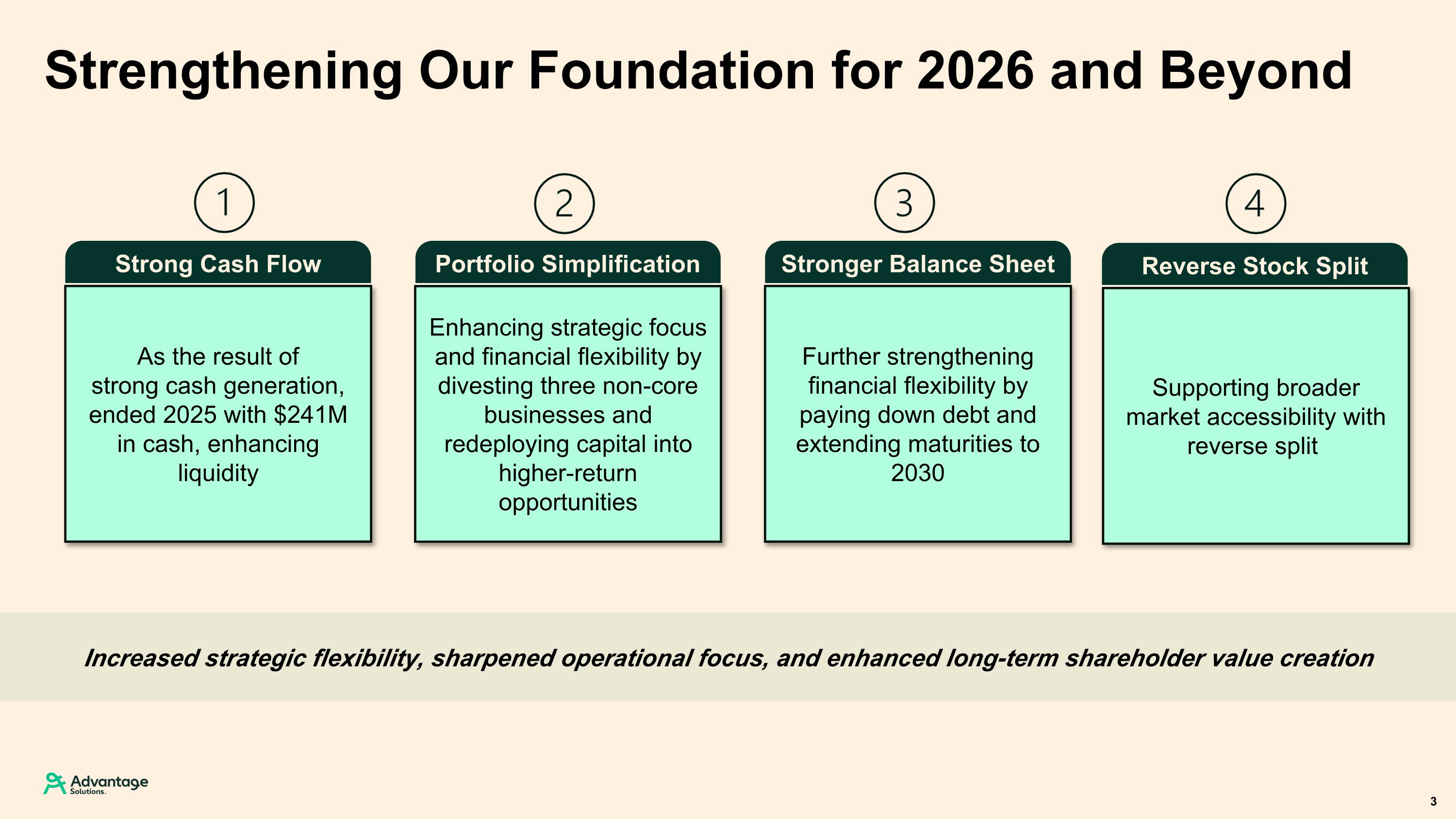
Strengthening Our Foundation for 2026 and Beyond 3 Increased strategic flexibility, sharpened operational focus, and enhanced long-term shareholder value creation As the result of strong cash generation, ended 2025 with $241M in cash, enhancing liquidity Enhancing strategic focus and financial flexibility by divesting three non-core businesses and redeploying capital into higher-return opportunities Further strengthening financial flexibility by paying down debt and extending maturities to 2030 Supporting broader market accessibility with reverse split Strong Cash Flow Portfolio Simplification Stronger Balance Sheet Reverse Stock Split
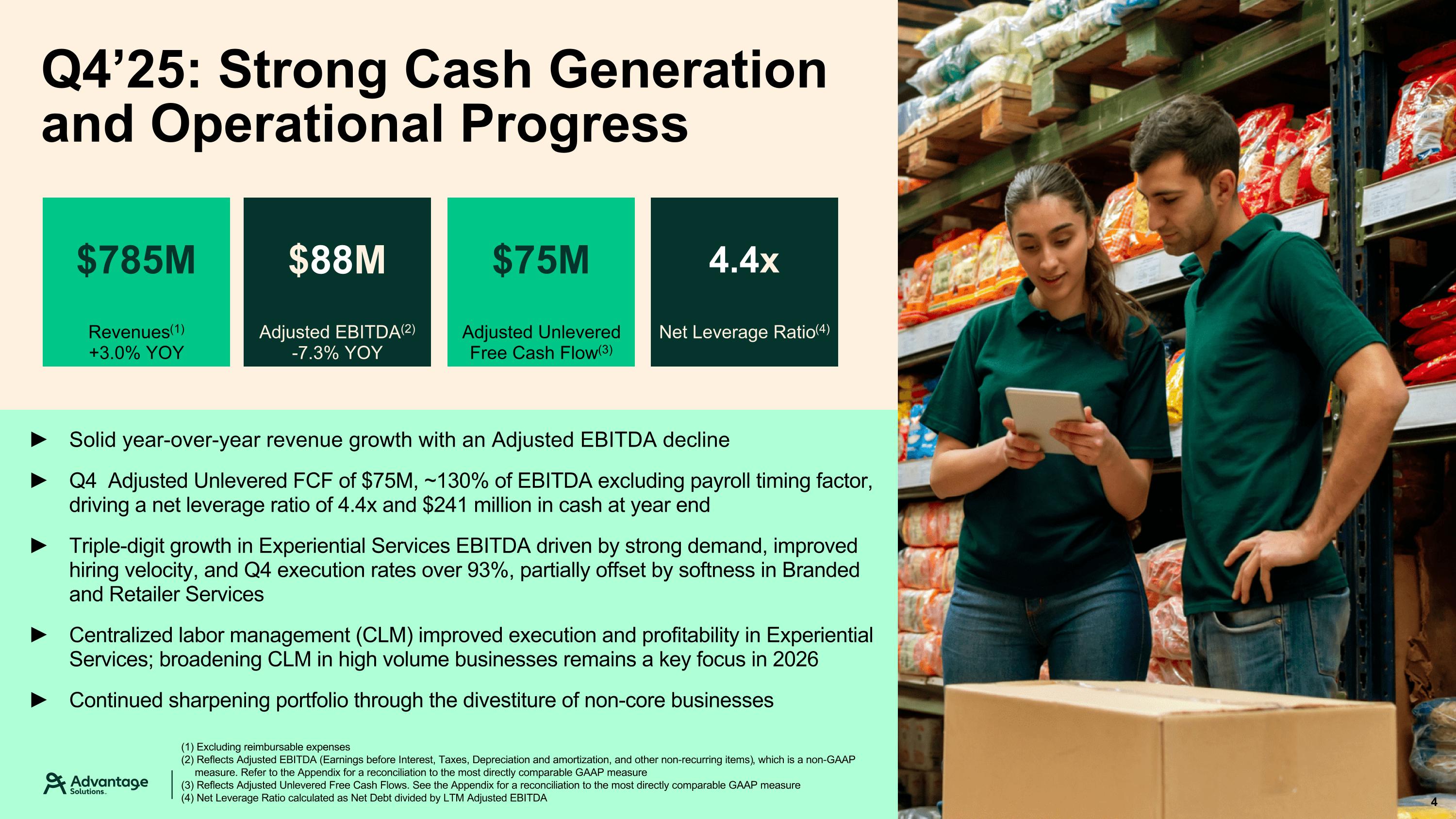
Q4’25: Strong Cash Generation and Operational Progress Solid year-over-year revenue growth with an Adjusted EBITDA decline Q4 Adjusted Unlevered FCF of $75M, ~130% of EBITDA excluding payroll timing factor, driving a net leverage ratio of 4.4x and $241 million in cash at year end Triple-digit growth in Experiential Services EBITDA driven by strong demand, improved hiring velocity, and Q4 execution rates over 93%, partially offset by softness in Branded and Retailer Services Centralized labor management (CLM) improved execution and profitability in Experiential Services; broadening CLM in high volume businesses remains a key focus in 2026 Continued sharpening portfolio through the divestiture of non-core businesses Revenues(1) +3.0% YOY $785M Adjusted EBITDA(2) -7.3% YOY $88M Adjusted Unlevered Free Cash Flow(3) $75M Net Leverage Ratio(4) 4.4x (1) Excluding reimbursable expenses (2) Reflects Adjusted EBITDA (Earnings before Interest, Taxes, Depreciation and amortization, and other non-recurring items), which is a non-GAAP measure. Refer to the Appendix for a reconciliation to the most directly comparable GAAP measure (3) Reflects Adjusted Unlevered Free Cash Flows. See the Appendix for a reconciliation to the most directly comparable GAAP measure (4) Net Leverage Ratio calculated as Net Debt divided by LTM Adjusted EBITDA 4
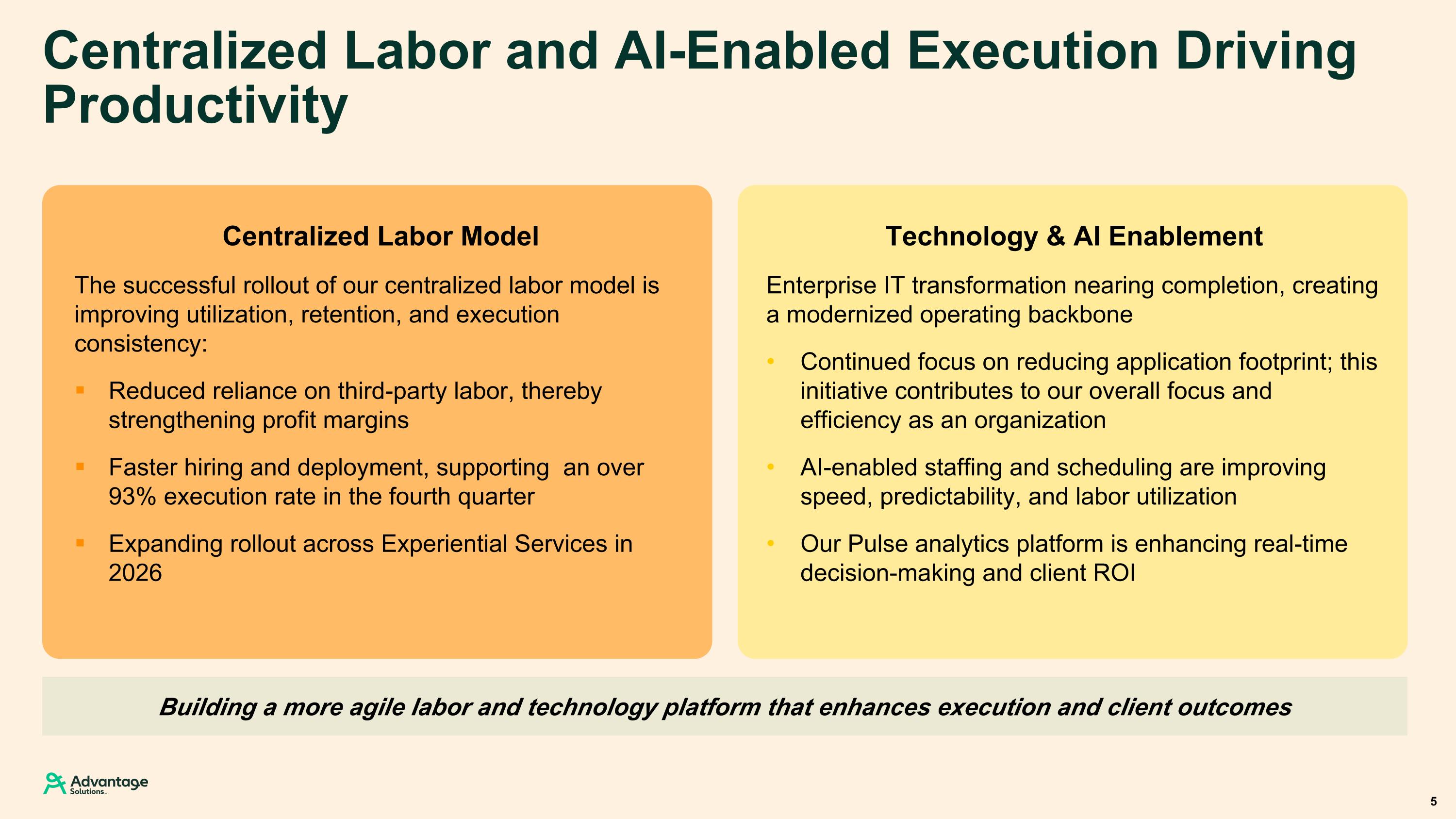
Building a more agile labor and technology platform that enhances execution and client outcomes Centralized Labor and AI-Enabled Execution Driving Productivity 5 Centralized Labor Model The successful rollout of our centralized labor model is improving utilization, retention, and execution consistency: Reduced reliance on third-party labor, thereby strengthening profit margins Faster hiring and deployment, supporting an over 93% execution rate in the fourth quarter Expanding rollout across Experiential Services in 2026 Technology & AI Enablement Enterprise IT transformation nearing completion, creating a modernized operating backbone Continued focus on reducing application footprint; this initiative contributes to our overall focus and efficiency as an organization AI-enabled staffing and scheduling are improving speed, predictability, and labor utilization Our Pulse analytics platform is enhancing real-time decision-making and client ROI
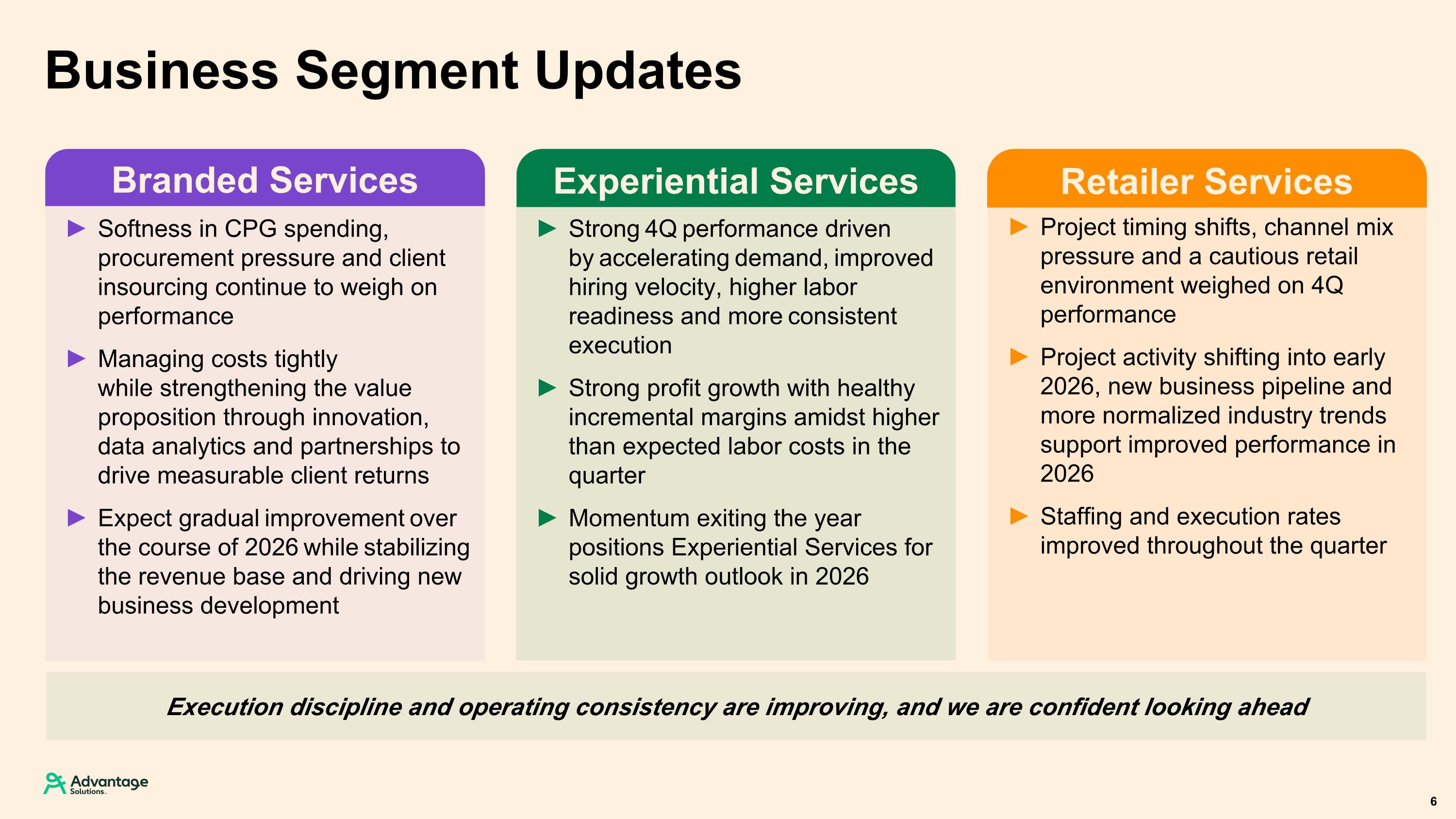
Business Segment Updates Retailer Services Branded Services Experiential Services Softness in CPG spending, procurement pressure and client insourcing continue to weigh on performance Managing costs tightly while strengthening the value proposition through innovation, data analytics and partnerships to drive measurable client returns Expect gradual improvement over the course of 2026 while stabilizing the revenue base and driving new business development Strong 4Q performance driven by accelerating demand, improved hiring velocity, higher labor readiness and more consistent execution Strong profit growth with healthy incremental margins amidst higher than expected labor costs in the quarter Momentum exiting the year positions Experiential Services for solid growth outlook in 2026 Project timing shifts, channel mix pressure and a cautious retail environment weighed on 4Q performance Project activity shifting into early 2026, new business pipeline and more normalized industry trends support improved performance in 2026 Staffing and execution rates improved throughout the quarter 6 Execution discipline and operating consistency are improving, and we are confident looking ahead
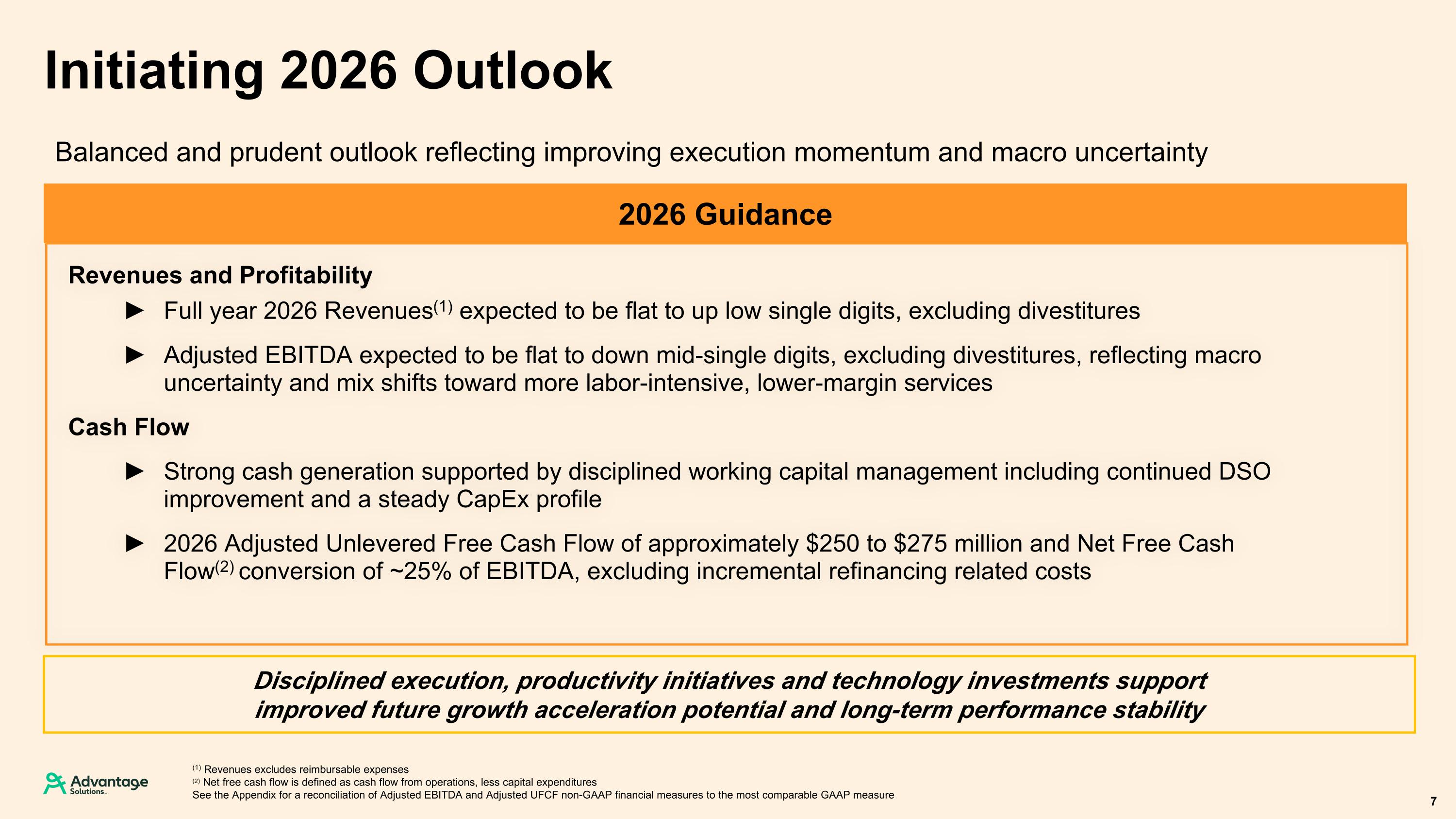
Initiating 2026 Outlook 7 Revenues and Profitability Full year 2026 Revenues(1) expected to be flat to up low single digits, excluding divestitures Adjusted EBITDA expected to be flat to down mid-single digits, excluding divestitures, reflecting macro uncertainty and mix shifts toward more labor-intensive, lower-margin services Cash Flow Strong cash generation supported by disciplined working capital management including continued DSO improvement and a steady CapEx profile 2026 Adjusted Unlevered Free Cash Flow of approximately $250 to $275 million and Net Free Cash Flow(2) conversion of ~25% of EBITDA, excluding incremental refinancing related costs 2026 Guidance Disciplined execution, productivity initiatives and technology investments support improved future growth acceleration potential and long-term performance stability Balanced and prudent outlook reflecting improving execution momentum and macro uncertainty (1) Revenues excludes reimbursable expenses (2) Net free cash flow is defined as cash flow from operations, less capital expenditures See the Appendix for a reconciliation of Adjusted EBITDA and Adjusted UFCF non-GAAP financial measures to the most comparable GAAP measure
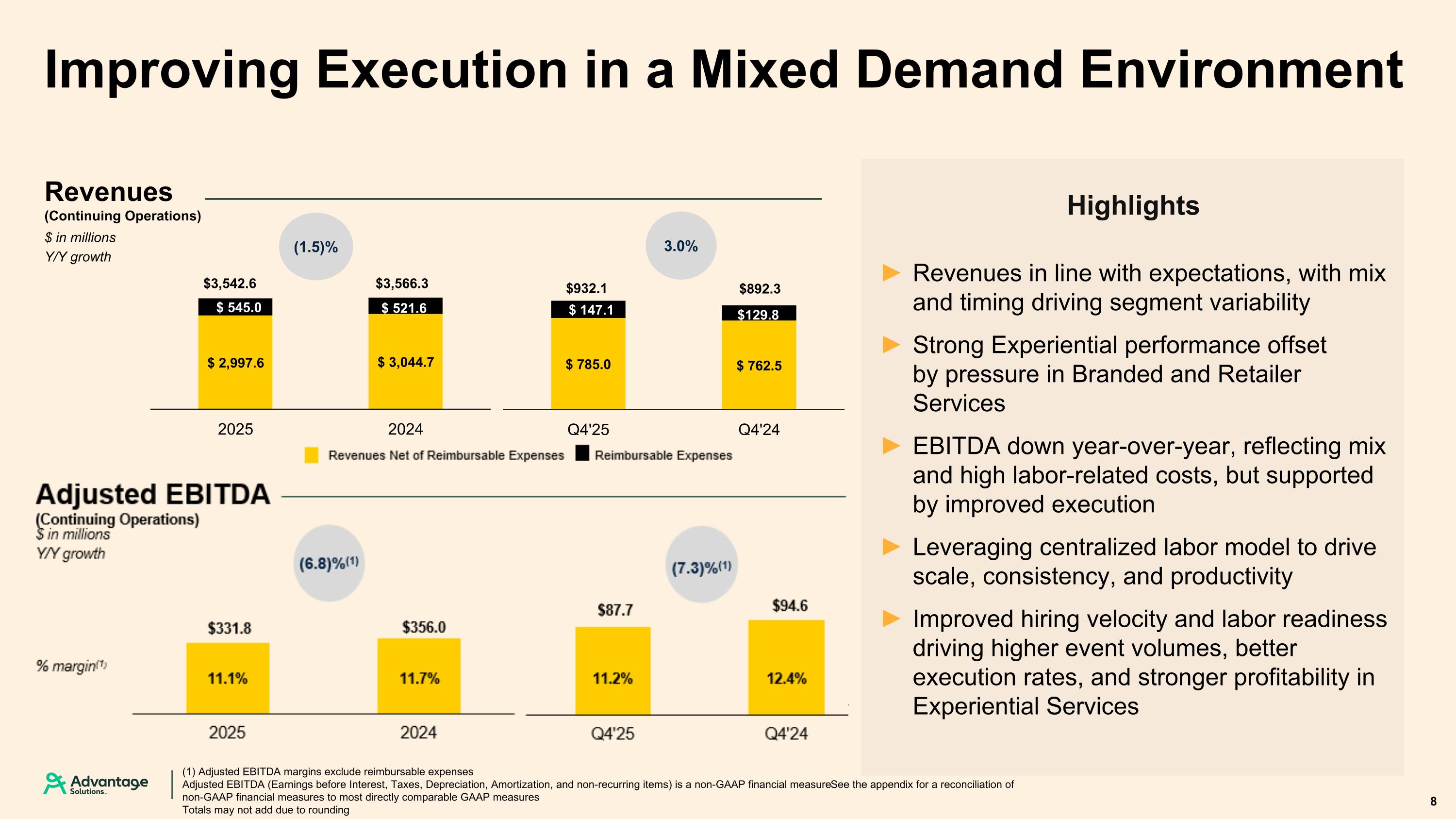
$892.3 Improving Execution in a Mixed Demand Environment (1) Adjusted EBITDA margins exclude reimbursable expenses Adjusted EBITDA (Earnings before Interest, Taxes, Depreciation, Amortization, and non-recurring items) is a non-GAAP financial measureSee the appendix for a reconciliation of non-GAAP financial measures to most directly comparable GAAP measures Totals may not add due to rounding $3,566.3 (7.3)%(1) Revenues Net of Reimbursable Expenses Reimbursable Expenses Highlights 8 3.0% Revenues (Continuing Operations) $ in millions Y/Y growth % margin(1) $ in millions Y/Y growth Adjusted EBITDA (Continuing Operations) (1.5)% (6.8)%(1) $3,542.6 $932.1 11.1% 11.7% 11.2% 12.4% Revenues in line with expectations, with mix and timing driving segment variability Strong Experiential performance offset by pressure in Branded and Retailer Services EBITDA down year-over-year, reflecting mix and high labor-related costs, but supported by improved execution Leveraging centralized labor model to drive scale, consistency, and productivity Improved hiring velocity and labor readiness driving higher event volumes, better execution rates, and stronger profitability in Experiential Services
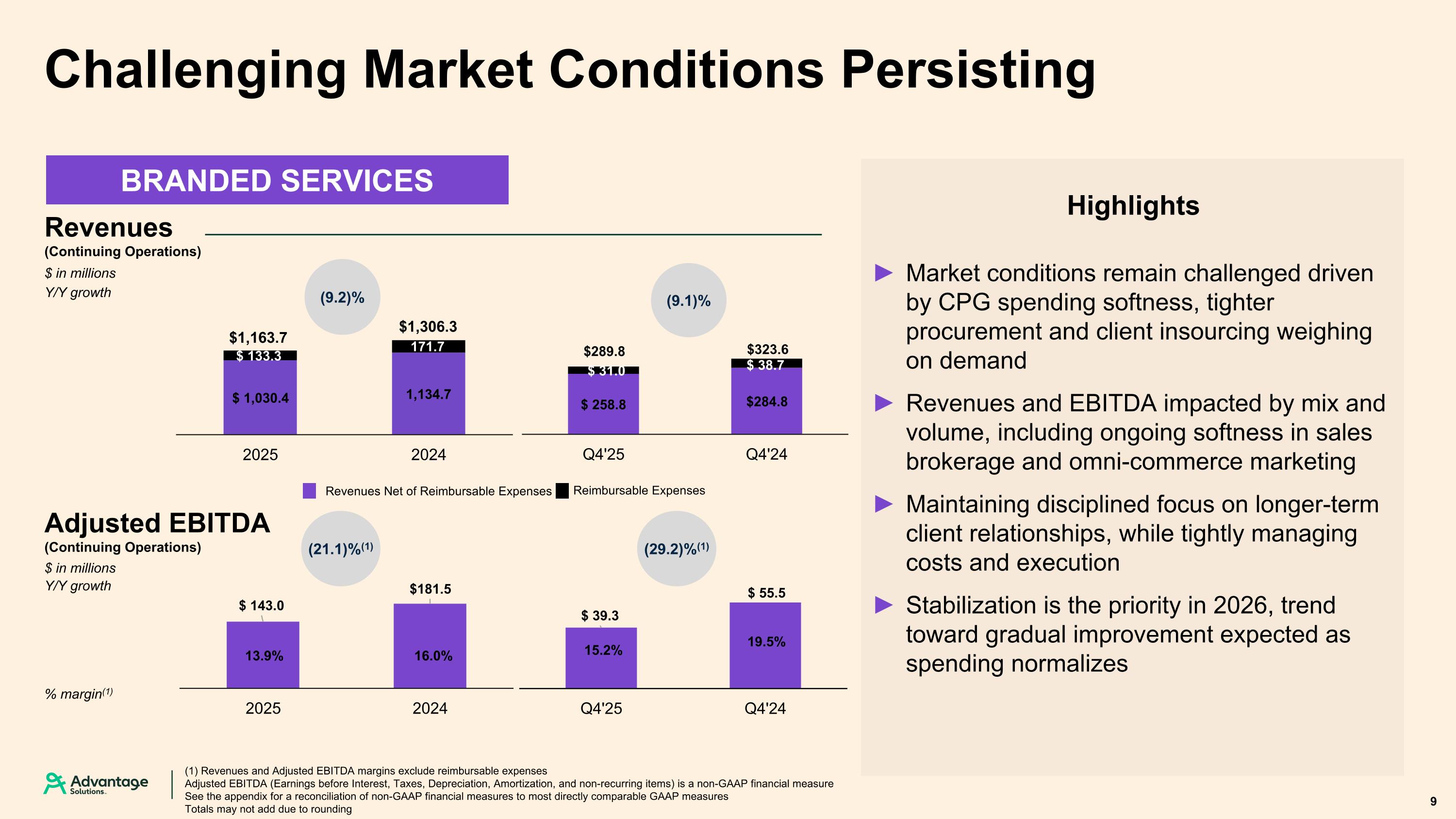
$323.6 Market conditions remain challenged driven by CPG spending softness, tighter procurement and client insourcing weighing on demand Revenues and EBITDA impacted by mix and volume, including ongoing softness in sales brokerage and omni-commerce marketing Maintaining disciplined focus on longer-term client relationships, while tightly managing costs and execution Stabilization is the priority in 2026, trend toward gradual improvement expected as spending normalizes (1) Revenues and Adjusted EBITDA margins exclude reimbursable expenses Adjusted EBITDA (Earnings before Interest, Taxes, Depreciation, Amortization, and non-recurring items) is a non-GAAP financial measure See the appendix for a reconciliation of non-GAAP financial measures to most directly comparable GAAP measures Totals may not add due to rounding (29.2)%(1) % margin(1) Challenging Market Conditions Persisting Highlights $ in millions Y/Y growth Adjusted EBITDA (Continuing Operations) BRANDED SERVICES $1,163.7 $ in millions Y/Y growth 9 Revenues (Continuing Operations) Revenues Net of Reimbursable Expenses Reimbursable Expenses (9.2)% (9.1)% (21.1)%(1) $289.8 $1,306.3 15.2% 19.5% 13.9% 16.0%
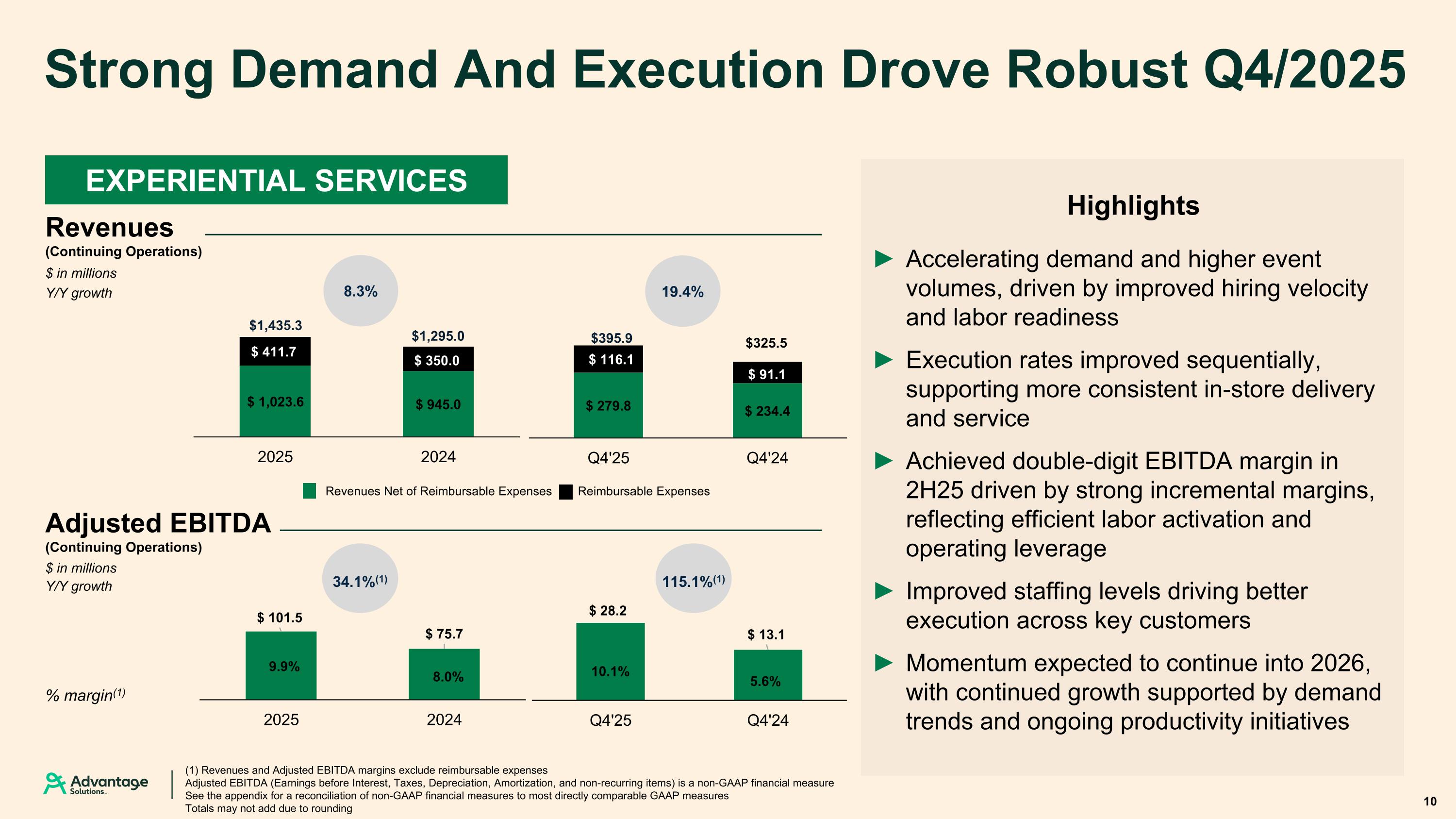
$325.5 Accelerating demand and higher event volumes, driven by improved hiring velocity and labor readiness Execution rates improved sequentially, supporting more consistent in-store delivery and service Achieved double-digit EBITDA margin in 2H25 driven by strong incremental margins, reflecting efficient labor activation and operating leverage Improved staffing levels driving better execution across key customers Momentum expected to continue into 2026, with continued growth supported by demand trends and ongoing productivity initiatives (1) Revenues and Adjusted EBITDA margins exclude reimbursable expenses Adjusted EBITDA (Earnings before Interest, Taxes, Depreciation, Amortization, and non-recurring items) is a non-GAAP financial measure See the appendix for a reconciliation of non-GAAP financial measures to most directly comparable GAAP measures Totals may not add due to rounding 8.3% 34.1%(1) % margin(1) Strong Demand And Execution Drove Robust Q4/2025 Adjusted EBITDA (Continuing Operations) $1,435.3 $1,295.0 $ in millions Y/Y growth $ in millions Y/Y growth 10 EXPERIENTIAL SERVICES Highlights Revenues (Continuing Operations) Revenues Net of Reimbursable Expenses Reimbursable Expenses 19.4% 115.1%(1) $395.9 10.1% 5.6% 9.9% 8.0%
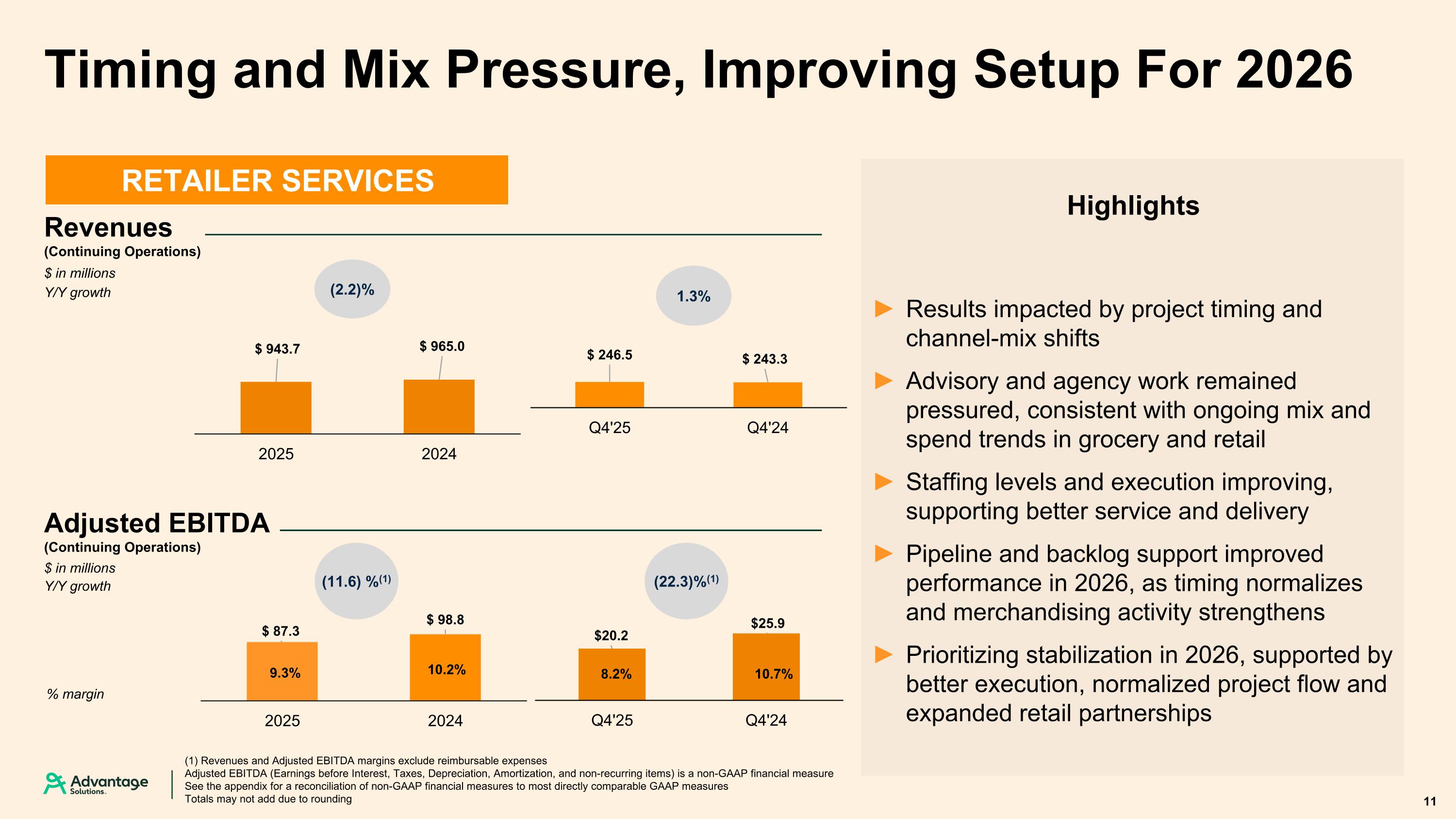
Results impacted by project timing and channel-mix shifts Advisory and agency work remained pressured, consistent with ongoing mix and spend trends in grocery and retail Staffing levels and execution improving, supporting better service and delivery Pipeline and backlog support improved performance in 2026, as timing normalizes and merchandising activity strengthens Prioritizing stabilization in 2026, supported by better execution, normalized project flow and expanded retail partnerships (1) Revenues and Adjusted EBITDA margins exclude reimbursable expenses Adjusted EBITDA (Earnings before Interest, Taxes, Depreciation, Amortization, and non-recurring items) is a non-GAAP financial measure See the appendix for a reconciliation of non-GAAP financial measures to most directly comparable GAAP measures Totals may not add due to rounding (11.6) %(1) 1.3% % margin Timing and Mix Pressure, Improving Setup For 2026 Adjusted EBITDA (Continuing Operations) 11 $ in millions Y/Y growth $ in millions Y/Y growth RETAILER SERVICES Highlights Revenues (Continuing Operations) (2.2)% (22.3)%(1) 8.2% 10.7% 9.3% 10.2%
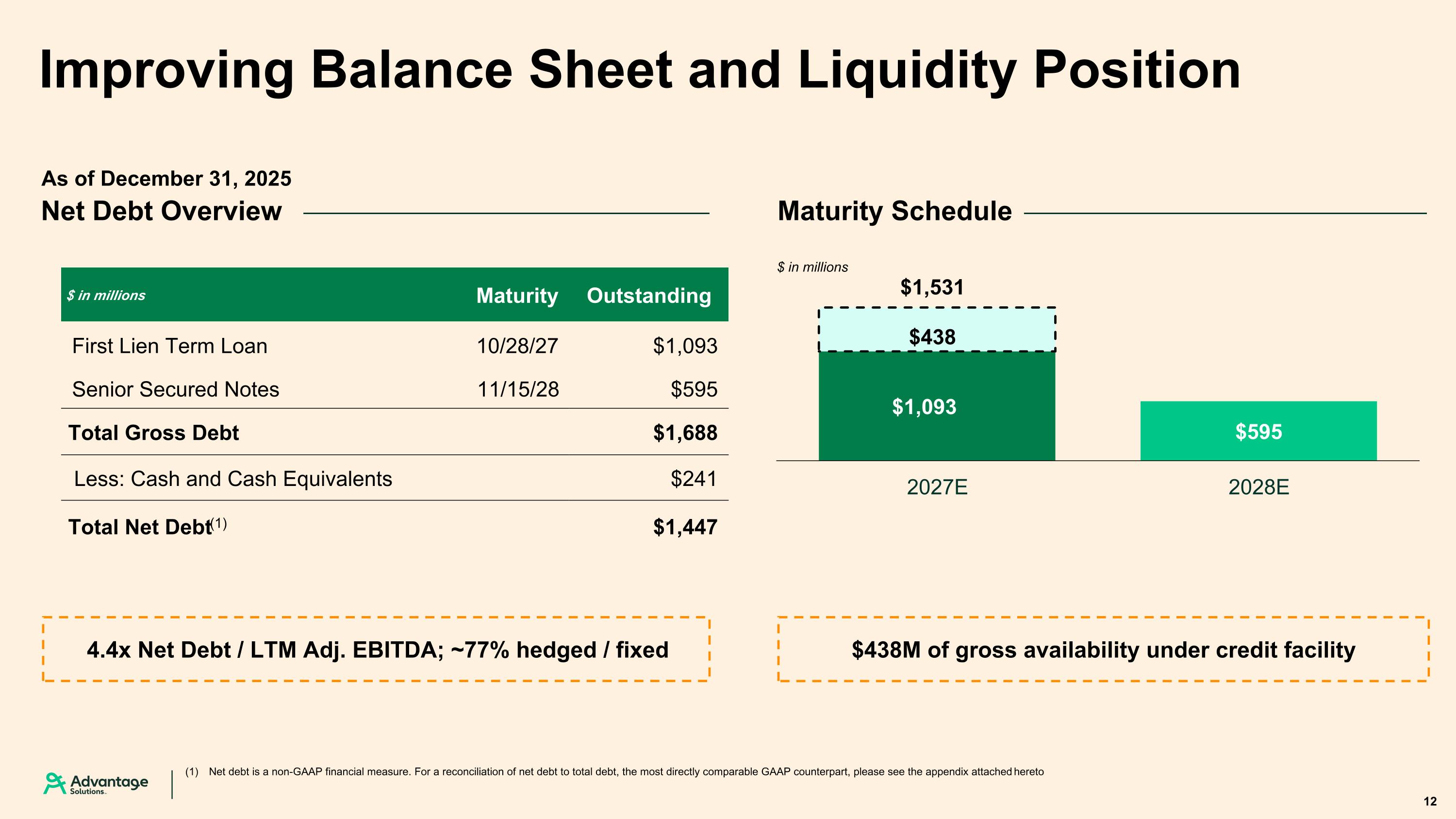
1L Term Loan Sr. Secured Notes $ in millions $1,531 Improving Balance Sheet and Liquidity Position As of December 31, 2025 $ in millions Maturity Outstanding First Lien Term Loan 10/28/27 $1,093 Senior Secured Notes 11/15/28 $595 Total Gross Debt $1,688 Less: Cash and Cash Equivalents $241 Total Net Debt(1) $1,447 Net Debt Overview Maturity Schedule (1) Net debt is a non-GAAP financial measure. For a reconciliation of net debt to total debt, the most directly comparable GAAP counterpart, please see the appendix attached hereto 12 $438M of gross availability under credit facility 4.4x Net Debt / LTM Adj. EBITDA; ~77% hedged / fixed $438
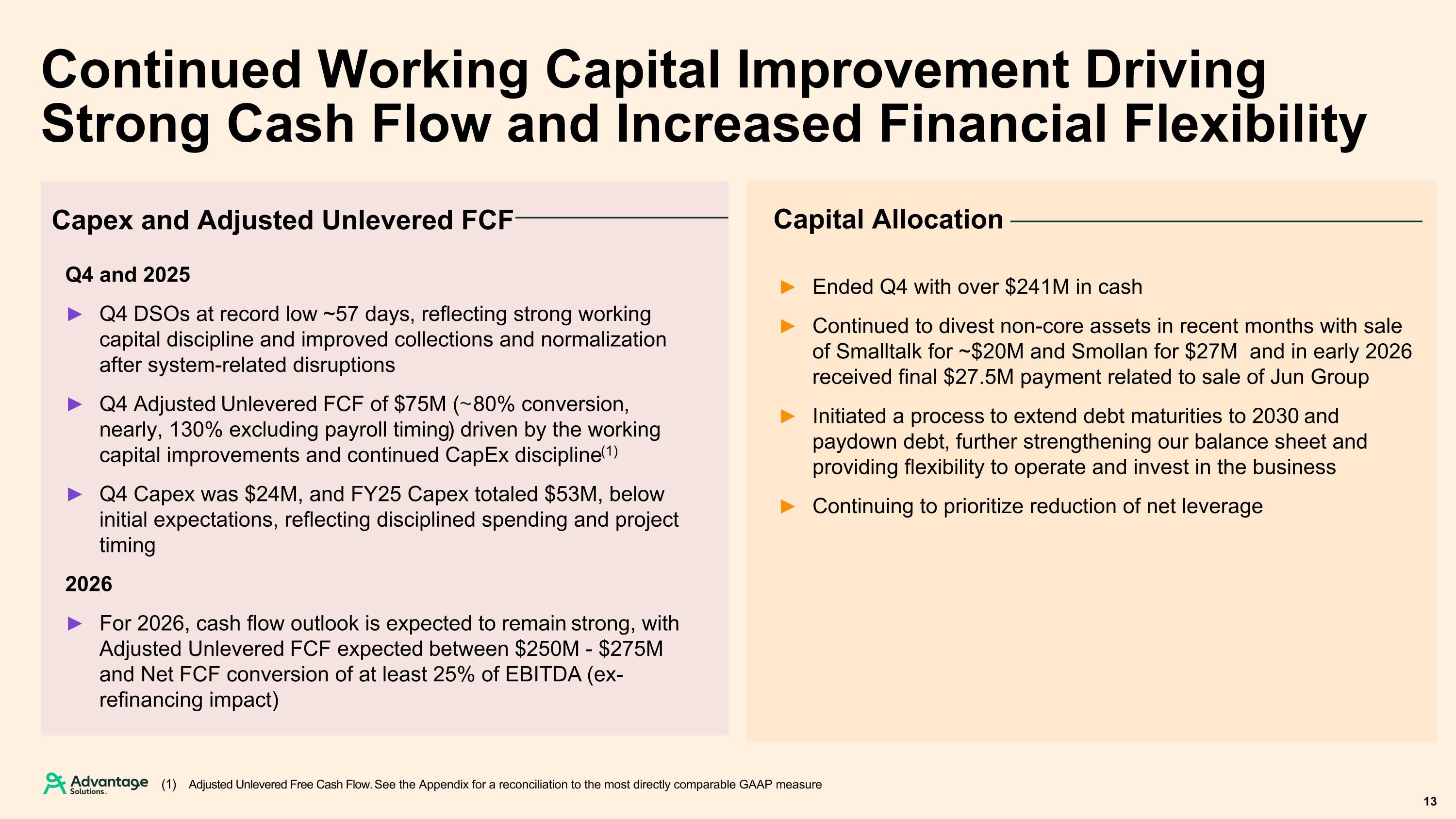
Continued Working Capital Improvement Driving Strong Cash Flow and Increased Financial Flexibility Capital Allocation Ended Q4 with over $241M in cash Continued to divest non-core assets in recent months with sale of Smalltalk for ~$20M and Smollan for $27M and in early 2026 received final $27.5M payment related to sale of Jun Group Initiated a process to extend debt maturities to 2030 and paydown debt, further strengthening our balance sheet and providing flexibility to operate and invest in the business Continuing to prioritize reduction of net leverage Capex and Adjusted Unlevered FCF Q4 and 2025 Q4 DSOs at record low ~57 days, reflecting strong working capital discipline and improved collections and normalization after system-related disruptions Q4 Adjusted Unlevered FCF of $75M (~80% conversion, nearly, 130% excluding payroll timing) driven by the working capital improvements and continued CapEx discipline(1) Q4 Capex was $24M, and FY25 Capex totaled $53M, below initial expectations, reflecting disciplined spending and project timing 2026 For 2026, cash flow outlook is expected to remain strong, with Adjusted Unlevered FCF expected between $250M - $275M and Net FCF conversion of at least 25% of EBITDA (ex-refinancing impact) 13 Adjusted Unlevered Free Cash Flow. See the Appendix for a reconciliation to the most directly comparable GAAP measure
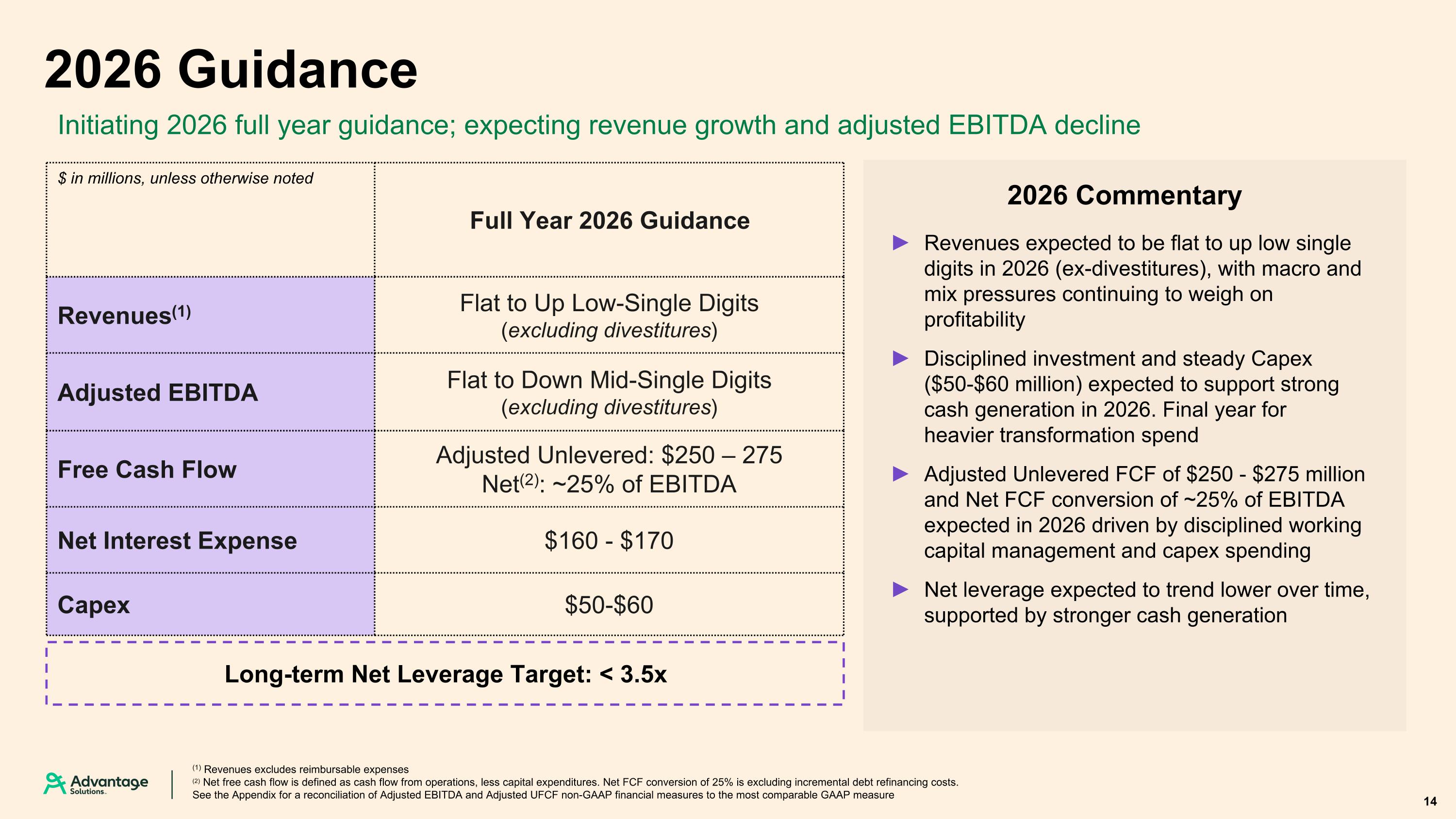
2026 Guidance Initiating 2026 full year guidance; expecting revenue growth and adjusted EBITDA decline $ in millions, unless otherwise noted Full Year 2026 Guidance Revenues(1) Flat to Up Low-Single Digits (excluding divestitures) Adjusted EBITDA Flat to Down Mid-Single Digits (excluding divestitures) Free Cash Flow Adjusted Unlevered: $250 – 275 Net(2): ~25% of EBITDA Net Interest Expense $160 - $170 Capex $50-$60 (1) Revenues excludes reimbursable expenses (2) Net free cash flow is defined as cash flow from operations, less capital expenditures. Net FCF conversion of 25% is excluding incremental debt refinancing costs. See the Appendix for a reconciliation of Adjusted EBITDA and Adjusted UFCF non-GAAP financial measures to the most comparable GAAP measure 14 Long-term Net Leverage Target: < 3.5x 2026 Commentary Revenues expected to be flat to up low single digits in 2026 (ex-divestitures), with macro and mix pressures continuing to weigh on profitability Disciplined investment and steady Capex ($50-$60 million) expected to support strong cash generation in 2026. Final year for heavier transformation spend Adjusted Unlevered FCF of $250 - $275 million and Net FCF conversion of ~25% of EBITDA expected in 2026 driven by disciplined working capital management and capex spending Net leverage expected to trend lower over time, supported by stronger cash generation

Appendix 15
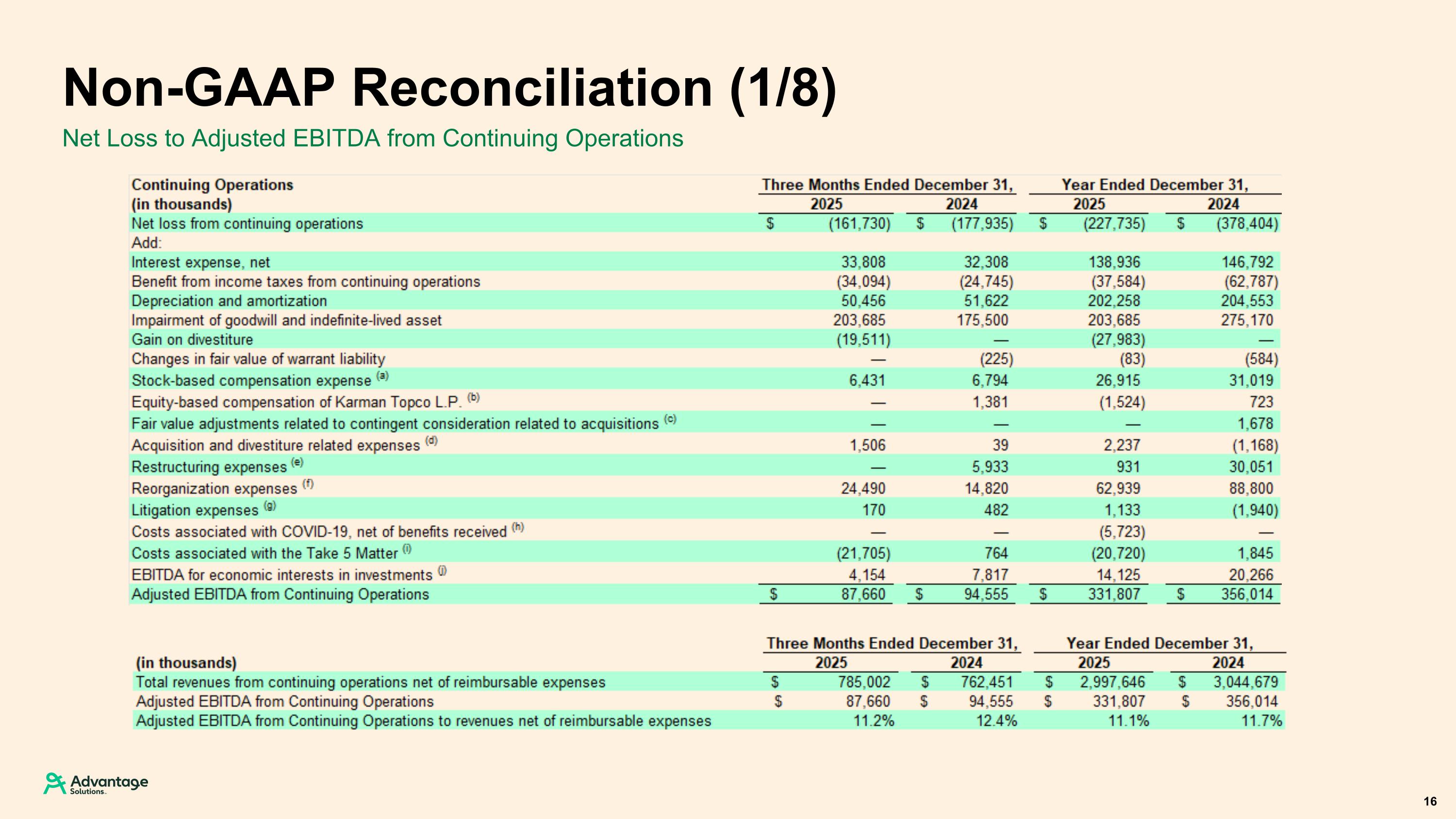
Net Loss to Adjusted EBITDA from Continuing Operations Non-GAAP Reconciliation (1/8) 16
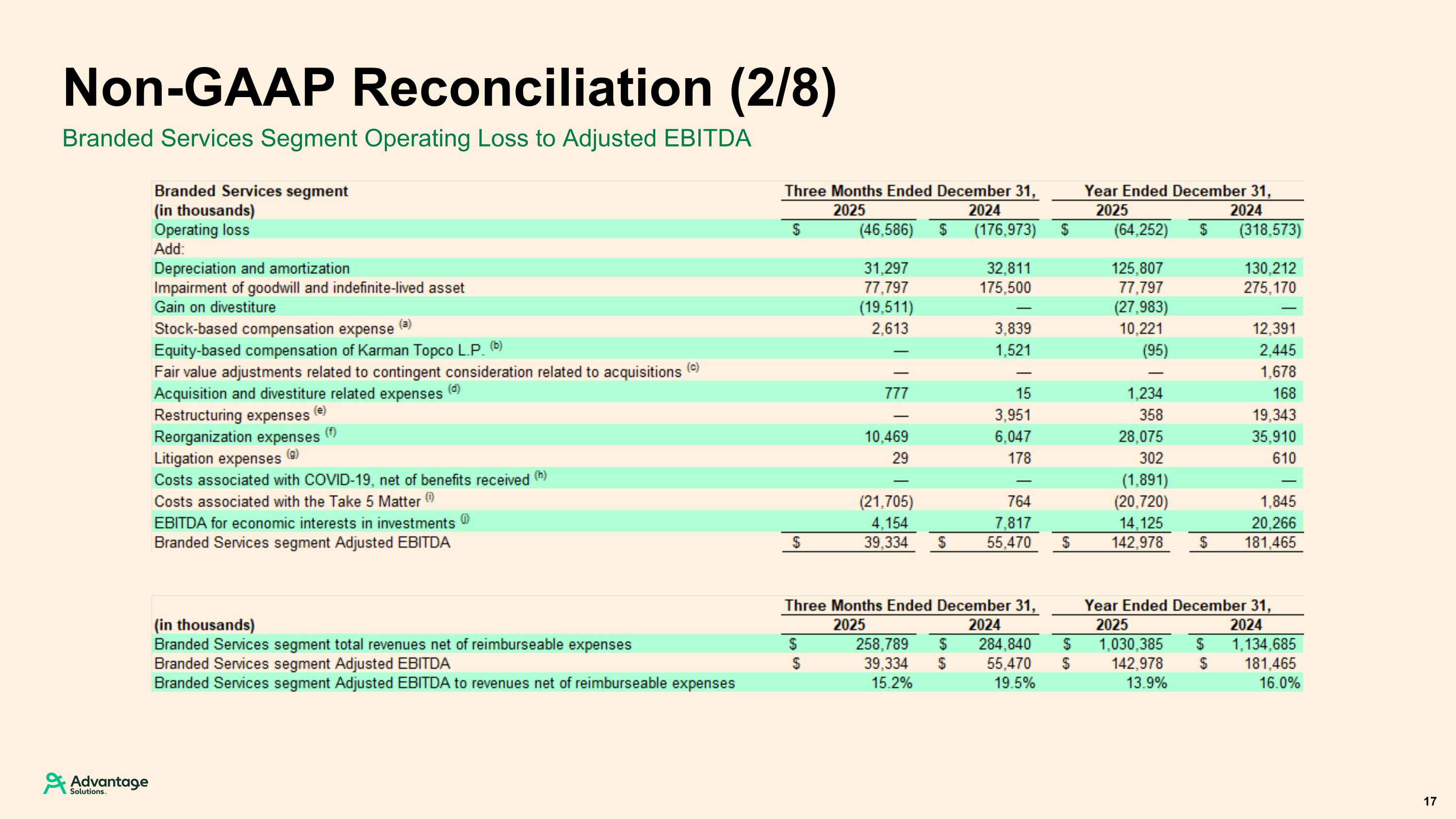
Branded Services Segment Operating Loss to Adjusted EBITDA Non-GAAP Reconciliation (2/8) 17
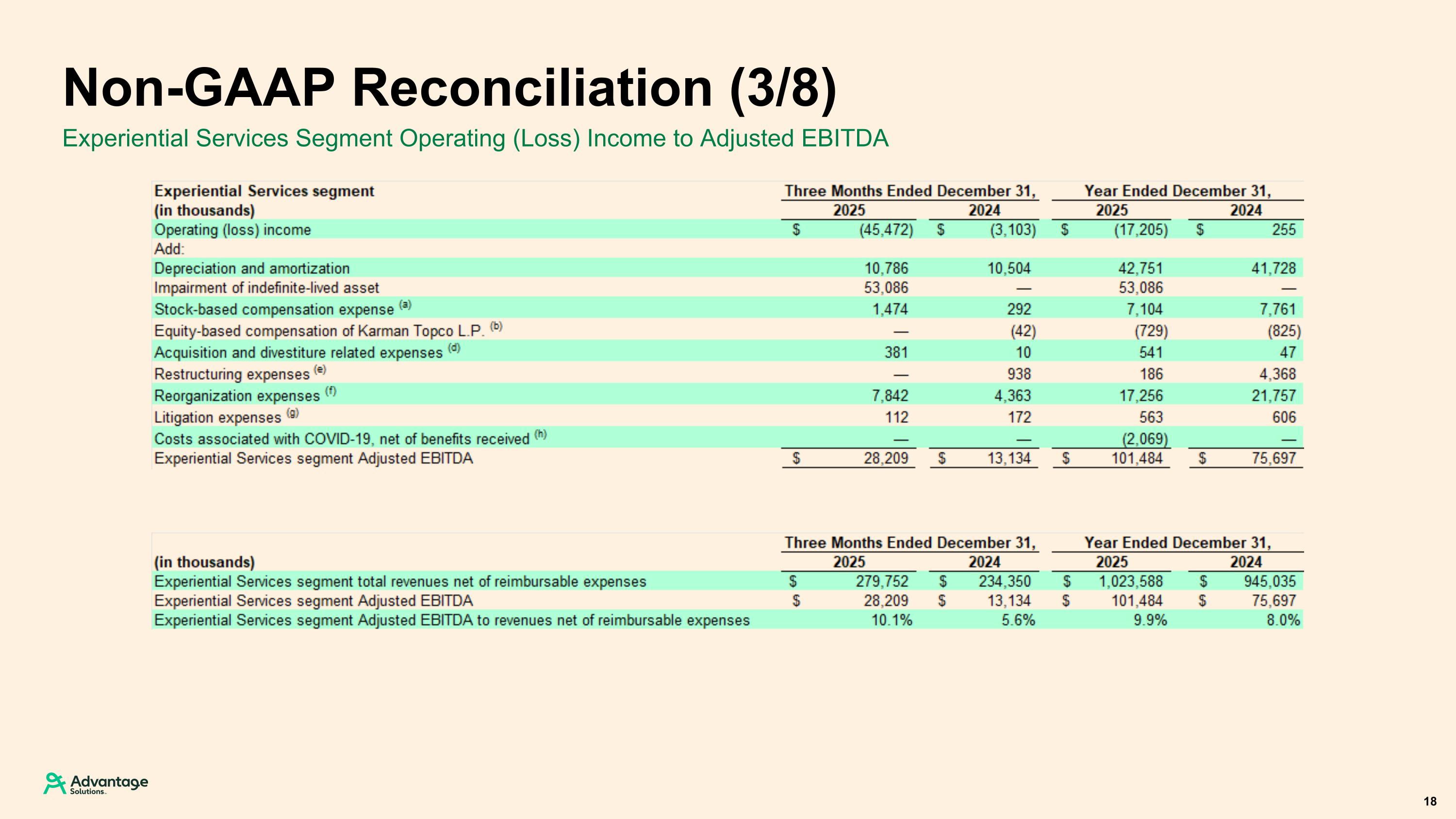
Experiential Services Segment Operating (Loss) Income to Adjusted EBITDA Non-GAAP Reconciliation (3/8) 18
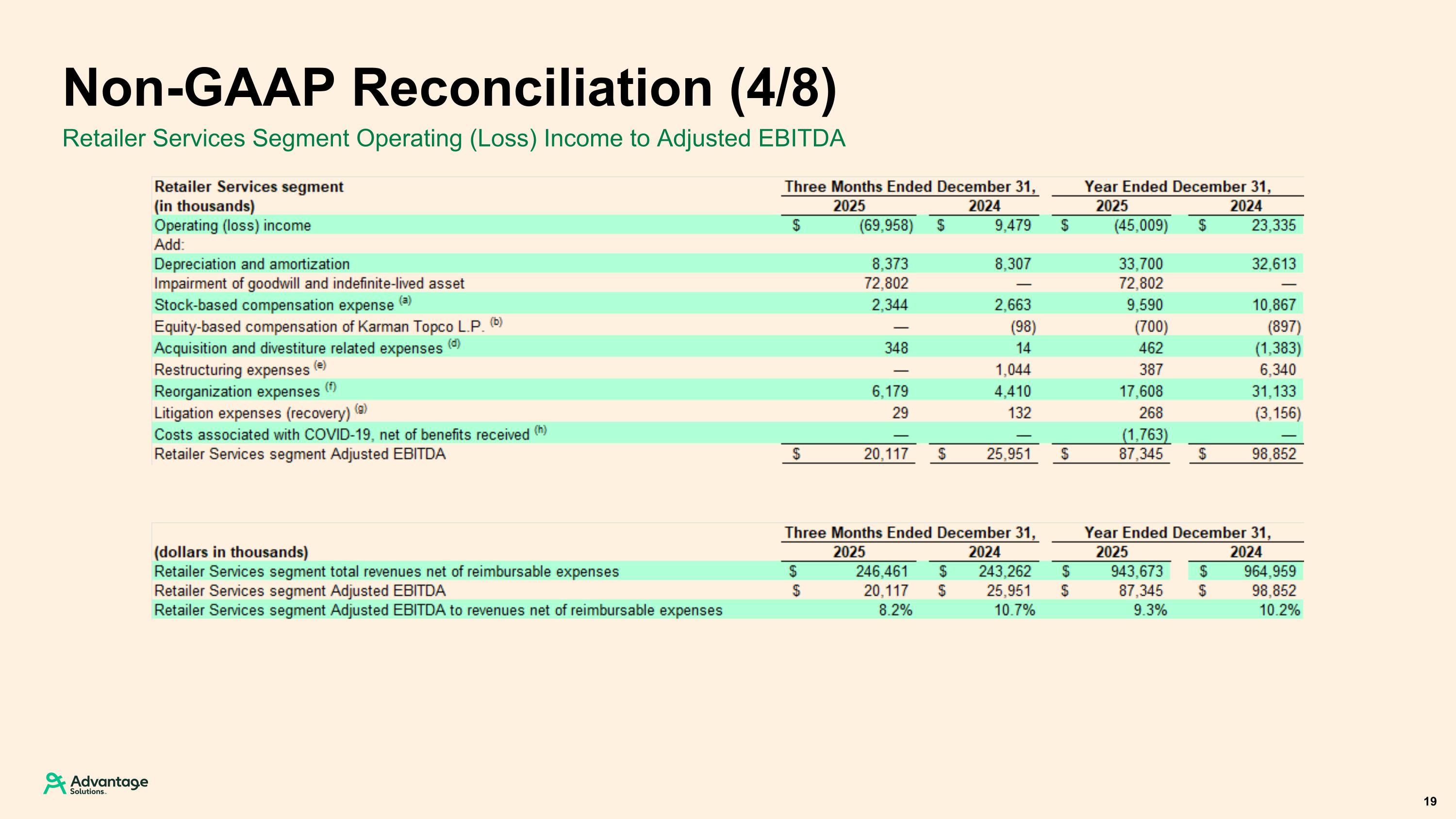
Retailer Services Segment Operating (Loss) Income to Adjusted EBITDA Non-GAAP Reconciliation (4/8) 19
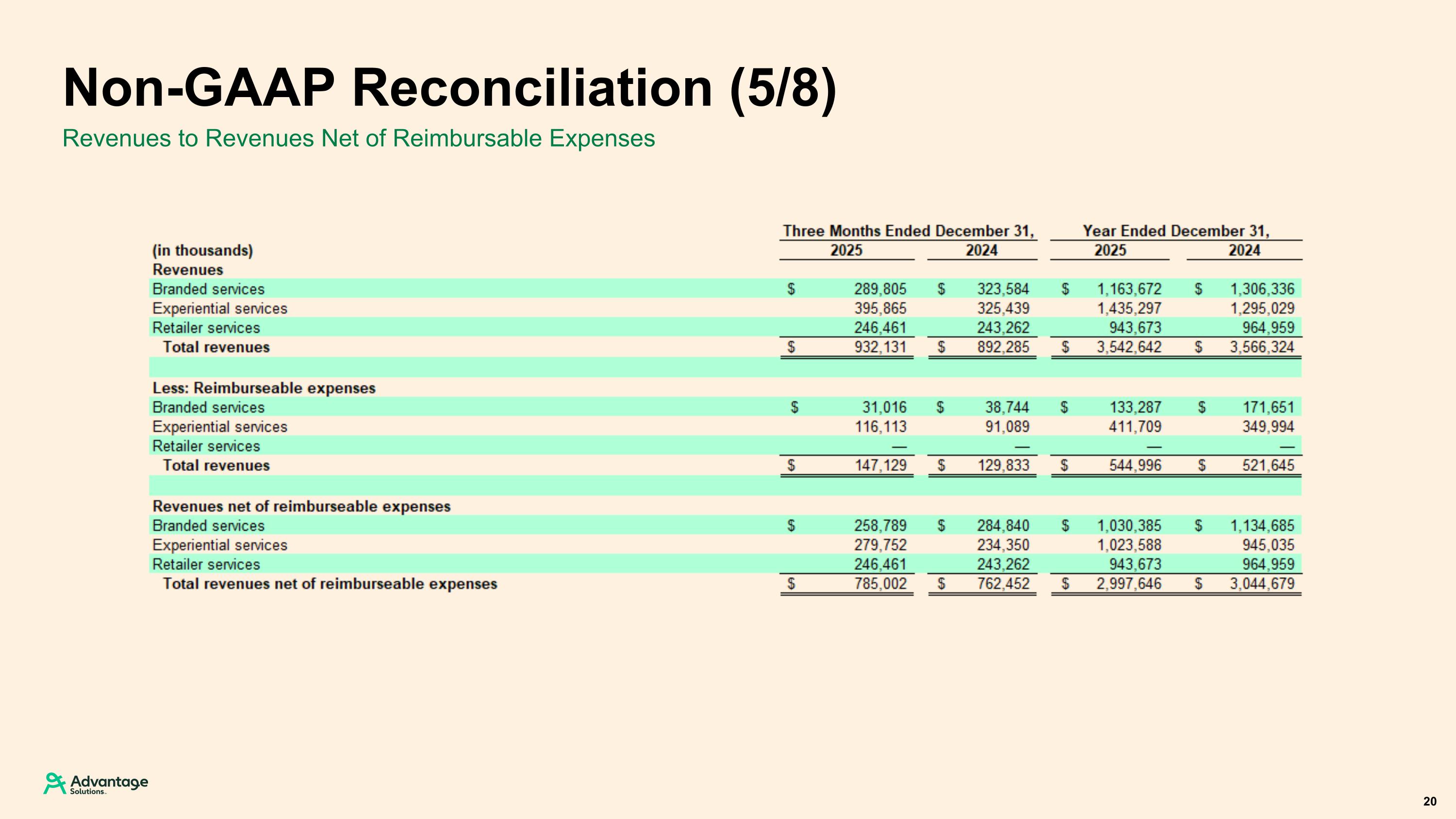
Revenues to Revenues Net of Reimbursable Expenses Non-GAAP Reconciliation (5/8) 20
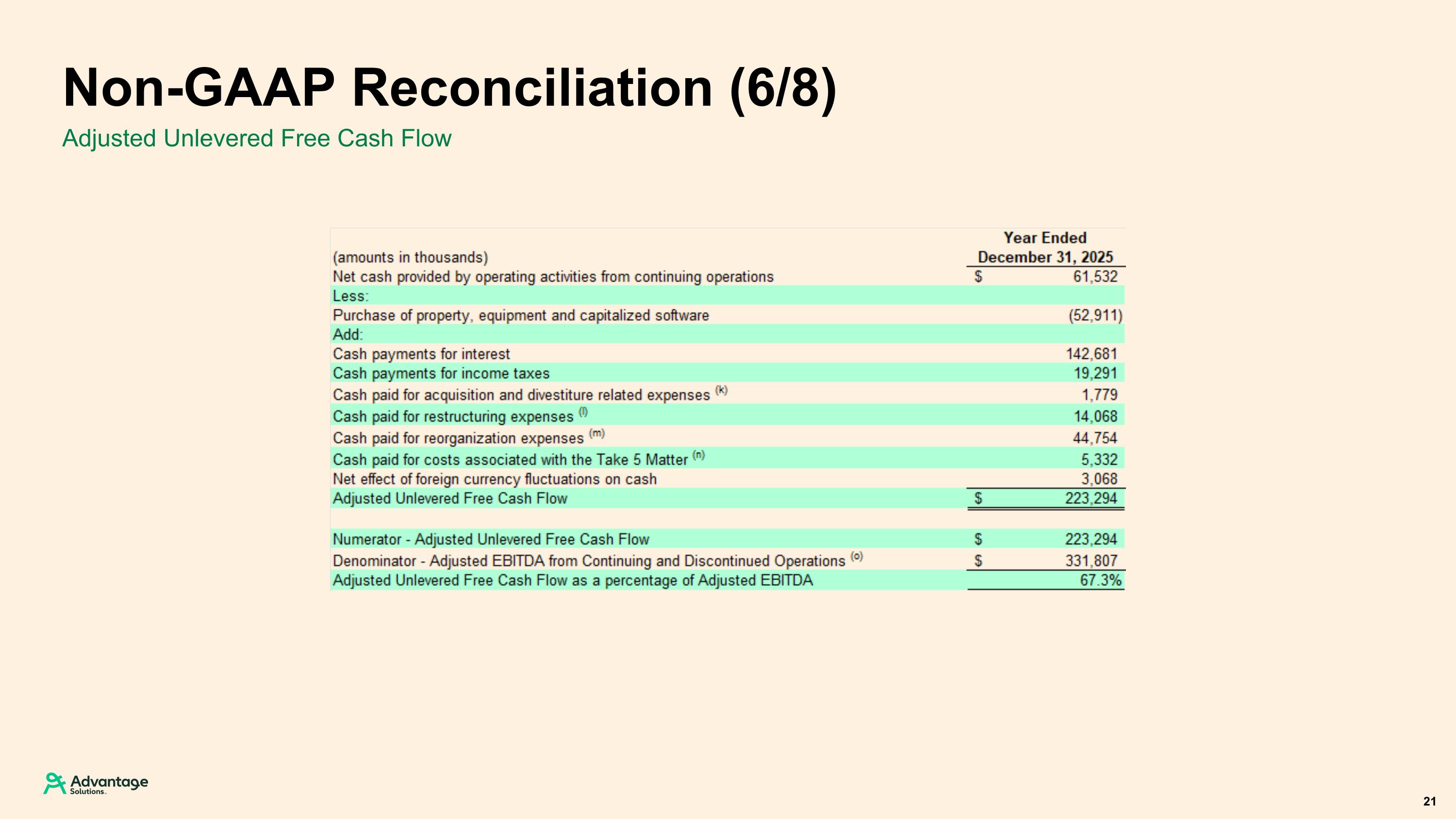
Adjusted Unlevered Free Cash Flow Non-GAAP Reconciliation (6/8) 21
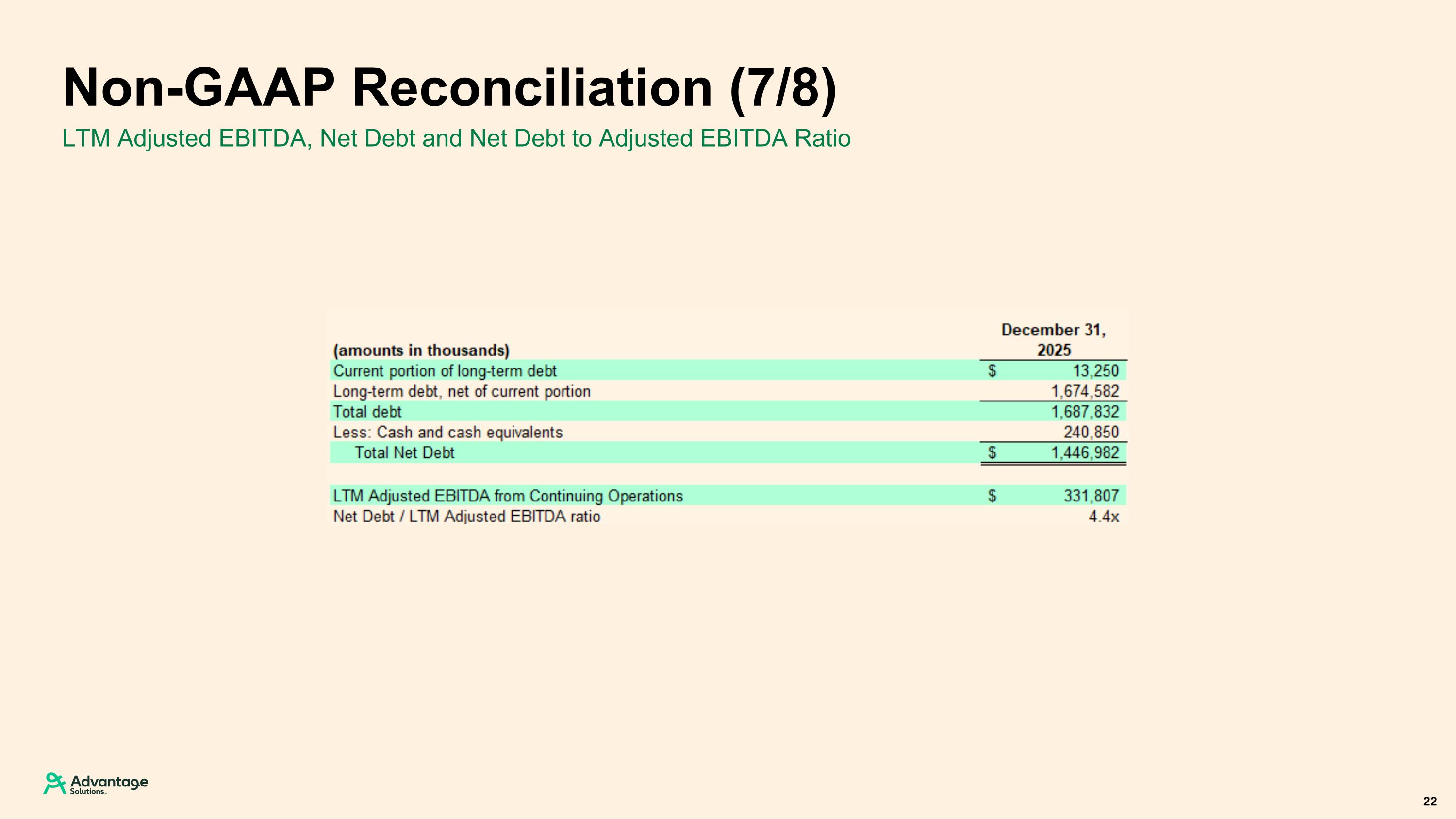
LTM Adjusted EBITDA, Net Debt and Net Debt to Adjusted EBITDA Ratio Non-GAAP Reconciliation (7/8) 22
Footnotes Non-GAAP Reconciliation (8/8) 23 (a) Represents non-cash compensation expense related to performance stock units, restricted stock units, and stock options under the 2020 Advantage Solutions Incentive Award Plan and the Advantage Solutions 2020 Employee Stock Purchase Plan. (b) Represents expenses related to equity-based compensation expense associated with grants of Common Series D Units of Karman Topco L.P. made to one of the sponsors of the Company. (c) Represents adjustments to the estimated fair value of our contingent consideration liabilities related to our acquisitions, for the applicable periods. (d) Represents fees and costs associated with activities related to our acquisitions, divestitures, and related activities, including professional fees, due diligence, and integration activities. (e) Restructuring charges including programs designed to integrate and reduce costs intended to further improve efficiencies in operational activities and align cost structures consistent with revenue levels associated with business changes. Restructuring expenses include costs associated with the VERP and employee termination benefits associated with the 2024 RIF and other optimization initiatives. (f) Represents fees and costs associated with various internal reorganization activities, including professional fees, lease exit costs, severance, and nonrecurring compensation costs. (g) Represents legal settlements, reserves, and expenses that are unusual or infrequent costs associated with our operating activities. (h) Represents benefits received from government grants for COVID-19 relief. (i) Represents costs associated with collection and remediation activities related to the Take 5 Matter, primarily professional fees and other related costs. (j) Represents additions to reflect our proportional share of Adjusted EBITDA related to our equity method investments and reductions to remove the Adjusted EBITDA related to the minority ownership percentage of the entities that we fully consolidate in our financial statements. (k) Represents cash paid for fees and costs associated with activities related to our acquisitions, divestitures and reorganization activities including professional fees, due diligence, and integration activities. (l) Represents cash paid for restructuring charges including programs designed to integrate and reduce costs intended to further improve efficiencies in operational activities and align cost structures consistent with revenue levels associated with business changes. Restructuring expenses include costs associated with the VERP and employee termination benefits associated with the 2024 RIF and other optimization initiatives. (m) Represents cash paid for fees and costs associated with various reorganization activities, including professional fees, lease exit costs, severance, and nonrecurring compensation costs. (n) Represents cash paid for costs associated with the Take 5 Matter, primarily, professional fees and other related costs. (o) Represents gains and losses on disposal of assets related to divestitures and losses on sale of businesses and assets held for sale, less cost to sell.